
Quick Verdict
The Siberian Cat wins for allergy-sensitive households and people who want a deeply bonded “one-person” companion.
The Maine Coon is better for families with kids, multi-pet homes, and owners who love a chatty, dog-like cat.
Key difference: The Siberian produces lower levels of the Fel d 1 allergen and forms intense single-person bonds; the Maine Coon is larger on average, more sociable across all family members, and famously playful.
Full breakdown below — including vet-cited health data and the Lifestyle Fit Matrix.
Both the Siberian cat and the Maine Coon look like something out of a fairy tale — enormous, fluffy, and impossibly soft. But spend a week with each breed, and you’ll realize they’re built for completely different kinds of owners.
Pick the wrong breed and you could end up with a cat that triggers your allergies daily, or one that demands constant attention when you need quiet evenings at home. The siberian cat vs maine coon decision comes down to your lifestyle, not just your taste in fur.
This guide cuts through the generic “both are great family cats” advice. You’ll get verified size and coat comparisons, vet-cited health data on heart disease and allergen levels, and a concrete Lifestyle Fit Matrix that tells you — based on your actual home situation — which breed belongs in it.
When comparing the siberian cat vs maine coon, your lifestyle matters more than aesthetics — both breeds are large, affectionate, and long-haired, but they suit very different households.
- Allergies: Siberians may produce lower Fel d 1 allergen levels than most breeds, making them the better choice for sensitive households — though no cat is truly hypoallergenic.
- Size: Maine Coons are generally larger (up to 18 lbs) with a rectangular body; Siberians are slightly smaller but powerfully built with a rounder silhouette.
- Personality: Maine Coons are dog-like, chatty, and family-oriented; Siberians are deeply affectionate but tend to bond more intensely with one person.
- Health: Both breeds carry genetic heart disease risks (HCM); Maine Coons also carry a PKD risk, while Siberians carry an SMA risk — genetic testing is essential for both.
- The Lifestyle Fit Matrix helps you score yourself across five dimensions (allergies, family size, activity level, space, and grooming time) to find your ideal match.
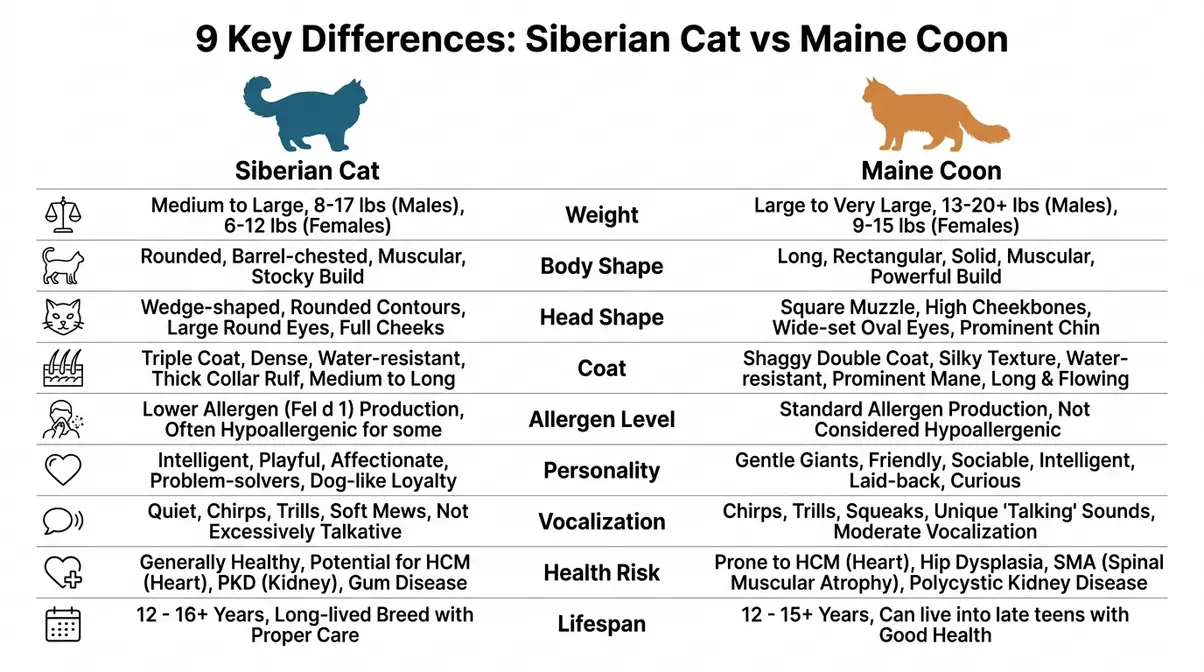
Key Differences at a Glance
Both breeds evolved in cold climates, developed thick coats, and grew to impressive sizes — which is exactly why so many prospective owners mix them up. Understanding where they came from helps explain why they behave so differently today. For a deeper dive into their history, check out our guide on Siberian cat vs Maine Coon differences explained.
Origins and Background
The Maine Coon is one of the oldest natural breeds in North America. It developed in the forests of Maine, likely from longhaired cats brought by European sailors in the 1800s that interbred with local shorthaired cats. The result was a rugged, large-boned cat with a shaggy, water-resistant coat built for harsh New England winters. The Cat Fanciers’ Association (CFA) officially recognized the Maine Coon as a breed in 1976, and it consistently ranks among the most popular breeds in the United States today.
The Siberian Forest Cat (often called simply the Siberian) is a centuries-old natural breed from Russia. References to large, semi-wild forest cats appear in Russian literature dating back to the 1000s. The breed was formally developed and standardized in the late 1980s after the fall of the Soviet Union, when Russian breeders began keeping detailed records. The International Cat Association (TICA) accepted the Siberian for championship status in 1996. Siberians are considered Russia’s national cat and are prized for their triple-layer, water-resistant coats.
Both breeds share a “forest cat” heritage — a term used by cat fanciers to describe large, semi-wild longhaired cats that evolved outdoors in cold regions. That shared ancestry explains the visual similarity that confuses so many new owners.
Breed Comparison Table
This side-by-side overview covers the nine most important differences at a glance. Detailed explanations follow in each section below.
| Feature | Siberian Cat | Maine Coon |
|---|---|---|
| Weight | 8–17 lbs (females lighter) | 9–18 lbs (males can reach 20+ lbs) |
| Body Shape | Rounded, barrel-chested, compact | Rectangular, long, large-boned |
| Head Shape | Rounded wedge, broad forehead | Medium-wide with square muzzle |
| Coat | Triple-layer (guard, awn, down) | Double-layer, silkier, prone to matting |
| Allergen Levels | May produce lower Fel d 1 | Typical Fel d 1 levels |
| Personality | Affectionate, bonds with one person | Dog-like, chatty, family-wide sociable |
| Vocalization | Quiet; soft chirps and trills | Chatty; chirps, trills, and frequent meows |
| Primary Health Risk | HCM, SMA | HCM, PKD |
| Lifespan | 12–15 years | 12–15 years |
| Breeder Price (as of 2026) | $1,200–$2,500+ | $1,000–$2,000+ |
Size, Appearance, and Coat: How to Tell Them Apart
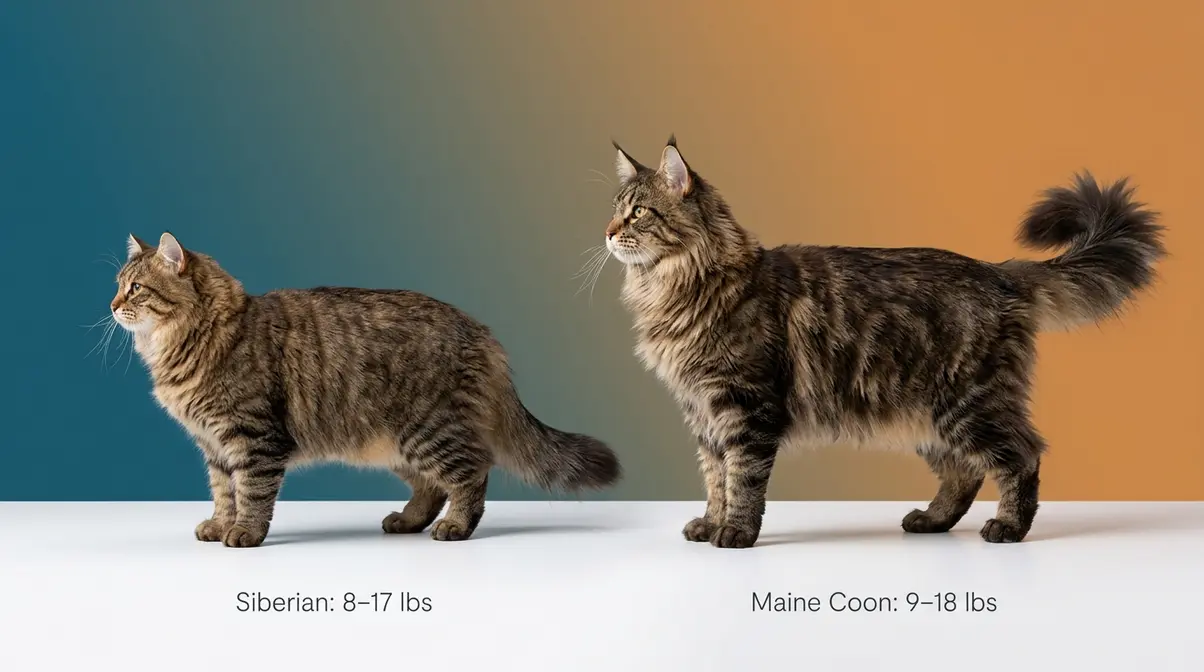
At first glance, both breeds look like large, fluffy cats. But once you know what to look for, telling them apart takes about five seconds. The differences in body structure, head shape, and coat texture are consistent and visually striking.
Weight, Height, and Body Type
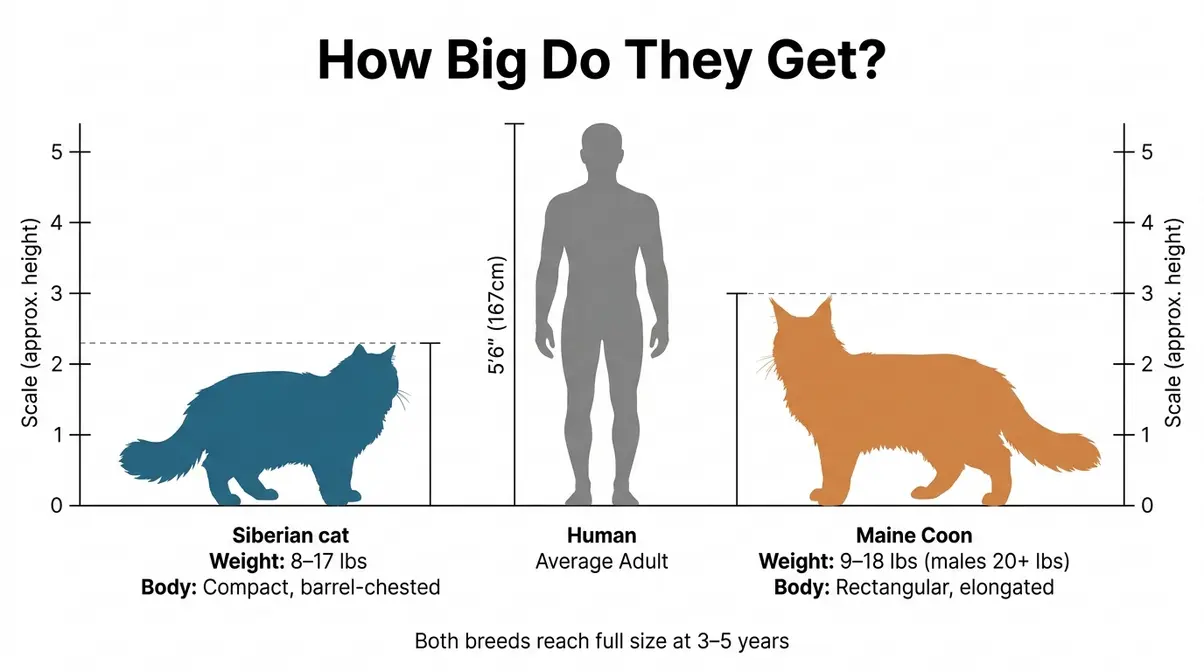
The Maine Coon is generally the larger of the two breeds. Males typically weigh between 13 and 18 pounds, and some reach 20 pounds or more. Females range from 9 to 13 pounds. The Maine Coon’s body is rectangular and long — think of a cat that looks stretched horizontally, with a wide chest, long torso, and a flowing, bushy tail that can be as long as its body. According to TICA breed standards, the Maine Coon is described as a large, muscular cat with a rectangular body profile and substantial bone structure. To see exactly how big they get at each age, review our Maine Coon cat size chart.
The Siberian is powerfully built but proportionally rounder. Males weigh 12 to 17 pounds; females typically 8 to 12 pounds. Where the Maine Coon looks elongated, the Siberian looks barrel-chested and compact — almost bear-like. The hindquarters are slightly higher than the shoulders, giving it a distinctive arch when walking. Both breeds are considered “slow maturing,” meaning they don’t reach full adult size until age 3 to 5.
Why does size matter for you? If you live in a smaller apartment, both breeds adapt reasonably well — but the Maine Coon’s longer body means it needs more horizontal space to stretch and play comfortably.
Head Shape and Facial Features
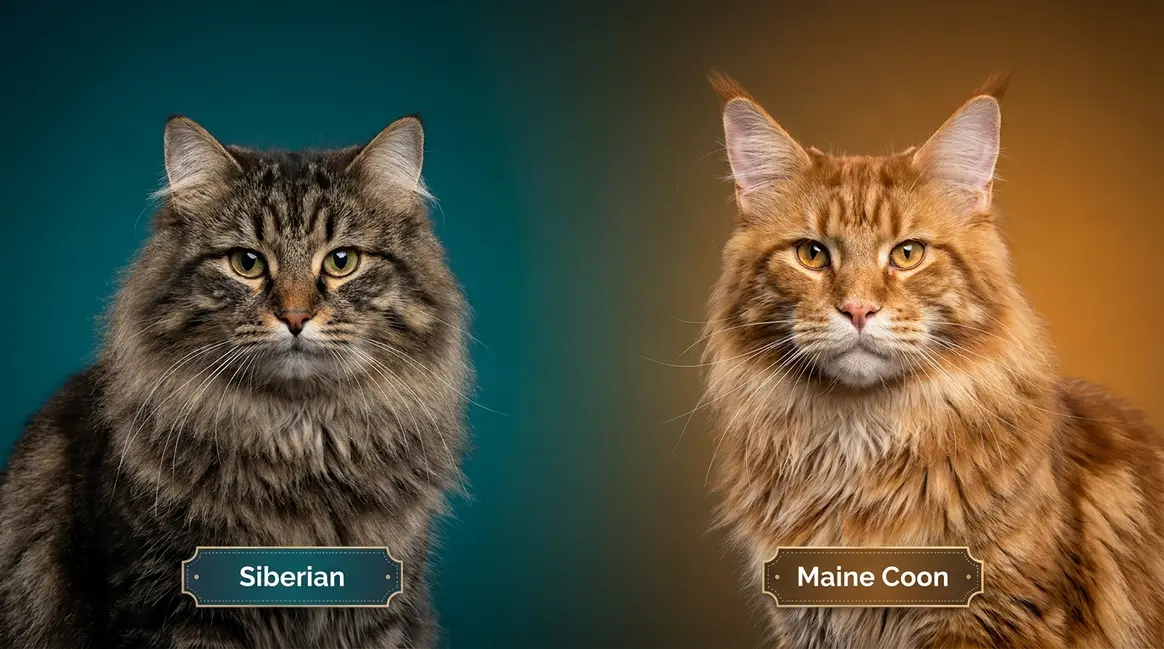
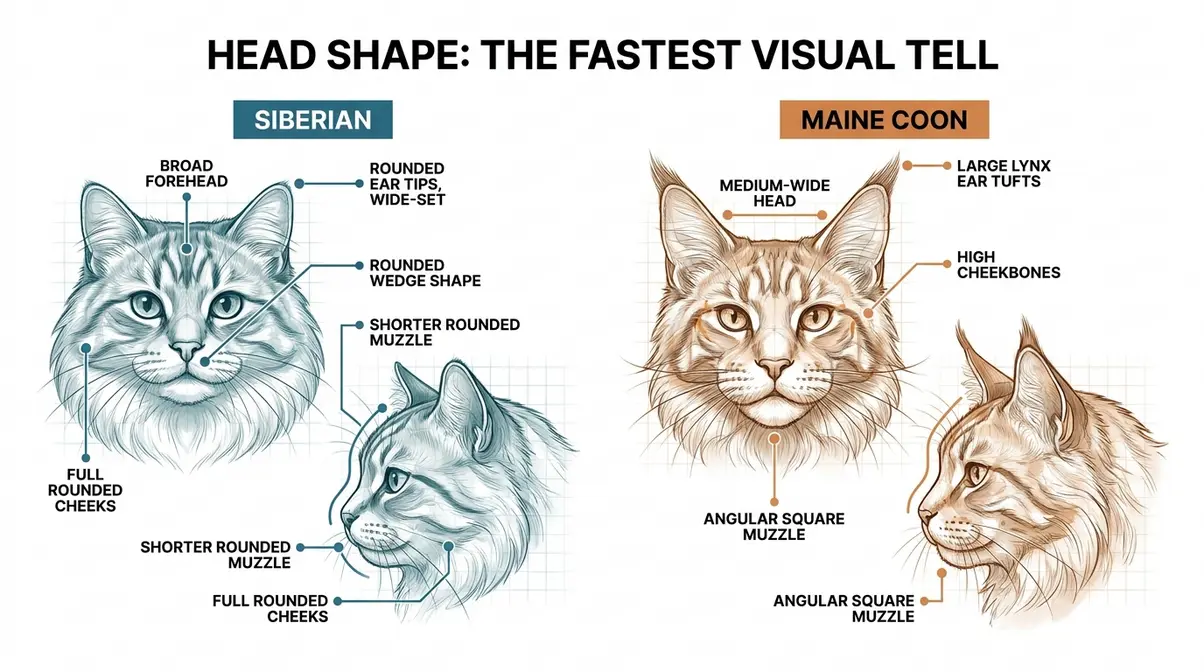
Head shape is the fastest way to tell these two breeds apart in a photo.
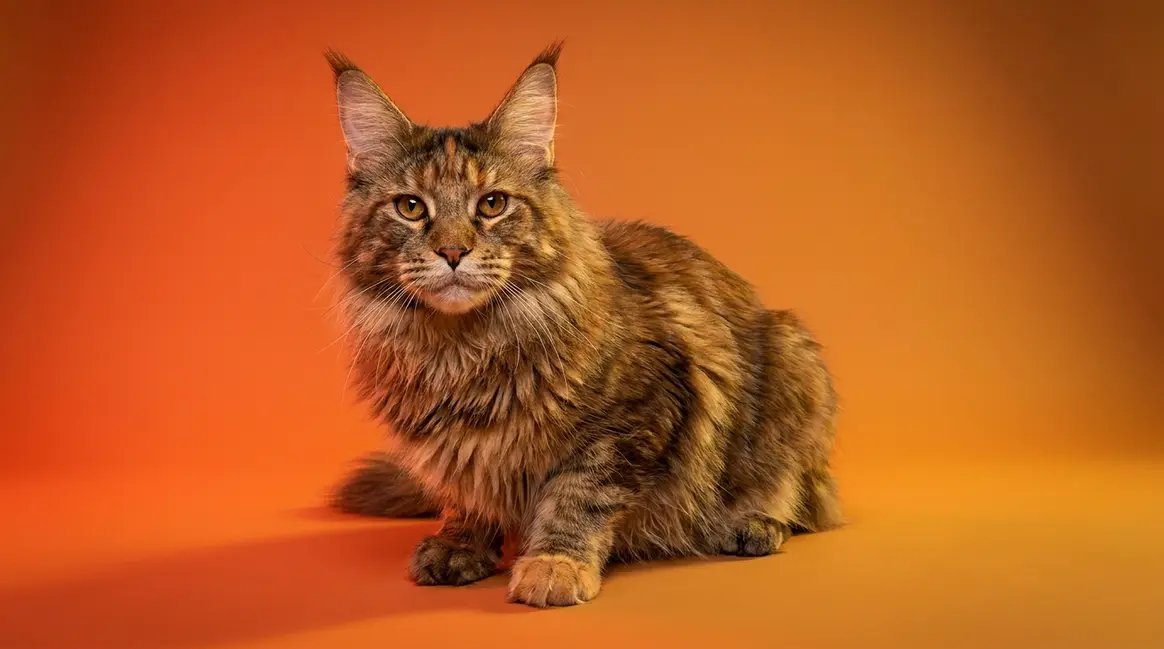
The Maine Coon has a medium-wide head with high cheekbones and a distinctively square muzzle — the muzzle appears almost box-like when viewed from the front. The ears are large, wide-set, and tufted with lynx-like tips. The profile shows a slight concave curve between the nose and forehead. The overall impression is angular and strong.
The Siberian has a broad, rounded wedge-shaped head with a wide forehead and full, rounded cheeks. The muzzle is shorter and rounder than the Maine Coon’s — no sharp angles. The ears are medium-large, rounded at the tips, and set wide apart. The nose has a gentle curve when viewed in profile. The overall impression is soft and bear-like.
Coat Types, Layers, and Colors
This is where the two breeds differ most practically — and where your grooming time commitment is decided.
The Siberian has a triple-layer coat consisting of three distinct layers: a long, coarse outer guard layer; a middle awn layer (sometimes called “intermediate hairs”) that adds insulation; and a dense, soft down undercoat. This triple system was nature’s answer to Russian winters. The coat is water-resistant and less prone to matting than the Maine Coon’s, though it still requires weekly brushing.
The Maine Coon has a double-layer coat — a silky, flowing outer coat and a softer undercoat. It’s longer around the neck (forming a distinctive ruff), on the stomach, and on the tail. Because it’s silkier and finer than the Siberian’s coat, it is more prone to matting, especially behind the ears and in the armpits. Maine Coons come in over 75 color and pattern combinations per TICA standards, including the striking black Maine Coon cat — a solid, jet-black variant that’s among the most searched color patterns for the breed.
Both breeds shed seasonally, with heavier shedding in spring and fall.
Personality and Temperament: Dog-Like vs. Lap Cat
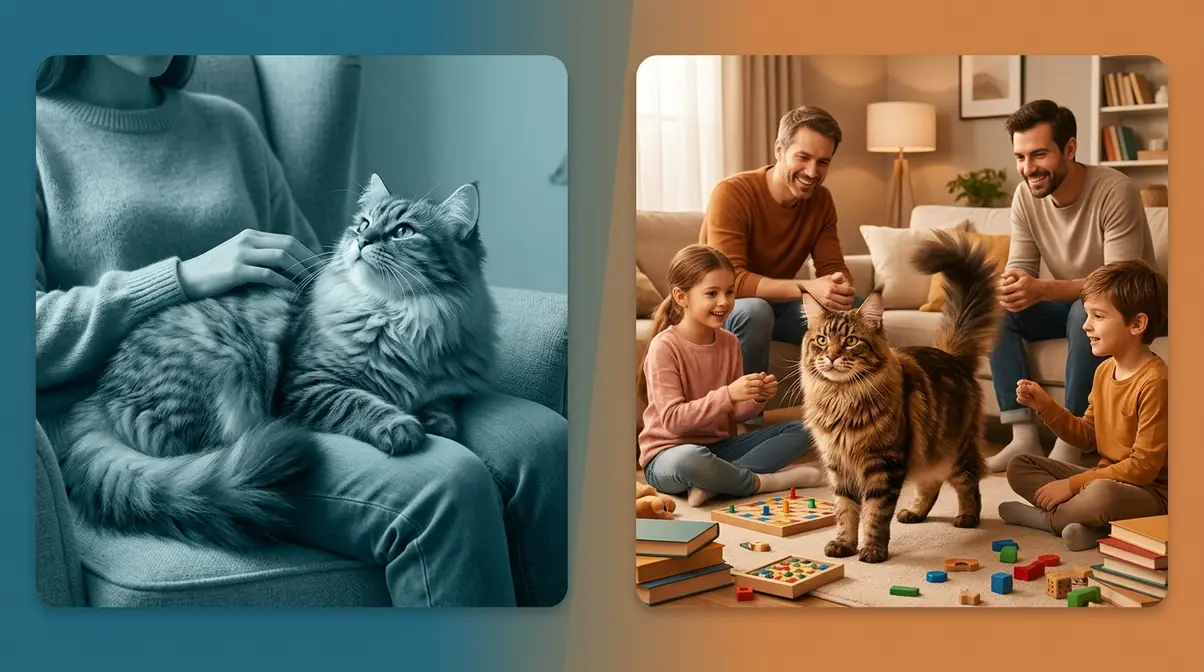
Both breeds are famously affectionate, which is why they’re both consistently recommended for families. But the way they show affection — and who they show it to — is very different.
The Maine Coon’s Dog-Like Personality
The Maine Coon is one of the most dog-like cat breeds in existence. Across Maine Coon owner communities and breed-specific forums, the consistent feedback is that these cats follow their owners from room to room, greet them at the door, and are genuinely curious about everything happening in the household. Many Maine Coons can be trained to walk on a leash, play fetch, and respond to their names reliably. However, this high energy can sometimes lead to Maine Coon behavior problems if they aren’t given enough stimulation.
Maine Coons are also fascinated by water — a trait that surprises many new owners. Expect to find yours pawing at the faucet or joining you near the sink. They’re highly interactive and thrive on play sessions, particularly with puzzle feeders and wand toys. The Maine Coon’s energy level is high well into adulthood, and they rarely become fully sedentary lap cats.
Their sociability extends to everyone in the household, not just one preferred person. This makes them an excellent choice for families, multi-person households, and homes where different people have different schedules. They’re also generally good with respectful dogs.
The Siberian’s Affectionate Nature
The Siberian is often described as a lap cat — but a selective one. Across Siberian cat owner communities, including Reddit’s r/SiberianCats, the consistent report is that Siberians tend to choose a primary person and bond deeply with them. They follow that person around, seek out physical contact, and will often wait at the door for their chosen human to return.
“If you want a cuddly cat, the odds are better with a Siberian than a Maine Coon, but each cat is an individual and there are no guarantees.”
Do Siberian cats pick one person? Commonly, yes — though it varies by individual cat. Siberians are affectionate with the whole family but tend to have a clear preference. They’re not aloof or standoffish; they simply love deeply rather than broadly. If you live alone or want a cat that feels like a true personal companion, the Siberian’s bonding style may suit you better than the Maine Coon’s more evenly distributed affection.
Siberians are also playful and athletic — they’re excellent jumpers and enjoy interactive play — but they tend to have a calmer baseline energy than the Maine Coon.
With Kids, Other Pets, and Dogs
Both breeds are generally good with children and other pets, but there are important nuances.
The Maine Coon handles the chaos of a busy family household particularly well. Its higher tolerance for noise, movement, and handling makes it more forgiving of young children who haven’t yet learned gentle touch. Maine Coons also integrate well into multi-cat households and tend to establish a friendly hierarchy rather than a competitive one.
The Siberian is gentle and patient, but its stronger single-person bonding can sometimes make it less enthusiastic about shared attention. It does well with children and other cats, but it may take longer to warm up to new pets or family members than the more immediately sociable Maine Coon.
For households with dogs, both breeds can coexist comfortably — especially when introduced early. The Maine Coon’s dog-like nature often means it adapts more quickly to canine companions.
Vocalization: Who’s Chattier?
The Maine Coon is the chattier of the two breeds — and noticeably so. Maine Coons use a distinctive repertoire of chirps, trills, and soft meows to communicate, often narrating their day or responding to their owner’s voice. This constant chirping is one of the unexpected characteristics of a Maine Coon that surprises new owners. This is part of what makes them feel dog-like; they seem to want to hold a conversation.
Siberians vocalize too, but more selectively. They tend to use quiet chirps and soft trills rather than loud meows, and they’re less likely to vocalize just for the sake of it. If you work from home or prefer a quieter household, the Siberian’s lower vocalization level is a meaningful quality-of-life difference.
Health, Allergies, and Grooming Needs
This section covers the three biggest practical concerns for prospective owners: whether the Siberian is genuinely better for allergy sufferers, what genetic health risks both breeds carry, and how much grooming time you should realistically budget each week.
Are Siberian Cats Really Hypoallergenic?
The short answer: Siberians are lower-allergen, not allergen-free. No cat breed is truly hypoallergenic.
Cat allergies are primarily triggered by Fel d 1, a protein (short for Felis domesticus allergen 1) produced mainly in a cat’s saliva and sebaceous skin glands. When cats groom themselves, Fel d 1 transfers to the fur and then becomes airborne as the fur dries and sheds.
Research and breeder data suggest that Siberians may produce lower levels of Fel d 1 than most other breeds, including the Maine Coon. A study referenced by Purina’s research team found that some Siberian cats produce measurably lower Fel d 1 concentrations, though levels vary significantly between individual cats. UC Davis veterinary genetics research has also noted that Fel d 1 production appears to have a heritable component, meaning some Siberian lines may consistently produce lower levels than others.
What this means for you: If you have mild to moderate cat allergies, a Siberian from a low-Fel d 1 line may be tolerable — but there are no guarantees. Ask breeders for Fel d 1 test results on the parents before committing, and ideally spend time with the specific kitten before purchasing. The Maine Coon, by contrast, produces typical Fel d 1 levels and is not considered a lower-allergen breed.
Common Health Concerns for Both Breeds
Both breeds are generally robust, but they carry known genetic health risks that every prospective owner should understand before purchasing.
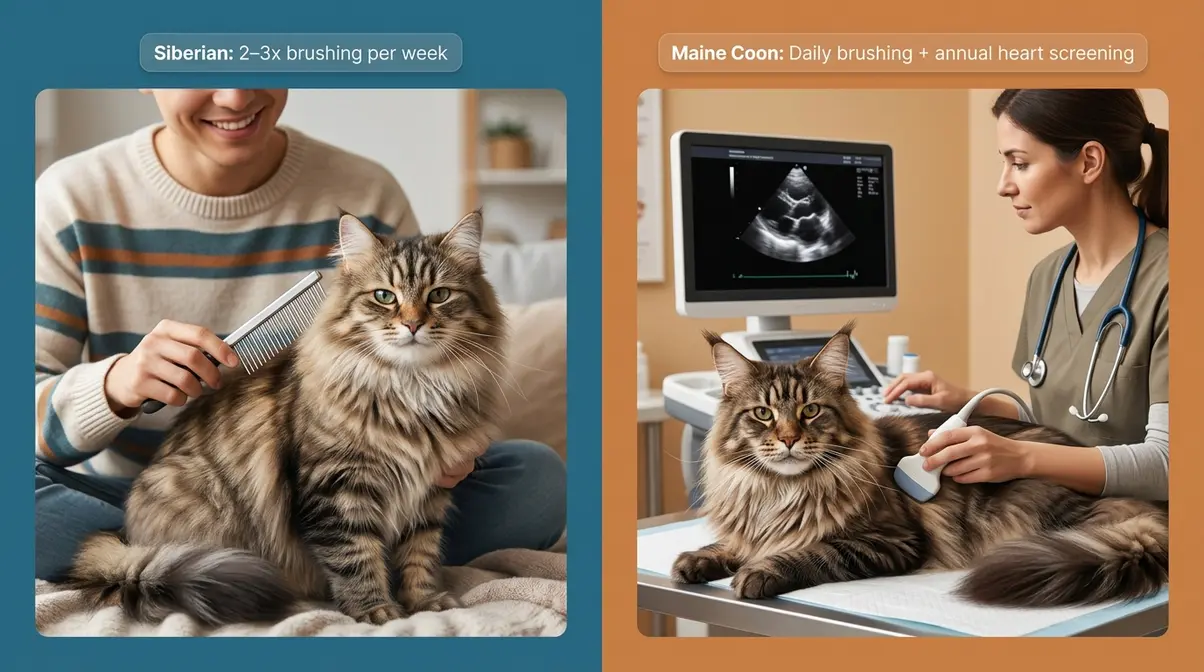
Hypertrophic Cardiomyopathy (HCM) — a condition where the heart muscle thickens, reducing the heart’s ability to pump blood effectively — is the most significant concern for both breeds. HCM is the most common heart disease in cats overall, and according to Cornell University’s College of Veterinary Medicine, it affects a significant proportion of Maine Coons and has been documented in Siberians as well. In cats, HCM is often called a “silent killer” because it can progress without obvious symptoms until it causes sudden cardiac events. Responsible breeders screen breeding cats via echocardiogram annually.
Polycystic Kidney Disease (PKD) — a genetic condition where fluid-filled cysts develop in the kidneys, gradually impairing kidney function — is an additional risk in Maine Coons. A DNA test can confirm whether a cat carries the PKD1 mutation. Reputable Maine Coon breeders test for PKD and should provide documentation.
Spinal Muscular Atrophy (SMA) — a genetic condition affecting the lower spinal cord neurons, causing progressive muscle weakness in the hindquarters — is a known risk in Siberians. SMA is not painful and doesn’t shorten a cat’s lifespan significantly, but it does affect mobility. Like PKD, it can be identified through DNA testing.
What this means for you: Always request genetic health testing documentation from any breeder. At minimum, ask for HCM echocardiogram results for the parents, and breed-specific DNA test results (PKD for Maine Coons; SMA for Siberians). According to UC Davis Veterinary Genetics Laboratory, DNA panels for these mutations are widely available and should be standard practice for responsible breeders.
Both breeds have an average lifespan of 12 to 15 years, with well-cared-for individuals sometimes reaching 17 or 18 years.
Grooming Schedules: What to Expect
Neither breed is low-maintenance, but the Siberian is somewhat more forgiving.
The Siberian’s triple-layer coat is water-resistant and naturally less prone to tangling. Most Siberian owners report that brushing two to three times per week keeps the coat in good condition, with daily brushing during the heavy seasonal shed periods in spring and fall. The coat doesn’t mat as quickly as the Maine Coon’s, which means a missed brushing session is less likely to result in a tangle emergency.
The Maine Coon’s silkier, longer coat mats more readily — particularly behind the ears, under the “armpits,” and along the belly. Most Maine Coon owners find that daily brushing is the safest approach, though three to four times per week can work if you’re consistent. Matted fur is uncomfortable for the cat and can lead to skin irritation if left unaddressed. A stainless-steel wide-tooth comb is the tool most commonly recommended by Maine Coon breeders for detangling. If you do encounter severe tangles, learning proper matted fur removal for cats is essential to avoid hurting their skin. Implementing a few essential grooming hacks for long fur cats can cut your brushing time in half.
Both breeds benefit from regular nail trims (every two to three weeks), ear cleaning (monthly), and dental care. Neither breed typically requires professional grooming, but some owners opt for a “lion cut” in summer to reduce shedding and heat.
| Grooming Task | Siberian | Maine Coon |
|---|---|---|
| Brushing frequency | 2–3x per week | Daily (or 4–5x per week minimum) |
| Matting risk | Low to moderate | Moderate to high |
| Seasonal shed | Heavy (spring/fall) | Heavy (spring/fall) |
| Professional grooming | Optional | Optional (some owners prefer it) |
| Nail trims | Every 2–3 weeks | Every 2–3 weeks |
How They Compare to the Norwegian Forest Cat
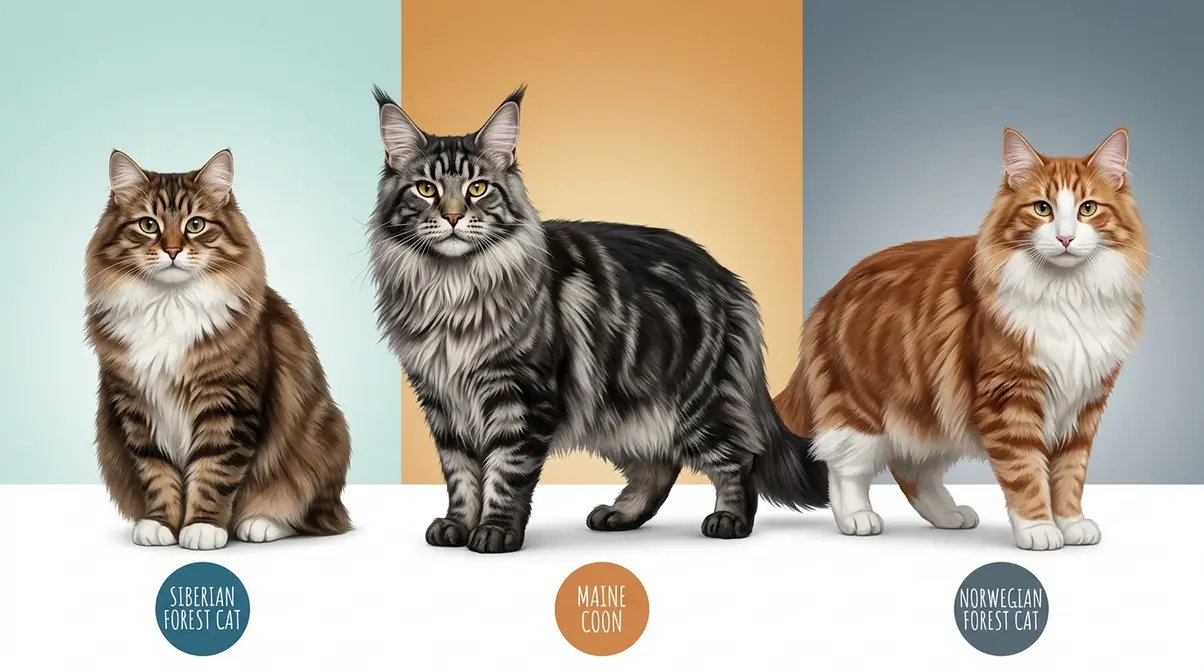
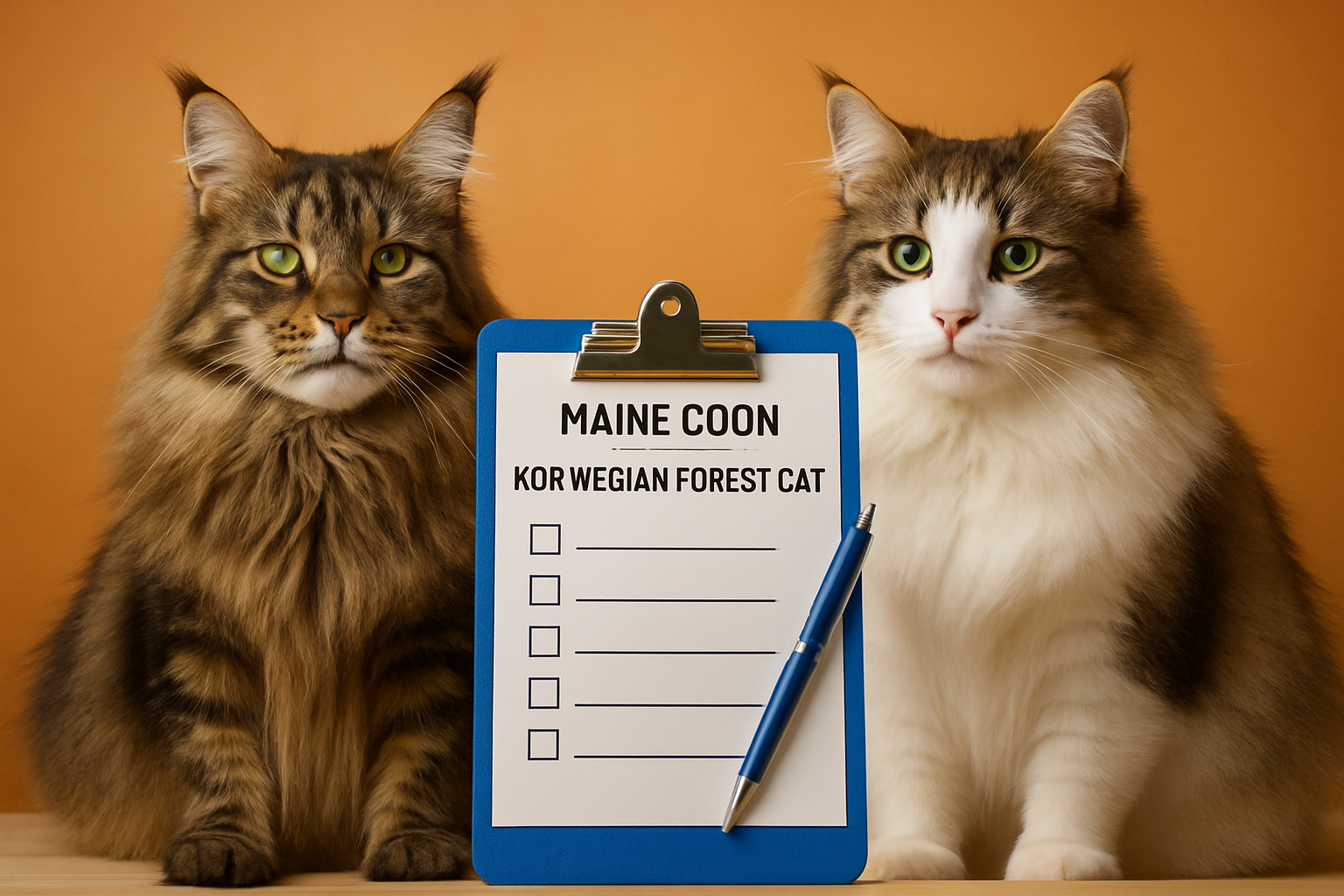
If you’ve been researching large, fluffy cats, you’ve almost certainly encountered a third breed: the Norwegian Forest Cat (often called the “Wegie”). All three breeds are sometimes grouped under the “forest cat” label, and they share enough visual similarities to cause genuine confusion — even among experienced cat owners. If you are struggling to decide between the American and Norwegian variants, our Maine Coon vs Norwegian Forest Cat checklist can help narrow it down.
Head Shapes: Telling Them Apart
Head shape is the definitive visual identifier for all three forest cat breeds, according to the Cat Fanciers’ Association’s breed standard documentation.
- Maine Coon: Medium-wide head with a square muzzle and high cheekbones. The profile shows a slight concave curve. Angular and strong.
- Siberian: Broad rounded wedge with a wide forehead and full cheeks. Shorter, rounder muzzle. Soft and bear-like.
- Norwegian Forest Cat: Head forms a near-equilateral triangle from the tip of the nose to the base of each ear. The profile is straight (no concave curve). The muzzle is long and straight, following the triangular geometry of the head.
Once you know this distinction — square muzzle (Maine Coon), rounded wedge (Siberian), equilateral triangle (Norwegian) — you can identify all three breeds reliably from a photograph.
Three-Way Comparison Table
| Feature | Siberian Cat | Maine Coon | Norwegian Forest Cat |
|---|---|---|---|
| Head Shape | Rounded wedge | Square muzzle, medium-wide | Equilateral triangle |
| Profile | Gentle curve | Slight concave curve | Straight (no curve) |
| Body Type | Compact, barrel-chested | Rectangular, elongated | Long, substantial, muscular |
| Coat | Triple-layer | Double-layer, silky | Double-layer, woolly undercoat |
| Allergen Level | Potentially lower Fel d 1 | Typical | Typical |
| Personality | Affectionate, bonds deeply | Dog-like, broadly sociable | Independent, gentle, reserved |
| Average Lifespan | 12–15 years | 12–15 years | 14–16 years |
The Norwegian Forest Cat is noticeably more independent and reserved than either the Siberian or the Maine Coon. If the Maine Coon is the dog-like extrovert and the Siberian is the devoted companion, the Norwegian Forest Cat is the quiet, dignified roommate who prefers affection on its own terms.
Identification, Mixes, and Breeders
Identifying Your Cat’s Breed
This is one of the most commonly searched questions about both breeds — and the honest answer is: visual identification alone is unreliable for mixed or rescue cats.
For purebred cats from registered breeders, you’ll have paperwork confirming the lineage. For cats without papers, here’s what to look for:
- Check the head shape first. Square muzzle with angular cheekbones → likely Maine Coon traits. Broad, rounded wedge with full cheeks → likely Siberian traits.
- Look at the body profile. Long and rectangular → Maine Coon. Compact and barrel-chested → Siberian.
- Check the ear tips. Prominent lynx tufts on large, wide-set ears → Maine Coon. Rounded ear tips with moderate furnishings → Siberian.
- Listen to vocalization. Frequent, varied chirps and trills → Maine Coon tendency. Quieter, selective chirps → Siberian tendency.
How can I tell if my cat is a Siberian? Look for the rounded wedge head, barrel chest, and triple-layer coat that feels denser and coarser than the Maine Coon’s silkier fur. Siberians also have slightly higher hindquarters than shoulders, giving a distinctive arch to the back when standing. If you don’t want to pay for a DNA test, look for specific signs your cat is a Maine Coon mix like ear tufts and toe fluff.
For a definitive answer, a cat DNA test (such as those from Basepaws or Wisdom Panel) can identify breed markers with reasonable accuracy, though results for mixed-breed cats should be interpreted as probabilistic rather than definitive.
What Is a Siberian Maine Coon Mix?
A Siberian Maine Coon mix is not a recognized breed — it’s a crossbreed between the two. These cats typically inherit traits from both parents in unpredictable combinations. You might get a cat with the Maine Coon’s rectangular body and the Siberian’s rounded head, or vice versa. Coat type, allergen levels, and personality traits all vary widely in mixed-breed cats, or you might simply have a standard Maine Coon mix with domestic longhair traits.
If you suspect your cat is a Siberian Maine Coon mix, the most reliable confirmation is a DNA test. From a care perspective, treat the coat based on what you observe — if it mats easily, brush daily; if it’s denser and more resistant, two to three times per week may suffice.
One important note: mixed-breed cats do not reliably inherit the Siberian’s potentially lower Fel d 1 levels. If allergens are a concern, do not assume a mixed-breed cat will be lower-allergen simply because it has Siberian ancestry.
How to Find a Reputable Breeder
Finding a reputable Maine Coon cat breeder or Siberian breeder follows the same principles for both breeds.
Start with TICA’s breeder directory (tica.org) or the CFA’s breeder referral list. Registered breeders agree to follow ethical breeding standards, including health testing protocols. Key questions to ask any breeder:
- Do you test breeding cats for HCM via annual echocardiogram?
- Do you test for PKD (Maine Coon) or SMA (Siberian) via DNA panel?
- Can I visit the cattery and meet the parents?
- Do kittens come with a health guarantee?
- Are kittens socialized with children, dogs, or other cats?
As of 2026, expect to pay $1,200–$2,500 for a Siberian kitten from a health-tested breeder, and $1,000–$2,000 for a Maine Coon kitten. Prices below $800 for either breed should be treated as a warning sign — they often indicate a kitten mill or breeder who skips health testing.
Rescue organizations specializing in large breeds are also a worthwhile option. Maine Coon Rescue (mainecoonrescue.net) and similar Siberian-focused rescue groups occasionally have adult cats available for adoption at a fraction of the breeder price.
Who Should Choose a Siberian Cat?
The Lifestyle Fit Matrix scores each breed across five dimensions: allergy sensitivity, household composition, activity level, available space, and grooming time. Here’s how the Siberian scores for specific owner profiles.
Choose a Siberian if you:
- Have mild to moderate cat allergies and are willing to ask breeders for Fel d 1 test results on parent cats
- Live alone or with one or two adults and want a deeply bonded companion that follows your specific energy
- Prefer a quieter household — the Siberian’s soft chirps won’t wake a sleeping baby or disrupt a home office
- Want a playful but calmer cat that enjoys interactive sessions without demanding constant stimulation
- Are committed to two to three brushing sessions per week and don’t mind a coat that’s dense but manageable
The Lifestyle Fit Matrix verdict for the Siberian: Best match for single-person households, allergy-sensitive owners, remote workers, and people who want a cat that feels like a devoted personal companion rather than a family mascot.
Consider alternatives: If you have young children who will be handling the cat frequently, or a multi-pet household where quick social adaptation matters, the Maine Coon’s broader sociability may serve you better.
Who Should Choose a Maine Coon?
The Maine Coon scores highest on the Lifestyle Fit Matrix for households that value sociability, playfulness, and adaptability over allergen management.
Choose a Maine Coon if you:
- Have no significant cat allergies in the household
- Have children — the Maine Coon’s tolerance for noise, movement, and handling is exceptional among large breeds
- Want a cat that integrates well with dogs and adapts quickly to new family members or pets
- Enjoy a chatty, interactive companion — the Maine Coon’s chirps and trills become a beloved household soundtrack for most owners
- Are prepared to brush daily (or near-daily) and don’t mind the higher matting risk that comes with a silkier coat
- Have enough horizontal space for a cat whose long, rectangular body needs room to stretch, climb, and play
The Lifestyle Fit Matrix verdict for the Maine Coon: Best match for families with children, multi-pet households, social households with frequent visitors, and owners who want a dog-like cat experience without actually owning a dog.
Consider alternatives: If anyone in your household has cat allergies, or if you want a quieter, more selectively bonded companion, the Siberian is the better fit.
How We Evaluated These Breeds
Our review of the siberian cat vs maine coon comparison draws on four primary sources: TICA and CFA published breed standards, UC Davis Veterinary Genetics Laboratory data on breed-specific genetic conditions, Cornell University’s Feline Health Center veterinary guidance on HCM and common feline diseases, and aggregated owner community reports from Reddit’s r/SiberianCats and r/mainecoons (combined membership of over 250,000 owners as of 2026).
Where claims about allergen levels, health risks, and personality traits appear, we have prioritized peer-reviewed veterinary sources and official breed organization standards over anecdotal reports. Personality descriptions are labeled “commonly reported” where they reflect owner consensus rather than controlled research. No breed is described as universally superior — both breeds have meaningful strengths and meaningful trade-offs, and the right choice depends entirely on your household circumstances.
Prices and availability figures are as of 2026 and subject to change. We recommend verifying current pricing directly with TICA-registered breeders in your region.
Frequently Asked Questions
How do I tell if my cat is a Siberian or Maine Coon?
The most reliable visual markers are head shape and body profile. Maine Coons have a medium-wide head with a distinctively square muzzle and a long, rectangular body. In contrast, Siberians feature a broad, rounded wedge-shaped head with fuller cheeks and a more compact, barrel-chested frame.
Are Siberian cats good house cats?
Yes — Siberians adapt well to indoor living, provided they have enough enrichment to satisfy their athletic and curious nature. They’re playful and enjoy climbing, interactive toys, and puzzle feeders. Siberians are not particularly destructive indoors, and their calmer baseline temperament compared to the Maine Coon makes them well-suited to quieter households. A second cat for company is often recommended for owners who work long hours.
Do Siberian cats pick one person?
Siberians commonly form a strong primary bond with one person, though they remain affectionate with the whole household. Across owner communities, the consistent report is that a Siberian will identify its “chosen human” and stick by their side throughout the day. You will often find them following this specific person from room to room, including waiting outside the bathroom door. They actively seek physical contact with their favorite human preferentially, often choosing to sleep on their chest or lap. This intense bonding style is part of what makes Siberians feel like deeply personal companions rather than general household pets. While individual variation exists, this single-person devotion is a hallmark of the breed.
What is the silent killer for cats?
Hypertrophic Cardiomyopathy (HCM) — a thickening of the heart muscle — is widely considered the “silent killer” for cats, including both Maine Coons and Siberians. HCM can progress for months or years without visible symptoms, then cause sudden cardiac events including congestive heart failure or aortic thromboembolism. According to Cornell University’s Feline Health Center, HCM is the most common heart disease in cats and is significantly heritable in certain breeds. Annual echocardiogram screening for breeding cats is the most important preventive measure for both breeds (Cornell Feline Health Center, 2026).
What cat breed should I avoid if I have allergies?
Avoid breeds with high Fel d 1 production if you have cat allergies, which includes most mainstream breeds like Persians, Ragdolls, and British Shorthairs. The Maine Coon produces typical Fel d 1 levels and is not considered a lower-allergen option. If allergies are a concern, the Siberian is currently the most evidence-supported lower-allergen option among large breeds, though you should always test your individual sensitivity first. The Petful breed comparison guide also notes that allergen sensitivity varies significantly between individuals of the same breed.
The Right Breed for Your Life
The siberian cat vs maine coon question doesn’t have a universally correct answer — it has a correct answer for your household. Both breeds are large, affectionate, long-lived companions that reward attentive owners. But they’re built for different lives.
The Siberian’s potentially lower allergen levels, quieter temperament, and deep single-person bonding make it the better fit for allergy-sensitive households, quieter homes, and owners who want a cat that feels like a devoted personal companion. The Maine Coon’s extraordinary sociability, dog-like playfulness, and adaptability make it the better fit for families, multi-pet homes, and anyone who wants a chatty, interactive cat that treats the entire household as its family.
The Lifestyle Fit Matrix gives you a framework to make this decision based on your actual circumstances — not just which breed has the more impressive photos online. Score yourself honestly across the five dimensions (allergy sensitivity, family size, activity level, space, and grooming time), and the right breed will become clear.
Your next step: contact two or three TICA-registered breeders for each breed, ask for health testing documentation, and arrange a visit to spend time with both breeds in person. Start your search with a reputable breeder who performs health screenings to ensure you bring home a healthy kitten. You can also take our Lifestyle Fit Matrix quiz to finalize your decision based on your specific household needs.

Dave King
Cat owner and writer at Mad Cat Man.