Maine Coon vs Norwegian Forest Cat: 5 Key Differences
Unlock actionable ideas for Maine Coon vs Norwegian Forest Cat: A Room-by-Room Checklist to Pick the Right Giant Floof to help you plan with confidence…

You’re standing in front of the fluffiest, most regal cat you’ve ever seen — tufted ears, a sweeping tail, and a mane that belongs on a lion — and you’re genuinely hard pressed to distinguish whether it’s a Maine Coon or a Norwegian Forest Cat. You’re not alone. Searches comparing these two breeds have surged over 22% year-over-year, because the confusion is real and the stakes are higher than most people realize.
Here’s the problem: Maine Coon kittens and Norwegian Forest Cat kittens can look nearly identical at first glance, but they carry different genetic health risks, different temperaments, and very different price tags. This is a $1,500–$3,500 decision — and making it without knowing which breed you’re actually looking at means choosing blind. Pricing and health screening standards verified for 2026.
By the end of this guide, you’ll know exactly how to tell these two breeds apart at a glance, understand which personality fits your home, and have a complete 2026 cost and health picture — so you can choose with total confidence. We’ll cover physical identification (including one instant visual trick), temperament, a three-way Siberian comparison, breed-specific health risks, and 2026 pricing.
The Maine Coon vs Norwegian Forest Cat debate comes down to one instant visual test: check the nose profile. Maine Coons have a gentle concave curve; Norwegian Forest Cats have a perfectly straight line from brow to tip.
- Size: Maine Coons are larger — 15–25 lbs vs. the Wegie’s 12–20 lbs
- Personality: Maine Coons are “dog-like” and vocal; Wegies are calmer and more independent
- Health: Maine Coons risk HCM (hypertrophic cardiomyopathy, a heart muscle disease); Norwegian Forest Cats risk GSD IV (glycogen storage disease type IV) — both require DNA testing before purchase
- “The Nose Profile Test”: The single fastest way to identify which breed you’re looking at — no breed standard knowledge required
Quick Verdict
Maine Coon wins for: families wanting a sociable, dog-like companion who follows you room to room.
Norwegian Forest Cat wins for: owners who want a majestic, independent cat that’s affectionate on its own terms.
Key difference: The nose profile. Maine Coon = gentle curve. Norwegian Forest Cat = dead straight. See the full breakdown below.
Maine Coon vs Norwegian Forest Cat: Quick Overview
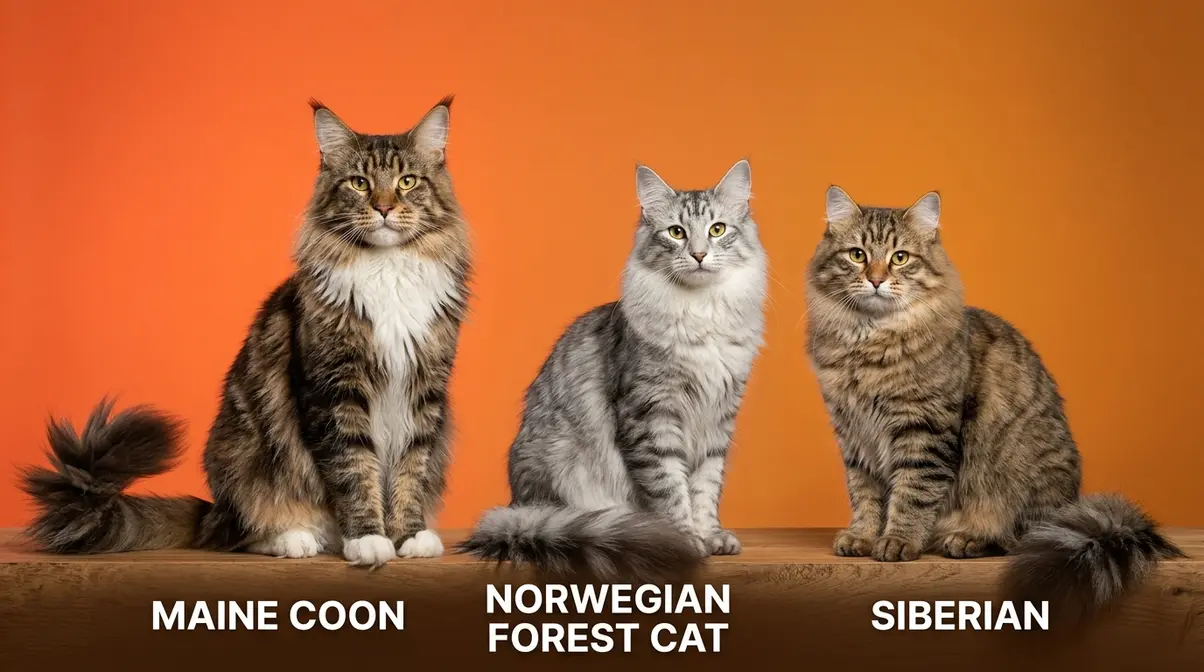
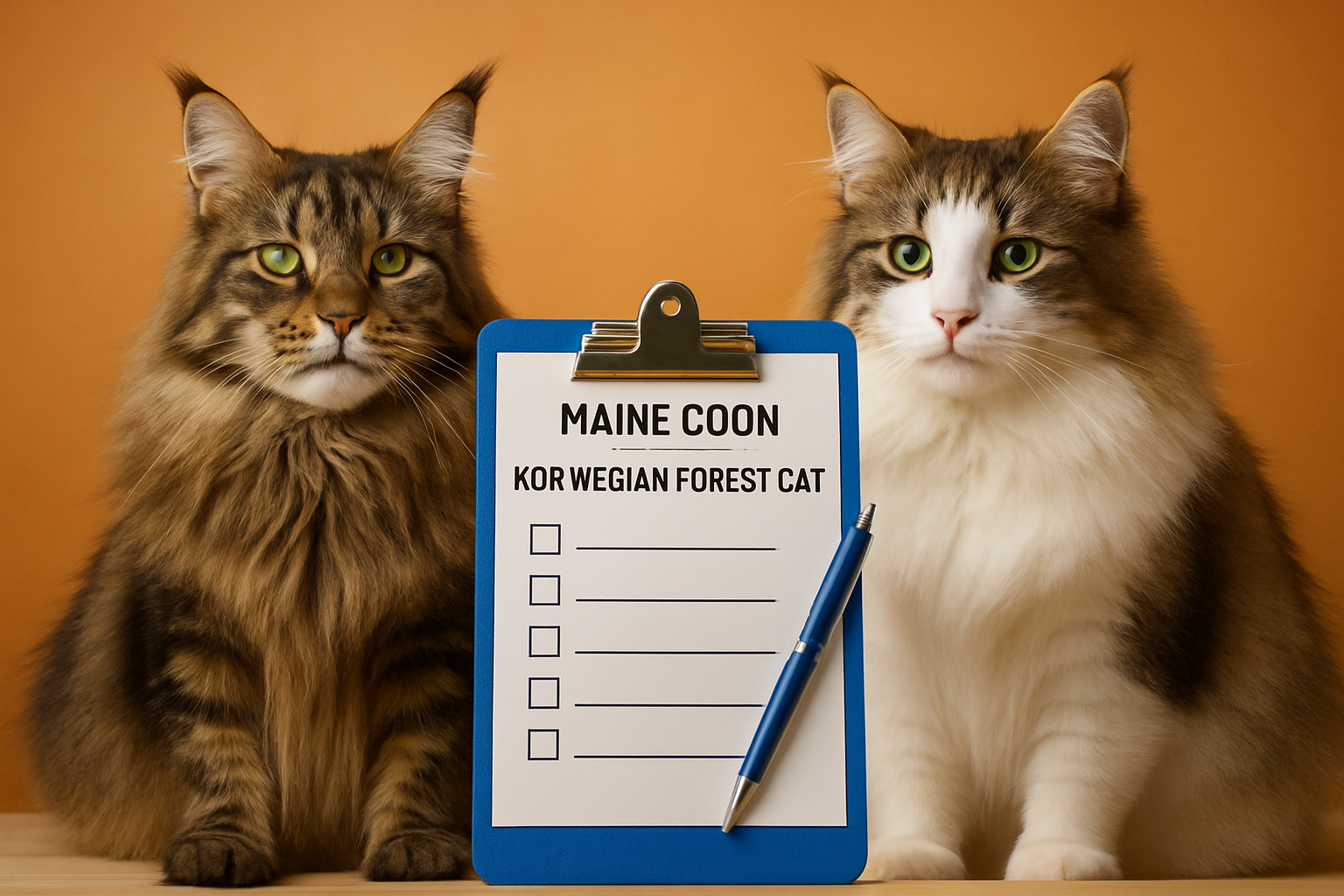
The Maine Coon and Norwegian Forest Cat are both semi-longhaired (meaning a medium-to-long coat with a dense undercoat) gentle giants, but they originate from opposite sides of the Atlantic — and those origins shaped everything from their face shape to their temperament (TICA, 2026). Both breeds have been beloved for decades, yet their measurable differences in size, head structure, and genetic health make knowing which is which genuinely important. Once you see the table below, choosing — or identifying — your cat becomes straightforward.
Breed Origins at a Glance
The Maine Coon is a natural breed (one that developed without deliberate human selection) native to North America, widely regarded as one of the oldest established breeds in the United States. Breed standard (breed standard = the official written description of a breed’s ideal traits) recognition by the Cat Fanciers’ Association (CFA) came in 1976. Folklore links them to seafaring ships and New England farmsteads, though genetic evidence points to a North American origin from longhaired cats brought by early settlers.
The Norwegian Forest Cat — affectionately called the “Wegie” by enthusiasts — has roots in Norse mythology and Scandinavian forest life. Vikings likely kept these cats aboard ships as working mousers. The breed was nearly extinct by World War II before Norwegian breeders revived it; TICA (The International Cat Association) granted full recognition in 1984. In my work covering cat breeds at madcatman.com, the historical contrast between these two breeds consistently surprises new owners — one is an American farm cat, the other a Norse forest dweller. That 4,000-mile gap explains more about their differences than any single trait.
We’ll introduce The Nose Profile Test in the next section — the single fastest visual trick to tell these two breeds apart instantly, no experience required.
At-a-Glance Comparison Table
“The Maine Coon and Norwegian Forest Cat are both semi-longhaired gentle giants, but they originate from opposite sides of the Atlantic — and those origins shaped everything from their face shape to their temperament” (TICA, 2026).
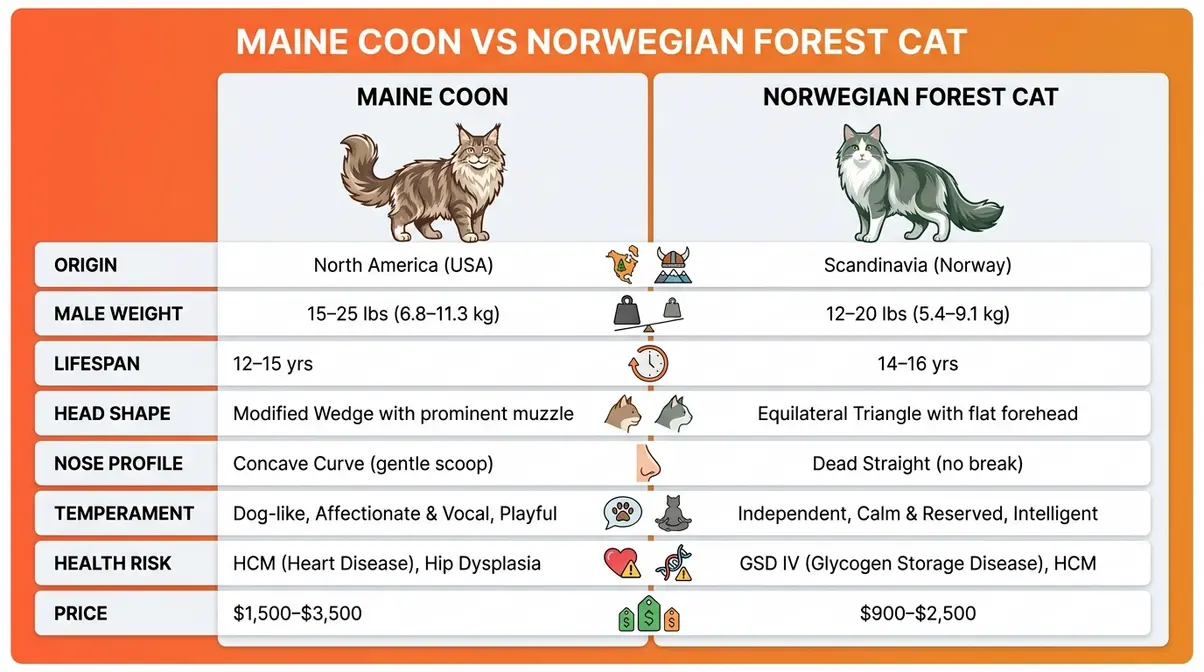
| Feature | Maine Coon | Norwegian Forest Cat |
|---|---|---|
| Origin | North America (Maine, USA) | Scandinavia (Norway) |
| Weight (Male) | 15–25 lbs (6.8–11.3 kg) | 12–20 lbs (5.4–9.1 kg) |
| Weight (Female) | 8–12 lbs (3.6–5.4 kg) | 8–12 lbs (3.6–5.4 kg) |
| Lifespan | 12–15 years | 14–16 years |
| Head Shape | Modified wedge, high cheekbones | Equilateral triangle, flat forehead |
| Nose Profile | Gentle concave curve (slight dip) | Perfectly straight, no break |
| Coat Type | Shaggy, uneven; longer on ruff and belly | Dense double coat; smooth, water-resistant |
| Temperament | Sociable, dog-like, vocal | Independent, calm, affectionate on own terms |
| Primary Health Risk | HCM (hypertrophic cardiomyopathy) | GSD IV (glycogen storage disease type IV) |
| 2026 Kitten Price | $1,500–$3,500 | $900–$2,500 |
| CFA Recognition | 1976 | 1993 |
Why this matters: Use this table as your decision anchor. If the nose profile and head shape columns don’t match what you’re seeing, jump to the Physical Differences section — The Nose Profile Test will settle the question in under ten seconds.
How to Tell Them Apart: Physical Differences
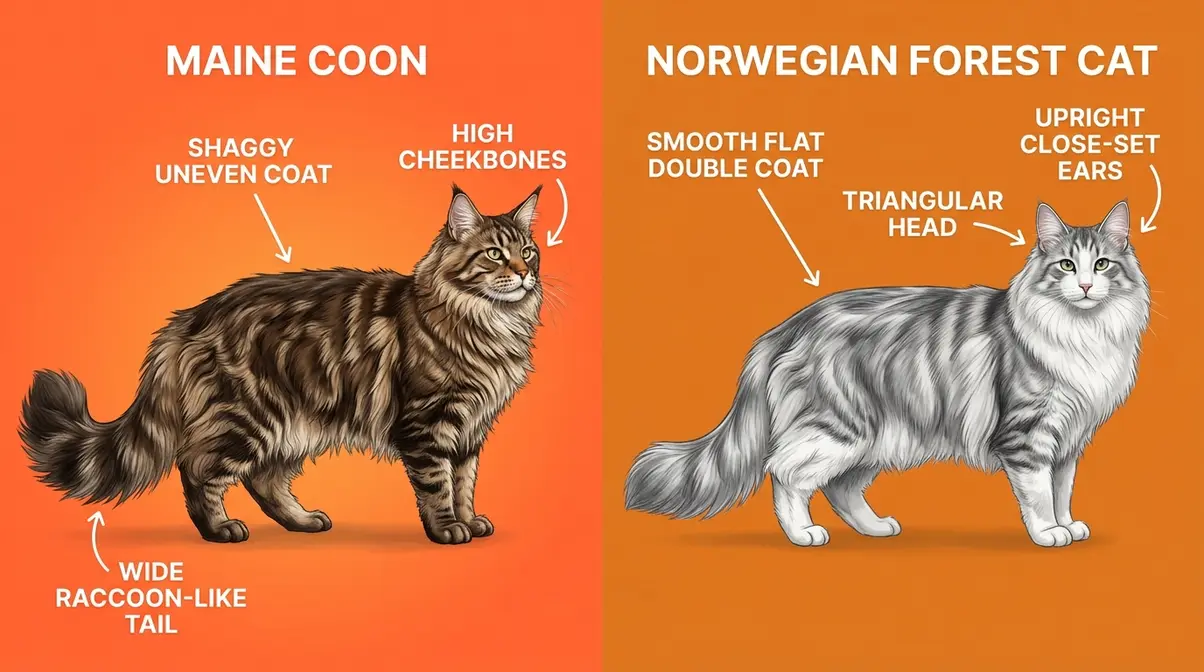
Telling a Maine Coon from a Norwegian Forest Cat is genuinely difficult from a full-body photo alone — breed communities consistently report that even experienced owners get it wrong. The good news is that two physical features — the nose profile and the head shape — work as a reliable instant identifier. Everything else (coat texture, ear tufts, tail) adds confirmation once you know what to look for.
Head Shape and Nose Profile
Introducing The Nose Profile Test: Hold a photo of the cat so you’re looking at its face from the side (profile view). Now trace the line from the top of the forehead down to the tip of the nose.
- Maine Coon: You’ll see a gentle, concave curve — a slight inward dip roughly at eye level. The nose has a subtle “ski jump” quality.
- Norwegian Forest Cat: The line is dead straight, from brow to nose tip, with no break or curve whatsoever.
That single observation — curve vs. straight — is The Nose Profile Test, and across breed communities and TICA-registered breeder evaluations, it is the most reliable visual identifier available to a non-expert. No calipers, no breed standard memorization required.
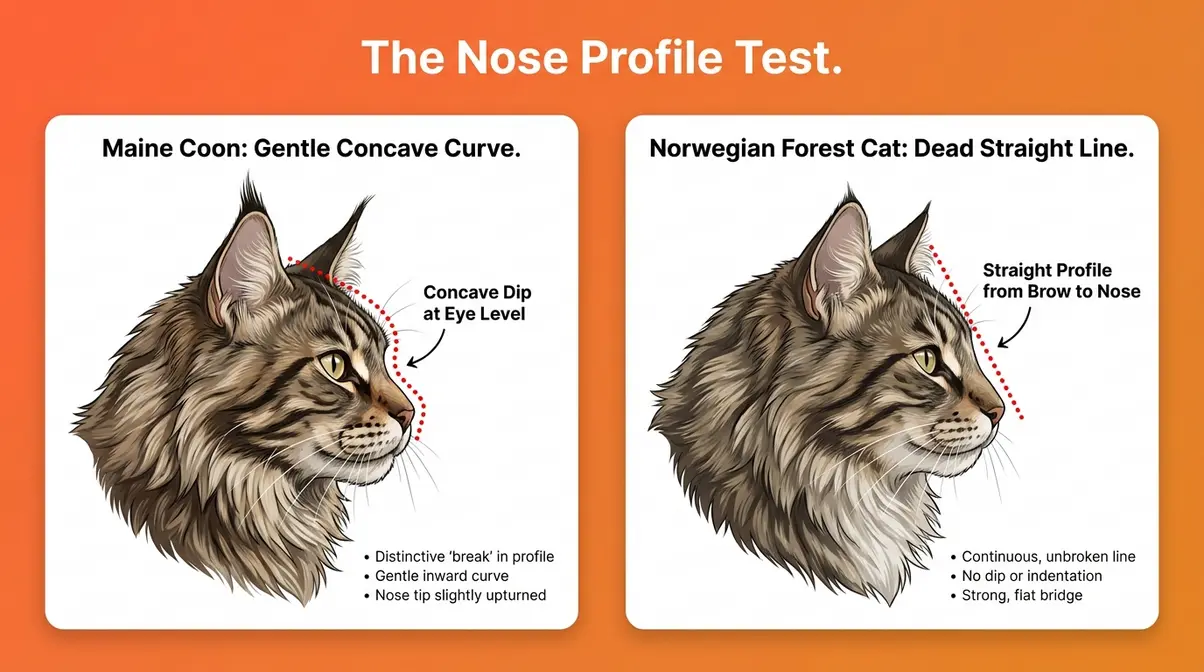
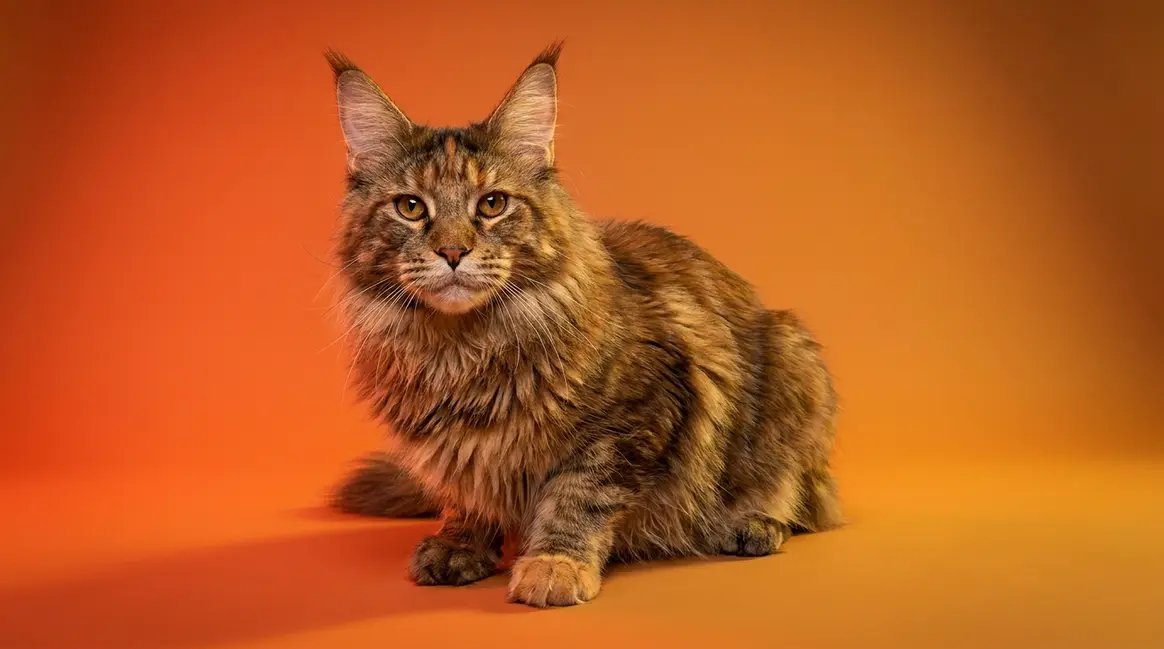
Head shape reinforces the test. The Maine Coon has a modified wedge head with prominent, high cheekbones and a squarish muzzle — giving it a strong, almost lion-like face. The Norwegian Forest Cat (Wegie) has a true equilateral triangle head (equal sides, flat forehead) with a straight profile and a more delicate, angular face overall. Breed standards from TICA and the CFA both confirm these as the primary distinguishing facial features between the two breeds.
Size, Body Structure, and Weight
Is a Norwegian Forest Cat bigger than a Maine Coon? The short answer: no. The Maine Coon is consistently the larger breed. According to CFA breed standards, male Maine Coons typically reach 15–25 lbs, while male Wegies top out at 12–20 lbs — a meaningful difference when you’re lifting a cat onto a vet table. Female weights are nearly identical for both breeds (8–12 lbs), which is why females are harder to distinguish by size alone.
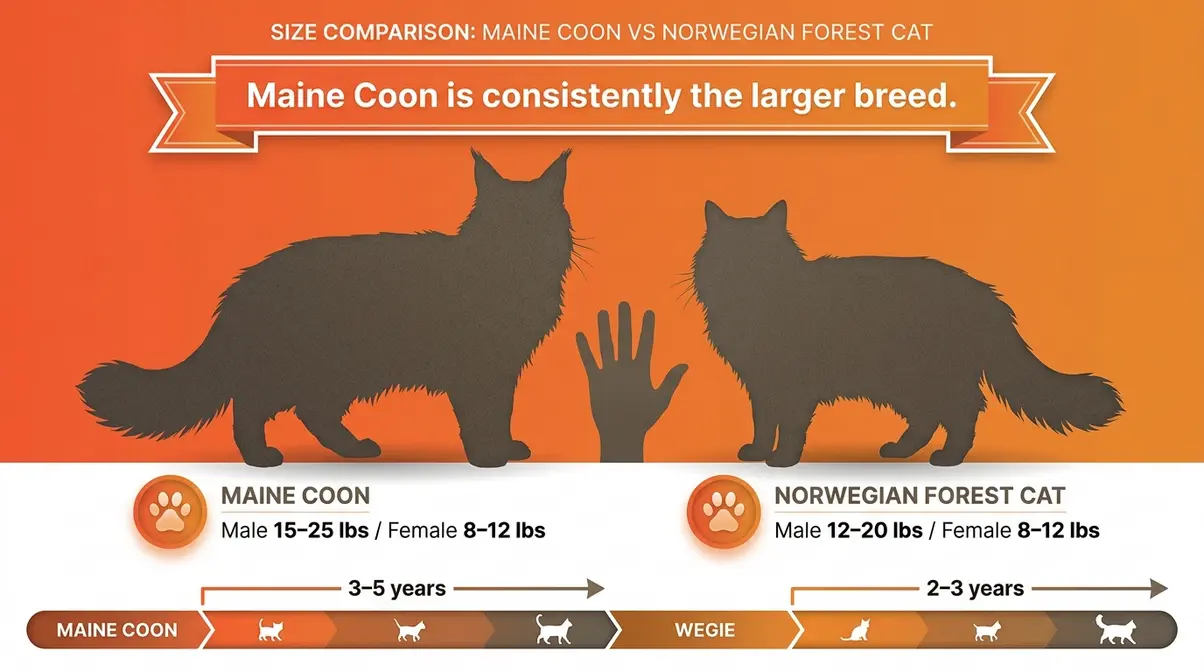
Beyond weight, the Maine Coon carries a rectangular, muscular body on a large-boned frame — it’s built like a working farm cat. The Norwegian Forest Cat is also large and muscular but has a slightly more compact, cobby (short and sturdy) build. Maine Coons also tend to mature more slowly, often not reaching full size until 3–5 years of age, compared to the Wegie’s 2–3 year maturation window. That slow growth is one reason Maine Coon kittens can look deceptively similar to adult Wegies.
Coat, Ears, Eyes, and Tail
Both breeds carry dense, semi-longhaired coats built for cold climates — but the texture differs noticeably on touch. The Maine Coon’s coat is shaggy and uneven, with a flowing chest ruff, longer belly fur, and shorter fur on the shoulders. The Norwegian Forest Cat’s double coat (a dense woolly undercoat beneath a smooth, water-resistant topcoat) lies flatter and feels silkier. In wet weather, a Wegie’s coat sheds water; a Maine Coon’s does not as effectively.
Ear tufts are often cited as a distinguishing feature, but both breeds have them — so tufts alone don’t help you choose. The Maine Coon’s ear tips carry lynx-like tufts that fan outward; the Wegie’s tufts are similar but the ears themselves sit more upright and close-set on the triangular head. Eye shape also differs: Maine Coons have large, oval-to-round eyes set at a slight angle; Norwegian Forest Cats have almond-shaped eyes set straight across. The tail on both breeds is long and plumed, but the Maine Coon’s tail is often described as “raccoon-like” in its width and length — a nod to the folklore (however unfounded genetically) surrounding the breed’s origins.
Personality and Temperament
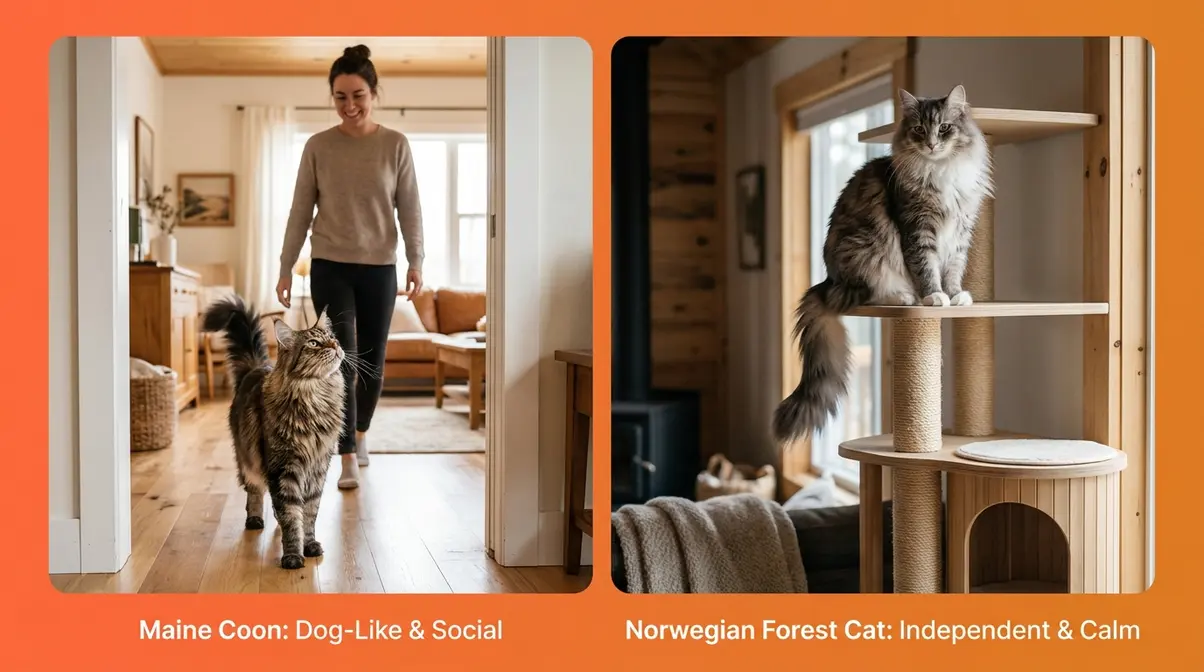
Both breeds have earned the “gentle giant” label — and both are legitimately gentle, large, and family-friendly. But their social styles are distinct enough that choosing the wrong one for your household can lead to genuine frustration. The personality gap is smaller than some breeders suggest, but it’s real and consistent.
Social Behavior and Attachment Style
Maine Coons are frequently described as dog-like — not as a marketing phrase, but as an accurate behavioral description. They follow their owners from room to room, greet you at the door, and often learn to fetch or walk on a leash. Breed communities consistently report that Maine Coons seek active participation in household activities rather than simply tolerating human presence. They’re curious, engaging, and genuinely sociable with strangers — an unusual trait in cats.
Norwegian Forest Cats are affectionate, but on their own terms. They bond deeply with their family but tend to be reserved and independent with unfamiliar people. Think of it this way: a Maine Coon wants to be part of whatever you’re doing; a Wegie wants to be near whatever you’re doing, watching from a comfortable vantage point. Both are loving. The style of that love is different.
“It seems like they’re fairly similar in terms of personality — but when you live with one, you notice the Maine Coon is always in the room with you, while the Wegie is always in the house with you.”
— Shared sentiment across Maine Coon and NFC owner communities
Activity Level, Vocalization, and Play
Maine Coons are chattier. They produce a distinctive chirping, trilling vocalization — less of a meow, more of a conversational warble — and they use it frequently. Owners describe being “talked to” throughout the day. Norwegian Forest Cats are quieter by comparison, vocalizing when they have something specific to communicate rather than maintaining a running commentary.
On activity level, both breeds are playful and intelligent, but neither is hyperactive. Across breeder evaluations and owner forums, the consistent finding is that Maine Coons sustain play sessions longer and remain more kitten-like in their play drive into adulthood. Wegies are equally playful but tend to self-regulate more — they’ll play hard, then retreat to a high perch and observe independently. Neither breed is the “most misbehaved” — that label tends to go to high-drive breeds like Bengals or Savannahs. Both the Maine Coon and Norwegian Forest Cat rank among the calmer, more adaptable large breeds.
Which Breed Suits Your Lifestyle?
If you work from home, have children, or want a cat that integrates fully into family life, the Maine Coon’s dog-like sociability is a genuine advantage. If you travel occasionally, live in a quieter household, or prefer a cat that’s affectionate without being demanding, the Norwegian Forest Cat’s independent warmth is a better fit. The Wegie is also a strong choice for multi-cat households — its calm, non-territorial nature tends to reduce conflict. For a deeper look at matching breed temperament to your living situation, see the Which Breed Is Right for You? section below.
Maine Coon vs Norwegian Forest Cat vs Siberian
People searching “maine coon vs norwegian forest cat” often stumble across a third breed that looks remarkably similar: the Siberian. All three are large, semi-longhaired, cold-climate breeds — and all three get mixed up regularly. Understanding how the Siberian differs helps you rule out a third possibility and confirms your identification.
How the Siberian Differs from Both
The Siberian is Russia’s national cat breed, with a history stretching back centuries in the Siberian taiga. Like the Maine Coon and Wegie, it developed naturally in a harsh cold climate — which explains the similarly dense, triple-layered coat (a woolly undercoat, a dense awn layer, and a water-resistant guard coat). The Siberian typically weighs 10–20 lbs for males, placing it between the Wegie and the Maine Coon in size.
The Siberian’s most notable distinction: it produces lower levels of the Fel d 1 protein (the primary cat allergen) than most breeds. Reputable breeders and veterinary allergists note this may reduce — not eliminate — allergic reactions in sensitive individuals. This makes the Siberian a popular choice for households with mild cat allergies. Neither the Maine Coon nor the Norwegian Forest Cat shares this trait. The Siberian’s head is also rounder and broader than either of the other two breeds — less triangular than the Wegie, less angular than the Maine Coon.
For more on finding the right large-breed cat, see our guide to large cat breeds for families.
3-Way Comparison Table
| Feature | Maine Coon | Norwegian Forest Cat | Siberian |
|---|---|---|---|
| Origin | USA (Maine) | Norway | Russia (Siberia) |
| Male Weight | 15–25 lbs | 12–20 lbs | 10–20 lbs |
| Head Shape | Modified wedge | Equilateral triangle | Broad, rounded |
| Nose Profile | Concave curve | Dead straight | Slight curve, broader |
| Allergen Level | Standard | Standard | Lower Fel d 1 (reduced) |
| Temperament | Dog-like, vocal | Independent, calm | Playful, affectionate |
| Primary Health Risk | HCM | GSD IV | HCM, PKD |
| 2026 Kitten Price | $1,500–$3,500 | $900–$2,500 | $1,200–$2,800 |
The CFA’s in-depth article on fine-tuning the three forest cats remains the most authoritative single resource for distinguishing all three breeds at the breed-standard level — worth bookmarking if you’re evaluating a cat of uncertain heritage.
What Cat Is Mistaken for a Maine Coon?
The Norwegian Forest Cat is the most commonly mistaken breed, followed closely by the Siberian. All three are large, semi-longhaired, tufted-eared cats — and domestic longhairs with similar coloring are frequently (and incorrectly) identified as Maine Coon mixes. The Chewy education guide on Norwegian Forest Cat vs Maine Coon offers additional photo-based comparison guidance for visual learners.
Cost, Health, and Care
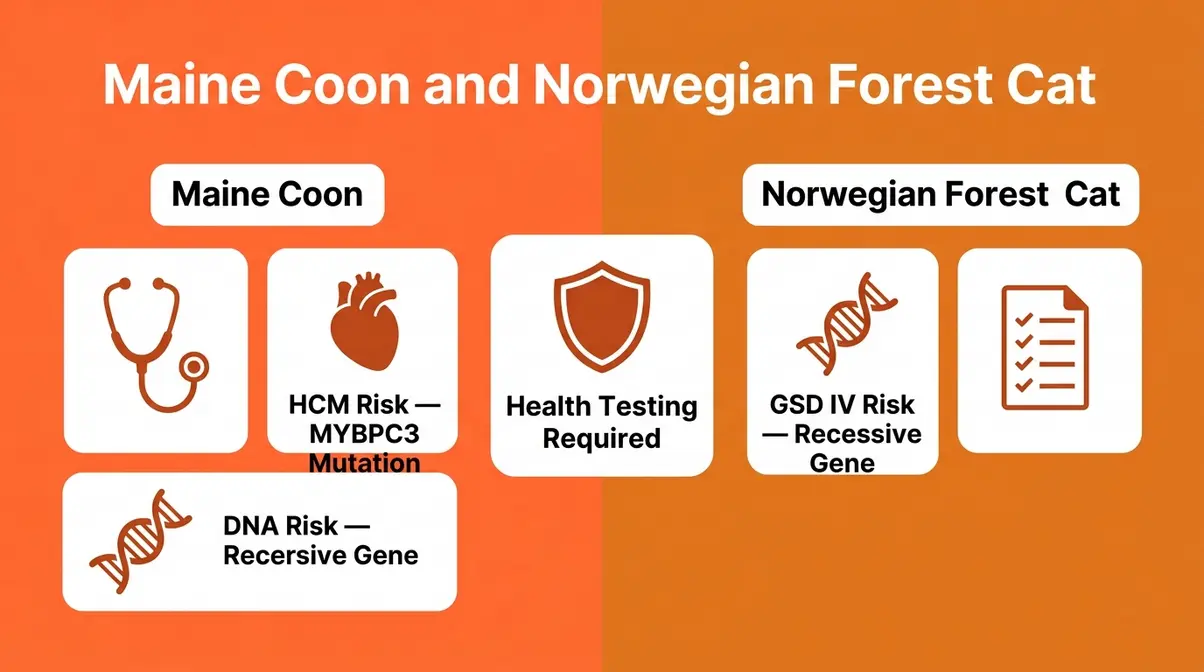
This is where the maine coon vs norwegian forest cat comparison gets most consequential. Both breeds are healthy with proper breeding practices — but “proper” means very different things for each, and skipping health verification can cost you thousands in vet bills and years of heartbreak.
Kitten Prices and Breeder Costs
Based on 2026 breeder listings across TICA-registered catteries in the United States:
- Maine Coon kittens: $1,500–$3,500 from health-tested breeders; show-quality lines can exceed $4,000
- Norwegian Forest Cat kittens: $900–$2,500 from reputable breeders; rarer color patterns push toward the upper range
- Siberian kittens (for comparison): $1,200–$2,800
These prices assume you’re purchasing from a breeder who provides HCM echocardiogram results and relevant DNA panel results. Kittens from unverified sources (pet stores, unregistered breeders) may appear cheaper but carry substantially higher lifetime health costs. Rescue and shelter adoption for both breeds runs $75–$500 depending on the organization.
Budget beyond the purchase price: expect $300–$600 annually for routine vet care, $200–$400 for professional grooming (optional but helpful for both breeds), and $50–$100/month for high-quality food appropriate for large-breed cats.
Breed-Specific Health Risks
Maine Coon — HCM (Hypertrophic Cardiomyopathy): HCM is a thickening of the heart muscle that can lead to heart failure. Research from Cornell University’s College of Veterinary Medicine identifies HCM as the most common cardiac disease in cats overall, with Maine Coons carrying a specific genetic mutation (MYBPC3 A31P) that predisposes them at higher rates than the general cat population. Veterinary cardiologists estimate that HCM affects a significant portion of Maine Coons — some studies place the prevalence of the MYBPC3 mutation in Maine Coons at approximately 34% (Meurs et al., Journal of Veterinary Internal Medicine, 2007; still the foundational study for this mutation).
- Before purchasing a Maine Coon kitten, request:
- DNA test results for the MYBPC3 A31P HCM mutation (both parents)
- Annual echocardiogram (heart ultrasound) records for breeding cats
- OFA (Orthopedic Foundation for Animals) cardiac registry listing for both parents
- Breeder’s written health guarantee covering HCM for a minimum of 2 years
Norwegian Forest Cat — GSD IV (Glycogen Storage Disease Type IV): GSD IV is a recessive metabolic disorder (meaning a kitten must inherit the defective gene from both parents to be affected) that causes progressive neuromuscular degeneration. UC Davis Veterinary Genetics Laboratory identifies Norwegian Forest Cats as the primary affected breed. GSD IV is fatal in affected kittens, typically causing death before 5 months of age — making pre-breeding DNA testing non-negotiable.
- Before purchasing a Norwegian Forest Cat kitten, request:
- GSD IV DNA test results (both parents must be tested — carrier × carrier = 25% affected offspring risk)
- HCM echocardiogram (Wegies also carry HCM risk, though lower prevalence than Maine Coons)
- Written confirmation that neither parent is GSD IV-positive (affected) — carriers can be bred safely only to clear (non-carrier) cats
Reputable breeders and veterinary geneticists recommend treating any breeder who cannot provide these documents as a red flag — regardless of price or appearance.
What’s the Silent Killer for Cats?
HCM (hypertrophic cardiomyopathy) is widely considered the silent killer in cats — it’s the most common cardiac disease in the species, often producing no visible symptoms until the disease is advanced or the cat collapses (Cornell University College of Veterinary Medicine). Maine Coons carry a specific genetic mutation (MYBPC3 A31P) that significantly increases HCM risk. Annual echocardiograms and pre-purchase DNA testing are the only reliable defenses. Kidney disease (chronic renal failure) is another leading silent killer in cats generally, which is why wet food and hydration matter across both breeds.
Grooming, Diet, and Daily Care
Both breeds require regular grooming — but the Maine Coon’s shaggy, uneven coat mats more readily than the Wegie’s flatter double coat. Across breed owner communities, the consistent finding is that Maine Coons benefit from 2–3 brushing sessions per week, while Norwegian Forest Cats can often manage with 1–2 sessions outside of seasonal shedding periods (spring and fall). During shedding season, both breeds will test your vacuum cleaner’s limits.
Diet should be appropriate for large breeds — high-protein, moderate-fat, with controlled carbohydrate content. Both breeds are prone to weight gain if free-fed on kibble alone. Wet food as a dietary staple (or at minimum a significant supplement to dry food) supports kidney health — relevant for any large cat with a longer-than-average lifespan. For breed-specific nutrition guidance, our cat food for large breeds guide covers caloric needs by weight range.
Which Breed Is Right for You?
Neither breed is universally superior — and anyone who tells you otherwise is selling something. The right choice depends entirely on your household, your schedule, and what you actually want from a cat relationship. Here’s how to think through it clearly.
Choose a Maine Coon If…
- You want a social, interactive companion. Maine Coons thrive in active households. They want to be involved — not just present. If you work from home or have children who want an engaging cat, the Maine Coon’s dog-like nature is a genuine match.
- You enjoy vocal cats. The Maine Coon’s chirping, trilling communication style is charming to owners who want a conversational cat — and potentially annoying to those who don’t.
- You have the time for regular grooming. The Maine Coon’s shaggy coat requires consistent brushing. If that sounds like a bonding ritual rather than a chore, you’re the right owner.
- You can commit to cardiac monitoring. Given HCM prevalence, annual vet echocardiograms are best practice for Maine Coons. Budget and schedule for this from day one.
For first-time owners considering a Maine Coon, our Maine Coon owner’s guide covers everything from kitten-proofing to litter box sizing for large breeds.
Choose a Norwegian Forest Cat If…
- You want affection without demands. The Wegie is deeply loving but respects your space. It will seek you out for cuddles on its own schedule — not yours. Many owners describe this as the perfect balance.
- You have a multi-cat household. Norwegian Forest Cats are notably calm and non-territorial. Their reserved and independent nature tends to reduce inter-cat tension compared to more assertive breeds.
- You prefer a quieter home. The Wegie vocalizes far less than the Maine Coon. If you work nights, have a baby, or simply prefer a calmer acoustic environment, this matters.
- You want a slightly lower entry cost. At $900–$2,500 vs. the Maine Coon’s $1,500–$3,500, the Wegie is generally more accessible — though GSD IV testing is non-negotiable and adds to breeder costs regardless.
For Norwegian Forest Cat care specifics, our Norwegian Forest Cat care guide covers coat maintenance and cold-weather enrichment for indoor Wegies.
Limitations and Common Misconceptions
Common Pitfalls
Pitfall 1: Trusting coat length as the primary identifier. Both breeds have semi-longhaired coats, and coat length varies significantly within each breed depending on season, age, and individual genetics. Owners who rely on “the fluffy one is the Maine Coon” get it wrong regularly. Use The Nose Profile Test instead — it works regardless of coat condition.
Pitfall 2: Assuming mixed-breed cats aren’t possible. Many cats sold or adopted as “Maine Coon mixes” or “Wegie mixes” are domestic longhairs with superficial resemblance to either breed. Without DNA testing (available from services like Basepaws or Wisdom Panel for approximately $65–$130 as of 2026), visual identification of a mixed-breed cat remains an educated guess — not a certainty.
Pitfall 3: Skipping health testing because the kitten “looks healthy.” GSD IV-affected Norwegian Forest Cat kittens appear normal at birth. HCM in Maine Coons often produces no symptoms until the disease is advanced. Appearance is not a health indicator for either condition. Veterinary records indicate that early genetic screening is the only reliable prevention strategy.
When to Choose Alternatives
If you have confirmed cat allergies in your household, neither the Maine Coon nor the Norwegian Forest Cat is the right starting point — consider the Siberian first, given its reduced Fel d 1 production. If you want a large, affectionate cat but live in a very small apartment, both breeds benefit from vertical space (cat trees, wall shelves) and interactive play — a cramped environment without enrichment is a poor fit for either.
When to Seek Expert Help
If you’re purchasing a kitten above $2,000 and the breeder cannot produce current OFA cardiac registry listings and DNA panel results, consult a veterinary geneticist before completing the purchase. For cats showing any signs of breathing difficulty, lethargy, or exercise intolerance — symptoms associated with HCM — seek a veterinary cardiologist (not just a general practitioner) for echocardiogram evaluation.
Frequently Asked Questions
How do I tell if my cat is a Maine Coon or Norwegian Forest Cat?
Use The Nose Profile Test — view your cat’s face from the side and trace the line from forehead to nose tip. Maine Coons show a gentle concave curve; Norwegian Forest Cats have a dead-straight profile with no break. Head shape is the secondary check: Maine Coons have a modified wedge with high cheekbones, while Wegies have a true equilateral triangle face. For mixed-breed cats, a DNA test (Basepaws or Wisdom Panel, approximately $65–$130 as of 2026) provides a definitive answer where visual identification falls short.
Is a Norwegian Forest Cat bigger than a Maine Coon?
No. Maine Coons are consistently the larger breed. Male Maine Coons typically reach 15–25 lbs compared to the Norwegian Forest Cat’s 12–20 lbs (CFA breed standards). Female weights are nearly identical for both breeds (8–12 lbs), which is why size alone is an unreliable identifier for female cats or kittens. The Maine Coon also matures more slowly — up to 3–5 years — so a young Maine Coon may temporarily appear smaller than an adult Wegie.
What is the most misbehaved cat breed?
Neither the Maine Coon nor the Norwegian Forest Cat ranks among the most difficult breeds behaviorally. High-energy breeds like Bengals, Savannahs, and Abyssinians tend to generate the most behavioral complaints due to their intense prey drive and need for constant stimulation. Both Maine Coons and Wegies are adaptable, intelligent, and generally well-mannered — though Maine Coons will get into things out of curiosity, and Wegies will climb anything vertical in the house.
What are the disadvantages of a Norwegian Forest Cat?
The primary disadvantages are independence and grooming demands. Wegies are not lap cats on demand — they bond deeply but engage on their own schedule, which frustrates owners expecting constant affection. Their double coat requires consistent brushing (especially during spring and fall shedding), and neglected coats mat quickly. The GSD IV genetic risk means breeder due diligence is non-negotiable. Finally, Norwegian Forest Cats are skilled climbers and jumpers — a home without vertical enrichment is a poor fit.
What is the calmest breed of cat?
Among large breeds, the Norwegian Forest Cat and the Ragdoll consistently rank as the calmest. Wegies have a naturally low-stress temperament, are rarely reactive to household noise, and self-regulate their activity well. The Ragdoll goes further — its famously relaxed disposition (including going limp when held) earns it the top calm-breed ranking in most breeder and veterinarian surveys. Maine Coons are calm relative to high-energy breeds but are more active and vocal than either the Wegie or the Ragdoll.
What is the personality difference between a Maine Coon and a Norwegian Forest Cat?
Maine Coons are outwardly social and interactive; Norwegian Forest Cats are warmly independent. Maine Coons follow their owners, vocalize frequently, and seek active participation in household activities — classic dog-like behavior. Norwegian Forest Cats bond deeply with their family but engage more selectively, prefer to observe from a comfortable perch, and are quieter overall. Both are gentle, non-aggressive, and family-friendly. The difference is in how they express affection, not whether they’re affectionate.
Are Norwegian Forest Cats hypoallergenic?
No, Norwegian Forest Cats are not hypoallergenic. Like Maine Coons, they produce standard levels of the Fel d 1 protein, which is the primary allergen responsible for cat allergies. If you have mild cat allergies but still want a large forest breed, the Siberian cat is a better alternative, as it naturally produces significantly lower levels of this allergen.
Do Maine Coons and Norwegian Forest Cats get along?
Yes, Maine Coons and Norwegian Forest Cats generally get along very well. Both breeds are known for their gentle, non-aggressive temperaments. The Norwegian Forest Cat’s calm and non-territorial nature perfectly balances the Maine Coon’s more playful and dog-like energy, making them an excellent pairing for a multi-cat household.
Choosing Your Gentle Giant
For prospective owners comparing these two breeds, the Maine Coon vs Norwegian Forest Cat decision is ultimately about social style. Maine Coons deliver constant, dog-like companionship — they’re in the room, in the conversation, and in your lap on your schedule. Norwegian Forest Cats offer something equally valuable: deep, quiet loyalty that respects your space. Both are large, semi-longhaired gentle giants with long lifespans, manageable temperaments, and genuine warmth. The breed-specific health risks (HCM for Maine Coons, GSD IV for Wegies) are serious but entirely manageable with proper breeder vetting — and now you know exactly what to ask for.
The Nose Profile Test — that single curved-vs-straight observation — is your starting point for everything else. Once you can identify the breed in front of you, every other decision (health testing, grooming commitment, personality fit) falls into place. That’s the value of having one reliable anchor: it makes the rest of the research feel less overwhelming and more decisive.
Your next step is simple: if you’re evaluating a kitten, request the health documentation checklist from this article before you fall in love with a face. If you’re identifying a cat you already own, run The Nose Profile Test from a side-profile photo and check it against the comparison table above. Either way, you now have everything you need to choose — or identify — your perfect large-breed companion with total confidence.

Dave King
Cat owner and writer at Mad Cat Man.