How to Groom a Long-Haired Cat: 5-Step Guide
Explore practical guidance for 12 Essential Grooming Hacks for Long Fur Cats: Tools, Daily Routines & When to See a Pro packed with data-backed advice…

“He absolutely hates the sound of the clippers and is very skittish in general. We manage to get his nails clipped and some of the bigger mats around his butt, but his tummy has gotten so matted.”
If that sounds familiar, you’re not alone — and you’re not doing anything wrong. Learning how to groom a long-haired cat is genuinely harder than most guides admit, and the gap between “brush regularly” and actually preventing mats is enormous when your cat fights back.
The real cost of inaction is worth naming: mats (tight tangles of fur that pull painfully against the skin) tighten over days until they’re too painful to brush out at home, and a cat that’s already uncomfortable becomes more resistant with every failed attempt. Left unmanaged, hygiene problems follow — especially around the rear, where feces can become trapped in matted fur.
In this guide, you’ll learn exactly how to groom a long-haired cat safely at home — from choosing the right tools to removing mats without scissors and calming a cat that fights back. We’ll walk through five clear steps, plus a product table of vetted grooming tools to make the job easier.
Disclosure: madcatman.com is a participant in the Amazon Services LLC Associates Program. If you purchase through our links, we may earn a small commission at no extra cost to you. This does not influence our recommendations.
Recommended Products
| # | Image | Product | Best For | Buy |
|---|---|---|---|---|
| 1 |  |
Docrok Deshedding Combo | Best overall combo kit | Buy on Amazon |
| 2 |  |
Aumuca Cat Grooming Brush | Everyday shedding control | Buy on Amazon |
| 3 |  |
Pat Your Pet Double-Sided Brush | Skin-friendly deshedding | Buy on Amazon |
| 4 |  |
FelineFun 2-in-1 Undercoat Rake | Dematting and deshedding | Buy on Amazon |
| 5 |  |
Double-Sided Dematting Rake | Ragdoll and Maine Coon | Buy on Amazon |
| 6 |  |
SleekEZ Deshedding Brush | USA-made, all coat types | Buy on Amazon |
| 7 |  |
Grooming Comb for Curly Hair | Tangle and mat prevention | Buy on Amazon |
| 8 |  |
Maxpower Planet Grooming Rake | Dense undercoat removal | Buy on Amazon |
Long-haired cats need daily brushing to prevent painful mats — cats spend up to 50% of their waking hours self-grooming, but long-haired breeds still need your help (Ohio State University College of Veterinary Medicine). The Groom-Calm-Reward Loop is a repeatable 3-step method that turns anxious grooming sessions into a calm, manageable habit.
- Never use scissors on matted fur — feline skin is paper-thin and easily cut
- Brush daily in friction zones: belly, armpits, behind the ears, and base of tail
- The Groom-Calm-Reward Loop conditions anxious cats to tolerate grooming in short, positive sessions
- Sanitary trims around the rear prevent hygiene problems (“boo-boo stuck”)
- Call a vet or groomer if mats are tight against the skin or your cat shows aggression
- 【Easy Dematting and Deshedding Tools】: Our Grooming brush and comb combo help effortlessly dematting and reduces shedding. A must have dog brush for shedding, pet supplies, cat supplies, dog supplies metal comb for dogs shedding.
- 【Safe Design】: Soft and protective edge brush and comb creating a comfortable feeling while detangling matted hair and deshedding without hurting your pet. Perfect metal comb for dogs, dematting comb for cats, undercoat rake for dogs double coat.
- 【2-in-1 Rake】: Our undercoat rake is perfect for medium and long-haired dogs and cats and other double coat pets. Wide side for easy dematting, dense side for deshedding. Well made deshedding tool, grooming brush and deshedder brush for dogs.
- 【2-in-1 Comb】: Wide sided for comb knot, smoothing and modeling your pet's hair, dense side for removal of loosen hair, you can use it on the legs, head or tail of your pets where the brush can’t. Perfect metal comb for dogs, dematting comb for cats deshedding tool for dogs.
- 【Sturdy and Comfortable Design】: Premium Stainless steel metal teeth and compact design make our product sturdy and durable. High-quality & lightweight TPR handle make your grooming effortlessly. High-quality undercoat rake for dogs double coat, metal comb for dogs, dematting comb for cats, dog comb for matted hair.
- 【Professional Cat Hair Brush】Perfect gift for pet owners, vets, and pet groomers. Using this cat brush for long haired cats on a regular basis can gently and effectively remove loose hair, tangles, knots, dander and trapped dirt. Suitable for short, medium or long, thick, thin or curly haired dogs/cats/rabbits, making your pets shiny and healthy.
- 【Skin-friendly Massage Needles】The mental pins on the cat brush with release button have round rubber tips on the ends. As a cat deshedding brush, it's perfect for shedding and massaging your pets without scratching your pet's skin, even the sensitive skin. After use, you can hang it with the silicone loop strap to protect the bent needle.
- 【Upgraded High Quality Material】The our long hair cat grooming brush made of durable 304 stainless steel and fine ABS material. Our wire bristles is 1.2 times as thick as bristles of other deshedding brush for cats. More sturdy and not easy to deform, can be used for a long time. 150° bent needles designed to penetrate deep into the coat are really easier to groom the undercoat well.
- 【One-click Cleaning Button】After brushing your pet, simply click the button. The shutter will pop out, separating the brushed hair from the metal needle, then wipe the hair off. The button of cat shedding brush on the handle saves time and energy when grooming and cleaning.
- 【SUPPORT · 365 Days】If the pet hair brush have any problems during use, we will provide you with replacement or 100% money back. And we have a professional customer service team and pet experts to provide you with the pre-sales and after-sales service. aumuca is always at your side.

- Dual-Head Design: 2 sides, 2 coats, 1 tool! Use the 9-teeth side of this dog and cat brush for smooth dematting, and the 17-teeth side for quick coat thinning and deshedding.
- Skin Safe: Pamper your pet - pain-free! The teeth on this dog brush for shedding are rounded to make sure your furry friend's skin is protected.
- This deshedding brush is perfect for cats and dogs with thick, long fur - but it's great for coats of all kinds! Long lasting and durable pet comb that works great even on horses.
- Easy Grip Handle: Get even the nastiest knots out with ease! Our dog and cat brush for shedding has a non-slip handle to give you a firm and comfortable grip.
- Comes with a "paw tag" for your keychain or pet collar!

- 【𝗧𝗮𝗶𝗹𝗼𝗿𝗲𝗱 𝗳𝗼𝗿 𝗖𝗮𝘁𝘀】Every part that Touches your Cat is Crafted with the Utmost Gentleness in Mind, Ensuring a Stress-Free Grooming Experience for your Feline Friend and a Quick, Professional Look in Just Minutes.
- 【𝗩𝗲𝗿𝘀𝗮𝘁𝗶𝗹𝗲 𝗗𝗼𝘂𝗯𝗹𝗲-𝗦𝗶𝗱𝗲𝗱 𝗗𝗲𝘀𝗶𝗴𝗻】The Lower Density Side Serves as a Dematting Rake, Handling Stubborn Mats and Tangles, While the Higher Density Side Excels as a Detangler, Deshedding Tool, or Undercoat Rake, Providing Faster Results in Thinning and Shedding control.
- 【𝗚𝗲𝗻𝘁𝗹𝗲 𝗼𝗻 𝗦𝗲𝗻𝘀𝗶𝘁𝗶𝘃𝗲 𝗦𝗸𝗶𝗻】Dematting Tool has Sharp Stainless Steel Blades that Cut Through Mats and Tangles Without Pulling Hair. Plus, All Teeth have Dull Rounded Ends to keep your Pet's Skin Scratch-Free and Irritation-Free During Grooming.
- 【𝗖𝗼𝗺𝗳𝗼𝗿𝘁𝗮𝗯𝗹𝗲 𝗚𝗿𝗼𝗼𝗺𝗶𝗻𝗴 𝗘𝘅𝗽𝗲𝗿𝗶𝗲𝗻𝗰𝗲】Rounded Ends make it Safer on Sensitive Skin, Functioning as an Effective Undercoat Brush. The Anti-Slip High-Qulity Wooden Grip Guarantees a Comfortable and Relaxing Brushing Experience for Both you and your Feline Companion.
- 【𝗖𝗼𝘀𝘁-𝗘𝗳𝗳𝗲𝗰𝘁𝗶𝘃𝗲 𝗦𝗼𝗹𝘂𝘁𝗶𝗼𝗻】One Comb, Multiple Uses. This comb serves as a Dematting Brush, Detangling Comb, Undercoat Comb & Deshedding Rake. Easily Tackle Mats & Tangles, Then Switch to Deshedding for Cats , Saving you from Buying Separate Tools.
- DUAL-SIDED DESIGN: Our Undercoat Rake Dog brush is perfect for deshedding your pet's coat. Designed with a dual-sided design, start with a 9-teeth side to tackle stubborn mats and tangles, and finish with a 17-teeth side to thin out and deshed after.
- HEALTHY COAT AND REDUCED SHEDDING: Our deshedding brush for dogs is designed with sharpened but finely rounded teeth that allow you to easily and safely remove mats, tangles, knots, and loose hair without irritation or scratching.
- EFFECTIVE DESHEDDING TOOL: This dematting and deshedding brush gently removes loose hair and eliminates tangles, knots, dander, and trapped dirt. The perfect cat grooming tool solution for pets with thick fur or dense double coats.
- COMFORTABLE TO USE: Keep your pet clean and healthy with our dog and cat brush for grooming. Designed with a lightweight, comfortable handle and a non-slip rubber base to keep the brush from moving around as you brush your pet.
- PERFECT GIFT FOR PET LOVERS: Our dog comb brush is a must-have grooming products for dogs and cats. A great gift undercoat rake dog for pet lovers who want to keep their fur buddies clean, healthy, and well-groomed!

- SAVE MONEY: Reduce expensive trips to the groomer. Our dog shedding brush works great as a dog brush for short haired dogs & dog brush for long haired dogs. It is an absolute essential for pet supplies, dog supplies, and a dog grooming kit.
- ALL HAIR & FUR TYPES: Our dog brushes for grooming safely removes loose hair without irritation. SleekEZ dog hair brush works great as a pet hair remover / dog hair remover for pets of all fur types and hair lengths.
- EASY AND FAST CLEANUP: SleekEZ also works great as a carpet rake, pet hair rake, & dog fur remover tool. It removes hair & fur from couches, cars, blankets, beds & more! Its innovative design ensures that hair is easily gathered and removed.
- PAINLESS AND ENJOYABLE: SleekEZ's patented design helps grab at the tips of the hair to extract from the skin without painful tugging. It is the perfect undercoat brush for dogs and deshedding dog brush. Works on all coat types and animal breeds!
- GREAT GIFT: A must have metal dog comb for any pet grooming kit. The perfect pet grooming metal comb for dogs & dog deshedding brush. Worlds best grooming brushes / dog grooming brush. Voted #1 dog brushes for shedding & deshedder brush for dogs.

- 【Professional-Grade】: This hair comb set black are made of upgrade Carbon Fiber, sturdy and durable. Not easy to deform and break, can be used for a long time to save your money.
- 【Comfortable】: KL professional wide and fine tooth comb were designed to be glide smoothly without hurting the scalp, avoid hair tangling and knotting. improve blood circulation, reduce hair loss.
- 【Wide Applications】: Our rat tail hair barber comb is good for women & man use, barber, hair salon and more, this comb kit will accommodate a variety of styling needs, combs for wet curly natural hair detangling parting teasing styling & cutting demands.
- 【What You Will Get】 : You will get 6 pieces combs totally, with rich styles and enough quantity to meet most of your styling needs in daily life.
- 【Risk-Free After-Sales】: KL focused on bringing you the quality products to fit your lifestyle forever. We always stand behind all our products, If there are any reason you're not happy with it, pls contact us we will get this matter resolved as soon as possible till to your satisfaction.
- DUAL-SIDED DESIGN: Our Undercoat Rake Dog brush is perfect for deshedding your pet's coat. Designed with a dual-sided design, start with a 9-teeth side to tackle stubborn mats and tangles, and finish with a 17-teeth side to thin out and deshed after.
- HEALTHY COAT AND REDUCED SHEDDING: Our deshedding brush for dogs is designed with sharpened but finely rounded teeth that allow you to easily and safely remove mats, tangles, knots, and loose hair without irritation or scratching.
- EFFECTIVE DESHEDDING TOOL: This dematting and deshedding brush gently removes loose hair and eliminates tangles, knots, dander, and trapped dirt. The perfect cat grooming tool solution for pets with thick fur or dense double coats.
- COMFORTABLE TO USE: Keep your pet clean and healthy with our dog and cat brush for grooming. Designed with a lightweight, comfortable handle and a non-slip rubber base to keep the brush from moving around as you brush your pet.
- PERFECT GIFT FOR PET LOVERS: Our dog comb brush is a must-have grooming products for dogs and cats. A great gift undercoat rake dog for pet lovers who want to keep their fur buddies clean, healthy, and well-groomed!
Step 1 — Master the Basics: Essential Tools and Grooming Techniques
- Quick Answer: How to Groom a Long-Haired Cat
- Gather your tools: slicker brush, metal comb, mat splitter
- Start with the metal comb, working from tips to roots
- Brush friction zones daily: belly, armpits, behind ears, tail base
- Never force — keep first sessions under 5 minutes
- Reward your cat immediately after every session
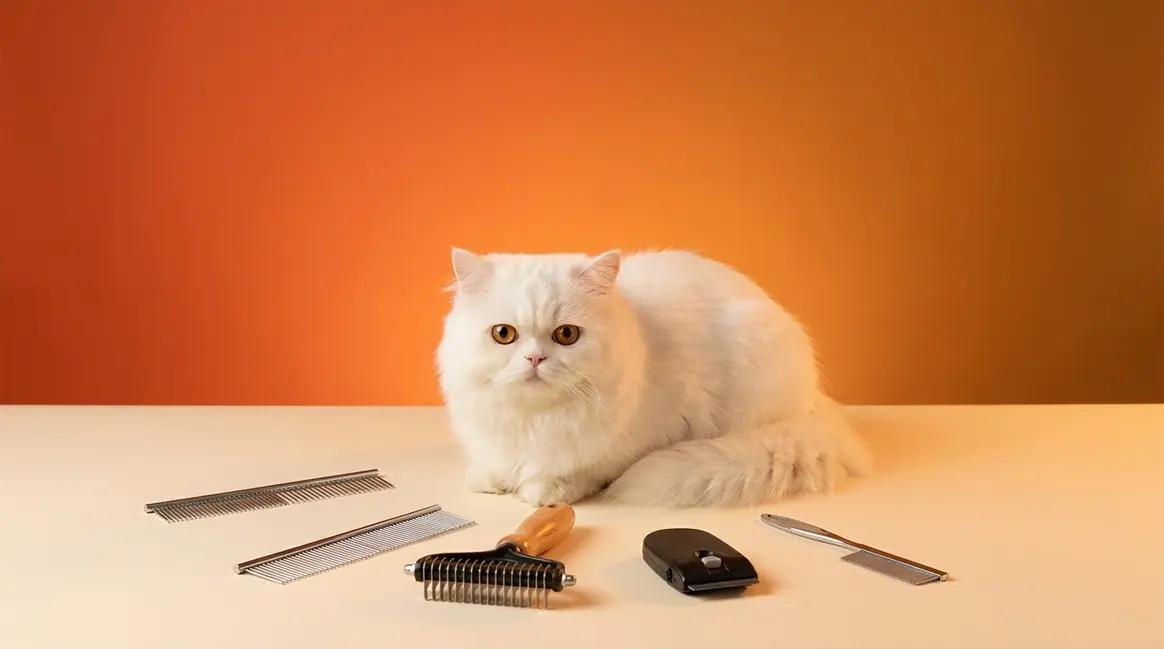
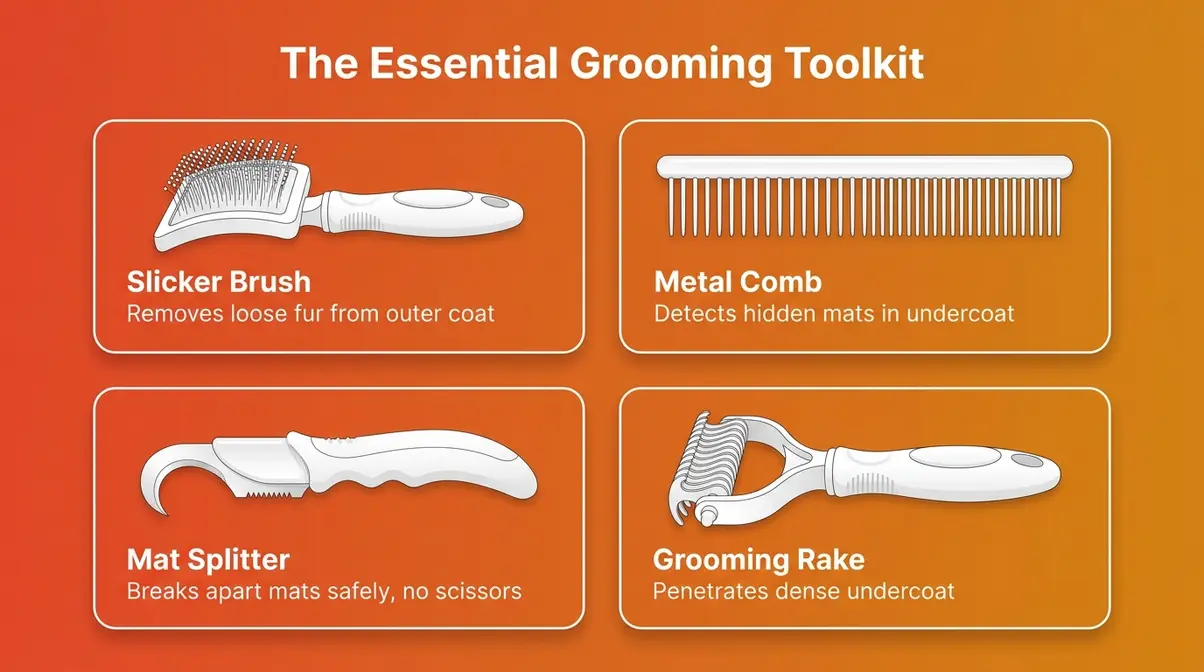
Knowing how to groom a cat starts with having the right four tools — and understanding what each one actually does. As the Ohio State University College of Veterinary Medicine notes, cats spend up to 50% of their waking hours grooming, yet long-haired breeds still need daily human assistance to prevent the painful mats that form in friction zones. You can learn essential cat grooming techniques even if you’ve never held a slicker brush before — and you’ll build on these tools in Step 4 when we introduce the Groom-Calm-Reward Loop for resistant cats.
The Four Tools Every Long-Haired Cat Owner Needs
You can groom a long-haired cat yourself with just four tools — but buying the wrong ones (or skipping one entirely) is the most common reason beginner owners struggle.
1. Slicker brush — a paddle-shaped brush with fine wire bristles set in a flexible base. It removes loose fur from the outer coat and smooths surface tangles. Without it, shed fur sits on top of the coat and becomes the raw material for new mats.
2. Wide-tooth metal comb — your single most important tool. A greyhound-style comb with both wide and narrow teeth reaches through the outer coat all the way to the skin, which is where mats actually start. Think of it as a “mat detector” — if it snags, you’ve found a problem before it becomes serious. Most beginners skip this and buy only a brush, which is why they miss hidden mats until they’re painful.
3. Mat splitter (also called a mat breaker) — a specialized comb with sharp inner edges designed to break apart a tangled clump without pulling the skin. This is the safe alternative to scissors for small, manageable mats. A double-sided dematting rake like those in our product table above combines mat-splitting and undercoat removal in one tool.
4. Grooming rake — a wider tool with rotating teeth that penetrates the dense undercoat of long-haired breeds like Persians, Maine Coons, and Ragdolls. The Docrok Deshedding Combo and the Maxpower Planet Grooming Rake from our table both include rake functionality built in.
“If you only buy one tool today, make it the metal comb — it will tell you immediately whether a mat is forming before it becomes painful.”
The infographic below shows all four tools and when to use each one.
Now that you have the right tools, the next step is knowing exactly how to use them — and where to focus first.
How to Brush a Long-Haired Cat Without Causing Pain
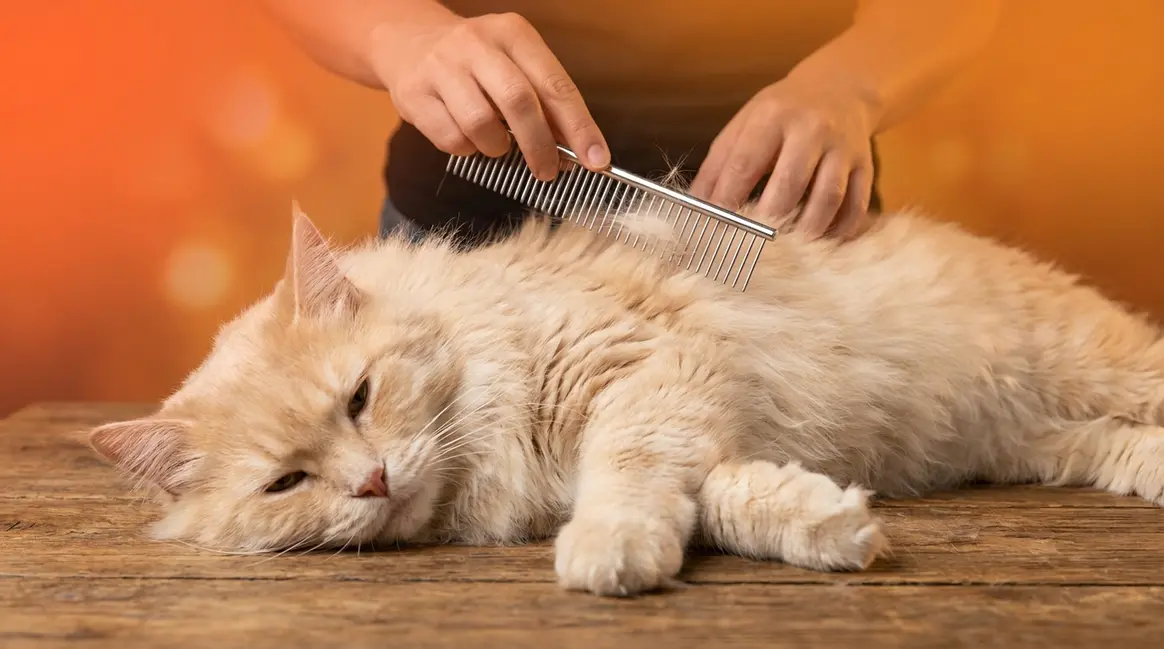
Learning how to groom a cat at home safely comes down to sequence and pressure. The most important rule: always start with the metal comb, never the brush.
Long-haired cats have two layers of fur — a silky outer coat and a dense, woolly undercoat. Mats form in the undercoat, not on top. If your brush glides easily but your comb snags, you’re only brushing the surface. This is the #1 beginner mistake, and it’s why mats continue forming even when owners think they’re grooming regularly.
Brushing sequence (follow this order every time):
- Place your cat on a non-slip surface at waist height — a rubber bath mat on a table works well.
- Section off a small area of fur (about the size of your palm).
- Hold the base of that section gently with your free hand to prevent skin-pulling.
- Start the metal comb at the tips of the fur and work toward the roots in short strokes — never root-to-tip, which drags the comb through tangles.
- When the comb glides through freely with no resistance, follow with the slicker brush in the same direction as fur growth.
- Reward immediately with a treat or brief play.
Experienced cat groomers consistently find that short, methodical sections cause far less distress than long, sweeping strokes across the whole coat. Aim for 5 minutes maximum for new or anxious cats.
Knowing how to brush is only half the equation — knowing WHERE to brush is what separates owners who prevent mats from those who discover them too late.
The Friction Zones: Where Mats Form First
Five areas on your cat’s body mat faster than anywhere else — and they’re the ones most owners miss:
- Belly and abdomen — the most common site for tight mats; movement from walking constantly rubs these hairs together
- Armpits — where the front legs meet the chest; high friction from every step
- Behind the ears — especially in cats that wear collars or are handled frequently
- Base of the tail — where the tail meets the back; often overlooked during brushing
- Collar area — if your cat wears a collar, the fur underneath mats within days
These are the friction zones — the areas where your cat’s “tummy has gotten so matted.” They’re the first to go and the last to get attention in a typical brushing session. Check these zones first at every grooming session by running the metal comb through each one before doing anything else. If you find resistance in any zone, address it before moving on to the rest of the coat. How to groom a cat with matted fur always starts by locating exactly where those mats are hiding.
Now that you know the tools and the technique, the next question every long-haired cat owner asks is: how often do I actually need to do this?
Step 2 — Build a Grooming Routine That Prevents Mats
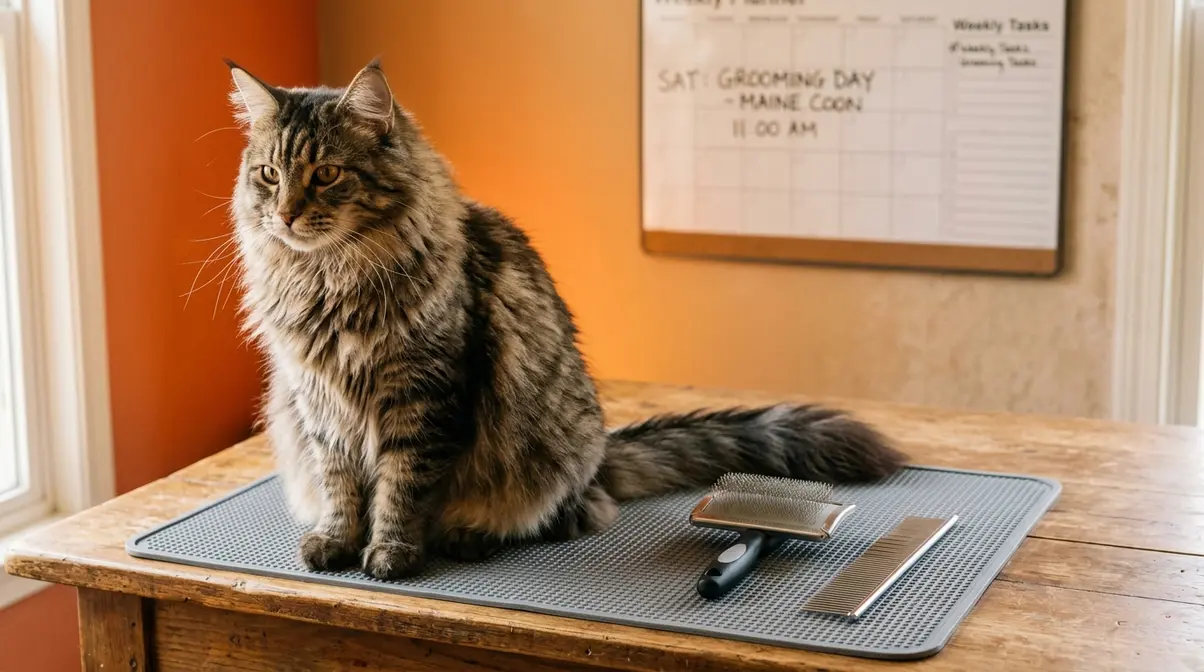
Long-haired cats need a brief comb-through of friction zones every day and a full grooming session at least twice a week. Without this routine, loose undercoat fur tangles into mats within days — especially in high-movement areas like the belly and armpits. Long-haired cats require daily brushing in friction zones to prevent mat formation; weekly full-coat grooming sessions are the minimum for breeds like Persian and Maine Coon.
How Often Should You Groom a Long-Haired Cat?
How often to groom a long-haired cat depends on coat length and density, but the baseline schedule for all long-haired breeds is the same:
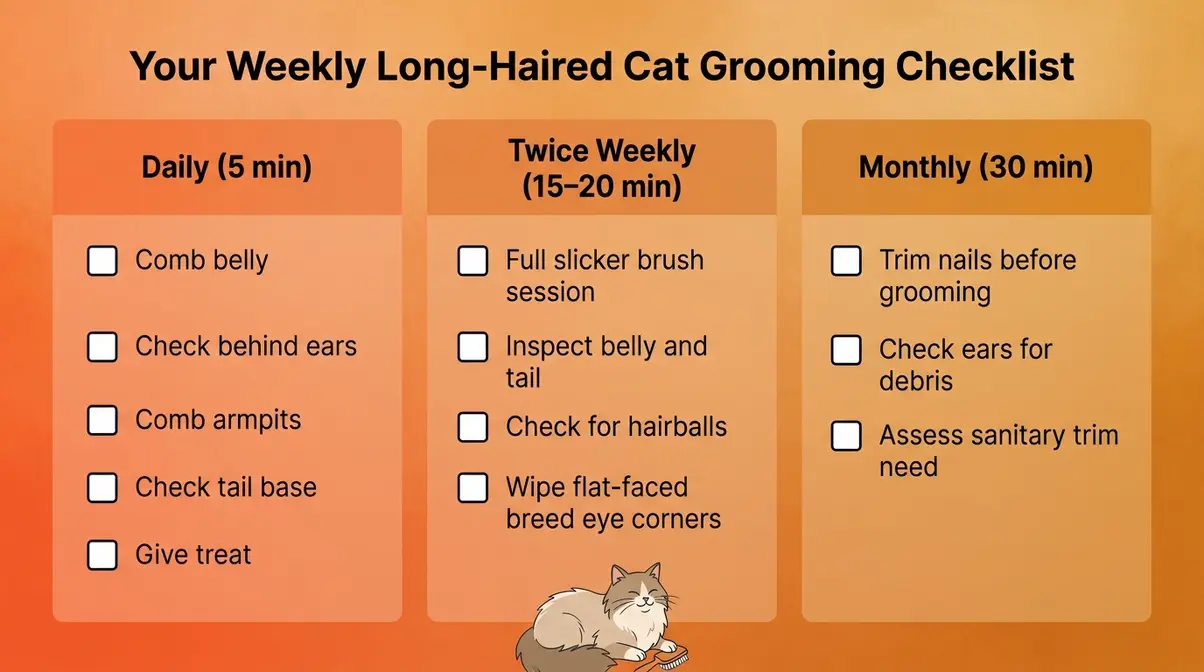
Daily (5 minutes): A quick comb-through of friction zones only. The goal is to catch loose fur before it tangles. Think of it as maintenance, not a full session — you’re not trying to groom the whole cat, just checking the five problem areas.
Twice weekly (15–20 minutes): Full coat brush-out, including belly, tail, and collar area. This is when you check for early-stage mats (small tangles that still pull apart easily with your fingers). Breeds like Persian, Maine Coon, Ragdoll, and Norwegian Forest Cat benefit from a third session per week during spring and fall shedding seasons.
Monthly (30 minutes): Full inspection including ears, eyes, nails, and the anal area. This is also when to assess whether a sanitary trim is needed around the rear (covered in Step 5).
| Frequency | Time | Tasks |
|---|---|---|
| Daily | 5 min | Comb friction zones; check for new tangles |
| Twice weekly | 15–20 min | Full brush-out; inspect belly, tail, collar area |
| Monthly | 30 min | Full inspection; ears, nails, anal area; sanitary trim assessment |
Important: If your cat’s fur is already heavily matted, skip straight to Step 3 — daily brushing on an ungroomed coat will cause pain and make your cat more resistant over time.
A schedule is only useful if you can actually stick to it — which is why the next section breaks it into specific, easy tasks.
Daily, Weekly, and Monthly Grooming Tasks
- Daily routine (5 minutes):
- Run the metal comb through the belly
- Check behind both ears
- Run the comb through both armpits
- Check the base of the tail
- Reward with a treat
- Weekly tasks:
- Complete the daily friction-zone sequence first
- Follow with a full slicker brush session from neck to tail
- Check for hairballs — frequent vomiting or excessive self-licking signals the coat needs more frequent brushing
- For flat-faced breeds (Persians, Exotic Shorthairs), wipe eye corners gently with a damp cloth
- Monthly tasks:
- Trim nails before grooming — it reduces scratching if the cat becomes anxious
- Check ears for dark debris or unusual odor (signs of infection that warrant a vet visit)
- Assess whether a sanitary trim is needed around the rear
Experienced cat owners consistently find that pairing the daily comb-through with a meal — grooming while the cat eats — reduces resistance significantly. The cat’s attention is on the food, not the comb. Building a daily grooming routine for long-haired cats takes about two weeks to become habit for both of you.
Save the checklist below — it covers everything you need to do and when.
A consistent routine prevents most mats from forming — but if your cat already has tight tangles, the next step is critical: how to remove them safely without reaching for scissors.
Diet, Hydration, and Coat Health
What your cat eats directly affects how easily their coat mats. Omega-3 fatty acids (found in fish oil supplements or high-quality wet food) reduce excessive shedding and improve coat elasticity, making individual hairs less prone to tangling. Several pet nutrition studies and veterinary sources including the Pet Doctors of America note this diet-coat connection as consistently underappreciated by owners.
Dehydration makes fur brittle and more likely to mat — ensure fresh water is always available, and consider transitioning to wet food for cats that drink very little. A cat with a dry, dull coat that mats quickly may need a diet review, not just more brushing. Even with the best routine, mats can still form — especially in friction zones on cats that resist handling — and when they do, you need to know exactly how to remove them safely.
Step 3 — Safely Remove Matted Fur Without Scissors
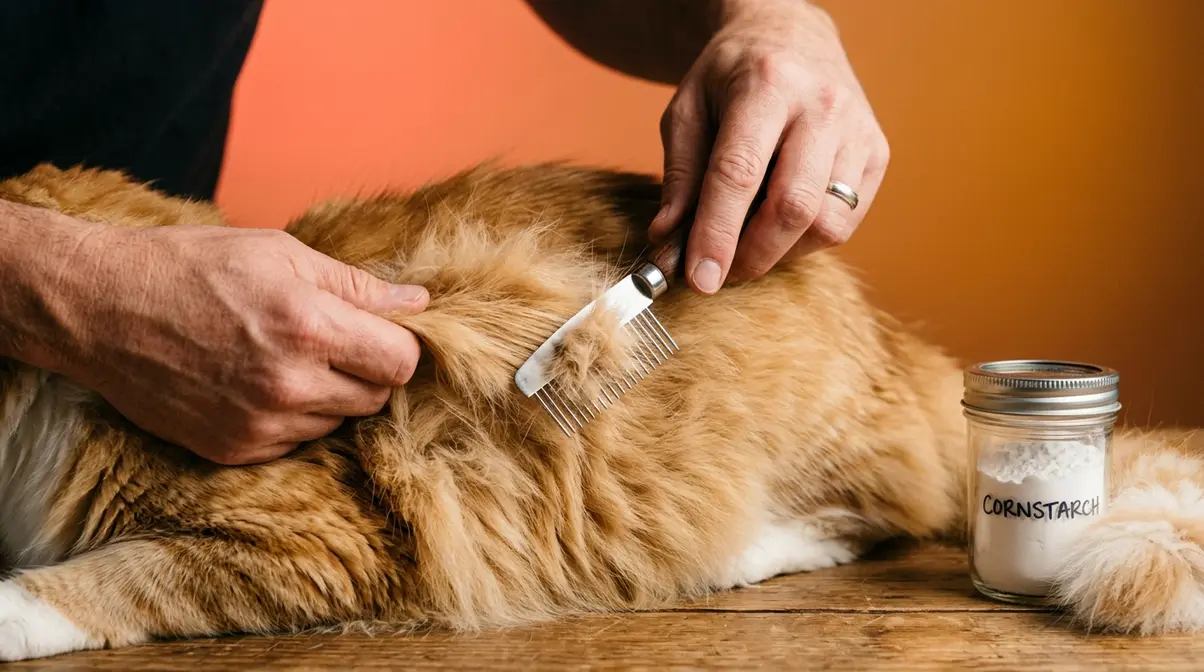
Safe mat removal is one of the most critical skills for any long-haired cat owner. Mats that are caught early — when they’re still soft and pull apart with fingers — can be addressed at home in minutes. Mats that are tight against the skin are a different problem entirely, and the tool most people instinctively reach for (scissors) is the most dangerous choice you can make.
Why You Must Never Use Scissors on Cat Mats
⚠️ SAFETY WARNING: Never use scissors to cut cat mats.
Feline skin is extremely thin and loose — it folds, tents, and shifts in ways that make it nearly impossible to see where the skin ends and the mat begins. What looks like a safe gap between mat and skin is often a fold of skin itself. Veterinary emergency rooms treat scissor lacerations from at-home mat removal regularly, and the Cornell Feline Health Center explicitly warns against using scissors on matted cat fur for exactly this reason.
The mat pulls the skin upward toward the blades. You cannot feel the skin through a tight mat, and cats often go still from pain — not cooperation — making the cut seem safe when it isn’t.
Can I cut my cat’s matted fur with scissors? The answer from veterinary professionals is a consistent and unambiguous no. Use a mat splitter, a mat breaker comb, or call a professional groomer. These tools work with the mat’s structure rather than against the skin.
Step-by-Step: How to Remove a Mat at Home
Mat removal at home is appropriate for soft, early-stage mats only. If the mat is hard, tight against the skin, or larger than a golf ball, skip to the professional groomer guidance below.
What you’ll need: A mat splitter or wide-tooth metal comb, cornstarch or a detangling spray (optional), and high-value treats.
Estimated time: 5–10 minutes per small mat.
Steps:
- Sprinkle a small amount of cornstarch directly onto the mat and work it in gently with your fingers. Cornstarch reduces friction between hairs and makes the mat easier to separate.
- Hold the base of the mat firmly between your thumb and forefinger, pressing against the skin. This is the most important step — it prevents the skin from being pulled when you work the mat.
- Insert the mat splitter (a specialized comb with sharp inner edges designed to break apart a tangled clump) at the outer edge of the mat, not the center. Work from the outside in, making short downward strokes away from the skin.
- Use your fingers to gently tease apart the loosened sections. Never pull upward or outward — always work in the direction the fur naturally grows.
- Follow with the wide-tooth metal comb once the mat begins to break up, combing from tips to roots in small sections.
- Reward immediately with a treat after each mat is removed — even if the session was stressful. This is the foundation of the Groom-Calm-Reward Loop you’ll learn in Step 4.
As Tufts University’s Cummings School of Veterinary Medicine notes, pulling on matted fur causes genuine pain — the skin beneath a tight mat is often already irritated. Work slowly, take breaks, and never attempt more than one or two mats per session on an anxious cat.
When to Call a Professional Groomer or Vet
Some mats are beyond safe home removal — and recognizing that line protects both you and your cat.
- Call a professional groomer when:
- The mat is hard, dense, and tight against the skin
- The mat covers a large area (belly, flanks, or multiple zones simultaneously)
- Your cat becomes aggressive, vocalizes in pain, or goes completely limp during attempts
- The mat has been present for more than a week and shows no give
- Call a vet (not just a groomer) when:
- The skin beneath a mat appears red, raw, or has an odor
- You suspect a wound is hidden under the mat
- Your cat requires sedation for grooming — a vet can perform a “shave-down” safely under light sedation for severely matted cats
Experienced groomers across professional cat grooming communities consistently note that owners who wait too long — hoping the mat will loosen on its own — end up with cats that require full sedation shave-downs. Early intervention always produces better outcomes for the cat.
Step 4 — Groom a Cat That Bites, Scratches, or Runs Away
Behavioral resistance is the #1 reason long-haired cats end up severely matted. When grooming becomes a battle, owners avoid it — and mats compound. Every competitor guide acknowledges this problem; none of them solve it. This section does.
Why Your Cat Fights Grooming (And It’s Not Spite)
Cats that bite, scratch, or run away during grooming aren’t being difficult. They’re responding to genuine discomfort or fear — and those two causes require different responses.
Pain-based resistance happens when a cat has been groomed through mats without the base-holding technique, has had fur pulled repeatedly, or associates the brush with a previous negative experience. These cats often tolerate the beginning of a session and then suddenly bite — a clear pain signal that says “you’ve hit something that hurts.”
Fear-based resistance is more common in skittish cats or those that were not handled regularly as kittens. These cats may flee before grooming starts, react to the sound of clippers, or freeze and then explode unpredictably. The AAFP (American Association of Feline Practitioners) Feline-Friendly Handling Guidelines identify unfamiliar restraint and unexpected touch as the two primary triggers for fear-based aggression during handling.
How do you groom an unwilling cat? The answer isn’t stronger restraint — it’s a structured desensitization process that changes the cat’s emotional association with grooming over time.
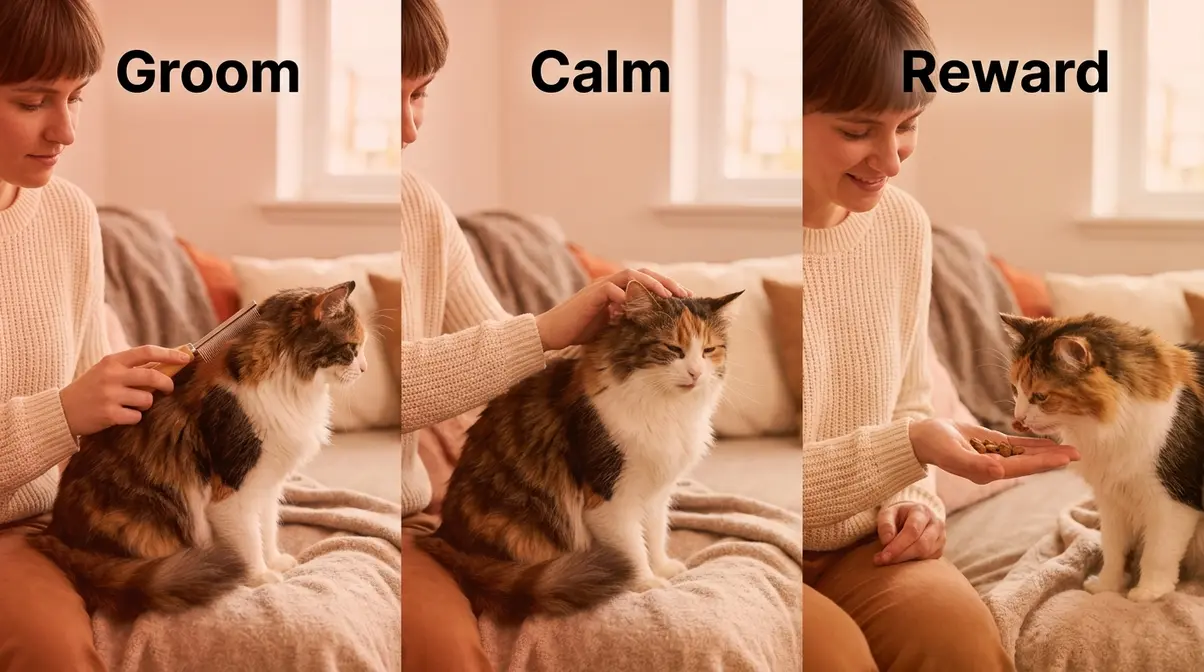
The Groom-Calm-Reward Loop: A 3-Step Desensitization Method
The Groom-Calm-Reward Loop is a repeatable behavioral cycle that conditions an anxious or resistant cat to tolerate — and eventually accept — grooming sessions. It works by pairing every grooming action with a positive outcome, building trust incrementally rather than forcing compliance.
“The Groom-Calm-Reward Loop” — a 3-step behavioral system: one brief grooming action, one calming pause, one immediate reward. Repeated consistently, it rewires a cat’s stress response to grooming within 2–4 weeks.
The three steps:
Step 1 — Groom (10–30 seconds): Perform one small grooming action. For a highly resistant cat, this might be simply touching the cat with the comb without moving it. For a moderately resistant cat, it might be one or two gentle comb strokes on the back (the least sensitive area). Stop before the cat shows stress signals (tail flicking, skin rippling, ears flattening).
Step 2 — Calm (15–30 seconds): Put the tool down. Pet your cat with your hand in their preferred spot — most cats prefer the base of the skull or the chin. Speak quietly. Let the cat’s body language return to neutral. This pause is not optional — it’s what separates a grooming session from a grooming battle.
Step 3 — Reward (immediately): Offer a high-value treat the moment the cat is calm. The treat must come after calm, not after the grooming action itself — you’re rewarding the emotional state, not just the tolerance.
Repeat this loop 3–5 times per session. Total session time: under 5 minutes. Fear Free Pets, whose Fear Free certification program is used by veterinary professionals nationwide, consistently identifies short, positive sessions as the most effective approach for reducing grooming-related anxiety in cats.
Over 2–4 weeks, most cats show measurable improvement — sessions can gradually extend as the cat’s tolerance builds. The Groom-Calm-Reward Loop is the foundation that makes every other step in this guide sustainable.
Safe Handling Techniques for Anxious Cats
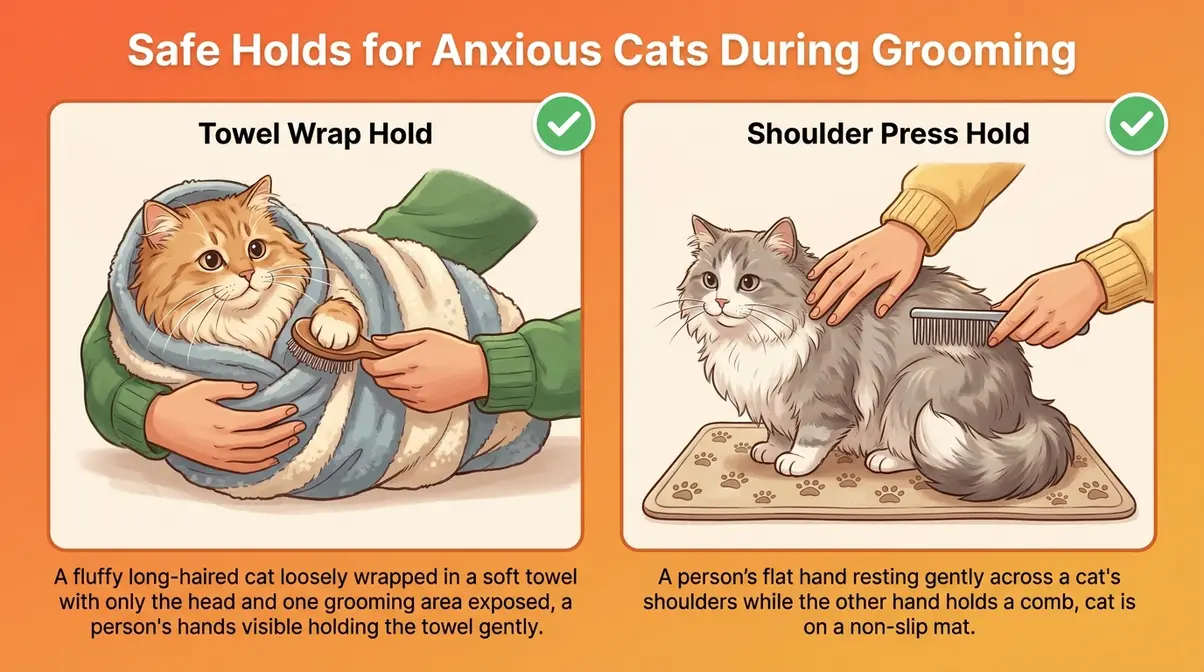
Restraint that feels like a trap triggers immediate aggression. These handling techniques reduce that response:
The towel wrap (for cats that bite): Wrap your cat loosely in a towel, leaving only the area you’re grooming exposed. This isn’t about immobilizing the cat — it’s about reducing the number of surfaces the cat feels need defending. Experienced groomers across professional communities report that loose towel wrapping reduces biting incidents significantly compared to bare-hand restraint.
The “scruff-free” approach: Avoid scruffing (grabbing the loose skin at the back of the neck) — the AAFP guidelines identify scruffing as a stress-escalating technique that increases aggression rather than reducing it. Instead, use gentle body pressure: place one hand flat across the cat’s shoulders while grooming with the other.
Session timing: Groom after play or after a meal, never when the cat is alert and active. A slightly tired or food-focused cat is far more cooperative.
Step 5 — Advanced Grooming: Clippers and Sanitary Trims
Once your cat tolerates basic brushing through the Groom-Calm-Reward Loop, you can introduce clippers for targeted trimming. Clippers are not required for most long-haired cats — but for specific situations, they’re the right tool for the job.
When to Use Clippers (And When Not To)
Are you supposed to trim long-haired cats? Not necessarily — but there are three situations where trimming genuinely helps:
- Sanitary areas: Fur around the rear that traps feces (“boo-boo stuck”) should be trimmed regularly. This is a hygiene necessity, not a cosmetic choice.
- Severely matted coats: When mats are too extensive for brushing, a professional clipper shave-down (the “lion cut”) may be the kindest option.
- Cats with mobility issues: Senior cats that can no longer groom themselves benefit from regular trimming to prevent hygiene problems they can’t manage independently.
When NOT to use clippers at home: If your cat is skittish around sound and vibration, clippers will be highly stressful — many owners report their cats absolutely hate the sound of clippers. In this case, a professional groomer with experience in fearful cats is the better choice. Never use clippers near the face, ears, or genitals without professional training.
How to Perform a Sanitary Trim Safely
A sanitary shave (sometimes called a “hygiene trim”) removes fur from the area around the anus and genitals to prevent fecal and urine matting. This is the most practical trim for long-haired cat owners to learn at home.
What you’ll need: A small, quiet clipper designed for pet use, a non-slip surface, and two people if possible (one to hold, one to trim).
Estimated time: 5–10 minutes.
Steps:
- Complete the Groom-Calm-Reward Loop for 2–3 minutes first — never start with clippers on a cold session.
- Turn the clippers on away from the cat and let them hear the sound for 30 seconds before approaching. Pair the sound with treats.
- Place your cat on a non-slip surface. Have a second person gently support the cat’s body from the front.
- Lift the tail gently and trim only the fur within 2–3 cm of the anus, using the clipper blade flat against the skin — never at an angle.
- Work slowly, in the direction of fur growth, and stop immediately if the cat vocalizes or struggles.
- Reward generously when finished.
| Area | Trim frequency | Tool | Why |
|---|---|---|---|
| Anal area | Every 4–6 weeks | Small pet clipper | Prevents fecal matting |
| Belly (optional) | Every 8–12 weeks | Wide clipper or scissors (by groomer only) | Reduces mat risk in friction zone |
| Paw pads | As needed | Small scissors or clipper | Reduces tracking and slipping |
The Lion Cut: What It Is and When It’s the Right Choice
The lion cut is a full-body shave that leaves fur only on the head, lower legs, and tail tip — giving the cat a lion-like silhouette. It’s a legitimate option for severely matted cats or cats that cannot tolerate regular brushing, but it’s not a shortcut to replace grooming.
- The lion cut is appropriate when:
- The coat is so severely matted that removal by brushing is impossible and would cause pain
- The cat has a medical condition (arthritis, obesity) that prevents self-grooming
- The owner is physically unable to maintain a regular grooming routine
- The lion cut is not appropriate when:
- Used as a permanent substitute for brushing — the coat grows back within 3–6 months and mats will return without a maintenance routine
- Performed at home by an untrained owner — a lion cut requires professional clippers, skill, and ideally a second handler
Always have a lion cut performed by a certified professional groomer or a veterinary clinic that offers grooming services. The regrowth phase requires immediate implementation of a daily brushing routine to prevent the same problems from returning.
Limitations and Safety: When Home Grooming Isn’t Enough
Home grooming is effective for prevention and maintenance — but it has clear limits, and recognizing those limits is part of responsible cat ownership.
Common Pitfalls to Avoid
Pitfall 1 — Grooming through resistance: If your cat is biting, vocalizing loudly, or has gone rigid, stop immediately. Forcing through resistance doesn’t desensitize cats — it traumatizes them and makes future sessions harder. Use the Groom-Calm-Reward Loop to rebuild trust first.
Pitfall 2 — Skipping the metal comb: Brushing without combing first is the single most common reason owners miss mats until they’re painful. The slicker brush does not reach the undercoat. Always comb first.
Pitfall 3 — Grooming the whole coat at once: Long sessions overwhelm anxious cats. Five focused minutes on the friction zones beats thirty stressful minutes of full-coat grooming every time.
Pitfall 4 — Using human detangling products: Many human hair detanglers contain xylitol or other compounds that are toxic to cats. Use only products specifically formulated for cats, or plain cornstarch.
When to Choose a Professional Groomer or Vet
Some situations are simply beyond safe home management:
- Mats covering more than 20% of the body — a full coat shave-down by a professional is safer and less traumatic than piecemeal home removal
- Skin visible beneath a mat that appears raw, red, or weeping — this requires veterinary assessment before any grooming
- Cats that have bitten hard enough to break skin during previous grooming attempts — a Fear Free certified groomer or vet-groomer team is the appropriate choice
When to Seek Expert Help
If your cat requires sedation for grooming, this is not a failure — it’s a medical and welfare decision. Veterinarians can perform grooming under light sedation for cats with severe mat coverage or extreme grooming-related anxiety. This is a legitimate, vet-approved option that prioritizes the cat’s wellbeing over the convenience of at-home grooming.
Frequently Asked Questions
Are you supposed to trim long-haired cats?
Long-haired cats do not require trimming to be healthy, but trimming specific areas — particularly the sanitary area around the rear — is strongly recommended for hygiene. Breeds like Persian and Maine Coon can develop serious hygiene problems when feces becomes trapped in fur near the anus (the “boo-boo stuck” problem familiar to many long-haired cat owners). Trimming the belly and paw pads is optional but reduces mat risk in friction zones. Full-body trims like the lion cut are a welfare option for severely matted cats, not a routine necessity.
What are common cat grooming mistakes?
The most common cat grooming mistakes are brushing without combing first, skipping friction zones, and grooming through resistance. Brushing only the top coat while ignoring the dense undercoat is why mats keep forming despite regular brushing. Owners also frequently use scissors on mats — a dangerous practice that causes lacerations because feline skin is paper-thin and folds into the cutting path. A 2023 survey of professional cat groomers found that the majority of emergency grooming appointments involve mats that worsened due to owner attempts to cut them with household scissors.
Do long-haired cats get matted easily?
Yes — long-haired cats mat significantly faster than short-haired breeds, particularly in friction zones. The dense double coats of breeds like Persian, Maine Coon, Ragdoll, and Norwegian Forest Cat shed continuously, and loose undercoat hairs tangle with the outer coat during normal movement. Without daily combing of friction zones, mats can form within 48–72 hours in high-movement areas like the belly and armpits. Cats that are overweight, elderly, or have reduced mobility are at even higher risk because they cannot reach all areas during self-grooming.
Can I cut my cat’s matted fur with scissors?
No — cutting cat mats with scissors is dangerous and should never be attempted at home. Feline skin is extremely thin and loose, folding upward into the mat in ways that make it impossible to see where the skin ends. The Cornell Feline Health Center and veterinary emergency professionals consistently report scissor lacerations as a common at-home grooming injury. Use a mat splitter or mat breaker comb instead, which breaks the mat apart without cutting toward the skin. For mats that are too tight or large to remove with a mat splitter, call a professional groomer or vet.
How do you groom an unwilling cat?
The most effective method for grooming an unwilling cat is the Groom-Calm-Reward Loop — a 3-step desensitization cycle of one brief grooming action, one calming pause, and one immediate high-value treat. Fear Free Pets’ veterinary-backed guidelines identify short, positive sessions as the single most effective approach for reducing grooming-related anxiety. Start with the least sensitive area (the back, never the belly), keep sessions under 5 minutes, and stop before the cat shows stress signals. Consistency over 2–4 weeks produces measurable improvement in most cats, including those that currently bite or run.
Your Long-Haired Cat Can Be Groomed — Starting Today
For long-haired cat owners dealing with mats, resistance, and hygiene problems, the path forward is clearer than it feels when you’re in the middle of it. Knowing how to groom a long-haired cat safely comes down to four right tools, five friction zones to check daily, and a behavioral framework that works with your cat’s instincts rather than against them. Cats spend up to 50% of their waking hours grooming themselves (Ohio State University College of Veterinary Medicine) — they want a clean coat. Your job is to make the process feel safe enough for them to let you help.
The Groom-Calm-Reward Loop is the framework that makes everything else sustainable. Without it, even perfect technique fails on a cat that fights back. With it, owners who once couldn’t touch their cat’s belly report full grooming sessions within a month. The loop works because it changes the cat’s emotional association with grooming — not through force, but through repetition and reward.
Start today with the metal comb and one friction zone. Run it through the belly for 30 seconds, offer a treat, and stop. That’s your first Groom-Calm-Reward Loop. Repeat it tomorrow. By the end of two weeks, you’ll have a cat that at least tolerates the comb — and that’s the foundation everything else is built on.

Dave King
Cat owner and writer at Mad Cat Man.