Signs Your Cat Is a Maine Coon Mix: 7 Key Traits
Unlock actionable ideas for Signs Your Cat Is a Maine Coon Mix: 12 Clues You Can Check at Home including common pitfalls to avoid with Mad Cat Man by your…

You keep glancing at your cat’s tufted ears, that ridiculous poofy tail, and the way they follow you from room to room like a golden retriever — and you think: wait, are you actually a Maine Coon?
Most breed guides leave you more confused than when you started. They throw around terminology, list vague traits, and never actually tell you how to check. You deserve a clear system.
To spot the signs your cat is a Maine Coon mix, look for a square muzzle, tufted “lynx tip” ears, a long shaggy coat with “trousers” on the hind legs, and a thick, bushy tail. Watch their behavior too — chirping, dog-like loyalty, and water fascination are strong signals. This 6-step guide takes about 15 minutes and covers every physical and behavioral clue, plus DNA testing for certainty.
By the end of this guide, you’ll know exactly which features to look for, how to compare your cat to common look-alikes, and whether a DNA test is worth it for you. We’ll walk through six steps: physical signs, behavioral signs, breed comparisons, DNA testing, kitten-specific clues, and what Maine Coon heritage means for your daily life.
Maine Coon mixes display a recognizable set of physical and behavioral traits — no single sign is definitive, but using the Trait Trifecta (physical + behavioral + DNA) gives you the clearest answer.
- Square muzzle + tufted ears: The two most diagnostic physical signs of Maine Coon heritage
- Chirping and trilling: Maine Coons rarely meow — they vocalize differently from most domestic cats
- Slow growth: Maine Coon mixes may not reach full size until 3–5 years old (PetMD)
- DNA testing: The only way to confirm partial ancestry with certainty
- The Trait Trifecta: Physical markers + behavioral signals + DNA = confident identification
What You Need to Know Before You Start
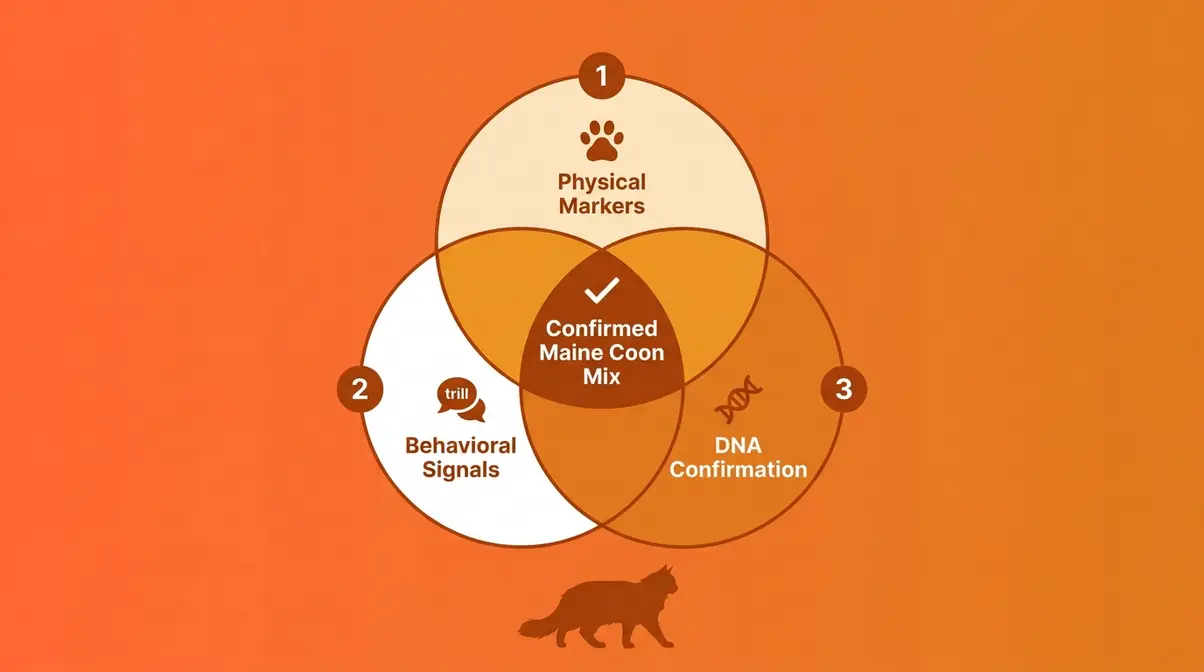
Here’s the first thing to know: not having papers doesn’t mean your cat isn’t part Maine Coon. Without official pedigree documentation from a registered breeder, any long-haired cat is technically classified as a Domestic Longhair — the default label for mixed-breed cats without documented ancestry. But that classification says nothing about genetic heritage. Your cat could absolutely carry Maine Coon DNA and display Maine Coon traits without a single piece of paperwork to prove it.
This guide uses a three-part framework called The Trait Trifecta — a structured identification system covering physical markers, behavioral signals, and DNA confirmation — where any two of three parts strongly suggesting Maine Coon heritage gives you a confident (if not official) answer. Think of it as a checklist, not a verdict. The more signs that match, the more likely your cat has Maine Coon roots. One or two signs alone aren’t conclusive, but five or six? That’s a strong case.
The Maine Coon is a large, semi-longhaired breed native to Maine and one of the oldest natural breeds in North America. They’re recognized for specific, distinctive traits — and those traits often show up even in mixed-breed cats who carry their genes.
Before you start: Grab your cat or a clear photo of them. You’ll be looking at specific features in each step, so having your subject nearby makes this much easier.
Step 1 — Check the Physical Signs
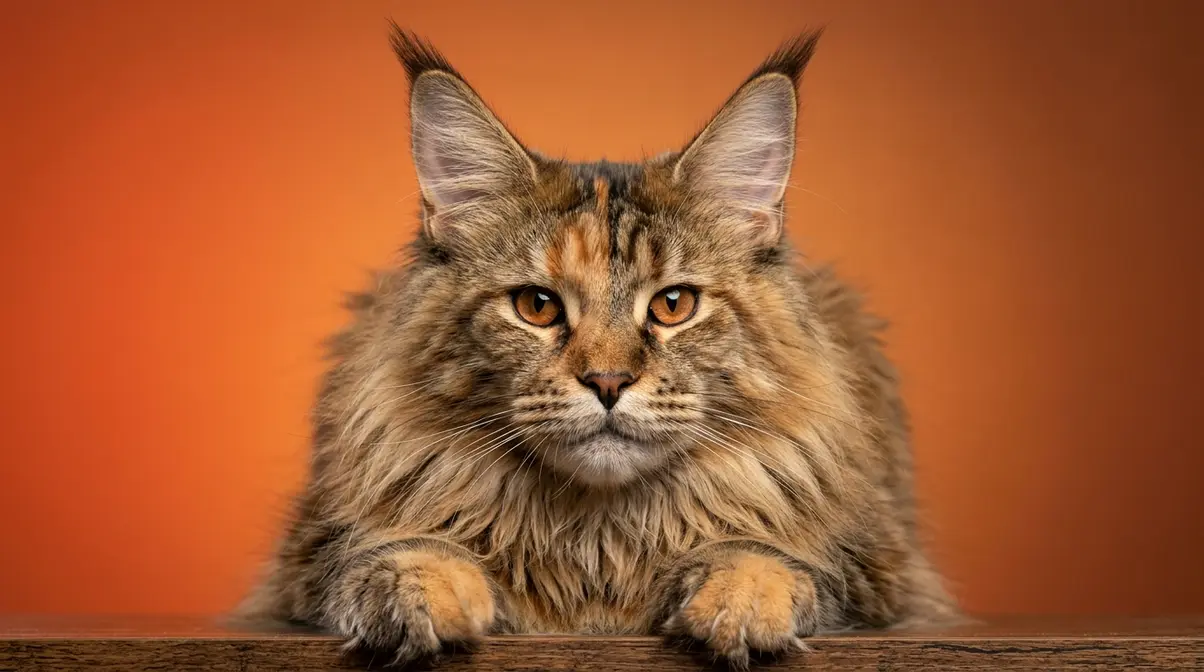
The physical signs your cat is a Maine Coon mix fall into five key areas: body size, facial structure, ears, coat, and paws. According to the CFA Maine Coon breed standard, authentic Maine Coons are defined by their square muzzle, heavy shaggy coat, and tufted ear tips. Checking these five features takes about five minutes and gives you the clearest picture before moving on to behavioral clues.
These physical markers form Part 1 of the Trait Trifecta — the most visible and immediately assessable evidence of Maine Coon heritage.
Body Shape and Size
Maine Coons are unusually large cats — and size is your first physical checkpoint. Males typically weigh 13–18 lbs (6–8 kg) at full size; females generally reach 8–12 lbs (3.6–5.4 kg) (PetMD). If your cat is noticeably bigger than the average domestic cat, that’s a meaningful starting signal — though size alone isn’t conclusive.
Body shape matters just as much as weight. Maine Coons have a long, rectangular torso — not compact or rounded like most house cats. When you pick up your cat, do they feel long and solid? Do their back legs seem to stretch out further than you’d expect?
Stand your cat on a flat surface and look down from above. A Maine Coon mix will appear notably long and substantial, almost like a small wildcat — not petite, not round. One important note: Maine Coons are slow to mature and may not reach full adult size until 3–5 years old. A young cat may not look impressively big yet — so don’t rule out Maine Coon heritage just because your cat is still on the smaller side.
For exact weight ranges by age, see our Maine Coon size and growth chart.
Size gives you a first impression — but the most reliable physical sign is found in your cat’s face.
The Square Muzzle and Wedge-Shaped Face
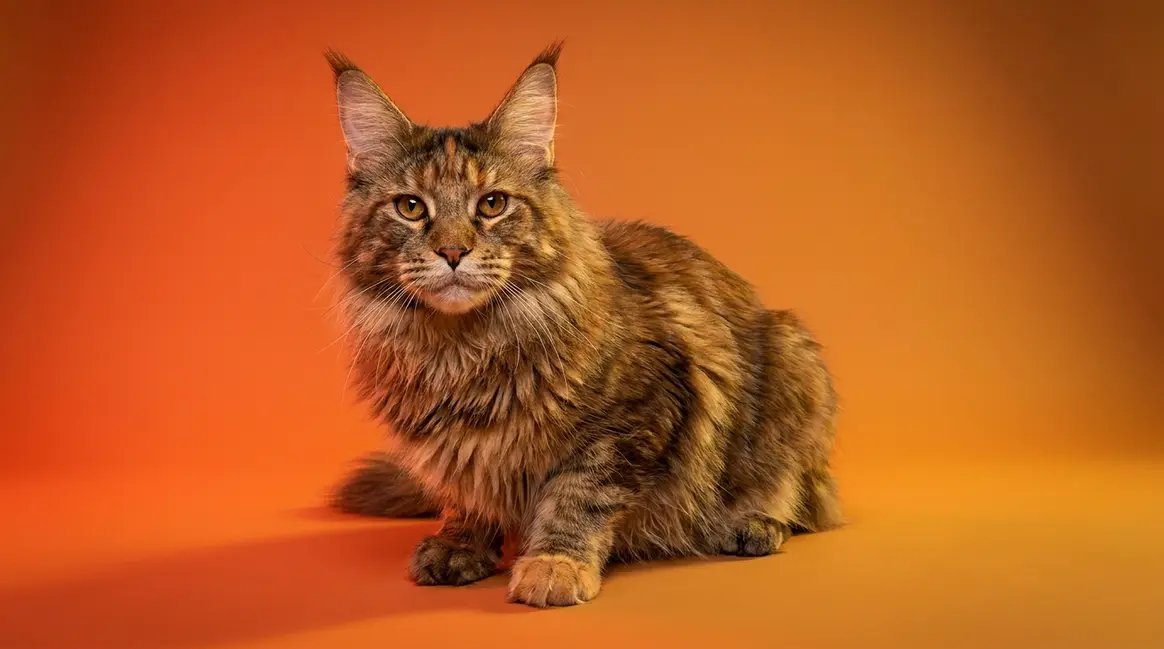
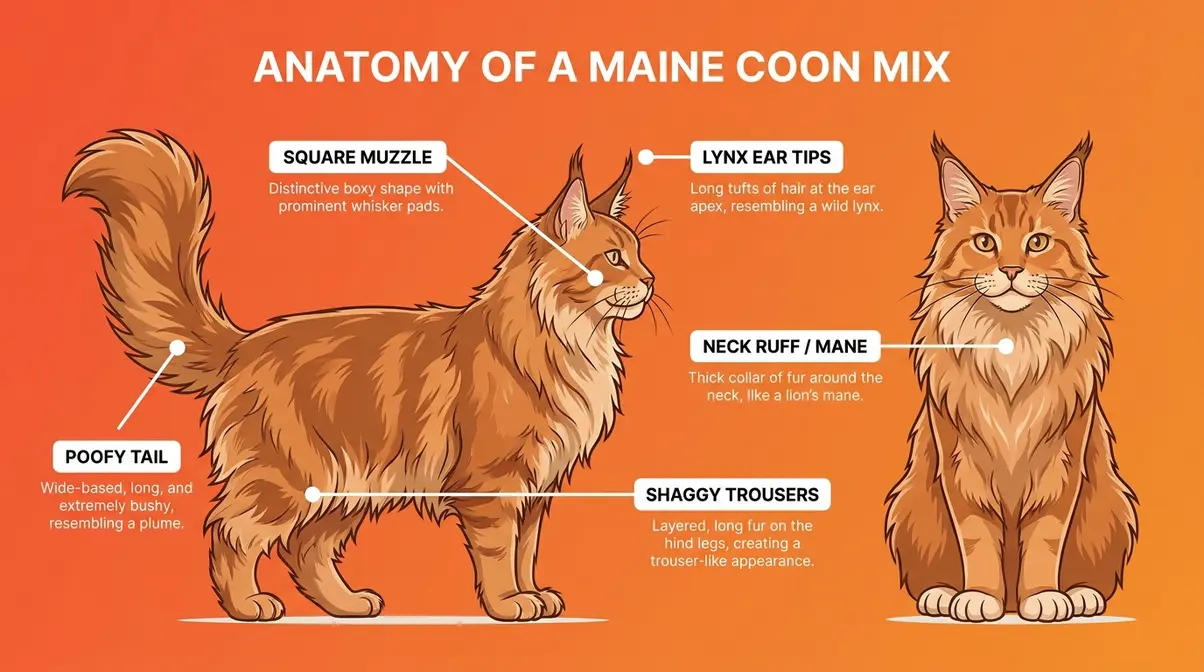
The square muzzle is the single most diagnostic physical feature of a Maine Coon — and it’s one you can assess with your hands in about ten seconds. A Maine Coon’s muzzle is visibly squared-off and boxy, not tapered or pointed like most domestic cats. From the front, the face looks rectangular. From the side, the muzzle protrudes slightly with a defined, boxy shape.
How to check: Cup your fingers gently under your cat’s chin and muzzle. If it feels squared and boxy — almost like a little rectangle — rather than pointed and narrow, that’s a strong Maine Coon indicator.
Maine Coon owners in the community describe this perfectly:
“MCs have long but wedge shaped faces with rectangular mugs.”
— r/MaineCoon community
That’s exactly right. The face has those distinctive wedge-shaped faces combined with the boxy, rectangular mugs that set Maine Coons apart from other longhaired breeds. A tapered, narrow muzzle is a strong indicator that you’re looking at a different breed — or a mix where Maine Coon genes didn’t dominate the facial structure.
Tufted Ears (Lynx Tips)
Look at the very tip of each ear. Do you see a small tuft of fur sticking straight upward? That’s called a lynx tip — the small tufts of fur that grow upward from the very tip of each ear, resembling the tufts of a wild lynx. These are one of the most recognizable and photographable Maine Coon traits, and they show up reliably even in mixes.
Don’t confuse lynx tips with ear furnishings — the long, feathery fur that grows inside the ear canal. Both are common in Maine Coons, but the lynx tip sits at the very point of the ear, pointing skyward. If your cat has those little antenna-like tufts, that’s a meaningful checkmark on your list.
Why does this matter? Lynx Ears are one of the defining features in the CFA breed standard. Most domestic cats and even many longhaired breeds don’t have them — so their presence is genuinely informative, not just decorative.
The Tail, Coat, and ‘Shaggy Trousers’
Maine Coons have one of the most distinctive coats in the cat world — and it’s not just about length. The coat is layered and asymmetric: shorter on the shoulders, longer on the belly and flanks, with a prominent neck ‘mane’ (the thick ruff of fur around the neck and chest) that gives them a lion-like silhouette.
The tail is equally striking. A true Maine Coon tail is long, wide at the base, and covered in flowing, feathery fur — the classic poofy tail that fans out like a plume. Run your hand along your cat’s tail from base to tip. Does it feel thick and full? Does the fur fan outward rather than lying flat?
Then check the back legs. Maine Coons are famous for their shaggy trousers — the longer, ruffled fur on the back of the hind legs that looks almost like they’re wearing knickerbockers. This feature appears consistently even in Maine Coon mixes and is easy to spot when your cat sits or walks away from you.
The coat is also water-resistant — a trait from their cold-weather New England origins. You may notice your Maine Coon mix’s fur repels water rather than absorbing it immediately.
Large Paws and Polydactyly
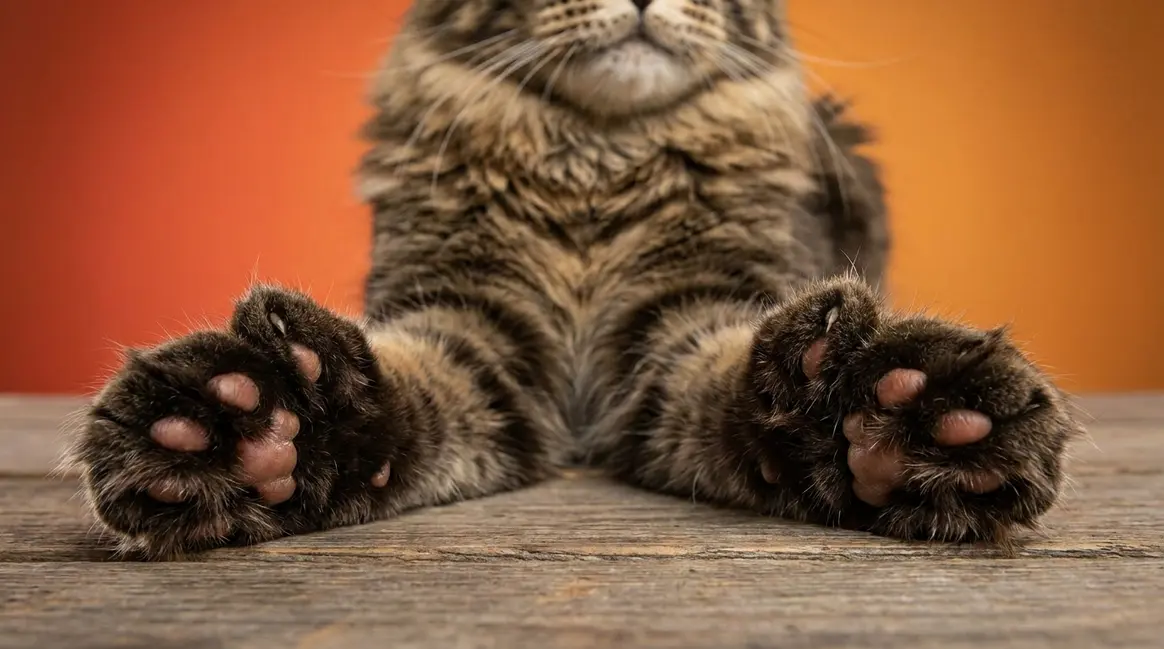
Maine Coons have large, round, tufted paws — and the fur between their toes (called toe tufts) often grows long enough to be visible between the pads. This long hair on his feet is a charming and practical trait: historically, it acted like a natural snowshoe in harsh Maine winters.
Look at your cat’s front paws. Do they appear unusually large for the cat’s body? Is there noticeable fur sprouting between the toes?
Some Maine Coons also carry a gene for polydactyly — meaning they have extra toes. Historically, polydactyl Maine Coons were common in New England; the trait became less prevalent after selective breeding, but it still appears occasionally in mixes. If your cat has six or more toes on a paw, that’s an interesting additional data point — though not definitive on its own.
Checkpoint: Go through all five physical traits above. How many does your cat have? Three or more is a meaningful pattern. Now let’s look at how your cat acts.
Step 2 — Observe the Behavioral Signs
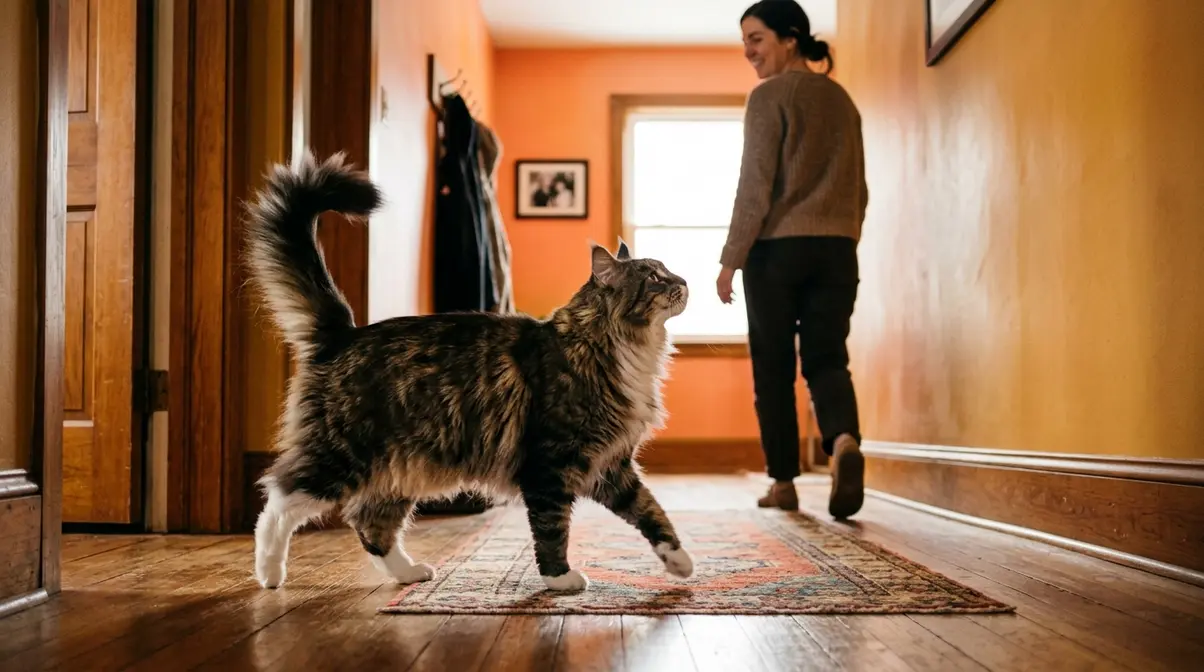
Physical traits are your starting point, but behavior completes Part 2 of the Trait Trifecta. Maine Coons have a personality profile that’s genuinely different from most domestic cats — and owners across Maine Coon communities on Reddit consistently describe the same three behavioral patterns: dog-like loyalty, unusual vocalizations, and a strange obsession with water.
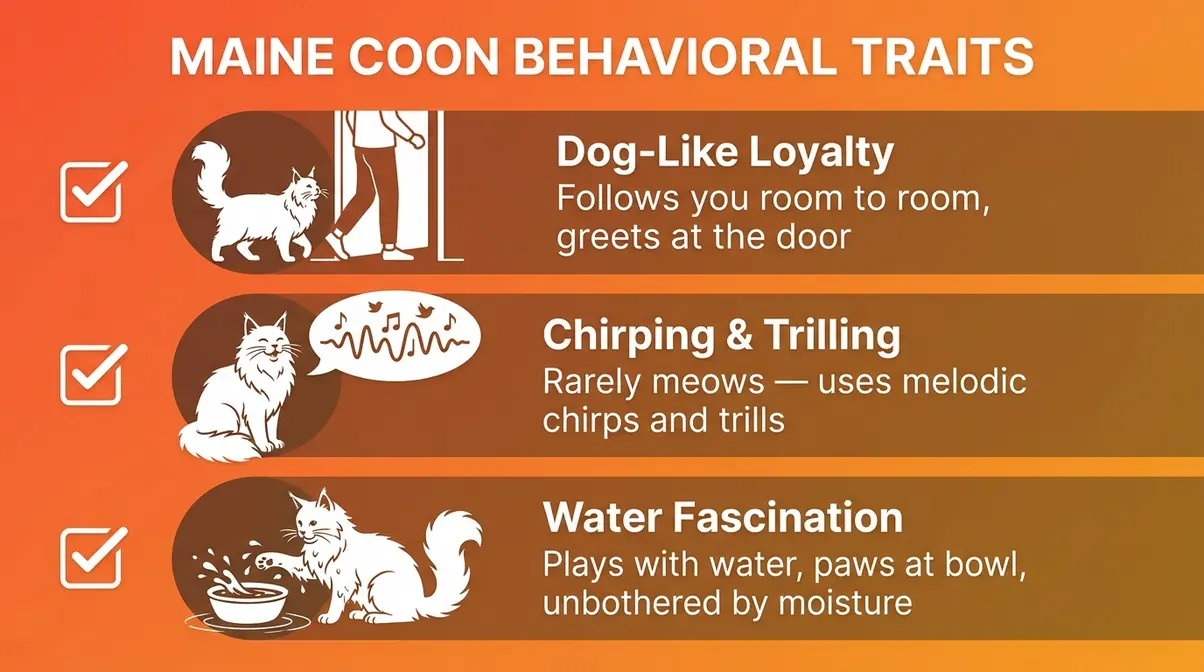
Dog-Like Personality and Following Behavior
Maine Coon owners consistently report that their cats behave less like typical cats and more like loyal, sociable dogs. Your Maine Coon mix will likely follow you from room to room, greet you at the door when you come home, and want to be near you — not necessarily on your lap, but always in the same space.
This is sometimes called the “dog of the cat world” personality, and it’s a well-documented trait across Maine Coon communities. According to the Cat Fanciers’ Association breed description, Maine Coons are known for their gentle, playful, and highly social temperament — they form strong bonds with their people and rarely display the aloofness associated with many other breeds.
What to watch for: Does your cat follow you into the bathroom? Do they greet visitors rather than hiding? Do they seem genuinely interested in what you’re doing — watching, participating, supervising? That’s very Maine Coon behavior. This trait often shows up strongly even in mixes, because it’s deeply embedded in the breed’s temperament.
Chirping, Trilling, and Unusual Vocalizations
Maine Coons are famously chatty — but they don’t meow the way most cats do. Instead, they chirp, trill, and produce a distinctive bird-like chatter. A trill is a rolling, melodic sound that sits somewhere between a purr and a meow — it’s the sound Maine Coons make when they’re happy to see you or want your attention.
Across Maine Coon communities on Reddit, the consistent feedback is: “my cat barely meows — it just chirps and trills at me.” If your cat sounds more like a songbird than a house cat, that’s a meaningful behavioral signal.
How to assess: Talk to your cat. Do they respond with a trill or chirp? Do they make soft, melodic sounds rather than loud, demanding meows? These vocalizations are part of the breed’s communication style — and they tend to carry through even in mixed-breed cats who inherit Maine Coon genes.
Fascination with Water
Does your cat paw at the water bowl, dip their feet in, or try to join you in the shower? Maine Coons have an unusual and well-documented attraction to water — a behavioral trait that likely traces back to their seafaring and fishing origins in coastal Maine.
This isn’t just curiosity. Many Maine Coon mixes actively play with running water, splash in their bowls, or will sit near a dripping faucet for extended periods. Their water-resistant coat makes them more comfortable around moisture than most cats. If your cat regularly “paddles” at their water dish or seems unbothered by getting wet, add that to your checklist.
Checkpoint: How many behavioral signs does your cat show? Even one or two, combined with three or more physical traits, builds a compelling case. Next, let’s compare your cat to the breeds most often confused with Maine Coons.
Step 3 — Compare Your Cat to Look-alike Breeds
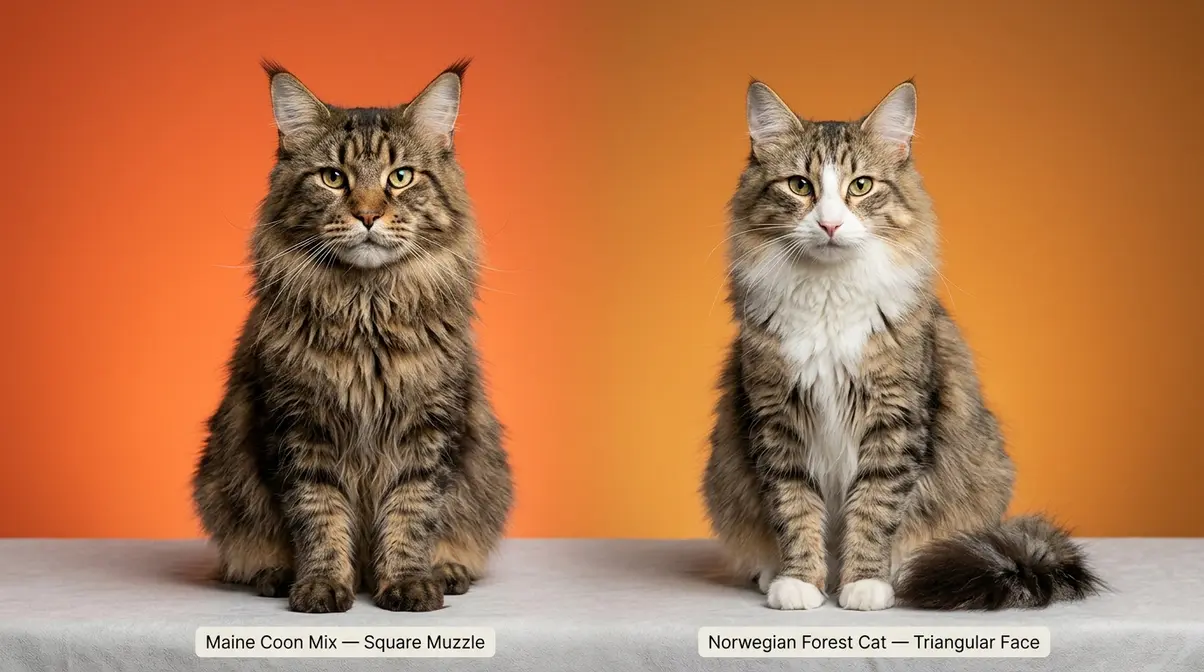
Not every large, fluffy cat is a Maine Coon mix — and several breeds look remarkably similar. Knowing the differences prevents false positives and gives you genuine confidence in your assessment.
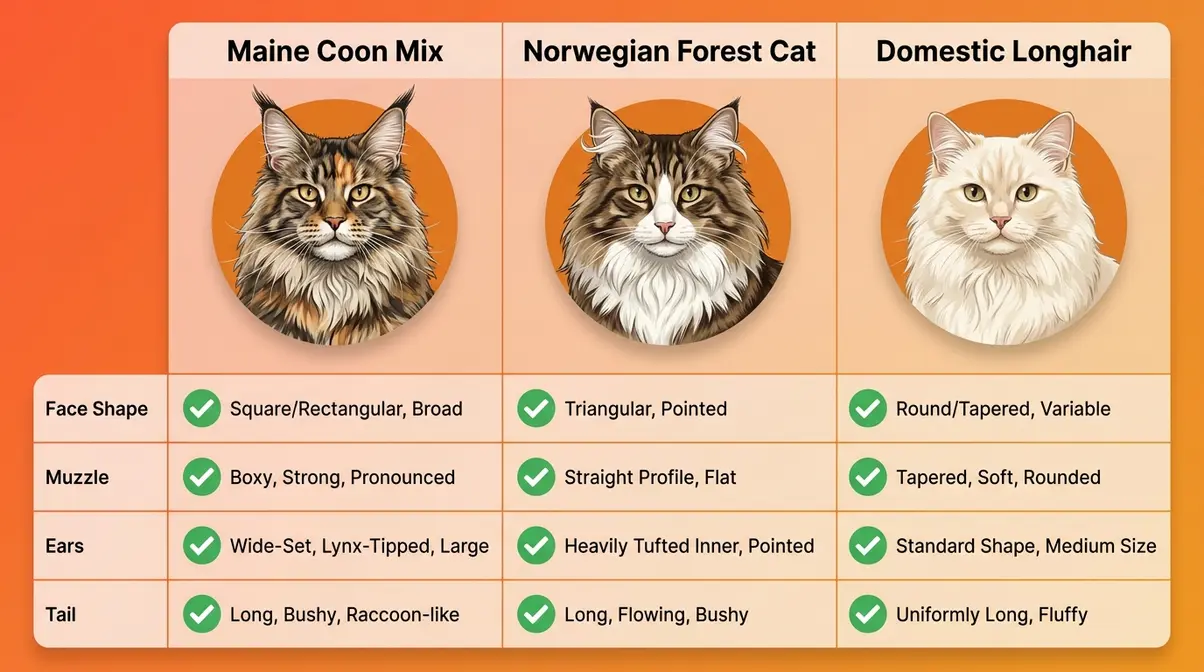
Maine Coon vs. Norwegian Forest Cat
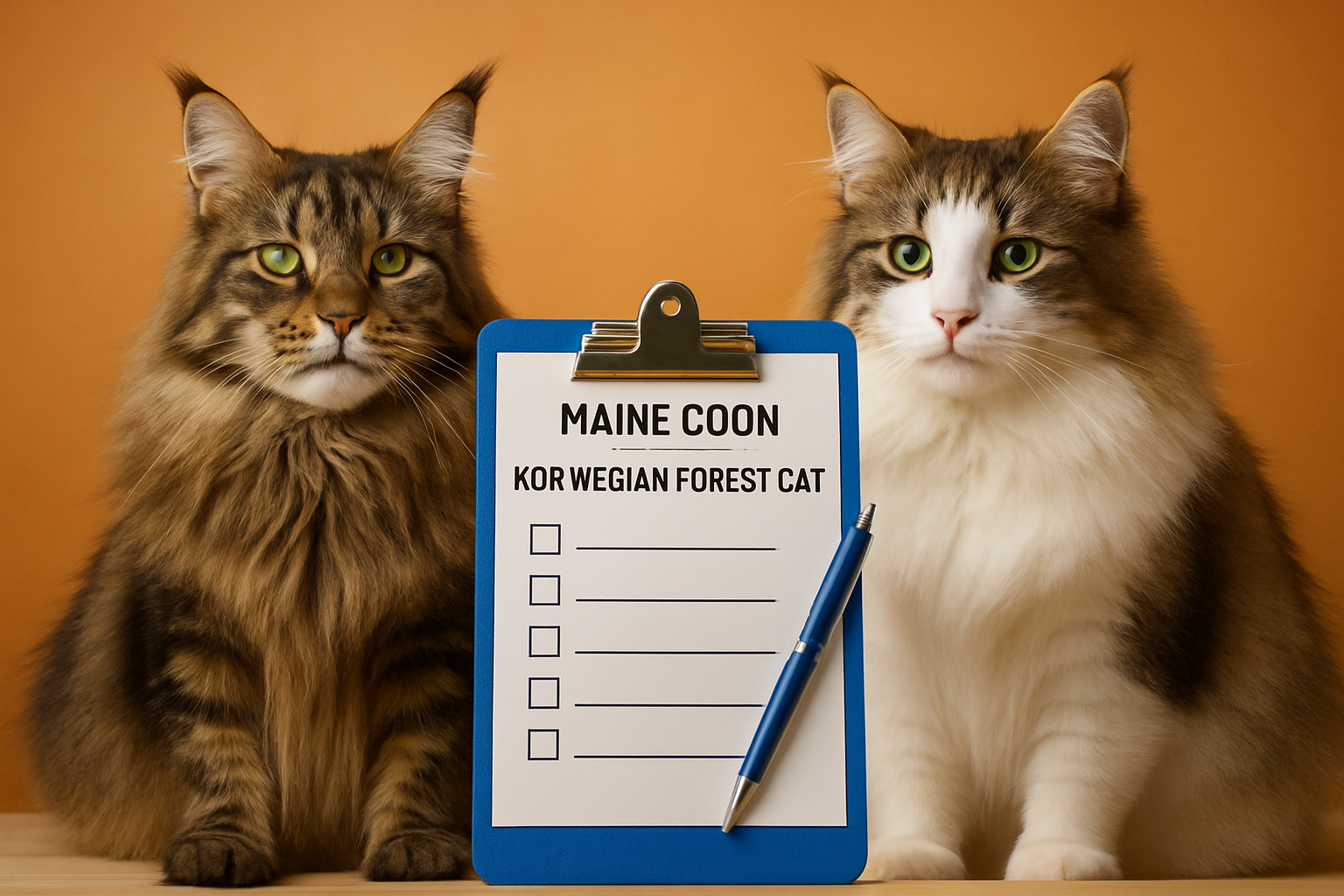
The Norwegian Forest Cat (NFC) is the breed most commonly mistaken for a Maine Coon — and the confusion is understandable. Both are large, semi-longhaired, tufted-ear cats with thick, layered coats. But there are clear differences once you know what to look for.
| Feature | Maine Coon | Norwegian Forest Cat |
|---|---|---|
| Face shape | Square muzzle, rectangular face | Triangular face, straight nose profile |
| Muzzle | Boxy, squared-off | Tapered, pointed |
| Ears | Wide-set, lynx tips | Triangular, heavily tufted inside |
| Chin | Firm, square chin | Less pronounced |
| Body | Long, rectangular, substantial | Long but slightly less boxy |
| Tail | Full, flowing plume | Dense, bushy, slightly less flowing |
The simplest test: look at the face straight-on. A Maine Coon has that unmistakable rectangular mug. A Norwegian Forest Cat has a more triangular, fox-like face with a straight nose. If your cat’s face is more triangle than rectangle, Norwegian Forest Cat heritage may be in play.
Maine Coon vs. Domestic Longhair
The Domestic Longhair is the most common look-alike — and the one most likely to cause a “false positive” identification. A Domestic Longhair is simply any mixed-breed cat with a long coat. They can be large, fluffy, and even have ear tufts by chance — but they lack the specific combination of traits that defines Maine Coon heritage.
Key differences to watch for: Domestic Longhairs typically have tapered muzzles (not square), less defined neck ruffs, and coats that are more uniformly long rather than layered and asymmetric. Their tails tend to be fluffy but narrower at the base than a Maine Coon’s wide-based plume.
The Maine Coon mix identification guide at maine-coon-cat-nation.com puts it well: a Domestic Longhair may have one or two Maine Coon-like traits by coincidence, but rarely displays the full cluster of muzzle, ears, coat layering, and behavioral traits together.
Checkpoint: If your cat passes the look-alike comparison and still checks most of the boxes, you’re building a strong case. But if you want certainty, there’s only one definitive step — DNA testing.
Step 4 — Confirm with a DNA Test
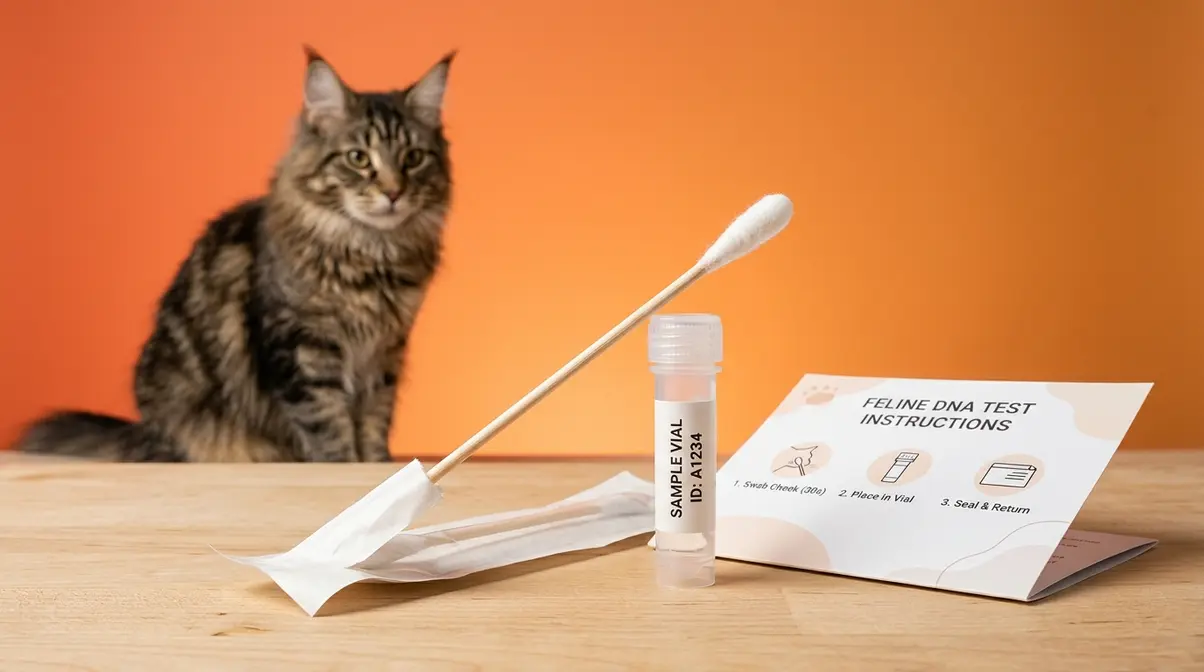
Physical and behavioral signs are compelling — but they’re not proof. The only way to confirm Maine Coon ancestry with certainty is a feline DNA test. This is Part 3 of the Trait Trifecta, and for many owners, it’s the most satisfying step.
How Feline DNA Tests Work
Feline DNA tests work exactly the way human ancestry tests do. You collect a saliva sample from your cat using a cheek swab (included in the kit), mail it to the lab, and receive a breed breakdown report within 2–4 weeks. The lab compares your cat’s genetic markers against a reference database of known pedigreed breeds — including Maine Coon — and calculates the percentage of each breed in your cat’s ancestry.
Veterinary geneticists at UC Davis confirm that modern feline DNA panels have become significantly more accurate as breed reference databases have expanded — the UC Davis Veterinary Genetics Laboratory offers breed identification panels alongside health screening for genetic diseases. The Cornell University Feline Health Center also recommends genetic testing for Maine Coon mixes specifically, given the breed’s elevated risk for hypertrophic cardiomyopathy (HCM) — a serious heart condition discussed in Step 6.
One important caveat: if your cat is a Maine Coon mix several generations back, the percentage may be low (10–20%) even if they display strong physical traits. Genetics and phenotype don’t always align perfectly.
Top DNA Test Options and Costs in 2026
| Test | Price (approx.) | What It Covers | Turnaround |
|---|---|---|---|
| Basepaws Breed + Health | ~$149 | 70+ breeds, 45 genetic health markers | 4–6 weeks |
| Wisdom Panel Complete | ~$159 | 70+ breeds, 25+ health conditions | 2–3 weeks |
| Orivet Cat DNA Test | ~$99 | Breed ID, basic health screening | 3–4 weeks |
The Wisdom Panel cat breed database includes a dedicated Maine Coon breed profile and is one of the most widely used consumer feline DNA tests available. For owners who want health screening alongside breed identification — particularly for HCM risk — the Basepaws Breed + Health panel is worth the slightly higher price.
Checkpoint: If you’ve completed Steps 1–3 and still want confirmation, a DNA test is a worthwhile investment. It’s the one step that moves you from “strong suspicion” to “I know.”
Step 5 — Spotting Signs in Kittens
Identifying a Maine Coon mix in a kitten is trickier than assessing an adult cat — many of the most distinctive traits don’t fully emerge until later. But there are early clues worth watching for.
Early Physical Clues to Watch For
Even at 8–12 weeks, some Maine Coon-mix kittens show early indicators. Look for a slightly squarer muzzle than other kittens in the litter, oversized paws relative to their body (Maine Coon kittens often look like they’re wearing shoes several sizes too big), and the beginnings of ear tufts. The ear tufts may be subtle at this stage — just a slight upward point at the ear tip — but they’re usually visible.
The coat is another early signal. Maine Coon-mix kittens often have a fluffier, shaggier appearance than average kittens, with the neck ruff beginning to develop by 3–4 months. Their tails also tend to be noticeably bushy compared to littermates.
Behaviorally, Maine Coon-mix kittens tend to be exceptionally social and curious — less shy than average kittens, more interested in play, and already showing signs of that dog-like following behavior. Across Maine Coon communities on Reddit, owners frequently report that their cats were unusually confident and interactive from the very first weeks.
The Slow Growth Timeline (3–5 Years)
Here’s the most important thing to understand about kitten identification: patience is required. Maine Coons are one of the slowest-maturing cat breeds — they don’t reach their full adult size, coat density, or facial structure until 3–5 years of age (PetMD). A Maine Coon mix at 6 months may look like an ordinary fluffy kitten. At 18 months, those traits start becoming more obvious. At 3 years, the full picture emerges.
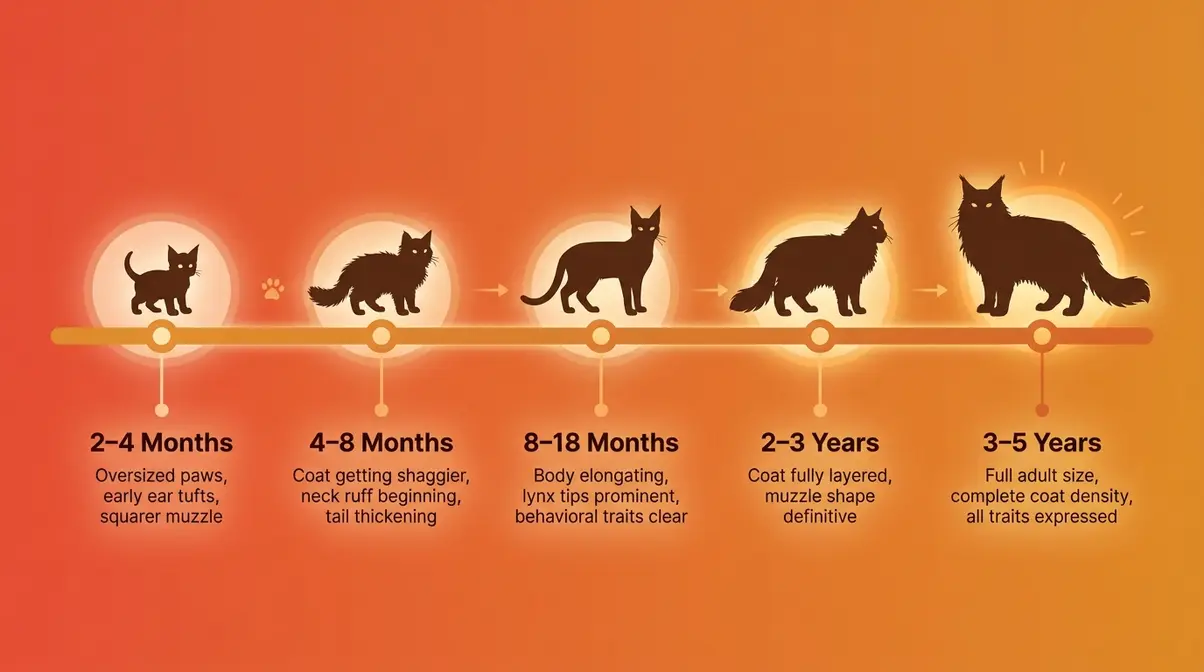
| Age | What to Watch For |
|---|---|
| 2–4 months | Oversized paws, early ear tufts, squarer muzzle than littermates |
| 4–8 months | Coat getting shaggier; neck ruff beginning; tail thickening |
| 8–18 months | Body elongating; lynx tips more prominent; behavioral traits clear |
| 2–3 years | Coat fully layered; muzzle shape definitive; full adult weight approaching |
| 3–5 years | Full adult size, complete coat density, all traits fully expressed |
If you have a young cat and you’re unsure, revisit this checklist at each stage. The picture gets clearer with time.
Checkpoint: For kittens, focus on paw size, muzzle shape, and early ear tufts as the most reliable early indicators. Revisit your assessment every 6 months as they grow.
Step 6 — What Owning a Maine Coon Mix Means for You
Knowing your cat has Maine Coon heritage isn’t just satisfying — it’s genuinely useful information for how you care for them.
The Benefits: Gentle, Playful, and Loyal
Maine Coon mixes tend to inherit the breed’s famously gentle temperament. They’re typically excellent with children, tolerant of other pets, and adaptable to different home environments. The Cat Fanciers’ Association describes Maine Coons as “gentle giants” — playful well into adulthood, curious, and highly interactive without being demanding or high-strung.
Maine Coon owners consistently report that their cats are unusually communicative — not in a loud, yowling way, but through those chirps, trills, and constant social presence. They want to be with you. They’ll sit next to you while you work, supervise cooking from a safe distance, and greet every guest at the door.
This is a breed — and a mix — that rewards engagement. The more you play with them, talk to them, and involve them in daily life, the more you get back. For families or individuals who want a deeply bonded, interactive cat, Maine Coon heritage is genuinely wonderful news.
The Challenges: Grooming, Energy, and Health Screening
That spectacular shaggy coat comes with a responsibility. Maine Coon mixes need brushing at least 2–3 times per week to prevent matting — particularly in the neck ruff, the shaggy trousers on the hind legs, and the tail. A quality wide-toothed comb or slicker brush is essential. Without regular grooming, the layered coat can mat painfully close to the skin.
Maine Coon mixes are also high-energy cats that need mental stimulation. Puzzle feeders, wand toys, and climbing structures aren’t optional extras — they’re necessary for a cat with this intelligence level.
Most importantly: health screening matters. The Cornell University Feline Health Center identifies hypertrophic cardiomyopathy (HCM) — a thickening of the heart muscle — as the most significant genetic health concern in Maine Coons. The breed carries a higher-than-average prevalence of the HCM gene mutation. If your cat has confirmed or suspected Maine Coon heritage, ask your veterinarian about cardiac screening, and consider the genetic health panel offered through the UC Davis Veterinary Genetics Laboratory alongside any breed DNA test.
Checkpoint: Talk to your vet about HCM screening if your cat shows strong Maine Coon signs. It’s a simple, proactive step that can make a real difference in long-term health outcomes.
Common Mistakes When Identifying a Maine Coon Mix
Even careful owners make a few predictable errors when assessing their cat. Knowing these in advance saves frustration.
Mistake 1: Relying on coat length alone. Long hair does not equal Maine Coon. Millions of Domestic Longhairs have beautiful, flowing coats with zero Maine Coon ancestry. Coat length is a starting point, not a conclusion. Always assess the muzzle shape and ear tufts alongside coat.
Mistake 2: Assuming size = Maine Coon. Some domestic cats are simply large. A big cat without the square muzzle, lynx tips, or behavioral traits is likely just a big domestic cat. Size is one data point — not a diagnosis.
Mistake 3: Dismissing a young cat too early. Because Maine Coons mature slowly, owners sometimes assess a 1-year-old cat, find the traits underwhelming, and conclude “probably not a Maine Coon mix.” Revisit your assessment at 2, 3, and even 4 years old. The breed’s most distinctive features often emerge late.
Mistake 4: Over-weighting a single trait. One lynx tip, one chirp, one large paw — none of these alone means anything definitive. The Trait Trifecta works because it requires convergence across multiple categories. Look for patterns, not single signs.
Mistake 5: Skipping the look-alike comparison. Norwegian Forest Cats and Domestic Longhairs are genuinely easy to confuse with Maine Coon mixes. Before concluding your cat has Maine Coon heritage, run the comparison in Step 3. The muzzle shape is your clearest differentiator.
Frequently Asked Questions
How do I know if my cat is a Maine Coon or not?
The most reliable way to know if your cat is a Maine Coon is to assess all three parts of the Trait Trifecta — physical markers, behavioral signals, and DNA confirmation. Look for the square muzzle, lynx ear tips, shaggy layered coat, and poofy tail. Watch for chirping, water fascination, and dog-like loyalty. If three or more physical traits and at least one behavioral trait align, the evidence is strong. A feline DNA test from Basepaws or Wisdom Panel confirms ancestry with approximately 70+ breed markers and provides the only definitive answer short of official pedigree papers.
What cat is most often mistaken for a Maine Coon?
The Norwegian Forest Cat is the breed most commonly mistaken for a Maine Coon — both are large, semi-longhaired, and have tufted ears. The key difference is facial structure: Maine Coons have a square, boxy muzzle and rectangular face, while Norwegian Forest Cats have a distinctly triangular face with a straight nose profile. Domestic Longhairs are also frequently confused with Maine Coon mixes, particularly when they happen to be large or have fluffy tails — but they typically lack the full cluster of muzzle shape, ear tufts, and behavioral traits.
Can a cat be partially Maine Coon?
Yes — a cat can absolutely be partially Maine Coon, and this is actually the most common scenario for cats without pedigree papers. Maine Coon genes can appear in any generation of a mixed-breed cat’s ancestry. A cat that is 25% or even 15% Maine Coon may still display several recognizable traits, particularly the square muzzle, tufted ears, and behavioral tendencies. A feline DNA test will give you a specific percentage. According to the Ziggyfamily Maine Coon crossbreed guide, partial Maine Coon ancestry is far more common than many owners realize.
What is the personality of a Maine Coon cat mix?
Maine Coon mixes typically inherit a gentle, playful, and highly social temperament. They tend to be dog-like in their loyalty — following their owners, greeting guests, and forming strong bonds. They’re generally good with children and other pets. Their communication style is distinctive: chirping and trilling rather than loud meowing. Maine Coon mixes are curious and intelligent, which means they need mental stimulation and interactive play. The specific personality of any individual mix depends on what other breeds are in their ancestry, but Maine Coon behavioral traits tend to be dominant and recognizable.
How can I tell if my kitten is a Maine Coon mix?
In kittens, focus on three early indicators: oversized paws, a slightly square muzzle, and the beginnings of ear tufts. These traits are visible even at 8–12 weeks in cats with Maine Coon heritage. A Maine Coon-mix kitten will also often be unusually social and confident compared to littermates. However, the full picture takes time — Maine Coons are slow to mature, and many of their most distinctive traits don’t fully emerge until 2–4 years of age (PetMD). Revisit your assessment every 6 months as your kitten grows.
How do you spot a “fake” Maine Coon?
A “fake” Maine Coon is typically a Domestic Longhair with some superficially similar features — and the muzzle is your best test. Genuine Maine Coon heritage almost always produces a squared-off, boxy muzzle. A cat with a tapered, pointed muzzle is unlikely to have significant Maine Coon ancestry, regardless of how fluffy or large they are. Other signals of a false positive: coat that is uniformly long rather than layered and asymmetric, no neck ruff or shaggy trousers, standard domestic-cat vocalizations (regular meowing), and no real water fascination. When in doubt, a DNA test removes all guesswork.
What is the most misbehaved cat breed?
“Misbehaved” is a matter of perspective — but high-energy, intelligent breeds like Bengals, Savannahs, and Siamese are often cited as the most demanding and challenging to manage. Maine Coons and their mixes are generally not considered misbehaved — they’re curious and playful, but also gentle and trainable. Their intelligence can lead to mischief (opening cabinets, figuring out puzzle toys in seconds, supervising everything you do), but Maine Coon owners across Reddit consistently describe them as affectionate and manageable rather than destructive or difficult.
Conclusion
For curious cat owners wondering whether their fluffy, tufted companion has Maine Coon heritage, the signs your cat is a Maine Coon mix are both physical and behavioral — and they cluster in recognizable patterns. The square muzzle remains the single most diagnostic physical trait, followed by lynx ear tips, the layered shaggy coat with neck ruff and hind-leg trousers, and those distinctive chirping vocalizations. Maine Coon males typically weigh 13–18 lbs at full maturity, and the breed’s slow 3–5 year growth timeline means young cats may not show the full picture yet.
The Trait Trifecta framework — physical markers, behavioral signals, and DNA confirmation — gives you a systematic way to move from midnight Googling to a confident, evidence-based answer. Any two of the three parts aligning strongly suggests Maine Coon heritage. All three together is as close to certainty as you can get without official papers.
Your next step: work through the physical checklist in Step 1 right now — it takes five minutes. If your cat checks three or more boxes there, move to the behavioral signs in Step 2. And if you want a definitive answer, consider a Basepaws or Wisdom Panel DNA test. Many owners find the results genuinely surprising — and either way, you’ll know your cat a little better than you did before.

Dave King
Cat owner and writer at Mad Cat Man.