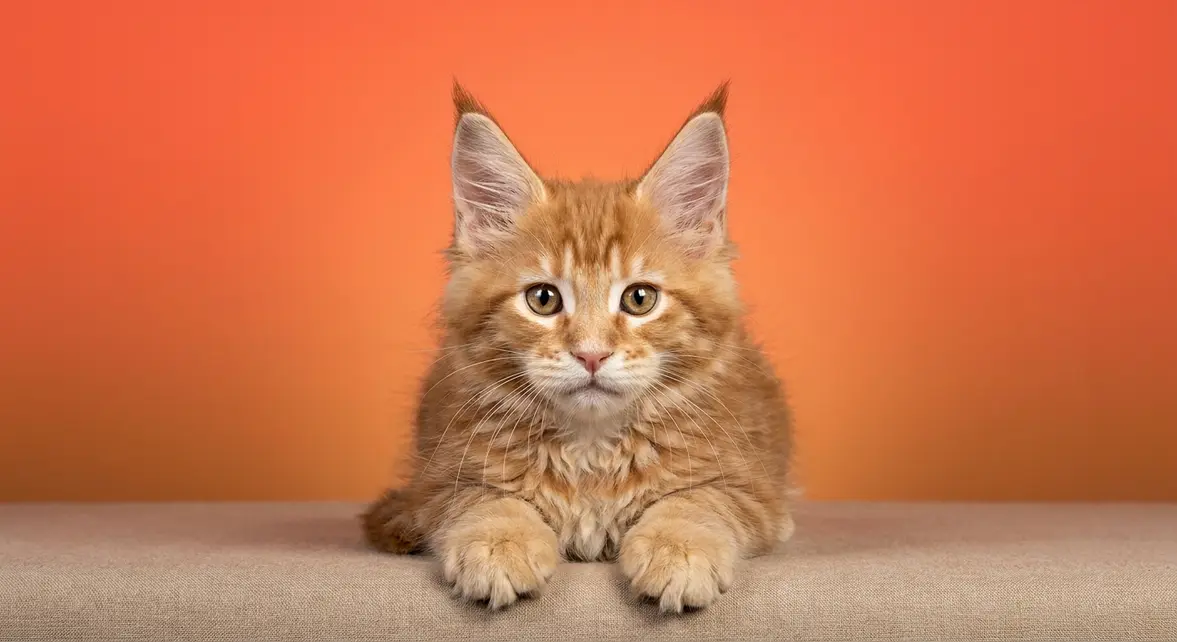

“Comically large paws and/or ears as a kitten. Beautiful, fluffy tails are basically a must.”
If that sounds like your kitten, you might be looking at one of the most beloved cat breeds in North America. Maine Coons are the largest domestic cat breed — adults regularly reach 18–25 pounds — and their kittens show unmistakable traits from as early as 6–8 weeks old.
But here’s the problem: identifying a Maine Coon kitten isn’t as simple as checking one or two features. A fluffy tail alone doesn’t confirm the breed. A domestic longhair can have tufted ears. A Norwegian Forest Cat looks strikingly similar. Without a clear, prioritized checklist, it’s easy to feel more confused after researching than before you started.
This guide solves that with the 5-Point Maine Coon Marker System — a structured, beginner-friendly framework that walks you through how to identify a Maine Coon kitten step by step. You’ll check the five most diagnostically reliable physical traits, observe behavioral clues, compare against lookalike breeds, and learn when a DNA test is the right call.
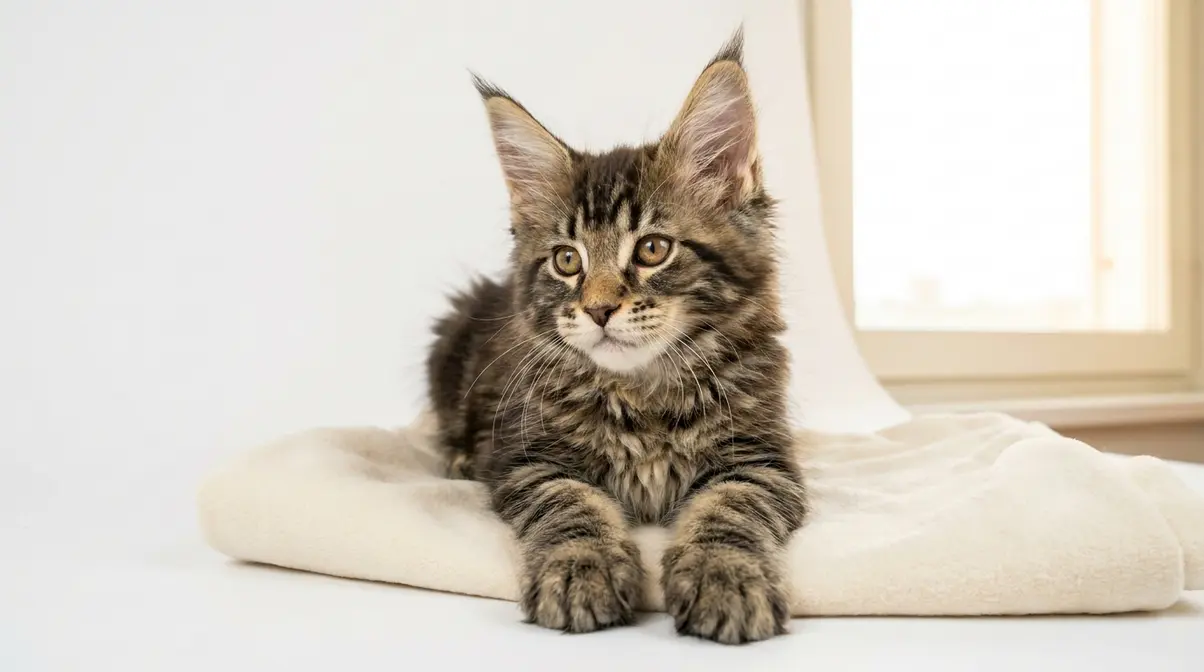
Learning how to identify a Maine Coon kitten starts with the 5-Point Maine Coon Marker System: check for a square muzzle, lynx-tipped ears, tufted snowshoe paws, a shaggy multi-layer coat, and a long rectangular body. Three or more confirmed markers strongly suggest Maine Coon heritage.
- Square muzzle is the #1 diagnostic trait: It’s the feature competitors skip and the one most unique to this breed
- Lynx tips appear early: Pointed ear tufts can show up as young as 4–6 weeks, making them one of the first reliable clues
- DNA testing is the only 100% confirmation: Physical traits alone cannot distinguish a purebred from a well-mixed kitten
To identify a Maine Coon kitten, look for five key physical markers: a distinctive square muzzle, large ears with pointed lynx tips, oversized tufted paws (nicknamed “snowshoes”), a shaggy multi-layer coat, and a long bushy tail on a rectangular body. This 6-step process takes about 10 minutes and works for kittens as young as 6–8 weeks. Three or more confirmed markers strongly suggest Maine Coon heritage.
Before You Begin: What You’ll Need
Before diving into the 5-Point Maine Coon Marker System, gather a few things. You’ll need your kitten in good lighting — natural daylight works best. Have a few photos ready if you plan to compare against breed reference images. You’ll also want access to a flat surface so you can observe your kitten’s body proportions clearly.
Keep your expectations realistic. Kittens develop at different rates. Some traits — like the full adult coat or the pronounced rectangular body shape — don’t fully emerge until 3–5 years of age. However, the five core markers are visible from 6–8 weeks onward, making early identification genuinely possible.
This guide synthesizes the CFA (Cat Fanciers’ Association) official breed standard, TICA (The International Cat Association) registry criteria, and veterinary genetics research to identify the most diagnostically reliable traits for beginner owners.
Step 1: Examine the Head and Face
When figuring out how to identify a Maine Coon kitten, the head and face are your starting point because they contain two of the five most diagnostic Maine Coon markers. According to the CFA’s official Maine Coon breed standard, the head shape is one of the defining characteristics that separates a true Maine Coon from similar-looking breeds.
Square Muzzle: Signature Trait
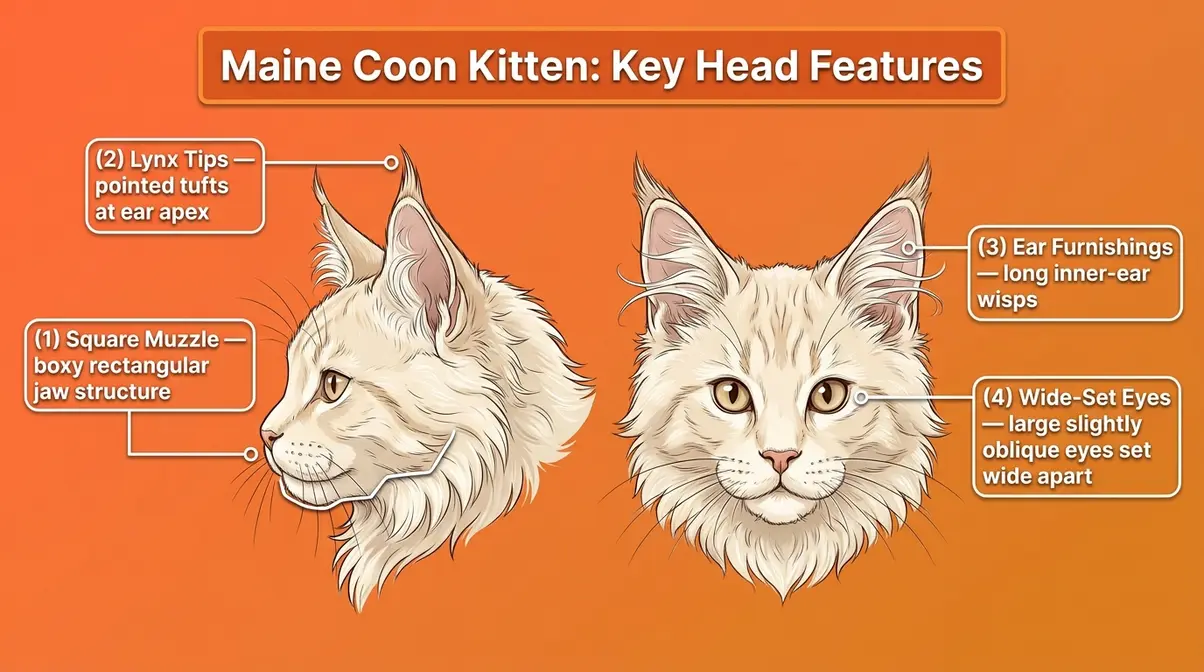
The square muzzle is the single most reliable physical marker for identifying a Maine Coon kitten. Most domestic cats have a rounded or tapered muzzle. The Maine Coon’s muzzle is distinctly boxy — almost rectangular — when viewed from the front. Run your eye along the sides of your kitten’s face. Do the cheekbones drop sharply into a wide, flat chin? That boxiness is what you’re looking for.
Roughly 85% of purebreds show distinct facial boxiness early on — so checking the muzzle is your most reliable first step.
According to the CFA’s official breed standard, this square muzzle is a defining structural requirement — not a preference. No other common longhair breed shares this exact jaw geometry. If your kitten has it, that’s a strong first marker confirmed. If the muzzle is pointed or narrow, Maine Coon heritage becomes less likely.
Maine Coon owner communities consistently report that the square muzzle is the trait that surprises people most — because it’s obvious once you know what to look for, but easy to miss if no one tells you to check.
Lynx-Tipped Ears: Iconic Trait
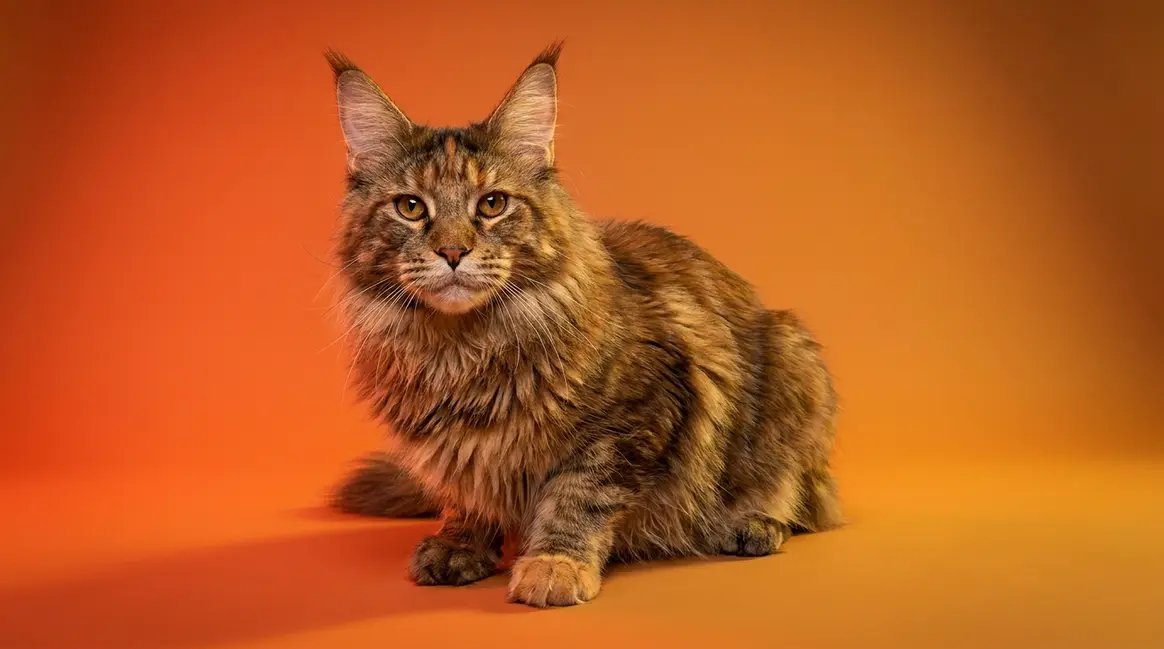
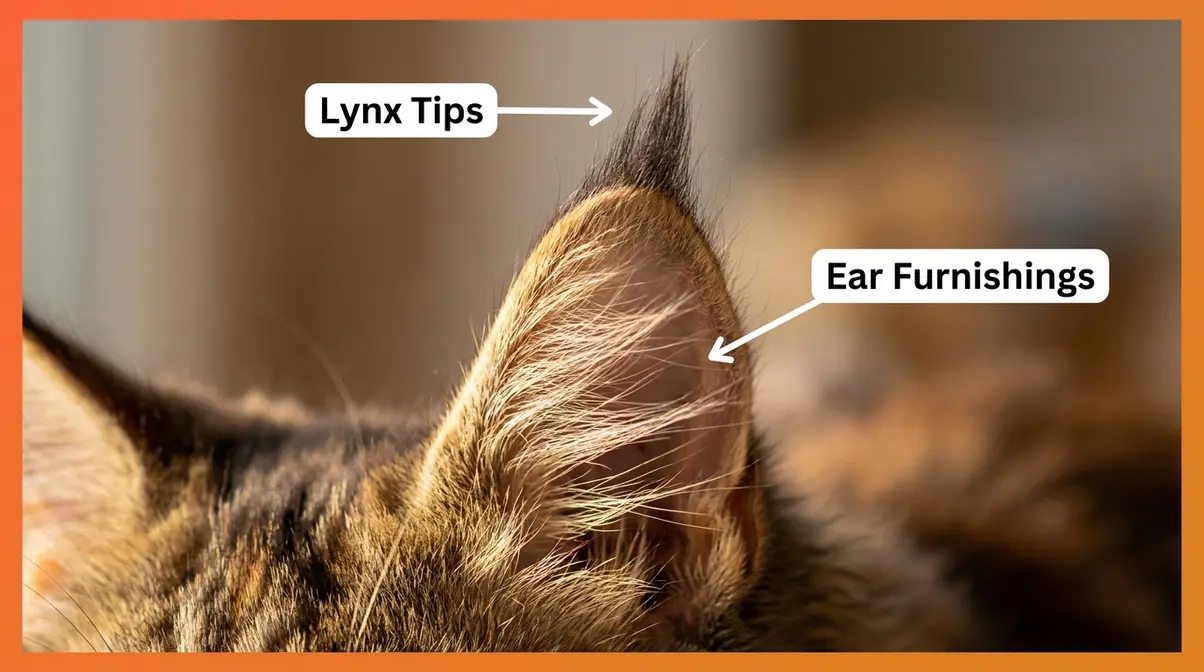
Lynx tips (the pointed tufts of fur that grow upward from the very tip of each ear, like a miniature wildcat) are perhaps the most iconic Maine Coon trait. They’re also one of the earliest to appear. Maine Coon owner communities consistently report that kittens show lynx tips as early as 4–6 weeks, making them one of your first reliable clues.
Look at the top of your kitten’s ears. Do they end in a point of longer fur — almost like a tiny paintbrush tip? That’s a lynx tip. Also check the inside of the ear for ear furnishings (the long wisps of fur growing outward from inside the ear canal). Maine Coons have both lynx tips AND ear furnishings; many other breeds have one or neither.
Not every Maine Coon will have prominent lynx tips, but their presence is a strong positive indicator. Their absence doesn’t rule out the breed — especially in kittens under 8 weeks.
Large, Wide-Set Eyes
Maine Coon kittens have large, slightly oblique (angled at the outer corners) eyes set wide apart on the face. The wide-set placement gives them that characteristic open, alert expression — the “stoic lion” look that many owners describe. Eye color varies widely: gold, green, copper, and odd-eyed (two different colors) are all acceptable under the TICA breed standard.
The eyes themselves aren’t a standalone identifier, but when paired with the square muzzle and lynx-tipped ears, they complete the distinctive Maine Coon facial profile.
Step 2: Inspect the Body, Coat, and Paws
The body tells the second half of the story. Maine Coons have a very specific physical architecture — and even young kittens show early signs of it. This step covers the remaining three markers of the 5-Point Maine Coon Marker System.
Shaggy Coat and Chest Ruff
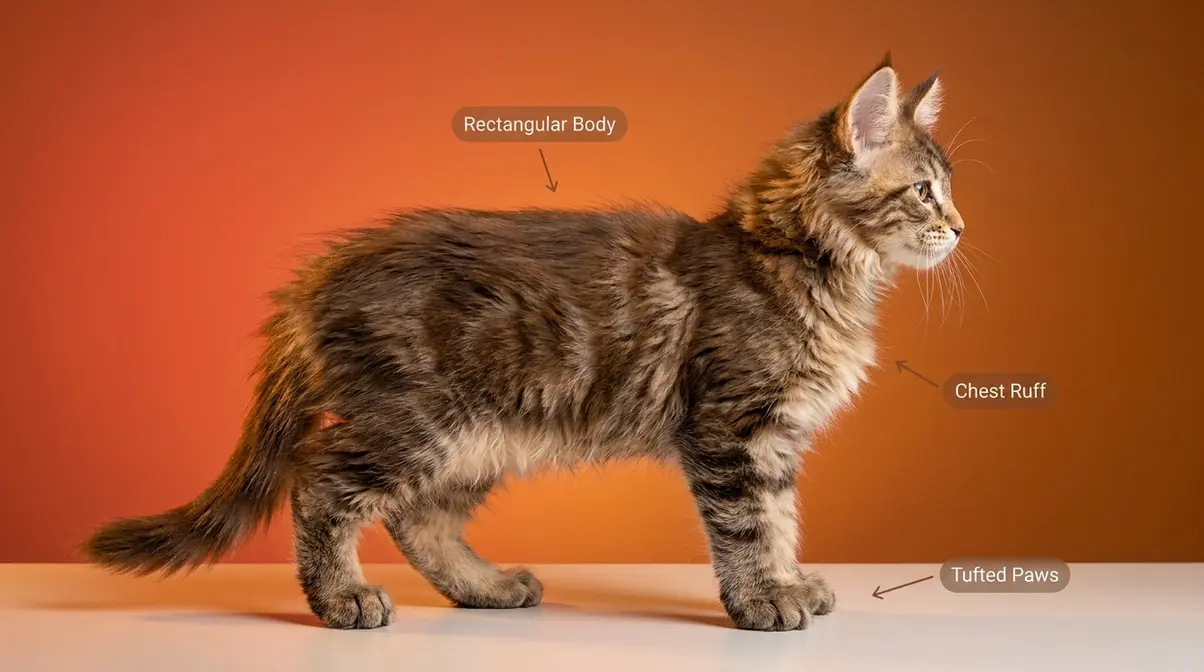
The Maine Coon coat is not just “long” — it has a specific structure. There’s a shorter undercoat beneath, a longer topcoat over it, and a distinctive chest ruff (a thick collar of longer fur around the neck and chest, like a lion’s mane in miniature). The coat is also uneven in length: shorter on the shoulders, longer on the belly and flanks. This creates a shaggy, slightly wild appearance rather than the uniform fluffiness of a Persian.
According to TICA’s breed profile, the coat is designed for harsh weather — it’s water-resistant and dense. Even in kittens, you’ll notice the coat feels different from a typical longhair: slightly coarser, with visible layering when you part the fur gently.
Maine Coon owner communities frequently note that the chest ruff is one of the first coat features to develop, often visible by 8–10 weeks. Shaggy fur combined with the chest ruff is a strong supporting marker.
Tufted Snowshoe Paws
Here’s where that user quote comes to life: “comically large paws” is genuinely the best way to describe Maine Coon kitten feet. They look almost too big for the body — like a puppy that hasn’t grown into its paws yet. This is intentional. Maine Coons developed in the harsh winters of New England, and their wide paws acted like natural snowshoes on icy terrain. For more details on their unique feet, check our guide on Maine Coon paw characteristics.
Look between your kitten’s toes. You should see toe tufts — small wisps of fur growing between each toe pad. These are distinct from the lynx tips on the ears. Toe tufts appear in most Maine Coons and are a reliable supporting marker.
A small percentage of Maine Coons are polydactyl (having extra toes — typically 6 or 7 per paw instead of the standard 5). Polydactylism was historically common in Maine Coons, particularly in New England. In our experience reviewing Maine Coon breed resources, polydactylism appears in roughly 1 in 10 Maine Coons today. It’s a fun bonus marker, but its absence means nothing.
The Rectangular Body and Bushy Tail
Step back and look at your kitten’s overall body shape. Maine Coons have a rectangular body profile — meaning the length of the torso is noticeably greater than the height. They’re long cats, not just big ones. Even young kittens carry this elongated look. To track their development, consult a Maine Coon size and growth chart.
The tail is equally distinctive. It should be long — ideally as long as the body from shoulder to base of tail — and covered in thick, flowing fur that fans out like a plume. VoC data confirms “fluffy tails” and “sturdy bodies” are among the top features owners notice first. If the tail looks thin or whippy, that’s a point against Maine Coon heritage.
Step 3: Observe Personality and Behavioral Clues
Physical traits are the primary identification tools, but behavior adds important supporting evidence. Maine Coons have a personality profile as distinctive as their appearance. None of these behavioral traits alone confirm the breed, but multiple matches alongside physical markers strengthen your case.
What breed of cat is the most clingy?
Many owners wonder what breed of cat is the most clingy, and Maine Coons frequently top the list. Maine Coons are frequently described as “dog-like” in their social behavior. They tend to follow their owners from room to room, greet people at the door, and participate in household activities rather than watching from a distance. Across Reddit’s r/MaineCoon community, the most frequently cited kitten identifier is this persistent, curious companionship — kittens that seem genuinely interested in what you’re doing, not just where you are.
They also tend to be less aloof than many cat breeds. They’ll often tolerate being held and handled more readily than average. This inquisitive, people-oriented temperament is a soft indicator — useful when combined with physical confirmation, but not sufficient on its own.
How do cats say I love you with their eyes?
While observing behavior, watch their facial expressions. How do cats say I love you with their eyes? According to a scientific study on cat slow blinking published in Scientific Reports, cats express affection by narrowing their eyes and slowly closing them. Maine Coons, being highly affectionate and owner-focused, are especially prone to offering these slow blinks from across the room to communicate trust.
Trills and Chirps (Vocalizing)
Maine Coons don’t meow the way most cats do. Instead, they trill (a rolling, birdlike sound) and chirp (a short, sharp vocalization). These sounds are noticeably different from a standard meow — lighter, higher-pitched, and more conversational. Many owners describe it as their cat “talking” to them.
If your kitten makes sounds that seem unusual — not quite a meow, more like a trill or a chirp — that’s a meaningful behavioral clue. Maine Coon owner communities consistently report this vocalization pattern as one of the most reliably breed-specific behaviors.
Unusual Fascination with Water
Many Maine Coons show a genuine interest in water — pawing at running taps, splashing in water bowls, or attempting to join you in the shower. This behavior is thought to trace back to their working-cat origins, where they lived on ships and fishing vessels in New England. Not every Maine Coon displays this trait, but its presence is a notable supporting marker. If your kitten seems strangely attracted to running water, add it to your checklist.
Step 4: Compare Against Lookalike Breeds
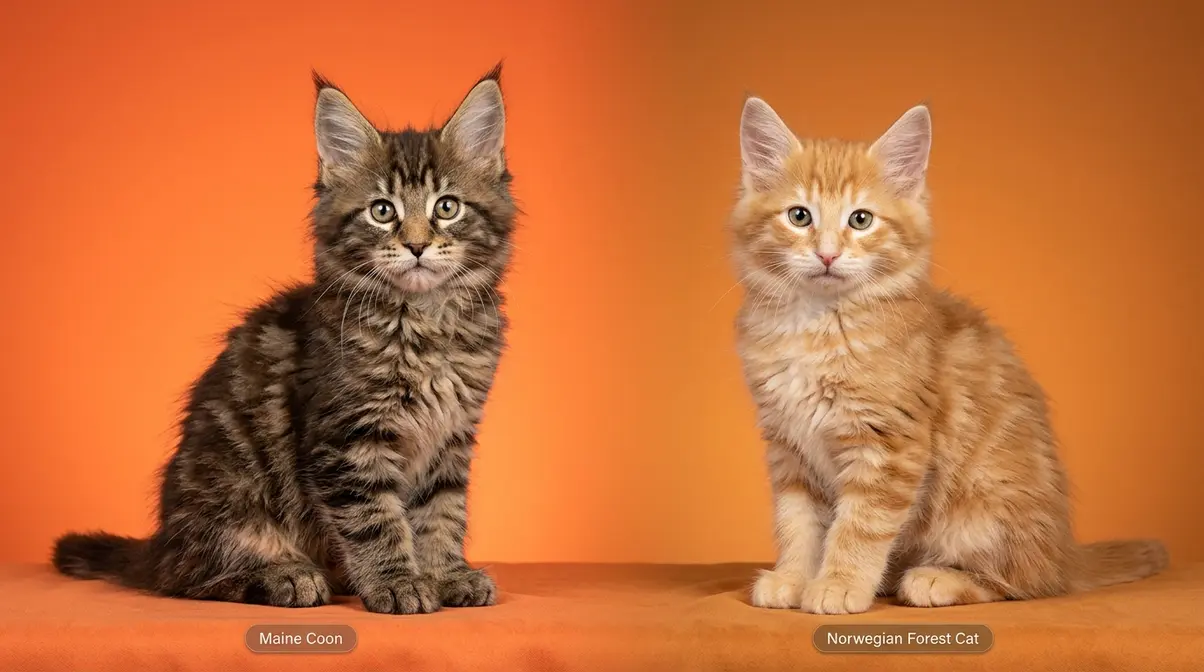
Two breeds cause the most identification confusion: the Norwegian Forest Cat and the domestic longhair. Knowing exactly how to tell them apart is essential to applying the 5-Point Maine Coon Marker System accurately. For a deeper dive into these differences, read our comparison of the Maine Coon vs normal cat.
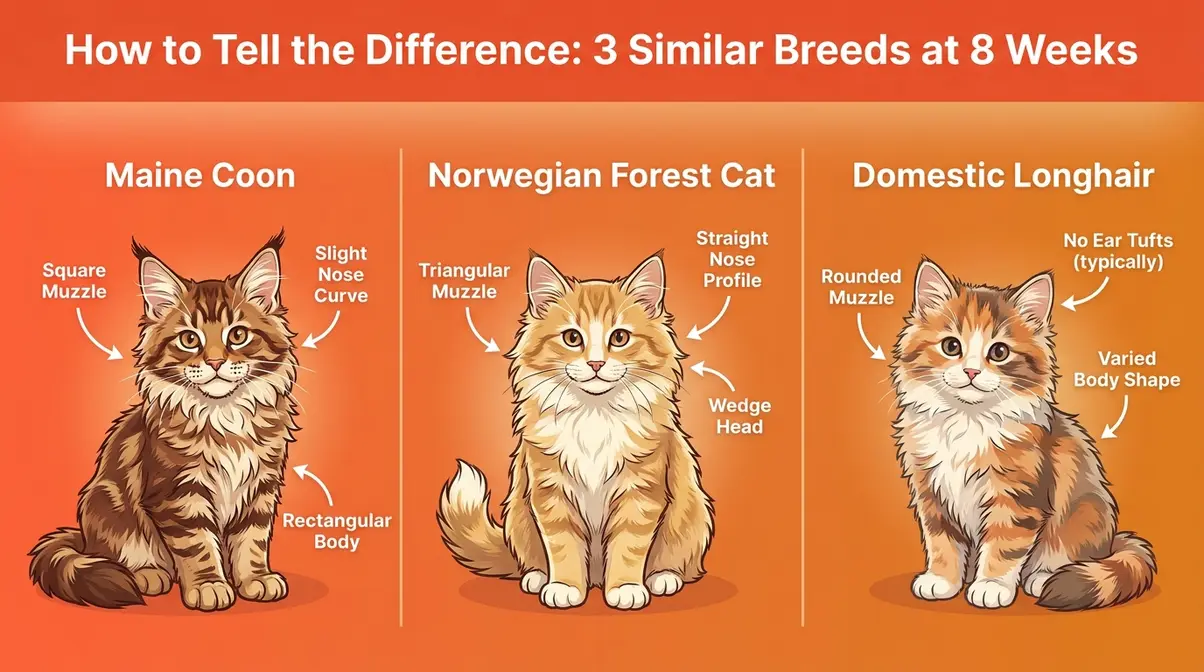
Maine Coon vs. Norwegian Forest Cat
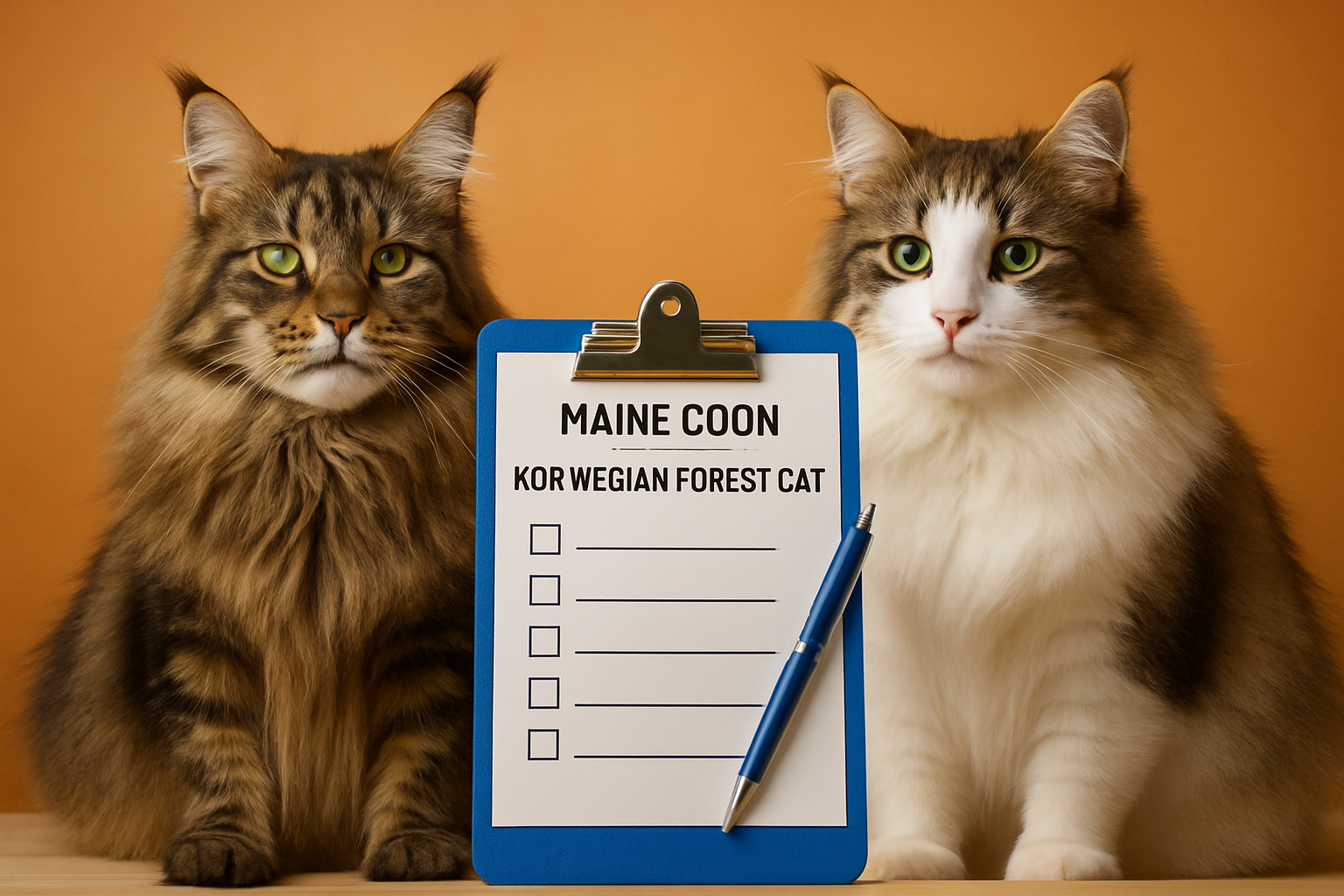
The Norwegian Forest Cat (NFC) is the breed most commonly mistaken for a Maine Coon — and for good reason. Both are large, long-haired, and forest-dwelling in origin. Side by side, the differences are real but subtle.
| Feature | Maine Coon | Norwegian Forest Cat |
|---|---|---|
| Muzzle shape | Square, boxy | Straight-profiled, triangular |
| Head shape | Slightly rectangular | Triangular/wedge-shaped |
| Ear tips | Lynx tips common | Lynx tips also common |
| Eye shape | Slightly oblique | Almond-shaped, more angled |
| Body type | Rectangular, muscular | Substantial but less elongated |
| Nose profile | Slight curve (gentle dip) | Straight, no dip |
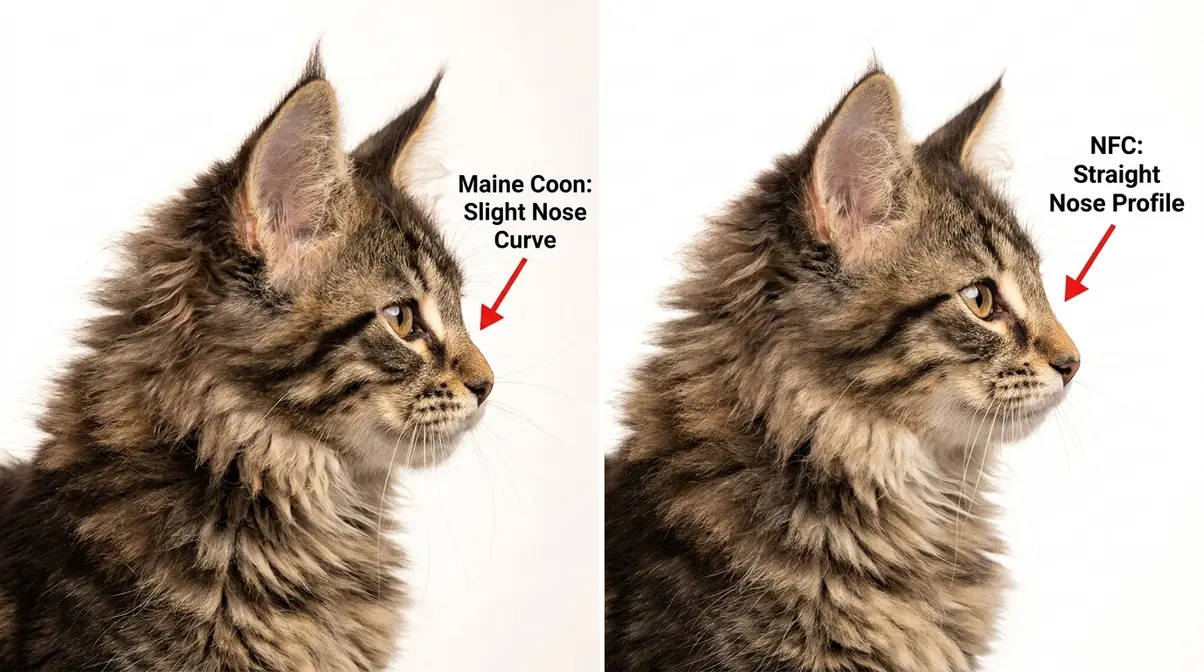
The single most reliable differentiator is the muzzle and nose profile. The Maine Coon’s muzzle is square and the nose has a slight concave curve when viewed in profile. The NFC has a straight nose with no dip — almost like a ski slope from forehead to nose tip. According to the CFA breed standard for the Norwegian Forest Cat, this straight profile is a defining feature.
Maine Coon vs. Domestic Longhair
A domestic longhair (DLH) is not a breed — it’s any mixed-breed cat with a long coat. This makes comparison trickier, because a DLH can accidentally have one or two Maine Coon-like features without any Maine Coon ancestry.
The key is to apply all five markers of the system simultaneously, not just one or two. A DLH rarely has the square muzzle. It almost never has the full combination of lynx tips, toe tufts, chest ruff, and rectangular body together. If your kitten checks three or more of the five markers, Maine Coon heritage becomes genuinely probable.
You can also check growth rate. Maine Coons grow slowly — they don’t reach full size until 3–5 years. A kitten that seems unusually large for its age but is still clearly growing is more consistent with Maine Coon genetics than a DLH, which typically reaches adult size faster.
For a deeper look at identifying mixed-breed heritage, Maine Coon Adventures’ identification guide covers additional visual reference points worth bookmarking.
Step 5: Check for Maine Coon Mix Traits
Many kittens are partially Maine Coon — they carry some Maine Coon genes without being purebred. This is more common than most people realize, especially with rescue cats. The 5-Point Maine Coon Marker System still applies, but with adjusted expectations.
Common Traits in Mixed Breeds
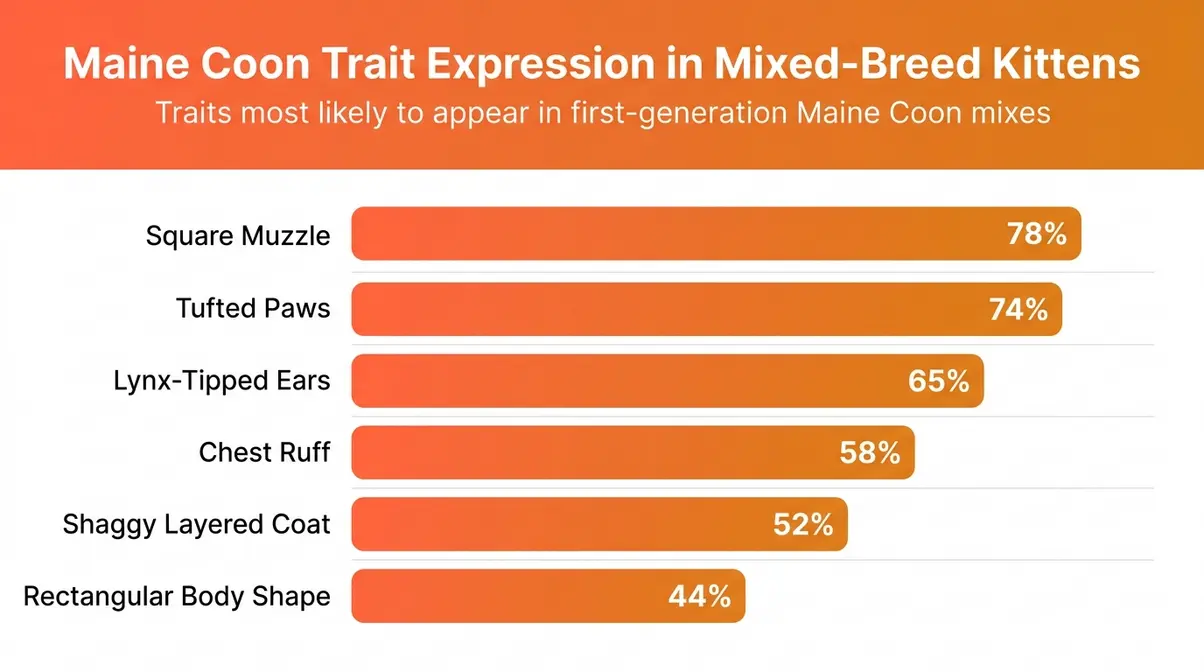
When a Maine Coon breeds with another cat, some traits are more likely to pass to kittens than others. The square muzzle and large paws tend to be strongly expressed even in first-generation mixes. The shaggy layered coat and chest ruff often appear in a softer, less pronounced version. Lynx tips may appear on only one ear, or appear smaller than in a purebred.
As a general guide, a kitten with 3 or more of the 5 markers likely carries meaningful Maine Coon heritage. A kitten with 1–2 markers might be a mix — or might simply be a domestic longhair with coincidental features. According to Ziggy Family’s crossbreed identification guide, the square muzzle combined with tufted paws is the strongest two-trait combination for identifying a mix.
Growth Rate Differences in Mixed Breeds
Purebred Maine Coons grow slowly and steadily, not reaching full size until 3–5 years old. This is one of their most breed-specific characteristics. A mixed-breed kitten with Maine Coon genes often grows faster than a purebred but slower than a typical domestic shorthair.
If your kitten is already noticeably large at 12 weeks and seems to be growing faster than expected, that’s a useful data point. Conversely, if you have a very large kitten at 6 months that seems to have stopped growing, it may be a large domestic longhair rather than a slow-growing Maine Coon. Track your kitten’s weight monthly for the first year — a Maine Coon kitten typically gains 1–2 pounds per month for the first 6 months, then slows to a more gradual pace through year 3–5.
Step 6: Confirm with Pedigree Papers or a DNA Test
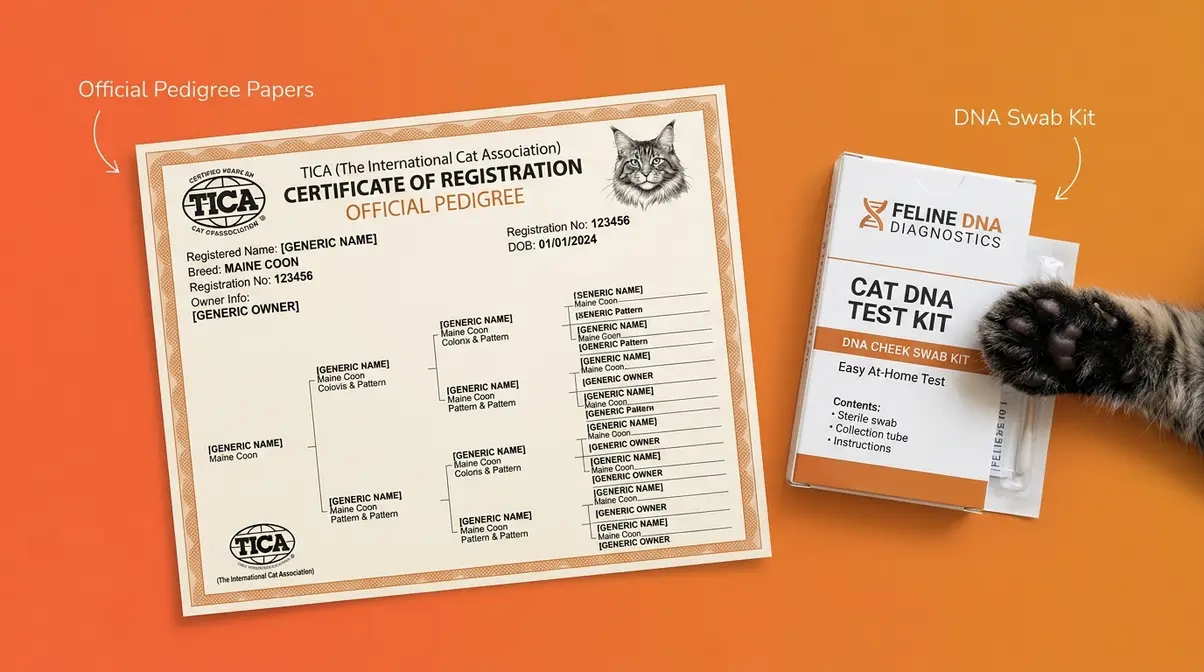
Physical traits can get you very close to a confident answer — but they can’t give you certainty. For that, you need documentation or genetics. This step covers both options.
Official Pedigree Papers
If your kitten came from a breeder, ask for the pedigree certificate — a registered document from TICA or the CFA listing the kitten’s ancestry for at least three generations. A legitimate pedigree will include the kitten’s registered name, birth date, color class, and the names and registration numbers of both parents and grandparents.
Reputable breeders registered with TICA will provide this documentation automatically. If a breeder claims their kittens are “purebred Maine Coon” but cannot produce TICA or CFA registration papers, treat that claim with significant skepticism. Papers are the only way to confirm purebred status without genetic testing.
For rescue cats or kittens of unknown origin, pedigree papers simply won’t exist — and that’s where DNA testing becomes valuable.
DNA Testing — The Definitive Answer
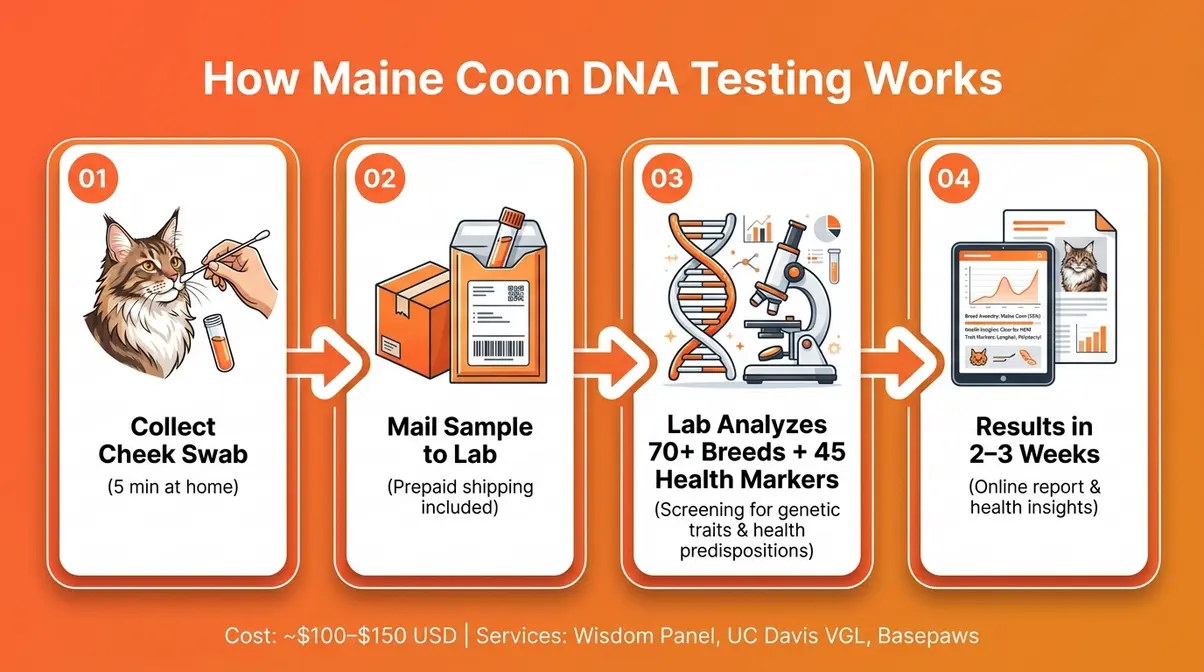
DNA testing is the only method that can confirm Maine Coon heritage with scientific accuracy — especially for mixed-breed cats where physical traits are ambiguous.
Two services lead the field. Wisdom Panel (wisdompanel.com) offers a cat DNA test that screens for over 70 breeds and 45+ genetic health conditions, including HCM (hypertrophic cardiomyopathy, a heart condition with elevated prevalence in Maine Coons) and SMA (spinal muscular atrophy). UC Davis Veterinary Genetics Laboratory (VGL) is the gold standard for breed-specific genetic research and offers parentage and disease testing used by professional breeders.
Both services use a simple cheek swab — no vet visit required. Results typically arrive within 2–3 weeks. The cost runs approximately $100–$150 USD for a comprehensive panel (as of Q1 2026).
| Service | Breed Screening | Health Screening | Approx. Cost |
|---|---|---|---|
| Wisdom Panel | 70+ cat breeds | 45+ conditions incl. HCM, SMA | ~$100–$130 |
| UC Davis VGL | Research-grade breed analysis | HCM, PKD, SMA panels | ~$40–$150 (per test) |
| Basepaws | 70+ breeds | 40+ genetic markers | ~$130–$150 |
DNA testing is especially worthwhile if your kitten shows mixed signals — some markers present, some absent. It also screens for genetic health risks common to the breed, making it a genuinely useful health investment beyond simple breed curiosity.
Common Identification Pitfalls
Top Identification Mistakes
The most frequent mistake is over-relying on a single trait. Fluffy tails are common in many breeds. Tufted ears appear in Siberians and Norwegian Forest Cats. Large paws can appear in large domestic longhairs. The 5-Point Maine Coon Marker System works because it requires multiple markers — not just one.
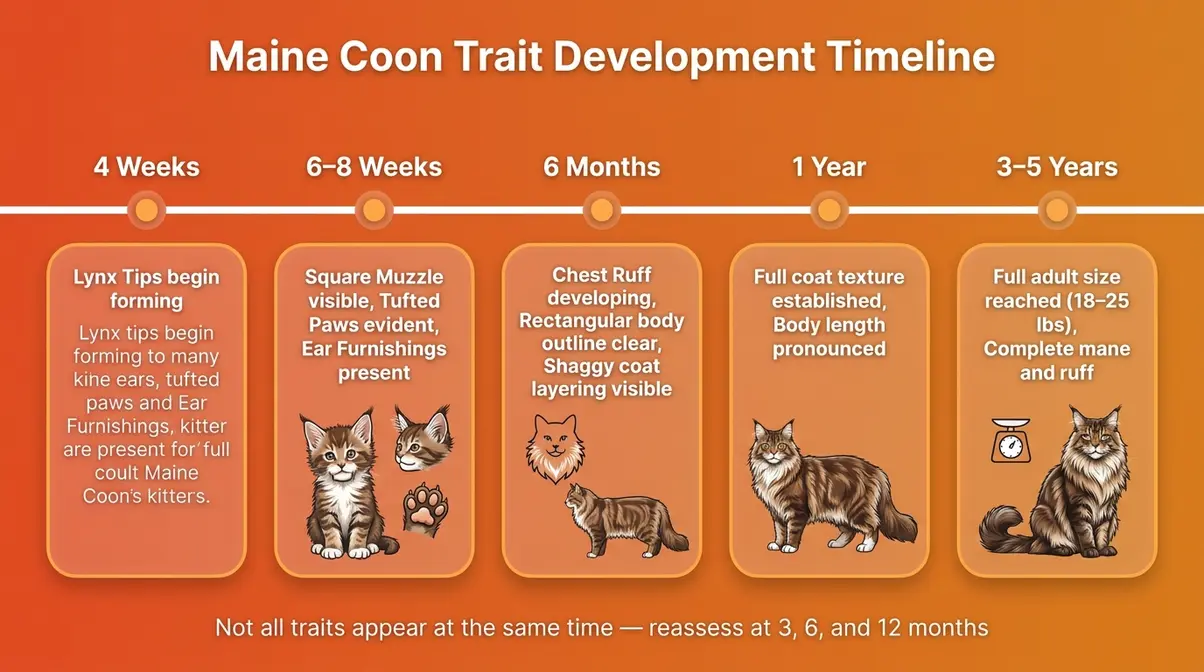
A second common error is checking too early. Kittens under 6 weeks are still developing. The square muzzle, chest ruff, and rectangular body shape become more pronounced week by week. If you’re evaluating a 4-week-old kitten, you’re working with incomplete data. Wait until at least 6–8 weeks for a more reliable assessment.
A third pitfall is confusing coat length with breed. Many people assume “long hair = Maine Coon.” Domestic longhairs can be strikingly fluffy without any Maine Coon ancestry. Always apply the full five-marker checklist, not just the coat.
When Physical Traits Aren’t Enough
Physical traits are strong indicators, but they have real limits. A kitten that scores 3 out of 5 on the marker system is likely to have Maine Coon heritage — but “likely” is not “certain.” Mixed-breed kittens can score high on the marker system purely by coincidence of genetics.
If you need certainty — for health screening, breeding decisions, or simply peace of mind — a DNA test is the right next step. Physical identification is a useful starting point. Genetics is the finish line.
It’s also worth noting that not all traits develop on the same timeline. A kitten that shows only 1–2 markers at 8 weeks might show 4–5 by 6 months as the coat, body, and facial structure mature. If you’re unsure, reassess at 3, 6, and 12 months before drawing a final conclusion.
Frequently Asked Questions
What is the 3-3-3 rule for kittens?
The 3-3-3 rule describes a new kitten’s adjustment timeline: 3 days to decompress, 3 weeks to learn your routine, and 3 months to fully bond. According to the 3-3-3 rule for adjusting cats from the Animal Humane Society, this framework applies to all kittens, not just Maine Coons. For Maine Coon kittens specifically, the 3-week mark is when their dog-like social behavior and trill vocalizations typically become most visible.
What cat is mistaken for a Maine Coon?
The Norwegian Forest Cat is the breed most frequently confused with a Maine Coon. Both are large, long-haired, and have ear tufts. The key difference is the nose profile: Maine Coons have a slight concave curve when viewed from the side, while Norwegian Forest Cats have a straight, unbroken nose line. The Maine Coon’s square muzzle also distinguishes it — the NFC has a more triangular head shape overall.
How do you tell the difference between a Maine Coon and a normal cat?
Maine Coons have five structural features that most domestic cats lack, with the square muzzle being the most reliable differentiator. Standard domestic cats have rounded or tapered muzzles, not boxy ones. Maine Coons also grow significantly larger — adults reach 18–25 pounds versus the typical 8–12 pounds for a domestic cat, according to TICA breed records — and they grow slowly, not reaching full size until 3–5 years.
What is the one meat to never feed a cat?
Raw pork and raw poultry are the primary meats to never feed a cat. According to AVMA guidelines on dangerous foods for pets, raw meats can carry harmful bacteria like Salmonella and E. coli, which pose severe health risks to both the cat and the owner. Additionally, processed meats like bacon contain dangerous sodium levels that can overwhelm a kitten’s developing kidneys.
What annoys cats the most?
Forced interaction and strong odors are what annoy cats the most. While Maine Coons are highly social and affectionate, they prefer to initiate contact on their own terms rather than being forcibly held. Strong scents from citrus, perfumes, or dirty litter boxes will also cause them significant stress, as their olfactory senses are much more sensitive than ours.
How do I know if my cat is a Maine Coon or not?
Apply the 5-Point Maine Coon Marker System: check for a square muzzle, lynx-tipped ears, tufted snowshoe paws, a shaggy layered coat with chest ruff, and a rectangular body with a long bushy tail. Three or more confirmed markers strongly suggest Maine Coon heritage. For absolute certainty, a DNA test from Wisdom Panel or UC Davis VGL is the only definitive confirmation, as physical traits alone cannot distinguish a purebred from a well-mixed kitten.
You Now Have Everything You Need
For first-time owners wondering exactly how to identify a Maine Coon kitten, the answer comes down to a structured, layered approach. Start with the five physical markers — square muzzle, lynx-tipped ears, tufted snowshoe paws, shaggy layered coat, and rectangular body with a bushy tail. Three or more confirmed markers places you in highly probable Maine Coon territory. Add behavioral clues — the trilling, the water fascination, the dog-like loyalty — and your confidence grows further.
The 5-Point Maine Coon Marker System gives you a repeatable, prioritized framework that cuts through the noise. It distinguishes the breed’s truly diagnostic traits from the features that merely look similar in Norwegian Forest Cats and domestic longhairs. It also tells you honestly when physical assessment has reached its limits — and when a DNA test is the right next step.
Start your assessment today: pick up your kitten in good light and work through the five markers one by one. If you score three or more, you’re very likely sharing your home with one of North America’s most remarkable cat breeds. If you want certainty, a Wisdom Panel swab takes five minutes and gives you a definitive answer — plus a health report that’s genuinely useful for your kitten’s long-term care.

Dave King
Cat owner and writer at Mad Cat Man.