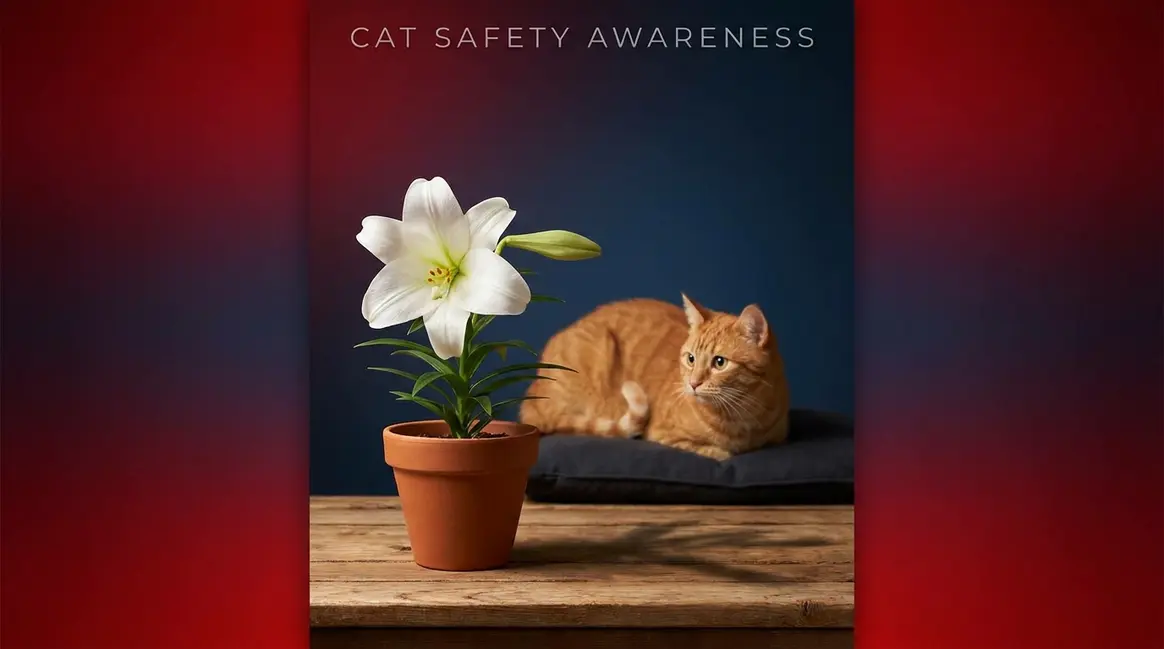
Are Lilies Toxic to Cats? Vet-Backed Guide + Emergency Steps
Explore practical guidance for Cats and Lily Plants: A Vet-Approved Emergency Checklist and 9 Safe Flower Alternatives including common pitfalls to avoid…

⚠️ MEDICAL DISCLAIMER
This article is for informational purposes only and is not a substitute for professional veterinary advice. If you believe your cat has been exposed to a lily, contact your veterinarian or an emergency animal poison control hotline immediately:
📞 ASPCA Animal Poison Control: (888) 426-4435
📞 Pet Poison Helpline: (855) 764-7661
Time is critical — do not wait for symptoms to appear.
Medically reviewed by a licensed veterinarian (DVM).
Every year, thousands of cats are rushed to emergency veterinary clinics after exposure to lilies — and many owners had no idea the bouquet on the counter was lethal. A cat can brush against an Easter lily, lick a few grains of pollen from its whiskers, and be in fatal kidney failure within 72 hours. The question “are lilies toxic to cats” has a short, alarming answer: yes, profoundly so — and the danger goes far beyond eating a petal.
“Throw the lily away. Lilies are super toxic to cats and can kill them.”
— Widely echoed warning from the veterinary community and cat owner forums
The danger isn’t just from chewing the flower. Pollen, vase water, and even proximity to a blooming lily create real risk — and most guides don’t tell you that. This guide covers the science behind the toxicity, a visual identification system for dangerous vs. safe varieties, every exposure route explained, and a step-by-step emergency protocol — so you can act immediately if you need to.
Yes, if you are asking “are lilies toxic to cats,” the answer is extremely toxic — even licking pollen from their fur can trigger fatal kidney failure within 72 hours. This applies to all true lilies (Lilium) and daylilies (Hemerocallis).
- True lilies are the deadliest: Easter, Tiger, Stargazer, and Asiatic lilies can kill a cat from any part of the plant — pollen, petals, leaves, or vase water.
- Pollen is as dangerous as petals: Grooming pollen off fur is a common — and fatal — route of exposure.
- The Lily Risk Ladder: Not all “lilies” are equally deadly. Peace Lilies cause mouth irritation, not kidney failure — but they are still not safe.
- The 18-hour window: Treatment started within 18 hours of ingestion dramatically improves survival odds.
- If in doubt, call now: Never wait for symptoms to appear before contacting the ASPCA Poison Control at (888) 426-4435.
Why Lilies Are Deadly: Feline Science
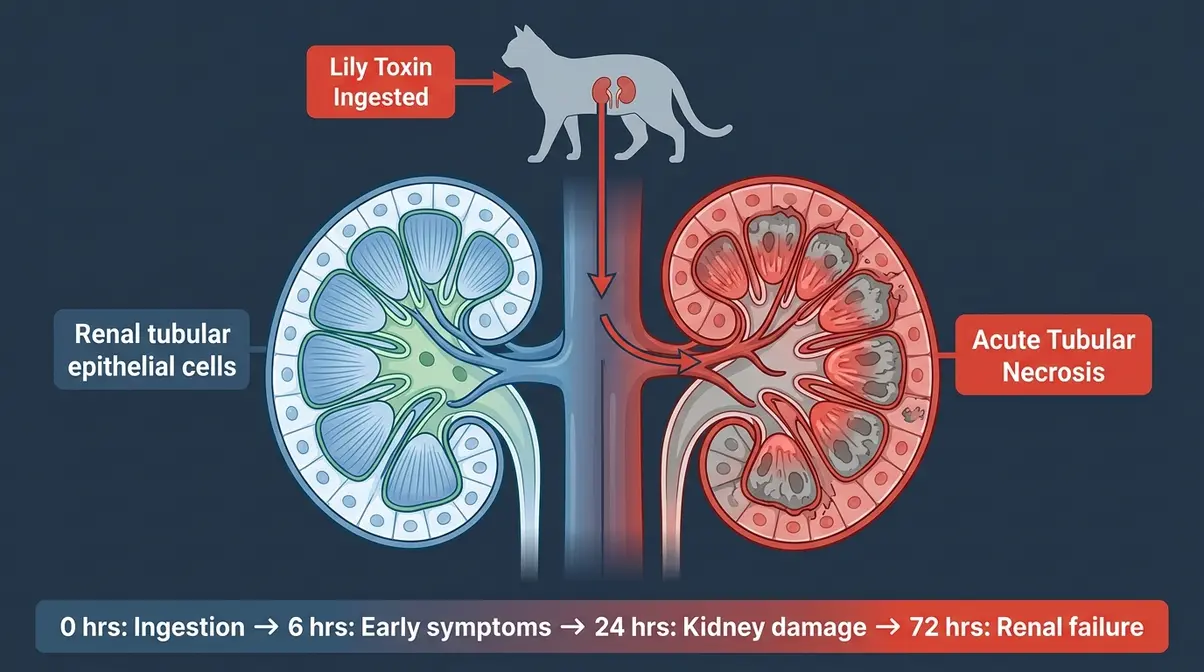
When pet owners ask, are lilies toxic to cats, they often don’t realize that lilies are not just mildly harmful to cats — they are among the most acutely nephrotoxic (kidney-damaging) plants known to veterinary medicine. Understanding why they are so dangerous helps you understand why speed of treatment is everything.
What Makes True Lilies Fatal to Cats?
True lilies belong to the genus Lilium (true lily) and the genus Hemerocallis (daylily). Both genera contain an as-yet unidentified toxin — researchers have not fully isolated the exact compound responsible — but its effects on feline kidneys are catastrophic and well-documented.
When a cat ingests any part of a true lily, the toxin is rapidly absorbed through the gastrointestinal tract and targets the renal tubular epithelial cells — the specialized cells lining the kidney’s filtering tubes. These cells are essential for filtering waste from the blood. The toxin causes them to die off in a process called acute tubular necrosis (ATN), meaning the kidney’s filtering system essentially collapses from the inside.
What this means for your cat: Within 24–72 hours of exposure, your cat’s kidneys can stop working entirely. Waste products that should be filtered out of the blood begin to accumulate, causing a condition called azotemia (toxic buildup in the bloodstream). Without aggressive veterinary intervention, this progresses to acute renal failure (ARF) and death.
The FDA Animal Health Literacy page on lilies confirms this mechanism and emphasizes that all parts of the plant — including pollen, leaves, petals, stems, and even the water in a vase containing cut lilies — are considered toxic.
A critical detail: the toxic compound has not been chemically identified as of 2026. This means there is no antidote. Treatment is entirely supportive — IV fluids to flush the kidneys and prevent further damage — which is why time is the only variable that can be controlled.
Why Cats Are Uniquely Vulnerable
Dogs can also experience gastrointestinal upset from lily exposure, but they do not suffer the same catastrophic kidney failure that cats do. Humans are unaffected entirely. So why are cats uniquely vulnerable?
The answer lies in feline metabolism. Cats are obligate carnivores, meaning their livers evolved to process a meat-only diet. They lack several key liver enzymes — most notably glucuronyl transferase — that humans and dogs use to detoxify plant compounds. This means cats cannot neutralize the lily toxin the way other species can, and it reaches the kidneys at full, unmetabolized potency.
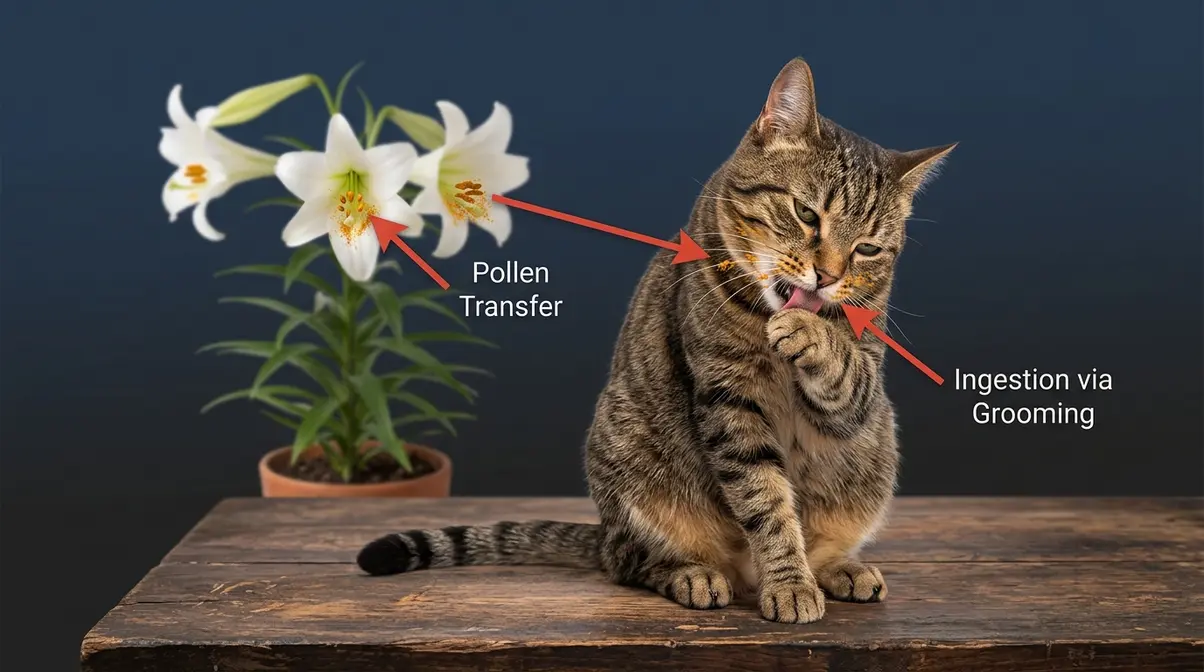
Additionally, cats are meticulous groomers. A cat that walks through a room with a blooming lily, brushes a stamen, and then grooms its fur will ingest pollen directly — a route of exposure that would be harmless to a dog or child. This grooming behavior makes cats uniquely and disproportionately at risk compared to any other household pet.
What this means for you: If you have a cat, a lily in your home is categorically different from a lily in a home without cats. The risk is not theoretical — it is a documented, repeatable, and frequently fatal outcome.
How Severe Is Lily Poisoning, Really?
The severity of lily poisoning is determined by two factors: the amount ingested and how quickly treatment begins. A peer-reviewed study published in 2024 (which remains the clinical standard in 2026) published in PMC reviewing feline lily toxicosis cases found that cats treated with IV fluid diuresis within 18 hours of exposure had significantly improved survival outcomes compared to cats treated after the 18-hour mark (PMC, 2024).
The prognosis without treatment is grim. According to the Pet Poison Helpline, untreated lily poisoning carries a very high mortality rate, with cats typically progressing to irreversible kidney failure and death within 3–6 days of exposure.
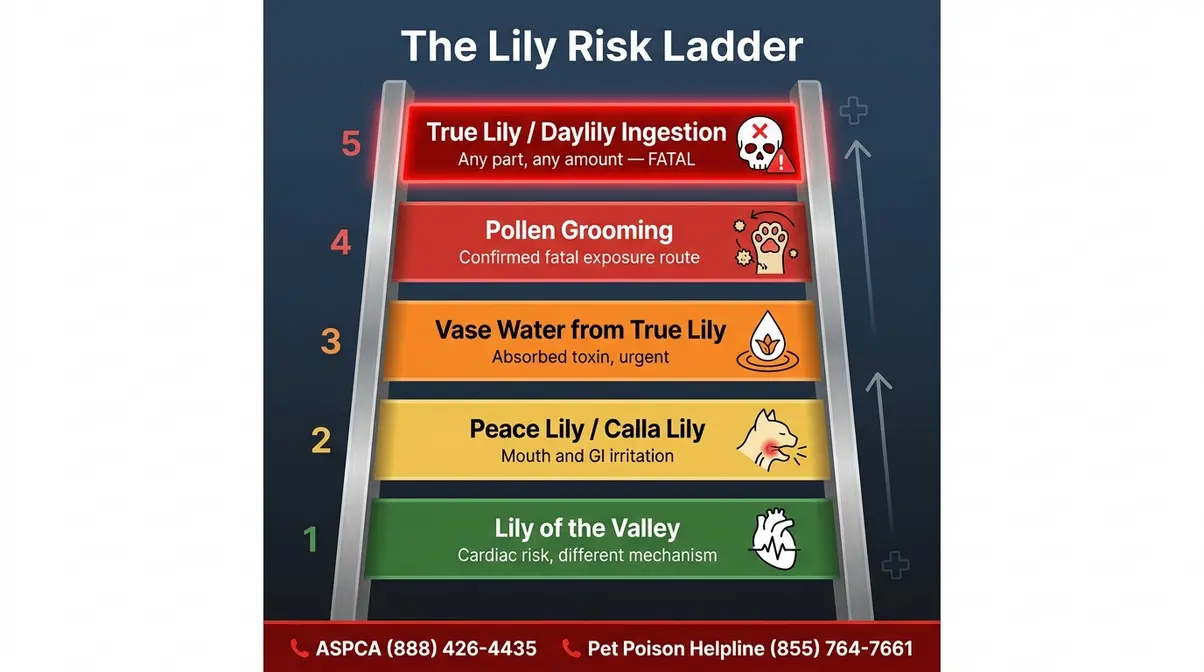
The Lily Risk Ladder — a severity framework for thinking about lily exposure — places true lily and daylily ingestion at the top rung: a 5-alarm veterinary emergency requiring immediate intervention. The lower rungs include pollen-only exposure (still urgent, but slightly lower immediate risk) and non-true-lily species like Peace Lily (serious mouth irritation but not kidney failure). This framework, detailed throughout this guide, helps you calibrate your response without either panicking unnecessarily or — more dangerously — underreacting.
Veterinary consensus confirms that even a single leaf from an Easter lily (Lilium longiflorum) can cause fatal kidney failure in an adult cat. There is no established “safe” dose. For a comprehensive safety review to audit your home, consult our cats and lily plants vet-approved checklist.
Which Lilies Are Toxic to Cats?
Not every plant with “lily” in its name poses the same danger. The Lily Risk Ladder begins with understanding that the word “lily” describes dozens of unrelated plants — some lethally toxic, some merely irritating, and a few genuinely safe. Knowing the difference could save your cat’s life.
True Lilies — The Most Dangerous Group
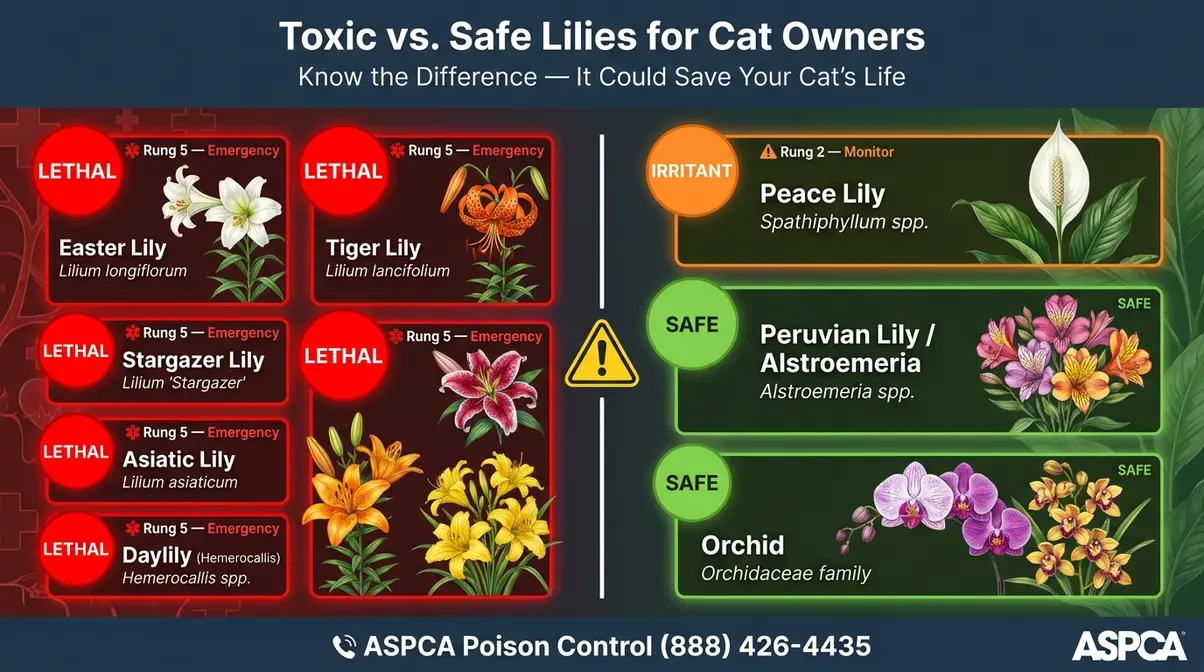
True lilies belong to the genus Lilium and represent the highest level of danger on the Lily Risk Ladder. Every part of every plant in this genus is considered lethally toxic to cats, according to the ASPCA Animal Poison Control Center.
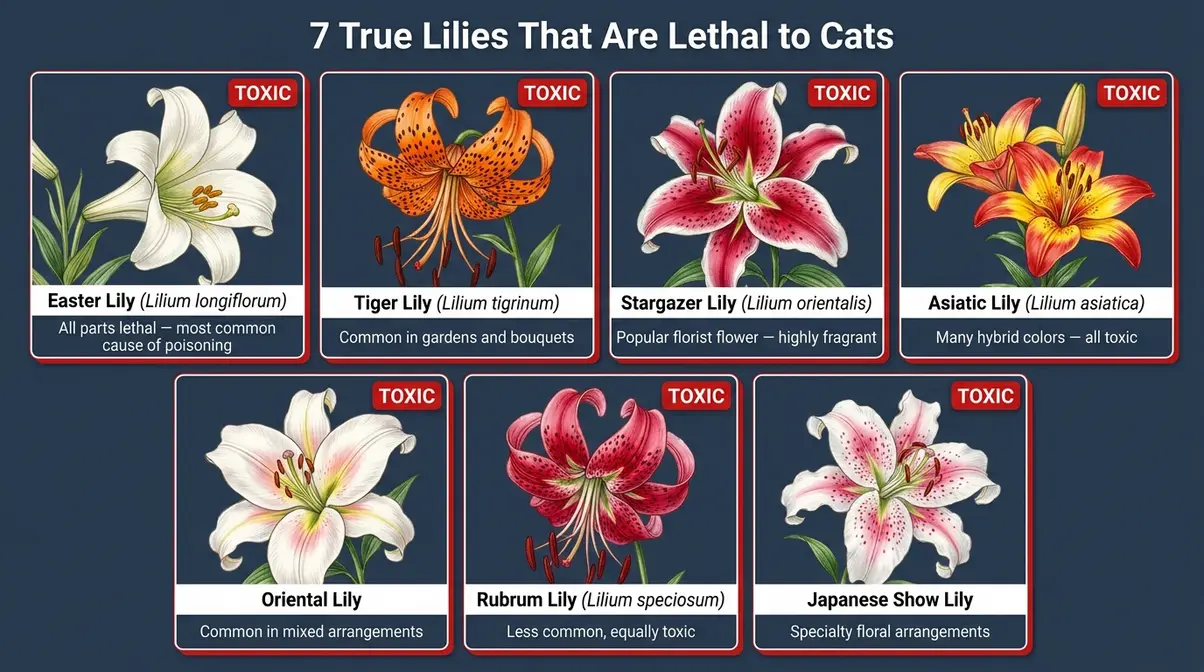
The most commonly encountered true lilies in homes and florist bouquets include:
- Easter Lily (Lilium longiflorum) — the white, trumpet-shaped lily sold heavily around spring holidays. One of the most common causes of lily poisoning in cats.
- Tiger Lily (Lilium tigrinum / Lilium lancifolium) — orange petals with dark spots; commonly found in gardens and cut flower arrangements.
- Stargazer Lily (Lilium orientalis ‘Stargazer’) — deep pink with white edges and a powerful fragrance; extremely popular in florist bouquets.
- Asiatic Lily (Lilium × asiatica) — broad category covering many popular garden hybrids in yellow, red, orange, and pink. All are toxic.
- Oriental Lily (Lilium orientalis) — large, fragrant blooms; frequently included in mixed flower arrangements.
- Rubrum Lily (Lilium speciosum var. rubrum) — dark pink to red flowers; less common but equally toxic.
- Japanese Show Lily (Lilium speciosum) — white with pink spotting; often in specialty floral arrangements.
What makes identification critical: Many of these lilies appear in mixed bouquets without being labeled. If you receive a floral arrangement and cannot identify every flower, treat it as potentially containing a true lily and keep it completely out of reach of your cat — or remove it from your home entirely.
Daylilies: Equally Fatal to Cats
Daylilies (Hemerocallis spp.) are not technically in the Lilium genus, but they cause identical kidney failure in cats through what appears to be the same or a very similar nephrotoxic mechanism. According to the Virginia-Maryland College of Veterinary Medicine, daylilies are fully nephrotoxic to cats and should be treated with the same urgency as true lilies.
Daylilies are extremely common in residential gardens across North America. They produce trumpet-shaped flowers in shades of orange, yellow, red, and peach, and are often planted as low-maintenance perennials. Their very commonness creates a false sense of familiarity — many cat owners assume a garden plant is safe precisely because it’s everywhere.
Common daylily varieties to know:
- Common Orange Daylily (Hemerocallis fulva) — the classic roadside orange daylily; extremely widespread
- Stella de Oro (Hemerocallis ‘Stella de Oro’) — a popular yellow dwarf daylily used in landscaping
- Happy Returns (Hemerocallis ‘Happy Returns’) — pale yellow, repeat-blooming; widely sold at garden centers
Critical safety note: Daylilies are so commonly planted that outdoor cats face significant exposure risk. If your cat goes outdoors and your yard — or a neighbor’s yard — contains daylilies, this is a genuine hazard requiring active management.
The ASPCA’s toxic plant database explicitly lists daylilies (Hemerocallis) as toxic to cats, causing the same acute renal failure as true lilies. This is not a case where a smaller dose creates a smaller risk — the toxic threshold is extremely low.
Mildly Toxic: Peace & Calla Lilies
Peace Lily (Spathiphyllum spp.) and Calla Lily (Zantedeschia aethiopica) are two of the most-searched lily types — and they create significant confusion because they are genuinely dangerous to cats, but in a completely different way than true lilies.
Neither Peace Lily nor Calla Lily belongs to the Lilium or Hemerocallis genera. They do not cause kidney failure. Instead, both plants contain calcium oxalate crystals — microscopic needle-like structures that cause intense mechanical irritation when chewed or swallowed. Think of it like swallowing tiny shards of glass that embed in the mouth, tongue, throat, and esophagus.
Symptoms of Peace Lily or Calla Lily ingestion include:
- Immediate oral pain — pawing at the mouth, drooling, head shaking
- Difficulty swallowing
- Vomiting
- Swelling of the mouth and throat (in severe cases)
Where Peace Lily and Calla Lily sit on the Lily Risk Ladder: Rung 2 — concerning and requiring veterinary attention, but not the same 5-alarm emergency as true lily ingestion. Your cat is unlikely to die from eating a Peace Lily, but it will be in significant pain and may need veterinary treatment for severe oral swelling or persistent vomiting.
The dangerous misconception to avoid: Because Peace Lily is “not as toxic,” some owners conclude lilies in general are overrated as a danger. This is a potentially fatal reasoning error. Peace Lily ≠ true lily. If you are unsure which type of lily your cat encountered, always treat it as a true lily emergency until a vet confirms otherwise.
Lily Types That Are Safe for Cats
A small number of plants commonly called “lilies” are not toxic to cats at all. Knowing these gives you genuine peace of mind — and helps you make safer choices when decorating your home.
Cat-safe “lily” types include:
- Peruvian Lily (Alstroemeria spp.) — also called Alstroemeria; popular in bouquets; not toxic to cats (mild GI upset possible if large amounts eaten, but not nephrotoxic)
- Bromeliad (various genera) — sometimes loosely called “lily” in casual language; non-toxic to cats
- Orchids (Orchidaceae family) — not a lily, but a common substitute in floral arrangements; non-toxic to cats per ASPCA
Important caveat: “Non-toxic” means these plants will not cause serious illness. It does not mean your cat should eat them freely. Any plant material consumed in large quantities can cause GI upset. The critical distinction is the absence of nephrotoxic risk.
Reference Table: Toxic vs. Safe Lilies
The table below summarizes the most common lily types by toxicity level, toxic mechanism, and risk rating on the Lily Risk Ladder. Use this as your fast-reference identification guide.
| Plant Name | Common Name | Toxic to Cats? | Mechanism | Risk Ladder Rung | What to Do |
|---|---|---|---|---|---|
| Lilium longiflorum | Easter Lily | ✅ YES — LETHAL | Acute kidney failure | Rung 5 — Emergency | Call vet NOW |
| Lilium tigrinum | Tiger Lily | ✅ YES — LETHAL | Acute kidney failure | Rung 5 — Emergency | Call vet NOW |
| Lilium orientalis | Stargazer / Oriental Lily | ✅ YES — LETHAL | Acute kidney failure | Rung 5 — Emergency | Call vet NOW |
| Lilium × asiatica | Asiatic Lily | ✅ YES — LETHAL | Acute kidney failure | Rung 5 — Emergency | Call vet NOW |
| Hemerocallis spp. | Daylily (all varieties) | ✅ YES — LETHAL | Acute kidney failure | Rung 5 — Emergency | Call vet NOW |
| Spathiphyllum spp. | Peace Lily | ⚠️ YES — Irritant | Calcium oxalate crystals | Rung 2 — Concerning | Call vet today |
| Zantedeschia aethiopica | Calla Lily | ⚠️ YES — Irritant | Calcium oxalate crystals | Rung 2 — Concerning | Call vet today |
| Convallaria majalis | Lily of the Valley | ✅ YES — LETHAL | Cardiac glycosides (heart) | Rung 1 — Emergency (different mechanism) | Call vet NOW |
| Alstroemeria spp. | Peruvian Lily | ✅ Generally safe | Mild GI at most | Safe | Monitor only |
| Orchidaceae family | Orchid | ✅ Generally safe | Non-toxic | Safe | No action needed |
Source: ASPCA Animal Poison Control Center toxic plant database; Pet Poison Helpline; FDA Animal Health Literacy.
Lily of the Valley note: Convallaria majalis is listed separately because its toxic mechanism is cardiac (it contains cardiac glycosides that cause heart arrhythmia), not renal. It is equally lethal but through a different pathway — and requires immediate emergency care.
How Lily Poisoning Happens in Cats
Many cat owners assume their pet is safe because “it didn’t eat the lily.” This is one of the most dangerous misconceptions in feline safety. Lily poisoning has multiple exposure routes — some of which require no chewing at all.
Does My Cat Have to Eat the Lily?
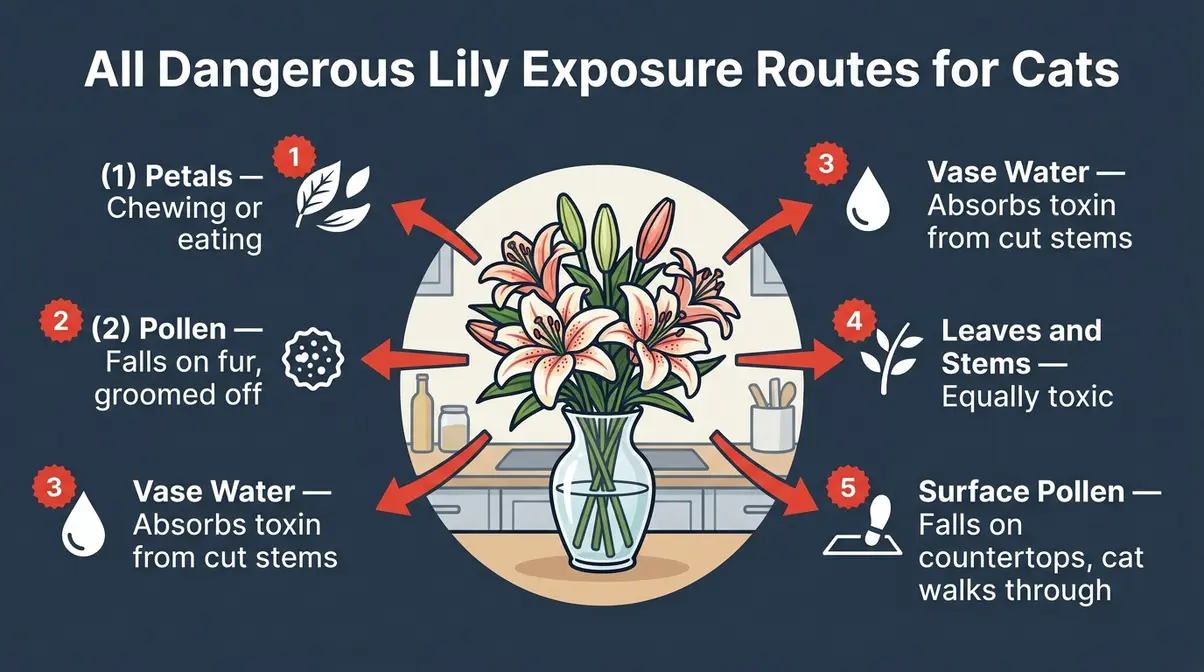
No. Your cat does not have to eat, chew, or even bite a lily to be poisoned by it. According to the FDA’s animal health guidance on lilies, all of the following parts of a true lily are considered toxic to cats:
- Petals — the most obvious source of ingestion
- Leaves — chewing even a small leaf fragment is dangerous
- Stems — less commonly chewed but still toxic
- Pollen — tiny, lightweight, and easily transferred to fur and whiskers
- Vase water — water from a vase holding cut true lilies absorbs the toxin and is itself dangerous if a cat drinks from it
What this means for your cat: A cat does not need to eat a lily. It needs only to brush against a stamen, walk across a surface where pollen has fallen, or drink from a vase. Any of these exposures can initiate the same toxic cascade.
This is why the only genuinely safe approach is removing true lilies from any home that contains a cat — not relocating them to a different room, not putting them on a high shelf. Removal.
Is Lily Pollen Dangerous to Cats?
Yes — lily pollen is one of the most insidious exposure routes precisely because it seems so minor. True lily flowers produce abundant, highly visible orange or yellow pollen that falls freely from the stamens (the pollen-bearing structures inside the flower). This pollen can land on:
- A cat’s fur, whiskers, or paws from brushing against the flower
- Countertops, tables, or floors where the cat then walks
- Soft surfaces like blankets or cushions where a cat rests
When a cat grooms itself — which cats do constantly — it ingests any pollen on its fur directly. The Pet Poison Helpline explicitly identifies pollen grooming as a confirmed, documented route of fatal lily poisoning.
Practical implication: If you notice orange or yellow pollen on your cat’s fur or whiskers, do not wait to see if symptoms develop. Contact your veterinarian or ASPCA Poison Control (888-426-4435) immediately. Gently wipe the pollen from your cat’s coat with a damp cloth before it can be groomed away — but do this quickly and then call for guidance.
Can Cats Get Sick from Smelling a Lily?
This is one of the most frequently asked questions about lily safety — and the answer requires a careful distinction.
Casually sniffing a lily from a distance is not documented as a cause of lily toxicosis. The toxic compound in true lilies is not volatile (meaning it does not evaporate into the air in meaningful concentrations), so simply walking past a lily or being in the same large room with one is not equivalent to ingestion.
However — and this is critical: the act of sniffing a lily up close almost inevitably results in pollen contact with the nose, whiskers, and face. A cat that “smells” a lily by pressing its face into the bloom will almost certainly get pollen on its whiskers and face — and will groom that pollen off within minutes.
So while “smelling” a lily is not itself toxic, the behavior of sniffing lilies reliably leads to pollen exposure, which is toxic. The practical answer for cat owners: do not allow your cat near a blooming true lily under any circumstances, regardless of whether the cat is eating it or merely investigating it.
Are Dried or Dead Lilies Still Toxic?
Yes. This is another dangerous misconception — that a wilted, dried, or dead lily is no longer a threat. Veterinary toxicologists confirm that the nephrotoxic compounds in true lilies do not degrade significantly when the plant dries out. A dried Easter lily arrangement sitting in a vase for weeks still contains active toxin in its petals and leaves.
The ASPCA does not distinguish between fresh and dried lily exposure in its toxicity guidance — all plant material from true lily species is treated as hazardous regardless of the plant’s condition.
Similarly: An unbloomed lily bud is equally toxic. A lily that has dropped all its petals still has toxic leaves and stem. A lily that appears completely dead and desiccated still poses a risk if a cat chews on it.
The rule is simple: If it was once a true lily, treat every part of it as toxic, at every stage of its life cycle. When disposing of cut lilies, place them in a sealed bag and dispose of them in a bin your cat cannot access.
Lily Poisoning Symptoms & Action Plan
Recognizing the symptoms of lily poisoning early — and acting within the critical 18-hour window — is the difference between a cat that recovers and a cat that doesn’t. Veterinary consensus confirms that early intervention is the single most important factor in survival outcomes.
Early Warning Signs (0–12 Hours)
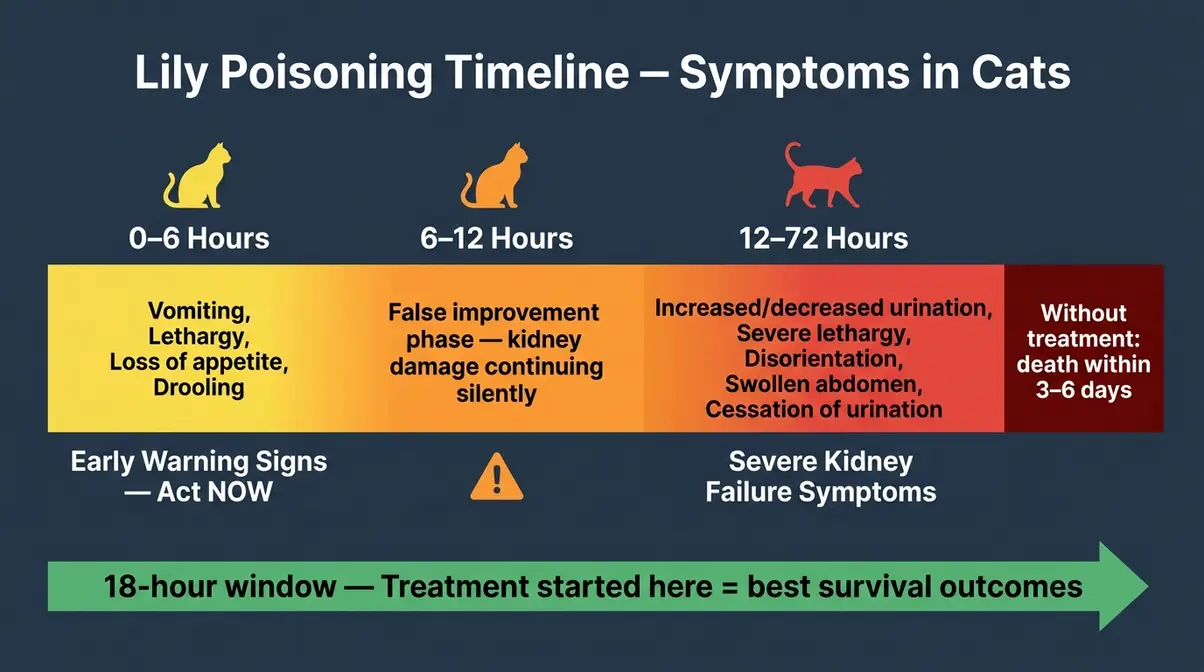
The first symptoms of lily poisoning typically appear within 0–6 hours of exposure. They are easy to mistake for a mild stomach upset — which is exactly why so many owners wait too long to seek help.
Early symptoms include:
- Vomiting — often the first and most prominent sign; may contain plant material
- Lethargy — unusual tiredness, reluctance to move or interact
- Loss of appetite — refusing food or treats the cat normally loves
- Drooling — excessive salivation, especially if pollen or plant material contacted the mouth
- Hiding — cats instinctively hide when they feel unwell
Critical guidance: These symptoms are deceptively mild. A cat in early lily toxicosis may seem like it just has an upset stomach. Do not wait to see if the symptoms resolve on their own. If your cat has had any possible lily exposure — even pollen contact — and shows any of these signs, call your vet or ASPCA Poison Control immediately.
Severe Symptoms (12–72 Hours)
If lily poisoning is not treated, the initial GI symptoms may temporarily subside around 6–12 hours post-exposure — giving owners a false sense that the crisis has passed. In reality, the toxin is actively destroying kidney tissue during this apparent “improvement” phase.
Severe symptoms appearing 12–72 hours after exposure include:
- Increased or decreased urination — the kidneys losing regulatory function
- Increased thirst — a classic sign of kidney distress
- Severe lethargy and weakness — the cat may be unable to stand or walk normally
- Disorientation or neurological signs — stumbling, head pressing, seizures in late-stage cases
- Swollen, painful abdomen — fluid accumulation from kidney failure
- Complete cessation of urination — a critical emergency sign indicating total kidney shutdown
- Death — without treatment, acute renal failure typically causes death within 3–6 days of initial exposure
The PMC research is unambiguous: cats treated after the 72-hour mark — when kidney failure is already established — have dramatically lower survival rates than those treated within the first 18 hours. Once kidneys fail completely, the damage is irreversible.
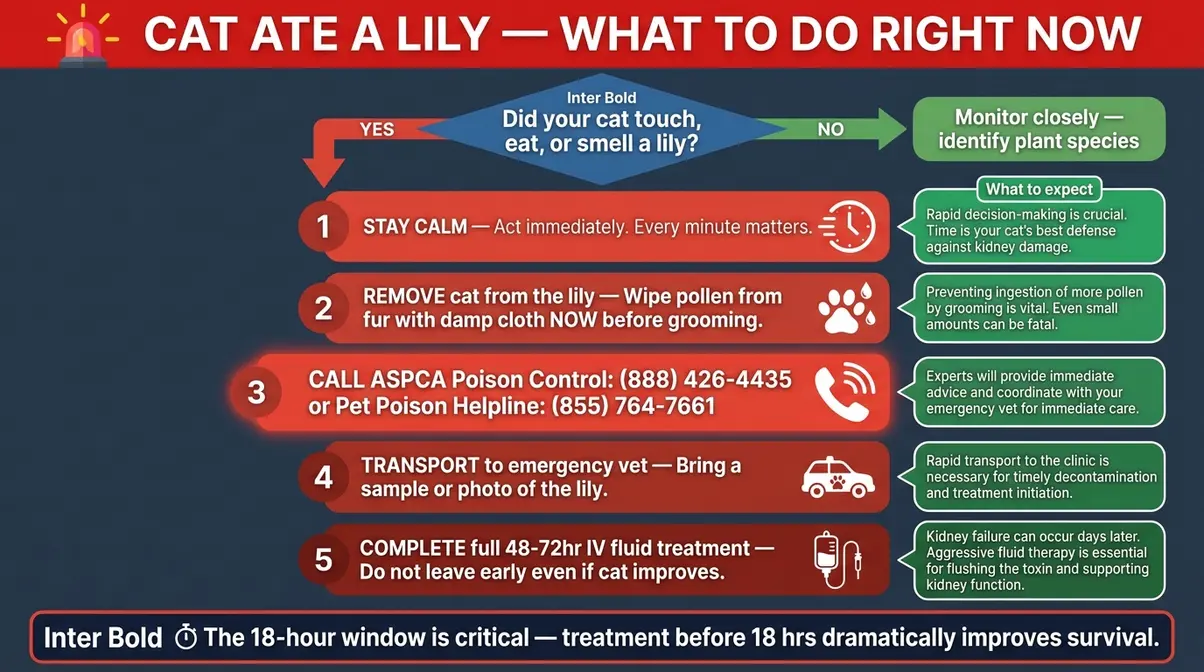
Your 5-Step Emergency Action Plan
Tools needed: Phone, carrier or box for transport, damp cloth. Estimated total time to complete Steps 1–4: under 5 minutes.
If you know or suspect your cat has been exposed to a lily — any lily, any amount, any part — follow these steps immediately. Do not wait for symptoms.
Step 1: Stay calm and act immediately.
Panic slows you down. Take one breath, then focus. Every minute matters, but a clear-headed owner is faster than a panicked one. Your cat needs you to function.
Expected outcome: You are in action mode, not freeze mode.
Step 2: Remove your cat from the lily and the area.
Physically move your cat away from the plant. If there is pollen on your cat’s fur or whiskers, gently wipe it off with a damp cloth — do not allow your cat to groom itself before this step. Do not let your cat return to the area.
Expected outcome: Exposure is stopped. No further pollen ingestion via grooming.
Step 3: Call ASPCA Poison Control or your emergency vet immediately.
📞 ASPCA Animal Poison Control: (888) 426-4435
📞 Pet Poison Helpline: (855) 764-7661
Have ready: the type of lily (if known), the estimated amount your cat may have ingested or touched, your cat’s weight and age, and when the exposure occurred. The poison control specialist will advise you on whether to induce vomiting and whether immediate emergency care is needed.
Expected outcome: Expert guidance specific to your cat’s exposure level and next steps confirmed.
Step 4: Transport to the emergency vet without delay.
Do not drive and hold your cat. Place your cat in a carrier or secure box. Bring a sample of the lily or a photo of it if possible — this helps the vet confirm the species. Call ahead so the clinic can prepare.
Expected outcome: Veterinary team is ready to begin IV fluid therapy immediately upon arrival.
Step 5: Follow the full treatment protocol — do not leave early.
Treatment for lily poisoning typically involves aggressive IV fluid diuresis (flushing the kidneys with large volumes of fluid) for 48–72 hours. Some owners leave before the full protocol is complete when the cat appears to be improving. Complete the full treatment course. Kidney damage can continue even when the cat seems better. For a deeper dive into the immediate response, review these lily and cats 7 emergency steps in the first hour.
Safe Flowers and Plants for Cat-Friendly Homes

Knowing which flowers are dangerous is only half the equation. The other half — and the part that brings genuine peace of mind — is knowing what you can have in your home without putting your cat at risk.
Safe Lily Alternatives for Cats
Cat-safe flower alternatives are more abundant than most owners realize. You do not have to choose between having flowers and having a safe home for your cat. The following options are confirmed non-toxic by the ASPCA’s complete non-toxic plant list and are widely available through florists and garden centers:
Florist bouquet alternatives:
- Roses (Rosa spp.) — the classic choice; non-toxic to cats (thorns are a physical hazard but no chemical toxicity).
- Sunflowers (Helianthus annuus) — bright, cheerful, and completely safe for cats.
- Snapdragons (Antirrhinum majus) — non-toxic and widely available in cut flower arrangements.
- Orchids (Orchidaceae) — non-toxic; a popular and elegant lily substitute in arrangements. If you want to feature these beautiful blooms, read our guide on making an orchid safe for cats with 9 vet-backed ways to choose, display, and pet-proof your blooms.
- Alstroemeria / Peruvian Lily (Alstroemeria spp.) — non-toxic and visually similar to some lilies, making it an ideal direct substitute.
Garden and potted plant alternatives:
- Catnip (Nepeta cataria) — not only safe, but actively enriching for cats.
- Spider Plant (Chlorophytum comosum) — non-toxic; a popular hanging houseplant.
- Boston Fern (Nephrolepis exaltata) — non-toxic and adds lush greenery.
- African Violet (Saintpaulia spp.) — non-toxic; compact and flowering.
While these alternatives are non-toxic, it is still best practice to place them in areas where your cat won’t constantly graze on them. Even safe plants can cause mild stomach upset if consumed in large quantities. Elevating plants on sturdy stands or using hanging baskets can help keep your feline friends from turning your indoor garden into a salad bar.
For a comprehensive guide to building a cat-safe home environment with plants and flowers, see our complete resource on cat safe plants featuring 25+ ASPCA-verified picks.
Other Toxic Plants and Flowers
Lilies are the most acutely dangerous plants for cats, but they are far from the only hazard in a typical home or garden. A broader awareness of toxic plants is an important layer of protection for any pet owner.
Are Lilies Also Dangerous for Dogs?
While lilies are uniquely fatal to cats, dog owners should still exercise caution. Dogs can experience significant gastrointestinal upset if they ingest lilies, including vomiting and diarrhea. However, dogs do not suffer the same catastrophic acute kidney failure that makes lilies so lethal to felines. The toxic mechanism in true lilies specifically targets feline renal cells. Still, keeping lilies away from all pets is the safest approach.
Common Toxic Plants to Remove
The following plants are among the most commonly encountered household toxins for cats—and are frequently present in homes and gardens without owners realizing the risk:
- Sago Palm (Cycas revoluta): This ornamental plant causes severe liver failure. All parts are toxic, but the seeds (nuts) are especially lethal.
- Tulips (Tulipa spp.): The bulbs are the most toxic part of the plant. Ingestion causes intense gastrointestinal irritation, drooling, and in large doses, dangerous cardiac and respiratory issues.
- Azalea and Rhododendron: These common landscaping shrubs contain grayanotoxins. Eating even a few leaves can cause vomiting, drooling, tremors, and potentially fatal cardiovascular collapse.
- Dieffenbachia (Dumb Cane): Similar to the Peace Lily, this plant contains insoluble calcium oxalate crystals. Chewing it causes intense oral pain, excessive drooling, and severe swelling of the mouth and throat.
- Pothos / Devil’s Ivy (Epipremnum aureum): An extremely common houseplant that also relies on calcium oxalate crystals as a defense mechanism, causing immediate oral and GI irritation.
- Foxglove (Digitalis purpurea): Contains cardiac glycosides similar to Lily of the Valley. Ingestion can lead to fatal heart arrhythmias.
- Dracaena: A popular indoor plant that contains saponins. If you have this plant, you must learn the signs of toxicity. Read our guide on dracaena toxic to cats and 9 signs every cat owner needs to know.
A note on seasonal plants: Holiday plants like poinsettia (mildly toxic—irritant), mistletoe (moderately toxic—GI and cardiovascular effects), and amaryllis (toxic—GI and CNS effects) are frequently brought into homes without owners checking their safety for cats.
For a full guide to toxic and non-toxic plants in and around your home—including room-by-room safety checklists—see our complete guide on what is toxic to cats and hidden dangers in your home.
When Lily Safety Gets Complicated
Even with the clearest guide available, real-world lily safety involves situations that aren’t black and white. Understanding the common mistakes and knowing when to seek emergency care — rather than waiting — is the final layer of protection.
Common Mistakes Cat Owners Make
Mistake 1: Assuming a high shelf is safe enough.
Cats are extraordinary climbers. A lily placed on a high shelf, a refrigerator, or a bookcase is not inaccessible to a curious cat. Pollen also falls from lilies onto surfaces below — a cat walking across a counter dusted with lily pollen is at risk even if it never approached the plant directly.
Mistake 2: Waiting for symptoms before calling.
The 18-hour treatment window is not a symptom window — it is an intervention window. By the time a cat shows severe symptoms (decreased urination, lethargy, swollen abdomen), the kidney damage is already advanced. The call to poison control should happen the moment you discover exposure, not when symptoms appear.
Mistake 3: Believing Peace Lily is “safe” because it’s not a true lily.
Peace Lily is toxic. It does not cause kidney failure, but it causes significant oral pain, drooling, swelling, and vomiting. A cat that chews a Peace Lily needs veterinary attention — it is not a “watch and see” situation.
Mistake 4: Thinking vase water is harmless.
Multiple veterinary case reports document cats developing lily toxicosis after drinking water from a vase containing cut lilies. The water absorbs the toxin from the cut stems. Treat lily vase water as toxic liquid and dispose of it promptly.
Mistake 5: Assuming outdoor cats aren’t at risk from indoor plants.
The reverse is equally true: indoor cats are at risk from outdoor plants. Daylilies are one of the most commonly planted garden perennials in North America. A cat with outdoor access in a neighborhood where daylilies are planted faces real, ongoing exposure risk.
When to Seek Emergency Vet Care
- Always seek emergency care immediately if:
- Your cat has chewed, eaten, or had confirmed contact with any true lily (Lilium) or daylily (Hemerocallis)
- You found pollen on your cat’s fur or face near a lily
- Your cat drank from a vase that contained cut lilies
- You are unsure what type of lily was involved — treat all unknowns as true lilies
- *A monitored at-home approach may be appropriate only if:*
- The plant has been confirmed (by name and photo identification) as a non-nephrotoxic species — Peace Lily, Calla Lily, or a confirmed safe variety
- Your cat shows only very mild drooling or mouth pawing consistent with calcium oxalate irritation
- You have spoken with ASPCA Poison Control and they have specifically advised monitoring at home
- You are able to monitor your cat continuously and transport immediately if symptoms worsen
The 18-hour window is not negotiable. Veterinary consensus, supported by the PMC 2024 peer-reviewed review of feline lily toxicosis cases, confirms that decontamination (inducing vomiting) and IV fluid therapy begun within 18 hours of ingestion are the primary determinants of survival. After 18 hours, the window for preventing permanent kidney damage closes rapidly.
If there is any doubt — any doubt at all — call ASPCA Poison Control at (888) 426-4435. The call is not an overreaction. It is the right response.
Frequently Asked Questions About Lilies and Cats
Can I have lilies in the house?
No — it is not safe to have true lilies in a home with cats, under any circumstances. Easter, Tiger, Stargazer, Asiatic, and Oriental lilies (Lilium spp.) and all daylilies (Hemerocallis spp.) are lethally toxic to cats from every part of the plant. Pollen falls onto surfaces and fur; vase water becomes toxic; a cat doesn’t have to eat the plant to be poisoned. The ASPCA and FDA both recommend removing true lilies from any home with cats entirely. Peace Lilies are also not safe — they cause significant oral irritation — though they do not cause kidney failure.
Can cats breathe near lilies?
Casual proximity to a lily in a large, well-ventilated room is not documented as a cause of lily toxicosis. The nephrotoxic compound in true lilies is not significantly volatile, meaning it does not evaporate into the air in dangerous concentrations. However, any close-range sniffing of a lily almost certainly results in pollen contact with the cat’s nose and whiskers — and that pollen will be groomed off and ingested. For practical safety purposes, do not allow your cat near a blooming true lily. The “breathing” risk is low; the pollen-contact risk from sniffing is real and documented.
How fast do lily poisoning symptoms show?
Early symptoms of lily poisoning typically appear within 0–6 hours of exposure — usually vomiting, lethargy, and loss of appetite. These initial symptoms may temporarily ease around 6–12 hours, creating a false impression of recovery. Severe kidney-failure symptoms (decreased urination, weakness, swollen abdomen) emerge between 12 and 72 hours post-exposure. According to a 2024 peer-reviewed review of feline lily toxicosis (PMC, 2024), irreversible kidney damage can occur within 24–48 hours without treatment. The apparent improvement between early and late symptoms is a dangerous deception — always seek veterinary care immediately after any exposure, not after symptoms appear.
Can I keep lilies in a separate room?
No — a separate room does not provide adequate safety. Cats access most rooms in a home, and pollen can travel on air currents, on clothing, and on surfaces. Vase water remains a hazard if the cat ever enters the room. The only reliable safety measure is removing true lilies from the home entirely. If you receive a lily bouquet as a gift, the safest action is to thank the giver and immediately dispose of the flowers in a sealed bag in an outdoor bin. No shelf height, closed door, or separate room arrangement reliably eliminates the risk when a true lily is present in a home with a cat.
Can cats survive without treatment?
Survival without treatment is very unlikely. The Pet Poison Helpline reports that untreated lily poisoning carries a very high mortality rate, with most cats progressing to irreversible acute renal failure and death within 3–6 days. The kidneys cannot repair themselves once tubular cells are destroyed by the toxin — there is no antidote, and the body cannot reverse established kidney failure without aggressive IV fluid support. Cats treated promptly — within 18 hours, with full IV diuresis protocols — have significantly better outcomes. The answer to “can my cat survive without treatment” is: please don’t find out. Call (888) 426-4435 now.
Protecting Your Cat From Lilies
Lilies are genuinely, lethally toxic to cats — and the danger is broader than most people realize. True lilies (Lilium) and daylilies (Hemerocallis) can kill a cat from pollen alone, from vase water, from a single leaf. The 18-hour treatment window is not a guideline — it is the clinical boundary between a cat that recovers and one that doesn’t. For any cat owner, the clearest possible action is this: remove all true lilies from your home, check your garden for daylilies, and save the ASPCA Poison Control number — (888) 426-4435 — in your phone right now.
The Lily Risk Ladder exists to cut through the confusion. Not every plant called a lily is equally dangerous — Peace Lily causes mouth irritation, not kidney failure — but true lilies and daylilies sit at the top of that ladder for a reason. When in doubt, treat every unknown lily as a Rung 5 emergency, call for guidance immediately, and don’t wait for symptoms.
When asking are lilies toxic to cats, remember that safe alternatives exist: roses, sunflowers, snapdragons, orchids, and Peruvian lilies are all beautiful, widely available, and confirmed non-toxic by the ASPCA. You do not have to choose between a beautiful home and a safe one. You just need to know which flowers to choose — and which to leave at the florist.

Dave King
Cat owner and writer at Mad Cat Man.