New Kitten Checklist: Complete Guide for First-Time Owners
Discover expert insights on New Kitten Checklist for Beginners: A Room-by-Room, First-Week Guide to Supplies, Safety & Vet Visits including common…

It’s the night before pickup day. You’re excited, maybe a little anxious, and staring at a browser tab full of conflicting advice about what to buy, where the kitten should sleep, and whether you’re already doing something wrong. That feeling is completely normal — and incredibly common among first-time kitten owners.
Most guides either hand you a shopping list with no context, or offer vague behavioral tips with no structure. Almost none do both — and the first 72 hours are exactly when you need both at the same time. This new kitten checklist covers everything: the supplies, the home prep, the first vet visit, and a day-by-day behavioral framework for those critical first three days. Here’s what’s ahead: home preparation, an essential supplies checklist, a vet care guide, and a behavioral survival guide built around The First 72 Hours Framework.
A complete new kitten checklist covers four areas: supplies, home prep, vet care, and behavioral guidance for the first 72 hours — the most critical window for building trust with your new cat.
- Safe room first: Set up one kitten-proofed room before your kitten arrives
- The First 72 Hours Framework: Day 1 = decompress, Day 2 = explore, Day 3 = routine
- Vet visit: Schedule within the first week; core vaccines start at 6–8 weeks
- Night crying: After needs are met, gentle ignoring teaches healthy sleep habits
- Breakaway collar: A safety essential — regular collars can cause choking
Recommended Products
| # | Image | Product | Best For | Buy |
|---|---|---|---|---|
| 1 |  |
31-Piece Kitten Starter Kit | Complete first-time setup | Buy on Amazon |
| 2 |  |
8-Piece Pink Kitten Starter Kit | Budget-friendly essentials | Buy on Amazon |
| 3 |  |
Yizepet Breakaway Kitten Collar | Safety-first new owners | Buy on Amazon |
How to Prepare Your Home for a New Kitten

Preparing your home before your kitten arrives is the single most important thing you can do to reduce stress — for both of you. The ASPCA (America’s leading animal welfare organization) recommends setting up a dedicated “safe room” — a single, kitten-proofed space where your new kitten will spend their first night — before they ever walk through your front door. Kittens overwhelmed by a full house on day one are more likely to hide, refuse food, and cry through the night. A little preparation now means a much calmer arrival for everyone.
This checklist for a new kitten starts at home — not at the pet store. Think of it as building the physical foundation for Day 1 of The First 72 Hours Framework (more on the full framework in the behavioral guide below). Once your safe room is ready and hazards are removed, bringing home a new kitten checklist items like food bowls and toys will actually have somewhere safe to live.
Setting Up the Perfect Safe Room
When bringing home a new kitten checklist-style preparation is done right, it starts with one room. Choose a small, quiet space — a spare bathroom, a laundry room, or a small bedroom all work well. The logic is simple: a large, unfamiliar house feels threatening to a kitten. A small, contained space feels manageable. According to ASPCA safe room guidelines, a dedicated safe room equipped with essentials helps kittens acclimate without becoming overwhelmed during their first nights (ASPCA, 2026).
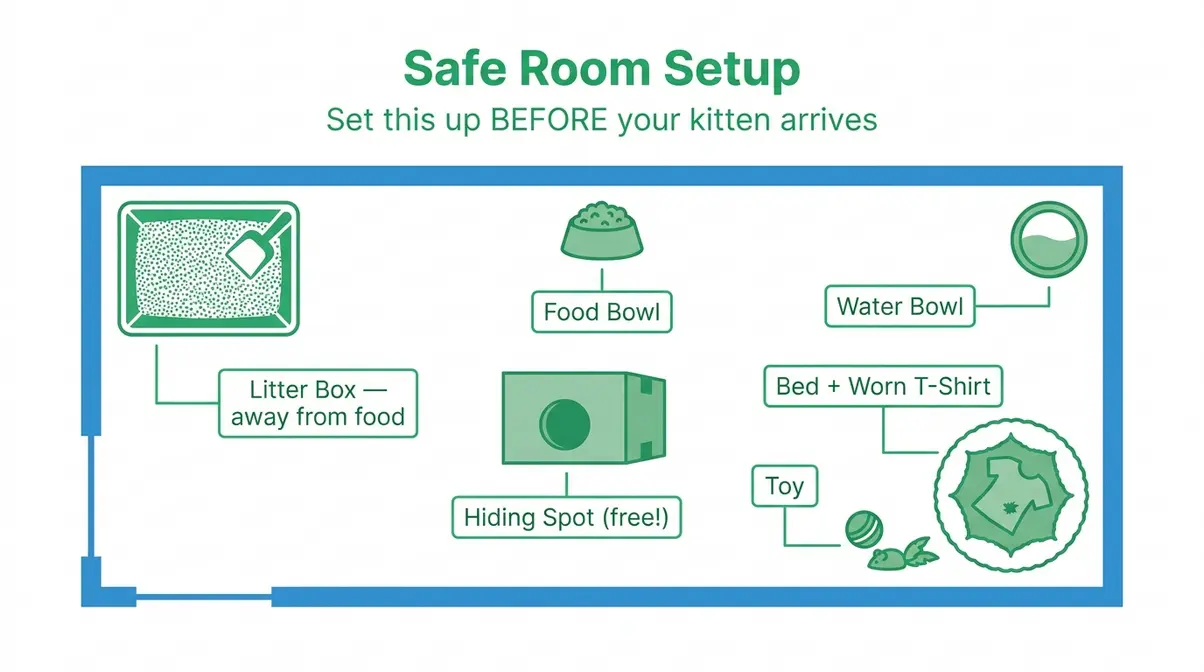
Here’s exactly what goes in the safe room — set these up before your kitten arrives:
- Litter box — place it in a corner, away from food and water
- Food bowl — wide and shallow (more on why this matters in the supplies section)
- Water bowl — on the opposite side of the room from the litter box
- Comfortable bed or soft blanket — a folded fleece blanket works perfectly
- At least one toy — a simple crinkle ball or feather wand
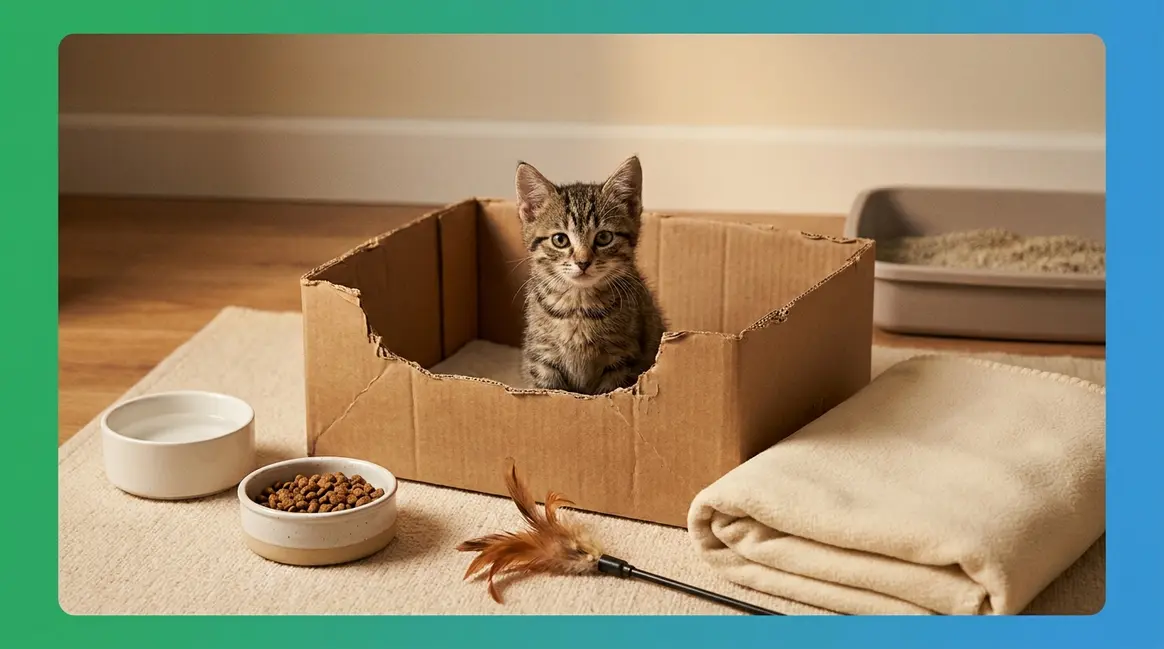
- A hiding spot — a cardboard box on its side is free and works brilliantly
Picture this: a spare bathroom, door closed, cardboard box on its side in one corner, a small nightlight plugged in so the kitten can find the litter box in the dark, and your worn T-shirt tucked into the blanket. That last detail — your scent — is genuinely calming to a kitten who has just left their mother and siblings. Many new kitten owners report that this single step reduces first-night crying significantly.
Where should a kitten sleep?
A kitten should sleep in their designated safe room on the first night — a small, kitten-proofed space with a litter box, food, water, and a comfortable bed. The ASPCA recommends this approach to prevent overwhelm in a large, unfamiliar environment (ASPCA, 2026). Place a worn T-shirt in their bed for scent comfort. Most kittens settle faster in an enclosed, quiet space than in a large bedroom with an anxious new owner hovering nearby.
Once the safe room is ready, it’s time to go through the rest of your home — room by room — and remove anything that could hurt a curious kitten.
Room-by-Room Kitten-Proofing Checklist
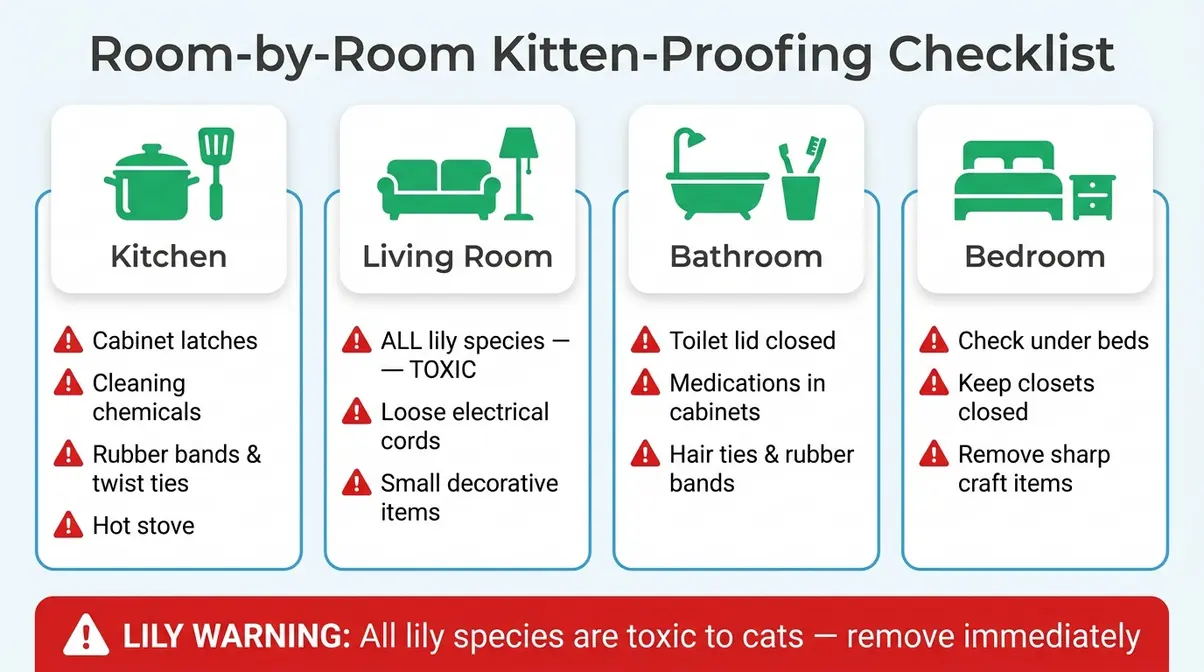
Kitten-proofing (the process of removing or securing household hazards before a kitten arrives) sounds overwhelming until you break it down by room. Veterinary sources confirm that most kitten injuries in the first week happen at home, from hazards owners didn’t realize were dangerous. Work through each room systematically using this list.
- Kitchen:
- Secure cabinet latches on any cabinets containing cleaning products
- Move cleaning chemicals to high shelves or locked storage
- Check the floor for rubber bands and twist ties — both are choking hazards
- Keep the stove off whenever the kitten is nearby; hot burners cause burns
- Living Room:
- Remove or relocate ALL lily species immediately — this is non-negotiable
- Check for loose electrical cords; use cord organizers or cable covers
- Move small decorative items (pebbles, figurines, candles) off low surfaces
- Bathroom:
- Keep the toilet lid closed — kittens can fall in and drown
- Store all medications in closed cabinets; even common painkillers like ibuprofen are lethal to cats
- Remove hair ties and rubber bands from countertops
- Bedrooms:
- Check under beds for loose items a kitten could swallow
- Keep closets closed — kittens squeeze into tiny spaces and can become trapped
- Remove sewing needles, pins, or any sharp craft materials
The Lily Warning — Non-Negotiable: The ASPCA Animal Poison Control Center toxic plant list confirms that all species of lilies — including Easter lily, tiger lily, and day lily — are highly toxic to cats and can cause acute kidney failure if even a small amount is ingested (ASPCA, 2026). All species of lily are highly toxic to cats and can cause acute kidney failure — even a small amount ingested requires immediate emergency veterinary care. If you have lilies anywhere in your home, remove them before your kitten arrives. This is not a “monitor carefully” situation — it is a “remove entirely” situation.
If you’re in the UK, the same room-by-room rules apply. Additionally, check for common UK houseplants like foxglove and daffodils, which are also toxic to cats.
For a deeper dive into hazard-proofing your entire property, see our guide on how to cat-proof your home for a new kitten.
You’ve removed the hazards. Now here’s what to do the night before your kitten comes home — so day one goes as smoothly as possible.
Night Before Kitten Arrival Tasks
This is your bringing home new kitten checklist for the 12 hours before pickup. Completing these steps the evening before means you won’t be scrambling on arrival day.
- Set up the safe room completely — litter box, food bowl, water bowl, bed, toy, hiding spot all in place
- Fill water and food bowls — use the same food the kitten has been eating (sudden food changes cause digestive upset)
- Place clean, unscented litter in the litter box — avoid heavily scented litters for kittens; the smell can deter use
- Put a worn T-shirt in the kitten’s bed — your scent is a proven calming signal for a kitten separating from their litter
- Prepare the carrier — line it with a familiar-smelling blanket; a blanket from the breeder or shelter carries the kitten’s existing scent, which reduces car anxiety
What NOT to do with a new kitten on day one: Do not let them roam the whole house immediately. Do not force cuddles or pick them up repeatedly — let them come to you. Do not introduce them to other pets on arrival day. These well-meaning impulses create stress, not bonding.
One practical tip on timing: if you can arrange to bring your kitten home on a Friday, you’ll have two full days at home before the working week begins. That consistent presence during the first 48 hours makes a meaningful difference to how quickly a kitten settles.
For more guidance on that first transition, read our full guide on how to introduce your kitten to a new home.
Your home is ready. Now let’s make sure you have everything your kitten needs once they walk through that door.
Essential Kitten Supplies Checklist
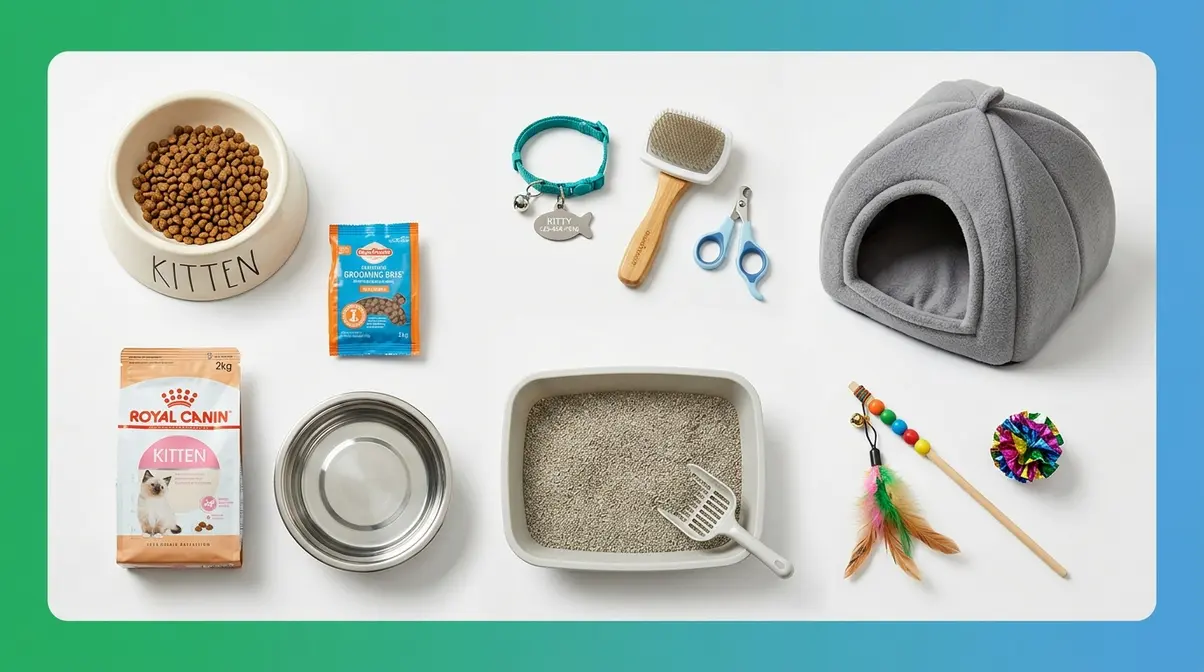
Every new kitten needs a starter kit of supplies — but not everything at the pet store is necessary on day one. Check out our vet-informed kitten supplies picks for specific brand recommendations. This kitten essentials checklist is organized by category, ranked by priority, and explains the why behind each item so you’re buying with confidence, not guesswork. Veterinary sources and experienced kitten owners consistently identify the same core categories: food and water, litter, comfort, enrichment, grooming, and safety.
Two items on this list deserve special attention because competitors rarely explain them: whisker fatigue and the breakaway collar. Understanding these two details alone will make you a more prepared owner than most.
Food, Water & Feeding Essentials
What your kitten eats in their first weeks sets the foundation for lifelong health. Veterinary guidelines recommend starting with the same food the kitten was eating before rehoming — abrupt changes cause digestive upset, and a stressed kitten is already more vulnerable.
- Food essentials:
- Kitten-specific wet food — kittens need higher protein and fat than adult cats; adult food doesn’t meet their nutritional needs
- Kitten-specific dry kibble — for free-feeding between meals; choose a formula labeled “complete and balanced for growth”
- Wide, shallow food bowls — this is where whisker fatigue matters
Whisker fatigue — a real condition where a cat’s sensitive whiskers become overstimulated when pressed against the sides of a deep bowl — causes many kittens to paw food out of their bowl or refuse to eat. Wide, flat dishes (even a small plate) eliminate the problem entirely. Many new kitten owners report their kitten’s “picky eating” disappears the moment they switch to a shallow bowl.
- Water essentials:
- Ceramic or stainless steel water bowl — plastic bowls harbor bacteria and can cause feline acne (small chin breakouts)
- Optional: pet water fountain — cats are naturally drawn to moving water; a fountain increases hydration, which supports kidney health long-term
Litter Box Setup: What You Actually Need
The litter box section is where new owners tend to over-complicate things. Keep it simple. Learn how to litter train your kitten in 7 days to ensure a smooth transition.
- The basics:
- One litter box per cat, plus one extra — the standard rule among veterinary professionals is one box per cat plus one. For a single kitten, two boxes is ideal.
- Unscented, clumping litter — strongly scented litters are off-putting to kittens; unscented clumping litter is the most widely recommended starting point
- Low-sided litter box — kittens have short legs; a box with a high entry point is physically difficult for them to use
- Litter scoop — clean the box at least once daily; kittens are fastidious and will avoid a dirty box
What you don’t need yet: A self-cleaning litter box is a useful upgrade later, but the mechanical noise can frighten a kitten in their first week. Start simple. For more help, read our litter training expert tips.
Comfort, Bedding & Enrichment
A kitten who feels secure sleeps better, eats better, and bonds faster. UC Davis School of Veterinary Medicine’s enrichment guidelines emphasize that environmental enrichment — hiding spots, climbing opportunities, and interactive play — directly supports healthy behavioral development in kittens.
- Comfort essentials:
- Soft bed or igloo-style cat bed — enclosed beds feel safer to kittens; they mimic the feeling of being nestled with littermates
- Fleece blanket — washable, inexpensive, and doubles as a scent carrier
- Cardboard scratching post — kittens scratch instinctively; redirecting this to an appropriate surface protects your furniture from day one
- Enrichment essentials:
- Feather wand toy — interactive play builds your bond and provides essential exercise; aim for two 10-minute sessions per day
- Crinkle balls or toy mice — for solo play when you’re not home
- Cardboard box — free, endlessly entertaining, and serves as a hiding spot
Grooming & Safety Gear
This is where the must-haves and nice-to-haves split clearly.
- Must-haves:
- Kitten nail clippers — start trimming nails at 8–10 weeks to establish the habit early; it’s much easier than trying to start with an adult cat
- Soft-bristle brush or grooming glove — even short-haired kittens benefit from regular brushing; it reduces shedding and strengthens the bond
- Breakaway collar — a breakaway collar (a collar designed to snap open if it gets caught on an object, preventing choking or strangulation) is a safety essential that regular collars cannot replicate. If a regular collar catches on a door hinge, a fence post, or a piece of furniture, it can trap or strangle a kitten. A breakaway collar releases under pressure — the Yizepet option in our recommended products table above is a well-reviewed kitten-sized option. This is non-negotiable if your kitten will ever be unsupervised.
- ID tag — attach to the breakaway collar with your phone number; even indoor kittens escape
- Nice-to-haves (not day-one essentials):
- Cat harness and leash (for leash training — start young for best results)
- Toothbrush and pet-safe toothpaste (dental care is important but can wait a few weeks)
- Pet carrier upgrade (the basic carrier you used for pickup works fine initially)
Download Your Free Kitten Checklist PDF
A printable checklist makes the pet store run faster and less stressful. The downloadable PDF version of this new kitten checklist covers all four categories — supplies, home prep, vet essentials, and first-days tips — on a single page. Get the free beginner’s printable kitten checklist here.
Your New Kitten Vet Checklist

Scheduling your kitten’s first vet visit is one of the most important items on any new kitten checklist. Veterinary sources confirm that early health screening catches problems before they become serious — and establishes a vaccination schedule that protects your kitten through their most vulnerable months. Many new kitten owners feel uncertain about what happens at that first appointment, or when exactly to go. This section removes that uncertainty.
Disclaimer: The information in this section is for general guidance only. Always consult your licensed veterinarian for advice specific to your kitten’s health needs.
What Does a New Kitten Need at the Vet?
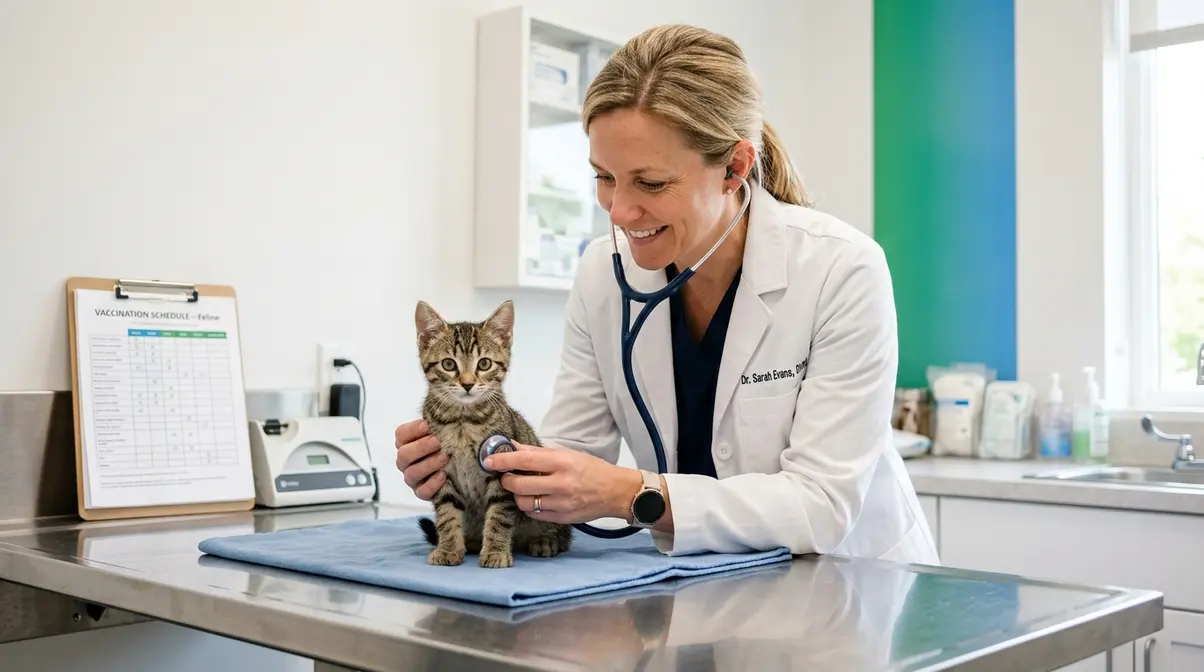
Your kitten’s first vet visit should happen within the first week of bringing them home — ideally within 48–72 hours if possible. This is true even if the breeder or shelter provided a health certificate.
What to expect at the first appointment:
- Full physical examination — the vet checks weight, eyes, ears, teeth, coat condition, and heart/lung sounds
- Fecal test — to check for intestinal parasites (roundworms and hookworms are extremely common in kittens, even from reputable breeders)
- Vaccination assessment — the vet reviews what vaccines the kitten has already received and schedules next doses
- Flea and parasite check — visual inspection and discussion of prevention options
- Microchip discussion — many vets recommend microchipping at or before 8 weeks
- Nutrition and feeding guidance — your vet will confirm appropriate food type and quantity for the kitten’s age and weight
Bring any health records from the breeder or shelter to this appointment. If you have none, that’s okay — the vet will start fresh.
Kitten Vaccination Schedule and Shots
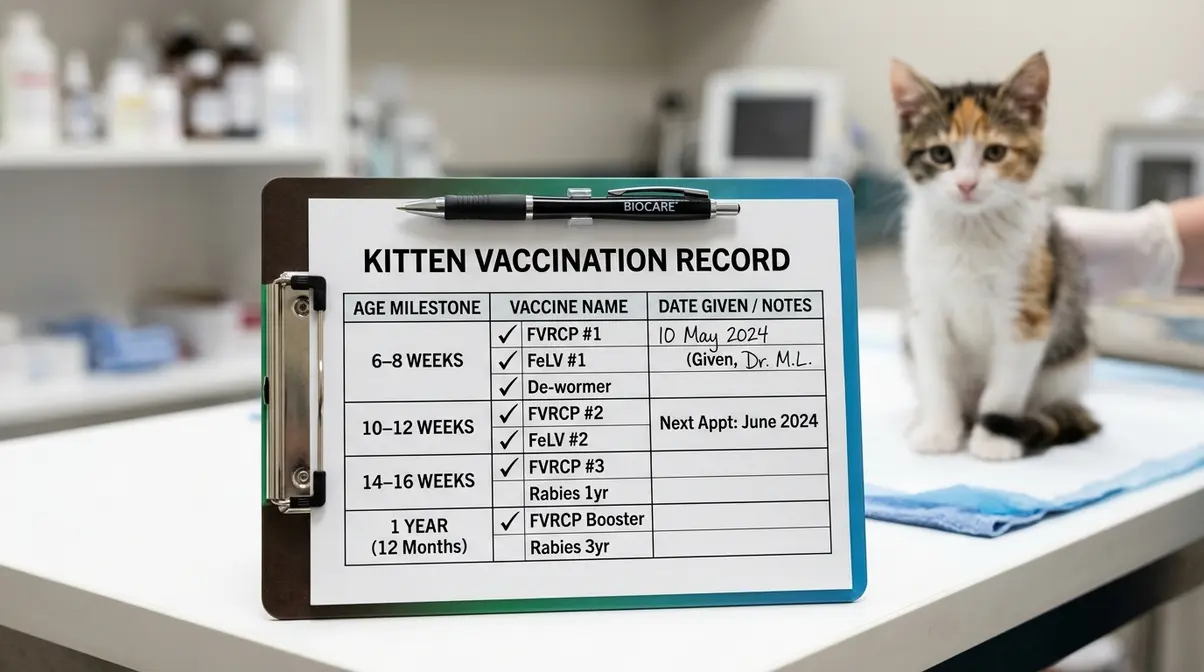
According to the Cornell Feline Health Center, core kitten vaccinations begin at 6–8 weeks of age and follow a specific schedule through 16 weeks (Cornell Feline Health Center, 2026). Core vaccines are those recommended for all kittens regardless of lifestyle.
| Age | Core Vaccines | Notes |
|---|---|---|
| 6–8 weeks | FVRCP (first dose) | Protects against feline viral rhinotracheitis, calicivirus, and panleukopenia |
| 10–12 weeks | FVRCP (booster) + FeLV (optional) | FeLV (feline leukemia) recommended for outdoor or multi-cat households |
| 14–16 weeks | FVRCP (final booster) + Rabies | Rabies vaccine timing varies by local law |
| 12 months | FVRCP booster + Rabies booster | Annual or 3-year boosters thereafter per vet recommendation |
FVRCP stands for feline viral rhinotracheitis (a respiratory virus), calicivirus (another respiratory virus), and panleukopenia (a serious viral disease affecting the immune system). Your vet will explain each in plain terms — don’t hesitate to ask questions. The AVMA (American Veterinary Medical Association) recommends discussing your kitten’s specific lifestyle with your vet to determine which non-core vaccines may also be appropriate.
Spaying, Microchips & Parasites
Spaying and neutering: Most veterinarians recommend spaying (for female kittens) or neutering (for male kittens) between 4 and 6 months of age — before the first heat cycle in females, and before testosterone-driven behaviors develop in males. Some shelters spay/neuter before adoption; check your paperwork. Early spaying and neutering reduces the risk of certain cancers and eliminates unwanted litters.
Microchipping: A microchip (a tiny device about the size of a grain of rice, implanted under the skin between the shoulder blades) provides permanent identification that cannot fall off or be removed like a collar. The AVMA strongly recommends microchipping all cats, including indoor-only cats — because even indoor cats escape. The procedure takes seconds and causes minimal discomfort. Register the chip with a national database immediately after implantation.
Parasite prevention: Veterinary sources confirm that flea and tick prevention should begin as early as 8 weeks, depending on the product. Ask your vet about a monthly topical or oral preventative — many are prescription-only and far more effective than over-the-counter options. Read more about how often cats need worming. Also discuss heartworm prevention if you live in a high-risk region.
For more on keeping your kitten healthy long-term, read our guide on cat veterinary checklist.
Your New Kitten’s First Days: A Behavioral Guide
The supplies are bought, the home is prepped, and the vet appointment is scheduled. Now comes the part most guides skip entirely: what actually happens during those first 72 hours, and how do you respond to it? The First 72 Hours Framework is a structured, day-by-day approach to those critical first three days — combining behavioral science with practical advice from experienced kitten owners and veterinary guidance. This is where confident ownership begins.
Understanding the 3-3-3 Rule for Kittens
The 3-3-3 rule is a behavioral framework used by animal shelter workers and veterinary professionals to describe the typical adjustment timeline for a new cat or kitten: 3 days to decompress, 3 weeks to learn the routine, and 3 months to feel fully at home.
- Days 1–3: Your kitten feels overwhelmed. They may hide, refuse food, or cry. This is normal — not a sign that something is wrong.
- Weeks 1–3: Your kitten begins to recognize your voice, routine, and scent. They’ll start exploring more, eating more consistently, and engaging with toys.
- Months 1–3: Your kitten settles into their full personality. Bonding deepens, play becomes more confident, and they claim their territory.
Understanding the 3-3-3 rule prevents the most common new-owner mistake: interpreting normal adjustment behavior as a problem. A hiding kitten on day one is not an unhappy kitten — they’re a kitten doing exactly what evolution programmed them to do in an unfamiliar environment.
Day-by-Day Guide: The First 72 Hours
The First 72 Hours Framework gives you a simple, structured plan for each of the three most critical days. Many new kitten owners report that having a day-by-day structure removes the anxiety of “am I doing this right?”
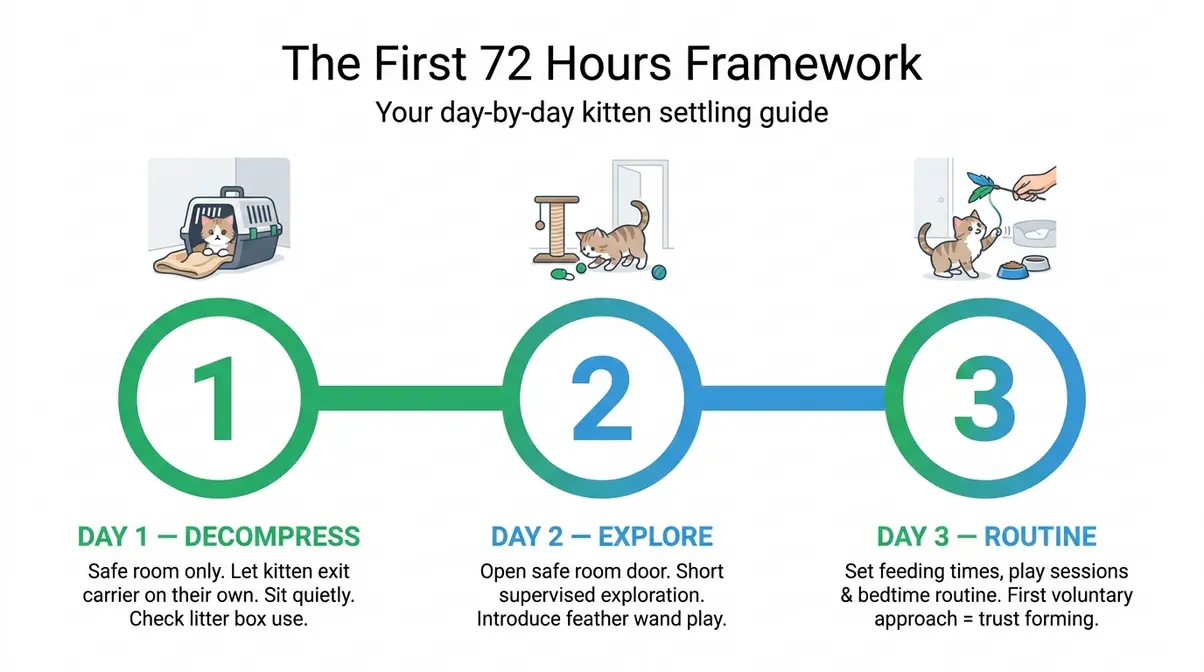
Day 1 — Decompress
Bring your kitten directly to the safe room. Place the carrier on the floor, open the door, and let them come out on their own terms. Do not reach in. Sit quietly in the room — read a book, work on your laptop — so your presence becomes associated with calm rather than intrusion. Offer food and fresh water. If they don’t eat on day one, don’t panic — stress suppresses appetite. Check on the litter box to confirm they’ve used it; if not within 12 hours, consult your vet.
Day 2 — Explore
If your kitten slept through the night and ate on day one, you can begin opening the safe room door for short supervised periods. Let them choose when and how far to explore. Continue to sit at floor level when interacting — towering over a kitten feels threatening. Introduce a feather wand toy for a brief play session; interactive play accelerates bonding faster than any other single activity.
Day 3 — Routine
Start establishing the schedule that will define your kitten’s life: feeding times, play sessions, and a consistent bedtime routine. Kittens thrive on predictability. By day three, most kittens will seek you out voluntarily — this is the first unmistakable sign that trust is forming.
“A harness — you can take your cat out for walks. It is easier if you start training them as a kitten.”
— Experienced cat owner
Day 3 is also the ideal time to introduce a harness if outdoor enrichment is part of your plan. Kittens introduced to a harness before 12 weeks old adapt far more readily than cats introduced as adults — a small investment of patience now pays dividends for years.
Ignoring Nighttime Kitten Crying?
First-night crying is one of the most common concerns new kitten owners report — and one of the most misunderstood. A kitten who cries at night has just been separated from their mother and littermates for the first time. Some crying is completely normal and expected.
Once you’ve confirmed your kitten’s basic needs are met, gentle ignoring is the recommended approach. Check that the litter box is clean, water is available, and the room is warm. (Kittens can’t regulate body temperature well under 8 weeks). If all needs are met, responding to every cry with cuddles can reinforce the behavior. Instead, provide a ticking clock wrapped in a towel (which mimics a heartbeat) and a warm water bottle under their blanket, alongside your worn T-shirt for scent comfort.
Most kittens adjust within three to five nights. If crying persists beyond a week or is accompanied by signs of illness, contact your vet.
Introducing Pets and Family
With children: Teach children to approach the kitten at floor level, to let the kitten sniff their hand first, and to never chase or corner the kitten. Short, calm interactions build trust faster than long, overwhelming ones.
With dogs: Keep the kitten in the safe room for at least the first three days. Introduce scent first — swap bedding between the dog and kitten so they become familiar before meeting. First visual introductions should happen with the dog on a lead and the kitten free to retreat.
With other cats: Cat-to-cat introductions are the most complex. Use a scent-swapping protocol for at least a week before any visual contact. Feed both cats on opposite sides of a closed door so they associate each other’s scent with something positive (food). Rushing this process is the number-one cause of long-term cat conflict in multi-cat households.
For a detailed guide on multi-pet introductions, see our article on how to introduce cats to each other.
Are cats happier in pairs or alone?
Whether a cat is happier with a companion depends on the individual cat’s history and personality. Kittens socialized with other cats before 12 weeks of age generally adapt well to companions. Adult cats who have lived solo often prefer to remain so. If you’re considering getting a second cat, introduce them gradually using a scent-swapping protocol before any face-to-face contact. A certified feline behaviorist or your veterinarian can help assess whether your specific cat is likely to benefit from a companion.
Common New Kitten Mistakes (and How to Avoid Them)
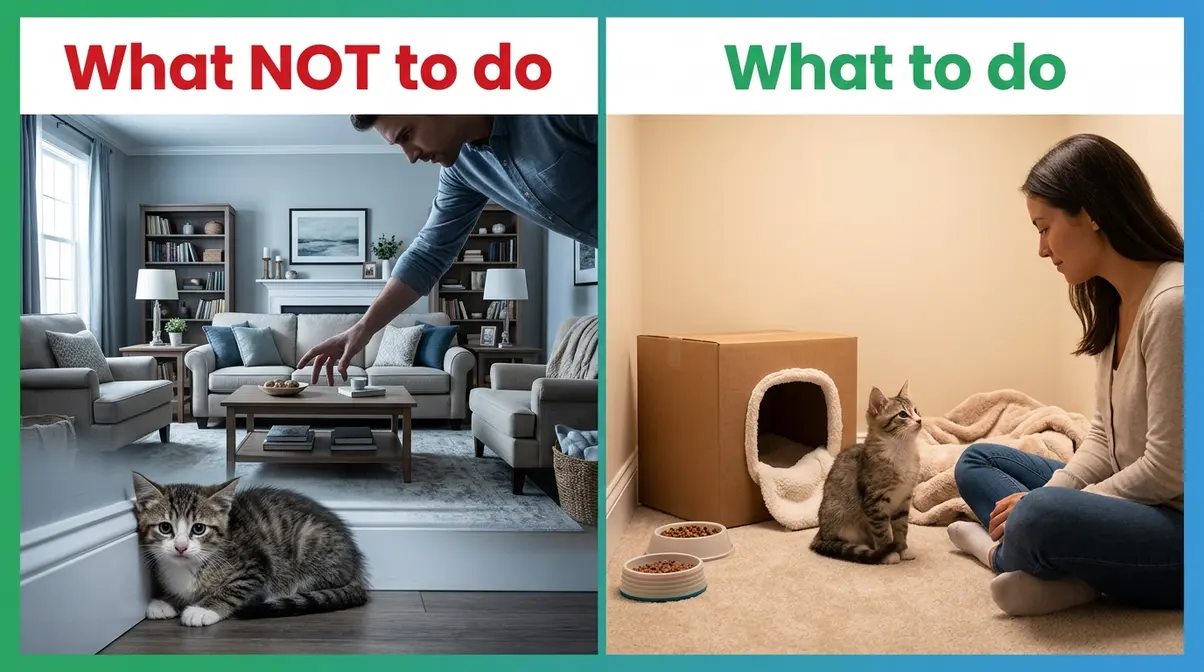
Every new kitten owner makes at least a few mistakes in the first week — that’s not a failure, it’s part of the learning curve. The goal is to avoid the ones that cause real harm or set back the bonding process. Our team evaluated the most common issues reported by new kitten owners and identified the five that come up most consistently.
Disclaimer: The information in this section is for general guidance only. Always consult your licensed veterinarian for advice specific to your kitten’s health needs.
5 Common First-Week Mistakes
Mistake 1: Giving the kitten free roam of the house on day one
Why it’s a problem: A large, unfamiliar environment triggers the kitten’s stress response, leading to hiding, food refusal, and prolonged adjustment. The fix: safe room for at least 48–72 hours, then gradual expansion.
Mistake 2: Forcing interaction
Why it’s a problem: Picking up a kitten who isn’t ready, or following them when they retreat, erodes trust. The fix: let the kitten initiate contact. Sit on the floor, be patient, and let them come to you.
Mistake 3: Using a regular collar instead of a breakaway collar
Why it’s a problem: Regular collars can catch on objects and cause choking, strangulation, or a broken jaw as the kitten tries to free themselves. The fix: use only a breakaway collar (a collar designed to snap open under pressure) from day one.
Mistake 4: Skipping the vet in the first week
Why it’s a problem: Many health issues — intestinal parasites, upper respiratory infections, early signs of feline leukemia — show no obvious symptoms in the first week but are highly treatable when caught early. The fix: schedule the first vet visit within 48–72 hours of bringing the kitten home.
Mistake 5: Feeding adult cat food
Why it’s a problem: Adult cat food doesn’t meet the higher calorie, protein, and fat requirements of a growing kitten. The fix: use only food labeled “complete and balanced for growth” or “for all life stages” until your kitten is 12 months old.
When to Call the Vet Right Away
Some situations require immediate veterinary attention — do not wait for a scheduled appointment. Contact your vet or an emergency animal hospital if your kitten shows any of the following:
- Not eating or drinking for more than 24 hours
- Vomiting more than twice in 24 hours
- Diarrhea with blood
- Difficulty breathing, open-mouth breathing, or labored breathing
- Lethargy — unable to stand, unresponsive, or significantly less active than normal
- Suspected ingestion of a toxic substance (lilies, medications, cleaning products — call the ASPCA Animal Poison Control Center at 888-426-4435)
- Eye discharge that is yellow, green, or crusty
- Crying that is persistent, distressed, and does not stop after needs are met
Trust your instincts. If something feels wrong, it’s always better to call and be reassured than to wait and regret it. For a complete guide to recognizing signs of illness in cats, see our dedicated resource.
Frequently Asked Questions
What is the 3-3-3 rule for kittens?
The 3-3-3 rule describes the typical adjustment timeline for a new kitten: 3 days to decompress, 3 weeks to learn the household routine, and 3 months to feel fully at home. During the first 3 days, expect hiding, reduced appetite, and possible crying — all normal stress responses. By week 3, most kittens are eating consistently and seeking interaction. At the 3-month mark, their full personality emerges. This framework helps owners avoid misinterpreting normal adjustment behavior as a problem.
What not to do with a new kitten?
Avoid these four common errors in the first week: Don’t give your kitten free roam of the entire house on day one — overwhelming environments increase stress. Don’t force cuddles or pick them up repeatedly before they’ve initiated contact. Don’t introduce them to other pets on arrival day. And don’t skip the first vet visit, even if the breeder provided a health certificate. Each of these mistakes delays the bonding process and can cause lasting behavioral issues.
What meat is toxic to cats?
Raw or undercooked pork is among the meats most commonly flagged by veterinary sources as risky for cats, due to the potential for Trichinella parasites and other pathogens. More broadly, veterinarians recommend avoiding raw fish (which destroys thiamine, a B vitamin essential to cats), raw chicken without proper handling protocols, and any processed deli meats high in sodium. Always consult your vet before introducing any raw food diet. Stick to commercially prepared kitten food labeled “complete and balanced” as your primary feeding approach.
How do cats show love with eyes?
A slow blink from a cat is widely recognized by veterinary behaviorists as a sign of trust and affection. When your cat makes eye contact and slowly closes and reopens their eyes, they are signaling that they feel safe and comfortable with you. You can reciprocate — make soft eye contact and slowly blink back. Many cats respond by blinking in return. Research from the University of Sussex (2020) found that cats are more likely to approach humans who slow-blink at them, suggesting it functions as a genuine social signal.
Do cats prefer female or male owners?
Research suggests cats may form stronger initial bonds with female owners, partly due to differences in communication style — women tend to speak to cats more frequently and at a higher pitch, which cats respond to more readily. A study published in Behavioural Processes (Turner, 2021) found that cats initiated contact more often with female owners. However, individual personality, early socialization history, and the quality of daily interaction matter far more than gender in determining the strength of the human-cat bond.
What You’ve Got — and What Comes Next
Bringing a new kitten home is one of the most rewarding things you can do — and with the right preparation, those first 72 hours can be genuinely joyful rather than just stressful. The First 72 Hours Framework gives you a clear structure: Day 1 to decompress, Day 2 to explore, Day 3 to establish routine. Pair that with a kitten-proofed safe room, a complete supplies starter kit, and a vet appointment in the first week, and you’ve already done more than most first-time owners. Research consistently shows that early veterinary care and structured home preparation are the two factors most strongly associated with long-term kitten health and owner satisfaction.
The framework works because it respects your kitten’s timeline rather than rushing it. Every item on this new kitten checklist — from the breakaway collar to the wide food bowl to the worn T-shirt in the bed — exists to reduce stress and build trust during the window when it matters most.
Your next step is simple: download the free printable checklist, complete your safe room setup before pickup day, and book that first vet appointment now — don’t wait until after the kitten arrives. For ongoing kitten care guidance, explore our full library of kitten care resources at madcatman.com. Your kitten is lucky to have an owner who prepared this thoroughly before they even arrived.

- kitten Starter Kit for Indoor Cats: our kitten starter kit has 10 pieces kitten needs, including a breathable mesh cat bag, a kitten litter box, a feeding bowl, a cat climbing frame, a cat teaser, a cat mat, a cat collar, a cotton rope badminton, two red springs
- All-in-one beginner Cat Starter Kit: our kitten starter kit for indoor kittens has everything your kitten needs; From basic comforts to engaging toys, get all your kitten essentials in one package
- Comfortable and Practical Design: the breathable mesh cat bag, integrated feeding bowl, and spacious kitten litter box make this kit both practical and comfortable for every cat parent
- Engaging Play and Recreation: with a feather cat teaser and toy ball, our kitten starter kit promotes exercise and play, essential for the health and growth of indoor kittens
- Durable and Safe Materials: featuring a robust plastic cat litter box and leather collar, our kitten starter kit ensures durability and safety for your feline, making it ideal for indoor kittens; Note: not suitable for kittens or cats with strong chewing ability; It is recommended to use under the supervision of the owner; If it is broken, discard it immediately

- Kitten Beginner's Kit: our kitten starter kit comes with 8 kitten items: 1 semi-enclosed cat litter box, 1 cat litter scoop, 1 automatic cat food water feeder bowl, 1 cat scratch pad, 1 cat teaser wand, 1cat litter mat, 1 foldable kitten travel carrier and 1 steel comb; This kitten supplies starter kit covers kitten daily care including feeding, grooming and playing, simplifying pet care and meeting your kitten's daily needs while easing the burden on new cat owners
- Ideal Litter Box and Feeding: as practical indoor kitten supplies, the litter box is 14.5 x 11.5 x 6.3 inches, made of durable easy-to-clean plastic with a high-sided design for kittens to enter and exit easily; The 23.6 x 17.7 inches PVC litter mat effectively traps scattered litter; The integrated automatic water and food bowl provides convenient drinking and eating for kitten, saving you the trouble of frequent water replacement
- Foldable Cat Carrier Design: our foldable cat carrier is 40 x 25 x 25 cm / 15.75 x 9.84 x 9.84 inches, made of lightweight durable polyester; Padded straps and four-sided mesh create a safe comfortable space for your pet; It folds flat for space-saving storage, lightweight and portable for travel, perfect as kitten starter kit for indoor kittens
- Interactive Entertainment Tools: as essentials for indoor kittens, the corrugated cat scratch pad is made of non-toxic corrugated cardboard, keeping kitten claws in good condition and avoiding injury; It relieves your cat's daily boredom; The cat wand satisfies kittens' natural playful needs for healthy growth; The steel comb grooms kitten fur and keeps it neat and clean
- Excellent Gift Choice: this set is perfect as a cat kitten starter kit for your kitten and is also an essential item for your cat at home or while traveling; Color-coordinated cat supplies are designed to provide comfort, fun, convenience, and great value; We've researched hundreds of cat supplies to offer you the most practical and essentials for indoor kittens, perfect for new pet owners, comes with practical cat scratch board for daily claw care
- Suitable: The cat collars are adjustable from 7.8-10.2 inches, 0.4 inches in width. Please measure your cat' s neck girth in advance.
- Well-made: Heavy-duty material improves product quality and lightweight collars make your cat feel comfortable and secure.
- Safe: Breakaway buckle is easy to take on and off. When you exert pressure, it will release quickly. So it is very safe.
- Lovely Flowers: With 4 different color flowers for each collar, suitable for every seasons especially summer.
- Package: 4 pcs of a set with different color flowers , absolutely perfect for your furry friends, cute and fashionable.

Dave King
Cat owner and writer at Mad Cat Man.