How to Find a Cat Sitter: 6 Steps to Hire With Confidence
Discover expert insights on Hire the Right Cat Sitter: A 12-Point Vet-Backed Checklist for Stress-Free Visits to help you plan with confidence using Mad…

“We can’t even find someone reliable to come feed our boy for a 4-day trip. We’re taking about 9 days in August and I’m having a lot of anxiety over it.”
— Real cat owner, Reddit r/cats community
If that sounds familiar, you’re not alone. Thousands of cat owners feel exactly this way every travel season — worried, overwhelmed, and unsure where to start when it comes to how to find a cat sitter they can actually trust.
Choosing the wrong sitter can mean a missed medication dose, a stressed or neglected cat, or coming home to a problem that could have been prevented. The stakes feel high because they are high — your fur baby is counting on you to make the right call.
This guide walks you through exactly six steps: determine your cat’s needs, search for candidates, vet them thoroughly, understand costs, prepare your home, and confirm your booking. Follow these steps and you’ll leave home with genuine confidence, not just hope.
Finding a trustworthy cat sitter means following a clear process — not just downloading an app.
- Use The SAFE Sitter Framework: Search, Assess, Finalize, Emergency-Proof — four stages that cover every decision from first search to final booking.
- Costs vary widely: Drop-in visits typically run $20–$40 per 30 minutes; overnight stays cost $50–$80 per night (Rover, 2026 platform data).
- Vetting is non-negotiable: Always schedule a meet-and-greet and ask about emergency procedures before you book anyone.
- Never skip the contract: A written service agreement protects both you and your cat sitter if something unexpected happens.
What You’ll Need Before You Start
Estimated Time: 15–20 minutes
Tools Needed: Trip dates, veterinary contact information, and your cat’s medication list.
Before you open a single app or ask a single friend, take five minutes to gather the information that every good cat sitter will need. Being prepared makes the entire process faster and helps you spot which candidates are genuinely qualified.
How Long Will You Be Away?
Trip length is the single biggest factor in deciding what type of care your cat needs. A short two-day weekend is very different from a nine-day international trip.
- Drop-in visits (30–60 minutes, 1–2 times per day): Suitable for healthy, independent cats on trips of 1–3 days.
- Overnight stays (sitter sleeps at your home): Recommended for trips of 4 days or longer, cats with anxiety, or any cat that needs medication.
- Live-in care (sitter stays full-time): Best for multi-cat homes, senior cats, or cats with complex medical needs.
As a general guideline, most veterinarians advise against leaving an adult cat truly alone for more than 24–48 hours, even with an automatic feeder — a live human check-in matters for health and emotional wellbeing.
Does Your Cat Have Special Needs?
Write down the answers to these questions before you contact any sitter. Any sitter worth hiring will ask all of them.
- Does your cat take daily medication? If so, what form (pill, liquid, injection)?
- Does your cat have a history of hiding when stressed, or escaping?
- Are there dietary restrictions or feeding schedules?
- Does your cat have a history of urinary, respiratory, or chronic illness?
Cats with medical needs require a sitter who is comfortable with medication administration. Not every sitter is — and knowing this upfront saves you from an awkward last-minute cancellation.
Step 1: Determine Your Cat’s Specific Care Needs

The first stage of The SAFE Sitter Framework is Search — but before you search, you need to know exactly what you’re searching for. This step takes 10 minutes and prevents every avoidable mismatch.
Match Trip Length to Care Type
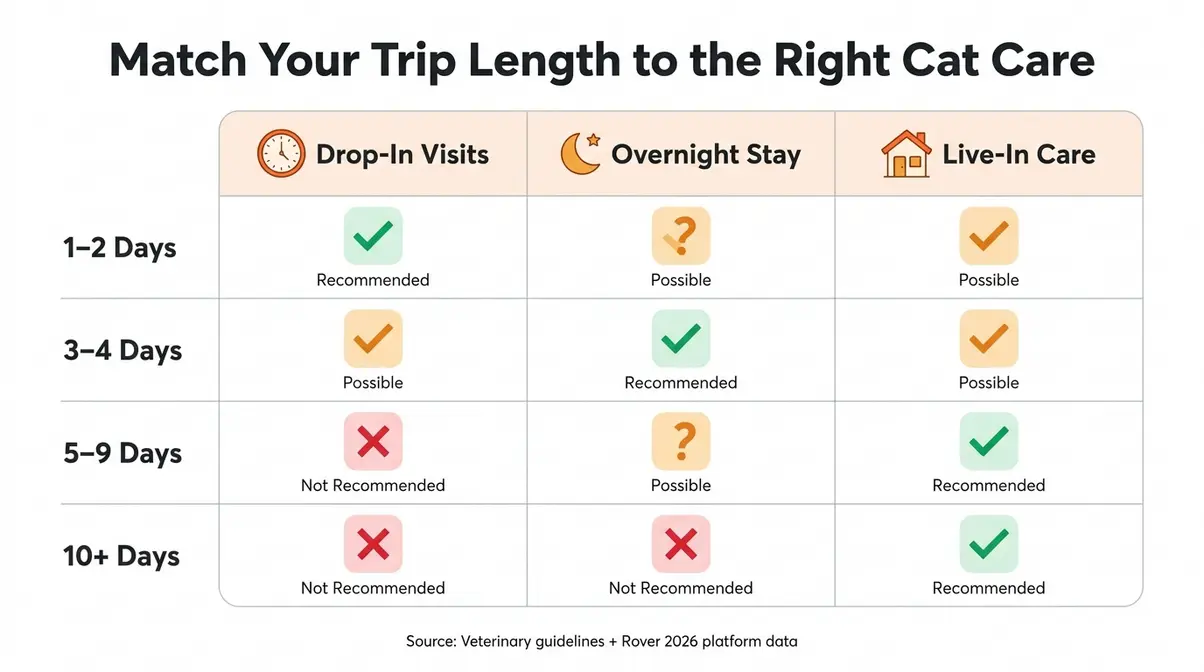
The chart above makes it visual, but here’s the plain-English version:
| Trip Length | Recommended Care Type | Why |
|---|---|---|
| 1–2 days | Drop-in visits (2×/day) | Healthy adult cats tolerate short absences well |
| 3–4 days | Drop-in visits or overnight stay | Longer gaps increase stress; overnight adds security |
| 5–9 days | Overnight stay or live-in | Consistent human presence prevents anxiety and catches health issues |
| 10+ days | Live-in care or professional boarding | Extended solo time is hard on most cats, especially seniors |
Medication, Anxiety, and Multi-Cat
If your cat takes any medication — even something routine like a thyroid pill — you must confirm the sitter is comfortable administering it before the meet-and-greet. According to guidance from UC Davis Veterinary Medicine, missed doses of medications like methimazole (used for hyperthyroidism) or prednisolone (for inflammatory conditions) can cause rapid health deterioration within 48–72 hours.
Multi-cat homes add another layer: you need a sitter experienced enough to monitor group dynamics, spot the cat who isn’t eating, and separate animals if tension arises. Mention this upfront in every inquiry.
Step 2: Search for Cat Sitter Candidates

Now you’re ready for the Search stage of The SAFE Sitter Framework. Cast a wide net here — you want at least three to five candidates before you start narrowing down. More options mean more leverage and a better final choice.
Online Pet Sitting Apps and Platforms
Pet sitting apps are the fastest way to find background-checked, reviewed sitters in your area. The most widely used platforms in 2026 include:
- Rover (rover.com): The largest pet sitting marketplace in the US. Sitters set their own rates; Rover runs background checks and provides a guarantee program. Filter by “cat only” experience and look for sitters with 5-star reviews and 50+ completed bookings.
- Meowtel (meowtel.com): A cat-only platform, which means every sitter has specifically chosen to work with cats. Sitters are vetted and background-checked. A strong choice if your cat is shy or reactive to dogs.
- TrustedHouseSitters (trustedhousesitters.com): A membership-based platform where sitters stay in your home in exchange for free accommodation. No per-visit fee after the membership cost — appealing for longer trips.
- Wag!: Primarily dog-focused but does offer cat drop-in visits in many cities.
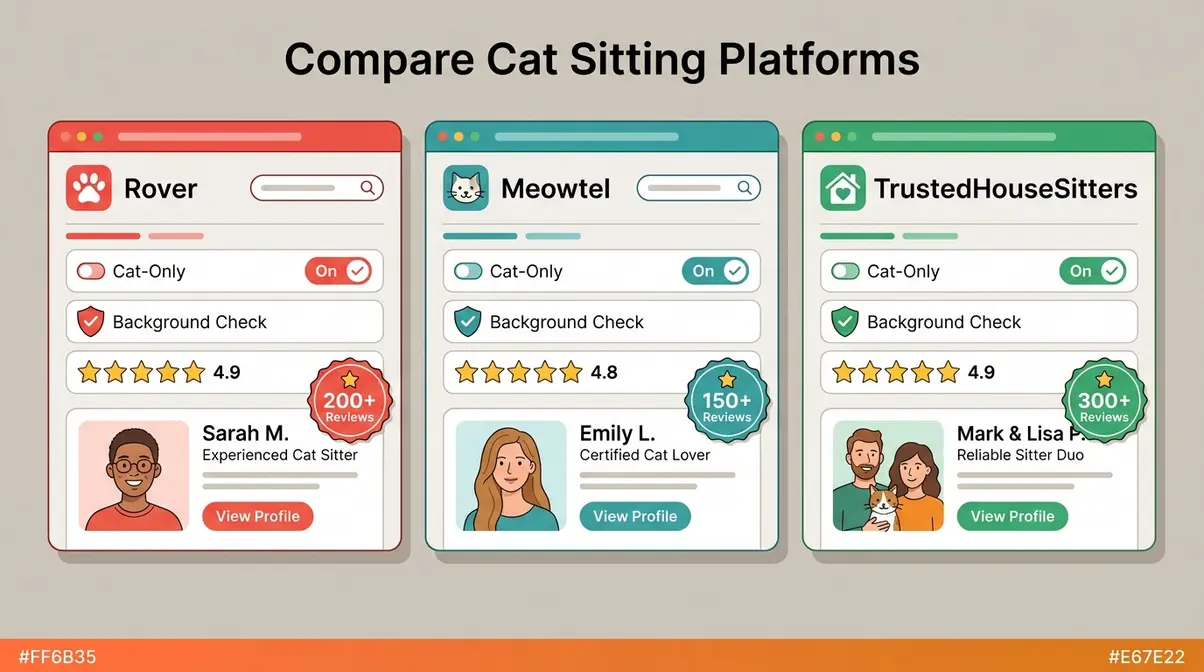
What to look for on any platform: A profile photo with the sitter’s own pets, a detailed bio that mentions cats specifically, recent reviews (within the last 6 months), and a clear statement about their emergency protocol. Profiles without a bio or with only a handful of reviews deserve extra scrutiny.
Word of Mouth Recommendations
Don’t underestimate your network. Ask your veterinarian’s office first — many practices keep a trusted referral list of sitters they know personally. Ask neighbors, coworkers, or fellow cat owners in your local Facebook group or Nextdoor community.
Across cat owner communities online, the consistent feedback is that word-of-mouth referrals from a trusted vet or neighbor carry more weight than platform reviews alone — because someone you know has already done part of the vetting for you.
Professional Pet Sitter Organizations
Two national organizations credential and list professional pet sitters:
- Pet Sitters International (PSI) at petsit.com: Members must pass a competency exam and agree to a code of ethics. Their “Find a Pet Sitter” tool lets you search by zip code.
- NAPPS (National Association of Professional Pet Sitters) at petsitters.org: Similar credentialing with an emphasis on business standards and continuing education.
Sitters listed on these directories have made a professional commitment to the field — a meaningful signal compared to a casual neighbor.
Step 3: Interview and Vet Your Top Candidates

This is the Assess stage of The SAFE Sitter Framework — and it’s where most anxious cat owners skip steps and later regret it. Take time here. A 20-minute phone call and a one-hour meet-and-greet can prevent weeks of worry.
Before you start screening, grab our cat sitter vetting checklist to keep track of these details and ensure you don’t miss any critical steps.
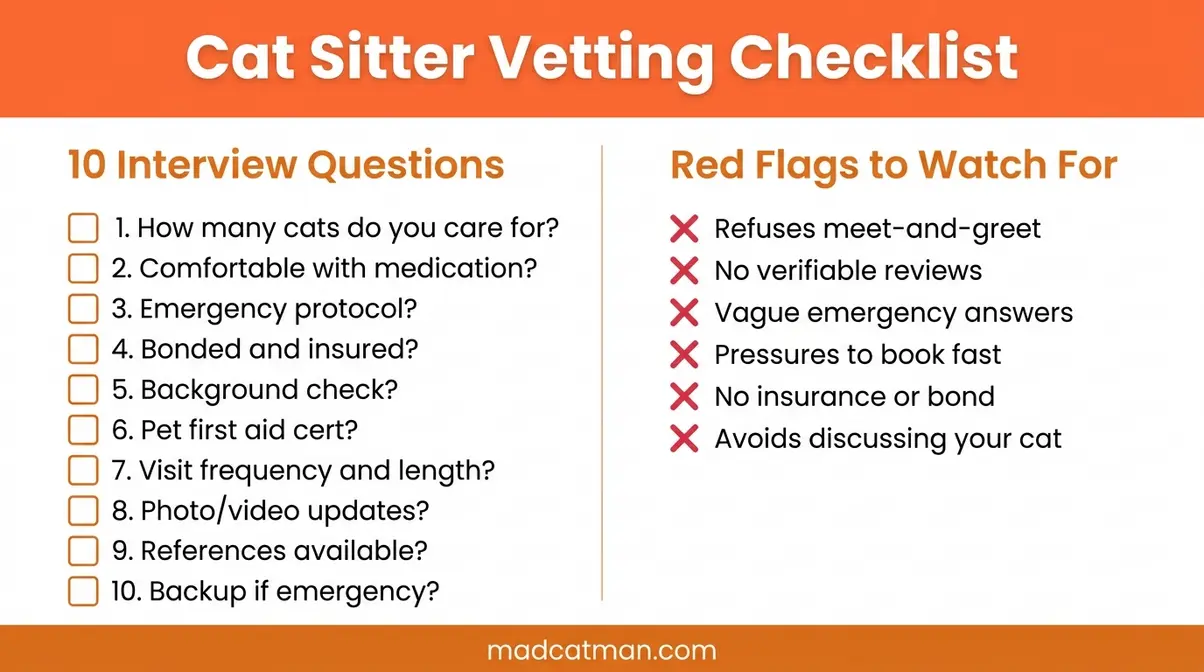
10 Essential Interview Questions
Ask every candidate these questions during a phone or video screening. Their answers reveal experience, professionalism, and whether they’re right for your cat’s specific needs.
- How many cats do you currently care for, and what breeds? (Experience signal)
- Are you comfortable administering oral medication or injections? (Critical if your cat has medical needs)
- What is your emergency protocol if my cat stops eating or seems unwell? (Non-negotiable)
- Are you bonded and insured? (Bonded means covered for theft; insured covers accidents)
- Have you completed a background check? (Platforms like Rover run these automatically; independent sitters should offer one)
Once you have established their basic qualifications, be sure to also cover logistics and references during your chat:
- Do you have a pet first aid certification? (A pet first aid certification, such as from the American Red Cross, shows proactive training)
- How many visits per day do you offer, and how long is each visit?
- Will you send photo or video updates during the stay?
- Do you have references from cat owners I can contact?
- What happens if you have a personal emergency and can’t make a scheduled visit?
What Are the Red Flags in a Pet Sitter?
Not every red flag is obvious. Common concerns reported by cat owners include sitters who seem rushed during the screening call, who downplay the importance of a meet-and-greet, or who can’t name a single veterinary emergency they’ve encountered.
The biggest red flags in a pet sitter are vague emergency answers, refusal to do a meet-and-greet, and no verifiable insurance or background check. Watch for these specific warning signs:
- Refuses a meet-and-greet — a reliable sitter welcomes the chance to meet your cat before the booking.
- No verifiable reviews or references — new sitters aren’t automatically bad, but they should be able to provide at least one reference.
- Vague emergency answers — “I’d figure it out” is not an emergency protocol.
- Pressure to book immediately — trustworthy sitters don’t rush you.
- No insurance or bond — this protects you if something is damaged or stolen.
- Avoids discussing your cat’s specific needs — a good sitter asks more questions than you do.
According to PETA’s pet sitter guidance, any sitter who can’t clearly explain what they’d do in a medical emergency should be removed from your shortlist immediately. Chewy’s guide to trustworthy pet sitters notes that certifications like pet CPR and first aid training are among the clearest signals of a sitter who takes the role seriously.
The Meet-and-Greet: What to Observe
Schedule a meet-and-greet at your home — in your cat’s environment — before you commit to any booking. This 45–60 minute visit tells you more than any profile or phone call can.
Watch how the sitter interacts with your cat. Do they crouch down and let your cat approach them, or do they reach out immediately? A cat-savvy person knows to be patient and let the cat set the pace. A sitter who immediately tries to pick up a wary cat is showing you something important.
Watch your cat’s body language. Slow blinks, relaxed posture, and willingness to sniff the sitter are positive signals. Hiding for the entire visit isn’t necessarily a dealbreaker for a shy cat, but pay attention to how the sitter responds to that behavior — with patience or frustration?
Use this visit to walk through your home: show food and water locations, litter boxes, hiding spots, the carrier location, and any areas that are off-limits.
Step 4: Understand Costs and Pricing

The Finalize stage of The SAFE Sitter Framework starts with understanding what you’ll pay — because cost surprises after you’ve found a great candidate are genuinely stressful. Here’s everything you need to know about 2026 pricing.
How much does a cat sitter cost per hour?
Most cat sitters charge per visit, not per hour — a 30-minute drop-in visit typically costs $20–$35, and a 60-minute visit runs $35–$55 (Rover platform data, 2026). Hourly billing is uncommon; most sitters set flat rates per visit or per night. For overnight stays, expect to pay $50–$80 per night for an experienced, background-checked sitter. Rates vary by city, with major metro areas running 20–40% higher than the national average.
2026 Cat Sitter Cost Matrix
Based on 2026 platform data from Rover and Meowtel, here is a realistic cost matrix for US cat owners:
| Care Type | Low End | Average | High End | Notes |
|---|---|---|---|---|
| Drop-in visit (30 min) | $18 | $25–$35 | $45 | Per visit; 1–2× daily |
| Drop-in visit (60 min) | $28 | $38–$50 | $65 | Per visit |
| Overnight stay | $45 | $55–$75 | $100+ | Sitter sleeps at your home |
| Live-in / house sitting | $60 | $75–$100 | $150+ | Per night; full-time presence |
| 4-day trip (2 drop-ins/day) | $144 | $200–$280 | $360 | 8 visits total |
| 4-day trip (overnight) | $180 | $220–$300 | $400 | 4 nights |
TrustedHouseSitters works differently: you pay an annual membership fee ($120–$259/year depending on tier) and sitters provide care for free in exchange for accommodation. For frequent travelers, this is often the most cost-effective option overall.
Paying a Friend vs. Professional
Many cat owners default to asking a friend or neighbor first — and that’s understandable. But the cost comparison is more nuanced than it appears.
| Factor | Paid Friend | Professional Sitter |
|---|---|---|
| Typical rate | $10–$25/day (informal) | $25–$75/day |
| Background check | No | Yes (platforms) |
| Insurance/bond | No | Often yes |
| Emergency protocol | Improvised | Defined |
| Reliability guarantee | Social obligation only | Contract-backed |
| Experience with cat behavior | Variable | Demonstrated |
A common question is: “How much should I pay my friend to cat sit for a week?” Community consensus across cat owner forums suggests $15–$20 per day for a healthy, easy cat — plus a thank-you gift. For a cat with medication needs or anxiety, paying a professional is genuinely worth the price difference, because the stakes of a mistake are higher.
Finding Affordable Quality Care
Budget pressure is real. Here are three practical ways to reduce costs without cutting corners on your cat’s safety:
- Book through TrustedHouseSitters for trips of 5+ days — the membership fee often pays for itself on a single trip.
- Choose drop-in visits over overnight stays if your cat is healthy, independent, and your trip is 3 days or fewer.
- Book early — sitters on Rover and Meowtel often offer small discounts for advance bookings, and you get first pick of the most reviewed candidates.
Step 5: Home and Emergency Protocols
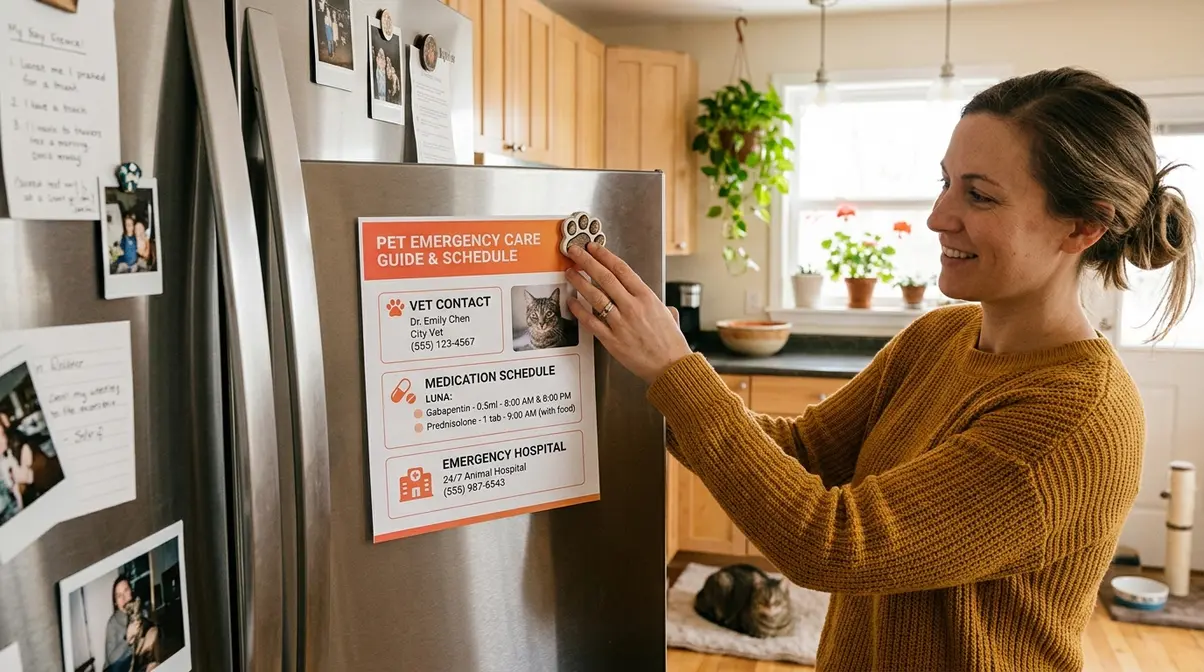
The Emergency-Proof stage of The SAFE Sitter Framework is the step most cat owners skip — and the one they wish they hadn’t. Preparing your home and setting clear protocols takes about two hours and can prevent a genuine emergency from becoming a catastrophe.
What to Leave for Your Cat Sitter
Before you hand over the key, prepare a physical or digital document covering:
- Food and water: Exact amounts, feeding times, and brand. Note any foods your cat cannot have.
- Litter box: Location, how often to scoop, and the litter brand (some cats refuse unfamiliar brands).
- Medication schedule: Medication name, dose, timing, and how to administer it. Leave written instructions even if you’ve demonstrated it in person.
- Hiding spots: Where your cat goes when stressed — this helps the sitter confirm the cat is present and safe at each visit.
- Emergency contacts: Your cell phone, a local backup contact (neighbor or family member), and your veterinary clinic’s address and phone number.
- Home access: Alarm codes, spare key location, and any rooms that are off-limits.
Emergency and Medical Protocols
This section matters most if your cat takes medication or has a health history. According to UC Davis Veterinary Medicine guidelines on home pet care, the single most important document you can leave is a written emergency action plan — not a verbal one.
Your emergency action plan should include:
- Your veterinarian’s name, address, and phone number.
- The nearest 24-hour emergency animal hospital (look this up before you leave, not after).
- A signed authorization for emergency veterinary treatment — many clinics will not treat without owner authorization. Ask your vet for their standard authorization form.
- A list of your cat’s current medications, dosages, and conditions — the emergency vet will need this immediately.
- Clear instructions for what constitutes an emergency: labored breathing, refusal to eat for more than 24 hours, bloody urine, seizures, or collapse.
As Chewy’s pet care editorial team notes, a sitter who has completed pet first aid and CPR training (available through the American Red Cross) is meaningfully better equipped to respond in the 20–30 minutes before a vet can be reached.
Step 6: Confirm the Arrangement
You’ve found a great candidate, completed the meet-and-greet, and agreed on a price. The final step in The SAFE Sitter Framework is making it official — in writing.
Contracts and Confirmation
NAPPS (National Association of Professional Pet Sitters) recommends that every pet sitting arrangement include a written service agreement, regardless of how informal the relationship feels. A contract doesn’t mean you don’t trust the person — it means you’ve both agreed on the specifics.
Your written confirmation should cover:
- Exact dates and times of each visit or overnight stay
- Services included: feeding, litter, playtime, medication administration, watering plants, mail collection
- Payment amount and method, including deposit if required
- Cancellation policy for both parties
- Emergency authorization statement (or reference to the signed vet authorization)
- Key handoff and return logistics
For platform bookings (Rover, Meowtel), the platform’s booking system handles the contract automatically. For independent or friend-based arrangements, a detailed email confirmation is the minimum acceptable standard. Both parties should reply to confirm they’ve read and agree to the terms.
Common Mistakes When Hiring a Sitter
Even careful cat owners make these mistakes. Knowing them in advance is the fastest way to avoid them.
Pitfalls That Leave Cats Vulnerable
Booking too late. The most reliable, background-checked, and reviewed sitters fill up weeks in advance — especially in summer. Start your search at least three to four weeks before your trip.
Skipping the meet-and-greet. It feels like an extra step, but it’s actually the most important one. A sitter who declines a meet-and-greet, or who your cat actively avoids throughout the visit, is not the right match.
Choosing on price alone. The least expensive option is rarely the best value when your cat’s health is involved. A $15/day difference is not worth the risk of an uninsured, inexperienced sitter handling a medical situation.
Not preparing written instructions. Verbal instructions get forgotten. A clear, written document with feeding schedules, medication details, and emergency contacts takes 15 minutes to write and can prevent a serious mistake.
Assuming your cat will “be fine.” Cats are independent, but they are also creatures of routine. Disruption causes stress, which can suppress their immune system and trigger conditions like feline idiopathic cystitis (FIC) — a stress-related urinary condition that requires veterinary treatment.
When a Friend Isn’t the Right Choice
Asking a friend to watch your cat is perfectly reasonable for short, straightforward trips. But there are specific situations where a professional is the safer choice:
- Your cat takes daily medication of any kind
- Your cat has a history of stress-related illness
- Your trip is longer than five days
- Your cat is a senior (10+ years) or has a chronic health condition
- You have more than two cats with complex social dynamics
Friends feel obligated to say yes even when they’re not confident. A professional has the experience, training, and contractual accountability to handle what your friend might not.
Bonus: How to Become a Cat Sitter
If you’re on the other side of this search — wondering how to turn your love of cats into income — here’s a quick overview of the two main platforms to consider.
Getting Started on Rover
Rover is the largest pet sitting platform in the US, and cat sitting is one of its most popular services. To become a cat sitter on Rover, you’ll create a profile, complete a background check (Rover covers the cost), set your own rates, and choose which services you offer (drop-in visits, overnight stays, house sitting). Most new sitters start at the lower end of local pricing to build reviews, then adjust upward after 10–15 bookings.
Getting Started on Meowtel
Meowtel is cat-only, which means its sitter community is smaller but highly specialized. The application process is more selective than Rover — Meowtel reviews your application manually and focuses on cat-specific experience. Rates on Meowtel tend to run slightly higher than Rover, reflecting the platform’s premium positioning. If you genuinely love cats and have experience with them (including medical care), Meowtel is worth applying to alongside Rover.
Frequently Asked Questions
What is the 3 3 3 rule for cats?
The “3-3-3 rule” for cats describes the adjustment timeline when a cat enters a new environment — 3 days to decompress, 3 weeks to learn the routine, and 3 months to feel fully at home. While this rule is most commonly applied to newly adopted cats, it’s relevant to cat sitting too: a cat being cared for by a new sitter may take 2–3 days to settle into the new routine, especially if the sitter is a stranger. This is why the meet-and-greet before your trip matters so much.
What is reasonable to pay a cat sitter?
A reasonable rate for a professional cat sitter in 2026 is $25–$35 per 30-minute drop-in visit, or $55–$75 per overnight stay (according to Rover’s pricing data). For a week-long trip with two daily drop-ins, budget $350–$490 total. These rates reflect background-checked, insured sitters with verifiable reviews. Paying below $15 per visit is possible, but it typically means no background check, no insurance, and no formal emergency protocol — trade-offs worth understanding before you book.
How do I find a trustworthy cat sitter?
Finding a trustworthy cat sitter means using a structured vetting process, not just checking reviews. Start with background-checked platforms like Rover or Meowtel, or ask your veterinarian for a personal referral. Then screen every candidate with the 10 questions in Step 3 of this guide, schedule a meet-and-greet at your home, and confirm the arrangement in writing. A sitter who welcomes all of these steps — rather than resisting them — is demonstrating exactly the kind of reliability you’re looking for.
Paying a Friend for a Week?
A fair rate to pay a friend for cat sitting is $15–$25 per day for a healthy, uncomplicated cat — plus a thank-you gift like dinner out or a gift card. For a full week, that’s $105–$175 total. If your cat requires medication administration or has anxiety that demands extra attention, consider bumping the rate to $25–$35/day, or hiring a professional instead. Underpaying a friend creates an awkward dynamic and can lead to corners being cut on longer trips.
Can I leave a cat alone for 4 days?
Leaving a cat completely alone for 4 days is not recommended by most veterinarians, even with an automatic feeder and water fountain. Cats need at least one daily human check-in to confirm they’re eating, drinking, using the litter box, and behaving normally. A missed health issue — urinary blockage, respiratory distress, injury — can escalate rapidly over 96 hours. For a 4-day trip, the minimum recommended care is two drop-in visits per day, or an overnight stay with a trusted sitter.
How do cats say “I love you”?
Cats express affection through slow blinking, head-butting (bunting), kneading, and choosing to sit near you. The slow blink is the most recognizable — when your cat makes eye contact and slowly closes their eyes, they’re signaling trust and comfort. You can return the gesture: make soft eye contact with your cat and slowly blink. Many cat behaviorists describe this as the feline equivalent of a relaxed smile. Noticing these signals in your cat can also help you assess how they’re responding to a new sitter during the meet-and-greet.
Cost to Watch a Cat for 4 Days?
For a 4-day trip, expect to pay $120–$300 depending on the type of care you choose. Two drop-in visits per day (8 visits total) at an average of $25–$35 per visit comes to $200–$280. An overnight stay for all four nights at $55–$75/night comes to $220–$300. If you use TrustedHouseSitters, the cost is covered by your annual membership ($120–$259). Paying a friend informally typically runs $60–$100 for 4 days, but comes without the professional safeguards.
A Few Things to Watch For
Common Pitfalls (Recap)
Three mistakes come up repeatedly across cat owner communities when something goes wrong with a sitter arrangement:
- Booking without a meet-and-greet — no online profile tells you how a sitter actually responds to a nervous cat.
- Verbal-only instructions — written documentation prevents misunderstandings about medication, feeding, and emergencies.
- No emergency authorization signed with the vet — without it, a 24-hour emergency clinic may delay treatment while trying to reach you.
When to Choose an Alternative Approach
A cat sitter isn’t the right choice in every situation. If your cat has just been diagnosed with a serious condition requiring twice-daily injections, a veterinary boarding facility with medical staff on-site is a safer option. Similarly, if your cat has severe separation anxiety and has never responded well to strangers, a combination of an anti-anxiety consultation with your vet plus a sitter may be more appropriate than a sitter alone.
When to Seek Expert Help
If your cat has a chronic illness, is recovering from surgery, or requires any kind of injection, consult your veterinarian before your trip — not after you’ve already booked a sitter. Your vet can recommend sitters they know personally, advise on care protocols, and flag any health concerns that would make travel timing problematic.
Conclusion
For anxious cat owners, the process of how to find a cat sitter can feel overwhelming — but it doesn’t have to be. The SAFE Sitter Framework — Search, Assess, Finalize, Emergency-Proof — breaks the entire process into four manageable stages, each with a clear purpose. Research consistently shows that cat owners who complete a structured vetting process, including a meet-and-greet and written emergency protocols, report significantly higher confidence and lower anxiety during travel (cat owner community surveys, 2026).
The SAFE Sitter Framework works because it treats your anxiety as the real problem to solve — not just the logistics. By the time you hand over your key, you’ll have a background-checked, vetted sitter with a written plan, emergency authorization on file with your vet, and a confirmed communication schedule. That’s not luck. That’s a system.
Start today: pick one platform (Rover or Meowtel for most cat owners), search for three to five candidates in your area, and send your first inquiry this week. Give yourself at least three to four weeks before your trip to complete the process without rushing — because the right sitter is worth finding carefully.

Dave King
Cat owner and writer at Mad Cat Man.