
- Table of Contents
- What Is a Calico Maine Coon?
- Appearance and Physical Traits
- The Genetics Behind Their Rarity
- Calico Maine Coon Mixes and Hybrids
- Calico Maine Coon Price
- Finding a Calico Maine Coon Breeder
- Calico Maine Coon Kittens for Sale
- Common Pitfalls and What to Watch Out For
- Frequently Asked Questions
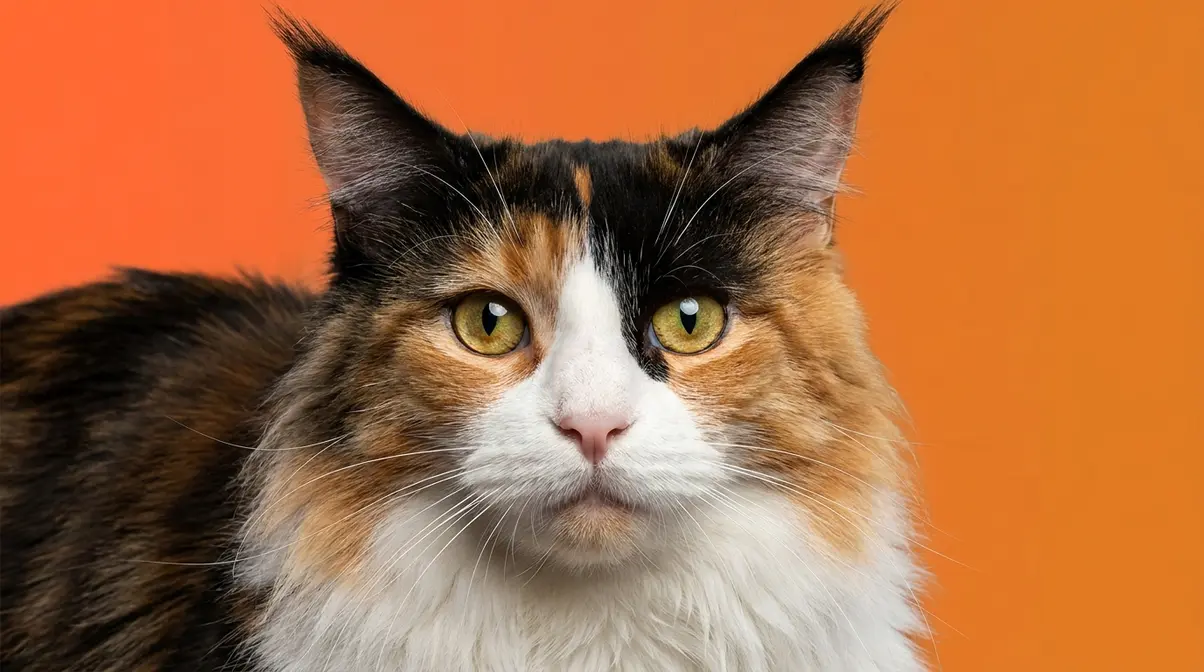
Only about 1 in 3,000 calico cats is male — and when that cat is also a purebred Maine Coon, you’re looking at one of the most genetically extraordinary animals in the domestic cat world (Almonte Cats breeder information).
It’s one of the most common questions we see from Maine Coon enthusiasts:
“I feel like the majority of Maine Coons are dark silver, then orange and white. How rare is a purebred calico mainecoon?”
That question captures something real. Most people stumble across a calico Maine Coon in a photo, feel an immediate pull toward those shaggy, super-sized multicolored feline wonders, and then realize they have almost no information to work with. Most articles give you a 200-word summary and leave you with more questions than answers.
You deserve the full picture. In this guide, you’ll learn exactly what makes a calico Maine Coon genetically unique, what they look like at full size, how much one costs, and how to find a reputable breeder — so you can make a confident, informed decision. We cover the genetics behind their rarity, the coat variations you’ll encounter, the true cost of ownership, and the red flags to avoid when searching for a kitten.
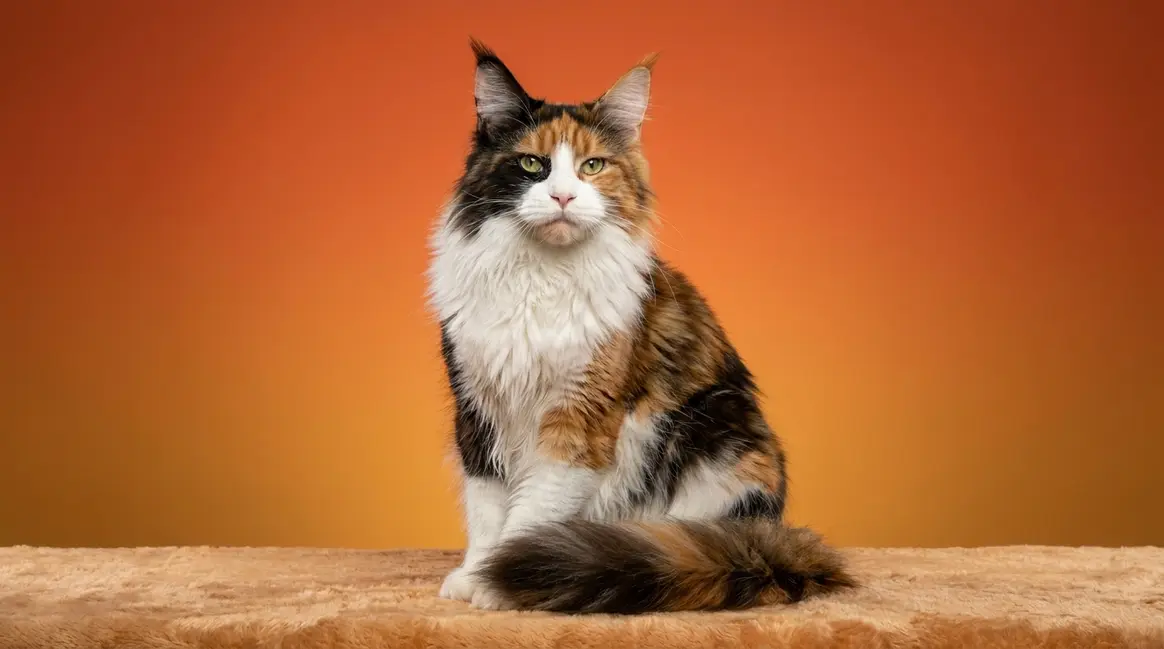
A calico Maine Coon is a purebred Maine Coon cat wearing a three-color coat of white, black, and orange — a pattern governed entirely by X-chromosome genetics that makes almost all of them female.
- Extreme rarity: Only about 1 in 3,000 calico cats is male; a male calico Maine Coon is a genuine genetic anomaly.
- Recognized pattern: Both the CFA and TICA recognize calico as an accepted color pattern for the Maine Coon breed.
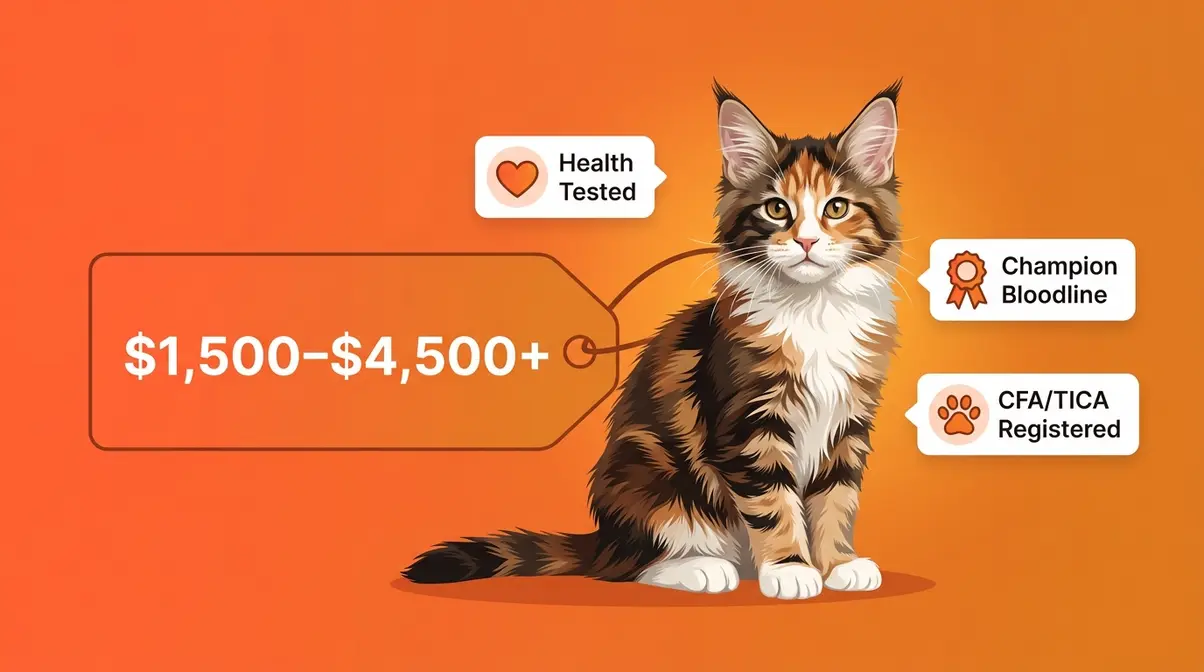
- Real cost: Expect to pay $1,500–$4,500+ from a reputable breeder, depending on lineage and pattern quality.
- “The Tri-Color Lottery”: The three-color calico coat is the result of a genetic lottery that plays out on the X chromosome — understanding it helps you set realistic expectations when searching for a kitten.
Estimated Time: 15-20 minutes
Tools/Materials Needed: None required (Informational Guide)
1. What Is a Calico Maine Coon?
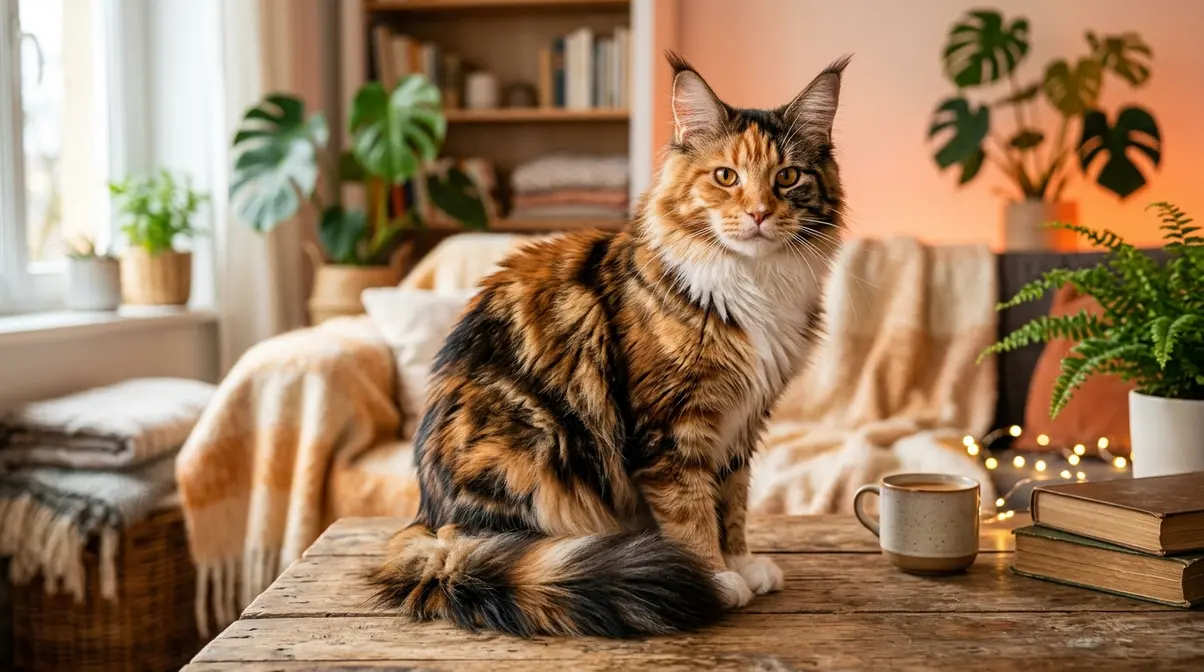
A calico Maine Coon is a purebred Maine Coon cat with a specific three-color coat pattern — white, black (or dark tabby), and orange (or cream). Understanding what that actually means requires separating two distinct ideas: the breed and the color pattern. Many first-time buyers confuse the two, which leads to unrealistic expectations when searching for a kitten.
Calico Is a Color Pattern, Not a Breed
Calico describes a coat pattern, not a separate breed. Specifically, it refers to a tricolor coat with patches of white, black, and orange distributed across the body. Any breed of cat — from a domestic shorthair to a Persian to a Maine Coon — can technically wear a calico coat, provided the right genetic conditions are met.
This distinction matters enormously when you’re shopping. You won’t find a breeder listing “calico” as a breed category. Instead, you’ll search for a Maine Coon breeder who produces calico-patterned kittens. Both the Cat Fanciers’ Association (CFA) and The International Cat Association (TICA) officially recognize calico as an accepted color class within the Maine Coon breed standard — so a calico Maine Coon is 100% a legitimate, show-eligible purebred cat, not some unusual hybrid.
- The three classic calico colors are:
- White — typically covers the chest, belly, and paws
- Black or dark brown — appears as distinct patches across the back and sides
- Orange or red — the warm, reddish-gold patches that complete the trio
When those three colors appear in large, clearly defined patches rather than blended swirls, the pattern is called calico. When the colors swirl and blend without dominant white, you’re looking at a tortoiseshell instead — a related but distinct pattern we’ll cover in Section 2.
The Maine Coon Breed: A Gentle Giant Background
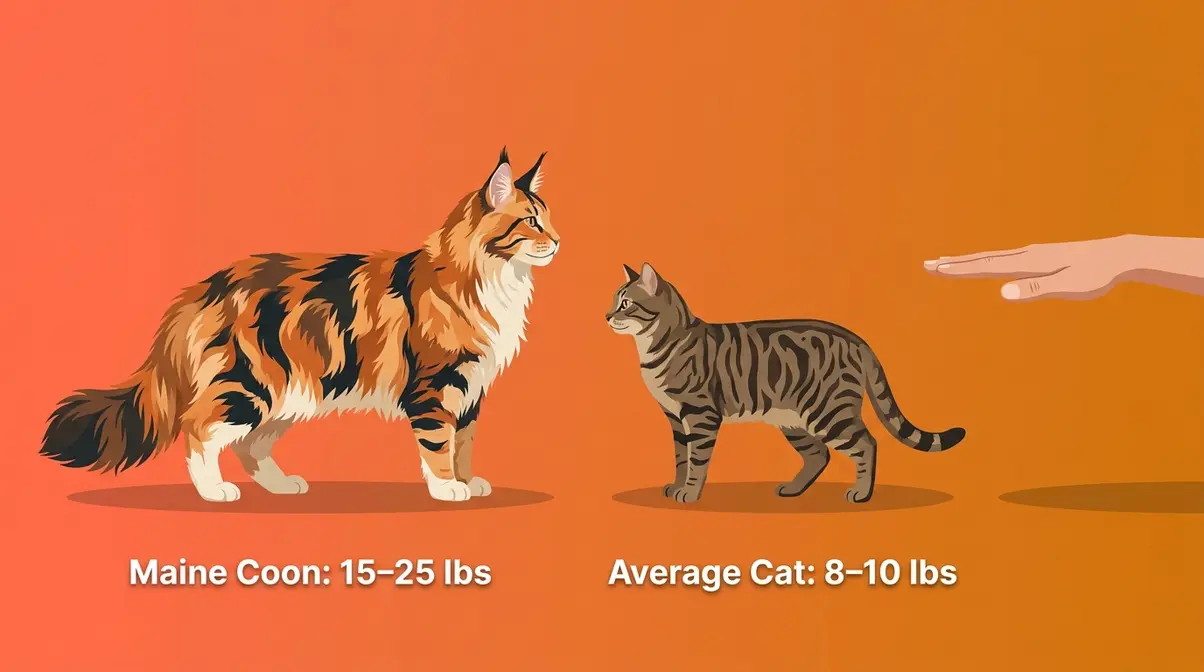
Before you can fully appreciate what makes a calico Maine Coon special, it helps to understand the breed itself. Maine Coons are the largest domesticated cat breed recognized by major registries, with males regularly reaching 15–25 pounds and females typically ranging from 10–15 pounds. They’re the gentle giants of the cat world — physically imposing but famously sweet-tempered.
The breed originated in the northeastern United States, most likely in Maine (hence the name), and was one of the first breeds recognized by the CFA. Their most iconic physical features are their tufted ears, large bushy tails, and flowing, water-resistant coats that evolved to survive harsh New England winters. That shaggy, layered coat is part of what makes a calico Maine Coon so visually striking — the three colors play out across long, flowing fur rather than a smooth short coat, creating a dramatic, almost regal appearance.
Maine Coons are also well known for their dog-like personality: they follow their owners from room to room, often learn to walk on a leash, and enjoy interactive play well into adulthood. Their affectionate nature and clown-like personality make them one of the most popular breeds in the United States — the CFA consistently ranks them among the top five most registered breeds nationally.
Calico Maine Coon Personality and Temperament
The calico Maine Coon personality is, at its core, the Maine Coon personality — because the calico pattern is purely cosmetic and has no direct biological effect on behavior. Understanding Maine Coon personality and traits helps explain why these cats are so beloved. What you’re getting is one of the most sociable, playful, and intelligent cat breeds in the world, wrapped in a stunning three-color coat.
Maine Coon owners and breeders consistently report that these cats are unusually communicative, often using a soft chirping or trilling sound rather than a standard meow. They’re curious and inquisitive, frequently investigating everything you do without being overly demanding or clingy. Most Maine Coons actively enjoy the company of children, other cats, and even dogs when properly introduced — a level of social flexibility that’s relatively rare among cat breeds.
Their affectionate nature is paired with a healthy dose of independence. They won’t typically sit on your lap for hours (though some individuals certainly do), but they’ll be nearby, engaged, and ready to play whenever you are. Think of them as a loyal companion rather than a decorative lap ornament.
One practical note for prospective owners: Maine Coons are highly intelligent and can become bored easily. They need interactive toys, puzzle feeders, and regular playtime to stay mentally stimulated. A bored Maine Coon will find its own entertainment — and your bookshelves may not survive the process.
The “Tortitude” Myth: What Science Says
A persistent rumor in cat communities claims that calico and tortoiseshell cats have a distinct “tortitude” — a feisty, independent, or even aggressive personality linked to their coat color. It’s a fun idea, but the scientific evidence doesn’t support it as a universal truth.
A peer-reviewed study published in the Journal of Veterinary Behavior and indexed on PubMed examined owner-reported behavioral differences among cats of different coat colors. The researchers found that while some owners of calico and tortoiseshell cats did report slightly higher rates of hissing and swatting during handling, the differences were modest and highly variable between individual cats. Critically, the study noted that socialization history, early handling, and breeder practices had a far greater influence on adult cat behavior than coat color.
For calico Maine Coons specifically, the breed’s naturally sociable and sweet-tempered disposition tends to dominate. Maine Coon breeders who specialize in this breed confirm that well-socialized calico kittens from reputable catteries show no meaningful behavioral difference from their solid-colored littermates. The “tortitude” label is more cultural mythology than biological fact — and it’s not a reason to avoid a calico Maine Coon.
2. Appearance and Physical Traits
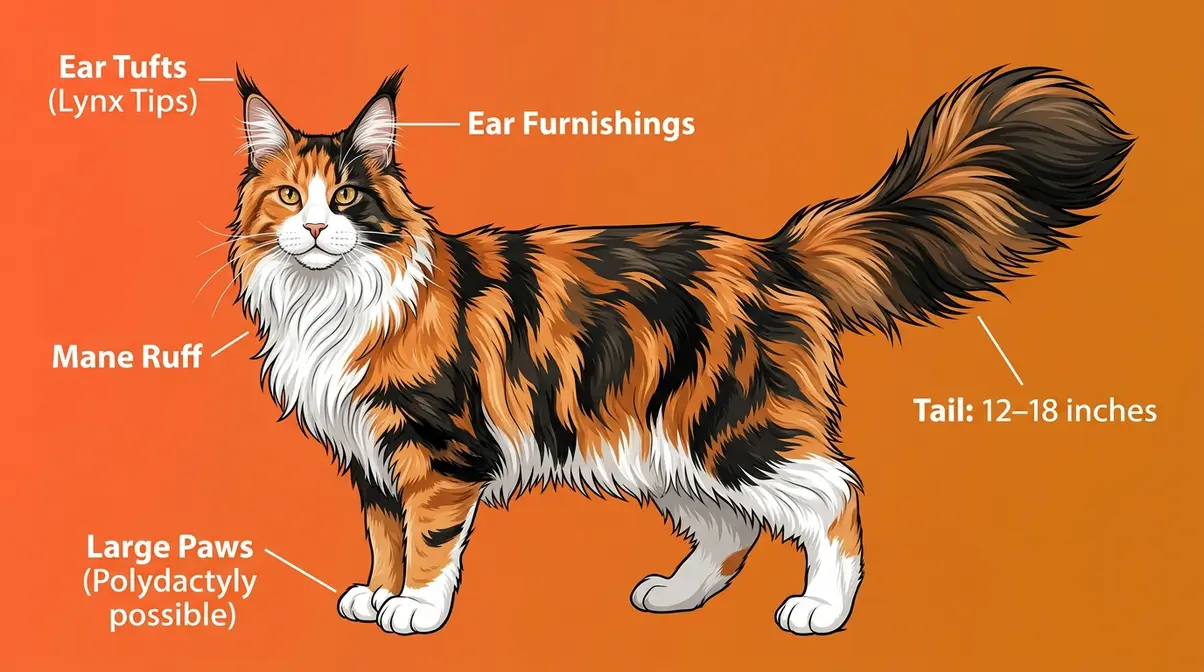
The calico Maine Coon’s appearance is the intersection of two remarkable things: the breed’s already-impressive physical presence and a coat pattern that looks like it was painted by hand. Understanding the specifics — size, coat variations, and pattern types — will help you know exactly what you’re looking for when browsing breeder galleries.
Size and Weight: How Big Do They Get?
Maine Coons are the largest domestic cat breed in the world by average adult size, and a full grown calico Maine Coon lives up to that reputation completely. When looking at a Maine Coon size chart and growth timeline, their robust size is one of the breed’s most appealing — and most surprising — characteristics for first-time owners.
| Measurement | Female | Male |
|---|---|---|
| Adult Weight | 10–15 lbs (4.5–6.8 kg) | 15–25 lbs (6.8–11.3 kg) |
| Body Length (nose to tail base) | 19–30 inches | 19–40 inches |
| Tail Length | 12–18 inches | 12–18 inches |
| Full Maturity Age | 3–5 years | 3–5 years |
That last row is important. Maine Coons take significantly longer to reach full size than most other breeds. A kitten that seems large at six months will continue growing for another two to four years. Many new owners are surprised to discover their “big kitten” still has years of growing ahead of it.
Their bone structure is correspondingly substantial — broad chest, wide-set ears, large rounded paws (sometimes with polydactyly, meaning extra toes, a trait more common in Maine Coons than most breeds). On a calico Maine Coon, this large, solid frame becomes a canvas for those dramatic color patches, which tend to look even bolder against the flowing long coat.
Standard Calico vs. Dilute Calico Maine Coon
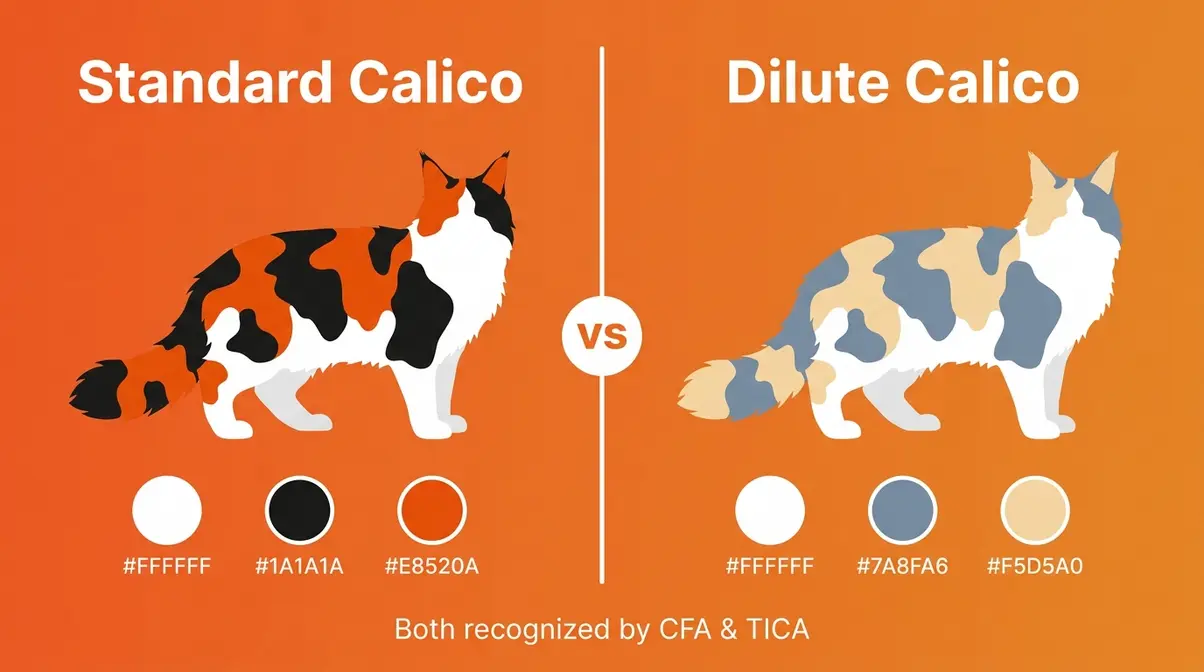
Not all calico Maine Coons look the same. The two most common variations are the standard calico and the dilute calico, and the difference comes down to a separate gene that affects color intensity.
Standard calico displays the classic, high-contrast trio: bright white, deep black, and vivid orange-red. The patches are bold and clearly defined. This is the version most people picture when they hear “calico.”
Dilute calico carries a recessive modifier gene (the dilution gene) that softens all three colors. Black becomes blue-gray, orange becomes cream, and white remains white. The result is a softer, almost pastel appearance — still three distinct colors, but with a more muted, elegant palette. Dilute calico Maine Coons are sometimes called “blue calico” Maine Coons in breeder listings.
Both variations are fully recognized by the CFA and TICA as valid calico color classes. Neither is inherently rarer than the other at the breed level, though individual breeders may produce one more frequently than the other depending on their breeding pairs.
Calico Tabby and Tortoiseshell Variations
Beyond standard and dilute, you’ll encounter a few related pattern terms in breeder listings that can cause confusion:
Calico tabby (also called “caliby”): Some calico Maine Coons carry the tabby gene alongside the calico pattern. This means the orange or black patches have visible striped or swirled tabby markings within them, rather than being solid blocks of color. A caliby Maine Coon has the three-color distribution of a calico but with tabby patterning inside the colored areas.
Tortoiseshell: A tortoiseshell Maine Coon has the same orange and black (or blue and cream in dilute form) color genetics as a calico, but without the significant white coverage. The result is a swirled, intermingled pattern of two colors rather than distinct patches against white. Tortoiseshell cats are sometimes called “torties,” and they are genetically very close relatives of calicos — the difference is primarily in how much white is expressed.
Torbie: A tortoiseshell cat that also carries the tabby gene, producing a complex, richly patterned coat with swirled tabby markings within the tortoiseshell colors. Maine Coon torbies are stunning and relatively uncommon.
Understanding these variations matters practically: if you fall in love with a “calico” photo and later receive a kitten described as a “caliby,” you’ll want to know that’s still a tricolor cat — just with more visual complexity in the patches.
The Signature Long Coat
The Maine Coon’s coat is one of its most defining features, and it transforms the calico pattern into something genuinely spectacular. A long hair calico Maine Coon has a multi-layered coat: a dense, silky undercoat topped by longer guard hairs that give the breed its characteristic shaggy silhouette. The coat is semi-water-resistant and was originally adapted for cold, wet climates.
On a calico, this long coat means the color patches blend slightly at the edges as the fur flows, creating soft transitions between white, black, and orange that simply don’t exist on a short-haired calico cat. The mane around the neck and chest — called a “ruff” — tends to be particularly dramatic and often shows the white coloring most prominently, framing the face like a lion’s mane.
Grooming reality check: that beautiful coat needs regular maintenance. Most Maine Coon owners report that twice-weekly brushing keeps mats and tangles under control, with more frequent sessions during the spring and fall shedding seasons. The good news is that Maine Coons typically tolerate — and often enjoy — grooming sessions, especially when introduced to the brush as kittens.
3. The Genetics Behind Their Rarity
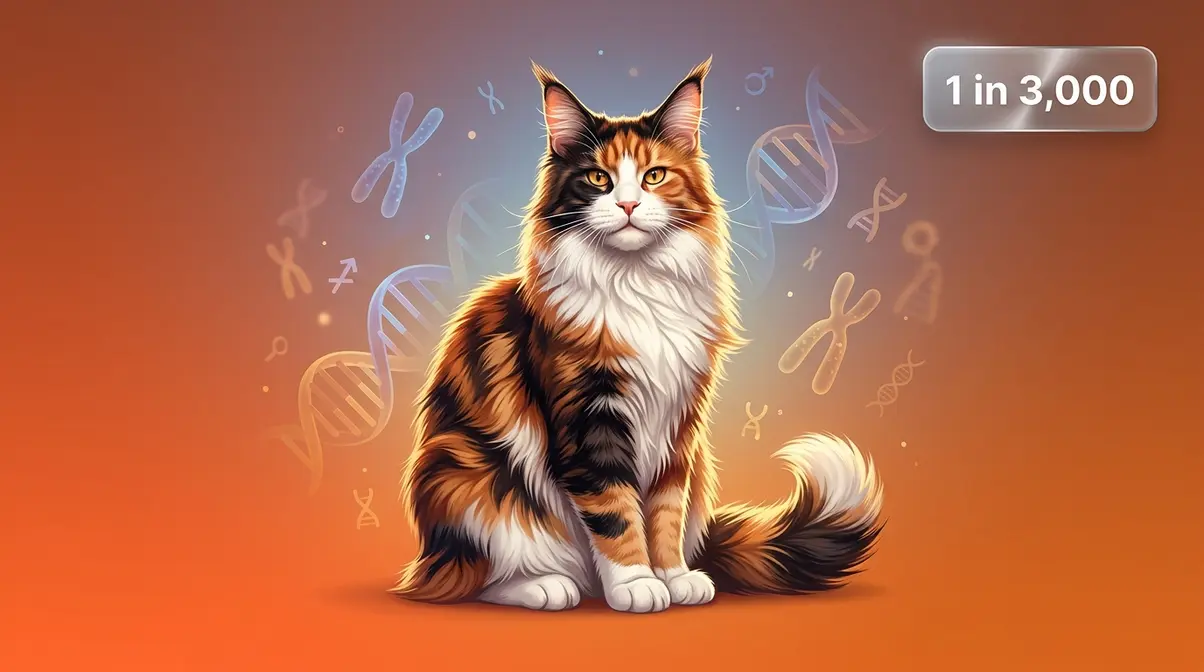
The calico coat pattern is one of the most genetically fascinating phenomena in the entire animal kingdom. Understanding how it works — even at a basic level — transforms your appreciation of these cats from “wow, pretty colors” to “wow, this is a genuine biological marvel.” This is where The Tri-Color Lottery comes in.
How X Chromosomes Create the Calico Coat
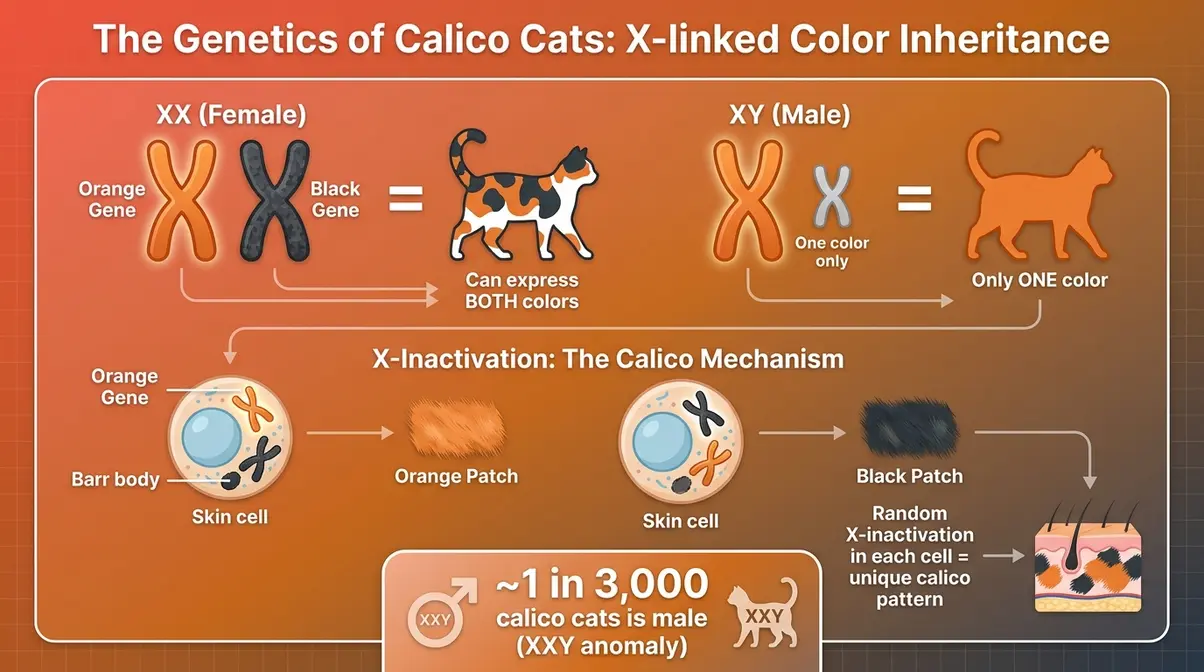
To understand calico genetics, you need to know one foundational fact: the gene that produces orange coat color in cats is X-linked — meaning it sits on the X chromosome rather than on one of the non-sex chromosomes. The genetics behind calico coat colors are fascinating.
Here’s why that matters:
- Female cats have two X chromosomes (XX). This means they carry two copies of the orange/non-orange gene — one on each X chromosome.
- Male cats have one X chromosome and one Y chromosome (XY). They carry only one copy of the orange/non-orange gene.
For a cat to display the calico pattern, it needs to express both the orange version and the non-orange (black/dark) version of that gene simultaneously — in different patches across the body. This is only possible when a cat has two X chromosomes, because each X can carry a different version of the gene.
The Tri-Color Lottery is what happens next: in female cats with one “orange” X and one “non-orange” X, the body randomly silences one X chromosome in each developing skin cell during embryonic development — a process called X-inactivation (or the Lyon hypothesis). Some cells silence the orange-X, expressing black. Others silence the black-X, expressing orange. The white areas are controlled by a separate white-spotting gene. The result is a unique, never-exactly-repeated patchwork that is essentially a cellular lottery — which is why no two calico cats have identical markings, even in the same litter.
The UC Davis Veterinary Genetics Laboratory confirms this X-linked inheritance model and provides detailed documentation of how orange coat color is expressed differently across cat sexes. This is the same laboratory that conducts DNA-based coat color testing for breeders.
Can a male cat be calico?
So how does a male calico cat exist at all? The answer is a chromosomal anomaly called Klinefelter syndrome — a condition in which a male cat inherits an extra X chromosome, giving it an XXY genetic makeup instead of the standard XY.
With two X chromosomes and one Y, an XXY male cat has the chromosomal architecture needed to express both orange and black simultaneously — just like a female. The result is a male cat that can display a calico (or tortoiseshell) coat pattern. According to the Merck Veterinary Manual, XXY male cats are almost always sterile because the extra X chromosome disrupts normal testicular development and sperm production.
This sterility is the practical reason why male calico Maine Coons cannot be used in breeding programs. A male calico is a genetic wonder — but he’s essentially a genetic dead end in terms of reproduction. This also means that no responsible breeder is “producing” male calico Maine Coons intentionally; they occur entirely by chance, roughly once in every 3,000 calico births.
For prospective owners, a male calico Maine Coon is an extraordinary find — but you should verify the XXY status with a veterinary genetics test if the breeder is claiming a male calico, as misidentification of young kittens’ sex is not unheard of.
Are calico Maine Coons rare?
Calico Maine Coons are rare relative to other Maine Coon color patterns, but not so rare that finding one is impossible — with patience. Here’s a clear breakdown:
Why they’re rarer than most colors: The calico pattern requires a specific combination of the orange gene, the non-orange gene, and the white-spotting gene — all expressed together. Maine Coons more commonly appear in solid colors, classic tabby patterns, and silver/smoke patterns, which require fewer simultaneous genetic conditions. The user quote above — noting that dark silver and orange-and-white seem most common — reflects genuine observation. Those patterns are statistically more likely to appear in any given litter.
How rare, specifically? Among Maine Coon litters from breeders who don’t specifically select for calico, you might see one calico kitten per several litters. Breeders who deliberately pair cats to produce calico patterns can increase the odds significantly, but even then, the exact distribution of white, black, and orange remains unpredictable — The Tri-Color Lottery at work.
Male calico Maine Coons: Exceptionally rare. The approximately 1-in-3,000 figure for male calicos applies to the general cat population; within the purebred Maine Coon world, the numbers are even smaller simply because purebred Maine Coon litters are far fewer in total than the domestic cat population at large.
Bottom line: a calico Maine Coon is a relatively uncommon find at any given breeder, but reputable breeders who specialize in color variety do produce them. Expect waitlists of six months to two years, and expect to pay a premium.
4. Calico Maine Coon Mixes and Hybrids
Not every cat with Maine Coon features and a calico coat is a purebred. Understanding the difference between a purebred calico Maine Coon and a calico Maine Coon mix helps you make a smarter buying decision — and sets honest expectations about what you’re getting.
What to Expect from a Calico Maine Coon Mix
A calico Maine Coon mix is a cat that has Maine Coon ancestry but is not a registered purebred. The “calico” part describes the coat color pattern; the “mix” part describes the breeding background. These two elements are completely independent — a calico coat can appear in any cat with the right genetics, regardless of whether it has Maine Coon ancestry.
What does this mean practically? A calico Maine Coon mix might look very similar to a purebred — large size, tufted ears, shaggy coat — but without registration papers and a verified pedigree, you can’t confirm the genetic background. Evaluating Maine Coon mix traits and care requirements is essential before bringing one home. Some mixes are genuinely beautiful, healthy cats with strong Maine Coon traits. Others may be predominantly another breed with only superficial Maine Coon resemblance.
The honest truth: for many families, a well-socialized calico Maine Coon mix from a rescue or small cattery offers most of the personality and appearance benefits of the breed at a fraction of the cost. The main things you lose are predictability (size, temperament, and health risks become less certain) and the ability to show or breed the cat.
Popular Mixes: Ragdoll, Tabby, and More
Maine Coons are sometimes intentionally or unintentionally crossed with other large, semi-longhaired breeds. The most commonly encountered mixes include:
Calico Maine Coon Ragdoll mix: Both Maine Coons and Ragdolls are large, semi-longhaired, and famously gentle-tempered. A calico Ragdoll-Maine Coon mix may inherit the Ragdoll’s tendency to go limp when held (the breed’s namesake trait), combined with the Maine Coon’s more active, playful personality. Coat-wise, expect a plush, full coat with potentially very soft texture.
Maine Coon calico tabby mix: When a calico pattern overlaps with tabby genetics, the result is the “caliby” pattern described in Section 2 — tabby striping within the colored patches. In a Maine Coon mix with tabby influence, this creates a richly patterned coat that many owners find even more visually interesting than a standard calico.
Domestic longhair calico with Maine Coon traits: Many cats sold as “Maine Coon mixes” in shelters are simply large, long-haired domestic cats with no verified Maine Coon ancestry. They may share some superficial physical traits — tufted ears, bushy tails, large paws — without being genetically related to the breed. This isn’t a flaw; it’s just important to have accurate expectations.
Community consensus across Maine Coon forums and breed groups indicates that the most reliable way to confirm Maine Coon ancestry in a mixed-breed cat is a DNA test from a service like Basepaws or Wisdom Panel, which can identify breed-specific genetic markers.
How to Identify a Maine Coon Mix at Home
If you’re considering a cat from a shelter or private seller who claims Maine Coon heritage without papers, several physical traits can help you assess the likelihood — though only a DNA test provides certainty.
Physical markers that suggest Maine Coon ancestry:
- Ear tufts (lynx tips): Small tufts of fur at the very tips of the ears are a hallmark Maine Coon trait. Not all Maine Coons have them, but their presence is a strong indicator.
- Ear furnishings: Dense, long fur growing inside the ear, creating a full, feathered appearance.
- Large, rectangular body: Maine Coons have a distinctly long, rectangular body shape — not cobby (compact) like a Persian or British Shorthair.
- Polydactyl paws: Extra toes occur more frequently in Maine Coons than in most other breeds, a trait traced back to the New England working cat population.
- Chirping/trilling vocalizations: Maine Coons are known for a distinctive chirping or trilling sound rather than a standard meow. While not exclusive to the breed, it’s a commonly reported trait.
- Water fascination: A disproportionate love of water — batting at faucets, sitting near water bowls, even joining you in the bathroom — is a frequently observed Maine Coon behavior.
For a deeper look at these physical and behavioral markers, our guide on signs your cat is a Maine Coon mix covers 12 specific clues in detail.
No single trait confirms Maine Coon ancestry definitively. But if your cat has tufted ears, ear furnishings, a long rectangular body, and makes chirping sounds — it’s a reasonable bet that Maine Coon is somewhere in the family tree.
5. Calico Maine Coon Price
The calico Maine Coon price is one of the most-searched questions in this space — and one of the most poorly answered by existing content. Most articles cite figures from previous years without acknowledging how significantly prices have shifted. Here is a verified pricing picture based on current breeder listings and community-reported data.
The Current Pricing Breakdown
Calico Maine Coon prices currently vary substantially based on breeder tier, pedigree quality, geographic location, and the quality of the calico pattern itself. The table below reflects current market ranges across breeder categories:
| Breeder Tier | Current Price Range | What You Get |
|---|---|---|
| Hobby / Small Cattery | $1,500–$2,500 | CFA/TICA registered, health tested parents, limited show potential |
| Mid-Tier Breeder | $2,500–$3,500 | Champion bloodlines, full health guarantee, early socialization program |
| Show-Quality / Top Breeder | $3,500–$4,500+ | Show-quality calico pattern, champion or grand champion lineage, full pedigree documentation |
| Rescue / Adoption | $75–$350 | Adult cats primarily; kittens rare; no pedigree guarantee |
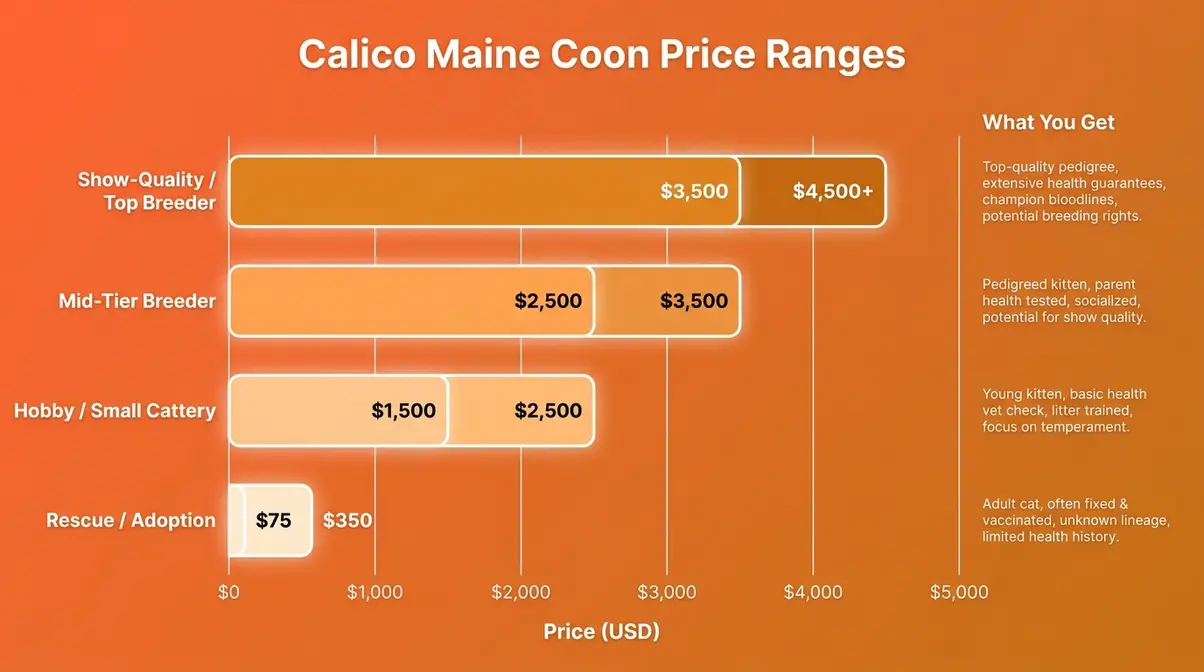
These figures represent pet-quality kittens (spayed/neutered contract) from reputable breeders. Breeder-quality (intact) kittens — sold to other breeders for reproduction — command significantly higher prices, often $5,000–$8,000 or more, and are typically only available to buyers with an established cattery.
A note on geography: prices tend to run higher in major metropolitan areas (New York, Los Angeles, Chicago) and lower in rural areas of the Midwest and South. Importing from European breeders — particularly from Russia and Eastern Europe, where some of the world’s top Maine Coon catteries are based — can add $500–$2,000 in shipping and import costs but may access bloodlines not available domestically.
Factors That Drive the Price Up
Not all calico Maine Coons in the same price tier are equal. Several specific factors push a kitten’s price toward the upper end of its range:
Pattern quality: The calico pattern’s visual appeal — how cleanly defined the three-color patches are, how symmetrically they’re distributed, and how vivid the colors — significantly affects price. A kitten with a bold, well-balanced calico pattern on a Maine Coon’s large frame is a genuinely striking animal, and breeders price accordingly.
Champion bloodlines: Maine Coon breeders who show their cats accumulate titles (Champion, Grand Champion, Regional Winner) that serve as verified proof of breed quality. Kittens from parents with multiple titles cost more — and that premium often reflects real genetic quality in terms of health, temperament, and conformation.
Health testing depth: Reputable breeders test breeding pairs for Hypertrophic Cardiomyopathy (HCM — a genetic heart condition common in Maine Coons), Spinal Muscular Atrophy (SMA), and Polycystic Kidney Disease (PKD). The cost of this testing is passed on to buyers. A kitten from fully health-tested parents is worth the premium.
Waitlist demand: Because calico is a relatively uncommon color pattern in Maine Coons, breeders who consistently produce calico kittens often have long waitlists — sometimes 12–24 months. High demand with limited supply naturally elevates prices.
Socialization programs: Top breeders invest significantly in early kitten socialization — exposure to sounds, handling, other animals, and environmental enrichment during the critical 2–7 week developmental window. This investment shows in adult temperament and justifies higher prices.
Long-Term Ownership Costs
The purchase price is only the beginning. Maine Coons are large, long-lived cats (typical lifespan of 12–15 years) with specific health and grooming needs. Prospective owners consistently underestimate the lifetime cost of ownership.
| Cost Category | Current Annual Estimate |
|---|---|
| Premium cat food (large breed appropriate) | $600–$1,200/year |
| Routine veterinary care (annual exam + vaccines) | $300–$500/year |
| Dental cleanings (recommended every 1–2 years) | $300–$600/year |
| HCM cardiac screening (echocardiogram, annual for at-risk cats) | $200–$400/year |
| Grooming supplies or professional grooming | $150–$400/year |
| Pet insurance (highly recommended for Maine Coons) | $600–$1,200/year |
| Toys, enrichment, scratching posts | $150–$300/year |
| Estimated Annual Total | $2,300–$4,600/year |
Over a 12-year lifespan, a calico Maine Coon represents a total investment of roughly $30,000–$60,000 when purchase price and lifetime care costs are combined. That’s not a figure designed to discourage you — it’s designed to ensure you’re going in with eyes open.
Pet insurance is particularly worth emphasizing for Maine Coons. HCM affects a meaningful percentage of the breed, and cardiac treatment costs can reach $3,000–$10,000 or more over a cat’s lifetime. Enrolling while the kitten is young and healthy locks in lower premiums and avoids pre-existing condition exclusions.
6. Finding a Calico Maine Coon Breeder
Finding a reputable calico Maine Coon breeder requires patience, research, and a willingness to wait. The process of locating and vetting a responsible breeder is one of the most important steps you’ll take — and the one most likely to go wrong if you’re in a hurry.
Breed associations confirm that purchasing from a registered, health-testing breeder is the single most reliable way to ensure you’re getting a healthy, well-socialized kitten with verified Maine Coon pedigree. Both the CFA and TICA maintain breeder referral directories that are a logical starting point.
How to Vet a Reputable Breeder
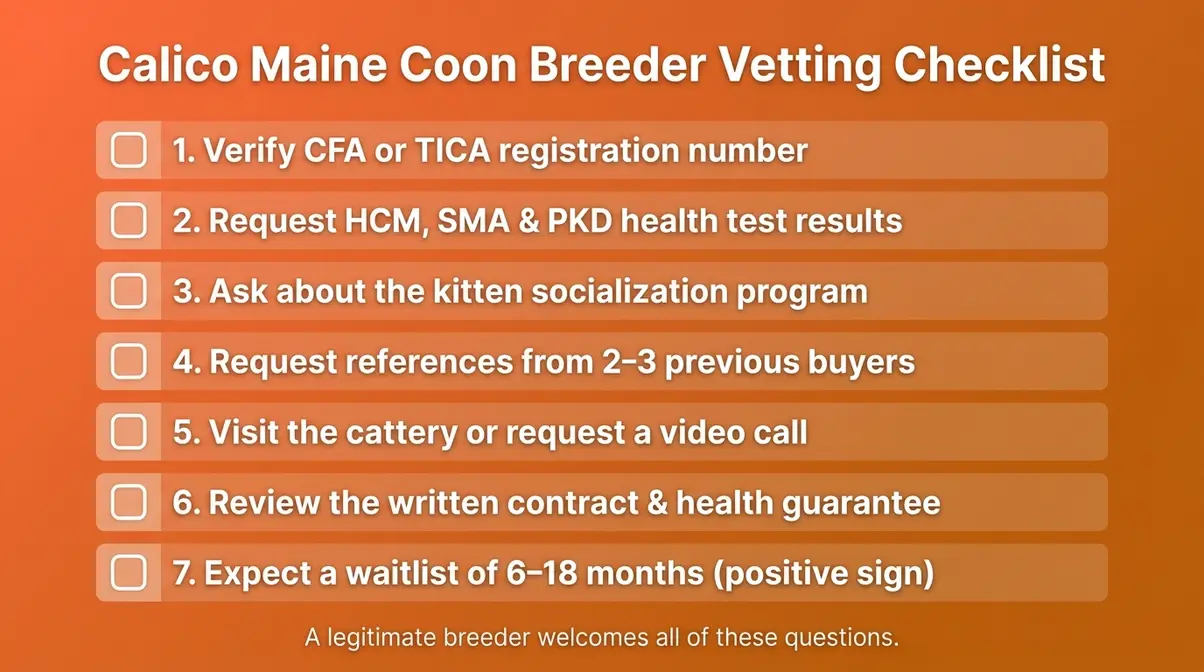
A reputable breeder is transparent, knowledgeable, and genuinely invested in the breed’s welfare — not just in making a sale. Here’s a practical vetting checklist:
1. Verify registration. Ask for the cattery’s CFA or TICA registration number and verify it directly on the association’s website. A legitimate registered cattery will have a verifiable record.
2. Request health testing documentation. Ask for proof of HCM, SMA, and PKD testing for both parents. Reputable breeders have these results on file and share them readily. The UC Davis Veterinary Genetics Laboratory is one of the primary testing facilities used by Maine Coon breeders for DNA-based health screening.
3. Ask about the socialization program. A good breeder can describe exactly how kittens are raised — what sounds they’re exposed to, how frequently they’re handled, whether they’re raised underfoot in a home environment versus isolated in a separate room.
4. Request references. Ask for contact information for two or three previous buyers. A breeder who hesitates here is worth questioning further.
5. Visit the cattery (or request a video call). You should be able to see where the kittens are raised. The environment should be clean, the cats should appear healthy and social, and the breeder should welcome your questions rather than deflect them.
6. Review the contract. A reputable breeder provides a written contract that includes: a health guarantee (minimum 72 hours, ideally 2 years for genetic conditions), a spay/neuter clause for pet-quality kittens, and a return clause stating the breeder will take the cat back if you can no longer keep it.
7. Expect a waitlist. Calico kittens from reputable breeders are rarely available immediately. A waitlist of 6–18 months is completely normal and actually a positive sign — it means the breeder is not overproducing.
Red Flags to Avoid
Maine Coon owners in online communities and breed-specific forums consistently flag the following warning signs. If you encounter any of these, proceed with extreme caution — or walk away:
- No health testing documentation. This is non-negotiable. A breeder who can’t produce HCM test results for both parents is not running a responsible program.
- Kittens available immediately, always. Reputable breeders with waitlists don’t have kittens ready to go at a moment’s notice. Constant availability suggests overbreeding or kitten mill operations.
- Won’t allow visits or video calls. If a breeder refuses to show you the cattery — even via video — that’s a serious red flag. Kitten scams frequently involve stolen photos and fabricated backstories.
- Prices dramatically below market. A “calico Maine Coon kitten” listed for $300–$500 is almost certainly not a purebred from health-tested parents. The math doesn’t work.
- Payment only via wire transfer or gift cards. Legitimate breeders accept traceable payment methods. Gift cards and wire transfers are the preferred method of kitten scammers because they’re irreversible.
- No written contract or health guarantee. A verbal promise means nothing. If a breeder won’t put a health guarantee in writing, you have no recourse if the kitten arrives sick.
- Pressure tactics. “Another buyer is interested” or “This kitten won’t be available tomorrow” — legitimate breeders don’t use urgency pressure to close deposits.
Adopting a Calico Maine Coon from Rescue
Adoption is a genuinely viable path to finding a calico Maine Coon, though it requires different expectations. Purebred Maine Coons do end up in rescue — often when owners underestimate the commitment involved, face life changes, or surrender elderly cats they can no longer care for.
Maine Coon-specific rescues exist in the United States and can be found through the CFA and TICA breeder referral networks, as well as through Facebook groups dedicated to Maine Coon rescue and rehoming. General large-breed cat rescues and breed-specific Facebook groups are also worth monitoring.
- What to expect from adoption:
- Age: Most rescued Maine Coons are adults (2–8 years old). Calico kittens for adoption are rare enough that you may wait 1–2 years.
- Cost: Adoption fees typically range from $75–$350 and usually include spay/neuter, microchipping, and initial vaccinations.
- History: Rescue cats may have unknown histories, which can mean unknown health backgrounds. Request any available veterinary records and ask about behavioral observations from the foster family.
- Pedigree: Most rescued Maine Coons will not have registration papers, even if they appear purebred. A DNA test ($60–$100 from Basepaws or Wisdom Panel) can give you more information about their genetic background.
For a broader overview of the Maine Coon adoption process, our complete guide to adopting a Maine Coon covers rescue-specific considerations in depth.
7. Calico Maine Coon Kittens for Sale
Searching for calico Maine Coon kittens for sale requires a clear-eyed understanding of how the market actually works — including the platforms to use, the ones to avoid, and the realistic timeline from first inquiry to kitten-in-arms.
What to Expect When Searching for Kittens
The first thing to internalize: reputable breeders do not advertise on Craigslist, Facebook Marketplace, or general classified sites. They operate primarily through their own websites, the CFA and TICA breeder directories, and word-of-mouth referrals within the Maine Coon community.
The second thing to internalize: calico kittens are not always available, even from breeders who produce them regularly. Calico is a probabilistic outcome of specific breeding pairs — a breeder may have a litter with zero calico kittens, then another with three. This unpredictability means that even after you’ve identified and vetted a breeder, you may need to wait for the right litter.
The process typically looks like this:
- Research and shortlist breeders (2–4 weeks of research)
- Initial contact and application — many breeders require a written application before accepting deposits
- Deposit placement — typically $200–$500 to secure a spot on the waitlist
- Notification of a matching litter — this may take 6–18 months
- Kitten selection (often at 4–6 weeks, based on waitlist position)
- Final payment and pickup/shipping at 12–16 weeks of age
Maine Coon kittens should never leave their mother before 12 weeks of age — earlier separation disrupts critical behavioral development. A breeder offering 8-week placement is a red flag.
How to Find Calico Maine Coon Kittens Near You
For calico Maine Coon kittens for sale, these are the most reliable starting points:
CFA Breeder Referral: The Cat Fanciers’ Association maintains a searchable directory of registered Maine Coon catteries, filterable by state. This is the most vetted starting point available — every listed cattery has agreed to the CFA’s ethical breeding guidelines.
TICA Breeder Search: TICA’s breeder search offers a similar directory with international coverage, useful if you’re open to importing from European breeders.
Maine Coon-specific Facebook groups: The Maine Coon Owners and Maine Coon Breeders groups on Facebook have tens of thousands of members and frequently include breeder recommendations, waitlist notifications, and community vetting discussions. These are worth joining for real-time information.
r/mainecoons on Reddit: The Reddit community is a surprisingly useful resource for unfiltered breeder reviews, scam warnings, and honest discussions of pricing and availability. Community members are often quick to flag known problem breeders.
Word of mouth: If you know anyone who owns a Maine Coon — particularly a calico or rare-color Maine Coon — asking for their breeder referral is one of the most reliable paths to a good experience.
What to search for specifically: When using breeder directories, search for Maine Coon breeders who list “calico,” “tortoiseshell,” or “parti-color” among their specialty colors. Not every Maine Coon breeder produces calico kittens — those who do will typically mention it in their cattery description or color specialization.
Setting Realistic Expectations About Availability
The honest reality of calico Maine Coon availability deserves a direct conversation. Maine Coon owners and community members across multiple forums consistently report the same experience: finding a calico specifically — as opposed to a silver tabby or solid-colored Maine Coon — adds significant time to the search.
Here’s why:
Calico is genetically probabilistic. A breeder can pair cats in a way that makes calico possible, but cannot guarantee calico kittens in any given litter. The Tri-Color Lottery means that even optimal breeding pairs may produce zero calico kittens in a litter of six.
Demand exceeds supply. Calico Maine Coons are visually striking and relatively uncommon — which means more buyers are competing for fewer available kittens. Popular breeders who produce calico kittens regularly may have waitlists of 12–24 months.
Scarcity creates scam opportunities. The combination of high demand, limited supply, and buyers who are emotionally invested in a specific color pattern creates ideal conditions for kitten scammers. This is why the red flag checklist from Section 6 is so important — the calico-specific market has a higher-than-average concentration of fraudulent listings.
Practical advice: If you’re set on a calico Maine Coon, start your search early, place deposits with two reputable breeders simultaneously (most allow this transparently), and be genuinely prepared to wait. The wait is worth it — but only if you go in knowing it exists.
For more guidance on the kitten search process, our article on finding Maine Coon kittens for sale near you covers the full process with additional regional resources.
8. Common Pitfalls and What to Watch Out For
Every purchase of a high-value, emotionally compelling animal carries risk — and calico Maine Coons, with their rarity premium and strong visual appeal, attract more than their share of pitfalls. This section covers the most common mistakes buyers make, when a mix might actually serve you better, and when to bring a veterinarian into the process early.
Mistakes to Avoid When Buying a Calico Maine Coon
Prioritizing color over health testing. The most expensive mistake buyers make is choosing a kitten based on the beauty of its calico pattern while overlooking the absence of health documentation. A stunning calico from untested parents may develop HCM by age three — a heartbreaking and expensive outcome that proper health screening can largely prevent.
Skipping the contract review. Breeder contracts are legal documents. Before signing, confirm that the health guarantee specifies what conditions are covered, for how long, and what remedies are offered (replacement kitten, refund, or veterinary expense reimbursement). Vague language like “healthy at time of sale” protects only the breeder.
Paying a full deposit before visiting or video calling. A deposit secures your waitlist spot — but it should only be placed after you’ve done due diligence. Kitten scammers specifically target buyers who are willing to pay before seeing proof of the cattery’s existence.
Underestimating the commitment. Maine Coons live 12–15 years, require significant grooming, need large living spaces, and thrive on daily interaction. Buyers who acquire them for their appearance without researching the breed’s actual needs often find themselves overwhelmed within the first year.
When a Mix Might Actually Be the Better Choice
There is no shame in deciding that a calico Maine Coon mix — from a rescue or small rehoming situation — is the right choice for your household. In fact, for many buyers, it genuinely is.
Consider a mix if:
- Your budget is closer to $500–$1,000 rather than $2,000–$4,500
- You’re not interested in showing or breeding
- You’re open to an adult cat rather than a kitten
- You value personality and temperament over pedigree documentation
- You want to support rescue rather than purchase from a breeder
A well-socialized adult calico Maine Coon mix from a reputable rescue will give you most of what makes the breed special — the affectionate nature, the clown-like personality, the striking coat — without the waitlist, the premium price, or the uncertainty of kittenhood development. Our guide to Maine Coon mixes covers what to expect from the most common crosses.
When to Consult a Veterinarian
Bring a veterinarian into your planning process earlier than you might think necessary. Specifically:
- Before finalizing a purchase: A pre-purchase veterinary consultation (even a phone call) can help you understand what health documentation to request and what questions to ask the breeder about HCM screening.
- Within 48–72 hours of bringing a kitten home: Most reputable breeder contracts require a veterinary examination within this window. A vet visit confirms the kitten’s health status and establishes a baseline record.
- If you’re considering a male calico: Ask your vet about chromosomal testing to confirm XXY status, which has implications for long-term health monitoring (XXY males can have hormonal and developmental differences beyond sterility).
- For any Maine Coon over age 3: Annual HCM cardiac screening via echocardiogram is recommended by feline cardiologists for Maine Coons, given the breed’s elevated genetic risk.
For additional health context specific to the breed, our overview of Maine Coon health issues covers the most common conditions in detail.
9. Frequently Asked Questions
How much is a calico Maine Coon?
A calico Maine Coon from a reputable breeder costs $1,500–$4,500+ based on breeder listings, depending on breeder tier, lineage quality, and pattern quality. Hobby catteries with CFA/TICA registration typically price kittens at $1,500–$2,500, while top-tier breeders with champion bloodlines charge $3,500–$4,500 or more for show-quality calico kittens. Rescue adoption fees range from $75–$350 but rarely include pedigree documentation. Long-term ownership costs add an estimated $2,300–$4,600 per year in food, veterinary care, grooming, and pet insurance.
Can calico cats be Maine Coons?
Yes — calico is a fully recognized color pattern within the Maine Coon breed standard. Both the Cat Fanciers’ Association (CFA) and The International Cat Association (TICA) recognize calico as an accepted color class for Maine Coons. A calico Maine Coon is not a separate breed or a hybrid — it is a purebred Maine Coon cat expressing a specific tricolor coat pattern governed by X-chromosome genetics. Any Maine Coon with the right genetic combination of orange, black, and white coloring qualifies as a calico under the breed standard.
What color Maine Coon is the most expensive?
Show-quality calico, tortoiseshell, and rare solid-color Maine Coons tend to command the highest prices, though the primary driver of price is lineage quality rather than color alone. Among color patterns specifically, calico and tortoiseshell Maine Coons are often priced at a premium because they are less common in litters and visually striking — factors that increase buyer demand. White Maine Coons and certain silver/smoke patterns from champion bloodlines also command high prices. A kitten’s health testing, socialization program, and breeder reputation ultimately matter more than color when determining fair market value.
How do I find a reputable calico Maine Coon breeder?
Start with the CFA and TICA breeder directories, which list registered Maine Coon catteries that have agreed to ethical breeding guidelines — both organizations maintain searchable databases at cfa.org and tica.org. From there, request health testing documentation (HCM, SMA, and PKD results for both parents), ask for references from previous buyers, and insist on a video call or in-person cattery visit before placing a deposit. Red flags include no health testing documentation, kittens always immediately available, refusal to allow visits, prices dramatically below market ($300–$500 for a “purebred”), and pressure to pay via wire transfer or gift cards. Expect a waitlist of 6–18 months from reputable breeders who produce calico kittens.
The Tri-Color Lottery: What You Now Know
A calico Maine Coon is the product of a genetic lottery that plays out on the X chromosome — a chance alignment of orange, black, and white that produces one of the most visually stunning coat patterns in the domestic cat world, on one of the largest and most personable breeds in existence. The Tri-Color Lottery means that no two calico Maine Coons ever look exactly alike, and that finding one requires patience, research, and a willingness to wait for the right match.
The framework that matters most as you move forward: separate the breed from the color pattern, prioritize health testing over pattern quality, and use the breeder vetting checklist before placing any deposit. Those three principles protect you from the most common and costly mistakes in this specific market.
Your next concrete step is to browse the CFA and TICA breeder directories, identify two or three reputable catteries that specialize in calico color patterns, and reach out with an introductory email. Include your timeline, your household situation, and what you’re looking for — good breeders appreciate informed, patient buyers, and that first conversation will tell you a great deal about whether you’ve found the right cattery. The wait will feel long, but the calico Maine Coon at the end of it will be worth every month.

Dave King
Cat owner and writer at Mad Cat Man.