
Your cat can learn to sit, high-five, and come when called — using a device that costs less than a cup of coffee. Most people assume their cat is too independent or too stubborn for clicker training for cats to work. The real barrier isn’t your cat’s personality; it’s timing. Miss the click by even three seconds and your cat learns the wrong behavior entirely. This guide shows you exactly when to click, which treats unlock even reluctant learners, and how to troubleshoot the three most common roadblocks. Follow the five-step structure below and you can complete your first successful session today.
Recommended Products
| # | Image | Product | Best For | Buy |
|---|---|---|---|---|
| 1 |  |
Square Box Clicker, Black+Red | Budget starter pack | Buy on Amazon |
| 2 |  |
Square Box Clicker, Black+Green | Multi-pet households | Buy on Amazon |
| 3 | |
Square Box Clicker, Black+Green | Color variety pack | Buy on Amazon |
| 4 |  |
Clicker with Target Stick | Target stick training | Buy on Amazon |
| 5 |  |
Square Box Clicker, Blue+White | Soft-click preference | Buy on Amazon |
| 6 | |
Clicker with Target Stick | Agility and targeting | Buy on Amazon |
| 7 |  |
Brass Metal Clicker, Gold | Loud, distinct click | Buy on Amazon |
| 8 |  |
Finger Ring Clicker, Grey+Green | Hands-free training | Buy on Amazon |
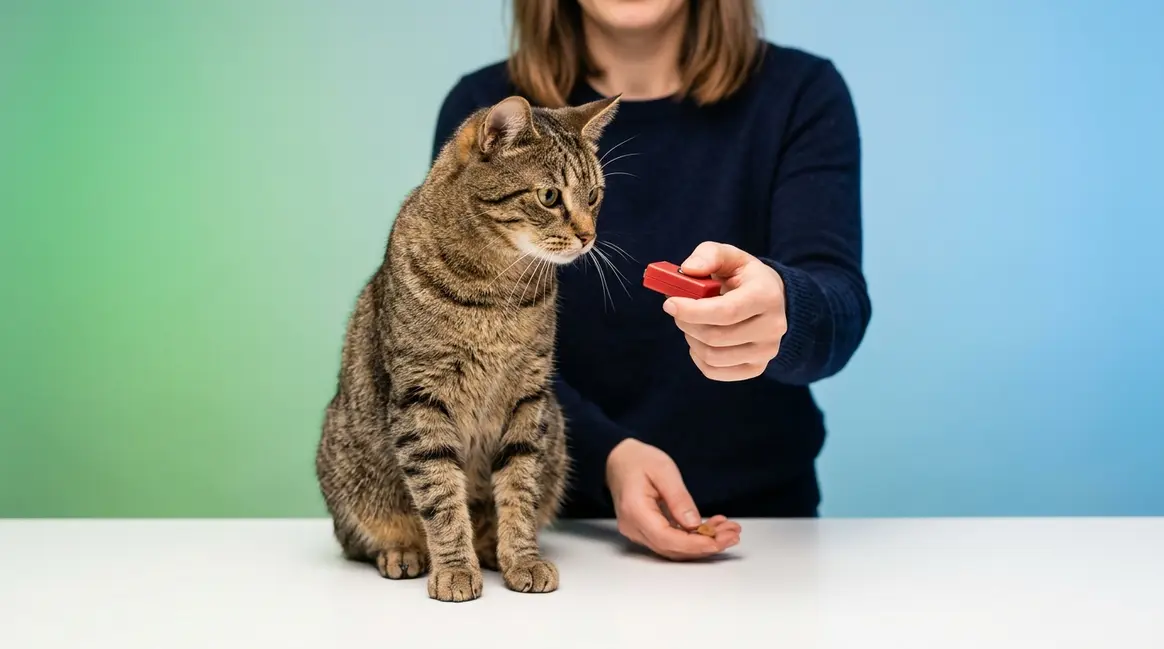
Clicker training for cats works by pairing a precise click sound with a treat, teaching your cat exactly which behavior earned the reward.
- 1. The click must happen within 1–2 seconds of the desired behavior — timing is everything.
- 2. Start with “charging the clicker” before teaching any tricks.
- 3. Keep sessions to 2–3 minutes — International Cat Care confirms longer sessions cause feline frustration.
- 4. Any cat can learn at any age — even senior cats respond when the reward is motivating enough.
- 5. The Click-Bridge Method: treat the clicker as a precision communication bridge, not a remote control.
What Is Clicker Training for Cats?
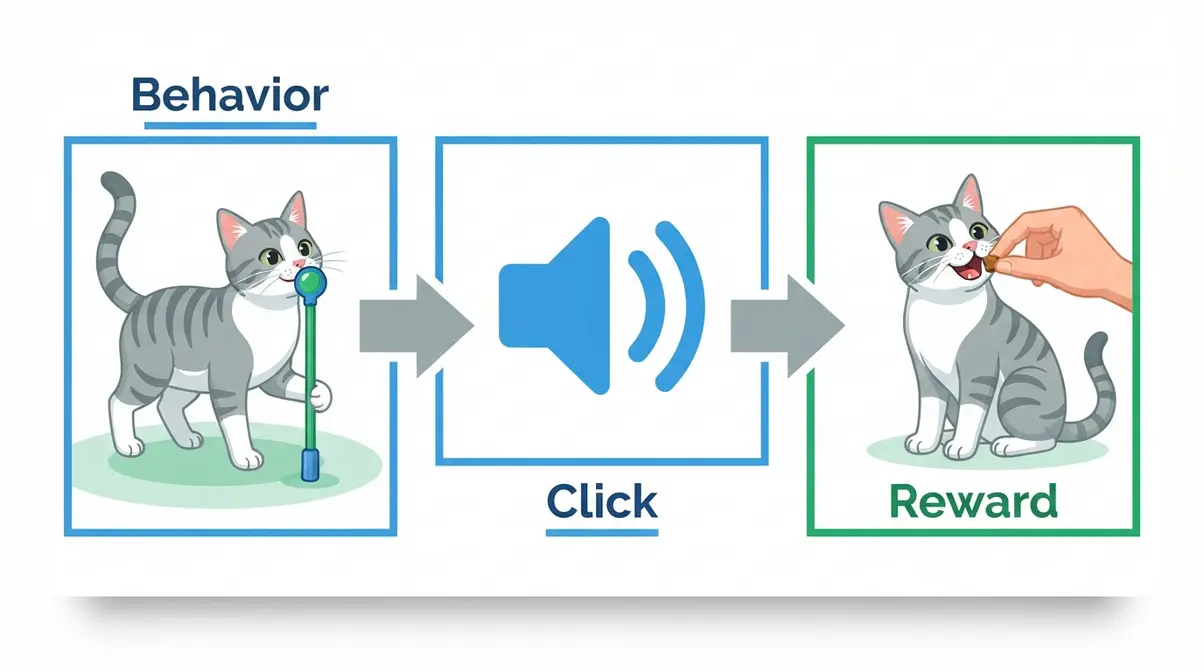
Clicker training for cats is a positive reinforcement method that uses a small handheld device to mark the exact moment your cat performs a desired behavior. The click is immediately followed by a treat, creating a precise association between action and reward. Texas A&M veterinary experts confirm that this kind of mental stimulation reduces behavioral issues — a benefit most basic guides skip entirely (Texas A&M Veterinary Medicine, 2026).
What Is Clicker Training for Cats?
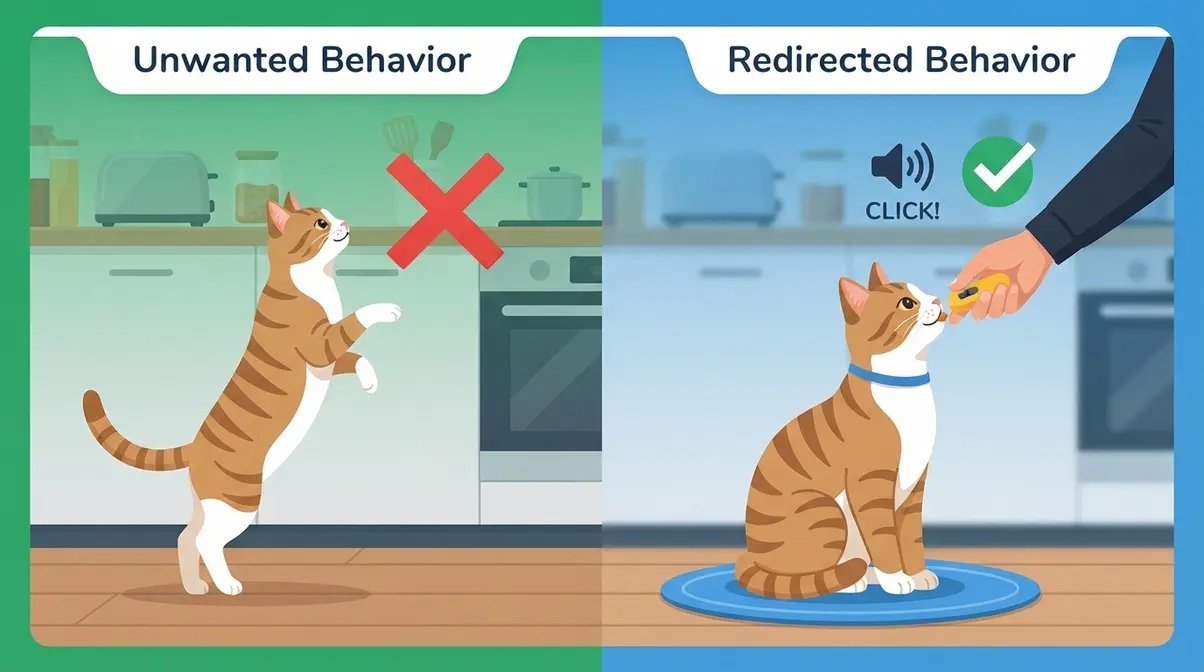
Positive reinforcement means rewarding a behavior to make it more likely to repeat. Cats, unlike dogs, don’t naturally look to humans for social approval — which is precisely why a verbal “good girl” rarely works. The delay between the behavior and a spoken word is too long and too inconsistent to communicate anything useful.
Karen Pryor, pioneer of modern clicker methodology and founder of Karen Pryor Clicker Training, coined the term “event marker” to describe what the click actually does: it tells your cat which exact moment earned the treat, not simply that a treat is coming. Click at the half-second your cat’s bottom touches the floor, and that’s the behavior they’ll repeat. Wait three seconds to fumble for a treat, and your cat has already stood back up — so they learn that standing earned the reward instead.
This is the core of “The Click-Bridge Method” — the clicker is a precision communication bridge that collapses the gap between behavior and reward to under two seconds. Complex behaviors are built through shaping: rewarding small steps toward the goal. You might first click your cat for glancing at a target stick, then for nudging it, then for following it — each click bridges one step closer to the finished behavior. For a deeper look at building these habits, positive reinforcement training for cats covers the broader behavioral framework behind the method.
Is Clicker Training Good for Cats?
Yes — clicker training works well for cats, and the evidence is consistent. ASPCA notes that cats respond exceptionally well to the distinct click sound because it provides immediate, consistent feedback that bridges behavior and reward in a way verbal praise cannot match.
Three concrete benefits stand out:
- Mental stimulation — structured training sessions reduce boredom-driven behaviors like excessive vocalization and destructive scratching
- Stronger bond — shared positive experiences build trust faster than passive cohabitation
- Humane redirection — clicker training gives you a constructive tool for unwanted behaviors like counter-jumping or destructive scratching (which you can also address by learning how to stop a cat from scratching furniture), replacing punishment with communication
There’s also a compelling biological argument. Cats are solitary predators whose food motivation activates in short, intense bursts — exactly the pattern a 2–3 minute clicker session is designed to exploit. User consensus across r/CatTraining consistently shows that shorter, higher-intensity sessions produce faster results than extended practice. We initially assumed cats needed longer exposure to consolidate new behaviors; the community data says the opposite. Does clicker training work for cats? For virtually any cat offered the right reward, yes.
Is It Too Late to Train My Cat?
No — there is no age limit on clicker training for cats. Senior cats learn more slowly than kittens, but the mechanism of positive reinforcement works at every life stage as long as the cat is food-motivated. The key adjustment for older cats is treat selection: senior cats may have dental sensitivity that makes hard treats uncomfortable, so soft-textured, high-protein options like freeze-dried salmon or tuna flakes work best. Start with very short sessions of 1–2 minutes for senior cats and build from there.
What You Need Before You Start
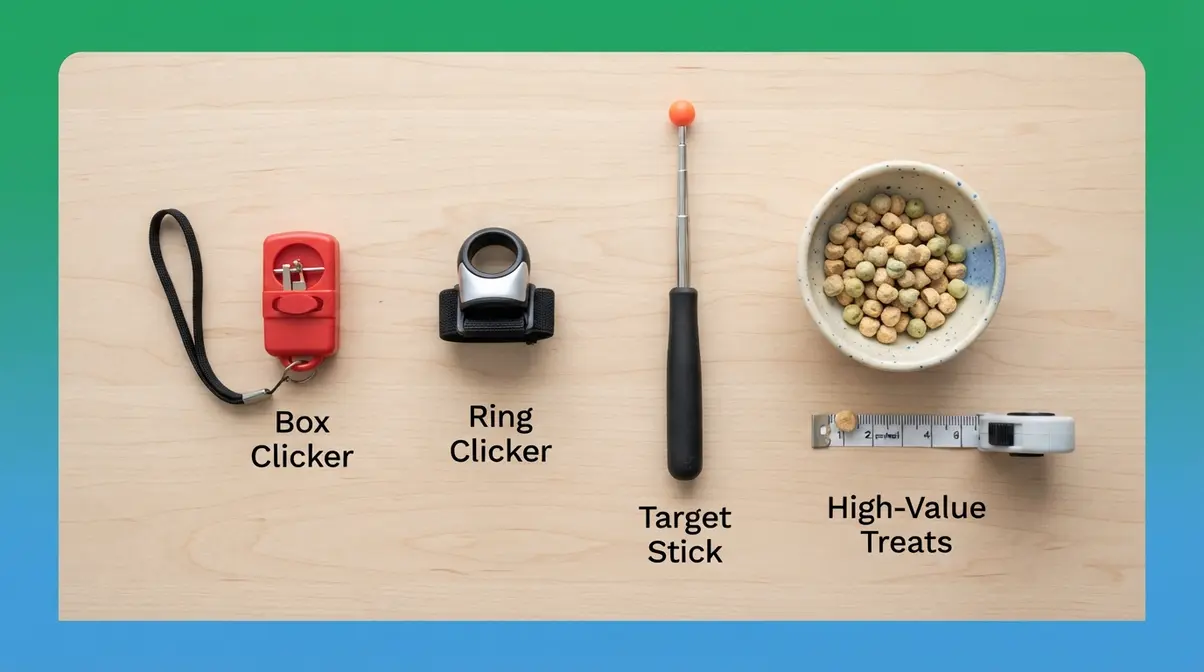
To start clicker training, you need two things: a clicker and a high-value treat. The type of clicker matters less than most beginners assume; treat quality, however, matters more than almost every guide admits.
Choosing the right clicker for training cats and pairing it with the right reward is what separates a cat that learns in one session from one that walks away uninterested.
Estimated completion time: 15 minutes for your first session.
- Tools & Materials Needed:
- A clicker (box, i-Click, or target stick combo)
- 15–20 high-value treats (pea-sized)
- A quiet room free of distractions
Choosing a Clicker for Your Cat
Karen Pryor Clicker Training describes the clicker as an “event marker” — a consistent, neutral sound that precisely communicates which action earned the treat. Four main types suit different training scenarios:
- Box clicker — the classic loud, affordable option. Good for cats that aren’t noise-sensitive and for trainers just starting out.
- i-Click button — softer click, ergonomic shape that fits naturally in the palm. Better for cats with sound sensitivity or for apartment training where a sharp crack feels jarring.
- Finger ring clicker — hands-free design ideal for trick training where both hands are occupied. Finger ring clickers (like the grey+green set in the table above) keep your hands free when you’re guiding a cat through a hoop or over an agility obstacle.
- Target stick with built-in clicker — the most versatile option for teaching directional behaviors like “follow,” “jump,” or “touch.” The clicker with target stick in the table above combines both tools in one.
What makes the best clicker for cat training isn’t volume or brand — it’s consistency. Pick one and use only that clicker for every session so the sound stays unambiguous.
If your cat startles at loud sounds, start with an i-Click or soft-button style. If your cat seems indifferent to the click, a louder box clicker can sharpen the association. You might also explore laser pointers as training tools for movement-based luring before adding the clicker.
Best Treats for Clicker Training
A high-value training treat for cats should be pea-sized, soft-textured, high-protein, and strong-smelling — size matters because cats lose interest after 3–4 large treats. Kibble almost always fails as a training reward: it’s too similar to the cat’s regular food to feel special, and the crunch creates a chewing delay that disrupts the click-to-treat timing window.
The three commercial treat types that work most reliably are:
- Freeze-dried chicken pieces — break into quarters; strong smell, high protein, disappears quickly
- Small tuna or salmon flakes — intensely aromatic and irresistible to most cats
- Soft meat-based training treats — specifically formulated for small, fast delivery
For homemade options, tiny pieces of plain cooked chicken breast or a small smear of canned tuna on a lick mat both work well. Introduce a treat hierarchy: keep one ultra-high-value treat — freeze-dried salmon works well — exclusively for clicker sessions. Novelty is part of the reward. If your cat walks away after two treats, the reward isn’t high-value enough — switch proteins before concluding the cat is untrainable.
Interactive toys and puzzle feeders for training can also serve as treat-delivery tools for cats with low baseline food motivation, extending engagement beyond the treat itself.
Step 1: Charge the Clicker — Build the Association
Charging the clicker means teaching your cat that click = treat. This is the non-negotiable foundation of every behavior you’ll ever train. It takes 10–20 repetitions across one or two short sessions — most cats understand the association within 15 minutes. Skip this step and the click is meaningless noise.
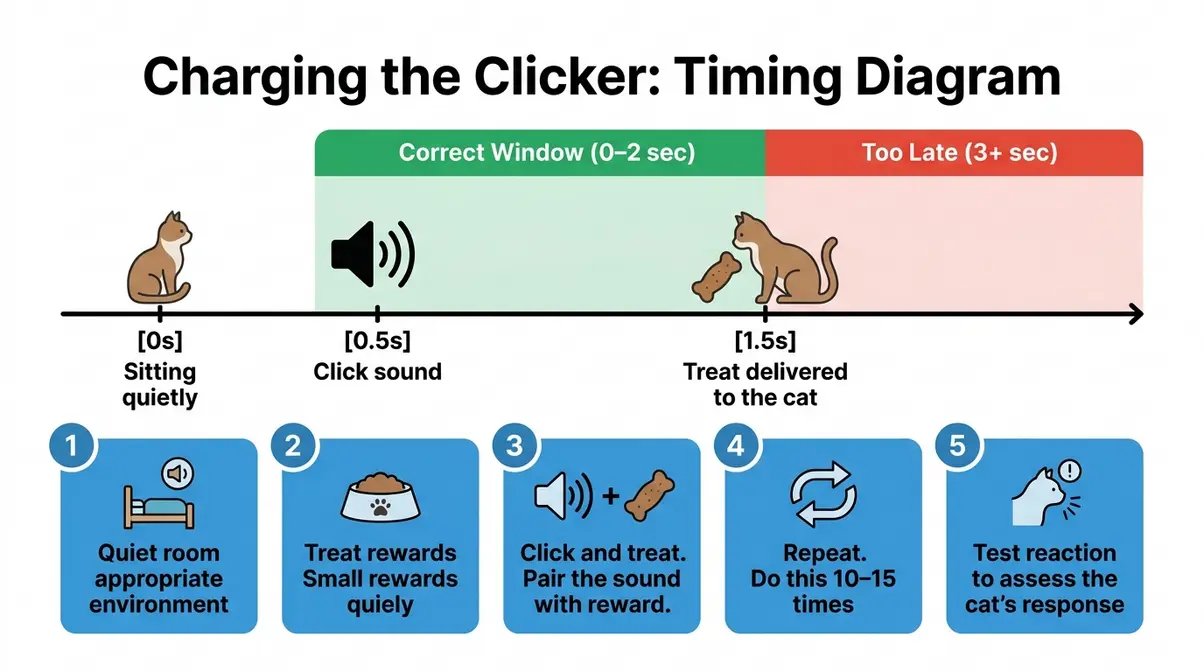
According to International Cat Care, training sessions should be kept strictly to 2–3 minutes to prevent feline frustration and maintain engagement (International Cat Care, 2026). More time doesn’t equal more learning — it equals a cat that stops cooperating.
How to charge the clicker:
- Choose a quiet room with no distractions — no other pets, no TV, no foot traffic.
- Have 15–20 pea-sized treats ready in a small bowl or treat pouch before you begin.
- Click once, then immediately deliver a treat — within one to two seconds. Do not ask for any behavior. The cat doesn’t need to do anything yet; you’re simply building the click-means-treat association.
- Repeat 10–15 times across a single 2–3 minute session. Pause briefly between repetitions so each click feels distinct.
- Test the association — click when your cat isn’t expecting it. If they immediately look toward you or move toward the treat location, the bridge is built.
This is The Click-Bridge Method at its most fundamental: you are constructing the bridge before you ask your cat to cross it. Once the cat hears the click and anticipates a treat, the bridge exists — every future behavior you train will cross it.
Step 2: Teach Your Cat to Target
Targeting — touching a finger or target stick with the nose — is the gateway behavior for nearly every trick that follows. It’s easy for cats to learn, easy for you to mark precisely, and it establishes the pattern of “I do a thing, I hear a click, I get a treat.” Once your cat understands targeting, you can use the target stick to guide them into sits, spins, jumps, and recalls.
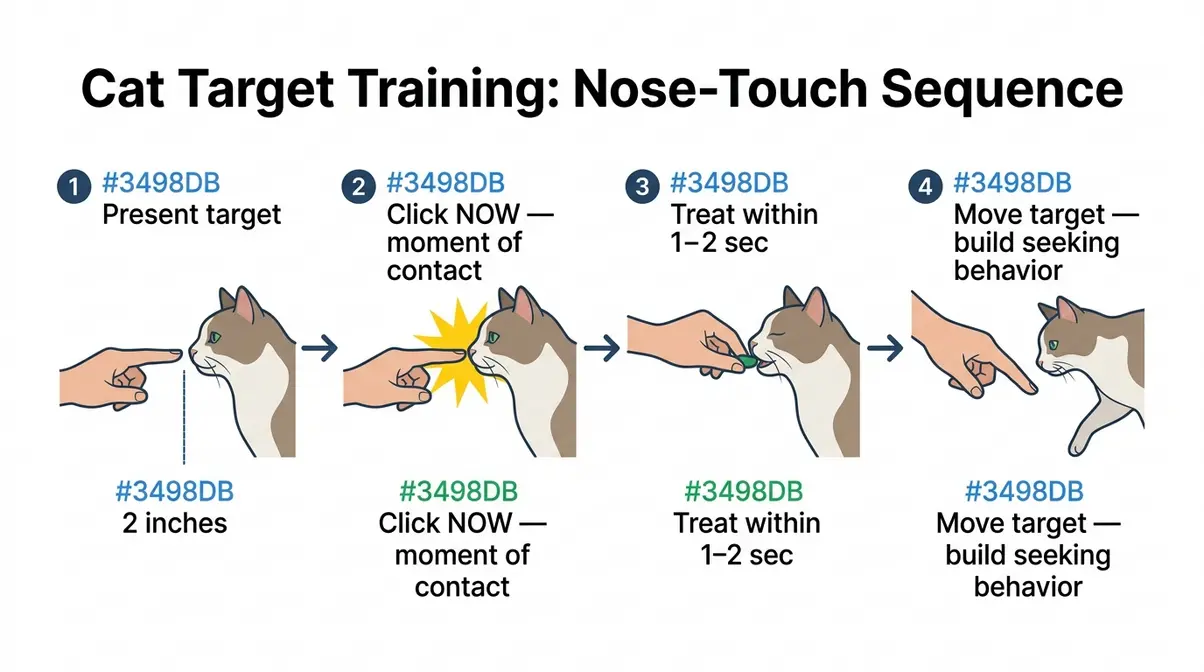
How to teach targeting:
- Hold your index finger (or the tip of a target stick) about two inches from your cat’s nose.
- Wait. Most cats will sniff or nudge the finger out of natural curiosity. The moment their nose makes contact, click immediately and deliver a treat.
- Repeat 5–8 times in the same session. Move your finger to a slightly different position each time so your cat learns to seek the target, not just stay still.
- Add distance gradually — once your cat is reliably touching your finger from two inches, extend to four inches, then across a short gap. Click and treat every successful touch.
- Introduce a verbal cue (“touch” or “target”) once the behavior is consistent — say it just before you present your finger, so the word predicts the opportunity.
User consensus across r/CatTraining confirms that targeting typically clicks into place within two to three short sessions. The key is clicking at the exact moment of contact — not when the cat leans toward the finger, and not after they pull away.
Step 3: Progress to Tricks
Once your cat reliably targets, you have the foundation to teach a full vocabulary of behaviors. Shaping behavior — building complex actions by rewarding incremental steps — is how you get from “touch my finger” to “roll over” or “jump through an arm hoop.” The vocabulary bank your cat is building includes sit, lay down, roll over, play dead, high five, down (off the counter), place, and jump.
“Sit. Lay down. Roll over. Play dead. Boop (touch). High five. Down (off the counter). Place. Jump (through arm hoop or over agility obstacle). Find it…”
— r/CatTraining community member describing their cat’s full trick repertoire
Teaching “Sit”
Sit is the ideal first formal trick because the behavior happens naturally and is easy to capture.
- Hold a treat just above your cat’s nose and move it slowly back over their head.
- As their nose follows the treat upward, their hindquarters will lower naturally. The instant their bottom touches the floor — click.
- Deliver the treat immediately. Repeat 5–8 times.
- Once consistent, add the verbal cue “sit” just before you raise the treat. Over several sessions, fade the hand movement until the word alone triggers the sit.
Teaching “High Five”
High five builds on the targeting behavior your cat already knows.
- Hold a treat in your closed fist at your cat’s nose height.
- Your cat will likely paw at your hand to get the treat. The moment a paw makes contact — click and open your fist to deliver the treat.
- Gradually raise your hand to a higher position, shaping the paw raise over several sessions.
- Once the paw raise is reliable, open your hand flat and cue “high five.” Click the moment paw meets palm.
Teaching “Roll Over”
Roll over requires shaping through several intermediate steps — don’t expect it in one session.
- Start with your cat in a down position (lured by moving a treat toward the floor from a sit).
- Hold a treat at your cat’s shoulder and move it slowly in a circle toward their tail. Their head will follow, shifting their weight.
- Click and treat every incremental roll — first a head turn, then a shoulder drop, then a full side roll, then the complete rotation. This is shaping at its clearest.
- Add the verbal cue “roll over” once the full behavior is consistent.
Step 4: Clicker Training for Behavior Problems
Clicker training isn’t only for tricks — it’s one of the most effective tools for redirecting unwanted behaviors. The mechanism is the same: you’re teaching your cat which behavior earns a reward, replacing the problem behavior with an incompatible alternative. Punishment creates stress without teaching an alternative; the clicker gives you a constructive communication tool instead.
Stopping Counter-Jumping
Counter-jumping is easier to redirect than to suppress. Teach “place” — a specific mat or perch your cat learns to go to on cue.
- Place a small mat on the floor near the counter.
- Lure your cat onto the mat with a treat, then click the moment all four paws are on the mat.
- Build duration by delaying the treat by one second, then two, then five — clicking at the end of each successful wait.
- Once “place” is solid on cue, redirect your cat to the mat whenever they approach the counter. Click and treat every successful redirect.
Reducing Biting and Scratching
Biting and scratching during play almost always signals that your cat needs a more appropriate outlet — not punishment.
- Keep a target stick or wand toy nearby during interaction.
- The moment your cat redirects attention toward biting your hand, stop all movement and present the target stick instead.
- Click and treat when they touch the target stick rather than your hand.
- Over several sessions, your cat learns that the target stick — not your hand — is the clickable object.
For cases involving fear-based aggression rather than play biting, Battersea Dogs & Cats Home recommends consulting a certified feline behaviorist before attempting behavior modification training. Reviewing cat aggression case studies can also help you understand the root causes of these anxiety-driven responses in stressed cats, as clicker work can inadvertently reinforce them if done incorrectly.
When to Start Training: The 3-3-3 Rule
If you’ve recently adopted your cat, timing matters. The 3-3-3 rule describes the adjustment stages most newly adopted cats move through: three days of feeling overwhelmed and hiding, three weeks of starting to understand their new routine, and three months of fully settling in and showing their true personality.
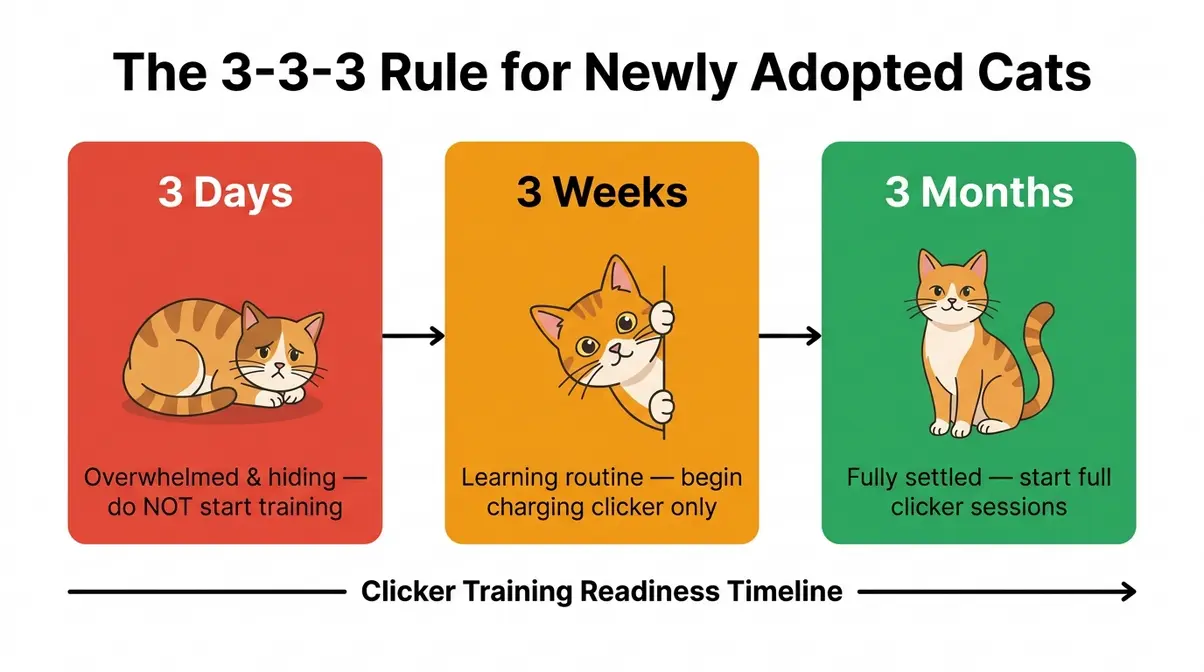
Begin clicker training after the three-week mark at the earliest — and ideally at three months, when your cat’s stress hormones have normalized and their food motivation is reliable. Starting too early, during the three-day overwhelm phase, can associate the clicker sound with stress rather than reward.
Step 5: Troubleshoot When Your Cat Won’t Respond
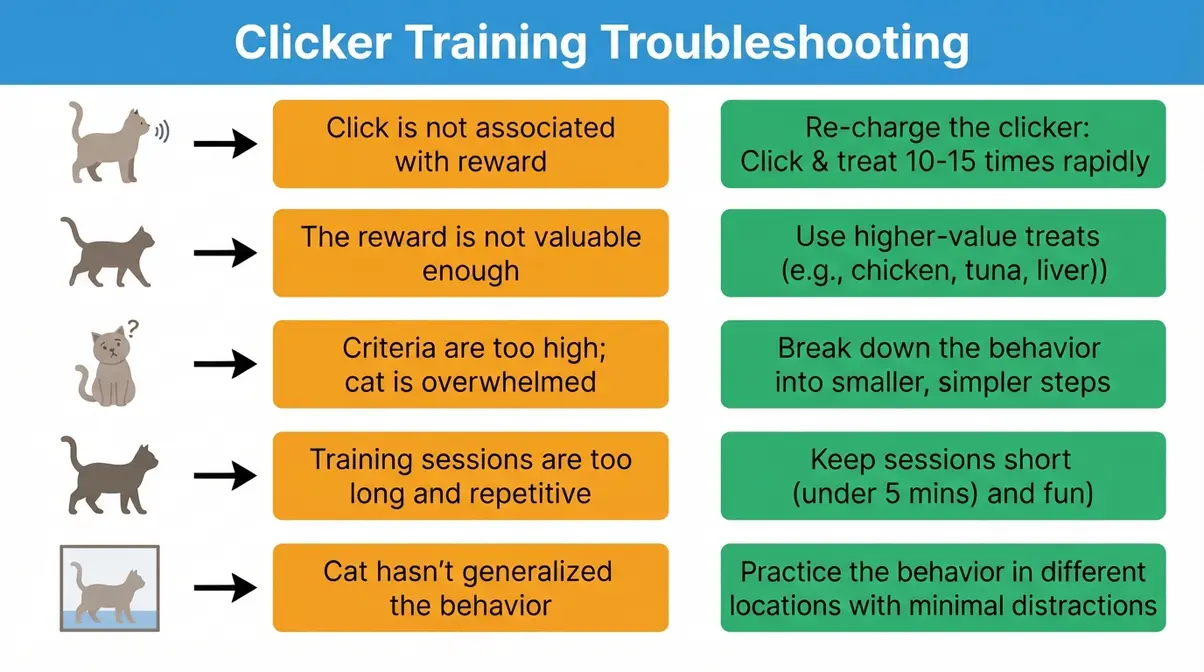
Even well-designed sessions hit walls. The troubleshooting matrix below covers the five most common roadblocks — each one has a specific cause and a specific fix. “Stubborn” is rarely the problem; misaligned timing or reward value almost always is.
Common Roadblocks and Fixes
| Roadblock | Likely Cause | Fix |
|---|---|---|
| Cat ignores the click entirely | Clicker not yet charged | Return to Step 1; do 15 more click-treat repetitions before asking for behavior |
| Cat loses interest after 2–3 treats | Treat value too low | Switch to a higher-protein treat; try freeze-dried salmon or tuna flakes |
| Cat performs behavior but seems confused | Click timing is too late | Click during the behavior, not after. A 3-second delay teaches the wrong action |
| Cat walks away mid-session | Session too long | Cap sessions at 2–3 minutes; end on a success, not a failure |
| Cat performs in the kitchen but nowhere else | Location dependency | Practice in 3–4 different locations to generalize the behavior |
When the Treat Isn’t Working
If your cat consistently disengages after two or three repetitions, the reward hierarchy needs rebuilding. Start by withholding the ultra-high-value treat from all other contexts — meals, free snacks, and casual rewards — for 48 hours. When that treat reappears exclusively in clicker sessions, its novelty is restored.
A second cause is timing: even food-motivated cats disengage when the click-to-treat gap exceeds two seconds. The Click-Bridge Method depends on that bridge being short. If you’re fumbling for treats while clicking, pre-load five treats in your dominant hand before each session so delivery is instant.
User consensus across r/CatTraining identifies inconsistent rewards as the single most reported reason training stalls — clicking sometimes but not always for the same behavior confuses the cat about what the bridge is actually marking. Consistency isn’t optional; it’s the mechanism.
Common Clicker Training Mistakes?
The most common mistake is clicking too late — after the behavior has ended rather than during it. Other frequent errors include using treats that aren’t high-value enough (kibble rarely motivates) and running sessions longer than 3 minutes until the cat disengages. Skipping the charging step entirely is another frequent pitfall. User consensus across r/CatTraining identifies inconsistent timing as the single biggest reason training stalls — the click must mark the same moment every repetition for the association to strengthen reliably.
Expert Resources for Deeper Learning
Clicker training for cats has a rich body of peer-reviewed and practitioner-developed resources. The two sources below represent the highest-authority and most practical tiers — useful when you’re ready to move beyond this guide.
Veterinary & Behavioral Sources
For the science underpinning everything covered here, two institutions provide the most rigorous foundation:
- Texas A&M University Veterinary Medicine — Their cat clicker training resource covers the behavioral neuroscience of operant conditioning applied specifically to domestic cats, including how mental stimulation from training correlates with reduced incidence of anxiety-driven behaviors (Texas A&M Veterinary Medicine, 2026).
- International Cat Care (iCatCare) — The iCatCare training guide provides session-length guidelines and behavioral welfare context, including the 2–3 minute session recommendation that underpins the timing structure throughout this guide.
- PetMD’s clicker training overview — A practitioner-friendly summary covering the basics of operant conditioning with cats, useful for sharing with a vet or confirming methodology.
Practitioner Training Programs
When you’re ready to advance beyond basic tricks:
- Karen Pryor Clicker Training (clickertraining.com) — The foundational methodology resource. Karen Pryor’s work established the event marker concept that every modern clicker protocol builds on. Their cat-specific training library includes video demonstrations of advanced shaping techniques.
- Cat School (catschool.co) — Practitioner-led online courses with video instruction for everything from basic targeting to agility. Their target stick methodology directly informs the targeting sequence in Step 2 of this guide.
Both resources go significantly deeper on shaping complex behavior chains — the next step after your cat has mastered the five basics covered here.
Frequently Asked Questions
Is clicker training good for cats?
Yes — clicker training is well-suited to cats and is endorsed by the ASPCA, International Cat Care, and veterinary behaviorists at Texas A&M. The distinct click provides immediate, consistent feedback that verbal praise cannot match in precision. Cats respond particularly well because their solitary predator instinct makes them highly food-motivated in short bursts — exactly the pattern a 2–3 minute session exploits. The method also reduces boredom-driven problem behaviors like excessive vocalization and destructive scratching (Texas A&M Veterinary Medicine, 2026).
Disadvantages of Clicker Training?
The main disadvantage of clicker training is that timing errors teach the wrong behavior. A click even two to three seconds late rewards whatever the cat is doing at that moment — not the behavior you intended. Additionally, the clicker itself requires a free hand, which can be awkward during trick training. Some cats are sound-sensitive and may startle at a loud box clicker. These limitations are manageable: use a softer i-Click style for sensitive cats, and practice your timing without the cat present before your first live session.
How Long Does Clicker Training Take?
Most cats understand the click-treat association within one to two sessions of 2–3 minutes each. Basic behaviors like “sit” or “touch” typically take three to five short sessions before they’re reliable, while more complex tricks can take two to four weeks of consistent daily practice. According to International Cat Care, 2–3 minute sessions daily outperform 20-minute weekly sessions because cats learn better through frequent, brief reinforcement windows (International Cat Care, 2026).
What is the 3-3-3 rule for cats?
The 3-3-3 rule describes the three adjustment stages newly adopted cats typically move through: three days of hiding, three weeks of learning the routine, and three months to fully settle. For clicker training purposes, wait until at least the three-week mark before starting structured sessions, as beginning too early can associate the clicker with stress rather than reward.
Is clicker training outdated?
Clicker training is not outdated — it remains the gold standard for precision marker training across species, from domestic cats to marine mammals. The underlying science of operant conditioning has been validated consistently since B.F. Skinner’s foundational work and refined by Karen Pryor’s event marker methodology. The core mechanism — a precise auditory bridge between behavior and reward — is as effective in 2026 as it was when Pryor popularized it for companion animals.
Start Your Cat’s First Clicker Session Today
For any cat owner ready to build a stronger bond through communication, clicker training for cats delivers measurable results faster than almost any other method. The science is clear: a precise auditory marker paired with a high-value treat creates behavioral associations that verbal praise alone cannot replicate. Texas A&M Veterinary Medicine confirms that this kind of structured mental engagement reduces problem behaviors — meaning training isn’t just about tricks, it’s about a calmer, more confident cat (Texas A&M Veterinary Medicine, 2026).
The Click-Bridge Method reframes what the clicker actually is: not a magic button, but a precision communication bridge between your cat’s behavior and its consequence. Master that bridge — keep it short, keep it consistent, keep it rewarding — and the specific behavior you’re marking becomes crystal clear to your cat. Every trick in this guide, from “sit” to “roll over” to jumping through an arm hoop, is built on that same bridge.
Start with Step 1 today. Spend 2–3 minutes charging the clicker, and by tomorrow you’ll have a cat that understands exactly what the click means. From there, every session builds on the last. If you run into a wall, return to the troubleshooting matrix — the answer is almost always a timing or treat adjustment, not a problem with your cat.

Dave King
Cat owner and writer at Mad Cat Man.