
Table of Contents
- Introduction
- Why cats love laser pointers
- The benefits of laser pointers (when used right)
- The risks and how to mitigate them
- How to choose a safe laser pointer (UK buyers)
- How to Use the Laser Pointer: Best Practice for UK Homes & Indoor Cats
- Recognising and dealing with problems
- Laser pointer myths and facts
- FAQ — Quick answers to common questions
- Conclusion
This blog post may contain affiliate links. As an Amazon Associate I earn from qualifying purchases.
Laser Pointers for Cats: Expert Tips for Fun Playtime (UK Edition)
Introduction
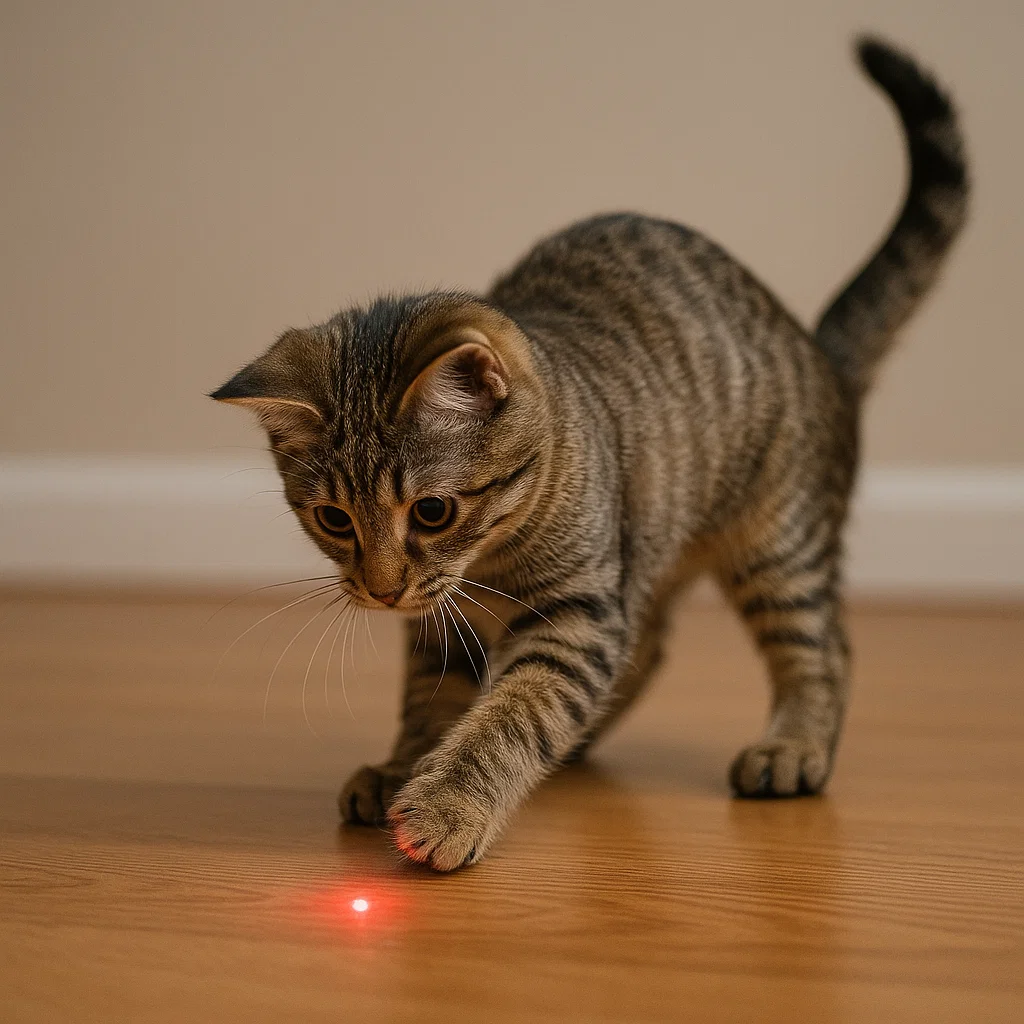
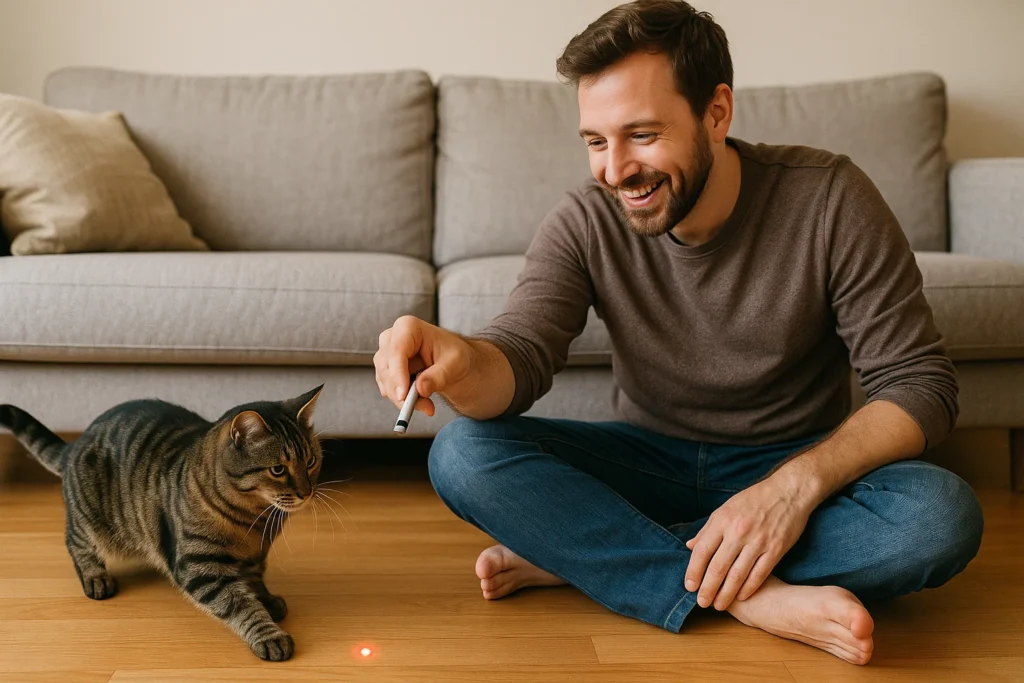
If you’ve ever watched your cat’s eyes track that little red dot darting around the room, you already know how mesmerising a laser pointer can be. But whilst they’re great for interactive fun, they also come with important considerations. This article explains why laser pointers for cats work, how to use them safely, and how to integrate them into your play-routine in a way that’s both fun and stress-free for your feline friend — from the perspective of a UK-based pet owner.
You’ll discover:
- What drives cats to chase lasers
- The benefits of using laser pointers (when done right)
- The risks and how to mitigate them
- How to choose a safe laser pointer and set up play sessions
- Practical tips for UK households, indoor cats and multi-cat homes
- A full FAQ section for quick answers
By the end you’ll feel confident that you can make laser-playtime a win for your cat’s physical and mental health — safely, intelligently and with that “mad catman.com” level of care.
Why cats love laser pointers
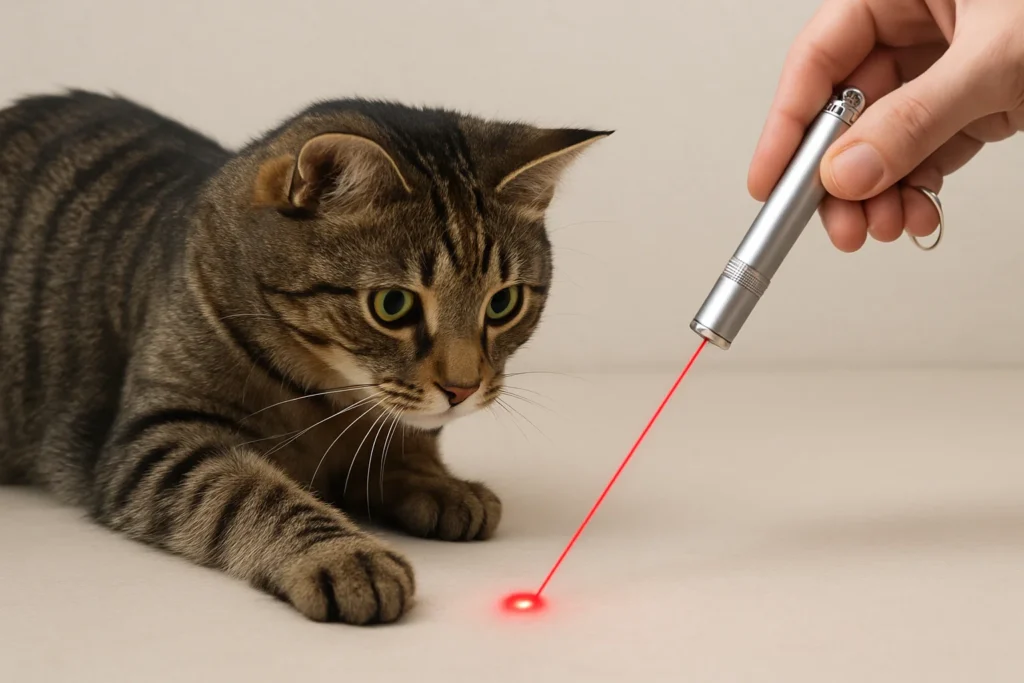
Cats are natural predators. Even indoor cats retain the instinct to stalk, chase and capture. As one expert summary puts it:
“Cats chase the laser pointer’s dot because it changes direction and speed… they see the moving dot as alive and worth catching.” Hill’s Pet Nutrition+1
What’s going on biologically
- The moving dot mimics prey-behaviour: sudden changes of direction, quick dashes — all trigger the hunting instinct. PetMD+1
- Through play the cat exercises muscles, stimulates brain circuits and relieves boredom. One article notes:
“Laser pointers can be great for helping cats lose weight and mental stimulation.” PetMD
- In UK households where cats are often indoor and may not have access to wide outdoor terrain, laser-play offers a convenient outlet.
LSI keywords and related queries in context
You’ll often see phrases like: “interactive cat toy laser pointer”, “indoor cat exercise”, “what watt laser pointer safe for cats”, “laser pointer play frustration in cats”. We will cover each of those to make sure you’re fully informed.
The benefits of laser pointers (when used right)
Using a laser pointer thoughtfully gives you more than just fun. Here are the true advantages:
Physical exercise & weight management
Indoor cats may lack natural hunting space. Running after a light dot helps them burn off energy and maintain muscle tone. As studies show, structured play is important for maintaining feline health. PMC+1
Mental stimulation & enrichment
Chasing that unpredictable dot engages the cat’s mind — changing direction, sudden stops and starts keep them alert. This counters boredom and its associated issues (over-grooming, restlessness). Petcube web-site+1
Bonding opportunity
Play is a social interaction. By joining in with your cat’s hunting play, you strengthen your relationship. Use the laser pointer as a tool to enrich time together.
Easy to implement
A laser pointer is affordable, portable and simple to use in small UK homes. No large toys or bulky equipment needed. You can fit a session into your evening routine.
The risks and how to mitigate them
Laser pointers are not trouble-free. They carry risks — especially if used incorrectly. Use this section to be fully aware and safe.
Risk: Eye injury
Though most pointers for pets are low power, they must still never be aimed at eyes — yours, your cat’s or anyone else’s. One source warns:
“They may hurt your cat’s eyes … most laser pointers are … low level but still considered dangerous if aimed directly.” Catster
Risk: Frustration & behavioural issues
Because the dot cannot be “caught”, your cat may become frustrated, developing repetitive or compulsive behaviours. A peer-reviewed study found a link between frequent laser play and abnormal repetitive behaviours (ARBs) in cats. PubMed
Risk: Physical injury or damage
If the dot is moved too fast or too high, cats may leap awkwardly, crash into furniture or knock things over. This is emphasised in UK-specific guidance. Kinship
Risk: Over-reliance or unsupervised automation
Automatic laser toys which operate when you’re not present may leave your cat chasing and never “winning”. One source states:
“Automatic toys with lasers… just not safe.” Daily Paws
Mitigation summary
- Avoid shining the beam at eyes or reflective surfaces. Pets4Homes+1
- End each session with a tangible “catch” — a toy or treat your cat can grab. Kinship+1
- Keep sessions short (5-10 minutes) and supervised. Nevada Humane Society
- Use only cat-specific, low-power lasers (under 5 mW). Pets4Homes+1
- Supplement with physical toys and avoid using laser play as the sole or main activity.
How to choose a safe laser pointer (UK buyers)
Selecting the right product matters. Follow this checklist to ensure you pick something that’s safe, suitable and enjoyable for your cat.
Laser power & class
- In the UK, laser pointers for pets should typically be class 2 or less (under 1 mW) ideally. Wikipedia+1
- Avoid industrial-strength pens with output >5 mW — those pose eye hazards. Pets Stack Exchange
Beam colour
- Red is common and safe (longer wavelength, lower power). Some cats respond differently to green—but green lasers may carry higher risk. laserpointerforums.com
Build and design
- Buy from reputable UK / EU pet-toy retailers. Look for labels “for pet play”, “less than 5mW”, “CE mark”.
- Ensure the pointer has a stable beam, good ergonomics, and doesn’t overheat.
Additional features
- Some pointers include motion patterns, auto-switch-off or companion toys. These can be fun but should not replace supervised play.
- Avoid unsupervised, always-on “robotic” lasers which may encourage frustration or risky behaviour.
Price vs value
- Don’t assume the most expensive is best—what matters is safe power rating and usability.
- Check reviews for reliability (does the beam flicker? does the pointer get hot?).
Recommended buying checklist
| Feature | Why it matters |
|---|---|
| < 5 mW power rating | Minimises eye hazard |
| Marked “Pet toy” or “Cat play” | Ensures design is intended for animals |
| Stable dot + reliable switch | Smooth play session for your cat |
| UK/EU certification (CE, UKCA) | Legal safety compliance |
| Good reviews + brand reputation | Less risk of hidden defect |
How to Use the Laser Pointer: Best Practice for UK Homes & Indoor Cats
Here’s a step-by-step guide to making laser play safe, fun and beneficial.
Setup the play environment
- Choose an open, safe space in your home where your cat can chase without crashing into shelves, glass or breakables.
- Remove hazardous items, slippery rugs or obstacles.
- Have a collection of other toys ready (feather wands, soft balls, treat puzzle) to finish the session.
Engaging the play session
- Start the pointer low and close to the floor, mimicking a small prey animal hiding or scuttling.
- Move the dot in random, unpredictable patterns — dashes, stops, quick turns.
- Let the chase build gradually; avoid moving it too fast initially.
- After a few minutes (5-10 mins is ideal for most cats) transition the dot towards a toy or treat your cat can physically “catch”. This gives closure. UK guidance emphasises letting the cat “win”. Kinship+1
- End with the toy or treat and calm petting—so the cat leaves the session satisfied, not frustrated.
Frequency & timing
- Ideally 1-2 short sessions a day rather than one long one.
- Avoid immediately before bedtime if your cat then becomes hyperactive—allow a wind-down toy afterwards.
- For older cats or cats with health issues: reduce intensity, keep play low-impact.
Multi-cat households / indoor restriction
- If you have more than one cat, ensure each has their own turn so that lower-ranked cats still get engaging play.
- Indoor-only cats benefit from laser play as part of a wider enrichment programme: scratching posts, climbing frames, treat puzzles.
- Monitor for signs of frustration or obsessive behaviour (see next section).
Recognising and dealing with problems
Even when done right, you need to watch your cat’s response. Here’s what to look out for, and how to act if you spot issues.
Signs of frustration or obsessive behaviour
- Your cat keeps staring at walls or lights after a session.
- Sudden increase in tail-chasing, spinning or over-grooming. PubMed
- Aggression or attention-seeking immediately after a laser session.
- Losing interest in other toys, only wanting the laser.
What to do
- Pause laser play for a few days; use more physical toys instead.
- End every session with a tangible capture reward (toy/treat).
- Include slower, calmer play and other enrichment activities.
- If the behaviour continues, consult your vet or a feline behaviour expert—especially if combined with other stress signs.
Health or age considerations
- For cats with mobility issues, limit jumping and rapid sprints; use slower movement of the dot.
- For kittens, keep sessions short and supervise—they may be more prone to over-excitement.
- For older cats, include gentler toys and ensure warm-up/cool-down as you would in human workouts.
Laser pointer myths and facts
Let’s clear up some common questions quickly.
Myth: Laser pointers are bad and should never be used
Fact: They’re safe and beneficial when used correctly — the key is responsible use and ending with a “catch”. Professional sources support this when done carefully. PetMD+1
Myth: Any laser pointer will do
Fact: No. Low-power (<5 mW) units, labelled for pet use, are essential. Higher-power units carry eye risk. Catster+1
Myth: A laser pointer is enough enrichment on its own
Fact: It must form part of a broader enrichment plan—wands, climbing toys, interactive play and rest all matter. Over-reliance may lead to frustration. zooplus
FAQ — Quick answers to common questions
Q: Are laser pointers safe for cats?
A: Yes — when you use a low-power, pet-specific laser, avoid aiming at eyes or reflective surfaces, supervise sessions and ensure the cat “catches” something at the end. Hill’s Pet Nutrition+1
Q: What power rating of laser pointer is safe for cats in the UK?
A: Ideally class 2 (<1 mW) or definitely under 5 mW. Anything over that may pose eye safety risks. Pets4Homes+1
Q: How long should each laser-play session last?
A: Generally 5–10 minutes, once or twice a day. Short and supervised is better than long and unsupervised. Nevada Humane Society
Q: My cat gets obsessed with the laser and won’t calm down — why?
A: This can happen if the “hunt-catch” cycle is incomplete (dot never caught) or if sessions are too long/frequent. Provide a toy or treat to “catch” at the end and reduce frequency. PMC+1
Q: Can I leave an automatic laser toy on when I’m out?
A: It’s not recommended. Automatic machines can increase risk of frustration, injury or destruction of objects. Supervised human-led play is safer. Daily Paws
Q: What if my cat ignores the laser pointer?
A: Some cats don’t find the dot motivating. Try varying speed, height, angle. If still uninterested, switch to another interactive toy (wand, ball, puzzle). Always monitor individual preference.
Conclusion
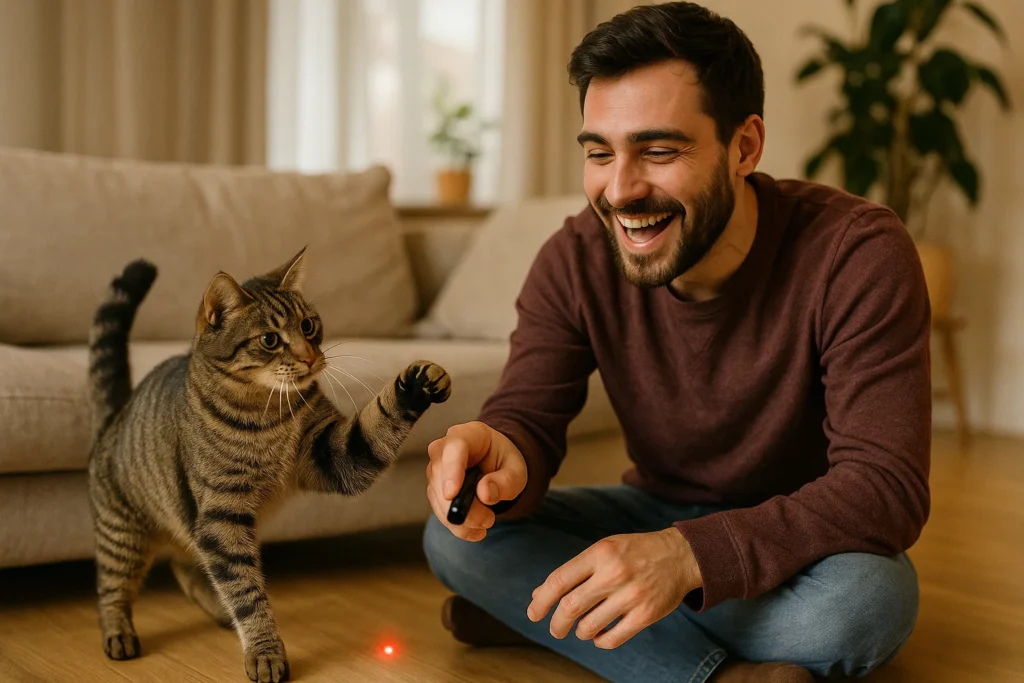
At Mad Cat Man we believe that your cat’s well-being matters just as much as your business systems and networks. In the same way we deliver best-in-class IT solutions, you can deliver best-in-class playtime for your cat — one that is engaging, healthy and smart.
Laser pointers can be a brilliant addition to your cat’s enrichment toolkit — if used thoughtfully, in moderation and with care. Choose a safe model, follow the steps above, keep sessions fun and satisfying, and you’ll ensure your cat gets the benefits without the risks.
Here’s your play-time checklist:
- Buy a safe, low-power laser pointer certified for pet use.
- Clear a safe indoor space and have supplementary toys ready.
- Hold short, supervised play sessions that end in a catch.
- Watch for signs of frustration or obsessive behaviour.
- Keep laser time as part of a balanced enrichment routine with wand toys, climbing and rest.
Make playtime purposeful — for both you and your cat. And remember: the dot may be tiny, but its impact on your cat’s happiness and health can be big.
Useful Reads
- What Breed Is My Cat? A Comprehensive Guide to Identifying Your Feline Friend
- Best Cat Toys 2025: Mad Cat Man’s Top-Rated Cat Toy Picks
- Best Cat Tree UK | We Tested 12 Models
We hope this guide becomes your go-to resource on laser pointers and cat play. Enjoy the chase! 🐾