
Most people see their first Maine Coon and think a small dog wandered into the room. A full-grown male can weigh up to 18 pounds and stretch more than 40 inches from nose to tail — longer than many Beagles (Cat Fanciers’ Association, 2026). When you put Maine Coon size compared to dog breeds side by side, the numbers are genuinely surprising.
If you’re thinking of adopting a Maine Coon — or you’ve just seen one go viral online — you need real numbers, not vague comparisons to “small dogs.” Without a clear picture, you might be genuinely shocked the day you bring one home.
By the end of this guide, you’ll know exactly how Maine Coon size compares to dog breeds across six specific comparisons — with a full data table, custom silhouette visuals, and an explanation of the size illusion that fools everyone. We’ll cover their exact measurements, a breed-by-breed dog comparison, their famous “dog-like” personality, and where they actually came from.
Don’t worry if you’re new to Maine Coons. We’ll explain every term as we go — no cat-show jargon required.
A full-grown male Maine Coon weighs 13–18 lbs and can reach 40+ inches long — rivaling the size of a Beagle or Cocker Spaniel. They’re one of the largest domestic cat breeds alive.
- The Fluff Factor: Their thick double coat makes them look 30–50% larger than their actual frame
- Dog-sized reality: A large Maine Coon outweighs most toy and small dog breeds
- Personality match: Often called the “dogs of the cat world” for their loyalty and playfulness
- Slow growers: Maine Coons take 3–5 years to reach their full size (TICA, 2026)
How Big Does a Maine Coon Get? Key Measurements Explained
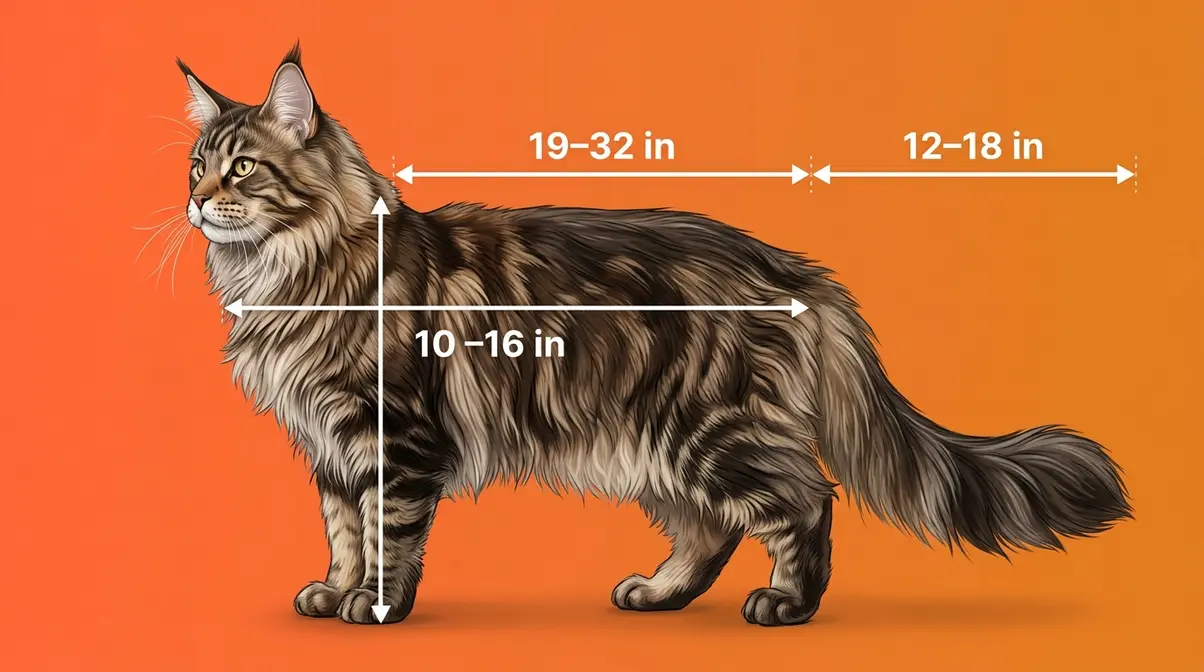
Maine Coons are the largest domestic cat breed native to the United States — and their numbers back that claim up completely. A male Maine Coon typically weighs between 13 and 18 pounds, stands 10–16 inches tall at the shoulder, and stretches 19–32 inches from chest to tail base (Cat Fanciers’ Association, 2026). Add the tail — which alone can run 12–18 inches — and you’re looking at a cat that regularly exceeds 40 inches in total length. That’s longer than most Beagles.
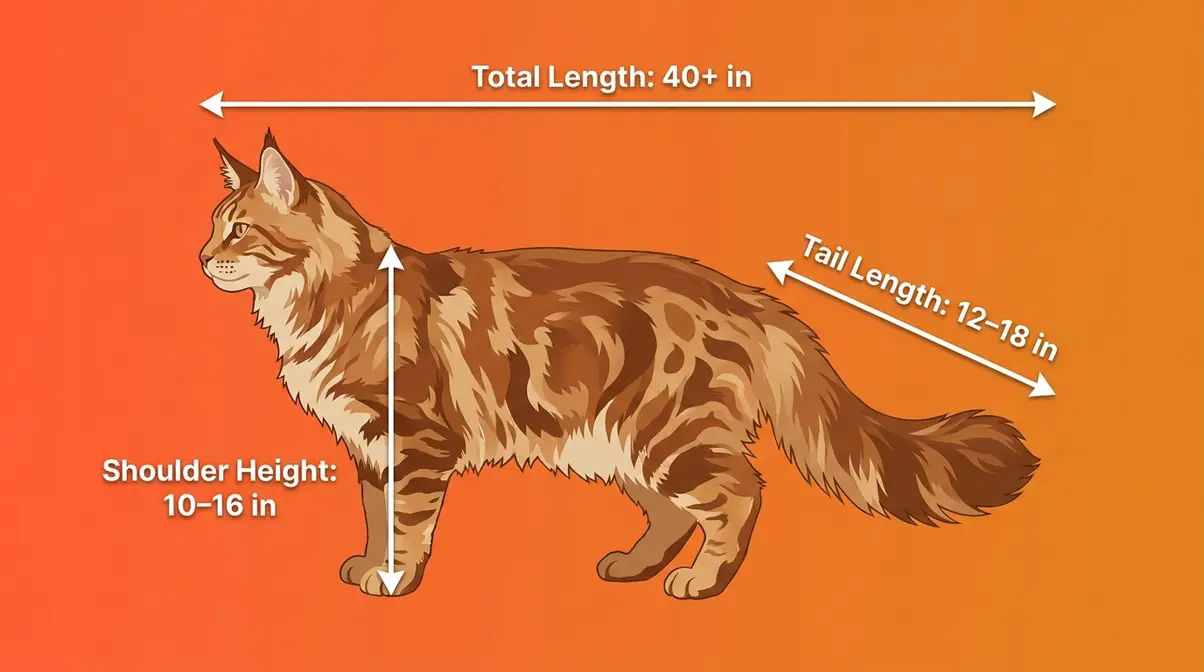
Weight, Height, and Length: The Numbers That Surprise People
The Cat Fanciers’ Association (CFA), the world’s largest registry of pedigreed cats, publishes the following breed standard ranges for Maine Coons:
| Measurement | Male Maine Coon | Female Maine Coon |
|---|---|---|
| Weight | 13–18 lbs (5.9–8.2 kg) | 8–12 lbs (3.6–5.4 kg) |
| Height at Shoulder | 10–16 inches (25–41 cm) | 8–14 inches (20–36 cm) |
| Body Length (chest to tail base) | 19–32 inches (48–81 cm) | 19–30 inches (48–76 cm) |
| Total Length (including tail) | 38–48 inches (97–122 cm) | 36–44 inches (91–112 cm) |
To put 16 inches at the shoulder in perspective: that’s roughly the height of a standard school ruler standing upright. And the record-holder puts those averages to shame — Barivel, a Maine Coon from Italy, measured 47.2 inches (120 cm) in total length, certified by Guinness World Records in 2018 as the world’s longest living domestic cat.
Female Maine Coons are meaningfully smaller than males, but they still outweigh the average housecat — which typically tops out around 10 pounds — by a comfortable margin. What this means for you: even a “small” female Maine Coon will feel noticeably heavier and longer than most cats you’ve held before.
Maine Coons Take 3–5 Years to Reach Full Size
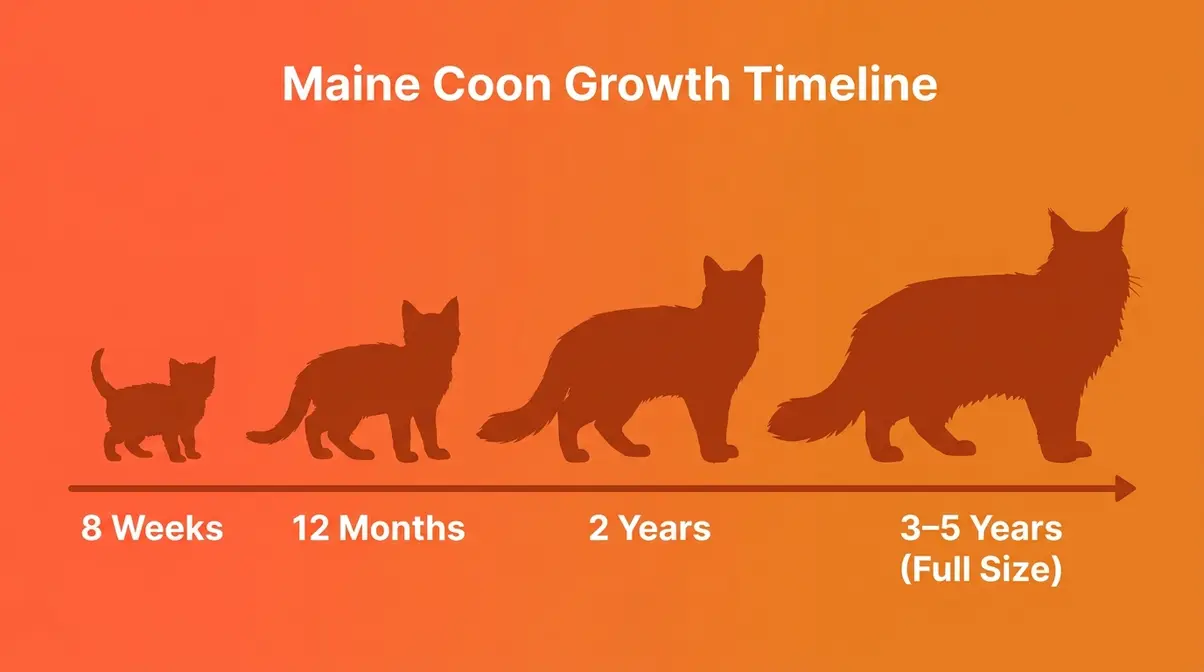
Here’s something that surprises almost every new owner. Most cat breeds reach their adult size by around 12 months. Maine Coons operate on a completely different timeline.
The International Cat Association (TICA), a global feline breed authority, notes that Maine Coons typically take 3 to 5 years to reach their full adult size (TICA, 2026). That means the kitten you bring home at 8 weeks old won’t stop growing until it’s practically school-aged.
This extended growth period has a practical implication: a Maine Coon at 18 months old may look like a big cat, but it’s still filling out. Owners who underestimate this often find themselves buying a second, larger cat tree or upgrading their litter box mid-growth. Plan for the full adult size from day one.
The Fluff Factor: Why Maine Coons Look Even Bigger Than They Are
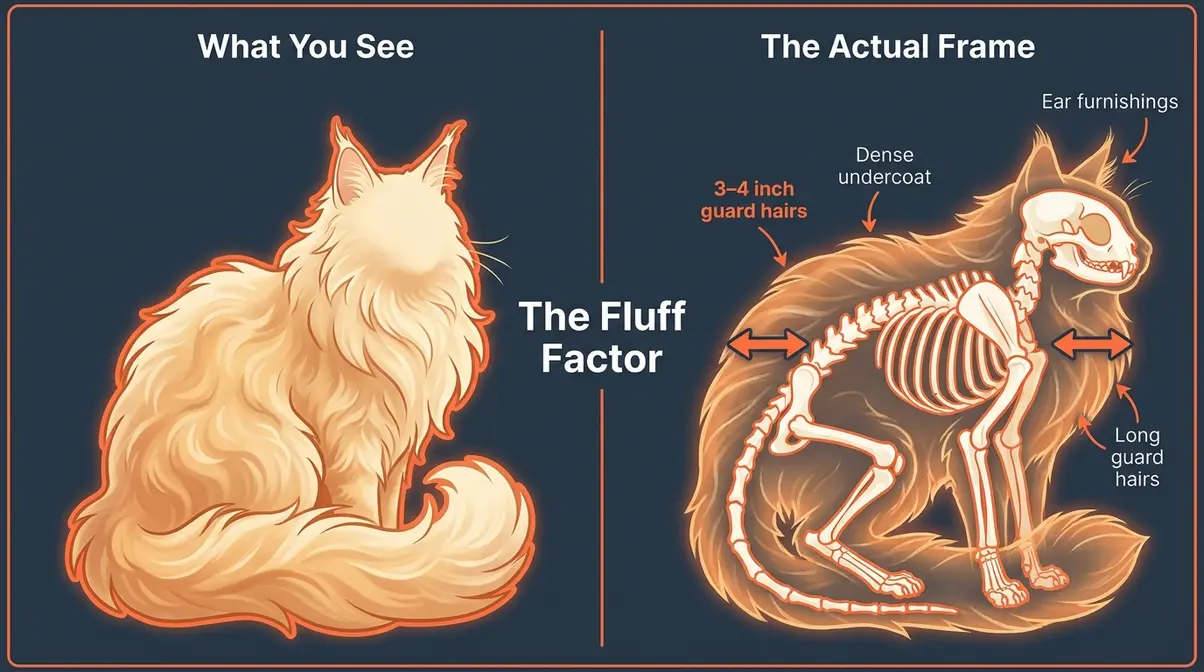
Here’s the concept no other guide explains: The Fluff Factor — the measurable optical illusion created by the Maine Coon’s coat that makes their actual frame appear 30–50% larger than it truly is.
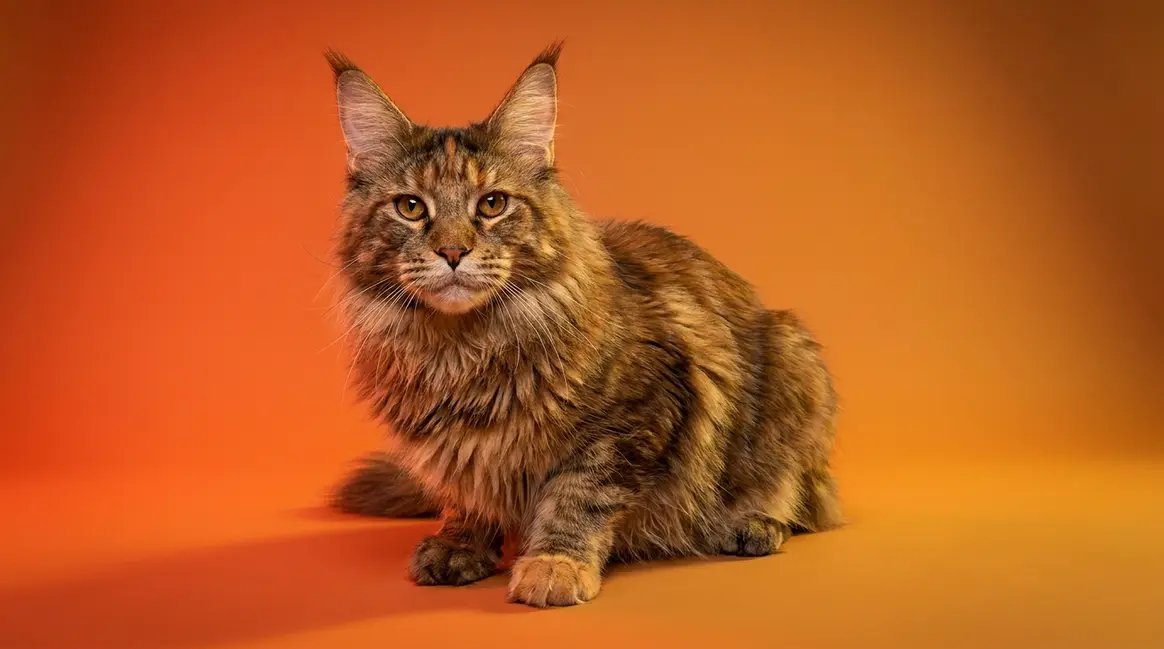
Maine Coons carry a dense, water-resistant double coat with three distinct layers: a soft undercoat, a middle layer, and long guard hairs that can reach 3–4 inches in length. They also grow a prominent ruff (the thick fur around the neck, similar to a lion’s mane) and heavily tufted paws and ears. When all that fur is dry and fluffed, it adds significant visual bulk around the shoulders, chest, and flanks.
The UC Davis Veterinary Genetics Laboratory, which has studied Maine Coon genetics extensively, confirms that the breed’s coat characteristics are a natural adaptation to harsh New England winters — not a grooming artifact (UC Davis VGL, 2026). The bone structure underneath is substantial, but the coat amplifies it dramatically.
What this means for you: If you weigh a Maine Coon and feel surprised the number isn’t higher, The Fluff Factor is why. The cat you’re seeing is partly coat. The cat you’re weighing is the frame beneath it. Both are real — just different measurements of the same impressive animal.
How to Measure Your Maine Coon’s Size at Home
If you want to see exactly how your own cat stacks up against the breed standards and dog comparisons, taking accurate measurements is a straightforward process.
Estimated time: 10-15 minutes
Tools/Materials needed: Soft fabric measuring tape, high-value cat treats, and a willing helper.
Step 1: Gather Your Materials
Collect your soft measuring tape and a handful of your cat’s favorite treats. Having a second person to dispense treats will keep your Maine Coon distracted and standing still while you take the measurements.
Step 2: Measure the Shoulder Height
Have your helper hold a treat slightly above the cat’s nose so they stand squarely on all four paws. Place the end of the measuring tape on the floor just behind their front paw, and measure straight up to the top of their shoulder blade (the withers).
Step 3: Measure the Body Length
While the cat is still standing straight, place the zero mark of the tape at the center of their chest (prosternum). Run the tape along their side all the way to the base of the tail where it meets the spine. For total length, continue the measurement to the very tip of the tail bone (ignoring the fur extending past the bone).
Step 4: Weigh Your Cat Safely
The easiest way to weigh a large Maine Coon at home is the subtraction method. First, step on your bathroom scale while holding your cat and record the total weight. Then, step on the scale by yourself. Subtract your weight from the total to find your Maine Coon’s exact weight.
Maine Coon Size Compared to Dog Breeds: A Breed-by-Breed Breakdown
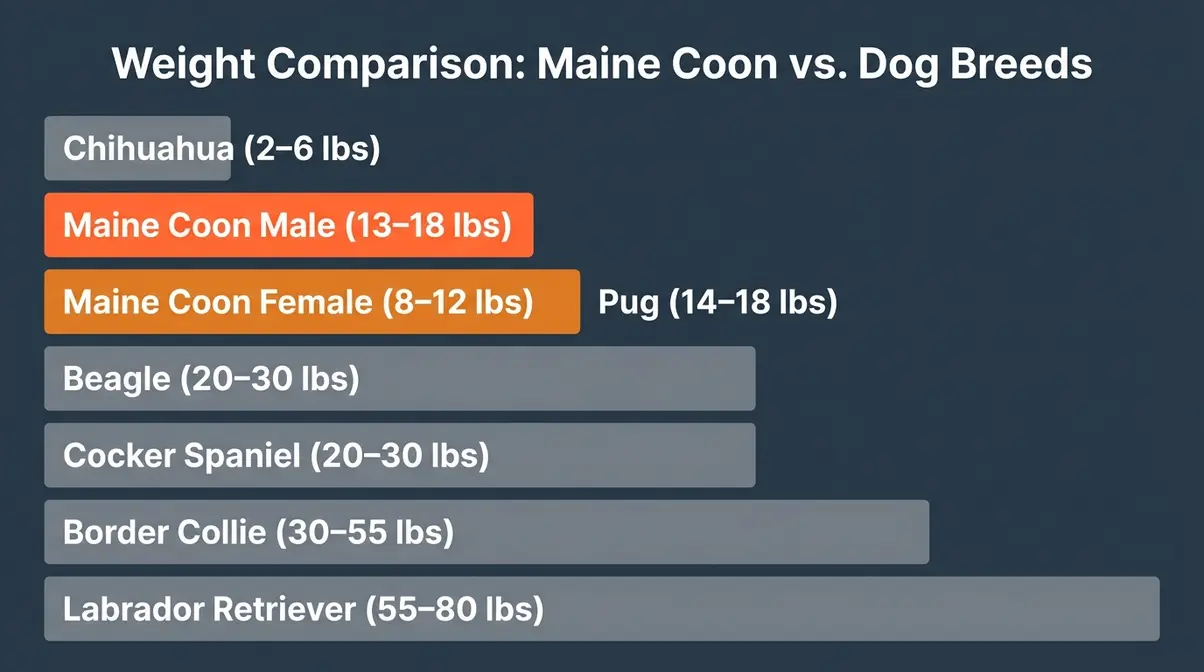
Now for the comparison most people actually came here for. When you put Maine Coon size compared to dog breeds across six specific animals, a clear picture emerges: Maine Coons genuinely overlap with small-to-medium dogs in weight, and they outmatch nearly every toy breed outright.
“Maine Coons weigh like 25 pounds, so any 40lb dog should easily clear. The heaviest dog that would probably lose would be an English Bulldog.”
That community observation captures the intuition well. Let’s replace intuition with data.
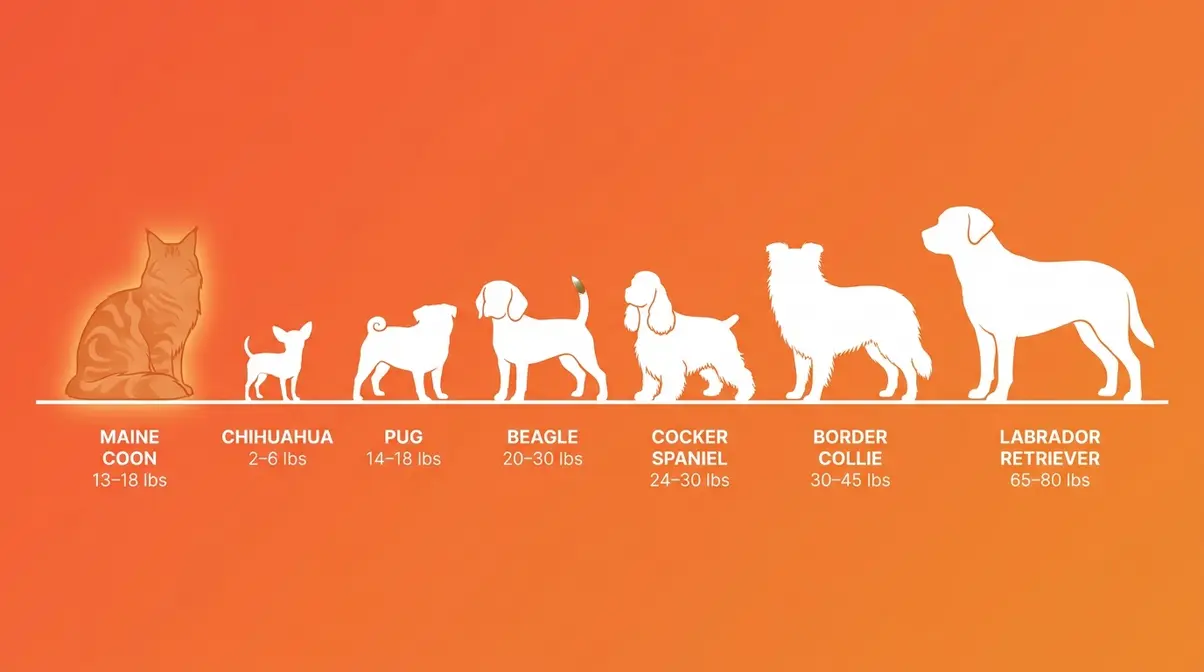
Maine Coon vs. Small Dogs: Chihuahua and Pug
This is where the size gap becomes almost comical. The Chihuahua, the smallest recognized breed according to the American Kennel Club (AKC, 2026), typically weighs just 2–6 pounds and stands 5–8 inches at the shoulder. A male Maine Coon outweighs the average Chihuahua by a factor of three or more.
The Pug is sturdier — weighing in at 14–18 pounds and standing 10–13 inches tall (AKC, 2026). That puts an average Pug almost exactly in the same weight range as a male Maine Coon. Side by side, they’re surprisingly matched on the scale. But the Maine Coon is dramatically longer — its body length alone (up to 32 inches) dwarfs the Pug’s compact 12–14 inch frame.
What this means for you: If someone tells you their Maine Coon is “about the size of a small dog,” they probably mean a Pug — and they’re not wrong about the weight. But the Maine Coon’s length and leg height make it feel far more imposing in person.
For more on how Maine Coon size affects their daily needs, see our Maine Coon size comparison guide.
Maine Coon vs. Medium Dogs: Beagle and Cocker Spaniel
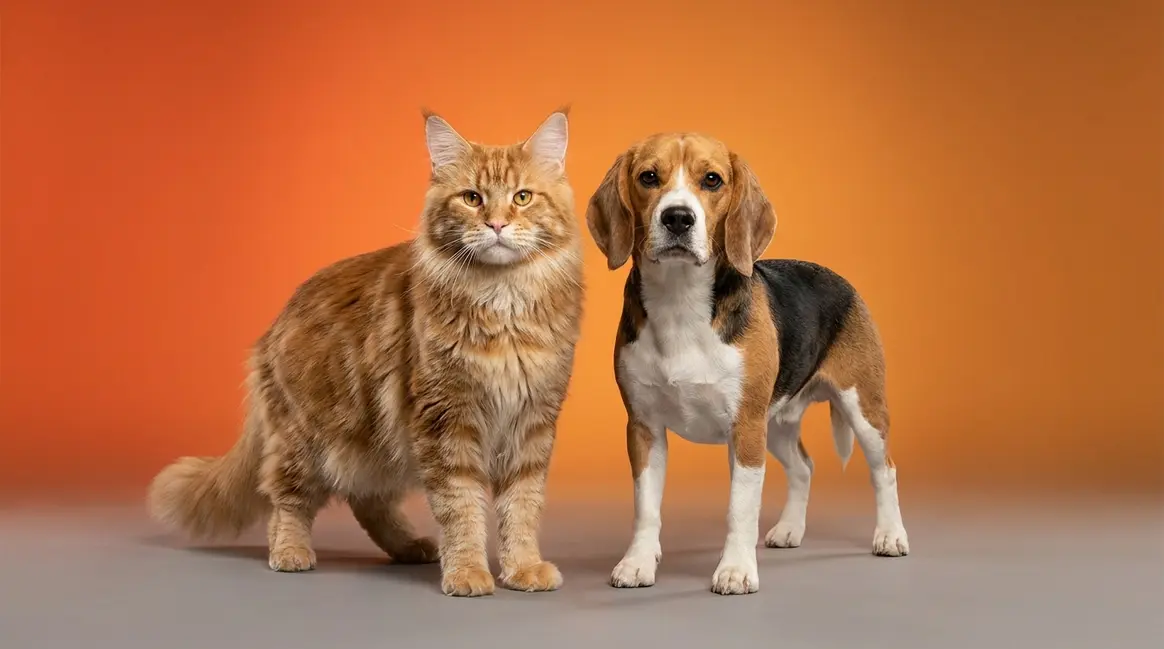
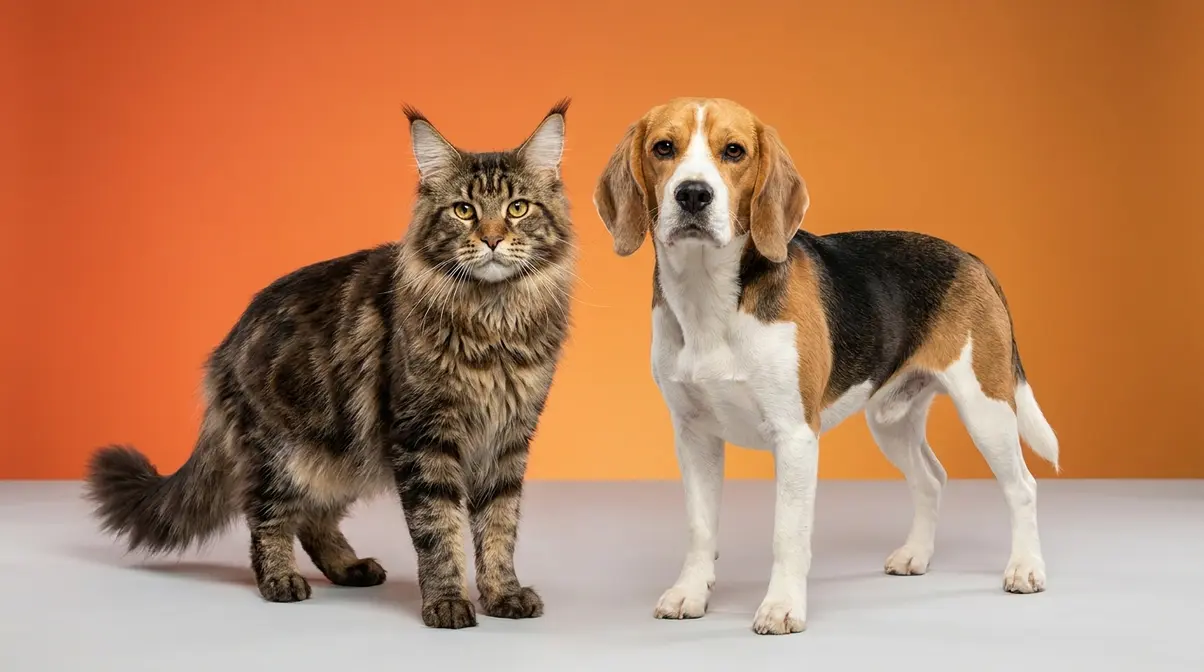
This is where the comparison gets genuinely fascinating. The Beagle — one of the most popular family dogs in the United States — weighs 20–30 pounds and stands 13–15 inches tall (AKC, 2026). A large male Maine Coon at 18 pounds comes within striking distance of a smaller Beagle’s weight, while matching or exceeding its shoulder height.
The Cocker Spaniel sits at 20–30 pounds and 13.5–15.5 inches at the shoulder (AKC, 2026). The weight gap is real — a Cocker Spaniel will typically outweigh a Maine Coon by 5–12 pounds. But in terms of height and overall presence, the Maine Coon holds its own. Owners who keep both often report that guests do a double-take when the cat walks into the room.
The Beagle comparison is arguably the most useful mental benchmark. A large male Maine Coon is approximately the same height as a Beagle and about 60–70% of its weight — close enough that the “medium-sized dog” comparison is entirely justified.
Maine Coon vs. Large Dogs: Border Collie and Labrador Retriever
Here’s where the Maine Coon’s size story hits its honest upper limit. The Border Collie weighs 30–55 pounds and stands 18–22 inches at the shoulder (AKC, 2026). The Labrador Retriever — consistently one of America’s most popular breeds — weighs 55–80 pounds and stands 21.5–24.5 inches tall (AKC, 2026).
A Maine Coon cannot match either of these breeds in weight. Even the heaviest documented Maine Coons (25–30 lbs in exceptional individuals) fall well short of a Border Collie’s average. The height gap is also significant: a Labrador stands nearly 10 inches taller at the shoulder than the tallest Maine Coon.
However, there’s a meaningful comparison to be made in terms of presence and personality rather than raw mass. Maine Coons match the Border Collie’s intelligence, trainability, and need for engagement. They’re “large” in the way that matters to most households — not in pounds, but in personality and physical footprint.
Where the Border Collie comparison is about intelligence, the Labrador comparison is about affection. Maine Coons, like Labs, are famously people-oriented, follow their owners from room to room, and enjoy physical play. The size gap is real. The personality overlap is genuine.
Full Size Comparison Table: Maine Coon vs. 6 Dog Breeds
This table pulls all CFA and AKC breed standard data into one place for direct comparison. All measurements represent typical adult ranges.
| Breed | Weight (lbs) | Height at Shoulder (in) | Body Length (in) | Category |
|---|---|---|---|---|
| Maine Coon (Male) | 13–18 | 10–16 | 19–32 | Cat |
| Maine Coon (Female) | 8–12 | 8–14 | 19–30 | Cat |
| Chihuahua | 2–6 | 5–8 | 9–12 | Toy Dog |
| Pug | 14–18 | 10–13 | 12–14 | Toy Dog |
| Beagle | 20–30 | 13–15 | 20–25 | Medium Dog |
| Cocker Spaniel | 20–30 | 13.5–15.5 | 20–26 | Medium Dog |
| Border Collie | 30–55 | 18–22 | 28–34 | Large Dog |
| Labrador Retriever | 55–80 | 21.5–24.5 | 36–42 | Large Dog |
Sources: Cat Fanciers’ Association (CFA, 2026); American Kennel Club (AKC, 2026)
The data tells a clear story. Maine Coons match or exceed toy breeds in every dimension. They sit just below medium dogs in weight but overlap in height and length. They are genuinely outclassed by large breeds — but no honest comparison would claim otherwise.
For a deeper look at how Maine Coon traits affect daily living, visit our guide on 9 unexpected characteristics of a Maine Coon.
The “Dog of the Cat World”: Maine Coon Temperament and Personality
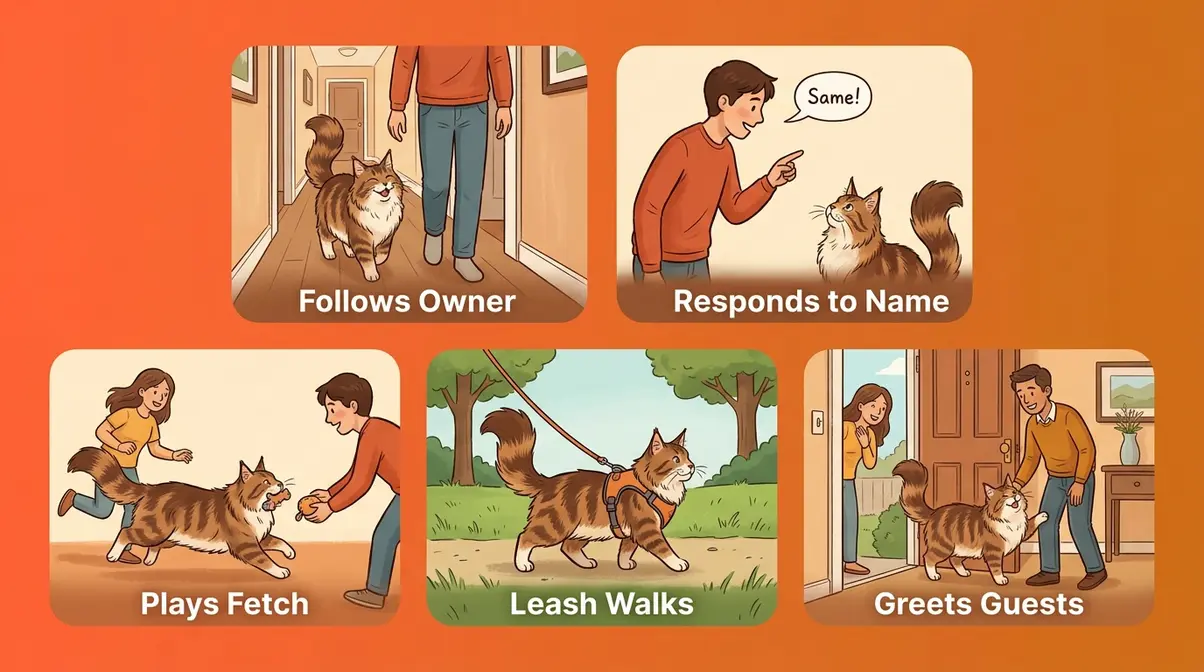
Size alone doesn’t explain why Maine Coons earn their “dogs of the cat world” nickname. Their personality is just as remarkable as their measurements — and for many owners, it’s the bigger surprise. The American Veterinary Medical Association notes that Maine Coons are among the most socially oriented domestic cat breeds, showing attachment behaviors more commonly associated with dogs (AVMA, 2026).
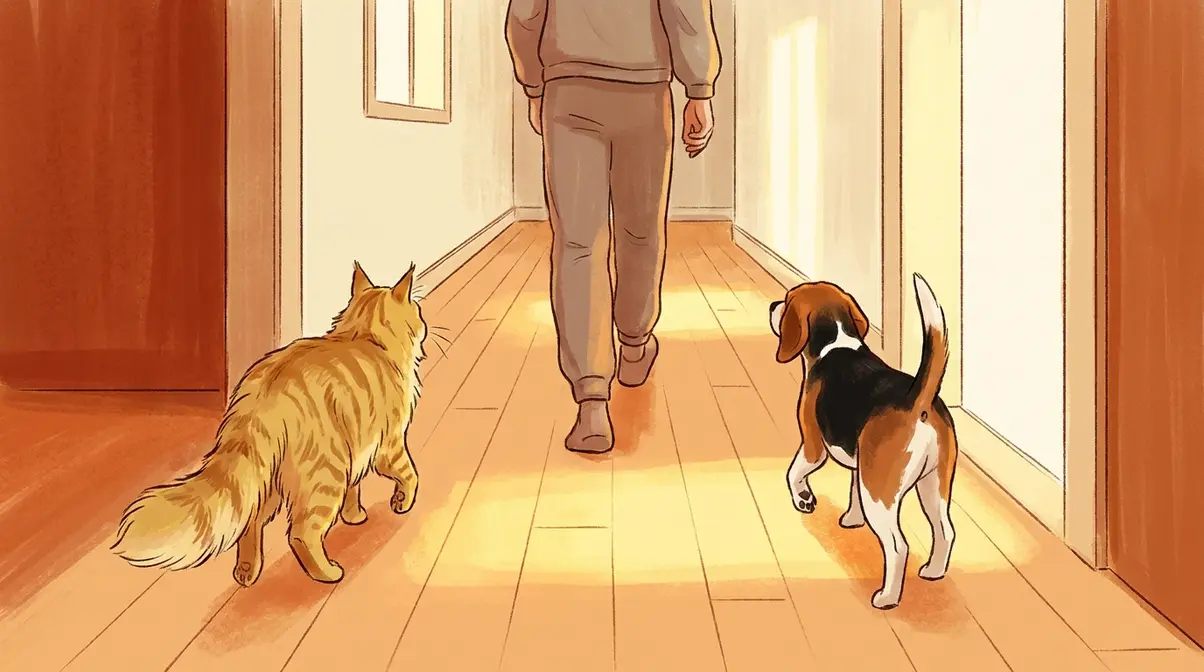
5 Dog-Like Behaviors That Set Maine Coons Apart
Across Maine Coon breeder communities and owner forums, the consistent feedback is that these cats genuinely behave like dogs in ways that catch new owners off guard. Here are the five behaviors reported most frequently:
- Following their owner from room to room. Maine Coons don’t just want to be near you — they want to be with you, tracking your movements throughout the house. This behavior is characteristic of pack-oriented dogs, not solitary felines.
- Responding to their name and coming when called. Unlike most cats, Maine Coons reliably respond to verbal cues. Many owners successfully teach them to sit, fetch, and perform basic commands — behaviors documented in TICA’s breed temperament notes (TICA, 2026).
- Playing fetch. Yes, genuinely. Maine Coons frequently retrieve small toys and return them, repeating the game unprompted. This is a retrieving instinct almost never seen in other cat breeds.
- Walking on a leash. Maine Coons adapt to harness and leash training with surprising ease. Their curiosity about the outdoors and calm temperament make them ideal candidates for supervised outdoor walks.
- Greeting guests at the door. Where most cats disappear when strangers arrive, Maine Coons often trot to the entrance to investigate. This social confidence is a hallmark of the breed and one of the most frequently cited “dog-like” behaviors in owner communities.
What this means for you: If you want the companionship of a dog without the walks-twice-daily commitment, a Maine Coon is a genuinely compelling option. Their engagement level is high — which also means they need stimulation and interaction to stay happy.
Are Maine Coons Friendly or Aggressive?
Maine Coons are consistently rated among the friendliest domestic cat breeds — not just tolerant of humans, but actively seeking their company. The International Cat Association describes the breed as “dog-like in their devotion,” gentle with children, and rarely aggressive without provocation (TICA, 2026).
That said, they’re not pushovers. Maine Coons are confident, curious cats. If they feel cornered or are handled roughly, they will communicate discomfort — usually through a warning chirp (their distinctive vocalisation, somewhere between a meow and a trill) rather than an immediate scratch. Aggression in Maine Coons is almost always a response to mishandling or environmental stress, not a breed-typical trait.
One important nuance: Maine Coons are selective in their affection. They may bond most deeply with one or two family members while being friendly but less attached to others. This loyalty pattern is another dog-like quality — think of how a Labrador bonds with its primary owner.
For prospective adopters, the honest summary is this: a well-socialized Maine Coon raised in a calm household is extremely unlikely to be aggressive. A Maine Coon that was poorly socialized as a kitten or kept in an overstimulating environment may show defensive behaviors — but that’s true of most breeds.
Learn more about managing Maine Coon behavior in our Maine Coon behavior and personality traits guide.
Maine Coons with Families, Kids, and Other Pets
Maine Coons are one of the most reliably family-friendly cat breeds available. Their gentle temperament, physical sturdiness, and high tolerance for noise and activity make them well-suited to households with children. The AVMA notes that larger, confident cat breeds like the Maine Coon typically show lower stress responses to child-level handling than smaller, more reactive breeds (AVMA, 2026).
With other pets, Maine Coons tend to adapt well — particularly with dogs. Their size means they’re not easily intimidated by medium-sized dogs, and their social nature means they’ll often initiate play rather than retreat. Introductions should still be gradual and supervised, but the Maine Coon’s confidence makes the process smoother than with many other cat breeds.
With other cats, results vary more. Maine Coons can coexist peacefully with other felines, but their dominant size and personality mean they sometimes take time to establish a hierarchy. Slow introductions — separate spaces first, then shared territory — are the standard recommendation from breeders and veterinary behaviorists alike.
Maine Coon Origins: Where Did This Breed Really Come From?
Maine Coons are one of the oldest naturally occurring cat breeds in North America. Understanding where they came from helps explain both their impressive size and their distinctive personality. The UC Davis Veterinary Genetics Laboratory, which has conducted extensive genetic research on domestic cat breeds, confirms that the Maine Coon developed through natural selection in the harsh climate of New England — not through deliberate human breeding programs (UC Davis VGL, 2026).
What Two Breeds Make a Maine Coon?
This is one of the most searched questions about the breed — and the honest answer is that no one knows for certain. Maine Coons are a naturally occurring breed, meaning they weren’t created by crossing two specific parent breeds in a controlled program.
The most widely discussed theory suggests that Maine Coons descended from longhaired cats brought to North America by European sailors or settlers, which then bred with local short-haired cats over generations. Some early theories proposed a connection to the Norwegian Forest Cat, a similarly large, longhaired Scandinavian breed — and genetic analysis does show some shared ancestry between the two breeds (UC Davis VGL, 2026).
The romantic legend that Maine Coons are part raccoon — based on their bushy, ringed tails and tufted ears — is biologically impossible. Cats and raccoons cannot interbreed. The name “Maine Coon” most likely reflects the breed’s origin state (Maine) and the raccoon-like tail that made early observers wonder.
What this means for you: If you’re buying or adopting a Maine Coon, there’s no “recipe” of two parent breeds to verify. Reputable breeders register their cats with the CFA or TICA, which maintain pedigree records going back multiple generations — that’s your best assurance of a purebred Maine Coon.
See our full guide on how to identify a Maine Coon kitten for what to look for.
What Cat Is Most Often Mistaken for a Maine Coon?
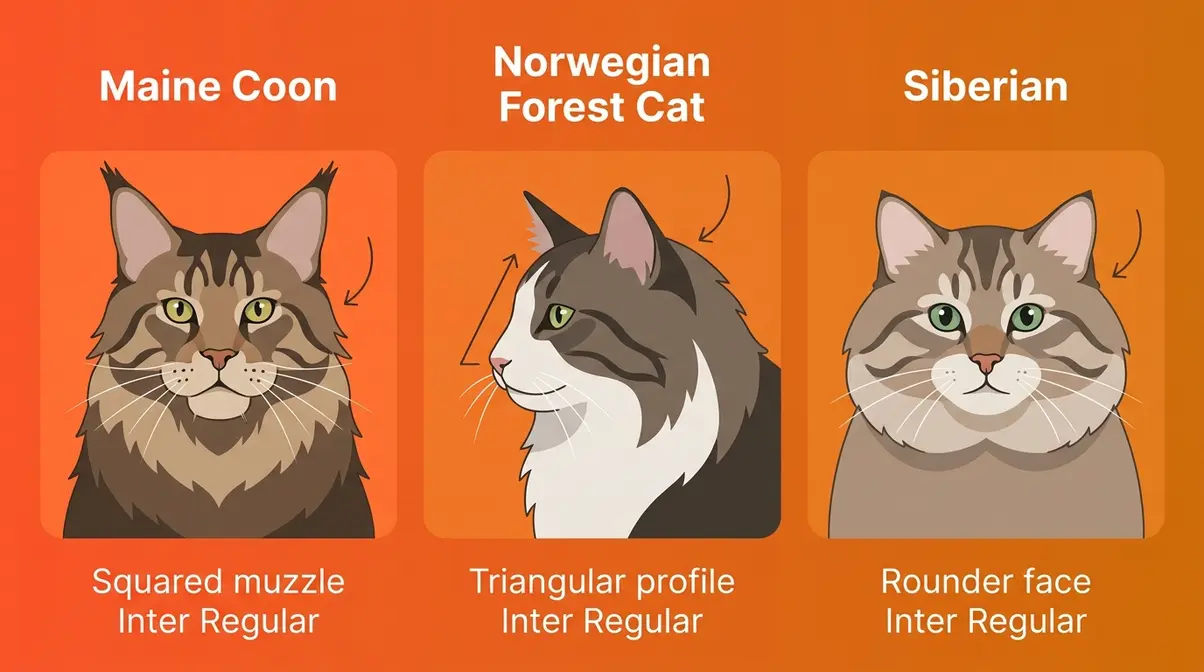
Three breeds are regularly confused with Maine Coons — and the mix-ups are understandable, because all three share the large-body, long-fur profile that makes Maine Coons so visually striking.
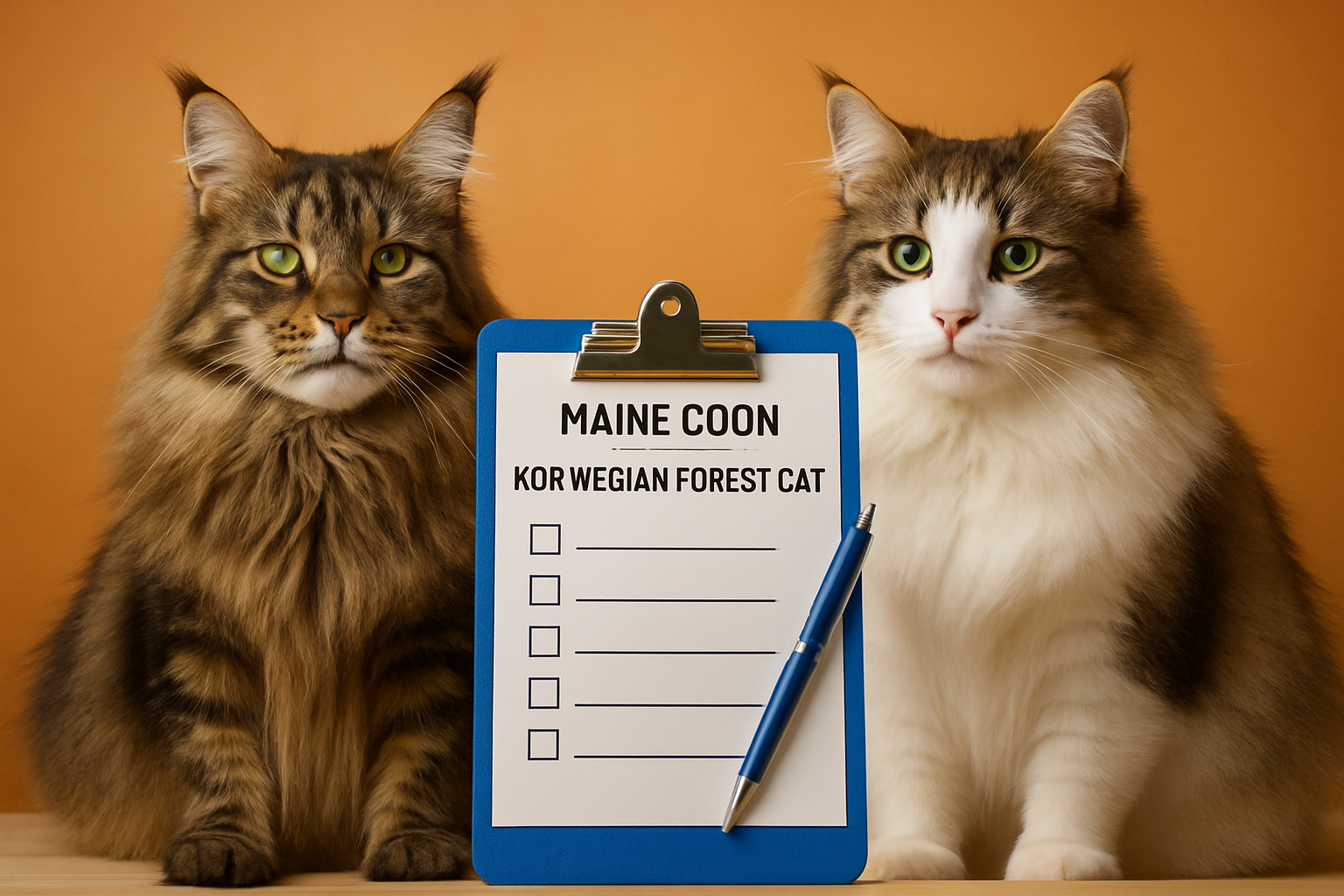
Norwegian Forest Cat is the most common case of mistaken identity. The two breeds share a similar silhouette, dense double coat, and tufted ears. The key difference: Norwegian Forest Cats have a straighter, more triangular facial profile, while Maine Coons have a more squared muzzle and prominent cheekbones. Norwegian Forest Cats also tend to be slightly lighter, averaging 9–16 pounds (TICA, 2026).
Siberian cats are another frequent source of confusion. Siberians are large (10–20 lbs), heavily coated, and similarly people-oriented. They’re distinguished primarily by their rounder face shape and their status as a Russian breed — genetically distinct from the American Maine Coon, as confirmed by UC Davis VGL research (UC Davis VGL, 2026).
Ragdoll cats occasionally get mixed up with Maine Coons, particularly in photos. Ragdolls are comparable in weight (10–20 lbs) but have a distinctly different temperament — they’re famously limp and passive when held, earning their name. They also lack the Maine Coon’s prominent ear tufts and shaggy, uneven coat.
For a detailed visual comparison, our guide on signs your cat is a Maine Coon mix breaks down the differences side by side.
Limitations and Honest Considerations
Common Pitfalls When Estimating Maine Coon Size
The biggest mistake prospective owners make is assuming every Maine Coon will hit the top of the weight range. The CFA’s 13–18 lb standard for males is exactly that — a standard range. Many perfectly healthy male Maine Coons weigh 12–14 lbs. Females frequently top out at 9–10 lbs. Genetics, diet, and individual variation all play a role.
A second common error is conflating The Fluff Factor with actual mass. A Maine Coon that looks enormous may weigh less than a stocky mixed-breed cat of average size. If you’re making adoption decisions based on size alone — for example, hoping the cat will hold its own with a large dog — verify actual weight with the breeder, not just visual impressions.
When Maine Coons Aren’t “Dog-Sized”
Compared to large and giant dog breeds, Maine Coons are simply not in the same weight class. A Labrador Retriever at 70 lbs outweighs even an exceptionally large Maine Coon by a factor of four or more. A Mastiff or Great Dane makes that gap even wider. The “dog-sized” comparison is accurate and meaningful for toy and small breeds — and partially true for medium breeds — but it should never be taken to mean Maine Coons rival large dogs in mass.
Similarly, Maine Coons are not immune to the size limitations of being cats. Their skeletal structure, despite its impressive dimensions, is still feline. They cannot match the physical strength, jumping endurance, or outdoor survivability of a medium or large dog. The comparison is a useful mental framework, not a literal equivalence.
Frequently Asked Questions
Are Maine Coons as big as dogs?
Maine Coons are comparable in size to small and some medium dog breeds, particularly in weight and height. A male Maine Coon weighing 13–18 lbs matches the weight of a Pug or approaches a smaller Beagle. Their total length (up to 40+ inches including tail) rivals many medium dogs. However, they are significantly smaller than large breeds like Labradors or Border Collies (AKC, 2026). Ultimately, the comparison is highly accurate for the toy-to-medium dog size range, but falls short when looking at working breeds.
How big is a full-grown Maine Coon?
A full-grown male Maine Coon typically weighs 13–18 lbs and stands 10–16 inches at the shoulder, with a total length of 38–48 inches including the tail (CFA, 2026). Females are smaller, typically 8–12 lbs and 8–14 inches tall. Most household Maine Coons fall comfortably within this standard range.
What dog is the same size as a Maine Coon?
The Pug is the closest weight match to a male Maine Coon, with both breeds typically landing in the 14–18 lb range (AKC, 2026; CFA, 2026). In height, the Beagle is the most comparable, as both stand around 13–16 inches at the shoulder. For overall presence and visual footprint, the Cocker Spaniel is the most frequently cited comparison. While no single breed is a perfect match, these three cover the range most accurately. If you own any of these dogs, you already know exactly how much space a Maine Coon will take up.
What two breeds make a Maine Coon?
Maine Coons are a naturally occurring breed, meaning they weren’t created by deliberately crossing two parent breeds. The most supported genetic theory suggests they descended from longhaired European cats that bred with North American shorthairs over centuries of natural selection (UC Davis VGL, 2026). The popular legend that they are part raccoon is biologically impossible.
Are Maine Coons friendly or aggressive?
Maine Coons are consistently ranked among the friendliest domestic cat breeds, described by the International Cat Association as “dog-like in their devotion” (TICA, 2026). They are gentle with children, adaptable with other pets, and rarely aggressive without provocation. Aggression, when it occurs, is almost always a response to mishandling or environmental stress rather than a breed-typical trait. Well-socialized Maine Coons raised in calm households are extremely unlikely to show aggressive behavior toward family members. Instead, they prefer to follow their owners from room to room.
What cat cost $100,000?
The Ashera cat is the most famous example of a cat sold for around $100,000, marketed as an ultra-rare hybrid of a domestic cat, an African Serval, and an Asian Leopard Cat. However, DNA testing later revealed that the Ashera was genetically identical to the Savannah cat, a legitimate hybrid breed (UC Davis VGL, 2008). Maine Coons, by contrast, are an accessible purebred that typically cost $800–$2,000.
What cat is mistaken for a Maine Coon?
The Norwegian Forest Cat is most commonly mistaken for a Maine Coon due to their shared large size, dense double coat, and tufted ears. The key difference is that Norwegian Forest Cats have a straighter, more triangular face profile, while Maine Coons have a squared muzzle and prominent cheekbones. Siberians and Ragdolls are also frequently confused with Maine Coons in photos. Genetic testing or pedigree registration is the definitive way to confirm breed identity. If you are adopting, always check the paperwork to be sure.
What are the top 3 largest dog breeds?
The three largest dog breeds by average weight are the Great Dane, Mastiff, and Saint Bernard (AKC, 2026). Great Danes average 110–175 lbs and stand up to 32 inches at the shoulder, while English Mastiffs can exceed 200 lbs. For context, even the heaviest documented Maine Coon weighs less than 20% of an average Great Dane, meaning the “dog-sized” comparison applies only to the small-to-medium range.
The Size That Earns the Title “Gentle Giants”
For curious pet owners wondering how Maine Coon size compares to dogs, the data delivers a satisfying answer. A full-grown male Maine Coon — weighing 13–18 lbs, standing up to 16 inches at the shoulder, and stretching 40+ inches from nose to tail tip — genuinely rivals small dog breeds and approaches medium ones. The CFA and AKC data confirm what viral photos only suggest: this is a cat that occupies dog-sized space in your home and your life.
The Fluff Factor makes the impression even stronger. That thick double coat, built for New England winters according to UC Davis VGL research, amplifies their frame visually — which is why so many first-time viewers reach for dog comparisons instinctively. The Fluff Factor isn’t exaggeration. It’s biology doing exactly what it was designed to do.
If you’re ready to bring one of these “dogs of the cat world” home, start with reputable CFA or TICA-registered breeders, plan for a cat that won’t stop growing for 3–5 years, and make sure your space is ready for a genuinely large animal. Check our Maine Coon size and weight tracker to follow your kitten’s growth milestones month by month.

Dave King
Cat owner and writer at Mad Cat Man.