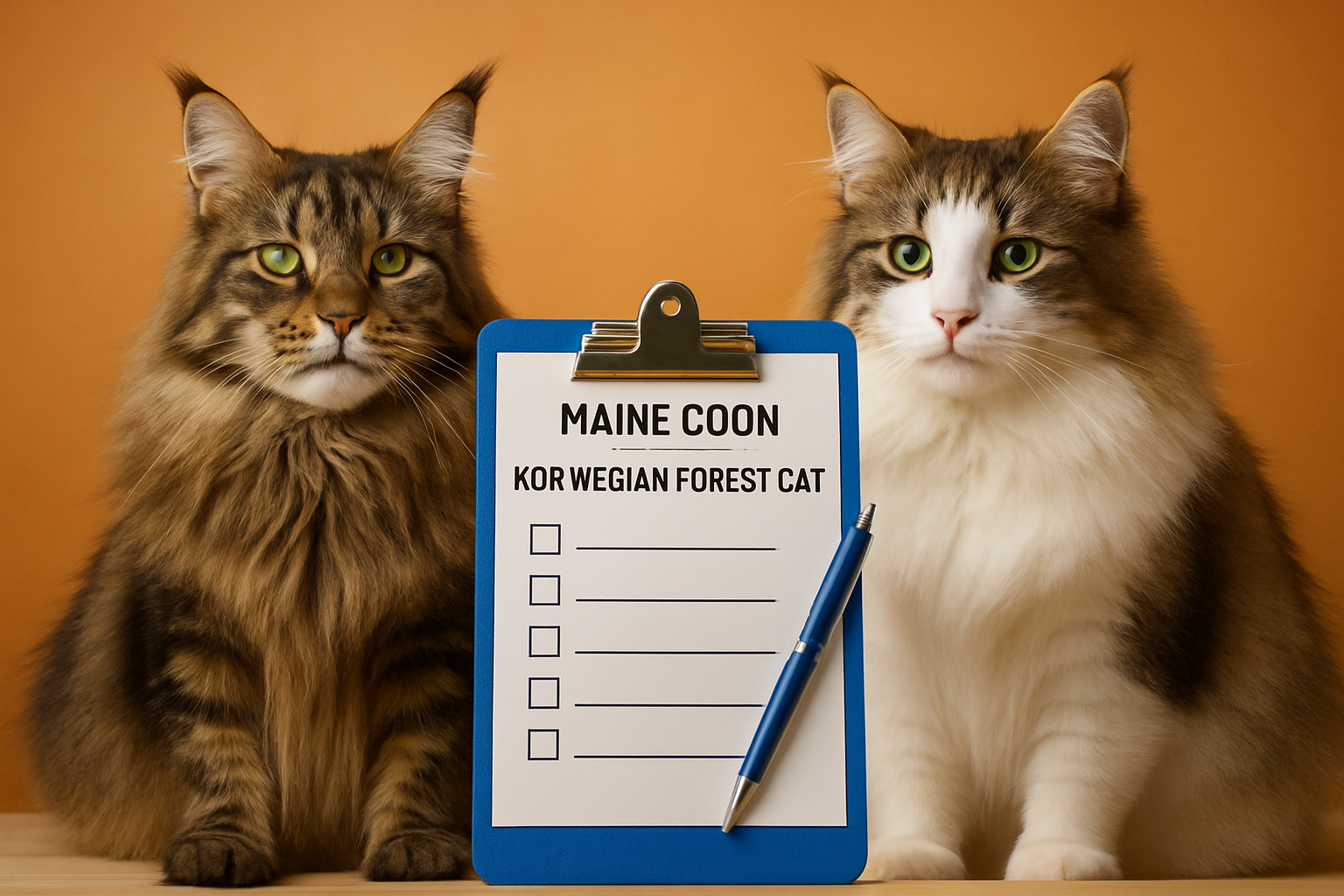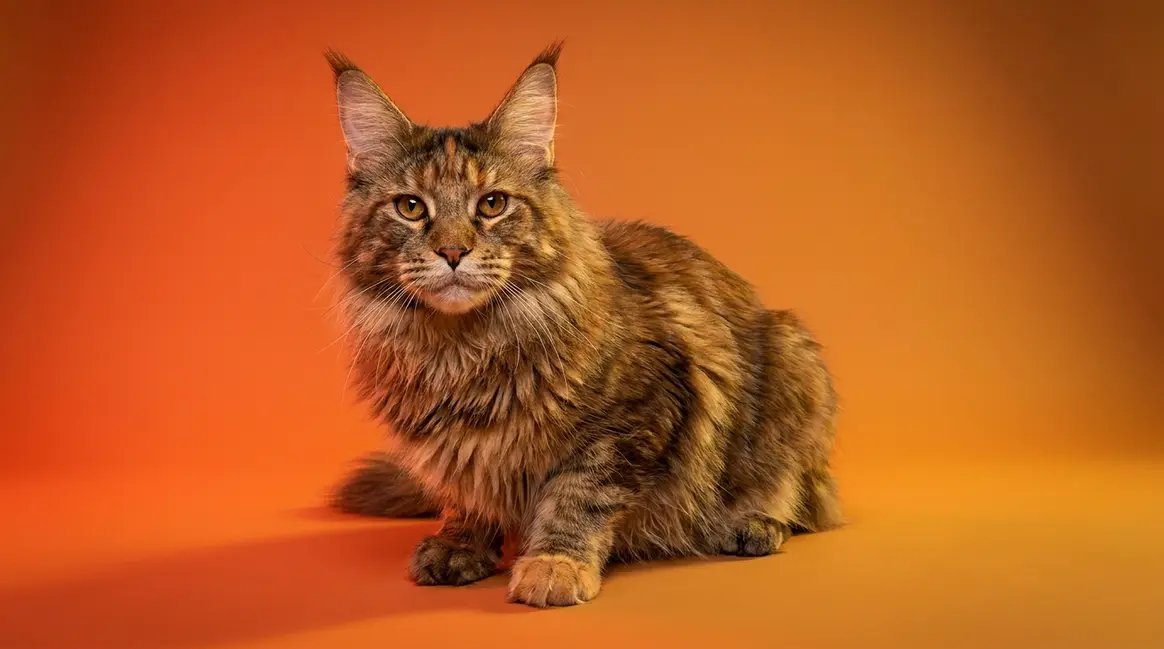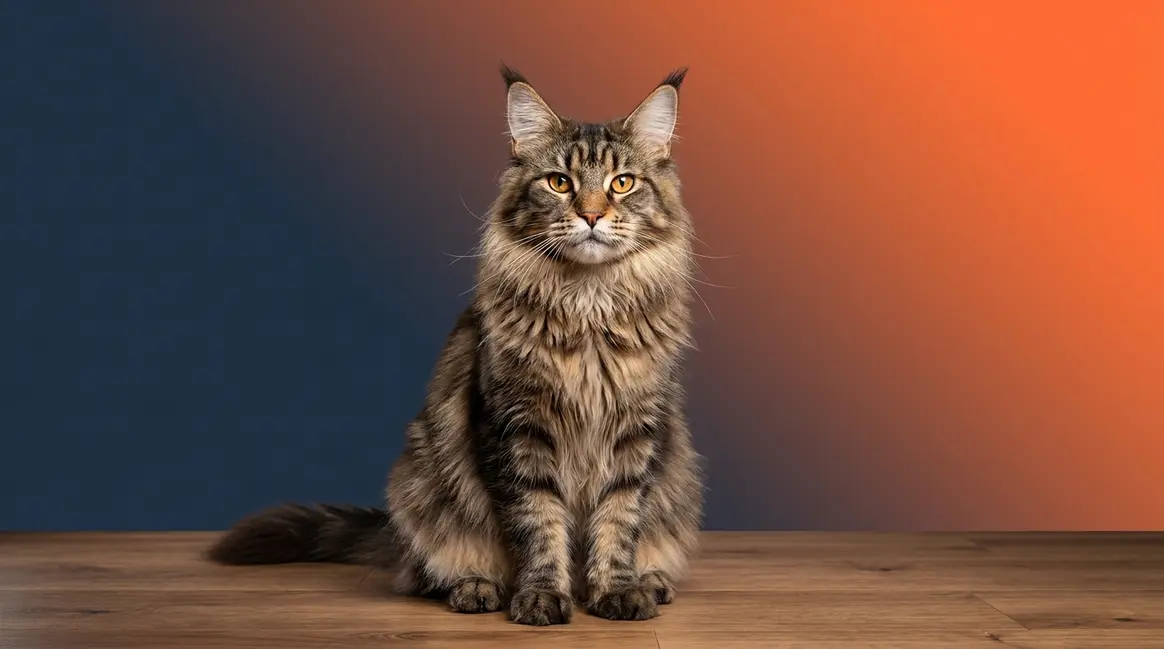

Maine Coon behaviour problems — from growling and hissing to terrorizing you at night — almost always trace back to one of five root causes: unmet energy needs, territorial instinct, separation anxiety, overstimulation, or an underlying health issue. This 5-step guide walks you through how to identify which problem you’re dealing with, and gives you a vet-backed, step-by-step fix for each one — without yelling or punishment. Time to fix: 10–30 minutes per step.
Your Maine Coon is a giant, fluffy contradiction — affectionate one second, then pushing your hand away with a paw the next. Sound familiar? One moment they’re draped across your lap purring like a motorboat. The next, they’re knocking your water glass off the counter at 3 a.m. or pinning their ears back and growling at the dog.
Without understanding why these behaviours happen, they tend to escalate. What starts as “a little stubborn” can become a genuinely stressed cat that hides, stops eating, or turns very aggressive. Maine Coon behaviour problems are rarely random — they’re communication. And once you learn the language, the fixes become surprisingly straightforward.
By the end of this guide, you’ll know exactly which of the five root causes is driving your Maine Coon’s behaviour, and have a step-by-step plan to fix it. We’ll cover identification, aggression, night-time chaos, separation anxiety, and positive discipline — in that order.
Maine Coon behaviour problems are almost always fixable — most stem from boredom, territorial instinct, or separation anxiety, not “bad” temperament.
- Use the Quirk-or-Crisis Test: Not every odd behaviour is a problem — know what’s normal first before trying to fix it
- Aggression has 5 warning signs you can spot before a bite happens (Cornell Feline Health Center)
- Night chaos is solvable with a 20-minute pre-bed play routine that drains energy naturally
- Never yell: Ohio State University vets confirm it increases fear and makes behaviour worse, not better
- Red flag rule: Sudden behaviour changes always need a vet check — they can signal pain or illness
What You’ll Need Before You Start
Before we work through these solutions, it helps to understand which common Maine Coon behavior problems are actually fixable with training — and which ones are breed traits you’ll need to accept.
You don’t need fancy equipment. Here’s what to have ready:
- High-value treats (small pieces of cooked chicken or tuna work best — something your cat will work for)
- A quiet 10-minute window each day for consistent practice
- Patience — most Maine Coon behaviour improvements take 2–4 weeks of consistent effort before you see a real shift
One term you’ll see throughout this guide: positive reinforcement. It simply means rewarding the behaviour you want to see more of, rather than punishing the behaviour you don’t want. Every step in this guide uses this method because it works — and because punishment makes things worse (more on that in Step 5).
⚠️ Vet Check First: If your Maine Coon’s behaviour changed suddenly — especially if they were previously calm — book a vet appointment before trying any of these steps. Sudden aggression, hiding, or litter box avoidance can signal pain, dental disease, or illness. No training protocol fixes a medical problem.
Ready? Start with Step 1 — because you can’t fix a problem until you know exactly what you’re dealing with.
Step 1: Identify the Behaviour Problem
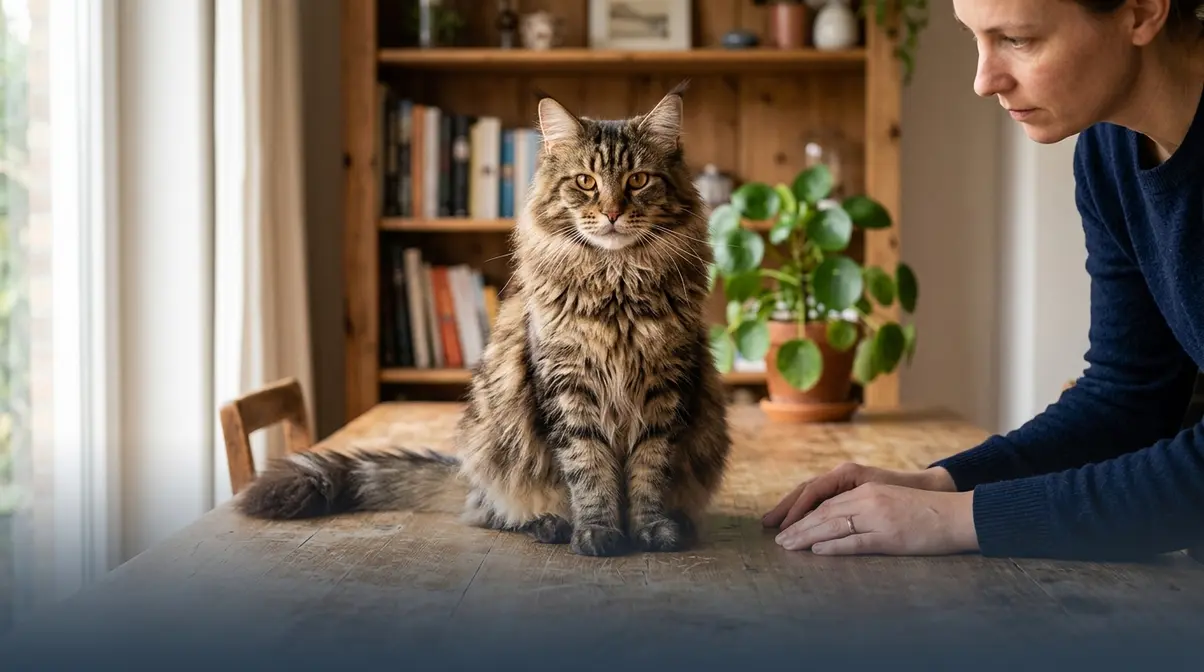
The single biggest mistake frustrated Maine Coon owners make is jumping straight to a “fix” without first checking whether the behaviour is actually a problem. Maine Coons are a large, semi-longhaired domestic cat breed known for dog-like loyalty and high intelligence — and that combination produces some genuinely odd behaviours that are completely normal for the breed.
The Quirk-or-Crisis Test is a simple two-question check: Is this behaviour new, or has it always been there? And is it causing harm — to you, your cat, or your household? If the behaviour is long-standing and not causing real harm, it’s likely a quirk. If it appeared suddenly or is escalating, it’s potentially a crisis that needs action.
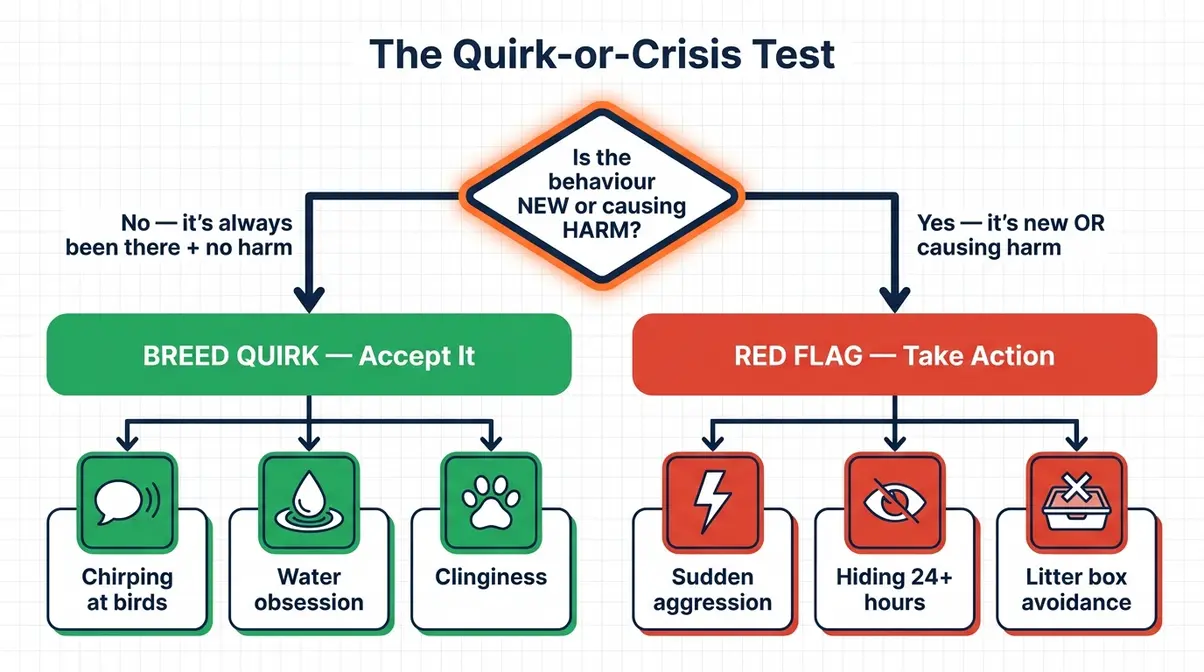
Quirk-or-Crisis: Normal vs. Red Flag
Maine Coon owners consistently report being confused by behaviours that look alarming but are actually standard for the breed. Here’s a quick reference:
| Behaviour | Quirk or Crisis? | What It Means |
|---|---|---|
| Chirping / trilling at birds | ✅ Quirk | Normal hunting vocalisation |
| Obsession with running water | ✅ Quirk | Breed trait — instinctive preference |
| Knocking things off surfaces | ✅ Quirk | Curiosity + attention-seeking |
| Following you room to room | ✅ Quirk | Dog-like loyalty — normal for breed |
| Sudden hissing at familiar people | 🚨 Crisis | Pain, fear, or overstimulation |
| Litter box avoidance (new) | 🚨 Crisis | Possible UTI, kidney issue, or stress |
| Hiding for 24+ hours | 🚨 Crisis | Illness, severe stress, or injury |
| Eating, then dropping food (quidding) | 🚨 Crisis | Likely dental pain — vet visit needed |
Red flag rule: Any behaviour that appeared suddenly in a previously calm cat is a medical concern until proven otherwise.
What is Tarzan Syndrome in Cats?
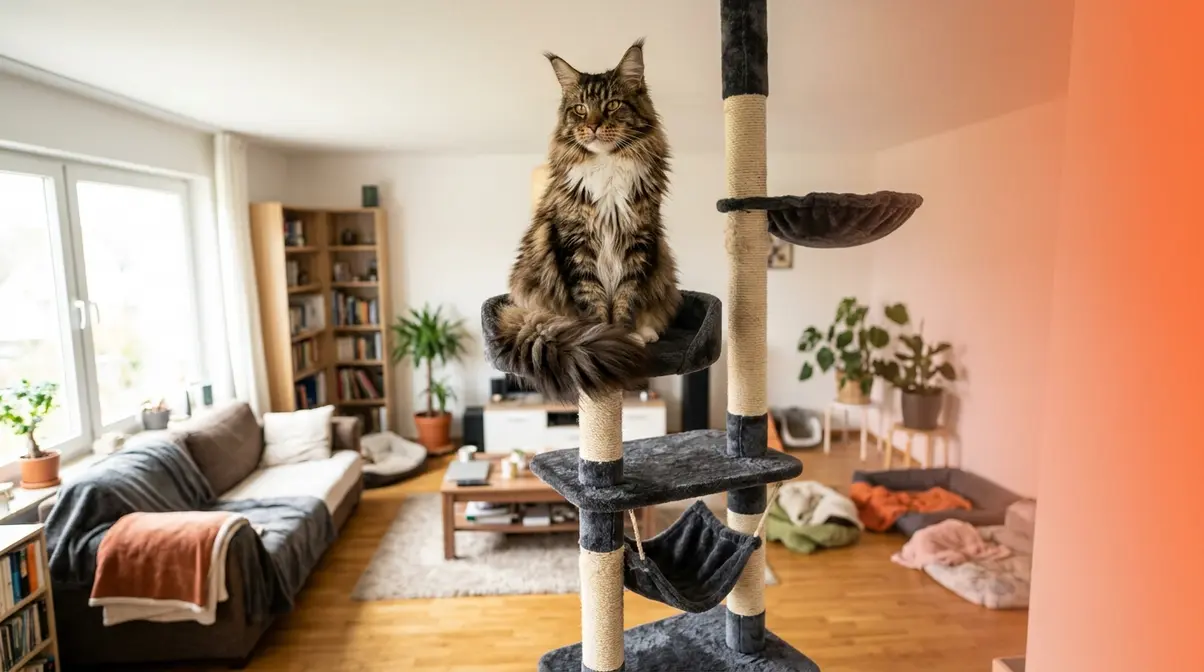
Three quirks that consistently alarm new Maine Coon owners — and all three have straightforward explanations:
Tarzan syndrome is an informal term for a cat’s compulsive drive to climb to the highest available point in any room. It’s particularly common in Maine Coons due to their strong prey instinct and physical size — they’re built to climb, and height feels instinctively safe and dominant to them. It’s not aggression, and it’s not a behavioural problem that needs correcting. The practical fix is providing a tall, sturdy cat tree (minimum 1.5–1.8 metres) so they direct the behaviour there rather than toward your bookshelves or kitchen cabinets.
Quidding is when a cat picks up food and then drops it from its mouth mid-chew. In the context of breed quirks, some Maine Coons do this with oversized kibble pieces. However, if it’s happening frequently, quidding is a clinical sign of dental pain — according to the Merck Veterinary Manual, oral discomfort is among the most under-diagnosed causes of changed eating behaviour in cats. If you see this more than occasionally, book a dental check.
Water obsession is one of the most reported Maine Coon quirks. These cats frequently dip their paws in water bowls, splash in sinks, or sit next to running taps. The ASPCA notes that cats with strong prey instincts often prefer moving water, which they associate with freshness and safety. A cat water fountain usually resolves any disruption this causes.
Quick Behaviour Checklist
Before moving to the steps, tick off what you’re actually dealing with:
- [ ] Biting or scratching without warning
- [ ] Growling, hissing, or pinning ears back
- [ ] Waking you up repeatedly at night
- [ ] Destructive chewing or scratching furniture
- [ ] Crying, howling, or vocalising when left alone
- [ ] Stealing food or obsessing over mealtimes
- [ ] Litter box avoidance (new behaviour)
- [ ] Sudden change in personality or energy level
Ticked one or more in the first four? Go to Step 2 or Step 3. Ticked the last four? Step 4 and the “When to Call Your Vet” section are your priority.
Step 2: Stop Aggression and Territorial Behaviour
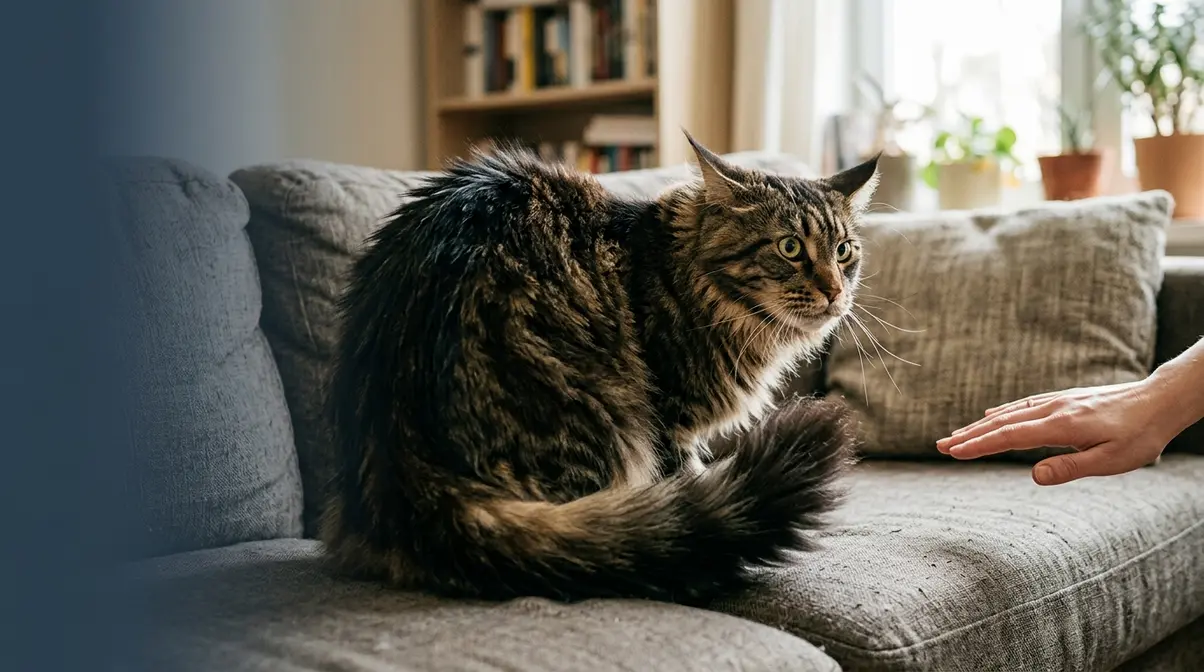
Aggression is the number-one Maine Coon behaviour problem that owners describe as “coming out of nowhere.” It almost never does. According to the Cornell Feline Health Center, aggression is the second most common behavioural complaint in domestic cats — and in the vast majority of cases, there are clear warning signs owners simply haven’t been taught to recognise.
Maine Coons are not naturally aggressive cats. When they bite or scratch, something triggered it. Your job is to learn the trigger — then remove it.
5 Warning Signs Before a Cat Snaps
Maine Coon owners who learn these signals can interrupt an escalation before it becomes a bite. Watch for all five:
- Tail lashing — a fast, whipping side-to-side motion (different from a slow curious swish)
- Skin rippling — the fur along the back twitches or rolls in waves
- Ears rotating or flattening — ears pin back or swivel sideways (“airplane ears”)
- Dilated pupils — even in a bright room, pupils widen suddenly
- Freezing mid-pet — your cat goes completely still under your hand
When you see two or more of these together, stop what you’re doing. Don’t pull your hand away quickly (that triggers a chase reflex). Instead, go still, then slowly withdraw.
“He will let you pet him and then push away your hand with a paw. Then he will let you pet and then wrap his paws around you and slight—”
— Maine Coon owner, Reddit community
This is petting-induced overstimulation — one of the most common triggers of Maine Coon aggression. It’s not random. The cat is communicating with their body the entire time; most owners just haven’t learned to read the signals yet.
The 5-Step De-escalation Plan
Use this framework when your Maine Coon is already in an agitated state:
Step 1: Stop all contact immediately. Go completely still. Do not pull away fast. Wait 3–5 seconds, then slowly remove your hand or move away. Why this matters: sudden movement activates predatory instinct and escalates the situation.
Step 2: Give them space — don’t follow. Back away slowly. Do not try to comfort them by reaching out again. Checkpoint: your cat should begin to relax their tail and ears within 60–90 seconds once you’ve backed off.
Step 3: Identify what triggered it. Was it duration of petting? A specific spot (belly, base of tail)? A sound or movement in the room? Write it down. Why this matters: pattern recognition is the fastest route to prevention.
Step 4: Reintroduce contact on their terms. Wait until your cat approaches you. Let them sniff your hand first. Pet briefly (5–10 strokes), then stop before they signal discomfort. Checkpoint: you should be able to end a petting session on your terms, not theirs.
Step 5: Reward calm behaviour. When your cat accepts petting without escalating, give a small treat immediately. Why this matters: you’re teaching them that calm equals reward — this is positive reinforcement in action.
Multi-Cat Household Aggression Fixes
Territorial aggression in multi-cat households follows a predictable pattern: one cat controls a resource (food bowl, favourite chair, litter box), and conflict happens when another animal approaches it. The fix is resource multiplication — not mediation.
Provide one resource per cat, plus one extra: if you have two cats, you need three litter boxes, three feeding stations, and multiple elevated resting spots. This removes the scarcity that drives territorial behaviour. Maine Coon owners who implement this report a significant reduction in household aggression within 2–3 weeks, according to community consensus across multiple Maine Coon owner forums.
Read more about identifying Maine Coon aggression triggers to fully resolve household tension.
Step 3: Manage High Energy and Night-time Chaos
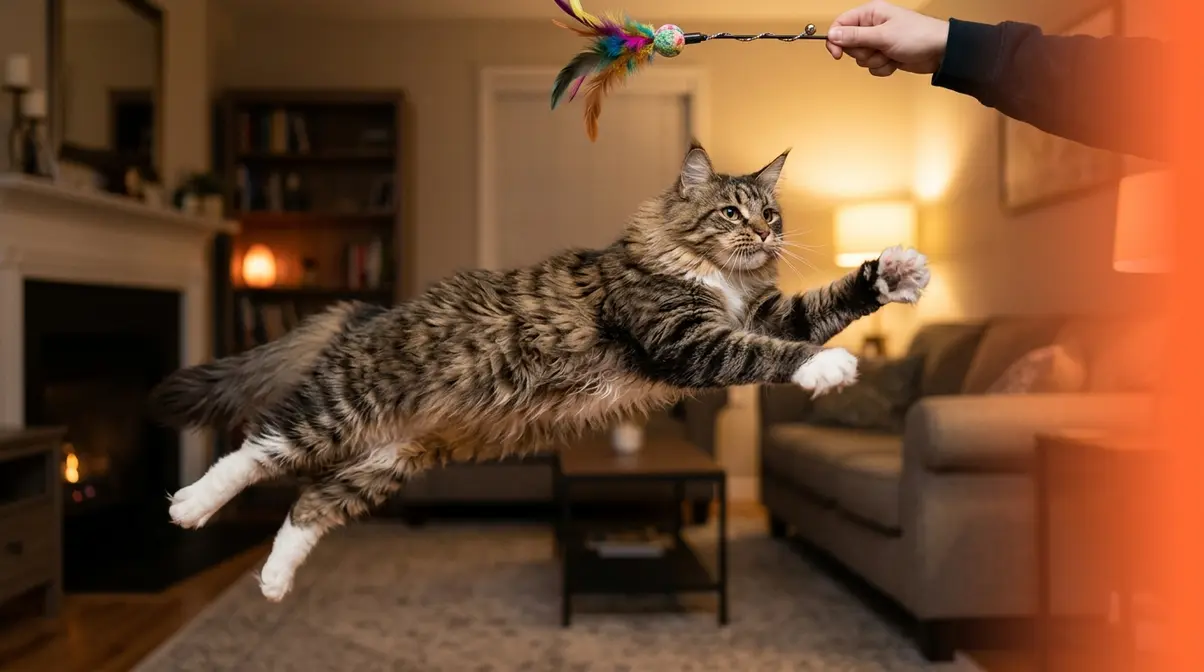
If your Maine Coon terrorizes you at night — knocking things over, vocalising, jumping on your face at 2 a.m. — you are not alone, and your cat is not broken. They’re crepuscular (most active at dawn and dusk), and in a home environment, “dusk” often lines up with exactly when you’re trying to sleep.
Maine Coon owners consistently report this as one of the most exhausting Maine Coon behaviour problems to live with. The good news: it’s one of the most reliably fixable, once you understand the biology behind it.
Why Maine Coons ‘Terrorize at Night’
Maine Coons are large, high-intelligence cats with a strong prey drive. In the wild, their ancestors hunted at twilight. In your living room, that same drive activates at night — and if there’s no outlet for it, your furniture, your feet, and your sleep schedule become the prey.
The problem isn’t that your cat is nocturnal. It’s that they’ve banked unused energy all day while you were at work, and now it needs to go somewhere. According to the ASPCA, insufficient daytime stimulation is the primary driver of night-time activity problems in domestic cats.
“Terrorizes at night” is almost always a daytime enrichment failure, not a night-time behaviour problem.
Pre-Bed Energy Drain Routine Steps
This routine takes 20 minutes and, when done consistently for 2 weeks, dramatically reduces night-time disruptions. Do it every evening, starting 30–45 minutes before your bedtime.
Step 1 (Minutes 0–10): Active hunt play. Use a wand toy (feather or mouse on a string) and mimic prey movement — erratic, fast, then slow, then freeze. Get your cat leaping, chasing, and pouncing. Why this matters: this replicates a full hunt cycle and activates the “tired predator” response.
Step 2 (Minutes 10–15): Wind down play. Slow the toy movements gradually. Let your cat “catch” the toy several times. End with them holding it still. Checkpoint: your cat should be panting lightly or lying down to groom — both signs of successful energy drain.
Step 3 (Minutes 15–20): Feed their main meal. Give dinner immediately after play. In the wild, cats hunt, then eat, then groom, then sleep. You’re completing that cycle artificially. Why this matters: feeding after play triggers the natural post-hunt rest response.
Step 4: Close the bedroom door if needed. There is no shame in this. A well-exercised cat will usually settle within 20–30 minutes of eating. A closed door is not cruel — it’s a boundary.
Stop Destructive Chewing Fast
Maine Coons chew furniture, cables, and clothing for three main reasons: teething (in kittens), boredom (in adults), or dental discomfort (in any age). Before redirecting the behaviour, rule out dental pain — especially if the chewing is focused on one side of the mouth.
- For boredom-driven chewing, the fix is redirection plus deterrent:
- Apply double-sided tape or citrus spray to surfaces they target (cats dislike both textures and smells)
- Offer a legal chew alternative: dental chew toys, raw hide-free chew sticks, or a frozen Kong-style toy
- Increase daily play by 10–15 minutes
Learn more about managing destructive Maine Coon behaviour to protect your home.
Step 4: Help a Clingy or Anxious Maine Coon
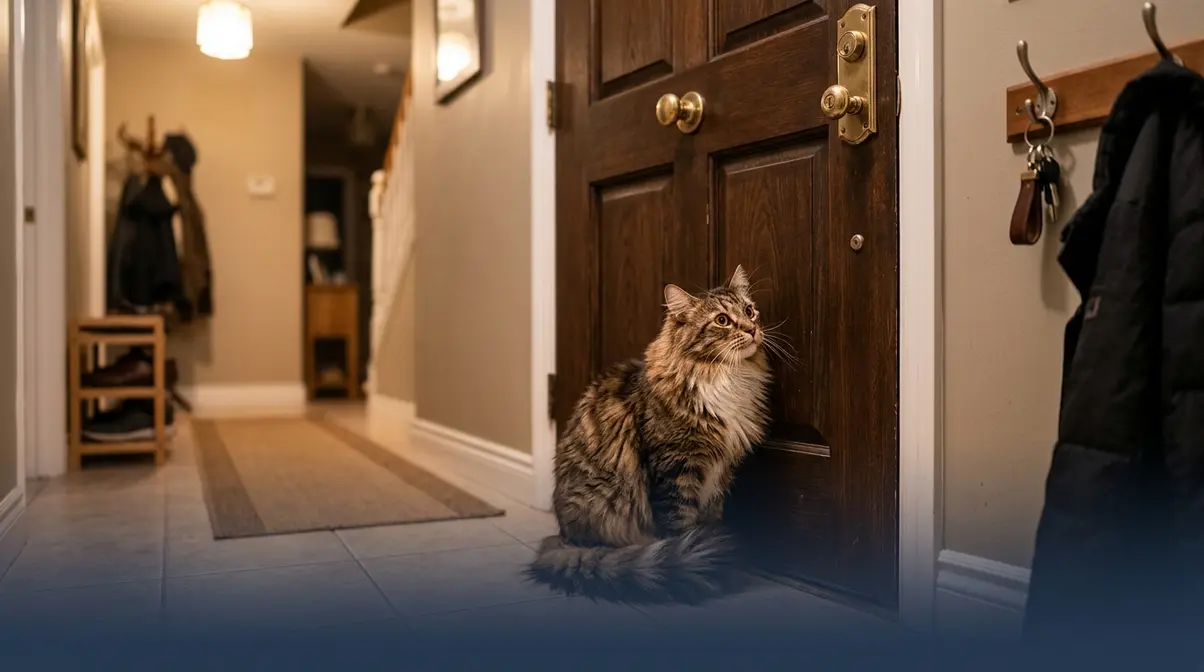
Maine Coons are often described as “dog-like” in their attachment to their owners — and for most people, that’s a feature, not a bug. But there’s a meaningful difference between a loyal cat who likes your company and a cat with genuine separation anxiety. One is a breed trait. The other is a welfare issue that needs addressing.
Signs of Feline Separation Anxiety
Veterinary behaviourists at Tufts University describe feline separation anxiety as a stress response triggered by the absence of a primary attachment figure — and Maine Coons, due to their high social intelligence, are more prone to it than most breeds.
Watch for these signs, specifically when you’re about to leave or have just returned:
- Excessive vocalisation when you pick up your keys or coat
- Destructive behaviour (scratching doors, knocking items over) that only happens when you’re gone
- Inappropriate elimination — urinating outside the litter box near your belongings
- Over-grooming — patches of thinning fur, especially on the belly or inner legs
- Frantic greeting behaviour when you return, followed by clinginess for hours
A cat that follows you room to room contentedly? Breed quirk. A cat that yowls for 30 minutes after you leave and has scratched through the doorframe? That’s separation anxiety.
“He will let you pet him and then push away your hand with a paw. Then he will let you pet and then wrap his paws around you and slight—”
This push-pull behaviour is also a classic anxiety signal — a cat that craves contact but can’t regulate their own arousal around it. It’s not mixed signals. It’s a cat that hasn’t learned how to feel secure.
Build Independence in 4 Steps
This protocol, used consistently over 3–4 weeks, helps your cat learn that being alone is safe — not threatening.
Step 1: Desensitise departure cues. Pick up your keys, put on your coat, then sit back down and do nothing. Repeat 5–10 times daily. Why this matters: your cat has learned that coat = abandonment. You’re breaking that association.
Step 2: Practice micro-absences. Leave the room for 30 seconds. Return calmly — no big hello, no fuss. Gradually increase to 2 minutes, then 5, then 10 over the course of a week. Checkpoint: your cat should stop vocalising before you return. If they’re still crying at 2 minutes after a week of practice, move more slowly.
Step 3: Create a safe “alone space.” Set up a comfortable area with a worn item of your clothing (your scent is calming), a puzzle feeder, and a window perch. This becomes the place they associate with calm solo time. Why this matters: cats with a defined safe space show significantly lower stress markers when alone, according to feline behaviour research.
Step 4: Consider a companion. For Maine Coons with severe separation anxiety, a second cat — ideally another Maine Coon or a similarly social breed — can be genuinely transformative. Introduce slowly using the scent-swap method (exchange bedding before allowing face-to-face contact).
Familiarizing yourself with Maine Coon separation anxiety signs is the first step toward building their confidence.
Step 5: Discipline Without Punishment
Here’s what “discipline” actually means for a cat: redirecting unwanted behaviour toward an acceptable alternative, using positive reinforcement. It does not mean yelling. It does not mean spraying water. It does not mean scruffing. Those methods don’t work — and the science on why is unambiguous.
What to Do Instead of Yelling at a Cat?
Instead of yelling, use the “stop, redirect, reward” method. The moment your cat does something unwanted: stop what you’re doing, silently move them or yourself away from the situation, redirect them to an acceptable alternative behaviour, then reward that alternative immediately. For attention-seeking behaviours specifically, any reaction — including yelling — reinforces the behaviour. Turning your back and giving zero attention is consistently more effective.
Veterinary behaviourists at Ohio State University’s Indoor Pet Initiative explain that cats do not have the cognitive framework to connect punishment with a past action. By the time you’ve raised your voice, your cat has already moved on mentally. What they register is: this person is unpredictable and sometimes frightening. The result is increased anxiety — which drives more of the exact behaviours you’re trying to stop.
Maine Coon owners who rely on yelling report a consistent pattern: the behaviour stops for a few seconds, then resumes, then escalates over weeks. This is because fear-based suppression doesn’t address the underlying need driving the behaviour. It just adds stress on top of it.
The stubborn Maine Coon paradox: The more you punish, the more anxious they become. The more anxious they become, the more “badly” they behave. Positive reinforcement breaks this cycle.
How to Discipline a Maine Coon Cat?
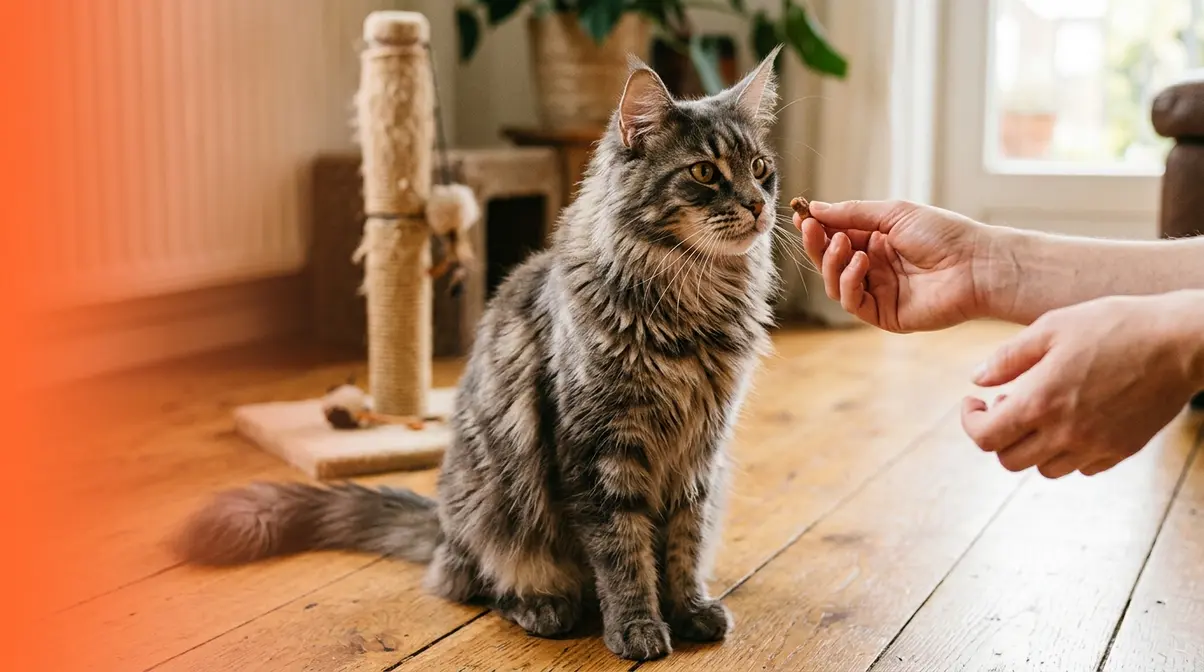
Discipline a Maine Coon using redirection and positive reinforcement — never punishment. When they do something unwanted, silently redirect them to the acceptable alternative (scratching post instead of sofa, cat tree instead of counter), then reward them immediately when they use it. Yelling, spraying water, or physical correction increases anxiety and worsens behaviour over time, according to veterinary behaviourists at Ohio State University.
Use this 6-step framework for any unwanted behaviour — scratching furniture, jumping on counters, stealing food, or biting:
Step 1: Catch them doing something right. The first step is observation. Spend one day just noticing when your cat is calm, quiet, or doing something acceptable. Why this matters: you need to know what “good” looks like before you can reward it.
Step 2: Mark the moment. The instant your cat does the right thing, say “yes” in a bright, consistent tone (or use a clicker — see below). Checkpoint: the marker must happen within 2 seconds of the behaviour, or the cat won’t connect them.
Step 3: Deliver the reward immediately. Follow the marker with a high-value treat within 3 seconds. Why this matters: the treat reinforces that the marked behaviour leads to good things.
Step 4: Ignore unwanted behaviour where safe to do so. For attention-seeking behaviours (vocalising, pawing), turn your back, cross your arms, and give zero eye contact. Any reaction — even negative — is a reward for an attention-seeking cat. Checkpoint: the behaviour will often get worse before it gets better (called an “extinction burst”) — this is normal. Hold firm.
Step 5: Redirect, don’t punish. If your cat is scratching the sofa, don’t shout. Silently move them to the scratching post, then reward them the moment they use it. Why this matters: you’re showing them where the behaviour is acceptable, not just where it isn’t.
Step 6: Be consistent across all people in the household. One person rewarding the behaviour while another punishes it creates a confused, anxious cat. Everyone needs to use the same method. Checkpoint: within 2–3 weeks of consistent application, you should see measurable reduction in the target behaviour.
Knowing exactly how to discipline a Maine Coon safely will transform your relationship with your pet.
Clicker Training for Maine Coons
A clicker is a small handheld device that makes a precise clicking sound — it’s faster and more consistent than a verbal marker, which makes it particularly effective for the intelligent, easily bored Maine Coon. According to Catster’s guide to Maine Coon discipline, clicker training is one of the most recommended tools by feline behaviourists for high-intelligence breeds.
- To start clicker training:
- Click, then immediately give a treat. Repeat 20 times over two sessions. Your cat now knows: click = treat coming.
- Wait for a natural behaviour you want to reinforce (sitting, staying on their cat tree). Click the instant it happens. Treat.
- Add a cue word (“sit,” “down”) just before the behaviour once your cat is doing it reliably.
- Practice for 5 minutes maximum per session — Maine Coons have high intelligence but short formal training attention spans.
Check out a complete Maine Coon clicker training guide to master these techniques.
When to Call Your Vet for Behaviour Issues
Not every Maine Coon behaviour problem is a training issue. Some behaviours are your cat’s only way of telling you they’re in pain. Knowing the difference between a behavioural problem and a medical symptom can be the difference between a training protocol and a life-saving vet visit.
What is a Red Flag Behavior in Cats?
A red flag behaviour is any sudden change from your cat’s established baseline — especially aggression, hiding, or litter box avoidance. These are your cat’s primary way of communicating pain or illness. A Maine Coon that was previously calm and suddenly becomes aggressive, or a cat that stops using the litter box without an obvious environmental cause, needs a vet visit within 24–48 hours. Gradual behavioural changes can also be red flags — particularly increased vocalisation or appetite changes in older cats, which can signal hyperthyroidism.
These specific behaviours require a vet appointment — not a training plan:
- Sudden aggression in a previously calm cat — pain (especially dental or arthritic) is the number-one cause of unexpected aggression in adult cats
- Hiding for more than 24 hours — cats hide when they feel vulnerable; sustained hiding signals illness or severe pain
- Litter box avoidance (new onset) — urinary tract infections, kidney disease, and bladder stones all present this way first
- Quidding (dropping food while eating) — as noted earlier, this is a primary clinical sign of dental disease
- Excessive vocalisation, especially at night, in older cats — can signal hyperthyroidism, hypertension, or cognitive dysfunction (feline dementia)
- Sudden change in appetite, thirst, or weight — multiple systemic conditions present this way
According to the Merck Veterinary Manual, behavioural changes are among the most reliable early indicators of underlying illness in cats — and are frequently the first symptom owners notice before any physical signs appear.
Being aware of common Maine Coon health problems can help you spot these red flags early.
Behaviour Problems as Health Signals
The connection between health and behaviour is direct and consistent. Here are the most common pairings Maine Coon owners and vets see:
| Behaviour Change | Possible Medical Cause | Urgency |
|---|---|---|
| Sudden aggression | Dental pain, arthritis, hyperthyroidism | Book within 48 hours |
| Increased vocalisation (older cat) | Hyperthyroidism, hypertension, cognitive dysfunction | Book within 48 hours |
| Litter box avoidance | UTI, bladder stones, kidney disease | Book same day |
| Quidding / dropping food | Dental disease, mouth ulcers | Book within 1 week |
| Over-grooming / hair loss | Allergies, stress, parasites, pain | Book within 1 week |
| Hiding / withdrawal | Any systemic illness, pain, fever | Book same day if prolonged |
⚠️ Veterinary Disclaimer: Sudden behaviour changes always warrant a vet visit — they can signal pain, illness, or neurological issues. This guide is not a substitute for professional veterinary advice. When in doubt, call your vet first.
Always review a comprehensive Maine Coon vet visit checklist before heading to the clinic.
Frequently Asked Questions
Downsides of Owning a Maine Coon?
Maine Coons require significantly more time, enrichment, and interaction than the average domestic cat. They are highly social and intelligent, which means boredom hits them hard — and bored Maine Coons become destructive Maine Coons. They also shed heavily (twice yearly blow-outs plus year-round moderate shedding), require regular grooming, and are prone to specific health conditions including hypertrophic cardiomyopathy (a heart condition) and hip dysplasia. For the right owner, none of these are dealbreakers. For someone wanting a low-maintenance pet, a Maine Coon may not be the right fit.
Understanding all Maine Coon pros and cons ensures you are fully prepared for ownership.
Do Maine Coon Cats Pick One Person?
Yes — Maine Coons frequently form a primary bond with one person in the household, though they’re generally friendly with everyone. They’ll follow their chosen person from room to room, sleep near them, and show signs of distress when that person is absent. This is a breed trait rooted in their high social intelligence, not a behaviour problem. However, if the attachment becomes so intense that your cat shows signs of separation anxiety (destructive behaviour, vocalisation, over-grooming when you’re gone), the independence-building protocol in Step 4 can help.
Many owners wonder, do Maine Coons pick one person, and the answer lies deeply in their social nature.
Male vs. Female Maine Coon?
Neither is objectively better — the differences are modest and largely influenced by whether the cat is spayed or neutered. Unneutered males are more territorial and prone to spraying. Unneutered females cycle loudly and frequently. Once both are altered, personality differences narrow considerably. Males tend to be slightly more laid-back and food-motivated (useful for training). Females tend to be slightly more independent. Individual personality varies far more than sex does — meet the specific cat before deciding.
Average Maine Coon Lifespan?
Maine Coons typically live 12–15 years, according to the American Veterinary Medical Association (AVMA), with well-cared-for cats occasionally reaching 17–18 years. Lifespan is heavily influenced by genetics, diet, veterinary care, and whether the cat is kept indoors. The breed’s two main health vulnerabilities — hypertrophic cardiomyopathy (HCM) and spinal muscular atrophy (SMA) — can shorten lifespan if unmanaged. Annual vet checks, a cardiac screening at age 2–3, and a high-protein diet are the most impactful steps you can take for longevity.
Conclusion
Maine Coon behaviour problems are rarely what they first appear to be. What looks like aggression is often overstimulation. What looks like stubbornness is often boredom. What looks like “being a little shit” at 3 a.m. is often a crepuscular cat with nowhere to direct 12 hours of stored energy. The Quirk-or-Crisis Test gives you the first and most important tool: knowing whether you’re dealing with a breed trait to accept or a genuine problem to fix.
This guide synthesises advice from veterinary behaviourists and Maine Coon owner communities — because both matter. The science tells you why the behaviour happens. The owner communities tell you what actually works at 2 a.m. with a real, 8-kilogram, opinionated cat.
Start with Step 1 today. Spend 10 minutes identifying which behaviour you’re actually dealing with before trying to fix anything. Most owners who do this discover that at least one of their “problems” is just a quirk — which means one less thing to stress about. For everything else, the five steps above give you a clear, vet-backed path forward. Your Maine Coon isn’t broken. They just need you to speak their language.
For more advanced techniques, consult a complete Maine Coon training guide to continue building a strong bond with your cat.

Dave King
Cat owner and writer at Mad Cat Man.