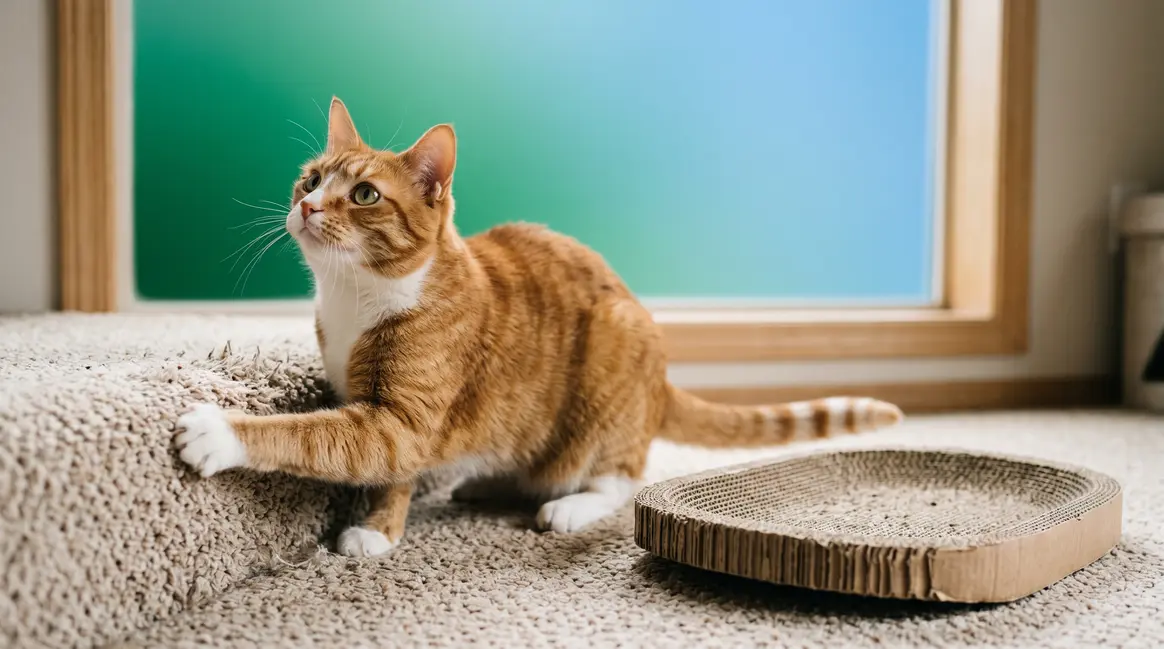

To stop cat scratching carpet, use a two-part approach: make the carpet unattractive with double-sided tape or a citrus spray, then place a horizontal sisal or cardboard scratcher directly over the spot your cat targets. This 6-step process takes 1–2 weeks to see consistent results. The key insight: carpet scratchers prefer horizontal surfaces, so vertical posts alone won’t work.
If your cat WILL NOT stop scratching every corner of your carpet, you are not alone — and you are definitely not dealing with a spiteful or broken cat.
“I have two cats, both a year old. We live in a rental and they WILL NOT stop scratching every corner of the carpets.”
This is one of the most common problems cat owners face. The solution is simpler than most guides make it seem — but only once you understand the real reason standard advice fails. Every day you wait means more damaged carpet, a higher risk of losing your security deposit, and more money wasted on vertical posts that your cat simply ignores. This guide will show you exactly how to stop cat scratching carpet using a complete 6-step system built on veterinary science — covering why it happens, how to deter the carpet, which alternatives actually work, how to train your cat, how to manage claws, and how to fix specific problem spots like stairs, doors, and nighttime scratching.
Wondering how to stop cat scratching carpet? It requires two simultaneous actions: deterring the carpet and providing a better alternative. Research from the University of Georgia shows indoor cats have strong horizontal or vertical scratching preferences — and carpet scratchers almost always prefer horizontal surfaces.
- The Horizontal Mismatch: Carpet scratchers need horizontal sisal mats or cardboard loungers, not upright posts
- Best deterrent: Double-sided tape or a DIY citrus spray on the problem spot
- Fastest fix: Place a horizontal scratcher directly over the damaged area
- Training rule: Reward the scratcher use immediately — never punish the cat
- Problem spots: Night-time and door scratching have specific causes and specific fixes
What You’ll Need Before You Start
Gather these items before beginning so you’re not scrambling mid-process:
- Time: 15–20 minutes for initial setup; 1–2 weeks for consistent behavioral change
- Budget: $5–$30 depending on your chosen method
- Items to gather:
- Double-sided tape OR clear contact paper (for the carpet deterrent)
- Citrus essential oil — lemon or orange, NOT tea tree (toxic to cats)
- A clean spray bottle
- A horizontal scratcher — cardboard lounger or sisal mat
- Small cat treats for positive reinforcement
- Nail clippers (optional, for Step 5)
- Good news: You do NOT need expensive products. The most effective deterrents can be made entirely from Dollar Store supplies.
Step 1: Understand Why Your Cat Scratches Carpet
Cats scratch carpet because of three hardwired biological drives — not spite, boredom, or a desire to ruin your security deposit. If you want to know how to stop cat scratching carpet, you first need to understand the biology behind it. According to a 2024 NIH study on feline scratching, scratching is classified as a “normal, beneficial behavior” serving territorial marking, claw maintenance, and full-body stretching functions. Treating this as a discipline problem — shouting, squirting, or punishing — makes things worse because it addresses none of the underlying biology.
Why Scratching Is Hardwired
Your cat’s scratching behavior is driven by three distinct biological mechanisms, and understanding cat scratching behavior starts here.
First, territory marking. Cats have scent glands tucked between their paw pads. Every scratch deposits invisible pheromone markers on the surface. Think of it as your cat leaving a sticky note: “I live here.” This is communication, not defiance. According to the Cornell Feline Health Center, scratching deposits scent from these special glands directly into the environment as a territorial signal.
Second, claw health. Every scratch strips away the dead outer husk of the claw — a process called sheath removal. Without regular scratching, claws become overgrown and painful. Your cat isn’t sharpening its claws; it’s peeling off the dull outer layer to expose a fresh, sharp one underneath.
Third, muscle maintenance. Watch your cat scratch and you’ll see a full-body event: spine arched, forelegs extended, shoulder muscles engaged. That full stretch is a form of physical maintenance cats perform multiple times a day.
Your cat isn’t scratching to spite you. But knowing why doesn’t fix your carpet — let’s look at exactly why carpet gets targeted more than anything else.
Three Reasons Cats Target Carpet
Carpet isn’t random. It’s specifically attractive to cats for three reasons.
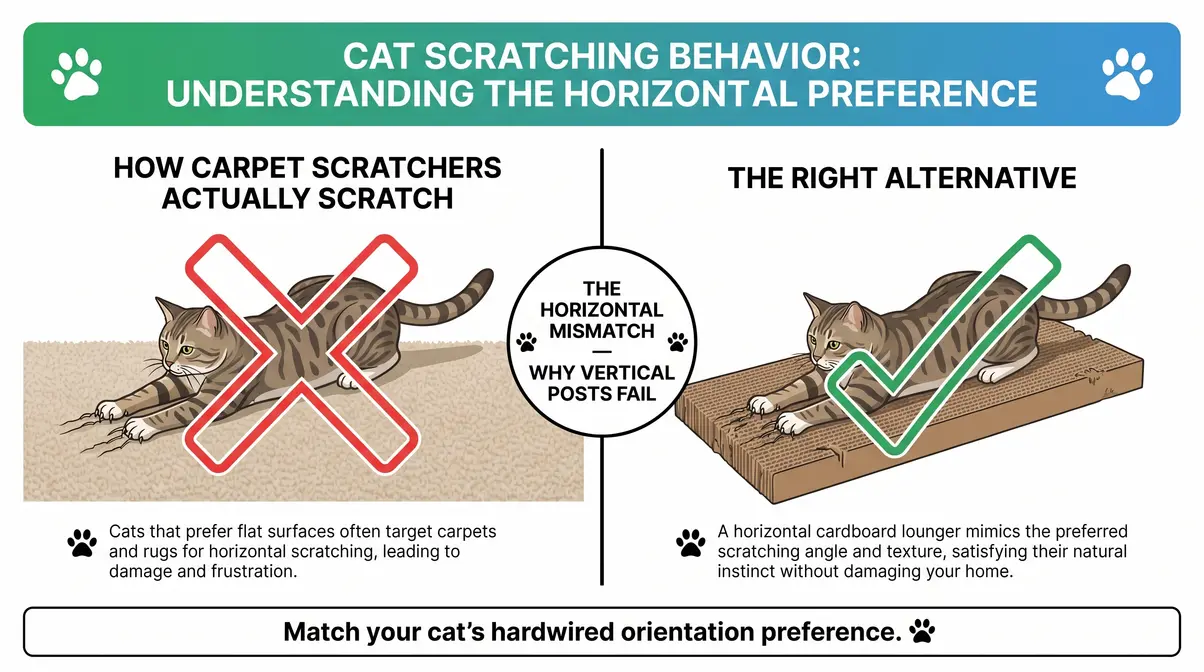
First, carpet texture mimics natural scratching surfaces — bark, dried grass, and fibrous plant material. Cats are instinctively drawn to this fibrous, grippy feel. Second, and most critically: carpet is horizontal. University of Georgia research confirms that indoor cats have strong individual preferences for either horizontal or vertical scratching surfaces, with a significant portion hardwired to prefer horizontal objects. Most pet advice recommends vertical posts. This is The Horizontal Mismatch — the single biggest reason your current post isn’t working. Your cat isn’t ignoring the post out of stubbornness; it’s ignoring it because the orientation is wrong.
Third, carpet is everywhere your cat patrols — doorways, hallways, stairs, bedroom thresholds — making it the default scratching surface on every territorial circuit.
“So your cat isn’t broken, and neither are you. Now let’s use this knowledge to build a solution that actually works.”
Your Solution Strategy
Effective solutions work with your cat’s instincts, not against them. The approach has two simultaneous parts: make the carpet unattractive AND offer a better outlet. Neither part works alone.
Because of The Horizontal Mismatch, the alternative scratcher you provide must be horizontal — or at minimum offer a flat scratching surface. This is the single most important decision point in how to stop a cat from scratching carpet. You can find detailed science-backed cat behavior training tips in our science-backed cat behavior training tips guide. Step 2 starts with the fastest wins: making your carpet the last place your cat wants to scratch.
✅ Step 1 Checkpoint: You now understand (a) scratching is biological, not behavioral defiance, (b) your cat may be a horizontal scratcher, and (c) vertical posts alone will not solve the problem.
Step 2: Make Your Carpet Unattractive to Scratch
Picture this: your cat walks up to the spot, sniffs it, and walks away. That’s the goal of this step. Before you can redirect your cat to a better surface, you need to close off the current one. Think of deterrents as closing a door — you also need to open a window (that’s Step 3). This is the “push” half of the push-pull strategy, and it works fastest when you address the exact spot your cat targets. To learn more about physical barriers, check out our guide on how to deter cats from clawing your carpet.
Physical Barriers That Work
Three physical deterrents are consistently effective for stopping cat clawing the carpet, and all are cat-safe when applied correctly.
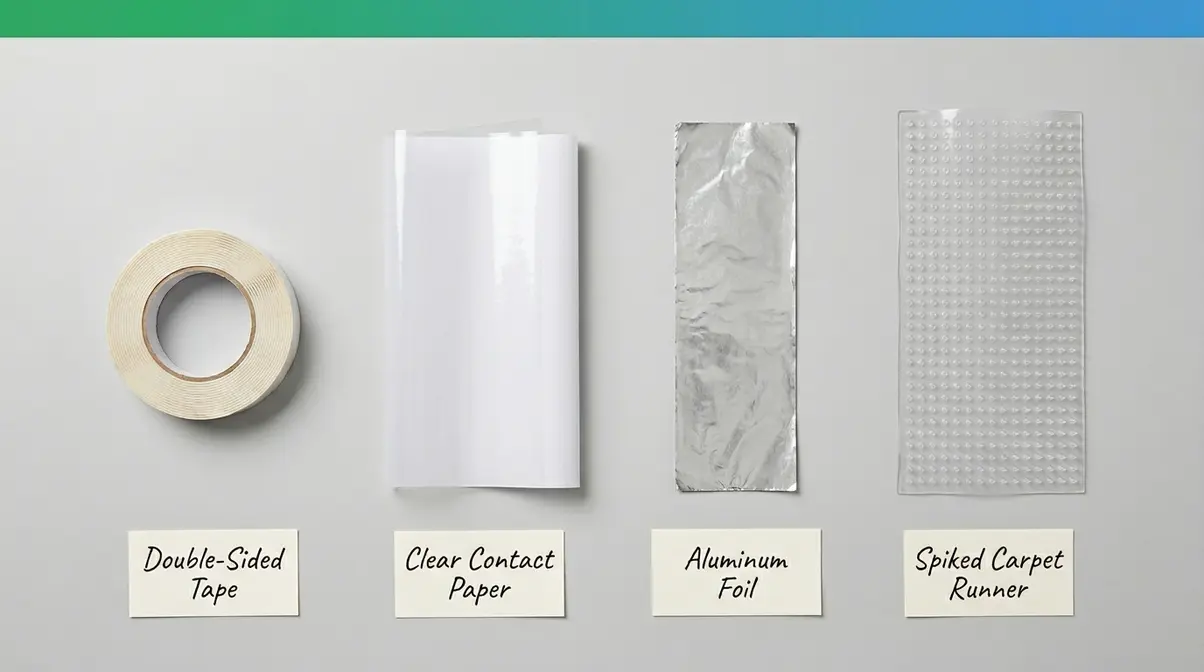
Double-sided tape is the fastest solution. Products like Sticky Paws — a double-sided tape product designed specifically for cat deterrence — stick directly to carpet edges and high-traffic scratch zones. Cats dislike the tacky sensation on their paws and stop returning to the spot within a few days. You can find similar tape at any dollar store. Apply strips in a grid pattern over the entire scratched area, not just the edges.
Clear contact paper or plastic runners (placed spike-side up) work well for larger areas like hallway carpets or stair edges. They’re invisible from a standing height and create an uncomfortable surface without harming paws.
Aluminum foil is a budget option. Lay it flat over the scratched zone. Most cats dislike the crinkle sound and cool texture under their paws. It’s not elegant, but it works while you set up the long-term solution.
| Deterrent | Cost | Best For | How Long to Apply |
|---|---|---|---|
| Double-sided tape (Sticky Paws) | $5–$8 | Carpet edges, corners | 2–4 weeks |
| Clear contact paper | $3–$6 | Large flat areas | 2–4 weeks |
| Aluminum foil | $1–$2 | Quick temporary fix | 1–2 weeks |
| Plastic carpet runner (spike side up) | $8–$15 | Hallways, stairs | 2–4 weeks |
DIY Citrus Deterrent Spray
What can you spray on your carpet to keep your cat from scratching it? A citrus-based spray is one of the most effective, cat-safe options available — and you can make it for under $2.
Cats find citrus scent deeply unpleasant due to their highly sensitive olfactory system, and multiple vet-approved sources confirm lemon and orange-based sprays are non-toxic when diluted and applied to surfaces (not directly to cats). Never use tea tree oil — it is toxic to cats even in small amounts.
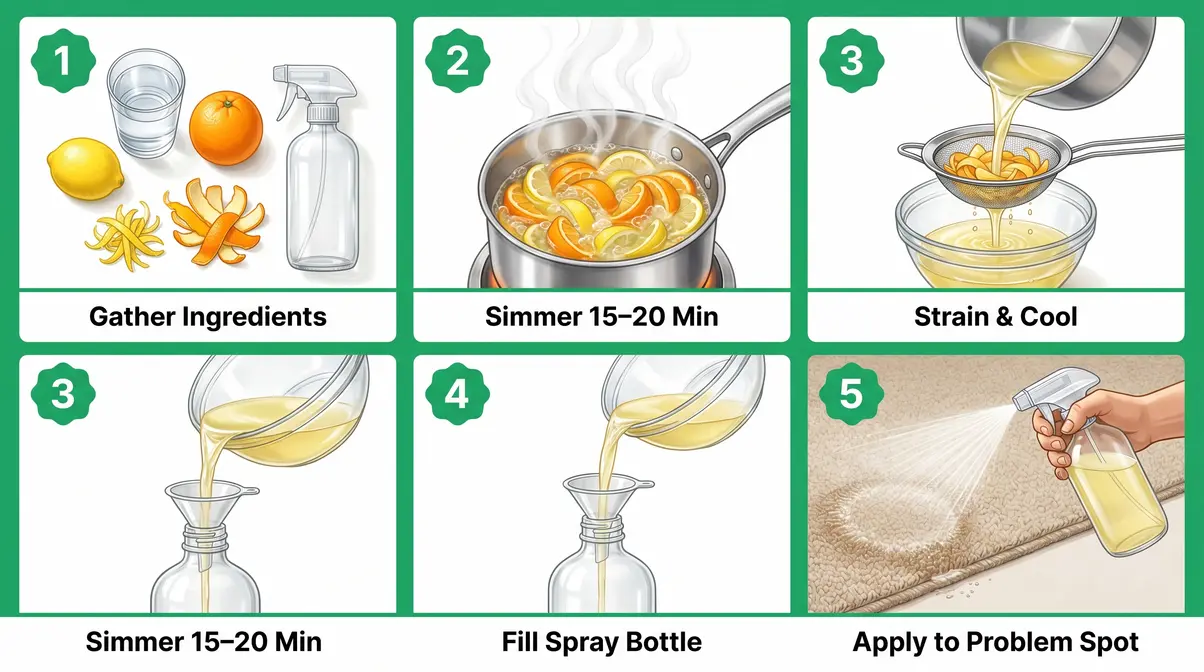
DIY Citrus Deterrent Spray — 5 Steps:
- Gather your ingredients: 2 cups of water, the peel of 1 lemon and 1 orange (no pith — the white part), and a clean spray bottle.
- Simmer the peels: Add the peels to the water in a small saucepan. Bring to a gentle simmer over medium heat and cook for 15–20 minutes. The water will turn pale yellow and smell strongly of citrus.
- Cool and strain: Remove from heat and let the mixture cool completely (at least 30 minutes). Strain out all peel pieces using a fine mesh strainer or cheesecloth.
- Fill your spray bottle: Pour the cooled liquid into your spray bottle. Add 1 teaspoon of fresh lemon juice for extra strength.
- Test before applying: Spray a small, hidden patch of carpet first and wait 10 minutes to check for any color change. Apply to the problem area and reapply every 2–3 days, or after vacuuming.
What Smells Deter Cats From Scratching?
What smells deter cats from scratching carpet? Beyond citrus, cats consistently avoid lavender, eucalyptus, and bitter apple scents. Commercial sprays like Feliway Spray (which uses synthetic feline pheromones to signal “this spot is already marked — no need to scratch”) take a different approach: instead of repelling, they communicate to your cat that the territory is settled. Cat owners in r/CatAdvice consistently report that Feliway works best when used alongside a physical barrier rather than alone.
Avoid: Sprays containing eucalyptus oil, pennyroyal, or citronella in high concentrations — these can cause respiratory irritation in cats. Always check the label for cat-safety certification before purchasing.
✅ Step 2 Checkpoint: The problem spot is now physically covered or scent-deterred. Your cat needs somewhere else to go — that’s Step 3.
Step 3: Offer Horizontal Alternatives
The single most important thing you can do to get your cat to stop scratching carpet is give them a better surface in the right place at the right orientation. Deterrents alone create a frustrated cat with nowhere to scratch. The horizontal alternative is what makes the whole system work. For specific product recommendations, explore the best cat scratching posts available in the uk to save your furniture.
Horizontal vs. Vertical Scratchers
Here’s the core problem with standard advice: nearly every guide tells you to buy a tall sisal post. But research from the University of Georgia confirms that indoor cats have distinct individual preferences for horizontal or vertical scratching surfaces. Cats that target carpet — a flat, horizontal surface — are almost always hardwired horizontal scratchers. Giving them a vertical post is like handing a left-handed person scissors designed for the right hand. They’ll use it reluctantly, or not at all.
The Horizontal Mismatch explains why so many owners feel like they’ve “tried everything.” They have tried everything — just in the wrong orientation. Once you match the scratcher to your cat’s hardwired preference, the behavioral shift can happen within days.
Best Types of Horizontal Scratchers
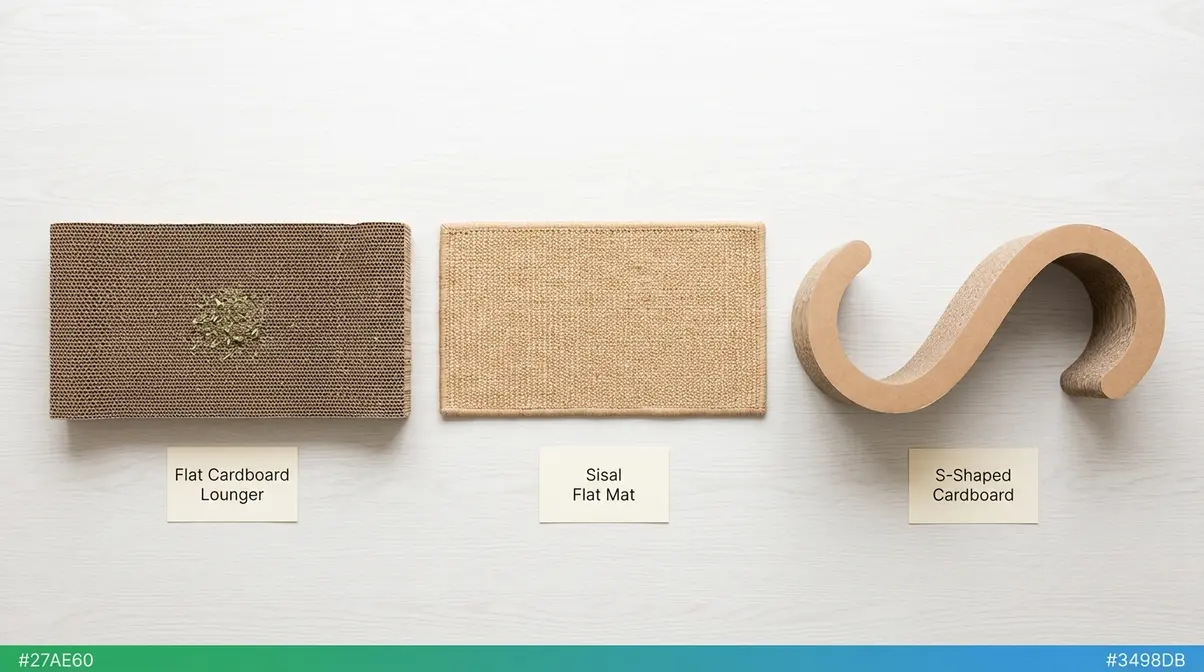
Three types of horizontal scratchers work best for carpet-targeting cats:
Cardboard flat loungers are the most popular and cost-effective option. They lie flat on the floor, mimic the carpet surface texture, and most cats adopt them quickly — especially if you sprinkle a small pinch of catnip on the pads. Replace them every 4–6 weeks as they wear down. Brands like Catit and PetFusion make durable versions for under $15.
Sisal flat mats are more durable than cardboard and have a rougher texture that many cats prefer for serious stretching sessions. They’re also heavier, so they don’t slide around during use — which matters, because a scratcher that slides gets abandoned.
S-shaped cardboard scratchers offer both horizontal and angled surfaces in one piece. A 2019 study published in PubMed found that kittens showed a clear preference for S-shaped cardboard scratchers over other formats — and adding catnip or the scent of other cats did not change that preference, suggesting the shape itself is the draw.
| Scratcher Type | Best For | Avg. Cost | Durability |
|---|---|---|---|
| Flat cardboard lounger | Most carpet scratchers | $8–$15 | 4–6 weeks |
| Sisal flat mat | Heavy scratchers, stretchers | $12–$25 | 3–6 months |
| S-shaped cardboard | Kittens and curious cats | $10–$18 | 6–10 weeks |
| Carpet-covered flat board | Transition cats (carpet texture) | $10–$20 | 2–4 months |
Where to Place the Scratcher
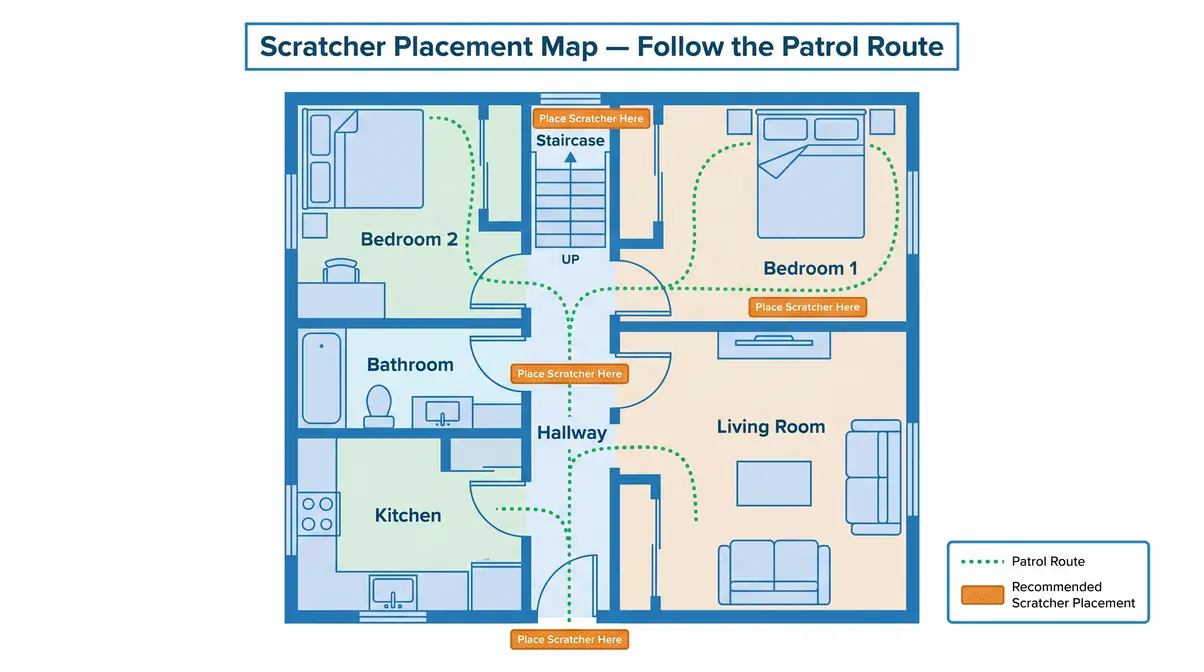
Placement is the most underestimated variable in this entire system. A scratcher placed in the corner of a spare bedroom will be ignored. Here’s why: cats scratch along their territorial patrol routes — the paths they walk every day. That’s why doorways, hallways, and stairs get destroyed.
Place the new scratcher directly on top of, or immediately beside, the spot your cat currently scratches. Not near it. Not across the room. On it. Once your cat consistently uses the new scratcher (usually within 1–2 weeks), you can move it a few inches per day toward a more convenient location.
✅ Step 3 Checkpoint: A horizontal scratcher is now placed directly over or beside the problem spot. Your cat has a legal outlet. Step 4 teaches them to use it consistently.
Step 4: Redirect with Positive Reinforcement
The American Association of Feline Practitioners confirms in its 2026 positive reinforcement training toolkit that if you want a cat to scratch in a desired location, you must immediately reward that behavior when it happens. Timing is everything. Reward that arrives even 10 seconds late is too late for a cat to connect it to the scratching behavior. This is a cornerstone of essential cat care tips for new owners in 2026.
The Right Way to Interrupt Scratching
When you catch your cat scratching the carpet, the goal is redirection — not punishment. Make a short, sharp noise (a single clap, a gentle “eh-eh”) to interrupt the behavior without startling your cat into a fear response. Then immediately guide them — physically carry them if needed — to the horizontal scratcher and gently run their paws along the surface. This shows them where the behavior belongs.
Do this every single time you catch them in the act. Inconsistency is the most common reason this step fails. If you redirect five times but ignore it twice, the carpet remains a valid option in your cat’s mind.
How to Reward Good Scratching Behavior
The moment your cat uses the horizontal scratcher — even a single swipe — reward them immediately with a small treat, a brief play session, or verbal praise in a warm, upbeat tone. This is positive reinforcement — the principle of rewarding good behavior to increase the chance it repeats. The reward must arrive within 2–3 seconds of the behavior.
Three techniques that accelerate the process:
- Catnip on the pads: Rub a small amount of dried catnip into the scratcher surface. Most cats will investigate and begin scratching within minutes of first contact.
- Treat trail: Place a treat on the scratcher surface to draw your cat toward it. When they step on it and begin pawing, deliver a second treat by hand immediately.
- Wand play near the scratcher: Use a feather wand to draw your cat’s attention to the scratcher. When they reach up or paw at it, treat immediately. This naturally encourages the scratching motion.
Certified veterinary behaviorists recommend pairing verbal praise (“good cat!”) with every treat reward — so that over time, the verbal praise alone can maintain the behavior without constant food rewards.
Should I Punish My Cat For Scratching?
Should you punish your cat for scratching the carpet? No — and this isn’t just a matter of kindness. Punishment actively makes the problem worse for three specific reasons.
First, cats do not connect punishment with a past action. Yelling at your cat after you’ve found new scratch marks teaches them nothing about the scratching — it only teaches them to fear you. Second, physical punishment (swatting, spraying water in the face) increases stress, and stressed cats scratch more as a coping mechanism. Third, punishment damages the trust bond you need for training to work.
Declawing is not a solution. The American Veterinary Medical Association and Cornell Feline Health Center both state that declawing (onychectomy) is an amputation of the last bone of each toe — it causes chronic pain and long-term behavioral problems including increased biting and litter box avoidance. It is banned in many countries and strongly discouraged by veterinary professionals worldwide.
✅ Step 4 Checkpoint: You now have a consistent redirection and reward system in place. Step 5 addresses the physical claw itself — reducing damage even on the days training slips.
Step 5: Trim Your Cat’s Claws Regularly
Regular claw trimming won’t stop the scratching behavior, but it dramatically reduces the damage each scratch causes. Think of it as damage control running in parallel with your behavioral training. According to the WSU Veterinary Teaching Hospital, trimming every 2–4 weeks keeps claws blunt enough that even a dedicated carpet scratcher does far less structural damage. For a deeper dive, read our full tutorial on how to trim your cat’s claws.
How to Trim Claws Safely
What you’ll need: Cat-specific scissor-style clippers (not human nail clippers — these split the claw), a towel for wrapping, and styptic powder in case of accidental nicking.
Total time: approximately 5–10 minutes per session. Follow these four steps carefully to ensure a stress-free experience for your feline friend:
- Choose the right moment. Wait until your cat is calm or drowsy — after a meal or a play session works well. Never attempt trimming when your cat is alert and active.
- Extend the claw. Hold your cat’s paw gently in your non-dominant hand. Press the middle of the paw pad between your thumb and forefinger. The claw will extend naturally.
- Identify the quick. The quick is the pink area visible inside the claw — it contains blood vessels and nerves. Cut only the white, sharp tip, at least 2mm away from the pink area. For cats with dark claws, trim in small snips from the tip, stopping where the nail begins to curve.
- Work one paw at a time. Trim one paw, then offer a treat and take a break. You do not have to do all four paws in one session. The goal is a calm, positive experience — not a speed record.
If you accidentally nick the quick and the claw bleeds, press styptic powder (or cornstarch in a pinch) to the tip for 30 seconds. Do not panic — this is not dangerous, just uncomfortable for your cat.
Nail Caps: A Temporary Solution
Nail caps — soft vinyl sheaths like Soft Paws — are glued over each trimmed claw using pet-safe adhesive. They’re completely humane: your cat can still extend and retract their claws normally, they just can’t do structural damage with them. Each set lasts 4–6 weeks before falling off naturally as the claw grows.
Nail caps work especially well for renters who need an immediate solution while the behavioral training takes hold. Cat owners in r/CatAdvice who’ve tried them consistently report the biggest challenge is the application process — having a second person hold the cat while you apply the caps makes it far easier. Your vet can also apply the first set and show you the technique.
✅ Step 5 Checkpoint: Claws are trimmed or capped. Damage from any remaining scratching is now significantly reduced. Step 6 tackles the specific scenarios that standard advice ignores entirely.
Step 6: Target Problem Spots
Standard carpet-scratching advice treats all scratching as the same problem. It isn’t. Scratching at a bedroom door at 3 AM has a completely different cause than scratching on the stairs at noon — and each needs a specific fix. This is the section that most guides skip entirely. For more advanced tactics, review these 8 tricks to stop your cat scratching your bedroom door at night.
Scratching at the Bedroom Door at Night
If your cat wakes you up by scratching the carpet at your bedroom door, you’re dealing with a crepuscular activity problem — not a training failure. Crepuscular (meaning most active at dawn and dusk) is the natural activity pattern of domestic cats. According to the University of Pennsylvania’s Fe-BARQ behavioral database, crepuscular activity is one of the most commonly measured — and most commonly misunderstood — feline behavior patterns. Your cat isn’t being malicious at 4 AM. Their biology is simply peaking.
Specific fixes for nighttime door scratching:
- Play before bed. A vigorous 10–15 minute interactive play session (feather wand, laser pointer) immediately before your bedtime burns off the burst of crepuscular energy and often results in your cat sleeping through the early morning peak.
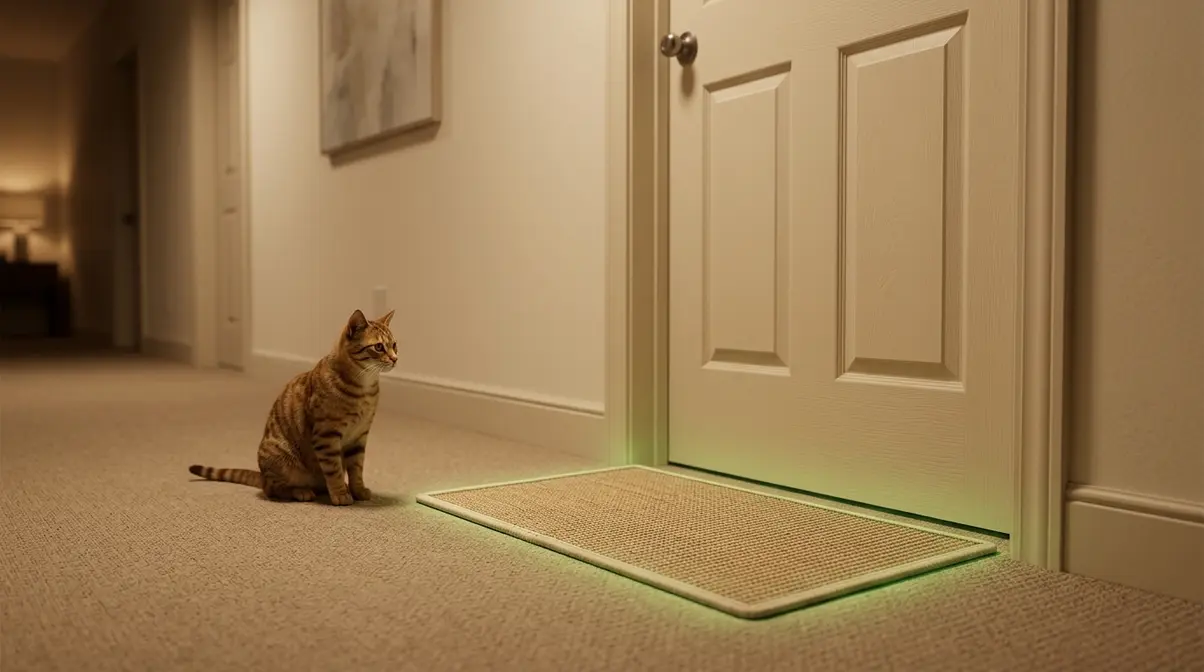
- Place a horizontal scratcher directly outside the bedroom door. This gives your cat a legal outlet for the energy without waking you.
- Timed automatic feeder. Set a feeder to dispense a small portion of food at 5 AM — your cat will wake up and head to the bowl instead of your door.
- Do not open the door when they scratch. This is critical. Opening the door — even once — teaches your cat that scratching works. The behavior will intensify, not stop.
Scratching on the Stairs
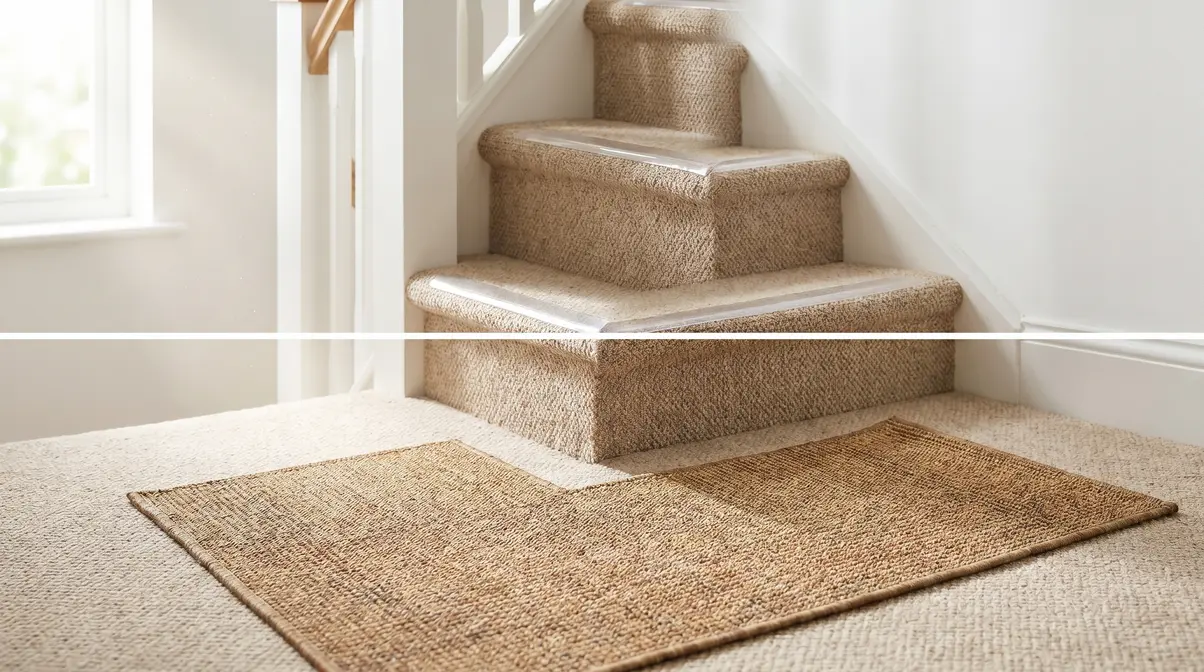
Stairs are a carpet-scratcher’s paradise: long horizontal runs of fibrous carpet along a primary patrol route, with the added bonus of a vertical riser right beside them. The fix requires both deterrence and an alternative.
Apply double-sided tape to the stair nosings (the front edge of each step) — this is where most cats scratch. The tape is nearly invisible and creates the same aversion as on flat carpet. For the stair risers (vertical faces), clear contact paper works well.
Place a sisal flat mat at the top and bottom of the staircase. These are the natural pause points in your cat’s patrol route and the highest-traffic scratching zones. A mat at each landing gives your cat two legitimate outlets framing the staircase, which redirects the territorial marking behavior without removing it.
Attention-Seeking Scratching
Some cats scratch the carpet specifically near you — by the sofa, at the bedroom door while you’re in the room, or at your feet — not because they want to scratch, but because they’ve learned scratching gets your attention. This is attention-seeking scratching, and it’s reinforced every time you react: shouting, moving, spraying water. Even negative attention is attention.
The fix is counterintuitive: completely ignore the scratching and immediately reward any behavior you do want — sitting calmly, using the scratcher, approaching you without scratching. Cat owners who’ve successfully broken the attention-seeking cycle report it takes 5–7 days of strict non-response before the behavior begins to drop. It gets worse before it gets better. Hold the line.
Additionally, increase scheduled interactive play sessions to 2–3 times per day. Attention-seeking scratching is often a signal that your cat’s enrichment needs aren’t being met.
✅ Step 6 Checkpoint: You now have specific solutions for nighttime, stairs, and attention-seeking — the three problem scenarios that standard advice ignores.
Limitations and When to Worry
Common Pitfalls
Even the best plan runs into obstacles. Here are the three most common ones — and how to handle them.
Pitfall 1: Moving the scratcher too soon. Owners often relocate the horizontal scratcher to a more convenient spot after just a few days, before the habit is established. Your cat returns to the carpet because the scratcher is no longer in the right place. Keep it on the original spot for at least 2 full weeks before moving it incrementally.
Pitfall 2: Inconsistent deterrent coverage. Applying tape to only part of a scratched area leaves an opening. Cats will simply shift to the uncovered section. Cover the entire damaged zone, not just the obvious corners.
Pitfall 3: Giving up after the first week. Behavioral change in cats takes 1–2 weeks of consistent application. If you’re not seeing results after 5 days, the most common cause is incomplete deterrent coverage or a scratcher that’s been moved or ignored. Check both before assuming the method isn’t working.
When to Choose Alternatives
If your cat is scratching obsessively despite a fully implemented deterrent and scratcher system, consider consulting your veterinarian. Excessive scratching can occasionally signal underlying anxiety or a skin condition causing paw discomfort. A certified veterinary behaviorist can assess whether anxiety medication or a behavior modification protocol is appropriate.
When to Seek Expert Help
Seek veterinary advice if: scratching is accompanied by over-grooming, hiding, or aggression (possible anxiety disorder); your cat is scratching at the same spot compulsively for hours (possible OCD-spectrum behavior); or you notice swollen, cracked, or bleeding paw pads (possible injury or infection). These scenarios go beyond training solutions.
If Your Cat Also Scratches Furniture
Furniture scratching and carpet scratching share the same biological roots, but they often require different surface solutions. Cats that scratch upholstered sofas are typically vertical scratchers — the opposite of carpet scratchers — which means the same horizontal scratcher you placed for the carpet may not satisfy the furniture-scratching urge.
For furniture, tall sisal posts (minimum 32 inches) placed directly beside the targeted sofa corner are the most effective alternative. The Cornell Feline Health Center recommends covering the targeted furniture section with a fitted sheet or furniture protector while the post habit is being established. For a complete furniture-specific strategy including deterrent sprays safe for fabric and DIY slipcover hacks, see our dedicated guide on how to stop a cat from scratching furniture. Addressing both problems simultaneously is possible — but they need separate, orientation-appropriate scratchers.
If Your Cat Is Peeing on the Carpet
Inappropriate urination on carpet is a separate issue from scratching and has entirely different causes: litter box aversion, urinary tract infections, territorial marking (especially in multi-cat households), or stress. If your cat is both scratching and urinating on the carpet, address each problem independently — the solutions do not overlap.
The most important first step for inappropriate urination is a veterinary check to rule out a UTI or bladder condition, both of which are common and treatable. If you have multiple pets, you might wonder if can cats share a litter box is the root of the territorial marking. For a full step-by-step guide to inappropriate elimination, visit our guide on how to litter train your kitten in 7 days.
Frequently Asked Questions
How to Stop Cat Clawing Carpet?
The most effective approach combines two simultaneous actions: apply a physical deterrent (double-sided tape or a citrus spray) to the problem spot, and place a horizontal cardboard or sisal scratcher directly on top of the same area. Carpet scratchers prefer horizontal surfaces — a vertical post alone rarely works. Reward every use of the scratcher with a treat within 2–3 seconds. Most cats show consistent improvement within 7–14 days of this combined approach (NIH, 2024).
What to Spray on Carpet to Deter Cats?
A DIY citrus spray is the most effective and cat-safe option. Simmer citrus peels (lemon and orange) in 2 cups of water for 15–20 minutes, strain, cool, and transfer to a spray bottle. Cats find citrus scent deeply unpleasant due to their sensitive olfactory system. Reapply every 2–3 days and after vacuuming. Commercial options like Feliway Spray use synthetic pheromones instead of scent aversion. Never use tea tree oil, eucalyptus, or pennyroyal — these are toxic to cats even in small amounts.
What Smell Do Cats Hate?
Citrus is the most universally disliked scent among domestic cats, followed by lavender and bitter apple. The strength of the aversion varies by individual cat — some cats will tolerate diluted citrus but flee from concentrated lemon oil. For the most reliable result, test your specific cat’s reaction to a small patch before committing to a full carpet application. The DIY citrus spray described in Step 2 is both the cheapest and most commonly effective option reported by cat owners.
What is a red flag behavior in cats?
Compulsive, repetitive scratching that continues despite environmental changes is a red flag. Normal scratching occurs in bursts of 30–60 seconds at regular intervals throughout the day. If your cat scratches obsessively for extended periods, scratches the same spot for hours, or combines excessive scratching with over-grooming, hiding, or appetite changes, these can signal an anxiety disorder or underlying medical condition. Scratching accompanied by swollen, cracked, or bleeding paw pads also warrants immediate veterinary attention.
How do cats say “sorry”?
Cats do not experience guilt or apologize the way humans do — this is a common misreading of feline body language. What owners often interpret as an “apology” (slow blinking, head bunting, rolling onto their back) is actually a cat displaying social bonding signals and trust. A slow blink toward you is genuinely meaningful — it signals that your cat feels safe and relaxed in your presence. When a cat scratches the carpet and then rubs against your leg, they’re not apologizing; they’re simply continuing their social routine.
Conclusion
For frustrated cat owners dealing with shredded carpet, learning how to stop cat scratching carpet is simpler than most guides suggest. Scratching is a hardwired biological behavior — according to the NIH, it serves three essential functions: territorial marking, claw maintenance, and muscle stretching. The reason most solutions fail comes down to The Horizontal Mismatch: carpet scratchers are hardwired to scratch horizontally, yet standard advice points them toward vertical posts. Fix the orientation, pair it with a carpet deterrent, and reinforce the right behavior consistently — and most cats respond within 1–2 weeks.
The 6-step system in this guide works because it addresses the biology, not just the symptom. The Horizontal Mismatch isn’t a quirk — it’s the central insight that separates solutions that stick from advice that gets ignored. Once you understand that your cat isn’t defying you but simply following instincts pointed in the wrong direction, the path forward becomes clear.
Start today with what you already have: apply double-sided tape to the problem spot and order a flat cardboard scratcher. Place the scratcher directly on the taped area. Reward every single use with a treat. Give it 14 days of consistency before evaluating results. That’s the fastest path from losing your mind to a cat that uses its scratcher without a second thought.

Dave King
Cat owner and writer at Mad Cat Man.