
Table of Contents
- Understanding Cat Coats: The Basics
- Cat Fur Lengths and Textures Explained
- The Tabby Pattern — Your Cat’s Most Common Coat
- Solid, Bicolor, and Colorpoint Coats
- Tortoiseshell, Calico, and Particolor Patterns
- Advanced Coat Effects — Smoke and Shaded Cats
- Grooming Needs by Coat Type
- Common Mistakes When Identifying Cat Coats
- Frequently Asked Questions
- The Genetic Wardrobe, Decoded
This blog post may contain affiliate links. As an Amazon Associate I earn from qualifying purchases.
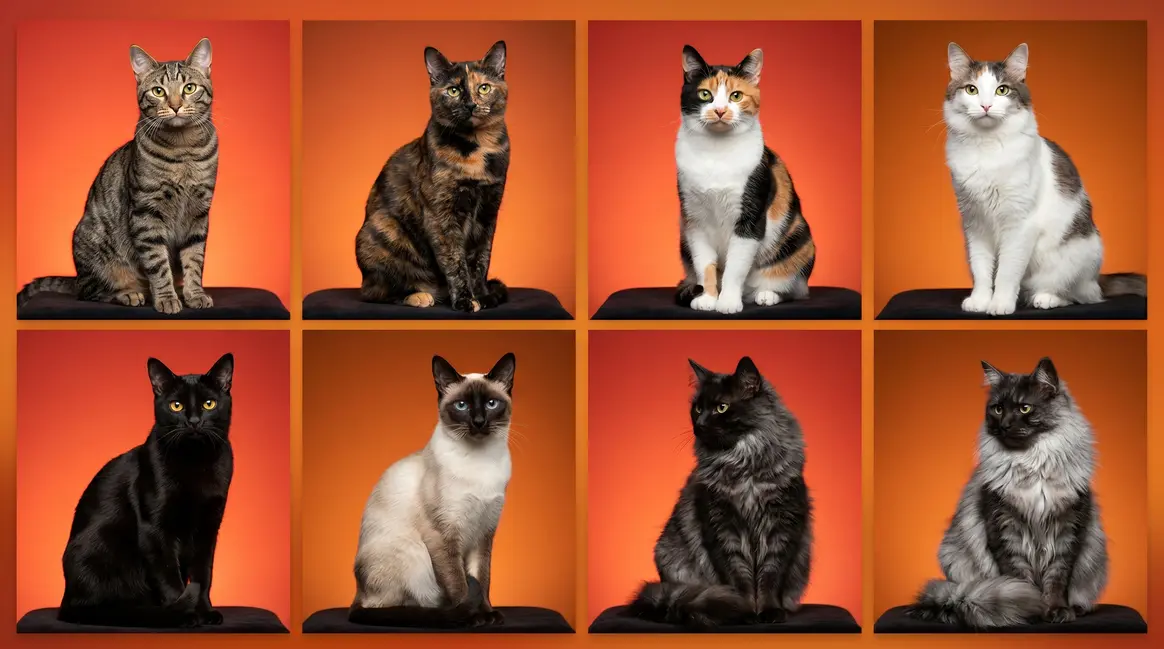
This cat coat types guide covers every pattern, color, and texture you’ll find on a domestic cat — from the science of tabby stripes to the genetics of rare calico males. Whether you have a fluffy tortoiseshell or a sleek black shorthair, you’ll finish this guide knowing exactly what you’re looking at and why.
- Jump To:
- Understanding Cat Coats: The Basics
- Cat Fur Lengths and Textures Explained
- The Tabby Pattern — Your Cat’s Most Common Coat
- Solid, Bicolor, and Colorpoint Coats
- Tortoiseshell, Calico, and Particolor Patterns
- Advanced Coat Effects — Smoke and Shaded Cats
- Grooming Needs by Coat Type
- Common Mistakes When Identifying Cat Coats
Here’s something that might genuinely surprise you: almost every cat — from your neighbour’s fluffy ginger to a sleek black stray — is secretly just black or orange underneath all the genetic magic. Everything else you see is a beautiful modification of those two base pigments, dressed up by a handful of modifier genes.
Most people describe their cat as “tabby” or “tortoiseshell” without really knowing what those words mean — or why their cat looks that way. That’s not a criticism; it’s just that nobody ever explained the system. Once you see it, you can’t unsee it.
By the end of this cat coat types guide, you’ll know exactly how to identify any coat pattern, understand the genetics driving it, and know what it means for your cat’s grooming routine. We’ll move through coat length and texture, then tabby patterns, solid and bicolor coats, particolors like calico and tortoiseshell, and finally the subtle advanced effects like smoke and shaded coats.
Cat coats are classified by three factors — length, texture, and pattern — and almost every variation traces back to just two pigments: black (eumelanin) and orange (phaeomelanin), modified by a handful of genes. By using this cat coat types guide, you can easily identify any feline friend using “The Genetic Wardrobe” framework.
- Coat length falls into three main categories: shorthair, longhair, and hairless/unusual textures
- The tabby pattern — the most common in the world — is defined by the ‘M’ marking on the forehead and driven by the DKK4 gene
- Calico and tortoiseshell patterns are almost exclusively female due to X-chromosome genetics
- Smoke and shaded cats look solid at first glance but reveal a white undercoat when the fur is parted
- “The Genetic Wardrobe”: two pigments, infinite combinations — every coat tells a genetic story
Understanding Cat Coats: The Basics
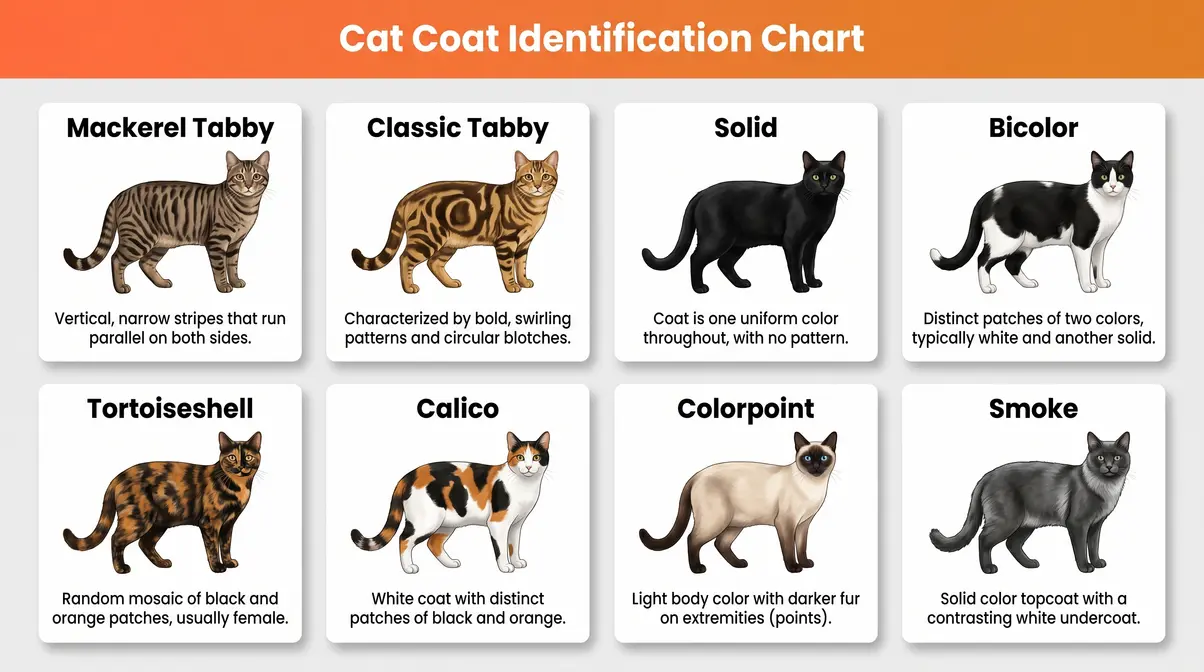
Cat coats are classified by three main factors: length, texture, and pattern. According to the UC Davis Veterinary Genetics Laboratory, all feline coat color variation traces back to just two base pigments — eumelanin and phaeomelanin — modified by a small set of genes. Understanding this three-part framework is the fastest way to identify any cat you encounter, regardless of breed or background.
Every cat coat — no matter how complex — is built from just two pigments: eumelanin (black/brown) and phaeomelanin (orange/cream), modified by a small set of genes (UC Davis Veterinary Genetics Laboratory). That single insight unlocks everything else in this guide.
The Three Ways to Classify a Cat’s Coat
When you look at any cat, you’re actually seeing three separate characteristics layered on top of each other. Think of it as a three-part ID system you can apply to any cat you meet.
- Length — How long is the fur? Cats fall broadly into shorthair, longhair, or unusual/hairless categories. Your sleek Siamese is shorthair; your Maine Coon is longhair.
- Texture — What does the fur feel and look like structurally? Is it straight and dense, soft and wavy, wiry, or absent entirely? A Devon Rex has curly, very fine fur; an American Shorthair has a plush, straight coat.
- Pattern — What is the visual design on the fur? This includes tabby stripes, solid blocks of color, patches of two or more colors, or the darker “points” of a Siamese.
Here’s the key insight for beginners: a single cat can have traits from all three categories at once. Your fluffy orange cat with swirling stripes is a longhair (length), likely with a dense double coat (texture), and a classic tabby pattern (pattern) — three facts from one glance. This cat coat types framework is your foundation for everything that follows.
With that framework in mind, let’s look at the genetic engine running underneath — because knowing what causes these coat variations makes identification feel less like guessing and more like reading a map.
The Genetics Behind the Colors
“Almost all cats are secretly black or orange beneath the mutations.”
That quote captures the entire science of feline coat genetics in one sentence. Here’s how it works.
Cats use exactly two pigments to color their fur. Eumelanin (pronounced you-MEL-ah-nin) is the pigment responsible for black and brown coloring. Phaeomelanin (pronounced fee-oh-MEL-ah-nin) is the pigment that produces orange and cream shades. Think of them as the only two crayons in a cat’s genetic coloring kit — everything else is about how those crayons are used.
Modifier genes are the instructions that tell those two pigments how to behave. They can dilute colors (so black becomes grey-blue, and orange becomes cream), restrict pigment to cooler body areas (creating the Siamese “pointed” look), arrange pigment in repeating patterns (tabby stripes), or suppress pigment in the hair shaft’s base (creating smoke and shaded effects). The DKK4 gene, identified by Stanford Medicine researchers in 2021, is one of the most important of these modifier genes — it establishes the early “prepattern” in fetal skin that eventually becomes a tabby’s stripes or spots.
A solid black cat is expressing pure eumelanin with no modifiers. A tabby is expressing eumelanin in a patterned way, guided by DKK4. An orange cat? Research published in Current Biology (Stanford Medicine, 2025) identified the specific X-linked mutation in the ARHGAP36 gene responsible for switching a cat’s pigment from eumelanin to phaeomelanin — a discovery that had eluded scientists for decades.
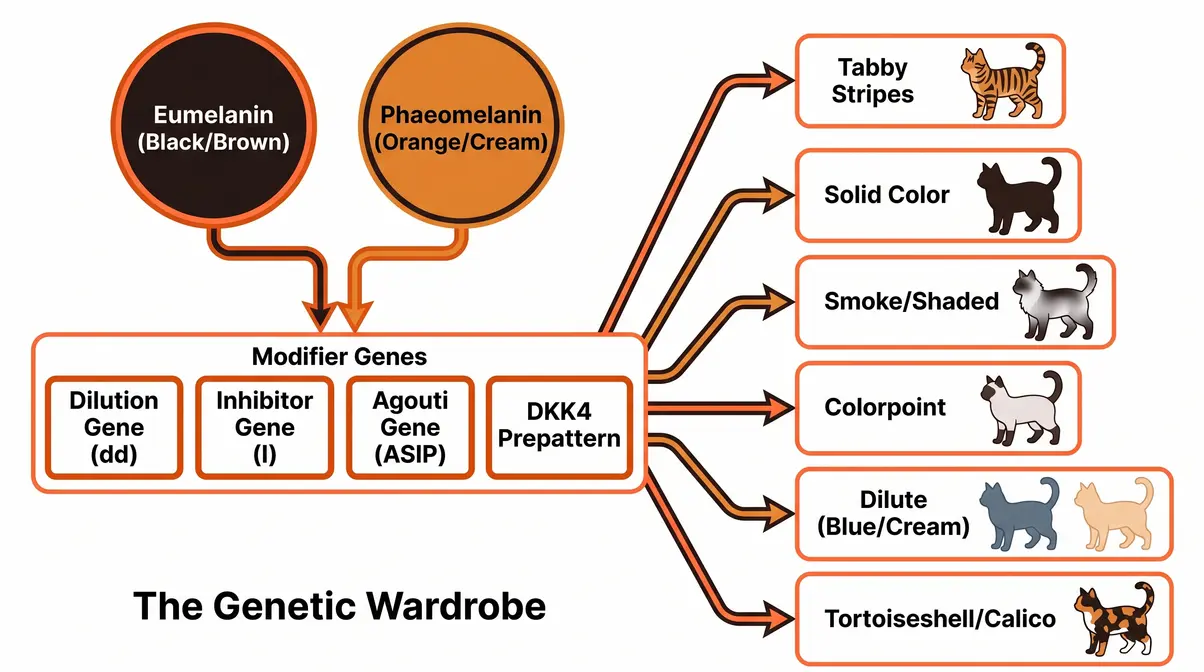
This is “The Genetic Wardrobe” — the idea that every cat’s visible coat is an outward expression of just two pigments dressed up by modifier genes. Think of eumelanin and phaeomelanin as the only two threads in a cat’s genetic loom, and every coat pattern as a different weave. The NIH research on tabby developmental genetics confirms that the archetypal tabby pattern features regularly spaced dark markings on a lighter background, driven by these specific developmental genetics (NIH/PMC, 2021).
Now let’s start with the most visible factor — the length and texture of your cat’s fur — before moving into the fascinating world of patterns.
understand cat fur and its importance
Cat Fur Lengths and Textures Explained
Fur length and texture are the first things you notice about a cat — before you even register the color or pattern. As you navigate this cat coat types guide, remember that fur length is controlled by separate genes from the ones that determine color, which is why you can have a longhaired tabby, a shorthaired calico, or a hairless colorpoint. Across cat owner communities and veterinary resources, the consensus is that understanding texture first makes pattern identification significantly easier.
Shorthair Cats: Low-Maintenance
Shorthair cats have fur that typically sits close to the body and measures less than 5 cm in length. They are by far the most common coat length in both domestic and feral cat populations worldwide.
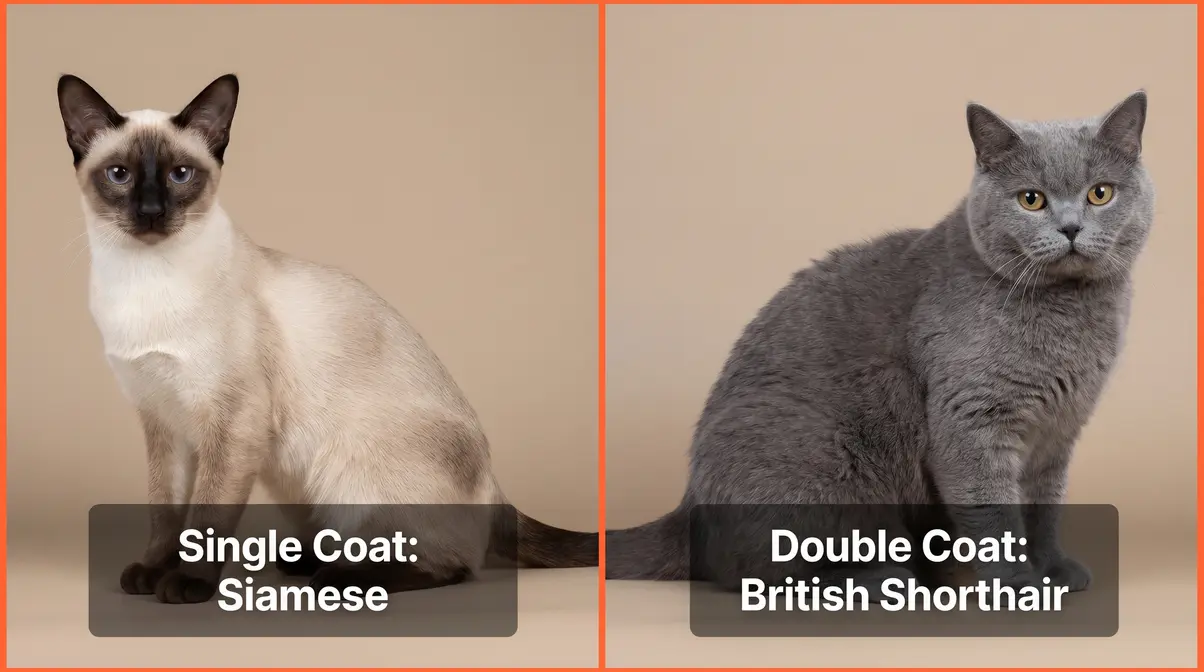
Shorthair cats can have either a single-layer coat (just the outer “guard hairs”) or a double coat (guard hairs plus a dense undercoat). Breeds like the Siamese and Burmese are true single-coat shorthairs — their fur lies flat and has almost no undercoat. Breeds like the British Shorthair and Russian Blue have a denser, plush shorthair coat with a noticeable undercoat.
Grooming needs: Weekly brushing is usually sufficient for single-coat shorthairs. Double-coat shorthairs benefit from twice-weekly brushing, especially during seasonal shedding periods.
Why this matters: Shorthair cats shed less visibly than longhairs, but double-coat shorthairs can still shed heavily. The texture of the coat — not just the length — determines how much maintenance your cat needs.
Longhair Cats: Luxurious but High-Maintenance
Longhair cats have fur exceeding 5 cm, sometimes reaching 15–20 cm in breeds like the Persian or Maine Coon. Longhair is a recessive trait — both parents must carry the longhair gene for kittens to express it. The Cat Fanciers’ Association (CFA), the world’s largest registry of pedigree cats, recognizes longhair as a distinct classification in most breed standards.
Longhair coats come in different textures. Persian fur is fine, silky, and prone to matting. Maine Coon fur is slightly coarser and more water-resistant, reflecting the breed’s cold-weather origins. Norwegian Forest Cats have a double longhair coat with a woolly undercoat beneath long guard hairs.
Grooming needs: Daily brushing is strongly recommended for longhair cats. Without it, the fur mats — especially around the armpits, belly, and behind the ears. Matting is painful and can trap moisture against the skin, leading to skin irritation. If you’re struggling to keep up with their needs, check out these 12 essential grooming hacks for long fur cats.
Double Coats: The Fluffy Middle Ground
A double coat consists of two distinct layers: a dense, soft undercoat (sometimes called “down hair”) and longer, coarser outer guard hairs. The undercoat acts as insulation, trapping warm air close to the body. Many shorthair cats actually have double coats — the British Shorthair, American Shorthair, and Siberian are classic examples.
Double-coated cats shed more than single-coat cats, particularly in spring and autumn when the undercoat “blows.” During these periods, a slicker brush or deshedding tool removes loose undercoat before it ends up on your furniture. The extra insulation means double-coated cats are often more comfortable in cold climates.
A key identification tip: Part your cat’s fur and look at the skin. If you see a thick, cottony layer of fur beneath the outer coat, your cat has a double coat — even if the overall coat looks short.
Rex, Wirehair, and Hairless: The Unusual Textures
Beyond the standard length categories, a small number of cats carry genetic mutations that produce dramatically different textures. These are among the most visually striking coat variations in the feline world.
Rex cats (Devon Rex and Cornish Rex) have curly or wavy fur caused by a mutation in the KRT71 gene (keratin 71), which encodes a protein essential for maintaining the hair shaft’s structure. The Devon Rex mutation is recessive — a cat needs two copies to display the curly coat. The result is soft, loose curls that cover the body. Cornish Rex cats have an even more dramatic wave pattern and very little guard hair, giving them a velvety feel.
American Wirehair cats carry a dominant mutation that produces crimped, resilient fur — every individual hair is bent or hooked at the tip. This gives the coat a wiry, springy texture unlike anything else in the domestic cat world. If you want to learn more about this unique texture, explore the American Wirehair cat breed.
Hairless cats (Sphynx, Donskoy, Peterbald) are hairless due to a separate recessive mutation affecting the HR gene, which is involved in hair follicle development. They’re not completely bare — most have a fine layer of downy fuzz, especially on the ears, face, and tail. However, they lack the full hair shafts that other cats have.
The Genetic Wardrobe still applies here: a hairless Sphynx still carries eumelanin and phaeomelanin, which is why you’ll see skin pigmentation in patches — a Sphynx can be “tortoiseshell-patterned” on its skin even without fur. For specific maintenance tips, consult our comprehensive Sphynx cat care guide.
The Tabby Pattern — Your Cat’s Most Common Coat
The tabby is the most common coat pattern on Earth — and it’s almost certainly the pattern shared by your cat’s wild ancestors. Every domestic cat carries the tabby gene. Even cats that appear to be a solid color often show faint “ghost striping” in certain lighting. Tabby is not a breed; it is a pattern, and it comes in four distinct variations.
What Makes a Cat a Tabby?
A tabby cat is any cat displaying a striped, blotched, spotted, or ticked pattern caused by the agouti gene — the gene that creates banded, two-toned individual hairs. The single most reliable identifier is the distinctive ‘M’ shaped marking on the forehead, present in all four tabby subtypes.
The agouti gene (technically the ASIP gene — Agouti Signaling Protein) works by producing hairs that alternate between dark and light bands along their length. Where the DKK4 gene comes in is at an earlier stage: Stanford Medicine researchers (2021) found that DKK4 establishes a “prepattern” in fetal cat skin, creating areas of thicker and thinner skin that eventually determine where dark and light fur will grow. Mutations in DKK4 disrupt this prepattern — which is why some cats end up ticked rather than striped.
A common misconception is that “tabby” means a specific breed. It doesn’t. Your rescue cat with stripes is a tabby. So is your pedigree Bengal, your mixed-breed brown cat, and your neighbour’s barn cat. Tabby is a pattern, not a breed.
Mackerel Tabby: The Wild Stripes
The mackerel tabby is the most common tabby subtype and the one that most closely resembles wild cats like tigers. The name comes from the fish — the parallel stripes running vertically down the cat’s sides look like the bones of a mackerel skeleton.
- Key identification markers for a mackerel tabby:
- Narrow, parallel vertical stripes along the body
- A dark line running along the spine
- Rings around the tail and legs
- The ‘M’ forehead marking
- Broken stripes sometimes look like rows of dots — these are still mackerel, not spotted
Mackerel tabby vs. classic tabby: The mackerel’s stripes are narrow and run parallel. The classic tabby (next section) has wide, swirling blotches. If you’re unsure, look at the flanks — mackerel stripes go straight down; classic blotches swirl in a target-like bullseye pattern. To see how these patterns manifest in specific breeds, explore our guide on Maine Coon colours.
Where the mackerel tabby’s bold stripes announce themselves clearly, the classic tabby takes a more dramatic, swirling approach.
Classic Tabby: The Swirling Blotch
The classic tabby (also called the “blotched tabby”) replaces the mackerel’s neat parallel lines with wide, swirling blotches — most strikingly, a bullseye or oyster-shell pattern on the flanks. This pattern is the result of a recessive modifier gene that disrupts the regular stripe spacing established by DKK4.
- Key identification markers for a classic tabby:
- Wide, swirling blotches on the flanks, often forming a bullseye
- A thick, unbroken line running along the spine
- Broader, more irregular markings overall
- The same ‘M’ forehead marking as all tabbies
Classic tabbies are common in the UK and Western Europe, where the recessive blotched allele has a higher frequency than in other regions. In North America, mackerel tabbies are slightly more common.
Spotted and Ticked Tabbies
Two tabby subtypes are often overlooked — the spotted and ticked patterns are genuine tabby variations, but they look so different from the classic stripe that many owners don’t recognise them as tabbies at all.
Spotted tabbies have round or oval spots scattered across the body instead of continuous stripes. The spots are essentially broken mackerel stripes — a modifier gene interrupts the stripe into discrete dots. Breeds like the Bengal and Ocicat are famous for their spotted coats. Rosettes (large, ring-shaped spots with a darker center, like those on a leopard) are a refined version of this pattern, seen most clearly in show-quality Bengals.
Ticked tabbies are the most subtle of all. At a distance, a ticked tabby looks almost solid — there are no obvious stripes or spots on the body. Instead, each individual hair is banded with alternating dark and light segments (the agouti banding). The Abyssinian is the classic ticked tabby. If you’re fascinated by this look, read more about the Abyssinian cat breed. The ticked pattern is directly linked to DKK4 mutations: research published in Nature Communications (2021) confirmed that mutations in DKK4 produce the ticked/agouti phenotype by disrupting the prepattern that would otherwise create stripes.
| Tabby Type | Body Pattern | Key Identifier | Common Breeds |
|---|---|---|---|
| Mackerel | Narrow parallel stripes | Fish-bone spine pattern | Domestic shorthair, Bengal |
| Classic | Wide swirling blotches | Bullseye on flanks | British Shorthair, Maine Coon |
| Spotted | Round or oval spots | Broken stripes / rosettes | Bengal, Ocicat |
| Ticked | No body markings | Banded individual hairs | Abyssinian, Somali |
Solid, Bicolor, and Colorpoint Coats
Not every cat has a pattern. A comprehensive cat coat types guide wouldn’t be complete without discussing cats that express a single, uniform color from nose to tail — and others that are divided into two distinct color zones. This section covers the non-tabby coat categories, from the simplest (solid) to the most genetically complex (colorpoint).
Solid Coats: One Color, Head to Tail
A solid cat (also called a “self” cat in show terminology) displays one uniform color across the entire body, with no stripes, spots, or patches. This happens when the non-agouti gene (aa) suppresses the tabby pattern entirely, preventing the agouti banding that creates visible markings.
- Common solid colors include:
- Black — full eumelanin expression, no dilution. For a stunning example of this, check out our deep dive into black Maine Coons.
- Blue (grey) — diluted black, caused by the dilution gene (dd)
- Chocolate/brown — a modifier reduces eumelanin intensity
- Cream — diluted orange (phaeomelanin)
- White — not a pigment at all; caused by a masking gene that prevents pigment from reaching the fur
One important note: many “solid” cats still carry the tabby gene. In strong sunlight, you may see faint “ghost striping” on a solid black or grey cat — this is the underlying tabby pattern showing through. It’s especially visible in kittens and fades as the cat matures.
Bicolor Cats: Endless Variations
A bicolor cat has patches of one color combined with patches of white. The white areas are caused by the white spotting gene (also called the piebald gene), which prevents pigment cells from migrating to certain areas of the skin during fetal development.
The amount of white varies enormously — from a tiny white locket on the chest (low white spotting) to a cat that is almost entirely white with just a few colored patches (high white spotting). The Cat Fanciers’ Association (CFA) classifies bicolor cats by the proportion of white:
| White Coverage | Classification |
|---|---|
| Less than 40% white | Low white / locket |
| 40–60% white | True bicolor |
| 60–80% white | Van pattern |
| 80%+ white | Harlequin pattern |
Bicolor cats can be any base color combined with white — black and white, orange and white, blue and white, and so on. The pattern of where the white appears is somewhat random, which is why no two bicolor cats look exactly alike.
Tuxedo Cats: The Dapper Bicolor
The tuxedo cat is a specific bicolor pattern — black (or dark) fur with white restricted to the chest, belly, paws, and often the chin. The result resembles formal evening wear, hence the name.
Tuxedo cats are not a breed — they’re a pattern that can appear in any domestic cat. The white spotting gene tends to restrict white to the underside of the cat, which is why tuxedo cats almost always have white on the belly and chest rather than the back or top of the head.
Tuxedo vs. bicolor: All tuxedo cats are bicolor, but not all bicolor cats are tuxedos. A tuxedo has a specific arrangement — dark on top, white underneath. A general bicolor cat can have white patches anywhere on the body in any proportion.
Colorpoint Cats: Temperature-Sensitive
Colorpoint cats have a pale body with darker color restricted to the “points” — the face (mask), ears, paws, and tail. This is one of the most elegant examples of genetics directly shaping appearance.
The cause is a mutation in the TYR gene (tyrosinase), which produces the enzyme needed for melanin production. The UC Davis Veterinary Genetics Laboratory has confirmed that mutations in TYR produce temperature-sensitive pigment production — the enzyme becomes inactive at normal body temperature (around 38–39°C) but activates at the cooler extremities (around 25–28°C). The result: color only where the body is coolest.
This is why a colorpoint kitten is born completely pale — in the warm womb, the enzyme is inactive everywhere. As the kitten grows and its extremities cool, the points gradually develop. It also explains why a colorpoint cat’s points can darken slightly in cold climates.
The Siamese is the classic colorpoint breed, but the pattern also appears in Ragdolls, Birmans, and Himalayans. The specific point colors — seal, blue, chocolate, lilac — are just the standard coat colors (black, grey, chocolate, lavender) restricted to the points.
Tortoiseshell, Calico, and Particolor Patterns
Particolor cats carry two distinct pigment colors in patches — not as a pattern imposed by a single gene, but as a mosaic created by X-chromosome genetics. These are among the most genetically fascinating coats in the feline world, and they’re almost exclusively found on female cats.
Tortoiseshell: The Mottled Masterpiece
A tortoiseshell cat has a coat of intermingled black (or dark) and orange patches, typically without any white. The patches can be large and clearly defined, or finely mottled — sometimes called “brindled” — where the two colors blend together in a tight mosaic.
The defining characteristic of a tortoiseshell: black and orange without white. As soon as white appears in significant patches, the cat is classified as calico rather than tortoiseshell.
Tortoiseshell cats can also appear in “dilute” form — where the black becomes grey-blue and the orange becomes cream. These dilute tortoiseshells have a softer, more pastel appearance and are sometimes called “blue-cream” cats in show terminology.
Calico: Three Colors with White
A calico cat has three distinct colors: orange, black, and white — in clearly defined, separate patches. The white comes from the white spotting gene, which overlays the tortoiseshell pattern with areas of unpigmented fur.
The quick identification rule: calico = tortoiseshell + white. If you see three clearly separated color zones — black, orange, and white — you’re looking at a calico. If you see only black and orange (with no significant white), it’s a tortoiseshell.
Calico cats also come in a dilute version, where black becomes blue-grey and orange becomes cream, giving a soft lavender, peach, and white appearance. To see this striking pattern on a large breed, read about the calico Maine Coon. Dilute calicos are sometimes called “muted calicos.”
Can Males Be Calico or Tortoiseshell?
This is one of the most common questions in feline genetics — and the answer is a beautiful piece of chromosome biology.
The orange coat color gene is carried on the X chromosome. Female cats have two X chromosomes (XX); male cats have one X and one Y (XY).
For a cat to display both black and orange in its coat, it needs two X chromosomes — one carrying the orange gene variant and one carrying the non-orange (black) variant. Female cats have two X chromosomes, so they can carry one of each. Male cats, with only one X chromosome, can only express one color — either orange or non-orange — not both.
Here’s where it gets even more interesting: female mammals undergo a process called X-inactivation, where one of the two X chromosomes in each cell is randomly switched off. In a tortoiseshell or calico female, some cells silence the X carrying the orange gene (producing black fur in that area) while others silence the X carrying the black gene (producing orange fur). The resulting coat is a mosaic of the two colors — a living map of which X chromosome is active in each patch of skin.
Research published in Current Biology (Stanford Medicine, 2025) identified the specific mutation responsible: a deletion in the X-linked ARHGAP36 gene that switches a cat’s pigment production from eumelanin to phaeomelanin in affected cells. This discovery finally explained the molecular mechanism behind the orange X-linked trait that geneticists had suspected for decades.
What about male calico cats? They exist — but they’re extremely rare, occurring in approximately 1 in 3,000 calico cats (ASPCA Pet Insurance). The most common cause is an XXY chromosome configuration (analogous to Klinefelter syndrome in humans), where the cat has two X chromosomes and one Y chromosome. With two X chromosomes, the same X-inactivation mosaic can occur. Most XXY male calicos are sterile, and many have associated health considerations. Very rarely, male calicos result from chimerism (two embryos fusing) or somatic mutation rather than XXY.
If you have a male calico, your cat is genuinely unusual — and worth mentioning to your veterinarian, as an XXY configuration can occasionally be associated with health considerations.
Harlequin and Van Patterns
At the high end of the white-spotting spectrum, two patterns stand out for their dramatic minimalism.
A Van pattern cat is almost entirely white, with color restricted to the head (typically a cap pattern between the ears) and the tail. The name comes from the Turkish Van breed, which naturally developed this pattern. Van-patterned cats of any breed carry a very high expression of the white spotting gene.
A Harlequin cat has large, irregular patches of color on a predominantly white body — more color than a Van, but still mostly white. Think of it as the midpoint between a standard bicolor and a Van.
Both patterns can occur in any color — a black-and-white Van, an orange-and-white Van, or even a tortoiseshell Van (where the colored areas display the tortoiseshell mosaic within the small head and tail patches).
Advanced Coat Effects — Smoke and Shaded Cats
Smoke and shaded cats are among the most misidentified coats in the feline world. At a glance, a smoke cat looks solid. A shaded cat looks like a solid silver or golden. Only when you part the fur — or watch the cat move — does the hidden structure reveal itself. Smoke and shaded cats are the Genetic Wardrobe’s most subtle expression: the same two pigments, but with the base of each hair shaft bleached white by the inhibitor gene.
Smoke Cats: Hidden White
A smoke cat appears solid at first glance — typically solid black, blue, or red. But when you part the fur, you’ll find a dramatically white undercoat. Each individual hair is dark at the tip and white at the root, with the dark color extending down about two-thirds of the hair shaft.
The smoke effect is created by the inhibitor gene (I), a dominant gene that suppresses pigment production at the base of the hair shaft. In a smoke cat, the inhibitor gene is combined with the non-agouti gene (which produces a solid-appearing coat rather than a tabby pattern). The result is a cat that looks solid but has a striking white undercoat visible when the fur is parted or when the cat moves.
When a smoke cat walks or stretches, the fur separates and the white undercoat flashes through — creating a shimmering, rippling effect that is unmistakable once you know what to look for. The Cat Fanciers’ Association (CFA) recognizes smoke as a distinct coat classification in multiple breeds, including the Maine Coon, Persian, and British Shorthair.
Shaded and Tipped Cats
Shaded and tipped coats are close relatives of the smoke coat — all three are produced by the inhibitor gene — but they differ in how much of the hair shaft carries pigment.
| Coat Type | Pigmented Portion of Hair | Appearance | Agouti Gene? |
|---|---|---|---|
| Chinchilla | Top 1/8 of hair | Almost white with a sparkling veil of color | Yes (tabby) |
| Shaded | Top 1/3 of hair | Mantle of color on back and sides, white undercoat | Yes (tabby) |
| Smoke | Top 2/3 of hair | Appears solid; white undercoat visible when parted | No (solid) |
A chinchilla cat (like the Chinchilla Persian) has only the very tips of the hairs colored — roughly the top eighth of the hair shaft. The result is a cat that looks almost white, with a delicate veil of color that gives a sparkling, silver appearance.
A shaded cat has color extending further down the hair shaft — about a third — creating a distinct mantle of color across the back and shoulders that gradually fades to white on the belly and chest. Shaded silver and shaded golden Persians are classic examples.
A practical identification tip: If a silver or golden cat has faint tabby markings (ghost stripes), it’s likely a shaded silver tabby rather than a true shaded. A true shaded cat should have no tabby barring — the CFA breed standards specify this distinction clearly. If you’re trying to distinguish a smoke from a solid, simply part the fur at the base — a solid cat’s fur will be the same color all the way to the skin; a smoke cat’s roots will be white.
Grooming Needs by Coat Type
Understanding your cat’s coat type isn’t just an intellectual exercise — it has direct, practical implications for how much grooming your cat needs and what tools work best.
Quick Grooming Guide by Coat Length
Grooming needs scale with both length and texture. Here’s a practical reference:
| Coat Type | Brushing Frequency | Key Tool | Matting Risk |
|---|---|---|---|
| Shorthair (single coat) | Once weekly | Rubber grooming mitt | Very low |
| Shorthair (double coat) | 2–3x weekly | Slicker brush + deshedding tool | Low |
| Longhair (silky, e.g., Persian) | Daily | Wide-tooth comb + dematting comb | High |
| Longhair (water-resistant, e.g., Maine Coon) | Every 2–3 days | Pin brush + slicker brush | Moderate |
| Double longhair (e.g., Norwegian Forest Cat) | Daily during shedding season | Undercoat rake + slicker brush | High |
| Rex (curly) | Occasional gentle wipe | Soft cloth or rubber mitt | Very low |
| Hairless (Sphynx) | Weekly bath | Gentle cat shampoo | N/A — skin care instead |
The single most important grooming rule: start grooming early. A cat that is accustomed to being brushed from kittenhood will tolerate — and often enjoy — grooming as an adult. A cat introduced to brushing late may resist it, making mat removal significantly more stressful for both of you.
Special Care for Unusual Textures
Rex cats require a lighter touch than most owners expect. Their curly coats are more fragile than straight fur — over-brushing can break the curl pattern and cause the coat to look frizzy. A soft rubber grooming mitt or a damp cloth to remove loose fur is usually sufficient. Because Devon Rex and Cornish Rex cats have very little guard hair, they also lose body heat more quickly than other cats — they tend to seek warm spots and may benefit from a cat-safe heated bed in cold weather.
Hairless cats like the Sphynx have no fur to absorb the natural oils their skin produces. Without fur acting as a wick, those oils accumulate on the skin and in skin folds, which can lead to a greasy feeling and, if not addressed, skin irritation. Most Sphynx owners bathe their cats weekly using a gentle, cat-formulated shampoo. Pay particular attention to the skin folds around the neck and armpits, and to the ears — hairless cats tend to accumulate dark ear wax more quickly than coated cats. A weekly ear clean with a veterinarian-approved ear cleaner is standard practice for Sphynx owners.
Common Mistakes When Identifying Cat Coats
Even experienced cat owners make predictable errors when identifying coat types. Knowing the most common misidentifications saves frustration and helps you communicate accurately with breeders, veterinarians, and other cat owners.
Common Misidentifications to Avoid
1. Calling a tabby a breed. “Tabby” is a pattern, not a breed. Across cat owner communities and veterinary resources, this is the single most common coat misconception. Your domestic shorthair tabby is not “a tabby breed” — it’s a domestic shorthair with a tabby pattern.
2. Confusing tortoiseshell with calico. The rule is simple: white patches = calico; no white = tortoiseshell. A cat with black, orange, and a small white locket on the chest is still technically a tortoiseshell (or a low-white bicolor tortoiseshell), not a calico.
3. Mistaking a smoke cat for a solid. If a cat looks solid but has an unusually silvery or shifting quality to its coat in motion, part the fur near the skin. A white root zone confirms smoke. Many smoke cats are registered as solid in shelters because the distinction is easy to miss.
4. Assuming a grey cat is a “blue” cat. In cat show terminology, “blue” means grey. A blue British Shorthair is grey. This isn’t wrong — it’s the correct technical term — but it surprises many new cat owners.
5. Thinking a pointed cat’s color is fixed. Colorpoint cats can darken or lighten with age and temperature. An older Siamese will have darker points than it did as a kitten, and a colorpoint cat living in a cold climate may develop slightly darker overall pigmentation.
When to Consult a Veterinarian
Most coat identification questions can be answered with the framework in this guide. However, there are situations where professional input is genuinely valuable.
Consult a veterinarian if: You believe your cat may be a male tortoiseshell or calico — an XXY configuration can be associated with health considerations and is worth confirming with a chromosomal test. Also consult a vet if you notice sudden changes in coat color or texture, which can sometimes signal underlying health issues (thyroid disease, nutritional deficiencies, or skin conditions).
Consult a breeder or the CFA if: You’re trying to determine whether a cat meets breed standard coat requirements for registration or showing. Breed standards for coat color and pattern are highly specific — what looks like a “shaded silver” to a casual observer may not meet the exact CFA specification for that designation.
Use the UC Davis Veterinary Genetics Laboratory if: You want genetic testing to confirm a cat’s coat color genetics, identify potential health-linked genes, or verify parentage. The UC Davis VGL offers feline coat color panels that can confirm eumelanin/phaeomelanin expression, dilution status, and white spotting genes.
Frequently Asked Questions
What are the main cat coat types?
Cat coats are classified by three main factors: length, texture, and pattern. Length ranges from shorthair to longhair to hairless. Texture includes straight, double-coated, curly (Rex), and wiry (Wirehair). Patterns include tabby (mackerel, classic, spotted, ticked), solid, bicolor, colorpoint, tortoiseshell, and calico. All color variation traces back to two pigments — eumelanin (black/brown) and phaeomelanin (orange/cream) — modified by a small set of genes (UC Davis Veterinary Genetics Laboratory). Understanding these three factors lets you identify any cat coat you encounter.
Why is my cat’s coat a mix of orange and black? Is that a tortoiseshell?
If your cat has intermingled black and orange patches without significant white, it is a tortoiseshell. If there are also clearly defined white patches, it’s a calico. The mixed colors occur because both orange and black coat genes are carried on the X chromosome, and female cats (who have two X chromosomes) can express both simultaneously through a process called X-inactivation. Each patch of color represents a cluster of cells where one X chromosome or the other has been silenced. Almost all tortoiseshell and calico cats are female for this reason (ASPCA Pet Insurance).
What makes a cat a tabby?
A tabby is any cat displaying a striped, spotted, blotched, or ticked pattern caused by the agouti gene. The universal identifier is the ‘M’ shaped marking on the forehead — present in all four tabby subtypes (mackerel, classic, spotted, ticked). Tabby is not a breed; it’s a pattern that can appear in any domestic cat regardless of breed or mix. Stanford Medicine research (2021) identified the DKK4 gene as the key regulator that establishes the early “prepattern” in fetal skin determining where dark and light fur will grow. Even cats that appear solid often carry a suppressed tabby gene.
Can male cats be calico or tortoiseshell?
Yes, but it is extremely rare — approximately 1 in 3,000 calico cats are male (ASPCA Pet Insurance). Because the orange and black coat genes are both carried on the X chromosome, a cat needs two X chromosomes to display both colors. Male cats typically have only one X chromosome (XY) and therefore express only one color. Male calicos and tortoiseshells usually have an XXY chromosome configuration (analogous to Klinefelter syndrome), which allows X-inactivation to create the two-color mosaic. Most XXY male calicos are sterile. Very rarely, male particolors result from chimerism — where two embryos fuse — rather than XXY.
What is the difference between a smoke cat and a solid cat?
A smoke cat appears solid but has a dramatically white undercoat visible when the fur is parted. Each hair on a smoke cat is dark at the tip and white at the root — the dark color covers roughly the top two-thirds of the hair shaft, with white at the base. A truly solid cat has the same color all the way down to the skin. The smoke effect is created by the dominant inhibitor gene, which suppresses pigment at the hair’s base (Cat Fanciers’ Association). The easiest test: part the fur near the skin. White roots confirm smoke; uniform color confirms solid.
The Genetic Wardrobe, Decoded
For any cat owner who has ever squinted at their pet and thought “but what kind of cat is it?” — this guide gives you the answer. Every coat you’ve read about here is a variation of the same elegant system: eumelanin and phaeomelanin, arranged and modified by a handful of genes that have been refining themselves over thousands of years of feline evolution. The Genetic Wardrobe isn’t just a metaphor — it’s a genuinely useful framework for understanding any cat you meet, from a mackerel tabby street cat to a chinchilla Persian.
The science is moving fast. Stanford Medicine’s 2025 discovery of the ARHGAP36 gene mutation finally explained why orange cats are orange — a question that had puzzled geneticists for decades. The 2021 DKK4 research explained how tabby stripes form before a kitten is even born. These aren’t abstract academic findings; they’re the genetic story written in your cat’s fur, and you now have the vocabulary to read it.
Start with length and texture, then move to pattern — and remember that almost every coat, no matter how complex, is just two pigments wearing different outfits. We hope this cat coat types guide has given you the answers you need. If you want to go deeper on any specific pattern or need help identifying your own cat’s coat, consulting the CFA breed standard resources or the UC Davis Veterinary Genetics Laboratory is the best next step. Your cat’s coat is waiting to be understood.