Are Roses Safe for Cats? Vet-Reviewed 2026 Guide
Master the essentials of Rose Cat Safe? The Ultimate Guide to Roses, Risks & Safer Alternatives so you can make smarter decisions backed by Mad Cat Man.

Reviewed by a licensed veterinarian (DVM) before publication. This article is for informational purposes only. Always consult your vet for any health concerns specific to your pet. In an emergency, call the Pet Poison Helpline at 1-800-213-6680.
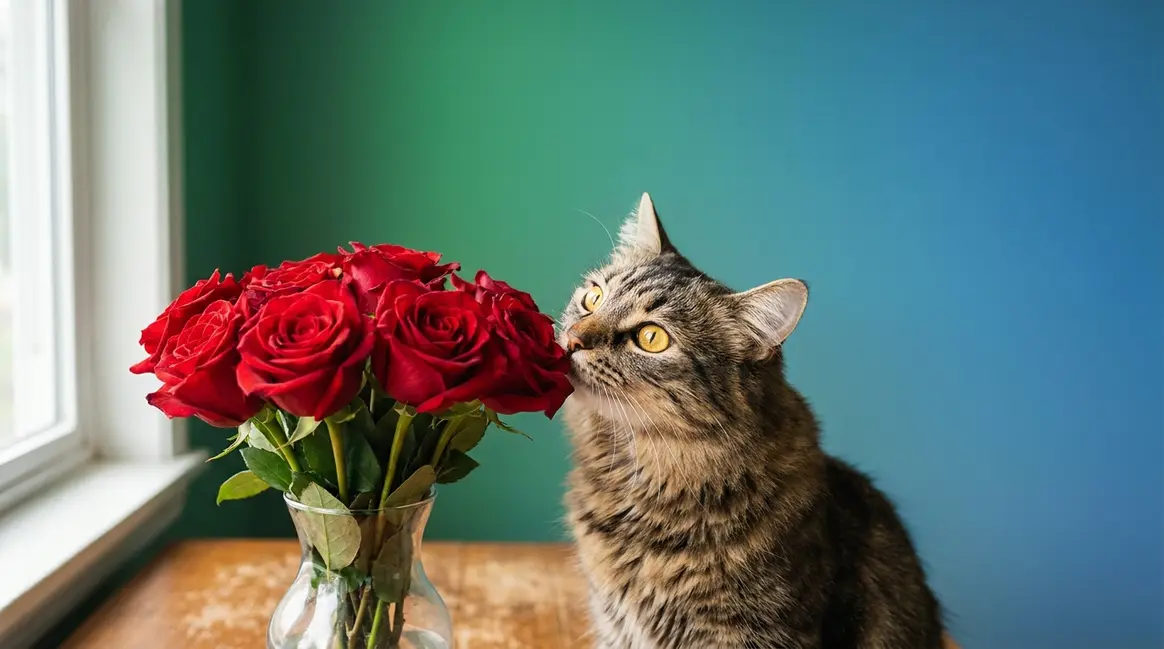
You just brought home a gorgeous bouquet of roses — or maybe a Valentine’s Day arrangement just arrived at your door — and your cat is already sniffing at the stems. Your stomach drops. Are roses safe for cats? Could one nibbled petal send you rushing to the emergency vet?
Here is the short answer: true roses (Rosa species) are classified as non-toxic to cats by the ASPCA. That is genuinely good news. But “non-toxic” does not mean “completely harmless,” and that distinction matters enormously for protective cat owners. Our editorial team reviewed the ASPCA toxicology database, Cornell Feline Health Center guidelines, and veterinary resources from PetMD to compile this guide — and what we found goes well beyond the basic “roses are fine” answer most websites stop at.
This guide introduces The 3-Layer Rose Risk Framework: three hidden hazard layers — thorns, pesticides, and vase additives — that can still hurt your cat even though rose petals themselves won’t poison her. You’ll get a clear safety answer, a look at dangerous look-alike plants, and a practical 6-step checklist to display roses without worry.
True roses (Rosa species) are non-toxic to cats, but The 3-Layer Rose Risk Framework reveals three hidden hazards that can still cause harm.
- Layer 1 — Thorns: Sharp stems can physically injure your cat’s mouth, paws, or eyes.
- Layer 2 — Pesticides: Store-bought roses are often treated with chemicals not safe for cats.
- Layer 3 — Vase additives: Floral preservative packets (the powder packets in bouquets) can cause GI upset (stomach distress) if your cat drinks the water.
- Look-alikes matter: Plants named “Christmas Rose” or “Desert Rose” are NOT true roses — and some are highly toxic.
- 6-step checklist: De-thorn, rinse, check fillers, use plain water, elevate the vase, and monitor your cat.
What You Should Know First
Before reading on, keep two things in mind. First, plant safety classifications can change, so always cross-check with the ASPCA Animal Poison Control Center for the most current information. Second, every cat is different — a cat with a sensitive stomach may react to a plant that causes no trouble for another. When in doubt, call your vet or the Pet Poison Helpline at 1-800-213-6680.
Are Roses Safe for Cats? What the Science Says
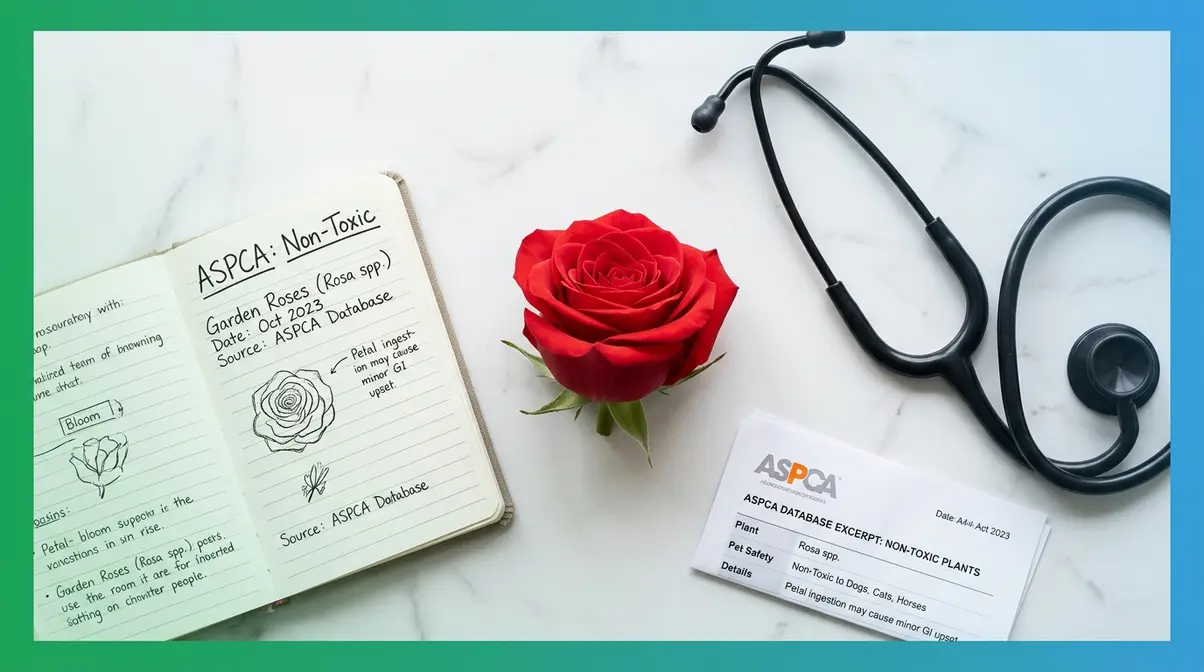
The direct answer: yes, true roses are safe for cats in the sense that they are non-toxic. But the full picture requires understanding exactly what “true rose” means, what parts of the plant carry any risk, and — critically — which plants masquerade as roses but are anything but safe.
ASPCA Guidelines on Roses
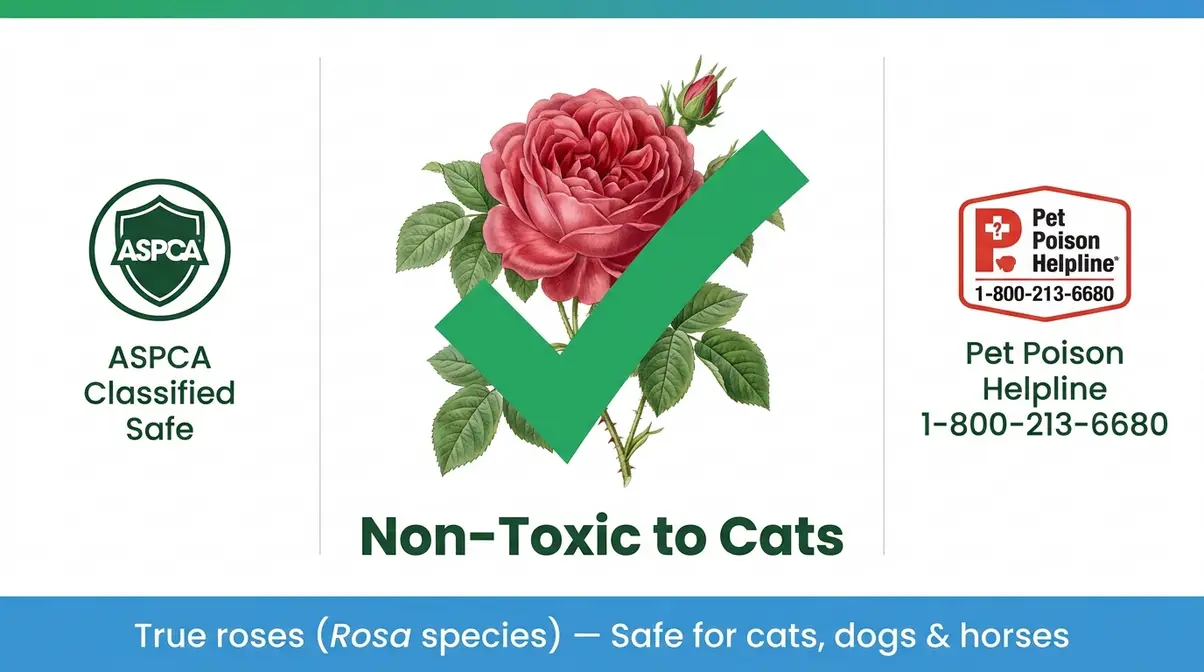
The ASPCA’s official toxicology database lists Rosa species — the true rose family — as non-toxic to cats, dogs, and horses. This is the gold standard reference that veterinarians and poison control specialists rely on. “Non-toxic” means the plant does not contain compounds that cause systemic poisoning or organ damage in cats.
That said, the ASPCA notes that mild GI upset (stomach distress, including vomiting or loose stools) is still possible if a cat eats a significant quantity of rose petals or leaves. This is a digestive response, not a toxic reaction — similar to what happens when a cat eats too much grass. According to PetMD’s veterinary review, symptoms from ingesting true rose plant material are typically mild and self-limiting, resolving within 24 hours without treatment.
Quotable fact: The ASPCA classifies Rosa species as non-toxic to cats — one of fewer than 30% of common houseplants that receive this designation.
Risks of Petals, Leaves, and Stems
Each part of a true rose carries a slightly different risk level. Understanding the difference helps you make smart decisions rather than panicking over every fallen petal.
Petals are the safest part of the plant. They contain no known toxic compounds. If your cat bats one off the table and takes a curious bite, the most you can expect is mild stomach upset — not poisoning.
Leaves are similarly non-toxic but slightly rougher in texture. Cats who chew leaves may experience more pronounced GI upset simply because leaves are harder to digest than soft petals.
Stems are where the physical danger lives. Rose stems carry thorns — and those thorns can cause real injury (more on this in the Hidden Hazards section below). Beyond physical puncture risk, stems also concentrate any pesticide residue applied to the plant during commercial growing.
Pollen is worth a brief mention. Some cats with respiratory sensitivities may sneeze or show mild eye irritation near heavily flowering roses. This is an allergic response, not toxicity, and it is uncommon.
True Roses vs. Toxic Look-Alikes
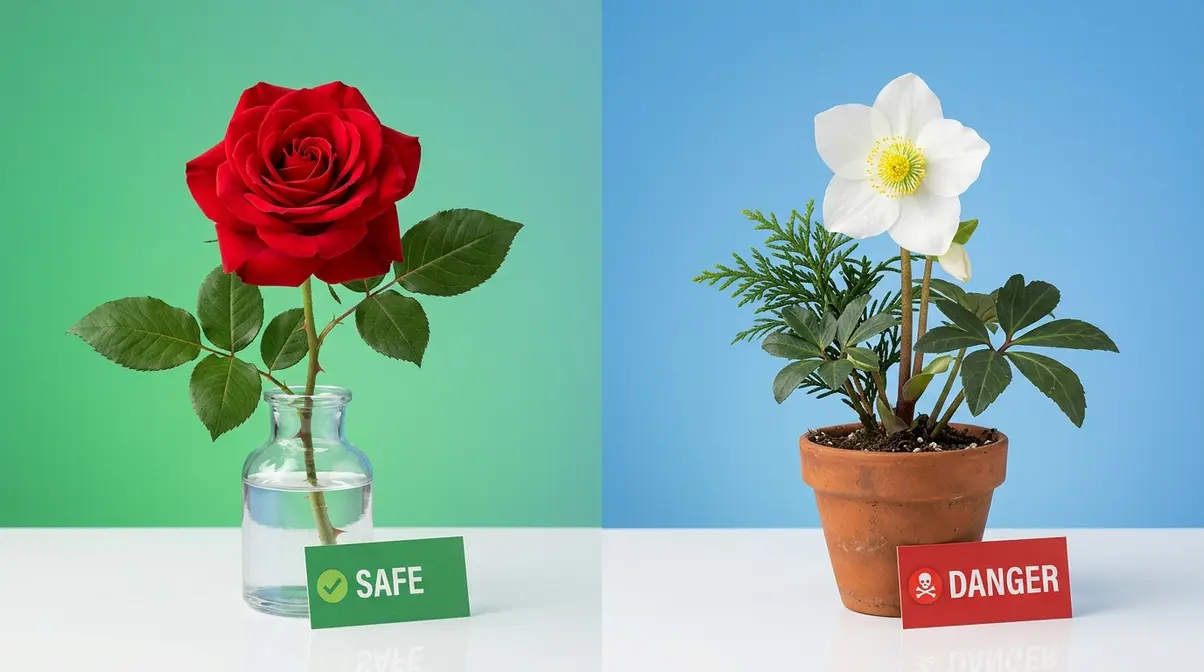
This is where many cat owners get caught off guard. The word “rose” appears in the common names of dozens of plants — and several of them are genuinely dangerous to cats. Knowing the difference could prevent a real emergency.
“True Rosa genus roses pose no danger to cats, but three misleadingly named garden plants can cause serious harm.”
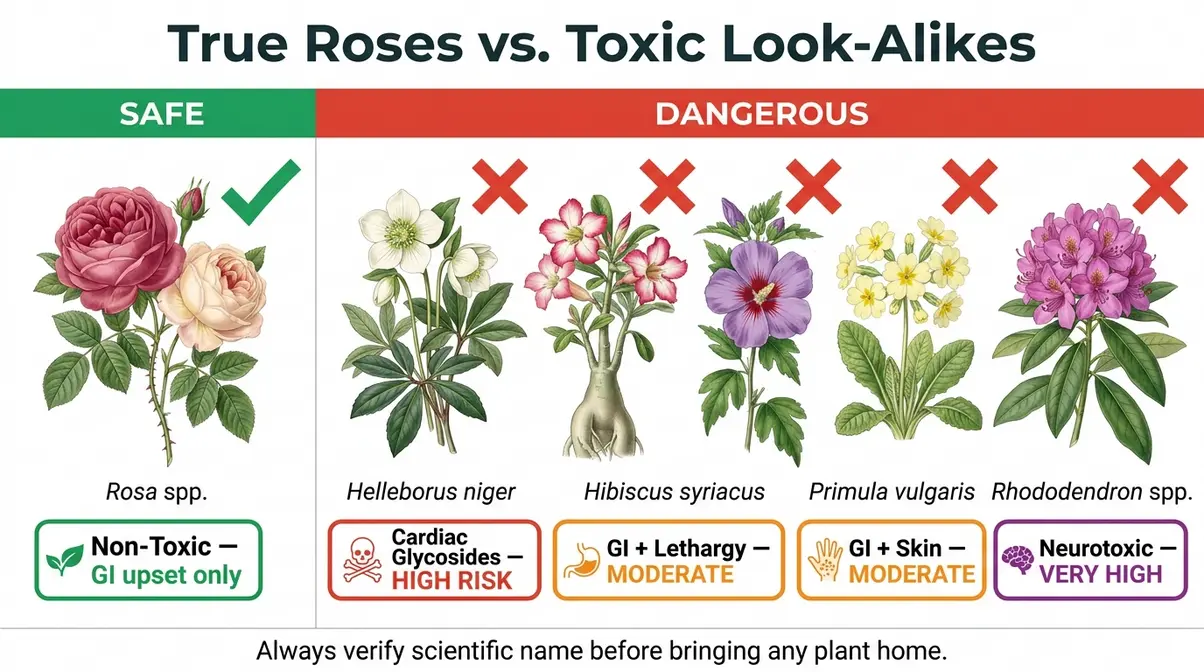
Here is a quick comparison of safe true roses versus toxic look-alikes:
| Plant Name | Scientific Name | True Rose? | Toxic to Cats? | Risk Level |
|---|---|---|---|---|
| Garden Rose | Rosa spp. | ✅ Yes | ❌ No | Low (GI upset only) |
| Christmas Rose | Helleborus niger | ❌ No | ✅ Yes | High (cardiac glycosides) |
| Desert Rose | Adenium obesum | ❌ No | ✅ Yes | High (cardiac glycosides) |
| Rose of Sharon | Hibiscus syriacus | ❌ No | ✅ Mildly | Moderate (GI, lethargy) |
| Primrose | Primula vulgaris | ❌ No | ✅ Yes | Moderate (GI, skin irritation) |
| Rosebay (Rhododendron) | Rhododendron spp. | ❌ No | ✅ Yes | Very High (neurotoxic) |
Christmas Rose (Helleborus niger) is particularly deceptive. It looks nothing like a garden rose, yet it shares the name and is commonly sold at holiday markets. It contains hellebrin, a cardiac glycoside (a compound that disrupts heart rhythm), and ingestion can cause drooling, vomiting, and in serious cases, cardiac effects. The UC Davis School of Veterinary Medicine lists hellebore species among plants requiring immediate veterinary attention if ingested by cats.
Desert Rose (Adenium obesum) is a popular houseplant in warm climates and is equally dangerous — its sap contains cardiac glycosides similar to those in Christmas Rose.
The 3 Hidden Hazards of Roses for Cats
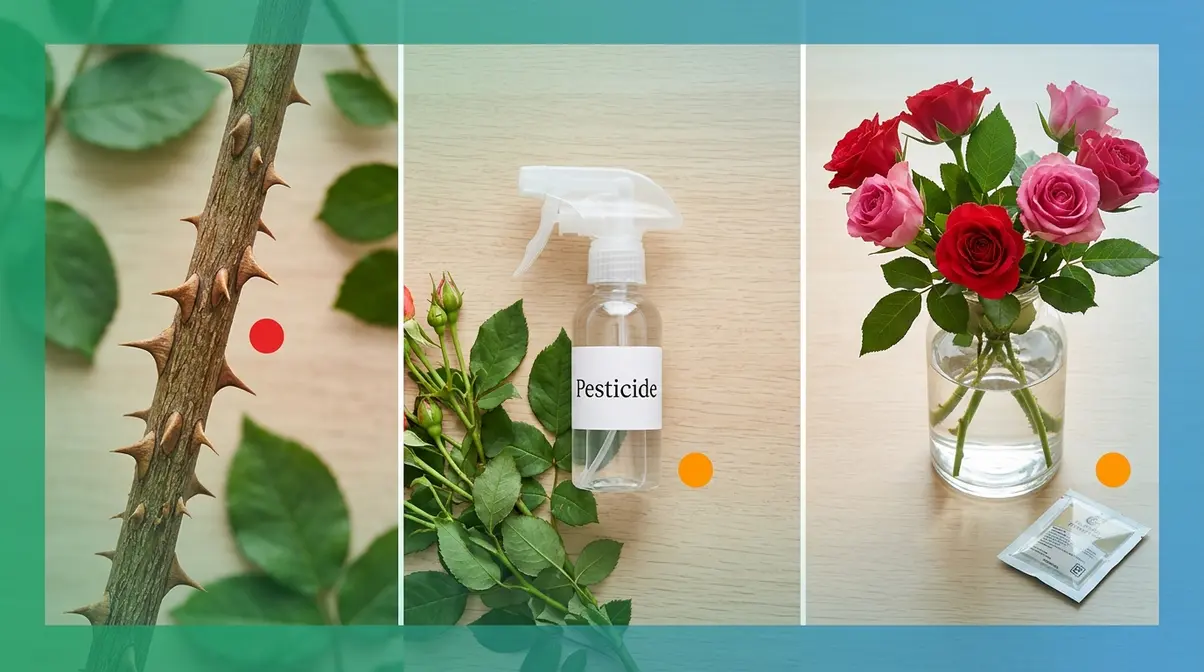
Even though true roses won’t poison your cat, The 3-Layer Rose Risk Framework identifies three real dangers that most guides completely ignore. Addressing these three layers is what separates a truly cat-safe bouquet from a merely “non-toxic” one.
Hazard 1 – Sharp Thorns
Thorns are the most immediate physical risk roses pose to cats. A curious cat who chews on a stem or bats at a vase can sustain puncture wounds to the mouth, tongue, gums, or paws. In rare cases, a thorn can cause an eye injury if a cat pushes her face into a low-placed arrangement.
Puncture wounds in the mouth are particularly concerning because they are hard to see and easy to miss. They can become infected quickly — the warm, moist environment of a cat’s mouth is ideal for bacterial growth. Veterinarians recommend checking your cat’s mouth if you notice excessive pawing at the face, drooling, or reluctance to eat after contact with a rose stem.
According to veterinary guidance from Alley Cat and Dog Pet Hospital, thorn injuries are among the most commonly reported rose-related incidents in cats, yet they receive almost no attention in standard plant safety guides.
Quotable fact: Thorn puncture wounds to a cat’s mouth can become infected within 24-48 hours if not identified and treated — making physical injury from roses a more immediate concern than toxicity for most cats.
Hazard 2 – Chemical Sprays
This is the hazard that virtually no competitor addresses — and it is a real one. Commercially grown cut roses, particularly imported varieties, are among the most heavily treated crops in the floral industry. According to the U.S. Environmental Protection Agency (EPA), cut flowers imported from countries like Colombia and Ecuador — which supply a significant share of U.S. Valentine’s Day roses — are routinely treated with fungicides, insecticides, and preservative sprays during growing, transport, and display.
These chemical residues remain on petals and leaves when you bring the bouquet home. A cat who chews on treated stems or licks her paws after walking near the arrangement can ingest pesticide residue. Symptoms of pesticide exposure in cats can include excessive drooling, vomiting, tremors, or lethargy — and unlike simple GI upset from eating rose petals, pesticide toxicity may require veterinary intervention.
The good news: rinsing rose stems and leaves thoroughly under cool running water before displaying them significantly reduces surface residue. This single step addresses Layer 2 of The 3-Layer Rose Risk Framework almost entirely.
What about organic roses? Roses labeled “organic” or “pesticide-free” still benefit from rinsing — the certification reduces, but does not always eliminate, surface chemical exposure during transport and handling.
Hazard 3 – Toxic Vase Water
Those small powder packets that come with bouquets — labeled “flower food” or “floral preservative” — are a hidden hazard that almost no cat safety article mentions. Floral preservatives (the powder packets in bouquets) typically contain a mixture of sugar (to feed the flowers), acidifier (to lower water pH), and biocide (to prevent bacterial growth in the vase water). Common biocides include bleach derivatives and aluminum sulfate.
When dissolved in vase water, these compounds create a solution that is mildly toxic if ingested. Just as you would learn about silent health risks in cats regarding their diet, you must be vigilant about what leaches into their water. Cats who drink from flower vases — and many cats find vase water mysteriously appealing — can ingest enough biocide to cause GI upset, vomiting, or diarrhea. In large quantities, some biocide compounds can cause more serious symptoms.
The fix is simple: skip the flower food packet entirely and use plain, fresh water. Roses will still last several days without it, and you eliminate Layer 3 of the risk framework completely.
Quotable fact: Floral preservative packets contain biocide compounds that can cause vomiting and GI upset in cats who drink from treated vase water — yet this hazard appears in fewer than 5% of rose safety guides for pet owners.
Hazard 4 – Toxic Bouquet Fillers
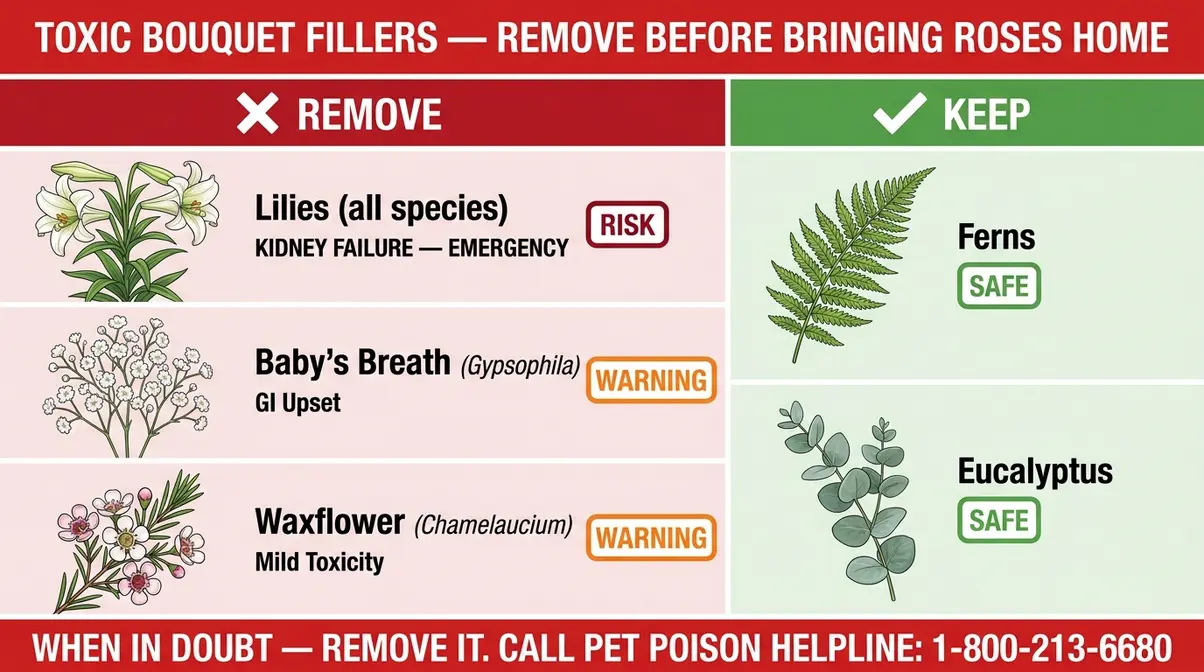
This hazard sits outside the rose plant itself but is critical to understand because it affects nearly every store-bought bouquet. Florists commonly include filler flowers alongside roses — and some of the most popular fillers are highly toxic or even lethal to cats.
Lilies are the most dangerous. True lilies (Lilium and Hemerocallis species — Easter lily, Tiger lily, Asiatic lily, Daylily) are among the most toxic plants known to cats. According to the ASPCA and the Cornell Feline Health Center, even tiny amounts of lily plant material — a single petal, a few grains of pollen, or a small sip of lily vase water — can cause acute kidney failure in cats. This is the “silent killer” risk that florist bouquets introduce: a cat owner thinks they are bringing home “just roses,” but the bouquet contains lily fillers that can be lethal within 24-72 hours of ingestion if untreated.
Other toxic filler flowers to watch for include Baby’s Breath (Gypsophila), which can cause mild GI upset, and Waxflower (Chamelaucium), which has some reported toxicity in cats. Gypsophila is widely used as a filler and is classified as mildly toxic by the ASPCA.
If you receive a mixed bouquet, remove ALL filler flowers you cannot positively identify as non-toxic before bringing it into your home. When in doubt, remove it.
How to Safely Display Roses for Cats

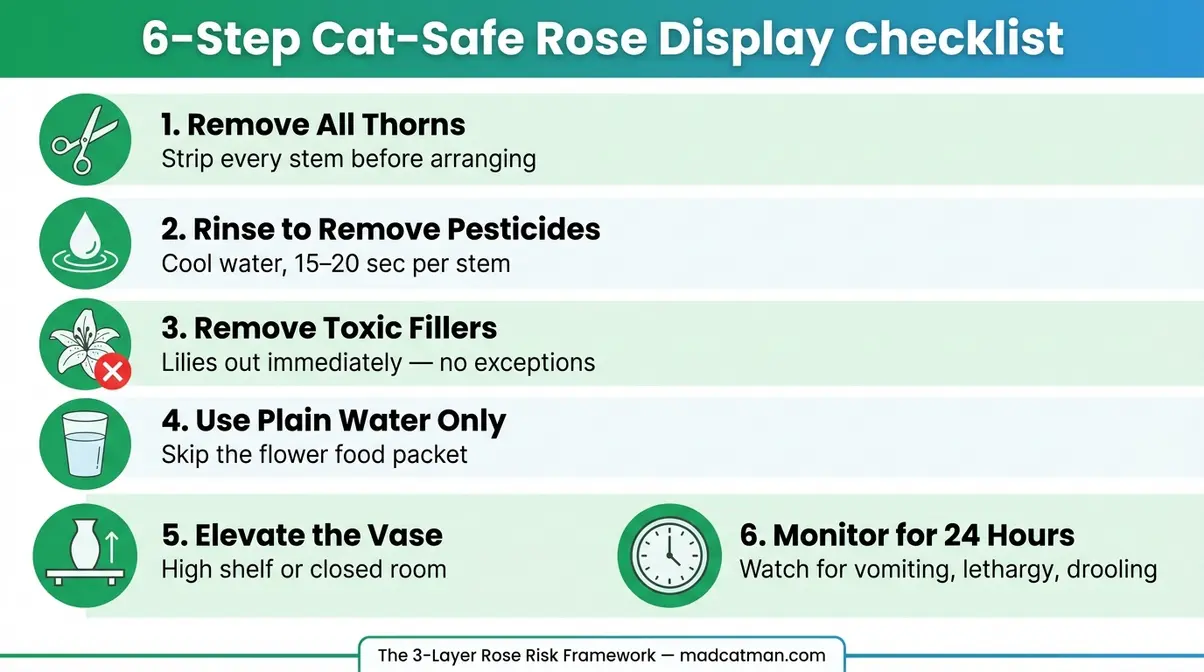
Now that you understand The 3-Layer Rose Risk Framework, here is exactly what to do. These six steps address each hazard layer systematically and give you a cat-safe bouquet you can display with confidence. Our team evaluated guidance from the ASPCA, PetMD, and the Pet Poison Helpline (1-800-213-6680) to compile these recommendations.
What you’ll need: Clean kitchen scissors or floral shears, a colander, plain tap water, a tall vase or high shelf, and approximately 10 minutes. Estimated total time: 10-15 minutes.
Step 1 – Remove All Thorns
Use clean kitchen scissors or a thorn stripper to carefully remove every thorn from every stem before arranging the bouquet. Work from the base of the stem upward. This step directly eliminates Hazard 1 from The 3-Layer Rose Risk Framework.
Why this matters: Even a de-thorned stem is safer to chew on — though you still want to discourage chewing. But if your cat does investigate, a smooth stem won’t puncture her mouth or paws. Estimated time: 3-4 minutes per bouquet.
Step 2 – Rinse to Remove Pesticides
Hold each stem under cool running water for 15-20 seconds, gently rubbing petals and leaves with your fingers. Pay particular attention to the undersides of leaves, where pesticide residue tends to concentrate. You can also rinse the entire bouquet in a colander.
Why this matters: This step addresses Hazard 2 — commercial pesticide residue. Rinsing won’t remove every trace of systemic pesticides (compounds absorbed into the plant’s tissues), but it removes the surface-level residue that poses the greatest risk to a cat who licks stems or petals. Estimated time: 2-3 minutes.
Step 3 – Remove Toxic Fillers
Before arranging, lay out every flower in the bouquet and identify each one. Keep only stems you can positively confirm are non-toxic. Remove all lilies immediately — do not set them aside, dispose of them in a sealed bag in an outdoor bin where your cat cannot access them.
Why this matters: This step addresses Hazard 4. A single lily petal contains enough nephrotoxic (kidney-damaging) compounds to cause acute kidney failure in cats. According to the ASPCA, lily toxicity is one of the most common causes of feline poisoning requiring emergency veterinary care. When uncertain about any filler, remove it.
Step 4 – Use Plain Water
Fill your vase with plain, fresh tap water. Do not add the flower food packet that came with the bouquet. Change the water every two days to keep it fresh and prevent bacterial growth.
Why this matters: This eliminates Hazard 3 entirely. Floral preservative packets contain biocide compounds that can cause GI upset if your cat drinks from the vase. Plain water is safe. Roses will still last 5-7 days with clean water and daily stem trimming.
Step 5 – Elevate the Vase
Cats are exceptional climbers and jumpers. A standard tabletop display is often within easy reach. Instead, place your vase on a high shelf your cat has never accessed, inside a closed room, or on a surface surrounded by items that discourage jumping (cats dislike unstable landing zones).
Why this matters: Physical separation is the most reliable safety measure for any cat-and-plant scenario. Elevating plants is one of the most effective tips for a cat-safe home environment. Even a perfectly prepared bouquet poses some risk if your cat has unlimited unsupervised access to it. The Pet Poison Helpline consistently recommends elevation and physical barriers as the primary prevention strategy for plant-related feline incidents.
Step 6 – Monitor for 24 Hours
After displaying your roses, watch your cat for any unusual behavior over the next 24 hours. Specifically, look for: vomiting, diarrhea, excessive drooling, pawing at the mouth, lethargy, or loss of appetite. These symptoms — while unlikely with properly prepared true roses — warrant a call to your vet.
Why this matters: Even non-toxic plants can cause mild GI upset in sensitive cats. Monitoring gives you an early warning window. If you see any of the symptoms above, contact your veterinarian or call the Pet Poison Helpline at 1-800-213-6680 immediately.
Can Cats Be in the Same Room?
Yes, cats can safely be in the same room as properly prepared roses. The key word is “properly prepared” — meaning thorns removed, stems rinsed, toxic filler flowers removed, and plain water used in the vase. If the bouquet has been prepared following the 6-step checklist in this guide, passive exposure poses no meaningful risk. Supervision is still advisable for particularly inquisitive cats.
Are Specific Rose Varieties Safe?
Are Spray Roses Safe?
Spray roses are simply miniature versions of standard garden roses. Because they belong to the same Rosa family, they are equally non-toxic to cats. The same preparation rules apply: remove the thorns, rinse the stems, and use plain water.
Does Rose Color Matter?
Whether you bring home red, white, pink, or yellow blooms, the color does not affect toxicity. When asking, “are roses safe for cats,” remember that variety and color don’t change the answer—all true Rosa species are completely non-toxic.
Are Roses Safe for Dogs Too?
If you live in a multi-pet household, you will be relieved to know that true roses are also non-toxic to dogs. The ASPCA classifies them as safe for both felines and canines. However, the exact same secondary hazards apply. Dogs are just as likely to suffer mouth punctures from sharp thorns or experience gastrointestinal upset from drinking treated vase water.
What to Do If Your Cat Eats a Rose
Even with every precaution in place, cats are resourceful. If your cat manages to eat part of a rose, here is exactly how to respond — calmly and effectively.
What If a Cat Eats a Rose Petal?
If a cat eats a rose petal from a true Rosa species rose, the most likely outcome is nothing at all — or mild, temporary GI upset (vomiting or loose stools) that resolves within 24 hours. Rose petals contain no known toxic compounds. A single petal or even a few petals will not cause poisoning. Monitor your cat for 4-6 hours. If vomiting or lethargy persists beyond that window, call your vet.
Common Mistakes to Avoid
Mistake 1: Panicking and inducing vomiting without vet guidance. Many cat owners instinctively try to make their cat vomit after any plant ingestion. This is dangerous without professional guidance — some situations where a cat vomits can cause additional harm (aspiration of stomach contents, for example). Never induce vomiting unless a veterinarian or poison control specialist explicitly instructs you to.
Mistake 2: Assuming “non-toxic” means “do nothing.” Non-toxic means the plant won’t cause systemic poisoning. It does not mean your cat will feel fine. A cat who eats a large quantity of rose petals may vomit or have diarrhea. A cat who chews a thorn-bearing stem may have a mouth injury. These still require attention.
Mistake 3: Waiting too long to call. If you’re unsure what your cat ate — especially if the bouquet contained unidentified fillers — call the Pet Poison Helpline at 1-800-213-6680 immediately. The helpline operates 24/7 and can assess the risk based on what your cat ingested and her body weight.
When to Seek Expert Help

Contact your veterinarian or the Pet Poison Helpline immediately if:
- Your cat ate any plant you cannot positively identify as non-toxic
- Your cat shows vomiting, diarrhea, drooling, or lethargy within 2 hours of plant contact
- You suspect lily ingestion of any amount — this is a veterinary emergency
- Your cat has a puncture wound in the mouth or on the paws from thorns
- Symptoms do not resolve within 4-6 hours
For suspected lily ingestion specifically, do not wait for symptoms — kidney damage from lily toxicity begins at the cellular level before clinical signs appear. Early treatment (within 6-18 hours of ingestion) dramatically improves outcomes. According to the ASPCA, cats treated promptly after lily ingestion have significantly better survival rates than those who receive delayed care.
What to Tell Your Vet
When you call, have this information ready:
- The plant name (or a photo of it)
- The approximate amount ingested (one petal? several leaves?)
- Your cat’s weight and age
- When ingestion occurred
- Any symptoms you have already observed
This information helps your vet or the poison control specialist triage the situation accurately and recommend the right next step — whether that’s watchful waiting at home or an immediate ER visit.
Limitations and Alternatives
Common Pitfalls
Pitfall 1: Buying roses without checking the bouquet contents. Many “rose bouquets” from grocery stores and florists include lily fillers by default. Always inspect the full arrangement before purchasing or accepting it. If you’re ordering for a cat-owner household, specifically request a lily-free arrangement.
Pitfall 2: Assuming “organic” roses are pesticide-free. Organic certification limits certain synthetic pesticides but does not guarantee zero chemical exposure. Rinsing is still recommended for all commercially grown roses, organic or not.
Pitfall 3: Relying on visual identification alone. Christmas Rose and Desert Rose look nothing like garden roses — they share only the name. If a plant is labeled “rose” at a garden center but doesn’t look like the Rosa species you recognize, look up the scientific name before bringing it home.
When to Choose Alternatives
If your cat is particularly curious, persistent, or has a history of chewing on plants, the safest choice is to skip cut flowers entirely and opt for completely cat-safe alternatives. The ASPCA’s non-toxic plant list includes orchids (Orchidaceae), African violets (Saintpaulia), and snapdragons (Antirrhinum) as fully cat-friendly options that pose essentially no risk even if heavily chewed.
For households with cats who have shown lily-ingestion behavior previously, a strict no-cut-flowers policy is a reasonable and protective choice. No bouquet is worth an emergency vet visit.
Consulting a Professional
If you are unsure whether a specific plant in your home is safe, do not guess — use the ASPCA Animal Poison Control Center’s searchable database at aspca.org or call their hotline. For any active ingestion concern, the Pet Poison Helpline at 1-800-213-6680 provides 24/7 triage by veterinary toxicologists.
Frequently Asked Questions
Are roses poisonous to cats?
True roses (Rosa species) are not poisonous to cats according to the ASPCA’s official toxicology database. They are classified as non-toxic, meaning they do not contain compounds that cause systemic poisoning or organ damage. However, eating large amounts of rose petals or leaves can cause mild GI upset (vomiting, loose stools) due to digestive irritation — not toxicity. The real risks come from thorns, pesticide residue, and toxic floral preservatives in vase water, which is why following a preparation checklist matters even with non-toxic roses.
Can I have roses in my house with a cat?
Yes, you can have roses in your home with a cat as long as you take a few precautions. True roses are non-toxic, so the plant itself is not the concern. Your preparation steps matter more than the roses themselves: remove thorns, rinse away pesticide residue, eliminate any lily or other toxic filler flowers from the bouquet, use plain water (no flower food packets), and place the vase out of easy reach. One critical rule: if the bouquet contains lilies of any kind, remove them immediately before bringing the arrangement indoors — lily ingestion is a veterinary emergency for cats.
Are dried roses safe for cats?
Yes, dried true roses are non-toxic to cats. However, dried petals and stems can become brittle and sharp as they age. This texture can cause mild throat irritation or a potential choking hazard if swallowed by an overly curious feline. Ensure dried arrangements are kept out of reach to prevent mechanical irritation.
Is rose water safe for cats?
Pure rose water made from true Rosa species is generally non-toxic. However, commercial rose water often contains added preservatives, artificial fragrances, or essential oils that can cause stomach upset or toxicity in cats. It is best to keep all commercial cosmetic and floral waters away from your pet.
Keeping Roses and Cats Safely Together
True roses are one of the few common household flowers that cat owners can genuinely relax about — the ASPCA’s non-toxic classification is well-established, and mild GI upset from curious nibbling is the realistic worst-case scenario for the rose plant itself. The 3-Layer Rose Risk Framework exists not to alarm you, but to give you complete information: address the thorns, the pesticide residue, and the vase water, and you have neutralized every meaningful risk that roses pose to cats.
The framework matters because “non-toxic” is only part of the story. A rose bouquet that arrives with lily fillers, untreated pesticide residue, and a flower food packet in the vase water is genuinely riskier than one that has been prepared thoughtfully — even though the rose petals themselves are the same. Ten minutes of preparation transforms a potentially hazardous arrangement into a genuinely cat-safe display.
So, are roses safe for cats? Yes, but your preparation makes all the difference. Start with Step 1 of the 6-step checklist the next time a bouquet arrives at your door. Remove the thorns, rinse the stems, pull out any filler flowers you cannot identify, skip the flower food packet, and find the highest shelf in the room. Then enjoy your roses with confidence. For any plant safety question beyond roses, bookmark the ASPCA’s non-toxic plant database — it is the most reliable free resource available to cat owners and is updated regularly by veterinary toxicologists.

Dave King
Cat owner and writer at Mad Cat Man.