
You went outside to check on your seedlings and found them scattered across the soil. Again. A neighborhood cat has decided your carefully planted vegetable patch is the perfect outdoor litter box — and your baby plants are paying the price.
You’re not alone in this frustration. One gardener summed it up perfectly:
“What do you all use to keep neighborhood cats out of your garden?? I have one in particular that already dug up my carrots, broccoli and rosemary to hide where they did their business 🤬”
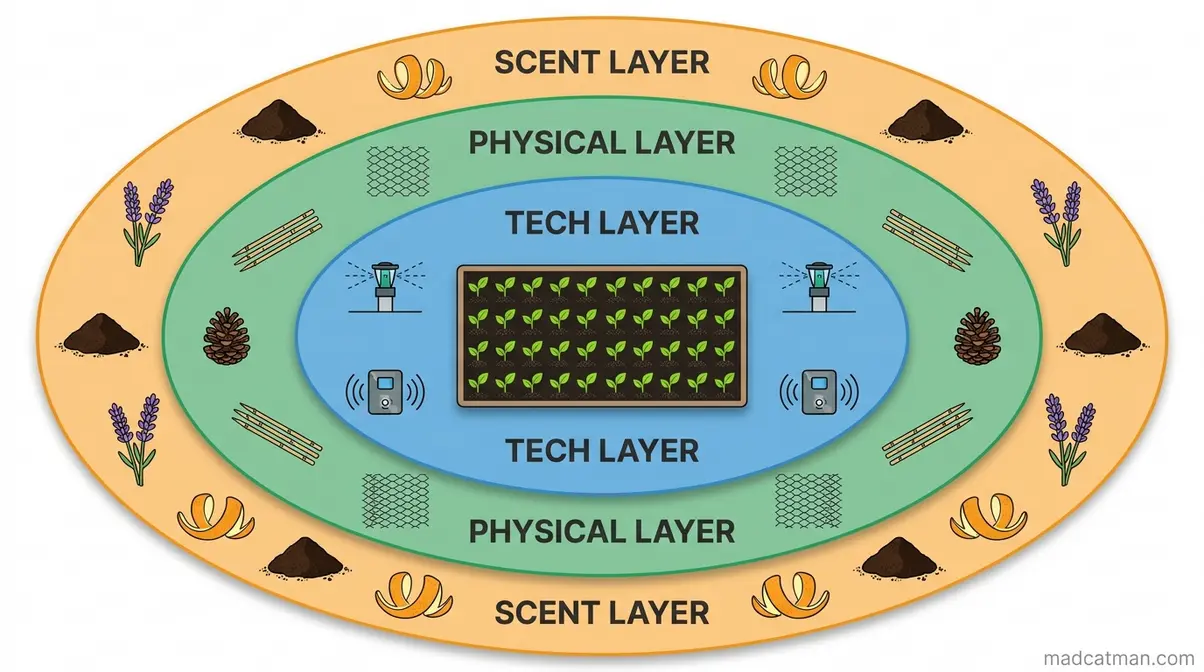
Knowing how to keep cats out of garden beds and borders is genuinely confusing. There are dozens of tips online, but most articles skip the crucial safety details and leave you guessing about what actually works. This guide is different. It introduces The Garden Defense Stack — a layered, three-category system (Scent → Physical → Tech) that you can build step by step, customized to your specific garden type, starting this weekend.
Knowing how to keep cats out of garden areas works best when you layer methods rather than rely on one alone — that’s the core of The Garden Defense Stack.
- Start with scent: Citrus peels, coffee grounds, and cat-repellent plants create the first line of defense.
- Add physical barriers: Chicken wire, prickly mulch, and ground stakes remove comfortable digging spots.
- Deploy tech for stubborn cases: Motion-activated sprinklers are the most reliable active deterrent, according to animal welfare organizations.
- Customize by garden type: Flower beds, raised beds, vegetable patches, and containers each need a slightly different approach.
- Never use peppermint or eucalyptus essential oils near cats — both are toxic to felines, confirmed by veterinary sources including VCA Animal Hospitals.
What You’ll Need Before You Start
You don’t need specialist tools or expensive equipment to reclaim your garden. Most of these items are already in your kitchen or available at any hardware store for a few dollars.
- Basic supplies:
- Citrus peels (orange, lemon, or grapefruit)
- Used coffee grounds
- White vinegar
- Spray bottle
- Chicken wire (a flexible metal mesh used as a garden barrier), wire cutters, and garden staples
- Prickly mulch (pine cones, holly clippings, or coarse bark)
- Bamboo skewers or plastic forks
- Optional upgrades:
- Motion-activated sprinkler (connects to a standard garden hose)
- Ultrasonic cat repeller (battery or solar-powered)
- Cat-repellent plants (lavender, rue, or Coleus canina — also called the “scaredy cat plant”)
Understanding The Garden Defense Stack: This guide uses a layered approach. Think of it like building a fence with three layers of security. The first layer (scent) makes your garden smell unwelcoming. The second layer (physical) makes it uncomfortable to walk or dig. The third layer (tech) actively surprises any cat that pushes through the first two. Gardening communities consistently report that using all three layers together is far more effective than any single method alone.
Step 1: Apply Scent-Based Repellents
Scent is your cheapest, fastest first line of defense. Cats navigate primarily through smell, so making your garden smell wrong to them is the quickest way to discourage visits. According to the Old Farmer’s Almanac, cats are particularly sensitive to strong citrus, vinegar, and certain herbal scents — and will actively avoid areas where these smells are present.
Scents That Cats Hate Most
Cats dislike several common smells that are easy to source at home. The most effective options reported by gardening communities include:
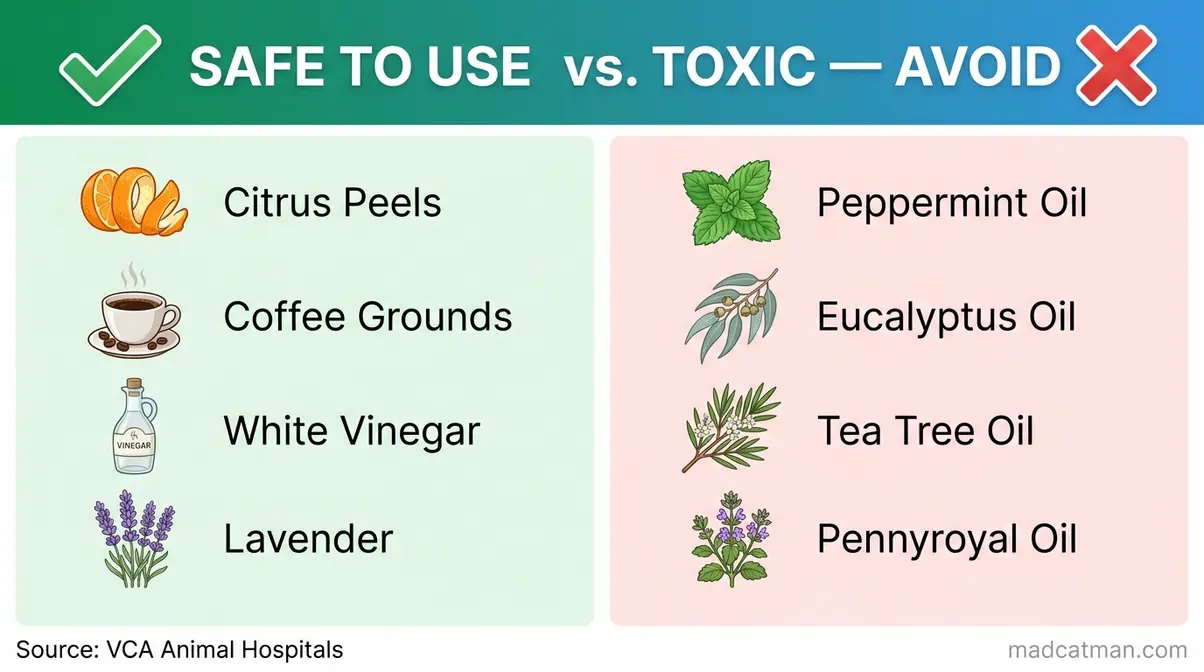
- Citrus peels: Scatter orange, lemon, or grapefruit peels directly on the soil. Refresh every 3–4 days, especially after rain, as the scent fades quickly.
- Coffee grounds: Sprinkle used grounds around plant bases. They also add nitrogen to the soil, so your plants benefit too.
- White vinegar: Dilute one part vinegar to three parts water and spray around the garden border — not directly on plants, as vinegar can harm them.
- Lavender or rosemary: Fresh cuttings placed on the soil surface add scent while looking tidy.
Gardeners consistently report that citrus peels need refreshing every 3–4 days after rain to stay effective. Scent alone rarely stops a determined cat, which is why The Garden Defense Stack layers this method with physical and tech deterrents.
Cat-Repellent Plants to Grow in Your Garden
Growing certain plants throughout your garden creates a natural, long-lasting scent barrier. The most commonly recommended options include:
- Coleus canina (the “scaredy cat plant”): Emits a sharp, skunk-like odor when brushed. Plant every 2–3 feet around garden borders.
- Lavender (Lavandula): Strongly scented, low-maintenance, and attractive to pollinators.
- Rue (Ruta graveolens): A traditional cat deterrent. Note: Wear gloves when handling rue — it can cause skin irritation in humans and is toxic to cats if ingested. Do not use this plant if you have cats of your own.
- Lemon thyme: A low-growing option that works well as a border plant between flower beds.
The Royal Horticultural Society notes that cat-repellent plants work best as a supporting measure alongside physical barriers, rather than as a standalone solution. For more specific herb integration, check our cats and basil plants 9-step checklist.
⚠️ Safety Warning: Essential Oils Toxic to Cats
This is the most important section in this guide. Please read it before trying any scent-based remedy you find online.
Many popular DIY cat-repellent recipes recommend adding peppermint oil or eucalyptus oil to water and spraying it around your garden. Do not do this. Both oils are confirmed toxic to cats.
According to VCA Animal Hospitals, cats lack the liver enzymes needed to process phenols — organic compounds found in high concentrations in peppermint and eucalyptus oils. Even skin contact or inhalation can cause symptoms including drooling, vomiting, tremors, and respiratory distress. The Pet Poison Helpline lists both oils on its feline toxin watch list.
The full list of essential oils toxic to cats includes: peppermint, eucalyptus, tea tree, cinnamon, clove, citrus oil, pennyroyal, pine, ylang-ylang, and sweet birch.
Stick to the safe scent options listed above — citrus peels, coffee grounds, and diluted vinegar — which are effective without posing any risk.
DIY Natural Scent Spray Recipe
This simple spray uses only safe, cat-friendly ingredients and takes about five minutes to make.
You’ll need: 1 spray bottle, water, white vinegar, citrus peels. Estimated time: 5 minutes.
- Fill a spray bottle with 2 cups of water.
- Add ½ cup of white vinegar.
- Drop in 10–15 pieces of fresh citrus peel (orange or lemon work best).
- Seal the bottle and shake well.
- Spray along garden borders and on the soil between plants — avoid spraying directly on leaves.
- Reapply every 3–4 days, or after any rainfall.
Expected outcome: A noticeable citrus-vinegar scent that most cats will avoid. This spray is safe for plants, soil, and visiting wildlife.
What smell do cats absolutely hate?
*Cats absolutely hate the smell of rue (Ruta graveolens), which is widely described as the most intensely disliked scent among cat-repellent plants.* Citrus and vinegar are strong runners-up. However, if you grow rue, handle it with gloves — it causes skin irritation in humans and is toxic to cats if ingested. Stick to citrus peels and coffee grounds for a safe, effective, and easy-to-source alternative that won’t harm any animal that wanders through.
Step 2: Install Physical Barriers
Physical barriers are the most reliable long-term solution for stopping cats from digging, according to university extension research from Oregon State University Extension. If you are wondering how to keep cats out of garden spaces permanently, remember that scent fades; a well-installed barrier stays in place. This step focuses on two proven approaches: covering the soil surface and making it uncomfortable to walk on.
Ground-Level Barriers: Chicken Wire and Netting
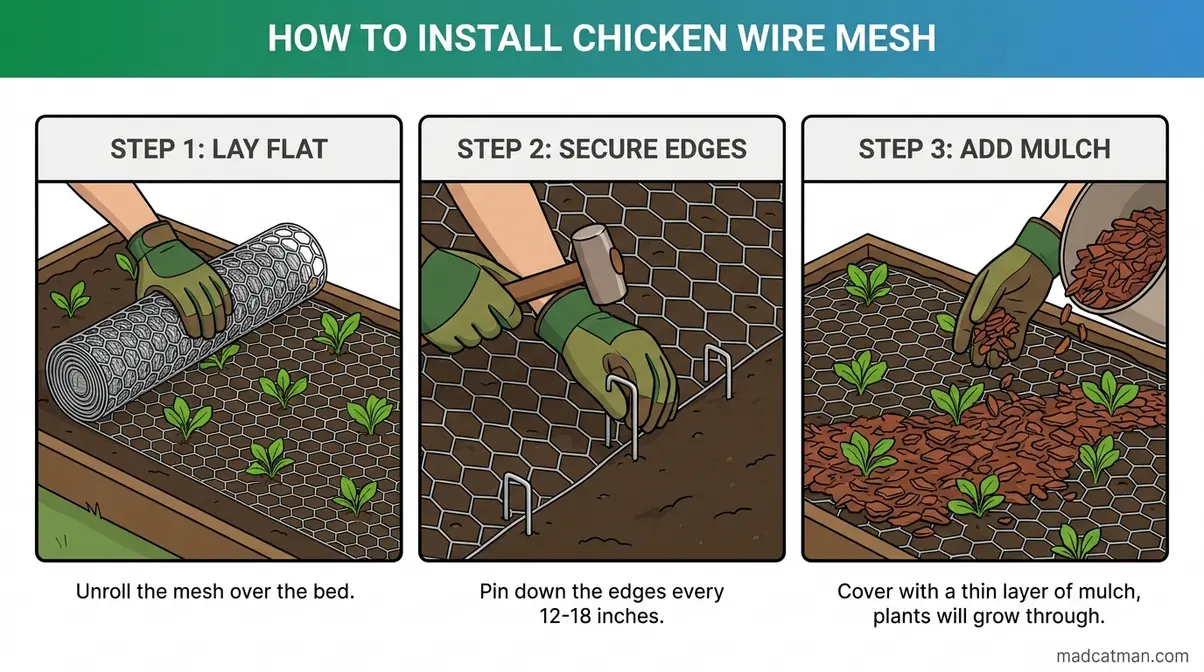
Chicken wire (a flexible metal mesh used as a garden barrier) laid flat on the soil is one of the most effective physical deterrents available. Cats dislike walking on the uneven surface and will avoid areas covered with it.
How to install flat chicken wire:
- Measure the area of your garden bed you want to protect.
- Cut chicken wire to size using wire cutters.
- Lay it flat on the soil surface between your plants.
- Secure the edges with garden staples (U-shaped pins pushed into the soil) so it can’t be pushed aside.
- Cover lightly with a thin layer of mulch if you want it to look tidier.
Expected outcome: Cats step on the wire, find it uncomfortable, and move on. Your plants grow up through the gaps without any interference. The Neighborhood Cats organization recommends this method as one of the most effective low-cost options for protecting bare soil.
Textural Deterrents: Mulch, Pinecones, and Stakes
If chicken wire feels like too much work, textural deterrents are an easier starting point. The goal is the same: make the soil surface uncomfortable enough that cats don’t want to dig in it.
- Effective options:
- Pine cones or holly clippings: Scatter generously across bare soil. The prickly surface discourages digging.
- Coarse bark mulch: Heavier mulch is harder to dig through than fine soil. A 3-inch layer also retains moisture for your plants.
- Bamboo skewers or plastic forks: Push them into the soil handle-first, 6 inches apart across the bed. Cats avoid weaving between them.
- Stone or gravel borders: A ring of smooth river stones around a bed adds a textural boundary cats often won’t cross.
Common feedback from gardening communities is that textural deterrents work best when they cover the entire surface of bare soil — leaving gaps gives cats exactly the soft patch they’re looking for.
Step 3: Deploy Motion-Activated Tech
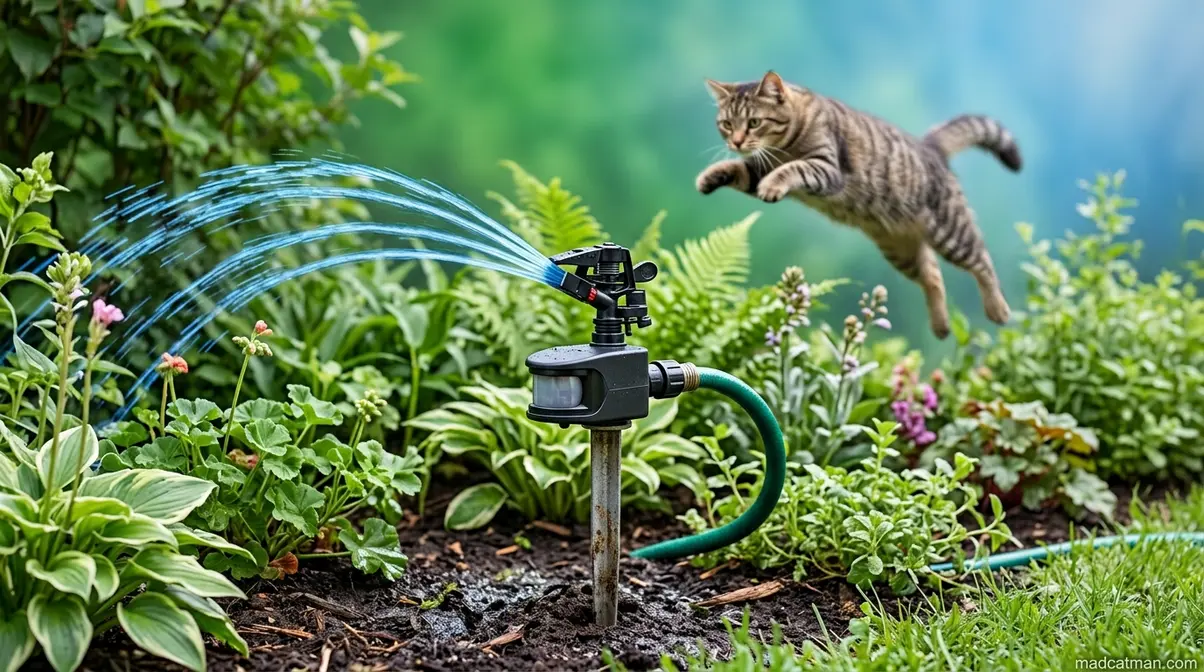
Some cats push through scent and physical barriers anyway. For these persistent visitors, motion-activated technology is your most powerful tool. Animal welfare organizations recommend motion-activated sprinklers as the most humane active deterrent available for garden use.
Motion-Activated Sprinklers
A motion-activated sprinkler connects to your garden hose and uses an infrared sensor to detect movement. When a cat enters the detection zone, the sprinkler fires a short burst of water — startling the cat without causing any harm. According to the City of Bowie, MD Animal Services, repeated exposure trains cats to avoid the area over time.
- Key setup tips:
- Position the sprinkler to cover the most frequently visited area of your garden.
- Most models detect movement within a 30-foot range and a 120-degree arc.
- Set sensitivity to medium to avoid triggering on small birds or passing wind.
- Bring it inside during freezing temperatures to prevent pipe damage.
Limitation: Sprinklers require a water connection and don’t work well in winter. They may also occasionally trigger on other animals.
Ultrasonic Repellers
Ultrasonic repellers emit a high-frequency sound (typically 15,000–25,000 Hz) that cats find irritating but that humans can’t hear. They’re battery or solar-powered and require no water connection, making them a good option for areas away from your hose.
Honest assessment: Results from gardening communities are mixed. Some cats habituate to the sound over time and stop responding. They work best as a supplementary layer within The Garden Defense Stack rather than as a standalone solution. Check that any model you choose specifies it won’t affect dogs, hedgehogs, or other garden wildlife at the frequency it uses.
Step 4: Customize Your Defense by Garden Type
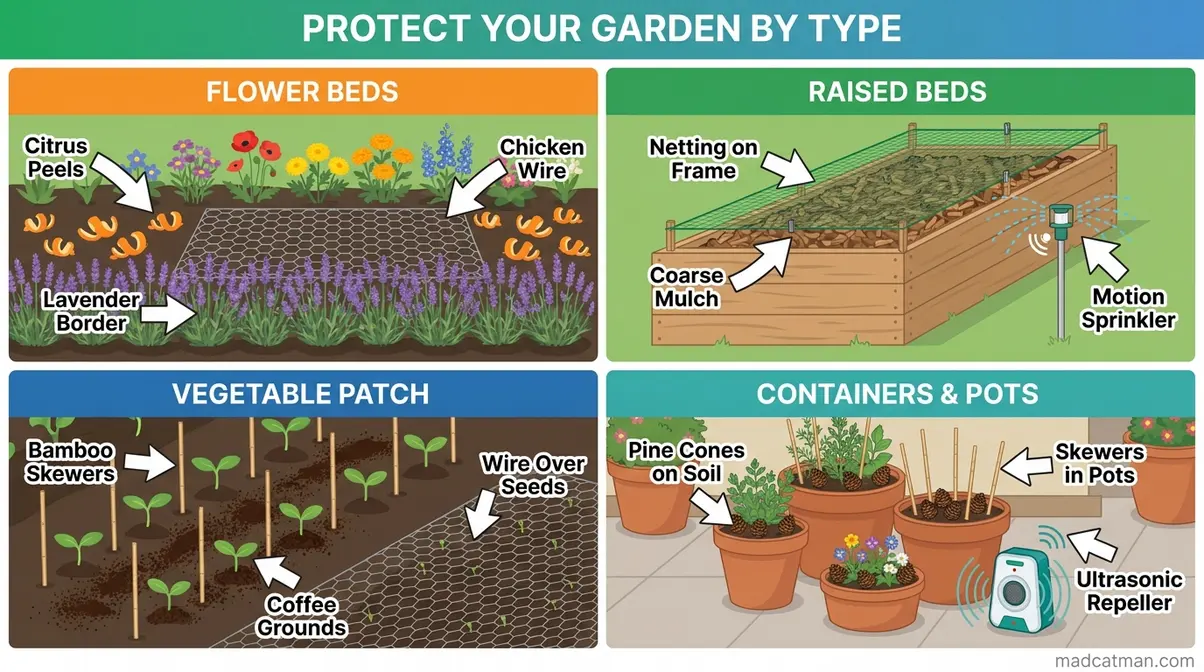
Different garden setups attract cats for different reasons, and the best combination of methods varies by garden type. This step covers how to tailor your approach — and is the key to making your Garden Defense Stack work for your specific situation.
Protecting Flower Beds and Border Gardens
Flower beds are prime cat territory because they often contain loose, freshly dug soil — exactly what a cat looks for in an outdoor litter box. This is the most common complaint from gardening communities, and it’s where The Garden Defense Stack earns its keep fastest.
- Recommended combination:
- Scatter citrus peels across the soil and refresh every 3–4 days.
- Plant lavender or Coleus canina along the front border.
- Lay chicken wire flat on the soil between plants, secured with garden staples.
For large border gardens, focus your physical barriers on the sections with the most bare soil — cats are drawn to the softest, most accessible spots first.
Protecting Raised Garden Beds
Raised garden beds (elevated planting boxes, typically 6–12 inches above ground level) are easier to protect than open ground because you’re working with a defined perimeter. The David Suzuki Foundation recommends physical barriers as the most reliable method for raised beds specifically.
- Recommended combination:
- Attach chicken wire or garden netting across the top of the frame when beds are newly planted and vulnerable.
- Once plants are established, replace with a layer of coarse mulch on the soil surface.
- Add a motion-activated sprinkler nearby if cats are persistent.
Protecting Vegetable and Herb Gardens
Vegetable and herb gardens are especially frustrating to deal with because cats using them as a litter box creates a genuine hygiene concern — their waste can carry pathogens that affect edible crops. Oregon State University Extension’s guide to protecting gardens from cats specifically highlights the importance of physical barriers in vegetable patches.
- Recommended combination:
- Use bamboo skewers across bare soil between seedlings — they protect baby plants without blocking sun or water.
- Apply coffee grounds around the base of herbs (they benefit from the nitrogen anyway).
- Cover newly seeded rows with chicken wire until seedlings are established.
Protecting Container Gardens and Pots
Containers and pots are surprisingly vulnerable because they’re compact, easy to access, and filled with soft potting soil. A single medium-sized pot is practically an invitation for a cat.
- Recommended combination:
- Place pine cones or smooth river stones on the soil surface of each pot — they leave no soft digging spot.
- Push 3–4 bamboo skewers into the soil of each container, pointing upward.
- Group containers together and place a motion-activated repeller nearby if you have multiple pots on a patio or balcony.
Step 5: Handle Stray, Feral, and Neighbor’s Cats
Not all visiting cats are the same, and knowing who you’re dealing with changes your approach. The methods in Steps 1–4 work on all cats, but understanding the source of the problem helps you choose the right long-term solution.
Dealing with Stray and Feral Cats
Stray cats are lost or previously owned cats that are comfortable around people. Feral cats are wild-born cats with little or no human contact — they typically won’t approach you and are not suitable for rehoming. This distinction matters because the solutions differ.
For stray cats, The Garden Defense Stack (scent + physical + tech) is usually enough to redirect them elsewhere. For feral cats, the most humane and effective community-level solution is Trap-Neuter-Return (TNR) — a program where feral cats are humanely trapped, spayed or neutered, vaccinated, and returned to their territory. According to Alley Cat Allies, TNR has been shown to reduce colony sizes over time and decrease nuisance behaviors including roaming and territorial marking.
Contact your local animal shelter or humane society to find a TNR program in your area. In the meantime, apply your full Garden Defense Stack to protect your garden while the population issue is being addressed at a community level.
One important note: Do not put out food near your garden, even if you feel sorry for stray cats. Feeding them establishes your garden as a safe, rewarding destination — the opposite of what you want.
Neighbor’s Cats — A Diplomatic Approach
If you know the cat belongs to a neighbor, a calm, friendly conversation is often the most effective first step. Most pet owners don’t realize their cat is causing problems in nearby gardens. You can also read our detailed guide on keeping neighbours’ cats out of your garden for a full walkthrough of the diplomatic and practical options available to you.
In brief: talk first, deploy your Garden Defense Stack second, and involve your local council only as a last resort.
How do I stop my neighbour’s cats from coming into my garden?
Start with a polite conversation with your neighbor — most pet owners genuinely don’t know their cat is causing problems next door. Then apply your full Garden Defense Stack: scent deterrents on the borders, physical barriers over bare soil, and a motion-activated sprinkler for the most visited spots. For a full step-by-step approach, our dedicated guide on keeping neighbours’ cats out covers every option including local council escalation paths.
Verify Your Results
After one week of applying your chosen methods, walk your garden and check for signs of cat activity: fresh digging, disturbed mulch, or droppings. If you find none, your Garden Defense Stack is working — keep refreshing scent deterrents every 3–4 days and check your physical barriers after heavy rain or wind.
If you still see signs of cat activity, move to the Troubleshooting section below.
- Quick progress checklist:
- ✅ Scent deterrents applied and refreshed within the last 3 days
- ✅ Bare soil fully covered by physical barriers
- ✅ Motion-activated sprinkler or ultrasonic repeller positioned in the most visited area
- ✅ No food or water sources near your garden that might attract cats
Troubleshooting — When the Methods Aren’t Working
Cats Are Ignoring Your Scent Deterrents
Scent deterrents stop working for two main reasons: the scent has faded, or the cat has habituated (got used) to it. Common feedback from gardening communities is that scent methods alone rarely suffice for determined or repeat visitors.
Fix: Refresh scent deterrents every 2–3 days instead of every 4–5, and switch to a different scent. If citrus isn’t working, try coffee grounds. If coffee grounds aren’t working, try a diluted vinegar spray. Rotating between scents prevents habituation. Then add a physical barrier — scent alone is rarely enough.
Your Physical Barriers Keep Getting Moved
Chicken wire that isn’t secured properly can be pushed aside by curious or persistent cats. Bamboo skewers can fall over in wind.
Fix: Use longer garden staples (4–6 inches) to anchor chicken wire flat to the soil. For bamboo skewers, push them at least 3 inches deep and at a slight inward angle. If barriers keep failing, upgrade to a motion-activated sprinkler — it’s the most consistent active deterrent and doesn’t rely on the cat avoiding a static obstacle.
When You’re Dealing with More Than Just Cats
If rabbits, foxes, or dogs are also entering your garden alongside neighborhood cats, a single deterrent won’t cover all species. Dogs, for example, are not deterred by cat-specific ultrasonic frequencies, and rabbits respond better to solid fencing than to scent.
Fix: Prioritize solid physical barriers (chicken wire with a buried edge to stop burrowing) as the universal foundation. Then layer species-specific deterrents on top. For cats and dogs together, motion-activated sprinklers are the most effective multi-species deterrent — the water burst works on both. For cats and rabbits together, focus on solid perimeter fencing first, then add the scent layer for cats specifically.
Frequently Asked Questions
How do I stop a cat pooping in my garden?
The most effective way to stop a cat pooping in your garden is to remove the bare, soft soil it’s attracted to. Cover every exposed patch with chicken wire, coarse mulch, pine cones, or bamboo skewers — cats need a soft surface to dig, so denying them that surface is your fastest fix. Add citrus peels or coffee grounds on top for a double deterrent. A motion-activated sprinkler is your best option if the problem persists after covering the soil.
What smell do cats hate most?
Cats hate the smell of citrus most consistently — orange, lemon, and grapefruit peels are the most widely reported effective scents across gardening communities. White vinegar and fresh coffee grounds are close runners-up. The Old Farmer’s Almanac confirms that citrus is among the most reliable natural cat repellents available. Refresh whichever scent you choose every 3–4 days, especially after rain.
What is the 3-3-3 rule for cats?
The 3-3-3 rule is a guideline for helping a newly adopted cat settle into a home — it has no direct application to garden deterrence. It describes the typical adjustment timeline: 3 days to decompress, 3 weeks to learn routines, 3 months to feel at home. If you’re dealing with a stray that has started visiting your garden, this rule is a reminder that cats can quickly establish new habits and territories — which is why acting quickly with your Garden Defense Stack matters.
What can I do if my neighbor’s cat keeps pooping in my garden?
If a neighbor’s cat keeps using your garden as a litter box, your best approach combines diplomacy with physical deterrents. Speak to your neighbor first — calmly and with specific examples of the damage. Meanwhile, cover all bare soil with chicken wire or coarse mulch, add citrus peels along the borders, and install a motion-activated sprinkler aimed at the most-used spots. If the problem continues after two to three weeks of consistent deterrence, contact your local council or animal services to understand your options — most areas have nuisance animal policies.
Will coffee grounds hurt my plants?
Used coffee grounds are generally safe for most plants and act as a gentle fertilizer. Because they add nitrogen to the soil, they benefit acid-loving plants while simultaneously deterring cats. However, avoid applying thick layers that can compact and prevent water from reaching the roots.
Are ultrasonic cat repellers safe for dogs?
Most commercial ultrasonic cat repellers operate at frequencies that dogs can also hear. While they are not harmful to dogs, the high-pitched sound can be annoying or distressing to them. If you share your garden with a dog, motion-activated sprinklers are usually a better multi-species deterrent.
Your Garden, Reclaimed
Cats in your garden are a genuinely frustrating problem, and the sheer number of tips online makes it hard to know where to start. If you want to know how to keep cats out of garden beds effectively, the good news is that most gardeners see a real improvement within one to two weeks when they apply The Garden Defense Stack consistently — layering scent deterrents, physical barriers, and tech in combination rather than trying one thing at a time and giving up.
Start with what you already have at home: citrus peels on the soil, a few bamboo skewers between your seedlings, and a diluted vinegar spray around the border. Add a motion-activated sprinkler if the problem persists. Customize the combination for your specific garden type using Step 4 as your guide. And remember: the single most important safety rule is to avoid essential oils entirely — peppermint and eucalyptus are toxic to the very cats you’re trying to deter humanely.
Your next step is simple. This weekend, walk your garden, identify the two or three spots cats visit most, and apply your first layer of scent and physical deterrents there. Most people find that targeted, consistent action in the highest-traffic spots produces faster results than spreading deterrents thinly across the whole garden. Your baby plants deserve better — and with the right system in place, they’ll get it.

Dave King
Cat owner and writer at Mad Cat Man.