
Table of Contents
- Why Cats and Basil Plants Can Coexist Safely
- Cats and Basil Plants: A 9-Step Checklist to Grow, Pet-Proof, and Share Basil Safely
- Pet-Proof Grow Setups: Pots, Shelves, and Hydroponics
- How Much Basil Is Okay for Cats? Benefits, Risks, and Red Flags
- Training, Enrichment, and Redirecting Herb Hunters
- Quick Troubleshooting: Basil and Cat Behaviors You Will See
- The Mad Cat Man Starter Kit for Basil-Loving Homes
- Wrap-Up: A Cozy Kitchen Where Basil Thrives and Whiskers Win
This blog post may contain affiliate links. As an Amazon Associate I earn from qualifying purchases.
If you share your home with both a sprightly herb and a whiskered explorer, you have probably wondered how cats and basil plants can happily coexist without shredded leaves or upset bellies, and you are absolutely not alone. When my tabby, Miso, first discovered my windowsill basil, he treated it like a salad bar, and I treated Google like a panic button, only to learn that basil is considered non-toxic to cats by the ASPCA (American Society for the Prevention of Cruelty to Animals).
From that day, I set up a few smart boundaries, added better enrichment, and started offering the occasional basil leaf the right way. In this friendly guide from Mad Cat Man, you will get a practical, 9-step checklist plus cat-focused product suggestions and pet-proofing tips to care for basil, protect your setup, and share tiny tastes safely, all while lowering stress for you and delight for your cat.
Why Cats and Basil Plants Can Coexist Safely
Here is the reassuring headline first: basil is classified as non-toxic to cats by the ASPCA (American Society for the Prevention of Cruelty to Animals), which means a curious nibble is unlikely to cause serious harm, though individual sensitivities can still happen. That said, cats are obligate carnivores that get their core nutrition from meat, so basil should be treated as an occasional novelty rather than a snack bowl, and think of it more like a sprig of parsley on a plate than the plate itself.
Most veterinarians, including many doctor of veterinary medicine (DVM) professionals we speak with for Mad Cat Man guides, suggest keeping all treats, including herbs, under 10 percent of daily calories, and for basil that usually translates to a leaf or two once in a while. Because the aromatic compounds that make basil smell amazing can be a little much for delicate tummies when eaten in quantity, it is smart to watch for signs of mild gastrointestinal upset like soft stools or drooling after a first taste.
- Non-toxic does not mean no limits; it means low risk when common sense is used.
- Fresh basil leaves are gentler than concentrated essential oil, which cats should not ingest or have applied to their fur.
- Pet-proofing your grow area reduces nibbling and soil digging, which are the real day-to-day headaches.
Cats and Basil Plants: A 9-Step Checklist to Grow, Pet-Proof, and Share Basil Safely
Think of this checklist like a calm, repeatable routine that keeps plants thriving and paws out of trouble, even if you live in a small apartment with sun that moves like a spotlight across the wall. You do not need fancy gear to start, but a few strategic upgrades make a big difference, and they are the same kinds of stability and safety upgrades we emphasize across Mad Cat Man’s cat-focused product reviews and buying recommendations (food, toys, furniture, grooming supplies), along with our coverage of cat plant kits and pet-proofing tools.
If you are brand-new to herbs, start with a compact sweet basil variety, choose a bright window, and build up from there, because momentum beats perfection every time. And as you go through the steps, note which ones address your cat’s actual habits, such as high jumping, soil digging, or leaf nibbling, so you can pick the exact pet-proofing measures that matter most in your home.
Watch This Helpful Video
To help you better understand cats and basil plants, we’ve included this informative video from Jackson Galaxy. It provides valuable insights and visual demonstrations that complement the written content.
- Pick the right basil variety: Start with sweet basil or Genovese basil since they are vigorous and forgiving, and save purple or Thai basil for later once your routine clicks.
- Use a sturdy, heavy pot: A ceramic or weighted planter with drainage resists tipping during zoomies, and a saucer catches runoff so you avoid mess and mold.
- Choose quality potting mix: A fluffy, well-draining blend supports roots and dries evenly, which discourages soil digging because there is less damp, loose clumping to paw at.
- Place plants at cat-neutral height: Use a shelf just out of casual reach, or a window bar placed so your cat can watch birds from one perch while the basil lives on another.
- Add a light if needed: A simple LED (light-emitting diode) grow light on a 12 to 14 hour timer helps basil get the equivalent of 6 to 8 hours of good sun when winters get gloomy.
- Block soil access: Snap-on mesh covers, decorative gravel topdressing, or a breathable plant collar stops digging without trapping moisture or blocking growth.
- Offer a legal chew: Provide fresh cat grass and a few crunchy, vet-approved dental treats so your cat has a satisfying, permitted alternative whenever curiosity strikes.
- Share basil the right way: Offer a single, well-rinsed leaf, chopped or torn into tiny bits on top of wet food, and wait 24 hours to observe tolerance before giving another.
- Redirect and reward: If a paw reaches for the plant, gently move the cat, say your cue, then hand over cat grass or a wand toy, and praise like a sportscaster when they choose it.
Pet-Proof Grow Setups: Pots, Shelves, and Hydroponics
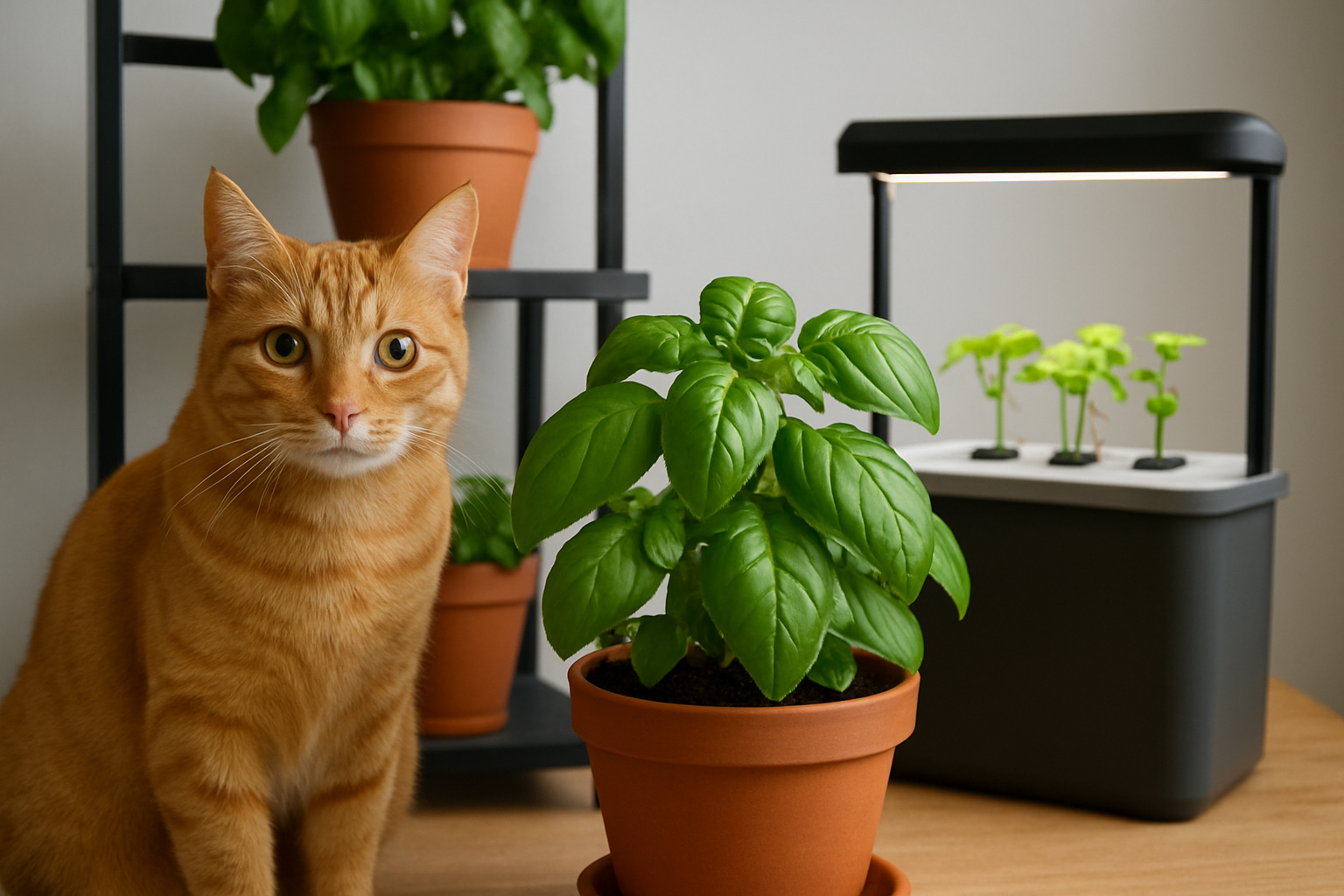
Different homes and different cats call for different setups, and picking the right one early keeps you from playing basil Tetris later when a plant outgrows its corner. Window growers love self-watering planters because they smooth out dry-down cycles when life gets busy, while shelf growers lean on clip-on LED (light-emitting diode) bars to deliver steady light without heating leaves, and hydroponic fans enjoy tidy kitchens and fast growth with zero soil.
From a cat-safety angle, stability matters most, so look for weighty pots, wall-anchored shelves, or hydro kits with wide bases, because fewer wobbles mean fewer test jumps. The table below breaks down common options with the key pros and the cat-proofing tricks we have seen work best across hundreds of reader homes and our own test setups at Mad Cat Man.
| Setup | Best For | Cat Safety Tips | Cost Range | Pros | Cons |
|---|---|---|---|---|---|
| Heavy ceramic pot on sill | Sunny windows, simple care | Add gravel topdressing, use plant collar, place near but not on cat perch | Low to medium | Stable, attractive, easy watering | Soil can entice diggers without a cover |
| Self-watering planter | Busy schedules, consistent moisture | Pick a low, wide reservoir; hide fill spout behind décor | Medium | Even growth, fewer wilt scares | Some models are light and tip-prone |
| Wall shelf with clip-on light | Limited floor space, neat look | Anchor shelf, route cords in cord covers out of paw reach | Medium | Great light control, tidy footprint | Requires mounting and cable management |
| Countertop hydroponic kit | Soilless, fast growth | Use lid domes while seedlings are tiny, tuck cords away | Medium to high | Clean, predictable, year-round harvest | Upfront cost, pump noise may intrigue playful cats |
| Hanging planter | Acrobatic climbers | Hang away from jump points, check hooks regularly | Low to medium | Zero surface access, cute aesthetic | Watering can be messy without a tray |
How Much Basil Is Okay for Cats? Benefits, Risks, and Red Flags
Let us set a helpful rule of thumb first, and then tweak for your cat’s size and sensitivity, because guardrails beat guesswork every time. For an average 10 pound adult cat, think of basil as a novelty garnish or enrichment scent rather than food, which means a torn leaf once or twice per week is plenty, and only if there is no stomach upset, because cats vary just like people.
Basil contains aromatic compounds and small amounts of vitamins that will not meaningfully change feline nutrition, yet the snuffle and crunch can be enriching in the same way a new cardboard box is enriching, and enrichment matters for indoor cats. If you ever see persistent vomiting, diarrhea, or lethargy, do not offer more basil, put the plant out of reach, and check with your veterinarian or a doctor of veterinary medicine (DVM), because safety is about your specific animal, not averages on a chart.
| Cat Size | Suggested Basil Portion | Frequency | Watch For | Action |
|---|---|---|---|---|
| Small adult (under 8 lb) | Half a leaf, finely torn | Once per week | Soft stools, drooling, lack of appetite | Pause basil for two weeks and reassess |
| Average adult (8 to 12 lb) | One small leaf, finely torn | Once or twice per week | Gas, vomiting, hyper-salivation | Stop immediately and call your vet if signs persist |
| Senior or sensitive stomach | A few tiny slivers only | Every other week | Any change from baseline behavior | Skip basil and use cat grass instead |
| Herb | Safety for Cats | Notes |
|---|---|---|
| Basil | Non-toxic | Fresh leaves only in tiny amounts; avoid essential oil |
| Cat grass (wheat or barley) | Generally safe | Great alternative nibble; can aid hairball passage |
| Rosemary | Generally safe | Strong flavor; most cats ignore it |
| Mint | Use caution | Some mints can upset stomachs; avoid essential oil |
| Chives | Unsafe | Members of the allium family can be toxic to cats |
| Oregano | Use caution | Not recommended as a cat treat; can irritate |
Training, Enrichment, and Redirecting Herb Hunters
If your cat is a plant chaser, training is not about saying no forever, it is about offering a better yes right away, and then celebrating that choice so it sticks, because cats absolutely learn patterns that pay off. Start by making the basil just a bit less interesting with a mesh soil cover and a small reposition, and simultaneously make the alternative irresistible, like a fresh pot of cat grass placed on your cat’s favorite sun patch or a wand toy session that begins the second they glance toward the plant.
Consistency is queen, so use the same cue word, the same redirect, and the same happy reward every time for a few weeks, which sounds like a lot but quickly becomes muscle memory. For many families, the issue is not just leaf nibbling but also boredom, so rotate toys every few days and introduce short training games that turn your kitchen into a tiny enrichment gym.
- Use a simple cue like “this way,” then guide to grass, reward with praise and a treat.
- Schedule two short play sessions daily to drain that curious energy before it targets plants.
- Feed a leaf only during mealtime so basil becomes part of a routine, not a free-for-all.
- Consider a cat shelf or window perch to give your cat a sanctioned view near the window.
| Category | What to Look For | Budget Range | Mad Cat Man Notes |
|---|---|---|---|
| Self-watering planter | Wide base, visible water indicator, removable inner pot | Affordable to mid-range | Reduces watering guesswork that leads to droop and leaf drop |
| Clip-on grow light | Full-spectrum bulbs, flexible gooseneck, timer function | Affordable | Great for short winter days without heating the plant |
| Soil cover | Breathable mesh or pea gravel, easy to remove for watering | Low | Stops digging and keeps the setup tidy |
| Cat grass kit | Fast germination, sturdy tray, minimal mess | Low | The best redirect because it meets the chewing urge |
| Wand toy | Durable cord, replaceable lure, comfortable handle | Low to mid-range | Instant redirect tool during training sessions |
At Mad Cat Man, our testing and reviews focus on how gear behaves in real homes with real felines, which is why we call out stability for planters, cord management for lamps, and easy cleaning for grass trays. If you need a one-page shopping plan, our how-to checklists and buying recommendations cover the lot in plain language, from baseline food and grooming picks to enrichment and safety tools, so you are not stuck comparing techy specs in a vacuum.
And because our health guides are vet-approved or expert-backed, you will see when we say no to products that do not earn their keep, even if they look clever in a photo. These little credibility checks matter when your goal is a calm kitchen where basil photos flourish and paws go where they are supposed to go, every day, not just on day one.
Quick Troubleshooting: Basil and Cat Behaviors You Will See
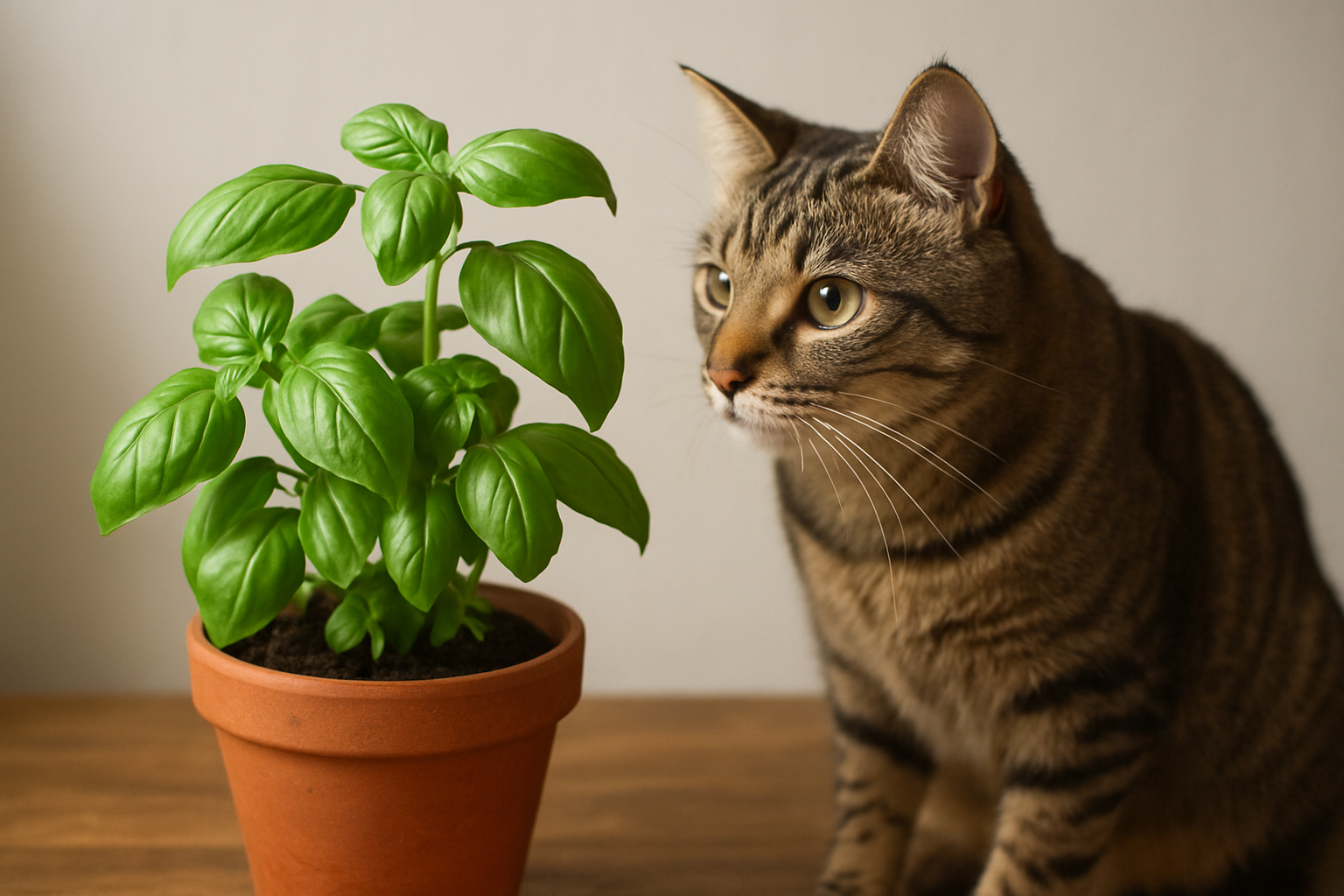
Even with a good plan, things happen, and a quick diagnosis saves both your plant and your mood, especially when you are juggling dinner and your cat decides to re-enact a jungle documentary. The most common basil issues indoors are overwatering, low light, and rough handling, and the most common cat issues near plants are curiosity spikes at sunrise and sunset, which is when short play sessions make a big difference.
If a nibble happens, do not panic, remove the plant for the day, offer water and rest, and note any behavior changes, because the goal is steady learning not perfect behavior. Use the table below to triage both plant problems and feline mischief in one glance, so you can move on with your evening without your basil or your cat stealing the show.
| Issue | Likely Cause | What To Try | When To Call A Vet |
|---|---|---|---|
| Leaves yellowing | Overwatering or low light | Let soil dry, add light, remove saucer water | N/A (not applicable) for the plant; no cat concern here |
| Leggy stems | Insufficient light | Pinch tops, add LED (light-emitting diode) light, rotate pot weekly | None |
| Soil flung out | Cat digging | Install mesh cover, switch to gravel topdressing, add cat grass nearby | Only if foreign objects were ingested or cuts are visible |
| Cat chewing leaves | Curiosity or boredom | Redirect with grass, give play session, offer tiny basil leaf at mealtime | If vomiting or lethargy persists beyond 24 hours |
| Whole plant tipped | Zoomies or unstable pot | Use heavier planter, non-slip mat, or move to anchored shelf | If there are injuries from the fall or glass shards |
The Mad Cat Man Starter Kit for Basil-Loving Homes
New or uncertain cat owners often tell us the hardest part is not the doing, it is the choosing, because every product page promises the moon while your basil just needs good light and your cat needs good options. That is why Mad Cat Man organizes content into clear categories with step-by-step how-tos, behavior and training advice, breed-specific notes, and vet-approved health guides, so you can build a setup without opening twenty browser tabs.
Below is a quick starter kit that maps common needs to simple gear picks across budgets, and each item links back to the habits you are training, like redirecting chewing or stabilizing planters. Use it as a shopping checklist, then save our in-depth reviews for when you are ready to upgrade or compare, because the best setup is the one you actually use every day.
| Need | Recommended Item | Why It Helps | Budget Guidance |
|---|---|---|---|
| Stability | Heavy ceramic or stone planter with saucer | Resists tipping so curious paws cannot knock it over | Affordable to mid-range |
| Light | Clip-on full-spectrum LED (light-emitting diode) grow light with timer | Delivers consistent light to prevent leggy growth | Affordable |
| Soil protection | Mesh soil cover or decorative gravel top layer | Blocks digging while allowing airflow and watering | Low |
| Redirect chew | Cat grass tray | Provides a permitted nibble source, reducing basil interest | Low |
| Enrichment | Wand toy and treat pouch | Channels energy and rewards plant-friendly choices | Low to mid-range |
| Cord safety | Cord covers and cable clips | Prevents chewing and accidental yanks on lights | Low |
When you are ready to dig deeper, Mad Cat Man has detailed product reviews and buying recommendations, plus health and preventive care guides like worming, microchipping, and dental care, because a contented, healthy cat is far less likely to pester your plants. Our breed guides and comparisons, including popular Maine Coon articles, explain how size and personality influence plant setups, since a long, athletic jumper can reach shelves that a smaller, mellow cat will not consider.
And when you want absolute clarity on safety, especially for humidifiers, air purifiers, or plants, our safety and product-suitability content shows you what is okay to place where, and what earns a careful maybe. The end result is a calm, informed plan that turns cats and basil plants into a sweet little partnership rather than a daily tug-of-war.
Wrap-Up: A Cozy Kitchen Where Basil Thrives and Whiskers Win
Here is the promise we started with made real: you can grow lush basil, pet-proof your setup, and safely share tiny tastes with your cat using a simple, nine-step routine.
Imagine the next twelve months with a steady supply of bright, fragrant leaves and a cat who knows exactly where the fun is meant to happen, from cat grass trays to sunny perches.
What one change will you try first to make cats and basil plants thrive together in your home?
Additional Resources
Explore these authoritative resources to dive deeper into cats and basil plants.