
You’re thinking about getting a second cat — but your apartment barely fits the litter box you already have. The question on every new multi-cat owner’s mind: can cats share a litter box, or is that asking for trouble?
Get it wrong, and you’re looking at accidents outside the box, cats that refuse to use it at all, and — in some cases — expensive veterinary visits for stress-related illnesses. The good news is that the answer isn’t a hard no. It comes with conditions, and once you know them, you can set your cats up for success even in a small two-bedroom apt.
In this vet-reviewed guide, you’ll learn the expert-recommended rule for multi-cat households, which exceptions actually hold up, and how to make the best of limited space. We’ll cover the N+1 rule, real health risks, bonded cat exceptions, self-cleaning box solutions, interspecies sharing, and the warning signs that tell you something is wrong.
Can cats share a litter box? Technically yes — but veterinary guidelines strongly recommend against relying on a single box for two or more cats. The N+1 rule (one box per cat, plus one extra) is the gold standard for preventing stress, accidents, and health problems.
- The N+1 Rule: Two cats need three litter boxes — one per cat, plus one spare, placed in separate locations.
- Health Risks Are Real: Sharing one box is associated with stress-related urinary disease (FLUTD), territorial guarding, and faster spread of parasites between cats.
- The Litter Box Stress Ladder: Sharing starts with mild tension, escalates to avoidance, and can end in stress-induced illness — catching early signs prevents the climb.
- Self-Cleaning Boxes Help — But Don’t Replace the Rule: An automatic box reduces waste buildup, but most vets still recommend a second box alongside it.
- Bonded pairs and sibling kittens may tolerate sharing better short-term, but the N+1 rule still applies as they mature.
Can Cats Share a Litter Box? The Short Answer
Cats can physically share a litter box, but most veterinary and feline behavior experts recommend against relying on a single box for two or more cats. Whether it works in practice depends on your cats’ personalities, how often you clean the box, and how much space they have to avoid each other.
“Do I need more than 1 litter box if I was to get another? I just dont really have the room for another, or would I be best getting one of the self cleaning so its constan”
That question — asked by a real cat owner weighing a second cat — captures exactly what most people feel. You’re not wrong to wonder. Plenty of cats do share without obvious drama, especially bonded pairs (cats that have lived together since kittenhood and genuinely seek each other’s company) or sibling kittens who grew up using the same box.
- When sharing can work, at least temporarily:
- Your cats are a bonded pair with no territorial history
- You clean the box at least twice daily
- The box is large enough for both cats to use comfortably without stepping on each other’s waste
- Neither cat shows any signs of stress (see the Warning Signs section below)
However, analysis of veterinary research consistently shows that even cats who seem to get along really well can develop problems over time when forced to share. The issue isn’t always visible conflict — it’s the low-grade stress that builds beneath the surface. That’s the first rung of The Litter Box Stress Ladder: a progression from mild tension to avoidance to physical illness that many owners don’t notice until it’s already a vet visit.
For a deeper look at how stress affects multi-cat households, see our guide to multi-cat household setup.
Will a cat use a litter box that another cat has used?
Most cats will use a litter box that another cat has used, but many prefer not to — especially if it hasn’t been cleaned recently. Cats have a highly developed sense of smell, and a box carrying another cat’s scent signals territorial ownership. Subordinate cats (less dominant ones) are most likely to avoid a box that a dominant cat has recently used. Scooping after every use reduces this friction significantly.
How Many Litter Boxes Do You Need? The N+1 Rule
The N+1 rule — one litter box per cat, plus one extra — is the universally accepted veterinary standard for multi-cat households. For two cats, that means three boxes. For three cats, four boxes. This isn’t arbitrary; it’s designed to prevent resource guarding and give every cat a private option.
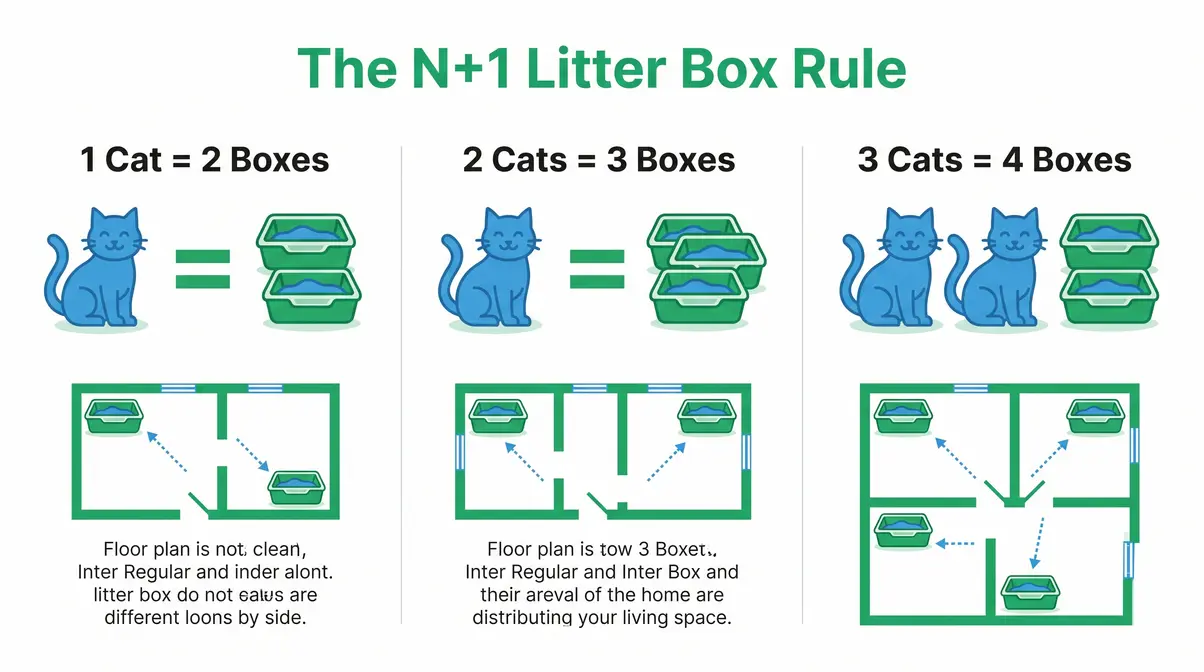
The Ohio State University Indoor Pet Initiative describes this as “The Golden Rule” for litter box management, noting that urine spraying and box avoidance can be prevented or reduced by providing multiple boxes. The AAHA Feline Life Stage Guidelines echo this recommendation, specifying one box per cat plus one additional, or one box per social group plus one additional.
Why does an extra box matter so much?
Cats are territorial by nature — meaning they instinctively claim spaces and resources as their own and may guard them from other cats. When two cats share one box, the dominant cat can block access, either physically or simply by leaving their scent so strongly that the other cat feels unwelcome. The subordinate cat (the less dominant one) then holds it in, which raises the risk of urinary problems.
Practical placement tips for small spaces:
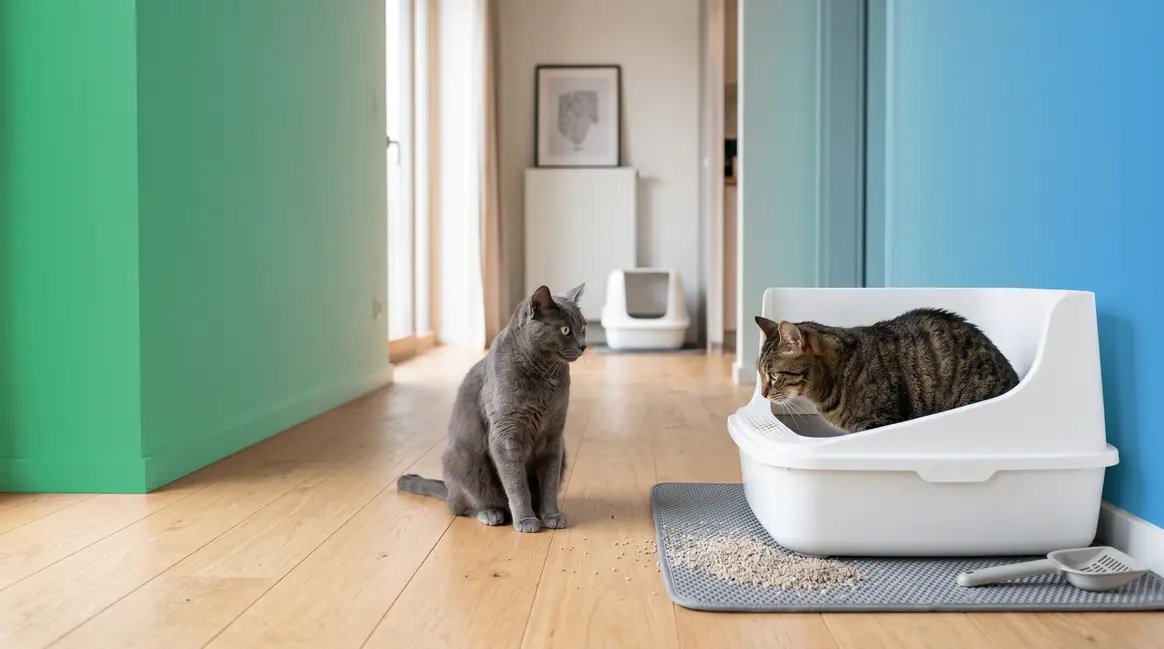
- Place boxes in different rooms — never side by side (two adjacent boxes feel like one box to a cat)
- One box per floor if you have a multi-story home
- Avoid high-traffic areas or spots next to noisy appliances
- Keep boxes away from food and water bowls
| Number of Cats | Minimum Boxes (N+1 Rule) | Recommended Placement |
|---|---|---|
| 1 | 2 | Two separate rooms |
| 2 | 3 | Three separate locations |
| 3 | 4 | One per floor + spare |
| 4 | 5 | Spread across all living areas |
What Goes Wrong When Cats Share One Box?
Sharing a single litter box creates two distinct categories of problems: behavioral conflicts and physical health risks. Both can develop quietly before you notice anything is wrong.
Territorial Disputes and Box Guarding
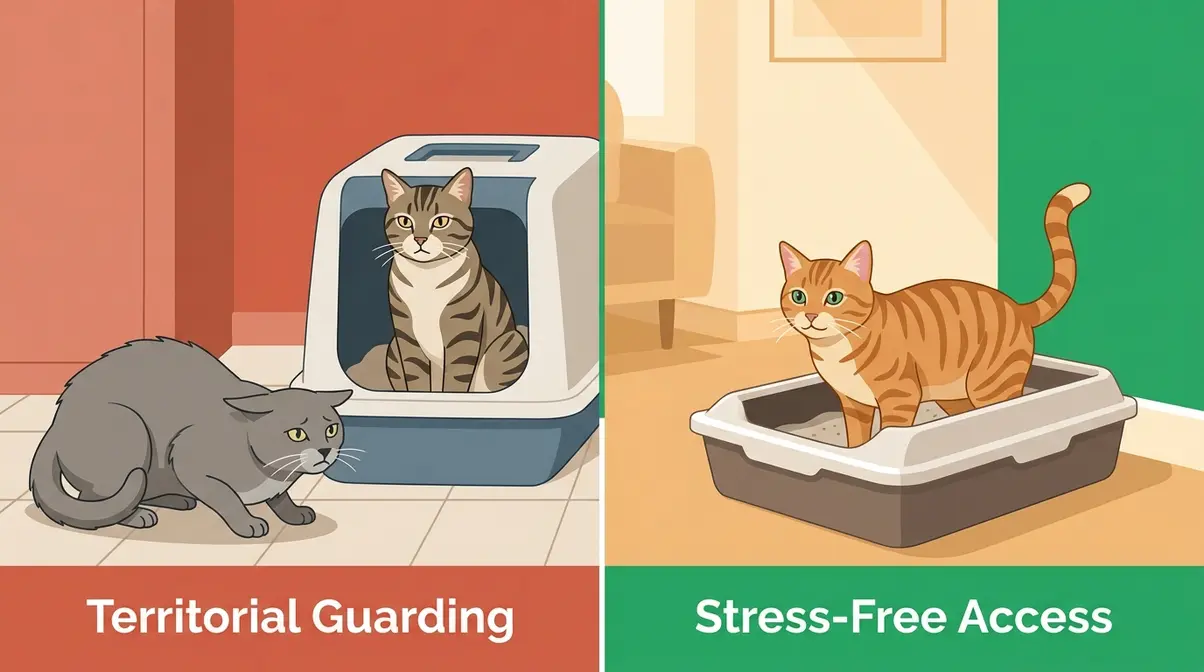
Territorial behavior (when a cat claims a space as their own and guards it from others) is one of the most common reasons multi-cat litter box sharing breaks down. Your cats might get along really well at feeding time and on the sofa — but the litter box is a different kind of resource.
A dominant cat may sit near the box and simply stare at the other cat, which is enough to stop them from approaching. The subordinate cat learns to avoid the box during certain hours or altogether. Across cat behavior communities, the consistent feedback is that this kind of passive guarding is far more common than outright fighting — and far easier to miss.
- Signs of box guarding to watch for:
- One cat using the box much more than the other
- A cat loitering near the box without using it
- Elimination in corners, bathtubs, or behind furniture
Health Risks: UTIs, Disease Transmission, and Stress-Related Illness
When cats share one box, the health risks are real and well-documented. Veterinary research from Tufts University (2026) identifies poor litter box conditions as “a major source of stress leading to urinary problems.” The specific condition to know is FLUTD — feline lower urinary tract disease — a painful condition triggered or worsened by stress, which causes straining, blood in urine, and in male cats, potentially life-threatening blockages.
The 2026 iCatCare consensus guidelines (published in PMC) confirm that stress-related feline idiopathic cystitis (FIC) is the most common cause of lower urinary tract signs in otherwise healthy adult cats. While UTI (urinary tract infection) itself is uncommon in healthy cats at under 3%, the stress pathway from a shared, dirty, or contested litter box is a well-established trigger for FIC.
Beyond urinary health, a shared box accelerates the spread of parasites, viruses, and bacteria between cats. If one cat has giardia, roundworm, or a gastrointestinal illness, a shared box becomes a direct transmission route. Respiratory risks are also worth noting: litter dust asthma (when fine litter particles irritate a cat’s airways) is worsened when a box is used more frequently and cleaned less often — exactly what happens when two cats share one box.
“Chronic stress around toileting doesn’t stay behavioral — it translates into measurable physical disease,” veterinarians note, with feline lower urinary tract conditions regularly diagnosed in cats with inadequate litter box access (Cornell Feline Health Center, 2026).
What happens if two cats share a litter box?
When two cats share a litter box, the most common outcomes are territorial stress, box avoidance, and — over time — health problems. The dominant cat may guard the box, leaving the subordinate cat to hold waste in. This is directly associated with feline idiopathic cystitis (FIC), a stress-triggered urinary condition. Shared boxes also become dirty faster, increasing parasite and disease transmission risk. Two cats who share without obvious conflict may still be experiencing low-grade stress that only becomes visible when symptoms appear (Kinship, 2026).
Do Bonded Cats and Kittens Change the Rule?
A bonded pair or sibling kittens may tolerate sharing a litter box better than two unrelated adult cats — but the N+1 rule still applies, and here’s why. The relationship between cats affects how quickly problems develop, not whether they develop.
Bonded pairs (cats who actively seek each other’s company, groom each other, and sleep together) have a lower baseline of social stress. They’re less likely to guard resources aggressively. However, as cats age, territorial instincts can strengthen even in previously harmonious pairs. What worked when they were kittens may not work at age three or four.
Sibling kittens are the most forgiving case. Kittens raised together from birth often share without conflict for months. The risk increases significantly after they reach social maturity, which happens between 18 months and 4 years of age. This is when territorial behavior fully develops — and when a shared box can suddenly become a problem.
Does gender matter?
Two females or two males can both develop box-guarding behavior. Unneutered males are more likely to spray (mark territory with urine outside the box), which is a separate issue from sharing. Spaying and neutering significantly reduces territorial behavior across all genders and is strongly recommended for multi-cat households regardless of litter box setup.
The bottom line: If your cats are a bonded pair or sibling kittens who have always shared without issues, you may have more flexibility — but plan for a second box before problems start, not after.
Do Self-Cleaning and XXL Boxes Help?
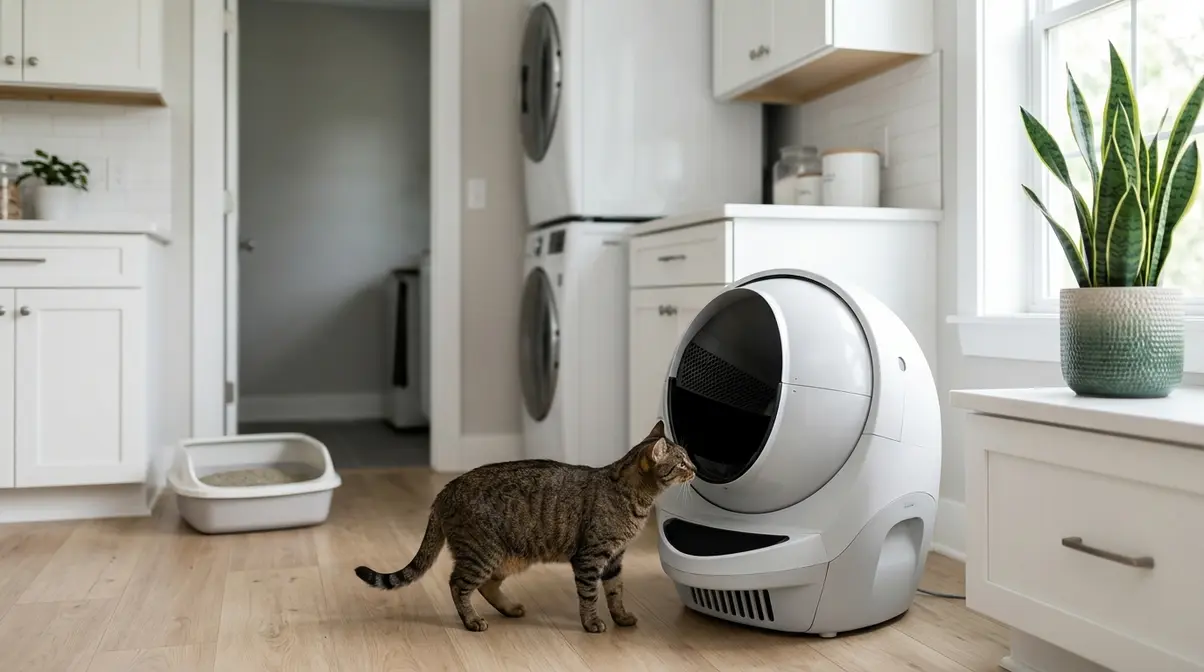
Self-cleaning litter boxes and XXL-sized boxes can meaningfully reduce the stress of sharing — but most vets still recommend following the N+1 rule alongside them, not instead of it. That said, for cat owners in a small two-bedroom apt with genuine space constraints, these options are worth understanding.
Self-Cleaning Boxes
A self-cleaning box (like the Litter-Robot) automatically sifts and removes waste after each use, usually within minutes. This solves one of the biggest problems with sharing: waste accumulation. A dirty box is more likely to be avoided, and a box that two cats are using fills up twice as fast.
Analysis of owner feedback and manufacturer guidelines (Litter-Robot, 2026) indicates that a single self-cleaning unit can support up to four cats, provided it’s emptied several times per week. The key advantage is that each cat encounters a clean box — reducing the scent-based territorial signals that discourage the subordinate cat from using it.
- What self-cleaning boxes do well:
- Remove waste quickly, reducing odor and territorial scent buildup
- Make a shared setup more hygienic between manual cleanings
- Some models (like the Litter-Robot 5) track individual cat usage, helping you spot which cat is avoiding the box
- What they don’t solve:
- Physical guarding (one cat blocking the entrance)
- The psychological need for cats to have their own space
- Territorial stress in cats that are already in conflict
XXL Enclosed Boxes
A large enclosed litter box (sometimes called an “xxl closed one” in cat owner communities) gives both cats more room to maneuver and reduces the chance that one cat’s waste is directly underfoot when the other enters. For two cats who are otherwise compatible, this can reduce friction.
However, enclosed boxes trap odors more than open ones — meaning they need cleaning more frequently when shared, not less. If you go this route, scoop at least twice daily.
The practical verdict: A self-cleaning box plus one traditional box in a separate location is the most realistic solution for small-space, multi-cat households. It respects the N+1 rule, works within space constraints, and keeps both cats comfortable.
Can Cats Share a Box with Other Pets?
No — cats should not share a litter box with dogs, ferrets, rabbits, or other species, and veterinary and product safety guidelines are clear on this. This is one area where the answer is a straightforward no, with no exceptions.
Here’s why interspecies sharing creates problems:
- Litter safety: Most cat litters — especially clumping clay varieties — are explicitly labeled as unsafe for dogs, rabbits, and ferrets. Ingestion during grooming can cause intestinal blockages in rabbits and ferrets.
- Disease transmission: Cats and dogs can share certain parasites (like toxoplasma) through shared waste contact. Ferrets are susceptible to different pathogens that cats carry.
- Behavioral incompatibility: Dogs are attracted to cat waste and may eat from the box (a behavior called “dietary indiscretion”). This is both a hygiene problem and a health risk for the dog.
- Litter type mismatch: Rabbits and ferrets require different litter types (paper-based, wood pellets) that cats typically reject.
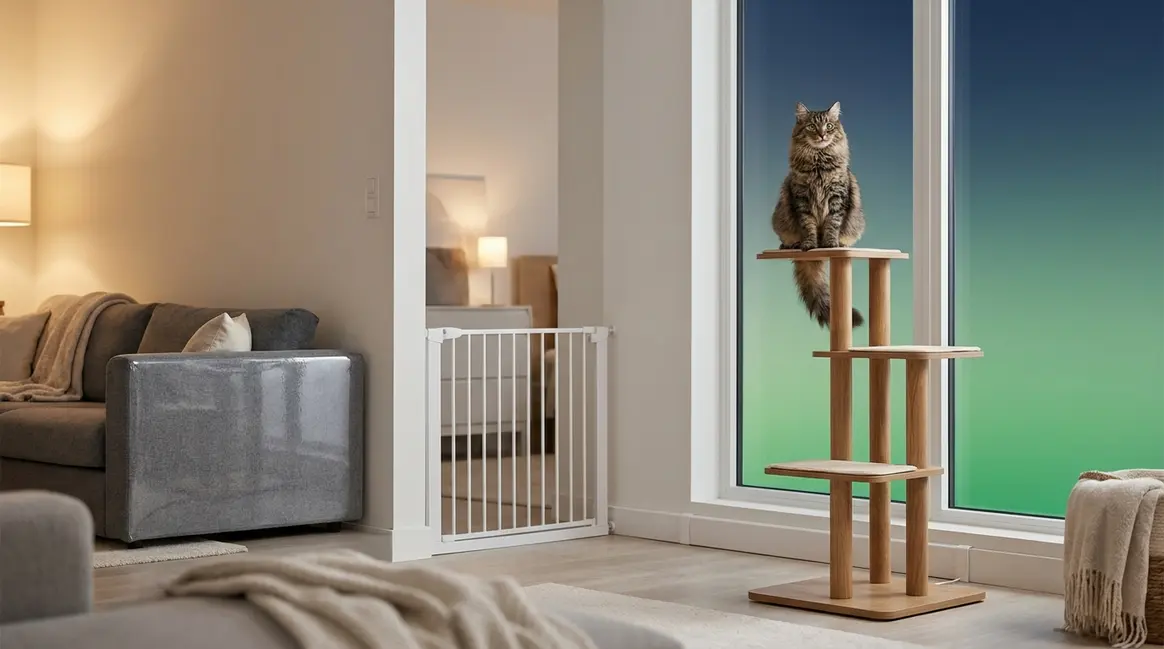
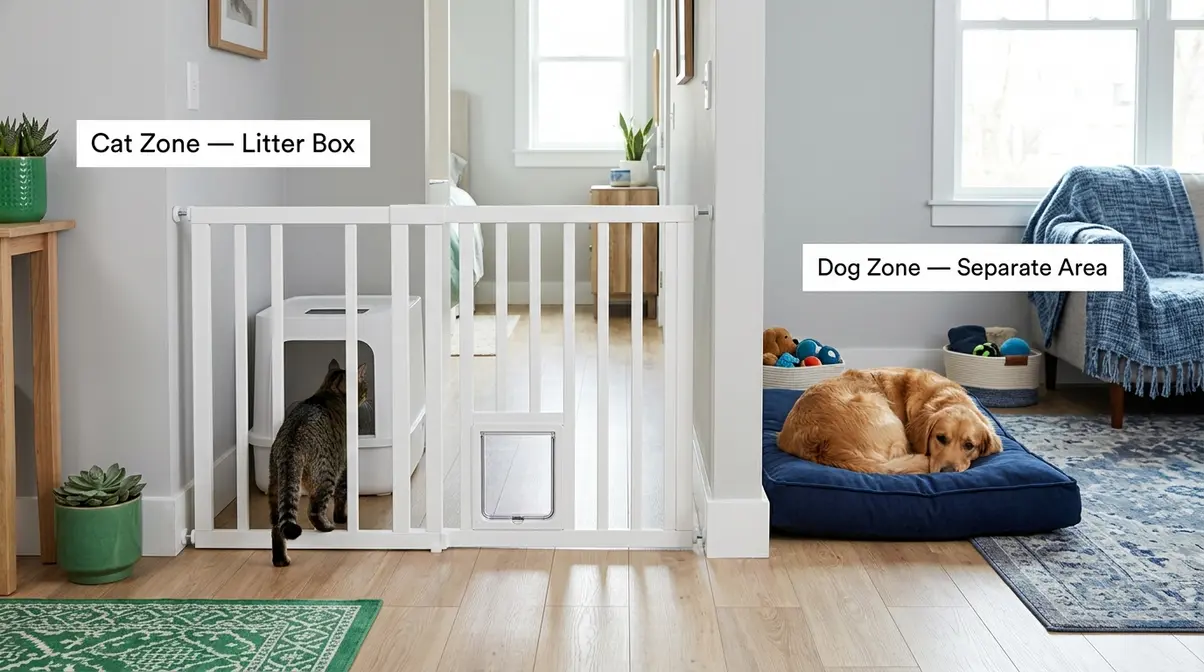
If you have a multi-species household, each species needs its own, separate litter or toilet setup — placed in locations the other animals cannot access. A baby gate or a cat-flap door that only the cat can fit through is a practical solution for keeping dogs out of the litter box area.
Warning Signs Your Cats Are NOT Okay Sharing
If your cats are sharing a litter box, you need to know the warning signs that the arrangement is causing stress — because the signs are often subtle, and they escalate quickly. This is where The Litter Box Stress Ladder becomes a practical tool: catching the problem at the bottom rungs prevents the climb to serious illness.
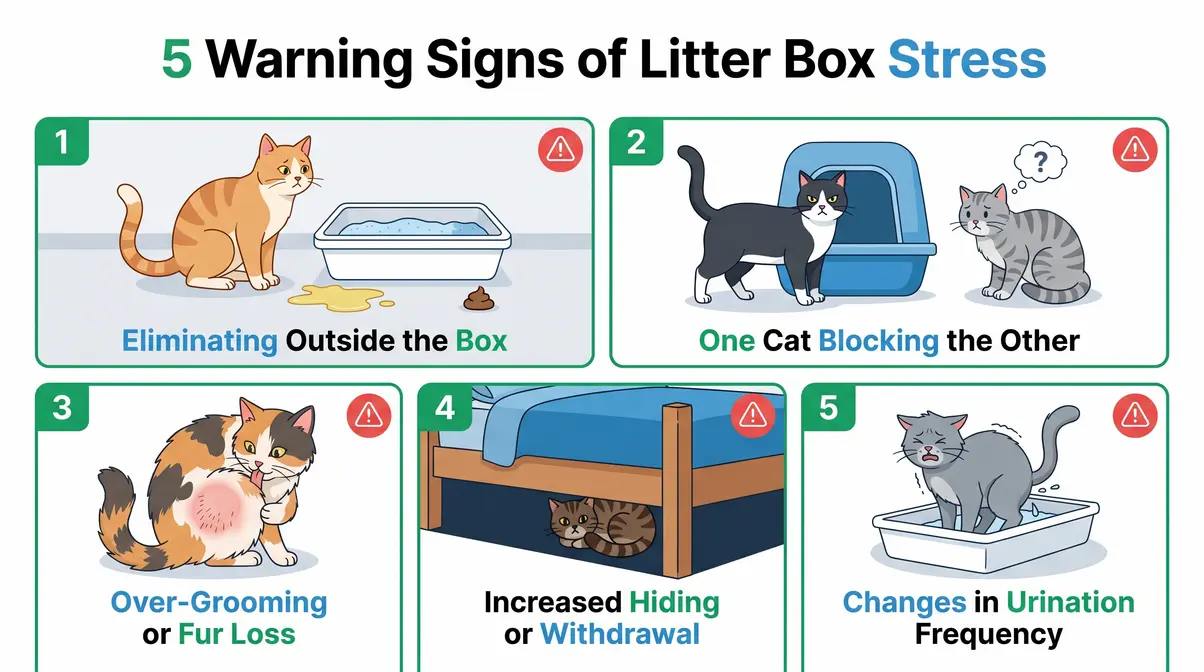
5 Behavioral Signs of Litter Box Stress
1. Eliminating outside the box. This is the most visible sign. If your cat is going on the floor, in a bathtub, or in a corner, the litter box situation is the first thing to investigate. This is not spite — it is avoidance driven by stress or fear.
2. One cat blocking the other. Watch for a cat sitting near the box without using it, or following the other cat to the box area. This is territorial guarding (claiming the box as their resource) and it causes the other cat to hold waste in — a direct path to urinary problems.
3. Changes in urination frequency. A cat urinating much more or much less than usual, straining in the box, or crying while urinating needs a vet visit immediately. These are signs of FLUTD (feline lower urinary tract disease — a painful condition linked to stress and inadequate litter box access).
4. Increased hiding or withdrawal. A cat that suddenly spends more time under the bed or in isolated spots may be experiencing chronic stress. Cats hide when they feel unsafe, and a contested litter box creates persistent low-level anxiety.
5. Over-grooming or fur loss. Stress-related over-grooming (licking or pulling fur, especially on the belly and inner legs) is a physical manifestation of anxiety. If you notice bald patches, consult your vet.
When to Call Your Vet
- Contact your veterinarian promptly if you observe any of the following:
- Straining to urinate or producing little to no urine (especially in male cats — this can become a life-threatening blockage within hours)
- Blood in the urine or litter box
- Crying or vocalizing while using the box
- Complete avoidance of the litter box for more than 24 hours
- Rapid weight loss alongside any litter box changes
These symptoms may indicate FLUTD, a urinary blockage, or a parasitic infection — all of which require prompt veterinary diagnosis. Do not wait to see if things improve on their own.
Frequently Asked Questions
What is the 3-3-3 rule for cats?
The 3-3-3 rule describes the adjustment timeline for a newly adopted cat. The first 3 days are for decompression — your cat may hide, refuse food, or seem shut down. After 3 weeks, they begin learning routines and showing their personality. After 3 months, they feel truly at home. Understanding this timeline helps multi-cat owners introduce a second cat without misreading normal adjustment behavior as a permanent problem.
Can cat litter trigger asthma?
Yes — fine-particle cat litter can trigger or worsen asthma in both cats and humans. Cats are particularly vulnerable to litter dust, which can cause feline asthma (chronic airway inflammation leading to coughing, wheezing, and labored breathing). When two cats share one box, usage frequency doubles, producing more dust per day. Low-dust or dust-free litters (paper-based, wood pellet, or crystal varieties) are recommended for multi-cat households or homes with cats that show respiratory symptoms. Consult your vet if your cat coughs or wheezes regularly.
What annoys cats the most?
Cats are most consistently bothered by unpredictability, forced interaction, and resource scarcity. Loud sudden noises, being picked up without warning, and — relevant here — having their access to the litter box blocked or contested rank among the top stress triggers identified by feline behaviorists. A dirty or shared litter box is one of the most common but overlooked sources of daily feline stress in multi-cat homes.
How do I say “hi” in cat language?
The slow blink is the closest equivalent to a friendly greeting in cat communication. When your cat looks at you and slowly closes and reopens their eyes, they’re signaling trust and comfort. You can return the gesture: make eye contact, then slowly close your eyes and open them. Many cats will mirror the behavior. A relaxed, slightly curved tail held upright is another friendly greeting signal when cats approach each other.
What is the least wanted cat color?
Black cats are statistically the least adopted in many shelter systems, a pattern documented by shelter organizations across the US and UK. This is attributed to superstition, lower visibility in shelter photos, and reduced contrast in adoption listing images. Black cats are behaviorally identical to cats of any other color — their coat has no effect on temperament, territorial behavior, or litter box habits.
Do cats forgive you for yelling at them?
Cats do not process punishment the way dogs do — yelling at a cat is more likely to damage trust than correct behavior. Cats associate punishment with the person delivering it, not the action they performed. Repeated yelling can cause a cat to become fearful or avoidant of you, which increases baseline stress — and stressed cats are more likely to develop litter box problems. Positive reinforcement (rewarding wanted behavior with treats or play) is consistently more effective and recommended by feline behaviorists.
Your Multi-Cat Litter Box Action Plan
For most multi-cat households, the combination of the N+1 rule, strategic placement, and consistent cleaning prevents nearly all litter box problems before they start. Analysis of veterinary research and cat behavior guidance points to the same conclusion: the setup you create before problems arise is far easier than fixing a stressed cat’s habits afterward.
Here’s where The Litter Box Stress Ladder pays off as a framework: if you address the lowest rungs (box scarcity, poor placement, infrequent cleaning) proactively, you prevent the climb toward avoidance, territorial conflict, and stress-induced illness. Most cats never need to climb that ladder at all — if their owners set things up correctly from the start.
- Your action plan for two cats:
- Add a second litter box before bringing the second cat home — not after
- Place boxes in two separate rooms (never side by side)
- Scoop at least once daily per box; twice daily is better
- Consider a self-cleaning box as your primary box, with a standard box as the backup in a second location
- Watch for the five warning signs in the section above — especially changes in urination habits
- If you notice any urinary symptoms, contact your veterinarian promptly
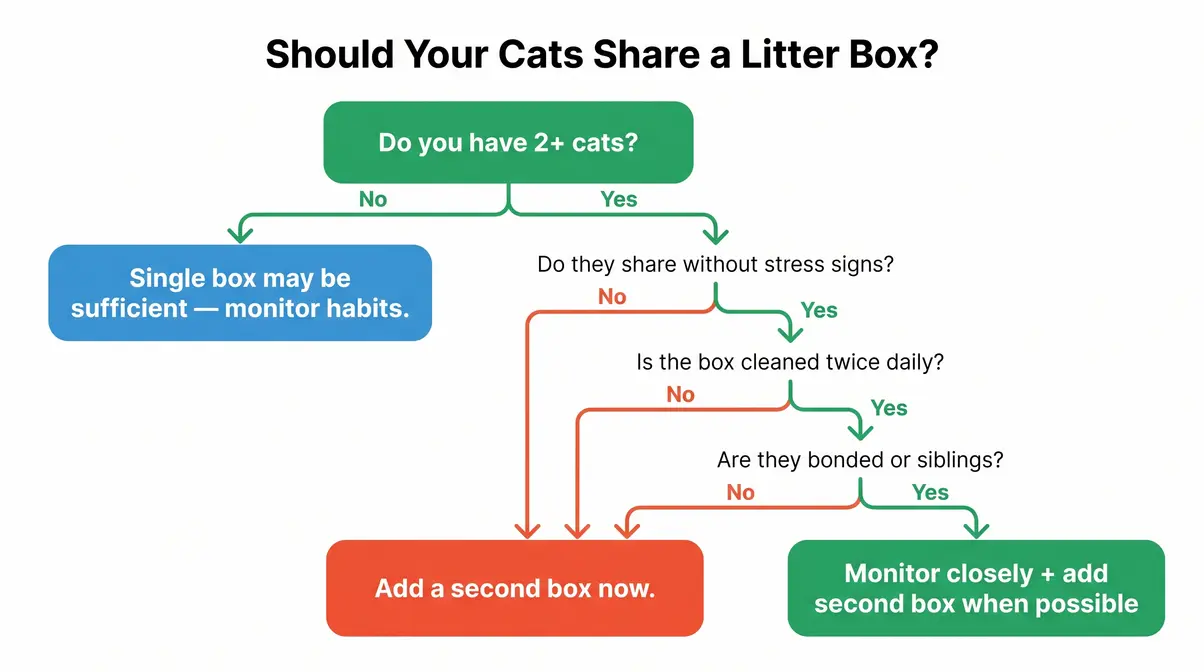
The honest answer to “can cats share a litter box” is: sometimes, temporarily, under the right conditions — but the N+1 rule exists because the conditions required to make sharing safe are harder to maintain than simply having the right number of boxes.
As always, consult your veterinarian if you notice any changes in your cat’s urination habits, appetite, or behavior. This guide reflects current veterinary guidelines as of May 2026, but your vet knows your cats best.

Dave King
Cat owner and writer at Mad Cat Man.