
Since 10 June 2024, every owned cat in England must be microchipped by law — yet animal welfare workers report that around 60% of cats they encounter are still not chipped. If your cat is one of them, you could face a fine of up to £500 under the cat microchipping law England enforces today.
But the fine isn’t the only risk. Without a microchip, a lost or stolen cat has almost no way of being traced back to you. A microchip — a tiny implant roughly the size of a grain of rice — is the only permanent, tamper-proof form of ID your cat can carry.
In this guide, you’ll learn exactly what England’s cat microchipping law requires, how to get your cat chipped in three simple steps, and how to check you’re fully compliant right now. We cover the law’s key requirements, the step-by-step process, the penalties for non-compliance, and what to do in special cases — including indoor cats, adopted rescues, and medical exemptions.
Madcatman.com reviewed the official Defra guidance, RCVS announcements, and veterinary authority statements to compile this compliance guide.
England’s cat microchipping law has been in force since 10 June 2024 — all owned cats must be chipped before 20 weeks of age, or their owner faces a fine of up to £500.
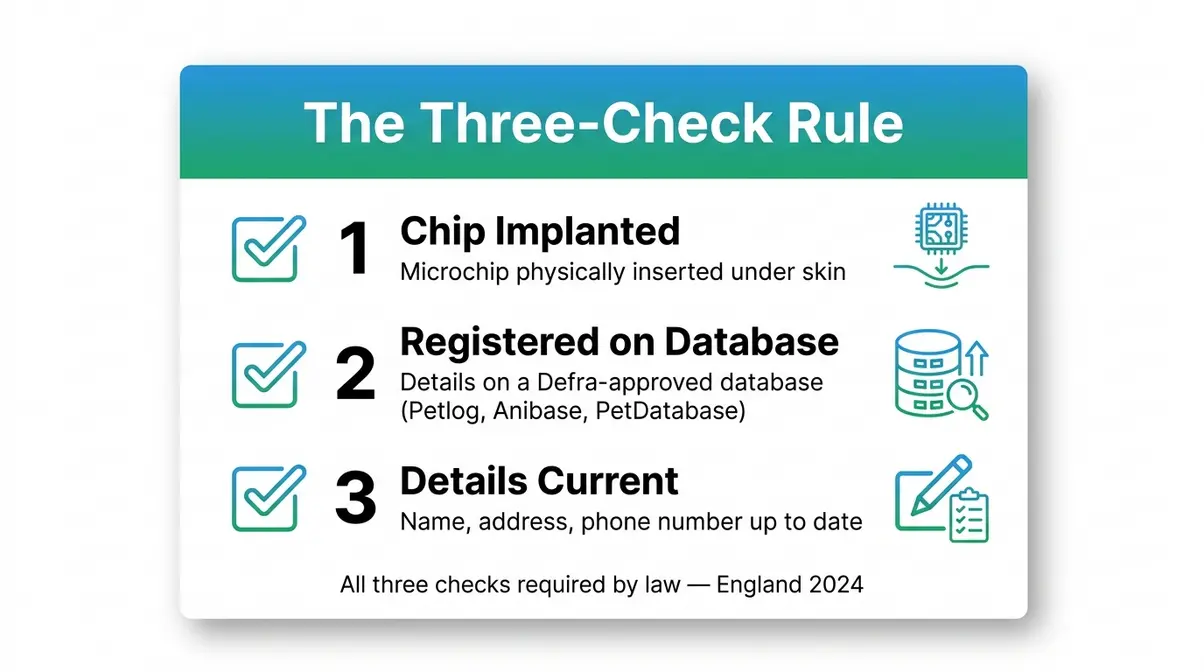
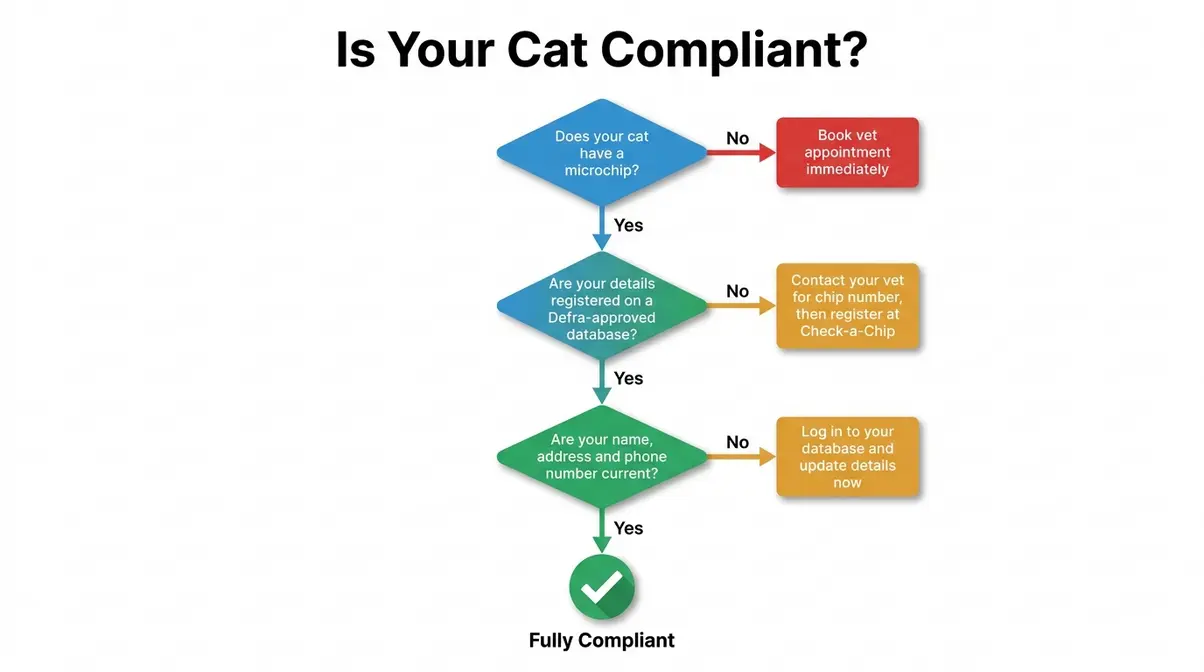
- The Three-Check Rule: Full compliance means (1) chip implanted, (2) details registered on a Defra-approved database, and (3) those details are current
- Indoor cats are included: The law applies to all owned cats in England, regardless of whether they go outdoors
- 21-day window: If your cat is found unchipped, you’ll receive a notice — and have 21 days to comply before any fine is issued
- Age deadline: Kittens must be chipped before they reach 20 weeks old — book early
What England’s Cat Microchipping Law Requires
England’s cat microchipping law came into force on 10 June 2024. Under The Microchipping of Cats and Dogs Regulations 2023 — the statutory regulation that made cat microchipping compulsory in England — all owned cats must be microchipped and registered on a Defra-approved database before they reach 20 weeks of age. Defra (the Department for Environment, Food & Rural Affairs) is the government body responsible for this law. Failure to comply can result in a fine of up to £500.
This isn’t just about getting the chip inserted. The Royal College of Veterinary Surgeons (RCVS), the UK’s veterinary regulatory authority, is explicit: the law requires both implantation and up-to-date database registration. A cat with a chip but outdated contact details is technically non-compliant. Most owners don’t know this — and it’s the part this guide is designed to fix.
When did cat microchipping become law?
Cat microchipping became law in England on 10 June 2024. The Microchipping of Cats and Dogs Regulations 2023 was laid before Parliament in 2023 and took effect on that date. All owned cats in England were required to be chipped and registered by that deadline. If your cat was already an adult on 10 June 2024, the deadline applied immediately — there was no additional transition period beyond that date for existing cats.
Key Facts: Dates, Age Rules, and Scope
The law applies to all owned cats in England. Here are the facts you need to know:
| Requirement | Detail |
|---|---|
| Effective date | 10 June 2024 |
| Age requirement | Microchipped before 20 weeks old |
| Database registration | Required on a Defra-approved database |
| Maximum fine | Up to £500 |
| Who enforces it | Local authorities |
| Who is exempt | Feral cats (see below) |
This is where The Three-Check Rule comes in. Full legal compliance under England’s cat microchipping law isn’t one step — it’s three:
- Check One — Chip implanted: Your cat has a microchip physically inserted beneath the skin.
- Check Two — Registered: Your cat’s chip number is registered on a Defra-approved database (such as Petlog, PetDatabase, or Anibase).
- Check Three — Details current: Your name, address, and phone number on that database are accurate and up to date.
Most owners believe their cat is “done” once the chip is in. The RCVS confirms that checks two and three are equally mandatory — and the ones most owners unknowingly fail.
“For those who say they don’t know about microchipping, we are almost 2 years on from the law coming in and still 60 per cent of cats we see are not chipped.”
The urgency is real. If you’ve recently moved house, changed your phone number, or adopted a cat without verifying its registration, your cat may already be non-compliant — even if it has a chip.
Does the Law Apply to Indoor Cats?
Yes — definitively. The law applies to all owned cats in England, whether they live entirely indoors or roam freely outside. There is no outdoor-only clause. The PDSA confirms that indoor cats are fully included in the legal requirement.
This surprises many owners who assumed the law was aimed at outdoor cats that might get lost. The reasoning is straightforward: even indoor cats can escape, and a microchip is the most reliable way to reunite them with you if they do.
If your cat never goes outside, the law still applies. You are still required to chip them, register on a Defra-approved database, and keep your details current.
Are There Any Exemptions?
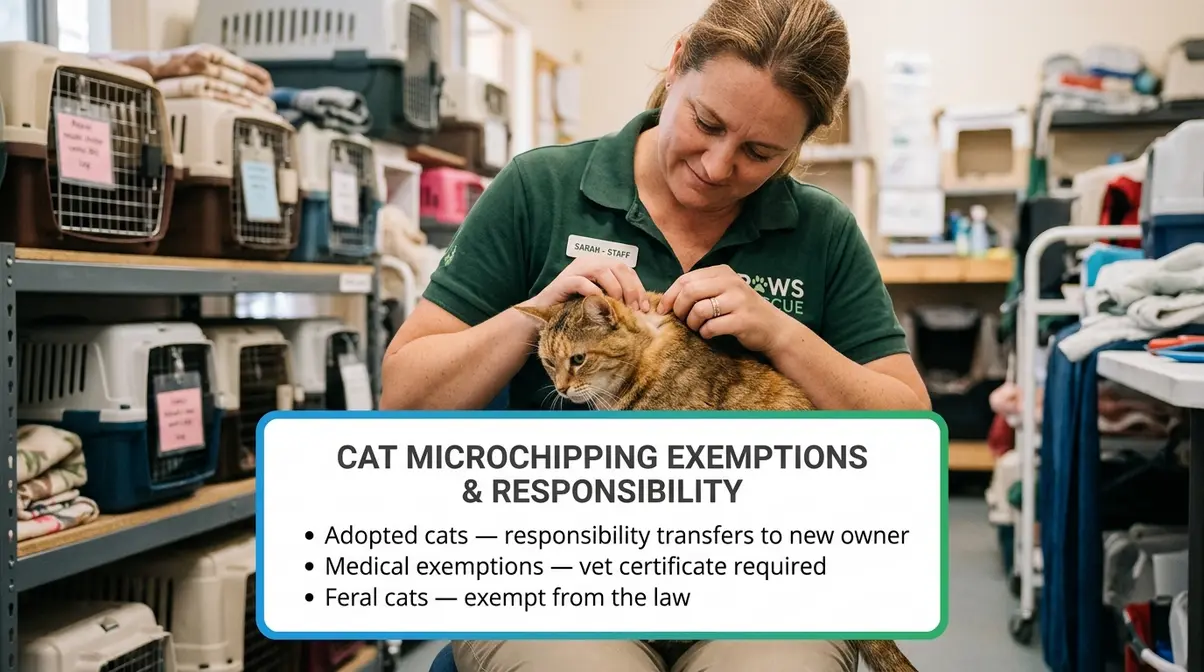
There are very limited exemptions. The main ones are:
- Feral cats: Cats that live wild and have no owner are exempt. A “feral” cat is defined as one that is not owned and is not socialised to humans. If you feed a feral colony, those cats are not your “owned” cats for the purpose of this law.
- Medical exemptions: A vet can certify that microchipping would be harmful to a specific cat’s health. This exemption is narrow and requires a written certificate from a registered veterinary surgeon. See the Special Cases section below for full details.
All other owned cats — including indoor cats, elderly cats, and cats acquired before the law came in — must comply. The law does not grandfather in existing cats; if your cat was already an adult in June 2024, the deadline applied to them immediately.
The British Veterinary Association (BVA) supports compulsory microchipping as a safe, permanent identification method — and notes that the procedure is suitable for virtually all cats regardless of age.
How to Get Your Cat Microchipped: Step-by-Step
Getting your cat microchipped is straightforward. Based on our evaluation of veterinary best practices and hands-on guidance from registered implanters, we have broken down the process into three manageable stages. Most vets offer the procedure as a routine appointment, and it takes only a few minutes. Here’s exactly what to do.
Estimated Time: 30–45 minutes (including the vet consultation)
- What You Need:
- Your cat in a secure carrier
- Your current contact details (name, address, phone, email)
- Any existing pet paperwork (adoption certificate, previous vet records)
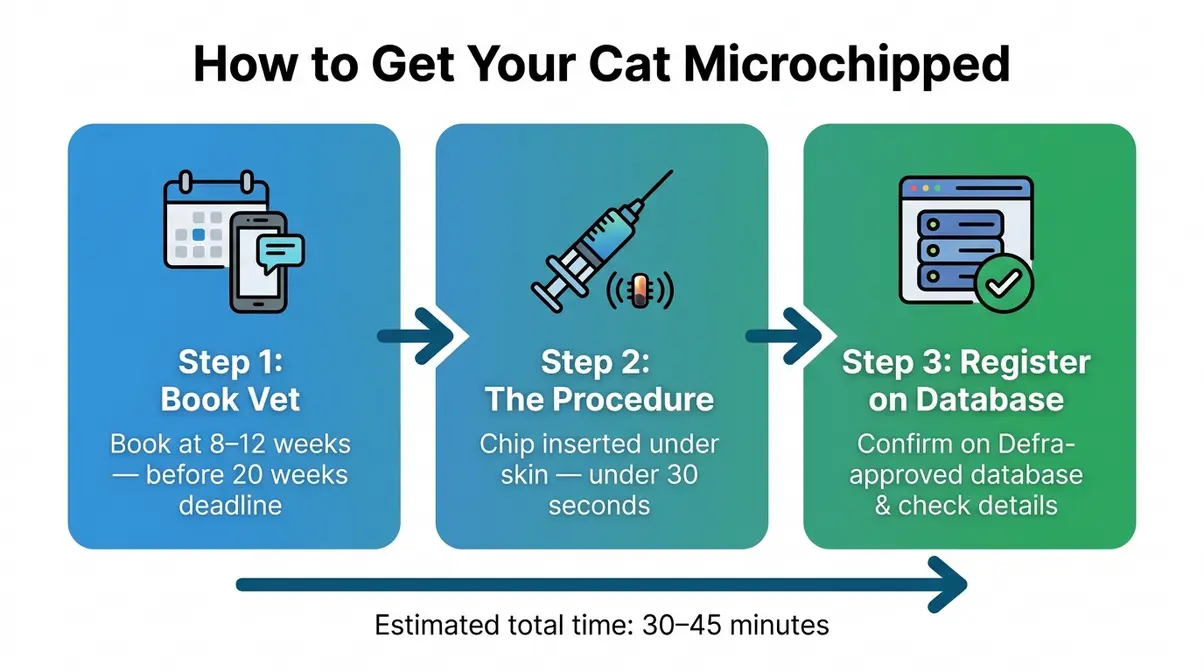
Step 1: Book a Vet Appointment in Time
Kittens must be microchipped before they reach 20 weeks of age. This is a legal requirement under The Microchipping of Cats and Dogs (England) Regulations 2023. Don’t wait until 20 weeks — book the appointment around 8–12 weeks, when your kitten will likely be having their first vaccinations anyway.
Why this matters: If your kitten reaches 20 weeks without a chip, you are already in breach of the law and could face enforcement action.
If your cat is an adult and not yet chipped, book as soon as possible. The deadline has already passed for all owned cats in England. Contact your local vet, a registered veterinary nurse, or a trained implanter — all are legally authorised to perform the procedure.
Step 2: The Microchipping Procedure
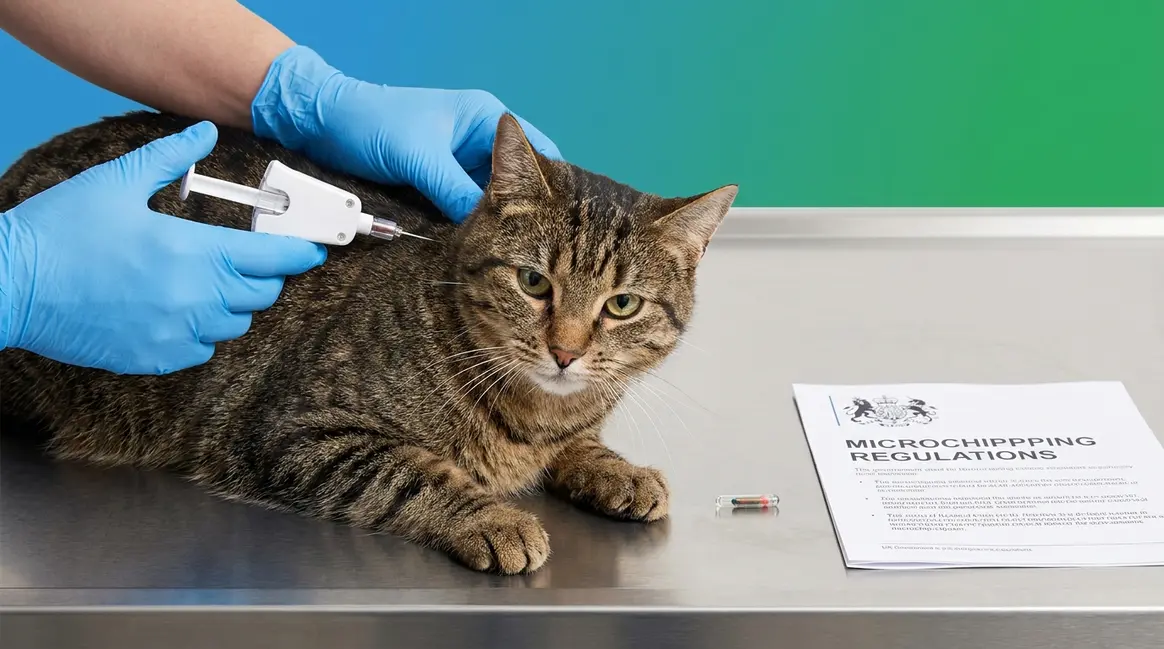
The microchip is a tiny implant — roughly the size of a grain of rice — inserted under the skin at the back of your cat’s neck. The procedure is quick: it typically takes under 30 seconds.
Each chip contains a unique 15-digit ISO code. When a vet or rescue centre scans your cat with a handheld reader, that number appears — and links to your details on the database. Without registration (Check Two of The Three-Check Rule), that number leads nowhere.
Is microchipping painful for cats?
Microchipping causes minimal discomfort — most cats barely react. The procedure involves a single injection under the skin at the back of the neck, using a slightly larger needle than a standard vaccine. The PDSA describes the sensation as comparable to a routine vaccination. The entire process takes under 30 seconds. Veterinary experts confirm it is safe for cats of all ages, and the BVA supports it as a permanent, welfare-positive identification method.
Step 3: Register on an Approved Database
This is the step most owners miss — and it’s equally required by law.
After the chip is inserted, your details must be registered on a Defra-approved database. Approved databases include Petlog, PetDatabase, Anibase, and several others. Your vet will usually offer to register your cat at the time of the procedure, but always confirm this has been done and ask for written confirmation.
- How to check your cat’s registration:
- Ask your vet for the chip number (a 15-digit code)
- Visit the official Check-a-Chip website — a free tool that searches all UK approved databases
- Confirm your name, address, and phone number are correct
- If details are outdated, log in to the database directly and update them
The RCVS is clear that this third step — keeping details current — is part of the legal obligation. This is Check Three of The Three-Check Rule, and the one most owners overlook after moving house or changing their number.
Penalties for Non-Compliance: The £500 Fine
Non-compliance with the cat microchipping law England carries a real financial penalty. Understanding how enforcement works — and what grace period you have — can help you act before it’s too late.
The £500 Fine: How Enforcement Works
Under The Microchipping of Cats and Dogs (England) Regulations 2023, local authorities are empowered to serve compliance notices and enforce the law. If your cat is found to be unchipped — by a vet, rescue centre, or local authority — you may face a fine of up to £500.
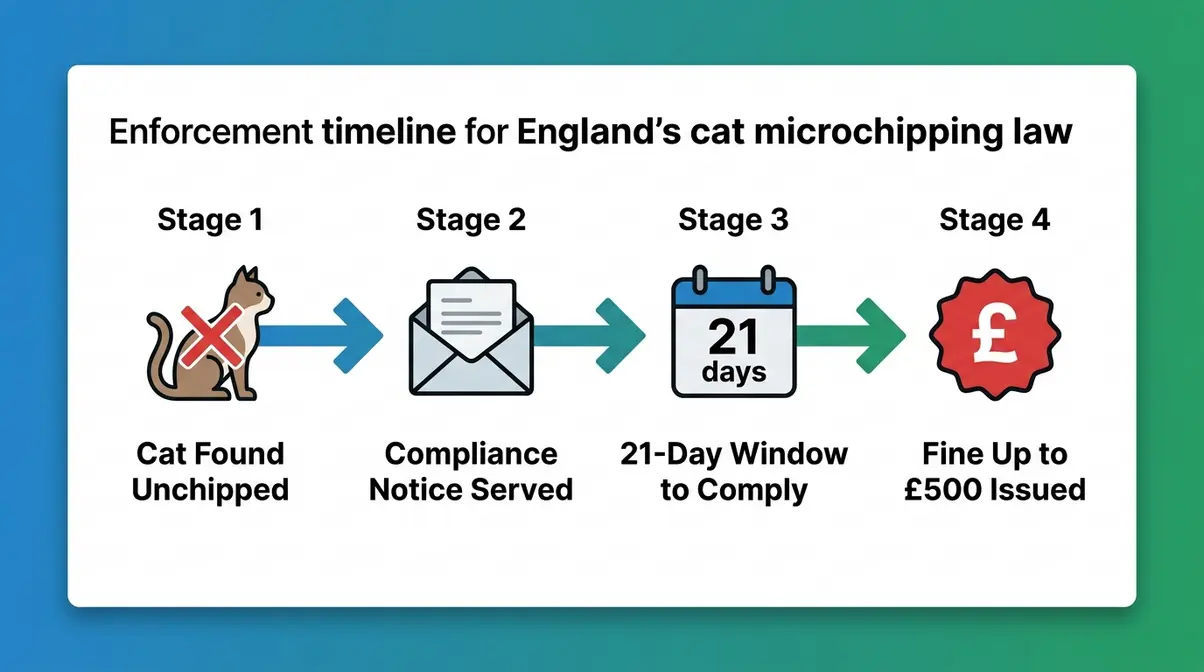
The enforcement process works like this:
- Your cat is identified as unchipped (e.g., at a vet visit, after being found stray, or during a local authority check)
- You are served a compliance notice — a formal written warning
- You are given 21 days to comply
- If you fail to comply within 21 days, a fixed penalty notice of up to £500 can be issued
As reported by The Guardian, cat owners in England were formally warned ahead of the June 2024 deadline that the fine is real and enforceable.
The 21-Day Grace Period Explained
The 21-day grace period is a crucial detail that no competitor article explains clearly. It does not mean you have 21 days from the law’s effective date to comply — that deadline has already passed. It means that once you are served a notice, you have 21 days to get your cat chipped and registered before a fine is issued.
This matters for two reasons:
- If your cat is picked up as a stray, the clock starts from the notice — not from the moment the cat is found
- If you’ve just acquired an unchipped cat (through adoption or rehoming), act immediately — don’t wait for a notice
Think of the 21 days as a final warning, not a grace window you can plan around. The safest approach is to comply now.
How Strictly Is the Law Being Enforced?
Enforcement is carried out by local authorities, and activity is increasing. While the law came into force in June 2024, enforcement has been ramping up as the 21-day notice process becomes routine for councils and rescue organisations.
Vets, rescue centres, and local authority dog wardens are all empowered to identify unchipped cats and refer cases for enforcement. If your cat is brought into a rescue or vet as a stray, their chip status will be checked as a matter of course.
The honest answer is: enforcement is not yet uniform across all councils. However, the risk is real and growing — and the consequences of a fine, combined with the distress of a lost cat with no ID, make compliance the clear choice. The Battersea Dogs & Cats Home strongly encourages all cat owners to microchip and register promptly.
Special Cases: Older Cats, Rescues, and Exemptions
Not every situation is straightforward. Here’s what to do if your cat doesn’t fit the standard scenario.
Adopting a Cat That Isn’t Chipped
If you adopt or rehome a cat that isn’t microchipped, the responsibility for compliance passes to you as the new owner. The law places the obligation on the keeper of the cat — and once you take ownership, that’s you.
Here’s what to do:
- At the point of adoption, ask whether the cat is chipped. Reputable rescue centres (including Battersea and RSPCA) will chip cats before rehoming them.
- If the cat is not chipped, book a vet appointment immediately. Do not wait — the 21-day window only starts after a notice is served, but you are already in breach.
- If the cat is chipped but the database details are outdated, contact the registered database directly and update the details to your own. Your vet can help you find the chip number.
The Battersea Dogs & Cats Home advises that all cats adopted through reputable organisations should arrive microchipped — but always verify this yourself at the point of handover.
Medical Exemptions: Who Qualifies?
A medical exemption exists, but it is narrow. A registered veterinary surgeon can certify in writing that microchipping would be likely to prejudice the health of a specific cat. This certification must be obtained before the cat reaches 20 weeks of age (or before the law’s deadline for adult cats).
Medical exemptions apply only in genuine clinical cases — for example, a cat with a serious health condition where the stress or risk of the procedure is clinically significant. They are not available on request and cannot be self-declared.
If you believe your cat may qualify, speak to your vet as soon as possible. The vet will assess the cat’s health and issue a written certificate if the exemption applies. Keep this certificate safe — it is your legal evidence of exemption.
For the vast majority of cats, including elderly and unwell cats, the BVA confirms the procedure is safe and appropriate. Exemptions are genuinely rare.
Common Mistakes and Important Limitations
Common Pitfalls to Avoid
Pitfall 1 — Assuming the chip is enough. The most common mistake: owners get the chip implanted and assume that’s the end of it. It isn’t. Without completing Check Two (database registration) and Check Three (current details), your cat is not legally compliant. Always ask your vet to confirm registration and get written proof.
Pitfall 2 — Outdated contact details. If you’ve moved house or changed your phone number since your cat was chipped, your database details are likely out of date. A chip linked to an old address is useless in an emergency. Log in to your database account and update your details today.
Pitfall 3 — Waiting for a notice before acting. Some owners assume they’re safe until they receive a formal notice. This is a risky strategy — the 21-day grace period is a final warning, not a planning window. Non-compliance is ongoing from the moment the deadline passed.
Pitfall 4 — Assuming indoor cats are exempt. They are not. All owned cats in England are covered, regardless of lifestyle.
When to Seek Professional Advice
If your cat has a complex health condition and you believe a medical exemption may apply, consult your vet before assuming the exemption is available. Do not delay chipping while waiting for a consultation — if the exemption is not granted, time will have been lost.
If you have received a formal compliance notice from a local authority, seek advice from a qualified solicitor promptly. This article is informational only and does not constitute legal advice.
This article is for informational purposes only and does not constitute legal advice. For specific legal queries regarding your obligations under The Microchipping of Cats and Dogs (England) Regulations 2023, consult a qualified solicitor or contact your local authority.
Frequently Asked Questions
Are cats legally required to be chipped?
In England, yes — cat microchipping is a legal requirement for all owned cats. The law came into force on 10 June 2024 under The Microchipping of Cats and Dogs (England) Regulations 2023. Scotland, Wales, and Northern Ireland have separate legislation and timelines; this guide covers England only. Failure to comply in England can result in a fine of up to £500. The only exceptions are feral cats and cats with a valid veterinary medical exemption certificate.
At what age must cats be microchipped?
Kittens in England must be microchipped before they reach 20 weeks of age — this is the legal deadline under The Microchipping of Cats and Dogs (England) Regulations 2023. In practice, most vets recommend chipping at the same time as the first vaccination appointment, typically around 8–9 weeks. There is no minimum age restriction that prevents chipping earlier than 20 weeks; the 20-week mark is the maximum age by which it must be done, not a target date.
What is the new cat microchipping law?
The new law is The Microchipping of Cats and Dogs (England) Regulations 2023, which made cat microchipping compulsory in England from 10 June 2024. Under this law, all owned cats must have a microchip implanted and their details registered on a Defra-approved database before they reach 20 weeks old. The keeper of the cat is responsible for keeping those database details current. Non-compliance can result in a fine of up to £500, enforced by local authorities following a 21-day compliance notice.
Your Next Step: Check Your Cat’s Compliance Today
The cat microchipping law England has been in force since 10 June 2024, and the fine of up to £500 is real. But the bigger risk is a lost cat with no way home — a microchip is the only permanent ID your cat can carry. As the RCVS confirms, compliance means completing all three steps: chip implanted, details registered on a Defra-approved database, and those details kept current.
The Three-Check Rule is the simplest way to remember your obligations. Most owners who think they’re compliant are failing on Check Two or Check Three — not because they’re careless, but because no one told them both steps were legally required. Now you know.
Take five minutes today: find your cat’s chip number, visit the official Check-a-Chip website, and confirm all three checks are complete. If your cat isn’t chipped yet, call your vet this week — don’t wait for a notice.

Dave King
Cat owner and writer at Mad Cat Man.