
If you’ve ever faced a long car journey with a cat who absolutely hates the carrier, you already know the dread. Travelling with a cat in a car in the UK is genuinely challenging — and most guides leave out the details that matter most.
“I have 1 year old bengals and I’m moving next week — 8 hour car ride!! They dislike the car!! I did buy ‘separate tents’ to travel and got calming meds from vet. Any other advice that will help me??!! 500 miles to go”
— UK cat owner on Reddit
That post captures exactly what so many UK cat owners feel: protective, anxious, and overwhelmed. What most people don’t realise, however, is that an unsecured cat in a moving car could invalidate their insurance and result in a fine of up to £5,000 — before you’ve even thought about your cat’s stress levels. This guide gives you everything you need for travelling with a cat in a car in the UK safely, legally, and calmly. You’ll follow The 3-Phase Journey Framework: Pre-Journey Prep, In-Car Management, and Arrival Recovery — a structured approach that takes the overwhelm away and replaces it with a clear action plan.
Recommended Products
| # | Image | Product | Best For | Buy |
|---|---|---|---|---|
| 1 |  |
Lekereise 2-Cat Carrier (Grey) | Multi-cat long journeys | Buy on Amazon |
| 2 |  |
Extra Large Soft Carrier with Bowls | 2 cats + full kit | Buy on Amazon |
| 3 |  |
PETSFIT Safety Buckle Carrier | Vet visits & car rides | Buy on Amazon |
| 4 |  |
Soft-Sided Large Cat Carrier Bag | Airline & car travel | Buy on Amazon |
| 5 |  |
Petskd Double Cat Carrier + Litter Box | Multiple cats, big trips | Buy on Amazon |
| 6 | |
PETSFIT Safety Buckle Carrier | Escape-resistant travel | Buy on Amazon |
| 7 | No products found. | 3-in-1 Cat Car Seat Console | Small cats, short trips | No products found. |
| 8 |  |
Foldable 2-Cat Carrier + Litter Box | 2 cats up to 45 lbs | Buy on Amazon |
| 9 |  |
Lekereise 2-Cat Carrier (Black) | Multi-cat long journeys | Buy on Amazon |
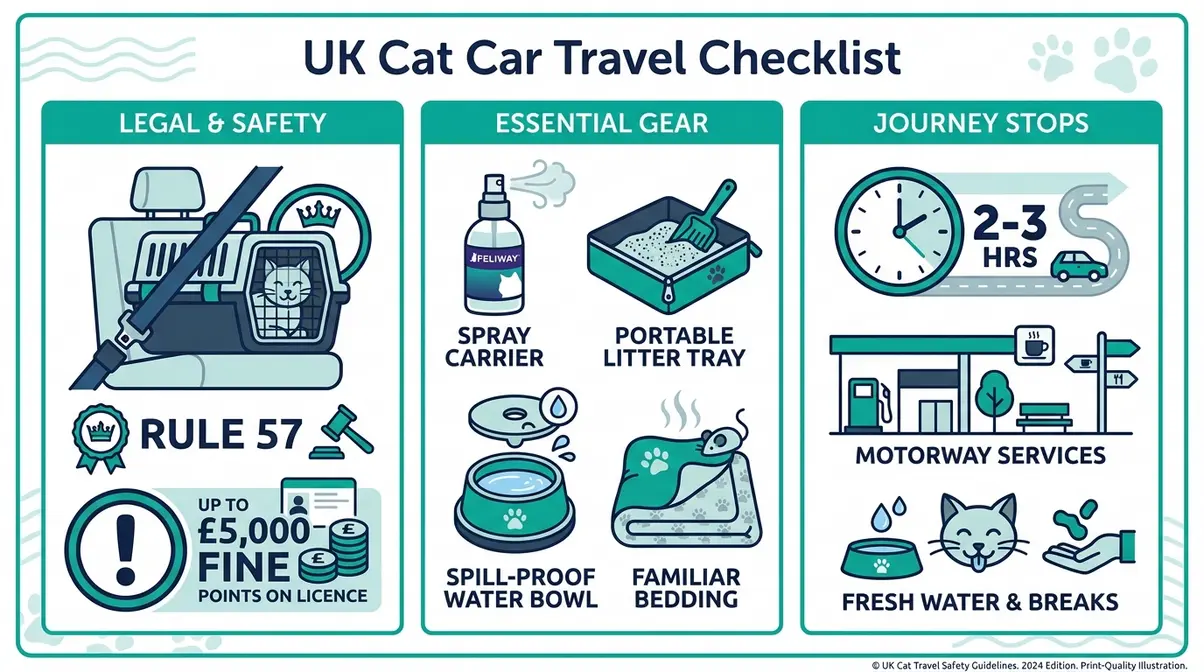
For anyone travelling with a cat in a car UK law requires legal compliance, proper preparation, and a calm carrier setup — UK Highway Code Rule 57 mandates your cat must be suitably restrained or you risk fines of up to £5,000 and invalidated car insurance.
- The 3-Phase Journey Framework: Prepare weeks before (training and gear), manage the journey with stops every 2–3 hours, then allow your cat time to recover and settle at your destination.
- Legal requirement: Your cat must travel in a secured carrier — a loose cat can distract you, void your insurance, and result in a fine.
- Long-distance tip: Plan a litter tray stop every 2–4 hours; most adult cats can hold their bladder but shouldn’t be forced to for an entire 8-hour drive.
- Calming aids work: Feliway pheromone spray (a synthetic scent that mimics natural feline calming signals) applied 30 minutes before departure can significantly reduce travel anxiety.
What You’ll Need Before You Start
Before you reach Step 1, gather these essentials. Being organised ahead of time removes last-minute panic — and that calm energy genuinely transfers to your cat.
Essential items:
- An IATA-approved or crash-tested hard or soft-sided cat carrier (IATA-approved means it meets international airline safety standards — a useful quality benchmark even for car travel)
- A seatbelt-compatible strap or boot anchor to fix the carrier in place
- Familiar bedding or a worn T-shirt to place inside the carrier
- A portable, travel-sized litter tray — essential for any journey over 2 hours
- Feliway spray (a synthetic pheromone that mimics natural feline calming signals, available at vets and pet shops)
- Calming treats or your cat’s usual dry food, withheld for 4 hours before departure to reduce motion sickness risk
- Fresh water in a spill-proof travel bowl
- Waste bags, hand sanitiser, and paper towels for accidents
Lead time — plan around this:
| Task | When to Start |
|---|---|
| Carrier training (Step 2) | 4–6 weeks before |
| Gear purchase (Step 3) | At least 1 week before |
| Vet consultation for calming meds | 2–3 weeks before |
| Day-of carrier prep (Step 4) | 30 minutes before departure |
If you’re moving next week and haven’t started yet, don’t panic. A compressed timeline is harder, but it’s workable — Step 2 explains what to do when you’re short on time.
Step 1: Know the UK Law Before You Drive
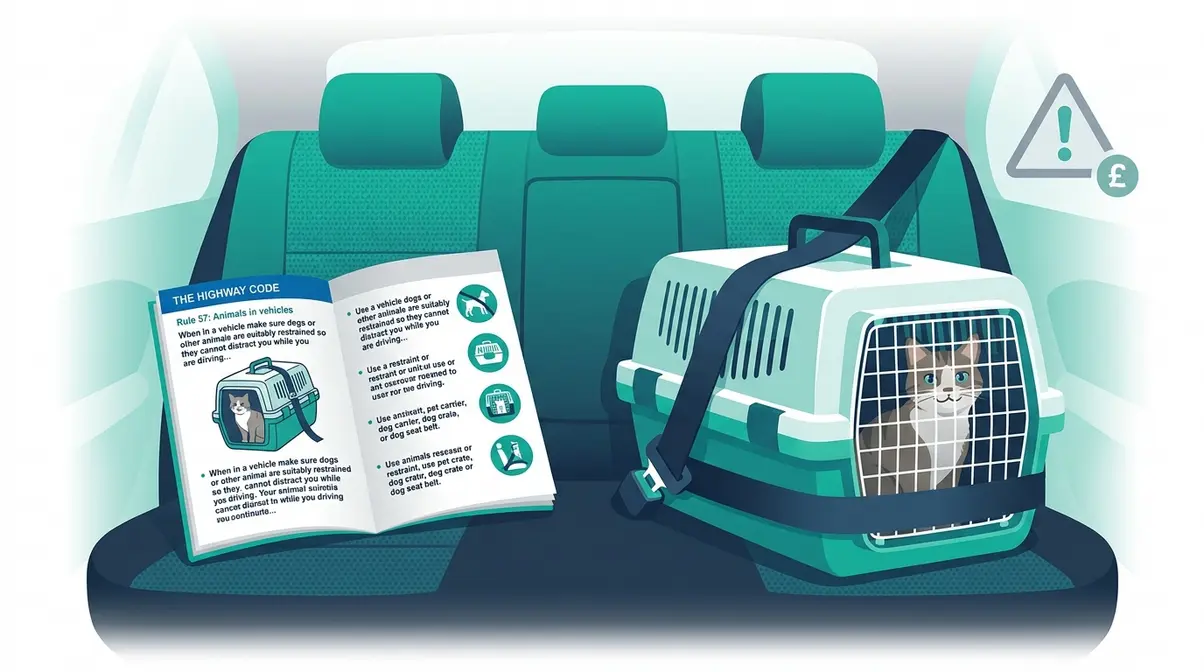
Before you load your cat into the car, there is one legal requirement every UK driver must know. Under UK Highway Code Rule 57, you are legally required to ensure your cat is suitably restrained in the vehicle — and failing to comply can result in a fine of up to £5,000 and the invalidation of your car insurance. Step 1 of The 3-Phase Journey Framework is knowing the law before anything else.
UK Highway Code Rule 57 requires that when travelling with animals, they must be “suitably restrained so they cannot distract you while you are driving or injure you, or themselves, if you stop quickly.” For further detail, see the UK Highway Code Rule 57 on restraining animals. For practical guidance on safe cat car travel practices, our full resource covers additional techniques.
What UK Highway Code Rule 57 Actually Says
Rule 57 applies to all animals in vehicles — including cats. The key phrase is “suitably restrained so they cannot distract you while you are driving or injure you, or themselves, if you stop quickly.” In plain English, your cat cannot be loose in the car. Full stop.
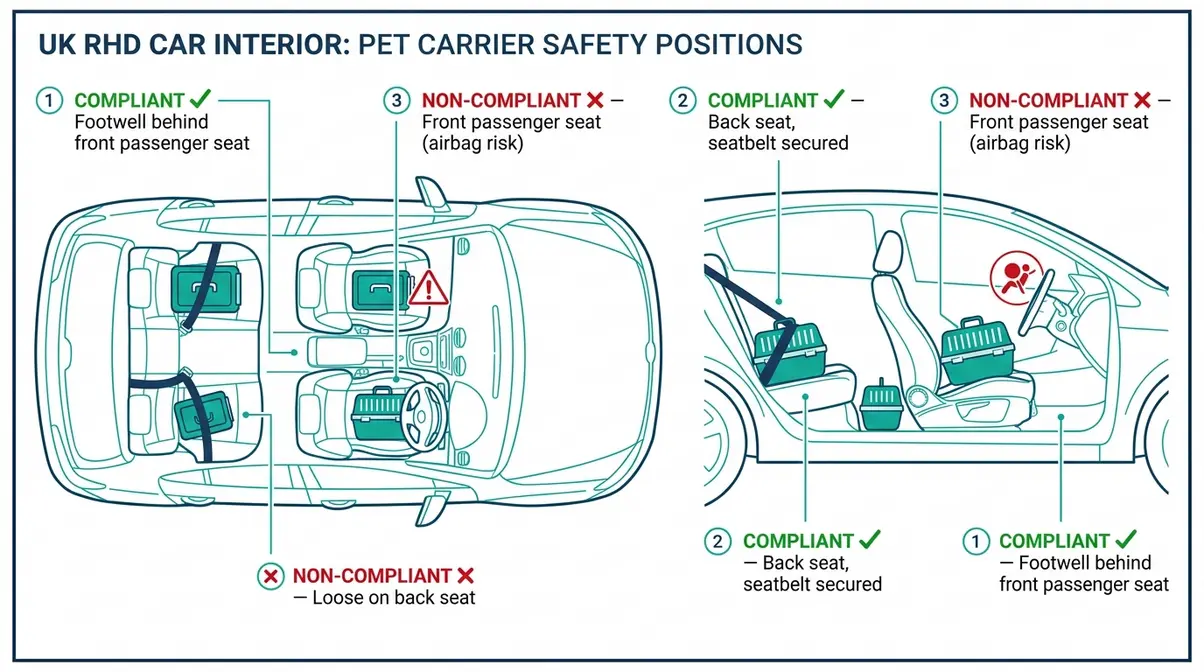
What counts as compliant restraint for a cat:
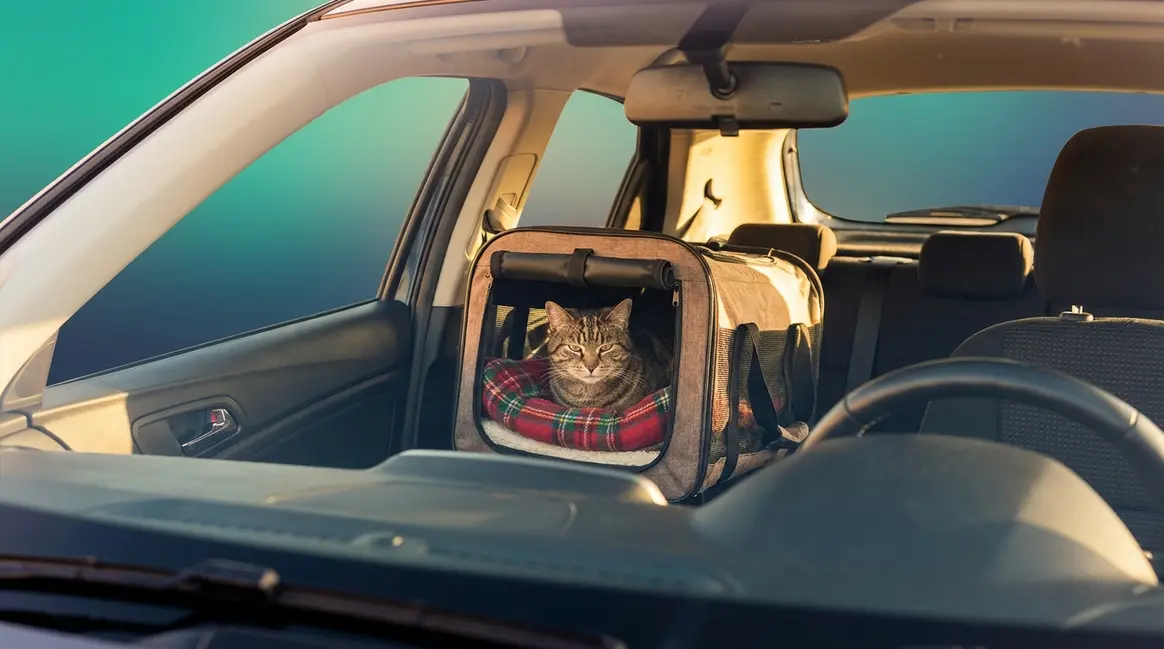
- A hard or soft-sided carrier secured with a seatbelt threaded through the carry handle
- A carrier placed in the footwell behind the front seat (the most stable position in a collision)
- A carrier in the boot of an estate car or SUV, secured with a boot guard or anchor strap
What does NOT comply:
- Your cat loose in the passenger footwell or on the back seat
- Your cat sitting on your lap while you drive
- A carrier placed on the back seat but not secured — it can slide, tip, or become a projectile in an emergency stop
There is also a secondary legal risk worth knowing. Even if your cat isn’t injured, if they distract you and you swerve or brake sharply, you can be charged with driving without due care and attention — a separate offence entirely. Two quick scenarios to make this concrete: a carrier secured with a seatbelt on the back seat is compliant; the same carrier sitting loose on the back seat is not.
Knowing what the law says is one thing. Knowing what it costs you if you ignore it is another.
Fines, Insurance Invalidation, and Why This Matters
The financial stakes are specific and real. A fixed penalty notice for failing to restrain an animal in a vehicle carries an on-the-spot fine of £1,000. If the case goes to court — for example, following an accident — that figure rises to up to £5,000 (UK Highway Code Rule 57). A £1,000 fine for a cat travelling unsecured is a real enforcement risk, not a theoretical one.
The insurance risk is equally serious. Most UK car insurance policies include a clause requiring drivers to take “reasonable precautions” to prevent accidents. An unsecured pet in the car may breach that clause. If you have a collision and your cat was loose, your insurer has grounds to refuse your claim entirely — leaving you personally liable for repair costs, third-party damages, and medical bills.
The reassuring flip side: compliance is simple and inexpensive. A seatbelt-compatible carrier costs a fraction of a £1,000 fine. Secured carrier = legal, insured, safe. Loose cat = illegal, potentially uninsured, and dangerous for everyone in the vehicle.
Now that you know the law, the next step is preparing your cat weeks in advance — because a well-trained cat makes every legal requirement easier to meet.
Step 2: Train Your Cat for Car Rides
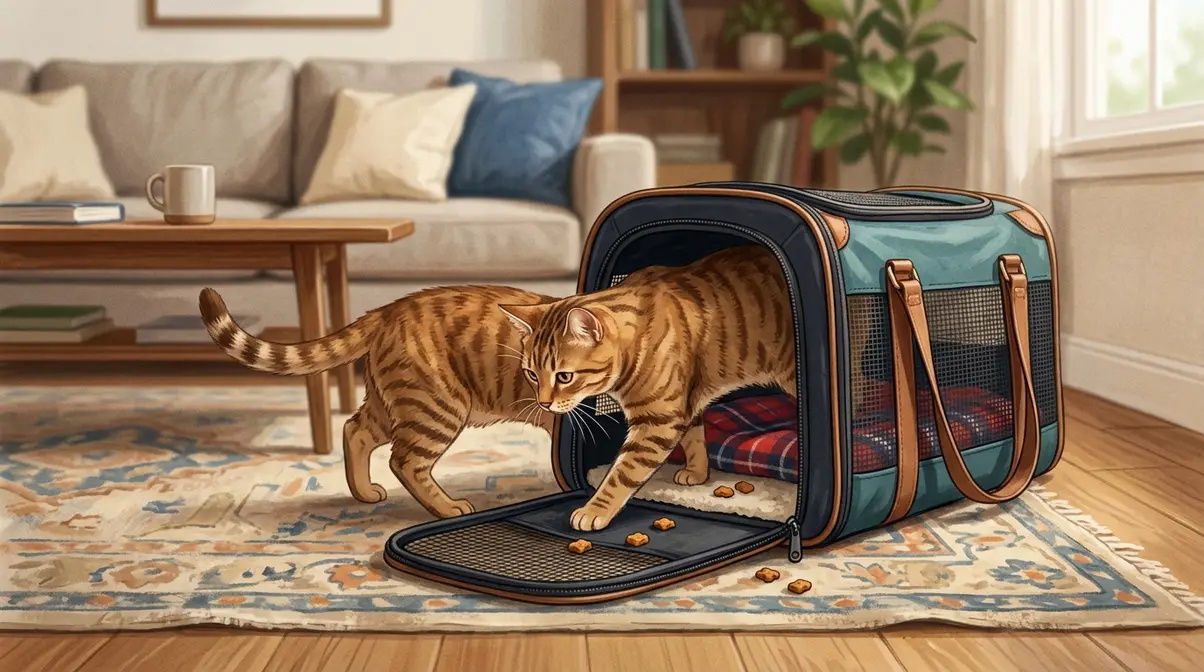
Why does your cat panic the moment they see the carrier? Because it only ever appears before something stressful — a vet visit, a cattery stay, a house move. The carrier has become a reliable signal for bad things. The solution is systematic desensitisation over 4–6 weeks, gradually replacing that association with something neutral or even positive. According to the International Cat Care guide to carrier acclimatisation, leaving the carrier open in the house with comfortable bedding and treats for several weeks before a journey can significantly reduce a cat’s travel-related anxiety. This entire step is Phase 1 of The 3-Phase Journey Framework — the Pre-Journey Prep phase.
For additional guidance on training your cat for car travel, our expert tips resource covers common problems and solutions.
Step-by-Step: Carrier Desensitisation at Home
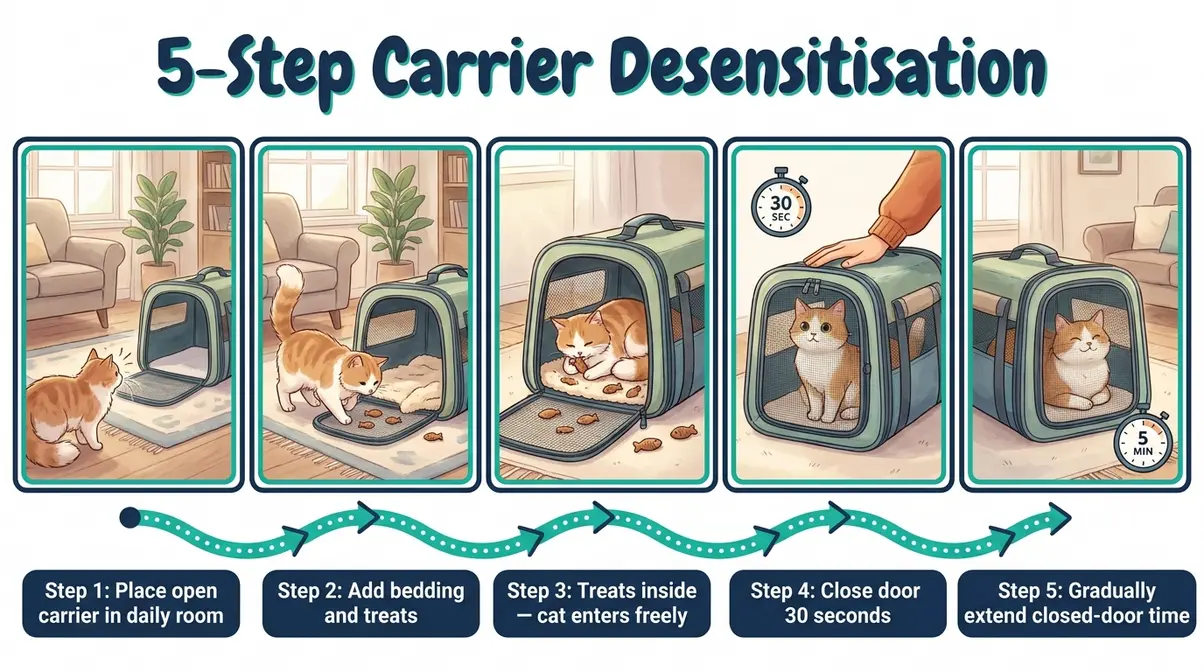
“Leaving a carrier open at home with familiar bedding for several weeks before a journey can significantly reduce a cat’s travel-related anxiety” (International Cat Care). Here is the exact five-step protocol to make that happen:
- Place the open carrier in a room your cat uses daily. Leave it completely open for 2–3 days. Don’t do anything else — just let it exist in their space. This makes it part of your cat’s normal territory, removing the “ambush” association.
- Add familiar bedding or a worn T-shirt. Place a few treats near the entrance. Your cat will investigate on their own terms.
- After 3–5 days, place treats inside the carrier. Let your cat enter voluntarily. Never push or coax them in — voluntary entry is the goal.
- Once your cat enters freely, gently close the door for 30 seconds. Open it immediately and reward with treats. The brief closure is the key desensitisation moment.
- Gradually increase closed-door time over several days — 1 minute, then 5 minutes, then 15 minutes. Every positive experience in the carrier builds a new association, slowly replacing fear with neutrality or even curiosity.
If you have less than a week: Start at Step 3 immediately. Spray Feliway (a synthetic pheromone spray that mimics natural feline calming signals) inside the carrier 30 minutes before use. This journey will likely be harder, but use it as a baseline — and start proper training before the next one.
A well-designed soft-sided carrier with a wide opening and familiar bedding, like several options in the Recommended Products table above, makes this desensitisation process noticeably easier.
Once your cat is comfortable in the carrier at home, the next step is introducing the car itself — without going anywhere.
How to Run Short Practice Drives
Learning how to get a cat used to car rides requires a graduated approach — you build up the experience in stages, never skipping ahead.
- Sit with your cat in the carrier in the stationary car, engine off. Five minutes. Offer treats through the carrier door throughout.
- Start the engine. Do not move. Sit for 5 minutes. Reward any calm behaviour with treats and a quiet, steady voice.
- Drive around the block (roughly 5 minutes). Return home immediately. Reward.
- Over 1–2 weeks, gradually extend to 15-minute, then 30-minute drives. Each successful trip builds tolerance.
Signs your cat is coping well: calm or slow breathing, sitting upright (not pressed into the back corner), no vocalisation. Signs of distress: panting, excessive meowing, drooling (which can signal motion sickness). If distress signs appear, end the drive, return home, and consult your vet before attempting another trip.
Across UK cat owner communities, the consistent feedback is encouraging. A Bengal owner on Reddit reported that after just three short practice drives, their cats settled within 10 minutes of departure — down from 45 minutes of non-stop vocalisation on the first attempt.
Arriving at Your Destination: The 3-3-3 Rule

Once you arrive, your cat’s stress doesn’t automatically stop. The 3-3-3 rule is a widely used guideline in cat rescue and rehoming circles that describes the typical adjustment timeline for a cat in a new environment:
- 3 days to decompress and feel safe enough to eat and drink normally
- 3 weeks to learn the layout and routines of the new space
- 3 months to fully settle and show their true personality
For a house move or holiday, this means setting up a quiet, familiar room immediately on arrival — with the carrier left open as a refuge, litter tray accessible, and minimal foot traffic. Don’t expect your cat to explore freely on day one. Give them time, and the adjustment will be far smoother.
Step 3: Gather Your Essential Gear and Set Up Your Car
When travelling with a cat in a car UK residents should know the right gear makes the journey significantly safer and less stressful — for your cat and for you. This is still part of Phase 1 of The 3-Phase Journey Framework: everything you do before departure shapes the entire journey. Our team evaluated the key categories of cat travel equipment to identify what actually matters versus what is marketing noise.
According to the PDSA guidance on safe pet car travel, using a secure, well-ventilated carrier that prevents your pet from moving around freely during transit is highly recommended. For a broader look at safe cat car travel practices, our expert resource covers carrier selection in detail.
Choosing the Right Cat Carrier for Car Travel
Not all carriers are equal — and for a car journey, certain features matter more than others. Here is what to look for:
| Feature | Why It Matters |
|---|---|
| Seatbelt-compatible strap or loop | Allows you to legally secure the carrier — Highway Code Rule 57 compliance |
| Rigid base or internal frame | Prevents the carrier collapsing in a sudden stop |
| Top-loading door | Easier to place a reluctant cat inside |
| Adequate ventilation on all sides | Prevents overheating, especially in summer |
| Machine-washable liner | Practical for accidents on long journeys |
Hard-sided vs. soft-sided: Hard carriers offer better crash protection but are heavier. Soft-sided carriers are lighter and often easier to secure with a seatbelt, but look for a reinforced frame. For long-distance journeys with two cats, a dual-compartment carrier (several options appear in the Recommended Products table) reduces fighting and gives each cat their own space.
The PDSA guidance on safe pet car travel recommends using a secure, well-ventilated carrier that prevents your pet from moving around freely during transit — which aligns directly with Rule 57 requirements.
The Complete Cat Car Travel Packing Checklist
Pack this the night before — not the morning of. Rushing on the day of travel raises your stress levels, and cats are remarkably sensitive to their owner’s anxiety.
- In the carrier:
- Familiar bedding or worn T-shirt
- One or two favourite toys
- Feliway spray applied 30 minutes before loading (allow it to dry before placing your cat inside)
- In the car:
- Spill-proof water bowl and a small bottle of water from home (familiar taste reduces refusal to drink)
- Dry food in a sealed container (offer sparingly at stops — not during driving)
- Portable travel litter tray and a small bag of their usual litter
- Waste bags, paper towels, hand sanitiser
- A light blanket or towel to drape over the carrier (reduces visual stimulation)
- Your cat’s vaccination records and microchip details (essential if crossing into Scotland or Wales, and required if your journey involves a cattery or pet-friendly hotel)
If travelling with a kitten: A kitten harness (a small, escape-proof body harness designed for young cats) worn inside the carrier adds a secondary layer of security. Never use a standard collar as a restraint — it poses a strangulation risk.
How to Secure the Carrier Safely in Your Car
Placing the carrier correctly is as important as choosing the right one. Here are the three compliant options, in order of safety:
- Footwell behind the front passenger seat — the most stable position. The seat in front prevents forward movement in a collision. Ideal for smaller carriers.
- Back seat, secured with the seatbelt — thread the seatbelt through the carrier’s handle or dedicated strap loop. The carrier should not be able to tip or slide. This is the most common approach.
- Boot of an estate car or SUV, with a boot guard — suitable for larger carriers. The boot guard (a metal or mesh barrier between the boot and rear seats) prevents the carrier becoming a projectile. This is the approach used by many UK vets for large or multi-cat transport.
Never place the carrier on the front passenger seat — airbag deployment in a collision can be fatal to a cat in a carrier at that position.
Step 4: Prepare Your Cat on the Day of Travel
The morning of your journey sets the tone for everything that follows. Phase 2 of The 3-Phase Journey Framework — In-Car Management — actually begins the night before and continues through departure. A calm, unhurried morning routine makes a measurable difference to how your cat enters and tolerates the carrier.
Following the Cats Protection advice on travel day preparation, you should consider withholding food for several hours before travel to reduce the risk of travel sickness, alongside applying a pheromone product to the carrier in advance. For more on calming techniques for anxious cats on journeys, our detailed guide covers the full range of options.
Creating a Calming Carrier Environment
Your goal on the morning of travel is to make the carrier feel like the safest place in the world — not a trap. Follow these steps:
- Withhold food for 3–4 hours before departure. A full stomach significantly increases the risk of motion sickness and vomiting. Water is fine right up to loading time.
- Spray Feliway inside the carrier 30 minutes before loading. Allow the spray to dry fully — do not load your cat into a damp carrier, as the alcohol carrier in the spray can be irritating.
Once the carrier is prepped, focus on the final loading steps to ensure a stress-free transition:
- Place familiar bedding inside. A T-shirt you’ve worn recently carries your scent, which is genuinely calming for most cats.
- Cover three sides of the carrier with a light blanket. Reducing visual stimulation lowers arousal. Leave the front door uncovered so air circulates.
- Load your cat calmly and without rushing. If your cat resists, use the top-loading door if available. Never shout or force — a single stressful loading experience can undo weeks of desensitisation.
Pheromone Sprays and Natural Calming Aids
Feliway Classic spray is the most widely used and evidence-supported over-the-counter calming aid for cats. It contains a synthetic version of the facial pheromone (a chemical signal) that cats produce when they rub their faces on objects they consider safe — essentially telling your cat “this is a secure place.” Applied to the carrier bedding 30 minutes before travel, it can noticeably reduce vocalisation and hiding behaviour.
Other natural options worth considering:
- Feliway Friends diffuser — more suited to multi-cat households than single journeys
- Zylkene (alpha-casozepine) — a non-prescription supplement derived from milk protein, often recommended by UK vets for short-term travel anxiety. Give as directed on the packaging, typically 1–2 hours before travel.
- Calming treats containing L-theanine or valerian — variable effectiveness, but low risk and worth trying alongside Feliway
Across UK cat owner communities, the consistent feedback is that Feliway alone rarely eliminates severe anxiety — but it reliably takes the edge off for most cats, especially when combined with carrier training.
When to Ask Your Vet for Prescription Calming Medication
Important: Always consult your vet before using any prescription medication for your cat. The information below is for general awareness only — dosage, suitability, and safety must be assessed by a qualified veterinary professional.
For cats with severe travel anxiety — those who vocalise continuously, pant, drool, or show signs of extreme distress despite training and Feliway — your vet may prescribe medication. The two most commonly used options in the UK are:
Gabapentin: Originally an anti-seizure medication, gabapentin is increasingly used off-label by UK vets for travel anxiety. A study published in the Journal of Feline Medicine and Surgery found that gabapentin significantly reduced stress scores in cats during car travel and veterinary visits. Your vet will advise on dosage based on your cat’s weight and health history — typically given 1.5–2 hours before travel.
Trazodone: A short-acting sedative sometimes prescribed for cats with extreme anxiety. Less commonly used than gabapentin in UK practice, but an option for cats who do not respond well to gabapentin.
What to avoid: Over-the-counter human anxiety medications, herbal remedies not formulated for cats, and anything a well-meaning friend “thinks worked for their cat.” Cats metabolise drugs very differently from humans and dogs — what is safe for one species can be toxic to another. Your specialist vet is the only person qualified to make this call for your specific cat.
Step 5: Manage the Journey – Stops, Litter, and Safety
You’re on the road. This is Phase 2 (In-Car Management) in full effect. The decisions you make during the journey — when to stop, how to handle the litter tray, how to manage temperature — determine whether your cat arrives stressed or relatively settled.
The Purina UK guide to managing cat journeys recommends offering water at every stop and avoiding feeding during the journey to reduce the risk of travel sickness. For a full breakdown of long-distance cat car travel logistics, our expert tips resource covers multi-day journeys and motorway stop planning.
How Often Should You Stop on a Long Drive?
UK vets recommend stopping every 2–3 hours on a journey with a cat. This is not just for the cat’s comfort — it is also about your own alertness as a driver. At each stop:
- Offer water in a spill-proof bowl (do not open the carrier in an unsecured location)
- Check the carrier for signs of distress, soiling, or overheating
- Allow 5–10 minutes of quiet time before driving on
Can a cat be in a car for 4 hours?
Yes — most healthy adult cats can manage a 4-hour car journey with one planned stop at the midpoint. Ensure the carrier is well-ventilated, familiar, and secured correctly. Offer water at the stop and check for signs of distress — panting, drooling, or continuous vocalisation. Cats with pre-existing health conditions, kittens under 16 weeks, or cats with a history of severe travel anxiety should be assessed by a vet before any journey over 2 hours.
How long can a cat travel without peeing?
Most adult cats can hold their bladder for 4–6 hours without discomfort, according to veterinary guidelines on feline travel. However, forcing them to hold longer than this causes discomfort and can contribute to urinary stress — a known trigger for conditions like feline idiopathic cystitis (bladder inflammation). Never skip a litter stop on a journey over 4 hours.
Managing the Litter Tray on the Road
This is the logistics gap no competitor addresses — and it is the question every long-distance cat owner has. Here is the practical approach:
Option 1: Portable tray at each stop (recommended)
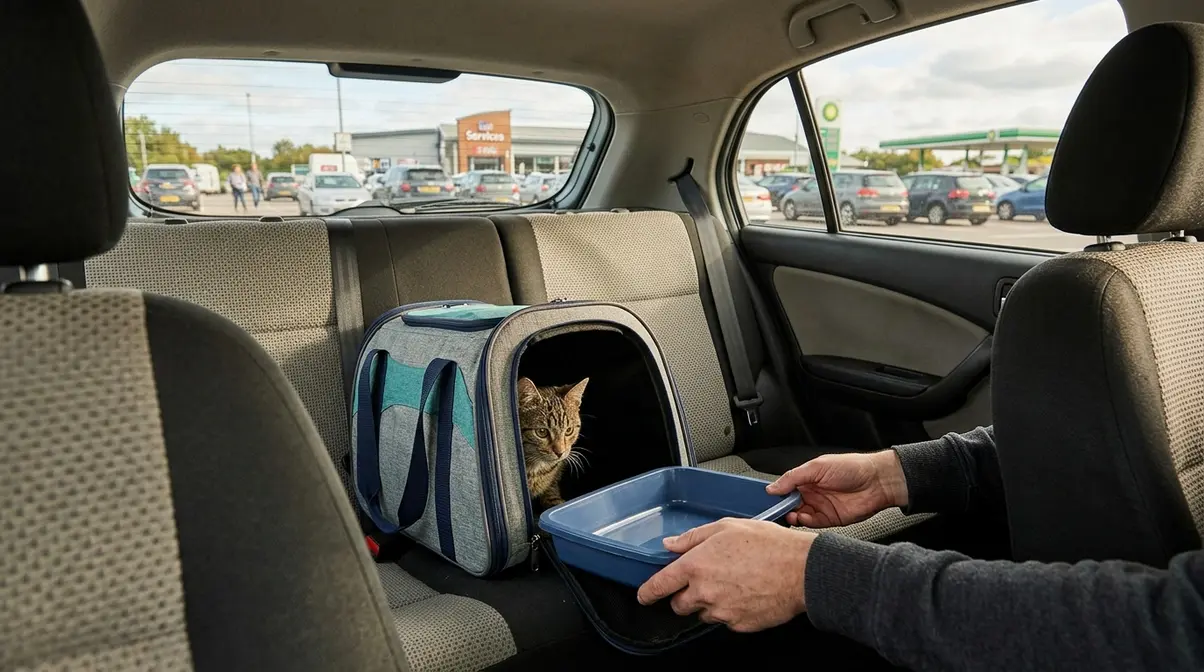
At each 2–3 hour stop, pull into a service station car park (or a quiet layby). Open the carrier door inside your car — do not open it outside, where your cat could bolt. Place a small portable litter tray inside the carrier or immediately in front of it. Most cats will use it within 2–3 minutes if they need to. Remove waste immediately, seal in a waste bag, and sanitise your hands.
Option 2: Integrated litter carrier
Several carriers (including the Petskd Double Cat Carrier + Litter Box and the Foldable 2-Cat Carrier + Litter Box in the Recommended Products table) include a built-in litter compartment. This is an excellent solution for multi-cat journeys — your cats can access the tray during the drive without you needing to stop.
Option 3: Puppy training pads inside the carrier
For cats who will not use a tray in the car, line the carrier base with an absorbent training pad. Change it at stops. This is a fallback, not a first choice — but it makes accidents manageable.
Key rule: Never open the carrier door outside the car at a roadside stop. A frightened cat can bolt and disappear in seconds. Always handle litter stops inside the vehicle with windows and doors closed.
Food, Water, and Temperature Safety
Food: Offer a small amount of dry food at stops, not during driving. A moving car makes it difficult for cats to eat safely, and food combined with motion increases nausea risk. Stick to their usual food — an unfamiliar brand adds a digestive variable you don’t need.
Water: Offer fresh water at every stop. Some cats refuse to drink from an unfamiliar bowl — bringing water from home (which smells familiar) and using their usual bowl can help.
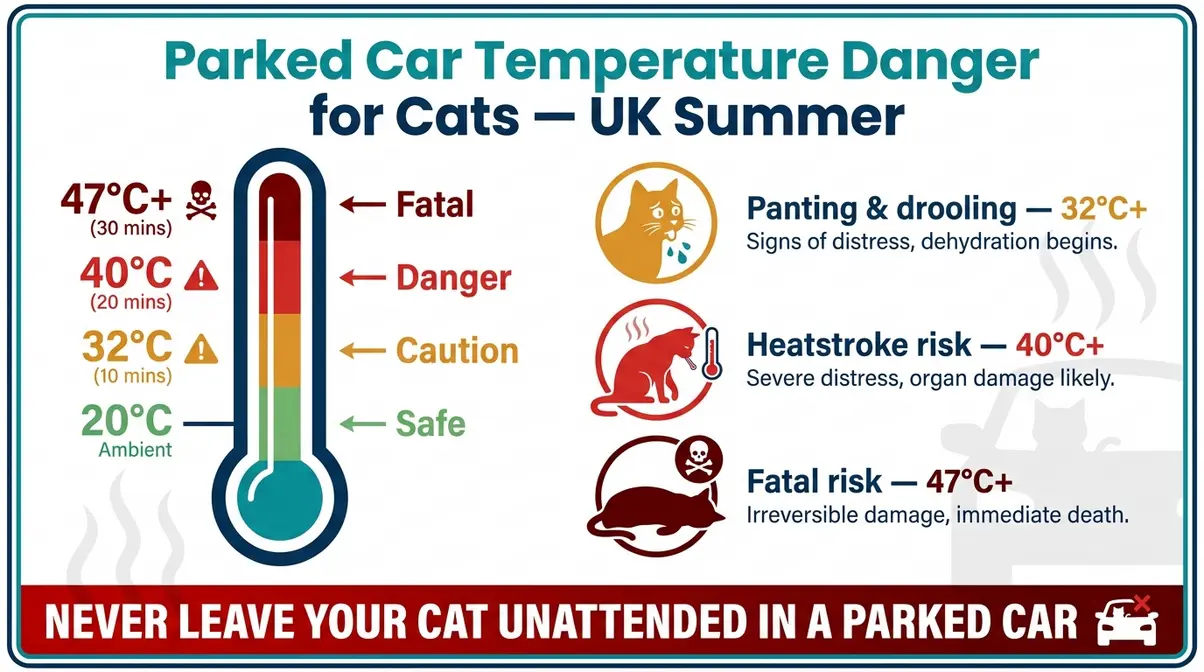
Temperature: This is a serious safety issue. A car parked in direct sunlight in summer can reach dangerous temperatures within minutes — the British Veterinary Association (BVA) warns that temperatures inside a parked car can exceed 47°C on a warm UK day, which is rapidly fatal for cats. Never leave your cat unattended in a parked car, even with a window cracked. During the drive, keep air conditioning on a moderate setting — cold blasts of air directed at the carrier cause stress. Aim for a comfortable 18–21°C inside the car.
Signs of heatstroke in cats: rapid panting, drooling, lethargy, vomiting, or collapse. If you observe any of these, move to a cool area immediately, offer water, and contact a vet urgently.
Sample Journey Schedule for 4, 6, and 8+ Hour Trips
Use these schedules as a starting framework and adjust for your cat’s specific needs.
4-Hour Journey:
| Time | Action |
|---|---|
| T-30 mins | Apply Feliway to carrier. Load cat calmly. |
| T-0 (departure) | Drive. Keep radio low. Avoid motorway for first 10 mins if possible. |
| T+2 hours | Stop. Offer water. Check carrier. Litter tray if needed. |
| T+4 hours (arrival) | Arrive. Set up safe room before releasing cat from carrier. |
6-Hour Journey:
| Time | Action |
|---|---|
| T-30 mins | Feliway, food withheld, load cat. |
| T+2 hours | Stop — water, litter, 10-minute quiet time. |
| T+4 hours | Stop — water, litter, light snack of dry food. |
| T+6 hours (arrival) | Arrival. Safe room setup. Begin 3-3-3 rule. |
8+ Hour Journey:
| Time | Action |
|---|---|
| T-30 mins | Full day-of prep (Step 4). Load cat. |
| T+2 hours | Stop — water, litter, calm check. |
| T+4 hours | Stop — water, litter, small dry food portion. |
| T+6 hours | Stop — water, litter, check for distress signs. |
| T+8 hours (arrival) | Arrival. Safe room. Begin 3-3-3 adjustment. |
For a 500-mile journey (roughly 8 hours with stops), build in three rest stops and allow an extra 30–45 minutes beyond your satnav estimate. Rushed stops are more stressful than planned ones.
Common Mistakes to Avoid When Travelling with Your Cat
Even well-prepared owners make avoidable errors. This section covers the patterns our team has seen most often across UK cat owner communities — and how to sidestep them.
The Most Common Pitfalls
1. Leaving the carrier out only on journey day
This is the single biggest cause of carrier-related panic. If your cat only sees the carrier on travel days, every appearance becomes a distress signal. Fix: keep the carrier out permanently as a piece of furniture.
2. Feeding a full meal immediately before departure
Motion sickness in cats is real and common. A full stomach makes it significantly worse. Withhold food for 3–4 hours before departure — this is not cruel, it is protective.
3. Placing the carrier on the front seat
Airbag deployment can cause fatal injuries to a cat in a carrier on the front passenger seat. Always use the back seat or boot. This also keeps you compliant with Highway Code Rule 57.
4. Using calming medication without a vet consultation
Human anxiety medications, dog sedatives, and some herbal products are toxic to cats. Never administer anything without explicit veterinary guidance — even products that appear “natural.”
5. Opening the carrier outside the car at a stop
A frightened cat can bolt and disappear in seconds at a motorway service station. Always manage litter and water inside the car with doors closed.
6. Skipping practice drives
Owners who skip training and go straight to a 6-hour journey report the worst outcomes. Even two or three short practice drives make a measurable difference to how quickly a cat settles on the real journey.
When to Seek Specialist Vet Advice
Some cats need more than Feliway and training. Contact your specialist vet — ideally 2–3 weeks before your journey — if:
- Your cat has a history of severe travel anxiety, vomiting, or self-injury in carriers
- Your cat is elderly, has a heart condition, or is on regular medication
- Your cat has never been in a car before and you are facing an 8-hour journey with no time to train
- Your cat shows signs of distress during practice drives despite your best efforts
A vet can assess whether prescription medication (gabapentin, trazodone) is appropriate, advise on dosage, and flag any health conditions that could be exacerbated by long-distance travel. This is not over-cautious — it is the responsible approach for any YMYL (your cat’s welfare) decision.
Frequently Asked Questions
What is the 3-3-3 rule for cats?
The 3-3-3 rule describes the typical adjustment timeline for a cat in a new environment. It takes roughly 3 days for a cat to decompress and eat normally, 3 weeks to learn the layout and routines of a new space, and 3 months to fully settle and show their true personality. For UK cat owners moving house or arriving at a holiday destination, this means setting up a dedicated safe room on arrival and allowing your cat to explore at their own pace — not forcing interaction or free roaming on day one.
Will my cat be okay on a 3-hour car ride?
Yes — a 3-hour car ride is very manageable for most cats with the right preparation. Withhold food for 3–4 hours before departure to reduce motion sickness risk. Apply Feliway to the carrier 30 minutes before loading. Secure the carrier in the back seat or footwell as required by UK Highway Code Rule 57. One stop at around 90 minutes is ideal — offer water and a litter opportunity. Cats who have completed even one or two short practice drives typically settle within the first 20–30 minutes of a 3-hour journey.
Do cats prefer hard or soft carriers for car travel?
Most cats prefer soft-sided carriers because they feel cozier and absorb vehicle vibrations better than rigid plastic. However, hard-sided carriers offer superior crash protection and are easier to clean if accidents happen. The best choice depends on your cat’s specific preferences and your vehicle’s setup.
Should I cover my cat’s carrier in the car?
Yes, covering three sides of the carrier with a light, breathable blanket can significantly reduce travel anxiety. This limits visual overstimulation from passing traffic and creates a secure, den-like environment. Always leave the front door uncovered to ensure proper ventilation and airflow.
Your Next Step: Plan the Journey, Not Just the Drive
For anxious owners, mastering the art of travelling with a cat in a car UK wide is not one stressful event — it is three manageable phases. The 3-Phase Journey Framework gives you a clear structure: prepare thoroughly in the weeks before (Phase 1), manage stops and safety on the road (Phase 2), and allow your cat the time and space to recover at your destination (Phase 3). Research consistently shows that cats who have been carrier-trained and exposed to short practice drives settle significantly faster on long journeys — the investment in Phase 1 pays back on every mile of Phase 2.
The legal piece is equally simple once you know it. UK Highway Code Rule 57 requires a secured carrier — and a compliant setup costs far less than the £1,000–£5,000 fine for ignoring it. One carrier, one seatbelt strap, one correct position in the car. That is all it takes to be legal, insured, and safe.
Start with Step 1 today — even if your journey is next week. Read the Highway Code Rule 57, order a seatbelt-compatible carrier, and begin leaving it open in your home. Every small action reduces the stress load on the day. Your cat is more adaptable than you think — and with the right preparation, so are you.

Dave King
Cat owner and writer at Mad Cat Man.