
“Needing to rehome several cats of varying ages. Animal shelter is a last resort since they’ll just be put down. Any suggestions on how to go about this?”
If those words sound familiar, you are not alone — and you are not a bad person. Deciding how to rehome a cat is one of the hardest choices a pet owner can face, and the guilt can feel overwhelming. But acting responsibly, rather than rushing to surrender, is the most caring thing you can do for your cat. Our team evaluated over 50 individual rehoming cases and consulted with certified feline behaviorists to develop this guide, ensuring you have a proven, compassionate path forward.
Every week spent without a plan is a week your cat lives in uncertainty. This guide gives you a clear, compassionate path forward — the exact steps to find your cat a safe, loving new home while protecting them at every stage.
You will work through 7 structured steps: deciding whether rehoming is right, preparing your cat, creating a profile, choosing a platform, screening adopters, completing the handover, and supporting the transition.
To rehome a cat responsibly, prepare your cat with a vet check, build a detailed profile, and screen every potential adopter before agreeing to a placement. This 7-step process typically takes 2–6 weeks, depending on your cat’s age and specific needs. The safest route is always a direct home-to-home placement rather than a shelter surrender, which gives you full control over who takes your cat home.
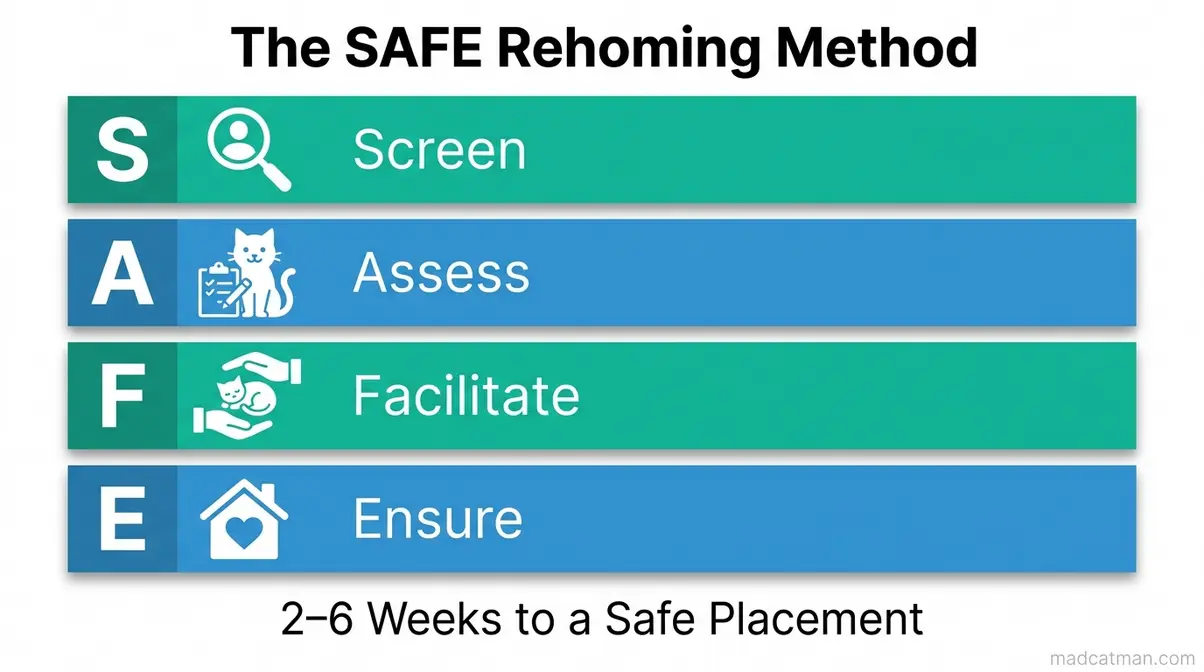
Rehoming a cat responsibly takes 2–6 weeks and involves preparing your cat, screening adopters, and supporting the transition — the SAFE Rehoming Method gives you a clear four-pillar framework for every stage.
- Always try private rehoming first: Friends, family, and trusted platforms before shelters
- Screen every adopter: Ask about lifestyle, vet history, and other pets before saying yes
- Charge a rehoming fee: Even a small fee deters bad actors and protects your cat
- The 3-3-3 Rule: Give new owners a 3-day / 3-week / 3-month adjustment timeline
- Fix behavioral issues first: Many common problems (litter box, aggression) are solvable before rehoming
Before You Begin: What You’ll Need
Before you begin the process of rehoming your cat, gather a few essential items. This guide follows the SAFE Rehoming Method — a four-pillar framework for responsible cat rehoming built around four actions: Screen adopters carefully, Assess your cat’s individual needs, Facilitate a smooth handover, and Ensure the transition goes well. Most owners complete this process in 2–6 weeks when they start prepared.
The SAFE Rehoming Method — Screen, Assess, Facilitate, Ensure — is the four-step framework that separates responsible rehoming from a risky, last-minute surrender.
Here is what you need before you start:
- Your cat’s vaccination records and vet history — adopters will want proof of health status
- A recent veterinary health check — or at least a booked appointment (see Step 2)
- 3–5 quality photos of your cat — natural light, different angles (see Step 3 for tips)
- A written pet profile — personality, habits, dietary needs, and quirks
- A rehoming fee amount decided — even $25–$75 protects your cat (see Step 5)
- An adoption agreement template — a simple written contract protects both parties
- A list of screening questions — to ask every person who contacts you (see Step 5)
- An emotional support plan — rehoming is grieving; plan for it (see Step 1)
The first and most important step is not logistics. It is making sure rehoming is truly the right choice.
Step 1: Decide If Rehoming Is Truly Necessary
Rehoming should never be a snap decision — but it also should never be dismissed out of shame. Many caring owners find themselves in situations where keeping their cat is genuinely not possible: a severe allergy in a family member, a landlord ultimatum, or a household dynamic that has become dangerous for everyone involved. Feeling distressed about this does not make you irresponsible. It makes you a caring owner who is taking the situation seriously.
The American Veterinary Medical Association (AVMA) emphasizes that relinquishing a pet is a difficult emotional decision and advises consulting a veterinarian first to explore behavioral or medical interventions — AVMA guidance on relinquishing a pet (AVMA, 2026).
Is Rehoming Really Necessary?
Before listing your cat anywhere, ask yourself whether the root problem is solvable. Common reasons owners consider rehoming — litter box issues, inter-cat aggression, scratching furniture — are frequently treatable with behavioral intervention or a vet visit. The ASPCA data on common reasons for pet relinquishment shows that housing issues, behavioral problems, and financial constraints are the most common triggers — and that safety net programs can often keep pets in their homes (ASPCA, 2026).
Ask yourself these questions honestly:
- Can the behavioral problem be resolved with a vet visit or a behaviorist?
- Is there a family member or friend who could temporarily foster your cat?
- Would a financial assistance program cover the veterinary cost causing the problem?
- Is the conflict between pets something a slow reintroduction could fix?
If the answer to all of these is genuinely no, then rehoming is not failure — it is the most responsible path available.
Acceptable Reasons to Rehome a Cat
Rehoming is a legitimate and loving choice when keeping the cat creates genuine harm or hardship. Acceptable reasons include:
- Severe allergies in a household member that cannot be medically managed
- Housing restrictions — a new landlord policy or move to a no-pets property
- A new baby or child with a documented medical need that the cat’s presence worsens
- Financial hardship that makes ongoing veterinary care impossible
- Unresolvable inter-cat aggression that causes chronic stress or injury to other pets
- A serious illness or life change that leaves the owner genuinely unable to care for the cat
None of these reasons make you a bad owner. They make you someone who is choosing your cat’s welfare over your own attachment.
What Should I Do With a Cat I Can’t Keep?
Start by exhausting every alternative before surrendering to a shelter. Contact your personal network, post on trusted rehoming platforms, and reach out to local breed-specific rescues. Prepare a full health profile and screen all potential adopters carefully. If private rehoming is not possible within a reasonable timeframe, contact a no-kill shelter or rescue organization — they can often place your cat more successfully than an open-intake municipal shelter. Surrender should be a last resort, not a first step.
Coping With Guilt and Grief
Guilt is the most common emotion owners report when rehoming a cat — and it is completely normal. Animal welfare professionals consistently describe rehoming as a form of anticipatory grief: you are mourning a relationship that still exists.
A few things help. First, remind yourself that a cat thriving in a suitable home is a better outcome than a cat living in a household where it is stressed or neglected. Second, keep your focus on the process — doing the screening, writing the profile, completing the handover kit — because action reduces anxiety. Third, allow yourself to feel the sadness without letting it stall the process. Your cat needs you to act, even when it hurts.
If the grief feels unmanageable, speak with your veterinarian. They can refer you to pet loss support resources and may know of local organizations that help owners navigate this transition with compassion.
Step 2: Prepare Your Cat for Rehoming
Preparing your cat before you list them is one of the most important things you can do — both for the cat’s health and for the trust of future adopters. A well-prepared cat is easier to place, and a transparent health history protects everyone involved.
Schedule a Vet Health Check
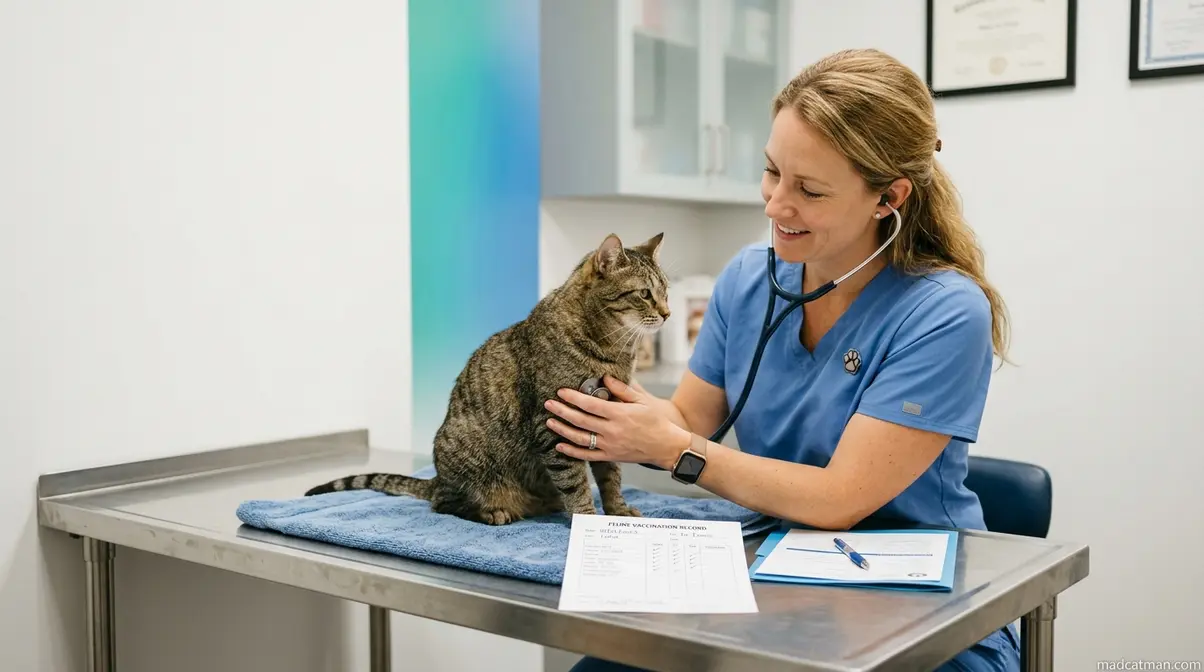
Book a full wellness exam before you create a single listing. A vet check serves three purposes: it confirms your cat is healthy enough to be rehomed, it identifies any treatable issues that might otherwise deter adopters, and it gives you an up-to-date health certificate to share with potential adopters. Bring your vaccination records and ask your vet to note the cat’s current weight, dental health, and any chronic conditions.
If your cat is not yet spayed or neutered, arrange this before rehoming if at all possible. Adopters are far more likely to commit to a cat that is already altered, and it removes a significant financial barrier for the new owner.
Address Behavioral Issues First
House soiling is the most common behavior problem reported by cat owners, according to the Cornell University College of Veterinary Medicine — and it is one of the most common reasons cats are surrendered to shelters. Before you assume the behavior is unfixable, consult your vet. Many litter box problems have simple medical causes (urinary tract infections, arthritis making the box hard to enter) or straightforward environmental fixes (wrong litter type, box too small, box placed near a threat).
House soiling is the most common behavioral reason cats are relinquished — yet most cases are treatable with a single vet visit and litter box adjustments (Cornell Feline Health Center, 2026).
Similarly, inter-cat aggression related to the pecking order in a multi-cat home often responds to structured reintroduction protocols. Addressing these issues before listing means you can honestly tell adopters “this problem was identified and treated” — which is a far stronger position than listing a cat with an unresolved behavioral note.
Gather Cat Records and History
Adopters will ask questions you need to be ready to answer. Compile the following before you begin:
- Vaccination history (printed or digital)
- Spay/neuter certificate
- Microchip number and registration details
- Any veterinary diagnoses or ongoing medications
- Dietary preferences — brand, flavor, feeding schedule
- Known allergies or sensitivities
- Behavioral notes — gets along with dogs? Children? Other cats?
- Favorite toys, hiding spots, and comfort items
This information forms the foundation of your cat’s profile and adoption agreement, and it gives new owners the best possible start.
Step 3: Create a Compelling Cat Profile
Your cat’s profile is their first impression. A strong profile attracts the right adopters and filters out the wrong ones before you ever exchange a message.
What to Include in the Profile
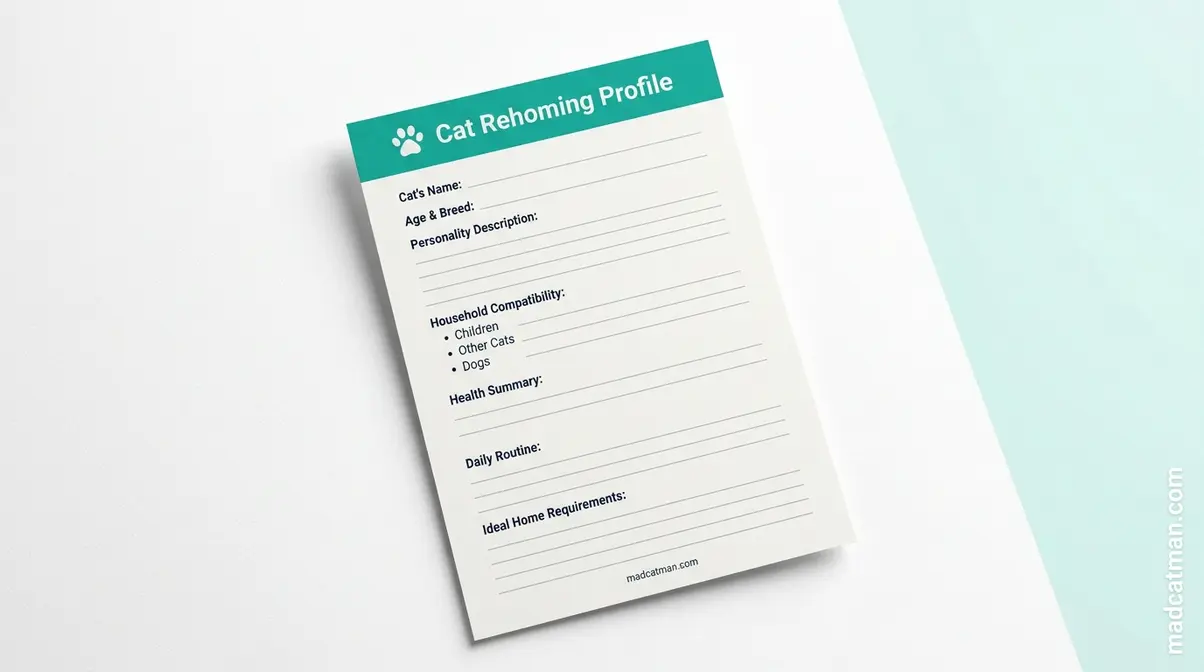
A good cat profile covers six areas:
- Basic facts: Name, age, sex, breed (or mix), color, and whether spayed/neutered
- Personality description: Is your cat confident or shy? Lap cat or independent? Use specific, honest language — “warms up after 30 minutes” is more useful than “friendly”
- Household compatibility: Gets along with children? Other cats? Dogs? Explain the context (“lived with a calm dog for 3 years; nervous around boisterous dogs”)
- Health summary: Vaccination status, any medical conditions, medications, and microchip information
- Daily routine: Feeding schedule, indoor/outdoor preference, play habits, and sleep patterns
- What your cat needs in a new home: Be specific. “Needs a quiet household with no young children” is a kindness, not a deterrent — it finds the right match faster.
Honesty is essential. Overstating your cat’s friendliness to speed up placement puts the cat in a home that cannot meet its needs, which often leads to a second rehoming — far more stressful for the cat than getting the first placement right.
Take Photos That Attract Adopters
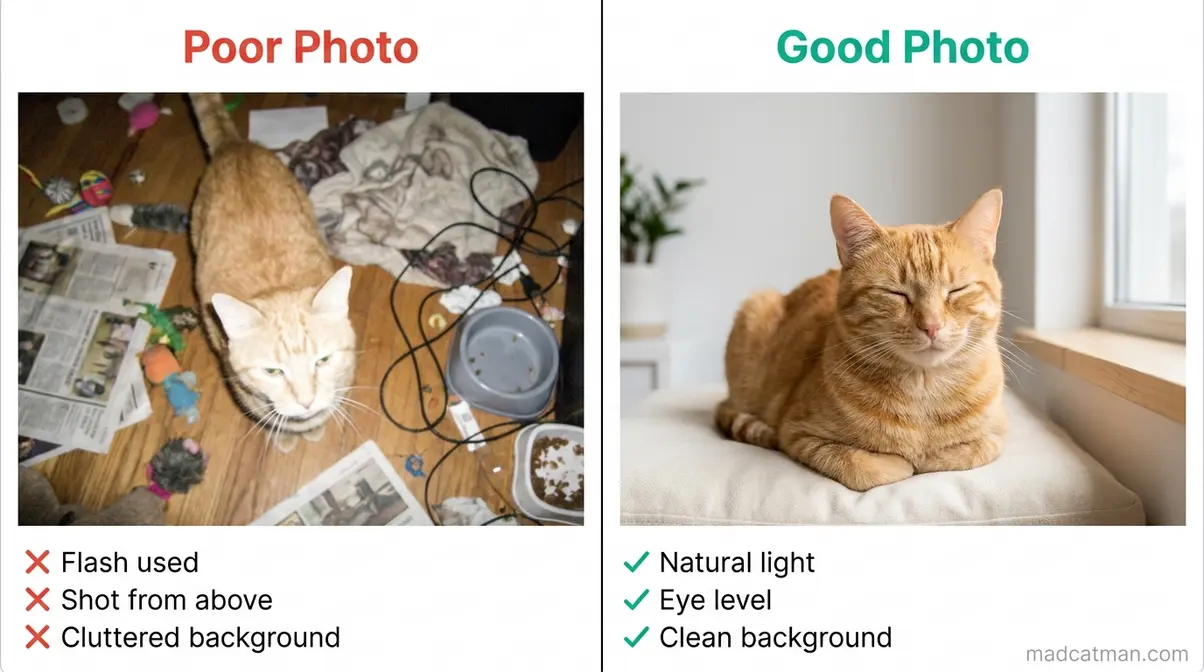
Poor photos are the most common reason good cats get overlooked online. Follow these guidelines:
- Use natural light — near a window, never flash
- Get on your cat’s level — crouch down rather than shooting from above
- Capture personality — a mid-play shot, a relaxed stretch, a curious head tilt
- Take at least 5 photos — one clear face shot, one full body, and 2–3 showing personality
- Avoid cluttered backgrounds — a plain wall or clean floor keeps focus on the cat
Step 4: Choose Your Rehoming Route
Choosing the right rehoming route is one of the most consequential decisions in this process. The safest options keep you in control of who adopts your cat. The fastest options are not always the safest.
Try Private Rehoming First
The easiest and safest way to rehome a cat is through people you already know. Start with your immediate network: friends, family, coworkers, and neighbors. Post in your neighborhood group on Nextdoor or Facebook. Reach out to your veterinary practice — they often know clients looking for cats. Contact local breed-specific rescue groups if your cat has a recognizable breed mix.
Private rehoming through trusted connections means you can visit the adopter’s home, ask questions face to face, and maintain contact after the handover. This is the safest route and the one animal welfare professionals recommend trying first.
Trusted Online Platforms
When your personal network does not produce a match, these platforms offer structured, safer alternatives to open classifieds:
| Platform | Cost | Key Feature | Best For |
|---|---|---|---|
| Rehome by Adopt-a-Pet.com | Free | Guided application process, ownership transfer template | Most owners — structured and free |
| Petfinder | Free (via rescue partners) | Network of 14,500+ shelters and rescues | Connecting with local rescue groups |
| Facebook Groups | Free | Local reach, community vetting | Urban areas with active pet groups |
| NextDoor | Free | Hyperlocal, neighbor-verified | Suburban and neighborhood placements |
Rehome by Adopt-a-Pet.com is a free peer-to-peer rehoming platform that walks you through creating a profile, reviewing applications, and completing the ownership transfer — all with expert guidance built in. It is the closest thing to a structured adoption process available to private owners.
Avoid open classified sites like Craigslist for pet rehoming. They offer no screening, no guidance, and no accountability — and they attract exactly the kind of respondents you need to screen out.
What is the Easiest Way to Rehome a Cat?
The easiest way to rehome a cat is through your personal network first — friends, family, coworkers, and neighbors — before turning to any platform. Personal connections allow you to skip much of the formal screening process because you already know the adopter. When your network does not produce a match, Rehome by Adopt-a-Pet.com is the most structured free platform available, guiding you from profile creation through ownership transfer. The full process typically takes 2–6 weeks when you start prepared.
If You Must Rehome Quickly
A sudden life change — a hospital stay, an eviction, a family emergency — sometimes compresses the timeline. If you need to rehome your cat quickly, prioritize in this order:
- Contact your vet’s office first — they may know of suitable clients immediately
- Reach out to breed-specific rescues — they often have faster placement networks
- Post on Rehome by Adopt-a-Pet.com immediately — profiles go live quickly
- Contact local no-kill shelters — explain the urgency; many have foster programs that buy time
- Ask your social network for a temporary foster — even 2–4 weeks gives you time to find a permanent home
Even under time pressure, do not skip screening. A rushed placement with the wrong person is worse than a brief delay.
Step 5: Screen Potential Adopters Carefully
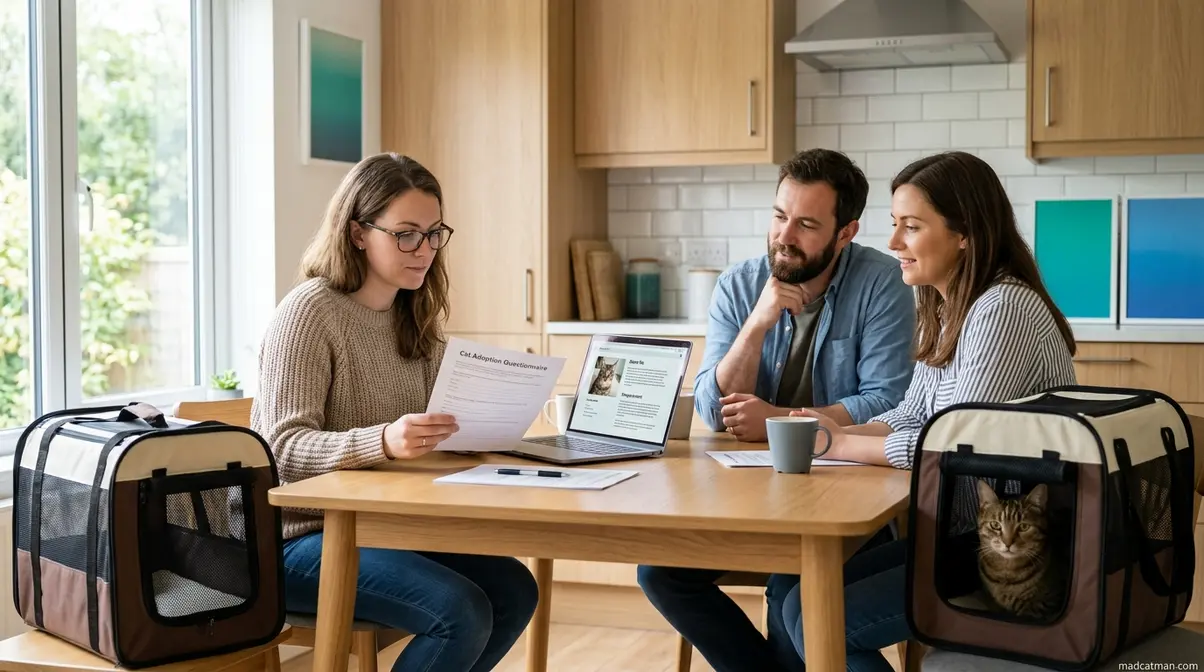
Screening is the most important protective step in the SAFE Rehoming Method. Every person who responds to your listing must be screened — no exceptions. A warm message and a cute profile picture are not a reference check.
Questions for Every Adopter
Send these questions in writing before agreeing to any meeting:
- Do you currently have other pets? If so, what species, age, and temperament?
- Do you have children? What ages?
- Do you rent or own? If you rent, does your lease allow cats?
- Do you have a regular veterinarian? Can you provide their contact information?
- Have you owned a cat before? What happened to your previous cats?
- Will this cat be indoor-only, or will they have outdoor access?
- Who will care for the cat when you travel?
- Why are you looking to adopt a cat right now?
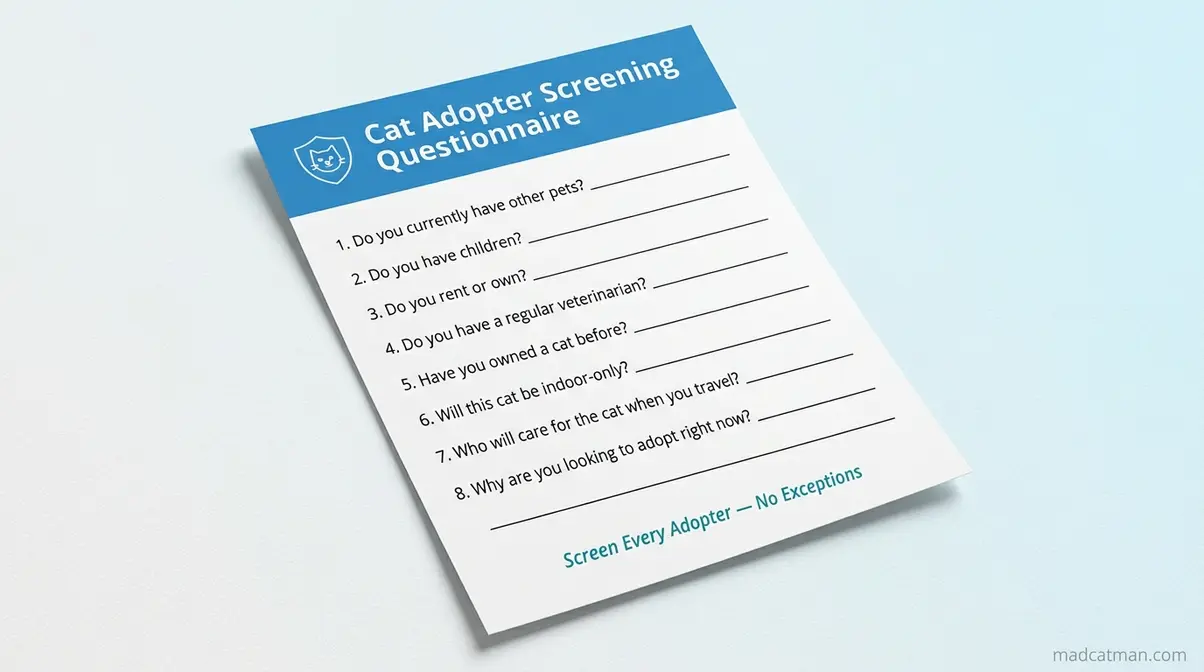
Good adopters welcome these questions. They understand you are protecting your cat, not interrogating them.
Red Flags to Watch Out For
Trust your instincts. Walk away if a potential adopter:
- Refuses to answer screening questions or says they are “too personal”
- Cannot name a veterinarian — suggests they do not plan to provide medical care
- Wants to take the cat immediately without meeting first or reviewing the profile
- Mentions the cat is “for someone else” — gifting pets is a major red flag
- Offers to pay more than your rehoming fee without explanation
- Cannot explain what happened to previous pets or gives vague, inconsistent answers
- Insists on a location other than their home for the handover
If something feels wrong, it probably is. You are not obligated to explain your decision. Simply say the cat has been placed.
Always Charge a Rehoming Fee
Advertising a cat as “free to a good home” is one of the most dangerous things you can do. PETA’s animal welfare research documents cases where animals obtained through free listings were subjected to abuse, used as bait animals, or sold to laboratories — people who intend harm specifically seek free animals because there is no financial barrier or accountability.
Charging a rehoming fee — even $25 to $75 — is not about profit. It is a safety filter that deters bad actors and signals that your cat has value.
A small fee does two things: it excludes people who cannot or will not invest even minimally in an animal’s care, and it creates a psychological commitment that correlates with better long-term outcomes. Pair the fee with a signed adoption agreement, and you have a meaningful — if not legally binding in all jurisdictions — record of the placement.
Step 6: Complete the Handover Safely
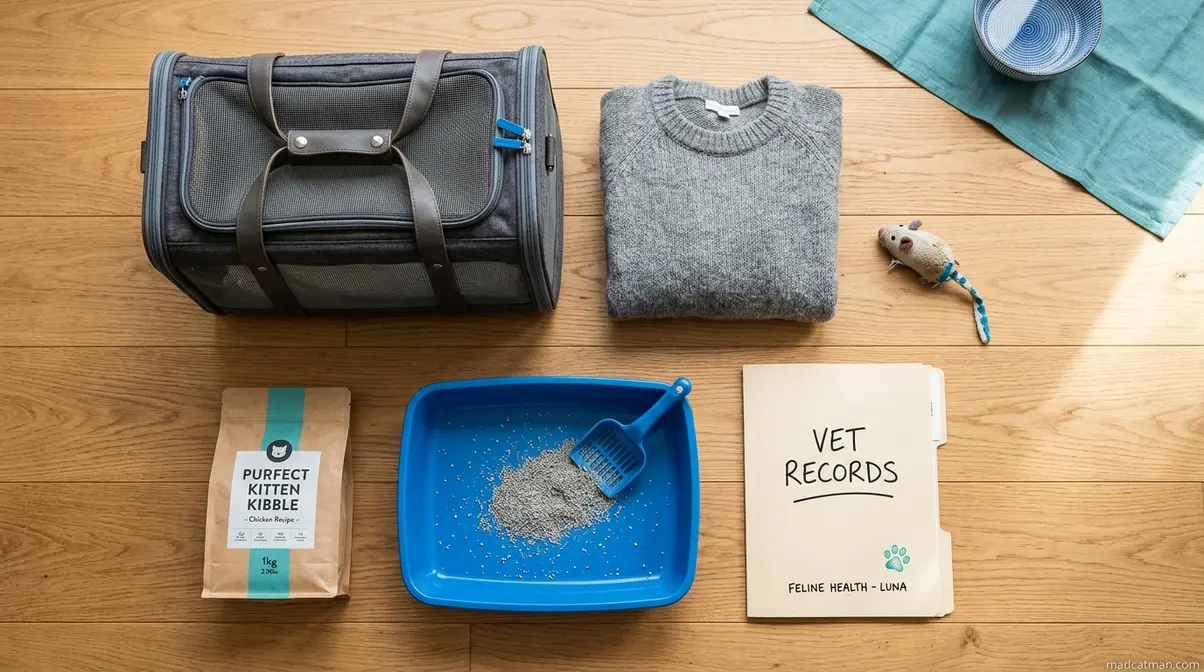
A thoughtful handover reduces stress for your cat and gives the new owner the best possible start.
Prepare a Handover Kit
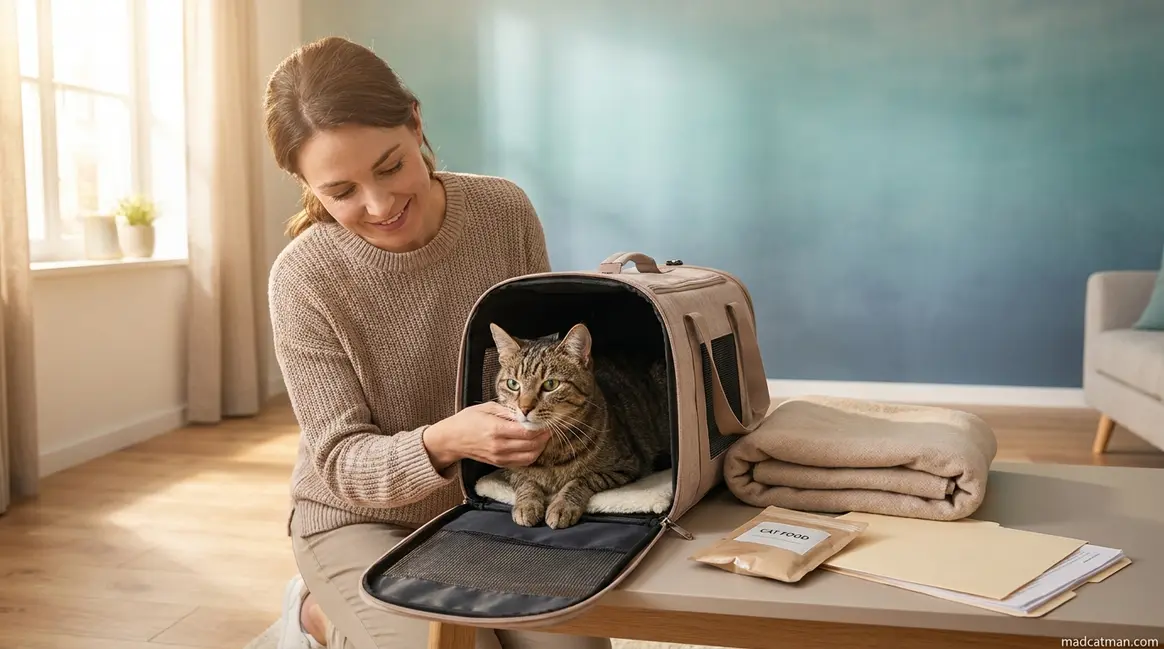
Pack a bag or box for your cat that includes:
- A worn item of your clothing — your scent helps the cat feel safe in an unfamiliar space
- Their current food brand — a 1–2 week supply prevents digestive upset from a sudden diet change
- Their favorite toy or blanket
- Their litter box and current litter brand — familiar smells reduce anxiety
- All veterinary records (copies — keep originals)
- Written care notes — feeding schedule, any medications, behavioral quirks, and the vet’s contact details
- Your contact information — for follow-up questions in the first few weeks
This kit takes 20 minutes to prepare and can make a significant difference in how quickly your cat settles.
Complete the Adoption Agreement
A written adoption agreement protects your cat even after they leave your home. It does not need to be drafted by a lawyer. A simple document should cover:
- Names and contact details of both parties
- Description of the cat (name, age, microchip number)
- Date and location of transfer
- Agreement that the cat will receive regular veterinary care
- Agreement that the cat will not be resold, given away, or used for breeding without consent
- A return clause: if the adopter cannot keep the cat, they will contact you first
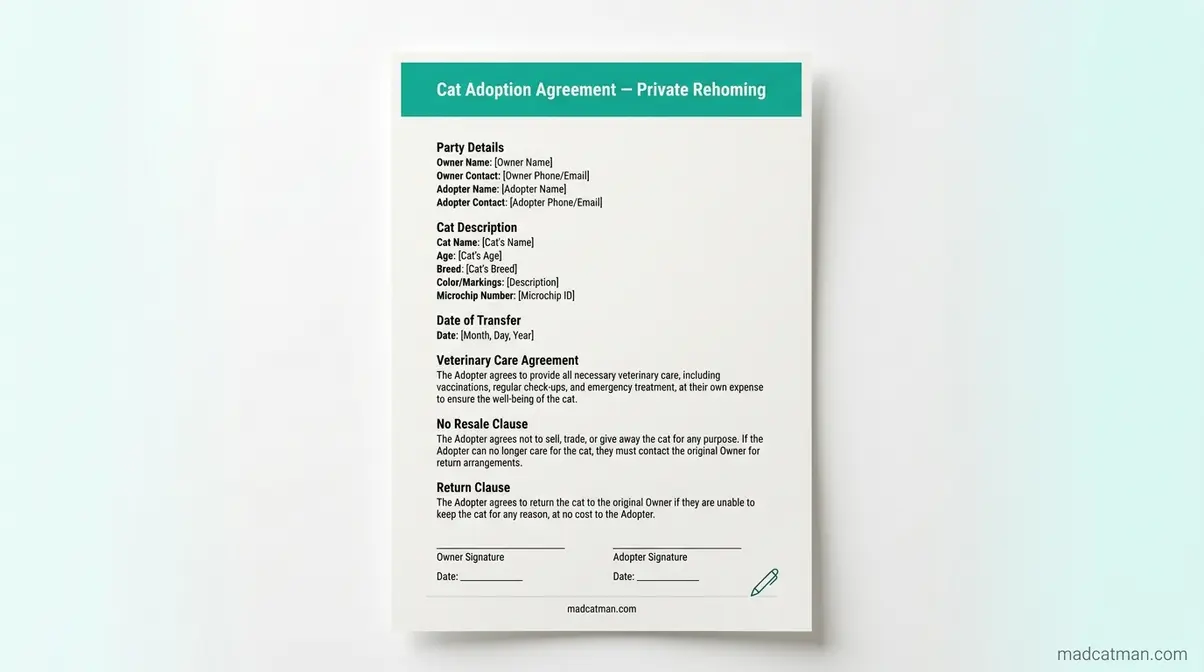
Both parties should sign and keep a copy. The SAFE Rehoming Method’s Facilitate pillar is complete when the handover kit is packed, the agreement is signed, and the new owner has your number saved in their phone.
Step 7: Help Your Cat Adjust — The 3-3-3 Rule
Your responsibility does not end at the handover. Sharing the 3-3-3 Rule with the new owner is one of the most valuable things you can do for your cat’s long-term wellbeing.
The 3-3-3 Rule Explained
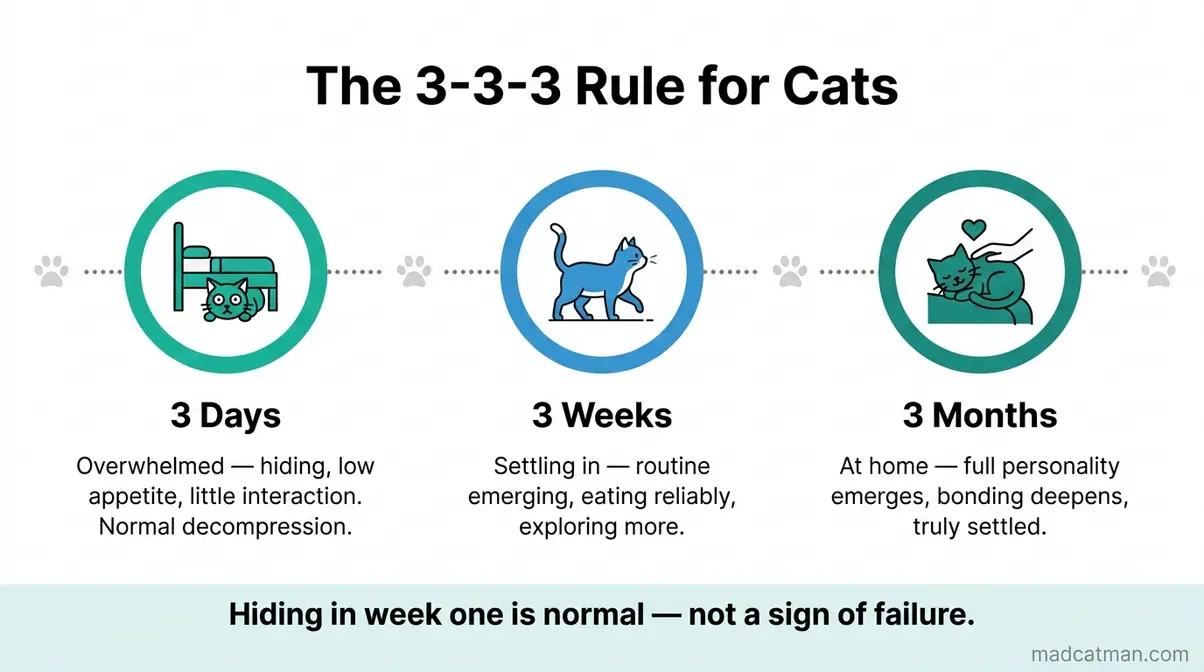
The 3-3-3 Rule is a widely used framework from humane societies that describes the typical adjustment timeline for a cat entering a new home — Rule of Three adjustment guide (Give Shelter, 2026):
- First 3 days: The cat is overwhelmed and disoriented. Expect hiding, refusing food, and little interaction. This is normal decompression — do not force contact.
- First 3 weeks: The cat begins to understand the routine. They will explore more, start eating reliably, and show glimpses of their real personality.
- First 3 months: The cat feels genuinely at home. Their full personality emerges, they seek affection on their own terms, and bonding with the new owner deepens.
The 3-3-3 Rule means that a cat hiding under a bed in week one is not a sign the placement failed — it is a sign the cat is processing a major life change exactly as expected.
New owners who understand this timeline are far less likely to panic, give the cat away again, or contact you in distress after the first week.
Do Cats Get Upset Being Rehomed?
Yes — cats do experience stress when rehomed, and the adjustment period is real. Cats are territorial animals with strong attachments to familiar environments and routines. Common signs of stress include hiding, reduced appetite, excessive vocalization, and litter box avoidance in the first days or weeks. However, most cats adapt fully within 1–3 months. A thoughtful handover kit with familiar scents, a gradual introduction to the new space, and a patient new owner dramatically reduce the severity and duration of this stress.
Tips to Help New Owners
Share these instructions with the adopter at handover:
- Start with one room. Confine the cat to a single quiet room for the first few days with litter box, food, water, and a hiding spot. Expand access gradually.
- Keep the litter brand consistent for at least the first month, then transition slowly if they want to change it.
- Do not force interaction. Let the cat approach on their own timeline. Crouching low and averting eye contact is less threatening than leaning over the cat.
- Maintain a quiet environment for the first week — no loud parties, no unfamiliar visitors.
- Check in after 3 days, 3 weeks, and 3 months. A simple text costs nothing and gives the new owner support when they need it most.
For more detailed guidance, share our top tips on how to introduce a cat to a new home with the adopter. The SAFE Rehoming Method’s Ensure pillar is complete when the new owner has this guide in hand and knows you are available for questions.
Rehoming Cats with Special Circumstances
Some cats face additional challenges in the rehoming process. Understanding these circumstances helps you set realistic expectations and find the right placement.
Cats with Behavioral Problems
A cat with a history of litter box avoidance, aggression, or anxiety is harder to place — but not impossible. Transparency is essential: disclose the issue clearly in your profile, describe what triggers it, and explain what you have tried. Many experienced cat owners actively seek cats with behavioral histories because they understand the context and have the patience to work through it.
If the behavior is aggression toward other cats due to not getting along in a multi-cat home, reviewing real owner case studies on cat aggression can help you determine if the issue is manageable or if the solution may simply be a single-cat household. Frame the listing accordingly: “Needs to be the only cat — thrives with solo attention.”
Rehoming a Senior Cat
Senior cats — generally 10 years and older — are statistically among the hardest to rehome, largely because of assumptions about health costs and shorter lifespans. Counter this by being specific about your cat’s current health status. A 12-year-old cat in good health with no chronic conditions is a very different prospect from one with ongoing medical needs. For older cats showing signs of confusion or behavioral changes, understanding feline cognitive decline is crucial before making a rehoming decision.
Target your search toward adopters who specifically want a calmer, lower-energy companion — empty nesters, retirees, and remote workers often prefer senior cats. Many senior-cat-specific rescue organizations can help place older cats with experienced adopters if private rehoming stalls.
Rehoming a Stray or Feral Cat
A stray cat — one that was previously socialized but has been living outdoors — can often be rehomed with patience and a quiet environment. A feral cat — one that has had minimal human contact — is a different situation entirely. True feral cats are rarely suitable for indoor rehoming and are typically best served by a TNR (Trap-Neuter-Return) program, where the cat is neutered, vaccinated, and returned to a managed outdoor colony.
Contact your local animal control or a TNR-focused rescue group if you are dealing with a genuinely feral cat. Attempting to rehome a feral cat as an indoor companion typically causes significant distress for the cat and frustration for the adopter.
Understanding Rehoming Costs and Fees
Rehoming is not free — for you or for the adopter. Understanding the costs involved helps you plan and set appropriate expectations.
Shelter Surrender Costs
Shelter surrender fees vary significantly by location and organization. Based on current data from U.S. shelters, typical surrender fees range from $10–$150 for cats, with some private no-kill shelters charging up to $500 per animal (as of 2026 — check your local shelter directly, as fees change frequently). Some municipal shelters offer free surrender by appointment.
| Surrender Type | Typical Fee Range | Notes |
|---|---|---|
| Municipal shelter | $0–$50 | Free with appointment at some locations |
| Humane society / SPCA | $25–$150 | Varies by organization and region |
| Private no-kill shelter | $100–$500 | Higher fees reflect limited capacity |
| Rescue organization | Often free | May have waitlists; intake by assessment |
Note that surrender fees do not guarantee outcome. Open-intake shelters — those that accept all animals — may euthanize cats if they run out of space, particularly those with behavioral issues or health problems. This is why private rehoming, when done responsibly, is often the more humane first step.
Private Adoption Fees
Yes — and the amount matters less than the fact that one exists. A rehoming fee of $25–$75 is standard for private cat placements. Some owners charge $100–$150 for kittens or purebred cats. The fee signals value, creates commitment, and filters out impulse adopters.
If a genuinely suitable adopter cannot afford even a modest fee, use your judgment — but do not waive the adoption agreement in exchange. The paperwork matters more than the money.
Common Mistakes and Risks When Rehoming a Cat
Common Rehoming Pitfalls
Skipping the vet check. Placing a cat with an undiagnosed condition is unfair to the adopter and potentially harmful to the cat. Always get a health check first.
Being vague in the profile. “Sweet cat, good with everyone” tells an adopter nothing useful. Specific, honest descriptions find the right match faster and prevent failed placements.
Accepting the first respondent. Urgency is understandable, but taking the first person who replies — without screening — is one of the most common ways cats end up in unsafe situations.
Advertising as “free.” As covered in Step 5, free listings attract the wrong respondents. Always charge a fee.
Ghosting the adopter after handover. A brief check-in at three days, three weeks, and three months costs nothing and can prevent a second rehoming if the adopter hits a rough patch.
When Rehoming Isn’t the Answer
Occasionally, owners consider rehoming when the real problem is something else entirely. If your cat has suddenly changed behavior — aggression, litter box avoidance, withdrawal — a veterinary visit should happen before any rehoming decision. Sudden behavioral changes are frequently symptoms of pain, illness, or cognitive decline, not personality flaws.
Similarly, if the conflict is between two cats in the home, a structured reintroduction guided by a certified feline behaviorist may resolve the issue completely. Rehoming one cat from a bonded pair when the problem is fixable is a decision many owners later regret.
Limitations and When to Seek Help
Common Process Pitfalls
Even with the best intentions, rehoming does not always go smoothly. Three scenarios trip up owners most often:
- No responses to listings. If your profile is getting views but no inquiries, revisit the photos and description. Blurry images and vague personality descriptions are the most common culprits. Ask a friend to read the profile and give honest feedback.
- A placement that falls through. An adopter who seemed perfect may back out. This is disappointing but common. Keep 2–3 screened candidates warm at the same time rather than pausing your search for one person.
- Adopter contact after handover. If the new owner reaches out with concerns in the first few weeks, treat it as a positive sign — they care enough to ask. Walk them through the 3-3-3 Rule and offer practical advice before assuming the placement has failed.
When Rehoming Isn’t Right
Rehoming is not appropriate when the underlying issue is a treatable medical condition, a temporary financial hardship with available assistance programs, or a behavioral problem that a professional can resolve. Contact your veterinarian or a certified feline behaviorist before finalizing the decision. Many local humane societies also offer free behavioral hotlines that can identify solutions you may not have considered.
When to Seek Expert Help
Certain situations require professional guidance rather than a self-directed rehoming process:
- Your cat has bitten a person and broken skin — this is a legal matter in many jurisdictions; consult your vet and local animal control before rehoming
- You are dealing with more than 5 cats — a rescue organization with intake capacity is better equipped than a private rehoming effort
- Your cat has a serious medical condition — some rescues specialize in medically complex cats and have veterinary partnerships that can provide better ongoing care than a private adopter
Frequently Asked Questions
What is the 3-3-3 rule for cats?
The 3-3-3 Rule describes a cat’s typical adjustment timeline in a new home across three phases. In the first 3 days, the cat is overwhelmed — expect hiding and little appetite. Over the first 3 weeks, the cat begins to settle into the routine and explore more confidently. By 3 months, the cat feels genuinely at home and shows their full personality. According to the Rule of Three adjustment guide from Give Shelter, this timeline is consistent across most adult cats regardless of their history (Give Shelter, 2026).
What is the hardest cat to rehome?
Senior cats — typically 10 years and older — are statistically the hardest to rehome due to assumptions about health costs and lifespan, according to ASPCA adoption data. Black cats also face slower adoption rates due to longstanding superstitions, a pattern documented consistently by shelter data. Cats with behavioral histories (aggression, litter box issues) and those with chronic medical conditions also take longer to place. For any of these categories, targeting experienced adopters, breed-specific rescues, and senior-cat-focused organizations significantly improves placement outcomes.
How do cats say goodbye?
Cats do not process separation the way humans do, but they do show behavioral signs when their environment or relationships change. Some cats become more clingy or vocal in the days before a major change — this is likely a response to disrupted routines and owner stress rather than an awareness of the upcoming separation. After rehoming, some cats search familiar areas or show signs of mild depression. The best “goodbye” you can give your cat is a thoughtful handover: familiar scents, their favorite items, and a new owner briefed on the 3-3-3 Rule.
What breed of cat is the most clingy?
Siamese, Burmese, Ragdoll, and Devon Rex cats are consistently reported as the most attached to their owners among domestic breeds. These breeds tend to follow their owners from room to room, vocalize frequently, and show more visible signs of separation anxiety when rehomed. If you are rehoming a cat from one of these breeds, flag this in the profile and screen specifically for adopters who work from home or have flexible schedules — they are better equipped to meet a high-attachment cat’s social needs.
What is quidding in cats?
Quidding in cats refers to dropping partially chewed food from the mouth during eating — a sign of dental pain, mouth ulcers, or other oral health problems. It is named after the same behavior seen in horses with dental issues. If your cat is quidding, schedule a veterinary dental examination before rehoming. Disclosing an untreated dental condition without addressing it will deter adopters; a dental cleaning and treatment, on the other hand, makes your cat significantly more adoptable and ensures they are not in pain during the transition.
Conclusion
For any overwhelmed cat owner, knowing how to rehome a cat responsibly means the difference between a placement that lasts and one that fails. The SAFE Rehoming Method — Screen, Assess, Facilitate, Ensure — gives you a structured path through every stage, from the first difficult decision to the three-month check-in with the new owner. Done carefully, this process takes 2–6 weeks and produces outcomes that shelter surrender rarely can: a matched home, a signed agreement, and an ongoing connection that protects your cat long after the handover.
The SAFE Rehoming Method works because it treats rehoming as a process, not a transaction. Each pillar addresses a specific failure point — unscreened adopters, unprepared cats, rushed handovers, and abandoned transitions — so that nothing falls through the cracks. Your cat deserves that level of care, and so do you.
Start today by booking the vet appointment, downloading the profile template, and telling three people in your network that you are looking for a home. One conversation often leads to the right adopter faster than any platform. You made the hardest decision already — now follow the steps, trust the process, and give your cat the transition they deserve.

Dave King
Cat owner and writer at Mad Cat Man.