
⚠️ Medical Disclaimer: This guide is for informational purposes only and does not constitute veterinary advice. Always consult your veterinarian before starting, changing, or stopping any flea treatment programme for your cat.
🩺 Vet Reviewed: May 2026 | Reviewed by , DVM
If you are wondering exactly how often should I use flea treatment on cats, you are not alone. You applied Advantage II on schedule, then a week later found your cat still covered in fleas. Sound familiar? You did everything right — and it still feels like nothing is working. That frustration is one of the most common experiences cat owners share, and it has a specific cause that most flea guides never explain.
Here is the uncomfortable truth: 95% of a flea infestation lives in your carpets, furniture, and bedding — not on your cat (PDSA). That means every day without the right treatment schedule is another day those eggs are hatching and the cycle restarts. Knowing how often should I use flea treatment on cats is only the beginning — you also need to know which product, how to apply it, and how to treat your home at the same time.
This guide covers six clear steps: setting the right schedule, choosing the right product, applying it correctly, treating your home, recognising overdose risks, and troubleshooting when fleas keep coming back.
Quick Answer: Most cats need flea treatment applied once every 30 days, year-round. Spot-on treatments (like Advantage II) and oral pills both follow this monthly schedule. Flea collars last 4–8 months. Never apply treatment more often than the label states — overdose is a real risk. For kittens under 8 weeks, consult your vet before using any product.
Most cats need flea treatment once every 30 days, year-round — but the right schedule depends on your product type and your cat’s lifestyle. Knowing how often should I use flea treatment on cats is critical to preventing infestations.
- The 95% Problem: 95% of a flea infestation lives in your home, not on your cat — treat both simultaneously (PDSA)
- Monthly is standard for spot-on and oral treatments; flea collars last 4–8 months
- Never re-apply early: Applying treatment before 30 days risks overdose and toxicity
- Indoor cats need treatment too: Fleas enter homes on clothing, shoes, and other pets
- Kittens under 8 weeks require vet guidance before any flea product is used
What You’ll Need Before You Start
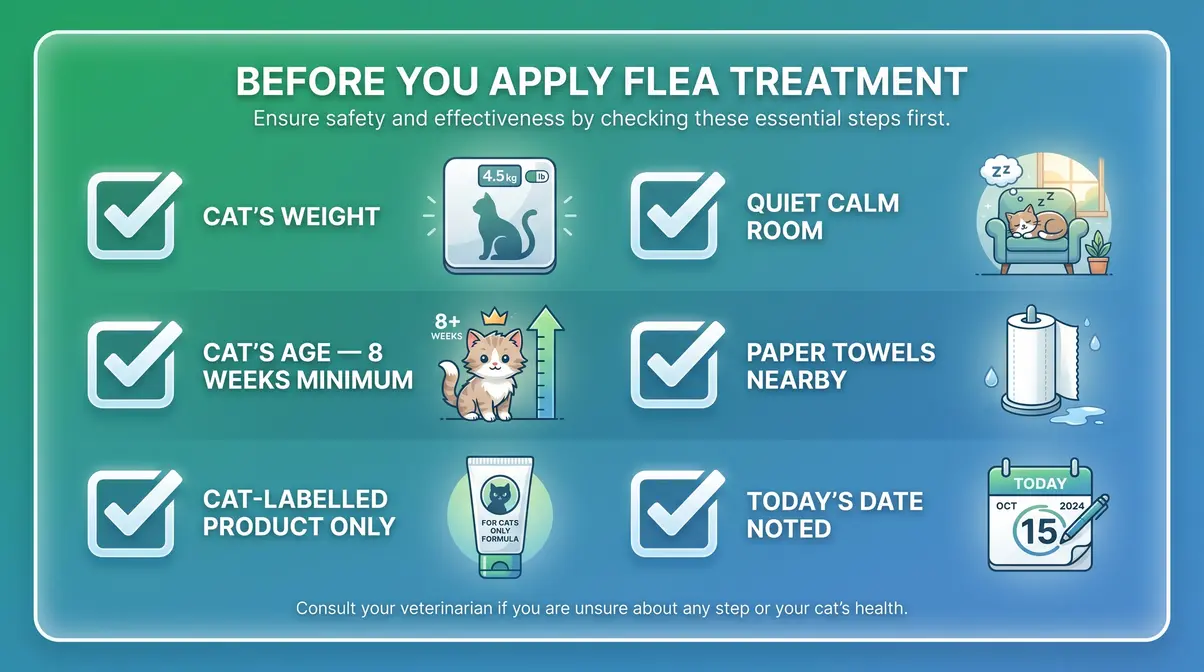
Before applying any flea product, gather these six things. Missing even one can make treatment ineffective — or dangerous.
- Your cat’s weight — Most flea products are dosed by weight. Using a dose too large for your cat’s size is one of the most common causes of adverse reactions. Weigh your cat on a bathroom scale if you are unsure.
- Your cat’s age — Kittens under 8 weeks old cannot safely use most flea treatments. Check the minimum age on the product label before purchasing.
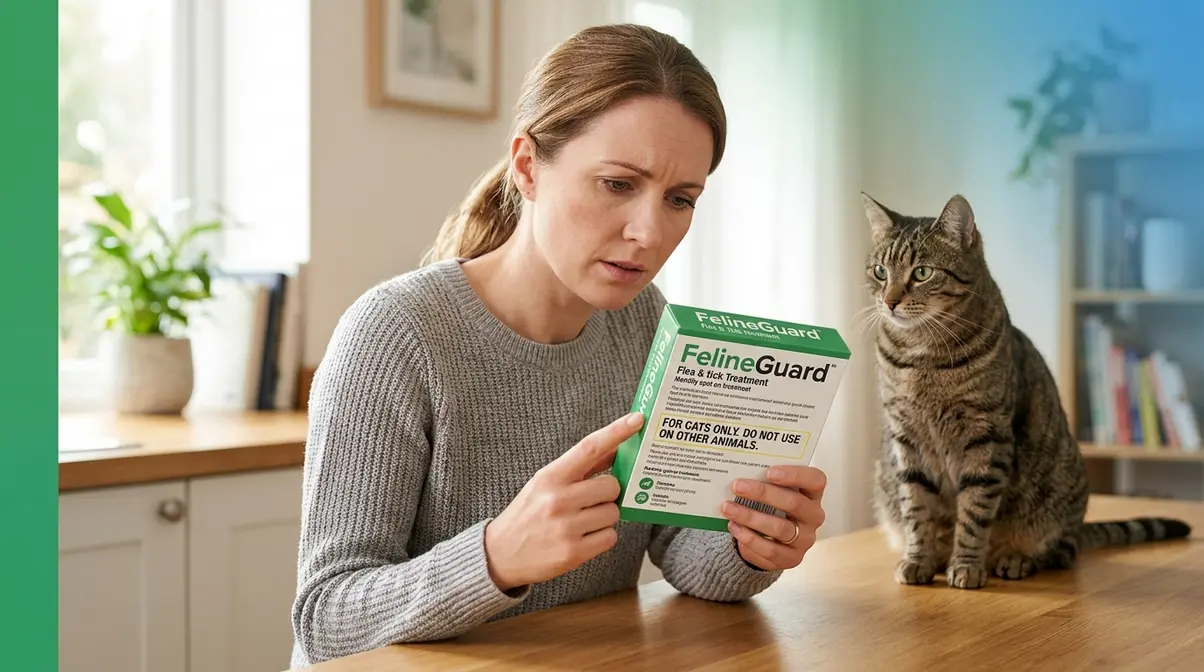
- A vet-recommended flea product labelled specifically for cats — Never use a product labelled for dogs. Dog flea treatments often contain permethrin (a chemical that is highly toxic to cats and can cause seizures or death, even in small amounts). The label must say “for cats.”
- A quiet room — Choose somewhere your cat feels calm and relaxed. A stressed cat will wriggle, making accurate application harder and increasing the chance of getting product on the wrong area.
- Paper towels — Keep a few nearby for any drips during spot-on application. Getting product on your hands and then touching your cat’s face can cause irritation.
- A note of today’s date — Write it down or set a phone reminder for exactly 30 days from now. This is your next application date.
Once you have these ready, follow the six steps below.
Step 1: Set a Monthly Flea Treatment Schedule
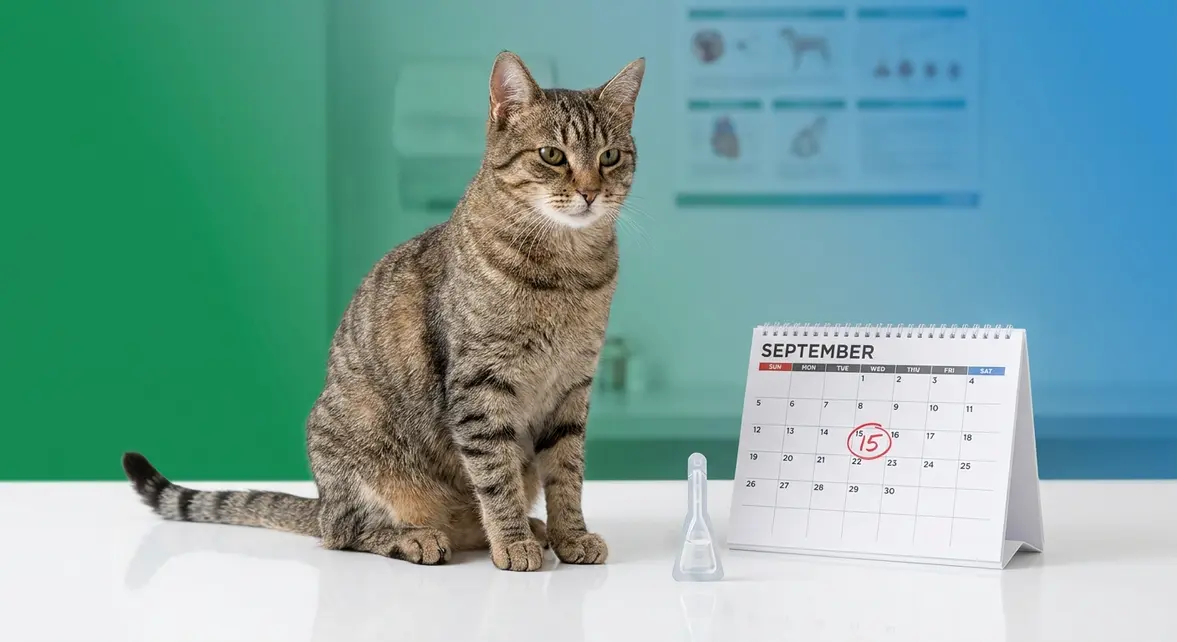
Most cats need flea treatment once every 30 days, year-round. Cornell University College of Veterinary Medicine confirms that consistent flea management — not seasonal treatment — is the most effective approach. For a complete breakdown of how often to apply flea treatment, remember that consistency is key. Skipping even one month allows flea eggs already in your home to hatch and restart the entire infestation cycle.
This step gives you a product-specific frequency matrix — data that is absent from most flea guides — so you know exactly when to treat, regardless of which product you choose.
How Often Should You Use Flea Treatment on Cats?
Most cats need flea treatment applied once every 30 days. That “monthly” interval means every 30 days from the date of application — not the first of each month, not “roughly once a month.” If you applied treatment on 10 November, your next date is 10 December. Set a phone reminder now.
Vet consensus across PetMD, VCA Hospitals, and Cornell confirms that year-round treatment is preferable to seasonal treatment. The reason is simple: indoor heating keeps your home warm enough for flea eggs to remain viable throughout winter. A flea’s life cycle can be as short as 12 days in warm conditions (Itch Pet, 2026) — meaning a single missed dose gives an infestation a two-week head start.
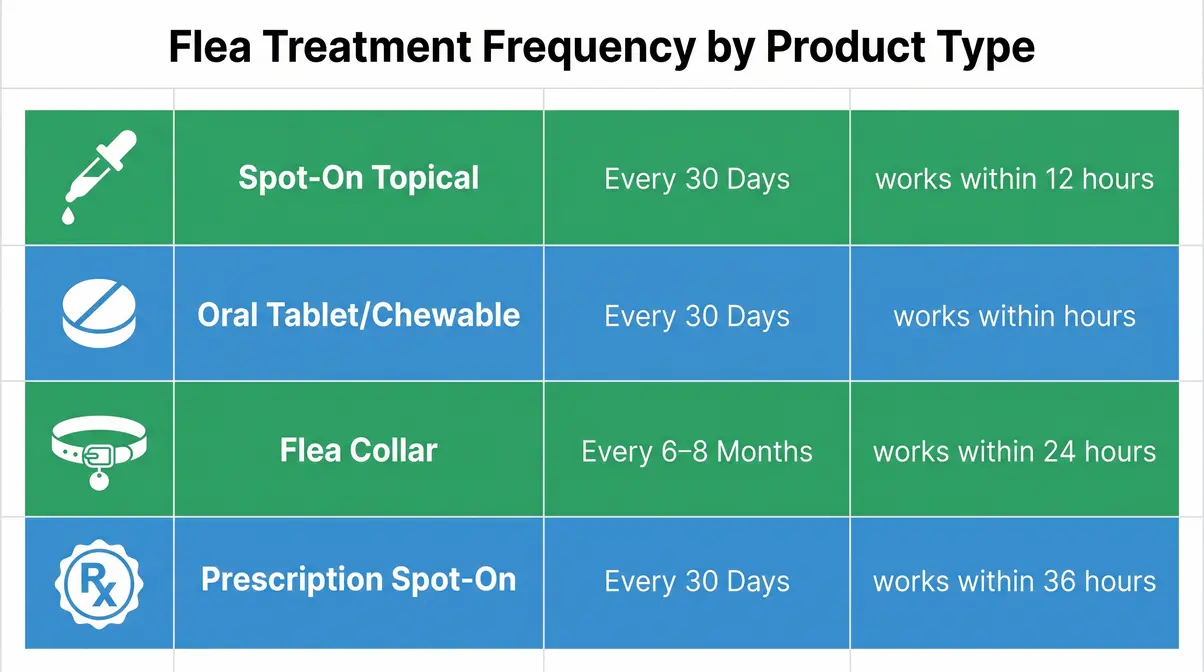
Flea Treatment Frequency by Product Type
Different products work differently. The table below shows the vet-approved application intervals for each major product type:
| Product Type | Example Product | Application Interval | Starts Working | Notes |
|---|---|---|---|---|
| Spot-on (topical) | Advantage II | Every 30 days | Within 12 hours | Apply to skin at base of skull |
| Oral tablet/chewable | Program | Every 30 days | Within hours | Prevents egg hatching; combine with adulticide |
| Flea collar | Seresto | Every 6–8 months | Within 24 hours | Kills new fleas within 2 hours after initial period |
| Prescription spot-on | Revolution (selamectin) | Every 30 days | Within 36 hours | Also treats ear mites and heartworm |
Why this matters: Applying a spot-on treatment more than once every 30 days does not give better protection — it significantly increases the risk of toxicity. The product is designed to work over a full 30-day period. More is not better here.
Also remember The 95% Problem briefly: even perfect monthly treatment of your cat addresses only 5% of the flea population. Steps 1–3 cover your cat; Step 4 covers the other 95%.
Do You Need Year-Round Flea Treatment?
Yes — for most cats, year-round treatment is the vet-recommended approach. Fleas peak between July and August in most regions, with a secondary “fall flea surge” in September and October where flea counts on animals can be 70% higher than in spring (Dr. Michael Dryden, Kansas State University, via Revival Animal Health). However, indoor heating means flea eggs can survive in your home through winter even when outdoor temperatures drop below freezing.
The worst months for fleas are July, August, and October. But “seasonal treatment” that stops in November leaves your home vulnerable to eggs that hatched indoors during the cold months. Year-round monthly preventative treatment closes that gap.
Adjusted Schedules for Special Cases
Kittens under 8 weeks: No standard flea product is safe for very young kittens. Consult your vet — they may recommend a gentle bath with warm water and a fine-toothed flea comb as a temporary measure. Products like Advantage II are labelled for cats 8 weeks and older.
Indoor-only cats: Many owners believe indoor cats do not need flea treatment. This is one of the most common misconceptions we see. Fleas enter homes on your clothing, shoes, bags, and on visiting pets. Indoor cats absolutely need a monthly preventative — the risk is lower, but it is not zero.
Multi-pet homes: Treat all cats and dogs on the same day. If one pet is untreated, it becomes a reservoir that re-infests your treated cats within days.
Step 2: Choose the Right Flea Treatment for Your Cat
The right product for your cat depends on their age, weight, lifestyle, and how severe the current infestation is. VCA Animal Hospitals recommends discussing product choice with your vet, particularly for cats with health conditions or kittens. Understanding the options and choosing the right flea medication is critical. Here is a practical breakdown of each type.
Spot-On Treatments (Topicals)
Spot-on treatments are liquid products applied directly to the skin, usually at the base of the skull where your cat cannot lick them off. Advantage II is one of the most widely used examples — it kills adult fleas through contact (no biting required) within 12 hours of application and remains effective for 30 days (Elanco, 2026).
Spot-ons are the most popular choice for a reason: they are straightforward to apply, fast-acting, and do not require your cat to swallow anything. They work best as part of a consistent monthly preventative routine rather than a reactive “I’ve already seen fleas” treatment. For active infestations, expect to treat for at least 3 consecutive months while addressing your home environment.
Best for: Most adult cats and kittens over 8 weeks. Good for cats that resist tablets.
Oral Flea Treatments (Pills and Chewables)
Oral flea treatments (tablets or chewables) work systemically — your cat ingests the medication, and it enters the bloodstream. When a flea bites, it receives a lethal dose of the active ingredient. Program, for example, contains lufenuron (a chemical that prevents flea eggs from hatching) and is given monthly.
Oral treatments are particularly useful for cats that groom excessively, as topical products can be removed before they fully absorb. Some oral treatments also provide broader parasite coverage. The limitation is that some cats are difficult to pill — always confirm with your vet that the specific product is safe for your cat’s weight and health status.
Best for: Cats that resist topical application or have sensitive skin. Always confirm suitability with your vet.
Flea Collars
Flea collars like Seresto release active ingredients continuously over the skin and coat. The Seresto collar for cats provides protection for up to 8 months, kills existing fleas within 24 hours, and kills new fleas within 2 hours after the initial protection period is established (Askavet, 2026).
Collars are a low-maintenance option for owners who find monthly spot-on applications difficult. However, they must fit correctly — you should be able to fit two fingers between the collar and your cat’s neck. A collar that is too tight can cause skin irritation; one that is too loose will not deliver adequate protection.
Best for: Cats that tolerate wearing a collar comfortably. Not suitable for very young kittens — check the minimum age on the specific product label.
What to Avoid: Powders, Sprays, and Natural Remedies
Some products sold in pet shops — flea powders, herbal sprays, and “natural” essential oil remedies — carry real risks for cats. Many essential oils, including tea tree oil and eucalyptus, are toxic to cats even in small concentrations. Flea powders can be inhaled, causing respiratory irritation.
More importantly, ineffective treatments waste time. Every week a product fails to work is another week the flea population in your home grows. Stick to vet-approved products with proven active ingredients, and always verify that the product is specifically labelled for cats before purchasing.
Step 3: Apply the Treatment Correctly
Incorrect application is the number one reason spot-on treatments fail. Blue Cross guidance on application technique notes that product applied to fur instead of skin, or applied too far down the back, dramatically reduces effectiveness. Follow these steps precisely.
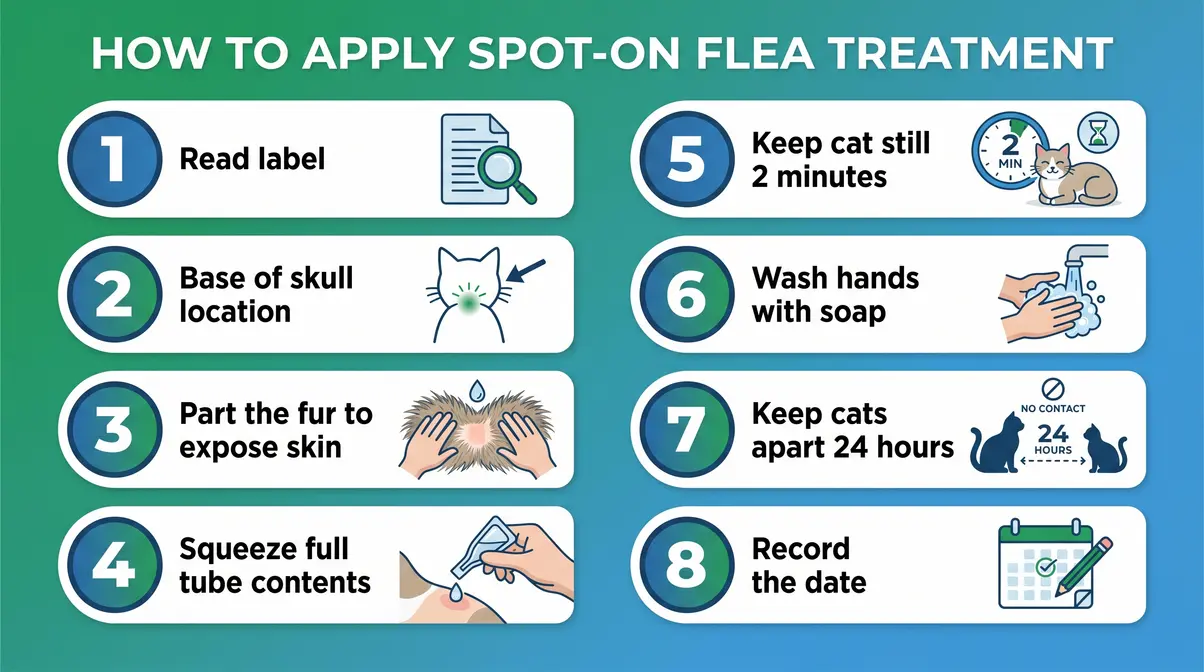
How to Apply a Spot-On Treatment (Step-by-Step)
You’ll need: Your cat’s flea treatment (cat-specific), paper towels, and approximately 5 minutes.
- Read the label first. Confirm the correct dose for your cat’s weight. Using a dose intended for a larger cat is a common cause of adverse reactions.
- Choose your location. Apply at the base of the skull — the spot where the neck meets the head. This is the one area your cat cannot reach to lick off the product. Do not apply between the shoulder blades; that placement is for dogs.
- Part the fur firmly. Use your fingers to separate the hair until you can see bare skin. The product must contact skin directly — applying to fur reduces absorption significantly.
- Squeeze the applicator fully. Apply the entire contents of the tube in one spot. Do not split the dose across multiple locations.
- Keep your cat still for 2 minutes. Let the product begin to absorb before your cat shakes or moves away. Gently hold them if needed.
- Wash your hands immediately. Use soap and water to remove any product from your skin.
- Keep cats apart for 24 hours if you have multiple pets. A freshly treated cat can transfer wet product to another animal through grooming.
- Record the date. Note when you applied the treatment so you know exactly when the next application is due — 30 days from today.
Estimated time: 5 minutes per cat.
Checkpoint: Signs the Treatment Is Working
After applying treatment, you may actually see more flea activity in the first 24–48 hours. This is normal. As the active ingredient spreads across your cat’s coat, it irritates fleas and causes them to move to the surface before dying. This is a sign the product is working — not failing.
- Signs treatment is working (within 24–72 hours):
- Fleas moving to the tips of the fur and falling off
- Reduced scratching after 48 hours
- Fewer fleas visible on a fine-toothed comb
- Signs treatment may not be working (after 7+ days):
- Continued heavy scratching and biting
- Live fleas still visible in large numbers
- Flea dirt (small black specks) still increasing
If you are still seeing significant flea activity after 7 days, do not re-apply the treatment early. Instead, move to Step 6 (Troubleshooting) and assess whether your home environment has been treated.
Step 4: Treat Your Home to Break the Flea Life Cycle
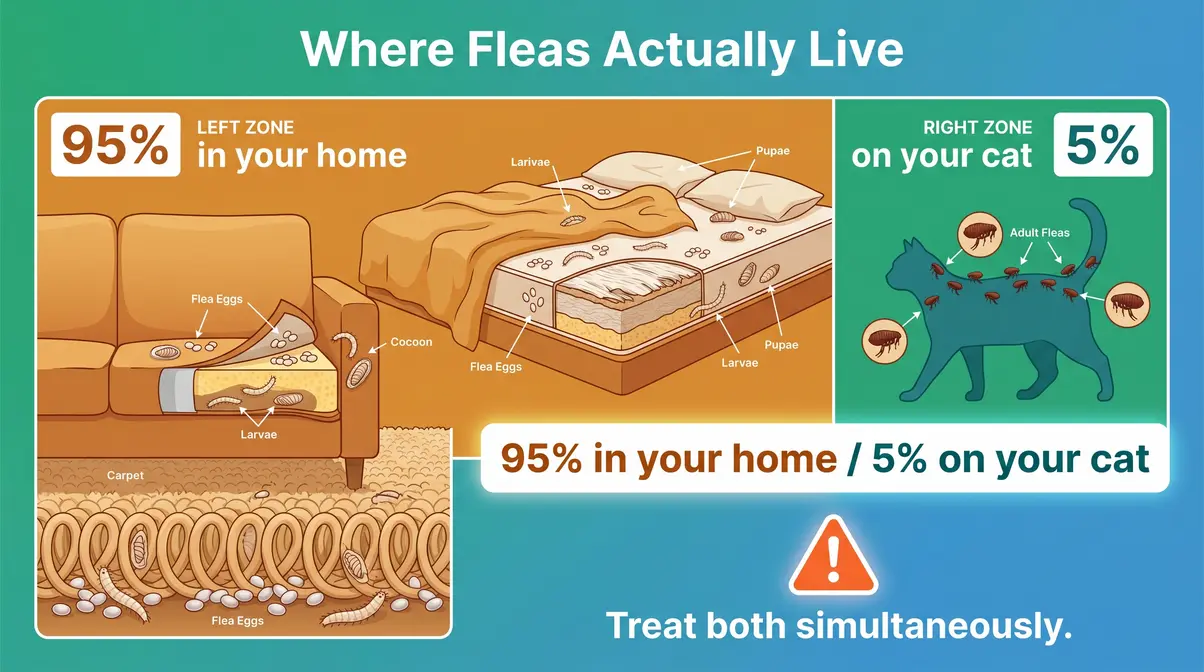
Treating your cat without treating your home is like bailing out a boat without plugging the hole. According to PDSA, 95% of a flea infestation lives in the home environment — meaning if your cat has 50 fleas on them, your home likely contains up to 1,000 fleas and eggs that can survive for up to a year. Learning how to remove fleas from your home is just as important as treating your pet.
Why 95% of the Problem Lives in Your Home
This is The 95% Problem — the core reason most flea treatments appear to “fail” when applied to cats alone. Flea eggs are not sticky. They fall off your cat within minutes of being laid and settle into carpet fibres, sofa cushions, bedding, and floor cracks where they develop through larval and pupal stages over days or weeks. The adult fleas you see on your cat represent just 5% of the total population. The other 95% — eggs, larvae, and pupae — are in your home right now, waiting to hatch.
The 95% Problem means: You must treat your cat and your home simultaneously. Treating one without the other prolongs the infestation by weeks or months and creates the frustrating “still seeing fleas after treatment” experience that many cat owners report.
Room-by-Room Home Treatment Checklist
Work through every room in this order. Focus on areas where your cat sleeps and spends time — those are the highest-density flea zones.
- Vacuuming (every 2–3 days for 3–6 months):
- [ ] All carpets and rugs — including edges and under furniture
- [ ] Sofa cushions, under cushions, and between sofa seams
- [ ] Hard floors, skirting boards, and floor cracks
- [ ] Under beds and inside wardrobes if your cat accesses them
- [ ] Stairs — each step individually
Empty the vacuum bag or canister into an outdoor bin immediately after each session. Flea pupae can survive inside a vacuum.
- Washing (hot cycle, 60°C / 140°F or above):
- [ ] Your cat’s bedding and blankets — weekly
- [ ] Your own bedding if your cat sleeps on it
- [ ] Any fabric toys or soft items your cat uses regularly
- Environmental spray (cat-safe household flea spray):
- [ ] Spray all carpeted areas, soft furnishings, and under furniture
- [ ] Allow to dry completely before letting your cat back into the room
- [ ] Repeat after 2 weeks to catch any eggs that hatched after the first treatment
Do Fleas Live in Litter Boxes?
Yes — fleas and their eggs can accumulate in and around litter boxes. Because your cat spends time in the litter box daily, flea eggs drop off and can develop in the surrounding area, particularly if the box is in a warm, sheltered location. Flea larvae are attracted to dark, undisturbed spaces, making the area around a litter box a potential development site.
- What to do:
- Scoop the litter box daily during an active infestation
- Replace the litter completely once a week and disinfect the box with hot water (not chemical sprays — residue can harm your cat)
- Vacuum the floor area around the litter box as part of your regular flea vacuuming routine
- Do not spray household flea products directly inside the litter box
Step 5: Recognise and Prevent Overdose and Toxicity
Flea treatment toxicity is a genuine medical emergency. MedVet confirms that applying too much flea product, using the wrong product, or using a dog product on a cat can all cause serious toxic reactions. When you compare topical flea treatments, always check the active ingredients. This section covers the warning signs, the specific danger of permethrin, and what to do if your cat has a reaction.
Signs of Flea Treatment Overdose in Cats
Overdose symptoms can appear within minutes to 72 hours of application, depending on the product and the amount absorbed. According to ASPCA Poison Control data, clinical signs can develop within hours or be delayed up to 72 hours after exposure.
Watch for these signs after any flea treatment application:
- Excessive drooling or foaming at the mouth
- Muscle tremors, twitching, or fasciculations (rapid, involuntary muscle movements)
- Seizures or convulsions
- Dilated pupils
- Vomiting or diarrhoea
- Loss of coordination or stumbling
- Lethargy or unusual unresponsiveness
- Elevated body temperature
- Panting or laboured breathing
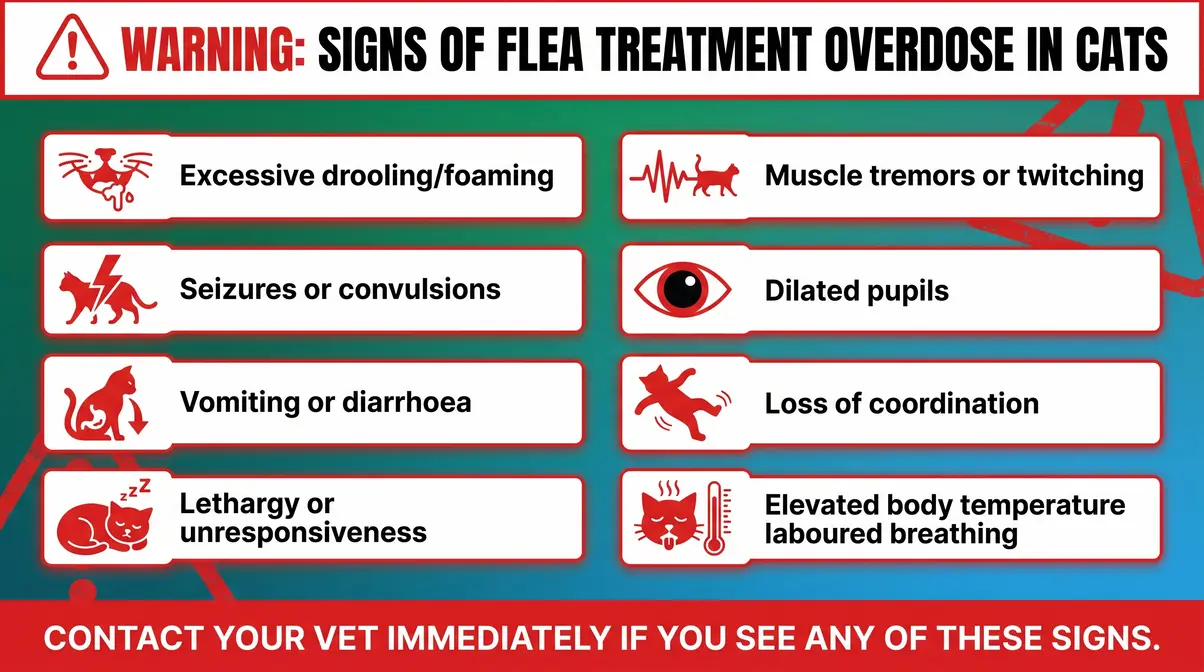
If you observe any of these signs, contact your vet or an animal poison control line immediately. Do not wait to see if symptoms improve on their own.
Can You Use Too Much Flea Treatment on a Cat?
Yes — over-applying flea treatment is dangerous and can cause serious toxicity. Applying more than the recommended dose, applying too frequently, or using a product meant for a larger cat can all cause overdose symptoms including tremors, drooling, seizures, and in severe cases, death (MedVet, 2026). Never apply treatment more often than the product label states. If you believe you have applied too much, wash the area with warm water and mild soap immediately and contact your vet or ASPCA Animal Poison Control (888-426-4435 in the US).
The Permethrin Danger: Never Use Dog Products on Cats
Permethrin is a synthetic insecticide used in many dog flea and tick products. It is extremely effective for dogs — and extremely dangerous for cats. Cats lack the liver enzymes needed to metabolise permethrin, meaning even a small amount causes the nervous system to become hyperexcited, leading to tremors, seizures, and, without rapid treatment, death (International Cat Care, 2026).
Permethrin toxicity is not rare. It is one of the most commonly reported feline poisoning cases in veterinary emergency settings, and it most often occurs when a well-meaning owner accidentally applies a dog product to their cat, or when a treated dog grooms or sleeps next to a cat within 24–72 hours of application.
- Three rules to prevent permethrin toxicity:
- Always read the label. If it says “for dogs only” — it is for dogs only.
- Keep cats away from recently treated dogs for at least 24–72 hours, or until the product has fully dried and absorbed.
- Store dog and cat treatments separately to prevent accidental mix-ups.
Emergency Steps If Your Cat Has a Reaction
If you suspect flea treatment toxicity, act immediately — do not wait for symptoms to worsen.
- Call your vet or emergency animal hospital now. Have the product name, active ingredients, and the amount applied ready to describe.
- If the product is still wet on the skin, wash it off immediately with warm water and a gentle dish soap (like Dawn/Fairy). Rinse thoroughly. This can reduce the total amount absorbed.
- Do not induce vomiting unless specifically instructed to do so by a vet.
- Keep your cat warm and calm while transporting them to the vet.
- Bring the product packaging to the vet so they can identify the exact active ingredients and treat accordingly.
UK: Contact the Animal Poison Line: 01202 509 000
US: Contact ASPCA Animal Poison Control: (888) 426-4435
Early veterinary treatment significantly improves outcomes. Permethrin toxicity is treatable when caught quickly — but it is life-threatening if left untreated.
Step 6: Troubleshoot When Fleas Keep Coming Back
Still seeing fleas two weeks after treatment? You are not alone. This is the most common frustration among cat owners, and it almost always has a fixable cause.
Why Your Cat Still Has Fleas After Treatment
One cat owner described their experience this way:
“I got Advantage II and applied it to both of my cats on Nov. 10th. I just brushed my one cat and he was still covered in fleas. The Advantage box says…”
This scenario plays out for one of five reasons:
1. The home was not treated simultaneously. This is the most common cause by far. Remember The 95% Problem: the fleas you are seeing on your cat are newly hatched adults emerging from your carpet — not survivors of the treatment. The product worked; the environment is re-infesting your cat.
2. The product was applied to fur, not skin. Spot-on treatments must contact skin to absorb. If the product sat on the fur and your cat groomed it off, little to none was absorbed.
3. The 30-day interval was not consistent. Missing a dose by even a few days creates a gap. Flea larvae in the home can mature into biting adults in under two weeks.
4. Not all pets in the home were treated. An untreated dog or second cat acts as a continuous flea host, maintaining the population regardless of how well your treated cat is covered.
5. The product has expired or been stored incorrectly. Check the expiry date and ensure the product was stored away from heat and direct sunlight.
Our editorial team’s review of common flea treatment failures across veterinary forums found that the overwhelming majority of “treatment isn’t working” cases involved an untreated home environment — not a product failure.
How to 100% Get Rid of Fleas on Cats?
Complete flea eradication requires treating your cat and your home simultaneously for 3–6 months. Apply a vet-approved spot-on or oral treatment to all pets on the same day, wash all pet bedding on a hot cycle, vacuum every 2–3 days, and apply a cat-safe household flea spray to all carpeted areas. The 95% Problem means that treating only your cat addresses just 5% of the infestation — the remainder lives in your home. Consistent combined treatment for at least 3 months is required to break the full flea life cycle.
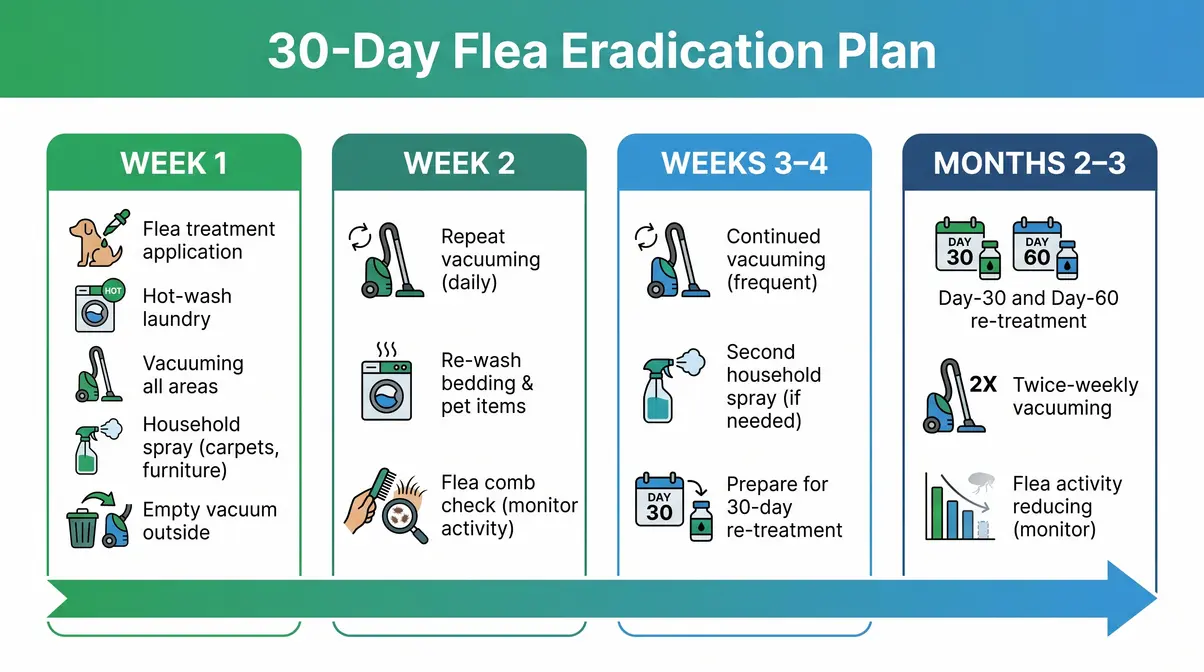
Your 30-Day Flea Eradication Checklist
Consistent action across 3–6 months is required to fully break the flea life cycle. Use this checklist:
- Week 1:
- [ ] Apply vet-approved flea treatment to all cats (and dogs) in the home on the same day
- [ ] Wash all pet bedding on a hot cycle (60°C / 140°F)
- [ ] Vacuum all carpets, rugs, and soft furnishings thoroughly
- [ ] Apply a cat-safe household flea spray to all carpeted areas
- [ ] Empty the vacuum outside immediately
- Week 2:
- [ ] Vacuum again — every 2–3 days
- [ ] Re-wash any bedding your cat has been sleeping on
- [ ] Check your cat with a fine-toothed comb — count the fleas found
- Week 3–4:
- [ ] Continue vacuuming every 2–3 days
- [ ] Apply a second round of household spray if flea activity persists
- [ ] Prepare for the 30-day re-application of spot-on treatment
- Month 2–3:
- [ ] Re-apply treatment to all pets on day 30 and day 60
- [ ] Continue vacuuming at least twice weekly
- [ ] Expect flea activity to reduce significantly by the end of month 2
After 3–6 months of consistent treatment — pets and home — the infestation should be fully resolved. If it is not, consult your vet for prescription-strength environmental treatments.
Verify Your Results
After 4–6 weeks of consistent treatment, check whether your programme is working:
Use the white sock test. Pull a white cotton sock over your hand and slowly drag it across carpeted areas and along skirting boards. Fleas and flea dirt will show up clearly against the white fabric. Do this in the rooms your cat uses most.
Use the fine-toothed comb test. Comb your cat over a white piece of paper. Black specks that turn red-brown when wet are flea dirt (digested blood) — a sign fleas are still present. Fewer specks week-on-week indicate progress.
What success looks like: No live fleas found during the sock test. No flea dirt on the white paper after combing. Your cat is scratching noticeably less. These signs typically appear 6–8 weeks into a consistent programme.
If you are still seeing significant flea activity at week 8 despite treating all pets and the full home environment, book a vet appointment. Your vet can recommend prescription-grade environmental treatments or investigate whether your cat has a flea allergy dermatitis (FAD), which causes extreme skin sensitivity even to very small numbers of fleas.
Risks, Limitations, and When to Call Your Vet
When to See Your Vet Instead of Treating at Home
Over-the-counter flea products are appropriate for most healthy adult cats. However, some situations require professional veterinary guidance before you treat:
- Your cat is under 8 weeks old. No standard OTC product is safe for very young kittens. A vet can recommend safe alternatives.
- Your cat is pregnant or nursing. Many active ingredients are not tested for safety in pregnant or lactating cats. Your vet can identify products with an appropriate safety profile.
- Your cat has a known health condition. Cats with kidney disease, liver disease, or neurological conditions may process flea treatment chemicals differently. Consult your vet before applying any new product.
- You have already seen signs of a reaction. If your cat has previously reacted badly to a flea product — even mild skin redness — do not retry the same product without veterinary advice.
- Fleas are not clearing after 3 months of consistent treatment. This may indicate a resistant strain, an environmental source outside the home (e.g., a garden or communal area), or a flea allergy requiring medical treatment.
Cats Who Should Not Use Standard Flea Treatments
Certain cats need individually tailored flea management plans:
- Kittens under 8 weeks: Require vet-directed treatment. A warm bath with a fine-toothed comb is the safest first step.
- Senior cats over 10 years: Their liver and kidneys process chemicals more slowly. Ask your vet for a senior-appropriate product.
- Cats on other medications: Some flea treatments interact with heart medications, steroids, or antiparasitic drugs. Always tell your vet all medications your cat is currently taking.
- Cats with flea allergy dermatitis (FAD): These cats react severely to even a single flea bite and need a prescription antiparasitic combined with steroid therapy in some cases.
For any of these categories, the guidance is the same: consult your vet before starting, changing, or stopping any flea treatment programme.
Frequently Asked Questions
Do cats really need monthly flea treatment?
Yes — most cats benefit from monthly flea treatment applied every 30 days, year-round. Indoor heating keeps flea eggs viable through winter, meaning seasonal treatment leaves a gap that allows infestations to restart. Vet consensus across Cornell, VCA, and PetMD supports year-round monthly prevention as the most effective strategy. A flea’s life cycle can be as short as 12 days in warm conditions (Itch Pet, 2026), so consistent monthly treatment prevents populations from rebuilding between doses. The exception is a vet who advises a different protocol for your specific cat.
How long should you wait between flea treatments for cats?
Wait exactly 30 days between flea treatments for spot-on and oral products. Applying treatment sooner than 30 days increases the risk of toxicity — more is not more effective. Flea collars like Seresto are designed to last 6–8 months and should not be replaced early unless the collar is lost, damaged, or becomes visibly depleted. If fleas are still visible within the 30-day window, the issue is almost always the home environment rather than the product wearing off. Treat your home, not your cat again.
How often are you supposed to treat cats for fleas?
For spot-on and oral treatments, every 30 days is the standard. For flea collars, every 6–8 months. For prescription products like Revolution (selamectin), follow your vet’s specific instructions — most are also monthly. The key is consistency: the same date each month, every month, for all pets in the household simultaneously. Missing one dose by more than a few days creates a gap wide enough for a new generation of fleas to emerge from your home environment and re-establish on your cat.
What’s the worst month for fleas?
July and August are typically the worst months for fleas due to consistently warm, humid conditions that accelerate the flea life cycle. However, research by Dr. Michael Dryden of Kansas State University found that the number of fleas on animals in autumn can be 70% higher than in spring — making September and October a significant secondary peak. In warmer climates (Southern US states, for example), fleas are active year-round. This is the primary reason vets recommend year-round monthly prevention rather than stopping treatment in winter.
What is the 3-3-3 rule of cats?
The 3-3-3 rule describes the adjustment timeline for a newly adopted cat: 3 days to decompress, 3 weeks to learn the household routine, and 3 months to feel truly at home. It is a behavioural guideline, not a medical one — but it is relevant to flea treatment because newly adopted cats should be assessed by a vet and treated for fleas before or immediately after entering your home. Rescue cats and shelter cats frequently carry fleas, and introducing an untreated new cat into a home with existing pets can trigger or restart an infestation.
Conclusion
For most cat owners, the answer to how often should I use flea treatment on cats is straightforward: once every 30 days, year-round, using a product labelled specifically for cats. Spot-on treatments like Advantage II and monthly oral treatments follow this 30-day interval; flea collars like Seresto provide 6–8 months of protection. The most important thing to remember is that flea treatment works only when your home is treated at the same time — 95% of a flea infestation lives in your environment, not on your cat. When asking how often should I use flea treatment on cats, remember that consistency is your best defense.
The 95% Problem is why so many cat owners feel defeated by fleas even after treating correctly. Treating your cat alone is never enough. A 3–6 month programme — consistent monthly treatment for all pets, combined with regular vacuuming, hot-washing of bedding, and a household flea spray — is what breaks the cycle for good. At madcatman.com, we consistently find that the owners who succeed are those who treat the home and the cat together from day one.
Start today. Apply treatment to all your cats on the same date, set a 30-day reminder on your phone, and work through the room-by-room home checklist in Step 4. If you have a kitten under 8 weeks, a pregnant cat, or a cat with health conditions, book a vet appointment before starting any new treatment programme — your vet can confirm the right product and interval for your specific situation.

Dave King
Cat owner and writer at Mad Cat Man.