
You’ve just heard about cat microchipping, or perhaps you received a database renewal notice and thought: “Is this really £18 a year just for basic info?” You’re not alone. Thousands of UK cat owners pay the upfront chipping fee without realising there are ongoing costs on top — and since the historic legislation passed on June 10, 2024, the stakes are higher than ever.
Since the historic legislation passed on June 10, 2024, it has been a legal requirement in England for every cat to be microchipped before they reach 20 weeks old. Owners who haven’t complied risk a fine of up to £500, according to UK Government guidelines on pet microchipping fines (GOV.UK, 2024).
This guide explains exactly how much it costs to microchip a cat in the UK, where to find free options, and how to stay legally compliant — including the ongoing database fees that most guides forget to mention. You’ll cover the law, the costs, finding a provider, the procedure itself, and how to keep your details up to date.
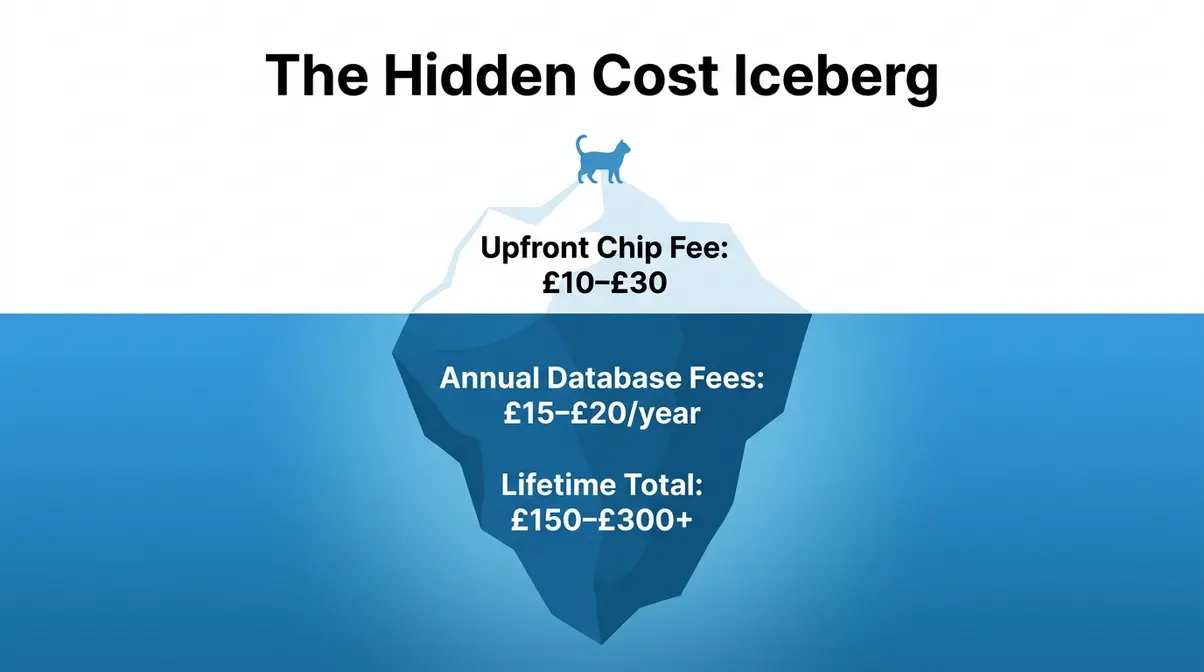
If you are wondering exactly how much does it cost to microchip a cat uk, the procedure typically ranges from £10–£30 at a vet or charity — but the real cost includes annual DEFRA database fees of around £18/year, a hidden expense most guides ignore (The Hidden Cost Iceberg).
- It’s the law: All cats in England must be chipped by 20 weeks or face a £500 fine (GOV.UK, 2024)
- Free options exist: Cats Protection, PDSA, and local charity drives offer free or subsidised chipping
- It’s not GPS: A microchip is a passive RFID tag — it cannot track your cat’s location
- It lasts a lifetime: Once implanted, the chip itself needs no replacement or renewal
Prerequisites: What You Need Before Microchipping
Microchipping is a quick process, but a little preparation makes it stress-free. Before you book an appointment, run through this short checklist.
Before your appointment, make sure you have:
- Your cat’s age confirmed — cats must be chipped before 20 weeks old under the Microchipping of Cats and Dogs Regulations 2023. If your cat is older and has never been chipped, you are already overdue — book as soon as possible.
- A provider booked — this could be your vet, a Cats Protection clinic, Pets at Home, or Vets4Pets (covered in Step 3).
- Payment ready — typical cost is £10–£30, though free options exist.
- Awareness that database registration is a separate step — the chip implant and the registration are two different actions. The chip does nothing until it is linked to your contact details on a DEFRA-approved database (covered in Step 5).
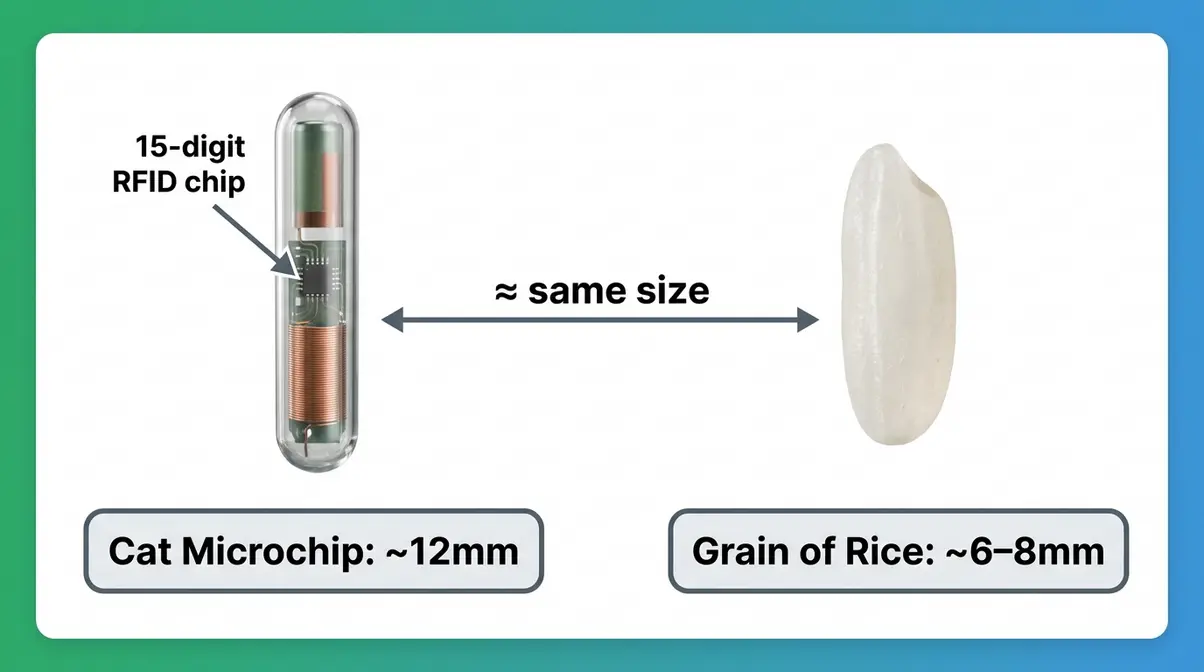
Think of a microchip as a permanent name tag hidden under the skin — about the size of a grain of rice, with no battery and no GPS. It stores a unique 15-digit ID number. A vet scanner reads that number and matches it to your contact details on a database. The whole process — from appointment to registration — takes less than 30 minutes.
Checkpoint: Confirm your cat’s age, choose a provider from Step 3, and remember that registration (Step 5) is a separate action after the appointment.
Now that you know what’s ahead, the first thing to confirm is whether your cat is legally required to be microchipped — and what happens if you’ve missed the deadline.
Step 1: Does Your Cat Legally Need a Microchip?
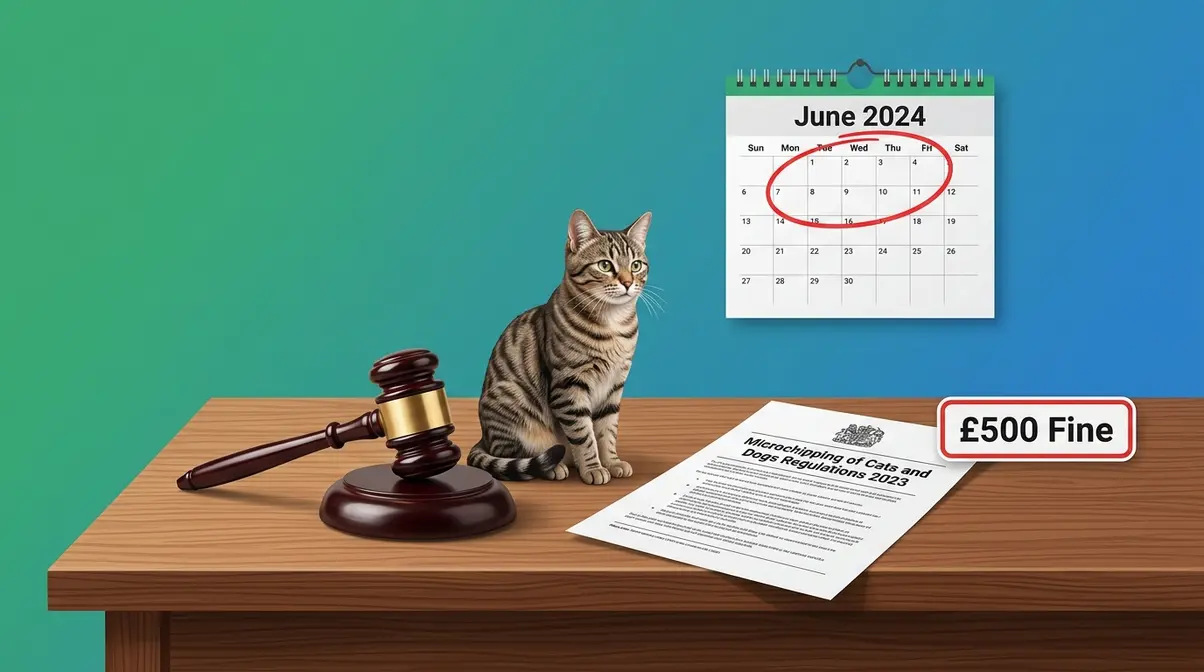
Ever since the rollout on June 10, 2024, microchipping is mandatory for all cats in England. The law applies to every cat over 20 weeks old, and the responsibility falls on the keeper — the legal term for the person responsible for the cat, which is usually the owner. If your cat is unchipped, you are already non-compliant and should act promptly.
Is Cat Microchipping Mandatory in the UK?
Yes — it is now the law in England. The Microchipping of Cats and Dogs (England) Regulations 2023 (a historical statute that remains in active enforcement today) came into force for cats historically on June 10, 2024. Every cat must be microchipped before it reaches 20 weeks of age.
If you have an adult cat that has never been chipped, the deadline has already passed for you. Get it done as soon as possible to avoid a fine. For example, if your kitten is currently 18 weeks old and unchipped, you have roughly two weeks to comply before you become legally non-compliant.
What about Scotland, Wales, and Northern Ireland? These nations have their own devolved legislation. At the time of writing, Scotland and Wales are consulting on similar mandatory requirements, but the historic 2024 law applies specifically to England. Always check with your local council or veterinary authority for the latest position in your nation.
What Happens If You Don’t Comply?
Failing to microchip your cat carries a real financial penalty. According to UK Government guidelines on pet microchipping fines (GOV.UK, 2024), owners who do not comply can be fined up to £500.
The process typically works like this: an enforcement officer (often from a local authority or rescue organisation) identifies an unchipped cat. The keeper is given a set period — usually 21 days — to get the cat chipped. If they fail to do so within that window, the fine can be issued.
Following the June 10, 2024 enforcement date, all cats in England must be microchipped before they turn 20 weeks old — failure to comply carries a fine of up to £500 (GOV.UK, 2024).
The fine is avoidable, and the chipping process itself costs far less than £500. For most owners, the sensible choice is clear. For a full breakdown of what the law means in practice, see our UK cat microchipping law guide.
Step 2: How Much Microchipping a Cat Costs
When asking how much does it cost to microchip a cat uk, the upfront cost is straightforward — but it’s only part of the picture. Understanding the total expense means looking at the full picture, including fees you won’t encounter until months or years after the appointment.
Standard Vet and Charity Prices
Vets across the UK typically charge between £10 and £30 for a microchipping appointment, according to the RSPCA’s microchipping guidance and PDSA pet health advice. The exact price depends on your location, your vet practice, and whether chipping is bundled with another service such as neutering. For a deeper dive into these initial fees, check our detailed cost breakdown for microchipping a cat.
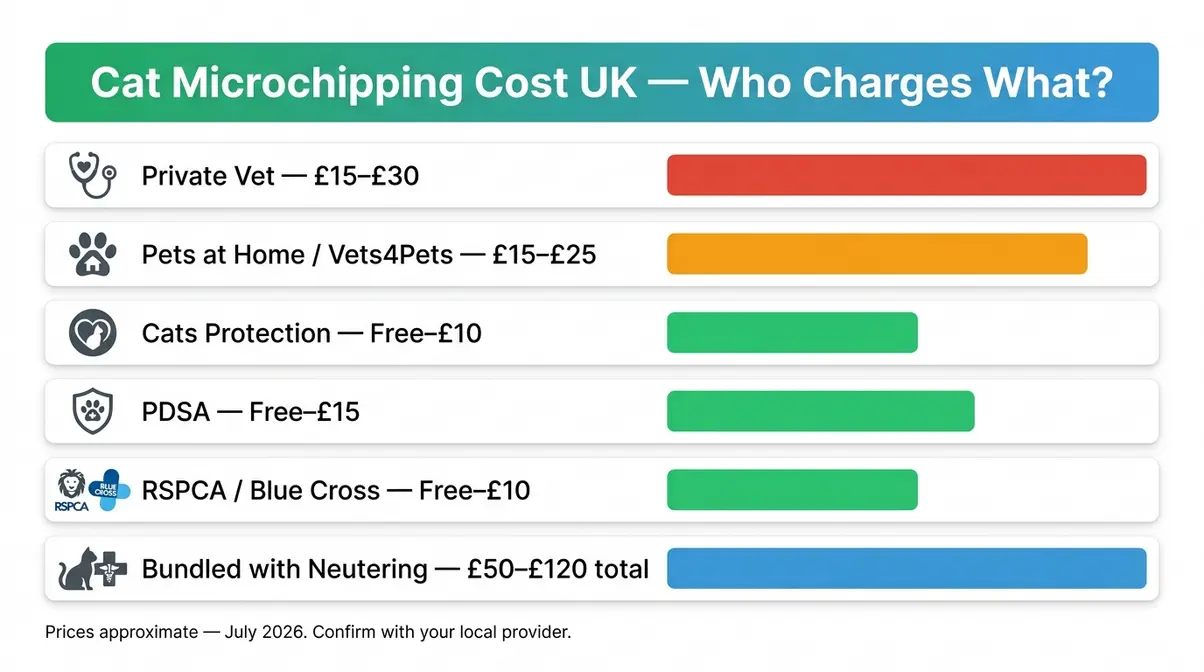
| Provider Type | Typical Cost | Notes |
|---|---|---|
| Private vet (standalone) | £15–£30 | Most common option; includes admin |
| Pets at Home / Vets4Pets | £15–£25 | Often runs promotions; check current pricing |
| Cats Protection | Free–£10 | Subject to eligibility; income-based |
| PDSA | Free–£15 | Must be registered with a PDSA PetAid hospital |
| RSPCA local branch | Free–£10 | Varies by branch; often during charity drives |
| Bundled with neutering | £50–£120 total | Saves money vs. separate appointments |
Prices verified July 2026 — confirm exact costs with your local provider.
The neuter and chip cost bundle is worth asking about specifically. Many vets and charities offer a combined price that works out cheaper than booking each procedure separately. If your cat is approaching the age for neutering, combining both in one visit is a practical way to save money and reduce stress for your pet.
The Hidden Cost Iceberg: Database Fees
Here is where most guides — and most owners — get caught out. The chip implant is just the visible tip of The Hidden Cost Iceberg.
Once your cat is chipped, the microchip number must be registered on a DEFRA-approved database. Many databases charge an annual subscription fee to keep your details active. Others charge a one-off lifetime registration fee. A minority offer genuinely free registration.
“Hi what does everyone pay for their cats microchip. Mine is up for renewal and is £18 per year for basic info. Is this standard price? Thanks”
That question, shared in a UK cat owner community, captures exactly the confusion this section is designed to resolve. The answer: yes, £18 per year is within the typical range for a standard annual database subscription — and it’s a cost almost no competitor article warns you about in advance.
| Database | Registration Type | Approximate Annual Fee | Address Update Fee |
|---|---|---|---|
| Petlog (The Kennel Club) | Annual or Lifetime | £17–£19/year or ~£29 lifetime | Included |
| Identibase | Annual or Lifetime | £15–£20/year or ~£20 lifetime | Included |
| Animal Tracker | Annual | ~£10–£15/year | Free |
| MicrochipCentral | Lifetime | One-off ~£9.99 | Included |
| PetDatabase.com | Lifetime | One-off ~£9.99 | Included |
Fees approximate as of July 2026. Always confirm current pricing directly with the database provider before registering.
The key insight: if you choose an annual-fee database, you will pay £10–£20 every year for as long as your cat lives. A cat that lives 15 years could cost you £150–£300 in database fees alone — on top of the original chipping cost. Choosing a one-off lifetime registration database at the point of chipping can eliminate this ongoing expense entirely.
How to Get Your Cat Microchipped for Free
Free cat microchipping does exist in the UK — but it usually comes with eligibility criteria. Here are three specific, actionable options to start with:
- Cats Protection — The UK’s largest cat welfare charity offers free or heavily subsidised microchipping to owners who are on means-tested benefits, or as part of their neutering assistance schemes. Visit cats.org.uk to find your nearest branch.
- PDSA PetAid hospitals — If you are registered with a PDSA PetAid hospital and receive qualifying benefits (such as Universal Credit or Housing Benefit), microchipping may be provided free or at a reduced cost. Check eligibility at pdsa.org.uk.
- RSPCA local branches — Individual RSPCA branches periodically run free microchipping events, particularly in spring and early summer. Check your local branch’s social media or website for upcoming dates.
Additionally, you can explore these local community alternatives:
- Local council schemes — Some local authorities run subsidised microchipping events in partnership with charities. Search ” free cat microchipping 2026″ to check for current schemes.
- Charity drives at Pets at Home — Pets at Home stores occasionally host charity microchipping events in partnership with local rescues. Ask your nearest store or check the Pets at Home website for scheduled clinics.
Free options reduce your upfront cost to zero — but always confirm whether database registration is included, or whether you will need to register separately (and at what cost).
Step 3: Find a Microchipping Provider Near You
Now that you know how much does it cost to microchip a cat uk, the next step is choosing where to get the procedure done. Several types of provider are available across the UK, each with different price points and convenience levels.
Vets, Charities, and Pet Stores Compared
Private vets are the most accessible option for most owners. You can book alongside a routine health check, and the vet can answer any health questions at the same time. The trade-off is cost — private vets typically charge at the higher end of the £15–£30 range.
Pets at Home and Vets4Pets clinics are widely available and often competitively priced. Vets4Pets, which operates inside many Pets at Home stores, regularly offers microchipping as part of health plan packages, which can bring the per-visit cost down significantly if you are already using a wellness plan.
Cats Protection, the RSPCA, and the Blue Cross offer the most affordable options, particularly for owners on low incomes. The Blue Cross advice on microchipping is a useful starting point for understanding what to expect from charity providers.
| Provider | Price Range | Best For |
|---|---|---|
| Private vet | £15–£30 | Convenience; combined appointments |
| Vets4Pets / Pets at Home | £15–£25 | Health plan holders; walk-in availability |
| Cats Protection | Free–£10 | Low-income owners; rescue cats |
| RSPCA / Blue Cross | Free–£15 | Charity drive events; eligible owners |
| PDSA | Free–£15 | Benefit recipients registered with PDSA |
Bundle Microchipping with Neutering to Save Money
One of the most cost-effective moves any cat owner can make is to book microchipping at the same appointment as neutering. Many vets and charities offer a combined “neuter and chip” price that is meaningfully cheaper than two separate visits. For more details on this combined approach, see our guide on cat neutering costs in the UK.
For example, a vet charging £25 for standalone microchipping and £80 for neutering might offer a combined price of £90–£95, saving you £10–£15. Cats Protection’s neutering assistance schemes often include microchipping as part of the package at no extra charge.
Beyond cost, there is a practical benefit: your cat only needs to go through the stress of a vet visit once. Since neutering typically happens around 4 months of age — close to the 20-week legal chipping deadline — timing both together makes logistical sense.
Step 4: What to Expect at Your Appointment
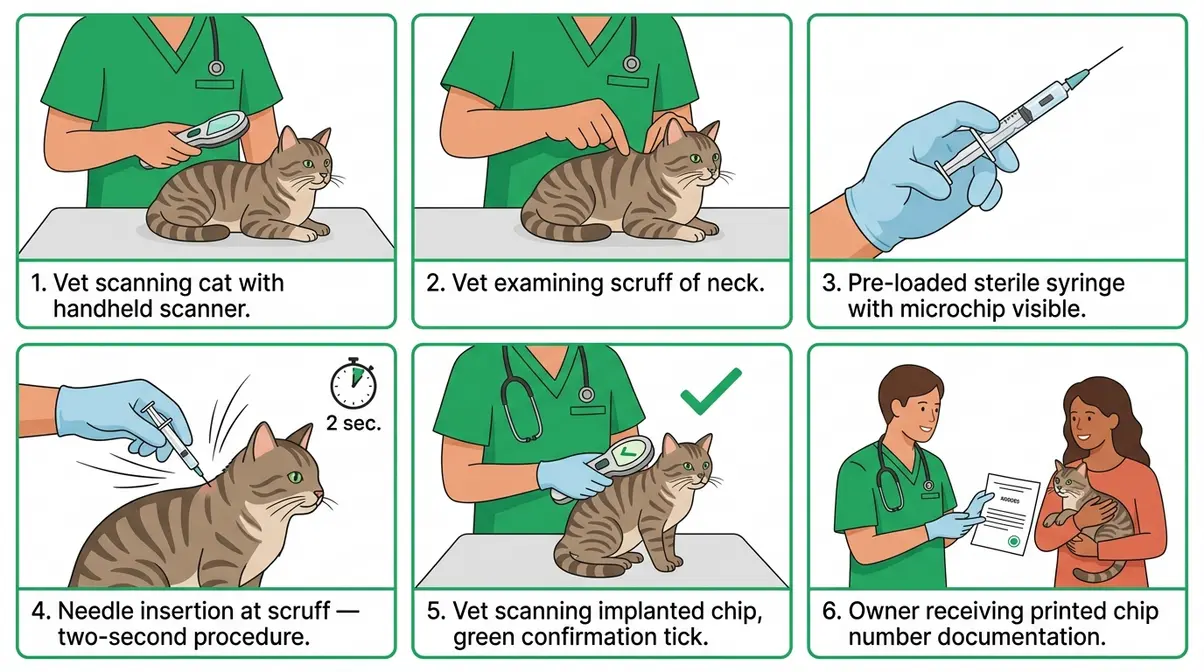
Many owners feel anxious about the procedure before they experience it. The reality is that microchipping is a routine, fast, and low-risk process. Knowing what to expect in advance makes the appointment much calmer — for you and your cat.
The Implantation Procedure Step by Step
The vet or trained implanter will follow these initial preparation steps:
- Check your cat’s identity — The vet confirms your cat’s details and checks that no chip is already present using a handheld scanner.
- Prepare the site — The implantation area is typically the scruff of the neck (the loose skin between the shoulder blades). No shaving or anaesthetic is required.
- Load the implanter — The microchip comes pre-loaded in a sterile, single-use syringe. It is about the size of a large injection needle.
Once prepared, the actual implantation happens quickly:
- Implant the chip — The vet inserts the needle under the skin and deposits the chip. This takes approximately two seconds.
- Verify the chip — The vet immediately scans the area to confirm the chip is reading correctly and records the 15-digit number.
- Provide documentation — You receive the chip number on paper or digitally. You will need this number to complete database registration in Step 5.
The entire procedure takes under five minutes from start to finish.
Is Microchipping Painful for Cats?
Most cats experience minimal discomfort — comparable to a standard vaccination injection, according to the RSPCA’s microchipping guidance. The needle is larger than a typical injection needle, but the procedure is over in seconds.
Some cats react with a brief flinch or a quiet vocalisation. Others show no reaction at all. Post-procedure soreness at the implantation site is rare and typically resolves within 24 hours. Serious complications — such as infection or chip migration — are uncommon when the procedure is performed by a trained professional.
“Microchipping is a safe, quick procedure that causes minimal discomfort — the vast majority of cats show no lasting reaction and return to normal behaviour within minutes” (RSPCA, 2024).
If your cat is particularly anxious about vet visits, ask your vet about using a calming spray or pheromone product before the appointment. This is a practical step that many owners overlook.
Step 5: Register on a DEFRA-Approved Database
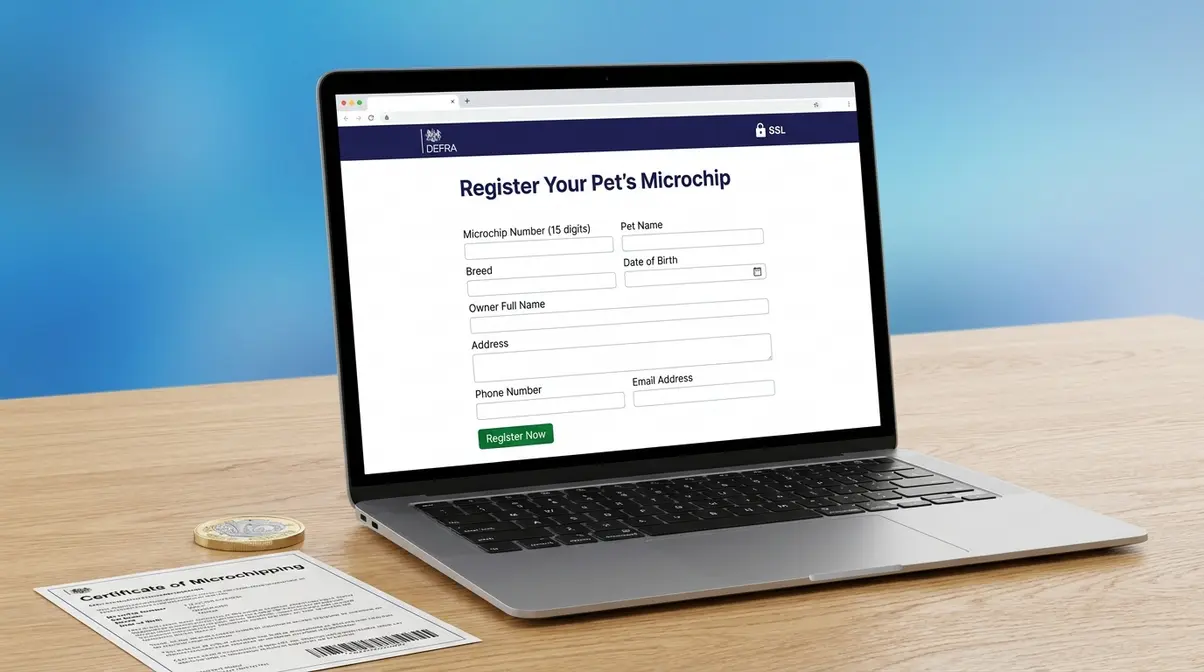
The microchip implant alone does not make your cat legally compliant. Registration on a DEFRA-approved database is a mandatory part of the process. Without it, the chip number cannot be matched to your contact details — and a lost cat cannot be returned to you.
Which Database Should You Use?
DEFRA (the UK Government department responsible for animal welfare) maintains a list of approved databases. All of them meet the minimum legal standard, but they differ significantly in cost structure and features.
As discussed in Step 2, the critical decision is annual subscription versus lifetime registration. If you plan to keep your cat for its natural life (10–15+ years), a one-off lifetime fee of £10–£30 will almost certainly cost less than paying £15–£20 every year.
- Key questions to ask before choosing a database:
- Is this a one-off fee or an annual subscription?
- Are address updates free, or do they charge per change?
- Is the database accessible 24/7 by vets and rescue centres?
- Can you transfer your registration if you switch providers?
Many vets will register your cat on a specific database as part of the chipping fee — often Petlog or Identibase. Before accepting this default, ask whether the registration fee is included and what the ongoing cost structure is. You are entitled to transfer your chip number to a different DEFRA-approved database at any time.
For a current list of all DEFRA-approved databases, visit the Cats Protection microchipping guidance.
What Information to Register
When you register, you will need to provide:
- Your cat’s microchip number (from the documentation provided at the appointment)
- Your cat’s name, breed, colour, and date of birth (approximate is fine)
- Your full name, address, and contact telephone number
- Your email address (for renewal reminders and account access)
Keep a copy of your chip number in a safe place — your phone’s notes app, a home filing system, or both. If your cat is ever lost and scanned, the chip number is the link between your cat and you.
Step 6: Keep Your Contact Details Up to Date
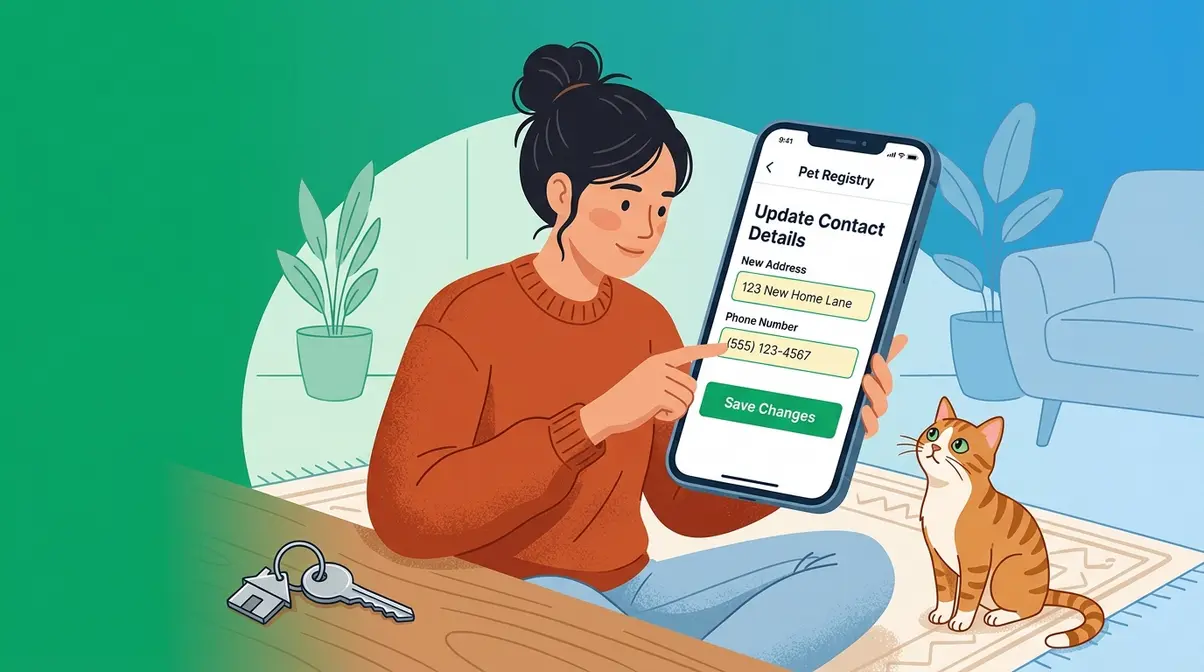
A microchip is only as useful as the contact details linked to it. If you move house, change your phone number, or transfer ownership of your cat, you must update your database record. An out-of-date record means a found cat cannot be returned — which defeats the entire purpose of chipping.
Why Out-of-Date Details Defeat the Purpose
Consider this scenario: your cat goes missing two years after you move house. A rescue centre scans the chip, finds a chip number, searches the database — and discovers an address you left 18 months ago. They cannot reach you. Your cat stays in a rescue centre, or worse.
This is not a rare edge case. Rescue organisations across the UK regularly report scanning microchipped cats whose registered details are years out of date. Keeping your database record current is as important as the chip itself.
The legal obligation also extends to ownership changes. If you rehome your cat, the new keeper must update the database record within a reasonable timeframe. Failing to do so means the original owner remains legally responsible — a situation that creates complications for everyone involved.
How to Update Your Details and What It Costs
“Hi what does everyone pay for their cats microchip. Mine is up for renewal and is £18 per year for basic info. Is this standard price? Thanks”
This is exactly the confusion The Hidden Cost Iceberg is designed to address. The £18/year that owner is paying is a standard annual database subscription — and it is a cost that catches many owners off guard because it was never clearly explained at the point of chipping.
Here is what you are typically paying for with an annual database fee:
- Active record maintenance — your details remain searchable by vets and rescue centres
- Address and contact updates — usually included in the annual fee
- Lost/found alert services — some databases notify local rescues if you report your cat missing
- Customer support — assistance if you forget login details or need to transfer ownership
If you are on an annual plan and want to reduce costs, check whether your database offers a lifetime upgrade. Many providers allow you to pay a one-off fee to convert from annual to lifetime registration, which can save money over the long term. For example, converting from a £18/year plan to a £29 lifetime plan breaks even in under two years.
“Annual DEFRA database subscription fees of £15–£20 per year represent the most overlooked long-term cost of cat microchipping in the UK — a cat owner over 12 years could pay more in database fees than the original chipping procedure cost.”
Verify Your Results
Before leaving the appointment — and again within 24 hours — take these steps to confirm everything is correctly in place:
- Scan confirmation at the clinic — Ask the vet to scan your cat before you leave and read the number aloud. Confirm it matches the documentation you have been given.
- Check your database registration — Log in to your chosen database and verify that your cat’s record is live, your contact details are correct, and the chip number matches.
- Test the system — Some databases allow you to search by chip number. Search your cat’s number and confirm the record appears correctly.
- Store your chip number — Save the 15-digit number in at least two places. A screenshot on your phone and a note in your home files is a sensible minimum.
If the chip does not scan at the clinic, ask for an immediate re-implantation. This is rare but does occasionally happen, and a reputable provider will resolve it at no additional cost.
Troubleshooting Common Microchipping Questions
Even after a successful appointment, owners often have lingering questions — particularly around what the chip can and cannot do.
Can a Microchip Track My Cat’s Location?
No — a microchip cannot track your cat’s location. This is the single most common misconception about cat microchipping, and it is worth addressing directly.
A microchip is a passive RFID tag (Radio-Frequency Identification). “Passive” means it has no battery and no power source. It cannot transmit any signal on its own. It only activates when a scanner is held within a few centimetres of it — at which point it broadcasts its unique ID number and nothing else. It contains no GPS component, no SIM card, and no location data.
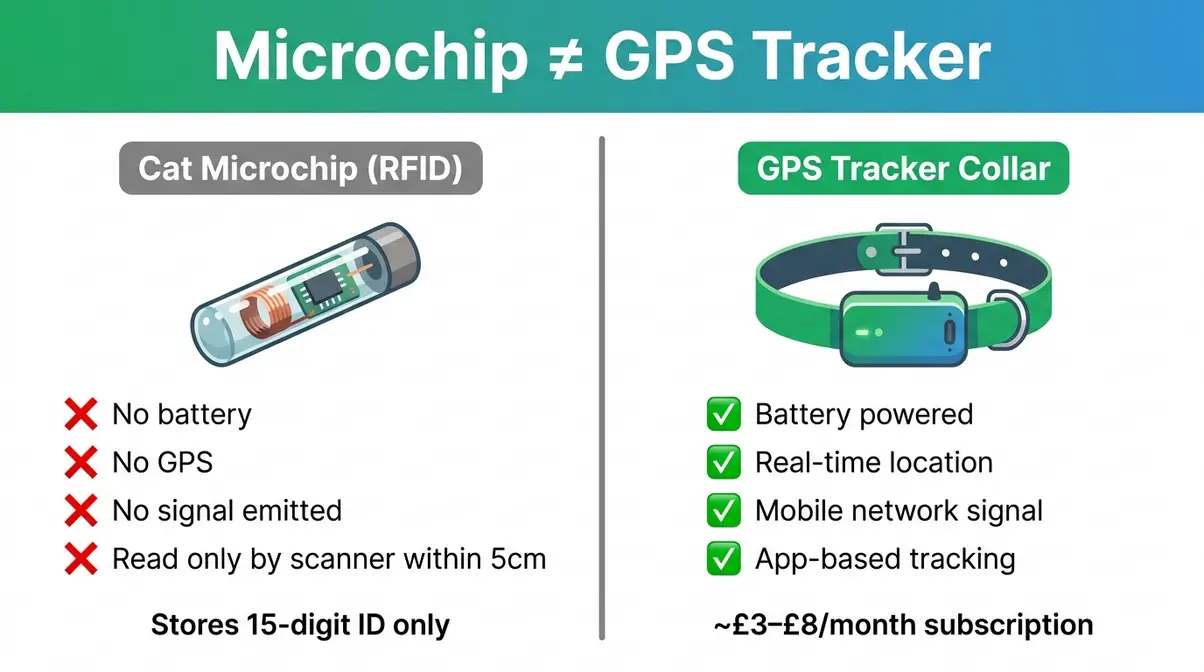
GPS tracking for cats requires a separate device — typically a small unit attached to a collar — that uses mobile network signals to report location in real time. These are available from specialist retailers and typically require a monthly subscription fee. They are a useful addition to microchipping, but they are not a replacement for it, and they are an entirely different product.
“A cat microchip is a passive RFID tag — it stores a 15-digit ID number and cannot transmit location data. GPS tracking requires a separate collar-mounted device with its own power source and subscription.” (International Cat Care, 2024)
What If the Microchip Fails or Moves?
Chip migration — where the chip moves from its original implantation site — does occasionally happen, though it is uncommon when the procedure is carried out correctly. The chip most often moves a short distance within the scruff area and remains fully functional. A vet scanner will still detect it.
Chip failure (where the chip stops transmitting entirely) is rare. If you have reason to believe your cat’s chip is no longer working — for example, a rescue centre reports it cannot be read — visit your vet for a scan. If the chip has failed, a new one can be implanted alongside the original without any harm to your cat.
To minimise both risks, always use a trained, accredited implanter rather than an unqualified individual. The procedure itself is low-risk, but correct technique matters.
Limitations and Drawbacks of Microchipping
What Microchipping Cannot Do
Microchipping is an excellent identification tool, but it has clear limits that every owner should understand before relying on it.
- It cannot prevent your cat from going missing. A chip does not act as a barrier or deterrent — it only helps reunite you with your cat after they are found.
- It cannot tell you where your cat is. As covered in the Troubleshooting section, there is no location data involved.
- It only works if the finder acts. If someone finds your cat but does not take it to a vet or rescue centre for scanning, the chip is never read. Outdoor cats in unfamiliar areas may not be scanned promptly.
- It requires accurate database records. A chip linked to outdated contact details is functionally useless for reunification purposes.
- It cannot prove ownership in a legal dispute on its own. While a microchip is strong evidence of responsible ownership, it is not legally conclusive proof of ownership in a civil dispute.
When to Consider Additional Identification Methods
Microchipping works best as part of a layered identification strategy, not as a standalone solution.
Consider adding:
- A quick-release safety collar with an ID tag — visible identification that any member of the public can read without needing a scanner. Use a quick-release (breakaway) collar to prevent injury if the collar catches on something.
- A GPS tracker collar — for cats that roam widely or have a history of going missing. These typically cost £30–£80 upfront plus a £3–£8/month subscription, but provide real-time location data that a microchip cannot.
- Recent photos — keep a current photo of your cat on your phone showing any distinctive markings. Useful for social media appeals and lost-pet posters.
Microchipping satisfies the legal requirement and provides a permanent, tamper-proof link between you and your cat. The additional methods above complement it — they do not replace it.
Frequently Asked Questions
Can I get my cat microchipped for free?
Yes — free cat microchipping is available in the UK, though it usually requires meeting eligibility criteria. Cats Protection offers free or subsidised chipping to owners on means-tested benefits. PDSA PetAid hospitals provide free microchipping to registered clients receiving qualifying benefits such as Universal Credit. The RSPCA runs periodic free microchipping events through local branches. Some local councils also partner with charities to run subsidised clinics — search for schemes in your area using ” free cat microchipping 2026.” Always confirm whether database registration is included in the free offer, as this is sometimes charged separately.
How long does a cat microchip last?
A cat microchip is designed to last the lifetime of the animal — typically 10 to 15 years or more. The chip itself requires no battery, contains no moving parts, and does not degrade under normal conditions. Once implanted correctly, it should never need to be replaced. What does require periodic attention is your database registration: if you are on an annual subscription plan, you must renew it each year to keep your record active. The chip and the database record are two separate things — the chip is permanent, but an inactive database record renders it functionally useless for reunification.
Do cats legally have to be chipped in the UK?
Yes — in England, microchipping is now a legal requirement for all cats. The Microchipping of Cats and Dogs (England) Regulations 2023 came into force on June 10, 2024, requiring all cats to be microchipped before they reach 20 weeks of age (GOV.UK, 2024). Owners who fail to comply face a fine of up to £500. The law applies to the keeper — the person responsible for the cat, usually the owner. Scotland, Wales, and Northern Ireland are subject to separate devolved legislation; always check your local authority’s current guidance if you are outside England.
Is microchipping painful for pets?
Microchipping causes minimal discomfort for most cats — comparable to a standard vaccination injection. The procedure takes approximately two seconds, uses a pre-loaded sterile syringe, and requires no anaesthetic. According to the RSPCA, the vast majority of cats show no lasting reaction and return to normal behaviour within minutes of the procedure. Some cats flinch briefly or vocalise; others show no reaction at all. Post-procedure soreness is rare and typically resolves within 24 hours. If your cat is particularly anxious at the vet, ask about using a calming pheromone spray beforehand to reduce stress.
Can I trace my cat with a microchip?
No — a microchip cannot trace or track your cat’s location. A microchip is a passive RFID tag that stores only a 15-digit identification number. It has no battery, no GPS, and no ability to transmit a signal independently. It can only be read when a scanner is held within a few centimetres of it. To trace your cat’s real-time location, you would need a separate GPS tracker — a collar-mounted device that uses mobile network signals and requires its own power source. These typically require a monthly subscription (around £3–£8/month, according to 2026 market averages for popular brands like Tractive). A microchip and a GPS tracker serve different purposes: one proves identity, the other provides location.
Bringing It All Together
Understanding how much does it cost to microchip a cat uk involves looking beyond the initial £10–£30 fee. For UK cat owners, microchipping a cat costs £10–£30 for the procedure itself — but The Hidden Cost Iceberg means the true long-term cost can be significantly higher once annual database subscription fees of £15–£20/year are factored in. Choosing a lifetime registration database at the point of chipping can eliminate this recurring expense entirely. Free options through Cats Protection, the PDSA, and RSPCA events are genuinely available for eligible owners, and the legal obligation in England has been in force since June 10, 2024, with fines of up to £500 for non-compliance (GOV.UK, 2024).
The Hidden Cost Iceberg framework is a useful mental model to carry forward: whenever you encounter a cost associated with pet ownership, ask whether there is a submerged layer of ongoing fees beneath the visible upfront price. For microchipping, the answer is clearly yes — and knowing that in advance puts you in control.
Your next step is simple: check your cat’s age, choose a provider from the options in Step 3, book an appointment, and select a DEFRA-approved database with a lifetime registration fee to avoid annual renewal surprises. If your cat is already chipped, log in to your database today and confirm your contact details are current — it takes five minutes and could make the difference between a lost cat coming home or not.

Dave King
Cat owner and writer at Mad Cat Man.