
⚕️ Medically Reviewed by a Veterinarian | Reviewed 2026
This article is for informational purposes only and does not constitute veterinary advice. Always consult your veterinarian for health concerns about your pet.
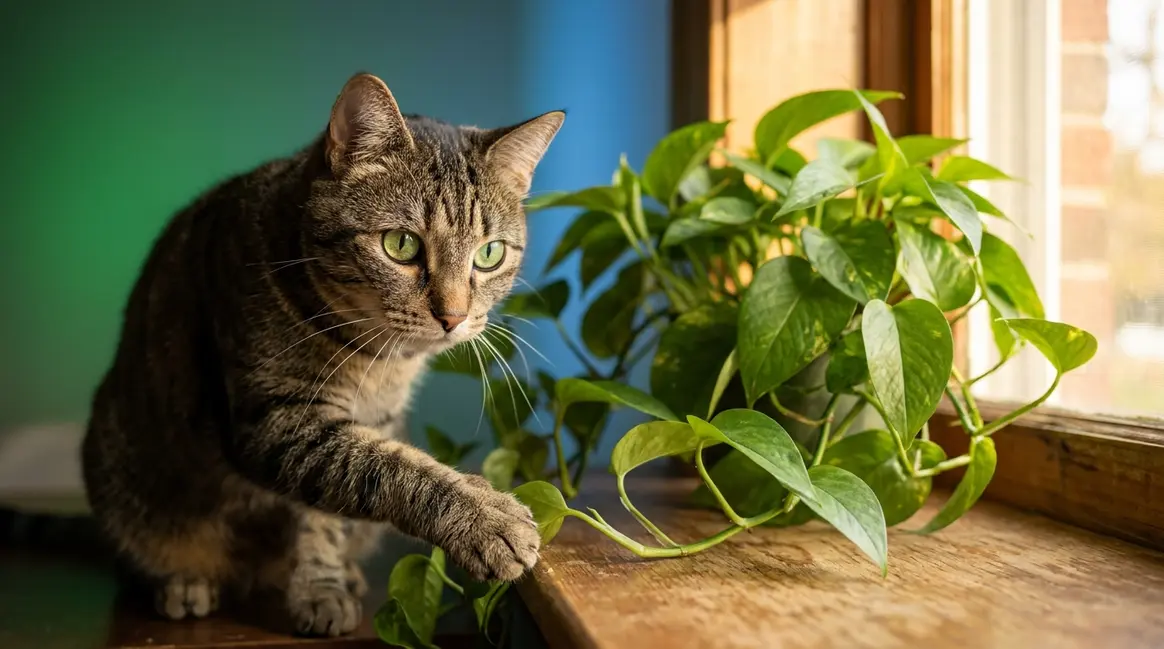
You walk into the living room and find your cat — your obligate carnivore (an animal biologically designed to survive on meat alone) who is supposed to only want meat — methodically chewing a leaf off your pothos. Your first thought is probably: Is this normal? Is my cat going to be okay?
“Why does my cat compulsively eat houseplants, despite the fact that they make him vomit?”
You’re not alone in asking that question. Across cat owner communities, it’s one of the most common concerns reported — and it’s completely understandable. The short answer is that why do cats eat plants comes down to a fascinating mix of evolutionary instinct, digestive need, and sometimes sheer boredom. Our editorial team reviewed veterinary literature from Cornell, Texas A&M, ASPCA, and NCBI to compile this guide — so you’re getting answers grounded in real science, written in plain language. In most cases, your cat is going to be absolutely fine. But there are specific situations where plant-eating becomes a genuine concern, and this guide will walk you through all of them.
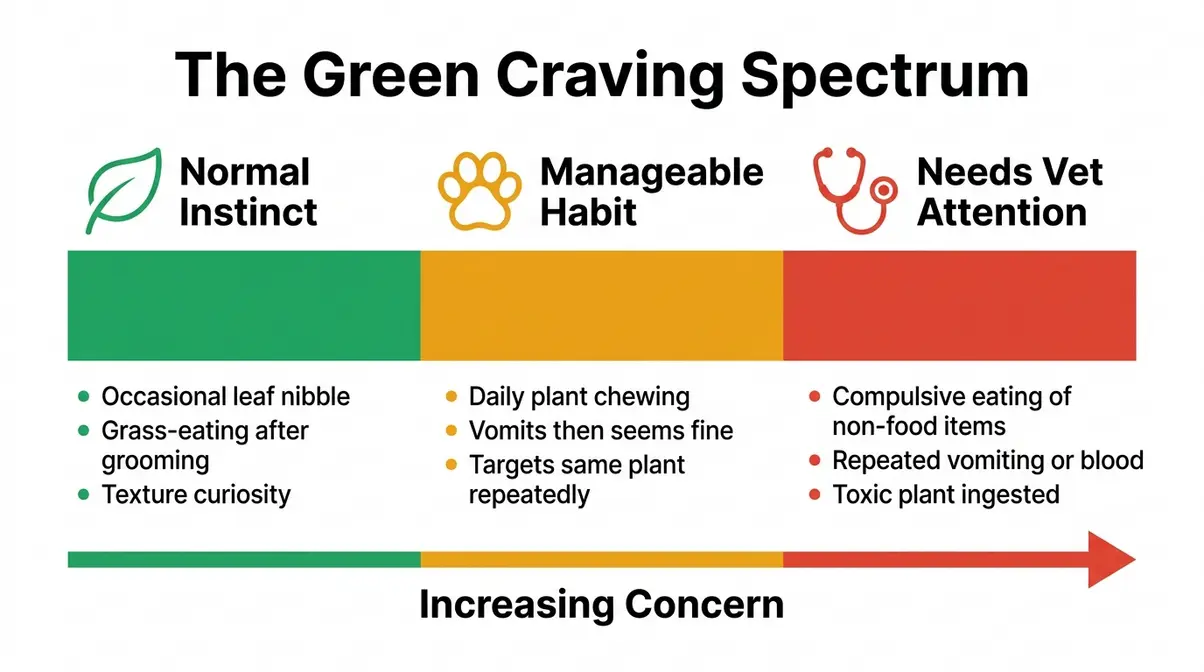
By the end, you’ll understand the full Green Craving Spectrum — a simple framework for judging whether your cat’s behavior is completely normal, a manageable habit, or a sign that needs veterinary attention.
Understanding why do cats eat plants helps you respond calmly and correctly — most plant-chewing is normal instinctive behavior, not a medical emergency.
- The Green Craving Spectrum: Plant-eating ranges from completely normal (instinct, boredom) to medically concerning (pica, poisoning) — knowing where your cat falls is the key.
- Toxic plants are a real danger: Lilies, pothos, and philodendrons can cause serious illness. Remove them or place them out of reach immediately.
- 7 strategies work: Providing cat grass, using citrus deterrents, and increasing enrichment (mentally stimulating activities) are the most effective ways to redirect the behavior.
- Call your vet if: You see vomiting that won’t stop, drooling, lethargy, or any sign your cat ate a known toxic plant.
⚠️ Medical Disclaimer: This article is for informational purposes only and does not constitute veterinary advice. If you suspect your cat has eaten a toxic plant, contact your veterinarian or the ASPCA Animal Poison Control Center at 888-426-4435 immediately.
Why Do Cats Eat Plants? The 5 Key Reasons
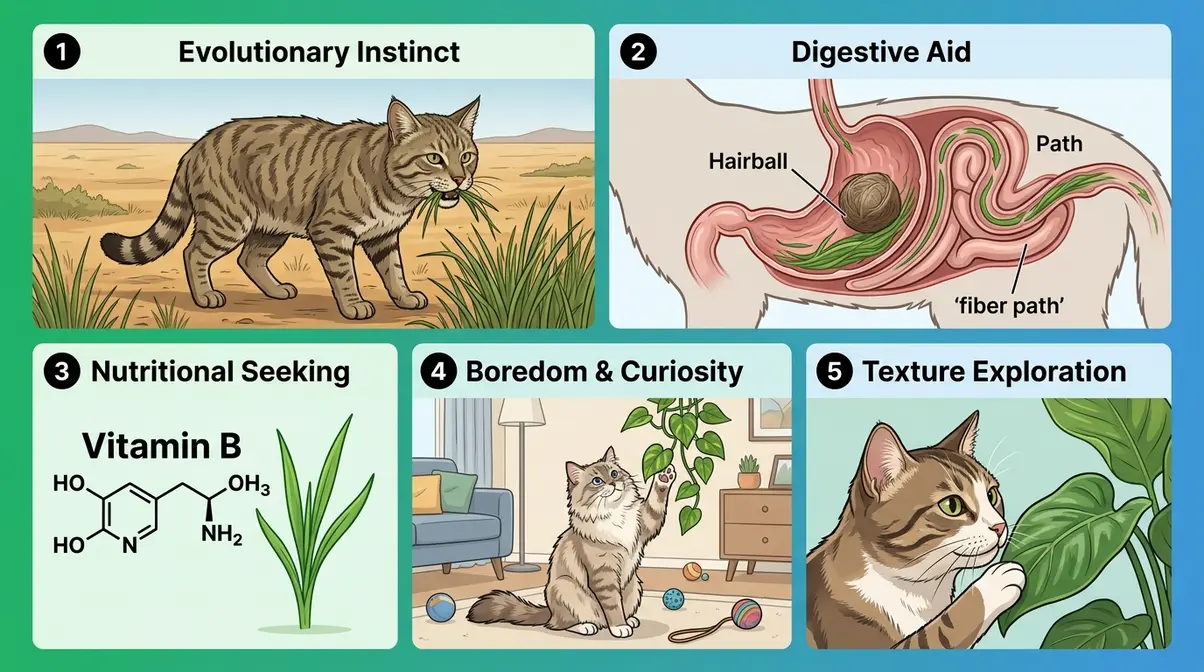
Most cats that eat plants aren’t sick, confused, or defiant. They’re following deeply embedded biological programming — the same programming that drove their wild ancestors. Veterinary consensus indicates that plant-eating in cats is a multi-layered behavior with at least five distinct drivers, and understanding each one helps you respond appropriately rather than panic.
It’s in Their Instincts: The Evolutionary Explanation
Cats eat plants because their wild ancestors did — and those instincts didn’t disappear when cats moved indoors. A landmark 2021 study published in the journal Ecology and Evolution (NCBI, 2021) surveyed over 1,000 cat owners and found that approximately 71% of cats eat plants or grass at least six times per year, and that the behavior appears to be an inherited trait rather than a learned one. Even cats raised entirely indoors, with no exposure to outdoor vegetation, will seek out and nibble on houseplants.
The evolutionary logic makes sense. Wild felids — the ancestors of your domestic cat — regularly consumed whole prey: bones, organs, fur, and the stomach contents of grass-eating animals. Plant matter entered their diet constantly, even if they never deliberately sought it out. Over millennia, the instinct to occasionally chew vegetation became hardwired. Your cat chewing your monstera isn’t making a dietary mistake. It’s following a biological script written long before houseplants existed.
This is the foundation of the Green Craving Spectrum — the idea that plant-eating sits on a continuum. On one end is completely normal, instinct-driven nibbling. On the other end is compulsive, medically driven consumption that signals a problem. Most cats live firmly at the normal end.
Plants as a Digestive Aid and Hairball Remedy
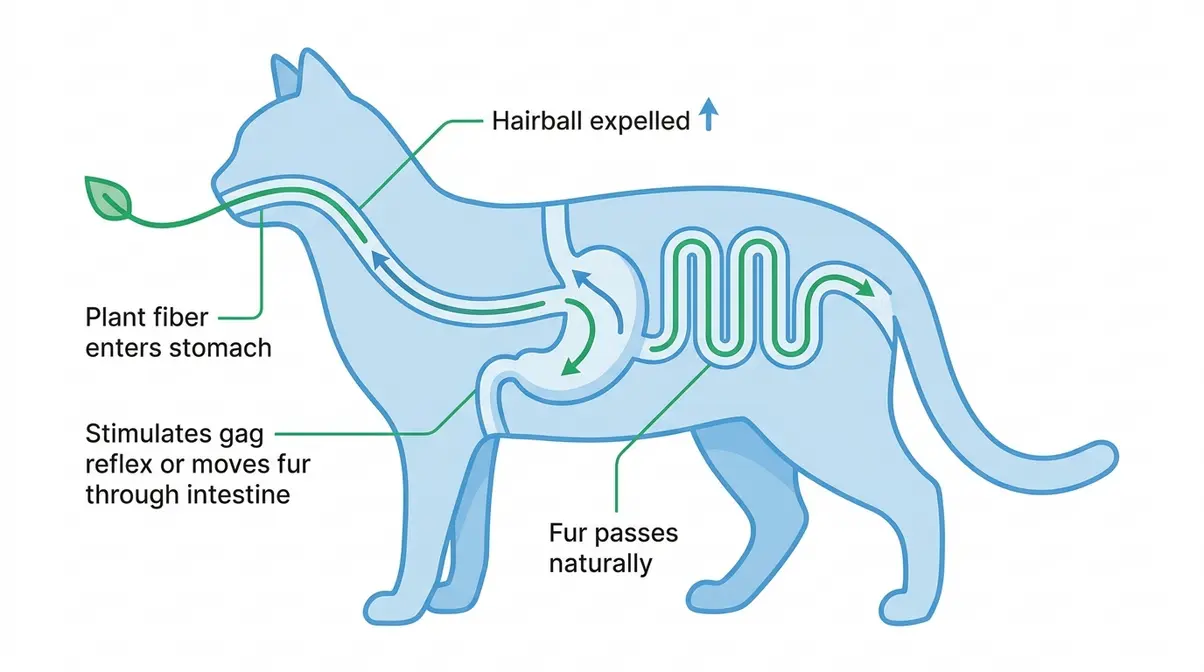
One of the most practical reasons cats eat plants is to help their digestive system do its job. Cats groom themselves constantly, swallowing loose fur in the process. That fur accumulates in the stomach and must be expelled — either as a hairball (a compressed cylinder of fur your cat vomits up) or moved through the digestive tract. Plant fiber helps move fur through the gut more efficiently, reducing the frequency and discomfort of hairballs.
The roughage (indigestible plant fiber) in leaves acts like a natural brush through the intestinal tract. When your cat chews on a leaf and then vomits shortly after, it’s not necessarily a sign of poisoning. In many cases, it’s a deliberate, instinctive act of self-maintenance — the plant fiber is triggering the gag reflex to clear the stomach of fur, bile, or other material that’s causing mild discomfort.
Veterinary consensus indicates that this is one of the most common reasons cats seek out plants, particularly cats that are heavy groomers or have long coats. It’s uncomfortable to watch, but it’s usually not dangerous — unless the plant itself is toxic.
Filling Nutritional Gaps: Fiber, Folic Acid, and Trace Minerals
Your cat’s commercial food is nutritionally complete — but cats don’t always know that. Their instinct to seek out folic acid (a B-vitamin that supports red blood cell production and healthy cell growth) and trace minerals from plant sources is ancient, and it doesn’t simply switch off because the kibble bag says “complete and balanced.”
Folic acid in particular is found in high concentrations in young grass shoots and certain leafy plants. Veterinary researchers at Texas A&M have noted that grass-eating in cats may be partly driven by a subconscious drive to supplement folic acid levels, which supports the production of hemoglobin (the protein in red blood cells that carries oxygen). Cats that are slightly deficient — even subclinically, meaning not enough to cause obvious symptoms — may instinctively seek out plant sources.
Dietary fiber is the other key nutrient. Cats eating a dry kibble diet in particular may not be getting enough insoluble fiber (the type that doesn’t dissolve in water and aids gut motility, or the movement of food through the digestive system). Chewing on leaves and grass provides a quick fiber top-up that helps regulate digestion. This is why some cats chew plants more frequently after switching to a new food or during periods of dietary change.
Boredom, Curiosity, and Texture Play
Not every plant-eating episode is biologically driven. Sometimes your cat is simply bored, and your hanging pothos is the most interesting moving object in the room. Cats are natural hunters with a strong prey drive — the instinct to stalk, pounce, bat, and bite. When that drive doesn’t get a proper outlet through play, it redirects toward whatever is available.
Plants are particularly attractive because they move in air currents, have an interesting texture to chew, and often dangle at a satisfying height for batting. Younger cats and indoor-only cats are especially prone to plant-chewing driven by boredom, because they have fewer opportunities to express natural hunting behaviors. Enrichment (activities, toys, and environmental features that keep your cat mentally and physically stimulated) is the most effective long-term solution for this type of plant-eating — more on that in the prevention section.
Texture curiosity also plays a role. Some cats are drawn to specific leaf textures — the waxy surface of a peace lily, the feathery fronds of a fern, the long strap-like leaves of a spider plant. This is sensory exploration, not nutritional seeking. It explains why cats will chew on a plant once, leave it alone for weeks, and then return to it suddenly.
Why Do Cats Eat Plants and Then Throw Up?
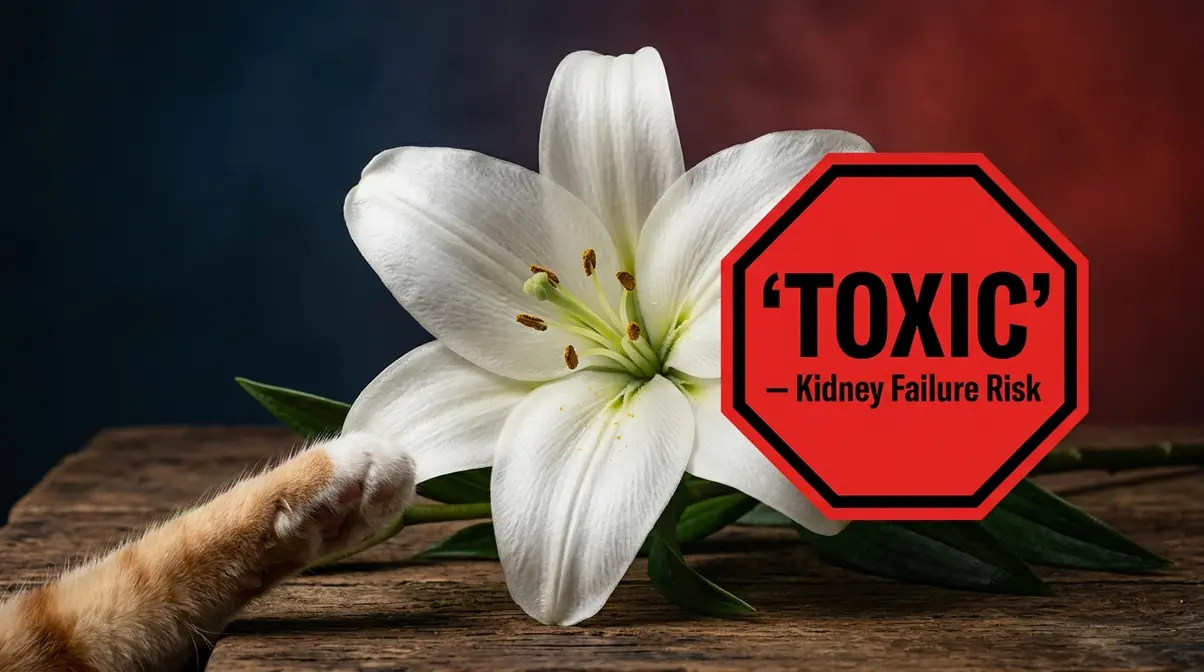
“Why does my cat compulsively eat houseplants, despite the fact that they make him vomit?”
This is the question that sends most cat owners straight to Google at 11 p.m. The sight of a cat deliberately eating something and then vomiting — sometimes within minutes — looks alarming. But the relationship between cats, plants, and vomiting is more nuanced than it appears.
Vomiting on Purpose: How Cats Clear Their Stomachs
Cats can and do induce vomiting deliberately — and plant fiber is one of the tools they use to do it. Unlike humans, cats have a relatively simple gag reflex that can be triggered by the texture and bulk of plant material in the stomach. When a cat feels nauseous, bloated, or has accumulated too much fur or bile in its stomach, it may seek out a plant specifically because chewing and swallowing the leaf will trigger vomiting and provide relief.
This is called purposeful emesis (deliberate vomiting), and veterinary consensus indicates it’s a normal self-regulation behavior in cats. A 2019 study published in Science (Science.org, 2019) found that grass-eating in cats correlated strongly with the presence of intestinal parasites or gastrointestinal discomfort — suggesting that the behavior evolved as a way to purge the gut. The plant fiber triggers muscle contractions in the stomach wall, which either moves the irritant through the system or expels it upward.
So when your cat eats a leaf and vomits 10 minutes later, ask yourself: Did they seem distressed before eating the plant? Did they seem relieved afterward? If the answer is “they seemed fine before and fine after,” you’re most likely watching a routine digestive self-correction. It’s unpleasant to clean up, but it’s not an emergency.
When Vomiting Is a Warning Sign, Not a Natural Reflex
The picture changes when vomiting is accompanied by other symptoms, happens repeatedly over a short period, or occurs after your cat has eaten a plant you know (or suspect) is toxic. Purposeful vomiting looks different from toxic vomiting — and knowing the difference can save your cat’s life.
Normal, deliberate vomiting after plant-eating typically involves: a single episode, the cat seeming alert and comfortable afterward, and the vomit containing recognizable plant material or hairball matter. The cat usually returns to its normal routine within 30 minutes.
Warning signs that vomiting is NOT normal include: multiple vomiting episodes within a few hours, blood in the vomit, the cat continuing to retch without producing anything, extreme lethargy (unusual tiredness or unresponsiveness) immediately after, or drooling and pawing at the mouth. These symptoms suggest the plant may have been toxic, or that something else is wrong. In these cases, contact your veterinarian or the ASPCA Animal Poison Control Center (888-426-4435) immediately — do not wait to see if the cat “gets better on its own.”
Grass vs. Houseplants: Is There a Difference?
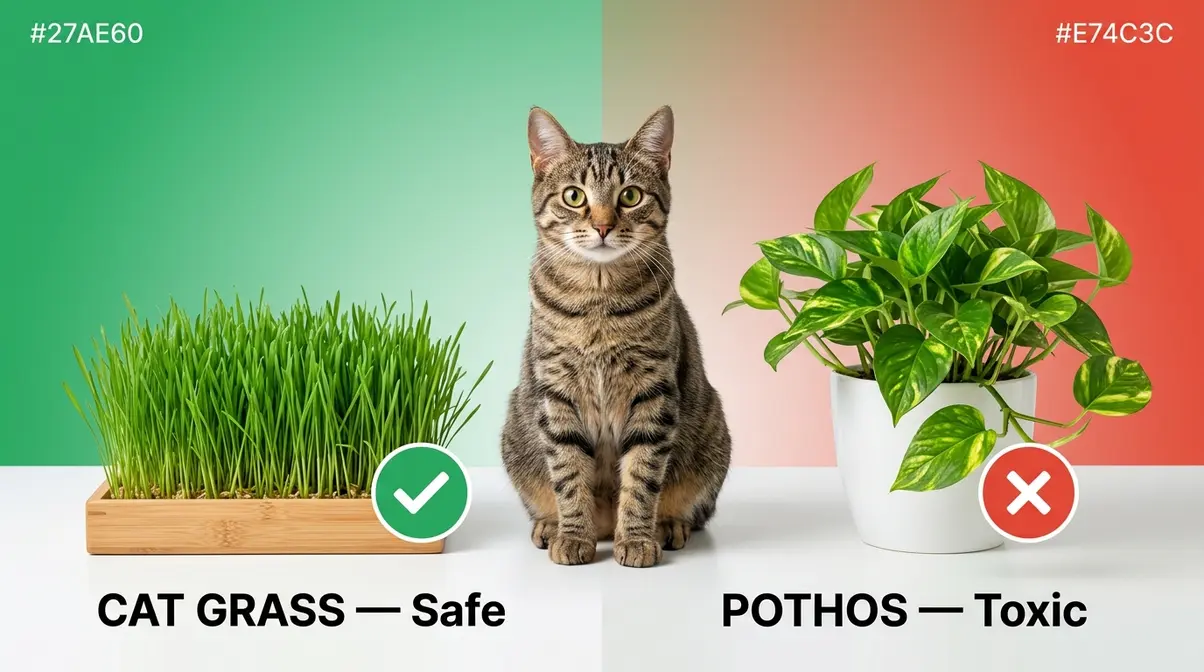
The short answer is yes — and the distinction matters. Grass and houseplants satisfy some of the same underlying drives in cats, but they come with very different risk profiles. Understanding why cats eat grass helps you make smarter decisions about what to keep in your home.
Why Cats Eat Grass: Benefits and Instincts
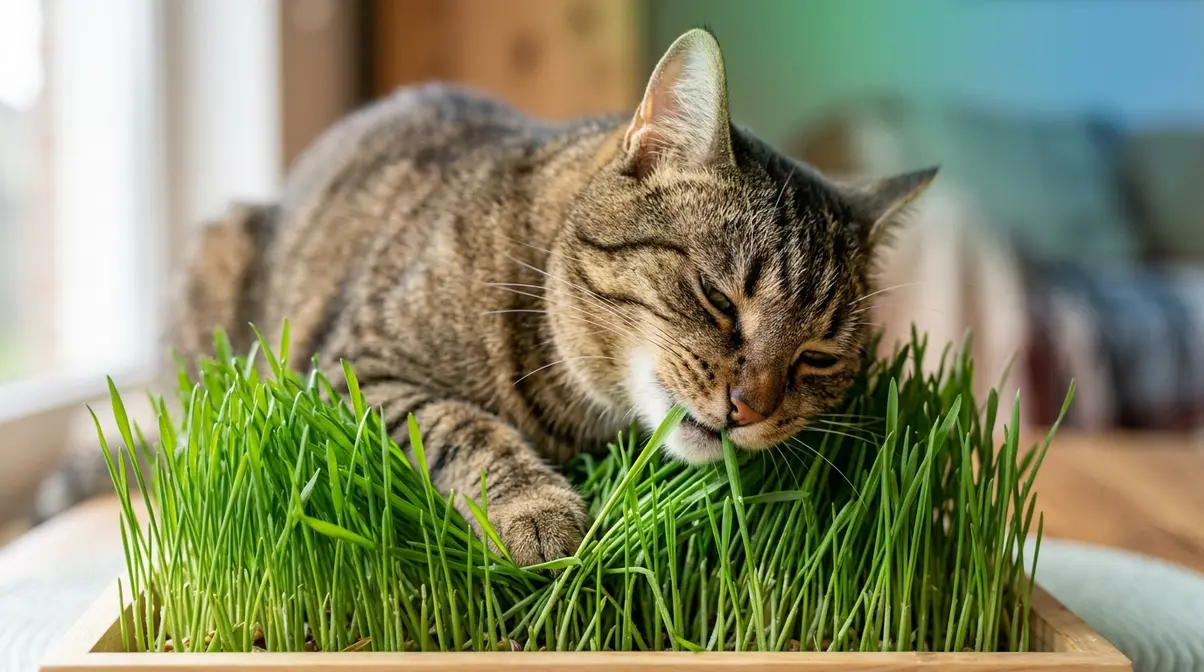
Cats eat grass because it provides fiber, folic acid, and a safe mechanism for digestive self-regulation — all with virtually zero toxicity risk. Grass, particularly young wheatgrass or oat grass (the types sold as “cat grass”), is one of the safest plants your cat can consume. It’s soft, digestible in small amounts, and contains the exact nutrients that cats instinctively seek from plant matter.
The Science.org study from 2019 — which surveyed 1,021 cat owners — found that 79% of cats were observed eating grass or plants more than 10 times, and that the behavior was significantly more common in younger cats (under 3 years old). Crucially, only 27% of grass-eating episodes were preceded by signs of illness — meaning the vast majority of grass-eating happens in healthy cats as a routine behavior, not a response to sickness.
The folic acid content of young grass shoots is particularly notable. Folic acid supports the production of hemoglobin and is critical for healthy cell division. While commercial cat foods contain adequate folic acid, the instinct to seek it from plant sources appears to be deeply embedded and not easily overridden by dietary completeness alone.
Do Cats Eat Grass When They Are Sick, Hungry, or Have Worms?
Cats may eat grass more frequently when they feel unwell, but sickness is not the primary driver of the behavior. This is an important nuance. The 2019 Science.org study found that only about 1 in 4 grass-eating episodes was preceded by obvious signs of illness — which means the majority of grass-eating occurs in perfectly healthy cats.
That said, there are specific health conditions that can increase grass-eating frequency:
- Intestinal parasites (worms): Cats with roundworms, tapeworms, or hookworms may eat grass more compulsively. The fiber and the triggered vomiting or diarrhea can help expel parasites — a behavior that evolved over thousands of years. If your cat has recently started eating grass much more frequently than usual, a fecal parasite test at your vet is a reasonable precaution.
- Gastrointestinal upset: Nausea, excess stomach acid, or mild food intolerance can all prompt grass-seeking as a self-soothing behavior. Soothing an upset stomach with plant fiber is instinctive.
- Hunger: There is limited evidence that hunger alone drives grass-eating, but some cats on restricted calorie diets may chew grass or plants as an oral behavior substitute. If your cat seems to eat grass primarily at mealtimes or immediately before feeding, hunger may be a contributing factor.
A 2021 NCBI study analyzing cat grass-eating behavior across multiple populations confirmed that the behavior is near-universal and not reliably linked to illness — supporting the interpretation that it is an ancestral instinct rather than a symptom.
How Grass-Eating Differs from Chewing Houseplants
The key difference between eating grass and chewing houseplants is safety, not motivation. The underlying drives — fiber-seeking, digestive regulation, folic acid supplementation, boredom — are largely the same. What changes is the risk profile of the plant being consumed.
Grass (particularly purpose-grown cat grass) is non-toxic, soft, and designed by nature to pass through a cat’s digestive system without harm. Houseplants, by contrast, are an unpredictable mix: some are completely safe, some cause mild stomach upset, and some — like lilies — can cause acute kidney failure and death within 24-72 hours of ingestion.
This is why the goal isn’t to stop your cat from ever chewing on anything green. The goal is to redirect that behavior toward safe options (cat grass, cat-safe herbs) and away from potentially toxic houseplants. Your cat’s instinct to eat grass is healthy. Your job is just to make sure the “grass” they have access to won’t hurt them.
Which Plants Are Toxic to Cats — and Which Are Safe?
Toxic plant ingestion is one of the most common reasons cats are taken to emergency veterinary clinics — and many owners don’t realize their favorite houseplant is dangerous until it’s too late. This section is the most important in the article. Read it carefully, check your home, and act now if you have any of the plants on the toxic list.
⚠️ ASPCA Disclaimer: The lists below are based on the ASPCA Animal Poison Control Center database and veterinary literature current as of 2026. This is not a complete list. Always verify any plant’s safety status at the ASPCA Toxic and Non-Toxic Plants database before bringing it into a home with cats. If you believe your cat has ingested a toxic plant, call 888-426-4435 immediately.
Common Toxic Houseplants to Remove Immediately
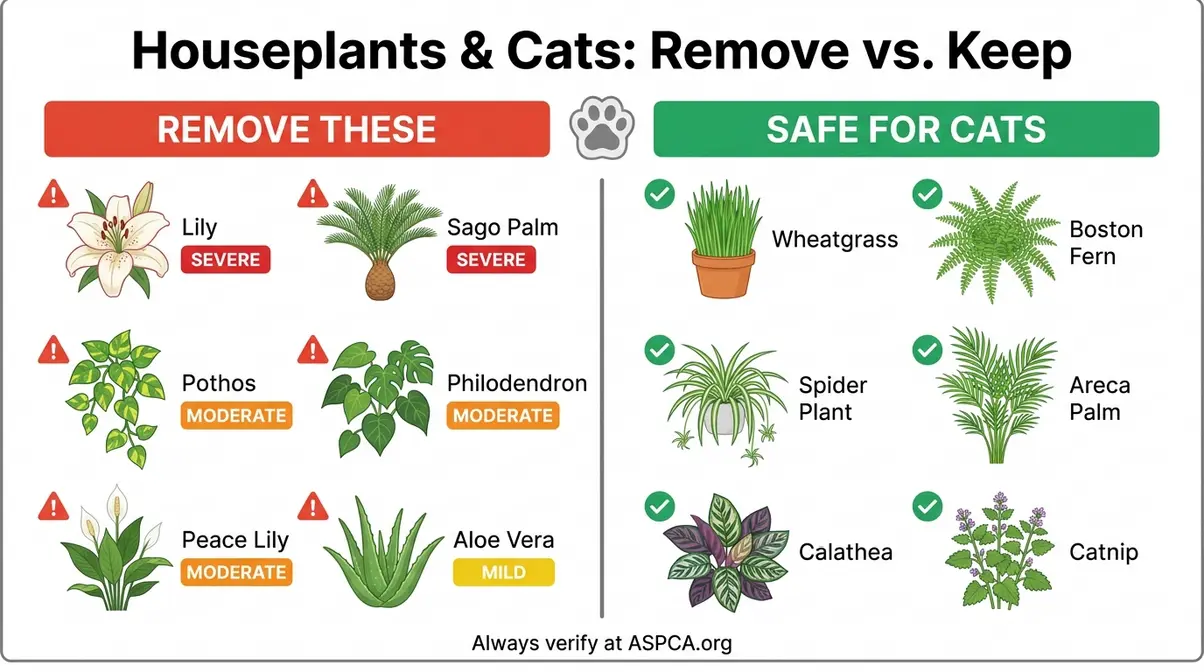
According to the ASPCA Animal Poison Control Center, the following plants are toxic to cats and should be removed from any home where cats live or visit:
| Plant Name | Toxicity Level | Primary Symptoms |
|---|---|---|
| Lilies (Easter, Tiger, Asiatic, Daylily) | SEVERE — can cause acute kidney failure | Vomiting, lethargy, kidney failure within 24-72 hrs |
| Sago Palm | SEVERE — liver failure | Vomiting, jaundice, seizures, death |
| Oleander | SEVERE — cardiac toxin | Drooling, vomiting, heart arrhythmia |
| Pothos / Devil’s Ivy | Moderate — oral and GI irritant | Drooling, swelling of mouth/throat, vomiting |
| Philodendron | Moderate — calcium oxalate crystals | Oral burning, excessive drooling, vomiting |
| Peace Lily | Moderate — calcium oxalate crystals | Oral irritation, difficulty swallowing, vomiting |
| Dieffenbachia (Dumb Cane) | Moderate — intense oral irritant | Mouth pain, drooling, difficulty swallowing |
| Aloe Vera | Mild-Moderate — saponins irritate GI tract | Vomiting, diarrhea, lethargy |
| English Ivy | Mild-Moderate | Vomiting, diarrhea, drooling |
| Kalanchoe | Moderate — cardiac glycosides | Vomiting, diarrhea, abnormal heart rate |
| Azalea / Rhododendron | Severe | Drooling, vomiting, low blood pressure, seizures |
| Cyclamen | Moderate-Severe | Vomiting, diarrhea, seizures (if large amount consumed) |
A special note on lilies: Veterinary consensus indicates that lilies are the single most dangerous common houseplant for cats. Even a small amount — a few pollen grains licked off fur, a single petal chewed — can cause irreversible kidney failure. If you have any lilies in your home, remove them immediately. This is not a “move them to a high shelf” situation. They need to leave the house entirely.
Why Cats Eat Spider Plants (And Whether It’s Dangerous)
*Spider plants (Chlorophytum comosum) are mildly hallucinogenic to cats — and that’s probably why your cat can’t leave them alone. According to the ASPCA, spider plants are non-toxic to cats, which is the good news. The concerning part is why* cats are so obsessively attracted to them.
Spider plants produce compounds that are chemically similar to opium (the substance derived from poppies that produces sedative and euphoric effects in mammals). These compounds have a mild hallucinogenic effect on cats — similar to, but weaker than, the effect of catnip. Cats that chew spider plants may seem slightly “spacy,” slow, or unusually relaxed for 20-30 minutes afterward.
While spider plants themselves won’t poison your cat, the compulsive chewing they trigger can cause mild gastrointestinal upset — vomiting and diarrhea — simply from the volume of plant matter consumed. If your cat is obsessively targeting your spider plant, the safest move is to hang it out of reach. The plant is safe; the compulsive behavior it triggers is the issue.
Safe Plants and Alternatives for Your Cat
The good news is that you don’t have to live in a plant-free home. Many beautiful, popular houseplants are completely safe for cats. The following are confirmed non-toxic according to the ASPCA database:
| Safe Plant | Notes |
|---|---|
| Wheatgrass / Cat Grass | The gold standard — grow it specifically for your cat |
| Boston Fern | Non-toxic; may cause mild GI upset if large amounts eaten |
| Spider Plant | Non-toxic; mild hallucinogenic effect may cause over-eating |
| Areca Palm | Non-toxic; safe for cats and dogs |
| Calathea / Prayer Plant | Non-toxic; safe and beautiful |
| Orchids (Phalaenopsis) | Non-toxic; may cause mild GI upset |
| Catnip | Non-toxic; safe and enriching |
| Valerian | Non-toxic; calming effect |
| Cat Thyme | Non-toxic; cats love the scent |
| Peperomia | Non-toxic; many varieties available |
The strategic move is to replace toxic plants with safe ones and provide dedicated cat grass as a positive outlet. This way, your cat’s instinct to chew on something green is satisfied safely, and your toxic plants are no longer a temptation.
💡 Pro Tip: Always verify any plant at the ASPCA Toxic and Non-Toxic Plants database before purchasing. Common names are unreliable — “lily” can refer to dozens of different plants with very different toxicity profiles.
How to Stop Your Cat from Eating Plants: 7 Proven Strategies
The most effective approach to stopping cats from eating plants combines physical barriers, sensory deterrents, and positive alternatives — not punishment, which veterinary behaviorists consistently find to be ineffective and potentially harmful to the cat-owner relationship. Here are 7 strategies, ordered from most to least impactful, based on our review of veterinary behavioral literature and guidance from Chewy’s animal behavior team.
Make Plants Physically Inaccessible
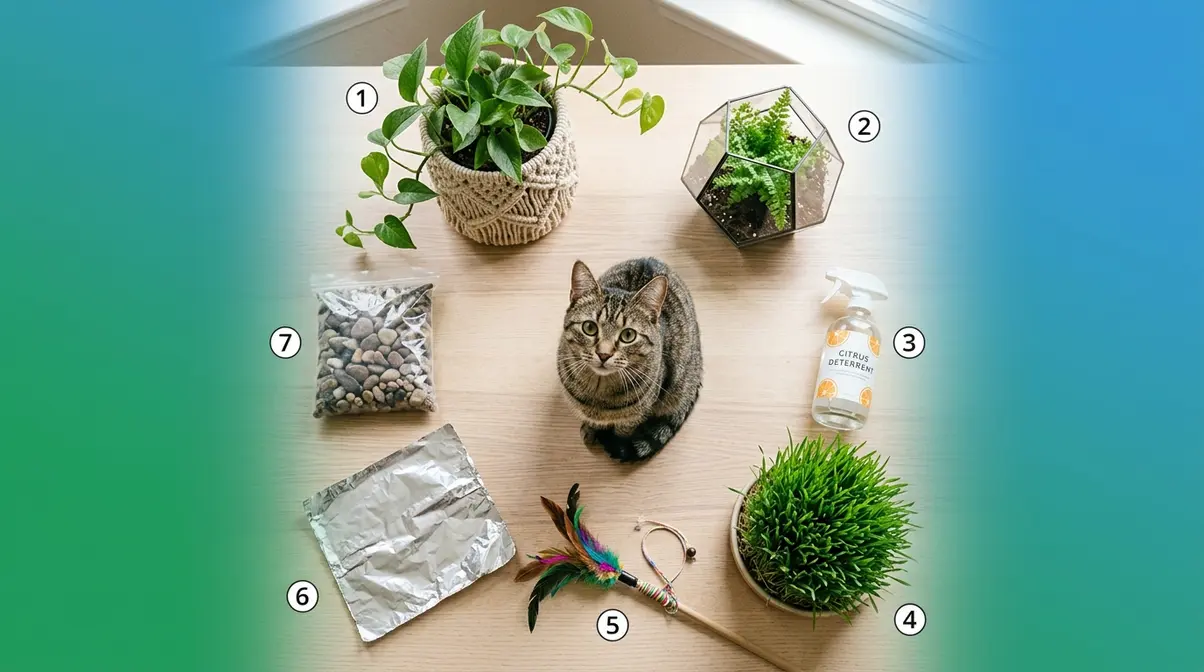
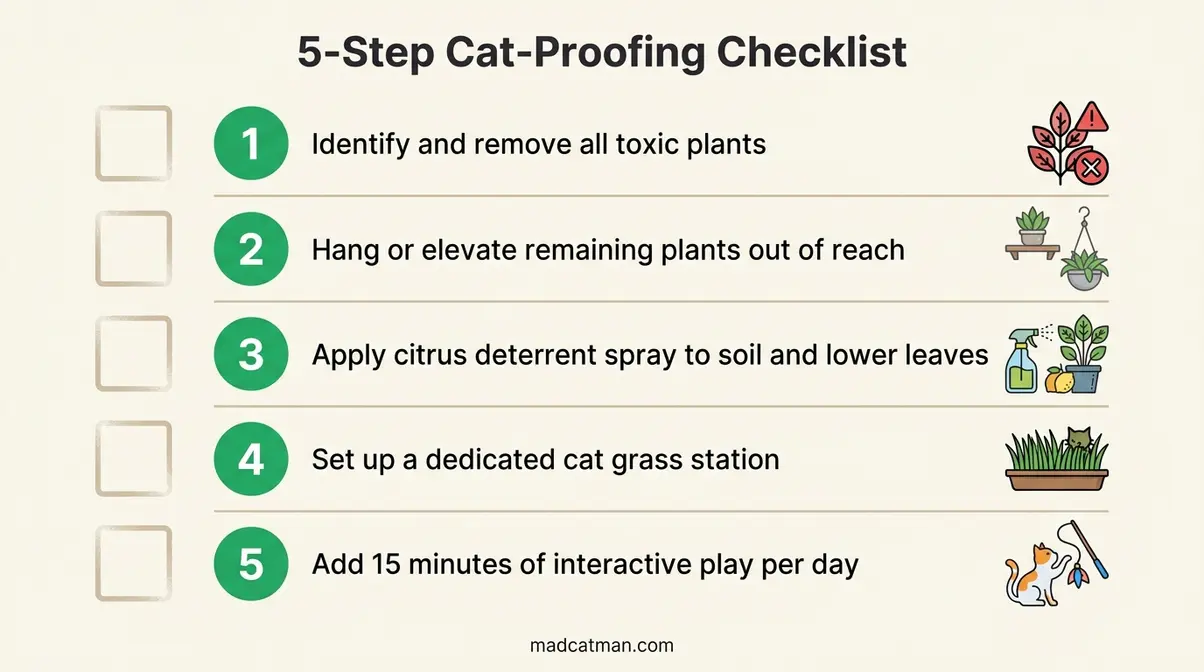
Strategy 1: Elevate and hang plants. Move all toxic plants to rooms your cat cannot access — a closed bedroom, a high shelf with no jumping route, or a hanging planter suspended from the ceiling. Cats are excellent climbers and jumpers, so “high up” is only safe if there’s genuinely no furniture pathway to reach the plant.
Strategy 2: Use plant cages or terrariums. Enclosed glass terrariums (wardian cases) or wire plant cages physically prevent access while keeping your plants visible and decorative. This is especially effective for small to medium-sized plants.
Strategy 3: Use sticky mats or aluminum foil around the base. Cats strongly dislike the texture of sticky surfaces and crinkly foil under their paws. Placing a sticky mat (like PetSafe SSSCAT mat) or a sheet of aluminum foil around the base of a plant pot creates an uncomfortable approach zone that most cats will avoid after one or two attempts.
Use Natural Deterrents Your Cat Dislikes
Strategy 4: Apply citrus deterrent spray. Cats have a powerful sense of smell and are strongly averse to citrus scents (orange, lemon, grapefruit). A diluted citrus essential oil spray (a few drops of orange or lemon essential oil in water) applied to the leaves and soil of your plants creates an effective olfactory barrier. Commercial options like Grannick’s Bitter Apple Spray or Nature’s Miracle No-Chew Spray are also effective and safe for most plants.
Important: Never use undiluted essential oils directly on plants or near cats — concentrated essential oils can be toxic to cats if ingested. Always dilute and test on a small area of the plant first.
Strategy 5: Use physical texture deterrents. Place decorative rocks, pinecones, or a layer of coarse gravel on top of the soil in your plant pots. Cats often dig and chew soil as well as leaves — the uncomfortable texture discourages both behaviors.
Provide Safe Alternatives Like Cat Grass
Strategy 6: Set up a dedicated cat grass station. This is the single most effective long-term strategy for cats driven by instinct or nutritional seeking. Cat grass (typically wheatgrass, oat grass, or barley grass) provides everything your cat is looking for from plants — fiber, folic acid, texture, and the satisfying act of chewing — without any toxicity risk.
Grow it in a shallow tray near your cat’s feeding area or in their favorite lounging spot. Refresh it regularly (every 2-3 weeks) as cats tend to lose interest in older, yellowing grass. Kits from brands like The Cat Ladies Organic Cat Grass Kit or Cedarbrook Farm Cat Grass are inexpensive and easy to maintain.
[INTERNAL LINK: anchor text “best cat grass options” — link to internal article on cat grass]
Veterinary consensus indicates that cats given access to fresh cat grass show significantly reduced interest in houseplants — the instinctive need is satisfied, so the motivation to seek out alternatives diminishes.
Increase Environmental Enrichment and Playtime
Strategy 7: Add 15 minutes of interactive play daily. Enrichment (activities, toys, and environmental features that keep your cat mentally and physically stimulated) is the most powerful tool against boredom-driven plant-eating. A cat that has had a satisfying hunt-play session is significantly less likely to redirect that energy toward your houseplants.
Use wand toys, laser pointers, or puzzle feeders (food toys that make your cat “hunt” for kibble) to engage your cat’s prey drive constructively. Rotate toys regularly to maintain novelty. Even a simple paper bag or cardboard box provides environmental enrichment that can reduce destructive behaviors.
For cats that chew plants for oral stimulation specifically, dental chew treats or rubber chew toys designed for cats (like Petstages Catnip Chew Sticks) provide a safe outlet for that chewing drive.
[INTERNAL LINK: anchor text “cat enrichment ideas” — link to internal article on cat enrichment and indoor stimulation]
When Plant-Eating Becomes a Problem: Could It Be Pica?
Occasional plant-nibbling is normal. Compulsive, relentless plant-eating — especially when it extends to non-plant items like plastic, fabric, or soil — is something different. According to the Cornell Feline Health Center, this pattern may indicate pica.
What Is Pica in Cats?
Pica is the compulsive eating of non-food items — a behavioral and sometimes medical condition that goes beyond normal plant-nibbling. The term comes from the Latin word for magpie, a bird known for eating almost anything. In cats, pica manifests as a persistent drive to chew and swallow items that have no nutritional value: plastic bags, rubber bands, fabric, paper, wool, soil, and yes — houseplants in excessive quantities.
Pica is different from occasional plant-chewing in both frequency and compulsion. A cat with pica doesn’t nibble a leaf out of curiosity and walk away. It returns obsessively, often multiple times per day, and may consume significant quantities of the item. The behavior can cause serious gastrointestinal blockages (obstructions that prevent food from passing through the digestive system) that require emergency surgery.
The Cornell Feline Health Center notes that pica in cats is associated with several underlying causes: nutritional deficiencies, gastrointestinal disease, neurological conditions, anxiety, obsessive-compulsive disorder, and early weaning (being separated from the mother before 7-8 weeks of age). Certain breeds — including Siamese, Burmese, and Oriental cats — appear to have a genetic predisposition to pica.
Signs Your Cat’s Plant-Eating Has Crossed a Line
The difference between normal plant-eating and pica is frequency, compulsion, and variety. Here are the signs that your cat’s behavior warrants a veterinary evaluation:
- Your cat eats plants multiple times per day, every day, despite being redirected
- The behavior extends beyond plants to plastic, fabric, paper, or soil
- Your cat shows signs of anxiety or distress when prevented from accessing plants
- You find missing pieces of plastic bags, rubber bands, or fabric that your cat has consumed
- Your cat has had unexplained vomiting, constipation, or GI distress without an obvious cause
- The behavior started suddenly after a major household change (new pet, new baby, move)
If you recognize several of these signs, schedule a veterinary appointment. Pica is treatable — but it requires a proper diagnosis to determine whether the cause is nutritional, behavioral, or medical. Your vet may recommend dietary changes, anti-anxiety medications, behavioral therapy, or further diagnostic testing.
[INTERNAL LINK: anchor text “cat anxiety and behavioral issues” — link to internal article on cat stress and anxiety]
When to Worry: Signs of Poisoning and When to Call Your Vet
Plant poisoning in cats is a genuine emergency — and the window for effective treatment is often narrow. This section tells you exactly what to look for and when to act.
Signs of Plant Poisoning That Need Emergency Care
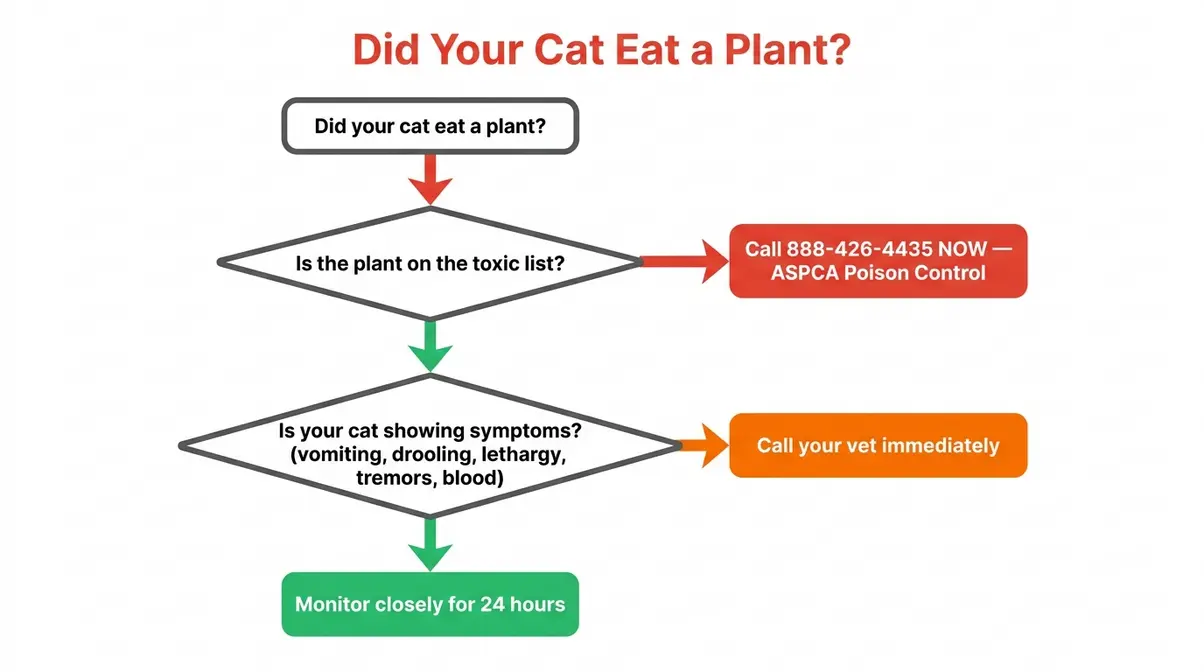
Use this flowchart immediately if your cat has eaten a plant — it guides you through the key decision points in under 60 seconds.
→ Yes: Call vet now. → No: Monitor for 24 hours.” — Alt: Cat plant poisoning emergency symptom flowchart — when to call the vet, Format: Flowchart]
The following symptoms after plant ingestion require immediate veterinary contact — do not wait to see if they resolve on their own:
- Vomiting that repeats more than twice within an hour
- Drooling excessively or pawing at the mouth (sign of oral burning from calcium oxalate crystals)
- Difficulty swallowing or a swollen-looking face/throat
- Lethargy — unusual unresponsiveness, not wanting to move
- Tremors or seizures
- Dilated pupils or disorientation
- Pale or yellowish gums (sign of liver stress)
- Difficulty breathing
- Blood in vomit or stool
If your cat has eaten a lily of any kind — even a small amount, even just pollen — treat it as an emergency regardless of symptoms. Lily toxicity causes acute kidney failure that may not produce obvious symptoms for 24-48 hours, by which point irreversible damage may have occurred.
When to Seek Veterinary Help
If in doubt, call. The ASPCA Animal Poison Control Center (888-426-4435) operates 24 hours a day, 7 days a week. There is a consultation fee, but the guidance you receive can save your cat’s life. When you call, have the following information ready:
- Your cat’s approximate weight and age
- The name of the plant (take a photo if you’re not sure — the vet can help identify it)
- How much you think was consumed and when
- Any symptoms your cat is currently showing
According to guidance from Grady Veterinary Hospital, even plants classified as “mildly toxic” can cause serious problems in small cats, kittens, or cats with pre-existing kidney or liver conditions. The size and health status of your cat matters enormously when assessing risk.
Never induce vomiting in a cat at home unless specifically instructed by a veterinarian or the ASPCA Poison Control line. Some toxic plant substances cause more damage on the way back up than they do going down.
[INTERNAL LINK: anchor text “emergency vet guide for cat owners” — link to internal article on emergency veterinary situations]
Frequently Asked Questions
Is it normal for cats to eat plants?
Yes, it is completely normal for cats to eat plants — in fact, it’s one of the most common behaviors reported by cat owners. A 2021 NCBI study found that approximately 71% of cats eat plants or grass regularly. The behavior is rooted in evolutionary instinct, digestive self-regulation, and nutritional seeking. The key concern isn’t whether your cat eats plants, but which plants they’re eating. Non-toxic plants like cat grass are a healthy outlet. Toxic plants like lilies are a medical emergency.
Do cats eat plants when sick?
Cats may eat plants or grass more frequently when they feel unwell, but sickness is not the primary reason most cats eat plants. The 2019 Science.org study found that only about 27% of grass-eating episodes were preceded by visible signs of illness — meaning healthy cats eat grass too, and often. If your cat has suddenly started eating plants much more often than usual, and especially if they also seem lethargic, are vomiting repeatedly, or have lost their appetite, a veterinary check-up is warranted to rule out intestinal parasites or gastrointestinal disease.
Why do cats eat plants and then throw up?
Cats often eat plants specifically to trigger vomiting — it’s a deliberate act of digestive self-regulation, not a sign of poisoning. The fiber in plant leaves stimulates the stomach wall and can trigger the gag reflex, helping cats expel accumulated fur, bile, or other material causing discomfort. This is normal if it happens occasionally and your cat seems fine afterward. It becomes a concern if vomiting is repeated, the cat seems distressed, there is blood in the vomit, or the plant consumed is known to be toxic.
What is the silent killer of cats?
Lilies are widely considered the “silent killer” of cats because the signs of poisoning are delayed and easy to miss. A cat that eats even a small amount of a lily — a petal, a leaf, or pollen licked off its fur — may seem fine for the first 12-24 hours. During that window, acute kidney failure is already developing. By the time obvious symptoms appear (lethargy, loss of appetite, vomiting), the damage may be irreversible. If you have any lilies in your home, remove them entirely. If your cat may have eaten one, call 888-426-4435 immediately.
How can I get my cat to stop eating plants?
The most effective approach combines three strategies: remove or isolate toxic plants, provide a dedicated cat grass station as a safe alternative, and increase daily interactive play to address boredom-driven chewing. Citrus deterrent sprays (diluted orange or lemon essential oil) applied to plant leaves and soil are also highly effective, as cats strongly dislike citrus scents. Punishment is not recommended — it increases stress without addressing the underlying motivation. For cats that chew compulsively despite these measures, a veterinary evaluation for pica may be needed.
How do I tell if my cat has pica?
Pica goes beyond occasional plant-nibbling — it’s a compulsive drive to eat non-food items repeatedly. Signs that your cat may have pica include: eating plants multiple times daily despite redirection, chewing or swallowing plastic bags, rubber bands, fabric, or paper, showing anxiety or distress when prevented from accessing the item, and unexplained gastrointestinal symptoms like vomiting or constipation. If you recognize these signs, schedule a veterinary appointment. Pica can cause dangerous intestinal blockages and has treatable underlying causes — nutritional deficiencies, anxiety, or early weaning — that a vet can identify and address.
Your Cat’s Green Cravings Are Manageable — Here’s What to Do Next
Understanding why do cats eat plants transforms a moment of anxiety into an opportunity to make your home safer and your cat happier. Most cats that chew on plants are doing exactly what their biology programmed them to do — seeking fiber, satisfying curiosity, or clearing a mildly uncomfortable stomach. The Green Craving Spectrum gives you a clear way to assess the situation: if your cat occasionally nibbles a non-toxic plant and seems otherwise healthy, you’re at the normal end of the spectrum. If the behavior is compulsive, involves toxic plants, or is accompanied by vomiting that won’t stop, you’re at the end that needs veterinary attention.
The practical steps are straightforward. Remove any lilies, pothos, philodendrons, or other toxic plants from your home — or move them to rooms your cat cannot access. Set up a cat grass station near your cat’s favorite lounging spot. Add 15 minutes of interactive play to your daily routine. Apply a citrus deterrent spray to any plants you want to keep. These four actions alone will resolve the plant-eating problem for the majority of cats.
⚕️ Medically Reviewed by a Veterinarian | 2026
If you suspect your cat has eaten a toxic plant or is showing any signs of illness, contact your veterinarian or the ASPCA Animal Poison Control Center at 888-426-4435 immediately. This article is for informational purposes only and does not substitute for professional veterinary advice.
Start today: walk through your home, check every plant against the ASPCA database at aspca.org, and order a pack of cat grass seeds. Your cat’s green craving isn’t going away — but with the right setup, it becomes a completely harmless, even enriching, part of their daily life.

Dave King
Cat owner and writer at Mad Cat Man.