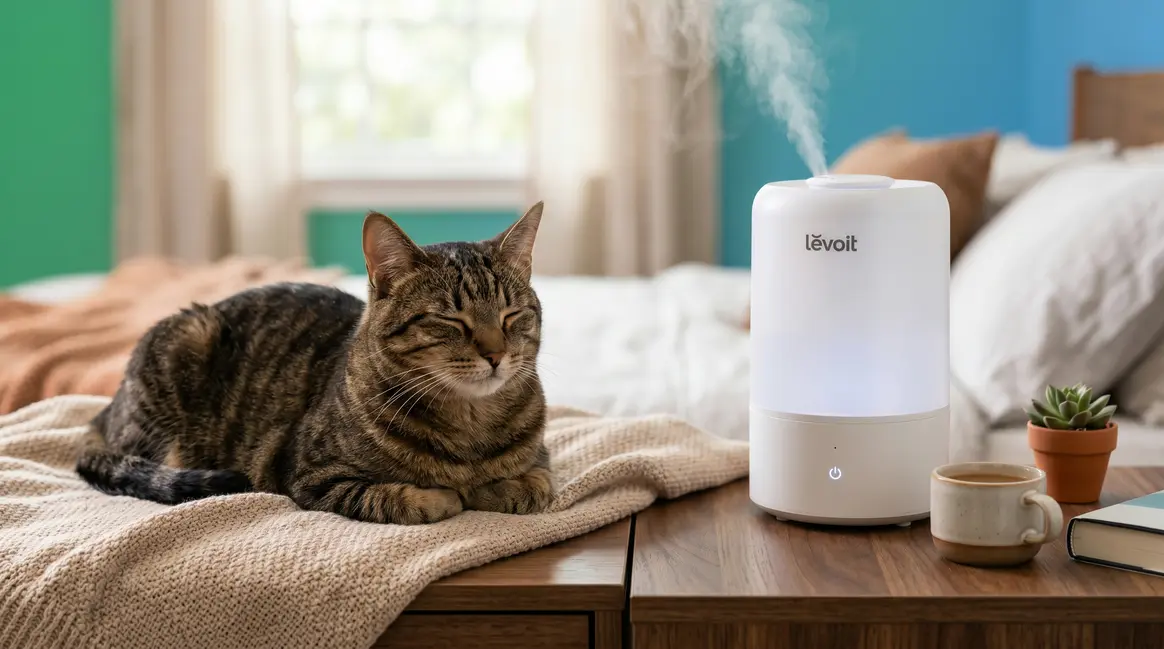

“I was today years old when I learned that Menthol in your humidifier is toxic to cats. Fortunately, I did not have a bad experience. The moment I turned on the humidifier and all three of my cats LOVED it, luckily I googled — to see it is TOXIC ☠️☠️☠️.”
— Cat owner, r/cats
This cat owner got lucky. Many don’t.
Most humidifier guides tell you to “use cool mist and clean it regularly.” What they don’t tell you is that the wrong additive — one you probably have in your medicine cabinet right now — can send your cat to the emergency vet. Are humidifiers safe for cats? Yes, but only when you understand all the ways they can go wrong. In this vet-approved guide, you’ll learn exactly how to use a humidifier safely around your cat — including the six steps every cat owner must follow and the hidden dangers that 90% of guides never mention.
This guide covers humidifier type selection, safe placement, essential oil toxicity, medicated additive risks, cleaning protocols, and how to monitor your cat’s response.
Are humidifiers safe for cats? Yes — but only when used correctly. Always choose a cool mist humidifier, use plain distilled water only, and never add essential oils, Vicks, or any fragrances. Keep the unit clean and place it out of your cat’s direct reach. Follow the six steps below for a fully cat-safe setup.
If you are wondering, are humidifiers safe for cats, the answer is yes—when you address all Three Layers of Humidifier Risk: physical dangers (burns, spills, mold), chemical dangers (essential oils, Vicks, white dust), and sensory dangers (ultrasonic frequencies). A plain cool mist humidifier with distilled water, cleaned every 3 days, poses minimal risk to healthy cats.
- Cool mist only: Warm mist and steam humidifiers create burn and scald risks for curious cats.
- No additives ever: Essential oils and Vicks are toxic to cats — even in small diffused amounts.
- Clean every 3 days: Dirty humidifiers breed mold and bacteria that harm your cat’s lungs.
- Monitor your cat: Watch for sneezing, watery eyes, or lethargy — stop use and call your vet immediately.
What You Need to Know Before You Start
Before you plug anything in, take 60 seconds to understand what you’re working with. This guide is for cat owners who use — or are considering — any type of home humidifier. You don’t need prior knowledge of humidifier mechanics or feline toxicology. You just need to follow the steps.
Estimated time: 15 minutes
- Tools and Materials:
- A cool mist humidifier (or a decision to buy one)
- Distilled water (not tap)
- A clean cloth and white vinegar for weekly cleaning
This guide is built around The Three Layers of Humidifier Risk — a framework that organizes every danger a humidifier poses to your cat into three clear categories:
- Physical: Burns, scalds, spills, and mold from standing water
- Chemical: Essential oils, Vicks, fragrances, and white mineral dust
- Sensory: High-frequency sound from ultrasonic units that may stress sensitive cats
Each of the six steps below addresses at least one of these layers. Work through them in order.
One important caveat: If your cat has asthma, a respiratory infection, or any chronic health condition, consult your vet before making any changes to your home’s humidity. Environmental changes — even beneficial ones — can affect vulnerable cats unpredictably.
Now let’s walk through the six steps that make a humidifier safe for your cat — starting with the most important decision you’ll make: which type to buy.
Step 1: Choose a Cool Mist Humidifier
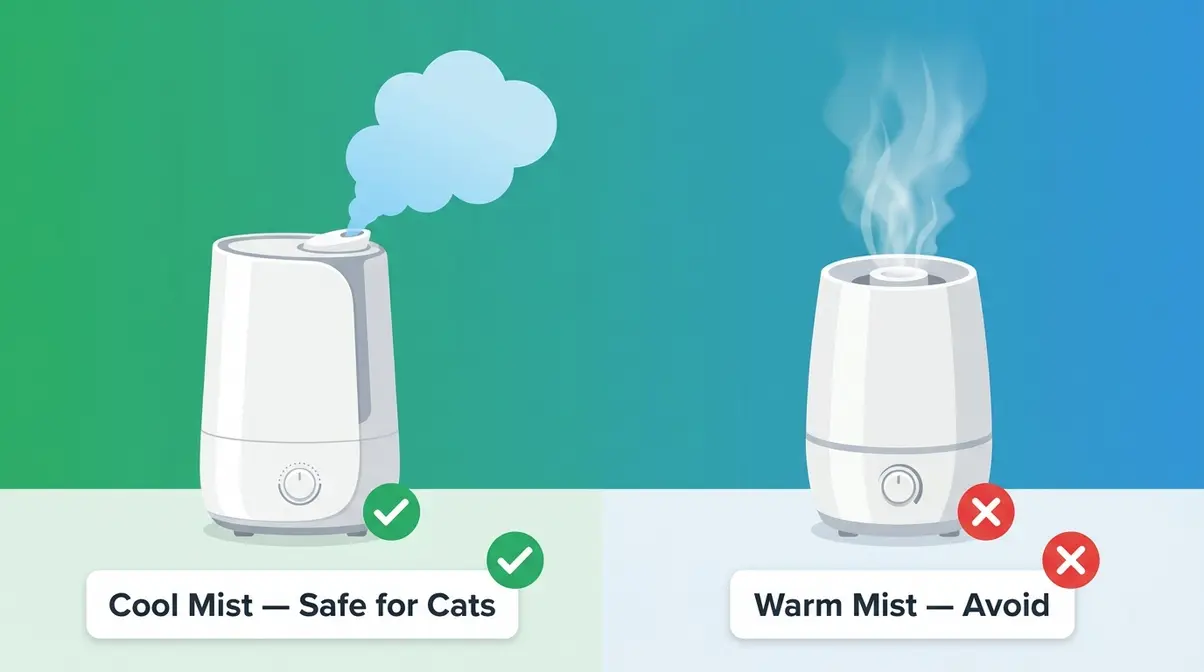
When asking are humidifiers safe for cats, the type of device you choose is the most critical factor. For homes with cats, cool mist humidifiers are the only safe choice. Warm mist units heat water to near-boiling temperatures; a curious cat jumping on the unit — or knocking it over — faces a serious burn and scald risk. Choosing cool mist eliminates the entire Physical layer of humidifier risk before your cat ever enters the room.
Cool Mist vs. Warm Mist
There are three main humidifier types. Here’s how they compare:
| Type | How It Works | Safe for Cats? | Key Risk |
|---|---|---|---|
| Evaporative (cool mist) | Fan blows air through a wet wick filter | ✅ Safest | None when clean |
| Ultrasonic (cool mist) | High-frequency vibrations create fine mist | ✅ Generally safe | Possible sound sensitivity (see below) |
| Warm mist / Steam | Heats water to boiling to release steam | ❌ Avoid | Burn and scald risk from hot water |
A cool mist humidifier — a device that releases room-temperature water vapor without heating the water — removes the burn risk entirely. An evaporative humidifier, which uses a fan and a wick filter to push moisture into the air, is the safest overall option. It produces no heat, no high-frequency vibrations, and no fine mineral particles.
The AVMA household hazard guidelines classify highly concentrated essential oils and medicated additives as household hazards that can severely harm pets (AVMA, 2026). The same principle applies to thermal hazards — warm mist units simply introduce an unnecessary physical risk that cool mist avoids entirely.
Cool mist humidifiers eliminate the burn and scald risk entirely — making them the only vet-recommended choice for homes with cats.
Aim to keep your home’s humidity between 30–50%, according to veterinary guidance from the University of Illinois College of Veterinary Medicine (2026). Most modern humidifiers include a built-in hygrometer to help you stay in that range.
Ultrasonic Units and Cat Hearing
An ultrasonic humidifier uses high-frequency sound vibrations to create mist — and this is where the Sensory layer of The Three Layers of Humidifier Risk comes in. Cats can hear sounds up to 85 kHz, one of the broadest hearing ranges among mammals (Heffner & Heffner, PubMed, 1985). Some ultrasonic humidifiers emit frequencies that, while inaudible to humans, may fall within a range your cat can detect.
Most cats show no reaction to ultrasonic units. However, if your cat avoids the room, flattens their ears, or seems agitated near the humidifier, switch to an evaporative model. It’s a simple fix that costs nothing.
Bottom line: Buy an evaporative cool mist humidifier. It’s the safest choice across all three risk layers.
✅ Checkpoint: You have a cool mist humidifier (or you’ve decided to buy one). You’re ready for Step 2.
Step 2: Place and Set Up Safely
Safe placement is the second step in protecting your cat from physical dangers. Even a cool mist unit can cause problems if it’s positioned incorrectly — creating puddles your cat walks through, or placed somewhere unstable that invites a spill.
Can cats be in the same room?
The question of whether a cat can be in the same room as a humidifier comes up constantly in cat owner communities. The answer is yes — as long as the room is ventilated, the unit is elevated, and your cat can exit freely. For a deeper dive into room dynamics, check out our comprehensive guide to humidifier safety for cats.
Follow these placement rules for a safe setup:
- Elevate it. Place the humidifier on a sturdy surface at least 2 feet off the ground — a dresser, shelf, or nightstand. This keeps the mist output above your cat’s face level and reduces direct inhalation of concentrated vapor.
- Keep it away from walls and furniture. Leave at least 6 inches of clearance on all sides to allow proper air circulation and prevent moisture buildup on surfaces.
Additionally, consider these environmental factors to ensure maximum safety:
- Avoid corners. Mist trapped in a corner raises local humidity too high, which encourages mold growth — a respiratory hazard for cats and humans alike.
- Choose a room your cat can leave freely. Never run a humidifier in a closed room where your cat is confined. Your cat should always be able to move away from the mist if it bothers them.
Preventing Spills and Tip-Overs
Cats are curious, and a humidifier sitting on a surface is an invitation to investigate. A knocked-over unit can spill water across electronics, create a slip hazard, or — if it’s a warm mist unit you haven’t yet replaced — cause burns.
- Use a non-slip mat under the humidifier to reduce wobble.
- Choose a wide-base model that’s harder to tip.
- Secure the power cord along the wall with cable clips so your cat can’t pull the unit down by tugging the cord.
- Consider a room your cat uses less. A bedroom you can close at night, or a home office, often works better than a living room where your cat spends hours at play.
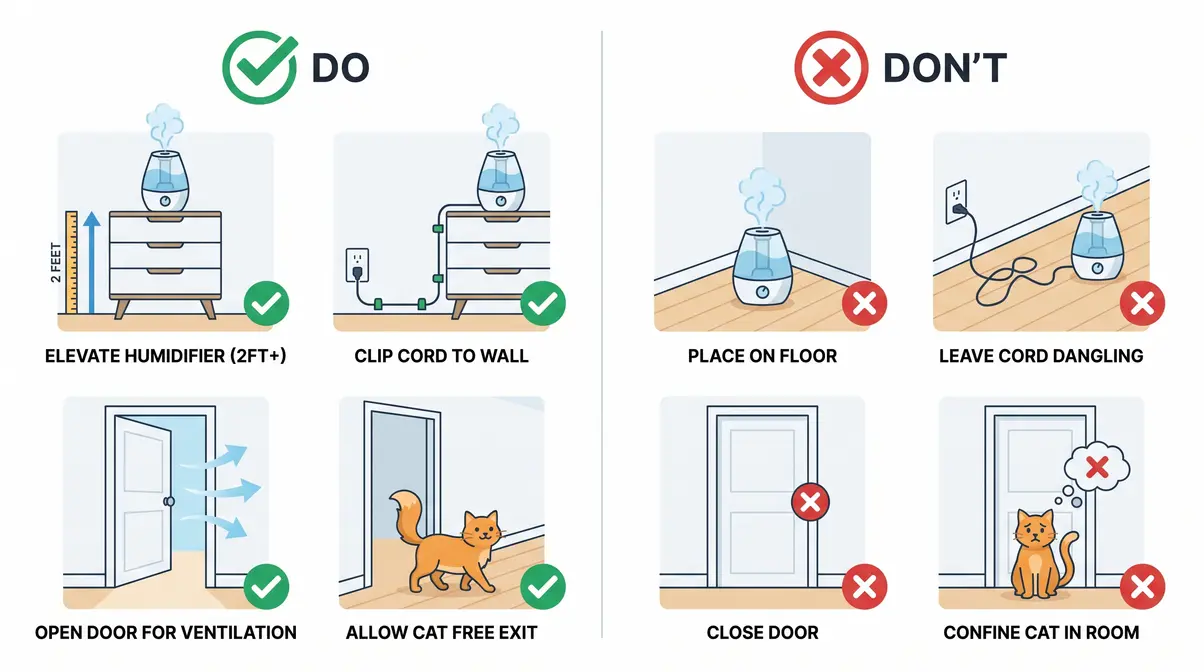
✅ Checkpoint: Your humidifier is elevated, stable, and in a room your cat can leave freely. Move on to Step 3 — the most important safety rule of all.
Step 3: Never Add Essential Oils
This is the rule that most cat owners don’t know until it’s almost too late — exactly like the cat owner quoted at the top of this guide. Never add essential oils, fragrance drops, or any scented liquid to your humidifier’s water tank. This step addresses the Chemical layer of The Three Layers of Humidifier Risk.
Why Essential Oils Are Toxic
Essential oils are toxic to cats for a specific biological reason, not just a vague chemical sensitivity. Essential oils are just one of many hidden household toxins for cats that owners often overlook. Cats lack sufficient glucuronyl transferase (the liver enzyme responsible for breaking down and eliminating certain toxins, including the phenols and terpenes found in essential oils). According to the ASPCA Animal Poison Control Center, essential oils can cause serious harm to cats through inhalation, skin contact, or ingestion — and diffused oils in a humidifier create all three exposure routes simultaneously.
When your cat inhales diffused oil particles, those compounds enter the bloodstream. Without the enzyme to process them, the toxins accumulate. The result can include liver damage, neurological symptoms, and respiratory distress. Across veterinary communities, the consistent warning is clear: even small, diffused amounts of certain oils can be dangerous for cats (VCA Animal Hospitals, 2026).
“Cats lack an essential enzyme in their liver and as such have difficulty metabolizing and eliminating certain toxins like essential oils.” — Pet Poison Helpline
This is also why cats are far more sensitive to essential oils than dogs. Dogs have more robust liver detoxification pathways. Your cat simply cannot process these compounds safely.
Essential Oils to Avoid
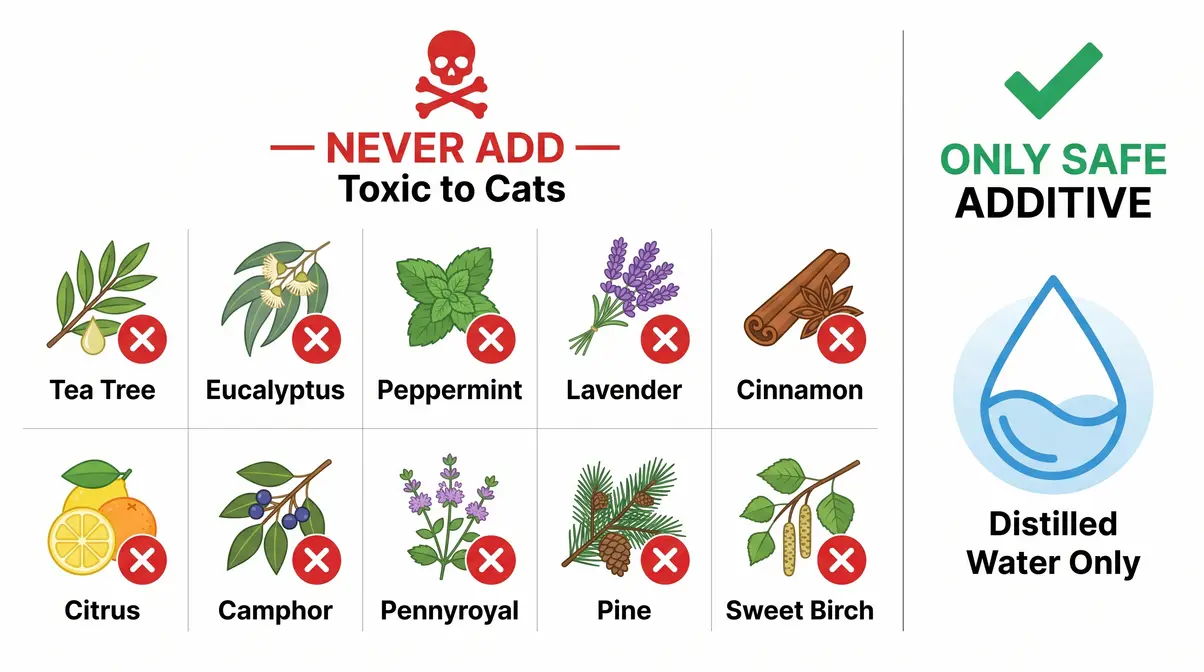
The following oils are confirmed toxic to cats and must never be used in a humidifier (VCA Animal Hospitals, 2026; ASPCA):
| Essential Oil | Risk Level | Symptoms |
|---|---|---|
| Tea tree (melaleuca) | Severe | Tremors, paralysis, liver failure |
| Peppermint | High | Respiratory distress, vomiting |
| Eucalyptus | High | Drooling, lethargy, seizures |
| Cinnamon | High | Mouth irritation, liver damage |
| Citrus (lemon, orange) | High | Vomiting, depression, skin irritation |
| Lavender | Moderate–High | Nausea, lethargy |
| Camphor | High | Seizures, CNS depression |
| Pine | High | Liver damage, kidney failure |
| Pennyroyal | Severe | Liver failure |
| Sweet birch | Severe | Similar to aspirin toxicity |
The safest rule: add nothing. Distilled water only.
Safe Alternatives for Scent
You don’t have to choose between a fresh-smelling home and a safe one. These alternatives pose no known risk to cats:
- Baking soda in a small open dish neutralizes odors without releasing airborne compounds.
- Ventilation — opening windows for 15–20 minutes daily removes stale air more effectively than any fragrance.
- Cat-safe plants like valerian or catnip provide natural scent without toxic compounds.
- Regular litter box cleaning (twice daily) eliminates the most common source of household odor.
✅ Checkpoint: Your humidifier contains distilled water only. No oils, no fragrances, no additives. You’re ready for Step 4.
Step 4: No Vicks or Medicated Additives
Vicks VapoSteam is one of the most common humidifier additives in medicine cabinets across the country. It’s also one of the most dangerous things you can add to your humidifier if you have a cat. This step continues addressing the Chemical layer of The Three Layers of Humidifier Risk.
Why Vicks VapoSteam Is Dangerous
Many cat owners reach for Vicks VapoSteam when their cat shows signs of a respiratory infection or upper respiratory infection — the logic being that if it helps humans breathe, it might help their cat. This is an understandable instinct, and a dangerous one.
Cats have a far stronger sense of smell than humans — roughly 14 times more sensitive — which means the concentrated vapors from Vicks are overwhelming even at low doses. Veterinary sources consistently advise against using Vicks or any medicated inhalant around cats (Dial-a-Vet, 2026). Inhalation of the vapors can cause respiratory irritation, excessive drooling, and central nervous system depression.
If your cat has breathing problems or shows signs of a respiratory infection, the correct action is a veterinary visit — not a home remedy with medicated steam.
Toxic Ingredients in Vicks
Vicks VapoSteam contains three active ingredients that are all problematic for cats:
- Menthol: A compound derived from peppermint oil. Cats cannot safely metabolize menthol — it causes respiratory irritation and can trigger neurological symptoms at higher exposures.
- Eucalyptus oil: Listed as toxic to cats by VCA Animal Hospitals. Symptoms of eucalyptus exposure include drooling, vomiting, lethargy, and in severe cases, seizures.
- Camphor: A substance that causes CNS (central nervous system) depression in cats. Even small amounts inhaled over time can lead to tremors and weakness.
The combination of all three in one product makes Vicks VapoSteam a triple threat. The rule here is identical to the essential oils rule: use plain distilled water. Nothing else.
✅ Checkpoint: You’ve confirmed your humidifier water contains no Vicks, no medicated additives, and no menthol or eucalyptus-based products. On to Step 5.
Step 5: Clean Your Humidifier Every 3 Days
A humidifier that isn’t cleaned regularly becomes a mold and bacteria incubator. The mist it releases then carries those microorganisms directly into your cat’s airways. This step closes the remaining Physical layer risk: biological contamination.
How Often to Clean Your Unit
Clean your humidifier every 3 days when it’s in daily use. Rinse the water tank daily and replace the water with fresh distilled water each time you refill it. Standing water — even in a clean tank — begins developing bacterial biofilm within 24–48 hours at room temperature.
Veterinary guidance from the University of Illinois College of Veterinary Medicine emphasizes that optimal indoor humidity for pets is the same as for humans (30–50%), and that a clean humidifier is essential to achieving that without introducing respiratory hazards (University of Illinois, 2026).
The 5-Step Cleaning Process
You’ll need: white vinegar, a soft cloth or sponge, clean water, and about 20 minutes.
- Unplug the humidifier and empty any remaining water from the tank. Never clean a plugged-in unit.
- Fill the tank halfway with undiluted white vinegar. Swirl it around to coat all interior surfaces, then let it sit for 20 minutes. Vinegar dissolves mineral deposits and kills most common mold species.
- Scrub the interior with a soft cloth or sponge. Pay close attention to the corners and the base of the tank where biofilm accumulates first.
- Rinse thoroughly with clean water — at least two full rinse cycles — until no vinegar smell remains. Residual vinegar vapor is irritating to cats’ respiratory tracts.
- Dry completely before refilling. A damp tank that sits unused invites mold to return within hours.
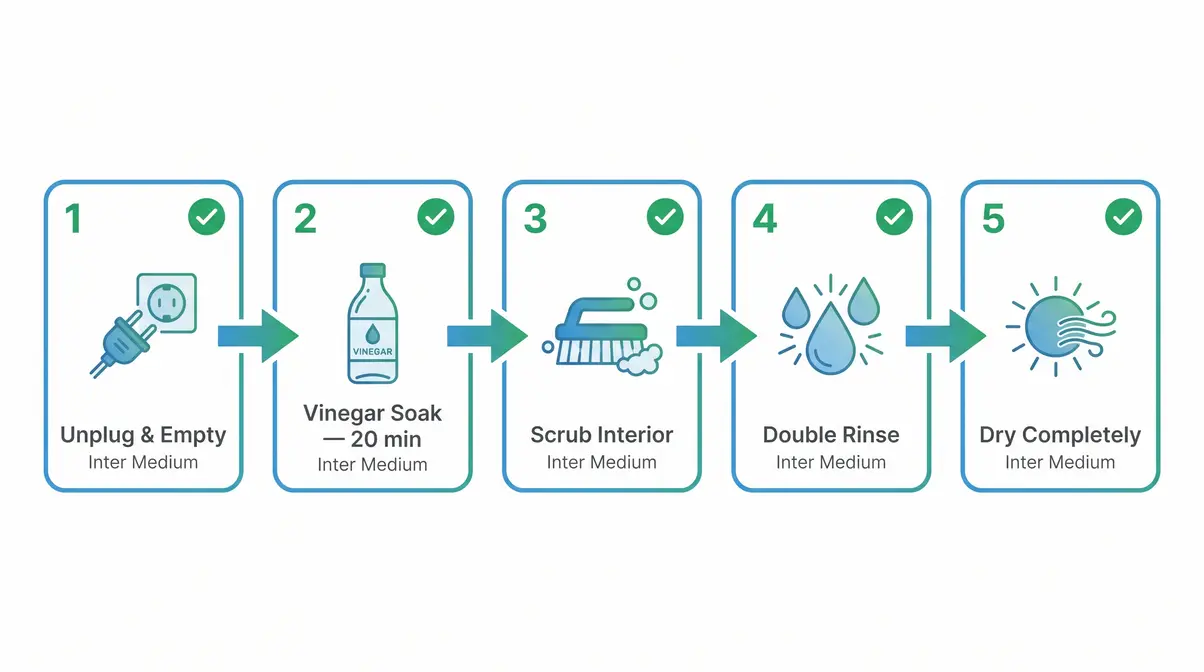
✅ Checkpoint: You have a cleaning schedule set for every 3 days. Your tank is rinsed and refilled with fresh distilled water. Time for the final step.
Step 6: Monitor Your Cat’s Response
Once your humidifier is running safely, your job isn’t over. Cats can’t tell you when something feels wrong. Watching your cat’s behavior and physical condition is the last — and ongoing — step in the protocol.
Does humidity affect breathing?
Humidity directly affects a cat’s respiratory comfort, particularly for cats with asthma, dry airways, or chronic upper respiratory infections. Cats with dry skin, mild respiratory issues, or seasonal itchy skin often show visible improvement within a week of consistent humidifier use.
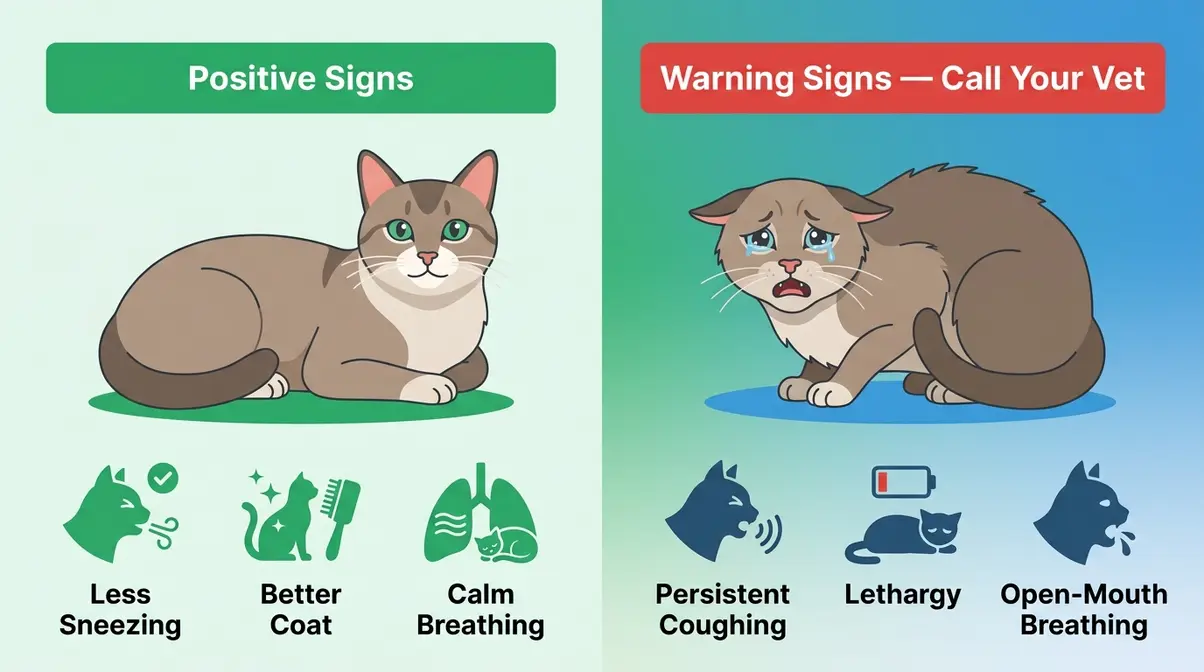
Positive signs to look for:
- Reduced sneezing — less frequent dry sneezing suggests the airways are better hydrated
- Improved coat condition — less static, less flaking, smoother fur texture
- More relaxed breathing — slower, quieter breaths without the occasional wheeze or rattle
- Increased comfort near the unit — some cats actively seek out the mist, which is a reliable behavioral signal that it’s not causing distress
Research from the Cornell Feline Health Center notes that environmental management — including air quality and humidity — is a key component of managing feline asthma and chronic respiratory conditions. Maintaining 30–50% indoor humidity supports comfortable breathing for most cats.
Warning Signs to Watch For
Stop using the humidifier and contact your veterinarian if your cat shows any of the following:
- Persistent sneezing or coughing that begins or worsens after the humidifier is turned on
- Watery or red eyes — a sign of airborne irritation
- Lethargy or hiding — behavioral withdrawal is a common early sign of toxin exposure
- Labored breathing or open-mouth breathing — this is a veterinary emergency; call immediately
- Excessive grooming or skin irritation — may indicate the mist is depositing something irritating on your cat’s coat
- Loss of appetite — often accompanies nausea from chemical exposure
Across cat owner communities, the consistent pattern is that problems arise within the first 24–48 hours of exposure to a new humidifier or additive. If your cat seems fine after 72 hours, the setup is almost certainly safe.
✅ Checkpoint: You’re actively monitoring your cat’s behavior and you know which signs require an immediate vet call. Your six-step protocol is complete.
A Quick Note on Dogs
If you share your home with both cats and dogs, the same six steps apply — with one important difference. Dogs have a more robust liver detoxification system than cats, which means they’re somewhat less sensitive to essential oils and medicated vapors. However, “somewhat less sensitive” does not mean “safe.” Menthol, eucalyptus, and camphor are all harmful to dogs as well. Vicks humidifiers are not safe for dogs either.
The practical takeaway: run your humidifier with distilled water only, regardless of which pets share your home. The cool mist, no-additives, clean-regularly protocol protects cats, dogs, and humans equally. There is no separate “dog-safe” list of humidifier additives — the safest additive for any pet household is plain water.
When Humidifiers Are Not Safe
Used correctly, a humidifier is a safe and genuinely helpful tool for many cats. Used incorrectly, it can cause serious harm. Here’s an honest assessment of where cat owners most often go wrong.
Common Mistakes Cat Owners Make
Veterinary consensus and cat owner communities consistently identify the same recurring errors:
- Using tap water instead of distilled. Tap water contains minerals that create “white dust” — fine particles that settle on surfaces and can be inhaled. Distilled water eliminates this entirely.
- Adding essential oils “just a little bit.” There is no safe dose of essential oils in a humidifier for cats. The glucuronyl transferase deficiency means even trace amounts accumulate over repeated exposures.
- Running the humidifier in a sealed room with the cat. Confined exposure concentrates any airborne compounds — including mineral dust or mold spores from a dirty unit — with no escape route for your cat.
Other frequent missteps include maintenance and equipment choices:
- Skipping the cleaning schedule. A humidifier that looks clean can harbor mold and bacteria within 48 hours of filling. Appearance is not a reliable indicator of biological safety.
- Using a warm mist unit “because it’s what they had.” The burn and scald risk is real. Replacing a warm mist unit with a cool mist model is a one-time cost that eliminates an ongoing physical hazard.
- Ignoring early warning signs. Occasional sneezing after the humidifier turns on is not normal variation — it’s a signal. Cat owners who dismiss early symptoms often face more serious veterinary situations later.
When to Call Your Veterinarian
Contact your vet immediately if your cat shows open-mouth breathing, severe lethargy, tremors, or loss of coordination after any humidifier exposure. These are signs of potential toxin exposure or respiratory distress and require urgent professional evaluation.
Call your vet (non-emergency) if you notice persistent sneezing, watery eyes, or appetite changes that correlate with humidifier use. You should also consult your vet before starting humidifier use if your cat has a known diagnosis of asthma, allergic reactions, chronic upper respiratory infections, or any immune condition. Environmental changes can alter the management of these conditions in ways that require professional guidance.
The Texas A&M College of Veterinary Medicine explicitly warns that essential oil diffusers — functionally similar to humidifiers with additives — pose documented risks to cats and should be avoided entirely in feline households (Texas A&M Veterinary Medicine & Biomedical Sciences).
Frequently Asked Questions
Are humidifiers safe for dogs?
Yes, cool mist humidifiers are generally safe for dogs when used with plain distilled water. Dogs have a slightly more robust liver detoxification system than cats, but they are still vulnerable to airborne toxins. Medicated additives like Vicks and highly concentrated essential oils can cause respiratory distress in canines just as they do in felines. Always stick to plain water to protect all the pets in your household.
Is cool or warm mist better?
Cool mist is always the better and safer choice for any household with pets. Warm mist units heat water to near-boiling temperatures to create steam, which introduces a severe burn and scald hazard. If a curious cat knocks over a warm mist humidifier, the resulting injuries can be devastating. By choosing an evaporative cool mist model, you completely eliminate this unnecessary physical risk.
What is the top safety rule?
The single most important rule is to never add anything to the humidifier’s water tank. No essential oils, no Vicks, no fragrances, and no medicated additives should ever be used around cats. According to the ASPCA Animal Poison Control Center, cats cannot safely metabolize the phenols and terpenes found in these additives due to a liver enzyme deficiency. Plain distilled water is the only safe option.
Keeping Your Cat Safe
Humidifiers are safe for cats — but only when all three layers of risk are addressed. The Physical layer (burns, spills, mold), the Chemical layer (essential oils, Vicks, white dust), and the Sensory layer (ultrasonic frequencies) each require a specific, deliberate response. A cool mist evaporative humidifier, filled with distilled water and cleaned every 3 days, addresses all three simultaneously.
The Three Layers of Humidifier Risk framework exists precisely because generic advice — “use cool mist, keep it clean” — leaves too many gaps. The cat owner in that Reddit post followed no specific protocol and nearly harmed three cats. The six steps in this guide close every one of those gaps.
Your next step is straightforward: check your current humidifier type, empty any water with additives, and refill with plain distilled water. If you don’t yet own a humidifier, choose an evaporative cool mist model. Set a 3-day cleaning reminder on your phone right now. If your cat has any existing respiratory condition, call your vet before you start. That one conversation could make the difference between a helpful tool and a harmful one. So, are humidifiers safe for cats? Absolutely, as long as you follow these guidelines.

Dave King
Cat owner and writer at Mad Cat Man.