
“I have 2 cats and one of them gets really stressed out with thunderstorms. Where I live, we’re getting into the rainy season where afternoon thunderstorms …”
— Cat owner, r/CatAdvice
If that sounds familiar, you’re not alone — and your cat’s fear is completely real.
Every storm season, millions of cats across the world tremble, bolt, and hide — and most of their owners have no idea why, or what they can do to help. The guilt of watching your pet suffer while feeling powerless is genuinely awful.
In this guide, you’ll learn exactly why cats scared of thunderstorms react the way they do, and get a step-by-step action plan you can use during the next storm — and every storm after that. We’ll cover the hidden science behind feline storm anxiety, four proven calming steps, long-term desensitization techniques, and when a vet visit is the right call.
Cats scared of thunderstorms react to three hidden physiological triggers — hypersensitive hearing, barometric pressure drops, and static electricity in their fur — together forming what we call The Storm Stress Triangle.
- The cause is physiological: Cats detect storms before they arrive through pressure and static changes their bodies sense directly
- Immediate help: A dark, interior “storm sanctuary” reduces sensory overload fast — choose a room with no windows
- 12 calming techniques range from white noise and pheromone diffusers to vet-prescribed gabapentin
- Long-term fix: Counterconditioning (gradually pairing thunder sounds with treats) can reduce fear over weeks to months
- Severe cases: Consult a vet — astraphobia (clinical storm phobia) may need prescription medication
Why Are Cats So Afraid of Thunderstorms?
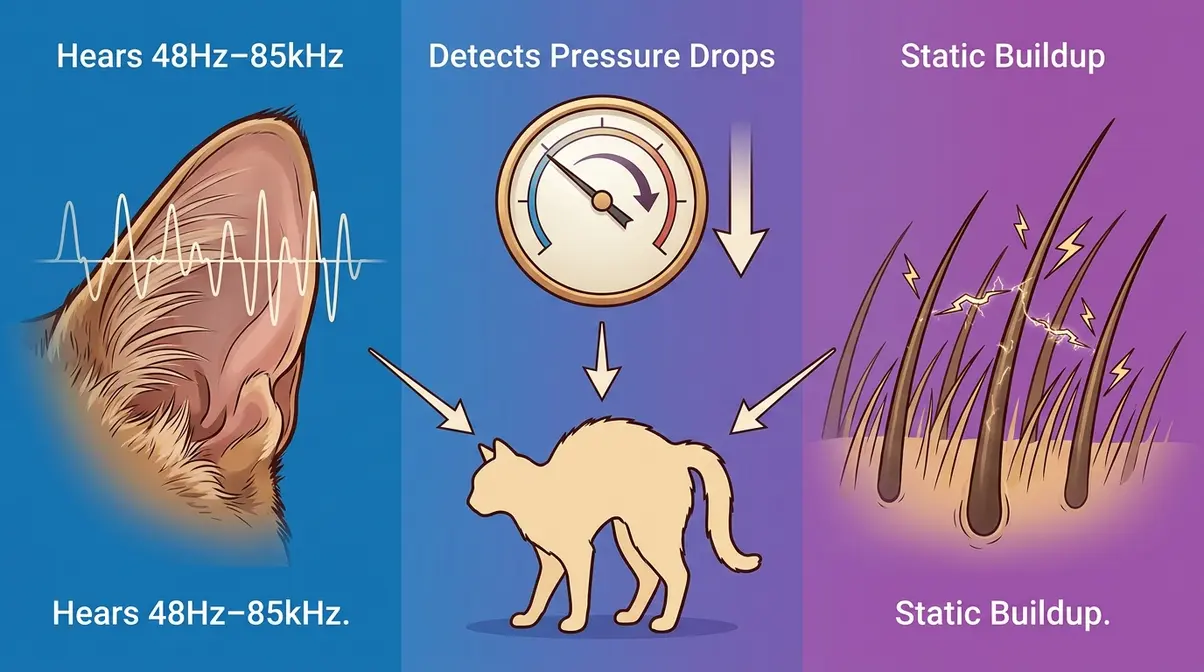
Cats don’t just dislike loud noises — they experience thunderstorms as a full-body, multi-sensory assault that activates their deepest survival instincts. Understanding the three physiological triggers behind feline storm anxiety helps you choose the right calming approach for your cat.
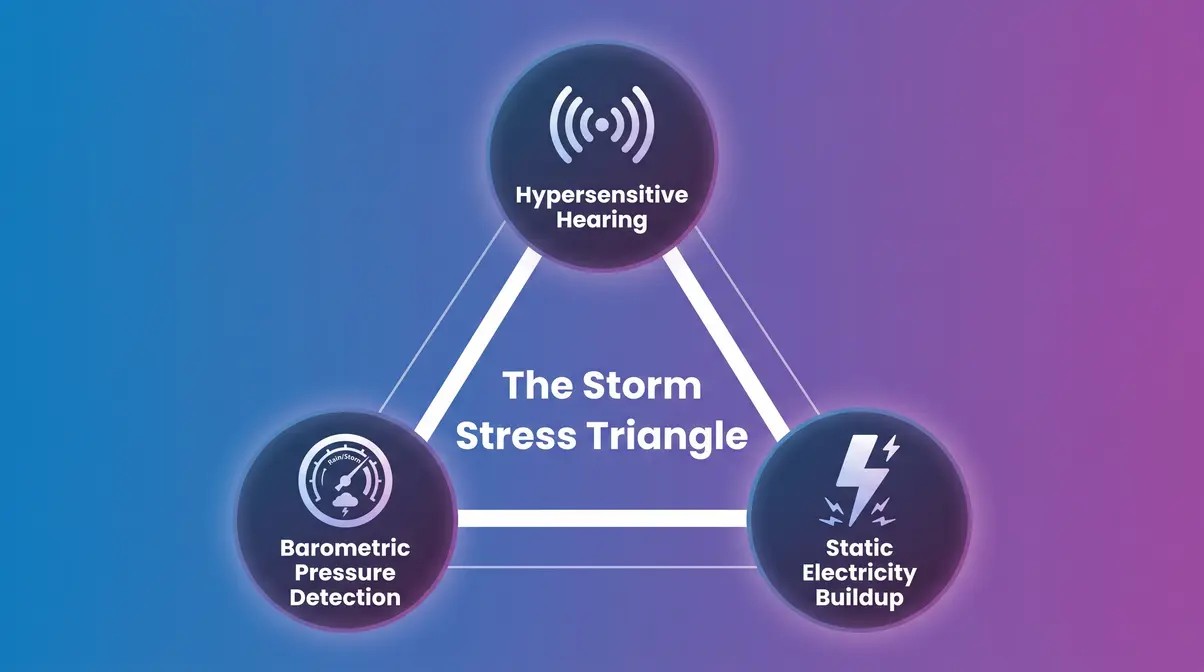
The Storm Stress Triangle
Why are cats so afraid of thunderstorms? The honest answer is that a storm isn’t one threat — it’s three hitting your cat simultaneously, each one triggering a biological alarm they cannot ignore. Cats experience thunderstorms as a compound sensory assault, which is why standard “just comfort your cat” advice often falls short.
Here are the three points of The Storm Stress Triangle:
1. Hypersensitive Hearing
Cats hear frequencies ranging from 48 Hz to 85 kHz — a range dramatically broader than the human hearing span of roughly 64 Hz to 23,000 Hz (PubMed, 1985; LSU School of Veterinary Medicine). That means a thunderclap your ears register as a loud boom registers to your cat as something far more intense and complex. Thunder contains low-frequency rumbles and sharp high-frequency cracks — your cat hears all of it, amplified.
2. Barometric Pressure Detection
Your cat’s inner ear is exquisitely sensitive to atmospheric pressure. Veterinary behavioral studies note that cats can detect changes in barometric pressure hours before a storm arrives — behavioral shifts have been documented 6 to 24 hours ahead of significant weather events (Farmers’ Almanac, citing veterinary study data). In plain terms: your cat’s inner ear works like a tiny weather barometer, sensing the storm’s arrival before the first thunderclap. This is why some cats run for cover before you’ve even seen a cloud.
3. Static Electricity Buildup
During thunderstorms, the atmosphere becomes highly charged. That charge accumulates in your cat’s fur — especially in longer-haired breeds. Research from Northwestern University (2026) confirmed that friction and dry-air conditions generate measurable electrostatic charges in animal fur. Your cat may feel repeated mild static shocks across their body, with no way to understand why. This physical discomfort compounds the sound and pressure triggers into something genuinely overwhelming.
These three triggers don’t arrive separately — they stack. A storm-anxious cat isn’t just startled by noise. They’re simultaneously hearing something painfully loud, feeling their inner ear register a pressure drop, and experiencing static discharges through their fur. Understanding this is why The Storm Stress Triangle matters: it explains why some techniques work for some cats and not others, and why matching the solution to the specific trigger is the key principle.
For a deeper look at feline anxiety behaviors and what drives them, see our guide on cats scared of thunderstorms.
Signs of Feline Storm Anxiety
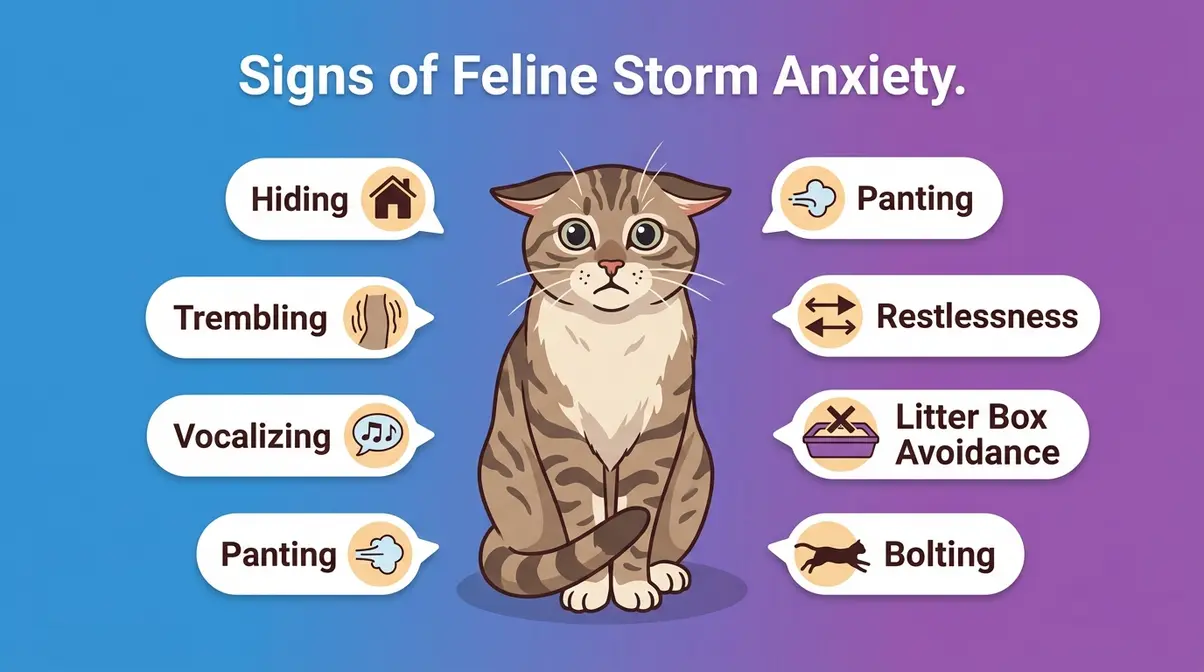
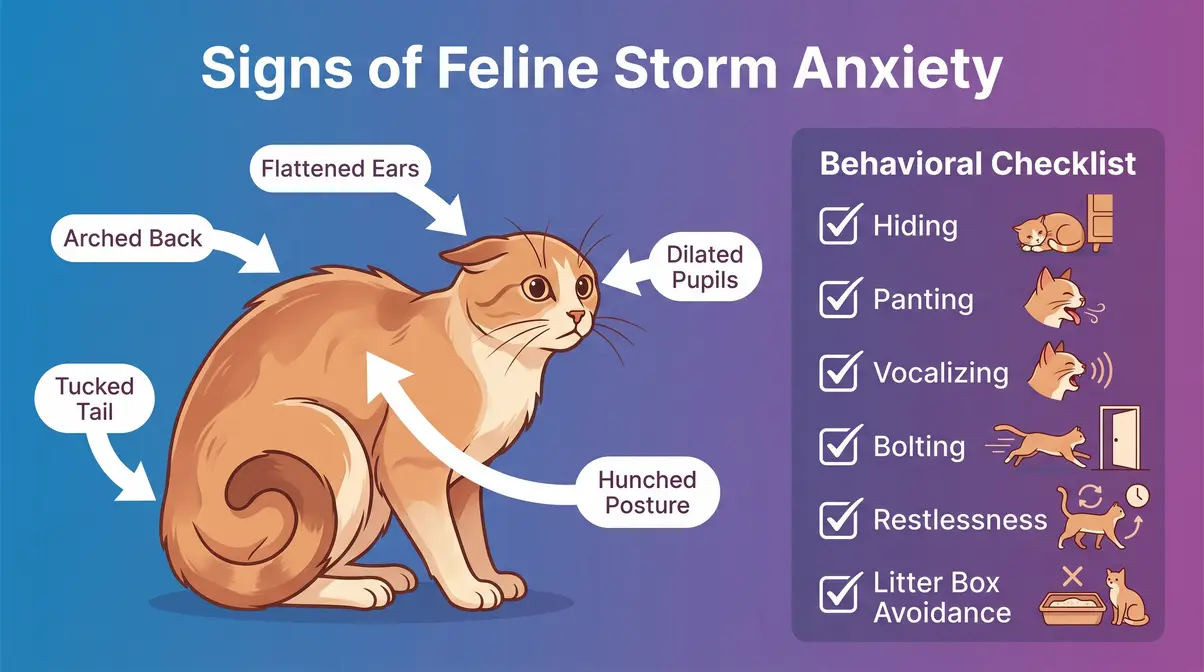
Not every storm-anxious cat trembles visibly. Some cats show dramatic signs; others suffer in silence. User consensus from cat owner communities — and clinical observation from veterinary behaviorists — points to a consistent set of behaviors.
Common signs of feline storm anxiety include:
- Hiding — under beds, inside closets, behind furniture, or in any enclosed dark space
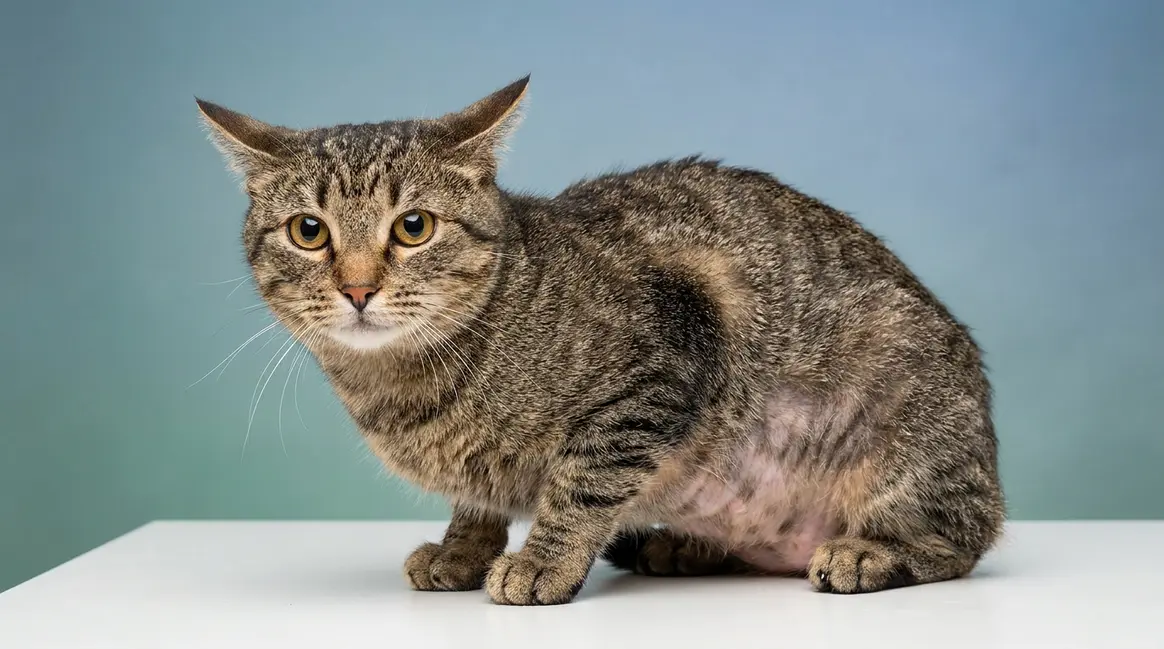
- Trembling or shaking — especially around the shoulders, flanks, or whole body
- Vocalizing — yowling, meowing more than usual, or crying
- Panting or drooling — signs of acute physiological stress, not just behavioral fear
- Restlessness — pacing, inability to settle, repeatedly moving from spot to spot
- Eliminating outside the litter box — a stress response, not a litter problem
- Bolting — sudden sprinting to hide at the first sound of thunder
This condition has a clinical name: astraphobia, the clinical term for an intense, exaggerated fear of thunderstorms in animals. It’s a recognized anxiety disorder, not a personality quirk.
One important nuance: some cats show none of these outward signs but still experience significant internal stress. Elevated cortisol, increased heart rate, and muscle tension can all occur without visible shaking or hiding. If your cat seems “fine” during storms but acts off afterward — clingy, withdrawn, or off their food — that’s worth noting.
Why the sudden fear of storms?
Cats can develop storm phobia at any age, even if they seemed unbothered by storms before. A single traumatic storm experience — a very close lightning strike, a power outage, or an injury during a storm — can create a lasting fear association. Age-related hearing changes can also make thunder suddenly more overwhelming. Additionally, cats may pick up on their owner’s own storm anxiety. If this is a new behavior, a vet visit is worth scheduling to rule out any underlying health changes, particularly age-related sensory shifts.
4 Steps to Calm Your Cat During Storms
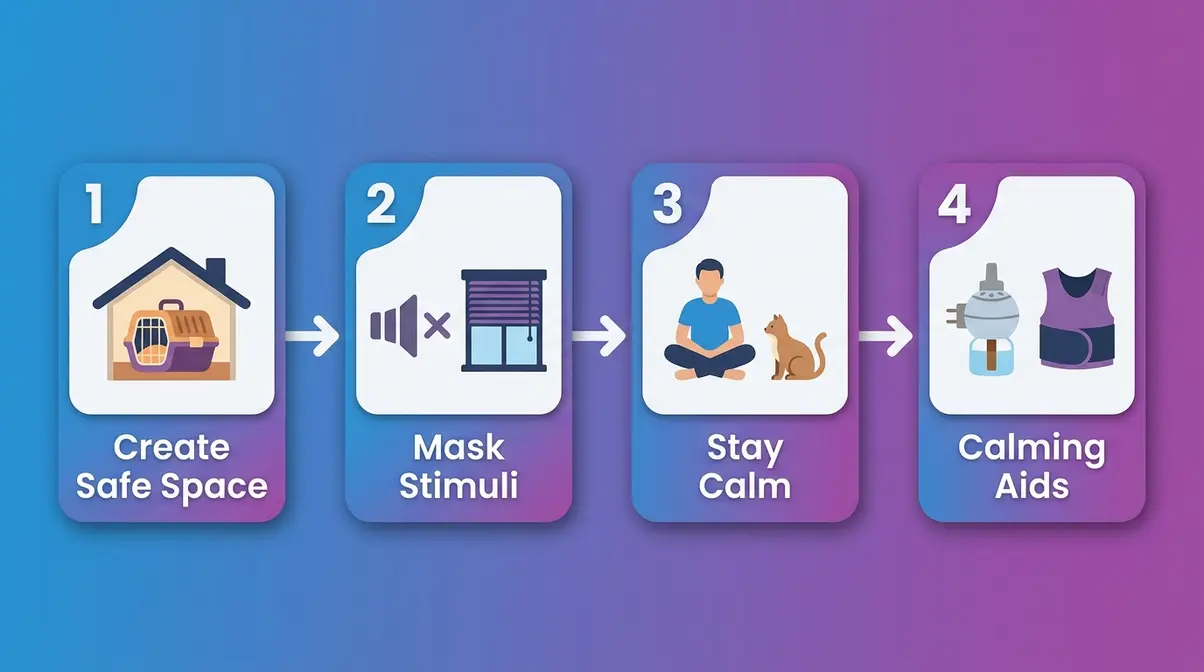
The four steps below address each point of The Storm Stress Triangle directly. You can implement all of them tonight, during the next storm. Before you begin, here’s what you’ll need:
- Prerequisites / What You’ll Need:
- Estimated time: 15-30 minutes for setup
- A quiet interior room (bathroom, walk-in closet, or bedroom away from windows)
- Blankets or an old T-shirt with your scent
- A white noise machine, fan, or a calm music playlist
- Optional: Feliway pheromone spray or diffuser (available at pet stores)
- Optional: Thundershirt or anxiety wrap (sized for your cat)
- High-value treats your cat loves
Step 1: Create a Safe Space
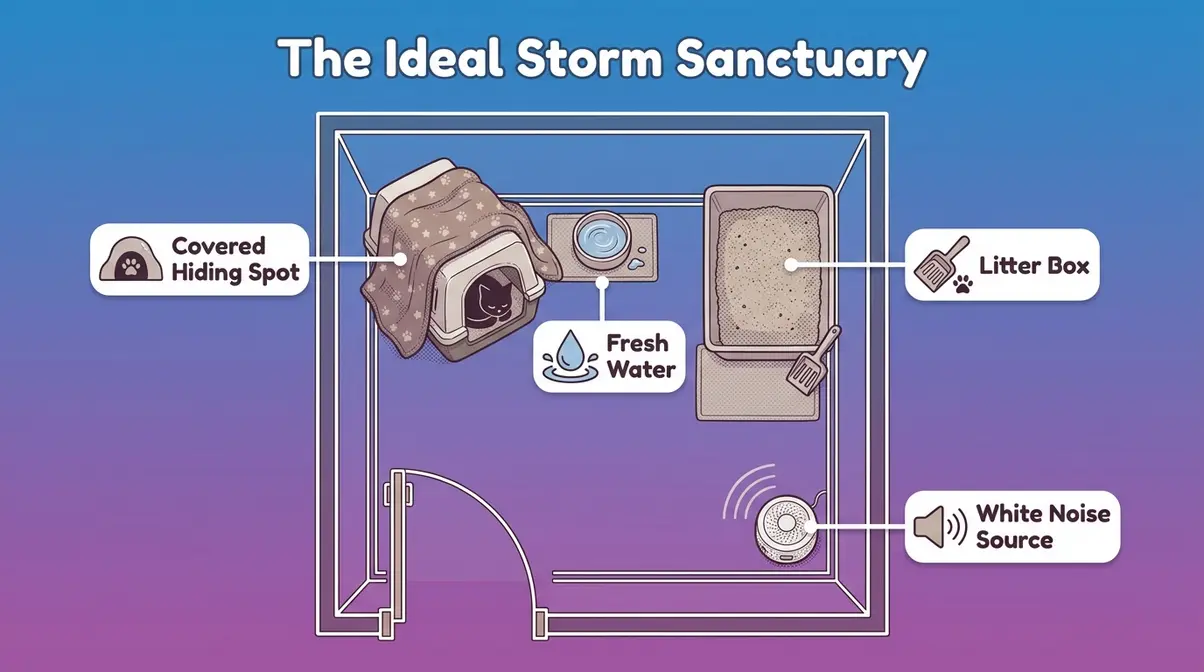
Every cat needs a storm retreat — a specific, pre-prepared space where they feel genuinely safe. The goal is to reduce all three points of the Storm Stress Triangle at once: muffled sound, no lightning flashes, and reduced static exposure.
How to set it up:
1. Choose an interior room
Select a space with no windows, or as few windows as possible. Bathrooms and walk-in closets work well. The walls provide natural sound dampening and block lightning flashes entirely.
2. Add familiar scent
Place an unwashed T-shirt or blanket you’ve recently used inside. Your scent signals safety to your cat’s brain, activating their social bonding response.
3. Include a covered hiding spot
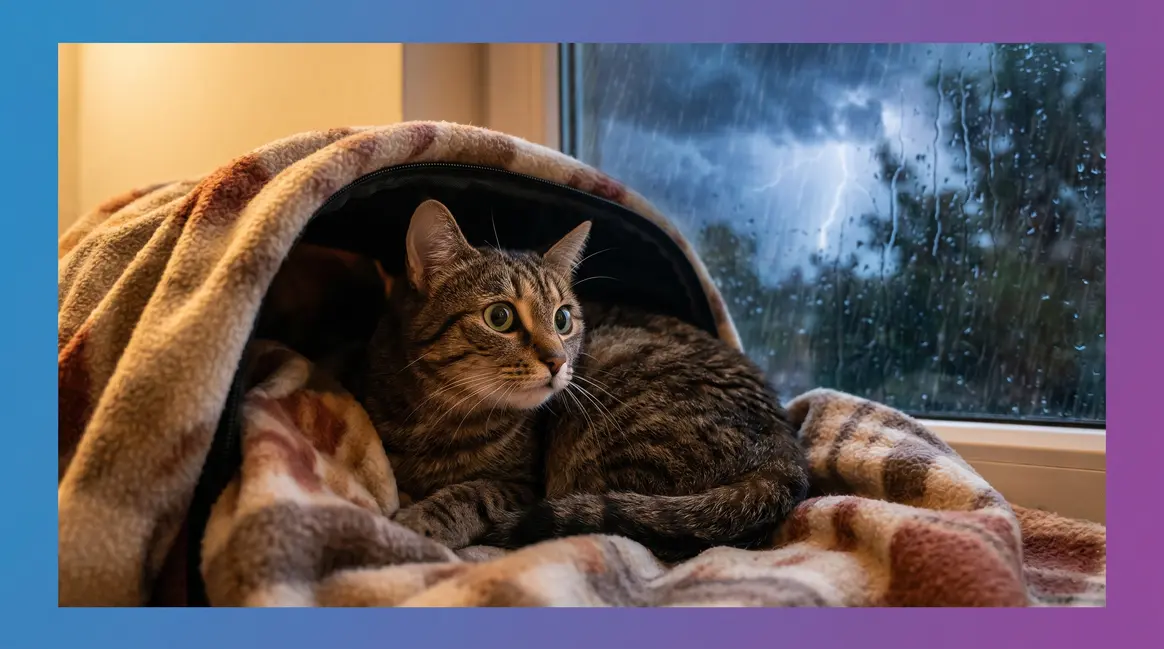
Use an open cat carrier with a blanket draped over it, or a cardboard box on its side. Enclosed spaces lower a cat’s perceived threat level significantly.
4. Add a litter box and water
Include these essentials if your cat tends to stay hidden for extended periods during storms, ensuring they don’t have to leave their safe zone.
5. Leave the sanctuary open all the time
Cats won’t use a space they associate only with forced confinement. Introduce it during calm weather by placing treats and toys inside so it becomes a positive space.
Why this works: The sanctuary directly addresses two Storm Stress Triangle triggers — it blocks visual lightning flashes and dampens sound. It also reduces the cat’s perceived need to be “on alert” by giving them a defensible, enclosed space their instincts recognize as safe.
Veterinary guidelines from the Ohio State University Indoor Cat Initiative emphasize that cats require predictable, owner-scented retreat spaces to self-regulate anxiety — this applies directly during storms.
Step 2: Mask Sound, Light, & Static
Once your cat is in their sanctuary, your next job is to reduce the sensory input reaching them. This step addresses all three points of The Storm Stress Triangle in sequence.
Sound: Turn on a white noise machine, a box fan, or play calm classical music at a moderate volume — enough to partially mask thunder without adding more startling noise. Research into sound therapy for anxious cats suggests consistent, low-frequency ambient sound reduces startle responses. Avoid sudden volume changes.
Light: Close all blinds and curtains in the room. If lightning is still visible under doors, place a rolled towel at the base. Eliminating the visual flash removes one of the three triggers entirely.
Static: This is the most overlooked step. During storms, increase humidity in the sanctuary using a small portable humidifier — higher moisture in the air allows static charges to dissipate rather than build in your cat’s fur (Northwestern University, 2026). For longer-haired cats especially, a light mist of water on their coat (if they tolerate it) can reduce charge buildup. Use cotton bedding instead of polyester, which generates more static. Do NOT use dryer sheets — they contain chemicals that are toxic to cats.
What this step achieves: You’re not eliminating the storm. You’re reducing the sensory intensity to a level your cat’s nervous system can begin to manage.
Step 3: Avoid Common Owner Mistakes
Your behavior during a storm matters more than most owners realize. Cats are exquisitely tuned to human emotional states — research from the University of Lincoln’s Animal Behaviour Cognition Unit has shown that cats use their owners’ emotional cues to evaluate whether a situation is threatening. If you’re visibly anxious or hovering, your cat’s brain interprets that as confirmation that the storm is dangerous.
Common owner mistakes — and what to do instead:
| Mistake | Why It Backfires | Better Approach |
|---|---|---|
| Excessive reassurance (“It’s okay, baby, it’s okay!”) | Rewards and reinforces anxious behavior | Speak in a calm, neutral tone — don’t ignore your cat, but don’t dramatize |
| Forcing your cat out of hiding | Causes additional stress and damages trust | Let your cat choose where to go — hiding is a healthy coping mechanism |
| Picking up and holding a panicked cat | Can result in scratches and increases their arousal level | Sit near them quietly; let them approach you |
| Reacting to thunder yourself (flinching, gasping) | Confirms the threat signal | Practice calm, predictable behavior — your stillness communicates safety |
| Punishing fear behaviors | Creates negative associations with the space | Never punish hiding, bolting, or vocalizing |
The troubleshooting principle here: Sometimes the most helpful thing you can do is less. Sit near the sanctuary, speak softly and infrequently, and let your cat set the pace of interaction. Your calm, steady presence is itself a calming signal.
Step 4: Calming Aids That Help
Calming aids work best as a complement to the sanctuary and sensory masking steps — not as a replacement. Here’s what the evidence supports.
Pheromone Diffusers (Feliway)
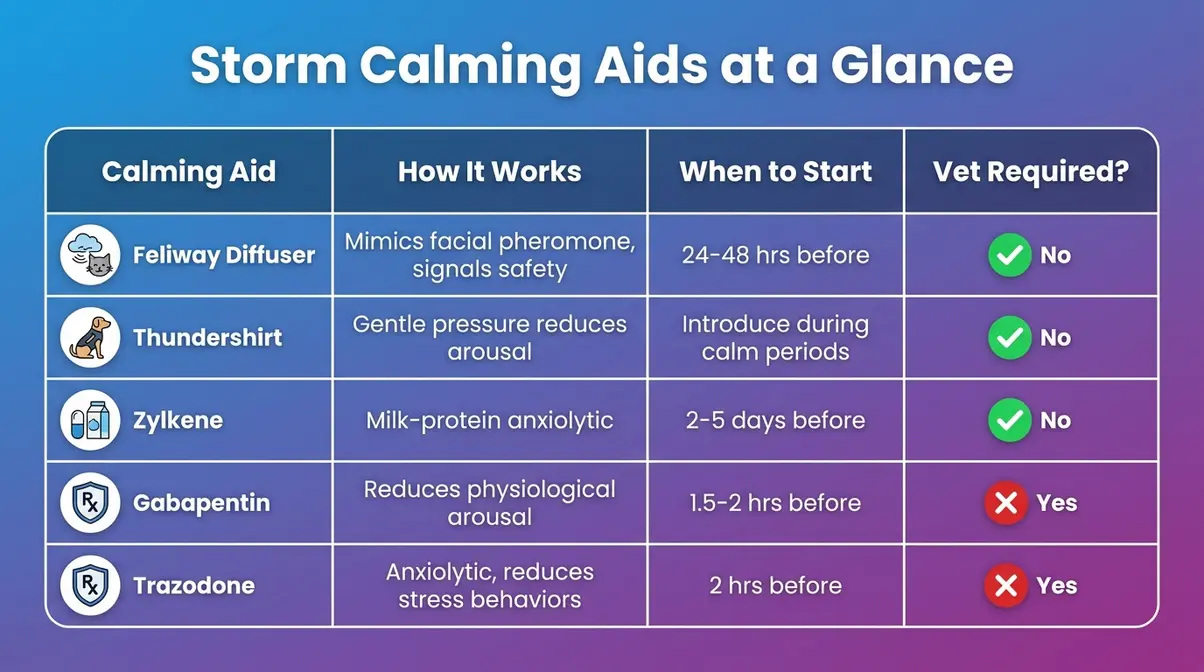
Feliway Classic mimics the “facial pheromone” cats deposit when they rub their face on objects — a signal that communicates “this place is safe.” A randomized, double-blind, placebo-controlled trial published in PLOS ONE (2026) found that Feliway Classic diffusers reduced undesirable stress behaviors in 77% of treated cats versus 45% in the placebo group. Plug a diffuser into the sanctuary room 24-48 hours before storm season begins for best results — it takes time to saturate the air.
Compression Wraps (Thundershirt)
Anxiety wraps apply gentle, constant pressure across the cat’s torso — similar in principle to swaddling an infant. Veterinary behaviorists report that many cats show reduced arousal within 15-30 minutes of wearing one, though individual response varies. Introduce the wrap during calm periods, never during a storm, so your cat doesn’t associate it with fear. Size it snugly but not tightly — you should be able to slide two fingers underneath.
Calming Supplements (Zylkene)
Zylkene contains alpha-casozepine, a milk-derived protein with mild anxiolytic (anxiety-reducing) properties. It’s available over the counter and considered safe for most cats. It works best when given consistently for several days before a storm event, not just on the day of.
CBD for Cats
User consensus from cat owner communities is mixed on CBD. No peer-reviewed feline-specific trials have confirmed efficacy for storm anxiety as of 2026. If you choose to try it, use a product formulated specifically for cats, and consult your vet on dosing — CBD quality and concentration varies enormously between brands.
Long-Term Desensitization & Meds
The steps above help during a storm. These strategies reduce how scared your cat gets before the next storm season begins.
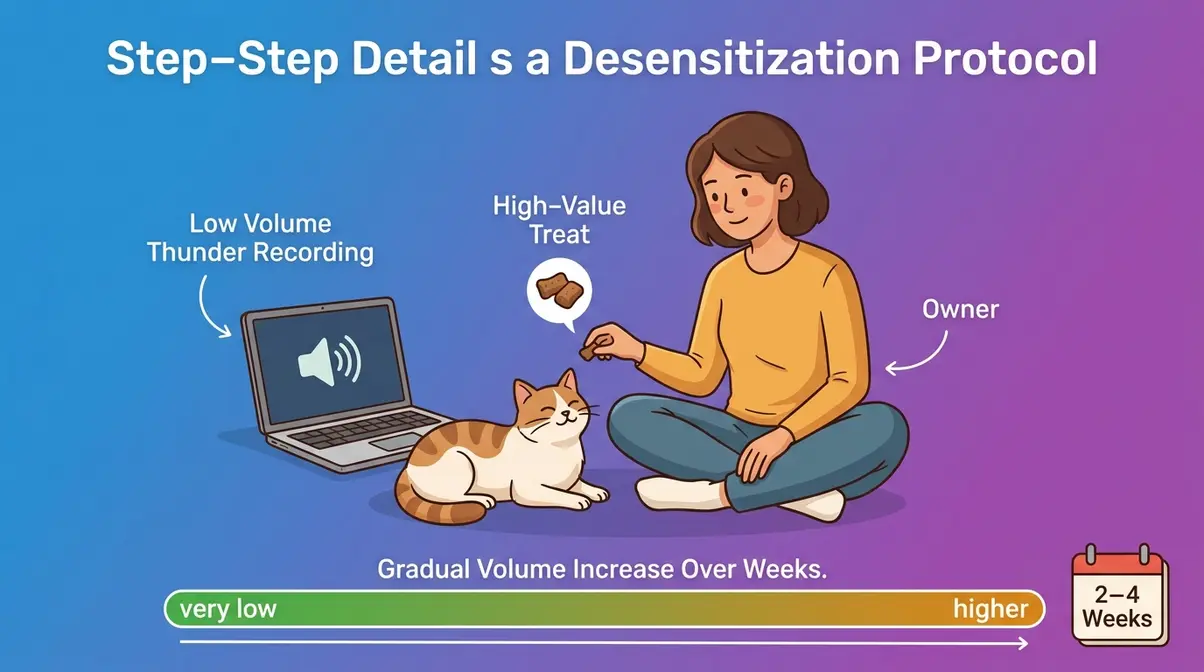
Counterconditioning to Thunder
Counterconditioning (pairing a feared stimulus with something positive to change the emotional response) is the gold-standard behavioral approach for noise phobias in cats. The American Animal Hospital Association (AAHA) and VCA Hospitals both recommend this technique as a first-line behavioral intervention.
Here’s the basic protocol:
- Find a high-quality thunderstorm recording on YouTube or a sound therapy app.
- Play it at the lowest possible volume — barely audible, well below your cat’s distress threshold.
- Immediately pair the sound with something your cat loves: high-value treats, a play session, or a gentle grooming session.
- After 5-10 minutes, stop both the sound and the reward.
- Repeat daily for 2-4 weeks, very gradually increasing volume only when your cat shows zero signs of anxiety at the current level.
The key rule: If your cat shows any anxiety signal — ears back, tail tucking, stopping to eat — you’ve moved too fast. Drop back to a lower volume and stay there longer.
This process takes weeks to months, not days. But according to Today’s Veterinary Practice, systematic desensitization paired with counterconditioning is one of the most reliably effective long-term approaches for thunderstorm phobia in companion animals.
Supplements and Prescription Meds
When behavioral techniques aren’t enough — especially for cats with severe astraphobia — veterinary-prescribed medications can make a significant difference. These are not sedatives; the goal is reducing anxiety to a manageable level, not knocking your cat out.
Gabapentin is the most commonly used option. Traditionally a pain medication, it has well-documented anxiolytic effects in cats. According to DVM360, gabapentin is typically dosed at 50-100 mg per cat and given 1.5-2 hours before a known stressor. It reduces physiological arousal without heavy sedation in most cats.
Trazodone is another option, with a typical empirical dose of around 50 mg per cat given orally approximately 2 hours before the stressor (Veterinary Medicine International, 2026). A 2026 study published in PMC found that trazodone at 5 mg/kg alone — or combined with gabapentin at 10 mg/kg — produced significant anxiety reduction in cats.
Over-the-counter vs. prescription — a quick comparison:
| Aid | Type | When to Start | Vet Required? |
|---|---|---|---|
| Feliway diffuser | Pheromone | 24-48 hrs before | No |
| Zylkene | Supplement | 2-5 days before | No |
| CBD (cat-formulated) | Supplement | Variable | Recommended |
| Gabapentin | Prescription | 1.5-2 hrs before storm | Yes |
| Trazodone | Prescription | 2 hrs before storm | Yes |
⚠️ All prescription medications require a veterinary consultation. Dosing depends on your cat’s weight, age, kidney function, and other medications. Never administer human gabapentin or trazodone formulations to your cat.
When to See a Vet About Storm Fear
Home strategies help the majority of mildly to moderately anxious cats. However, some cats have a level of storm phobia that goes beyond what comfort and calming aids can address.
Consult your veterinarian if your cat:
- Injures themselves trying to escape — through windows, screens, or doors
- Stops eating or drinking for more than 24 hours after a storm
- Becomes aggressive toward people or other pets during storms
- Shows anxiety that is getting worse each storm season, not better
- Has a known heart condition or other health issue that makes prolonged stress dangerous
- Doesn’t respond to any of the home techniques after 2-3 storm seasons
Your vet can rule out underlying health conditions that amplify anxiety, prescribe appropriate medications like gabapentin or trazodone, and refer you to a veterinary behaviorist for severe cases.
⚠️ Veterinarian Disclaimer: If your cat’s storm anxiety is severe, escalating, or causing physical harm, please consult a licensed veterinarian before attempting behavioral modification or supplementation. This guide is for educational purposes and does not replace professional veterinary advice.
Frequently Asked Questions
Will my cat be okay during a storm?
Most cats will be okay, but the experience is genuinely distressing for storm-anxious cats — not just mildly uncomfortable. Cats with astraphobia experience real physiological stress: elevated cortisol, increased heart rate, and muscle tension. Providing a storm sanctuary, pheromone support, and sensory masking significantly reduces that stress load. If your cat is injuring themselves, refusing food, or showing worsening anxiety each storm season, consult your vet — that level of distress warrants professional support.
How to create a safe space for my cat?
Choose an interior room with no windows — a bathroom or walk-in closet works well. Add a covered hiding spot (an open carrier with a blanket draped over it), your unwashed T-shirt for scent comfort, a water bowl, and a litter box. Introduce the space during calm weather with treats so your cat associates it with safety, not confinement. Plug in a Feliway diffuser 24-48 hours before storm season. The goal is a space your cat chooses to go to — not one they’re placed in during a crisis.
Are storms scarier than other noises?
Yes — thunderstorms are uniquely frightening for cats compared to most other loud noises. A single firework or door slam is one stimulus. A thunderstorm is three simultaneous biological threats: hypersensitive hearing registering intense sound, inner-ear pressure receptors detecting barometric drops, and static electricity building in their fur. Veterinary behavioral studies (Iowa State University) note that thunderstorm phobia is one of the most commonly reported noise-related anxiety problems in cats — partly because storms are prolonged, unpredictable, and multi-sensory in a way that other loud events are not.
Can I give my cat human medication?
No, you should never give a cat human anxiety medication. Human medications are highly toxic to felines and can cause fatal organ failure. Even if a medication like gabapentin is prescribed for both humans and pets, the feline dosage is drastically different. Always consult your veterinarian for a cat-specific prescription to ensure your pet’s safety during a thunderstorm.
Bringing It All Together
For worried cat owners dealing with feline storm anxiety, the key insight is this: cats scared of thunderstorms aren’t being dramatic — they’re responding to three simultaneous physiological triggers that their nervous systems cannot ignore. Addressing all three points of The Storm Stress Triangle — sound, pressure, and static — is what separates genuinely effective calming strategies from surface-level tips.
The research backs this up. A 2026 PLOS ONE trial found Feliway reduced stress behaviors in 77% of treated cats. Veterinary guidelines from AAHA and Today’s Veterinary Practice confirm that systematic desensitization is one of the most reliable long-term approaches for noise phobia. And for severe cases, gabapentin and trazodone have demonstrated meaningful anxiolytic effects in peer-reviewed studies.
Start with the storm sanctuary tonight — it costs nothing and works immediately. Layer in pheromone support and sensory masking for the next storm. Then, between storm seasons, begin the counterconditioning protocol. If your cat’s anxiety is severe or escalating, please consult your veterinarian before the next rainy season arrives. You don’t have to watch your cat tremble alone — and neither does your cat.

Dave King
Cat owner and writer at Mad Cat Man.