
You call your cat’s name. She makes direct eye contact — and then slowly, deliberately, turns away. That moment stings more than it should, because it looks so intentional.
Here’s the thing: it isn’t stubbornness. It’s a training gap, and it’s one you can close faster than you think.
“Teaching them to come when called, either to their name or any other command, can be done in a few evenings with nothing more than a bag of their favorite…” treats and a consistent approach.
In this guide, you’ll learn exactly how to train a cat to come when called — using a positive reinforcement method that works even on cats who have ignored you for years. You’ll get the complete 5-step recall training process, an optional clicker method, a dedicated section on outdoor cats, and the Recall Readiness Window framework — the timing principle that separates sessions that produce results from sessions that produce frustration. Unlike most guides, this one also addresses the specific scenarios where standard advice breaks down: rescue cats in their 3-3-3 adjustment window, deaf cats, and outdoor cats who need a reliable safety recall.
Most cats can learn to come when called in 2–4 weeks using consistent short training sessions — Oregon State University’s ongoing cat training research confirms that cats learn recall and other skills through positive reinforcement, and that even children can facilitate this training successfully.
- 1. Pick one cue: Choose a single word or sound and use it every time — never mix “come,” your cat’s name, and a clicker sound interchangeably.
- 2. Use a high-value treat: Reserve tuna, cooked chicken, or freeze-dried meat exclusively for recall sessions.
- 3. Start close, build distance: Begin 2–3 feet away; only increase distance when your cat responds reliably.
- 4. Time your sessions: Train during the Recall Readiness Window — when your cat is calm, alert, and slightly hungry (30–45 minutes before a scheduled meal).
- 5. Never call for something unpleasant: If the recall cue predicts a vet trip or bath, your cat will stop responding.
Can You Really Train a Cat to Come When Called?
Your cat isn’t broken. You’re not doing it wrong because your cat has a difficult personality. The frustration you’re feeling — calling and being ignored — is almost always a training environment problem, not a cat personality problem.
Yes, you can train a cat to come when called. Research from Oregon State University’s Youth-Cat Training Program, a two-year study led by OSU Extension 4-H faculty member Kristen Moore and funded by the Human Animal Bond Research Institute, demonstrates that cats can be successfully trained using positive reinforcement to learn skills like coming when called — and that even children can facilitate this training (OSU Extension, 2026). The OSU Extension study on positive reinforcement found that within a structured 12-session program, participants across age groups trained their cats to sit, come, walk on leash, and perform other cooperative behaviors using reward-based methods.
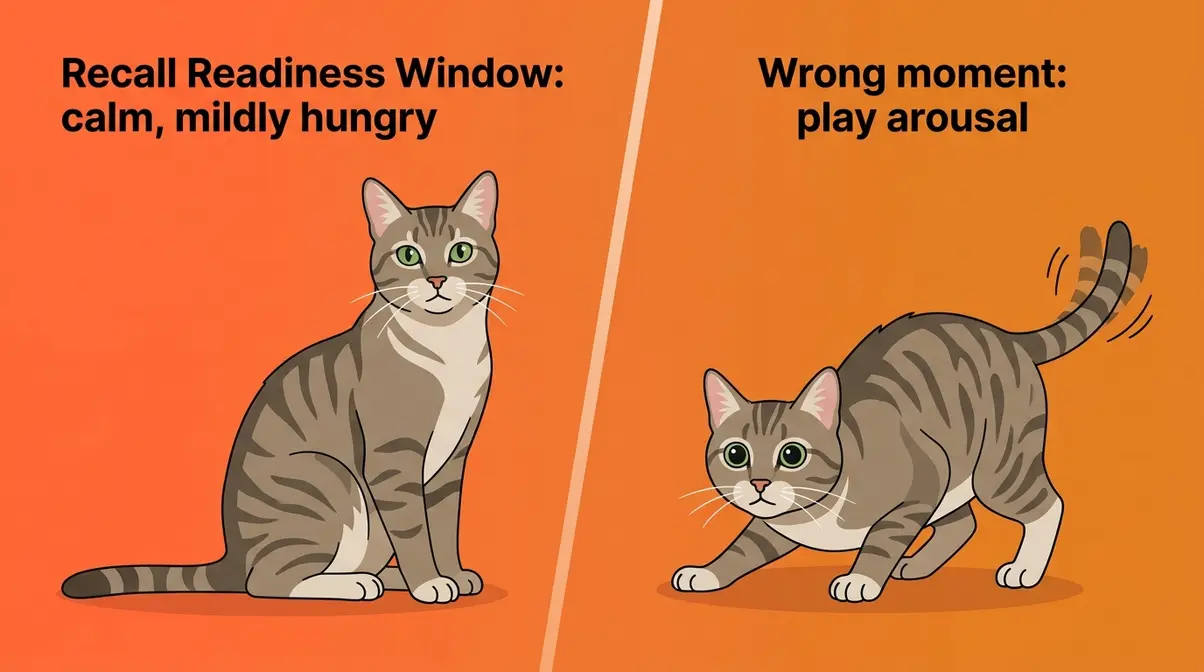
The key isn’t your cat’s personality. It’s the training environment and timing — specifically, the Recall Readiness Window: the state in which your cat is calm but alert, mildly hungry, and in a low-distraction setting. Train inside that window and results follow quickly. Train outside it and even the best method produces nothing.
“An Oregon State University research program confirms that cats can be successfully trained using positive reinforcement to learn useful skills — including coming when called — and that even children can facilitate this training successfully.” (OSU Extension, 2026)
Why Your Cat Ignores You When Called
The most common reason cats stop responding to their name is a “poisoned cue” — a training term for a recall sound that has become associated with something unpleasant. If you’ve ever called “Luna! Come here!” and then immediately put her in a carrier for a vet trip, trimmed her nails, or given her medication, you’ve inadvertently taught her that the recall cue predicts something she wants to avoid. That’s not stubbornness. That’s excellent memory.
The second reason is motivation. Cats are not driven by social approval the way dogs are. They respond to what is personally valuable in the moment. The AAFP/ISFM guidelines for shy cats note that for reluctant cats, passive treat-offering and allowing the cat to approach on its own terms is more effective than repeated calling (AAFP/ISFM, 2026). If the treat you’re offering is the same dry kibble she eats every day, there’s no incentive to interrupt whatever she’s doing.
The third reason is cue dilution. If you’ve called “Luna! Luna! LUNA! Come here!” ten times while she sat in the window, you’ve taught her the cue can be ignored indefinitely. Each repetition without a meaningful consequence — positive or negative — weakens the signal. The fix: say her name once, then immediately crinkle the treat bag and reward her arrival. One call, one reward, consistent every time.
There’s also a timing issue worth knowing: if your cat is in hunting or play mode — ears forward, tail twitching, pupils dilated — she’s in a heightened arousal state. That’s not a good training moment. Wait for the Recall Readiness Window instead.
Science of Positive Reinforcement
Positive reinforcement — rewarding a behavior immediately after it occurs, which makes the cat more likely to repeat it — is the mechanism behind every successful recall training method. The timing requirement is precise: the reward must arrive within 2–3 seconds of the behavior, or the cat doesn’t form the connection between the action and the reward.
This is where the Recall Readiness Window becomes essential. It describes a specific combination of conditions that create a cat’s optimal training state: (a) calm but alert — not in deep sleep or play arousal; (b) mildly hungry, approximately 30–45 minutes before a scheduled meal; and (c) in a low-distraction environment. Training outside this window produces slower results — not because the cat is stubborn, but because the reward isn’t compelling enough at that moment and the cat’s attention is elsewhere.
The clearest example: train your cat 10 minutes before dinner, when the smell of food is already motivating her, and she’ll respond to a high-value treat with enthusiasm. Train her 20 minutes after a full meal, and the same freeze-dried chicken produces almost no reaction. Same cat, same treat, dramatically different results.
The AAFP feline behavior guidelines confirm that cats can be taught to come and perform other behaviors using clicker training, food treats, catnip, or toys as rewards — validating that positive reinforcement-based recall training is well-established in veterinary science, not just anecdote (AAFP, 2026).
Key finding: The American Association of Feline Practitioners (AAFP) Feline Behavior Guidelines confirm that cats can be taught recall commands and other behaviors using positive reinforcement tools including clicker training and high-value food rewards. Source: AAFP Feline Behavior Guidelines, 2026.
Understanding the science also explains why punishment never works for recall training. If your cat fails to come and you respond with frustration, a loud voice, or any aversive consequence, you’re adding negative associations to the cue. The AAFP guidelines are explicit: rewards should be delivered within about three seconds of the desired behavior, and cats should never be punished during training. Unwanted behavior should be ignored or redirected, then rewarded when the cat performs the desired alternative.
What is the 3-3-3 rule for cats?
Yes — even rescue cats, deaf cats, and the so-called stubborn ones can be trained to come when called. They just need targeted adjustments to the standard approach.
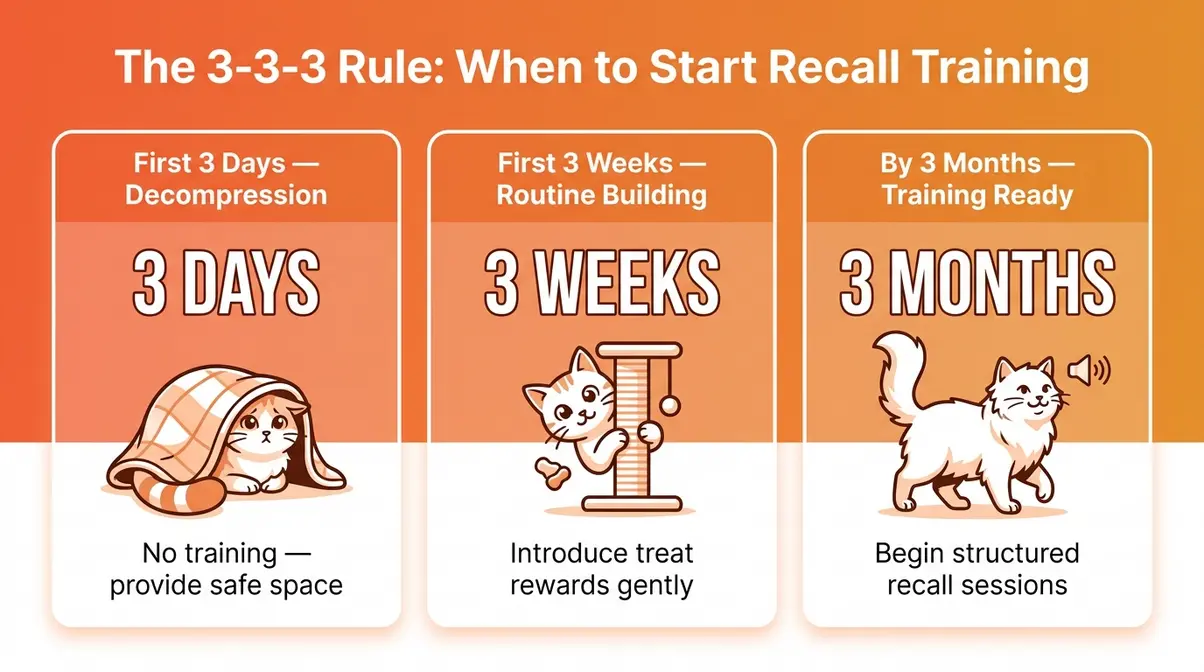
The 3-3-3 rule is a widely used guideline from rescue organizations and shelters for understanding how cats adjust to new homes:
- First 3 days — Decompression: The cat is overwhelmed. She hides, eats less, and barely explores. Do not attempt recall training. Focus entirely on providing a quiet, safe space with all resources (food, water, litter, hiding spots). Starting training during this phase is a common mistake that poisons the cue before it’s even established.
- First 3 weeks — Routine-building: The cat begins learning your household schedule, exploring during quieter hours, and eating more predictably. Light positive interaction can begin — brief, gentle, on her terms. You can start introducing your cat to the treat-reward concept, but not formal recall sessions yet.
- By 3 months — Trust and readiness: The cat has bonded, feels secure, and shows her real personality. This is when structured recall training produces reliable results (Humane Society of Sonoma County, 2026).
If you’ve adopted a rescue within the past three weeks, wait. The short-term patience pays off in a much faster training curve.
Training Deaf Cats
Visual and vibration cues replace the verbal recall for deaf cats. Effective options include: a flashlight blinked twice (pair it consistently with a high-value treat reward), a stomp on the floor that the cat can feel through vibration, or a distinct hand wave. The training process is identical to verbal recall — pair the cue consistently with a high-value reward, start close, and build distance gradually. Adventure Cats training resources confirm that the same positive reinforcement principles apply to nonverbal cues; the cue modality changes, but the learning mechanism does not.
How do I get a stubborn cat to come?
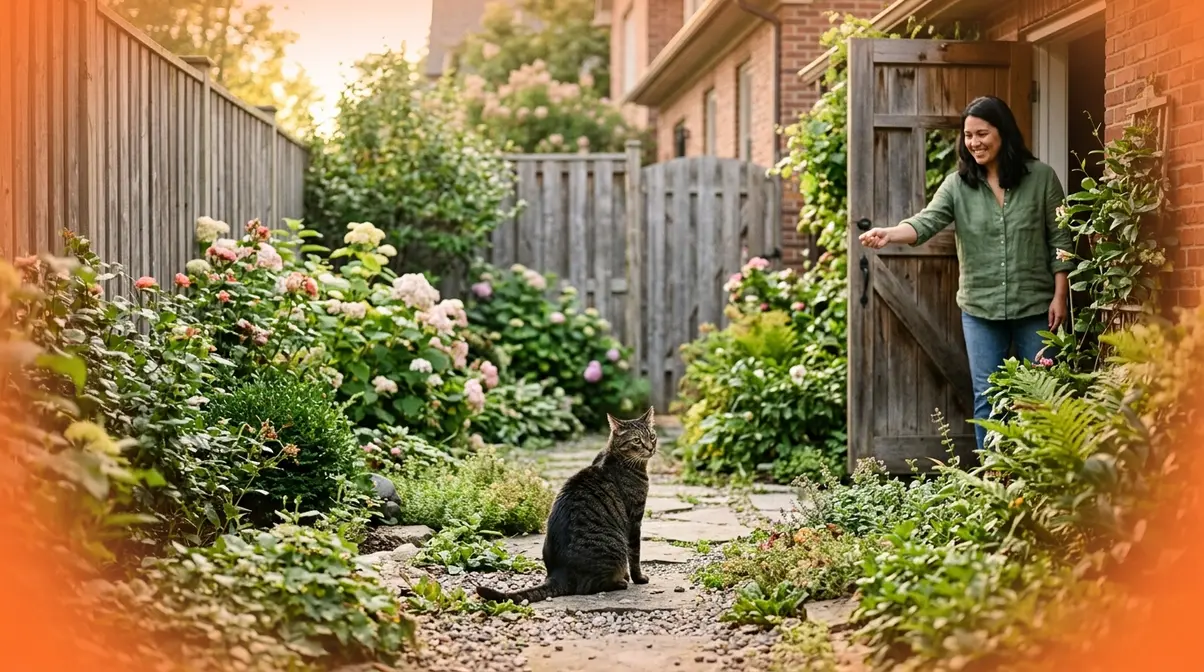
Per the AAFP/ISFM guidelines for shy cats, cats labeled stubborn are often in a high-arousal or anxious state — not defiant (AAFP/ISFM, 2026). For these cats: shorten sessions to 1–2 minutes maximum, use a uniquely high-value treat reserved exclusively for recall (tuna or freeze-dried chicken, never regular kibble), and engineer a success at the end of every session by calling from just one foot away if needed. Ending on a win maintains the cat’s positive association with the training interaction.
Now that you know your cat can learn this — and you’ve identified which category they fall into — here’s the exact 5-step process to make it happen.
How to Train Your Cat to Come When Called: 5 Steps
Here are the five steps to train a cat to come when called, starting tonight. Each step builds on the last — skip ahead and you’ll hit a wall at Step 3. Follow the sequence and you’ll have a reliable recall command within days.
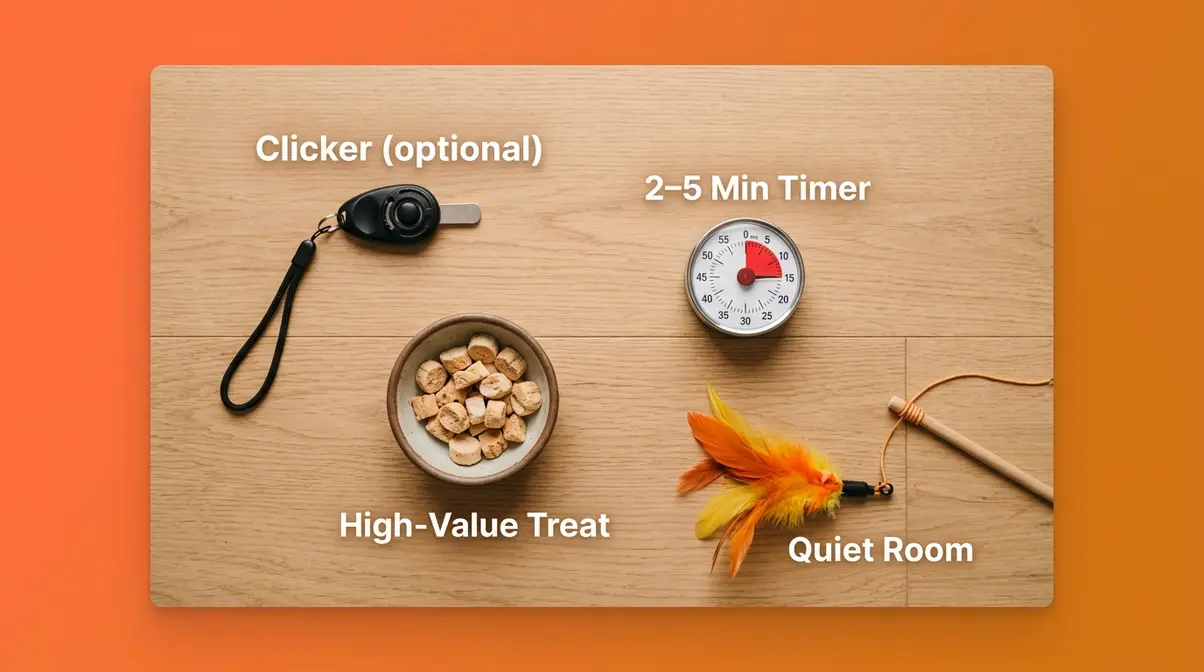
What You’ll Need Before You Start:
- High-value treats (tuna, freeze-dried chicken, or soft commercial cat treats — not regular kibble)
- A clicker or a consistent sound cue (optional but recommended — see H2 #3)
- A quiet room with minimal distractions
- A willing cat in her Recall Readiness Window (calm, mildly hungry — about 30–45 minutes before her scheduled meal)
- A timer set for 2–5 minutes maximum
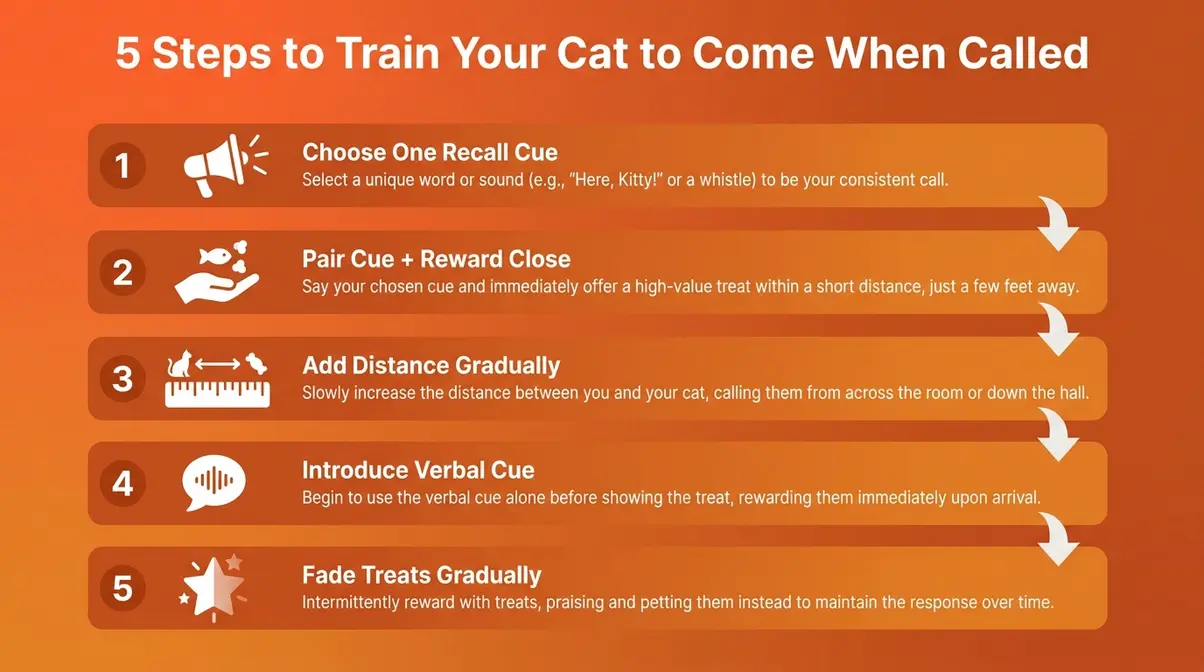
Step 1: Choose and Load Your Cue
Choose one recall cue — a single word like “come” or “here,” a specific whistle pattern, or the sound of crinkling a treat bag — and commit to it completely. This cue should be distinct from your cat’s name, which she hears in dozens of neutral contexts daily. Using her name as the recall cue makes it harder to build a strong association because the name already means many things.
Never mix cues. Alternating between “Luna,” “come,” and a clicker sound in the same session confuses the cat and slows learning dramatically. One cue, used the same way, every single time.
Why it works: Cats learn through consistent pairing — cue, then reward. The more consistent the cue, the faster the association forms. Cat training community consensus indicates that a dedicated recall cue, separate from the cat’s everyday name, produces faster and more reliable recall than name-based cues alone.
Common mistake to avoid: Using the recall cue in situations where you can’t deliver a reward. If you say “come” and then don’t have a treat ready, you dilute the cue’s value. For now, only use the recall cue when you have a high-value treat in your hand.
Step 2: Pair Cue and Reward Close
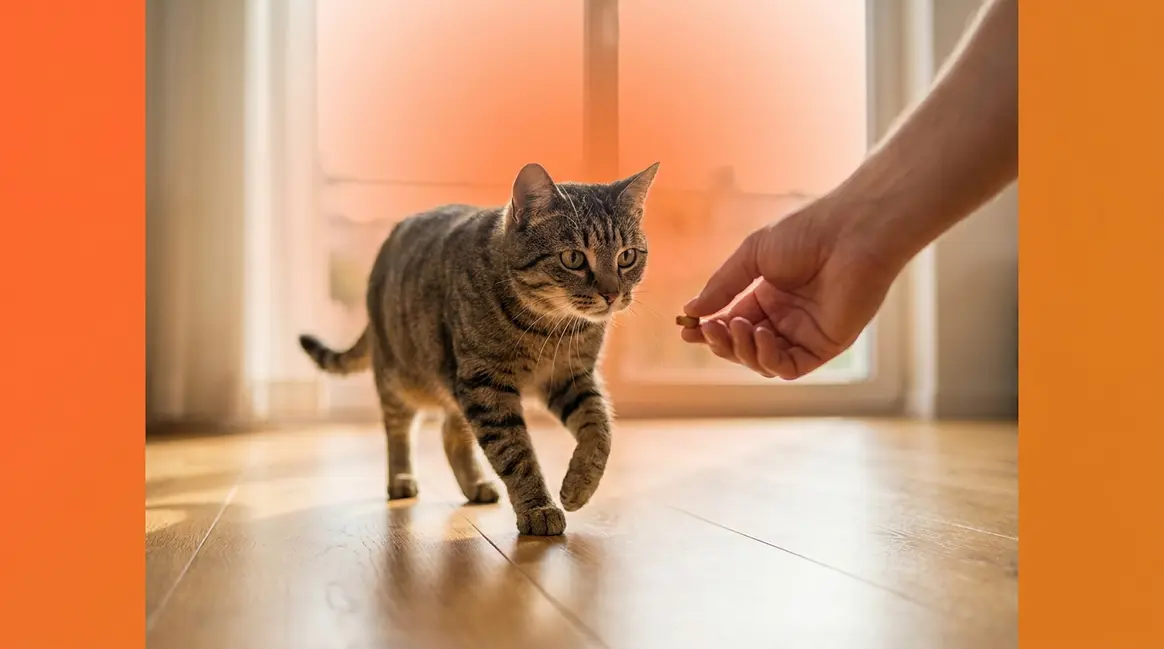
Before asking your cat to travel any distance, build the association between the cue and the reward at point-blank range. Sit on the floor next to your cat. Say your recall cue once, then immediately — within 2 seconds — place the high-value treat directly in front of her nose.
Repeat this 5–10 times in a single session. You’re not asking her to move yet. You’re teaching her that hearing this specific sound reliably predicts something excellent is about to happen. This is called “charging the cue,” and it’s the foundation everything else builds on.
Why it works: The 2-second reward window is critical. Research into feline learning confirms that reinforcers are most effective when delivered within approximately 1–3 seconds of the marked behavior — a late reward fails to create a clear connection (AAFP, 2026). At this stage, the “behavior” is simply being present when the cue sounds.
Common mistake to avoid: Rushing to Step 3 after one session. Run this step for at least 2–3 sessions across different days before introducing distance. Patience here makes every subsequent step faster.
Step 3: Add Distance Gradually
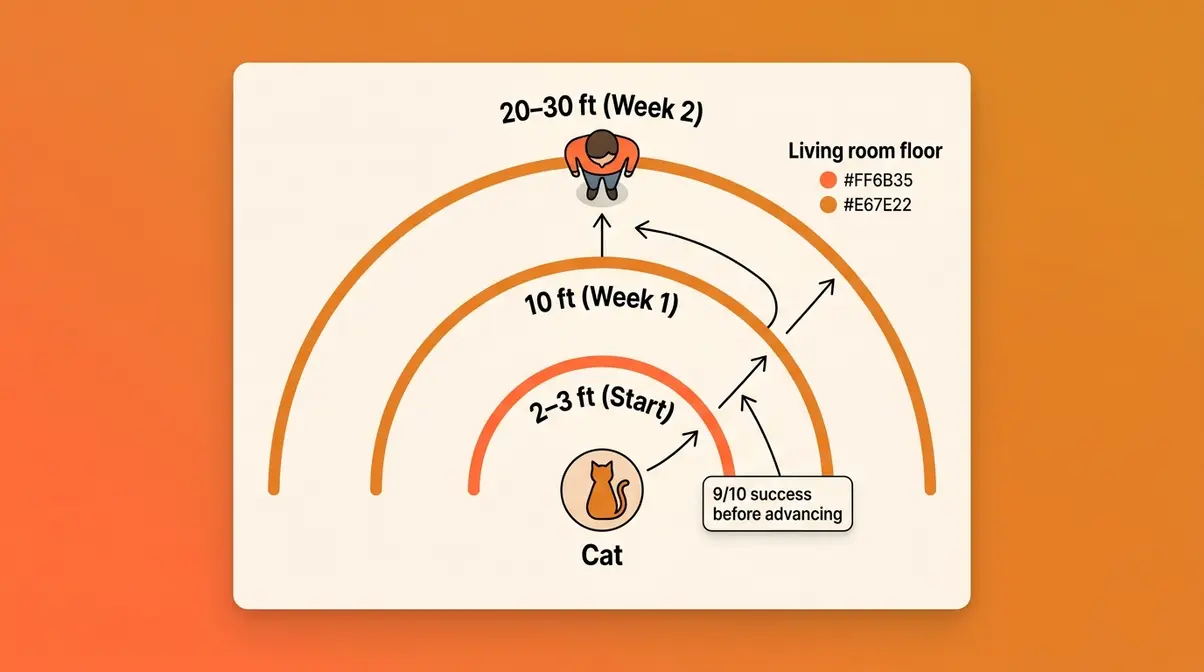
Now that your cat associates the cue with an immediate reward, you can introduce distance. Move 2–3 feet away from your cat. Say the recall cue once. The moment she takes even one step toward you, reward her immediately — don’t wait for her to reach you in the early stages.
This is where the Recall Readiness Window becomes your most practical tool. Schedule this step 30–45 minutes before her regular meal, when food motivation is at its peak. The same cat who ignores a freeze-dried treat right after dinner will trot across the room for it when she’s mildly hungry.
The rule for increasing distance: never advance until your cat succeeds 9 out of 10 attempts at the current distance. This “9/10 benchmark” is a concrete standard that prevents the most common stall point in recall training — owners increase distance too fast, the cat starts failing, and confidence (on both ends) erodes. If your cat misses two attempts in a row, move closer and rebuild success at the easier distance. How to train cat to come reliably comes down to this step.
Why it works: Gradual distance-building keeps the success rate high, which keeps the cat engaged and the cue strong.
Common mistake to avoid: Calling repeatedly when the cat doesn’t come. Say the cue once. If she doesn’t respond within 5 seconds, move closer, show the treat, and let her come to you. Then reward. One call is a signal; multiple calls are noise.
Step 4: Introduce the Verbal Cue
Here is where most guides get the sequence backward. Fear Free Happy Homes training guidance advises adding the verbal cue only after your cat is already moving toward you consistently — not at the very beginning of training (Fear Free Happy Homes, 2026). Specifically: once your cat is reliably coming to you, say the recall word as she looks up and is about to move, then reward her arrival.
Adding the verbal cue too early — before the movement is reliable — means the word gets associated with hesitation and uncertainty rather than confident movement. Wait until the behavior is happening, then name it.
“Fear Free experts advise waiting until your cat moves toward you consistently before adding a verbal cue like ‘Come’ — clicking the moment the cat begins to move, not after arrival.” (Fear Free Happy Homes)
For how to train my cat to come when called across larger spaces, practice the same sequence across multiple rooms. Call from around a corner, from another floor, or from outside a closed door. Each new location is a new training challenge — start at short distances again in each new environment before building back up to longer distances.
Why it works: Verbal cues that are added after the behavior is established create clean, unambiguous associations. The cat learns the word means “start moving toward the human,” not “consider whether to move.”
Common mistake to avoid: Using the recall cue for anything other than recall. If you call “come” and then pick her up for nail trimming, you’ve started poisoning the cue. Reserve it exclusively for voluntary approach rewarded with something she loves.
Step 5: Fade Treats Gradually
Once your cat responds to the recall cue reliably across different rooms and distances, you can begin reducing the frequency of food rewards. The key word is gradually. Shift to an intermittent reinforcement schedule: reward every third successful recall, then every fifth, then randomly. Intermittent reinforcement actually makes behaviors more persistent — the variability keeps the cat engaged because she never knows when the jackpot will arrive.
Importantly, always keep the treat reward available for difficult recalls — long distances, outdoor environments, or high-distraction situations. And when you ask for a truly impressive recall (calling from across the yard, for example), deliver a jackpot reward: a larger-than-usual portion of her highest-value treat. The bigger the ask, the bigger the payoff.
How to train your cat to come when called and keep it reliable long-term comes down to this step: never fully eliminate the reward. Cats are rational actors. If coming when called stops producing anything worth the effort, they stop doing it. Maintain occasional high-value rewards indefinitely.
Why it works: Intermittent reinforcement schedules are among the most durable in animal training. The unpredictability of the reward maintains the behavior more effectively than predictable reinforcement, which cats quickly learn to game.
Common mistake to avoid: Stopping all treats once the behavior seems reliable. This is the most common reason recall training regresses after an initial success period.
Recall Training Do’s and Don’ts
How to train cat to come consistently also means knowing what to avoid. Cat behaviorists report that most recall failures trace back to a handful of specific errors rather than general technique problems.
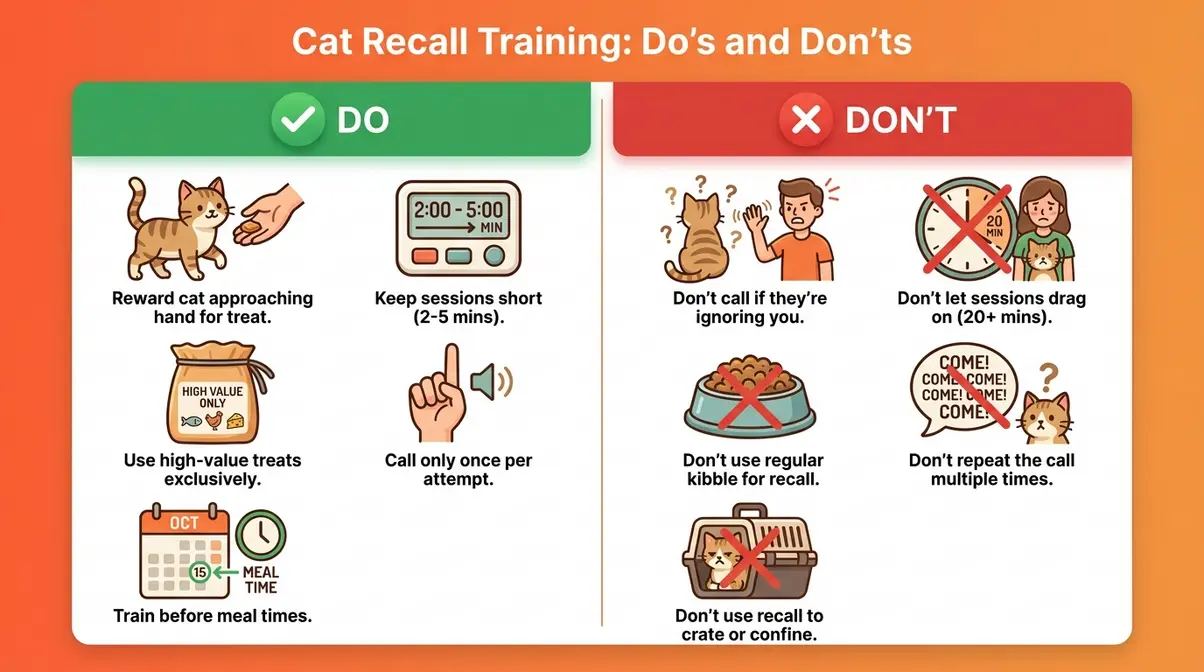
| ✅ DO | ❌ DON’T |
|---|---|
| Use one consistent recall cue every time | Mix the cat’s name, “come,” and a clicker interchangeably |
| Reward within 2–3 seconds of the behavior | Reward after a 10-second delay when the cat finally arrives |
| Use high-value treats reserved for recall only | Use regular kibble as the training reward |
| End every session with a successful recall | End a session after a failure — always engineer one success |
| Call once, then move closer if no response | Repeat the cue 5–10 times when the cat ignores you |
| Train 30–45 min before a scheduled meal | Train right after a full meal |
| Keep sessions to 2–5 minutes maximum | Run 20-minute sessions that bore or overstimulate the cat |
| Use the recall cue only for pleasant outcomes | Call the cat to give medication, a bath, or a carrier |
| Increase distance only after 9/10 success rate | Jump from 2 feet to across the room in one session |
| Celebrate enthusiastically when the cat arrives | React with neutral silence to avoid “rewarding” the cat |
Where excels at structured steps, the Do’s and Don’ts table gives you the pattern-recognition shortcuts that make the difference between a training method you’ll stick with and one that falls apart by the third session.
How to Use a Clicker to Train Your Cat to Come
A clicker isn’t required for recall training, but it’s a significant advantage. The click is a precise, consistent sound that marks the exact moment of the desired behavior — something your voice can’t replicate with the same consistency. For cats who are motivated by food but slow to connect the reward with the action, the clicker bridges that timing gap.
Cat behaviorists consistently report that clicker training accelerates the learning curve for recall because the marker sound travels instantly — the treat takes a second to produce, but the click communicates “yes, that exact thing you just did” in real time. The AAFP feline behavior guidelines specifically list clicker training as one of the validated positive reinforcement tools for teaching cats recall and other cooperative behaviors (AAFP, 2026).
Step 1: Charge the Clicker
Before the clicker can mark a behavior, your cat needs to understand that the click sound predicts a treat. This process — called “charging the clicker” — takes one or two short sessions.
Sit near your cat during her Recall Readiness Window. Click the clicker once, then immediately deliver a high-value treat. Repeat 15–20 times across two sessions. You’re not asking for any behavior. You’re simply teaching the equation: click = treat incoming. Fear Free Happy Homes’ clicker training guidance is specific: reinforcement should occur within 1 second of the marked behavior, and you should click first, then move your hand to get the treat — not the reverse (Fear Free Happy Homes, 2026).
You’ll know the clicker is charged when your cat’s ears rotate toward the sound, she looks at your hand, or she begins to approach you when she hears the click. That’s the association forming. Once you see that response consistently — usually within 15–20 repetitions — you’re ready to use the clicker as a training marker.
“Clicker training timing is everything: click the exact moment the behavior occurs, then deliver the treat within 1 second — a late click gives inaccurate information, not punishment, but it slows learning significantly.” (Fear Free Happy Homes, 2026)
Step 2: Add Clicker to Recall
With the clicker charged, integrate it into the 5-step recall process from H2 #2. The click replaces the verbal praise and bridges the gap between the cat’s movement and the treat delivery.
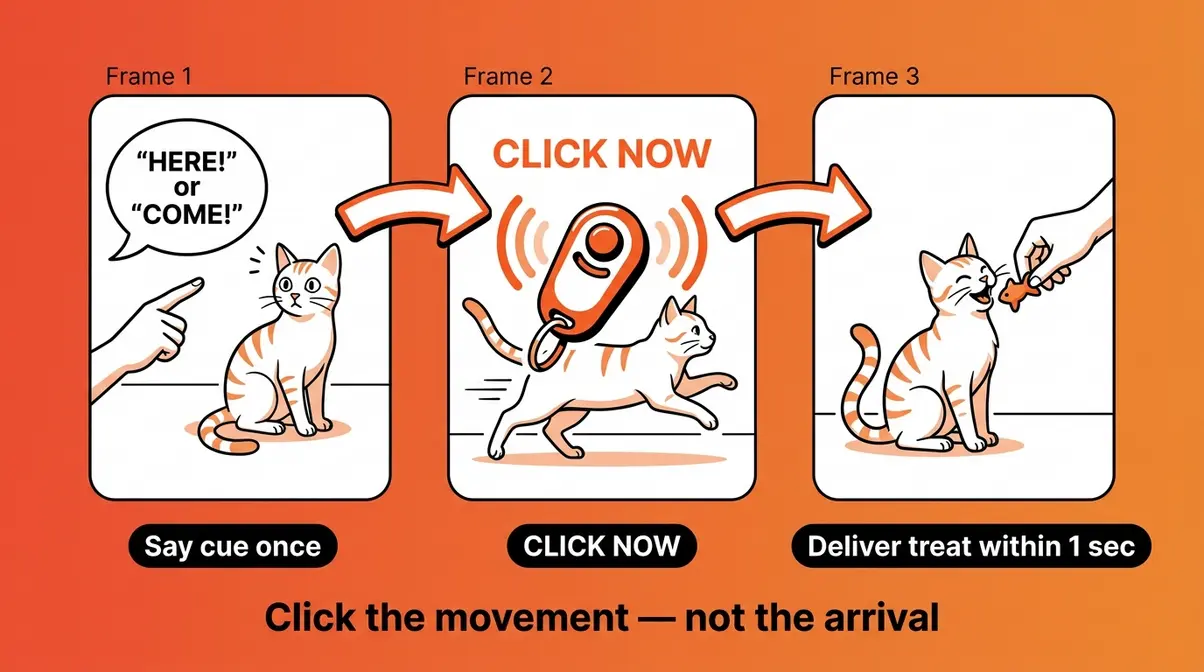
The critical timing insight, per Fear Free Happy Homes guidance: click the moment your cat begins moving toward you, not when she arrives at your feet (Fear Free Happy Homes, 2026). This is the most common clicker timing error — clicking on arrival rewards the stopping behavior, not the coming behavior. Click the movement itself.
The full sequence: say your recall cue once → cat begins moving → click immediately → cat arrives → deliver treat within 1 second.
Once your cat is responding reliably to the cue-and-click sequence, add the verbal recall word per Step 4 of the main process: say the word as the cat looks up and is about to move, then click as she moves. This layering — cue → movement → click → treat — produces the clearest behavioral associations. As Fear Free notes, once the verbal cue is reliably learned, the clicker can be faded out and rewards can be given less frequently (Fear Free, 2026).
Step 3: Choosing the Right Treats
Not all treats are equal for recall training. The reward hierarchy matters: low-value treats work for easy, low-distraction sessions; high-value treats are essential for building reliable recall across distances and outdoor environments.
Cat training community consensus, supported by guidance from the Connecticut Humane Society and the Humane Society of Sonoma County, recommends reserving a specific high-value treat exclusively for recall training — never offered at other times — to maintain its motivational power. When a treat is available constantly, it loses its training value quickly.
| Treat Type | Value Level | Best For | Notes |
|---|---|---|---|
| Regular dry kibble | Low | Very easy, zero-distraction sessions | Cat eats it daily — minimal motivation |
| Commercial soft treats (e.g., Temptations) | Medium | Indoor recall at short distances | Good for maintenance once recall is established |
| Freeze-dried chicken (single-ingredient) | High | Building recall at distance | Strong aroma, tiny pieces, low calorie |
| Freeze-dried tuna or salmon | High | Stubborn cats, long-distance recall | Intensely motivating for most cats |
| Plain cooked chicken or tuna in water | High | Jackpot rewards, emergency recall | Reserve for highest-difficulty asks |
| Lickable treat pouches (e.g., Inaba Churu) | Very High | Cats who don’t respond to dry treats | Use sparingly — very high palatability |
Key principle from humane society training materials: break all treats into pieces smaller than a pea so you can deliver many rewards per session without upsetting your cat’s stomach or exceeding her caloric needs. Total treat volume per session should stay under about two tablespoons (Connecticut Humane Society, 2026).
“A treat is ‘high value’ when your cat becomes alert, follows it with interest, and is willing to interrupt what she’s doing to earn it — if she doesn’t respond that way, the treat isn’t high enough value for that training context.” (Humane Society of Sonoma County, 2026)
How to Train an Outdoor Cat to Come Home
Outdoor cat recall training follows the same positive reinforcement principles as indoor training, with one critical addition: the outdoor environment is full of competing motivations — birds, smells, other cats, interesting terrain. When you train cat to come in an outdoor setting, your recall cue has to compete with all of that. The solution isn’t a louder voice; it’s a stronger association built indoors first, then carefully transferred to the outdoor context.
Research-consistent guidance and cat behaviorist consensus recommend that outdoor recall training should only begin after the indoor recall is reliable — meaning your cat responds 9 out of 10 times in an indoor setting across multiple rooms and distances. Skipping this prerequisite is the most common reason outdoor recall fails.
Outdoor Recall Prerequisites
Before taking recall training outside, confirm these essential prerequisites.
1. Indoor recall is reliable
Your cat responds to the cue 9 out of 10 times across different indoor rooms and distances up to 20–30 feet.
2. The cat is fully vaccinated and microchipped
Outdoor training involves brief unsupervised moments — this is non-negotiable for safety.
3. Your outdoor space is as enclosed as possible
A fenced yard, catio, or quiet garden is ideal for the first outdoor sessions. Avoid open areas near roads.
4. You have a jackpot treat
Outdoor recall demands your highest-value reward — freeze-dried tuna, plain cooked chicken, or a lickable treat pouch. Regular kibble will not compete with the outdoor environment.
5. The cat is in her Recall Readiness Window
This applies outdoors even more than indoors. Training right after a meal in a stimulating outdoor environment is almost guaranteed to fail.
Outdoor Recall: Step-by-Step
Phase 1 — The doorway transition (Days 1–3): Practice the recall cue while your cat is just inside or just outside the door — essentially at zero outdoor distance. Use the jackpot treat. The goal is to establish that the recall cue means the same thing outdoors as it does indoors: come here, get something excellent.
Phase 2 — Short garden distances (Days 4–10): Move to your enclosed outdoor space. Start at 5–10 feet. Call once, reward immediately on arrival with the highest-value treat you have. Keep sessions to 3 minutes maximum — outdoor environments are cognitively stimulating, and cats tire of formal training faster outside. Build to 30 feet before moving to Phase 3.
Phase 3 — Adding distractions (Week 2 onward): Call your cat while she’s engaged in interesting outdoor activities — investigating a smell, watching birds, exploring a corner of the yard. This is the real test of recall reliability. Reward these high-distraction recalls with a jackpot every single time, even once the behavior is well-established. You’re competing with the outdoors; the payoff has to be worth it.
For understanding cat behavior and training in outdoor contexts, the principle is consistent: every successful recall in a high-distraction environment should be treated as a high-value event, not a routine one.
Night Training and Dusk Curfews
Dusk and nighttime are the highest-risk periods for outdoor cats — reduced visibility, increased predator activity, and traffic risk all peak after dark. Cat welfare guidance consistently recommends establishing a nightly call-in routine as a safety protocol, not just a convenience.
How to build a reliable dusk recall:
- Choose a specific, consistent call-in cue distinct from the daytime recall cue — a particular whistle pattern, a specific word, or the sound of a treat container being shaken.
- Begin using it 30–60 minutes before sunset, when your cat is likely still close to home and in a familiar territory.
- Feed dinner immediately after the cat comes in — this creates a powerful association: dusk cue → come inside → dinner. Within a week, most cats begin anticipating the routine and returning proactively.
- Use a high-value treat reward every time for the first month, even if the cat comes in quickly. Consistency during the building phase creates a reliable cue.
Guidance from cat safety resources recommends feeding dinner at the same time each evening as an anchor for the dusk routine (The Alite Keep Safe, 2026). The feeding routine becomes a natural reinforcer that supplements the treat reward.
“Establishing a consistent dusk call-in cue paired with immediate dinner creates one of the most reliable outdoor recall patterns for cats — the feeding schedule reinforces the behavior even on evenings when you forget the treat.”
The Jackpot Emergency Recall Protocol
Every outdoor cat owner should train a separate, higher-value emergency recall — a cue used only in genuine safety situations that predicts the most extraordinary reward your cat has ever received. This is distinct from the everyday recall cue.
The emergency recall protocol, as described by cat behaviorist resources including Cattitude Adjustment’s emergency recall training guidance:
- Choose a unique emergency cue — a specific sound you’d never use casually, like a particular whistle pattern or the shake of a specific container.
- Pair it with a jackpot reward — a larger-than-usual portion of your cat’s absolute favorite treat, delivered every single time, without exception, for the life of the training.
- Practice it rarely — once or twice a week maximum, in calm conditions, to keep the association fresh without dulling the cue’s urgency.
- Never use it casually — the emergency recall cue should feel like a lottery win every time it fires. If you use it to call the cat in for a routine evening, it loses its emergency-level reliability.
The principle: by keeping the emergency recall cue rare and the reward extraordinary, you maintain a behavioral override that can cut through even intense outdoor distraction. Cat behaviorists report this protocol can produce recall even from cats who are mid-hunt or in high-arousal states — something the everyday recall cue cannot reliably achieve.
Outdoor Safety Essentials
A few non-negotiable safety practices for outdoor recall training:
- Microchip and collar with ID tag before any unsupervised outdoor time — recall training is reliable, not perfect.
- Supervise all early outdoor sessions — do not leave a cat unattended during the first 2–3 weeks of outdoor training.
- Bring cats inside at night — cat welfare organizations and veterinary guidance consistently recommend nighttime curfews to reduce risk from predators, traffic, and disorientation.
- Never call the recall cue and then do something unpleasant — this applies outdoors with even more force than indoors, because outdoor recall is harder to rebuild once poisoned.
Common Mistakes That Prevent Your Cat From Coming
Even owners who understand positive reinforcement make consistent errors that stall recall progress. Cat behaviorists report these mistakes appear across training attempts regardless of the cat’s age, breed, or prior training history.
The Biggest Training Errors
1. Calling repeatedly when ignored. This is the fastest way to teach your cat that the recall cue is optional. Every repetition without a consequence dilutes the signal. Say the cue once. If there’s no response, move closer, show the treat, and let the cat come to you. Reward that. Reset and try again.
2. Using the recall cue for unpleasant events. A carrier, a bath, nail trimming, medication — any of these, associated with the recall cue even once, can set back weeks of progress. If you need to catch your cat for something she dislikes, don’t use the recall cue. Go get her directly.
3. Training outside the Recall Readiness Window. Training immediately after a meal, during deep sleep, or when the cat is in play-arousal mode produces near-zero results and wastes both the session and the treat. The 30–45 minutes before a scheduled meal is the single most reliable window.
4. Increasing distance too fast. The 9/10 benchmark exists for a reason. Owners who push to longer distances before the cat is consistent at shorter ones end up with a cat who comes “sometimes” — which is functionally unreliable.
5. Inconsistent cues. Switching between the cat’s name, “come,” “here kitty,” and a clicker sound across sessions creates confusion. One cue, used identically every time.
6. Stopping all rewards once recall seems reliable. Recall maintained without any intermittent reward fades within weeks. Keep occasional high-value rewards in the rotation indefinitely.
When to Seek Professional Help
Most recall training challenges resolve with patience, consistency, and the adjustments described in this guide. However, some cats have behavioral needs that go beyond what a training protocol can address.
Consider consulting a certified cat behaviorist or your veterinarian if:
- Your cat shows signs of severe anxiety — hiding constantly, refusing food for more than 24–48 hours, excessive vocalization, or self-directed grooming to the point of hair loss. These are signs of a stress disorder, not a training problem.
- Your cat is aggressive when approached, even with food — hissing, swatting, or biting when you attempt positive interactions. This may require a behavior modification program supervised by a professional.
- No improvement after 4–6 weeks of consistent, correctly applied positive reinforcement training. A veterinarian can rule out underlying medical conditions (pain, hearing loss, vision changes) that may be affecting responsiveness.
- Your cat’s recall behavior regresses suddenly after previously being reliable — sudden behavioral changes can indicate a medical issue.
Disclaimer: The training methods in this guide are based on positive reinforcement principles and are appropriate for the majority of healthy, well-adjusted cats. For cats with serious behavioral issues, anxiety disorders, or aggression histories, please consult a certified cat behaviorist (CCBC) or a veterinarian with behavioral training before beginning a structured recall protocol.
Frequently Asked Questions
Can I train my cat to come when called?
Yes — most cats can learn to come when called using positive reinforcement and consistent short sessions. Oregon State University’s cat training research confirms that cats can be trained to recall and other cooperative behaviors through reward-based methods, and that this training can be successfully facilitated even by children (OSU Extension, 2026). The key factors are a high-value treat reserved exclusively for recall, a consistent cue, and sessions timed to the cat’s Recall Readiness Window — approximately 30–45 minutes before a scheduled meal. Most cats show reliable recall within 2–4 weeks of consistent daily practice.
How long does it take to train a cat?
Most cats can learn basic recall in 2–4 weeks of consistent, daily training. The exact timeline depends on the cat’s age, previous experiences, and the value of the treats used. Training during the Recall Readiness Window significantly accelerates this process. If you don’t see progress after a month, consult a certified behaviorist.
Can you train cats to come to you?
Yes, cats can reliably be trained to come to you — the idea that cats are untrainable is a myth rooted in misunderstanding cat motivation. Unlike dogs, cats don’t respond to social approval; they respond to what’s personally valuable. The AAFP feline behavior guidelines confirm cats can learn recall and other behaviors using clicker training, food treats, catnip, or toys (AAFP, 2026). The training process works when you use a high-value treat, a consistent cue, and sessions during the Recall Readiness Window. Cats who seem unresponsive are typically dealing with a poisoned cue, low-value rewards, or poor session timing — all fixable.
How do I train my cat to come here?
To train your cat to come, follow this five-step sequence: (1) Choose one consistent recall cue — a word, whistle, or sound — distinct from her name. (2) Pair the cue with an immediate high-value treat at zero distance for 2–3 sessions. (3) Add distance gradually, starting at 2–3 feet, rewarding any movement toward you. (4) Introduce the verbal cue only once the cat is already moving toward you reliably. (5) Fade treats to intermittent reinforcement once recall is consistent, but maintain occasional jackpot rewards long-term. Keep sessions to 2–5 minutes, train 30–45 minutes before a meal, and never use the recall cue for anything unpleasant.
What is the best treat for cat training?
The best treat is highly aromatic, easy to eat quickly, and reserved exclusively for training. Freeze-dried chicken, tuna, or lickable treat pouches are excellent high-value options. Avoid using their regular daily kibble, as it doesn’t provide enough motivation to interrupt their normal activities. Always break treats into pea-sized pieces to prevent overfeeding.
Why is my cat not coming to me when I call her?
The most common reasons a cat stops responding to being called are a poisoned cue, low-value rewards, or poor training timing. A poisoned cue forms when the recall sound has been associated with something unpleasant — a carrier, medication, or bath — even once. Low-value rewards (regular kibble) provide no incentive to interrupt whatever the cat is doing. Poor timing means training after a full meal or during play arousal, when food motivation is low. The AAFP/ISFM guidelines for shy cats also note that repeated calling without reward actively weakens the cue’s signal (AAFP/ISFM, 2026). The fix: rebuild the cue with a new sound, switch to freeze-dried protein treats, and train only during the Recall Readiness Window.
Conclusion
For intermediate cat owners frustrated by a cat who seems to deliberately ignore them, learning how to train cat to come using positive reinforcement is both achievable and faster than most expect. OSU Extension research confirms that cats learn recall through reward-based methods within structured training periods, and the AAFP feline behavior guidelines validate clicker training and high-value food rewards as the tools that make it work. The most reliable approach combines a dedicated recall cue, freeze-dried protein treats reserved exclusively for training, and sessions timed to the Recall Readiness Window — that 30-to-45-minute pre-meal period where food motivation and calm alertness intersect.
The Recall Readiness Window is the principle that separates recall training that produces results in days from training that produces frustration for weeks. It’s not about the cat’s personality or willingness — it’s about catching the moment when the reward is genuinely compelling and the environment isn’t competing for attention. Every section of this guide builds toward that first successful recall, and then toward making it reliable enough to trust outdoors and in emergencies.
Your next step: identify your cat’s Recall Readiness Window tonight — about 30–45 minutes before her scheduled dinner — pick up freeze-dried chicken or tuna at your next store visit, and run a single 3-minute charging session using the approach in Step 2. You don’t need a clicker yet, and you don’t need distance. Just build the association between the cue and the reward. Most cats show a visible response within the first session. Start there, and build from that first moment of “she actually came.”

Dave King
Cat owner and writer at Mad Cat Man.