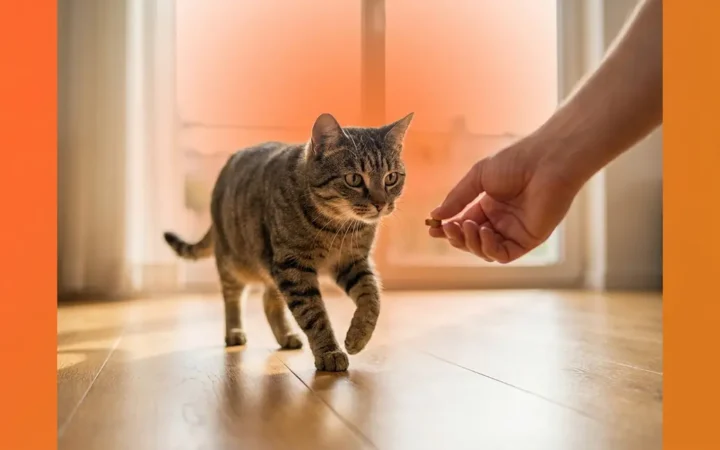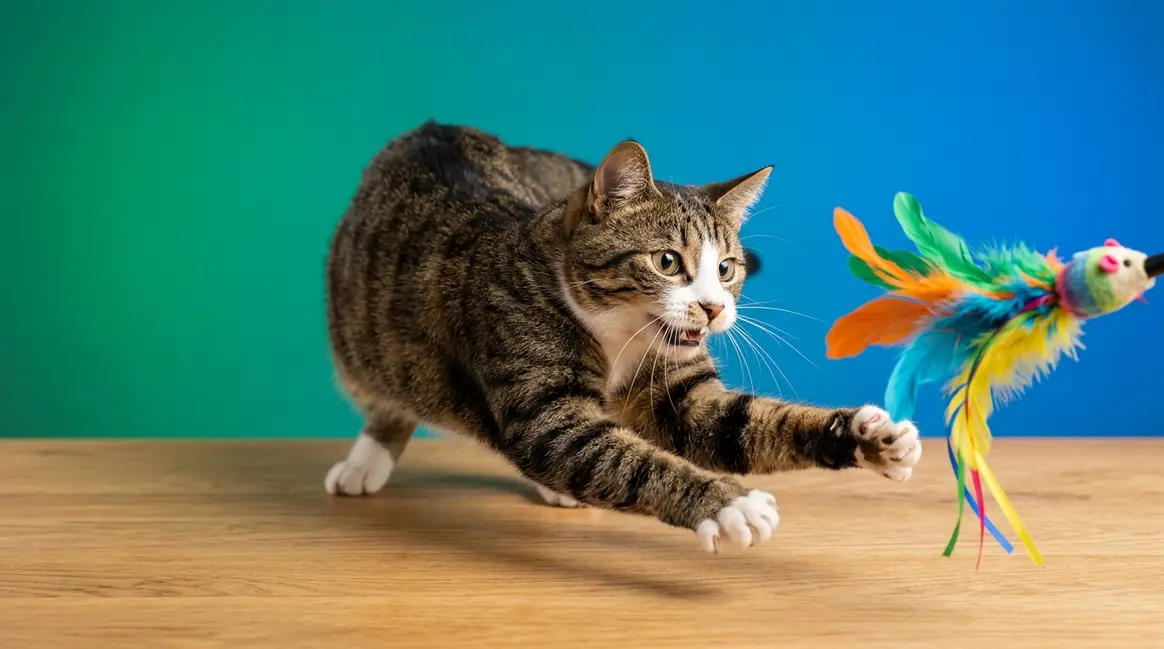

Your cat nips your hand during a petting session you thought was going well. Your ankles get ambushed every time you walk down the hallway. Your kitten treats your fingers like chew toys — and no amount of “no” seems to register. If any of this sounds familiar, you’re not alone, and you’re not doing something wrong.
“My cat keeps biting me and I’m at my breaking point.”
That sentiment shows up in cat owner forums, veterinary waiting rooms, and Reddit threads every single day — and it’s completely valid. Unlike most guides that pile on generic tips, this one starts with a diagnosis, because the right fix depends entirely on why your cat is biting. By the end of this guide, you’ll know exactly which of the three bite triggers applies to your cat — and you’ll have a step-by-step plan to stop it using the Bite-Trigger Triangle framework and the Freeze-and-Redirect method. You’ll move through seven sections: the root causes of biting, the core redirection method, petting and play biting, the “spicy cat” who bites and scratches, destructive chewing, multi-pet conflict biting, and medical triggers.
Key Takeaways: How to Stop a Cat from Biting
Every cat biting incident traces back to one of three triggers — and matching the fix to the trigger is what makes the training stick. Use The Bite-Trigger Triangle (Predatory Drive, Overstimulation, Pain/Medical) to diagnose your cat before applying any technique.
1. Identify the trigger first: Play drive, overstimulation, or pain each require a completely different response — applying the wrong fix makes biting worse.
2. Redirect, don’t punish: The Freeze-and-Redirect method outperforms physical discipline. Tufts University veterinary behaviorists confirm that punishment increases fear-based aggression.
3. Act in the moment: Withdraw attention within 2 seconds of a bite for the lesson to register neurologically.
4. Protect your home: Cord protectors, bitter sprays, and environmental enrichment stop destructive chewing before it becomes a hazard.
5. See a vet if biting is sudden: Abrupt behavior changes can signal dental pain, arthritis, or neurological issues that no amount of training will fix.
Why Does Your Cat Bite? The Bite-Trigger Triangle Explained {#h2-1}
Cats bite for three distinct reasons — predatory drive, overstimulation, or pain — and identifying which one is active is the only reliable first step to stopping it. Most owners skip this diagnosis and jump straight to corrections, which is why the behavior keeps coming back. The framework introduced here, The Bite-Trigger Triangle, gives you a mental model to self-diagnose your cat’s biting before applying any technique from this guide. According to the Cornell Feline Health Center, play aggression is the most common form of aggression directed at owners, often stemming from early weaning or a lack of appropriate play outlets (2024). Recognizing which of the three triggers is driving your cat’s behavior is the prerequisite to any solution that actually sticks — and a key step to stop a cat from biting for good.
The counterintuitive insight most owners miss: the response before the bite — reading which trigger is active — determines whether training works far more than anything you do after the bite happens. You can understand cat aggression and its causes across a range of real scenarios, but the Bite-Trigger Triangle gives you the diagnostic lens to apply those cases to your own cat.
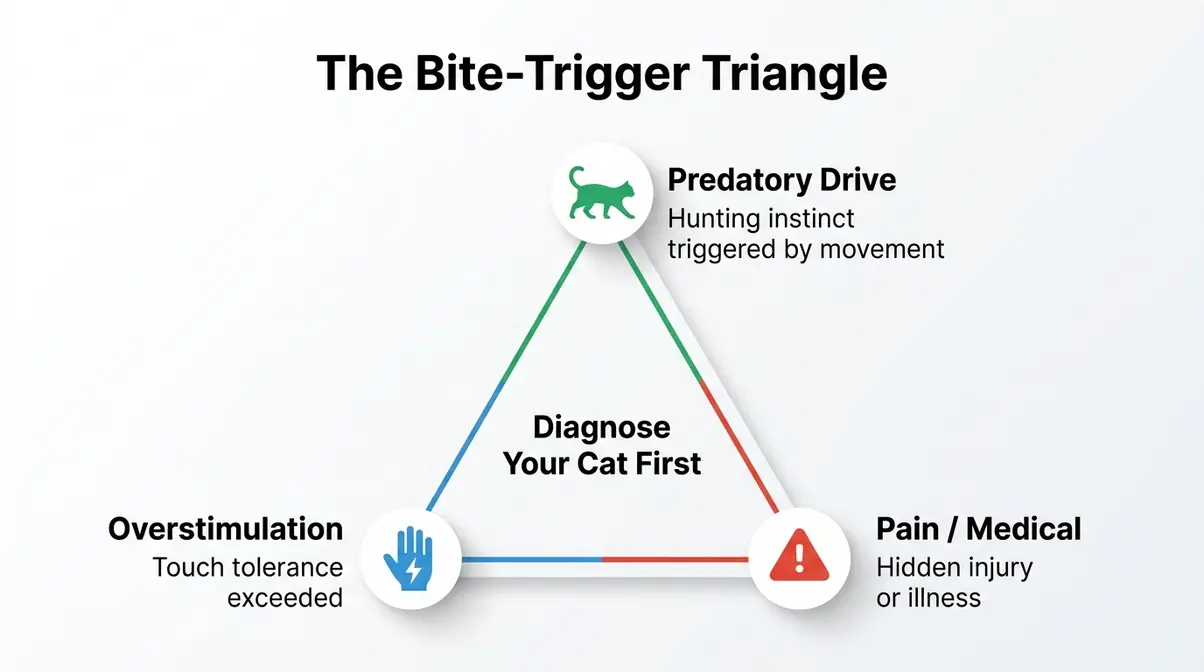
The Three Triggers: Predatory Drive, Overstimulation, and Pain
To stop a cat from biting effectively, you need to identify which vertex of the Bite-Trigger Triangle is active. Each trigger has a distinct behavioral signature, and each requires a different response.
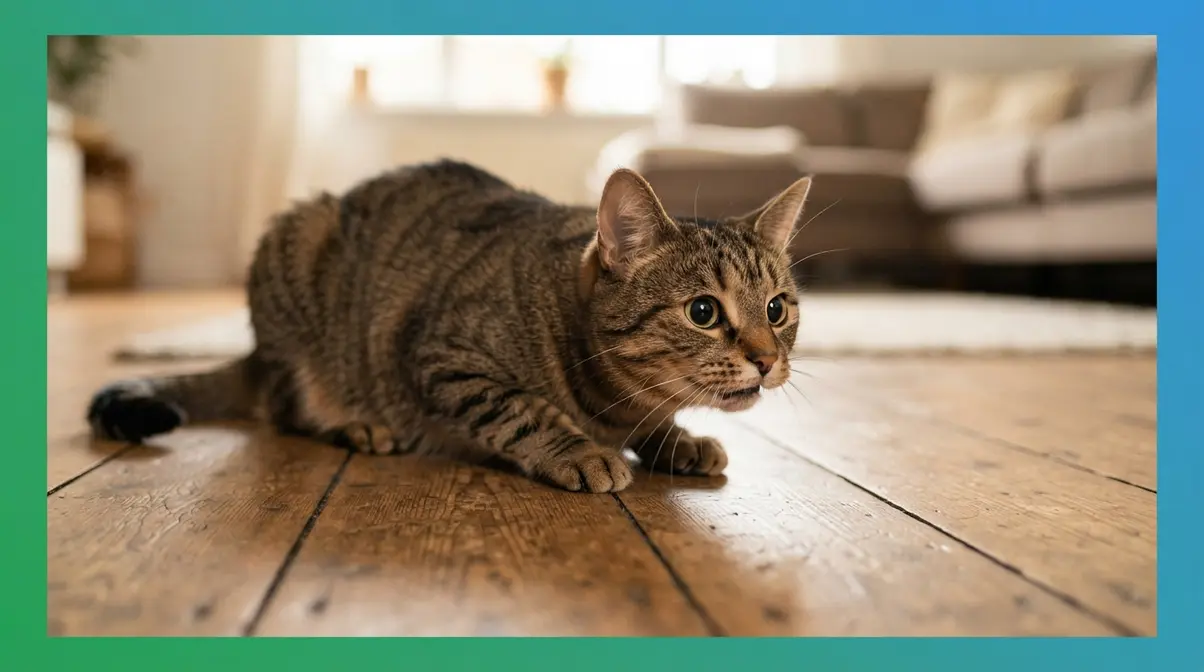
Predatory Drive is the cat’s hardwired hunting instinct, activated by fast-moving targets — hands, feet under blankets, dangling fingers, or ankles moving down a hallway. This is the most common trigger in kittens and young adult cats. The cat isn’t being aggressive toward you specifically; it’s responding to movement the way every felid on earth is wired to respond to prey. The Cornell Feline Health Center notes that play aggression is the most common form of aggression directed at owners, often stemming from early weaning or a lack of appropriate play outlets (2024).
Overstimulation (also called petting-induced aggression) is the “love bite” that comes out of nowhere during what seemed like a perfectly pleasant petting session. Cats have a significantly lower touch tolerance threshold than dogs, and they communicate “I’ve had enough” with their teeth when subtler signals — tail flicking, skin rippling, flattened ears — go unnoticed. The bite isn’t aggression in the traditional sense; it’s communication that escalated because earlier messages were missed.
Pain/Medical triggers sudden biting in cats with no prior behavioral history of aggression. When a normally gentle cat lashes out because touch hurts — from arthritis, dental disease, or a hidden injury — no amount of behavioral training will resolve it. This trigger is covered in depth in the medical section below, but if your cat’s biting appeared suddenly with no change in routine, skip ahead to that section first.
Kitten Biting vs. Adult Cat Biting — Why the Fix Is Different
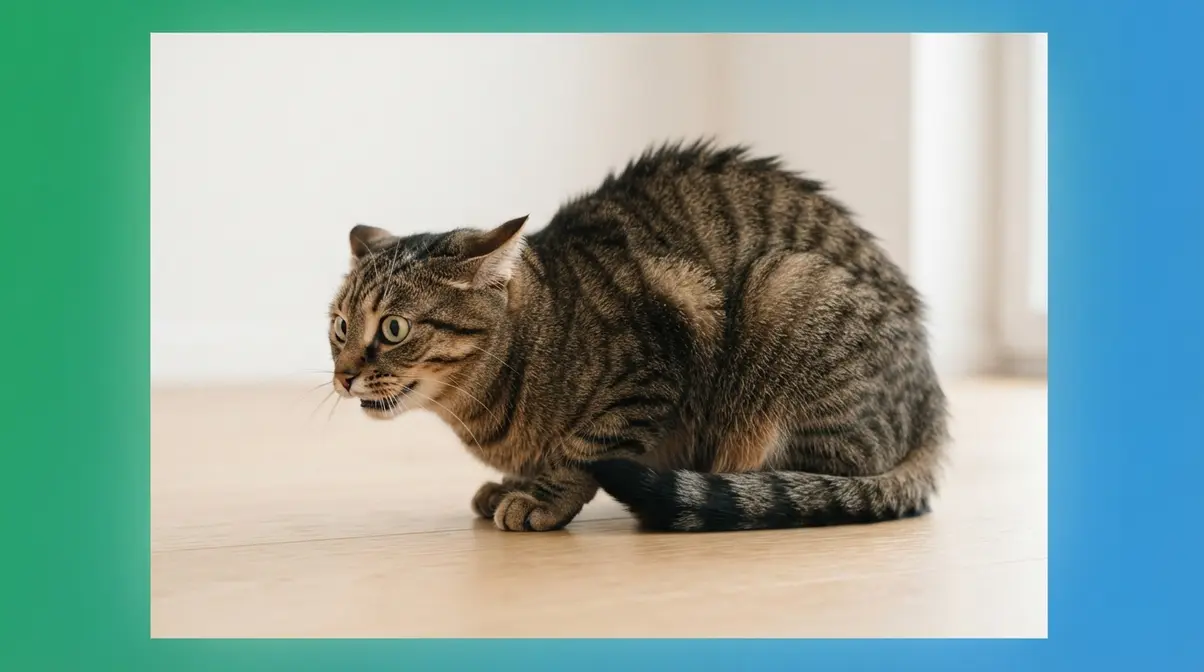
How to stop a young cat from biting and how to stop an adult cat from biting are related but meaningfully different problems. Understanding the developmental context changes your entire approach.
Kitten biting is normal exploratory behavior. Kittens learn bite inhibition — the ability to modulate bite pressure — through play with their littermates. When one kitten bites too hard, the other yelps and stops playing; that feedback loop is how bite control develops naturally. Research cited by the Cornell Feline Health Center indicates that early weaning (before 8 weeks) and a lack of appropriate play outlets are primary contributors to play aggression in cats (2024). Kittens removed from their litter before 8 weeks miss critical feedback sessions and often bite harder as a result.
The “One Bite Rule” is a practical heuristic worth internalizing: many cats deliver exactly one warning nip before escalating. That first bite is communication — “I’m overstimulated,” “I’m done being held,” “I’m locked onto prey mode.” Owners who recognize the warning nip as a signal rather than an attack can redirect before the situation escalates into a full bite. Watch for the single warning nip; it’s your cat’s last verbal attempt before switching to physical language.
How to stop an adult cat from biting requires acknowledging that if biting persisted through kittenhood without consistent correction, it has become a conditioned habit — one the cat has been accidentally rewarded for (usually with a dramatic reaction that provides stimulation). Adult cats do not self-correct. Behavior modification takes longer and requires more consistency, but the same Freeze-and-Redirect framework applies.
Do cats grow out of biting? Kittens often reduce biting significantly with age if consistent training is applied. Adult cats will not self-correct without active intervention — the behavior simply becomes more entrenched over time.
Once you know which trigger applies to your cat, the fix becomes straightforward — starting with the immediate in-the-moment technique in the next section.
How to Stop a Cat from Biting: The Freeze-and-Redirect Method {#h2-2}
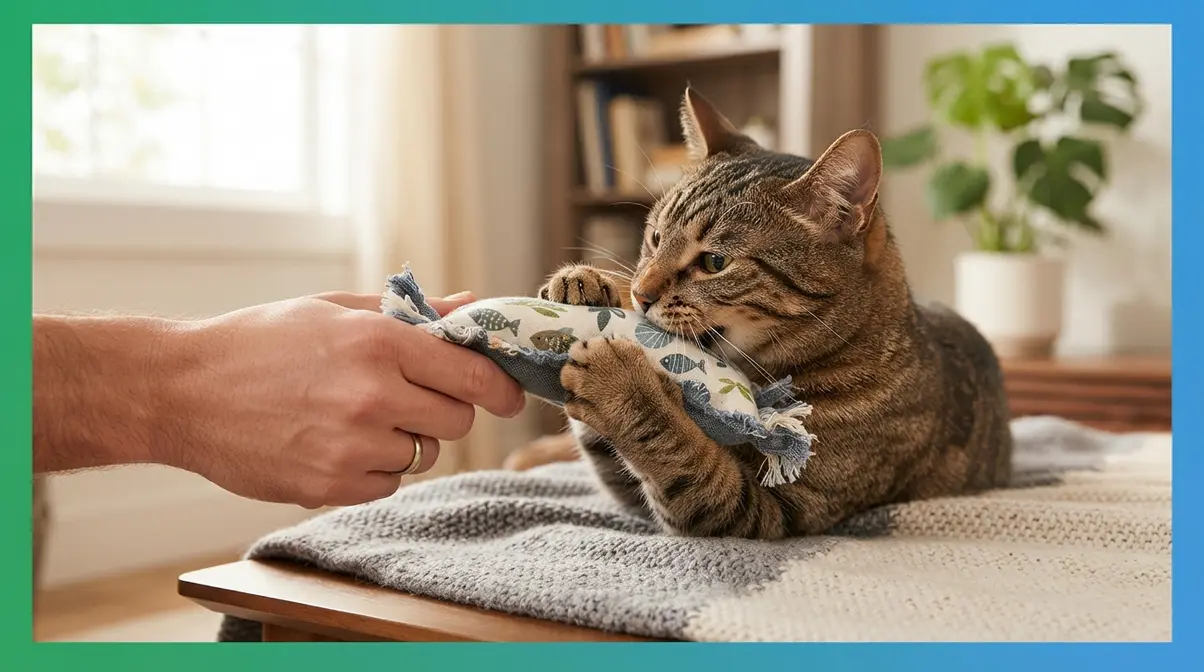
The most effective way to stop a cat from biting — regardless of which Bite-Trigger Triangle cause is driving the behavior — is the Freeze-and-Redirect method: go completely still the instant teeth make contact, immediately offer an appropriate target, then withdraw your attention. This method works across all three triggers with minor modifications, and it outperforms every punitive approach because it works with feline behavioral wiring rather than against it. Here’s exactly how to do it.
As Tufts University veterinary consensus confirms: punishing a cat for biting increases fear-based aggression; positive reinforcement and redirection are strongly recommended. Physical corrections — spraying water, tapping the nose, raising your voice — don’t teach a cat that biting is wrong. They teach a cat that you are unpredictable, which elevates baseline stress and makes biting more likely, not less.
For a visual demonstration of the Freeze-and-Redirect method, watch our step-by-step video:
You can also explore comprehensive cat behavior and training tips for step-by-step fixes across a wider range of behavioral challenges.
What You’ll Need Before You Start
1. A wand toy or fishing-rod toy — the primary redirection tool for play-drive biting
2. A kicker toy — a plush toy sized for your cat to bunny-kick and wrestle; essential for redirecting ankle ambushes and hand biting
3. Bitter apple or citrus deterrent spray — for object chewing (covered in the cord and furniture section below)
4. Patience — most cats show measurable improvement within 1–2 weeks of consistent redirection, though adult cats with entrenched habits may take 4–6 weeks
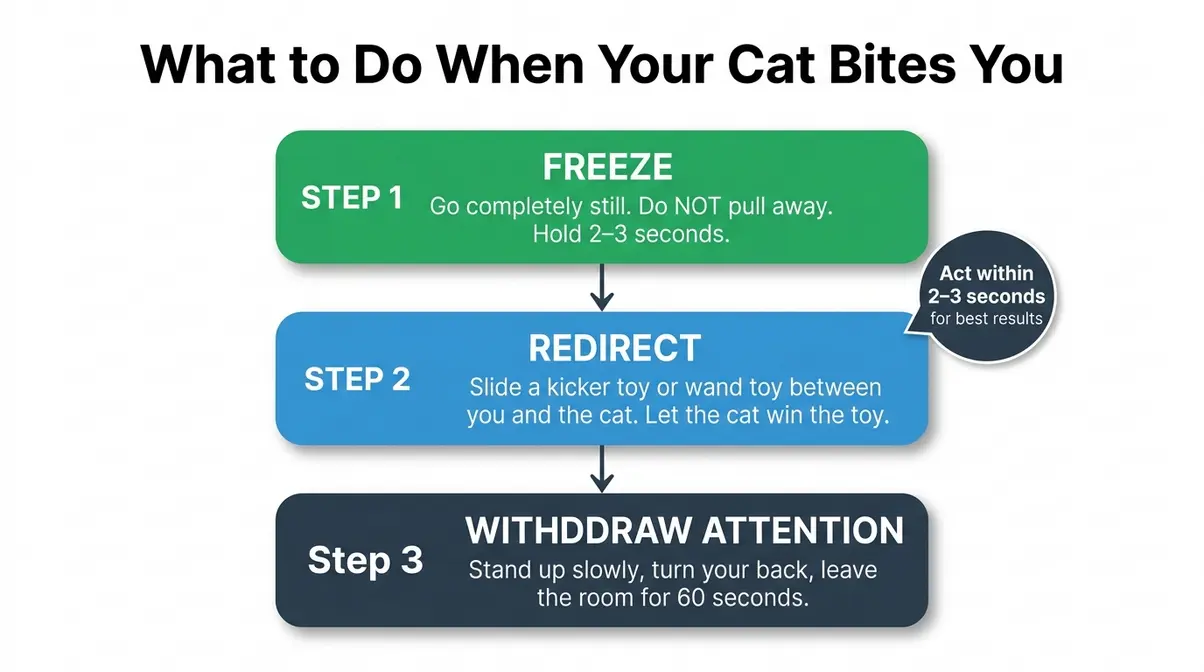
The 3-Step Freeze-and-Redirect Protocol
To stop a cat from biting in the moment, follow these three steps in sequence — every time, without exception. Consistency is what makes the method work.
Step 1 — Freeze. The instant teeth make contact with your skin, go completely still. Do not jerk your hand away, pull back, or flinch. Pulling away mimics prey movement — a fast-retreating object — and activates predatory drive at full intensity. Even a sharp flinch can escalate a warning nip into a full bite. Stillness removes the prey stimulus entirely. Hold the freeze for 2–3 seconds.
Step 2 — Redirect. While still frozen, use your free hand or foot to slide a kicker toy or wand toy between you and the cat. Let the cat “win” the prey item — allow it to grab, bite, and bunny-kick the toy. The redirection must happen within 2–3 seconds of the bite for the behavioral association to form. The goal is for the cat to learn: biting the human ends the fun; biting the toy continues it.
Step 3 — Withdraw Attention. Once the cat is engaged with the toy, stand up slowly, turn your back, and leave the room for 60 seconds. Do not look back, speak to the cat, or offer any reaction. This step is the most powerful negative consequence available for a social animal: the interaction ends. For a cat that bites for attention or stimulation, the abrupt removal of both is the clearest possible signal that biting is counterproductive.
Six Scenarios: How to Stop a Cat from Biting in Every Situation
These scenarios cover every common biting context, each mapped to its Bite-Trigger Triangle cause. Every scenario names a specific tool, action, and expected outcome — not just “try a toy.”
Scenario 1 — Ankle Ambush
Trigger: Predatory Drive. Cat hides behind furniture and attacks moving feet. Action: Stop walking immediately and freeze feet completely still. Redirect: Toss a crinkle ball or motorized mouse toy in the opposite direction — moving away from you. Tool: Crinkle ball or battery-powered mouse toy. Outcome: Cat redirects the hunt to the moving object; most cats disengage from ankles within 1–2 consistent sessions.
Scenario 2 — Hand-Biting During Play (how to stop a cat from biting when playing)
Trigger: Predatory Drive. Cat escalates from pawing to biting during a wand-toy session. Action: Drop the wand immediately and freeze both hands. Redirect: Let the cat “catch” the wand toy and hold it — end the session there, on a win. Tool: Wand toy with feather or mylar attachment. Outcome: Cat learns play has a natural endpoint; escalation during play decreases within 1–2 weeks.
Scenario 3 — Bite During Petting
Trigger: Overstimulation. Cat bites mid-petting with no apparent warning. Action: Freeze, then very slowly withdraw your hand. Do not pull away quickly. Redirect: End the petting session entirely — no consolation pets. Tool: None needed; see the full body language guide in the petting section below. Outcome: Shorter, owner-initiated petting sessions dramatically reduce incidents within 1 week.
Scenario 4 — Unprovoked Bite from a Distance
Trigger: Redirected Aggression (cat overstimulated by an outdoor stimulus — a stray cat, bird, or squirrel at the window — then redirects onto the nearest person). Action: Freeze, do not make eye contact, and back away slowly. Redirect: Leave the room; do not attempt to comfort or engage the cat for at least 30 minutes. Tool: Feliway calming diffuser placed in the room. Outcome: Identifying and blocking the outdoor trigger (frosted window film, closing blinds) removes the root cause within days.
Scenario 5 — Kitten Mouthing During Handling
Trigger: Developmental/Predatory Drive. Kitten mouths hands when picked up or stroked. Action: Yelp sharply (“Ouch!”), freeze immediately, then set the kitten down on the floor. Redirect: Offer a small kicker toy immediately after setting the kitten down. Tool: Small plush kicker toy. Outcome: Kittens typically reduce mouthing behavior within 2–3 weeks of consistent response — the yelp mimics littermate feedback.
Scenario 6 — Bite When Picked Up
Trigger: Overstimulation/Discomfort. Cat tolerates being lifted but bites when held beyond its comfort threshold. Action: Set the cat down immediately at the first warning signal (tail lashing, body stiffening) — before the bite occurs. Redirect: Provide an elevated perch as an alternative resting destination. Tool: Cat tree or wall-mounted shelf at eye level. Outcome: Cat chooses the elevated spot over being held; biting during handling decreases significantly within 2 weeks.
Long-Term Prevention: Scheduled Play and Environmental Enrichment
Stopping a cat from biting also means reducing the baseline pressure that builds toward a bite in the first place. Two daily play sessions — one in the morning and one in the evening before bed, each 10–15 minutes — drain predatory energy before it redirects onto owners. Always end laser pointer sessions with a physical, catchable toy so the cat experiences a “kill”; laser-only sessions that end without a catch have been associated with increased frustration-driven biting, according to veterinary behaviorists.
Environmental enrichment addresses the structural boredom that amplifies every trigger. Climbing structures, puzzle feeders, and window perches give cats legitimate outlets for predatory energy. Cats with access to vertical territory exhibit significantly less redirected aggression — a phenomenon behaviorists sometimes call “Tarzan Syndrome”: cats denied vertical space redirect pent-up energy onto the nearest moving target, which is usually you. A cat tree, wall shelves, or even cleared bookshelf space can meaningfully reduce biting frequency within days.
For kittens specifically, socialization before 12 weeks matters enormously. Kittens exposed to gentle handling by multiple people during the sensitive socialization window are significantly less likely to bite defensively as adults. If you have a young kitten, this is the highest-leverage investment you can make right now.
Troubleshooting: Common Mistakes That Make Biting Worse
Even well-intentioned owners sabotage the Freeze-and-Redirect method with these predictable errors:
- Pulling away quickly when bitten — this is the single most common mistake. It mimics prey flight and intensifies predatory drive. Freeze first, always.
- Inconsistent responses — redirecting 70% of the time while occasionally allowing hand-play sends a mixed signal. The cat learns that persistence pays off. Every single bite must receive the same response.
- Using hands as toys during play — roughhousing with bare hands teaches kittens that hands are legitimate prey items. Use toys for all interactive play, from day one.
- Punishing after the fact — scolding a cat 30 seconds after a bite accomplishes nothing. Cats do not connect delayed consequences to earlier behavior. The response must be immediate.
- Giving attention after biting stops — returning to pet a cat 2 minutes after it bit you teaches the cat that biting leads to a short break followed by more interaction. Withdraw for at least 10–15 minutes.
These scenarios cover the immediate response. The next section addresses the nuanced body language reading required to prevent petting-induced and play biting before they even start.
Petting Bites, Play Biting, and Attention Biting {#h2-3}
Petting-induced biting, play biting, and attention biting are the three most common biting contexts cat owners report — and each maps to a specific point on the Bite-Trigger Triangle. The critical skill that prevents all three is reading pre-bite signals: the body language your cat broadcasts in the 10–30 seconds before teeth make contact. Most owners learn this skill accidentally, after dozens of bites. This section gives you a systematic framework so you learn it deliberately.
Research from veterinary behavioral studies consistently shows that cats communicate discomfort through a predictable sequence of signals before biting — the bite itself is almost always a last resort, not a first choice. Understanding the difference between a “love bite” (a gentle inhibited nip communicating affection or mild overstimulation) and a true aggression bite (full pressure, often breaking skin) changes how you respond to each.
Reading Pre-Bite Signals: Your Cat’s Warning System
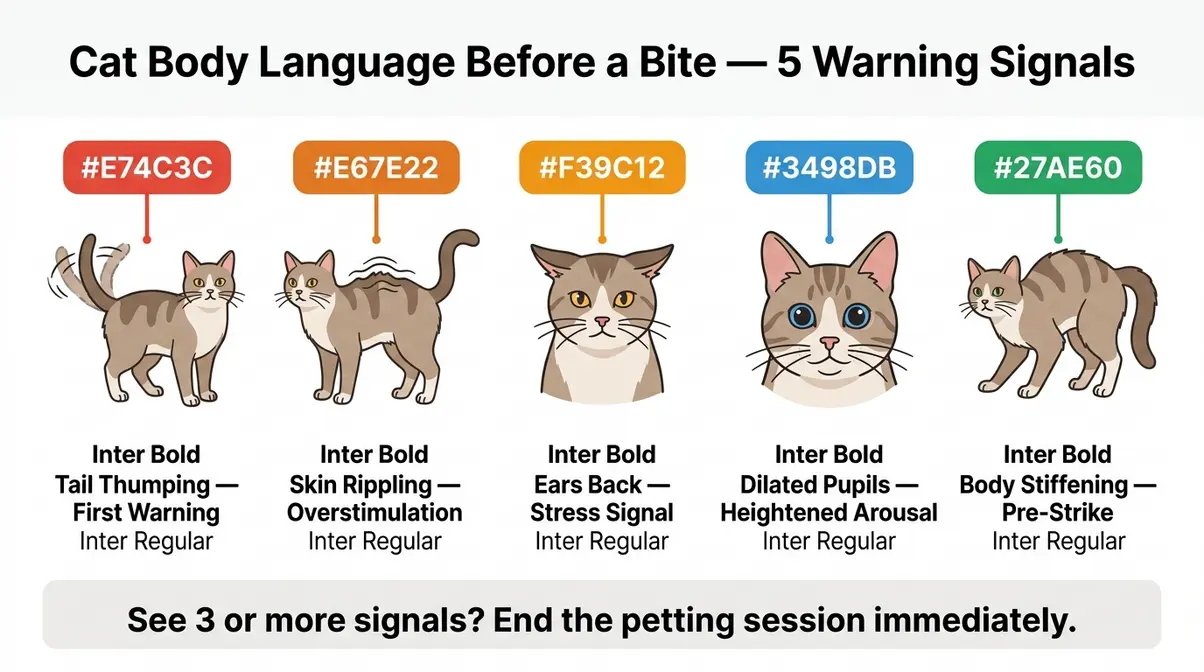
Petting-induced biting follows a reliable escalation pattern. Before the bite, most cats display a sequence of signals that owners learn to recognize — or miss entirely. Watch for:
- Tail movement: A tail that begins slowly swishing or thumping against a surface is the earliest warning. This is not contentment — it’s a stress signal.
- Skin rippling: The skin along the back twitches or “rolls” — a physiological sign of overstimulation.
- Ear rotation: Ears rotate backward or flatten slightly against the skull.
- Pupil dilation: Eyes widen suddenly; the cat’s focus sharpens.
- Body stiffening: The relaxed, heavy body weight shifts to a tense, coiled posture.
Most cats display at least three of these signals before biting. The challenge is that these signals can progress from first warning to bite in as little as 5 seconds. Practice watching for the tail signal specifically — it appears earliest and most reliably.
How to Stop Petting-Induced Biting
Petting-induced biting (also called petting-induced aggression) is not random. Every cat has a petting tolerance threshold — a point beyond which continued touch becomes aversive. The fix is not to stop petting your cat; it’s to learn and respect that threshold.
Step 1: Keep initial petting sessions short — 2–3 minutes maximum. End the session yourself, before you see any warning signals. This establishes you as someone who respects the cat’s limits.
Step 2: Identify your cat’s preferred zones. Most cats tolerate petting on the head, cheeks, and base of the tail far longer than petting on the belly, legs, or base of the tail for some individuals. Restrict petting to high-tolerance zones initially.
Step 3: At the first warning signal (tail movement is your cue), slowly withdraw your hand and end the session. Do not rush — a fast withdrawal triggers prey response. Move slowly and deliberately.
Step 4: Over several weeks, gradually extend session length by 30 seconds at a time, always ending before the cat reaches its threshold. You are incrementally raising the tolerance ceiling.
Veterinary consensus indicates that owners who apply this graduated approach report a significant reduction in petting-induced biting within 2–4 weeks (VCA Hospitals, 2024).
How to Stop Play Biting
Play biting — the ambush, the ankle attack, the hand-wrestling escalation — is driven entirely by Predatory Drive. The solution is not to suppress the drive; it’s to redirect it onto appropriate targets.
The core rule: Never use your hands as toys. If hands have been toys since kittenhood, retraining takes time, but it works. Replace all hand-play with wand toys and kicker toys immediately. No exceptions, no “just this once.”
Schedule interactive play at the same times each day. Cats are creatures of routine; a cat that knows a 10-minute wand-toy session happens every evening at 7 PM begins to anticipate that outlet rather than ambush you for stimulation. Structured play reduces spontaneous attack frequency measurably within one week.
End play sessions on a “kill.” Let your cat catch the wand-toy lure, hold it, and bunny-kick it for 30–60 seconds before you put the toy away. This satisfies the predatory sequence — stalk, chase, catch, kill — and leaves the cat neurologically satisfied rather than frustrated. Frustrated cats bite more.
How to Stop Attention Biting
Attention biting (the gentle nip that says “pet me,” “feed me,” or “play with me”) is the most behaviorally reinforced form of biting because it almost always works. The cat bites; the owner looks at the cat, says “no,” or picks it up — all of which provide the exact attention the bite was designed to obtain.
The fix is extinction: remove all reinforcement from the bite, consistently. The moment teeth touch skin — even gently — stand up, turn away, and ignore the cat completely for 5 minutes. Do not make eye contact. Do not speak. The goal is to make biting the least effective way to get attention.
Simultaneously, reward attention-seeking behaviors you do want: sitting near you, vocalizing, pawing gently. When your cat communicates without biting, respond immediately and positively. You are teaching a communication substitution, not just punishing one behavior.
The “Love Bite” — Affection or Warning?
The “love bite” is a low-pressure nip, usually during petting or grooming, that many owners interpret as affection. Often, it is. Cats groom each other with gentle nips as a bonding behavior — the love bite directed at an owner mirrors this social behavior.
However, love bites exist on a continuum. A gentle, inhibited nip with no body language tension is probably affectionate. The same nip accompanied by tail lashing, dilated pupils, or a stiffened body is the first step in an overstimulation escalation. The body language context is everything — the bite itself is not the diagnosis, the signals around it are.
The Spicy Cat: Biting AND Scratching {#h2-4}
A cat that bites and scratches in combination — what the internet has affectionately labeled the “spicy cat” — is usually operating from a different behavioral baseline than a cat that bites alone. The combination of teeth and claws typically signals either Predatory Drive at high intensity, fear-based defensive aggression, or redirected aggression (overstimulation from an external stimulus displaced onto the nearest person). Understanding which mechanism is driving the “spicy” behavior determines whether the solution is behavioral training, environmental modification, or a veterinary consultation.
Redirected aggression deserves particular attention here. A cat that witnesses a stray cat through the window, becomes highly aroused, and then attacks the owner who walks into the room is not being malicious — it’s redirecting an unresolvable predatory or territorial impulse onto an available target. According to the Cornell Feline Health Center, redirected aggression can be one of the most dangerous forms of feline aggression precisely because it appears unprovoked to the owner (2024).
Diagnosing the Spicy Cat: Fear vs. Play Aggression
The behavioral signature of fear-based aggression versus play aggression is distinct, and the fix for each is different.
Play aggression (Predatory Drive) looks like: cat in a crouched, stalking posture; tail low and twitching; pupils dilated; attack directed at moving body parts; cat disengages quickly after the strike and may play bow or run away. This cat is not afraid — it’s hunting. The Freeze-and-Redirect method applies directly.
Fear-based aggression looks like: cat cornered, hissing, or growling before biting; ears flat; body low and compressed; fur may be puffed along the spine; attack is sustained rather than a quick strike-and-release. This cat is trying to create distance. The correct response is to give it exactly that — back away, do not pursue, allow the cat to exit the situation. Attempting to comfort a fear-aggressive cat by reaching toward it escalates the attack.
Key diagnostic question: Did the biting and scratching begin when the cat was cornered, restrained, or unable to escape? If yes, fear-based. Did it begin during play, movement, or after the cat spotted an outdoor stimulus? If yes, predatory or redirected.
Managing the Spicy Cat: Environmental and Behavioral Strategies
For cats with persistent bite-and-scratch aggression, the environment often needs adjustment before behavior modification can work. A cat operating at chronically elevated stress levels cannot learn new behavioral patterns — the stress response overrides the capacity for associative learning.
Environmental strategies:
- Increase vertical territory: Cat trees, wall shelves, and elevated hiding spots reduce territorial stress significantly. A cat that can observe its environment from height feels safer and exhibits less defensive aggression.
- Provide escape routes: Never corner a spicy cat. Ensure every room the cat occupies has at least two exit paths — cats in dead-end spaces escalate to aggression faster.
- Reduce external triggers: If a stray cat visible through a window is triggering redirected aggression, apply frosted window film to the lower portion of the window. Removing the visual stimulus removes the trigger.
- Feliway diffusers: Synthetic feline facial pheromone diffusers (such as Feliway Classic) have evidence supporting their use in reducing general anxiety and stress-related aggression. They are not a standalone fix, but as part of a broader environmental management plan, they can lower baseline arousal.
Behavioral strategies:
Wand toys that allow distance play — keeping your hands far from the cat’s strike zone — are essential for spicy cats during the retraining period. Do not attempt to pet or handle a spicy cat immediately after an attack. Give a minimum 30-minute cool-down period before reengaging.
When to Consult a Veterinarian for Aggressive Behavior
If a cat that was previously social and manageable has become a spicy cat suddenly, a veterinary consultation is not optional — it is the appropriate first step. Sudden onset aggression in an adult cat with no prior history is a medical signal until proven otherwise. Hyperthyroidism, chronic pain, neurological changes, and vision or hearing loss can all manifest as new or escalating aggression. This is covered in detail in the medical section below.
Biting Cords, Plants, and Furniture {#h2-5}
A cat that bites electrical cords, chews houseplants, or gnaws furniture presents a different challenge from a cat that bites people — but the same Bite-Trigger Triangle applies. Destructive chewing in cats is driven by one of three causes: dental discomfort or teething (in kittens), predatory play drive applied to object-shaped stimuli, or nutritional deficiency and pica (the compulsive consumption of non-food items). Identifying which cause applies determines whether the solution is environmental management, deterrents, dietary adjustment, or veterinary evaluation.
The safety stakes are highest with electrical cord biting. Electrocution from chewed cords is a documented cause of death in cats, and cord-chewing injuries can also cause pulmonary edema (fluid in the lungs) even when the electrical shock appears minor. Treating cord biting as a behavioral nuisance rather than a safety emergency is a mistake.
Stopping Cord and Wire Biting
Electrical cord biting is rarely motivated by taste — it’s almost always driven by texture, movement, or the prey-like appearance of cords snaking along baseboards. The cat sees a cord as a long, thin, moving-when-touched object: a snake or tail analogue that triggers predatory investigation.
Immediate physical management comes first:
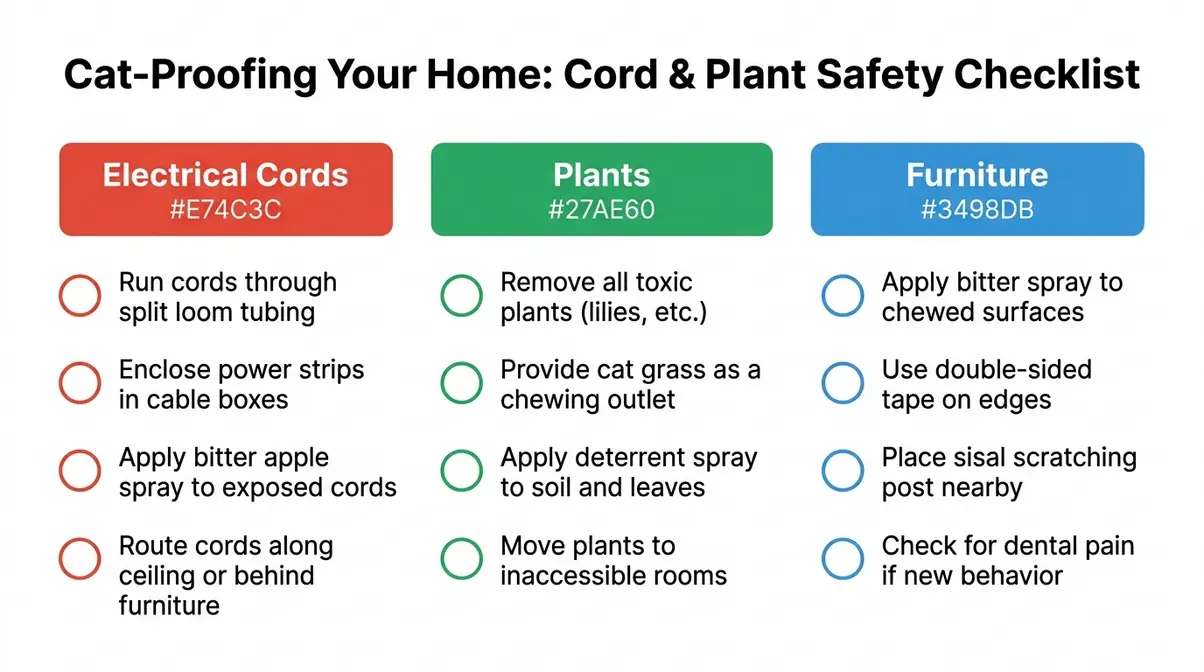
- Cord concealers and split loom tubing: Run all accessible cords through flexible plastic tubing (available at hardware stores for under $10). This removes the prey-like texture and makes chewing physically unrewarding.
- Cable management boxes: Enclose power strips and cable clusters in plastic boxes with small cord-exit holes. Cats cannot access bundled cords inside a closed box.
- Bitter deterrent spray: Apply a bitter apple or citrus spray directly to exposed cords. Reapply every 3–4 days until the behavior extinguishes. Most cats abandon cord biting within 1–2 weeks of consistent deterrent application.
- Cord elevation: Route cords along ceiling lines or behind furniture whenever possible. Out of sight, out of mind — and out of reach.
Behavioral enrichment as the root fix: Cord biting is often a symptom of insufficient predatory play outlets. A cat getting two daily interactive play sessions is significantly less likely to redirect predatory energy onto household objects. The enrichment recommendations in H2-2 apply directly here.
Stopping Plant Biting and Chewing
Plant chewing in cats has two distinct profiles. Opportunistic plant chewing — batting at dangling leaves, chewing grass-like houseplants — is normal exploratory and predatory behavior. Compulsive or excessive plant consumption can indicate pica, a behavioral condition associated with nutritional gaps, early weaning, or anxiety.
Toxicity is the immediate concern. Many common houseplants are severely toxic to cats — lilies (Lilium and Hemerocallis species) can cause acute kidney failure from a single leaf ingestion, according to the ASPCA Animal Poison Control Center. Before addressing the behavior, audit your home for toxic plants. The ASPCA maintains a comprehensive toxic plant database at aspca.org/pet-care/animal-poison-control.
Management strategies:
- Relocate toxic plants to rooms the cat cannot access — or remove them entirely.
- Provide cat grass or catnip (Nepeta cataria) as a sanctioned chewing outlet. Most cats will preferentially chew cat grass over houseplants when both are available.
- Apply deterrent spray to plant soil and lower leaves for plants you want to keep accessible.
- Hanging planters placed out of jump range eliminate access for most cats.
If a cat is consuming large quantities of non-food plant material compulsively, consult a veterinarian to rule out pica and assess dietary completeness.
Stopping Furniture Biting and Destructive Chewing
Furniture biting — chewing chair legs, gnawing wooden surfaces, mouthing fabric — is most common in kittens during teething (approximately 3–6 months of age) and in adult cats with insufficient chewing outlets or dental discomfort.
Teething kittens need appropriate chew items: rubber chew toys designed for cats, frozen wet food in a lick mat, or chilled teething rings. Providing these during the 3–6 month window prevents the habit from establishing.
For adult cats:
- Bitter deterrent spray on targeted furniture surfaces is the fastest intervention.
- Double-sided tape on commonly chewed edges creates a texture aversion — cats dislike sticky surfaces on their paws and faces.
- Redirect to appropriate scratching posts placed adjacent to the targeted furniture. Cats often chew and scratch the same surfaces; providing a sisal or cardboard alternative nearby redirects both behaviors.
- Dental evaluation: An adult cat that has developed new furniture-chewing behavior should be evaluated for dental pain. Chewing behavior sometimes represents an attempt to relieve oral discomfort. See the medical section for full diagnostic guidance.
A cat with appropriate play outlets, sufficient environmental enrichment, and a dental health check rarely becomes a destructive chewer. Addressing the behavioral root — insufficient stimulation — resolves most cases without ongoing management.
Multi-Pet Households: When Cats Bite Each Other {#h2-6}
Biting between cats in a multi-pet household is normal in small doses — play-fighting, gentle mutual grooming, and mock hunting between bonded cats all involve teeth. The problem arises when biting escalates to sustained attacks, causes injuries, or produces a household dynamic where one cat is chronically stressed and the other is chronically aggressive. Understanding the distinction between play fighting and genuine aggression is the foundational skill for multi-cat household management.
Play fighting between cats looks like: alternating roles (both cats take turns being “prey”), soft body postures, no vocalizations (no hissing, growling, or yowling), and both cats returning voluntarily for more. Biting during play fighting is inhibited — pressure is controlled, no injuries result.
Genuine aggression looks like: one cat consistently in the “predator” role, the other consistently fleeing; vocalizations (hissing, growling, screaming); flat ears, puffed tails, arched backs; bites that break skin or cause hair loss.
Introducing a New Cat Without Creating Biting Conflict
The introduction protocol is the single highest-leverage intervention for preventing inter-cat aggression. Rushed introductions — putting two cats in the same room and “letting them work it out” — create negative first associations that can take months to repair and sometimes never fully resolve.
The scent-swap introduction protocol:
- Separate completely for 7–14 days. The new cat lives in a dedicated room with its own food, water, litter box, and bedding. No visual contact with the resident cat.
- Scent exchange: Swap bedding between the two cats daily. Allow each cat to investigate the other’s scent on neutral territory before they ever meet visually.
- Feeding on opposite sides of a closed door: Place food bowls on either side of the door. The cats learn to associate each other’s scent with the positive experience of eating.
- Visual introduction through a cracked door or baby gate: Allow brief visual contact (30–60 seconds) while both cats are calm, then separate again. Gradually increase visual exposure over several days.
- Supervised shared space: Only when both cats show relaxed body language during visual introductions should you allow supervised access to shared space. Keep sessions short (10–15 minutes) and have a barrier ready.
According to veterinary behaviorists, cats introduced using a gradual scent-swap protocol show significantly lower rates of sustained inter-cat aggression compared to immediate introductions (VCA Hospitals, 2024).
Managing Established Inter-Cat Aggression
If two cats in an existing household have developed a biting conflict, the approach depends on whether the aggression is territorial, play-based, or redirected.
Resource competition is the most common driver of inter-cat aggression in established households. The standard veterinary recommendation is the N+1 rule: provide one more of each key resource than you have cats. Two cats need three litter boxes, three feeding stations, and multiple elevated resting spots. Resource scarcity forces cats into proximity and competition; abundance eliminates most of the motivation for conflict.
Redirected aggression between cats — where Cat A becomes aroused by an outdoor stimulus and attacks Cat B — is resolved by the same environmental management approach used for human-directed redirected aggression: identify and remove the external trigger, ensure both cats have adequate escape routes, and consider a Feliway MultiCat diffuser designed specifically for multi-cat households.
When Cat-to-Cat Biting Needs Veterinary Attention
Seek veterinary guidance when: biting between cats is causing injuries (puncture wounds, hair loss, abscesses); one cat is hiding persistently or refusing to eat due to stress from the other; aggression escalated suddenly with no change in the household; or the aggression has not improved after 4–6 weeks of structured management. A veterinary behaviorist can assess whether the cats are compatible long-term and whether pharmacological support (short-term anxiolytics) may bridge the gap during reintroduction.
Medical Reasons Your Cat Bites {#h2-7}
⚠️ This section contains health and safety information. It is not a substitute for professional veterinary advice. If your cat’s biting has changed suddenly or significantly, consult a licensed veterinarian before attempting any behavioral intervention.
Sudden or escalating biting in a cat with no prior behavioral history is a medical signal until a veterinarian rules out physical causes. This is the third vertex of the Bite-Trigger Triangle — Pain/Medical — and it is the most frequently missed diagnosis because owners default to behavioral explanations first. The critical distinction: if your cat’s biting appeared or intensified abruptly, without any change in routine, household composition, or environmental factors, schedule a veterinary appointment within 48–72 hours.
Medical Conditions That Cause Biting
Several conditions reliably produce biting behavior as a symptom:
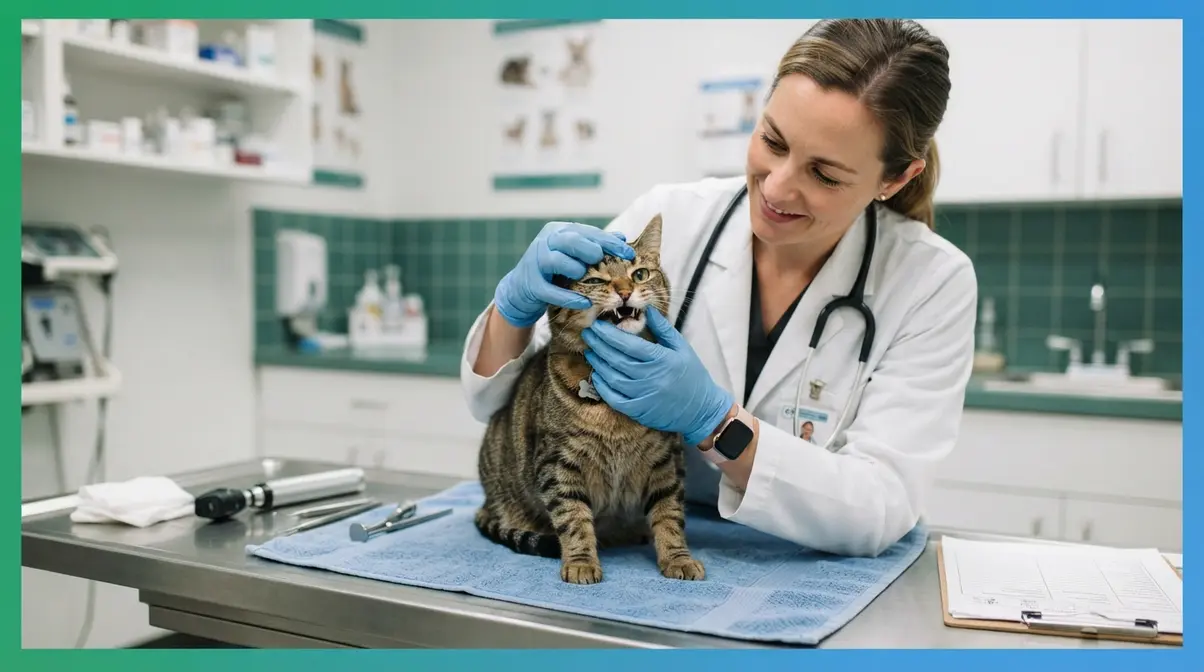
Dental disease and oral pain are among the most common and most underdiagnosed causes of sudden biting. Cats are stoic animals that hide pain — a cat with a fractured tooth, severe gingivitis, or oral resorptive lesion may show no obvious signs of distress except heightened irritability and biting when the face or jaw is touched. According to the Cornell Feline Health Center, dental disease affects an estimated 50–90% of cats over age 4 (Cornell Feline Health Center, 2024). If your cat bites specifically when you touch its head or face, a dental exam is the first diagnostic step.
Arthritis and musculoskeletal pain cause biting when a cat is touched in a painful area — the lower back, hips, or limbs are common sites. A cat that previously tolerated being picked up but now bites when lifted may be experiencing arthritic pain in its spine or hips. Arthritis is significantly underdiagnosed in cats; a 2022 study published in the Journal of Feline Medicine and Surgery found that radiographic evidence of arthritis was present in approximately 61% of cats over age 6.
Hyperthyroidism — overproduction of thyroid hormone — produces a state of chronic physiological arousal that lowers the threshold for aggression and biting. Other signs include weight loss despite increased appetite, increased vocalization, and restlessness. Hyperthyroidism is highly treatable once diagnosed; biting associated with this condition often resolves with appropriate medical management.
Neurological conditions, including cognitive dysfunction syndrome (feline dementia), brain tumors, and epilepsy, can produce sudden aggression and biting that has no behavioral explanation. If biting is accompanied by disorientation, changes in sleep patterns, staring at walls, or apparent confusion, neurological evaluation is warranted.
Vision and hearing loss can cause startle-response biting — a cat that cannot see or hear you approaching may bite defensively when touched unexpectedly. This is particularly common in senior cats.
Human Safety and Infection Risk from Cat Bites
⚠️ YMYL content — consult a healthcare provider for any cat bite that breaks skin.
Cat bites carry a disproportionately high infection risk compared to dog bites, despite appearing less dramatic. The primary pathogen is Pasteurella multocida, a bacterium present in the oral flora of approximately 75–90% of cats (PubMed, 2014 — historical reference; current clinical guidance from the CDC recommends this figure as still applicable). Pasteurella infections progress rapidly and can reach deep tissues, joints, and bone within 24–48 hours of a bite.
A landmark study published in the Journal of Hand Surgery (Trost et al., 2014, via PubMed) found that of 193 patients presenting to Mayo Clinic with cat bite wounds to the hand, approximately 30% required hospitalization — a rate significantly higher than dog bites of comparable apparent severity. The high hospitalization rate reflects the needle-like puncture nature of cat bites, which deposit bacteria directly into deep tissue layers that are difficult to irrigate.
According to the CDC’s guidance on animal bites, any cat bite that breaks the skin should be:
- Washed immediately with soap and water for a minimum of 5 minutes
- Evaluated by a healthcare provider within 24 hours — especially bites to the hand, face, or near joints
- Monitored for infection signs over the following 48 hours: increasing redness, warmth, swelling, pus, or red streaking from the wound (which can indicate lymphangitis)
High-risk populations — immunocompromised individuals, people with diabetes, those on corticosteroids, and the elderly — face elevated risk of serious infection and should seek medical evaluation for any bite that breaks skin, regardless of severity.
Cat scratch disease (caused by Bartonella henselae) is a separate but related concern — transmitted through scratches as well as bites, and more common in cats under 1 year of age. Symptoms include swollen lymph nodes near the scratch site, fever, and fatigue. Most healthy adults recover without treatment, but immunocompromised individuals can develop serious complications.
This guide does not constitute medical advice. Consult a licensed healthcare provider for any bite that breaks skin.
Limitations and Common Mistakes {#limitations}
Common Pitfalls That Stall Progress
1. Inconsistency is the most common reason the Freeze-and-Redirect method fails. The method requires the same response every time — not 80% of the time. A cat that receives an inconsistent response learns that persistence occasionally pays off, which actually strengthens the biting behavior through variable reinforcement (the same mechanism that makes gambling addictive). Every person in the household must apply the same protocol.
2. Misidentifying the trigger. Applying a play-drive solution to a pain-driven bite — or a fear-based solution to a predatory ambush — produces no results and can worsen the behavior. Return to the Bite-Trigger Triangle and re-diagnose if your current approach isn’t working within 2 weeks.
3. Expecting overnight results. Kittens show improvement within 1–3 weeks of consistent training. Adult cats with entrenched biting habits require 4–8 weeks of consistent application before significant change is measurable. Abandoning the method at week 2 because “it isn’t working” is the most common self-defeating pattern.
4. Anthropomorphizing the guilt response. Cats do not experience guilt in the way humans do. The “guilty look” — lowered gaze, flattened posture after a bite — is a stress response to the owner’s changed demeanor (elevated voice, changed body language), not remorse. Treating the look as guilt leads owners to forgive and reconnect too quickly, removing the withdrawal-of-attention consequence that makes the method work.
When to Choose Professional Help
If biting is causing injuries, if the biting cat is a multi-cat household aggressor creating chronic stress for other pets, or if 6–8 weeks of consistent behavioral intervention have produced no measurable improvement, the appropriate next step is a consultation with a board-certified veterinary behaviorist (Diplomate of the American College of Veterinary Behaviorists — DACVB). These specialists can assess whether pharmacological support, specialized desensitization protocols, or environmental restructuring beyond standard guidance is warranted.
A general-practice veterinarian is the appropriate first contact for any sudden-onset aggression to rule out medical causes before behavioral intervention begins.
When to Seek Expert Help
Any of the following situations warrants professional consultation rather than continued home management:
- Biting that breaks skin regularly, especially in a household with children, elderly individuals, or immunocompromised people
- Sudden-onset aggression in an adult cat with no prior behavioral history
- Aggression accompanied by other behavioral changes (appetite loss, hiding, vocalization changes, disorientation)
- Multi-cat household aggression causing injuries or chronic stress despite 4–6 weeks of structured management
Frequently Asked Questions {#faq}
How do you discipline a cat for biting?
The most effective discipline for cat biting is immediate withdrawal of attention — not physical correction. The instant teeth make contact with skin, freeze, then stand up, turn away, and leave the room for 60 seconds. This removes all social reward from the bite. Physical discipline (tapping, spraying water, raising your voice) has been shown to increase fear-based aggression in cats, according to Tufts University veterinary behaviorists. Consistency is essential — the same response, every time, is what produces lasting behavioral change.
What is the one bite rule for cats?
The “One Bite Rule” refers to the single warning nip most cats deliver before escalating to a full bite. This first nip is communication — “I’m overstimulated,” “stop handling me,” or “I’m in prey drive mode.” Owners who recognize this warning nip as a signal rather than an attack can respond immediately with the Freeze-and-Redirect method and prevent escalation. The rule is a practical heuristic, not a clinical term — it’s about training yourself to recognize the first bite as a message, not an attack.
Do cats grow out of biting?
Kittens often reduce biting significantly with age, but only if consistent training is applied during the critical development window. Without intervention, biting behavior typically becomes more entrenched, not less — kittens that bite freely learn that biting works and carry that conditioned habit into adulthood. Adult cats do not self-correct. Research from the Cornell Feline Health Center notes that early weaning and lack of appropriate play outlets are primary contributors to persistent play aggression. The younger the cat when training begins, the faster the improvement.
What deters cats from biting?
The most reliable deterrents combine behavioral training with environmental management. The Freeze-and-Redirect method trains the cat that biting ends positive interactions. Environmental deterrents — bitter apple spray on objects, cord concealers on wires, double-sided tape on furniture edges — remove the reward from destructive chewing. Scheduled daily play sessions reduce the baseline predatory pressure that drives biting. For cats biting from overstimulation, keeping petting sessions short and owner-initiated is the primary deterrent. No single deterrent works in isolation.
Do cats eventually stop biting?
Cats stop biting when they learn that biting is consistently unrewarding — but this requires active intervention, not passive waiting. Kittens who receive consistent redirection during the developmental period (under 12 months) typically show significant reduction by 12–18 months. Adult cats with established biting habits require 4–8 weeks of consistent behavioral modification. Cats biting from pain or medical causes will not stop until the underlying condition is treated. If your cat’s biting has not improved after 6 weeks of consistent training, a veterinary consultation is the appropriate next step.
Do cats feel guilty after biting?
Cats do not experience guilt in the way humans do. The submissive, lowered-gaze posture owners often interpret as guilt is a stress response to the owner’s changed demeanor — elevated voice, tense body language, direct eye contact — not remorse. This distinction matters practically: owners who interpret the post-bite look as guilt often reconnect with the cat too quickly, inadvertently removing the withdrawal-of-attention consequence that makes behavioral training effective. The cat is reading your emotional state, not reflecting on its own behavior.
Should I be worried if a house cat bites me?
Yes — any cat bite that breaks the skin warrants prompt medical attention, regardless of how well you know the cat. Approximately 75–90% of cats carry Pasteurella multocida in their oral flora (PubMed, 2014), and cat bite infections can progress to deep tissue, joint, and bone involvement within 24–48 hours. A study published in the Journal of Hand Surgery found that approximately 30% of cat bite wounds to the hand required hospitalization. Wash the wound immediately with soap and water for 5 minutes and consult a healthcare provider within 24 hours — especially for bites to the hand, face, or near joints.
How do you stop a cat from biting during petting?
Petting-induced biting is stopped by learning your cat’s overstimulation signals and ending sessions before the threshold is reached. Watch for early warning signs: tail swishing or thumping, skin rippling along the back, ears rotating backward, or sudden body stiffening. At the first signal, slowly withdraw your hand and end the session. Keep initial sessions to 2–3 minutes and gradually extend them over weeks as your cat’s tolerance increases. Restrict petting to high-tolerance zones — the head and cheeks — until you’ve mapped your cat’s individual limits.
Conclusion {#conclusion}
Every cat biting incident — whether it’s an ankle ambush, a petting-induced nip, a cord-chewing habit, or a sudden attack with no apparent cause — traces back to one of three triggers in the Bite-Trigger Triangle: Predatory Drive, Overstimulation, or Pain/Medical. Matching the fix to the correct trigger is what separates a solution that sticks from a tip that works once. For most cats, the Freeze-and-Redirect method, applied consistently within 2–3 seconds of every bite, produces measurable improvement within 1–4 weeks. For cats biting from pain or medical causes, no behavioral technique replaces a veterinary evaluation — sudden-onset aggression is a medical signal first.
The Bite-Trigger Triangle is the diagnostic lens that makes every other technique in this guide work. Once you know whether your cat is biting from prey drive, overstimulation, or physical discomfort, the right intervention becomes clear rather than guesswork. Apply the method consistently, adjust for your cat’s specific trigger, and give the process 4–6 weeks before drawing conclusions.
Your next step: identify which of the three Bite-Trigger Triangle points applies to your cat today. If it’s predatory drive, schedule two daily play sessions starting tonight. If it’s overstimulation, map your cat’s warning signals during the next petting session. If the biting is sudden and unexplained, call your veterinarian this week. One targeted action, taken today, is worth more than a dozen tips applied inconsistently. For any biting that involves injury, sudden behavioral change, or concerns about human safety, consult a licensed veterinarian or board-certified veterinary behaviorist — this guide is educational, not a substitute for professional veterinary advice.
Medically reviewed for accuracy against current veterinary behavioral guidelines — January 2026.

Dave King
Cat owner and writer at Mad Cat Man.