
Table of Contents
- What Makes Maine Coon Characteristics So Unique?
- Maine Coon Size and Appearance (At a Glance)
- Male vs. Female Maine Coon: Key Differences
- Maine Coon Kitten Characteristics (Quick Guide)
- Maine Coon Health, Care, and Lifespan
- Maine Coon Coat Colors and Variations
- Is My Cat a Maine Coon Mix?
- Getting a Maine Coon: Breeders vs. Adoption
- When a Maine Coon Might Not Be Right for You
- Maine Coon Characteristics FAQs
- The Gentle Giant Paradox — and Why It Matters
This blog post may contain affiliate links. As an Amazon Associate I earn from qualifying purchases.
Picture a cat that weighs as much as a small dog — up to 25 pounds of silky, shaggy fur — yet greets every stranger at the door with a chirp and a headbutt. That’s the Maine Coon. Most people expect a cat this big to be aloof and territorial. Maine Coons are the opposite: they’re laidback, curious, and deeply affectionate gentle giants who follow you from room to room like a devoted puppy.
The problem? Most breed guides hand you a 10-point bullet list and call it done. You’re here because you want real answers. Can they be left alone for eight hours? Are males or females easier to live with? How do you even know if your fluffy cat is a true Maine Coon and not a mix? These are the questions that actually matter before you commit.
This complete guide to maine coon characteristics covers everything — personality, size, gender differences, health, coat colors, how to spot a mix, and how to find one responsibly — so you can make a confident, informed decision.
Key Takeaways: Maine Coon Characteristics
Maine Coon characteristics combine record-breaking size with a surprisingly gentle, dog-like personality — making them one of the most family-friendly cat breeds in the world.
- The Gentle Giant Paradox: Males weigh up to 25 lbs yet are famous for their calm, laidback temperament — the biggest domestic cat with the gentlest soul
- Dog-like loyalty: Maine Coons follow their owners room to room, respond to their names, and some even play fetch
- Health to know: Genetically predisposed to HCM (a heart condition where heart muscle walls thicken); always request genetic screening from breeders
- Gender matters: Males are typically larger and goofier; females are smaller and more independent
- Not for everyone: Their thick, shaggy coat needs brushing 2–3 times per week to prevent painful mats
What Makes Maine Coon Characteristics So Unique?
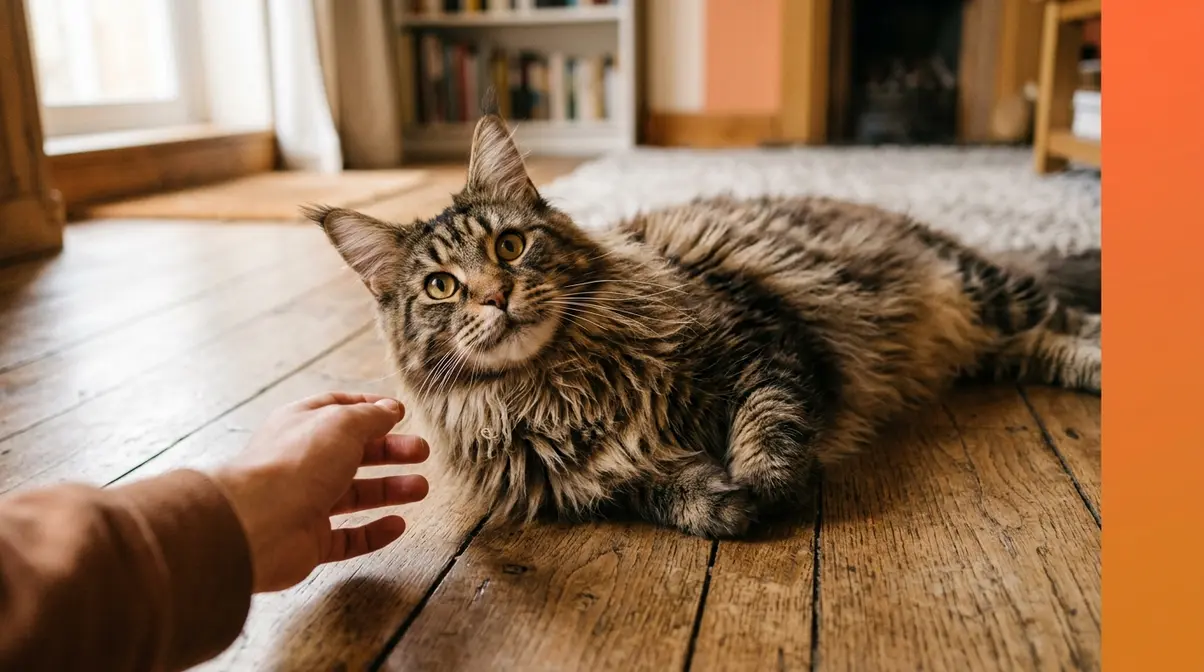
The Maine Coon personality is best described in one word: paradoxical. These are large, powerful cats — one of the biggest domestic breeds on the planet — yet they are consistently ranked among the gentlest, most sociable, and most people-oriented of all cat breeds. That contrast is precisely what makes them so special, and it’s the first maine coon characteristic that surprises every new owner.
According to the American Association of Feline Practitioners, highly intelligent and active breeds like the Maine Coon require significant environmental enrichment and mental stimulation to stay happy — a sign of just how cognitively complex this breed really is. Want to understand how Maine Coons compare to regular cats in personality? The gap is wider than most people expect.
What Is a Maine Coon’s Personality?
The Gentle Giant Paradox is this: the world’s largest domestic cat breed is also among its gentlest and most dog-like. Maine Coons are not just big cats with a nice reputation — they are genuinely calm, adaptable companions who take life in stride. Breed experts and the Cat Fanciers’ Association (CFA), the largest registry of pedigreed cats, note that the Maine Coon is one of North America’s oldest natural breeds, originally working alongside sailors and farmers. That centuries-long history of living closely with humans shaped a cat with unusually high social intelligence.
Their temperament is best described as “go with the flow.” A Maine Coon adapts to busy households with kids and dogs, quieter homes with a single owner, and everything in between. Unlike most cats that retreat when guests arrive, a Maine Coon typically investigates the newcomer with calm curiosity — tail up, eyes wide, ready to make a new friend.
That laidback nature extends to how Maine Coons interact with the people they love — and the way they show affection might surprise you.
Dog-Like Loyalty and Behavior
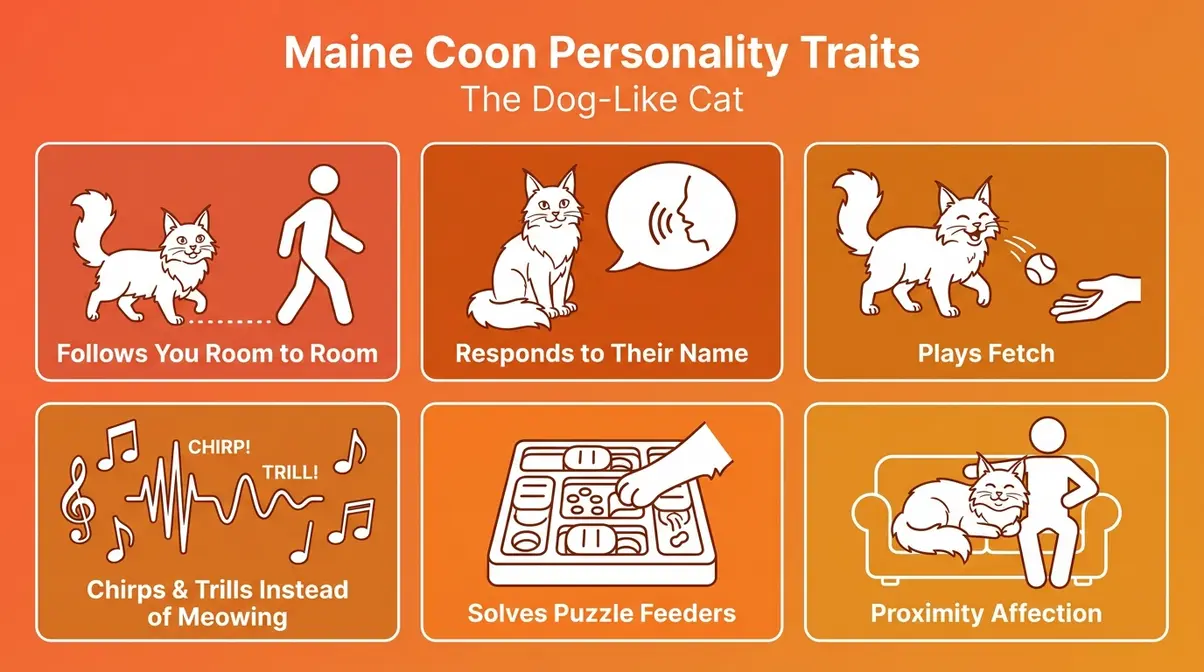
Maine Coons exhibit at least three behaviors that cat owners typically associate with dogs, and understanding each one helps you know what daily life with this breed actually looks like:
- Following you room to room: Your Maine Coon will trail you from the bedroom to the kitchen to the bathroom — not because they’re needy, but because they genuinely enjoy your company.
- Responding to their name: Call a Maine Coon’s name across the house and most will chirp back, trot over, or at minimum make eye contact. Name recognition in cats is rare; in Maine Coons it’s almost universal.
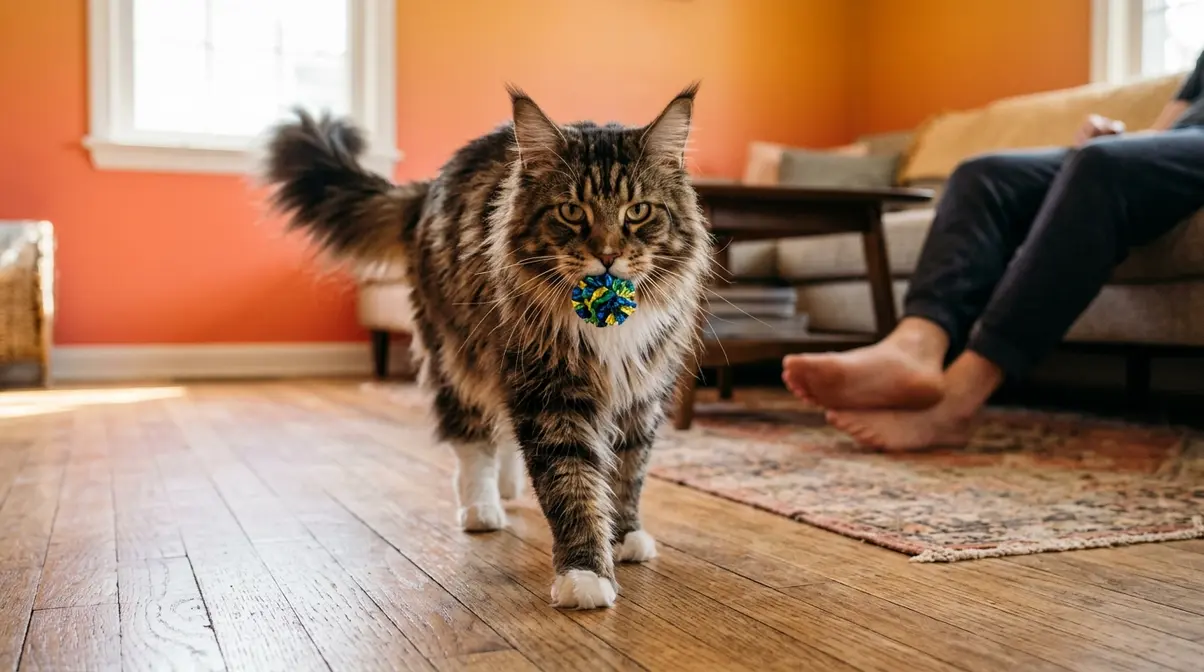
- Playing fetch: Many Maine Coons will retrieve a crinkle ball or toy mouse and drop it at your feet, expecting you to throw it again. This is not a trick — it’s instinct.
Their vocalizations are equally distinctive. Maine Coons rarely produce the typical “meow.” Instead, they chirp (a short, bird-like burst of sound) and trill (a rolling, musical warble). These sounds are how your Maine Coon “talks” to you — they’re a greeting, a request, and a sign of contentment all at once. For beginners, hearing a chirp for the first time is genuinely startling.
One Maine Coon owner described the breed perfectly:
“Smart, active, quirky, and super playful all the while being the cuddliest cat of all time.”
That quote captures the maine coon behavior characteristics better than any breed standard. Being this social does come with a flip side — Maine Coons need mental stimulation. Here’s what that looks like in practice.
Do Maine Coons Like to Be Cuddled?
Most Maine Coons enjoy closeness, but cuddliness varies by individual. Many are enthusiastic lap cats who settle on you every evening, while others prefer to sit beside you rather than on you — close enough to stay connected, independent enough to maintain dignity. What’s consistent across the breed is proximity affection: your Maine Coon wants to be near you, even if not always on you. That distinction matters if you’re hoping for a cat who tolerates being picked up and held — some do, some don’t, and it varies by personality more than breed.
Maine Coons are also among the most intelligent domestic cat breeds. They solve puzzle feeders, learn their names, and can be taught basic commands like “sit” or “high five” with treat-based training — something most cats flatly refuse. Their inquisitive nature means they investigate every new object in the house, often with a paw tap and a tilted head.
The playfulness stays strong well into adulthood. Unlike many breeds that mellow dramatically after kittenhood, Maine Coons remain active and game-ready for years. Budget at least two 15-minute interactive play sessions per day to keep your cat mentally satisfied.
Maine Coon Size and Appearance (At a Glance)
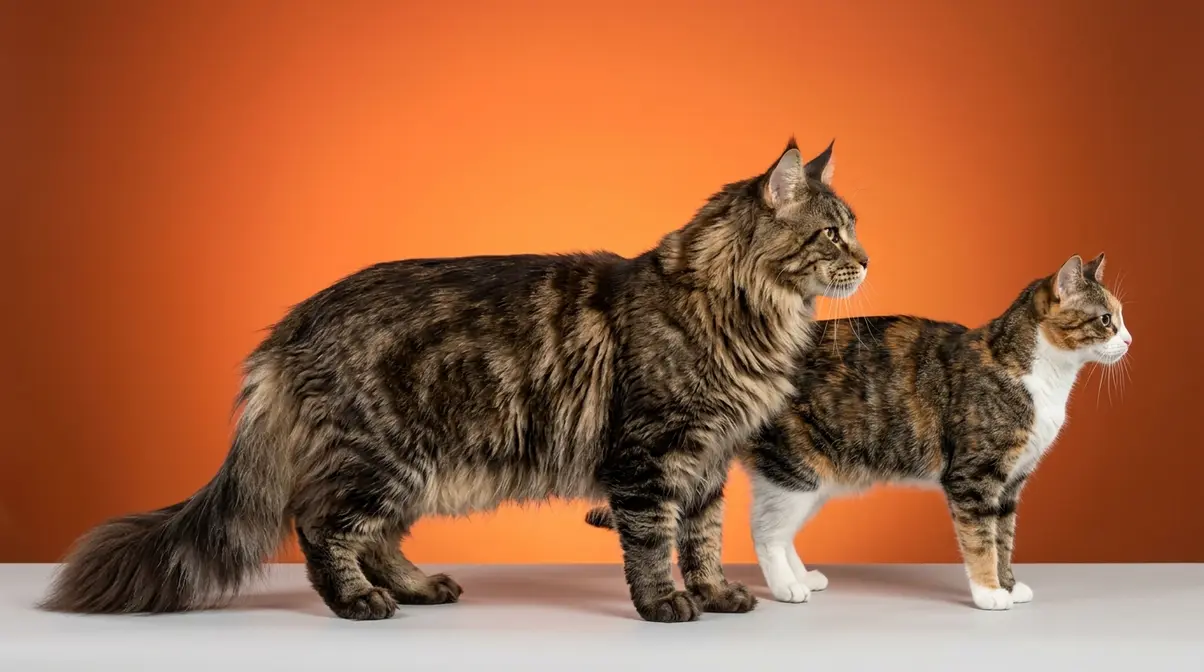
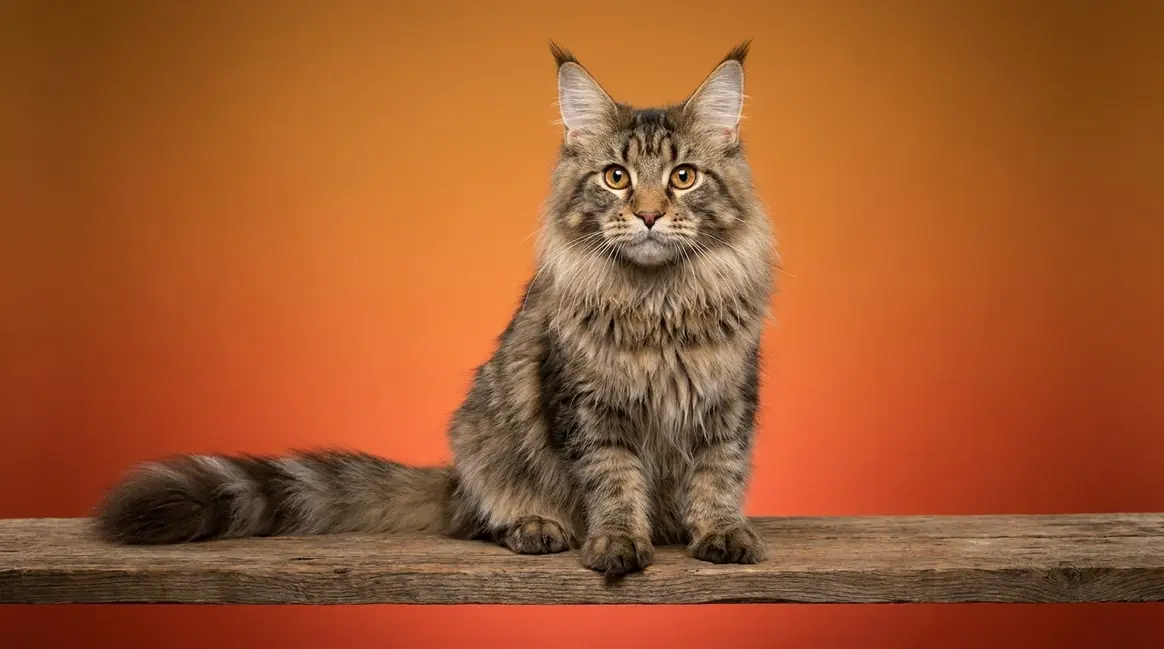
Maine Coons are the largest domestic cat breed in the world by average size. Males typically weigh 13–18 pounds, with some reaching 20–25 pounds. Females are smaller, usually 8–12 pounds. Their bodies are long and muscular, with a rectangular frame, broad chest, and substantial bone structure that makes even a “small” Maine Coon look impressive next to a typical domestic cat.
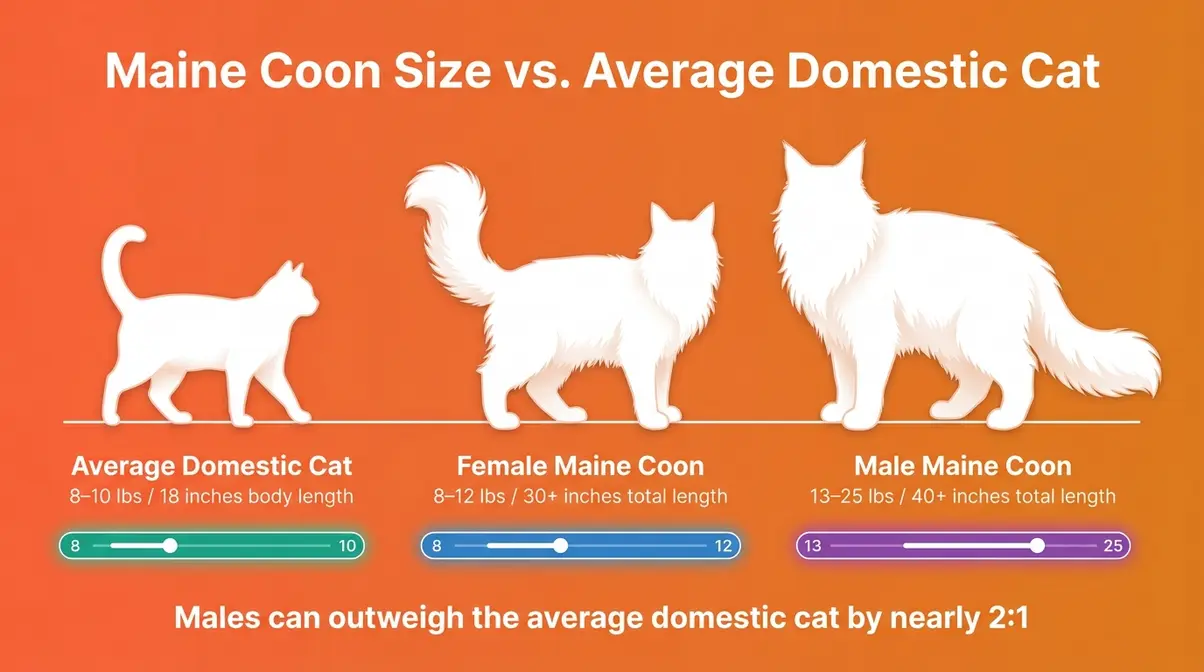
Their most recognizable features include:
- Tufted ears with lynx-like tips of fur
- A long, flowing shaggy coat with a distinctive ruff around the neck
- Snowshoe paws — large, round feet with tufts of fur between the toes that historically acted as natural snowshoes in the harsh New England winters
- A long, bushy tail that some owners describe as a “raccoon tail” — a feature that may have inspired the breed’s name
- High cheekbones and a square muzzle that give the face a wild, almost lion-like appearance
For a full breakdown of growth stages, weight-by-age charts, and real owner photos, see our dedicated Maine Coon size and growth guide. The CFA’s official breed standard confirms the Maine Coon’s rectangular body shape and dense, water-resistant double coat as defining characteristics of the breed.
Male vs. Female Maine Coon: Key Differences
One of the most common questions prospective owners ask — and one that almost no competitor breed guide answers — is whether to get a male or female Maine Coon. The differences are real, meaningful, and worth understanding before you choose.
Male Maine Coon Traits
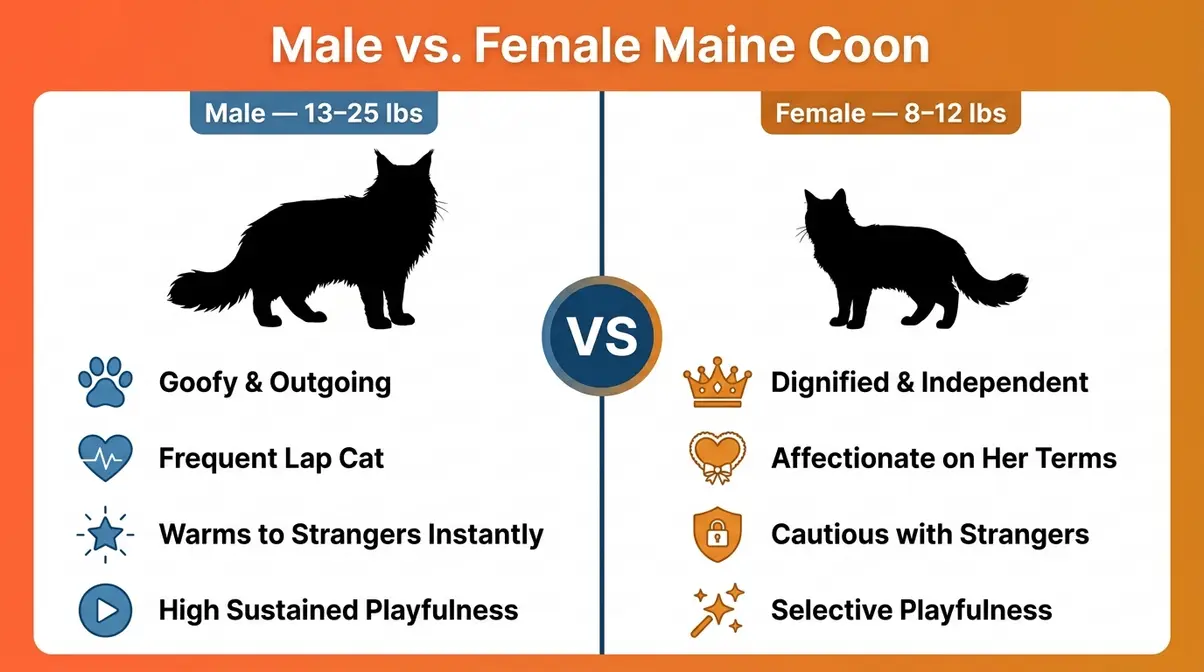
Male Maine Coons are the gentle goofballs of the breed. They tend to be larger — often 15–25 pounds fully grown — and their personalities lean toward playful, attention-seeking, and unabashedly affectionate. Maine Coon owners consistently describe neutered males as “big kittens” who never quite grow out of their playful phase. They are more likely to be lap cats, more likely to seek out cuddles on their own terms, and more likely to follow you everywhere with zero embarrassment about it.
Maine coon characteristics male owners notice most: a tendency toward clownish behavior, a higher tolerance for being handled, and an eagerness to interact with every person in the household — including guests. Males are often recommended for first-time cat owners precisely because their affection is so uncomplicated.
Female Maine Coon Traits
Female Maine Coons are smaller — typically 8–12 pounds — and carry themselves with a certain quiet dignity that males often lack. They are still affectionate and social, but on their own schedule. A female Maine Coon will come to you for attention when she decides it’s time, and she’ll let you know clearly when she’s done. Owners frequently describe maine coon characteristics female as “regal” — she’s engaged, curious, and warm, but she maintains her independence.
Females can be slightly more territorial than males, particularly in multi-cat households, and may take longer to warm up to strangers. However, once bonded, female Maine Coons are deeply loyal and form strong one-on-one connections with their primary person.
Head-to-Head Comparison
No competitor breed guide covers this directly — so here is a clear side-by-side breakdown:
| Trait | Male Maine Coon | Female Maine Coon |
|---|---|---|
| Average Weight | 13–25 lbs | 8–12 lbs |
| Temperament | Goofy, outgoing, highly affectionate | Dignified, independent, selectively affectionate |
| Cuddliness | Frequent lap cat | Affectionate on her own terms |
| Sociability with Strangers | Warm and curious immediately | Cautious; warms up gradually |
| Playfulness | High, sustained into adulthood | Moderate; playful but more self-directed |
| Best For | First-time owners, families with kids | Owners who appreciate feline independence |
| Spay/Neuter Impact | Neuter reduces roaming; amplifies affection | Spay reduces hormonal behavior; personality largely unchanged |
The common stereotype — males are goofier, females are more dignified — holds up in practice. Neither is “better.” The right choice depends entirely on what kind of companion you’re looking for.
Maine Coon Kitten Characteristics (Quick Guide)
Maine Coon kittens are born looking like fluffy, oversized pom-poms — but their most distinctive adult features take time to develop. The tufted ear tips, the full neck ruff, and the impressive tail usually don’t fully emerge until a kitten is 3–5 years old. Yes, years. Maine Coons are one of the slowest-maturing cat breeds, and many owners are surprised to learn their cat isn’t fully grown until age three or beyond.
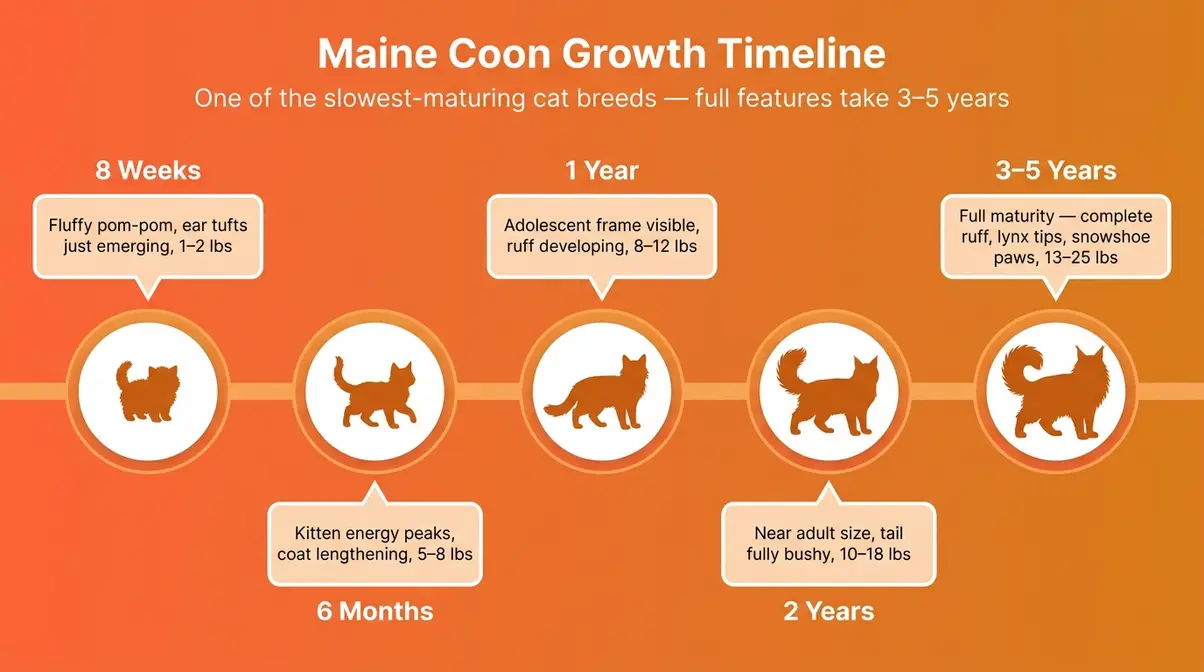
As kittens, Maine Coons are intensely playful and inquisitive. They test boundaries, climb everything, and require consistent interactive play to channel their energy productively. Socialization during the first 12 weeks is especially important — kittens exposed to a variety of people, sounds, and environments grow into the confident, laidback adults the breed is known for.
One important distinction: not every large, fluffy kitten is a Maine Coon. Identifying a true Maine Coon kitten requires looking for the combination of tufted ears, a square muzzle, large round paws, and a long body — not just size alone. For a full identification guide with photos and a breed comparison checklist, visit our dedicated Maine Coon kitten identification guide.
Maine Coon Health, Care, and Lifespan
Maine Coons are a generally hardy breed, but responsible ownership means understanding the health conditions they are predisposed to — and taking proactive steps to address them. Breed experts and veterinary sources confirm that with proper care, most Maine Coons live full, healthy lives.
HCM and Hip Dysplasia Risks
The two most significant health concerns in Maine Coons are Hypertrophic Cardiomyopathy (HCM) and Hip Dysplasia.
HCM is a heart condition where the muscle walls of the heart thicken over time, reducing the heart’s ability to pump blood efficiently. It is the most common heart disease in cats overall, according to the Cornell Feline Health Center, but Maine Coons are genetically predisposed to a specific inherited form. Research from veterinary cardiologists suggests that HCM affects a meaningful percentage of Maine Coons over their lifetime — some studies estimate prevalence as high as 30% in the breed (Meurs et al., veterinary cardiology research). Reputable breeders screen their breeding cats using echocardiograms (ultrasound of the heart) and DNA tests for the known genetic mutation (MyBPC3-A31P) through accredited labs like the UC Davis Veterinary Genetics Laboratory. Always ask your breeder for documented HCM screening results before purchasing a kitten.
Hip Dysplasia is a condition where the hip joint doesn’t develop correctly, causing pain and reduced mobility over time. It is more commonly associated with large dog breeds, which makes its presence in Maine Coons — another large breed — logical. The Wisdom Panel breed health database notes Maine Coons among the breeds with elevated hip dysplasia risk. Symptoms include reluctance to jump, a changed gait, or visible discomfort when moving.
Both conditions benefit from early detection. Ask your veterinarian about scheduling an annual cardiac exam for your Maine Coon, especially after age five.
Grooming Your Maine Coon’s Shaggy Coat
The Maine Coon’s shaggy coat is one of its most beautiful — and most demanding — features. It is a semi-long, double-layered coat with a silky undercoat and a slightly coarser top layer that is naturally water-resistant. Without regular grooming, the undercoat mats quickly, particularly around the armpits, belly, and behind the ears.
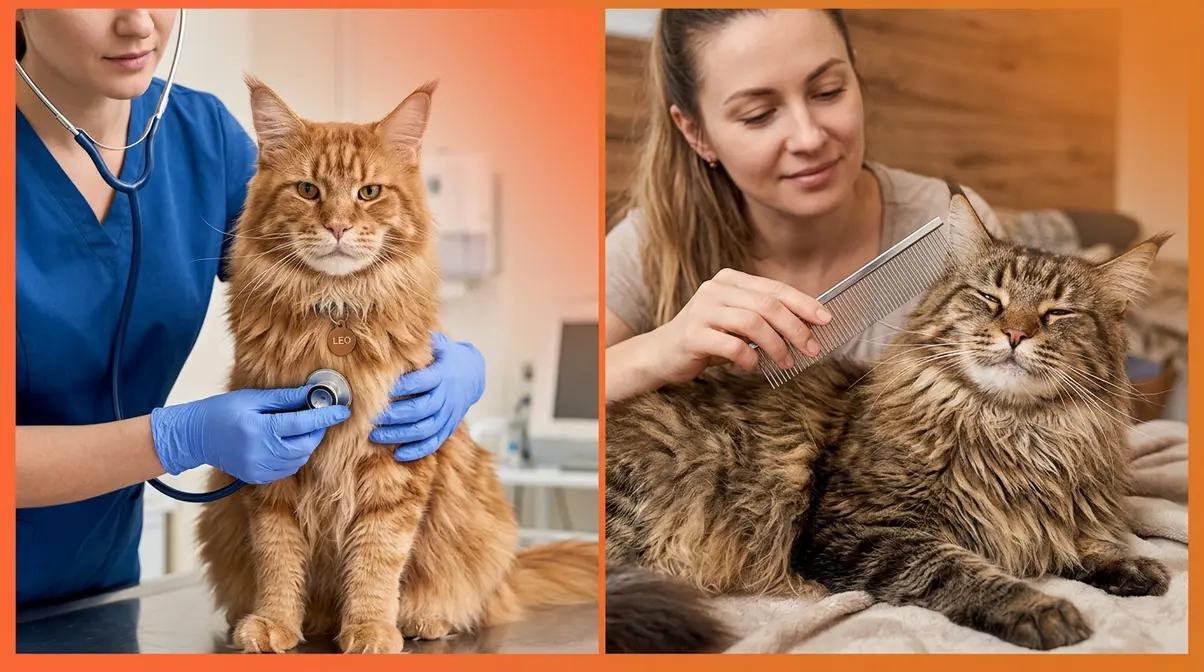
Grooming frequency: Brush your Maine Coon 2–3 times per week minimum. During spring and fall shedding seasons, daily brushing prevents the dramatic “fur explosion” that Maine Coon owners know well. Use a wide-toothed metal comb for the undercoat and a slicker brush for the top coat. Work in sections, and always brush in the direction of fur growth.
- Additional grooming tasks to build into your routine:
- Nail trimming: Every 2–3 weeks
- Ear cleaning: Monthly, or whenever you notice debris in the ear canal
- Dental care: Brushing teeth 2–3 times per week reduces the risk of periodontal disease, which affects a significant portion of adult cats
Start grooming routines when your Maine Coon is a kitten. A cat who grows up with regular brushing tolerates — and often enjoys — the process.
Diet, Exercise, and Lifespan
The Maine Coon lifespan is typically 12–15 years, with well-cared-for cats sometimes reaching 16 or beyond. Because of their large size and predisposition to HCM, diet quality matters more for Maine Coons than for many other breeds.
Feed a high-protein, meat-first diet — look for a named protein (chicken, salmon, turkey) as the first ingredient. Maine Coons are prone to obesity if overfed, and excess weight accelerates joint problems like hip dysplasia. Portion control matters. Many veterinarians recommend puzzle feeders for Maine Coons: they slow eating, provide mental stimulation, and reduce the risk of bloat in large cats.
For exercise, two interactive play sessions of 15–20 minutes per day keeps a Maine Coon physically and mentally healthy. Wand toys, feather teasers, and laser pointers work well. A tall cat tree or climbing wall satisfies their instinct to survey their environment from above.
Maine Coon Coat Colors and Variations
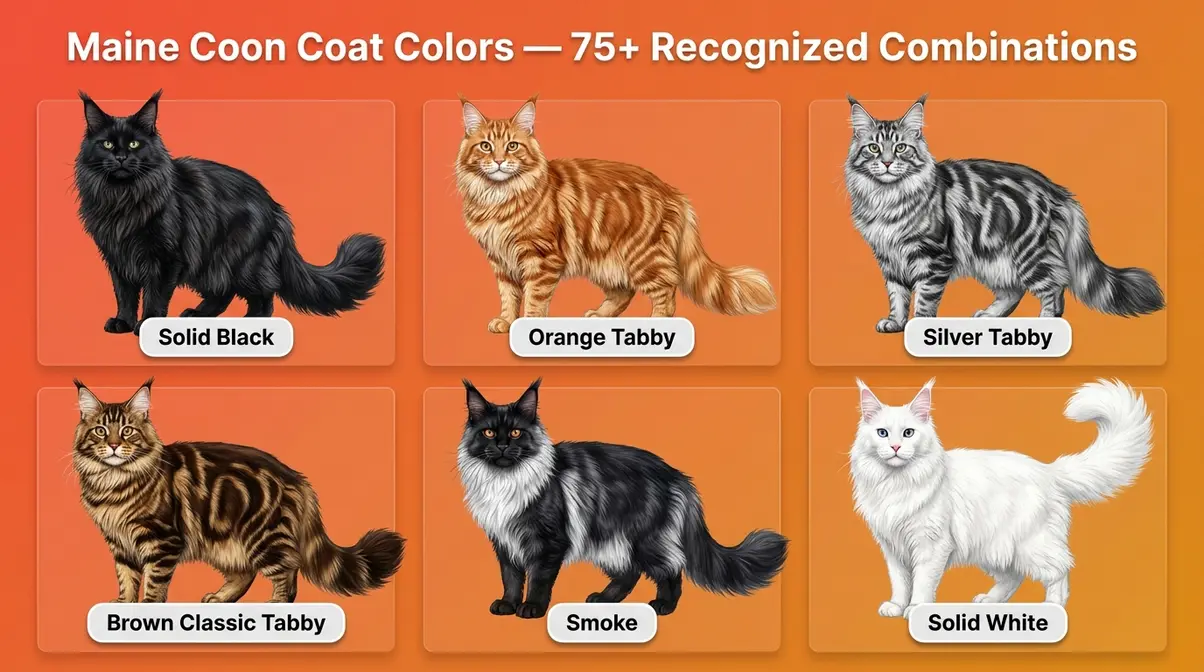
Maine Coons come in more than 75 recognized color combinations — one of the widest ranges of any cat breed. The CFA recognizes nearly all colors and patterns except chocolate, lavender, and the pointed (Siamese-style) pattern. Whether you’re drawn to a dramatic solid black or a warm, fiery orange, there’s a Maine Coon coat that matches your taste.
Black Maine Coon: Bold and Beautiful
The black Maine Coon is one of the most striking color variations in the breed. A true solid black Maine Coon has jet-black fur from root to tip with no undertones, ghost tabby markings, or white hairs. In sunlight, the coat can take on a faint brown or rusty sheen — this is normal and doesn’t disqualify a cat from being a true solid black.
Black Maine Coons carry the same personality characteristics as any other Maine Coon — the color has no influence on temperament. However, they are sometimes harder to photograph (the detail of their tufted ears and shaggy coat gets lost in low light), which may be why they’re slightly less visible on social media despite their popularity. Search interest for black Maine Coon cats remains high year-round, suggesting that many prospective owners specifically seek out this dramatic look.
Orange Maine Coon: Fiery Gentle Giant
The orange Maine Coon — also called red or ginger — is one of the most searched color variations, and for good reason. The warm, fiery coat against the breed’s large, fluffy frame creates an immediately striking appearance. Orange Maine Coons are almost always tabby-patterned (classic, mackerel, or ticked), meaning their orange base coat is overlaid with darker orange or brown striping.
An interesting genetic note: orange coloring in cats is sex-linked, meaning orange Maine Coons are disproportionately male. Female orange Maine Coons exist but are significantly rarer — roughly 1 in 5 orange cats of any breed is female. If you specifically want an orange Maine Coon, statistically you’re more likely to end up with a male, which aligns well with the outgoing, goofy temperament males are known for.
Is My Cat a Maine Coon Mix?
Many cat owners look at their large, fluffy cat and wonder: is there some Maine Coon in there? It’s a fair question — the breed’s traits can appear in mixed-breed cats, and not every large fluffy cat carries papers. Understanding what to look for helps you answer the question honestly.
Traits to Look For in a Potential Mix
A Maine Coon mix may display some — but rarely all — of the breed’s signature physical traits. The most reliable indicators of Maine Coon ancestry include:
- Tufted ear tips (lynx tips) — small tufts of fur pointing upward from the top of each ear
- Large, round paws with toe tufts (those characteristic snowshoe paws)
- A long, rectangular body — longer than a typical domestic cat, with a broad chest
- A square muzzle — more angular and defined than most domestic cats
- A bushy, long tail roughly equal in length to the body
- A shaggy, layered coat with a noticeable ruff around the neck
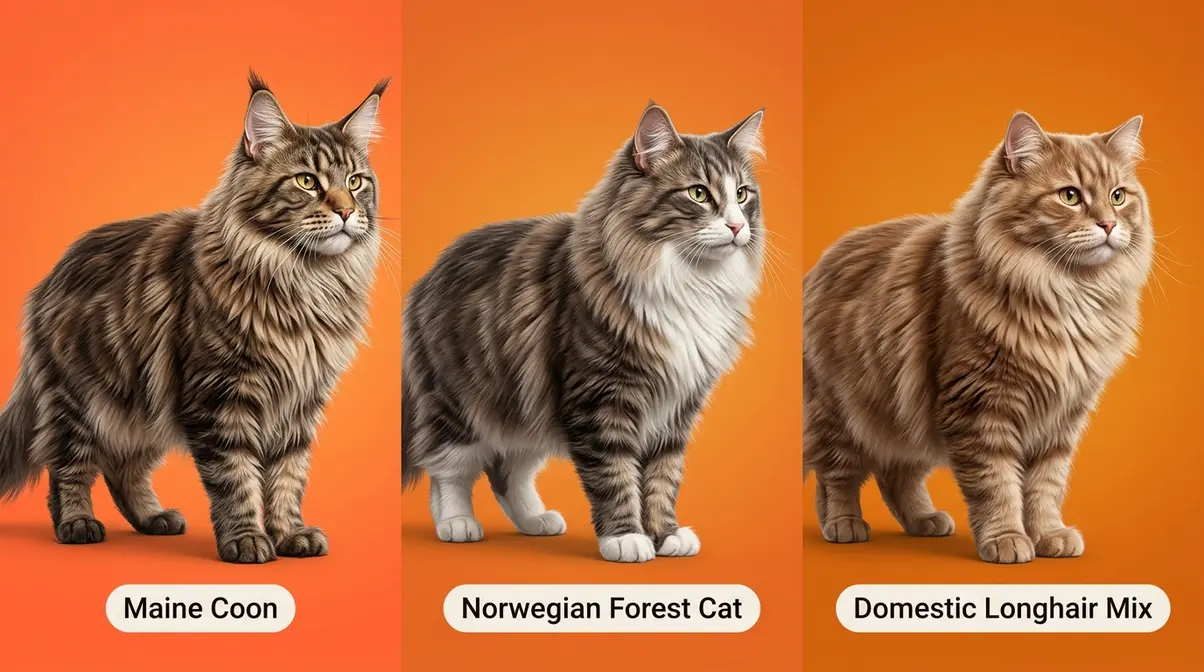
No single trait is definitive. A cat with tufted ears and a fluffy tail might be a Norwegian Forest Cat, a Siberian, or a domestic longhair. What cat is mistaken for a Maine Coon? The Norwegian Forest Cat is the most common case of mistaken identity — the two breeds share similar coat texture, ear tufts, and body size, and even experienced owners sometimes struggle to tell them apart without a pedigree.
Common Mixes: Tabby and Persian
The two most common Maine Coon mixes you’re likely to encounter are the Maine Coon tabby mix and the Maine Coon Persian mix.
A Maine Coon tabby mix typically inherits the tabby coat pattern (striped, spotted, or classic swirled markings) from one parent and the large frame and personality traits from the Maine Coon side. These cats often have the dog-like sociability of a Maine Coon with a slightly less dramatic coat than a purebred. Many are indistinguishable from purebreds to the casual eye.
A Maine Coon Persian mix (sometimes called a “Perscoon”) combines the Maine Coon’s size and personality with the Persian’s rounder face and denser, fuller coat. These cats tend to have flatter features than a purebred Maine Coon and may require even more intensive grooming. Their temperament is usually a blend — the Maine Coon’s sociability softened by the Persian’s more laid-back, less active nature.
If you need a definitive answer, a cat DNA test (from providers like Wisdom Panel or Basepaws) can identify Maine Coon ancestry with reasonable accuracy. For a video walkthrough of how to identify Maine Coon traits visually, the Maine Coon identification guide includes a step-by-step checklist.
Getting a Maine Coon: Breeders vs. Adoption
Whether you’re set on a kitten from a registered breeder or open to adopting an adult Maine Coon in need of a home, understanding your options — and the realistic costs — sets you up for a smooth experience.
Buying from a Reputable Breeder
A reputable Maine Coon breeder is registered with a recognized cat association (the CFA or TICA — The International Cat Association), health-tests their breeding cats for HCM and hip dysplasia, and provides a written health guarantee with your kitten. The process typically involves a waitlist, a screening questionnaire, and a contract that includes a spay/neuter clause and a return policy if you can’t keep the cat.
- How to find a reputable breeder:
- Start with the CFA breeder referral directory — all listed breeders have agreed to the CFA’s code of ethics
- Ask for proof of HCM cardiac screening (echocardiogram results, not just a visual exam)
- Request to see the kitten’s parents — temperament is partially hereditary
- Visit the cattery in person if possible; healthy kittens live in clean, enriched environments
- Avoid any breeder who offers kittens under 12 weeks old or cannot provide vaccination and vet records
Red flags: prices dramatically below market rate, no health testing, kittens available immediately with no waitlist, and reluctance to answer questions.
Maine Coon Adoption and Rescue
Maine Coons and Maine Coon mixes do appear in shelters and breed-specific rescues, though less frequently than mixed-breed cats. Organizations like Maine Coon Adoptions and regional breed rescues occasionally have adults available — often cats surrendered due to owner circumstances rather than behavioral problems.
Adopting an adult Maine Coon has real advantages: their personality is already established, they’re usually already spayed or neutered, and adoption fees are a fraction of breeder prices. The trade-off is that you may have less information about health history and genetic screening. Ask the rescue for any available veterinary records and schedule a full wellness exam within the first week of adoption.
Maine Coon Price Range: What to Expect
As of early 2026, Maine Coon kittens from reputable breeders typically cost $1,000–$2,500 in the United States, depending on lineage, coat color, and geographic location. Show-quality kittens from championship lines can exceed $3,000. Rare color variations — solid white, smoke, or silver — often command a premium.
Be cautious of listings advertising Maine Coon kittens for $300–$500. At that price point, you are almost certainly looking at a mix, an unregistered backyard breeder, or — in the worst cases — a kitten mill. The cost of a health-tested, responsibly bred kitten reflects the breeder’s investment in genetic screening, veterinary care, and socialization.
Adoption fees through rescues typically range from $75–$250, which usually includes spay/neuter, vaccinations, and microchipping.
When a Maine Coon Might Not Be Right for You
Maine Coons are exceptional companions — but they’re not the right choice for every household. Honest breed guidance means acknowledging the challenges alongside the rewards.
Common Maine Coon Challenges
Grooming commitment: A Maine Coon’s shaggy double coat requires real, consistent effort. If you travel frequently or have a busy schedule that makes 2–3 weekly brushing sessions unrealistic, mat removal becomes a painful and expensive problem. Professional grooming can cost $60–$120 per session.
Size and space: A 20-pound cat needs more physical space than a typical 10-pound domestic cat. Maine Coons climb, explore, and sprawl. Small apartments without vertical space (cat trees, shelves) can lead to boredom and destructive behavior.
Cost: Between purchase price, quality food for a large cat, veterinary care (including cardiac monitoring), and grooming, Maine Coon ownership costs more than the average cat. Budget accordingly.
Can They Be Left Alone for 8 Hours?
Maine Coons can manage 8 hours alone occasionally, but it is not ideal as a daily routine. They are highly social cats who thrive on interaction. A Maine Coon left alone every weekday may develop signs of boredom or separation anxiety, such as excessive vocalization, destructive behavior, or over-grooming. If your schedule requires long daily absences, consider adopting two Maine Coons so they have company, providing puzzle feeders, or using a pet camera with a treat dispenser to maintain some interaction during the day.
When to Consider a Different Breed
If you want a cat that is genuinely low-maintenance and content with minimal interaction, a Maine Coon may frustrate you with its social demands. Consider a British Shorthair (calm, independent, minimal grooming) or a Russian Blue (quiet, gentle, lower activity) instead.
If severe cat allergies are a concern, the Maine Coon is not a hypoallergenic breed. The Siberian cat produces lower levels of the Fel d 1 protein and may be a better fit for allergy-sensitive households.
A Note on Veterinary Care
The health information in this guide is provided for educational purposes only. Always consult a qualified veterinarian for advice specific to your cat’s health needs. Maine Coon health conditions like HCM and hip dysplasia require professional diagnosis — do not attempt to assess or treat these conditions at home. If you notice changes in your cat’s breathing, energy level, appetite, or mobility, contact your veterinarian promptly.
Maine Coon Characteristics FAQs
Pros and Cons of Owning a Maine Coon?
Maine Coons offer exceptional companionship, as they are affectionate, dog-like, intelligent, and gentle with children. The pros include their adaptable temperament, striking appearance, and longevity (12–15 years, according to Wisdom Panel data). The cons are equally real: their shaggy coat requires 2–3 brushings per week, they are genetically predisposed to HCM, and their large size means higher food costs.
How to Identify a True Maine Coon?
A true Maine Coon has a combination of specific physical traits, not just size alone. Look for tufted lynx-like ear tips, large round snowshoe paws with toe tufts, a long rectangular body with a broad chest, and a square muzzle. You should also look for a bushy raccoon-like tail and a shaggy layered coat with a neck ruff. No single trait is definitive, so the most reliable confirmation is a pedigree from a registered breeder or a cat DNA test.
What is the calmest breed of cat?
The Ragdoll is widely considered the calmest domestic cat breed, closely followed by the British Shorthair and the Persian. Maine Coons are calm relative to most active breeds, but they are more energetic and interactive than these three.
What cat is mistaken for a Maine Coon?
The Norwegian Forest Cat is the breed most commonly mistaken for a Maine Coon. Both breeds are large, have semi-long layered coats, tufted ears, and bushy tails. The key difference is that Maine Coons have a squarer, more angular muzzle, while Norwegian Forest Cats have a more triangular face with a straight nose profile. Siberians and large domestic longhairs are also frequently misidentified as Maine Coons.
Saying “I Love You” in Cat Language
The slow blink is a cat’s primary way of expressing trust and affection. When your Maine Coon looks at you and slowly closes their eyes, they are signaling that they feel safe and comfortable in your presence. Additional affection signals include headbutting, slow tail wraps, kneading, and the chirping trill they use specifically to greet their bonded humans.
The Gentle Giant Paradox — and Why It Matters
For a cat that can weigh as much as a small terrier, the Maine Coon’s reputation for gentleness isn’t just marketing — it’s a defining characteristic backed by centuries of social evolution and confirmed by the owners who live with them every day. The Gentle Giant Paradox holds true across every subtopic in this guide: the biggest domestic cat breed is also one of the easiest to love.
The maine coon characteristics that matter most aren’t the impressive size or the striking coat — though both are genuinely spectacular. What sets this breed apart is the combination: a laidback, dog-like companion who chirps good morning, follows you to the kitchen, and then drapes himself across your laptop like he owns the place.
That said, Maine Coons are not the right fit for every household. They need grooming, stimulation, social time, and proactive health monitoring. Go in with clear eyes, and this breed rewards you with 12–15 years of affectionate, quirky, utterly endearing companionship. If you’re ready to take the next step, start with the CFA’s Maine Coon breeder directory and schedule a visit — meeting one in person is the only convincing argument you’ll ever need.