Maine Coon Size Chart by Age: Full Growth Guide (2026)
Explore practical guidance for Maine Coon Cat Size Chart: Real-Owner Growth Timeline, Weight Benchmarks & Measuring Checklist packed with data-backed…

You just weighed your Maine Coon kitten and stared at the number wondering: is that normal? You searched online, found three different charts with three different answers, and now you’re more anxious than before. That feeling is more common than you think — and this guide exists to fix it.
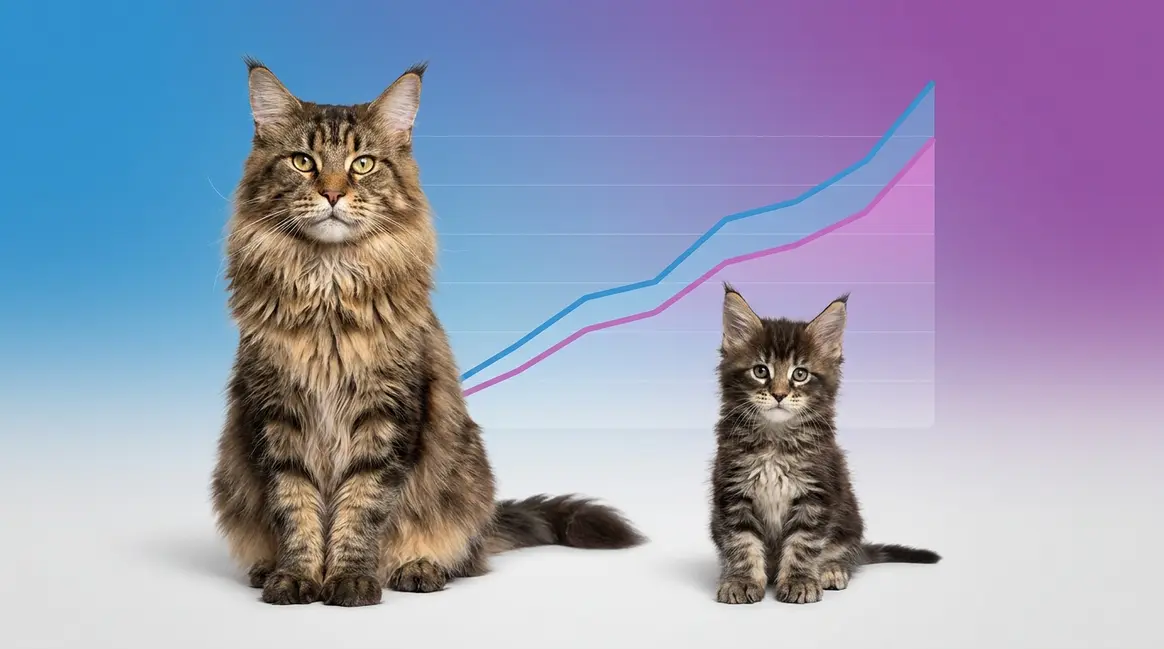
A healthy male Maine Coon kitten weighs approximately 8–11 lbs (3.6–5 kg) at 7 months and won’t reach his full Gentle Giant frame until age 3–5. Females typically weigh 6–8 lbs (2.7–3.6 kg) at 7 months. This guide’s maine coon size chart by age tracks both sexes from birth to 60 months — further than any other free resource online (TICA, CFA breed standards).
Most charts stop at 12 months — right before the breed’s most dramatic “filling out” phase begins. That gap leaves owners either worrying unnecessarily about a perfectly healthy cat or missing a genuine growth concern entirely.
By the end of this guide, you’ll know exactly what your Maine Coon should weigh at every age, what counts as normal variation, and precisely when to call your vet. We’ll walk through four clear steps: reading the chart, understanding growth stages, identifying what shapes final size, and verifying your cat’s health with a Body Condition Score.
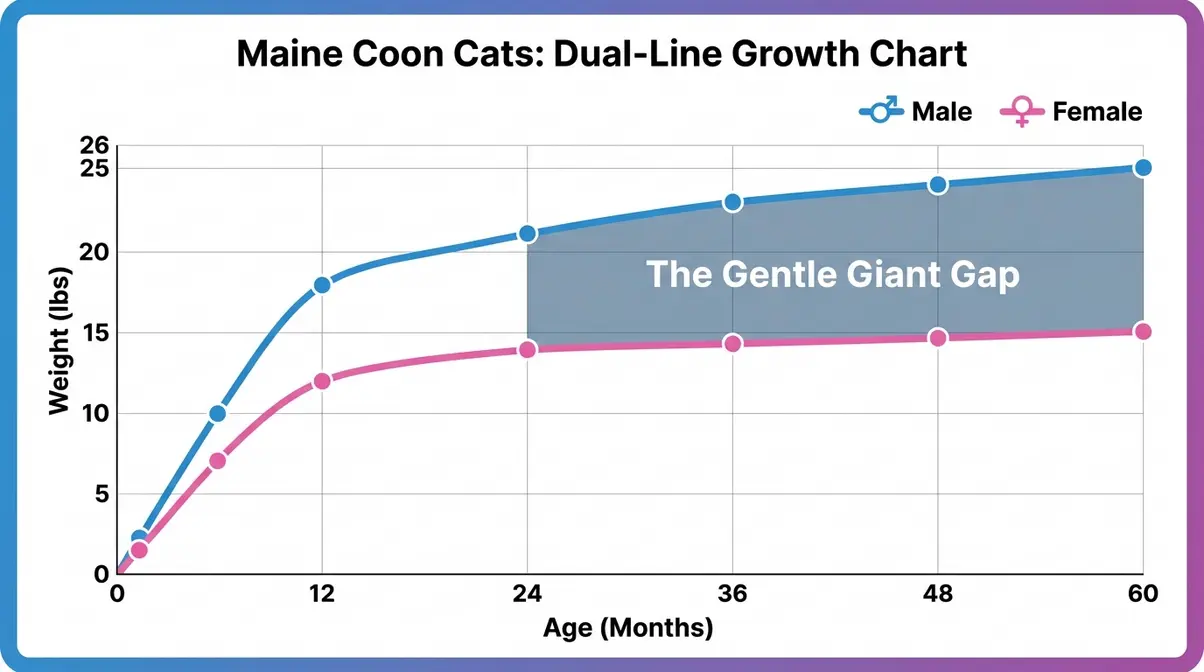
Male Maine Coons weigh 15–25 lbs at full maturity; females reach 10–15 lbs — but neither gets there until age 3–5, far longer than any other domestic cat breed (TICA, CFA). This is “The Gentle Giant Gap.”
- Year 1: Rapid growth — kittens gain roughly 1 lb per month during peak phases
- Years 2–5: “The Gentle Giant Gap” — slow, steady filling out of muscle and bone that most owners miss entirely
- Biggest size predictor: Parent size and gender, not paw size (a widely repeated myth)
- Health check: Use the 9-point Body Condition Score (BCS), not just the scale reading
What You’ll Need Before Using This Chart
Using this guide is straightforward. You only need two things: your cat’s date of birth (to calculate their exact age in months) and a simple kitchen scale or your vet’s most recent weight reading.
Estimated time: 5 minutes
- Tools and Materials:
- Date of birth — Calculate your cat’s exact age in months. Even a few weeks makes a difference in the first year.
- A scale — A kitchen scale works for kittens. For adults, weigh yourself, then weigh yourself holding the cat and subtract.
- Your cat’s sex — Male and female charts differ significantly. A “small” male and a “large” female can weigh the same.
- An open mind about averages — Healthy Maine Coons can fall 10–15% below or above any range listed here and still be perfectly fine.
One important note before the data: Maine Coon growth charts look very different from standard domestic cat charts. That’s because this breed takes 3–5 years to reach full physical maturity — roughly three to four times longer than the average house cat (CFA, 2026). What looks like “slow growth” is actually completely normal for a Gentle Giant.
Step 1: Read the Maine Coon Size Chart by Age
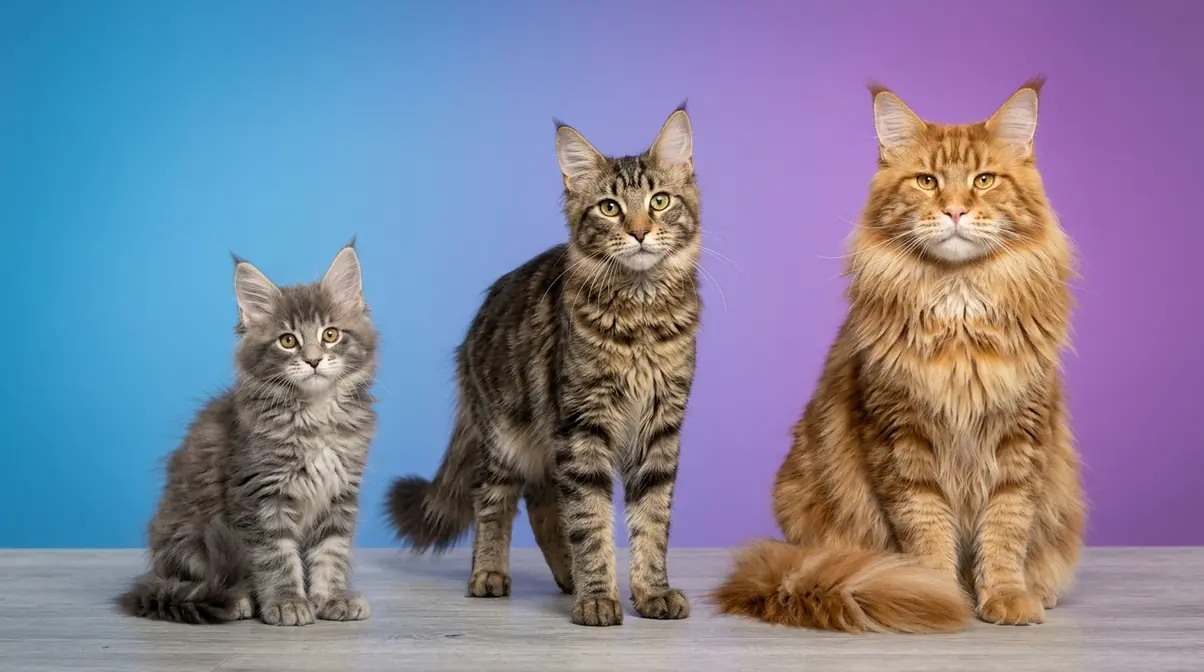
Maine Coons are one of the slowest-maturing domestic cats, and their maine coon growth chart by age reflects that unusual timeline clearly. Males average 15–25 lbs (6.8–11.3 kg) and females 10–15 lbs (4.5–6.8 kg) at full maturity, according to TICA breed standards. Knowing the benchmarks at each specific age helps you spot genuine growth concerns early — and reassures you when everything is going exactly as it should.
How We Compiled This Chart: The weight ranges below are drawn from TICA and CFA breed standards, cross-referenced with growth data from established Maine Coon catteries and community records aggregated at madcatman.com. Where ranges differ between sources, we’ve used the broader consensus figure and noted the variance. These are averages — your cat is an individual.
Male vs. Female Chart Differences
The maine coon size chart by age uses two sets of numbers because males and females grow at meaningfully different rates throughout their entire lives — not just at adulthood. This is a breed characteristic, not a health signal. A “large” female Maine Coon at 12 months may weigh exactly the same as a “small” male at the same age, and both are completely healthy.
Here’s what each column means:
- Age: Listed in months for Year 1, then annually for Years 2–5.
- Average weight range (lbs and kg): Both units are included — use whichever your vet records. Converting between them mid-appointment leads to errors.
- Key milestone: A brief note on what’s happening developmentally at that stage.
The ranges given are averages. A healthy Maine Coon can fall 10–15% below or above any figure listed. If your cat is active, eating well, and showing no symptoms, a slightly lower number is not a red flag — it’s individual variation.
Quick worked example: If your male kitten is 4 months old and weighs 4 lbs (1.8 kg), that falls within the healthy range. If he weighs 2 lbs (0.9 kg) at 4 months with no obvious explanation, that warrants a conversation with your vet.
Now that you know how to read the chart, here’s the full month-by-month breakdown — starting from birth through the first critical year.
Month-by-Month Weight (0-12 Months)
If you want to explore a comprehensive Maine Coon size chart by age, the table below is the core maine coon weight chart by age for the first year of life. This is the period of fastest growth — kittens can gain close to 1 lb per month during peak phases.
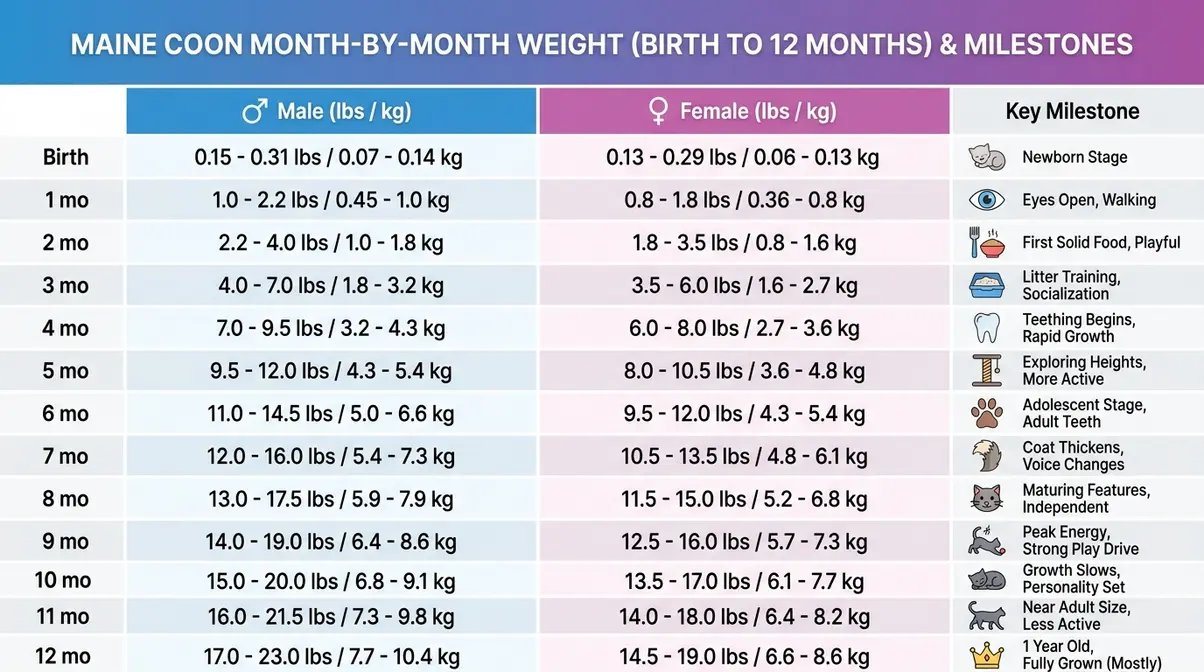
| Age | Male Avg (lbs) | Male Avg (kg) | Female Avg (lbs) | Female Avg (kg) | Key Milestone |
|---|---|---|---|---|---|
| Birth | 0.2–0.4 | 0.09–0.18 | 0.2–0.3 | 0.09–0.14 | Eyes closed; fully dependent |
| 1 month | 1.0–1.5 | 0.45–0.68 | 0.9–1.3 | 0.41–0.59 | Eyes open; beginning to explore |
| 2 months | 2.0–2.5 | 0.91–1.13 | 1.8–2.2 | 0.82–1.0 | Weaning begins; first solid food |
| 3 months | 3.0–3.5 | 1.36–1.59 | 2.5–3.0 | 1.13–1.36 | Vaccination phase; rapid energy |
| 4 months | 4.0–5.0 | 1.81–2.27 | 3.5–4.5 | 1.59–2.04 | Play instincts fully active |
| 5 months | 5.0–6.5 | 2.27–2.95 | 4.5–5.5 | 2.04–2.49 | Ear tufts becoming visible |
| 6 months | 6.0–8.0 | 2.72–3.63 | 5.0–7.0 | 2.27–3.18 | Lion-like mane beginning to form |
| 7 months | 8.0–11.0 | 3.63–4.99 | 6.0–8.0 | 2.72–3.63 | Lanky phase — limbs ahead of body |
| 8 months | 9.0–12.0 | 4.08–5.44 | 7.0–9.0 | 3.18–4.08 | Coat thickening noticeably |
| 9 months | 10.0–13.0 | 4.54–5.90 | 7.5–9.5 | 3.40–4.31 | Social bonding patterns solidify |
| 10 months | 11.0–14.0 | 4.99–6.35 | 8.0–10.0 | 3.63–4.54 | Secondary growth spurt in males |
| 11 months | 12.0–15.0 | 5.44–6.80 | 8.5–10.5 | 3.86–4.76 | Muscle definition increasing |
| 12 months | 12.0–16.0 | 5.44–7.26 | 9.0–11.0 | 4.08–4.99 | End of kittenhood — still growing |
(Sources: TICA breed standards; CFA breed documentation; community cattery data cross-referenced via Maine Coon breeder records)
What to do if your cat is outside the range: First, don’t panic. Recheck their age in months carefully — even a 2-week error shifts which row applies. Then check the Body Condition Score in Step 4. If your cat is visibly underweight or has lost weight suddenly, call your vet. A single weight reading below the range — with no other symptoms — is rarely cause for alarm.
Year 2-5: The Gentle Giant Gap
Here’s what almost every other Maine Coon growth guide gets wrong: the chart stops at 12 months, right when the breed’s most interesting phase is just beginning.
“The Gentle Giant Gap” is the 2-to-5-year phase when Maine Coons continue building muscle mass, bone density, and that iconic “Full Frame” bulk — long after most owners have stopped tracking. This is not a flaw in the breed. It’s the defining characteristic that makes Maine Coons unique among domestic cats.
“Male Maine Coons don’t reach their full Gentle Giant frame until age 3–5 — up to four years longer than the average domestic cat breed.” (CFA; TICA breed standards)
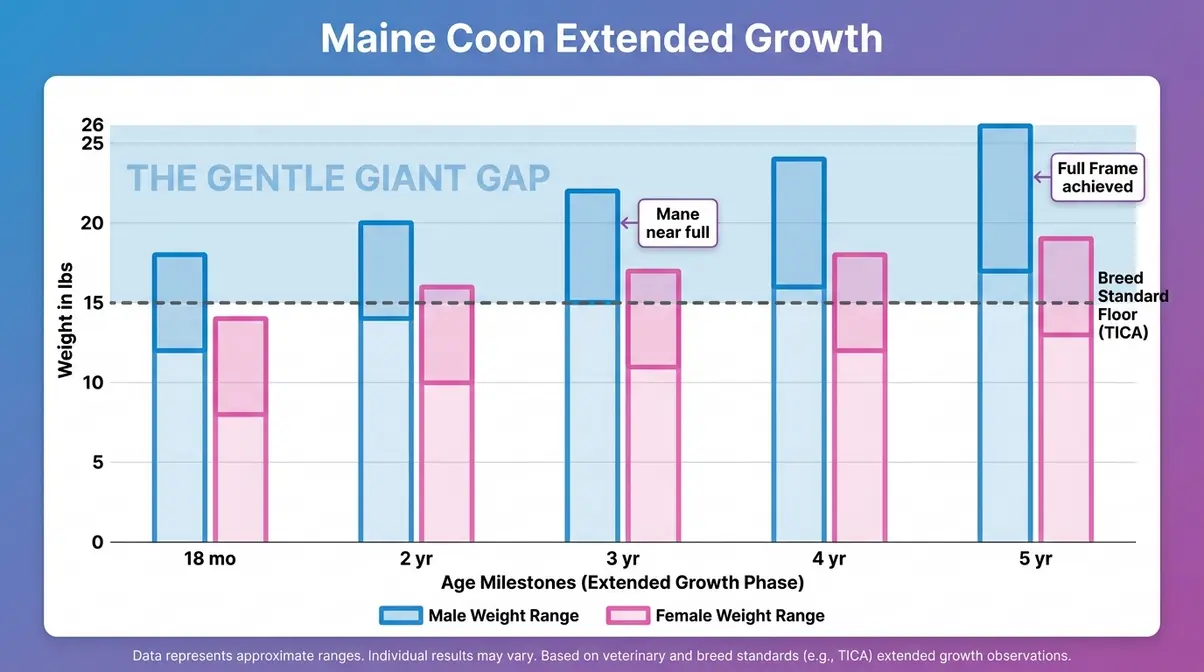
The table below extends the growth chart through Year 5. Growth during this phase is slower and less dramatic than Year 1, but it is real and measurable — particularly in males.
| Age | Male Avg (lbs) | Male Avg (kg) | Female Avg (lbs) | Female Avg (kg) | What’s Changing |
|---|---|---|---|---|---|
| 18 months | 13.0–17.0 | 5.90–7.71 | 9.5–12.0 | 4.31–5.44 | Chest broadening; coat fullness |
| 2 years | 14.0–18.0 | 6.35–8.16 | 10.0–13.0 | 4.54–5.90 | Muscle mass adding steadily |
| 3 years | 15.0–21.0 | 6.80–9.53 | 10.0–14.0 | 4.54–6.35 | Ruff and mane at near-full development |
| 4 years | 15.0–24.0 | 6.80–10.89 | 10.0–15.0 | 4.54–6.80 | Body depth and width increasing |
| 5 years | 15.0–25.0 | 6.80–11.34 | 10.0–15.0 | 4.54–6.80 | Full Frame achieved — breed standard met |
(Sources: TICA; CFA; sassykoonz.com cattery records; maine-coon-cat-nation.com community data)
During The Gentle Giant Gap, your cat may look “done” — but the muscle and connective tissue filling is still underway. This is why nutrition during Years 2–4 matters more than most owners realize. We cover that in Step 3.
7-Month-Old Maine Coon Size
This is one of the most searched questions about the breed — and the answer is reassuringly broad.
At 7 months, a healthy male Maine Coon typically weighs 8–11 lbs (3.6–5 kg). A healthy female weighs 6–8 lbs (2.7–3.6 kg). Both will look noticeably lanky at this stage — long legs, lean torso, oversized paws. That’s completely normal. The 7-month mark falls squarely in the lanky phase, when limbs grow faster than the body fills in.
If your 7-month-old male weighs 7 lbs, he’s at the lower end but not outside the realm of normal — especially for a smaller genetic line. If he weighs under 5 lbs with reduced appetite or lethargy, schedule a vet visit. Context always matters more than a single number.
Step 2: Maine Coon Growth Stages
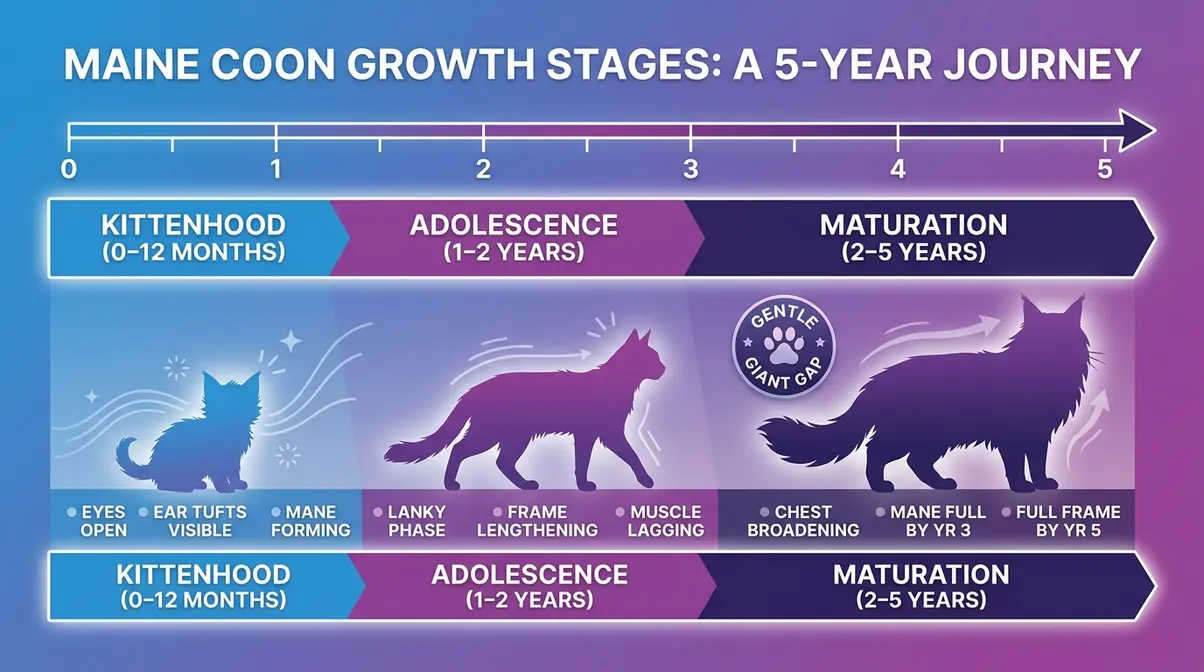
To fully understand the Maine Coon growth timeline and milestones, you must recognize that growth isn’t a straight line. Understanding the stages behind the numbers makes the chart far more useful. Maine Coon growth moves through three distinct phases, each with its own pace and characteristics. Knowing which phase your cat is in changes how you interpret what you see on the scale.
Phase 1: Kittenhood (0-12 Months)
This is the fastest growth period your Maine Coon will ever experience. Kittens can gain close to 1 lb per month during peak phases — a rate that far exceeds most domestic cat breeds (sweetgiantsmaincoons.com, 2026).
As you learn about Maine Coon kitten growth and development, you’ll notice the ear tufts (the distinctive tufted fur inside the ears) and the beginning of the lion-like mane forming around months 5–6. Their energy levels will peak during this time, requiring frequent, nutrient-dense meals to fuel both their playful behavior and their rapidly expanding skeletal structure. You will also see their coat begin to transition from soft kitten fluff to the dense, water-repellent double coat that characterizes the breed.
The body is growing quickly, but it’s not yet proportional. Legs, paws, and ears tend to develop ahead of the torso — which is why kittens look so charmingly oversized. Key nutrition priority at this stage: high-quality protein. Kittens need at least 30% protein in their diet to support rapid muscle and bone development (Merck Veterinary Manual, large breed kitten guidelines). Avoid low-protein “filler” foods during this critical window.
Phase 2: Adolescence (1-2 Years)
Between ages 1 and 2, most Maine Coon owners start to worry. Their cat looks tall and lean — almost awkward — and doesn’t seem to be filling out the way they expected. This is the lanky phase, and it is entirely normal.
During adolescence, your Maine Coon’s skeletal frame is reaching close to its final length and height, but the muscle mass hasn’t caught up yet. Think of it like a teenager who’s shot up six inches but hasn’t filled out their shoulders. The frame is there. The bulk comes later.
During this time, their tail may appear disproportionately long, and their legs can seem uncoordinated compared to their torso. Many owners mistakenly believe their cat is underweight during this stretch, leading to unnecessary overfeeding. However, as long as your cat meets the Body Condition Score targets, this lean appearance is simply part of the process.
Across Maine Coon owner communities, the consistent report is that the lanky stage peaks around 14–18 months and begins resolving by age 2 as muscle mass gradually accumulates. Breeders and veterinarians agree that this phase is a breed characteristic, not a health concern.
Phase 3: Maturation (2-5 Years)
This is The Gentle Giant Gap in action. Between ages 2 and 5, your Maine Coon slowly builds the muscle depth, chest width, and coat fullness that define the breed’s iconic silhouette. The changes are subtle month-to-month but dramatic year-over-year.
You will notice their head broadening, giving them that distinctly square, rugged muzzle. Because this growth is slow and steady, maintaining a high-protein diet without overfeeding calories is crucial. The goal is to support lean muscle accumulation without adding excess fat padding.
By age 3, the ruff (the thick fur collar around the neck) and mane are approaching full development. By age 4–5, most males have achieved their final body weight and the “Full Frame” that breed standards describe (TICA). Females typically finish slightly earlier, often reaching their adult frame by age 3–4.
The Gentle Giant Gap is also why a 2-year-old Maine Coon and a 5-year-old Maine Coon can look like almost different cats — even at the same weight. The distribution of muscle and the density of the coat changes everything.
Step 3: Factors Shaping Final Size
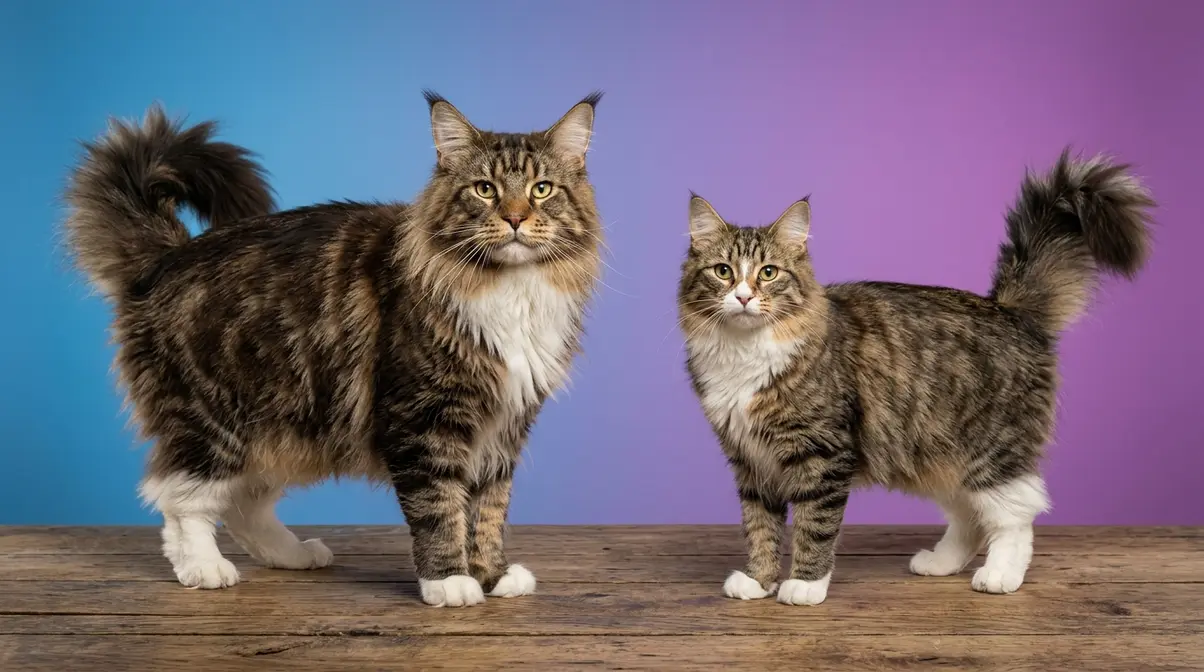
When you compare Maine Coon size and influencing factors, three major elements drive final adult size. The maine coon weight by age chart gives you the averages, but understanding these variables helps you set realistic expectations for your individual cat.
Genetics and Parent Size
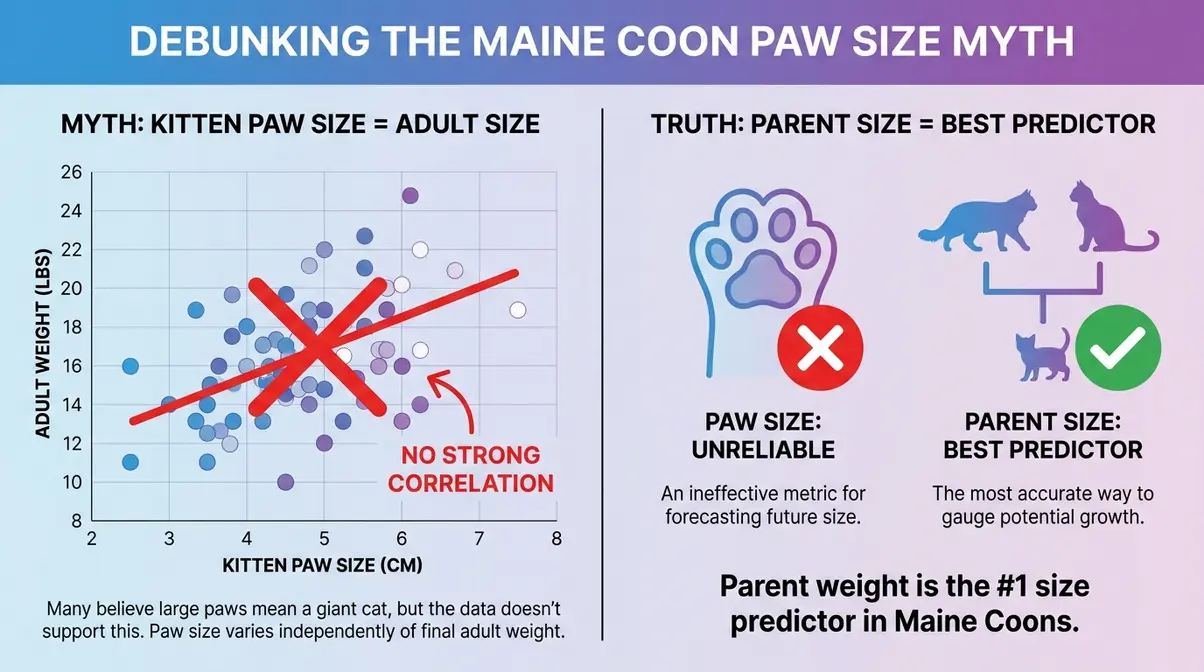
If you want to predict how big your Maine Coon kitten will eventually get, the single most reliable indicator is the size of their parents. This is true across all cat breeds, but it’s especially pronounced in Maine Coons because the breed naturally produces a wide size range — from compact 10-lb females to massive 25-lb males.
According to TICA breed standards, Maine Coons are described as a “large to very large” breed, but no minimum or maximum weight is specified — because individual variation within the breed is that significant. A kitten from two large-framed parents is likely to be large. A kitten from two compact parents may be a perfectly healthy “lightweight Coon” — smaller than average, but completely normal.
If you adopted from a breeder, ask for the parents’ adult weights. If you adopted from a shelter and don’t know the lineage, use the chart ranges as your guide and trust the Body Condition Score in Step 4 over any single weight number.
The Paw Size Myth Explained
If you want to discover how paw size relates to a Maine Coon’s final size, the truth is quite simple: it doesn’t. You’ve probably heard it: “Big paws mean a big cat.” It’s one of the most repeated pieces of Maine Coon advice — and there is no scientific evidence to support it as a reliable predictor.
Paw size in kittens reflects skeletal development at that specific moment, not final adult size. Some kittens have large paws early and grow into them proportionally. Others have large paws and end up mid-sized adults. The correlation simply isn’t consistent enough to use as a growth predictor, and no peer-reviewed veterinary study has validated paw size as a reliable indicator of adult body weight in domestic cats.
What paws CAN tell you: whether your kitten is developing symmetrically and whether the paws are free from deformity or injury. That’s genuinely useful. But as a size prediction tool, paws are not reliable — parent size remains the strongest single predictor.
Diet, Neutering, and Health
Beyond genetics, three controllable factors meaningfully influence your Maine Coon’s growth trajectory.
Diet and protein: Large breed cats require sustained high-protein nutrition throughout their extended maturation period. The Merck Veterinary Manual recommends that large breed cats receive diets with at least 26–30% protein on a dry matter basis to support healthy muscle development. Underfeeding protein during The Gentle Giant Gap (Years 2–4) can limit the muscle mass your cat ultimately achieves.
Neutering and spaying timing: Early neutering (before 6 months) delays the closure of growth plates — the areas of developing cartilage at the ends of long bones. This can result in a slightly taller, longer-limbed cat, but it does not necessarily mean a heavier or more muscular one. Many vets now recommend waiting until 12–18 months for large breeds like Maine Coons before spaying or neutering, though you should discuss the individual risks and benefits with your vet (Merck Veterinary Manual, feline reproductive physiology).
Health conditions: Parasites, chronic illness, or dental pain can all suppress appetite and slow growth during critical windows. If your kitten is consistently below the chart’s lower range and showing other symptoms — lethargy, dull coat, reduced appetite — a health issue may be the cause, not genetics.
“Fred, male, 6 years, 14 lbs. He is a lightweight Coon, very slim built.”
This is a real report from the Maine Coon owner community — and it perfectly illustrates natural size variation. Fred is healthy, active, and simply on the smaller end of the breed’s wide range. A slim, lightweight Coon isn’t a problem. It’s just Fred.
Step 4: Verify Health with BCS
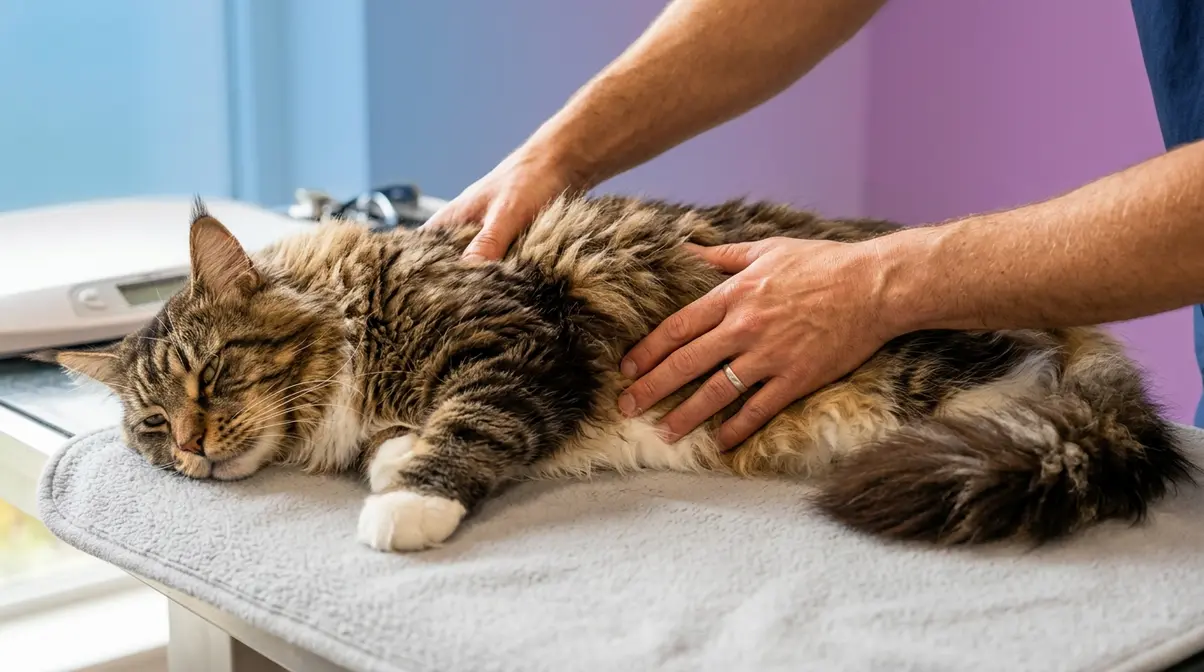
Weight alone doesn’t tell the full story. A Maine Coon can be within the chart’s weight range and still be carrying too much fat — or can be slightly below the range and be perfectly lean and healthy. That’s why veterinarians use the Body Condition Score (BCS) — a 9-point scale that assesses your cat’s actual body composition, not just the number on the scale.
Here’s how to use it at home:
- Run your hands along your cat’s ribcage. You should be able to feel individual ribs without pressing hard. If you can’t feel them at all, your cat may be overweight. If they’re very prominent with no padding, your cat may be underweight.
- Look at your cat from above. A healthy Maine Coon should show a slight waist behind the ribs — not a dramatic hourglass, but a visible taper.
- Look at your cat from the side. The abdomen should tuck up slightly behind the ribcage. A pendulous belly that sags suggests excess weight.
| BCS Score | What It Means | Action |
|---|---|---|
| 1–3 | Underweight — ribs, spine visible | Vet visit recommended |
| 4–5 | Ideal — ribs felt easily, slight waist visible | Continue current feeding |
| 6–7 | Overweight — ribs require firm pressure to feel | Reduce treats, reassess diet |
| 8–9 | Obese — ribs not palpable, belly sags | Vet visit recommended |
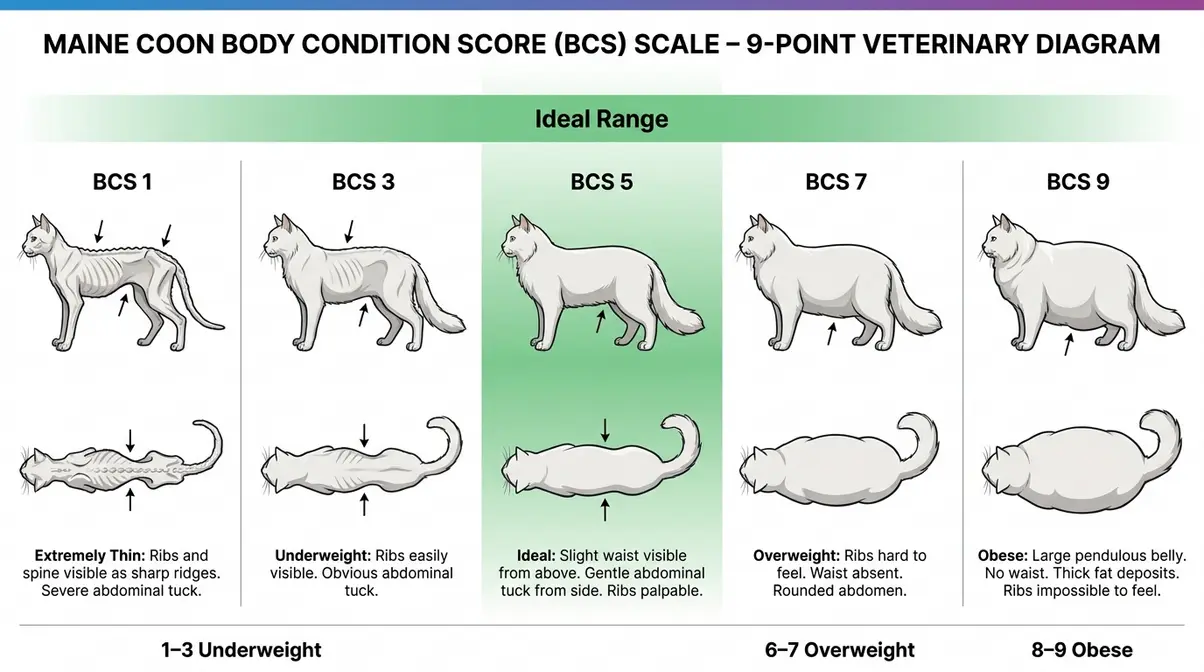
A BCS of 4–5 is the target for a Maine Coon at any age. If your cat’s weight is slightly below the chart’s range but their BCS is 4–5, they are healthy. If their weight is within range but BCS is 7–8, that’s worth addressing with your vet regardless of what the scale says.
Common Concerns and When to Call Your Vet
The chart is a tool, not a verdict. Most Maine Coon owners who worry about their cat’s size are worrying about a perfectly healthy animal. But there are genuine red flags worth knowing — and knowing the difference between a variation and a warning sign is the most useful thing this section can give you.
Disclaimer: This guide is for informational purposes only and does not replace professional veterinary advice. If you have concerns about your Maine Coon’s growth, weight, or health, consult a licensed veterinarian. Weight ranges provided are general averages and may not apply to every individual cat.
Signs of Abnormal Growth
Most weight variations are genetic and completely harmless. However, contact your vet if you notice:
- Sudden weight loss of more than 10% of body weight over 2–4 weeks without a dietary change
- Failure to gain weight across three consecutive monthly weigh-ins during the first year, despite adequate feeding
- Visible rib bones or a protruding spine alongside reduced appetite or lethargy
- Rapid, unexplained weight gain — particularly a soft, pendulous belly — which may indicate hormonal issues or overfeeding
- Asymmetrical growth — one side of the body noticeably larger than the other, or limbs that appear uneven
These are not “probably fine” situations. Each one warrants at least a phone call to your vet to describe what you’re seeing.
When the Chart Doesn’t Match Your Cat
Sometimes the chart simply doesn’t match your cat — and that’s fine. Here’s how to think about it:
If your cat is consistently below the range: First, verify the age calculation. Then check the BCS. If BCS is 4–5 and your cat is active and eating normally, you likely have a “lightweight Coon” — a smaller-framed individual within the breed’s wide natural variation. This is common, particularly in cats from smaller genetic lines. Community data from maine-coon-cat-nation.com consistently shows that owner-reported weights span a much wider range than any single chart captures.
If your cat is consistently above the range: Maine Coons do get large — but “above the chart” in a young cat can sometimes indicate overfeeding rather than exceptional genetics. Use the BCS to distinguish between a genuinely large-framed cat (BCS 4–5) and one carrying excess weight (BCS 7+).
If your cat stopped gaining weight suddenly: This is worth a vet visit regardless of where they fall on the chart. A plateau during the first year — especially combined with reduced energy — can indicate an underlying health issue.
Frequently Asked Questions
Predicting Your Kitten’s Size
The most reliable predictor of adult size is parent size. If you know the weights of your kitten’s mother and father, expect your cat to land somewhere in the same range. A kitten from two large-framed parents is likely to grow large; a kitten from compact parents may stay on the smaller side. Genetics account for the majority of size variation in Maine Coons. The TICA breed standard confirms that Maine Coons are “large to very large” but specifies no weight minimum or maximum — because the breed’s natural range is genuinely wide. Paw size is not a reliable predictor (see Step 3).
Size at 7 Months Old
A healthy 7-month-old male Maine Coon typically weighs 8–11 lbs (3.6–5 kg); females typically weigh 6–8 lbs (2.7–3.6 kg). (Source: TICA breed standards). Both will look noticeably lanky at this age — long-limbed, lean, and slightly awkward. That’s the breed’s normal adolescent phase. A male at 7 lbs is at the lower end but not necessarily concerning if he’s active and eating well. A cat below 5 lbs at 7 months with reduced appetite warrants a vet check. Remember: this breed won’t fill out until age 3–5, so the lanky look is expected.
At What Age Do Maine Coons Get Big?
Maine Coons reach their full adult size between ages 3 and 5 — significantly later than the average domestic cat, which typically matures by 12–18 months (CFA breed documentation). Males often continue adding muscle mass and chest depth until age 4 or even 5. This extended maturation is exactly what “The Gentle Giant Gap” describes: the years between 2 and 5 when your cat is still slowly building its iconic bulk, even though it may already look “grown.” Don’t be surprised if your 2-year-old Maine Coon looks noticeably different at age 4.
Does Paw Size Predict Adult Size?
No — paw size is not a reliable predictor of adult body weight in cats. This is one of the most persistent myths in Maine Coon ownership. While large paws can indicate a larger skeletal frame, the correlation between kitten paw size and final adult weight is not consistent enough to use as a growth predictor. No peer-reviewed veterinary study has validated this method for domestic cats. Parent size and gender remain the best available predictors. Use the size chart alongside the Body Condition Score rather than relying on paw size as a guide.
What Cat Is Mistaken for a Maine Coon?
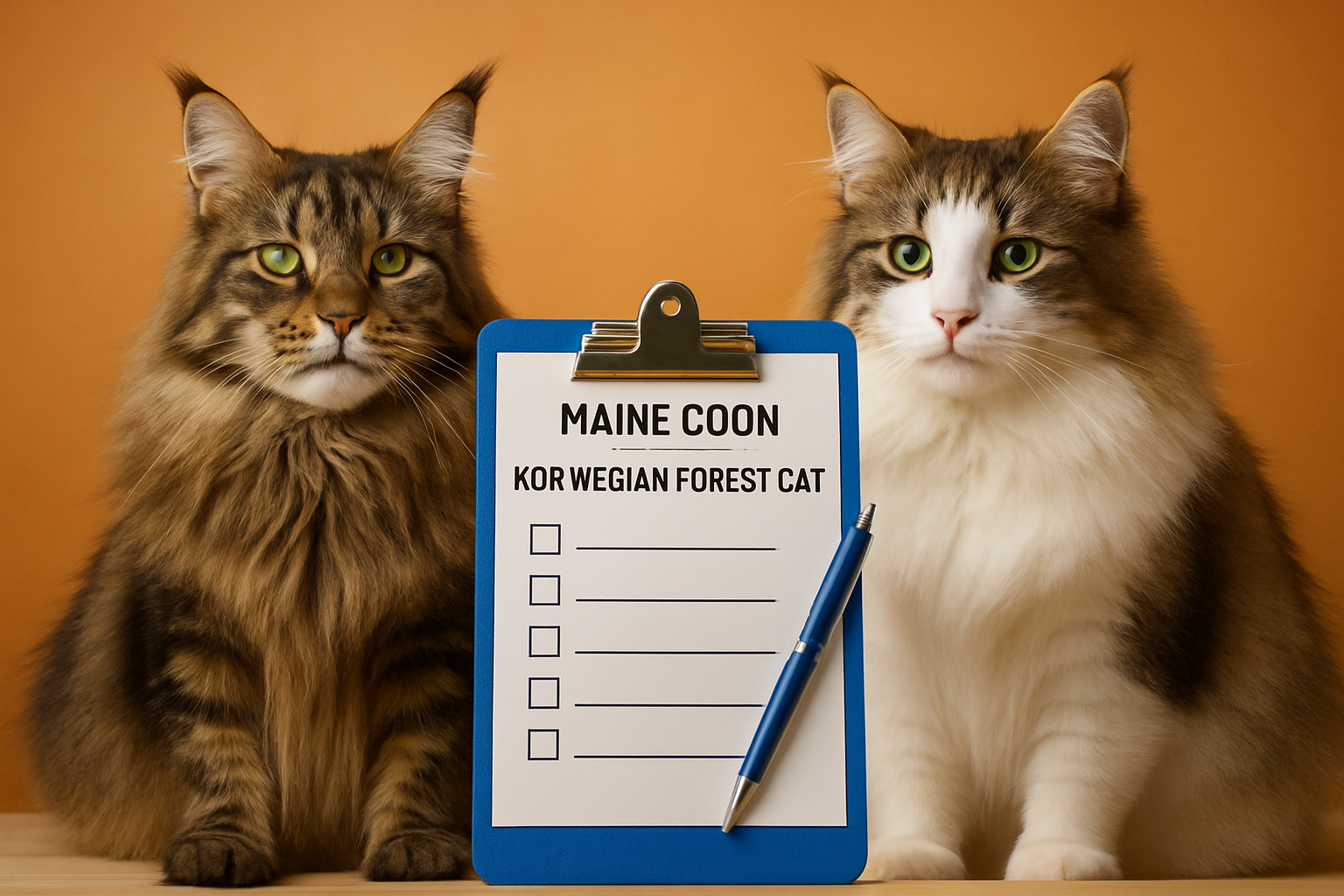
The Norwegian Forest Cat is the breed most commonly mistaken for a Maine Coon. Both breeds are large, long-haired, and share a similar “wild” appearance with tufted ears and a thick double coat. Key differences: Maine Coons have a more rectangular body shape, a distinctly shaggy and uneven coat, and a broader, squarer muzzle. Norwegian Forest Cats have a more triangular face and a sleeker, more uniform coat. The Siberian cat is another frequent look-alike, though it’s typically more compact than either breed.
How Do Maine Coons Show Affection?
Maine Coons are known for following their owners from room to room, chirping or trilling rather than meowing, and seeking proximity without necessarily demanding to be held. Unlike some breeds, Maine Coons often prefer to be near you rather than on you — sitting beside you rather than in your lap. They may tap you with a paw, greet you at the door, or bring a toy as a gift. This breed bonds deeply but on its own terms, which owners often describe as “dog-like” loyalty.
Saying “I Love You” in Cat Language
The slow blink is widely recognized as a cat’s way of signaling trust and affection. When your Maine Coon looks at you and blinks slowly, they’re communicating comfort and safety. You can return the signal: make eye contact, then blink slowly and look away. Many owners report their cats blink back. Other affection signals include head bunting (rubbing their head against you), kneading, and the raised tail-tip greeting when they approach you. These behaviors are your cat’s vocabulary for “I feel safe with you.”
Wrapping Up: Your Maine Coon’s Growth Journey
For new Maine Coon owners, madcatman.com’s complete maine coon size chart by age covers every milestone from birth to 60 months — including the years most guides ignore entirely. Males reach 15–25 lbs and females 10–15 lbs, but neither gets there before age 3–5 (TICA; CFA). The Body Condition Score at 4–5 is your most reliable health signal at any age, more useful than any single weight reading.
“The Gentle Giant Gap” is the key insight this guide offers: the 2-to-5-year window when your Maine Coon is still slowly and steadily building its Full Frame, even when most owners have stopped paying close attention. Understanding this phase transforms how you read the numbers — and how much you worry about them.
Your next step is straightforward: weigh your cat today, find their age on the chart, and run the quick BCS check from Step 4. If everything looks good, you can relax and enjoy watching your Gentle Giant slowly fill out over the next few years. If something feels off, you now know exactly what to look for and when to call your vet.

Dave King
Cat owner and writer at Mad Cat Man.