
You’re sitting on the couch when your cat suddenly lets out a sound you’ve never heard before — somewhere between a wail and a warble. Is something wrong? Is your cat happy? Are they in pain? That moment of confusion is something almost every cat owner knows. Researchers have identified over 20 distinct feline vocalizations, yet most owners can confidently name only two or three (National Geographic). That gap between what your cat is saying and what you’re hearing is exactly what this guide closes.
Here’s the uncomfortable truth: your cat might be telling you something important right now, and without the right framework, you’re missing it. The good news? Understanding what do cat sounds mean is genuinely learnable — and faster than you’d expect.
By the end of this guide, you’ll know what every major cat sound means and exactly how to respond — so you can build a stronger, calmer relationship with your cat. You’ll get a foundational overview, a breakdown of happy sounds, warning sounds, hunting sounds, and a full section on how to talk back to your cat in a language they actually understand.
Wondering what do cat sounds mean? Cats produce over 20 distinct vocalizations — each one communicates a specific emotion, need, or warning. Use The Feline Frequency Framework (Pitch + Purpose + Posture) to decode any sound your cat makes.
- Purring and trilling signal happiness, contentment, or a friendly greeting
- Hissing, growling, and yowling are warning signs — give your cat space immediately
- Chattering (“ek-ek-ek”) is a hunting instinct response to prey — completely normal
- The slow blink is how you say “I love you” back in cat language
- Persistent yowling, especially at night, may signal a health issue — consult your vet
Why Do Cats Make So Many Sounds?
If you are wondering what do cat sounds mean, the simplest answer is that every single vocalization is a deliberate message — and most of those messages are aimed directly at you. Researchers have catalogued over 20 distinct feline vocalizations, and the remarkable thing is that cats developed most of them specifically to communicate with humans, not with each other (National Geographic). Once you learn the patterns behind pitch, context, and body language, you can decode what your cat is telling you in seconds.
What do different cat sounds mean at their core? They fall into three broad categories. Positive or affiliative sounds (purring, trilling, chirruping, short meows) signal friendliness, contentment, and social bonding. Defensive or warning sounds (hissing, growling, yowling) signal fear, pain, or threat. Predatory or excitement sounds (chattering, chirping) are triggered by prey instinct and have almost nothing to do with you at all.
The Ohio State University on cat communication describes trilling as a high-pitched, friendly greeting used by cats toward both humans and other cats they trust, while noting that hissing acts as a universal feline warning signal that should never be ignored (OSU Indoor Pet Initiative).
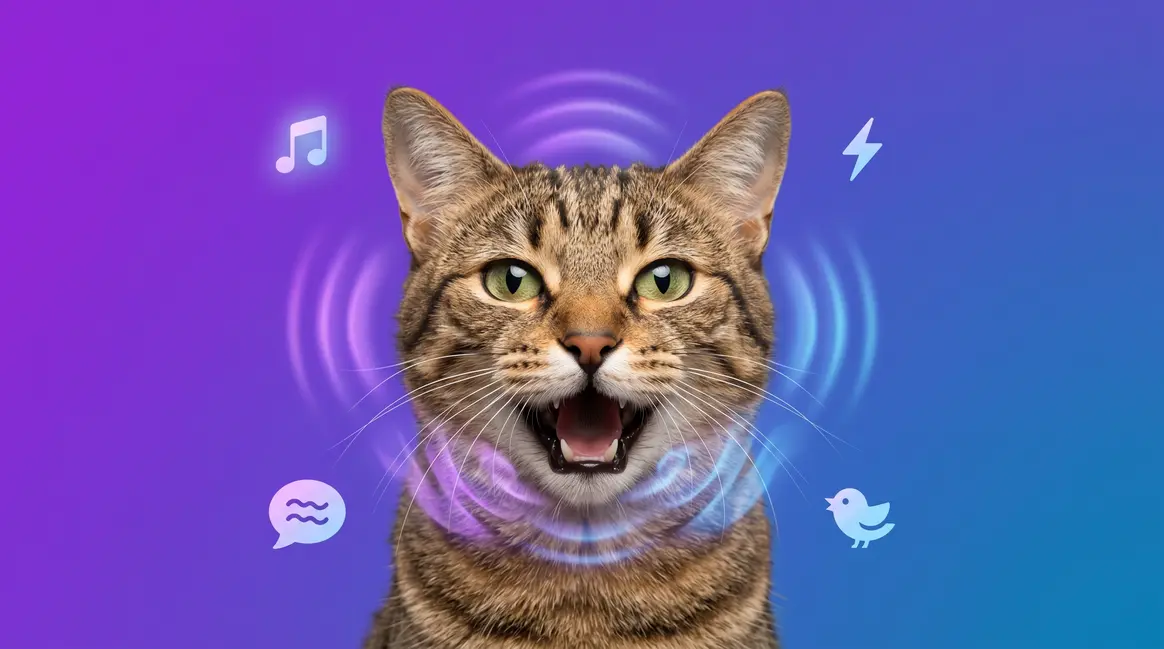
Understanding what your cat’s sounds mean starts with a simple tool. See the chart below for a visual overview of where each sound falls.
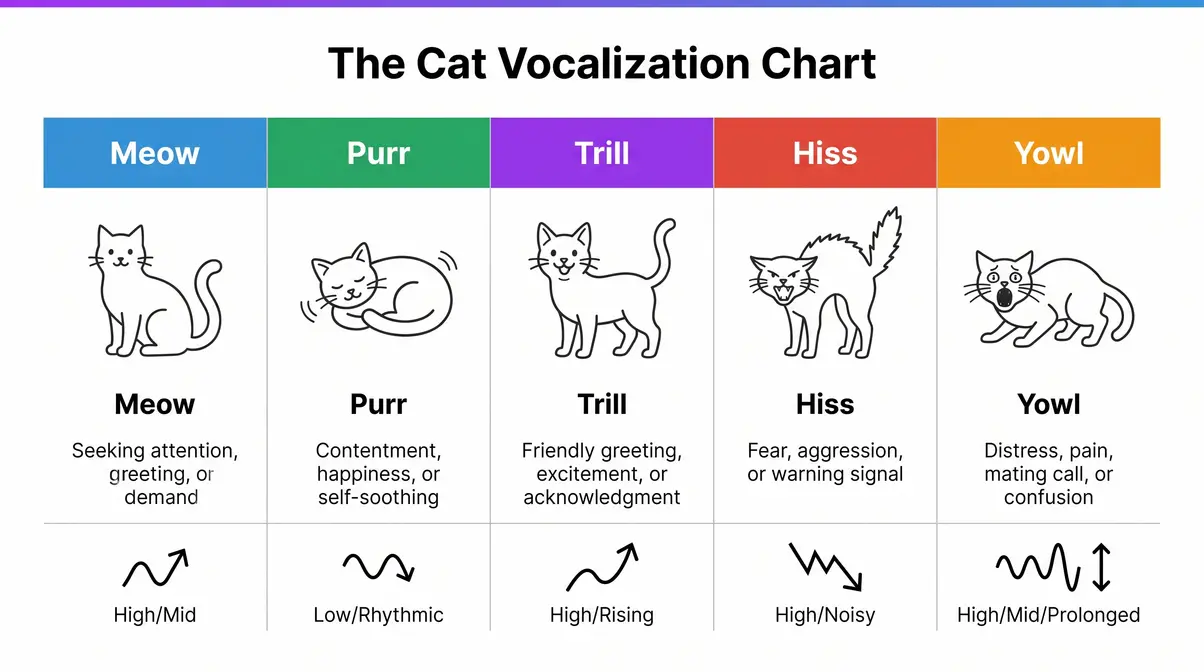
Also want to understand different cat meows and their meanings in more depth? That companion guide covers excessive meowing specifically.
The Feline Frequency Framework
Different cat sounds mean different things depending on three factors — and once you know them, you’ll never be stumped by a new noise again. The Feline Frequency Framework is a three-part mental model for interpreting any sound your cat makes:
- Pitch — Is the sound high or low? High-pitched sounds almost always signal friendly, playful, or urgent intent. Low-pitched sounds almost always signal warning, pain, or aggression.
- Purpose — Who or what is the sound aimed at? Is your cat looking at you (social)? Looking at a bird outside (predatory)? Facing another animal with a puffed tail (defensive)?
- Posture — What is the cat’s body doing? A relaxed cat with an upright tail making a sound is saying something entirely different from a cat with an arched back, flattened ears, and wide eyes making the same pitch.
Here’s the framework in action with two contrasting sounds. A trill: high pitch + aimed at you + tail up and relaxed = “Hello, I’m happy to see you.” A growl: low pitch + aimed at a threat + crouched body with flattened ears = “Back off — I mean it.” Same framework, completely opposite meanings. That’s the power of reading all three signals together.
The beauty of The Feline Frequency Framework is that it works for sounds you’ve never heard before, too. You don’t need to memorize every entry in a sound dictionary. You just need to ask: how high is it, who is it aimed at, and what is the body doing? Those three questions will get you to the right answer almost every time.
Why Cats Meow Exclusively to Humans
Here’s a fact that surprises most people: adult cats rarely meow at each other. The ASPCA guide to cat vocalizations notes that while kittens meow to communicate with their mothers, adult cats rarely meow at each other — they use meowing primarily as a communication tool for humans.
Think about what that means. When your cat was a kitten, meowing was how they got their mother’s attention. As they grew up, that behavior was essentially “re-purposed.” Your cat figured out, through living with you, that meowing gets a response. It works. So they kept doing it — but only with you.
Cat sounds and what they mean become much more personal once you understand this. Think of it this way: your cat developed a special language just for talking to you. No other cat gets to hear it the same way. When your cat meows at you, it’s a direct, intentional message — not random noise. That reframe alone changes how many owners feel about those early-morning wake-up calls.
Reading Pitch, Context, and Posture
What do the different sounds of a cat mean when you put pitch, context, and body language together? This is where reading your cat goes from guesswork to something genuinely reliable. Here’s the single most useful shortcut for beginners:
| Pitch | Likely Meaning |
|---|---|
| Short, high meow | Friendly greeting or mild request |
| Long, high-pitched trill | Excitement, happiness, or “follow me” |
| Low, drawn-out meow | Complaint or stronger demand |
| Low growl or hiss | Warning — do not approach |
Context matters just as much as pitch. The same purring sound means something different depending on where it happens. A purr during a lap session means contentment. A purr at the vet’s office, while trembling, is a self-soothing mechanism — your cat is trying to calm themselves down. Same sound, very different message.
Body language is always the tiebreaker. A tail held high means confidence and friendliness. Flattened ears mean fear or aggression. Dilated pupils can signal excitement or fear depending on the situation. You don’t need to become a body language expert — just glance at the tail and ears whenever you hear an unfamiliar sound.
Brief note on breed differences: Siamese cats are naturally very vocal — loud, frequent meowing is completely normal for them. Persian cats tend to be quieter, so a meow from a Persian often carries more weight. If your cat’s normal vocal frequency suddenly changes — becoming much louder, more frequent, or more urgent — that shift in intensity is worth paying attention to, regardless of breed.
Now that you have the full framework, let’s put it to work — starting with the sounds every cat owner loves to hear: the happy ones.
Happy Cat Sounds
Happy cat sounds are your reward for a good relationship with your feline companion. Applying The Feline Frequency Framework here: high pitch + social context + relaxed body = contentment. But even the most comforting sounds, like purring, carry nuances that most guides completely skip over. Knowing the difference can help you understand your cat on a deeper level — and catch early signs of stress before they escalate.
The Purr: More Than Just Happiness
The purr is the sound most people associate with a happy cat — and most of the time, they’re right. But purring is more complex than it looks on the surface. Purring operates at 25–150 Hz — a frequency range that research suggests may promote bone density and tissue healing, which explains why cats purr both when happy and when stressed or injured (PubMed, 2012).
That self-soothing function is the part most owners miss. A cat at the vet, or a cat recovering from surgery, will often purr continuously — not because they’re happy, but because the vibration is physiologically calming. It’s similar to how humans might hum or rock gently when anxious.
So how do you tell the difference between a happy purr and a stressed purr? Look at the full picture using the framework.
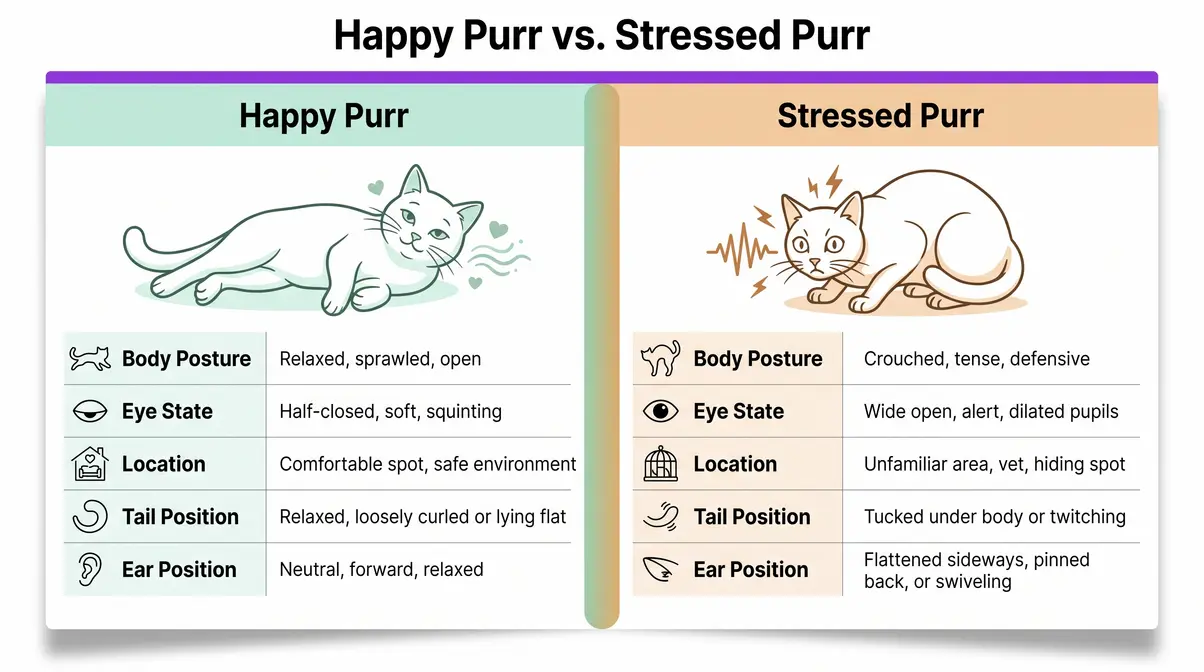
| Signal | Happy Purr | Stressed Purr |
|---|---|---|
| Body posture | Relaxed, loose muscles | Tense, crouched, or rigid |
| Eyes | Soft, half-closed (“slow blink”) | Wide, dilated pupils |
| Location | Lap, bed, warm sunny spot | Vet office, carrier, post-conflict |
| Tail | Still or slowly curling | Tucked, low, or lashing |
| Ears | Neutral or slightly forward | Flat or rotated back |
A cat purring loudly while kneading your lap? That’s pure contentment. A cat purring while hiding under the bed after a loud noise? That’s self-soothing — your cat needs calm reassurance, not more stimulation.
Trilling and the Trumpet Noise
If you’ve ever heard your cat make a sound that’s somewhere between a meow and a purr — a bright, musical, rising note that almost sounds like they’re saying “brrrup?” — that’s what cat owners often call the “trumpet noise.” Veterinary behaviorists call it trilling or chirruping (sometimes written as “chirping”), and it’s one of the most universally beloved sounds a cat makes.
“That is the trumpet noise and the true happy noise of a cat. They will do it when they’re happy or to communicate safety to another cat.”
That description from a cat owner community is exactly right. Trilling is an affiliative vocalization (a sound used to build and maintain social bonds). Mother cats use it to call their kittens. Adult cats use it to greet humans they trust. It’s also the sound many cats make when they want you to follow them — to their food bowl, to the door, or just around the house.
Across cat owner communities, the consistent report is that trilling increases when cats feel secure and well-bonded with their humans. If your cat trills at you when you walk into a room, take it as a genuine compliment. They’re saying “I’m glad you’re here” in the clearest way they know how.
A brief note on mimicking: Some cats will trill back if you make a soft “brrrup” sound at them. This isn’t just cute — it’s a form of communication your cat actually recognizes. More on this in the “How to Talk Back” section.
Standard Meows: Feline Requests
The standard meow is the most variable sound in a cat’s vocabulary. Short, bright meow at the food bowl? That’s a polite request. Long, insistent meow repeated every few seconds? That’s escalating to a demand. A soft, chirpy meow as you walk past? Just a friendly “hey, I see you.”
Most standard meows fall into one of four request categories:
- Food or water — timed around meals, near the food area, often with eye contact
- Attention or play — can happen any time; often accompanied by rubbing against your legs
- Access — your cat wants through a door, into a room, or onto a surface they can see
- Environmental complaint — litter box is dirty, something in their space has changed, they’re bored
The pitch and length of the meow give you the urgency level. Short and soft = mild request. Long and rising = more urgent. Repeated meowing that won’t stop despite your response can sometimes indicate anxiety or an unmet need — worth investigating if it’s a new behavior.
Now let’s shift to the sounds that require a different kind of attention: the ones that tell you your cat is scared, angry, or hurting.
Warning and Distress Sounds
Warning and distress sounds are the most important category to understand — because getting your response wrong can make the situation worse. Applying The Feline Frequency Framework: low pitch + defensive or pain purpose + tense or aggressive posture = back off and assess. This section covers what each warning sound means, how to tell the difference between anger and pain, and exactly how to respond safely.
Hissing: The Feline Warning Light
A hiss is not a mystery. It’s your cat’s clearest, most unambiguous communication: “I feel threatened — do not come closer.” The Humane World for Animals resource on cat behavior describes hissing as a defensive vocalization used when a cat feels cornered, threatened, or overwhelmed — it’s a warning, not an attack.
Hissing is sometimes called the “universal feline warning light” — and that’s exactly right. It doesn’t matter if your cat is hissing at a stranger, another pet, a loud noise, or you after accidentally stepping on their tail. The message is identical every time: give me space, right now.
Spitting is hissing’s more intense cousin. It’s a sharp, explosive sound — almost like a spit of air — that cats produce when the hiss hasn’t worked and they feel the threat is escalating. If your cat spits, the situation has moved from warning to genuine fear or defensive aggression.
- What to do when your cat hisses:
- Stop moving immediately
- Do not stare directly at the cat — avert your gaze slightly
- Slowly back away and give them more space
- Do not try to pet or reassure them — physical contact during a hiss often escalates the situation
- Identify and remove the trigger if possible (another pet, a visitor, an unfamiliar object)
- Give them 15–30 minutes to decompress before approaching again
Never punish a hiss. It’s your cat communicating clearly. Punishing it teaches them to skip the warning and go straight to biting.
Growling: Anger vs. Pain
Growling is the low, rumbling, guttural noise that most cat owners recognize immediately — and instinctively take seriously. Those guttural noises sit at the bottom of the pitch scale in the Feline Frequency Framework, and that low frequency is your clearest signal that something is wrong.
The key distinction to make is whether your cat is growling from anger or fear versus from pain. Here’s how to tell them apart:
- Anger/Fear Growl:
- Directed at a specific target (another animal, a person, an object)
- Accompanied by an arched back, puffed tail, or flattened ears
- Stops when the perceived threat moves away
- Cat is physically mobile and alert
- Pain Growl:
- May occur with no obvious external trigger
- Cat may be still, hunched, or reluctant to move
- May happen when you touch a specific area of their body
- Often accompanied by changes in other behaviors (eating less, hiding more)
Veterinary Note: A cat growling or vocalizing when touched in a specific area is a significant pain signal. Consult your veterinarian if this occurs — do not attempt to examine the area yourself, as even the gentlest cat may bite when in pain.
If your cat is growling at another pet in the household, this is a social conflict that needs slow, structured reintroduction — not forced togetherness. Across cat behavior communities, the consistent guidance is to separate first, then reintroduce gradually over days or weeks. If you want to dive deeper, learning about decoding cat growls and squeaks can help you identify warning signs before they escalate.
The Drawn-Out Yowl: When to Worry
The drawn-out yowl is the sound that worries cat owners most — and with good reason. It’s long, low, and mournful, and it sounds nothing like a normal meow. When your cat produces this sound, they’re communicating something intense.
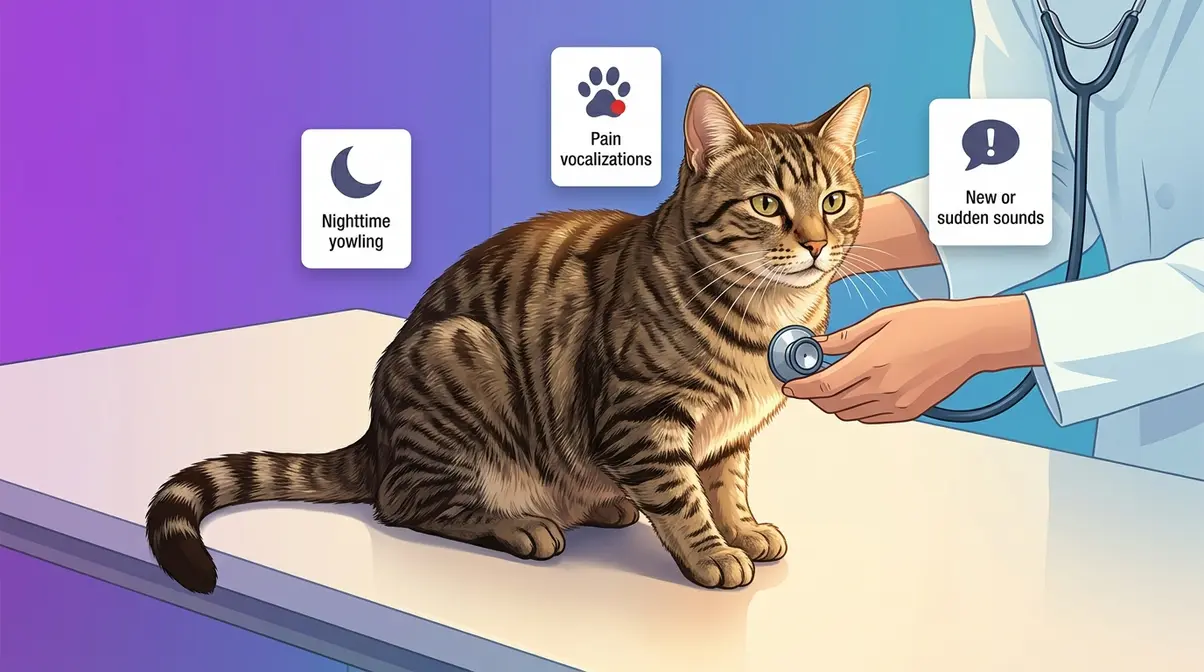
The Cornell Feline Health Center notes that yowling can indicate distress, mating behavior, or cognitive dysfunction. The context tells you which one you’re dealing with:
- Reproductive behavior — Unspayed females in heat and unneutered males yowl loudly and frequently. This is the most common cause in cats under two years old who haven’t been spayed or neutered.
- Territorial conflict — A cat who can see or smell another cat outside may yowl at the window in a display of territorial warning.
- Cognitive dysfunction — Senior cats (over 10 years) sometimes develop feline cognitive dysfunction syndrome (similar to dementia in humans), which can cause disoriented, repetitive yowling — especially at night.
- Pain or illness — Yowling with no obvious trigger, especially if new or sudden, can indicate hyperthyroidism, kidney disease, high blood pressure, or other medical conditions.
⚠️ Veterinary Disclaimer: If your cat suddenly begins yowling — especially if they’re over 7 years old, if it happens at night, or if it’s accompanied by other behavioral changes — schedule a vet appointment promptly. Persistent yowling is one of the more reliable signs that something is medically wrong and should never be dismissed as “just a phase.”
How to Respond to a Distressed Cat
When your cat is in a state of distress — hissing, growling, spitting, or yowling — your instinct to help can actually make things worse if you move too fast. Here’s how to respond safely:
Step 1: Stop and assess before doing anything.
Take 5 seconds to observe. What is the cat looking at? Are they injured? Is there an obvious trigger? Rushing in without information is the most common mistake.
Step 2: Remove yourself from the cat’s personal space.
Back away slowly and calmly. Do not turn your back and walk away quickly — that can trigger a chase response in highly aroused cats.
Step 3: Eliminate the trigger if safe to do so.
If another pet is the cause, separate them. If a loud noise is the cause, move the cat to a quiet room. If an unfamiliar person is present, ask them to give the cat space and avoid eye contact.
Step 4: Provide a safe retreat space.
A hiding spot (under a bed, inside a carrier with the door open, behind furniture) is genuinely calming for a distressed cat. Do not block their access to hiding spots — this increases anxiety significantly.
Step 5: Allow decompression time before re-engaging.
Wait at least 20–30 minutes after a distress event before attempting any contact. When you do approach, let the cat come to you rather than reaching toward them.
Step 6: Watch for escalating or repeated distress sounds.
If distress vocalizations are becoming more frequent, more intense, or are accompanied by physical symptoms (not eating, hiding constantly, changes in litter box habits), contact your veterinarian.
The Weird Chattering Sound
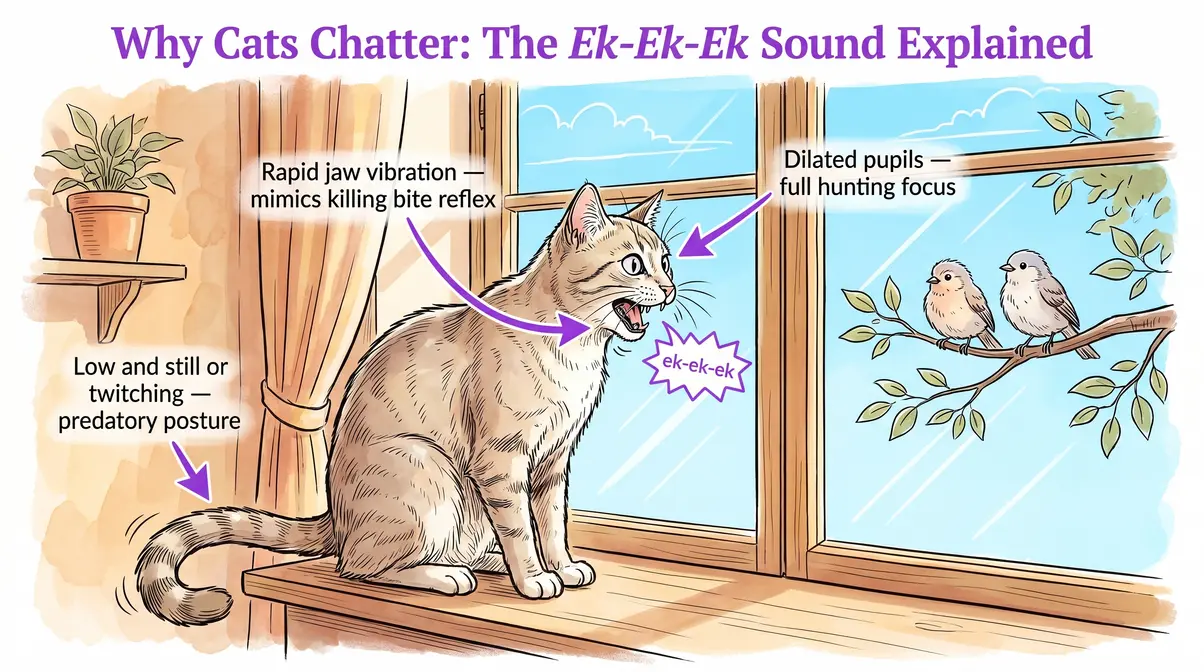
Of all the weird noises cats make, the chattering sound tends to confuse owners the most — because it looks so strange. Your cat is sitting at the window, watching a bird. Their jaw starts moving rapidly. A rapid, stuttering “ek-ek-ek” sound comes out, almost mechanical in quality. Nothing seems wrong. But what is that?
The short answer: it’s completely normal, and it’s all about instinct.
What the Ek-Ek-Ek Sound Means
That stuttering “ek-ek-ek” sound — which behaviorists call chattering — is a predatory vocalization. It’s triggered when your cat sees prey they can’t reach: birds outside the window, squirrels in the yard, or even insects on the ceiling.
The leading behavioral theory is that chattering is an involuntary motor response — the jaw is essentially mimicking the killing bite a cat would use to sever prey’s spinal cord. Some researchers have also proposed that wild cats may use similar sounds to lure prey by mimicking bird calls, though this is debated. What’s well-established is that the sound is tied directly to prey drive, not to distress or pain.
Applying the Feline Frequency Framework: the pitch of chattering is mid-range and staccato, the purpose is predatory (aimed at prey, not at you), and the posture is intensely focused — dilated pupils, rigid body, tail low and still or twitching slightly. This is hunting mode.
Chirping at Birds: Frustration?
The related chirping sound — a shorter, higher-pitched variation of chattering — tends to mix two emotions at once. Most behaviorists believe it combines genuine excitement (prey is RIGHT THERE) with frustration (but I can’t get to it).
Think of it as the feline equivalent of a sports fan watching their team score from behind a glass partition — the excitement is real, the physical barrier is maddening. Cat owners consistently report that chirping intensifies when the prey moves or gets closer to the window.
- What you can do about chattering and chirping:
- It requires no intervention — it’s a healthy expression of natural instinct
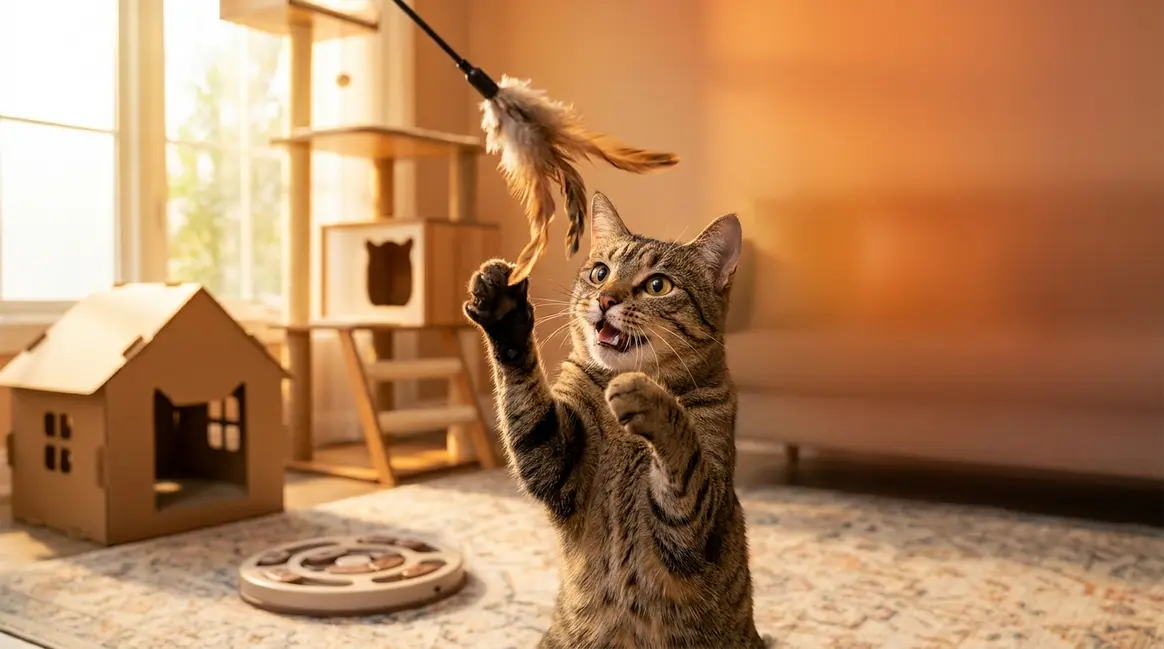
- Provide enrichment to channel that drive: wand toys, puzzle feeders, window bird feeders placed where your cat can watch safely
- If your cat seems distressed rather than excited (pacing, vocalizing constantly, not settling down), check for environmental stressors
One important note: chattering and chirping are distinct from the drawn-out yowl. If your cat is making guttural, repetitive noises at the window that escalate over time, that’s more likely territorial behavior toward an outdoor cat — not prey excitement.
This shift toward understanding hunting sounds creates the context for the most rewarding part of cat communication: learning to talk back.
How to Talk Back to Your Cat
Understanding what your cat’s sounds mean is one half of the conversation. The other half is knowing how to respond in ways your cat actually recognizes. This section covers the most effective, research-backed ways to communicate affection, greet your cat properly, repair the relationship after an upset, and manage the most disruptive vocalization most owners face: nighttime yowling.
Saying I Love You: The Slow Blink
The most powerful thing you can communicate to your cat has nothing to do with sound — it’s a look. The slow blink is the feline equivalent of “I love you” and “I trust you completely,” and it works both ways.
Research published in Scientific Reports (2020) and highlighted by Science Magazine found that cats are significantly more likely to slow blink at humans who slow blink at them first, and that cats approach unfamiliar humans more readily after a slow blink exchange (University of Sussex and University of Portsmouth, 2020). This makes the slow blink one of the most well-evidenced tools in cat communication.
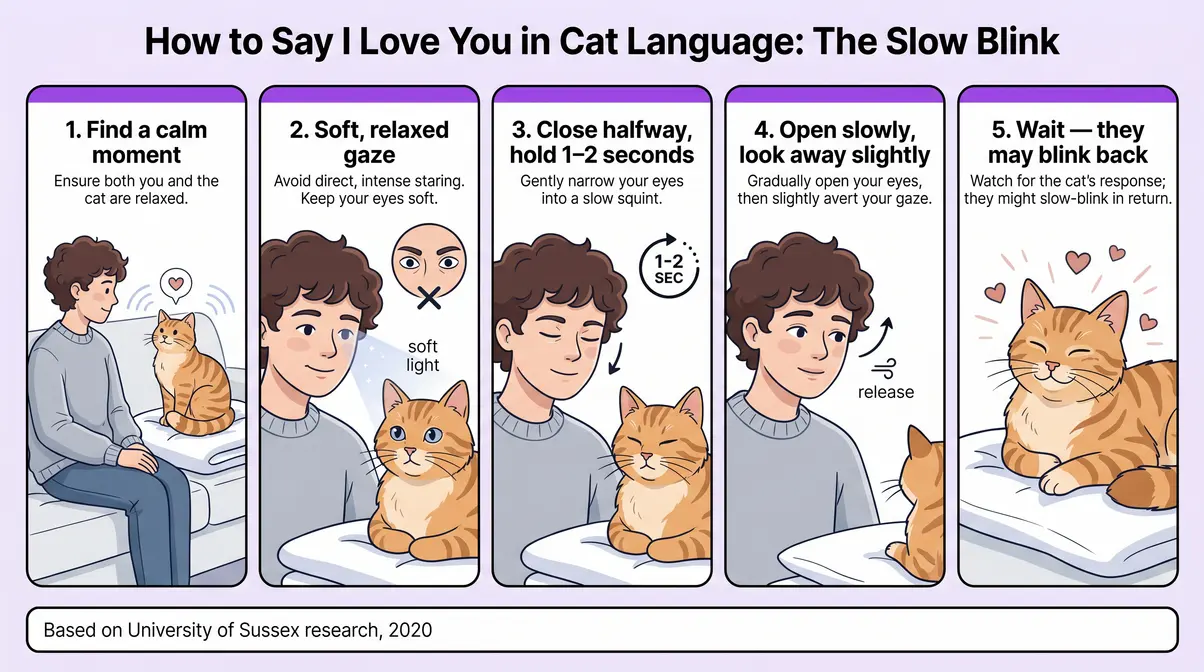
How to do the slow blink — step by step:
- Find a moment when your cat is calm and relaxed — sitting nearby, not actively playing or eating
- Make soft, relaxed eye contact (not a hard stare — that’s threatening in cat language)
- Slowly close your eyes halfway, hold for 1–2 seconds, then slowly open them
- Look away slightly after opening — breaking full eye contact signals peace, not disinterest
- Wait and watch — many cats will slow blink back within 10–30 seconds
You can pair the slow blink with a soft trill sound (“brrrup”) to combine a visual and auditory signal your cat recognizes. Many cats will trill back, approach, or begin kneading — all signs the message was received.
How to Say “Hi” to Your Cat
Cats have a specific greeting ritual, and matching it makes a real difference in how they respond to you. When cats greet each other, they approach slowly, make brief eye contact, and then touch noses. You can adapt this for human-cat greetings.
- The proper feline greeting:
- Crouch or sit down to reduce your height — looming over a cat is intimidating
- Extend one finger toward them at their nose level, about 6–8 inches away
- Wait — let the cat come to you and sniff your finger
- If they rub their face against your finger, that’s the nose-touch equivalent — they’re saying “hi” back
- You can add a soft, quiet “brrrup” trill sound as they approach
Cats who are greeted this way consistently show more relaxed body language and are more likely to initiate further contact. Cat owners across behavior communities report that this approach works even with shy or rescue cats who are still building trust. You might also wonder why does my cat rub against me when you greet them; this is another key affiliative behavior.
One thing to avoid: reaching your hand over a cat’s head to pet them immediately. From a cat’s perspective, a hand coming from above looks like a predator’s strike. Always let them sniff first.
How to Apologize to Your Cat
Cats have good memories for negative experiences — research suggests they can associate a specific person with an unpleasant event for a meaningful period afterward. If you’ve accidentally scared your cat, stepped on their tail, or forced an interaction they didn’t want, here’s how to rebuild trust:
Step 1: Give them immediate space. Don’t follow them or try to pick them up. Respect their retreat.
Step 2: Return to normal routine. Cats find predictability deeply reassuring. Feed them at the usual time, keep the environment calm, and avoid any sudden movements or loud noises for the next hour.
Step 3: Offer a peace gesture — on their terms. Sit near them (not right next to them) and let them decide whether to approach. Do not reach toward them.
Step 4: Use the slow blink. When they make eye contact, offer a slow blink. This signals “I’m calm, I’m not a threat.”
Step 5: Offer a high-value treat. Once they’ve approached voluntarily, a small treat creates a positive association with your presence again. Don’t bribe from a distance — wait until they’ve come to you.
The key principle across all five steps: let the cat lead the reconciliation. Forcing affection before they’re ready delays the process significantly.
What Annoys and Calms Cats
Understanding what triggers distress vocalizations is just as useful as knowing what the sounds mean. The most commonly reported cat irritants fall into clear categories:
- What annoys cats most:
- Forced handling — being picked up, held, or restrained when they haven’t consented
- Loud, sudden noises — fireworks, vacuums, shouting, dropped objects
- Strong smells — citrus scents, eucalyptus, strong perfumes, and certain cleaning products are intensely aversive to most cats
- Staring — prolonged direct eye contact reads as a threat or challenge
- Inconsistent routine — feeding time changes, rearranged furniture, new people in the home
What calms cats down:
Research and veterinary guidance consistently point to a few reliable calming strategies:
- Synthetic feline pheromones (such as Feliway, a synthetic version of the facial pheromone cats deposit when they rub their faces on objects) are among the most evidence-backed tools for reducing feline anxiety
- Lavender and chamomile in diluted, cat-safe formulations have shown some calming effects in studies, though always check with your vet before using any essential oil around cats — many are toxic at higher concentrations
- Valerian and catnip stimulate rather than sedate in most cats, but the post-stimulation phase often produces a calm, relaxed state
- Consistent routine is the most underrated calming tool — cats thrive on predictability
⚠️ Safety Note: Never apply essential oils directly to a cat or use a diffuser in an unventilated space. Cats cannot metabolize many compounds that are safe for humans. When in doubt, consult your veterinarian before using any scent-based calming product.
Managing Nighttime Vocalizations
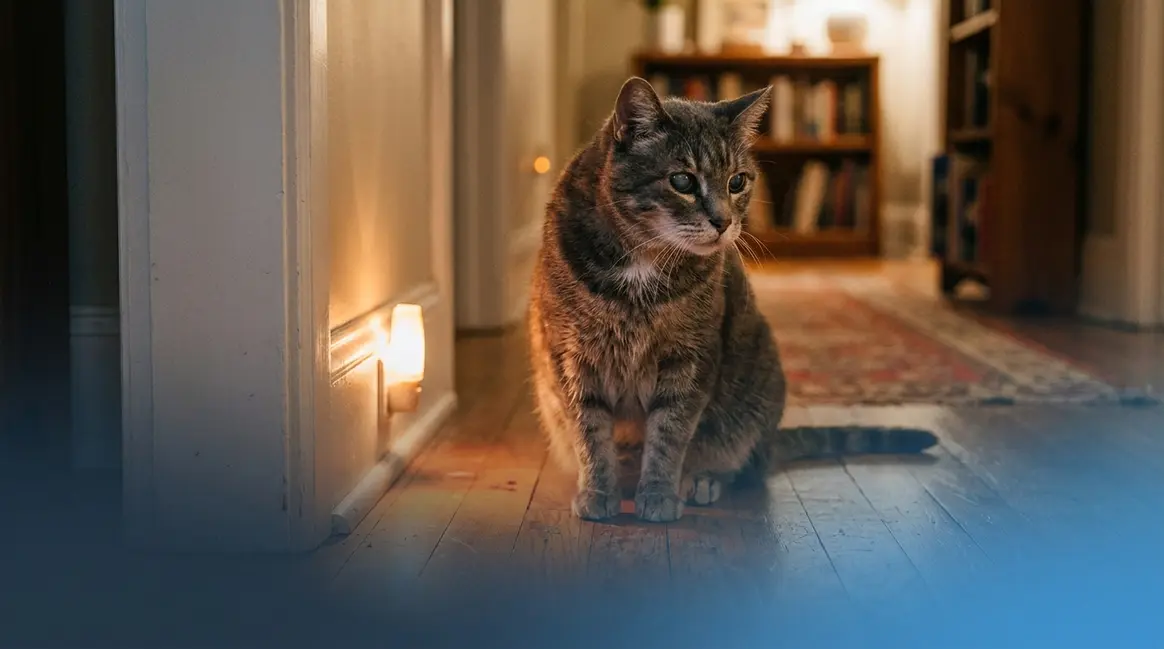
Nighttime yowling is one of the most disruptive cat behaviors owners face — and one of the least well-explained in most guides. If your cat is suddenly loud at 2 a.m., there’s almost always a specific reason. Here are the most common causes and exactly what to do about each.
Common causes of nighttime yowling:
- Hunger — Cats are crepuscular (most active at dawn and dusk), so overnight hunger is common, especially if they’re fed on a fixed schedule
- Reproductive behavior — Intact cats in heat or responding to a cat in heat outside will yowl loudly at night
- Cognitive dysfunction — Senior cats with feline cognitive dysfunction become disoriented, especially in the dark
- Hyperthyroidism — Overactive thyroid is common in older cats and causes increased vocalization, restlessness, and weight loss despite a good appetite
- Pain or illness — Any source of discomfort can cause nighttime vocalizations
- Boredom — A cat who sleeps all day may simply be awake and bored at night
5 steps to reduce nighttime yowling:
Step 1: Rule out medical causes first.
If nighttime yowling is new, sudden, or your cat is over 7 years old, schedule a vet appointment before trying behavioral interventions. Hyperthyroidism, kidney disease, and cognitive dysfunction all require medical treatment.
Step 2: Adjust feeding timing.
Give your cat their largest meal right before your bedtime. A puzzle feeder placed out at night can keep them occupied and mentally stimulated during their active hours.
Step 3: Increase daytime activity.
A cat who is physically and mentally tired at night is less likely to yowl. Aim for two 10–15 minute interactive play sessions during the day, using wand toys or laser pointers that mimic prey movement.
Step 4: Create nighttime enrichment.
A window perch where your cat can watch outdoor activity, a paper bag to explore, or a new toy left out can occupy an active cat without requiring your involvement.
Step 5: Do not respond to the yowling.
This is the hardest step. Getting up to check on your cat — even to tell them to be quiet — teaches them that yowling at 2 a.m. works. If medical causes have been ruled out, consistent non-response is the most effective behavioral intervention over time.
⚠️ Important: Never punish nighttime yowling with noise, spray bottles, or physical intervention. This increases anxiety and often makes vocalizations worse. If the behavior persists for more than two weeks despite these steps, consult a veterinary behaviorist.
When Cat Sounds Signal a Vet Visit
Most cat sounds are completely normal expressions of a healthy, communicative feline. But some patterns are worth taking seriously. Here’s a clear guide to when a vet visit is warranted:
Common Misread Feline Signs
Pitfall 1: Assuming all purring means happiness.
A cat purring while hiding, refusing food, or showing a hunched posture may be self-soothing due to pain or illness. If the purring is accompanied by behavioral changes, have your cat evaluated.
Pitfall 2: Dismissing yowling in senior cats as “just old age.”
Increased vocalization in cats over 7 is a recognized clinical symptom of several treatable conditions, including hyperthyroidism, hypertension, and cognitive dysfunction. It should always be investigated.
Pitfall 3: Interpreting hissing as “bad behavior” rather than communication.
A cat who suddenly begins hissing at family members they previously trusted may be in pain and communicating that touch hurts. This warrants a vet visit, not a behavioral correction.
When to Choose a Vet Visit
- Any new vocalization that persists for more than 48 hours with no obvious trigger
- Yowling or crying accompanied by straining in the litter box (potential urinary blockage — a veterinary emergency)
- Growling or vocalizing when touched in a specific body area
- Sudden increase in vocal frequency in a previously quiet cat
- Nighttime yowling in cats over 7 — rule out medical causes before behavioral intervention
When to Seek Expert Help
Veterinary behaviorists (board-certified specialists in animal behavior) are the right resource when vocalizations are tied to anxiety, aggression, or complex behavioral patterns that don’t respond to home management. Ask your regular vet for a referral if you’re dealing with persistent inter-cat aggression, severe separation anxiety, or compulsive vocalization that hasn’t improved after 4–6 weeks of consistent management.
⚠️ Veterinary Disclaimer: This guide is for educational purposes only and does not constitute veterinary advice. If you have concerns about your cat’s health based on their vocalizations, always consult a licensed veterinarian. For emergencies — including straining to urinate, collapse, or signs of severe pain — contact an emergency veterinary clinic immediately.
Frequently Asked Questions
How do I say I love you to my cat?
The slow blink is how you say “I love you” in cat language. Make soft eye contact with your cat, then slowly close your eyes halfway, hold for 1–2 seconds, and open them gently while looking slightly away. Research from the University of Sussex (2020) found that cats are significantly more likely to approach humans who slow blink at them. Pair it with a quiet “brrrup” trill for a combined audio-visual message your cat will recognize.
How do I say “hi” to my cat?
The proper feline greeting is the extended-finger nose touch. Crouch to your cat’s level, extend one finger at their nose height about 6–8 inches away, and wait for them to come to you. If they rub their face on your finger, that’s their version of a friendly nose-touch hello. Reaching over their head immediately is actually intimidating from their perspective — the slow approach always works better.
How do I apologize to my cat?
Give your cat immediate space, then let them lead the reconciliation. After upsetting your cat, don’t follow or force contact — retreat and return to your normal routine. Once they’re calm, sit nearby (not crowding them) and offer a slow blink. When they approach voluntarily, offer a small high-value treat to rebuild a positive association. Most cats re-engage within 30 minutes to a few hours if you don’t pressure them.
What annoys a cat the most?
Forced handling tops the list of feline irritants. Being picked up, held, or restrained without consent is the most consistently reported trigger for hissing and scratching. Loud sudden noises, strong citrus or eucalyptus scents, prolonged direct staring, and disrupted feeding routines are also major sources of feline stress. If your cat regularly hisses or runs from you, reviewing these triggers is the first step — it’s almost always one of them.
What scent calms cats?
Synthetic feline pheromones (such as Feliway) are the most evidence-backed calming scent option. These mimic the facial pheromone cats deposit when they rub their cheeks on objects — a natural signal of safety. Diluted lavender has shown some calming effects in research, but always check with your vet before using any essential oil around cats, as many are toxic at higher concentrations. Consistency of environment — familiar smells, unchanged furniture — is itself one of the most powerful calming signals.
What smell do cats absolutely hate?
Citrus is the most universally aversive scent for cats. Orange peel, lemon, and grapefruit are intensely off-putting to most cats and are often used as natural deterrents to keep cats off furniture or out of garden areas. Eucalyptus, strong perfumes, and certain cleaning products (especially those with pine or citrus bases) are also strongly disliked. Importantly, many essential oils that smell pleasant to humans are toxic to cats — never apply them directly to your cat or use them in a poorly ventilated room.
Conclusion
For any cat owner wondering what do cat sounds mean, the answer is now within reach. Cats produce over 20 distinct vocalizations, and every one of them is a deliberate message aimed — in most cases — specifically at you. The framework for decoding any of them is consistent: check the pitch, identify the purpose, read the posture. High, social, relaxed? Your cat is happy and communicating warmth. Low, defensive, tense? Give them space and look for the trigger.
The Feline Frequency Framework — Pitch, Purpose, Posture — is the tool that makes this stick. It’s not a list to memorize. It’s a mental model you can apply the first time you hear a sound you’ve never heard before, at 2 a.m. or in the middle of a vet visit. Most owners who start using it find that their cat’s communication shifts from confusing to genuinely readable within a few weeks of conscious practice.
Your next step: pick one technique from the “How to Talk Back” section and try it today. The slow blink is the easiest starting point — find a calm moment with your cat, make soft eye contact, and blink slowly. Watch what they do next. That small exchange is the beginning of a two-way conversation most cat owners never knew they could have. When you finally understand what do cat sounds mean, you can respond to their needs with confidence.

Dave King
Cat owner and writer at Mad Cat Man.