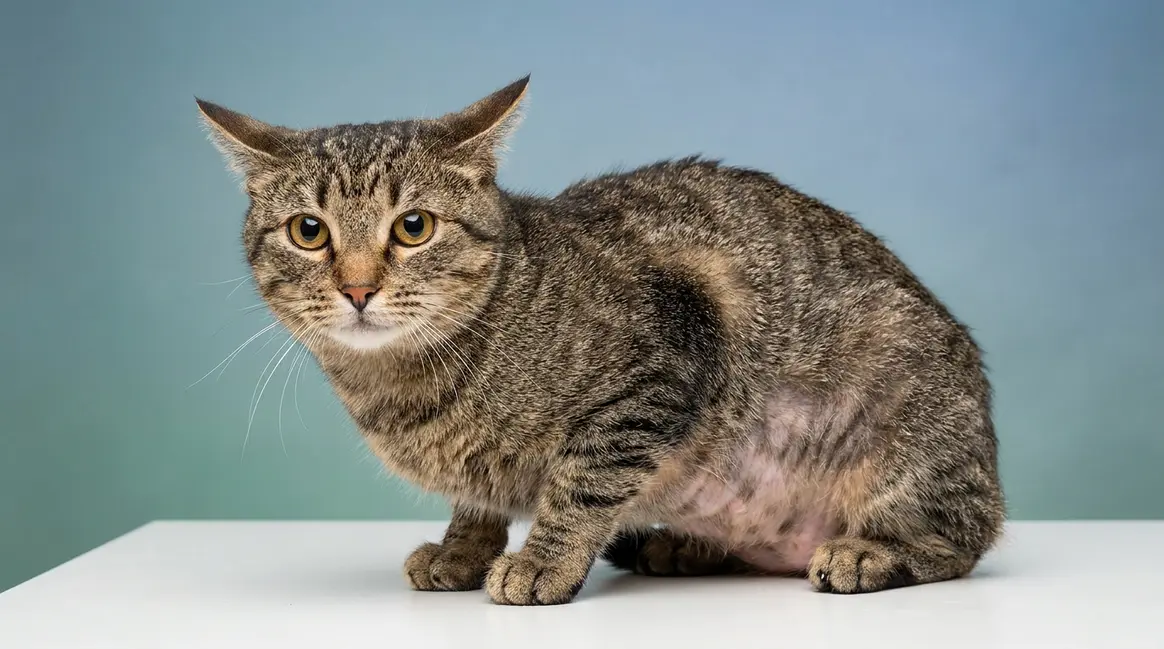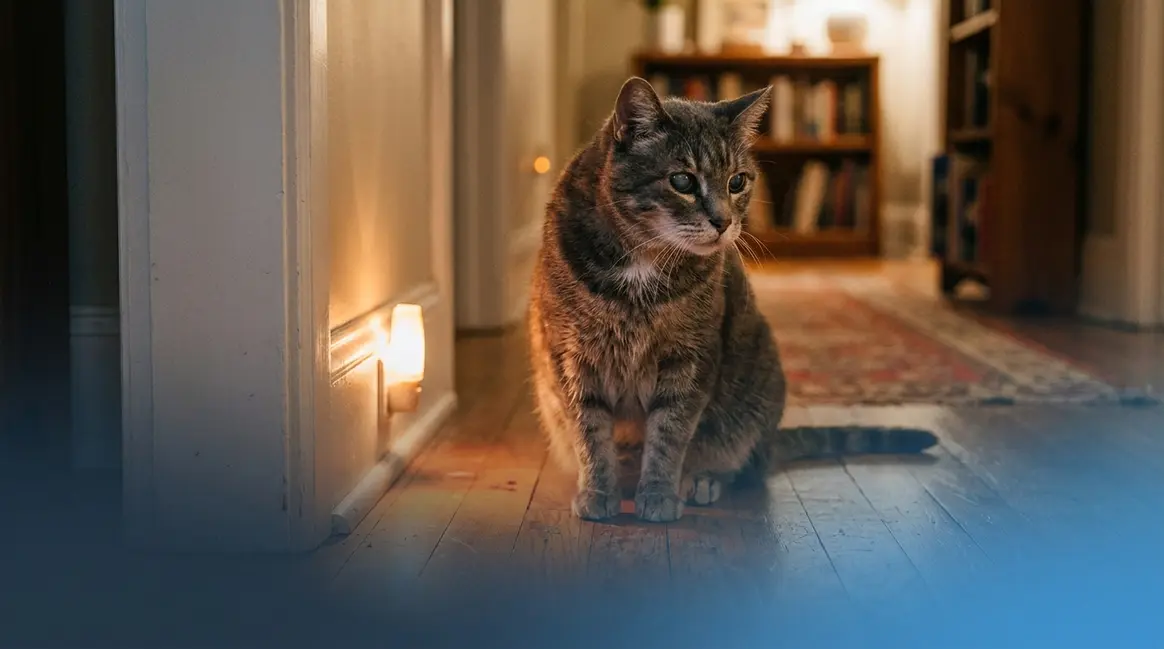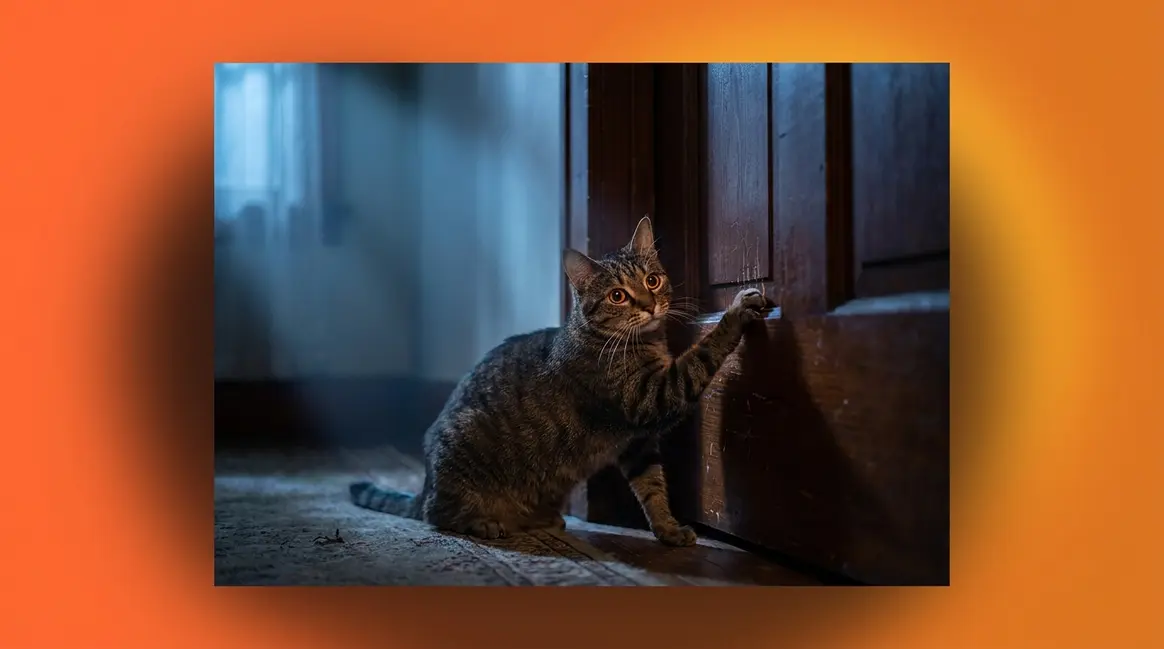

“Oliver is up scratching on walls, doors, shelves, etc… ALL NIGHT LONG. It’s not soft surfaces, always hard.”
If that quote sounds like your life right now, you’re not alone — and you’re not a bad pet owner for being exhausted and frustrated. Your cat isn’t doing this out of spite. There’s a real biological reason behind the scratching, and once you understand it, fixing it becomes much more straightforward.
The problem is a mismatch between your sleep schedule and your cat’s natural body clock. Left unaddressed, it means damaged doors, broken sleep, and a creeping sense of guilt for resenting a pet you genuinely love. In this guide, you’ll learn exactly why your cat scratching door at night happens and get a step-by-step plan to stop it for good — starting tonight if you want.
We’ll cover the “why” behind the behaviour, a proven behavioural training method, physical deterrents that protect your doors while training takes effect, and what to do when meowing joins the scratching.

- 32″ height allows cats to stretch fully and tone muscles
- Sturdy 16″ by 16″ base eliminates tipping and wobbling
- Fibrous and durable woven sisal naturally inspires scratching
- Superior to carpeted posts that may snag nail
- Assembles with two included screws


- Tall Sisal Scratcher: The 41.7" height and 6.2" thick natural sisal post give cats room to stretch, scratch and work their claws indoors.
- Stable Base And Perch: The 19.4" square base helps keep the post steady, while the top platform gives cats a raised spot to rest and look around.
- Flexible Setup Option: Use the full two-section height for multi-cat homes, or install one section first for a 1-cat home and keep the other section as a later replacement.
- Play Built In: 3 hanging balls invite batting, pouncing and daily activity, turning the scratcher into more than a simple clawing post.
- Setup in Under 5 Minutes: Numbered parts, included tools and clear instructions make assembly simple, so your cat can start using the scratching spot sooner.

- Premium Quality Materials- This product is made of 100% natural sisal hemp.The base and top is a weighted MDF covering the carpet.Nature High Quality Sisal Safe Plush Long Lasting Usage Stable basement, never tip over easily.
- Protect your furniture: - Grab sticks and plush toys combine to attract cats to play and grab, natural sisal is suitable for cats to grab, effectively preventing cats from grabbing furniture .
- Designed for indoor use- Neutral colors work well with existing decor in your home.ideal for any living room, bedroom, or home office.
- 34"Tall Cat Scratching Post-16 x 16 x 34 Inches,design for all size cats from kitten and adult cats .Other models are 22 " is specially designed for kitties or smaller cats.
- Easy Assemble:- Just screw all parts together,Assemble needed, all tools and instructions included.Please contact us if you have any further questions.

- Premium Quality Materials - This product is made of 100% natural sisal hemp.The base and top is a weighted MDF covering the carpet.Nature High Quality Sisal Safe Plush Long Lasting Usage Stable basement, never tip over easily.
- Protect your furniture - Grab sticks and plush toys combine to attract cats to play and grab, natural sisal is suitable for cats to grab, effectively preventing cats from grabbing furniture
- Designed for indoor use - Neutral colors work well with existing decor in your home.ideal for any living room, bedroom, or home office
- 22"Tall Cat Scratching Post -11.8 x 11.8 x 22 Inches,design for kitties or smaller cats.
- Easy Assemble - ust screw all parts together,Assemble needed, all tools and instructions included.Please contact us if you have any further questions.
Recommended Scratching Posts
| # | Image | Product | Best For | Buy |
|---|---|---|---|---|
| 1 | |
SmartCat Ultimate Scratching Post | Best overall pick | Buy on Amazon |
| 2 | |
LIKIMIO 41.7″ Cat Scratching Post | Large cats, wide base | Buy on Amazon |
| 3 | |
MECOOL 34″ Sisal Scratching Post | Adult indoor cats | Buy on Amazon |
| 4 |  |
32″ Sisal Post, Furniture Guard | Furniture protection focus | Buy on Amazon |
| 5 | |
MECOOL 22″ Kitten Scratcher Post | Kittens and small cats | Buy on Amazon |
Cat scratching door at night is driven by a mismatch between your cat’s natural crepuscular (dawn-and-dusk) activity cycle and your sleep schedule — what we call “The Scratch-Sleep Cycle.” A consistent pre-bedtime routine fixes it in 1–2 weeks for most cats.
- Root causes: Boredom, attention-seeking, territorial marking, or hunger — not spite
- Fastest fix: 15-minute play session + meal immediately before your bedtime
- The extinction burst: Behaviour WILL get worse for 3–7 days before it stops — do not give in
- Physical backup: Citrus spray or double-sided tape on the door buys time while training works
- When to see a vet: Sudden onset in a senior cat = medical check required
Why Is Your Cat Scratching the Door at Night?
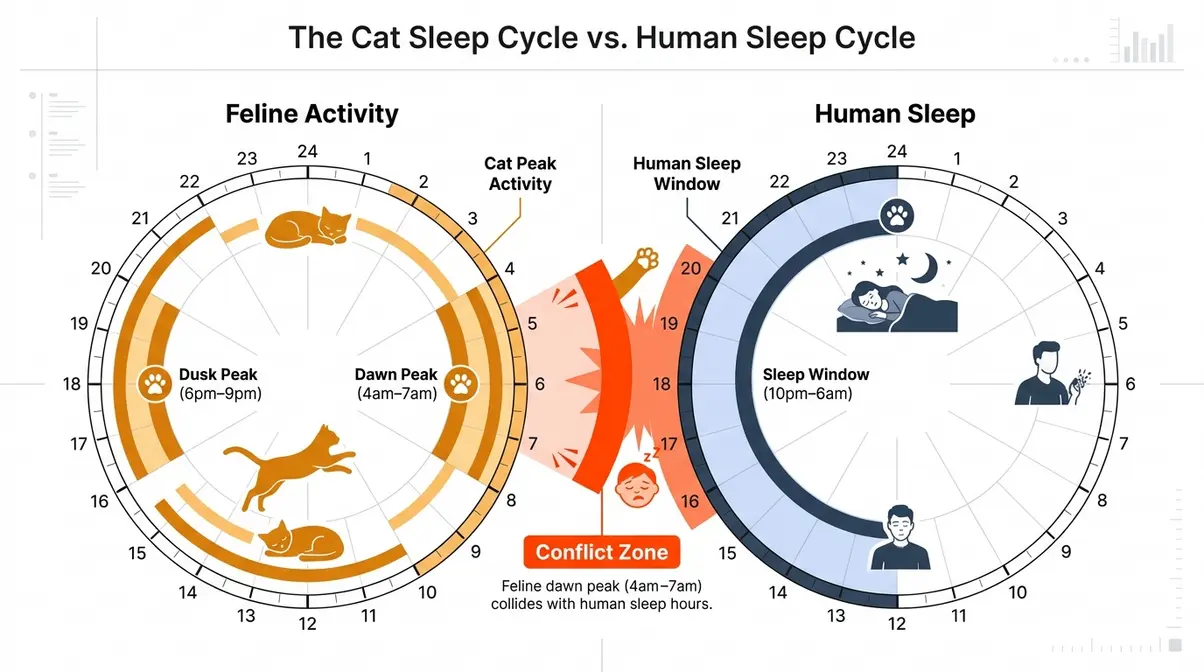
Your cat scratches the door at night because of deep biological drives — not because they’re misbehaving or trying to punish you. Cats are crepuscular (most active at dawn and dusk), which means their bodies are genuinely wired to be energetic and alert during the hours when you most want to sleep. According to Ohio State University’s veterinary team, nighttime activity is entirely normal for cats — it’s humans who are out of sync with feline biology, not the other way around. Knowing this points you directly toward the right fix.
The Cornell Feline Health Center confirms that cats scratch not just to sharpen claws, but to stretch muscles and leave visual and scent marks to define territory — so the behaviour serves multiple simultaneous purposes, which is why simply blocking one trigger often isn’t enough.
“Cats scratch doors at night because they are biologically programmed to be most active at dawn and dusk — not because they are misbehaving.” Understanding this is the foundation of every fix in this guide.
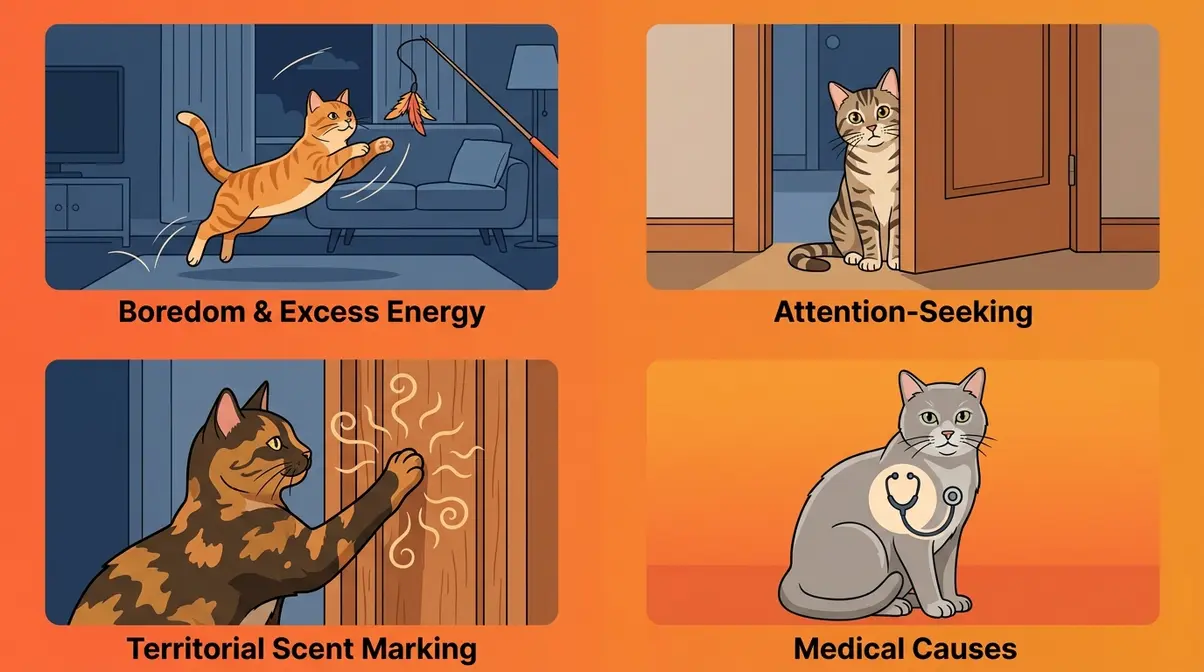
There are four main reasons your cat does this, and they are worth understanding separately because the solution for each one is slightly different. You may also find why your cat meows excessively at night is connected to the same root causes explored below.
Boredom and Excess Nighttime Energy
Cat scratching door at night is most often a simple energy problem. Indoor cats sleep between 12 and 16 hours each day. When they wake at 10pm or 2am, they have genuine physical energy to burn — and scratching the door is an outlet, not a deliberate choice. It feels urgent and satisfying to them in the same way a brisk walk feels to you after sitting at a desk all day.
Kittens and cats under two years old are especially prone to this. Their energy reserves are higher, and their impulse control is lower. But even adult cats can have this problem if their daytime environment is understimulating.
A useful way to self-diagnose: a cat left alone all day in a quiet flat with no interactive toys and no window access will have far more pent-up energy than one with a puzzle feeder, a window perch, and a cat tree to climb. If your cat scratches most intensely between 2am and 4am, boredom is the likely culprit — that’s peak feline activity time according to feline behaviour research.
- Signs boredom is the driver:
- Scratching stops when you interact with the cat, even briefly
- Your cat is highly active and playful during the evenings before bed
- There are few toys or enrichment items in your home
Boredom is the most common cause — but sometimes your cat isn’t bored. They’re working you.
Attention-Seeking — They Know It Works
This is the hardest cause for owners to accept, because it means the behaviour has been accidentally trained — by you. Even negative attention counts as a reward in feline learning. If you’ve ever got up at 3am to feed your cat, shouted at them through the door, or let them in “just this once” to get some peace, you’ve reinforced the scratching. Your cat now knows the routine works.
Understanding how to stop cat scratching door for attention starts with recognising the learned behaviour loop: cat scratches → owner responds (even with scolding) → cat receives attention → scratching is rewarded. The more consistently this loop runs, the more deeply the behaviour is entrenched.
This is the most important reason to understand before starting any training, because the solution — consistently ignoring the behaviour — feels completely counterintuitive when you’re lying awake at 3am listening to the noise. It’s the right move, but it’s genuinely hard to do without knowing why.
One important note: this attention-seeking explanation applies specifically to learned scratching behaviour. It does not apply to scratching driven by medical causes, which are covered in the H3 below.
Territorial instincts are the third driver — and they explain why some cats scratch the same spot on the door over and over.
Territorial Instincts and Scent Marking
Cats have scent glands in the pads of their paws. When they scratch a surface, they deposit pheromones (chemical scent signals) that communicate “this is mine” to other animals — and to themselves. Once a spot is marked, cats return repeatedly to refresh the mark, which is why your cat scratches the same door night after night rather than switching locations.
Your bedroom door is a particularly compelling target because it marks the boundary of YOUR territory, which your cat wants to access. You may notice your cat sniffs the door before scratching — they’re checking whether their scent mark is still present. If it’s faded, they’ll scratch again to renew it.
This scent-marking drive also explains why cat scratching bedroom door at night tends to happen at the same spot and the same time — it’s a territorial ritual, not random destruction. It’s also why pheromone sprays (covered in Section 3) work so well for this specific type of scratching: they satisfy the scent-communication drive without requiring physical damage to your door.
Medical Causes and Senior Cat Considerations
This is the section most other guides skip entirely — and it may be the most important one for some readers. If your cat’s nighttime scratching started suddenly, especially in a cat over seven years old, a medical cause needs to be ruled out before you try any behavioural training.
Hyperthyroidism (an overactive thyroid gland that speeds up the body’s metabolism) is one of the most common conditions in senior cats, affecting an estimated 10% of cats over 10 years old according to veterinary internal medicine data. One of its hallmark signs is increased restlessness and vocalisation at night — including scratching. Other medical causes include cognitive dysfunction syndrome (feline dementia, which disrupts sleep-wake cycles), chronic pain (arthritis makes cats seek warmth and company at night), and hypertension (high blood pressure, which often accompanies hyperthyroidism and kidney disease).
The key red flag is sudden onset. If your cat slept quietly for years and has recently started scratching the door every night, something has changed — and behavioural training alone will not fix a medical problem. A vet visit is the right first step. This is expanded further in Section 4.
How to Stop Cat Scratching Door at Night — Behavioral Training
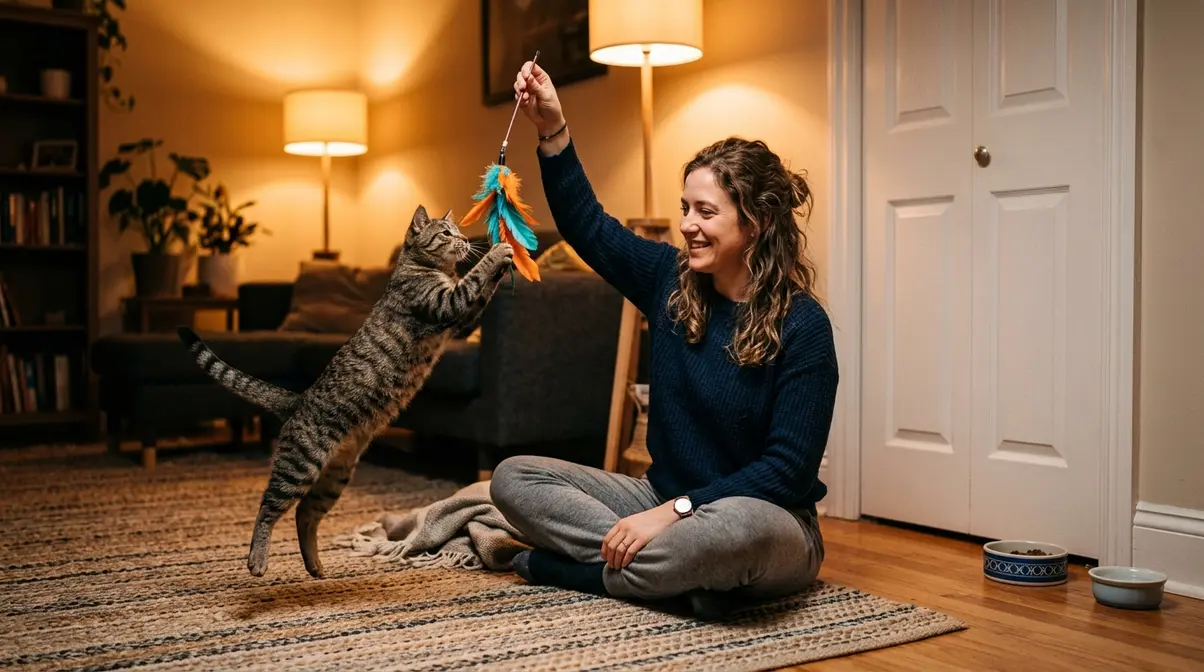
The most effective long-term solution to nighttime door scratching is resetting what we call “The Scratch-Sleep Cycle” — the predictable loop of biological energy peaks, unmet needs, and learned behaviour that drives the problem. Physical deterrents can protect your door, but they don’t address the underlying cycle. Behavioural training does.
The good news: cat owners consistently report that a structured pre-bedtime routine produces noticeable improvement within 3 to 5 days, with most cats settling fully within 1 to 2 weeks. The steps below are built around veterinary guidance and community-tested methods. Follow them in order for the best results.
Step 1 — The Pre-Bedtime Play and Feed Routine
Tools needed: An interactive wand toy (feather wand or laser pointer), your cat’s regular food or a small treat. Estimated time: 15–20 minutes each night.
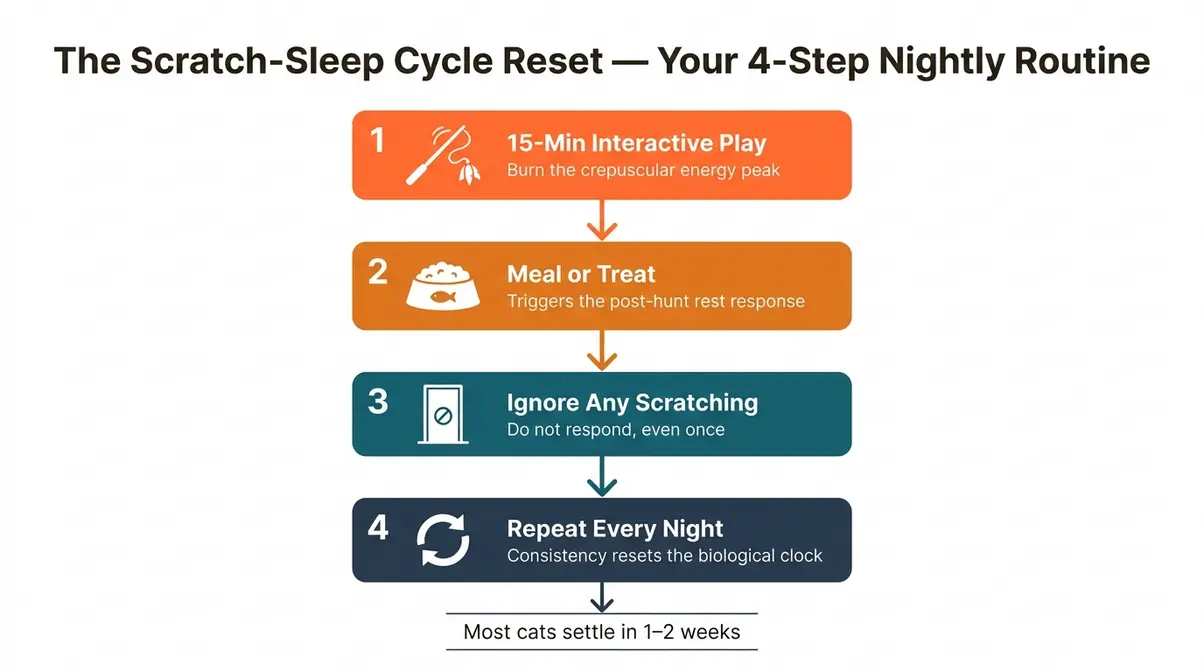
This is the single highest-impact change you can make. The goal is to simulate a hunt-catch-eat sequence, which is how cats are biologically wired to end an activity period and transition to rest. Follow these steps:
- Start active play 20–30 minutes before your intended bedtime. Use a wand toy or laser pointer to get your cat running, jumping, and pouncing. This is the “hunt” phase.
- Play until your cat slows down naturally — they’ll start sitting and watching rather than chasing. Don’t force them to stop; let the energy drain out.
- Immediately offer a small meal or treat. This is the “catch and eat” phase. It triggers a post-meal grooming and sleep sequence in most cats.
- Go to bed within 15 minutes of the meal. The timing matters — you want your cat to associate your bedtime with their natural post-meal wind-down.
How to stop cat from being destructive at night often comes down to this sequence alone. Ohio State University’s College of Veterinary Medicine specifically recommends interactive play sessions before bed as a primary intervention for nighttime activity problems in indoor cats. The pre-meal play session burns the energy that would otherwise go into scratching, and the meal triggers the biological “rest now” signal.
Settings reference:
| Step | Timing | Why It Works |
|---|---|---|
| Interactive play | 20–30 min before bed | Burns crepuscular energy peak |
| Meal or treat | Immediately after play | Triggers post-hunt rest response |
| Your bedtime | Within 15 min of meal | Pairs your sleep with cat’s natural wind-down |
Step 2 — Understanding the Extinction Burst
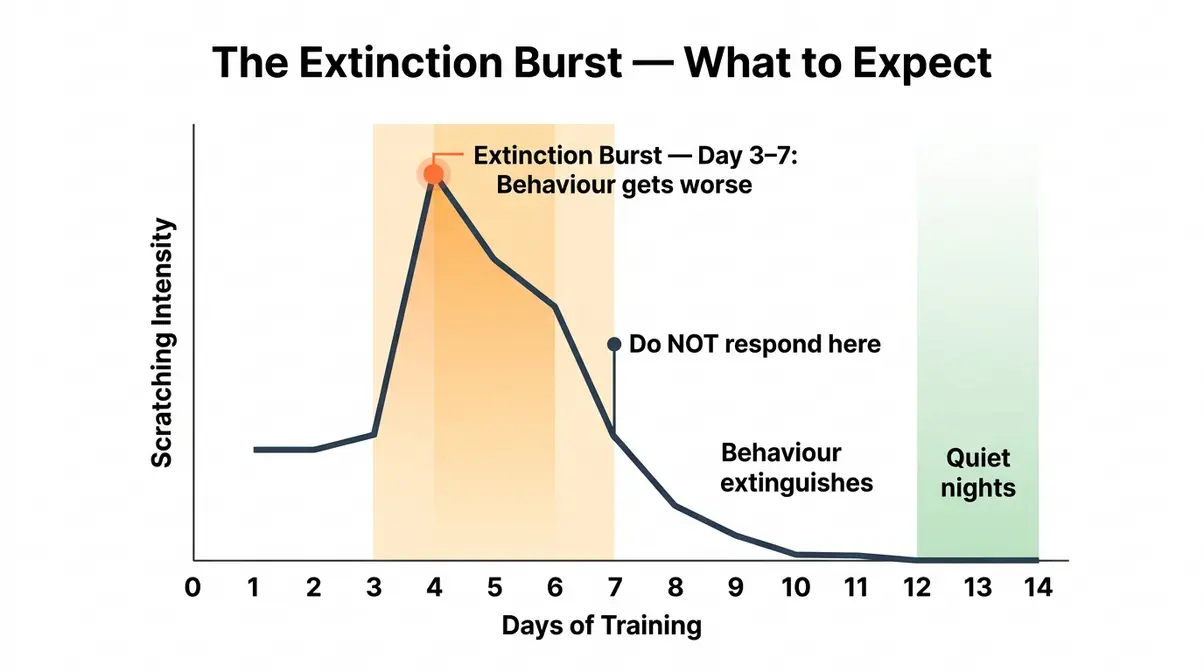
This step is not a physical action — it’s knowledge you need to survive the training process. Without it, most owners give up at exactly the wrong moment.
The extinction burst (a temporary, dramatic increase in a behaviour before it disappears) is what happens when your cat’s previously reliable strategy — scratching = attention — suddenly stops working. Your cat doesn’t understand why the scratching isn’t producing results. So they try harder. They scratch louder, longer, and more frantically. For 3 to 7 days, the behaviour will almost certainly get worse before it gets better.
This is not a sign that the training has failed. It is a sign that it is working.
Behaviour science is clear on this: the extinction burst is a predictable phase in any learned behaviour modification. The moment you respond to the escalated scratching — even once — you reset the clock entirely. Your cat learns that scratching harder, for longer, eventually works. You’ll have a worse problem than when you started.
Here’s how to get through it:
- Warn anyone else in the household so they don’t accidentally respond.
- Use earplugs or white noise to make the nights survivable while training takes effect.
- Mark your calendar. Knowing that day 7 is typically the turning point makes each night feel more manageable.
- Do not open the door, shout, or go to check on the cat during scratching episodes — any response counts as a reward.
Cat owners on Reddit consistently report that the extinction burst is the #1 reason training fails — not because the method doesn’t work, but because owners give in during the peak. One user in the r/CatTraining community described it clearly: “Night 4 was absolute chaos. Night 8 — completely silent. Hold the line.”
Step 3 — Establish a Consistent Sleep Routine
Cats are creatures of habit. Their bodies entrain (synchronise) to repeated daily schedules faster than most owners expect. “The Scratch-Sleep Cycle” is self-perpetuating — but it can be replaced with a new, quieter cycle using the same mechanism.
The key is consistency above all else. The play-feed-sleep sequence from Step 1 must happen at the same time every night, including weekends. Varying the schedule by even an hour can delay results significantly, because your cat’s internal clock needs a reliable anchor point to reset around.
- Additional routine elements that accelerate the process:
- Consistent feeding times throughout the day (not just at night) help regulate your cat’s hunger and activity cycle
- A dedicated sleeping spot near your bedroom door — not inside — gives your cat a sense of proximity without access
- A nightlight or low radio near their sleeping area reduces the anxiety that can drive attention-seeking at night
According to guidance from Willow Glen Pet Hospital, establishing predictable daily routines is one of the most evidence-supported interventions for managing nighttime activity in indoor cats — more effective long-term than any deterrent product alone.
Step 4 — Environmental Enrichment for Independent Play
Even with a perfect pre-bedtime routine, some cats — particularly young cats, high-energy breeds like Bengals or Abyssinians, and single-cat households — will still wake up during the night with energy to burn. Environmental enrichment (making your home interesting enough that your cat can entertain themselves) is the backup system that catches these wake-up windows.
Effective enrichment options for overnight independence:
- Puzzle feeders loaded with dry kibble or treats — these slow down eating and provide mental stimulation
- A window perch with outdoor visibility (even streetlights and passing cars are engaging to cats)
- Cardboard scratching pads placed near the bedroom door redirect the scratching urge to an appropriate surface
- Automated laser toys or motion-activated toys that activate when your cat approaches — these provide play without requiring you to be awake
- Cat trees near windows — vertical space is mentally enriching and physically tiring
The goal is to make the world outside your bedroom door more interesting than the world inside it. A cat that has satisfying things to do at 3am is a cat that isn’t scratching your door at 3am.
What Reddit Cat Owners Actually Do (Community Tips)
The r/CatTraining community has been discussing this exact problem for years, and several practical approaches come up consistently across hundreds of threads.
Community Consensus: The most upvoted solutions are (1) the play-feed-sleep routine, (2) puzzle feeders left out overnight, and (3) white noise machines for owners to survive the extinction burst. The most common mistake reported is responding “just once” during the extinction burst — which owners universally describe as setting them back to square one.
Top community-tested tips:
- “Rotate toys weekly” — cats habituate to the same toys quickly; new or rotated toys stay interesting longer
- “A Feliway diffuser near the bedroom door changed everything” — multiple owners report pheromone diffusers reducing the door-scratching intensity within days
- “Feed a second small meal at midnight via an automatic feeder” — this addresses hunger-driven 2am wake-ups without you having to get up
- “A cheap white noise machine was the only thing that got me through week one” — practical survival advice for the extinction burst period
- “Put a cardboard scratcher right next to the bedroom door” — redirects the scratching urge to an acceptable surface in the exact location they want to scratch
Physical Deterrents to Stop Cat Scratching at Night
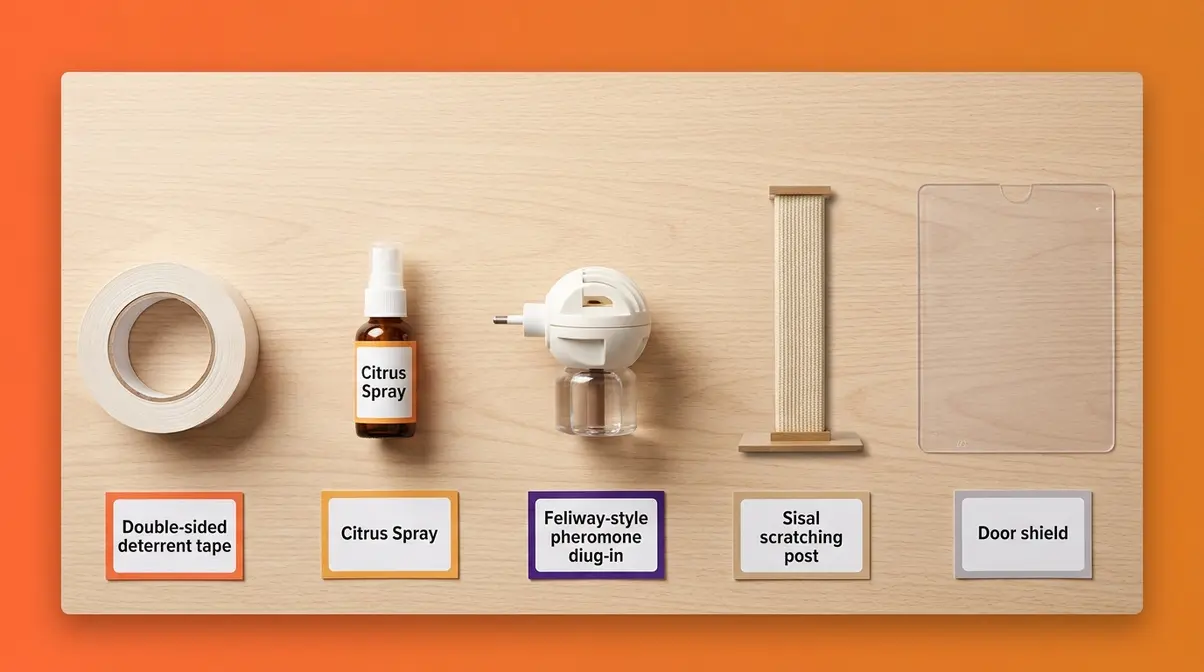
Physical deterrents work by making the door surface unpleasant to scratch and by redirecting your cat’s scratching urge to a more appealing alternative. They are not a standalone solution — used alone without behavioural training, most cats simply work around them. However, as a complement to the routine in Section 2, deterrents protect your doors while training takes effect and can significantly speed up the process.
Our evaluation of deterrent options found that the most effective approach combines a surface deterrent (making the door feel unpleasant) with a redirector (giving the cat something better to scratch nearby). Using only one without the other reduces effectiveness considerably.
All deterrents listed below are non-toxic and pet-safe. Never use anything near your cat’s scratching area that contains essential oils like tea tree, eucalyptus, or pennyroyal — these are toxic to cats even in small concentrations.
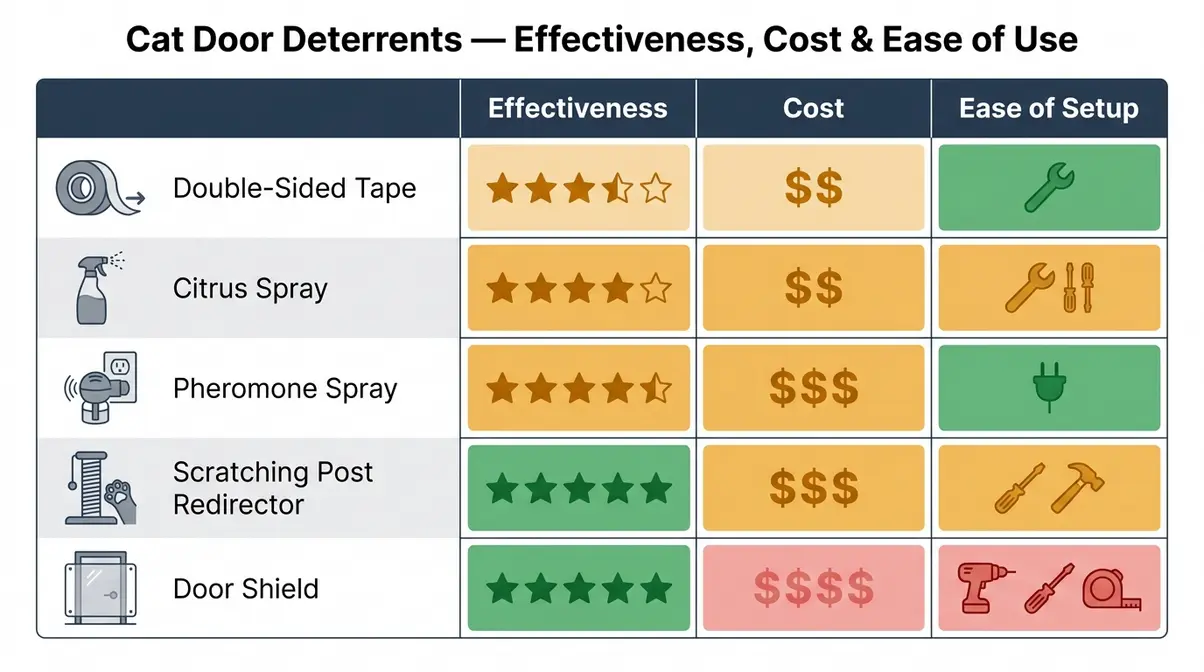
Double-Sided Tape and Aluminum Foil
These are the lowest-cost, most immediately available deterrents — and they work because cats intensely dislike sticky textures and the sound and feel of foil under their paws.
- How to apply double-sided tape:
- Clean the door surface with a dry cloth to remove dust and oils.
- Apply strips of double-sided tape vertically along the area your cat targets — typically the lower 18 inches of the door.
- Use a tape specifically designed for this purpose (standard tape can leave adhesive residue on painted doors). Products like Sticky Paws are widely used and safe for painted surfaces.
- Replace every 3–5 days as the adhesive loses strength.
Aluminium foil can be taped over the door panel as a temporary measure — the crinkle sound and cool texture deter most cats immediately. It’s not aesthetically ideal, but it works well during the first week of training when the extinction burst is at its peak.
These methods address the damage to your door in the short term. For the scent-marking driver specifically, however, surface deterrents are less effective because the urge to mark is strong. Scent deterrents work better for that case.
What Smells Do Cats Hate? Scent Deterrents Explained
Cats have approximately 200 million scent receptors compared to around 5 million in humans — making them extraordinarily sensitive to smells that barely register for us. Several scents are reliably aversive to most cats and can be applied near doors to deter scratching.
Effective scent deterrents (pet-safe options only):
| Scent | Form | How to Apply | Effectiveness |
|---|---|---|---|
| Citrus (lemon, orange, grapefruit) | Spray or fresh peel | Spray base of door or place fresh peel nearby | High — most cats react strongly |
| Lavender | Diluted spray | Spray lightly on door surface | Medium — variable by individual cat |
| Rosemary | Diluted spray or fresh sprigs | Place near door | Medium |
| Commercial cat repellent | Ready-to-use spray | Apply per product instructions | High — formulated for this purpose |
Critical safety note: Never use essential oil concentrates directly. Always use heavily diluted solutions (1–2 drops per 300ml water) or purpose-made cat repellent sprays. Many essential oils are toxic to cats in undiluted form. The ASPCA Animal Poison Control Center maintains a full list of toxic plants and substances — consult it before using any scent deterrent.
Citrus is the most consistently effective option. Cat owners on Reddit and in veterinary guidance from the Sheba pet care team both identify citrus as a top recommendation. Refresh the scent every 24–48 hours, as it fades quickly.
Pheromone Sprays — Calm Without Conflict
Pheromone products like Feliway work differently from other deterrents. Rather than making the door unpleasant, they communicate safety and calm to your cat using synthetic versions of the natural pheromones cats deposit when they rub their faces on surfaces (a contentment signal, not a stress signal).
Applied to the base of the door, a pheromone spray or plug-in diffuser can reduce the territorial anxiety that drives scent-marking scratching. Cat owners consistently report reduced scratching intensity within 3–7 days of starting a Feliway diffuser near the bedroom door.
- How to use pheromone spray effectively:
- Apply to the door surface at your cat’s nose height (approximately 8–12 inches from the floor).
- Do not apply directly over existing scratch marks — clean the area first so your cat isn’t responding to their own pheromones.
- Reapply every 24 hours for the first week, then reduce to every 2–3 days as behaviour improves.
- For persistent cases, a plug-in diffuser in the hallway near the bedroom door provides continuous coverage without daily reapplication.
Pheromone products are particularly effective for cats whose scratching is primarily territorial (they scratch the same spot repeatedly, sniff before scratching) rather than energy-driven.
Scratching Posts as Redirectors — Place Them Here
A scratching post only works as a deterrent if it’s placed in exactly the right location. Most owners put scratching posts in a corner of the living room — which does nothing to address door scratching, because the cat scratches the door for reasons specific to that location (territory, proximity to you, scent marks already there).
Placement rule: Put the scratching post within 12 inches of the bedroom door. This gives your cat an acceptable surface in the exact spot they want to scratch. Over time, the post accumulates their scent and becomes the preferred scratching location.
- For this to work, the post needs to meet a few criteria:
- Tall enough for your cat to fully stretch — at least 28–32 inches for an adult cat. The SmartCat Ultimate Scratching Post and LIKIMIO 41.7″ Post both meet this requirement.
- Stable enough not to wobble — a wobbly post gets abandoned immediately
- Sisal-wrapped rather than carpet-covered — sisal texture is closer to tree bark, which cats instinctively prefer for claw conditioning
- Vertical orientation — door scratching is a vertical behaviour, so a vertical post is a better redirect than a horizontal pad
For kittens or small cats, the MECOOL 22″ Kitten Scratcher Post provides the right scale. Larger cats or those with strong scratching habits do better with the MECOOL 34″ Sisal Post or the 32″ Sisal Post with Furniture Guard base.
Encourage use of the new post by rubbing a small amount of catnip on the surface or dragging a wand toy up and down it during daytime play sessions.
Door Shields and Physical Barriers
For cats that have already caused visible damage to a door — gouges, scratch marks, stripped paint — a physical door shield provides immediate protection while training takes effect. The most widely referenced product for this is the CLAWGUARD door shield, a clear plastic panel that attaches to the door surface and absorbs scratching without damage.
Door shields work as a passive, zero-maintenance deterrent. Once installed, they require no daily attention. The plastic surface is unpleasant to scratch (cats prefer wood, carpet, and sisal) and protects the door underneath.
- Installation steps:
- Clean the door surface thoroughly and allow to dry completely.
- Attach the CLAWGUARD panel using the included adhesive strips at the base of the door — position it to cover the area your cat targets.
- Check adhesion after 24 hours and press any lifting edges back down.
- The shield is transparent, so it doesn’t affect the door’s appearance significantly.
Door shields are best used in combination with a scratching post placed nearby — the shield removes the option to scratch the door, and the post provides the acceptable alternative. Used together, this combination redirects behaviour rather than simply blocking it.
When Your Cat Is Meowing AND Scratching at Night
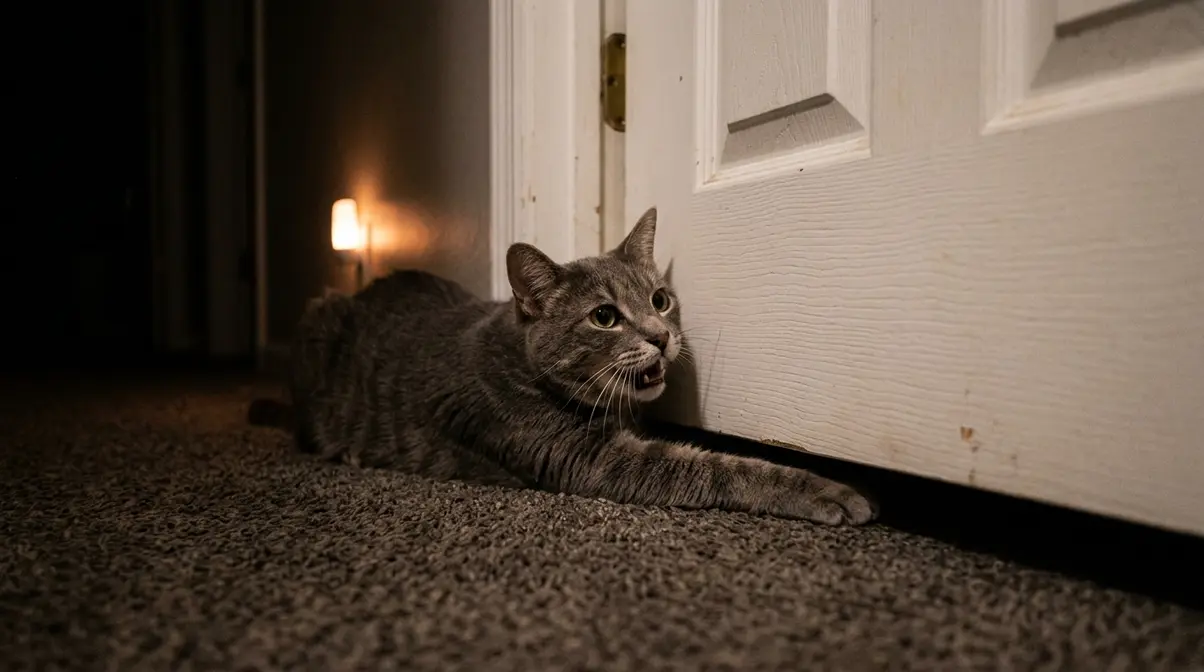
When scratching is accompanied by meowing (or howling at the door), the behaviour is almost always more urgent and harder to ignore. The combination typically signals that your cat has an unmet need they’re communicating about — not just excess energy. Understanding which need it is determines the right response.
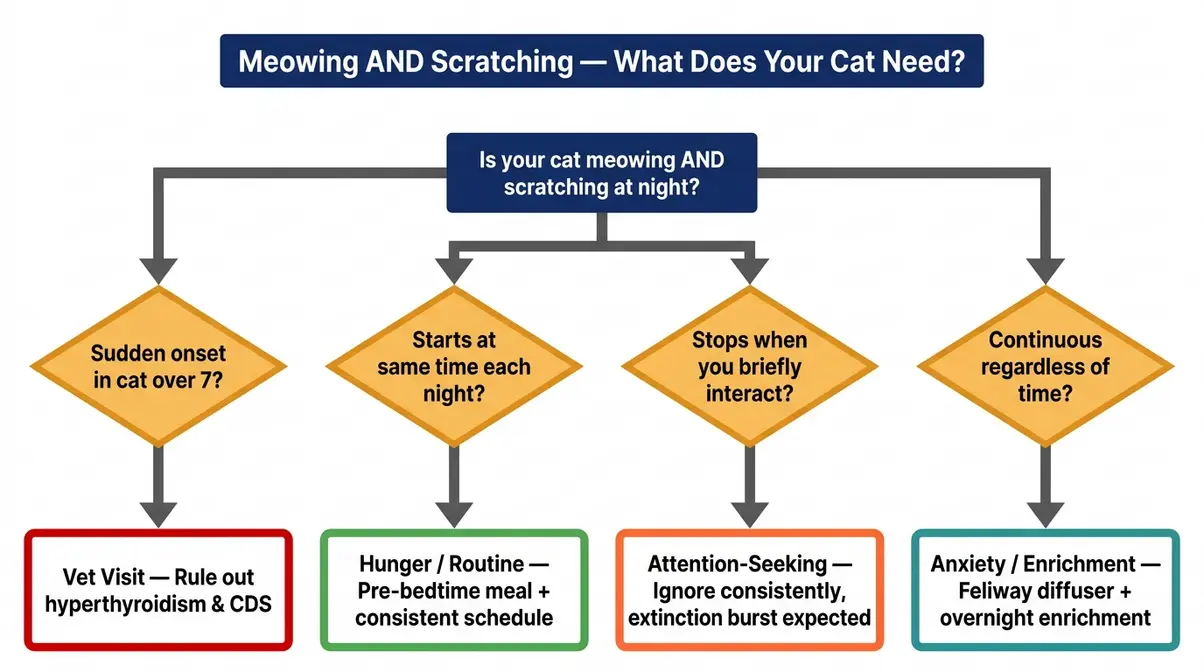
Why Meowing and Scratching Happen Together
The combination of meowing and scratching means your cat is using every communication tool available simultaneously — which indicates a higher level of urgency than scratching alone. Common triggers include hunger (an empty stomach at 2am is genuinely uncomfortable), separation anxiety (particularly in cats that are closely bonded to one person), and — in senior cats — the disorientation that accompanies cognitive dysfunction syndrome.
Why does my cat keep scratching the door and meowing? The answer almost always comes down to one of three things: they’re hungry, they’re anxious about being separated from you, or something is medically wrong. The meowing is the communication layer on top of the physical scratching behaviour — it’s your cat escalating from action to vocal demand.
For cats under seven years old with no sudden change in behaviour, hunger and separation anxiety are the most likely causes. For cats over seven with a recent behaviour change, a vet visit should be the first step before any training begins.
Pre-Bedtime Checklist — Meet Every Need Before You Sleep
One of the most effective ways to prevent the meowing-and-scratching combination is to systematically meet every need your cat might have before you close the bedroom door. Cat owners who feel overwhelmed by their cat’s “so needy” nighttime behaviour often find this checklist approach surprisingly effective — because it removes the guesswork.
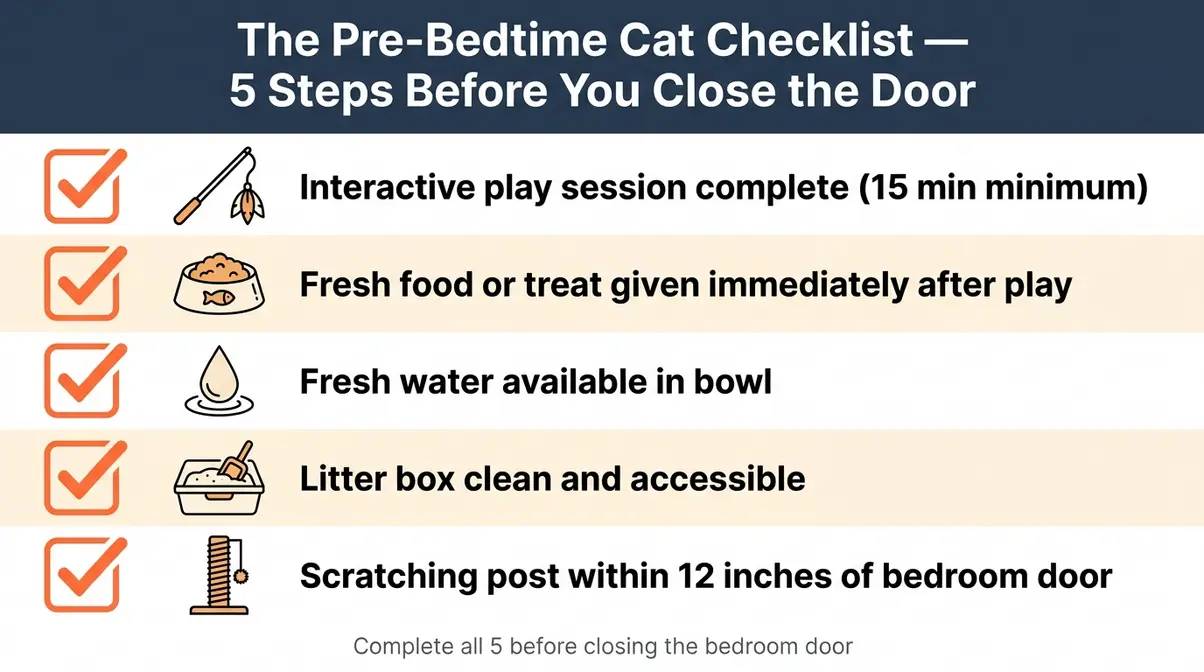
Before you close the bedroom door each night, verify:
- ✅ Interactive play session complete (15 minutes minimum, wand toy preferred)
- ✅ Fresh food or treat given immediately after play
- ✅ Fresh water available — dehydration causes restlessness in cats
- ✅ Litter box clean — cats will not use a dirty box and may vocalise distress about it
- ✅ Scratching post positioned within 12 inches of the bedroom door
This checklist approach is particularly effective for cats that meow at the door at night because it addresses the “indoor cat meowing at front door” pattern — where cats vocalise at boundaries because something on their side of the boundary is unpleasant or unmet.
When to Call the Vet — Red Flags to Watch For
Sudden onset of nighttime scratching and meowing in a previously quiet cat is a medical signal until proven otherwise. The following symptoms alongside nighttime scratching warrant a vet consultation — do not attempt behavioural training as a first response if these are present.
Medical red flags:
| Symptom | Possible Cause | Urgency |
|---|---|---|
| Sudden onset in cat over 7 years | Hyperthyroidism, hypertension, CDS | Vet within 1 week |
| Weight loss + increased appetite | Hyperthyroidism | Vet within 1 week |
| Disorientation, walking in circles | Cognitive dysfunction, hypertension | Vet urgently |
| Increased thirst and urination | Kidney disease, diabetes | Vet within 1 week |
| Crying out in pain when touched | Arthritis, internal pain | Vet urgently |
| Sudden behaviour change after years of quiet nights | Any of the above | Vet within 1 week |
Hyperthyroidism affects an estimated 10% of cats over 10 years old and is one of the most treatable conditions in senior cats when caught early. Cognitive dysfunction syndrome (feline dementia) affects approximately 28% of cats aged 11–14 and over 50% of cats aged 15 and older, according to veterinary neurology research. Both conditions disrupt sleep-wake cycles and can cause nighttime vocalisation and restlessness that looks exactly like behavioural scratching. A blood panel and thyroid check at your vet will rule these out quickly.
Common Mistakes — Why Nothing Seems to Work
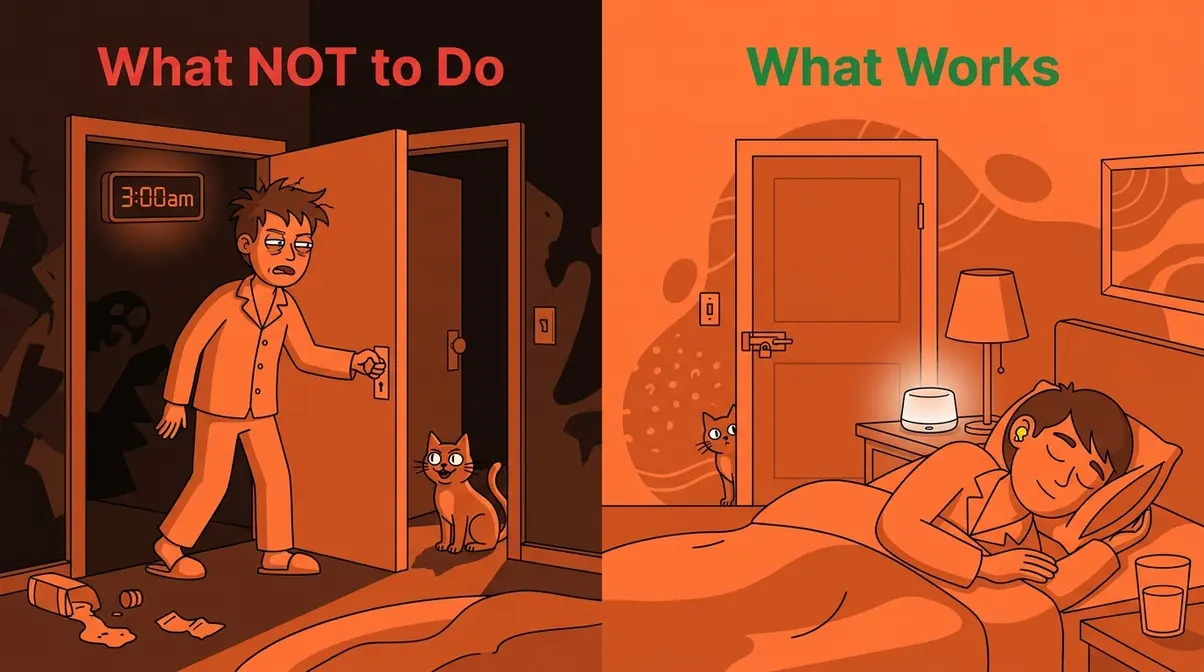
Even owners who know the right approach often stall because of a few consistent, predictable errors. Recognising these mistakes before you make them saves weeks of frustration.
Pitfalls That Make the Problem Worse
Responding during the extinction burst is the single most damaging mistake. As explained in Section 2, any response — including shouting, checking on the cat, or briefly opening the door — resets the extinction process and teaches your cat that more intense scratching eventually wins. Cat owners on Reddit who report training failure almost universally describe a moment where they “just gave in once” during the peak of the extinction burst.
Additional common pitfalls:
- Inconsistent timing of the pre-bedtime routine — varying your schedule by more than 30 minutes significantly slows habituation
- Placing the scratching post too far from the door — a post in the living room does not redirect door-specific scratching behaviour
- Using deterrents without providing an alternative — blocking scratching without redirecting it increases frustration and can cause the behaviour to shift to a different surface
- Punishing the scratching — spraying water, loud noises, or physical correction creates anxiety without teaching the cat what to do instead, and can damage your bond
When to Consider Alternatives
The approach in this guide works for the majority of cats within 1–2 weeks. However, some situations call for a different response:
- If you share a wall with neighbours and the noise is causing a crisis, consider temporarily allowing the cat to sleep in your room while you establish the pre-bedtime routine — then gradually transition to closed-door sleeping once the routine is working
- If you have a multi-cat household, the scratching may be driven by inter-cat tension rather than your cat’s relationship with you — a certified cat behaviourist can assess this more accurately than a general guide
- For guidance specific to your situation, the WikiHow guide on stopping door scratching offers additional scenario-specific tips that complement the approach here
When to Seek Veterinary Help
- Seek veterinary advice before starting any training programme if:
- The behaviour started suddenly in a cat over 7 years old
- The scratching is accompanied by any of the medical red flags listed in Section 4
- Your cat shows signs of anxiety or distress beyond the door scratching (excessive grooming, hiding, appetite changes)
- The behaviour has continued for more than 4 weeks without any response to consistent training
A veterinary behaviourist (a vet with specialist training in animal behaviour) can assess cases where standard approaches haven’t worked and may recommend short-term medication to reduce anxiety while training takes effect.
Frequently Asked Questions
Should I ignore my cat scratching at the door?
Yes — consistently ignoring the scratching is the correct response, once you’ve ruled out medical causes and completed the pre-bedtime routine. Ignoring the behaviour removes the reward (your attention) that sustains it. The critical caveat is the extinction burst: for 3 to 7 days after you start ignoring, the scratching will intensify significantly before it stops. This is normal and expected. Use earplugs or white noise to get through this phase — do not respond, even once.
How do I stop my cat from being destructive at night?
The most effective method combines a pre-bedtime play session with an immediate meal, followed by consistent ignoring of any nighttime scratching. Cats are crepuscular (most active at dawn and dusk), so a 15-minute interactive play session at 9–10pm burns the energy peak that would otherwise go into destructive behaviour. Pair this with environmental enrichment — puzzle feeders, a window perch, automated toys — so your cat has satisfying options for any middle-of-the-night wake-ups. Most owners see significant improvement within 5 to 7 days of consistent application.
Why do cats scratch my door at night?
Cats scratch doors at night because of four biological and learned drivers: boredom, attention-seeking, territorial scent marking, and hunger. Cats are naturally crepuscular, meaning their energy peaks coincide with your sleep hours — the scratching is a release valve for that energy. Additionally, if you’ve ever responded to scratching by opening the door or giving attention, your cat has learned that scratching works. Territorial marking (cats deposit scent from paw glands when they scratch) explains why the same spot is targeted repeatedly. In senior cats, medical causes like hyperthyroidism should also be ruled out.
What smell do cats hate to stop scratching?
Citrus is the most reliably effective scent deterrent for cats — the smell of lemon, orange, and grapefruit is aversive to most cats due to their highly sensitive olfactory system (approximately 200 million scent receptors versus 5 million in humans). Apply a diluted citrus spray to the base of the door, or place fresh citrus peel nearby, refreshing it every 24–48 hours. Lavender and rosemary also work for some cats. Always use diluted solutions or purpose-made pet repellent sprays — concentrated essential oils are toxic to cats. The ASPCA Animal Poison Control Center is the best reference for safe and unsafe scents.
The Bottom Line on Stopping Nighttime Door Scratching
For exhausted cat owners dealing with cat scratching door at night, the most important insight is this: the behaviour is predictable, it has specific causes, and it responds well to a structured approach. Cats scratch doors at night because their crepuscular biology creates energy peaks that coincide with your sleep hours — not because they’re misbehaving. A 15-minute play session followed by a meal before your bedtime addresses the biological driver directly, and most cats settle within 1 to 2 weeks of consistent application.
The Scratch-Sleep Cycle — the loop of biological energy peaks, unmet needs, and learned behaviour — is self-perpetuating. But the same mechanism that locks it in can be used to replace it with a quieter cycle. The pre-bedtime routine, combined with physical deterrents during the extinction burst and environmental enrichment for overnight independence, addresses the problem from every direction simultaneously.
Start tonight with the simplest version: a 10-minute wand toy session followed by your cat’s evening meal, then close the door and don’t respond to any scratching. Add the deterrents and enrichment in the days that follow. If your cat is over seven and this started suddenly, book a vet appointment first — madcatman.com always recommends ruling out medical causes before starting any behavioural programme. Your sleep is worth the effort, and so is your cat.

Dave King
Cat owner and writer at Mad Cat Man.