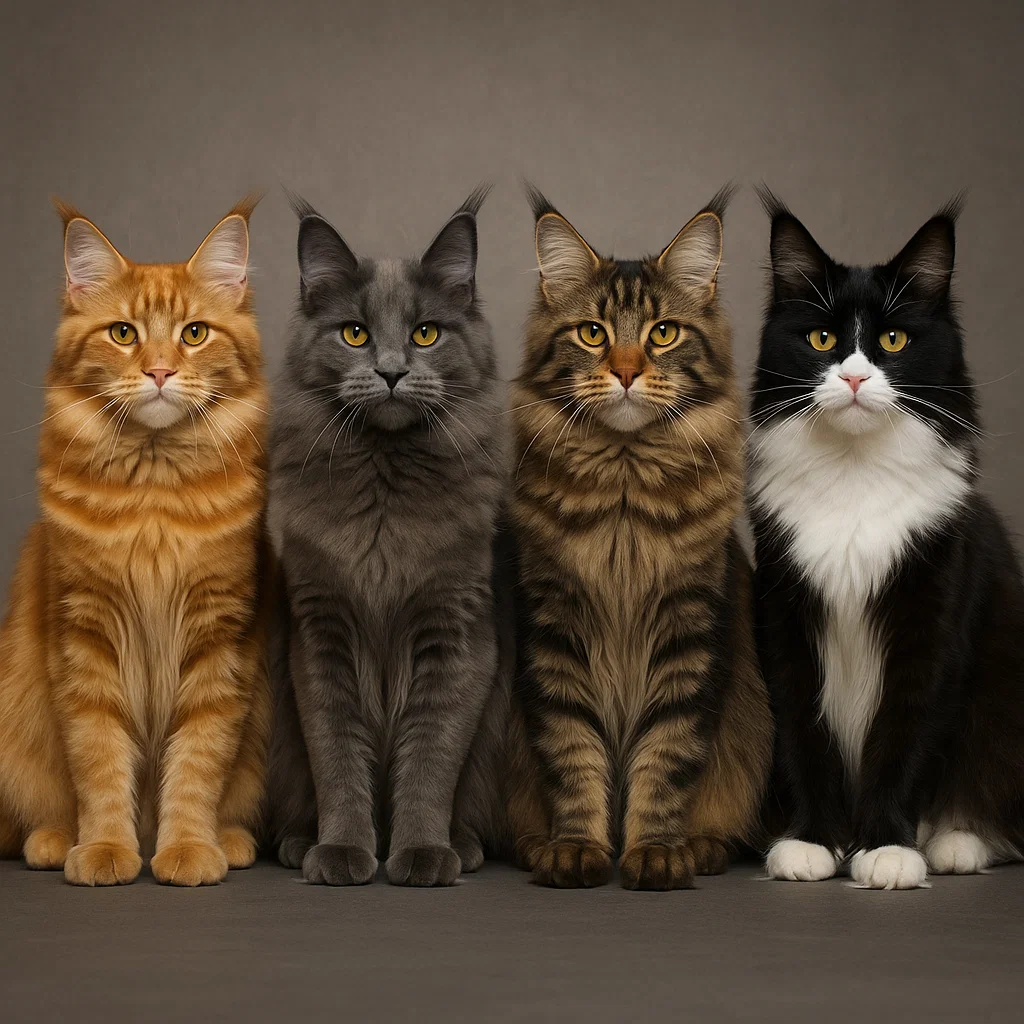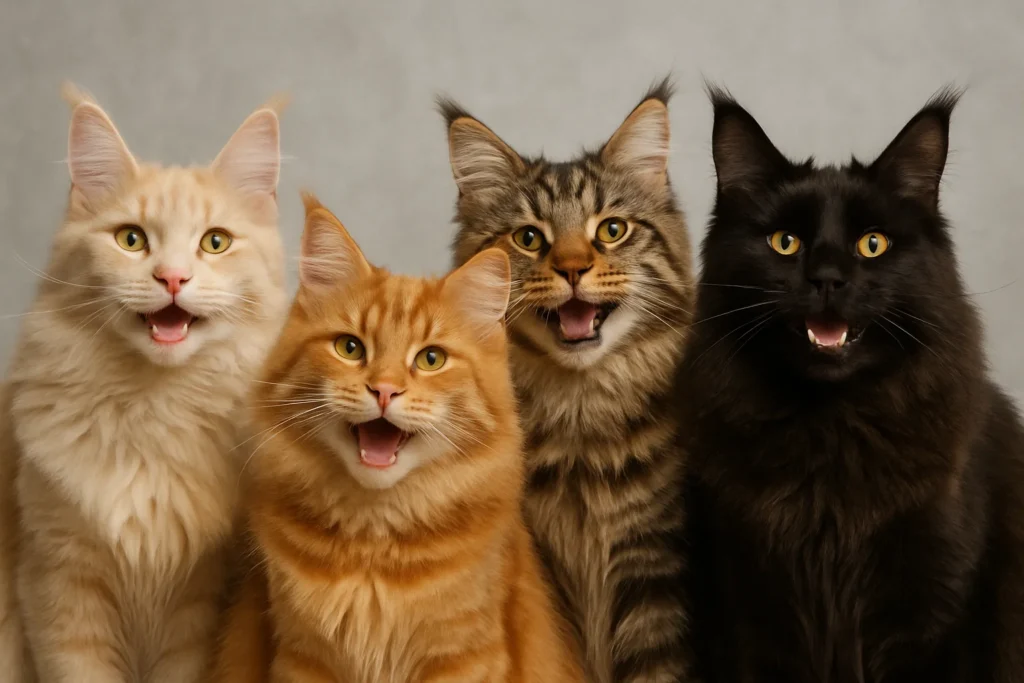
Maine Coon colours featured — brown tabby, black smoke, and silver shaded cats side by side
Cat Breeds Updated July 10, 2026 · 37 min read

Maine Coon Colours: Complete Guide to 75+ Patterns

Home Cat Breeds

This blog post may contain affiliate links. As an Amazon Associate I earn from qualifying purchases.

Maine Coon colours are among the most spectacular in the entire cat world — and also among the most confusing. With over 75 officially recognised combinations under CFA and TICA breed standards, it is easy to feel lost before you even begin. Is that fluffy silver kitten a “chinchilla” or a “shaded silver”? Is your new cat a “tortoiseshell” or a “torbie”? Why do some colours cost more than others, and what on earth is a “smoke”?

This guide cuts through the confusion with a single, learnable system: The Colour Spectrum Framework — a four-axis model that organises every Maine Coon coat by Base Pigment, Pattern Modifier, Dilution, and Inhibitor Effect. Once you understand those four levers, any coat you encounter makes immediate sense. If you want to explore various Maine Coon colors and patterns in even more detail, understanding this framework is the perfect starting point.

“Silver tabbies, smoke colors, red tabbies, and well marked torbies are often very popular.”
— Shared sentiment across Maine Coon breeder communities

Whether you are choosing a kitten, trying to identify your own cat’s pattern, or simply fascinated by feline genetics, this complete guide covers every colour class, explains the genetics behind each one, ranks colours by rarity, and details which patterns are disqualified by breed standards.

Key Takeaways

Maine Coon coat colours span 75+ officially recognised CFA/TICA combinations — and the Colour Spectrum Framework (Base Pigment → Pattern Modifier → Dilution → Inhibitor Effect) lets you decode any coat at a glance.

  • Tabbies dominate: Brown classic tabby is the most common Maine Coon colour by far, driven by the dominant agouti gene.
  • Smokes are the showstoppers: The inhibitor gene creates that dramatic silver-white undercoat beneath a rich top colour — easy to confuse with solids.
  • Rarest of all: Solid gold/shaded gold and true chinchilla are the hardest colours to breed consistently.
  • Colour affects price: Rare colours like black smoke or silver shaded can push kitten prices $500–$1,000 higher than common brown tabbies.
  • Some colours are banned: Pointed (Siamese-style), chocolate, and lilac are disqualified in CFA show competition.

How to Use This Guide

Before jumping into the colour sections, a quick orientation will save you time.

  • Estimated time: 15-20 minutes
  • Tools and Materials Needed:
  • Your Maine Coon cat (or a clear photograph)
  • Good natural lighting
  • This colour reference guide

This guide is structured in a deliberate order:

  1. Start with the Overview (next section) to get the big picture of colour categories and the Colour Spectrum Framework.
  2. Jump to any pattern section — Tabbies, Smokes, Solids — if you are trying to identify a specific coat.
  3. Read the Genetics section if you want to understand why colours look the way they do.
  4. Check the Pricing section last if you are budgeting for a kitten.

Technical terms are defined the first time they appear. If you encounter an unfamiliar word in a later section, look for its first use in the Overview or Genetics section.

What Are Maine Coon Colours? An Overview

Maine Coon tabby pattern overview showing classic brown tabby with bold markings
Tabby is the default Maine Coon coat — the agouti gene is dominant in the breed, making some form of tabby pattern the most common expression.

Maine Coon coat colours are not random — they follow a strict biological and regulatory system. The Cat Fanciers’ Association (CFA) and The International Cat Association (TICA) both publish detailed breed standards listing every permitted colour and pattern combination. As of 2026, the CFA recognises Maine Coons in virtually all colours and patterns except pointed (Siamese-style colouring), chocolate, and lilac — leaving more than 75 distinct combinations on the approved list (CFA Maine Coon Breed Standard, 2026).

The Colour Spectrum Framework breaks every coat into four axes:

Axis What It Controls Example
1. Base Pigment The fundamental colour: black, red, or white Black, Red (orange), Cream
2. Pattern Modifier How pigment is distributed: solid, tabby, tortoiseshell Classic tabby, Mackerel, Tortie
3. Dilution Whether the base pigment is full-strength or “watered down” Black → Blue; Red → Cream
4. Inhibitor Effect Whether a gene blocks pigment at the hair root Creates smoke, shaded, and silver coats

Every Maine Coon coat you will ever see is the product of some combination of these four axes. A “blue smoke” cat, for example, has a diluted black base (blue), no pattern modifier (solid), and an active inhibitor gene (smoke). Once that clicks, the entire colour list becomes logical.

Maine Coon colours Colour Spectrum Framework four-axis genetic diagram
The Colour Spectrum Framework turns 75+ Maine Coon coat combinations into a single, learnable four-axis system.

The Official Colour Categories: Solids, Tabbies, Smokes & More

The CFA and TICA organise Maine Coon colours into broad classes. Understanding these classes is the first step to identifying any coat. Here is a plain-English overview of each:

Solid (Self) Colours
A solid Maine Coon has one continuous colour from the root of the hair to the tip, with no striping, ticking, or shading. Recognised solid colours include black, white, blue (a diluted grey-blue), red (commonly called orange), and cream (a diluted, pale orange). White is technically the absence of colour pigment in the coat — it is produced by a separate masking gene rather than a true pigment.

Tabby Patterns
Tabby is not a colour — it is a pattern that sits on top of a base colour. A tabby Maine Coon has distinctive markings (stripes, swirls, or ticking) caused by the agouti gene (explained in detail in the Genetics section). The three tabby patterns recognised in Maine Coons are classic, mackerel, and ticked. Each can appear in brown, silver, red, blue, cream, and several other base colours.

Smoke Colours
A smoke Maine Coon looks solid at first glance, but when you part the fur, you reveal a dramatic white or silver undercoat. This is caused by the inhibitor gene (also called the silver gene), which blocks pigment from depositing at the base of each hair. Smoke colours include black smoke, blue smoke, red smoke, cream smoke, and tortoiseshell smoke — among others.

Shaded and Chinchilla
These are lighter versions of the smoke effect. In a shaded cat, the top one-third to one-half of each hair is pigmented. In a chinchilla, only the very tip — roughly one-eighth of the hair — carries colour. The result is a sparkling, almost ethereal coat. These are among the most sought-after Maine Coon colours.

Tortoiseshell (Tortie)
A tortoiseshell Maine Coon carries both black (or blue) and red (or cream) pigment in a patchy, intermingled pattern. Because the red gene is carried on the X chromosome, tortoiseshells are almost exclusively female. A male tortoiseshell is exceptionally rare and is almost always sterile.

Calico
Calico is essentially a tortoiseshell with the addition of white. The white areas are created by a separate piebald (white spotting) gene. Calico Maine Coons show three distinct colour zones: white, black (or blue), and red (or cream). Like torties, calicos are nearly always female.

Bicolour and Tuxedo
Any base colour combined with white patches constitutes a bicolour. When the white is confined to the chest, paws, and belly — mimicking formal wear — the pattern is called “tuxedo.” These patterns are created by the white spotting (piebald) gene and can occur in any base colour or tabby pattern.

Maine Coon colour categories overview grid showing eight major coat classes
The eight major Maine Coon colour classes — each produced by a different combination of the Colour Spectrum Framework’s four axes.

The Maine Coon Colours Chart: Your Visual Reference

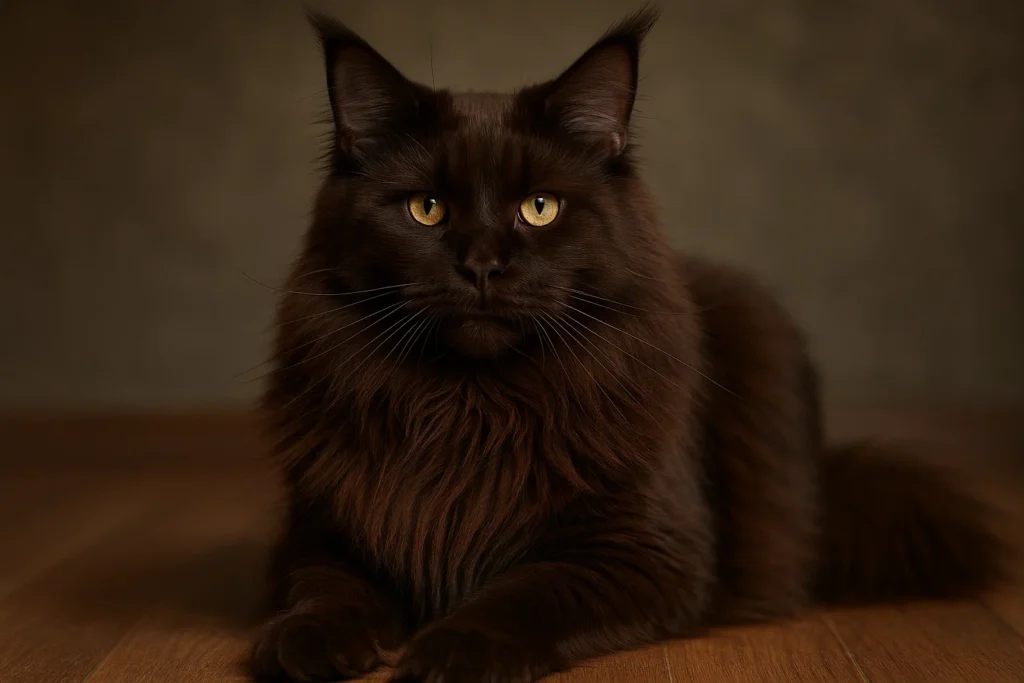
Black smoke Maine Coon with white undercoat revealed showing smoke coat effect
The smoke coat’s secret — a brilliant white undercoat hidden beneath a richly pigmented surface coat, revealed only when the fur moves or is parted.

The table below is your master reference for all major Maine Coon coat combinations. It is organised by colour class, with the base colour, pattern, and inhibitor effect listed for each. Use this alongside the photos in each section to identify any coat you encounter.

Colour Class Base Pigment Pattern Diluted? Inhibitor Active?
Black Solid Black None No No
Blue Solid Black None Yes No
Red (Orange) Solid Red None No No
Cream Solid Red None Yes No
White Solid White (masking gene) None N/A No
Brown Classic Tabby Black Classic No No
Blue Classic Tabby Black Classic Yes No
Silver Classic Tabby Black Classic No Yes
Red (Orange) Tabby Red Any No No
Cream Tabby Red Any Yes No
Brown Mackerel Tabby Black Mackerel No No
Silver Mackerel Tabby Black Mackerel No Yes
Ticked Tabby Any Ticked Varies Varies
Black Smoke Black None No Yes
Blue Smoke Black None Yes Yes
Red Smoke Red None No Yes
Cream Smoke Red None Yes Yes
Black Silver Shaded Black None No Yes (partial)
Chinchilla Silver Black None No Yes (minimal)
Tortoiseshell Black + Red Patchy No No
Blue-Cream Tortie Black + Red Patchy Yes No
Tortie Smoke Black + Red Patchy No Yes
Calico Black + Red + White Patchy No No
Dilute Calico Black + Red + White Patchy Yes No
Bicolour (any base + white) Any Any + White Varies Varies
Tuxedo Black + White Specific bicolour No No
Shaded Gold Warm gold None No Yes (partial)
Chinchilla Gold Warm gold None No Yes (minimal)
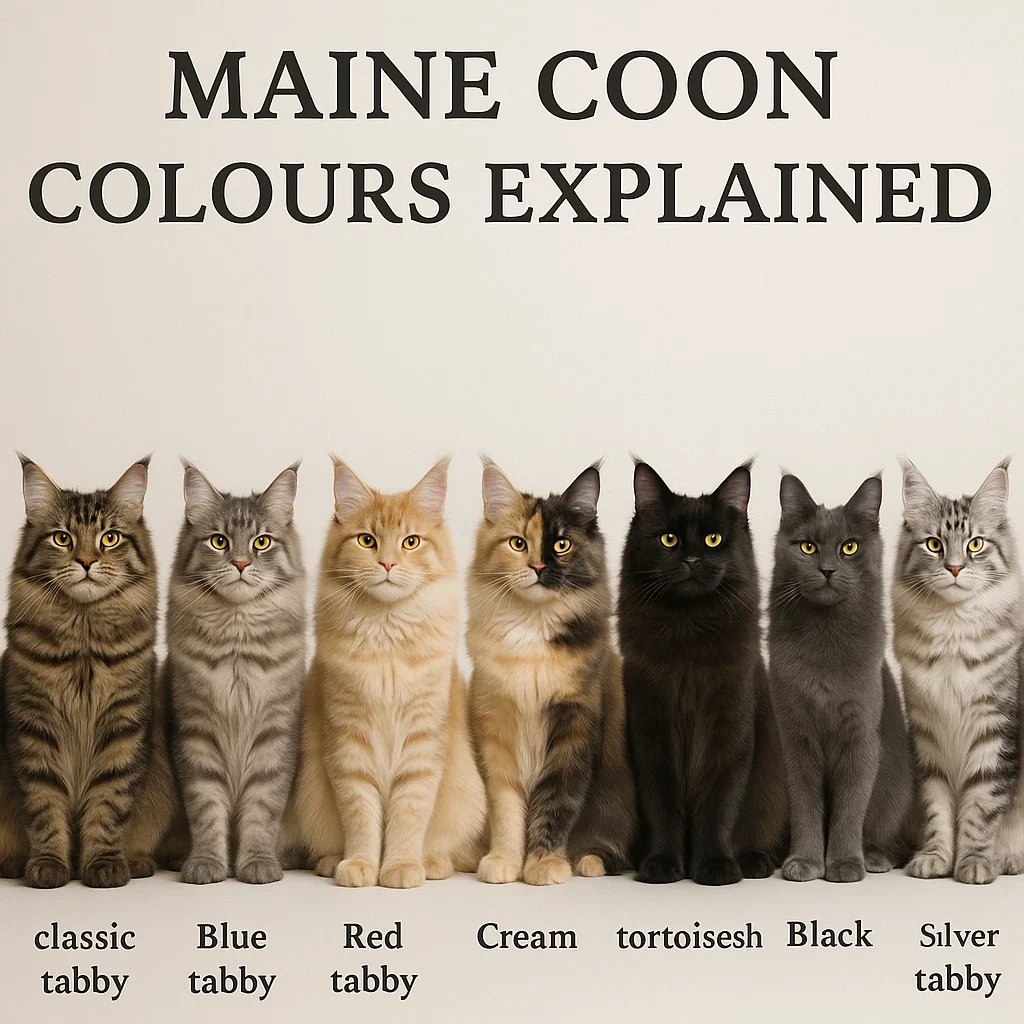
Maine Coon colours complete chart showing 75+ CFA TICA recognised coat combinations
Your visual reference for all major Maine Coon coat combinations — bookmark this chart and use it alongside the photos in each section.

Maine Coon Eye Colours: What to Expect

Chinchilla gold Maine Coon — one of the rarest Maine Coon colour variations
The chinchilla gold — considered the rarest Maine Coon colour — requires the simultaneous expression of the inhibitor gene and specific rufous modifier genes.

Eye colour in Maine Coons is largely independent of coat colour — with one important exception. Most Maine Coons have eyes ranging from gold and green to copper and green-gold. The TICA breed standard accepts all shades of green, gold, and copper, as well as odd-eyes (one eye each of a different colour) in white or bicolour cats (TICA Maine Coon Breed Standard, 2026).

The white coat exception is significant. White Maine Coons — those carrying the dominant white masking gene — can have blue eyes, odd-eyes (one blue, one gold or green), or standard gold/green eyes. Blue-eyed white cats across all breeds carry a higher statistical risk of congenital deafness, particularly in the ear on the same side as the blue eye. Research from the UC Davis Veterinary Genetics Lab confirms this link is associated with the W (dominant white) gene, not the blue eye colour itself.

Odd-eyes in non-white cats are a disqualification in CFA show competition. A black tabby Maine Coon with one blue and one gold eye would be disqualified from the show ring, even though it is a perfectly healthy cat.

Eye Colour Common In Show-Legal?
Gold / Copper All colours Yes
Green / Green-Gold All colours Yes
Blue White cats only Yes (white cats)
Odd-eyes (one blue, one other) White / bicolour cats Yes (white/bicolour)
Odd-eyes (non-white cats) Any coat No — CFA disqualification

Maine Coon Tabby Patterns Explained

Tabby is the default Maine Coon coat. The agouti gene — the gene responsible for creating banded, striped, or ticked hairs — is dominant in the breed, which means that the vast majority of Maine Coons express some form of tabby pattern. Even cats that look solid black may carry hidden tabby “ghost markings” visible in certain lighting. According to the CFA, tabby patterns are among the most frequently entered in Maine Coon show classes, confirming their dominance in the breed (CFA Maine Coon Show Results, 2026).

Understanding the three tabby patterns is simpler than it sounds. Each pattern is just a different way the agouti gene distributes pigment along the hair shaft and across the body.

Classic Tabby: Swirls and Bullseye Markings

The classic tabby — sometimes called the “blotched tabby” — is the most recognisable Maine Coon pattern. Its defining feature is a bold, swirling bullseye marking on each flank, often described as resembling a target or an oyster shell. Additional markings include:

  • Butterfly markings across the shoulders
  • Three distinct stripes running down the spine
  • Solid or broken necklace stripes on the chest
  • Ringed tail with a dark tip
  • The classic “M” marking on the forehead — present in all tabby patterns

The classic pattern is caused by the mc (non-agouti tabby) gene variant at the tabby locus. It requires two copies of the recessive mc gene, meaning both parents must carry it for a kitten to display the classic pattern. Brown classic tabby is the most common expression, but classic can appear in silver, blue, red, cream, and tortie combinations.

Mackerel Tabby: Narrow Parallel Stripes

The mackerel tabby is named for its resemblance to the striped pattern of a mackerel fish. Instead of swirls, this pattern features narrow, parallel vertical stripes running down the sides of the body from the spine. Key identifying features:

  • Thin, parallel stripes on the body (not swirls)
  • Continuous or broken rings on the tail and legs
  • Distinct spine stripe running from neck to tail base
  • The classic “M” forehead marking shared with all tabbies

Mackerel is the dominant tabby pattern — a cat needs only one copy of the mackerel gene (Mc) to display it. This is why mackerel tabbies are slightly more common than classic tabbies in the general cat population, though within Maine Coons, classic is very well represented. Breeders and owners consistently report that silver mackerel tabbies are among the most visually striking Maine Coons, their bright white background making the dark stripes pop dramatically.

Ticked Tabby: The Subtle Pattern

The ticked tabby — also called the Abyssinian tabby — is the most understated of the three patterns. At first glance, a ticked tabby can look almost solid, because the striping occurs at the microscopic level: each individual hair is banded with alternating light and dark pigment zones (called “agouti banding”). The body shows little or no striping, though faint ghost striping on the legs and face is common.

Identifying a ticked tabby requires a close look at the individual hairs. Part the fur and look for the alternating dark-and-light banding on each strand. The ticked pattern is caused by the Ta (ticked agouti) gene variant, which is dominant over both mackerel and classic — meaning a cat with one copy of Ta will display ticking regardless of what other tabby genes it carries.

Common identification mistake: Ticked tabbies are frequently confused with solid-coloured cats, especially in brown and blue tones. The key difference is the agouti banding on individual hairs and the faint leg striping.

Tabby Colour Variations: Brown, Silver, Red, Black & Blue

Each of the three tabby patterns can appear in a wide range of base colours. The combination of pattern plus colour is what creates the full tabby variety you see in Maine Coons. Here are the major tabby colour variations:

Brown Tabby (the most common Maine Coon colour overall)
The base colour is a warm, rich brown with black markings. “Brown” in cat genetics actually means a black base modified by the agouti gene — the warm brown tone comes from the interaction of black pigment with banded hairs. This is the iconic Maine Coon look: a large, rugged cat with rich, contrasting markings.

Silver Tabby (among the most popular with owners and breeders)
The inhibitor gene is active, blocking pigment at the hair root and creating a bright silver-white base. The markings remain black (or blue in blue silver), producing high contrast. Silver tabby Maine Coons have a striking, almost metallic appearance. The keyword “silver tabby maine coon” registers approximately 1,000 monthly searches, reflecting their popularity.

Red (Orange) Tabby
Red tabbies carry the O (orange) gene on the X chromosome, which converts all black/brown pigment to red-orange. All red Maine Coons are technically tabbies — even those that look solid — because the agouti gene always shows through on the red pigment pathway. Red tabbies range from pale ginger to deep, vivid orange.

Blue Tabby
A diluted version of the brown tabby, where the black pigment is genetically “watered down” to a soft grey-blue. The markings appear as deeper blue-grey on a pale blue-grey base. Blue tabbies have a softer, more muted look than brown tabbies.

Cream Tabby
The diluted version of red tabby. Cream tabbies are pale, warm ivory with faint buff or apricot markings. The contrast is subtle compared to brown or silver tabbies, giving cream tabbies a delicate, pastel appearance — sometimes called the pastel gene effect by breeders.

Tabby Colour Base Pigment Diluted? Inhibitor Active?
Brown Tabby Black No No
Blue Tabby Black Yes No
Silver Tabby Black No Yes
Blue Silver Tabby Black Yes Yes
Red (Orange) Tabby Red No No
Cream Tabby Red Yes No
Red Silver Tabby Red No Yes

Smoke and Silver Maine Coon Coats

Smoke and silver coats are the most visually dramatic Maine Coon colours — and also the most frequently misidentified. The key to understanding them is one gene: the inhibitor gene (also called the I gene or silver gene). According to research from the UC Davis Veterinary Genetics Lab, the inhibitor gene works by suppressing phaeomelanin (the yellow-red pigment) production at the base of each hair, creating the characteristic light root that defines smoke and silver coats (UC Davis Veterinary Genetics Lab, 2026).

Maine Coon silver coats represent some of the most searched-for colour types, with “blue smoke maine coon” drawing approximately 1,600 monthly searches and “silver tabby maine coon” around 1,000 — both significantly higher than most other colour searches.

What Is a Smoke Maine Coon?

A smoke Maine Coon is a cat that looks solid at rest but reveals a dramatic white or silver undercoat when the fur is parted or moves. This dual-layer effect is entirely caused by the inhibitor gene. Here is exactly how it works:

  1. At the hair root: The inhibitor gene blocks pigment production, leaving the base of each hair unpigmented (white or very pale).
  2. Moving toward the tip: Pigment production gradually resumes, producing a fully pigmented tip.
  3. The result: Each hair is white at the root and fully coloured at the tip — the opposite of what you might expect.
  4. At rest: The pigmented tips lie on top, making the cat look solid.
  5. In motion or when touched: The white roots are revealed, creating the characteristic “smoke” flash.

Common identification mistake: Black smoke Maine Coons are frequently mistaken for solid black cats, especially in photographs. The tell-tale sign is the white “ruff” (neck fur) and the silver flash when the coat moves. Kittens are often born looking solid and develop the smoke effect over their first few months as the inhibitor gene fully expresses.

Smoke Variations: Black Smoke, Blue Smoke & Red Smoke

Every solid base colour can combine with the inhibitor gene to produce a smoke variant. Here are the most recognised smoke colours in Maine Coons:

Black Smoke
The most dramatic smoke variation. The base colour is black, so the contrast between the jet-black tips and the white roots is maximum. Black smoke Maine Coons have a rich, mysterious appearance — their coats seem to shimmer and shift in the light. This is one of the most visually stunning and sought-after Maine Coon colours.

Blue Smoke
Blue smoke is the diluted version of black smoke. The base colour is blue (diluted black), producing a softer, more ethereal look. The tips are a soft grey-blue, fading to a white root. Blue smoke Maine Coons have an almost ghostly, silver-mist appearance. With approximately 1,600 monthly searches, blue smoke is one of the most actively sought Maine Coon colours.

Red Smoke (Cameo)
Red smoke — also called cameo — has a red (orange) base colour with the inhibitor gene active. The tips are vivid orange-red, fading to a white root. Red smoke cats have a warm, fiery shimmer. Because the inhibitor gene interacts differently with red pigment than with black, red smoke cats often show more visible tipping variation than black smokes.

Cream Smoke
The diluted version of red smoke. Cream smoke cats have pale ivory-cream tips over a white root — the most subtle of the smoke variations. The effect is a soft, almost luminous coat with very gentle contrast.

Tortoiseshell Smoke
A tortie smoke combines the tortoiseshell pattern (mixed black and red patches) with the inhibitor gene. Both the black and red areas show the smoke effect, producing a complex, multi-layered coat. This is one of the rarer smoke variations and is, again, almost exclusively seen in female cats.

Smoke Colour Base Diluted? Appearance
Black Smoke Black No Jet-black tips, white roots
Blue Smoke Black Yes Blue-grey tips, white roots
Red Smoke (Cameo) Red No Orange-red tips, white roots
Cream Smoke Red Yes Pale cream tips, white roots
Tortie Smoke Black + Red No Mixed black/red tips, white roots
Blue-Cream Smoke Black + Red Yes Blue/cream tips, white roots

Silver, Shaded & Chinchilla: Understanding the Spectrum

Smoke, shaded, and chinchilla are not three separate phenomena — they are three points on a single spectrum controlled by how much of the hair shaft the inhibitor gene affects.

Think of it as a sliding scale:

  • Smoke: The inhibitor affects only the bottom portion of the hair (roughly the bottom quarter to half). Most of the hair is pigmented.
  • Shaded: The inhibitor affects the bottom half to two-thirds of the hair. The top third to half is pigmented, creating a more even, “dusted” effect.
  • Chinchilla: The inhibitor affects most of the hair shaft, leaving only the very tip — roughly the top eighth — pigmented. The result is an almost white cat with just a sparkling edge of colour.

Silver Shaded Maine Coon
A silver shaded cat has black tips on a white ground, with the tipping covering approximately one-third to one-half of each hair. The overall appearance is a bright silver coat with a subtle dark overlay. Silver shaded Maine Coons are striking and elegant — less dramatic than black smoke but more distinctive than chinchilla.

Chinchilla Silver Maine Coon
The chinchilla is the palest of the silver series. Only the very tips of the hairs carry black pigment, giving the coat a sparkling, almost diamond-like quality. The face, legs, and tail show slightly more tipping than the body. Chinchilla Maine Coons are among the rarest and most expensive colour variations.

Blue Silver Shaded
The same as silver shaded, but with a diluted (blue) base instead of black. The tips are soft grey-blue on a white ground. Blue silver shaded Maine Coons have a particularly delicate, cool-toned appearance.

Shaded Gold and Chinchilla Gold
These are the warm-toned counterparts of the silver series. Instead of a white ground coat, gold-series cats have a warm, apricot-to-golden ground coat. The inhibitor gene is still active, but it interacts with the rufous (reddish-brown) modifier genes to produce warm gold tones rather than cool silver. Shaded gold and chinchilla gold Maine Coons are exceptionally rare and highly prized.

Solid, Calico & Bicolour Maine Coons

Solid black Maine Coon with uniform jet-black coat and gold eyes
A true solid black Maine Coon — uniform jet-black from root to tip with no tabby ghost markings, a majestic panther-like presence.

Solid, calico, and bicolour Maine Coons represent three very different genetic mechanisms — but they share one thing in common: they are among the most visually straightforward coats to identify. According to the Petful Maine Coon breed guide, solid and bicolour cats make up a significant portion of Maine Coons in pet homes, even if they are less frequently shown than tabbies and smokes (Petful, 2026).

The Colour Spectrum Framework helps here too: solid cats have no active Pattern Modifier and no Inhibitor Effect — just Base Pigment, with or without Dilution.

Solid Colour Maine Coons: Black, White, Blue, Red & Cream

A solid Maine Coon has a single, continuous colour from root to tip, with no striping, shading, or white patches. For a cat to be truly solid, it must carry two copies of the non-agouti gene (aa), which suppresses the tabby pattern entirely.

Solid Black
A true solid black Maine Coon has jet-black fur from root to tip with no rusting, browning, or white hairs. In practice, many black Maine Coons show slight reddish “rusting” in sunlight — this is a normal pigment oxidation effect and does not disqualify the cat from the show ring unless it is severe. Black Maine Coons have a majestic, panther-like appearance that is beloved by many owners. You can discover facts about Black Maine Coons to see why this panther-like look is so highly prized.

Solid White
White is genetically unique — it is not a colour at all, but the result of a dominant masking gene (W) that suppresses all colour expression in the coat. A white Maine Coon can carry any underlying colour genetically and may pass coloured kittens to offspring. White Maine Coons are striking, with their flowing, all-white coats and typically gold, green, blue, or odd-coloured eyes.

Solid Blue
Blue is the diluted form of black — a soft, even grey with a blue-ish cast. Solid blue Maine Coons have a uniform, cool-toned coat that is both elegant and distinctive. Blue is one of the most popular solid colours in the breed.

Solid Red (Orange)
Solid red Maine Coons are a deep, vivid orange-red. As noted earlier, true genetic solids are rare in red cats because the agouti pathway always expresses in red pigment — most “solid” reds will show faint ghost tabby markings. However, cats with very dense, even red colouring are shown and registered as solid red.

Solid Cream
The diluted form of red. Cream Maine Coons have a pale, warm ivory coat. Like red cats, truly solid cream cats may show faint ghost markings, but the overall impression is of a single, pale colour.

Tortoiseshell and Torbie: Two Different Things

Tortoiseshell (tortie) and torbie are two of the most frequently confused Maine Coon colour terms — even among experienced owners. Here is the clear distinction:

  • Tortoiseshell (Tortie): A cat with only black (or blue) and red (or cream) patches — no tabby striping visible. The two colours are intermingled in a mosaic or patchy pattern.
  • Torbie (Tortoiseshell Tabby): A tortoiseshell cat that also expresses a tabby pattern. In a torbie, the black patches show tabby striping or swirls, while the red patches may also show tabby markings. Also called a “patched tabby.”

The torbie pattern is actually more common than a true tortoiseshell in Maine Coons, because the agouti gene is dominant in the breed — most tortie Maine Coons will also express tabby markings, making them torbies.

Pattern Colours Present Tabby Markings? White Present?
Tortoiseshell Black + Red No No
Torbie Black + Red Yes No
Calico Black + Red + White No Yes
Patched Tabby (Torbie) Black + Red + White Yes Sometimes

Calico Maine Coons: Three Colours in One Coat

Calico is one of the most visually striking and genetically fascinating Maine Coon patterns. To truly understand Calico Maine Coon genetics, you have to look at the X chromosome. A calico cat has three distinct colour zones: white, black (or blue in dilute calico), and red (or cream in dilute calico). The white areas are produced by the piebald white spotting gene (S), while the black and red patches are the result of the same X-linked tortoiseshell gene mechanism.

“Calico maine coon” is one of the highest-volume searches in this topic area, with approximately 5,400 monthly searches — reflecting how beloved and sought-after this pattern is.

Why are calicos almost always female? The red (orange) gene is carried on the X chromosome. For a cat to show both black and red patches, it needs two X chromosomes — one carrying the black gene and one carrying the red gene. Female cats (XX) can carry both. Male cats (XY) typically have only one X chromosome, so they express either black or red, not both. A male calico would need an XXY chromosomal abnormality — an extremely rare event.

Dilute calico replaces the black with blue (diluted black) and the red with cream (diluted red), producing a softer, pastel version of the classic calico. Dilute calicos are equally beautiful but have a gentler, more muted colour palette.

Are calico and tortoiseshell the same thing?

No — calico and tortoiseshell are distinct patterns. A tortoiseshell (tortie) has black and red patches only, with no white. A calico has black, red, and white patches — the white is added by a separate piebald gene. Additionally, a torbie is a tortoiseshell that also expresses a tabby pattern — the black areas show stripes or swirls. All three patterns are almost exclusively female, because the red gene is X-linked and females (XX) are the only ones who can carry both black and red simultaneously.

Bicolour and Tuxedo Maine Coons

A bicolour Maine Coon is any cat that combines a base colour (or pattern) with white patches. The white is produced by the white spotting gene (S), which is separate from the dominant white masking gene. The amount of white varies widely — from a small white chest spot to a cat that is mostly white with a few coloured patches.

Tuxedo is a specific bicolour pattern where the white is concentrated on the chest, belly, paws, and sometimes the chin — creating the impression of a cat wearing formal wear. Tuxedo Maine Coons are typically black and white, though the same pattern can occur in blue-and-white or tabby-and-white combinations.

Van pattern is an extreme bicolour where the cat is almost entirely white, with colour restricted to the head and tail. Van-patterned Maine Coons are striking but relatively uncommon.

The TICA breed standard accepts bicolour Maine Coons in any combination of white with any recognised colour or pattern, provided the coloured areas meet the standard for that colour (TICA Maine Coon Breed Standard, 2026).

Rare vs. Common Maine Coon Colours

Not all Maine Coon colours are equally easy to find. Some — like brown classic tabby — appear in virtually every litter. Others — like solid gold or chinchilla gold — may require a year or more on a breeder’s waiting list. Understanding the rarity spectrum helps you set realistic expectations when searching for a specific colour. Across Maine Coon breeder communities, the consensus is that rarity is driven primarily by the number of genes that must align simultaneously to produce a given coat — the more genes required, the rarer the result.

The Most Common Maine Coon Colour

Brown classic tabby is the most common Maine Coon colour — and by a wide margin. The reasons are genetic: the agouti gene (which produces tabby patterns) is dominant in the breed, and the black base pigment is the most prevalent. The classic tabby pattern, while recessive to mackerel, is so well-established in Maine Coon genetics that it appears consistently across generations.

Brown mackerel tabby is a close second. Together, brown classic and brown mackerel tabbies account for a large majority of Maine Coons in pet homes and at shows. If you attend a CFA Maine Coon show, you will notice that the brown tabby class is almost always the largest.

Silver tabby is the third most common colour, driven by the relatively high frequency of the inhibitor gene in the breed — a legacy of the Maine Coon’s New England working cat heritage, where silver-coated cats were not selectively bred against.

  • Common colours (most to least frequent):
  • Brown classic tabby
  • Brown mackerel tabby
  • Silver (classic or mackerel) tabby
  • Red (orange) tabby
  • Blue tabby
  • Black solid
  • Blue solid

The Rarest Maine Coon Colours

Rarity in Maine Coon colours is determined by two factors: the number of specific gene combinations required, and how actively breeders select for that colour. Some colours are rare because the genetics are complex; others are rare because few breeders prioritise them.

The rarest Maine Coon colours include:

1. Solid Gold and Shaded Gold
Gold colouring requires the inhibitor gene plus specific rufous modifier genes that produce warm, golden tones rather than cool silver. Breeding consistently for gold is notoriously difficult, and true solid gold or shaded gold Maine Coons are exceptionally uncommon. When they do appear, they have a warm, almost honey-coloured glow that is unlike any other coat.

2. Chinchilla (Silver and Gold)
Chinchilla requires the inhibitor gene to express at maximum intensity — only the very tips of the hairs are pigmented. Breeding for true chinchilla colouring (as opposed to shaded, which is more common) requires careful selection over multiple generations. Chinchilla gold is considered the rarest of the rare.

3. Smoke Tortoiseshell
Combining the tortoiseshell pattern with the smoke effect requires the cat to carry the tortoiseshell gene, the inhibitor gene, and the non-agouti gene simultaneously. This multi-gene requirement makes smoke torties relatively uncommon.

4. Male Tortoiseshell and Male Calico
As explained in the genetics section, male tortoiseshells and calicos require a chromosomal abnormality (XXY) and are extremely rare — estimated at fewer than 1 in 3,000 tortoiseshell cats. They are almost always sterile.

5. Solid White
While not genetically complex, solid white Maine Coons are relatively uncommon in breeding programmes because the dominant white gene masks the underlying colour, making it difficult to predict offspring colours.

Maine Coon Colour Rarity Chart

Rarity Tier Colours Typical Wait (from reputable breeder)
Very Common Brown tabby, silver tabby, red tabby Available most litters
Common Blue tabby, black solid, blue solid, cream tabby 3–6 months
Uncommon Black smoke, blue smoke, tortoiseshell, calico 6–12 months
Rare Silver shaded, chinchilla silver, smoke tortie 12–18 months
Very Rare Solid gold, shaded gold, chinchilla gold 18+ months
Exceptionally Rare Male tortoiseshell, male calico Unpredictable

The Genetics Behind Maine Coon Coat Colours

Genetics is the engine behind every Maine Coon colour you have seen in this guide. You do not need a biology degree to understand the basics — just four key genes, and the Colour Spectrum Framework’s four axes each map directly to one of them. This section explains each gene in plain English, with a focus on why it matters for identifying and breeding Maine Coons.

According to the Maine Coon Cat Club, understanding coat genetics is increasingly important for responsible breeding — particularly for avoiding unintentional introduction of the colourpoint gene, which is a disqualifying trait in show competition (Maine Coon Cat Club, 2026).

The Agouti Gene: Why Most Maine Coons Are Tabbies

The agouti gene — the gene that controls whether a cat expresses a tabby pattern — is the single most important gene for understanding Maine Coon colouring. Here is how it works:

  • The agouti gene has two variants:
  • **A (dominant agouti):** The tabby pattern IS expressed. Each hair is banded with alternating light and dark pigment zones. This is why you see stripes, swirls, or ticking.
  • **a (recessive non-agouti):** The tabby pattern is SUPPRESSED. Each hair is uniformly pigmented from root to tip, producing a solid-coloured cat.

Why are most Maine Coons tabbies? Because the A (agouti) variant is dominant — a cat needs only one copy of it to display a tabby pattern. For a cat to be truly solid, it must inherit the recessive a variant from both parents. Since the Maine Coon gene pool has a high frequency of the A variant, solid cats are less common than tabbies.

The tabby pattern subtype (classic, mackerel, or ticked) is controlled by a separate gene locus (the T locus), but the agouti gene must be active for any tabby pattern to show at all.

The Inhibitor Gene: How Smoke and Silver Coats Form

The inhibitor gene (also written as the I gene, or the silver/smoke gene) is the gene responsible for all smoke, shaded, and chinchilla coats. It works by blocking phaeomelanin (yellow-red pigment) production in the lower portion of the hair shaft.

Step-by-step: how the inhibitor gene creates a smoke coat:

  1. A kitten inherits at least one copy of the dominant I gene.
  2. As each hair grows, the I gene suppresses pigment production near the hair root.
  3. Pigment production resumes further up the hair shaft.
  4. The result: a hair that is pale or white at the base and fully pigmented at the tip.
  5. The extent of the suppression determines whether the cat is smoke (minimal suppression), shaded (moderate), or chinchilla (maximum suppression).

Important note: The inhibitor gene is dominant — one copy is enough to produce the smoke/silver effect. This is why the inhibitor gene appears relatively frequently in Maine Coon breeding lines.

Smoke vs. silver tabbies: When the inhibitor gene is active in a cat that also expresses the agouti gene (tabby), the result is a silver tabby — a cat with a bright silver-white ground colour and full tabby markings. When the inhibitor gene is active in a non-agouti (solid) cat, the result is a smoke.

The Dilute Gene: From Black to Blue, Red to Cream

The dilute gene (written as the d gene) is the gene that “waters down” the intensity of the base pigment. It is a simple recessive gene — a cat must inherit two copies (dd) to display a diluted colour.

What the dilute gene does to each base colour:

Full Colour Diluted Colour Visual Change
Black Blue Jet black → soft grey-blue
Red (Orange) Cream Vivid orange → pale ivory
Chocolate Lilac Rich brown → pale lavender-grey
Cinnamon Fawn Warm red-brown → pale buff

Why does dilution happen? The dilute gene causes the pigment granules in the hair to be unevenly distributed — instead of packing tightly together to create a dense colour, they spread out in clumps, scattering light differently and making the colour appear lighter and softer.

Dilute calico and blue-cream are the most common expressions of the dilute gene in tortoiseshell and calico patterns. A dilute calico replaces the black patches with blue and the red patches with cream, creating a soft, pastel version of the classic calico.

Disqualified Colours: Pointed, Chocolate & Lilac

Not every colour you might see in a Maine Coon is accepted for show competition. The CFA breed standard explicitly disqualifies three colour types from Maine Coon competition — and understanding why they are disqualified reveals important information about the breed’s genetic heritage.

1. Pointed (Colourpoint) Pattern
Pointed colouring — where the face, ears, paws, and tail are darker than the body, as seen in Siamese cats — is caused by the cs (colourpoint) gene. This gene is temperature-sensitive: it produces pigment only in the cooler extremities of the body.

The CFA and TICA both disqualify pointed Maine Coons from show competition because the colourpoint gene is not considered part of the Maine Coon’s natural genetic heritage. Its presence in a Maine Coon line typically indicates an undisclosed outcross with a pointed breed at some point in the pedigree. Pointed Maine Coons are sometimes marketed as “Lynx Point” or “Siberian Point” Maine Coons, but they cannot be shown under CFA or TICA rules.

2. Chocolate
Chocolate is a brown colour caused by the b gene, which modifies black pigment to a warm, milk-chocolate brown. The CFA does not recognise chocolate in Maine Coons because it is not part of the breed’s established colour palette — its presence again suggests an undisclosed outcross.

3. Lilac
Lilac is the diluted form of chocolate — a pale, cool lavender-grey. Because it requires both the chocolate gene (bb) and the dilute gene (dd), lilac is a double-recessive colour. Like chocolate, it is disqualified by the CFA for Maine Coons.

Practical implication for buyers: If a breeder is selling “chocolate Maine Coons” or “pointed Maine Coons” and claiming they are show-quality, this is a red flag. These cats may be perfectly healthy and beautiful pets, but they cannot be shown under CFA or TICA rules, and their pedigree integrity may be questionable.

What colours are disqualified in Maine Coon shows?

Pointed (Siamese-style), chocolate, and lilac colouring are disqualified from CFA Maine Coon show competition. The colourpoint gene, chocolate gene, and their combinations are not considered part of the Maine Coon’s natural genetic heritage. Their presence in a pedigree typically indicates an undisclosed outcross with another breed. Odd-eyes (one blue, one other colour) are also disqualified in non-white cats. These cats make perfectly healthy pets but cannot compete in CFA or TICA breed shows.

Does Colour Affect Maine Coon Price?

The short answer is yes — but colour is rarely the primary price driver. Maine Coon kitten prices from reputable breeders typically range from $1,000 to $2,500 in the United States and £800 to £2,000 in the UK, regardless of colour. However, rare and visually striking colours do command a premium, and understanding the colour-price relationship helps you budget realistically for the kitten you want. The SassyKoonz breeding programme notes that colour rarity is one of the most common questions from prospective buyers — and that price differences by colour are real but often smaller than buyers expect (SassyKoonz, 2026).

Price Ranges by Coat Colour

The following price ranges reflect typical asking prices from reputable, TICA- or CFA-registered breeders in the US and UK as of Q1 2026. Prices vary by region, breeder reputation, pedigree, and whether the kitten is sold as a pet or show/breeding quality.

Colour Pet Quality (US) Show/Breeding Quality (US) Relative Demand
Brown tabby (classic/mackerel) $1,000–$1,500 $1,500–$2,000 High (very common)
Silver tabby $1,200–$1,800 $1,800–$2,500 Very High
Red (orange) tabby $1,000–$1,500 $1,500–$2,000 High
Blue tabby $1,100–$1,600 $1,600–$2,200 Moderate
Black solid $1,000–$1,500 $1,500–$2,000 Moderate
Blue solid $1,100–$1,600 $1,600–$2,200 Moderate
Black smoke $1,500–$2,200 $2,000–$3,000 Very High
Blue smoke $1,500–$2,200 $2,000–$3,000 Very High
Silver shaded $1,800–$2,500 $2,500–$3,500 High
Chinchilla silver $2,000–$3,000 $3,000–$4,500 High (rare)
Solid gold / shaded gold $2,000–$3,500 $3,000–$5,000 Very High (very rare)
Tortoiseshell / calico $1,200–$1,800 $1,800–$2,500 High

Prices as of Q1 2026. Always verify current pricing directly with registered breeders, as market rates fluctuate.

Why do black smoke and silver command higher prices? Two reasons: visual appeal drives demand, and breeding for these colours requires more careful selection. A smoke Maine Coon must carry the inhibitor gene, which requires deliberate pairing — breeders cannot simply put any two cats together and reliably produce smoke kittens.

What Really Determines a Maine Coon’s Price

While colour plays a role, several factors matter more than coat colour when it comes to price:

1. Breeder Reputation and Registration
A kitten from a TICA- or CFA-registered cattery with health-tested parents (HCM — hypertrophic cardiomyopathy — screening is standard in responsible Maine Coon breeding) will always cost more than an unregistered kitten, regardless of colour. The Litter-Robot Maine Coon breed guide emphasises that health testing and registration are the most important quality indicators for buyers (Litter-Robot, 2026).

2. Pedigree Quality
Kittens from champion-line parents command a significant premium. A brown tabby kitten from a Grand Champion bloodline will typically cost more than a gold kitten from an unproven line.

3. Pet vs. Show/Breeding Quality
Breeders typically sell kittens in two tiers: pet quality (sold with a spay/neuter contract) and show/breeding quality (sold without a neuter contract, at a higher price). The same colour kitten can vary by $500–$1,500 depending on which tier it falls into.

4. Geographic Location
Prices are higher in major metropolitan areas and in countries where Maine Coons are less common. A kitten that costs $1,500 in the US might cost the equivalent of $2,500 in Australia or New Zealand due to importation and scarcity.

5. Gender
Female kittens in breeding-quality tiers tend to cost more than males, because breeders value females for their reproductive potential. In pet-quality tiers, the price difference is typically small.

Frequently Asked Questions

What is the prettiest Maine Coon colour?

Beauty is subjective, but silver tabby and black smoke are consistently cited as the most visually striking Maine Coon colours across breeder communities and online owner forums. Silver tabbies offer maximum contrast — crisp black markings on a bright silver-white ground — while black smoke cats have an almost magical quality, appearing solid at rest and revealing a brilliant white undercoat when they move. Shaded gold and chinchilla gold are increasingly popular for their warm, jewel-like appearance. Ultimately, the “prettiest” colour is the one that makes your heart skip — and with 75+ options, you are spoiled for choice.

What is the rarest Maine Coon colour?

Solid gold and chinchilla gold are widely considered the rarest Maine Coon colours. They require the simultaneous expression of the inhibitor gene and specific rufous (warm-toned) modifier genes, making consistent breeding extremely difficult. Shaded gold is nearly as rare. Among non-gold colours, male tortoiseshell and male calico are exceptionally rare — occurring due to a chromosomal abnormality (XXY) estimated at fewer than 1 in 3,000 tortoiseshell cats. Expect waiting lists of 18 months or more for gold-series kittens from reputable breeders.

What is the most common Maine Coon colour?

Brown classic tabby is the most common Maine Coon colour, followed closely by brown mackerel tabby and silver tabby. The dominance of the agouti gene in the breed means that tabby patterns appear in the majority of litters, and the black base pigment is the most prevalent. At any CFA or TICA show, the brown tabby class is typically the largest and most competitive.

What is a smoke Maine Coon?

A smoke Maine Coon is a cat that appears solid-coloured at rest but reveals a dramatic white or silver undercoat when the fur is parted. This effect is caused by the inhibitor gene (I), which blocks pigment production at the base of each hair shaft. The hair is white at the root and fully pigmented at the tip. Black smoke is the most dramatic variety — the contrast between jet-black tips and white roots is maximum. Smoke cats are often mistaken for solid cats, especially in photographs.

Do Maine Coons like to sleep with you?

Yes — Maine Coons are known for being affectionate, sociable cats that frequently seek out their owners for companionship, including at night. They are often described as “dog-like” in their loyalty and attachment to their human families. However, individual personality varies: some Maine Coons prefer sleeping nearby rather than on top of you. Their large size means they take up considerable bed space, which owners either adore or find challenging. Their thick, semi-water-repellent coats make them particularly warm and comforting bed companions.

What is the biggest house cat?

The Maine Coon is widely recognised as the largest domestic cat breed, with adult males typically weighing 5.9–8.2 kg (13–18 lbs) and reaching up to 100 cm (40 inches) in body length including tail. The record for the longest domestic cat ever recorded was held by a Maine Coon named Stewie, who measured 123 cm (48.5 inches) according to Guinness World Records. The Norwegian Forest Cat is sometimes cited as a comparable size, but the Maine Coon generally edges it out in both length and overall mass.

Limitations and Expert Help

Common Identification Pitfalls

Even experienced Maine Coon owners make identification errors. Here are the most frequent mistakes and how to avoid them:

Pitfall 1: Confusing smoke with solid
At rest, a black smoke Maine Coon and a solid black Maine Coon can look nearly identical in photographs. The tell-tale signs of smoke are the silver or white ruff (neck fur), the lighter-coloured undercoat visible at the flanks, and the shimmering quality of the coat in motion. If in doubt, part the fur at the base of the neck — a smoke cat will show a distinctly white or pale root zone.

Pitfall 2: Calling every striped cat a “mackerel tabby”
Many owners default to “mackerel” for any tabby with stripes. Classic tabbies have swirling, blotched markings — not parallel stripes. Look at the flank: a classic tabby will have a bullseye or oyster-shell swirl, while a mackerel will have thin, roughly parallel vertical stripes. Ticked tabbies may show faint leg stripes but have no body striping at all.

Pitfall 3: Misidentifying torbie as tortoiseshell
True tortoiseshells have solid (non-tabby) black and red patches. Most Maine Coon “torties” are actually torbies — the dominant agouti gene means the black patches almost always show tabby striping. Look closely at the dark areas: if you see any striping or swirling, the cat is a torbie, not a pure tortoiseshell.

Pitfall 4: Assuming all white cats are albino
White Maine Coons are not albino. Albinism is caused by a complete absence of melanin production and results in pink or very pale blue eyes. A white Maine Coon’s white coat is caused by the dominant white masking gene (W) — the cat carries full colour genetics underneath. True albino cats are extremely rare in any domestic breed.

When to Choose a Different Resource

This guide covers coat colour identification and genetics comprehensively. However, for the following topics, specialised resources will serve you better:

  • Health genetic testing (HCM, SMA, PKD): Consult the UC Davis Veterinary Genetics Lab or your veterinarian for breed-specific health screening panels.
  • Breeding programme planning: The CFA and TICA both offer breeder mentorship programmes and detailed colour genetics resources for registered breeders.
  • Pedigree verification: For questions about whether a specific cat’s colour is consistent with its claimed pedigree, a DNA colour test (available through UC Davis and Wisdom Panel) is the definitive answer.

When to Seek Expert Help

If you are purchasing a Maine Coon specifically for show competition, consult a CFA- or TICA-registered judge or a mentor breeder before committing to a kitten. Colour assessment for show purposes requires in-person evaluation under show lighting — photographs can be misleading, especially for smoke, shaded, and silver cats where subtle tipping levels determine the colour class.

Conclusion

Maine Coon coat colours span an extraordinary range — from the familiar warmth of a brown classic tabby to the ethereal shimmer of a chinchilla gold, and from the dramatic flash of a black smoke to the three-colour artistry of a calico. With 75+ officially recognised CFA/TICA combinations, the variety can feel overwhelming at first. But through the Colour Spectrum Framework — Base Pigment, Pattern Modifier, Dilution, and Inhibitor Effect — every coat you encounter becomes a logical, decodable combination of just four variables.

The framework matters beyond identification. Understanding that a “blue smoke” is simply a diluted-black base with an active inhibitor gene, or that a “torbie” is just a tortoiseshell with the agouti gene switched on, transforms the entire colour list from a confusing catalogue into a coherent system. Across Maine Coon breeder communities, the consensus is clear: owners who understand the genetics behind their cat’s colour develop a deeper appreciation for the breed’s extraordinary diversity — and make better-informed decisions when choosing a kitten.

Your next step is simple: use the colour chart and photo galleries in this guide to identify your own cat’s coat, or to narrow down the colour you want in your next kitten. If you are ready to find a reputable breeder, look for CFA or TICA registration, ask specifically about HCM health testing, and do not hesitate to join a Maine Coon owner community — the collective knowledge of breeders and enthusiasts is one of the best resources available. The perfect Maine Coon colour is waiting for you.

Written by

Dave King

Cat owner and writer at Mad Cat Man.

Keep reading

Related guides.