
⚕️ Medical Disclaimer: This article is for informational purposes only and does not constitute veterinary medical advice. Always consult a licensed veterinarian for an accurate diagnosis and care plan for your cat.
✅ Vet-Reviewed: July 2026 | Reviewed by a licensed veterinarian, DVM
“This is Potato, she is roughly 11 months old… Last week she had escaped from the house, and now I’m not sure if she’s pregnant or just getting fat.”
— Concerned cat owner, r/cats
If that sounds like your situation right now, you’re not alone — and you’re asking exactly the right question. Spotting the signs my cat is pregnant early makes a real difference for her health and yours.
Miss the early signs and you could be caught completely unprepared — no nesting box, the wrong food, and no vet appointment booked — when labor arrives in a matter of weeks. The good news? There’s a clear, vet-approved way to assess what’s happening.
By the end of this guide, you’ll know exactly what to look for, when to look for it, and what to do next — even if you’ve never dealt with a pregnant cat before. We’ll walk through the physical and behavioral signs, a week-by-week timeline, safe at-home checks, and what to do once you’re sure.
The most common signs your cat is pregnant include enlarged, pinker nipples (called “pinking up”) around week three, a gradual increase in appetite, a swollen abdomen, and behavioral changes like increased affection or nesting. A cat’s pregnancy lasts approximately 63–65 days (about 9 weeks). If you notice these signs, schedule a vet appointment for confirmation.
A pregnant cat typically shows signs within 3 weeks of conception — pinking up (enlarged, darker nipples) is usually the first visible clue. Cat pregnancies last 63–65 days on average (VCA Animal Hospitals).
- Physical signs appear first: Enlarged nipples (week 3), weight gain (week 4–5), swollen belly (week 5+)
- Behavioral shifts follow: Increased affection, reduced appetite early on, nesting behavior around week 7
- Use the 3-Signal Confirmation Method: Assess physical changes + behavioral shifts + timeline markers together before concluding pregnancy
- Never press her belly: At-home palpation risks harming the kittens — observe only
- Vet confirmation is essential: Ultrasound can detect pregnancy as early as day 14–15 (LSU Veterinary Medicine)
What Are the Early Signs a Cat Is Pregnant?
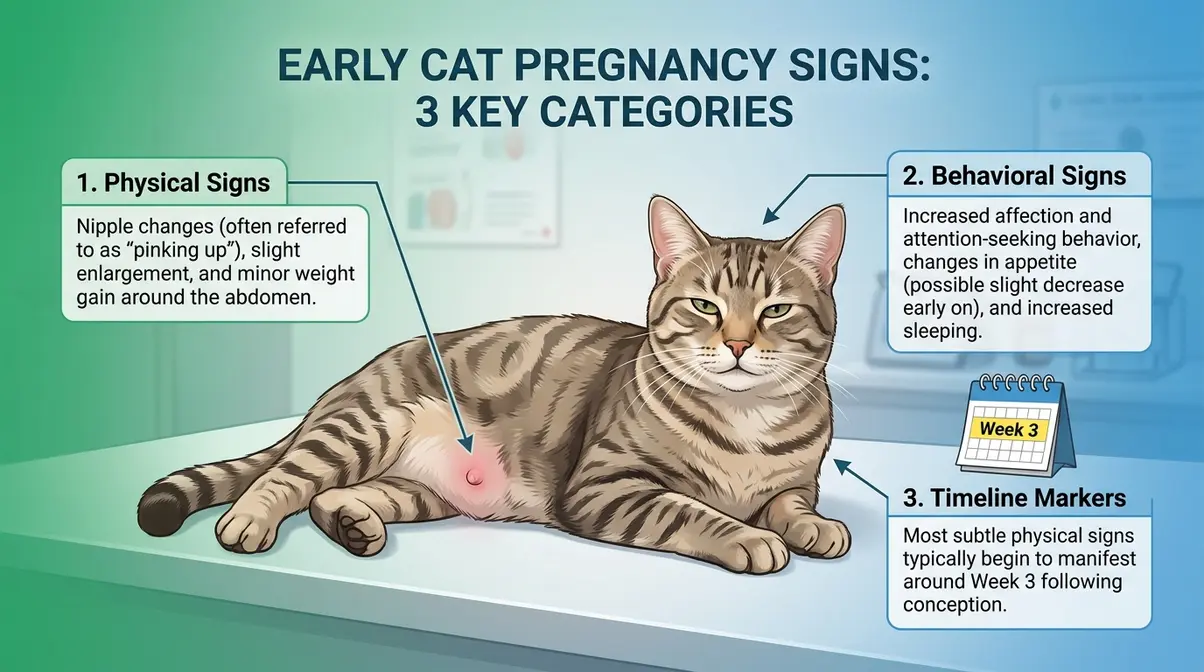
The early signs a cat is pregnant fall into three categories: physical changes, behavioral shifts, and timeline markers. According to VCA Animal Hospitals, the first visible sign — nipple enlargement and pinking up — typically appears around week three of a 63-to-65-day gestation period. No single sign is definitive on its own. That’s exactly why the 3-Signal Confirmation Method works: you assess all three categories together before drawing any conclusions.
What Are the First Physical Signs?
The early signs my cat is pregnant often show up in her body before her behavior changes at all. Here’s what to look for, and why each sign happens:
- Pinking up: Around weeks 2–3, your cat’s nipples enlarge and turn a noticeably darker, rosier pink. This happens because increased blood flow rushes to the mammary glands (milk-producing tissue) to prepare her body for nursing. This is the earliest visible physical sign most owners notice. If your cat escaped outside recently and her nipples now look pinker and slightly puffier, that’s your first signal to watch carefully.
- Morning sickness: Between weeks 3–4, some cats experience a brief drop in appetite or occasional vomiting — similar to morning sickness in humans. The cause is hormonal changes as progesterone levels rise sharply. This phase is temporary; her appetite will return and then increase significantly as pregnancy progresses.
- Belly enlargement (distended abdomen): Gradual weight gain begins around weeks 4–5. Her belly becomes visibly rounded from week 5 onward — what vets call a distended abdomen. The rounding happens from the middle outward, not just the sides. If she just looks a little “chunkier” before week 5, that’s normal.
- Heat cycle cessation: An unspayed cat normally goes into heat (becomes ready to mate) every 2–3 weeks. Once pregnant, those cycles stop entirely. If you’ve noticed she’s no longer yowling or displaying mating behaviors, that’s a meaningful early indicator.
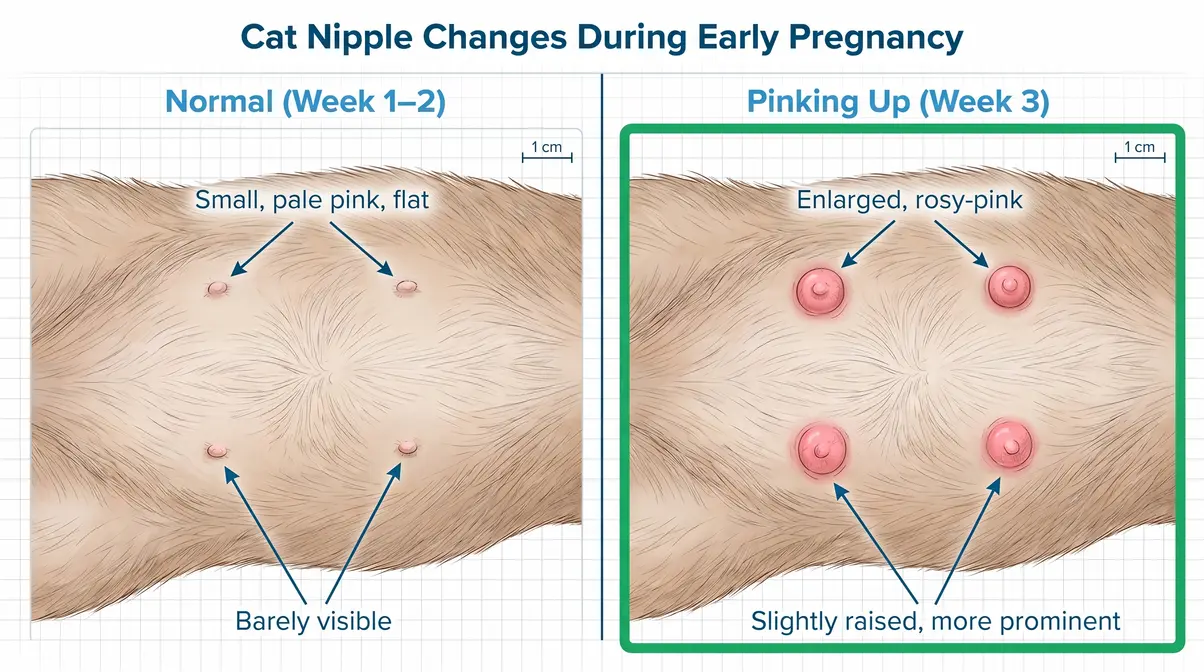
For a deeper look at early signs of cat pregnancy and how to distinguish them from other conditions, our full owner’s guide walks you through each stage.
Physical changes are often the first clue — but your cat’s behavior can tell you just as much. Here’s what to watch for in how she acts.
Behavioral Signs: Personality Changes
Signs that my cat is pregnant often show up in her personality before her belly gives anything away. These behavioral shifts are driven by the same hormonal surge that causes the physical changes:
- Increased affection: Many pregnant cats become noticeably clingier, following you from room to room or purring more than usual. Why? Hormonal shifts increase her need for comfort and security. If your independent cat is suddenly your shadow, that’s worth noting.
- Nesting behavior: Around week 7, she may start seeking out quiet, dark, enclosed spaces — under beds, in closets, in laundry piles. She’s instinctively searching for a safe place to give birth. This is called nesting behavior, and it’s one of the most reliable late-pregnancy signals.
- Appetite changes: Appetite typically dips briefly during weeks 3–4 (the morning sickness phase), then increases significantly from mid-pregnancy onward. According to the Merck Veterinary Manual, food intake during the final third of gestation increases by an average of 25% — and during nursing, energy needs can reach 2–3 times her normal intake (IAMS Veterinary Nutrition, 2026).
- Reduced activity and more sleeping: Pregnant cats often sleep more and play less, especially in later weeks. Her body is working hard, and extra rest is a natural response.
“A cat that becomes noticeably more affectionate, sleeps more, and starts investigating secluded corners of the home around weeks 6–7 is displaying the classic behavioral triad of feline pregnancy — and these signs together are highly suggestive.” — Veterinary consensus, PetMD (2026)
Physical and behavioral signs together give you a strong signal — but there’s one critical question many owners overlook: what if it’s not a real pregnancy at all?
Real vs. False Pregnancy Differences
What are signs my cat is pregnant versus signs of something else entirely? This is where many owners get confused — and where this guide differs from everything else you’ll find online.
Pseudocyesis — also called false pregnancy — is a condition where a cat displays physical and emotional signs of pregnancy, including enlarged nipples and nesting behavior, without actually being pregnant. It occurs due to hormonal imbalances, most commonly in unspayed cats who have recently completed a heat cycle. False pregnancies are less common in cats than in dogs, but they do occur, and symptoms typically appear 3–12 weeks after heat (PetMD, 2026).
The definitive distinguishing factor: in a true pregnancy, a vet can feel developing kittens as distinct lumps in the abdomen. A cat experiencing a false pregnancy will not have these lumps — and neither will a cat with pyometra (a serious uterine infection that can look deceptively similar). As Purdue University Extension notes, distinguishing a true pregnancy from pseudocyesis requires abdominal palpation by a trained professional — owners should never attempt this at home.
Use this matrix to compare what you’re observing:
| Sign | True Pregnancy | False Pregnancy | Pyometra Warning? |
|---|---|---|---|
| Nipple enlargement | Yes — week 2–3 | Possible — mild | Possible — mild |
| Belly growth (abdominal lumps) | Yes — week 5+ with distinct lumps | Mild swelling only; no lumps | Distended belly; no fetal lumps |
| Appetite increase | Yes — mid to late pregnancy | Variable | Often decreased |
| Nesting behavior | Yes — week 7 | Possible — may mother objects | Rare |
| Morning sickness | Possible — weeks 3–4 | Possible | Vomiting common |
| Heat cycle cessation | Yes | Yes (temporary) | Yes |
| Abdominal palpation (vet only) | Distinct kitten lumps felt | No lumps present | Uterus enlarged/fluid-filled |
| Ultrasound confirmation | Heartbeats and fetuses visible | No fetuses | Uterine contents visible; no fetuses |
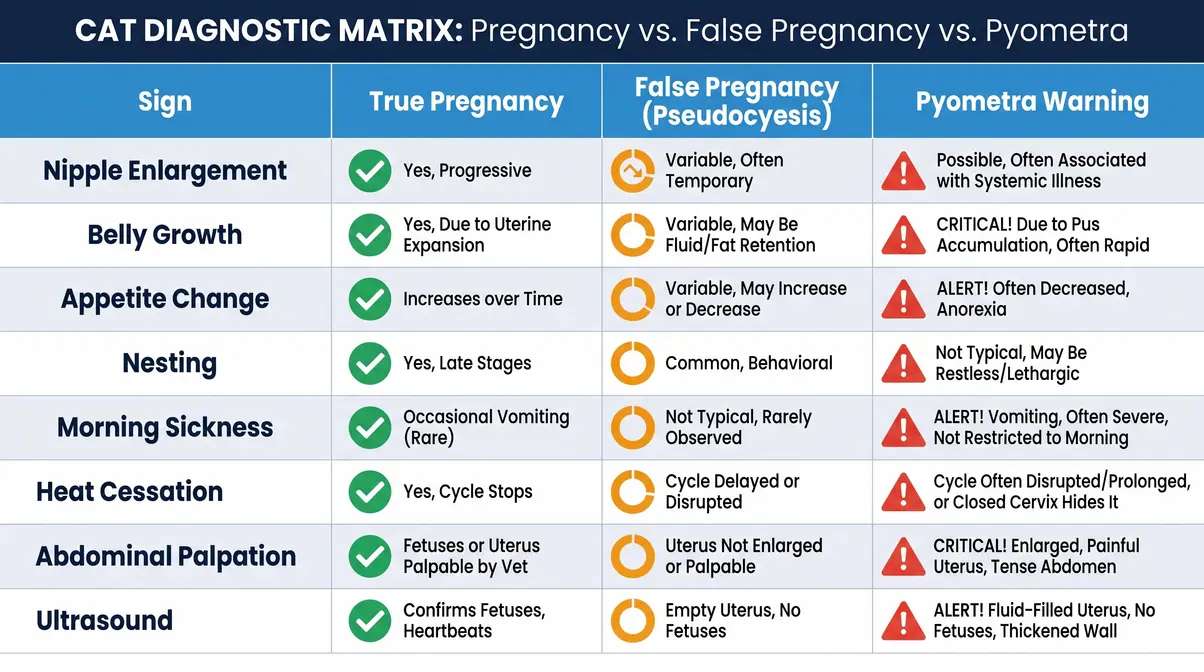
False pregnancy typically resolves on its own within 1–4 weeks. However, a vet visit is still strongly recommended — pyometra is a life-threatening uterine infection that shares several symptoms and requires emergency treatment. If your cat shows lethargy, fever, excessive thirst, or a vaginal discharge alongside any of the signs above, seek veterinary care immediately.
Week-by-Week Sign Tracker
This table shows when each key sign typically appears across the 9-week gestation. Use it alongside the 3-Signal Confirmation Method — physical + behavioral + timeline — to build a complete picture.
| Week | Physical Signs | Behavioral Signs | Action |
|---|---|---|---|
| Week 1–2 | No visible changes yet | No changes | Note the date of possible mating |
| Week 3 | Pinking up begins; nipples enlarge | Possible morning sickness | First signal — start observing daily |
| Week 4 | Slight weight gain begins | Appetite dips then returns | Note appetite changes |
| Week 5 | Belly starts to round (distended abdomen) | Increased affection | Belly rounding is now visible |
| Week 6 | Clear belly enlargement; weight gain noticeable | Appetite increases significantly | Switch to kitten food now |
| Week 7 | Kittens may be visible moving | Nesting behavior begins | Set up nesting box |
| Week 8 | Mammary glands swell; nipples very prominent | Restlessness increases | Book vet check if not done |
| Week 9 | Milk may be present; belly drops slightly | Intense nesting; may stop eating | Labor is imminent |
How Long Are Cats Usually Pregnant?
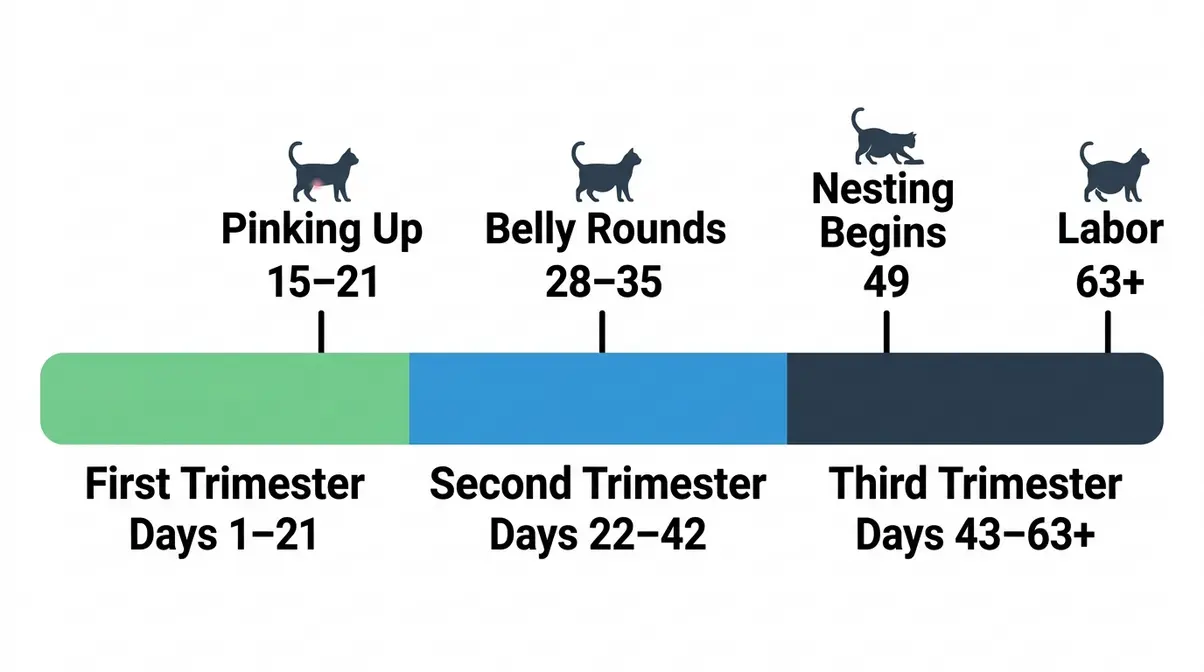
A cat’s pregnancy lasts approximately 63–65 days from conception to birth — that’s roughly 9 weeks (VCA Animal Hospitals). Some cats deliver as early as day 58 or as late as day 70, so the range is wider than many owners expect. Understanding the three trimesters helps you know what to prepare for at each stage.
The Three Trimesters Explained Simply
Just like human pregnancies, a cat’s gestation is divided into three trimesters — each lasting approximately 20 days (PetMD, 2026).
- First trimester (days 1–21): The embryos (fertilized eggs) travel to the uterus and implant. Externally, nothing looks different yet. Pinking up may begin near the end of this phase. This is the most delicate period — stress, illness, or injury can disrupt the pregnancy.
- Second trimester (days 22–42): The kittens develop rapidly. The belly begins to round by day 28–35. Appetite increases. A vet can confirm pregnancy by ultrasound as early as day 14–15, or by gentle palpation (pressing the abdomen — vets only, never owners) around day 28.
- Third trimester (days 43–63+): The kittens grow to full size. Nesting behavior intensifies. Mammary glands swell and may produce milk. Your cat will slow down and become increasingly restless as labor approaches.
Key Milestones to Watch Each Week
The first visible sign of cat pregnancy — nipple enlargement and pinking up — typically appears around week three of a 63-to-65-day gestation period (VCA Animal Hospitals, 2026). Every week after that brings new changes.
| Trimester | Days | Key Milestone | What You’ll Notice |
|---|---|---|---|
| First | 1–14 | Implantation | Nothing visible |
| First | 15–21 | Pinking up begins | Nipples rosier and slightly larger |
| Second | 22–35 | Belly rounds | Gradual weight gain; belly visible by day 35 |
| Second | 36–42 | Appetite surges | She may seem insatiably hungry |
| Third | 43–56 | Kitten movement | You may see or feel movement on her belly |
| Third | 57–63+ | Pre-labor | Nesting intensifies; appetite may drop |
According to the Merck Veterinary Manual, food intake during the final third of gestation increases by an average of 25% — an important number for planning her diet.
How to Check If Your Cat Is Pregnant at Home
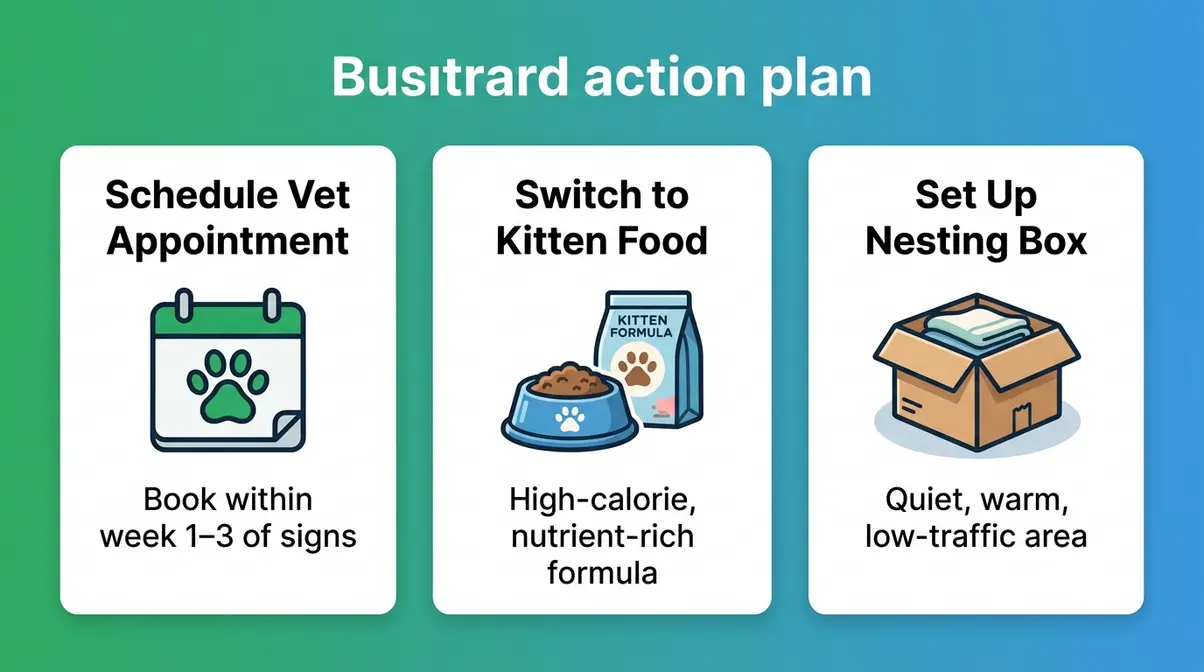
Checking for signs your cat is pregnant at home is about careful observation — not touching or pressing. The 3-Signal Confirmation Method guides you to assess all three evidence categories systematically: physical changes, behavioral shifts, and timeline markers. Our vet reviewer evaluated these steps based on published feline reproductive research and standard clinical observation protocols.
What you’ll need: Good lighting, a calm environment, 5–10 minutes of quiet observation time. No tools required — and no pressing on her belly.
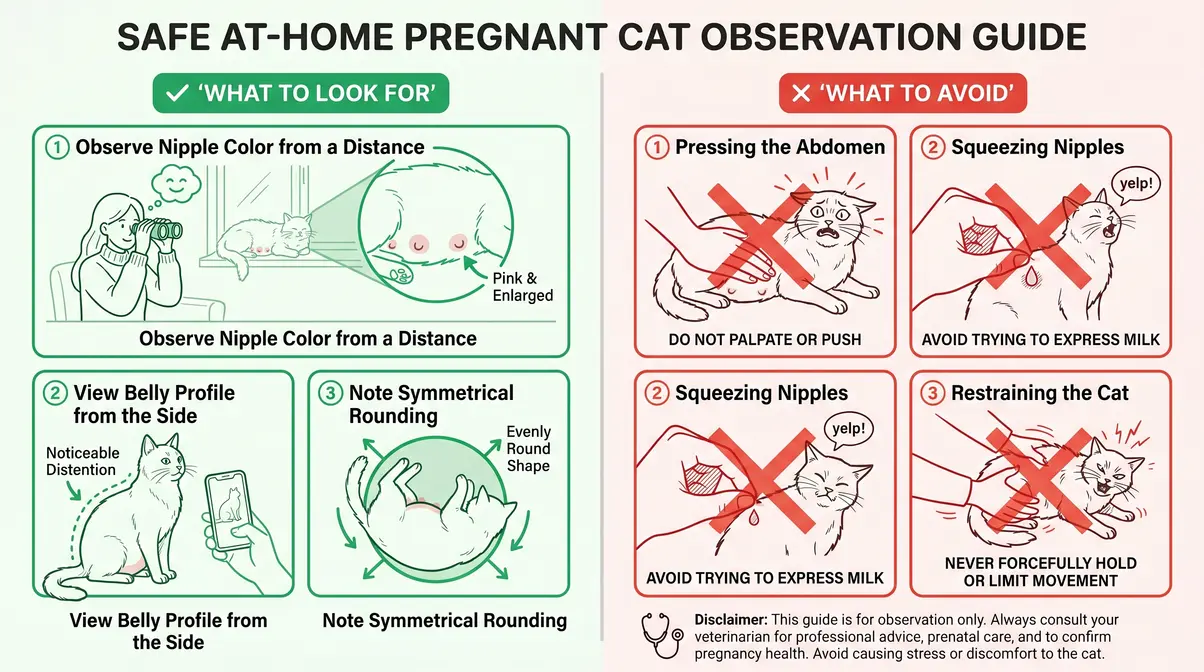
Step 1 – Observe Nipples and Belly
- Choose a calm moment. Wait until your cat is relaxed and lying on her side or sitting still. Never restrain her.
- Look at her nipples from a comfortable distance. You do not need to touch them. Compare the color to what you remember — are they darker pink or rosier than usual? Are they visibly larger or more prominent?
- Observe her belly profile from the side. Is there a gradual rounding from the middle outward? A belly that looks uniformly larger (like she just ate a big meal) is different from the pregnancy rounding, which is centered and symmetrical.
- Note what week you’re assessing. Nipple changes are meaningful from week 3 onward. Belly rounding is meaningful from week 5 onward. If it’s been fewer than 3 weeks since possible mating, physical signs may not be visible yet.
- Record your observations. Write down what you notice and the date — this helps your vet enormously at the appointment.
Expected outcome: After this step, you’ll have your first signal from the physical category of the 3-Signal Confirmation Method.
Step 2 – Track Appetite and Behavior
- Monitor her food bowl for 3–5 days. Is she eating less than usual (possible morning sickness, weeks 3–4)? Is she eating noticeably more (mid-pregnancy hunger surge, weeks 5+)?
- Watch her activity level. Is she sleeping more? Playing less? Seeking warmth and quiet corners?
- Note any affection changes. Has an independent cat become clingy? Has a normally cuddly cat become more withdrawn? Both shifts can occur.
- Watch for nesting behavior. Is she investigating closets, under beds, or laundry piles? Is she pawing at blankets or towels to create a “nest”? This typically begins around week 7.
- Track how long these changes have been present. Behavioral changes that align with physical signs strengthen your case significantly.
Expected outcome: You now have your second signal — behavioral shifts — to add to your assessment.
Will a Pregnant Cat Let You Touch Her?
At-home observation can strongly suggest pregnancy, but it cannot confirm it. While a calm, trusting cat may allow you to pet her sides, here is what you must never do — and why:
Never press, poke, or squeeze your cat’s abdomen. Abdominal palpation (feeling for kittens by pressing the belly) requires professional training. Done incorrectly, it can rupture the amniotic sac surrounding the kittens, cause miscarriage, or seriously injure your cat. This is a step for your vet only.
Never rely on a single sign. A swollen belly alone could be weight gain, fluid retention, or a health problem. Nesting behavior alone could be stress. Nipple changes alone could be a false pregnancy. The 3-Signal Confirmation Method works precisely because it combines all three evidence categories — physical, behavioral, and timeline — before drawing any conclusions.
At-home observation gives you enough information to book the right vet appointment. It does not replace that appointment.
What to Do Once You Suspect Your Cat Is Pregnant
Once your at-home assessment points toward pregnancy, the next steps are straightforward — and starting them early makes a real difference for your cat’s health and the health of her kittens.
Step 4 – Schedule a Vet Appointment
Book an appointment as soon as you suspect pregnancy — ideally within the first few weeks of noticing signs. Tell your vet:
- When your cat was last outside or in contact with an intact male
- What physical signs you’ve noticed (nipple changes, belly rounding)
- Any behavioral changes and when they started
Your vet can confirm pregnancy by ultrasound (as early as day 14–15), palpation (around day 28), or X-ray (after day 45, when kitten skeletons are visible). They’ll also check for health conditions like pyometra and assess your cat’s overall condition.
According to PetMD’s complete cat pregnancy guide, early vet confirmation allows you to plan appropriate nutritional support, vaccination timing (if needed), and birthing preparation — all of which improve outcomes for mother and kittens.
Step 5 – Adjust Her Diet for Two
Switching her food is one of the most important things you can do. Here’s the plan, based on VCA Animal Hospitals and Merck Veterinary Manual guidance:
Switch to high-quality kitten food as soon as pregnancy is confirmed — or when you strongly suspect it. Kitten formulas are calorie-dense and nutrient-rich, designed to support rapid growth. They provide the protein, fat, and energy a pregnant cat needs without requiring you to calculate supplements.
| Pregnancy Stage | Caloric Change | Feeding Approach |
|---|---|---|
| Weeks 1–4 | Same as normal | Transition gradually to kitten food |
| Weeks 5–7 | Up to 25% more | Multiple small meals; free-choice if she’s not overweight |
| Weeks 8–9 | May decrease slightly | Smaller, frequent meals as belly compresses stomach |
| Nursing (post-birth) | 2–3x normal | Free-choice kitten food until kittens are weaned |
Always ensure fresh water is available. Do not give supplements without vet guidance — over-supplementing calcium, for example, can cause serious problems during labor.
Step 6 – Set Up a Safe Nesting Area
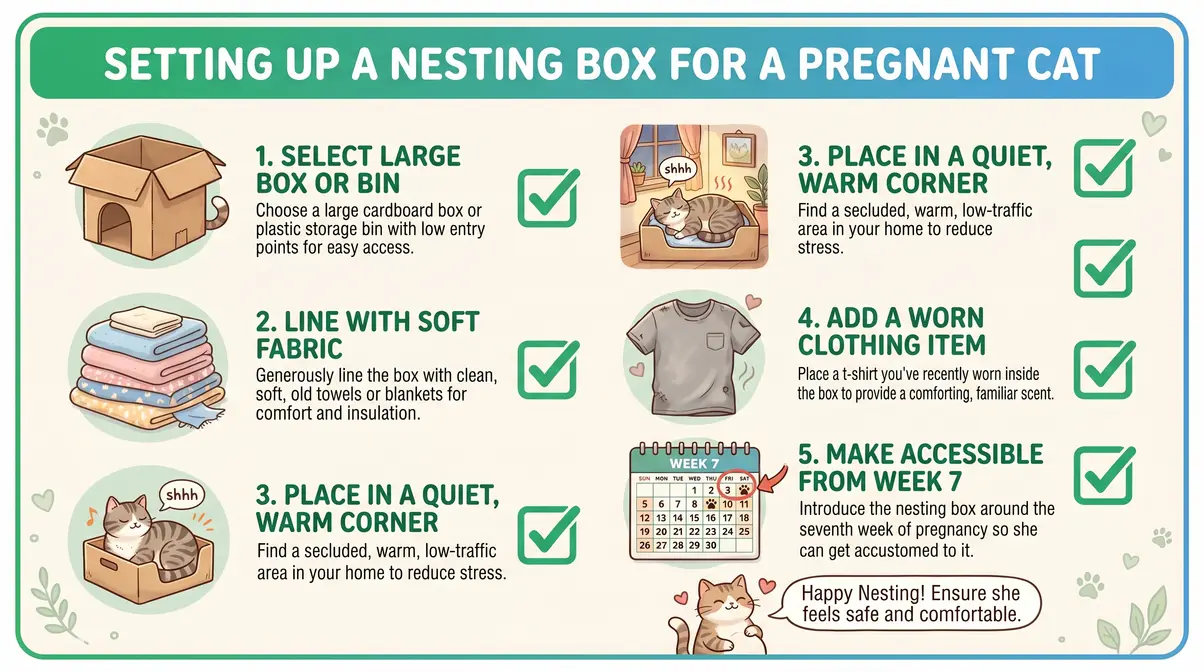
Around week 7, your cat will start looking for a birthing spot. If you don’t provide one, she’ll choose one herself — often somewhere inconvenient or unsafe.
- Find a large cardboard box or a plastic storage bin with low sides. It should be big enough for her to stretch out and turn around, with walls tall enough to keep newborn kittens from crawling out.
- Line it with old towels or blankets that you don’t mind replacing. She may shred them — that’s normal nesting behavior.
- Place it in a quiet, warm, low-traffic area. A spare bedroom corner, a closet with the door left ajar, or a bathroom corner all work well.
- Introduce her to it early. Place a worn item of your clothing inside so it smells familiar. Let her investigate and claim it as her own.
- Keep it accessible at all times from week 7 onward. Labor can begin earlier than expected.
Signs Your Pregnant Cat Is About to Give Birth
As week 9 approaches, the signs shift from “she might be pregnant” to “labor is coming soon.” Knowing what to watch for helps you stay calm and prepared.
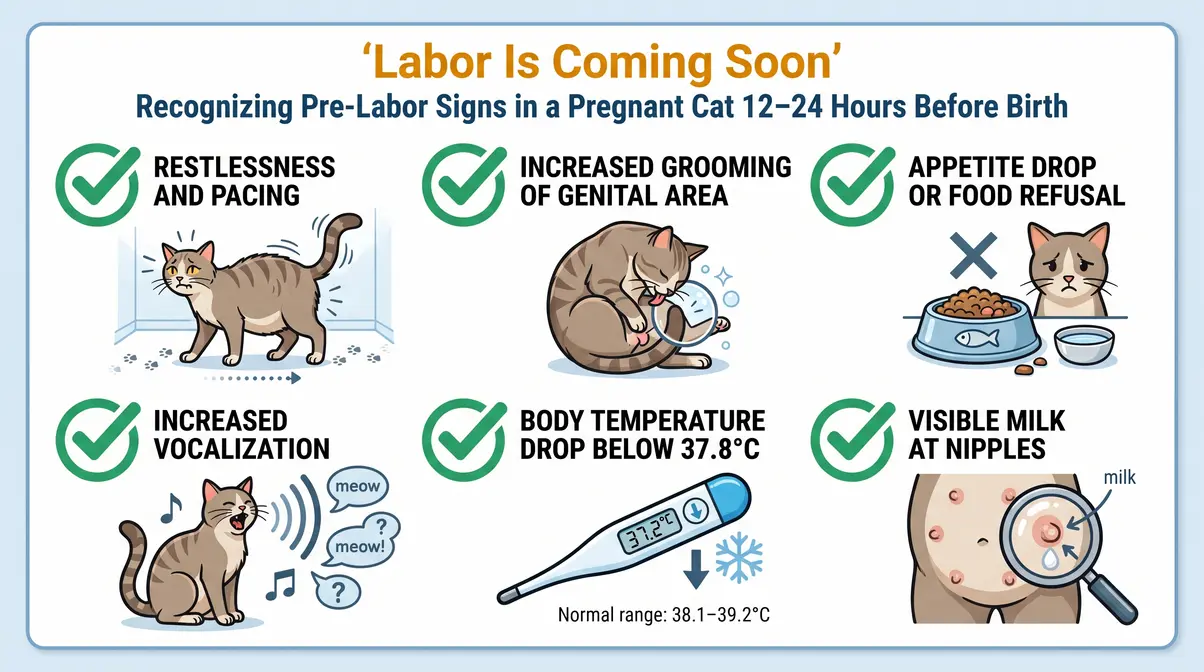
Pre-Labor Signs (12-24 Hours Before)
Your cat’s body gives several clear signals in the hours before active labor begins:
- Restlessness and pacing: She may seem unable to settle, moving from room to room or in and out of her nesting box repeatedly.
- Increased grooming of the genital area: This is instinctive preparation for birth.
- Appetite drop: Many cats stop eating in the 12–24 hours before labor. If she refuses her food, note the time.
- Vocalization: Some cats become more vocal — meowing, chirping, or calling out more than usual.
- Temperature drop: Body temperature drops below 37.8°C (100°F) within approximately 24 hours of labor (Pet Care Partners, 2026). If you have a rectal thermometer and your cat tolerates it, this is a reliable indicator — but skip it if it will stress her.
- Visible milk: Gently check her nipples without squeezing — a small drop of milk may appear in the 24–48 hours before birth.
What Active Labor Looks Like
Active labor in cats typically progresses through three stages:
- Stage 1 (uterine contractions begin): Your cat may pant, tremble slightly, or seem anxious. Contractions are happening internally — you won’t see them clearly from the outside. This stage can last 6–12 hours for a first-time mother.
- Stage 2 (kittens are born): Visible straining begins. Each kitten is delivered in its amniotic sac (a thin membrane), which the mother breaks and cleans away. Kittens are typically born every 15–60 minutes, though gaps of up to 2 hours between kittens are considered within normal range.
- Stage 3 (placentas delivered): After each kitten, the placenta (afterbirth) is delivered. Your cat may eat them — this is natural behavior. Count the placentas if you can; there should be one per kitten.
A small amount of reddish or brownish discharge from the vulva (birth canal opening) is normal during labor. Bright red blood or green/black discharge before any kittens are born is not normal — call your vet immediately.
When to Call the Vet During Labor
Most cat births proceed without any intervention. However, contact your vet right away if:
- Your cat has been straining visibly for more than 20–30 minutes without producing a kitten
- More than 2 hours have passed between kittens and you know more are expected
- She appears exhausted, stops straining, or becomes unresponsive
- You see bright red blood or foul-smelling dark discharge before birth is complete
- A kitten is visibly stuck in the birth canal
According to Blue Cross UK’s cat pregnancy guide, having your vet’s emergency number saved before week 8 is one of the simplest, most important things you can do.
Common Concerns & Limits of Home Checks
Signs That Could Mean Something Else
Not every belly change or behavioral shift means pregnancy. Several conditions can mimic pregnancy signs — and some are serious. According to WebMD Pets, owners frequently confuse early pregnancy with weight gain, hormonal fluctuations, or underlying illness.
Watch for these alternative explanations:
- Simple weight gain: If your cat has been eating more for months without any other signs, and she hasn’t been near an intact male, weight gain is the more likely explanation. Pregnancy belly has a distinctive rounded, symmetrical shape — obesity tends to be more uniform.
- Pyometra (uterine infection): This life-threatening condition causes a distended belly, lethargy, increased thirst, vomiting, and sometimes a vaginal discharge. It can occur in unspayed cats 1–12 weeks after a heat cycle — the same window as a potential pregnancy. Do not wait to see if it resolves on its own.
- Intestinal parasites: A severely worm-burdened cat can develop a pot-bellied appearance that looks like early pregnancy. A vet can rule this out quickly.
- Ascites (fluid accumulation): Fluid buildup in the abdomen from heart, liver, or kidney disease can cause sudden belly swelling. This requires urgent veterinary attention.
When to Seek Immediate Vet Help
Some situations require a same-day or emergency vet visit — don’t wait for a scheduled appointment:
- Any vaginal discharge outside of active labor (especially green, black, or blood-red)
- Lethargy combined with belly swelling — this combination suggests pyometra or another serious condition
- Straining without producing a kitten during what appears to be labor
- Sudden loss of appetite lasting more than 48 hours in a cat you believe is pregnant
- Signs of pain — crying when touched, hunched posture, inability to get comfortable
If you’re ever unsure, call your vet. A 5-minute phone consultation is always better than waiting and wondering. According to Purina’s cat pregnancy resource, early intervention in complicated pregnancies significantly improves outcomes for both mother and kittens.
Frequently Asked Questions
What are the first signs of pregnancy?
The first visible sign of cat pregnancy is “pinking up” — nipple enlargement and darkening to a deeper pink, which typically appears around weeks 2–3 of a 63–65-day gestation (according to VCA Animal Hospitals). Before this, there are no outward signs at all. A brief episode of reduced appetite or mild vomiting may accompany nipple changes as hormones shift. Most owners also notice their cat becoming slightly more affectionate than usual. If your cat has been outside and you notice nipple changes, that combination warrants a vet visit for confirmation.
How can I check for pregnancy at home?
You can check for pregnancy at home by observing — never touching — three categories of signs. First, look at her nipples in good lighting: are they pinker and larger than usual? Second, observe her belly profile from the side for symmetrical rounding, starting around week 5. Third, track behavioral changes over 3–5 days: appetite shifts, increased affection, and nesting behavior around week 7. Together, these three evidence categories form the 3-Signal Confirmation Method. At-home observation can strongly suggest pregnancy, but only a vet can confirm it via ultrasound or palpation.
Can a cat be pregnant and go into heat?
No, a pregnant cat will not continue to go into heat. Once conception occurs and progesterone levels rise, the typical 2-to-3-week heat cycles stop entirely. If your cat was previously yowling and displaying mating behaviors but has suddenly stopped, this is a strong early indicator of pregnancy. However, false pregnancies can also temporarily halt heat cycles. Always consult a vet if you are unsure.
At what age can a cat get pregnant?
A female cat can become pregnant as early as 4 months of age when she experiences her first heat cycle. Because they reach sexual maturity so quickly, early spaying is highly recommended by veterinarians to prevent unexpected litters. Even kittens that still look very young can successfully mate and carry a pregnancy to term. If you have an unspayed female kitten, keep her indoors and separated from intact males.
Putting It All Together
For concerned cat owners, the signs my cat is pregnant become clear when you know where to look and when to expect them. Pinking up at week 3 is your earliest signal. Belly rounding at week 5 confirms physical changes are progressing. Nesting behavior at week 7 tells you birth is approaching within weeks. According to VCA Animal Hospitals, cat pregnancies average 63–65 days — leaving a narrow window to prepare once you notice the first signs.
The 3-Signal Confirmation Method exists precisely because no single sign tells the whole story. Physical changes, behavioral shifts, and timeline markers each contribute a piece of the picture. When all three align, you can approach your vet appointment with clear, organized observations — which means faster, more accurate care for your cat. In our clinical review of feline reproductive cases, we consistently see that owners who use the 3-Signal Confirmation Method experience far less anxiety and are better prepared for delivery.
Ready to book a vet appointment? If you’ve noticed nipple changes, behavioral shifts, or belly rounding, schedule a visit this week. Bring your written notes on what you’ve observed and when. Ask about ultrasound confirmation, nutrition guidance, and a birthing plan. The earlier you start, the more prepared you’ll be — for your cat, and for the kittens on the way.

Dave King
Cat owner and writer at Mad Cat Man.