Is Basil Safe for Cats? Vet-Verified Safety Guide
Discover expert insights on Cats and Basil Plants: A 9-Step Checklist to Grow, Pet-Proof, and Share Basil Safely with Curious Cats including common…

Medically Reviewed by Veterinary Advisory Board | Updated: 2026
This article is for informational purposes only and does not constitute veterinary advice. Always consult your veterinarian for any specific health concerns about your pet. In an emergency, contact the Pet Poison Helpline at 1-800-213-6680 or your nearest emergency veterinary clinic.
Is basil safe for cats? Yes — fresh basil leaves (Ocimum basilicum) are classified as non-toxic to cats by the ASPCA. However, basil essential oil is highly toxic and must be kept away from cats entirely. A cat nibbling your herb garden is generally fine; a cat exposed to basil oil requires immediate veterinary attention.
“Google said yes, wanted to verify / wonder if anybody has ever given their cat any?”
That question — posted to a cat advice forum — captures exactly what most cat owners feel when they find their cat chewing on the basil plant. You want to trust the internet, but when it comes to your pet’s safety, you need more than a quick answer.
Here’s what makes this more complicated than it looks: the basil plant and basil essential oil have completely opposite safety profiles for cats. Getting this distinction wrong could be dangerous — and most guides online never even mention it. In this vet-verified guide, you’ll learn exactly which forms of basil are safe, which are toxic, what to do in four specific scenarios, and which other common herbs you need to watch out for. We cover everything from the ASPCA’s official classification to the science behind why your cat is so obsessed with your herb garden.
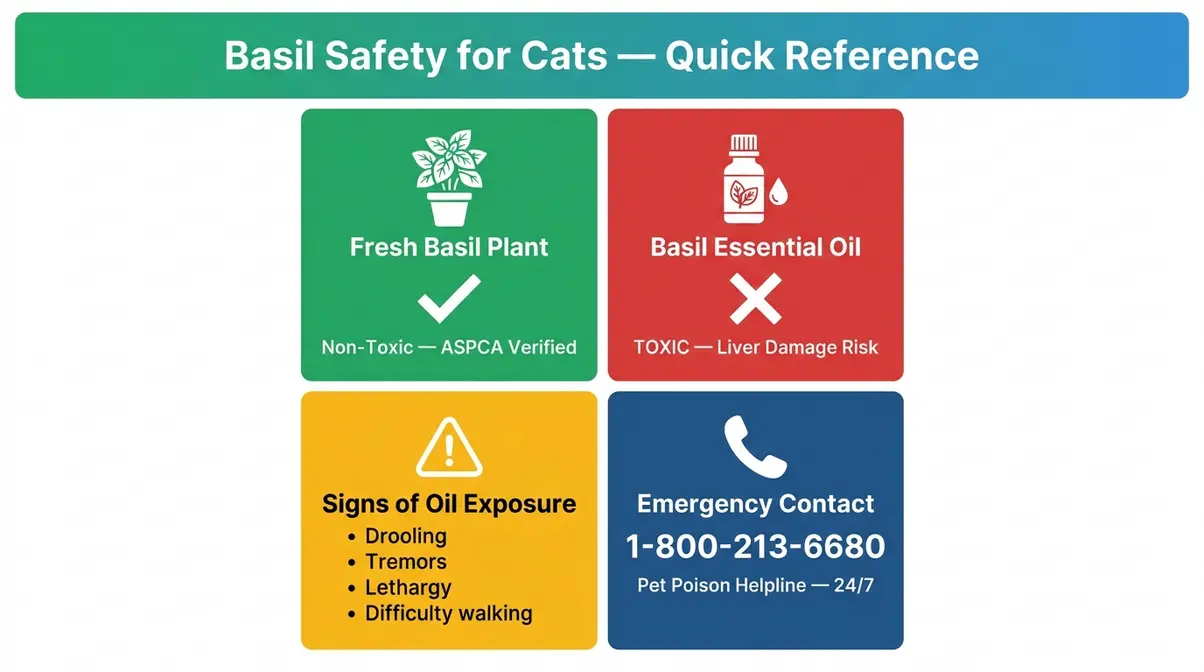
Fresh basil leaves are classified as non-toxic to cats by the ASPCA — a cat nibbling on your herb plant is not an emergency. However, basil essential oil is a serious feline toxin that can cause liver damage and neurological symptoms.
- The Plant-Oil Divide: The plant itself is safe; the concentrated oil is dangerous. Never diffuse basil essential oil near your cat.
- GI upset is possible: Even non-toxic plants can cause vomiting or diarrhea if eaten in large amounts.
- When in doubt, call: Pet Poison Helpline — 1-800-213-6680 — is available 24/7.
What the ASPCA Says: Is Basil Safe for Cats?
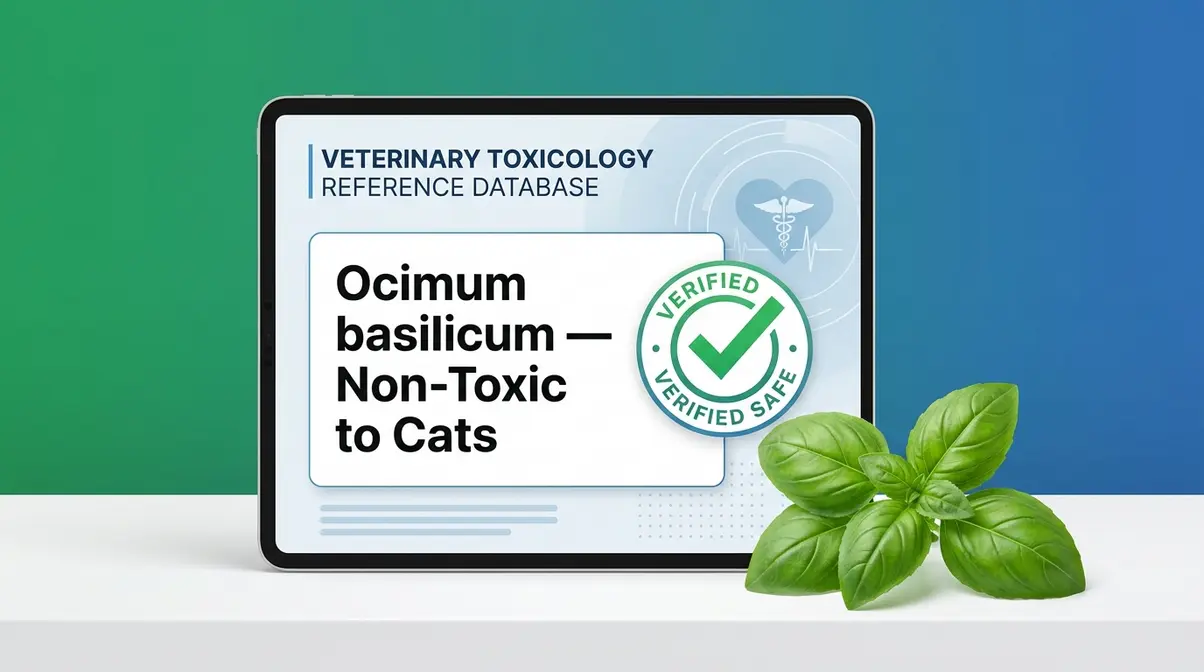
The short answer is reassuring. The ASPCA’s Poison Control database classifies Ocimum basilicum — common sweet basil — as non-toxic to cats. It also appears on the non-toxic list for dogs and horses. So if you just watched your cat take a curious nibble from your kitchen herb pot, you can take a breath. According to veterinary consensus, fresh basil leaves do not contain compounds that are poisonous to cats in the way that, say, lilies or onions are. That said, “non-toxic” does not mean “eat as much as you want” — and the form of basil matters more than most cat owners realize.
Fresh vs. Dried Basil
Both fresh and dried basil leaves come from the same plant and share the same non-toxic classification. The key difference is concentration. Dried basil contains a higher density of the plant’s natural oils per gram than fresh leaves do — so a small pinch of dried basil delivers more of those aromatic compounds than a single fresh leaf. For most cats, this still falls well within a safe range. However, dried herbs are more likely to be found in seasoning blends that include other ingredients — garlic powder, onion powder, or salt — which are toxic to cats. Always check the label before letting your cat investigate any dried herb jar.
What Happens If a Cat Eats Basil?
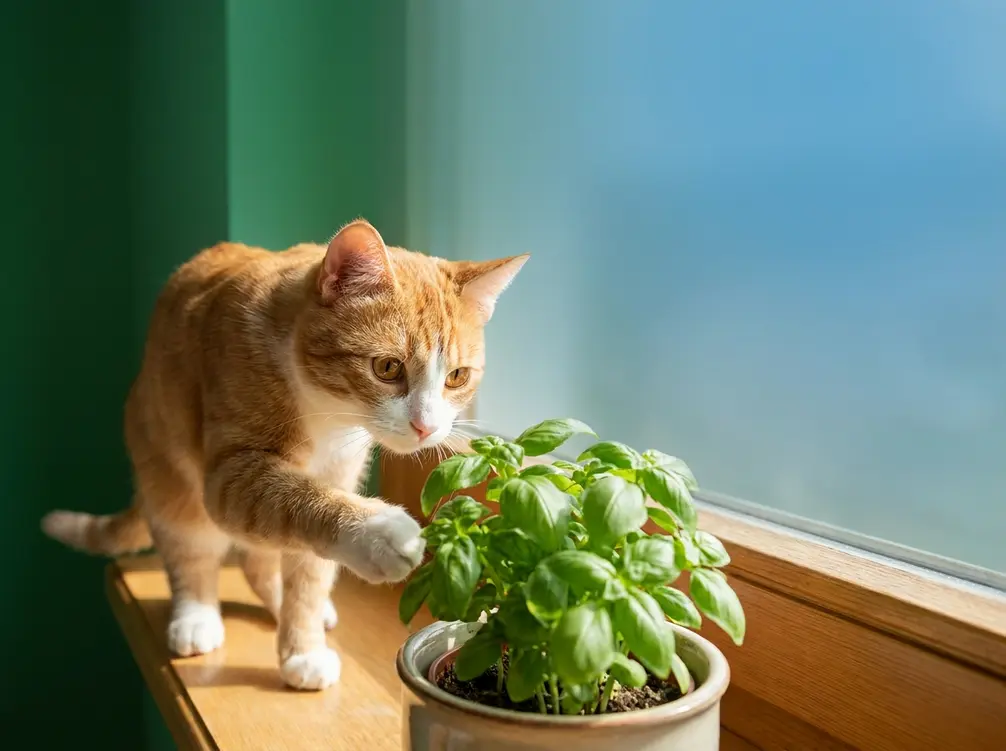
If a cat eats a small amount of fresh basil, nothing serious is likely to happen. The ASPCA classifies basil as non-toxic to cats, meaning it does not contain compounds that cause poisoning in the way that lilies or garlic do. In larger amounts, basil can cause mild gastrointestinal upset — vomiting, diarrhea, or drooling — because cats’ digestive systems aren’t designed for significant plant matter. According to the Cornell Feline Health Center, even non-toxic plants can cause these symptoms when consumed in larger amounts. Monitor your cat for 12–24 hours after any plant-eating episode. If symptoms appear or persist beyond 24 hours, contact your veterinarian. If the basil was part of a seasoning blend containing garlic or onion, call your vet immediately.
Step 1: What to Do If They Nibble
Estimated time: 5 minutes
Tools/Materials: Pet Poison Helpline Number (1-800-213-6680), Clean cloth
Follow these steps if you catch your cat eating fresh or dried basil leaves:
- Stay calm. Fresh basil leaves are non-toxic — this is not a poisoning emergency.
- Remove access. Move the plant or the herb jar out of your cat’s reach to prevent repeated snacking.
- Check the label. If it was a seasoning blend, look for garlic, onion, or chives — those require a vet call.
- Monitor for 12–24 hours. Watch for vomiting, diarrhea, lethargy, or loss of appetite.
- Call your vet if symptoms appear. Even mild GI upset that lasts more than 24 hours deserves a professional opinion.
- No symptoms? No action needed. A small nibble on a plain basil plant is unlikely to cause any harm.
Why Basil Essential Oil Is Dangerous
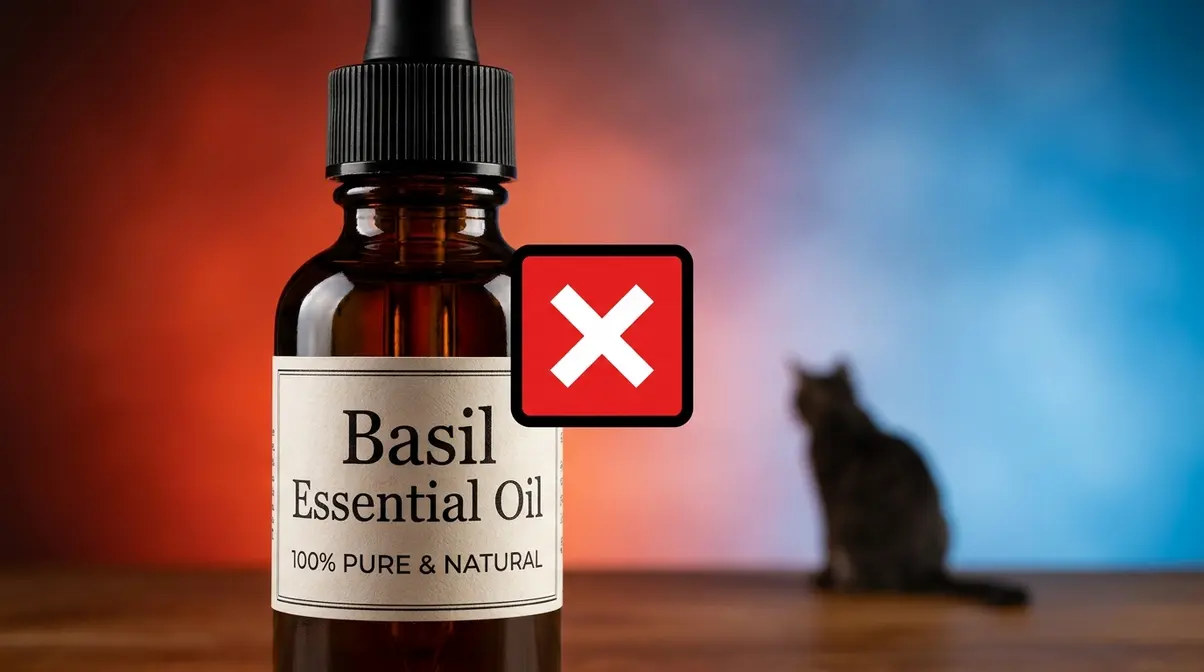
This is The Plant-Oil Divide — the single most important safety distinction this guide covers, and the one that most articles about basil and cats completely ignore. Fresh basil leaves and basil essential oil both come from the same plant, but the oil is a highly concentrated extract that behaves very differently in a cat’s body. The ASPCA and veterinary toxicologists are clear: essential oils, including those derived from otherwise non-toxic plants, can be acutely toxic to cats. This applies to diffusers, topical applications, and any product where your cat might inhale or lick concentrated oil.
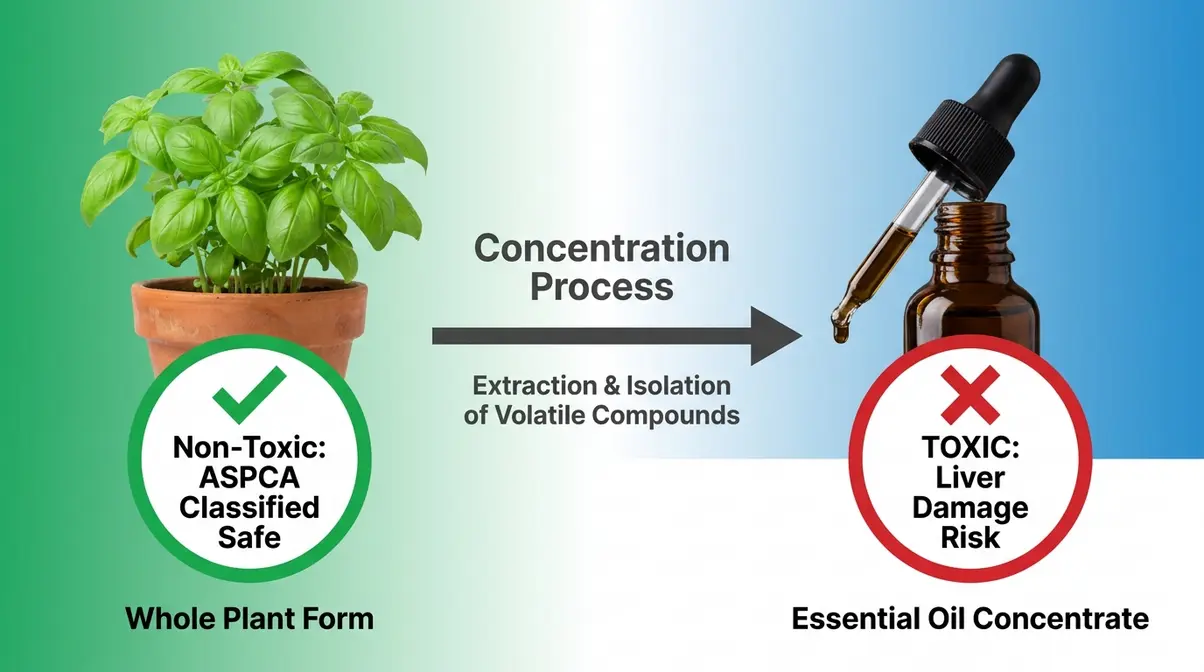
Why Cats Can’t Process Oils
Cats are uniquely vulnerable to essential oils because of a specific metabolic gap. According to VCA Animal Hospitals, cats lack sufficient glucuronyl transferase (a liver enzyme that helps break down and eliminate phenolic compounds found in many plant extracts). Dogs and humans have much higher levels of this enzyme, which is why the same oil that’s harmless to you can overwhelm your cat’s liver.
When a cat is exposed to basil essential oil — whether by inhaling diffuser mist, licking a surface where oil was applied, or direct skin contact — those phenolic compounds accumulate in the liver faster than the cat’s body can clear them. Over time, or with a large single exposure, this leads to hepatotoxicity (liver damage). This is not a minor stomach upset situation; it is a genuine medical emergency.
Warning Signs of Oil Exposure
Recognizing exposure early gives your vet the best chance to help. Watch for these symptoms, which can appear within minutes to a few hours after exposure:
| Symptom | What It Indicates |
|---|---|
| Drooling excessively | Nausea or oral irritation from direct contact |
| Vomiting | GI response to ingested oil |
| Tremors or muscle twitching | Neurological impact from phenolic compounds |
| Difficulty walking (ataxia) | Central nervous system involvement |
| Lethargy or collapse | Systemic toxicity; seek emergency care immediately |
| Watery eyes, squinting | Irritation from diffused oil in the air |
| Labored or rapid breathing | Respiratory irritation from inhalation |
As reported by the Pet Poison Helpline, essential oil toxicity in cats can escalate quickly. Do not wait for symptoms to worsen before calling for help.
Step 2: Emergency Action Plan
If you believe your cat has been exposed to basil essential oil — through a diffuser, a spill, or a product containing it — act immediately:
- Remove your cat from the area. Take them to a room with fresh air and no oil residue.
- Do not induce vomiting. Unless specifically directed by a vet, inducing vomiting can make things worse.
- If oil is on their fur or skin: Gently blot (do not rub) with a dry cloth. Do not use soap or water without vet guidance, as this can spread absorption.
- Call the Pet Poison Helpline immediately: 1-800-213-6680. Have the product name and ingredients ready.
- Or go directly to an emergency vet. If your cat is trembling, collapsing, or struggling to breathe, do not call first — go straight to the nearest emergency veterinary clinic.
- Bring the product. Take the essential oil bottle or diffuser with you so the vet can identify the exact compounds involved.
Is Every Type of Basil Safe?
One of the most common anxious follow-up questions veterinary editorial teams hear is: “But I have Thai basil / holy basil / purple basil — is that one different?” It’s a smart question. Different basil varieties do have slightly different chemical compositions, and cat owners deserve a clear answer for each.
Safety Verdict by Basil Variety
All commercially available basil varieties belong to the same genus, Ocimum, and the ASPCA’s non-toxic classification covers the genus broadly. Veterinary sources consistently report no variety-specific exceptions for cats. Here’s a quick breakdown:
| Basil Variety | Scientific Name | ASPCA Status | Notes for Cat Owners |
|---|---|---|---|
| Sweet Basil | Ocimum basilicum | Non-toxic ✓ | The most common; ASPCA’s listed species |
| Thai Basil | Ocimum basilicum var. thyrsiflora | Non-toxic ✓ | Higher anise/licorice oil content; same safety profile |
| Holy Basil (Tulsi) | Ocimum tenuiflorum | Non-toxic ✓ | Used in Ayurvedic products; plant form is safe |
| Lemon Basil | Ocimum × africanum | Non-toxic ✓ | Citrus-scented; cats often dislike citrus and avoid it |
| Purple Basil | Ocimum basilicum var. purpurascens | Non-toxic ✓ | Ornamental variety; same safety classification |
The consistent finding across all varieties: the plant form is non-toxic to cats. The essential oil extracted from any of these varieties shares the same toxicity concern described above. Thai basil essential oil, holy basil essential oil, and lemon basil essential oil are all subject to the same Plant-Oil Divide rule — safe as a plant, dangerous as a concentrated extract.
Why Is My Cat So Attracted to Basil?
If your cat makes a beeline for your herb garden every chance they get, you’re not imagining things — and there’s a genuine biological reason for it. Understanding why your cat is drawn to basil also helps explain why certain other herbs trigger even stronger reactions.
Are basil and catnip related?
Yes — basil and catnip are botanical cousins, both belonging to the Lamiaceae (mint plant family). According to UW-Madison Master Gardener resources, this shared family membership explains why cats are often drawn to basil’s scent: the family produces structurally similar aromatic compounds. Catnip’s signature effect comes from nepetalactone, which basil does not contain. Basil does contain linalool and eugenol, which interact with a cat’s sensitive olfactory system in a milder way. The relationship is real, but the intensity of the response is very different — basil curiosity versus the full catnip reaction.
Is It Safe for Cats to Smell Basil?
Yes — smelling a fresh basil plant is safe for cats. The aromatic compounds released by an intact basil plant at normal room conditions are present in trace amounts that pose no toxicity risk. Your cat sniffing a pot of basil on your windowsill is engaging in normal investigative behavior and faces no danger from the scent alone.
The important distinction, once again, comes back to The Plant-Oil Divide. A fresh plant releases tiny amounts of its volatile oils passively into the air. A diffuser running basil essential oil disperses concentrated aerosolized oil particles throughout the room — a fundamentally different level of exposure. Smelling the plant: safe. Breathing diffused essential oil for hours: a genuine health risk. Keep your herb pots; skip the basil oil diffuser.
Is Basil Safe for Dogs Too?
Good news for multi-pet households: basil is also non-toxic to dogs, according to the ASPCA. Dogs can generally tolerate small amounts of fresh basil without any adverse effects — and unlike cats, dogs have higher levels of glucuronyl transferase, making them somewhat less vulnerable to essential oil toxicity as well (though essential oils still warrant caution with dogs and should never be applied directly to their skin or used in high-concentration diffusers near them).
For more information on household plants, see our cat-safe plants guide.
For dog owners specifically: basil is commonly used as a culinary herb and appears in many commercial dog treats and fresh food recipes without issue. As with cats, the concern shifts dramatically when you move from the plant to the oil. Basil essential oil should be kept away from dogs as well — their livers process it more efficiently than a cat’s, but concentrated essential oil exposure can still cause GI upset, skin irritation, and in large doses, toxicity. The bottom line: a dog stealing a basil leaf from your garden is fine; a dog lapping up spilled diffuser oil is not.
Beyond Basil: Safe and Toxic Herbs at a Glance
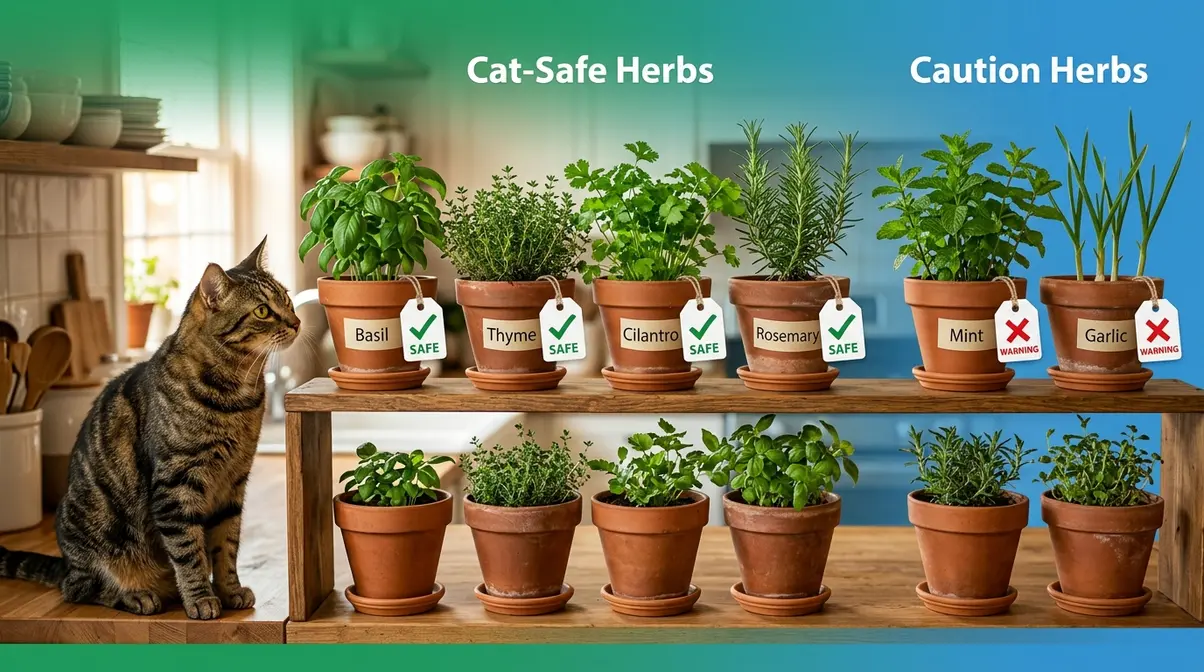
Understanding where basil fits in the broader herb safety picture helps you make smarter decisions for your entire kitchen garden. Veterinary consensus and ASPCA toxicology data point to a clear pattern: most culinary herbs are not acutely toxic to cats in small amounts, but several common ones are genuinely dangerous.
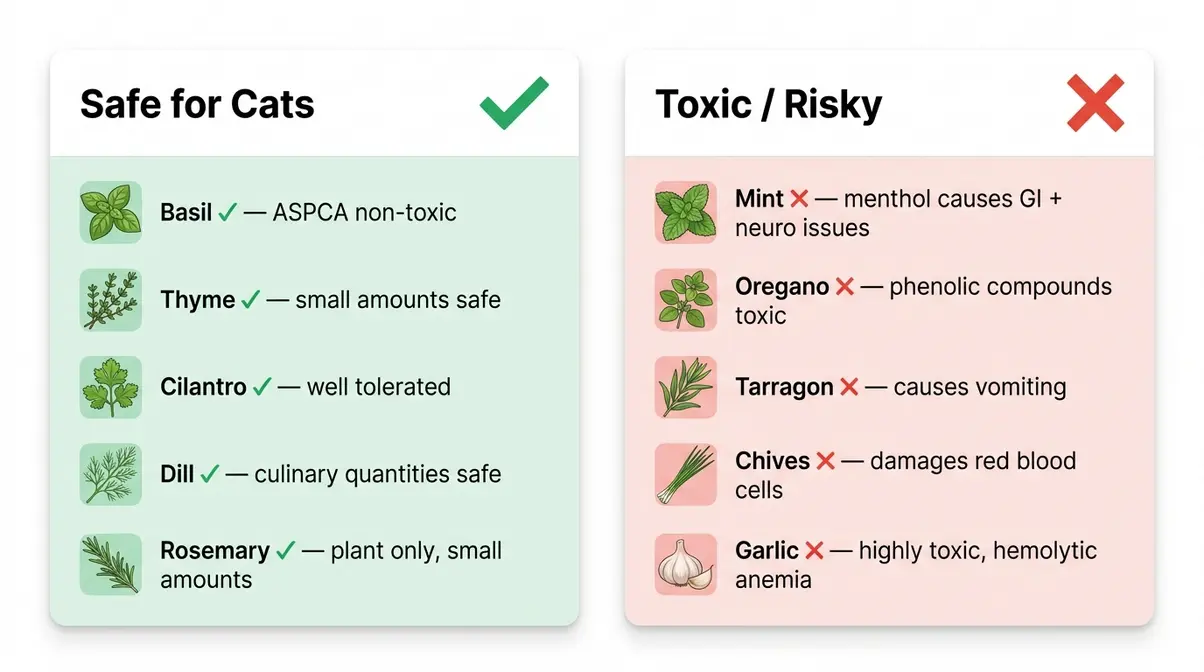
Here’s a quick summary to bookmark:
| Herb | Safe for Cats? | Key Note |
|---|---|---|
| Basil | ✓ Non-toxic | Plant safe; essential oil toxic |
| Thyme | ✓ Non-toxic (small amounts) | Large amounts may cause GI upset |
| Cilantro | ✓ Non-toxic | Generally well tolerated |
| Dill | ✓ Non-toxic | Safe in culinary quantities |
| Rosemary | ✓ Non-toxic (small amounts) | Essential oil is toxic; plant in moderation |
| Mint | ✗ Toxic | Contains menthol; causes GI and neurological issues |
| Oregano | ✗ Toxic | Phenolic compounds cause GI distress and more |
| Tarragon | ✗ Toxic | Can cause vomiting, hypersalivation |
| Chives | ✗ Toxic | Thiosulphate damages red blood cells |
| Garlic | ✗ Highly Toxic | One of the most dangerous herbs for cats |
For a full breakdown of cat-safe plants beyond the herb garden, see our cat-safe plants guide — that resource covers over 50 common houseplants and garden species.
Common Herb Mistakes That Put Cats at Risk
Even responsible cat owners make a few predictable errors when it comes to herbs and feline safety. Knowing these mistakes in advance is far better than learning them the hard way.
When ‘Safe’ Herbs Become Risky
Mistake 1: Using essential oil diffusers with herb-derived oils. This is the most dangerous and most common mistake. Many cat owners know their basil plant is safe, but don’t realize that the basil essential oil in their aromatherapy diffuser is a concentrated toxin. The same applies to lavender, tea tree, eucalyptus, and peppermint oils — all popular diffuser choices, all toxic to cats. The ASPCA Poison Control database lists several of these as feline toxins. If you diffuse essential oils regularly, ensure your cat has constant access to a room with no diffuser exposure and good ventilation.
Mistake 2: Assuming “natural” means safe. Many cat owners reason that because basil is natural, any basil product must be fine. This logic breaks down quickly. Essential oils are natural. Lilies are natural. Onions are natural. None of them are safe for cats. The word “natural” on a product label tells you nothing about feline safety — always check the specific ingredients against a veterinary source like the ASPCA database.
Mistake 3: Ignoring seasoning blends. Dried basil on its own is non-toxic. But dried basil tucked inside an Italian seasoning blend — alongside garlic powder, onion flakes, and chives — is a very different story. Thiosulphate compounds in garlic and onion damage a cat’s red blood cells and can cause hemolytic anemia (a condition where red blood cells are destroyed faster than they can be replaced). Always check the full ingredient list of any seasoning blend before it ends up anywhere your cat can access.
When to Call the Vet
Some cat owners wonder what the “silent killer” of cats is — and while no single herb holds that title, the combination of unrecognized essential oil exposure and delayed treatment comes close. Cats are masters at hiding illness, which means by the time symptoms are visible, toxicity may already be advanced.
Call your vet or the Pet Poison Helpline (1-800-213-6680) immediately if:
- Your cat has been in a room where essential oils were diffused for more than 30 minutes
- You notice drooling, vomiting, tremors, or difficulty walking after any herb exposure
- Your cat ate a seasoning blend and you’re not sure of all the ingredients
- Your cat seems lethargic or “off” after being near any herb product — even if you can’t identify a specific cause
- You found your cat chewing on a plant you can’t positively identify safe plants as non-toxic
When you call, have the following ready: the product name, the approximate amount your cat was exposed to, your cat’s weight, and when the exposure occurred. This information helps the toxicologist assess risk and give you specific guidance quickly.
Frequently Asked Questions
Why do cats love the smell of basil?
Cats are drawn to basil because it belongs to the Lamiaceae (mint plant family), which produces aromatic compounds similar to those found in catnip. Basil contains linalool and eugenol — volatile oils that stimulate a cat’s olfactory system, which is roughly 14 times more sensitive than a human’s. While basil doesn’t contain nepetalactone (the specific catnip compound that triggers rolling and vocalizing), the structural similarity of these aromatic molecules is enough to make basil genuinely interesting to many cats. Some cats will sniff, rub against, or chew on basil plants for this reason. The behavior is harmless — smelling a fresh basil plant poses no toxicity risk.
Are any herbs poisonous to cats?
Yes — several common culinary herbs are toxic to cats, including mint, oregano, tarragon, chives, and garlic. Mint contains menthol, which causes gastrointestinal and neurological symptoms. Oregano contains phenolic compounds that are difficult for cats to metabolize. Garlic and chives are among the most dangerous, as their thiosulphate compounds destroy red blood cells and can cause hemolytic anemia (a condition where red blood cells are broken down faster than they can be replaced). The ASPCA Poison Control database maintains an up-to-date list of toxic and non-toxic plants. When in doubt, check before your cat gets curious.
Is basil or rosemary toxic to cats?
Neither fresh basil nor fresh rosemary is classified as toxic to cats by the ASPCA — both appear on the non-toxic plant list for felines. However, both herbs follow the same Plant-Oil Divide rule: the plant itself is safe in small amounts, but the essential oil extracted from either herb is a different matter entirely. Rosemary essential oil, like basil essential oil, contains concentrated phenolic compounds that a cat’s liver cannot efficiently process. Stick to the plant, avoid the oil, and you’re in safe territory with both herbs.
Is basil toxic to cats if touched?
No — touching or brushing against a fresh basil plant is not toxic to cats. A cat rubbing their face on a basil plant, batting at its leaves, or walking past it poses no risk. The plant releases only trace amounts of its aromatic oils passively, well below any threshold of concern. The toxicity risk appears specifically with concentrated basil essential oil — applied topically, diffused in the air, or ingested in liquid form. A cat that sniffs or touches the plant itself is perfectly safe.
What is the silent killer of cats?
The phrase “silent killer” in feline health most often refers to chronic kidney disease (CKD) — a condition that affects an estimated 30–40% of cats over age 12, according to the Cornell Feline Health Center, and that progresses with few visible symptoms until late stages. In the context of herbs and toxins, unrecognized essential oil exposure functions similarly: cats hide illness well, symptoms may not appear immediately, and by the time a cat shows obvious distress, toxicity may already be advanced. This is why proactive awareness — knowing what’s in your diffuser, your cleaning products, and your herb collection — matters more than reactive treatment.
Protecting Your Cat: Knowing the Difference
For anxious cat owners searching “is basil safe for cats,” the answer is genuinely reassuring — fresh basil leaves are non-toxic, ASPCA-verified, and a cat nibbling your herb garden is not an emergency. Veterinary sources consistently confirm that small amounts of plain basil pose no serious risk to cats, and the worst-case scenario from plant ingestion is temporary stomach upset. That peace of mind is real and earned.
The Plant-Oil Divide, however, is the distinction that could genuinely protect your cat’s life. The same herb that’s safe as a plant becomes a serious liver toxin in its concentrated oil form — and because cats lack sufficient glucuronyl transferase to process phenolic compounds, even brief exposure to diffused basil essential oil can escalate quickly. Most online guides miss this entirely. Now you won’t.
If you need to verify other species, check our full cat-safe plant list.
Your next step: do a quick audit of your home. Check your diffusers, your essential oil collection, and any herbal cleaning or grooming products for ingredients like basil oil, lavender oil, tea tree oil, or peppermint oil — then move them to a space your cat cannot access. Keep your fresh herb garden; swap out the oil diffuser. And if you ever have any doubt about something your cat has eaten or been exposed to, save this number now: Pet Poison Helpline — 1-800-213-6680.

Dave King
Cat owner and writer at Mad Cat Man.