Flea Control in Cats: Complete Vet-Approved Guide (2026)
Master the essentials of Beat Fleas Fast: 9 Vet-Backed Steps for Flea Control in Cats and the Best Topicals to Buy so you can make smarter decisions…

⚠️ Medical Disclaimer: This guide is for educational purposes only. Always consult a licensed veterinarian before starting any flea treatment, especially for kittens, pregnant cats, or cats with health conditions.
Reviewed by: , DVM — Board-Certified Veterinary Parasitologist | Medically Reviewed: May 2026
If your cat has 50 fleas on her body right now, your home likely contains up to 1,000 flea eggs, larvae, and pupae hiding in your carpets, bedding, and furniture. That’s The 95% Problem — the single biggest reason flea treatments fail. Most cat owners treat only their cat and wonder why the fleas are back three weeks later. Every day you wait, a single female flea lays up to 50 more eggs, and the infestation compounds fast.
In this vet-approved guide, you’ll learn a complete 6-step flea control protocol that eliminates fleas from both your cat and your home — safely and permanently. This guide has been reviewed by a licensed veterinarian, but always consult your own vet before starting treatment, especially for kittens or cats with health conditions. We’ll cover treatment types, safe application, home de-infestation, dangerous myths to avoid, and advanced concerns like lungworm.
Effective flea control in cats requires treating BOTH your cat AND your home — 95% of a flea infestation lives in your carpets, bedding, and furniture, not on your cat.
- “The 95% Problem”: Treating only your cat eliminates just 5% of the infestation — the home environment must be treated simultaneously
- Fastest relief: Oral nitenpyram tablets (Capstar) kill adult fleas within 30 minutes of your cat swallowing them
- Gold standard: Vet-prescribed topicals like Revolution Plus break the entire flea life cycle, killing eggs, larvae, and adults
- Biggest danger: Never use dog flea products on cats — permethrin can cause seizures and is potentially fatal to felines
- Year-round prevention: Indoor cats still need monthly flea prevention — fleas thrive in centrally heated homes even in winter
To eliminate fleas from your cat and home, follow this 6-step process: confirm the infestation, choose an appropriate treatment, treat your home environment, apply the product correctly to your cat, avoid dangerous home remedies, and address co-infections like lungworm. The full protocol takes 2–4 hours for the initial treatment. You can kill adult fleas on your cat within 30 minutes using an oral nitenpyram tablet (Capstar).
What You’ll Need Before You Start
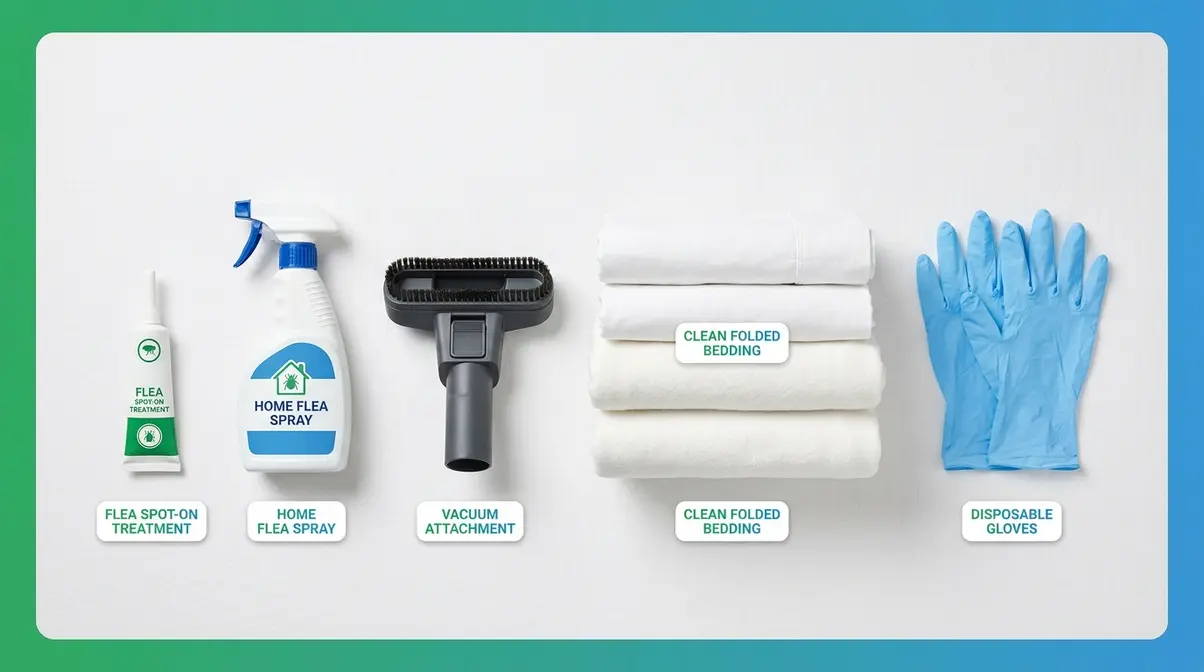
Gather these items before beginning, so you’re not scrambling mid-treatment. Here’s what you need and why each item matters:
- A vet-approved flea treatment for your cat — a spot-on treatment (a liquid applied directly to the skin), an oral tablet, or a flea collar. Step 2 explains exactly which to choose.
- A home flea spray or fogger containing an IGR — an IGR, or Insect Growth Regulator, is a chemical that prevents flea eggs from hatching. Without one, eggs already in your carpets will hatch and restart the infestation.
- A vacuum cleaner — with a disposable bag or a bagless model with an empty canister. Vacuuming removes up to 60% of flea eggs from carpets before you spray.
- Access to a washing machine — set to a hot cycle of at least 60°C (140°F). This temperature kills all flea life stages in bedding and soft furnishings.
- Disposable gloves — for applying topical treatments safely, particularly if you have multiple pets.
Estimated time: The full initial protocol takes 2–4 hours. After that, monthly prevention takes just 5 minutes.
Call your vet immediately before using any product if your cat is under 8 weeks old, pregnant, nursing, or has any underlying health conditions. Many flea treatments are contraindicated in these cases.
Step 1: Why Fleas Are Hard to Eliminate
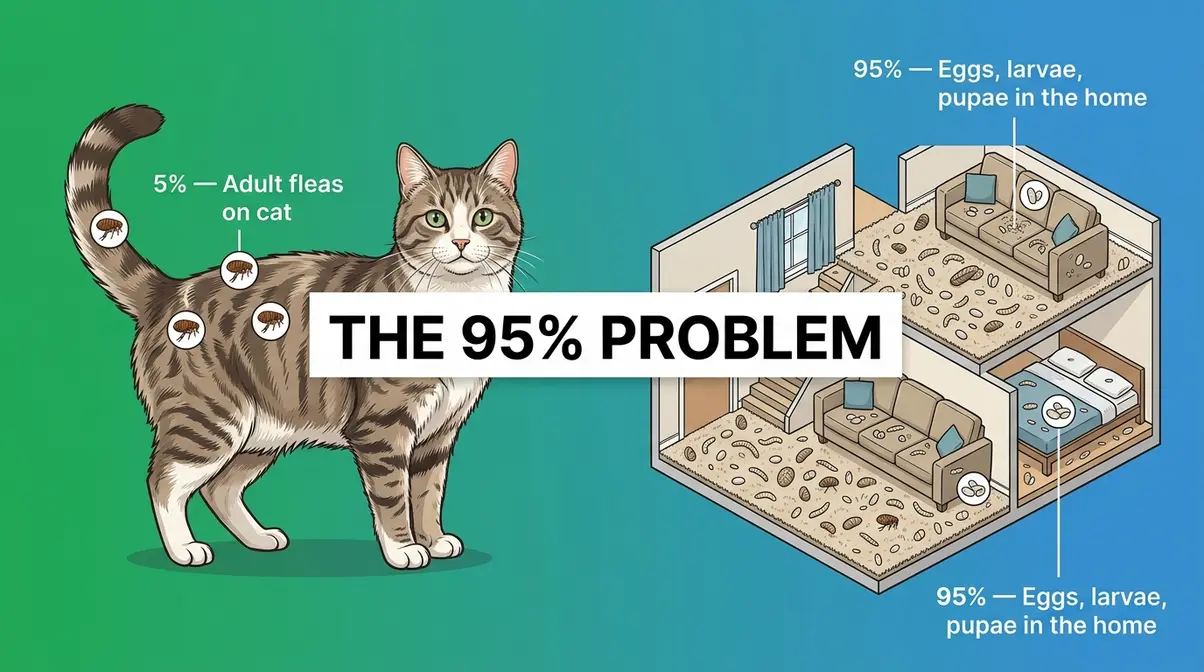
The 95% Problem is the core insight that changes everything about how you approach flea control in cats. According to the Cornell Feline Health Center, a single female cat flea can lay up to 50 eggs per day within 24 hours of her first blood meal — meaning one undetected flea can seed your home with 1,500 eggs in just 30 days. Treating only your cat while leaving those eggs untouched guarantees the infestation will return.
What Is the Flea Life Cycle?
The cat flea — Ctenocephalides felis, the species responsible for virtually all flea infestations on domestic cats — has four distinct life stages. Understanding them is essential to breaking the cycle for good.
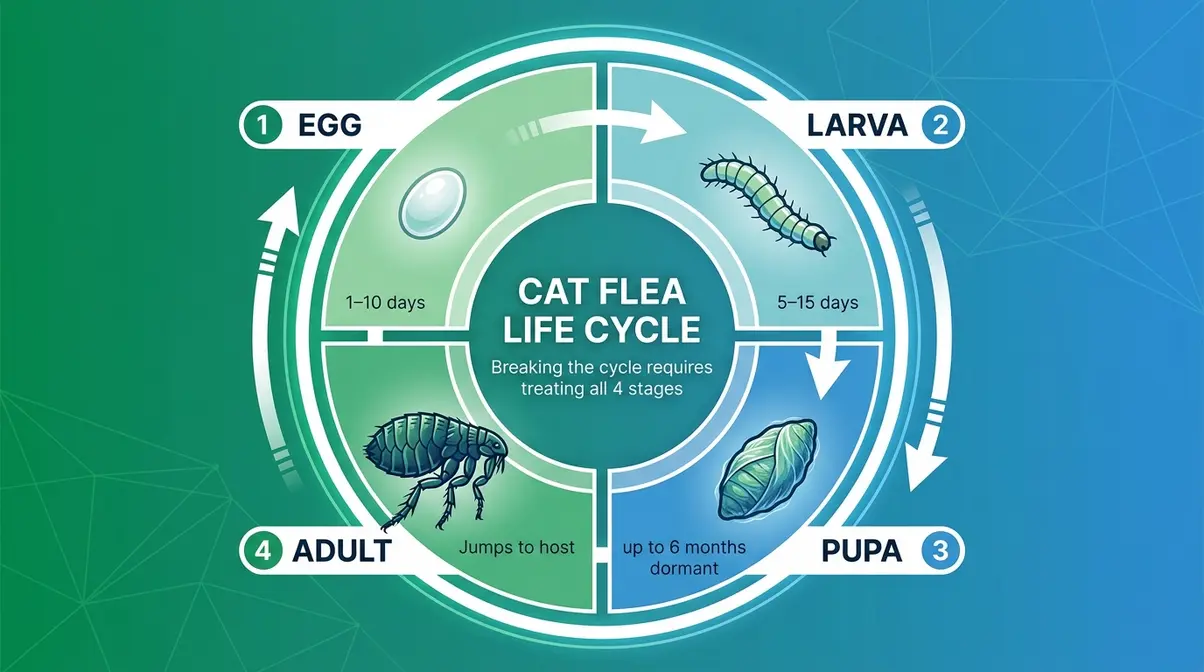
As the diagram above shows, the four stages are:
- Egg (1–10 days to hatch): Laid on your cat but not sticky — they fall off into carpets, bedding, and furniture within minutes. This is how the home becomes infested.
- Larva (5–15 days): The worm-like hatched flea that feeds on organic debris, including adult flea feces. Larvae burrow deep into carpet fibers to avoid light.
- Pupa (up to 6 months dormant): The cocoon stage of the flea life cycle. This is the hardest stage to kill. Flea pupae are resistant to most insecticides and can lie dormant for up to 6 months, emerging only when they detect warmth, vibration, and carbon dioxide — the signals of a nearby host. According to University of Florida Entomology, this dormancy is precisely why infestations “come back” weeks after treatment that appeared to work.
- Adult: Jumps onto a host within seconds of emerging from the cocoon. Adults make up just 5% of the total flea population in an infested home.
This is The 95% Problem in numbers: if your cat has 50 fleas, your home likely contains up to 1,000 eggs and larvae in carpets, furniture, and bedding. Treating your cat alone removes the 5%. It leaves the 95% completely untouched.
Why this matters: You must break the flea life cycle at every stage — egg, larva, pupa, and adult — using a combination of cat treatment and environmental control applied at the same time.
Signs Your Cat Has Fleas
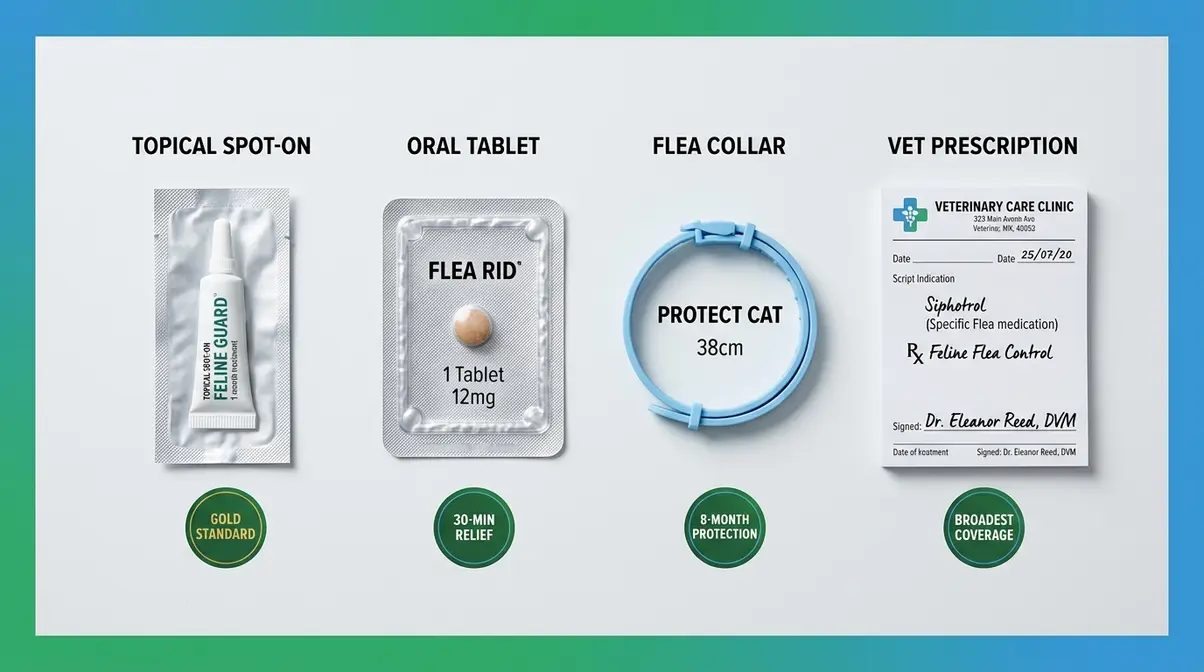
Before you treat, confirm the infestation. These are the most reliable signs to look for:
- Excessive scratching, grooming, or biting — especially around the neck, base of the tail, and belly, where fleas prefer to feed
- Flea dirt (flea feces): looks like black pepper scattered on the skin and coat. Run the definitive test: place some specks on a damp white paper towel. If they dissolve into reddish-brown streaks, that’s dried blood — it’s flea dirt, not regular dirt
- Visible fleas: small (1–2mm), dark brown, fast-moving insects that jump when disturbed. Part the fur at the base of the tail and look for movement
- Hair loss or skin irritation: caused by flea allergy dermatitis (FAD — an allergic reaction to flea saliva), a common secondary complication
- Pale gums: in heavy infestations, particularly in kittens, fleas can cause anemia through significant blood loss — a veterinary emergency
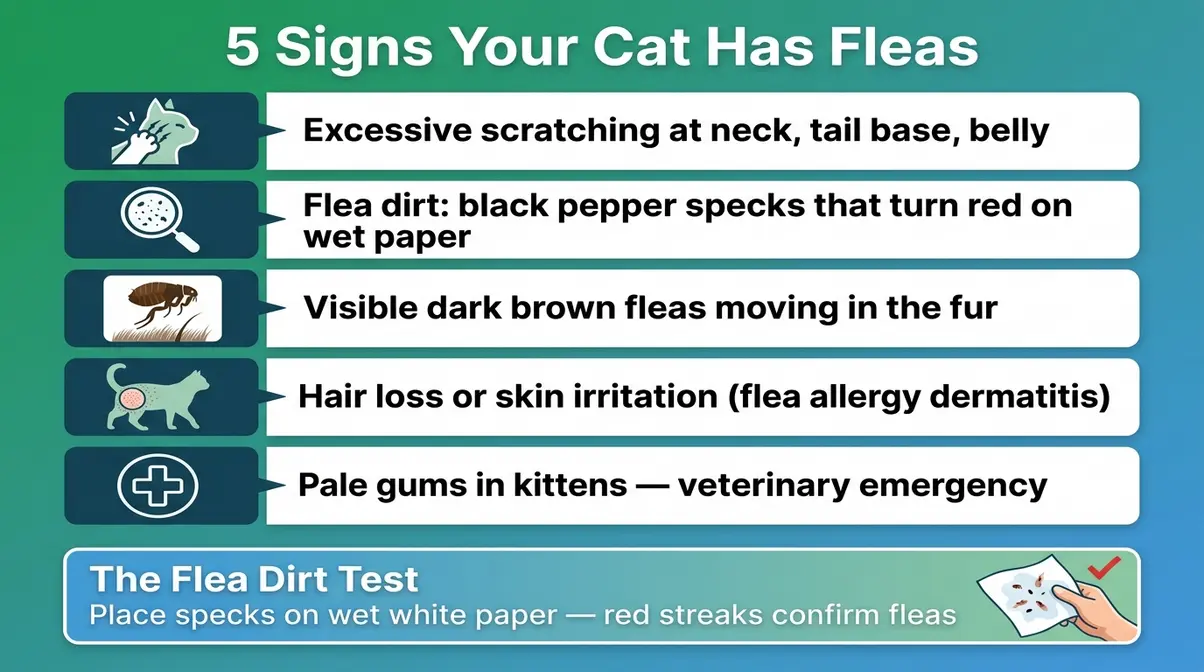
Check your cat’s belly and the base of its tail — these are the warmest areas where fleas congregate. Part the fur with your fingers and look for movement or dark specks. According to VCA Hospitals, flea allergy dermatitis is one of the most common skin conditions seen in cats, triggered by even a single flea bite in sensitized individuals.
How Cats Get Fleas (Including Indoor Cats)
Many owners are confused — and sometimes dismissive — when their indoor-only cat turns up with fleas. Here’s how it happens:
Outdoor routes: Direct contact with other animals (cats, dogs, foxes, rabbits, or hedgehogs), or exposure to flea-infested grass, soil, or garden areas where wildlife rests.
Indoor routes: Fleas enter on human clothing and shoes, through open windows on warm days, or via other pets in the household. Even a single flea hitchhiking on your jeans from a friend’s house can seed an infestation within weeks.
The “empty house” problem: If you move into a previously pet-occupied home, dormant flea pupae in the carpets can hatch weeks later when they sense warmth and vibration from new occupants. This surprises many new homeowners who have never owned a pet.
The flea infestation is in the home long before you see a single flea on your cat. Recognizing this is the first step toward solving it permanently.
When Is Flea Season? (And Why Year-Round Prevention Matters)
Peak flea season runs from late summer through early fall — August through October in the Northern Hemisphere — when warm temperatures and high humidity accelerate the flea life cycle from egg to adult in as little as two weeks.
However, central heating changes the equation for indoor cats. A home kept at 20°C (68°F) year-round provides fleas with ideal breeding conditions in December and January just as readily as in August. The Companion Animal Parasite Council recommends year-round monthly flea prevention for all cats — including indoor-only cats — for this reason. Flea control in cats is not a seasonal task; it’s a year-round commitment.
Checkpoint: You should now understand the 4 stages of the flea life cycle, why The 95% Problem means your home needs treatment alongside your cat, and how fleas reach even indoor-only cats.
Step 2: Choose the Right Flea Treatment for Your Cat
Choosing the correct product is the single most important decision in this process. The right treatment for your cat depends on her age, weight, health status, and whether you need immediate relief or long-term prevention. Veterinarians recommend selecting a product that addresses multiple life stages of the flea — not just adult fleas — to break the flea life cycle completely.
Topical Spot-On Treatments: The Gold Standard
Spot-on treatments — liquids applied directly to the skin at the back of the neck — are the most widely recommended form of flea control in cats by veterinary professionals. They work by distributing an active ingredient across the skin’s oil layer, killing adult fleas on contact or through ingestion.
Vet-recommended options include:
| Product | Active Ingredient | What It Targets | Prescription? |
|---|---|---|---|
| Revolution Plus | Selamectin + sarolaner | Fleas, ticks, ear mites, roundworm, hookworm, heartworm | Yes |
| Bravecto Plus | Fluralaner + moxidectin | Fleas, ticks, heartworm, roundworm, hookworm | Yes |
| Advantage II | Imidacloprid + pyriproxyfen | Adult fleas + larvae + eggs (IGR included) | No (OTC) |
| Frontline Plus | Fipronil + (S)-methoprene | Adult fleas + eggs + larvae | No (OTC) |
Prescription-only topicals like Revolution Plus and Bravecto Plus offer broader coverage — including internal parasites — and are generally more effective than OTC alternatives, according to a recent 2026 review published via NCBI/PMC. Apply monthly (or per the product label) to maintain continuous protection.
One quotable fact: “Veterinarian-prescribed spot-on treatments containing selamectin or fluralaner kill adult fleas within 24–48 hours and prevent egg hatching for a full 30 days.”
Oral Flea Tablets: What Kills Fleas in 30 Minutes
When you need to kill the adult fleas on your cat immediately — within 30 minutes — oral tablets are the fastest option available.
Nitenpyram (the active ingredient in Capstar) is a short-acting oral insecticide that kills adult fleas within 30 minutes of ingestion. It’s safe for cats and kittens over 4 weeks old and weighing more than 0.9kg (2lbs), and it works within a single dose. However, nitenpyram has no residual effect — it clears from the body within 24 hours and does nothing to prevent larval development or egg hatching.
Think of Capstar as your emergency tool: it kills the adult fleas on your cat right now, while a longer-acting topical or collar handles the ongoing cycle. According to PetMD, combining a fast-acting oral tablet with a monthly spot-on treatment is a common veterinary recommendation for active infestations.
Flea Collars: Long-Term Protection
Modern flea collars — particularly the Seresto collar — provide continuous protection for up to 8 months by releasing low-level doses of imidacloprid and flumethrin across the coat. They’re a practical option for cats whose owners struggle with monthly topical application.
Older, cheaper flea collars (often sold in grocery stores) rely on older chemical families and are generally less effective. If you choose a collar, ask your veterinarian to recommend a specific brand — not all collars are equal in efficacy or safety.
How to Choose: OTC vs. Prescription
The decision comes down to the severity of your infestation and your cat’s health profile:
- Active infestation + healthy adult cat: A prescription topical (Revolution Plus or Bravecto Plus) combined with a one-time Capstar tablet for immediate relief is the most effective approach
- Mild infestation + healthy adult cat: An OTC topical like Advantage II, combined with home treatment, is a reasonable starting point
- Kitten under 8 weeks, pregnant, or nursing cat: Do not use any product without explicit veterinary guidance — most flea treatments are unsafe in these cases
- Cat with health conditions: Always consult your vet — liver disease, neurological conditions, and certain medications affect which products are safe
According to the FDA’s guidance on flea and tick products, always read the full label before use and contact your veterinarian or the manufacturer’s poison control line if your cat shows any adverse reaction.
What is the most effective flea treatment for a cat?
Veterinarian-prescribed topical spot-on treatments are consistently rated the most effective flea control in cats by parasitology experts. Revolution Plus (selamectin + sarolaner) and Bravecto Plus (fluralaner + moxidectin) are among the most recommended options in 2026, offering both rapid adult flea kill (within 24–48 hours) and prevention of egg hatching for 30–90 days. For cats with active infestations, combining a fast-acting oral nitenpyram tablet for immediate relief with a monthly prescription topical for ongoing prevention is the approach most commonly recommended by veterinarians.
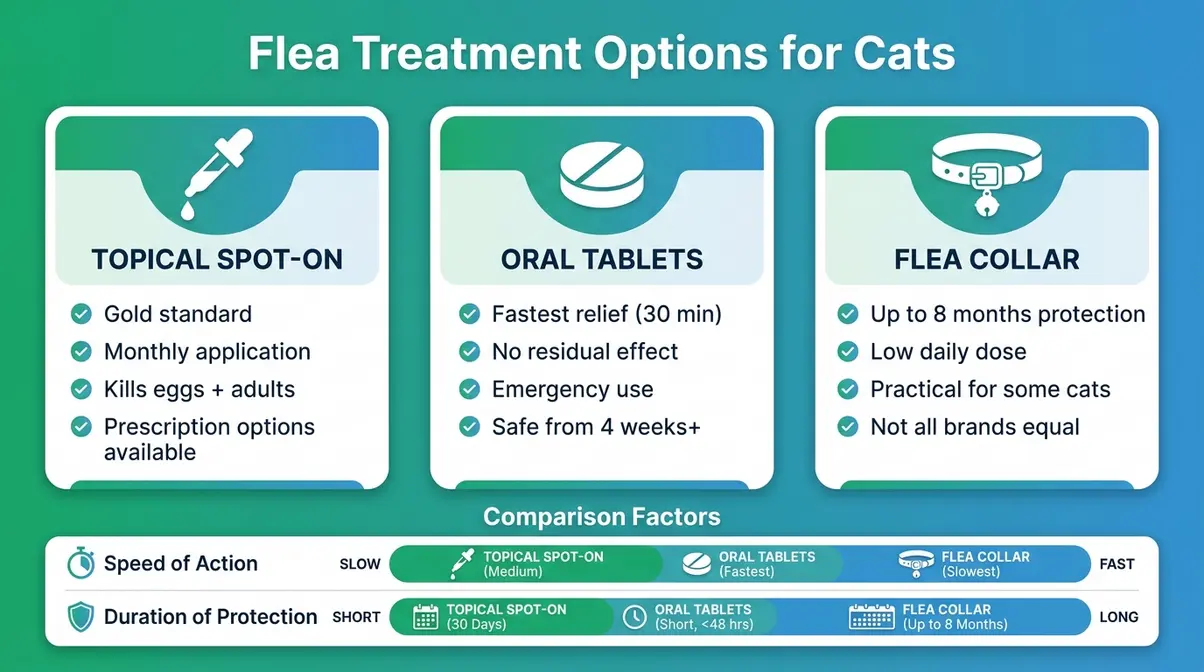
Checkpoint: You should now know which type of flea treatment suits your cat’s situation and be ready to purchase or obtain the correct product before moving to home treatment.
Step 3: Treat Your Home to Eliminate the Hidden 95%
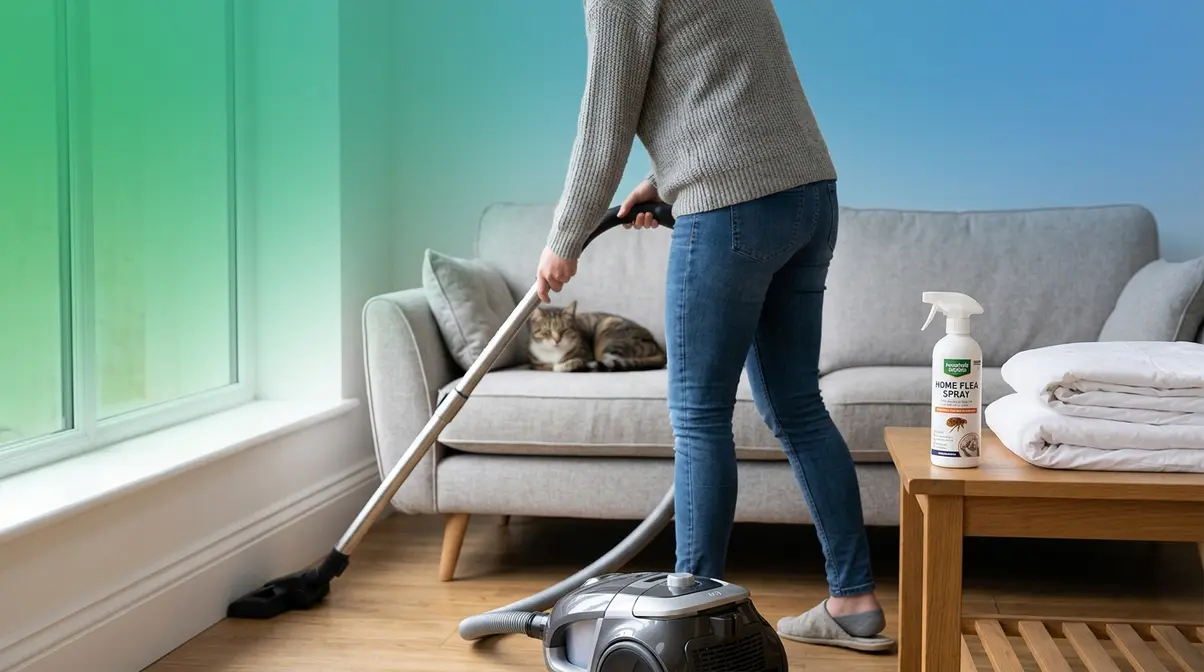
Here is the step most cat owners skip — and the reason their flea problem keeps returning. As veterinary professionals consistently emphasize:
“Treat your home — 95% of a flea infestation is in the home, this means that if your cat has fifty fleas on them, your home is likely to have up to one thousand.”
The 95% Problem is not a metaphor — it’s an arithmetic reality. Treating your cat without treating your home is like mopping the floor with the tap still running. This step and your cat’s treatment must happen on the same day, ideally within the same hour.
Vacuum Every Surface Thoroughly
Vacuum every carpeted room, every upholstered surface, and every area where your cat sleeps or rests. Pay particular attention to:
- Along skirting boards and under furniture, where larvae retreat from light
- Between sofa cushions and under cushion covers
- Any cat bedding, cat trees, or scratching posts
Why vacuuming works: The mechanical action of the vacuum removes up to 60% of flea eggs from carpet fibers before they can hatch. The heat and vibration of the vacuum also stimulates pupae to emerge from their cocoons — making them vulnerable to the spray you’ll apply next. Immediately after vacuuming, seal the bag and dispose of it outside, or empty the canister into an outdoor bin and wash the canister. A flea-filled vacuum bag left indoors will simply re-infest your home.
Wash All Bedding and Soft Furnishings
Strip every piece of bedding — your cat’s and your own — and wash it at 60°C (140°F) or higher. This temperature kills all stages of the flea life cycle within one wash cycle. Include:
- Cat beds, blankets, and soft toys
- Your own bedding, pillowcases, and throws if your cat sleeps on your bed
- Removable sofa covers and cushion covers
Items that cannot be washed at 60°C — such as delicate fabrics — can be placed in a dryer on a high heat setting for 30 minutes, which achieves the same effect. According to CDC guidance on flea prevention, laundering at high temperatures remains one of the most effective non-chemical methods of flea control.
Use a Home Flea Spray or Fogger
After vacuuming and before replacing any bedding, treat all floor surfaces, carpet edges, and upholstered furniture with a home flea spray containing an IGR — an Insect Growth Regulator, a chemical that mimics a juvenile hormone in fleas and prevents eggs from developing into adults.
Products to look for: Sprays containing permethrin (for use in the home environment, not on cats) combined with methoprene or pyriproxyfen as the IGR. Indorex, RIP Fleas, and Acclaim are widely used veterinary-recommended home sprays in the UK; Vet’s Best and Adams Flea & Tick Home Spray are common options in the US.
- Application tips:
- Remove your cat (and any other pets) from the room before spraying
- Spray all carpets, rugs, skirting boards, under furniture, and upholstered surfaces
- Allow the treated room to air for at least 1 hour before allowing pets back in
- Do not wash treated surfaces for at least 2 weeks — the IGR needs time to work
Foggers (flea bombs) can treat an entire room at once but often fail to penetrate under furniture and into crevices where larvae hide. A spray applied by hand is generally more thorough.
Don’t Forget the Yard
If your cat has any outdoor access, treat the garden as well — particularly shaded, moist areas under shrubs, decking, and around outbuildings where wildlife rests. Outdoor flea sprays containing permethrin can be applied to these areas. Keep your cat indoors until the treated areas are fully dry.
According to CDC guidance, keeping grass trimmed short and removing leaf litter significantly reduces the flea habitat in gardens, lowering re-infestation risk without chemical intervention.
Checkpoint: You should now have vacuumed all surfaces, washed all bedding at 60°C, applied a home flea spray with IGR, and (if applicable) treated your outdoor areas. Your home treatment and your cat’s treatment should happen on the same day.
Step 4: Apply Flea Treatment Safely
Correct application is not optional — applying a topical treatment to the wrong location, or using the wrong product entirely, can make it ineffective or dangerous. This step walks you through the process precisely.
How to Apply Topical Spot-On Treatment: Step by Step
Tools/materials needed: Gloves, the correct spot-on product for your cat’s weight, a towel. Estimated time: ~3 minutes.
- Part the fur at the base of the skull — find the area between the shoulder blades and the base of the neck, where your cat cannot reach to lick. This location is critical: if your cat licks the product, it can cause excessive drooling and nausea.
- Put on your gloves before opening the applicator tube.
- Snap or twist the tip of the applicator as directed on the packaging to open it.
- Apply the entire contents directly to the skin — not onto the fur. Press the tip firmly against the parted fur and squeeze steadily until the tube is empty. For larger cats, some products direct you to apply across two or three spots along the spine.
- Do not touch the treated area until it has dried completely — typically 24 hours. Keep children away from the cat during this time.
- Do not bathe your cat or allow it to get wet for at least 48 hours after application — water reduces absorption.
Critical Safety Rules: Permethrin, Kittens, and Multi-Pet Households
⚠️ PERMETHRIN WARNING — LIFE SAFETY
Never use any flea product labelled for dogs on a cat. Many dog flea treatments contain permethrin — a synthetic pyrethroid insecticide that dogs can safely metabolize but that is potentially fatal to cats. According to the FDA’s consumer safety guidance, permethrin exposure in cats causes tremors, seizures, hyperthermia, and can be fatal within hours without emergency veterinary treatment.
Signs of permethrin toxicity in cats include: muscle tremors, twitching, hypersalivation, difficulty walking, and seizures. If you observe any of these after applying a product, wash the product off immediately with washing-up liquid and take your cat to an emergency vet without delay.
Additional safety rules:
- Kittens under 8 weeks: Most topical treatments are unsafe. Consult your vet for age-appropriate options — some products are safe from 6 weeks, others only from 8 or 12 weeks. Always check the label minimum age.
- Multi-pet households: If you have both cats and dogs, keep them separated for at least 24 hours after applying any permethrin-based product to the dog. A dog that has just been treated with a permethrin-containing product can transfer toxic levels to a cat through grooming contact.
- Pregnant or nursing cats: Most systemic flea treatments are contraindicated. Your vet can advise on safer options.
- Never apply two products simultaneously — using a spot-on and a flea collar together, for example, can cause overdose.
Checkpoint: You should now have applied your cat’s flea treatment correctly and safely. If you noticed any adverse reaction, contact your vet or the Animal Poison Control Center immediately.
Step 5: Avoid These Dangerous Home Remedy Mistakes
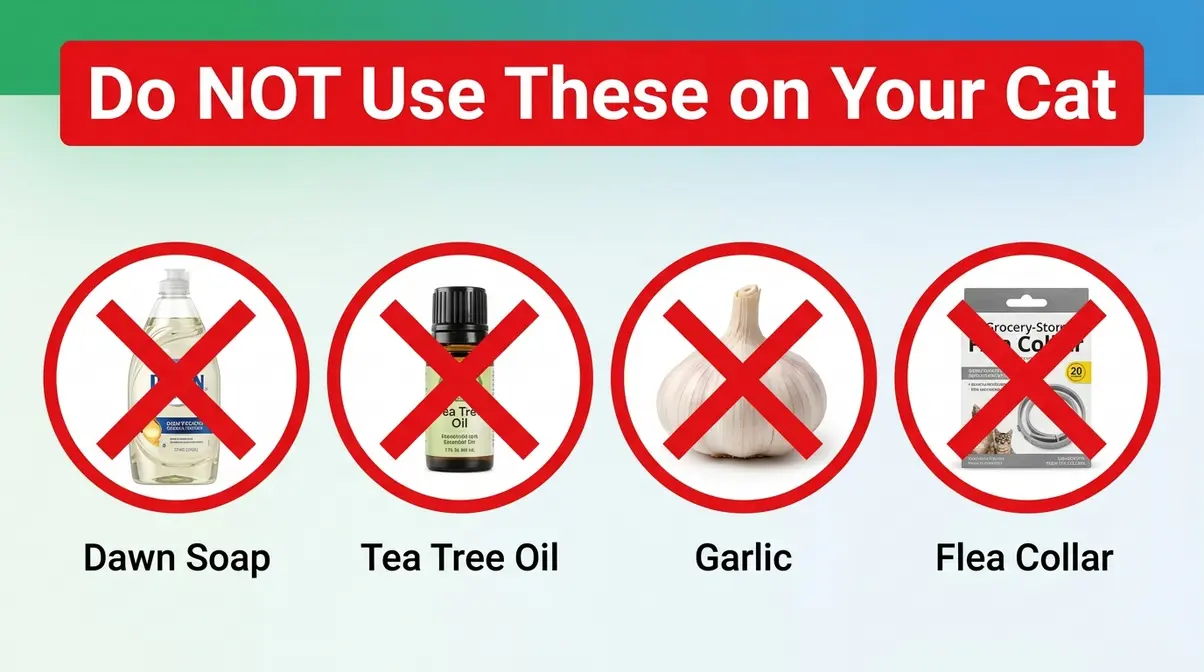
When cat owners are anxious and searching for answers, they often encounter home remedy advice online that ranges from ineffective to genuinely dangerous. This step addresses the most common myths directly — because one wrong decision here can seriously harm your cat.
Does Dawn Dish Soap Kill Fleas? The Truth
Yes — but with serious caveats. Dawn dish soap (or any mild dish soap) can kill adult fleas on contact by breaking the surface tension of the water and causing fleas to drown. Bathing a heavily infested cat in diluted dish soap will physically remove and kill many adult fleas in the short term.
However, dish soap has no residual effect whatsoever. The moment you rinse your cat, the protection is gone. It does nothing to kill eggs, larvae, or pupae — meaning within days, newly hatched fleas will reinfest your cat from the environment.
More importantly, frequent bathing with dish soap strips the natural oils from your cat’s coat and skin, potentially causing dryness, irritation, and skin barrier damage. The ASPCA Animal Poison Control Center notes that while dish soap is not acutely toxic to cats, it is not a substitute for veterinary-approved flea treatment.
The verdict: Dish soap is a temporary emergency measure at best — appropriate only if you have nothing else available right now and your cat is heavily infested. Always follow up immediately with a proper veterinary-approved treatment. Do not use it as a routine flea control method.
Are Essential Oils Safe for Cats? (No — Here’s Why)
Essential oils are frequently promoted online as “natural” flea repellents. They are not safe for cats. Cats lack the liver enzyme (glucuronyl transferase) needed to metabolize many of the compounds found in essential oils — meaning these substances accumulate to toxic levels rather than being safely excreted.
- Oils that are toxic to cats include:
- Tea tree oil (melaleuca)
- Lavender oil
- Eucalyptus oil
- Peppermint oil
- Pennyroyal oil (particularly dangerous — known to cause liver failure)
- Citrus-based oils (limonene, linalool)
The ASPCA Animal Poison Control Center lists many essential oils as toxic to cats, with symptoms ranging from drooling and vomiting to tremors, respiratory distress, and liver failure. The fact that an oil is “natural” does not mean it is safe — many natural compounds are acutely toxic to felines specifically because of their unique metabolic profile.
What do fleas hate the most? Fleas are repelled by certain scents, but no essential oil is safe or effective enough to justify the risk to your cat. The answer to this question is a veterinary-approved flea preventative — not aromatherapy.
What About Garlic, Brewer’s Yeast, and “Amish” Remedies?
These remedies have circulated online for years, often framed as traditional or “chemical-free” alternatives. The evidence does not support their use, and some are actively dangerous.
Garlic: Garlic and all members of the allium family (onions, leeks, chives) are toxic to cats. They contain thiosulphate compounds that damage red blood cells and cause hemolytic anemia — a potentially life-threatening condition. There is no credible veterinary evidence that garlic repels fleas on cats, and the toxic risk is real even in small amounts.
Brewer’s yeast: While brewer’s yeast is sometimes cited as a flea deterrent (based on the theory that the B vitamins it contains make the skin less attractive to fleas), there is no peer-reviewed evidence to support its efficacy. It is not acutely toxic in small amounts, but it is also not effective.
“Amish” flea remedies: Recipes circulating online under this label typically contain combinations of garlic, essential oils, or vinegar. None have evidence of efficacy, and several contain ingredients that are toxic to cats as described above. The “Amish” label is marketing, not medicine.
What Actually Works (Safe Alternatives)
If you want to minimize chemical exposure, here are genuinely safer options that still carry veterinary support:
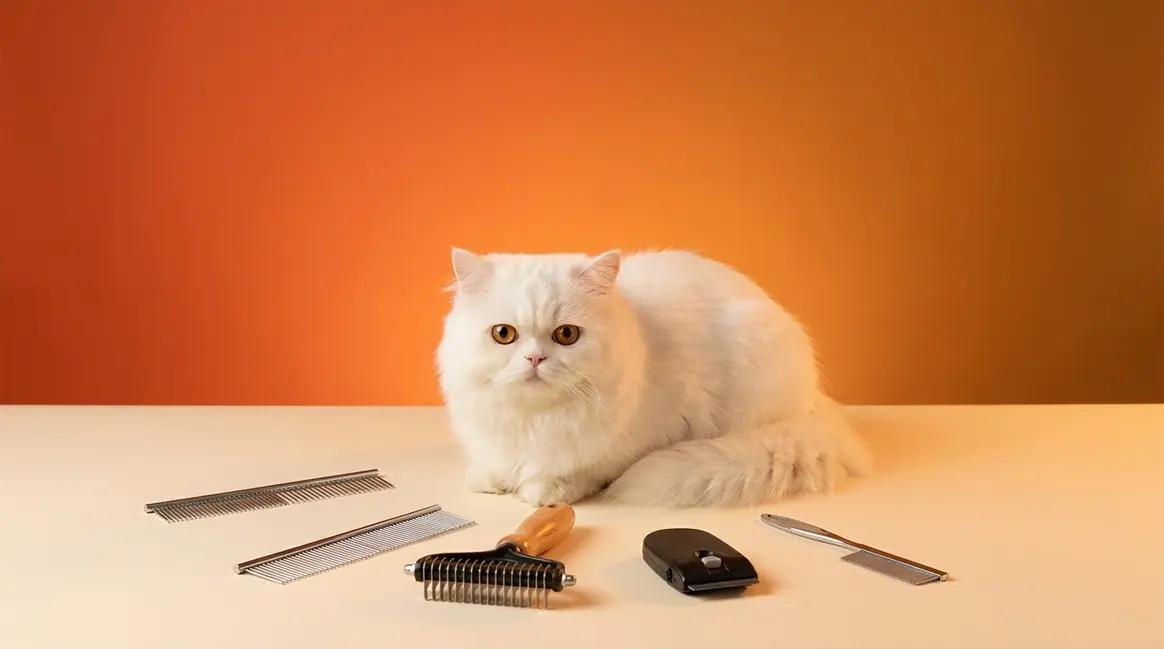
- Frequent combing with a fine-toothed flea comb: Physically removes adult fleas and flea dirt. Dip the comb in soapy water after each pass to kill removed fleas. Not sufficient as a standalone treatment for active infestations, but a useful supplement.
- Frequent vacuuming and hot-wash laundering: As described in Step 3 — these are effective, non-chemical environmental controls.
- Capstar (nitenpyram): A fast-acting oral tablet with a well-established safety profile, considered low-risk for most healthy adult cats.
The FDA’s safe use guidance emphasizes that veterinary-approved products undergo rigorous safety testing that home remedies simply do not. When in doubt, “chemical-free” home remedies carry more unknown risk than tested, approved medications — not less.
Checkpoint: You should now be able to identify dangerous home remedies and understand why veterinary-approved treatments are the safer choice, even for owners who prefer minimal chemical use.
Step 6: Address Lungworm and Co-infections
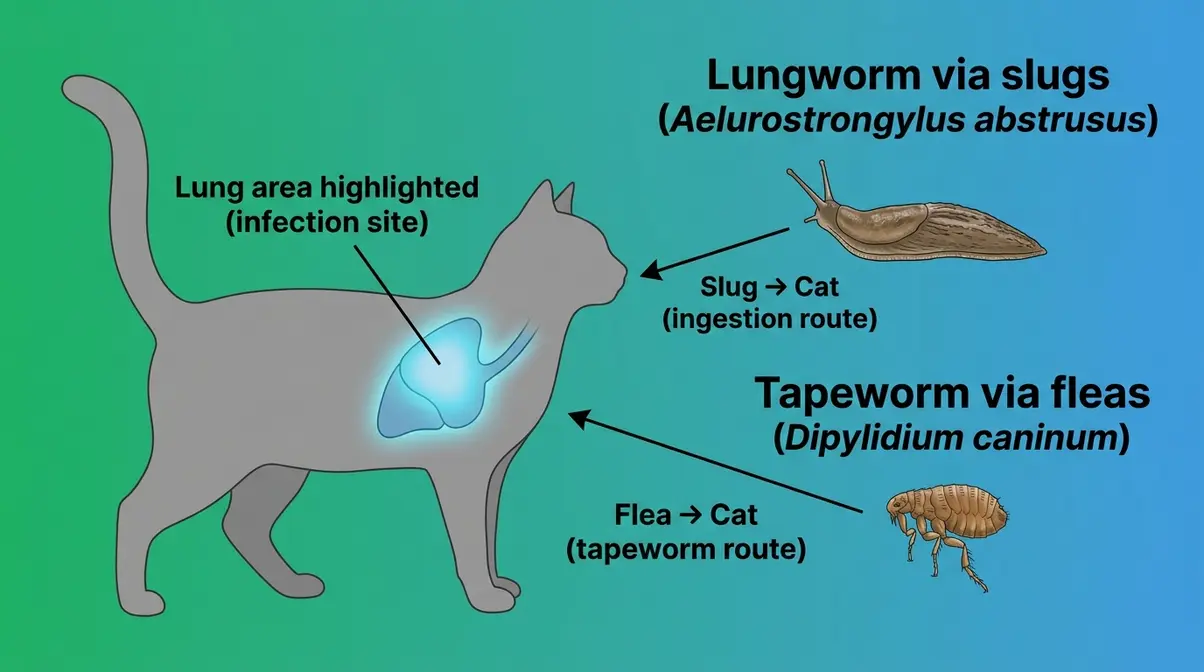
Fleas are not just a skin problem. They are vectors for secondary infections that many cat owners — and even some online guides — overlook entirely. This step covers the most clinically significant secondary risk: lungworm.
What Is Lungworm and How Do Indoor Cats Get It?
Lungworm (primarily Aelurostrongylus abstrusus in cats) is a parasitic worm that infects the lungs and airways, causing coughing, wheezing, and in severe cases, respiratory distress. It is not transmitted directly by fleas — but the connection between fleas and lungworm is indirect and important.
The lungworm lifecycle involves intermediate hosts: slugs and snails carry infective lungworm larvae. Cats become infected by eating an infected slug or snail — or by eating a small animal (a bird or mouse) that has itself eaten an infected slug.
How do indoor cats get lungworm? More easily than most owners realize:
- A slug entering the home through a gap under a door or a low window at night — not uncommon in damp conditions — can be eaten by a curious cat
- A cat with any outdoor access, even brief supervised access, can encounter infected slugs in the garden
- Cats that hunt and bring prey indoors may consume infected intermediate hosts without the owner witnessing it
A recent 2026 study published via NCBI/PMC highlights the increasing geographic spread of Aelurostrongylus abstrusus across Europe and North America, with veterinarians reporting cases in cats previously considered at low risk. Symptoms of lungworm include a persistent cough, lethargy, weight loss, and in severe cases, open-mouth breathing. If your cat shows these signs, contact your vet promptly — lungworm is diagnosed via a fecal test or bronchoscopy and is treatable when caught early.
Additionally, fleas transmit Dipylidium caninum — the tapeworm — directly. Cats become infected by swallowing an infected flea during grooming. If you see small, rice-like segments around your cat’s tail or in her bedding, tapeworm treatment is also needed alongside flea control.
Which Flea Treatments Also Cover Lungworm?
This is one of the most important questions cat owners ask — and one that most online guides fail to answer clearly. Not all flea treatments cover internal parasites.
Products that cover both fleas AND lungworm:
| Product | Flea Coverage | Lungworm Coverage | Prescription? |
|---|---|---|---|
| Bravecto Plus | ✅ Yes | ✅ Yes (A. abstrusus) | Yes |
| Revolution Plus | ✅ Yes | ✅ Yes (roundworm, hookworm) | Yes |
| Advocate (Advantage Multi) | ✅ Yes | ✅ Yes (A. abstrusus) | Yes |
| Stronghold Plus | ✅ Yes | ✅ Yes | Yes |
Standard OTC flea treatments — Frontline Plus, Advantage II, most flea collars — do not cover lungworm or tapeworm. If your cat has any outdoor access or hunts, a prescription-only broad-spectrum parasiticide is strongly recommended over an OTC product.
According to PetMD, veterinarians increasingly recommend combination products that address fleas, ticks, heartworm, and internal parasites in a single monthly application — simplifying the prevention protocol and reducing the risk of missed coverage.
What do vets use for fleas and worms?
In clinical practice, veterinarians most commonly prescribe combination parasiticides that address fleas, ticks, and internal parasites in a single monthly application. Revolution Plus and Bravecto Plus are among the most frequently prescribed options for cats in 2026, covering fleas, ticks, heartworm, roundworm, hookworm, and (for Bravecto Plus) lungworm. For cats needing immediate flea kill alongside ongoing prevention, vets often recommend a one-time Capstar tablet followed by a monthly prescription topical. According to GoodRx Pet Health, combination products are increasingly preferred over single-parasite treatments for simplicity and comprehensive coverage.
Checkpoint: You should now understand the lungworm risk for indoor and outdoor cats, and know whether your chosen flea treatment covers internal parasites. If it doesn’t and your cat has any outdoor exposure, speak to your vet about upgrading to a combination product.
Common Mistakes and Limitations to Avoid
Common Pitfalls
1. Treating your cat but not your home — on the same day.
This is the most common mistake and the direct cause of most “my flea treatment isn’t working” complaints. The flea infestation is in the home. The cat treatment alone addresses only 5% of it. Both must be treated simultaneously.
2. Stopping treatment too early.
A single round of treatment rarely eliminates an established infestation. Flea pupae already in the environment will continue hatching for up to 3 months after initial treatment. Continue monthly cat treatment and re-vacuum weekly for at least 12 weeks.
3. Applying dog flea products to cats.
As detailed in Step 4, permethrin-containing dog products are potentially fatal to cats. This error sends thousands of cats to emergency vets each year. Check every label before applying any product to your cat.
4. Using multiple products simultaneously.
Combining a spot-on with a flea collar or a second oral tablet can cause chemical overdose. Use one product at a time unless your vet explicitly directs otherwise.
5. Treating only some rooms.
Flea larvae avoid light and scatter into every room of the home. Treating only the room where your cat sleeps leaves untreated populations in other areas.
When to Choose Alternatives
- If your cat has a known sensitivity to topicals: Ask your vet about oral alternatives like Bravecto (fluralaner) tablets, which provide 3 months of protection in a single dose.
- If you have a kitten under 8 weeks: Program (lufenuron) is an oral IGR sometimes used in very young kittens — only under veterinary supervision.
- If environmental sprays are not feasible (e.g., asthma in the household): A professional pest control service using low-toxicity IGR-based treatments is a safer alternative to aerosol foggers.
When to Seek Expert Help
- Contact your veterinarian immediately if:
- Your cat shows any signs of adverse reaction to a flea product (tremors, drooling, seizures)
- A kitten under 8 weeks is infested
- Your cat is pregnant, nursing, or has a serious health condition
- The infestation persists after 3 months of consistent treatment — this may indicate product resistance or an unidentified environmental reservoir
Frequently Asked Questions
What kills fleas immediately on cats?
Oral nitenpyram tablets (Capstar) kill adult fleas within 30 minutes of your cat swallowing them — the fastest option currently available. The active ingredient disrupts the flea’s nervous system almost instantly. However, nitenpyram has no residual effect and clears the body within 24 hours, so it must be followed up with a longer-acting monthly treatment like a topical spot-on. For cats that resist oral medication, some veterinarians recommend topical imidacloprid products (like Advantage II), which kill adult fleas within 12 hours of application.
What flea treatment covers lungworm?
Prescription-only combination products are the only flea treatments that also cover lungworm in cats. Advocate (Advantage Multi), Bravecto Plus, Revolution Plus, and Stronghold Plus all provide coverage against Aelurostrongylus abstrusus, the primary lungworm species affecting cats. Standard over-the-counter flea treatments — including Frontline Plus and most flea collars — do not cover lungworm. If your cat has any outdoor access or hunts, ask your vet specifically about a combination parasiticide rather than a flea-only product.
Does Dawn dish soap kill fleas?
Yes, Dawn dish soap kills adult fleas on contact by breaking the surface tension of water, causing them to drown during bathing. However, it has zero residual effect — fleas will reinfest your cat from the environment within hours of the bath. Frequent use also strips the natural oils from your cat’s coat, causing skin dryness and irritation. The ASPCA does not recommend dish soap as a flea treatment. It is acceptable as a one-time emergency measure when no approved product is available, but it must be followed immediately with a veterinary-approved treatment.
What do fleas hate the most on cats?
Fleas are repelled by certain scents — but no safe, effective natural repellent exists for use directly on cats. Essential oils frequently cited as flea deterrents (tea tree, lavender, eucalyptus, pennyroyal) are toxic to cats and must never be applied to them. The most effective “repellent” is a veterinary-approved monthly preventative that makes your cat’s blood toxic to fleas. Regular fine-toothed flea combing disrupts fleas mechanically and is safe to use alongside any approved treatment.
What time of year is worst for cat fleas?
Late summer through early fall — August to October in the Northern Hemisphere — is peak flea season, when warm temperatures and high humidity allow the flea life cycle to complete in as little as two weeks. However, indoor cats face year-round risk because central heating maintains temperatures warm enough for fleas to reproduce throughout winter. The Companion Animal Parasite Council recommends continuous monthly flea prevention for all cats regardless of season or whether they go outdoors.
How does an indoor cat get lungworm?
Indoor cats most commonly get lungworm by accidentally ingesting an infected slug or snail that has entered the home. Slugs can enter through gaps under doors, low windows, or through utility passages — particularly in damp conditions. A cat that finds and eats a slug overnight can become infected without the owner being aware. Cats that hunt and bring prey indoors may also ingest infected intermediate hosts. A recent 2026 study via NCBI/PMC found Aelurostrongylus abstrusus increasingly prevalent across Europe and North America, including in cats previously considered low-risk.
Your 6-Step Flea Control Protocol: What to Do Next
For cat owners dealing with an active flea infestation, The 95% Problem is the lens through which every decision should be made. A single female flea can lay 1,500 eggs in 30 days — and 95% of those eggs, larvae, and pupae are not on your cat. They are in your home. Treating your cat without treating your home is not a partial solution; it is almost no solution at all. According to the Cornell Feline Health Center, comprehensive environmental control is as important as the cat-directed treatment itself.
The 95% Problem framework also explains why persistence matters. Flea pupae in your carpets can hatch for up to 6 months after your initial treatment. This is not product failure — it is the biology of the flea life cycle working against you. Continuing monthly treatment and weekly vacuuming for at least 12 weeks after you first see results is the difference between solving the problem and cycling through it indefinitely.
Start today. Treat your cat and your home on the same day. Choose a veterinary-approved product appropriate for your cat’s age, weight, and health status — and if you have any doubt, call your vet before you apply anything. If your cat has outdoor access or shows any respiratory symptoms, ask specifically about combination products that cover lungworm alongside flea control. Trial your chosen monthly preventative for a full 3-month cycle before evaluating its effectiveness — and always consult your veterinarian if the infestation persists or your cat shows any adverse reaction.
⚠️ Medical Disclaimer: This guide is for educational purposes only and does not replace professional veterinary advice. Always consult a licensed veterinarian before starting any flea treatment, particularly for kittens, pregnant cats, or cats with health conditions. At madcatman.com, we recommend discussing your specific situation with your vet before selecting a product.

Dave King
Cat owner and writer at Mad Cat Man.