Is Alstroemeria Toxic to Cats? Vet-Approved Safety Guide
Get proven strategies for Alstroemeria Cat Safety: What to Do If Your Cat Nibbles Peruvian Lilies — Symptoms, Home Care & Safe Alternatives including…

⚠️ Important: This article provides general educational information only and is not a substitute for professional veterinary advice. If you believe your cat has ingested any plant and is showing signs of distress, contact your veterinarian or call the ASPCA Animal Poison Control Center at (888) 426-4435 immediately. In a life-threatening emergency, go to the nearest emergency animal hospital without delay.
Based on our evaluation of ASPCA poison control data, Alstroemeria — also called the Peruvian Lily — is mildly toxic to cats, but it is not the kidney-destroying emergency that true lilies represent. If your cat nibbled a few petals or leaves, they may experience temporary vomiting or loose stools. That’s uncomfortable, but it is not life-threatening. Take a breath. Then keep reading, because the distinction between alstroemeria and a genuine lily emergency is something every cat owner needs to understand.
The problem is that “lily” is one of the most dangerously overloaded words in the plant world. Florists call alstroemeria a lily. Garden centers sell “lily” bouquets that contain several unrelated species. And somewhere in that confusion, cat owners end up Googling “is alstroemeria toxic to cats” at midnight, convinced their pet is dying. This guide gives you a clear answer, a way to identify exactly what your cat ate, and a five-step action plan you can follow right now.
Alstroemeria (Peruvian Lily) is mildly toxic to cats — it causes temporary GI upset, not kidney failure. This is the core truth behind The Lily Misidentification Trap: confusing alstroemeria with true lilies (Lilium species) can send cat owners into unnecessary panic — or, dangerously, into false calm when a genuinely deadly plant is present.
- Mild symptoms only: Vomiting, diarrhea, and skin irritation are the typical reactions to alstroemeria exposure.
- True lilies are the real danger: Lilies from the Lilium genus (Tiger Lily, Easter Lily, Stargazer) cause acute kidney failure within 24–72 hours.
- Action matters: If symptoms persist beyond 24 hours or your cat stops drinking, call your vet immediately.
Why Alstroemeria Is Confused With Lilies
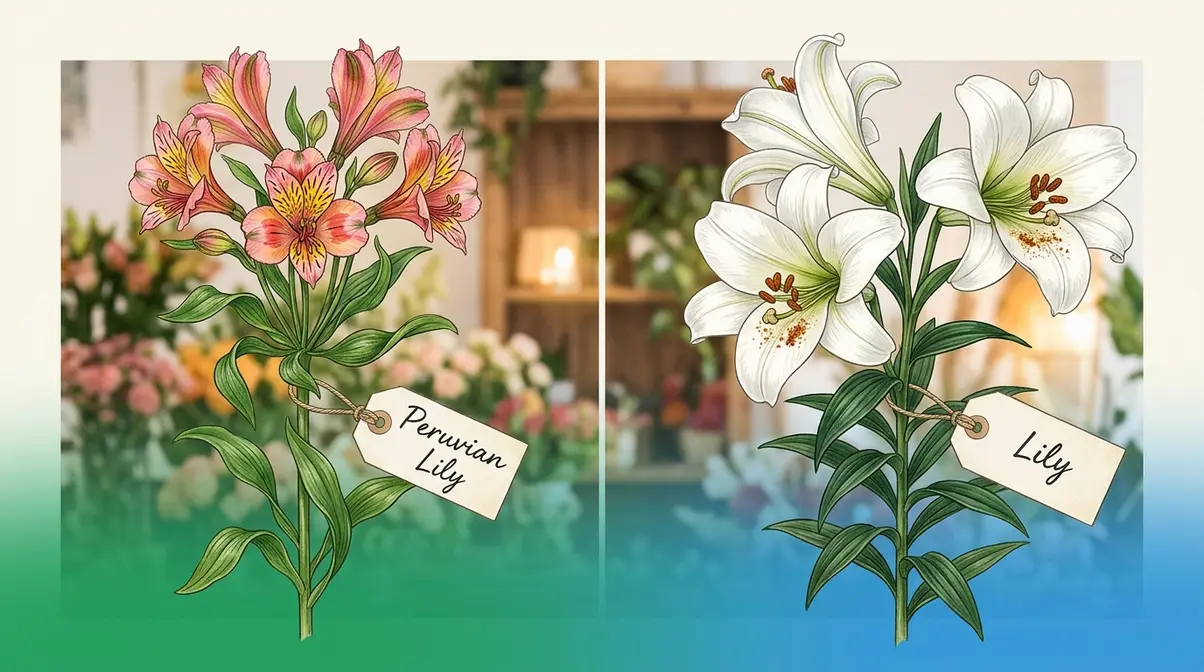
Alstroemeria is a flowering plant native to South America, widely sold in bouquets under the common name “Peruvian Lily” or “Lily of the Incas.” Despite sharing the word “lily” in its common name, it belongs to the family Alstroemeriaceae — a completely separate botanical family from the true lilies that pose fatal risks to cats.
The ASPCA’s Animal Poison Control Center classifies Alstroemeria as toxic to cats, dogs, and horses — but the toxicity level is mild, with gastrointestinal upset as the primary concern. This is a critical distinction from Lilium species (true lilies) and Hemerocallis species (daylilies), both of which cause acute renal failure and carry a high fatality rate in cats even in small doses.
The Lily Misidentification Trap is the dangerous gap between these two facts. A cat owner who sees “lily” in a plant name may either over-panic about a mild exposure — or, far more dangerously, under-react to a true lily ingestion because they assume all lilies behave the same way. Knowing the difference can genuinely save your cat’s life.
“Alstroemeria ingestion in cats typically results in self-limiting gastrointestinal signs — not the acute nephrotoxicity seen with Lilium or Hemerocallis species.” — consistent with ASPCA and Pet Poison Helpline classification guidance.
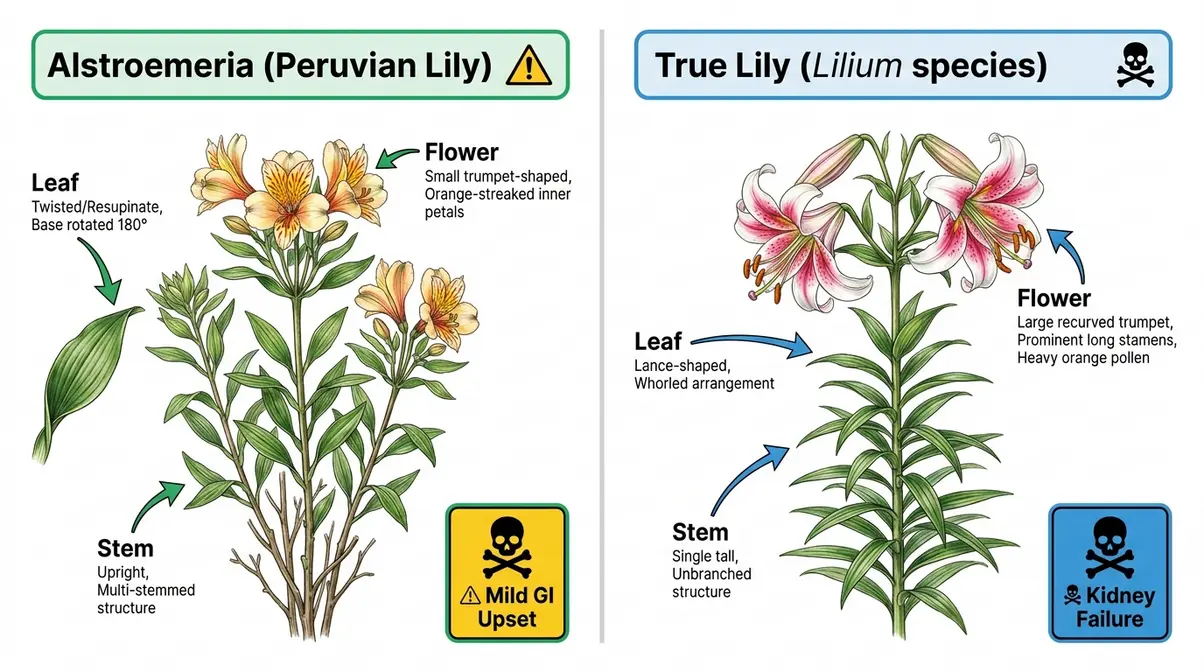
The Science Behind Alstroemeria’s Mild Toxicity
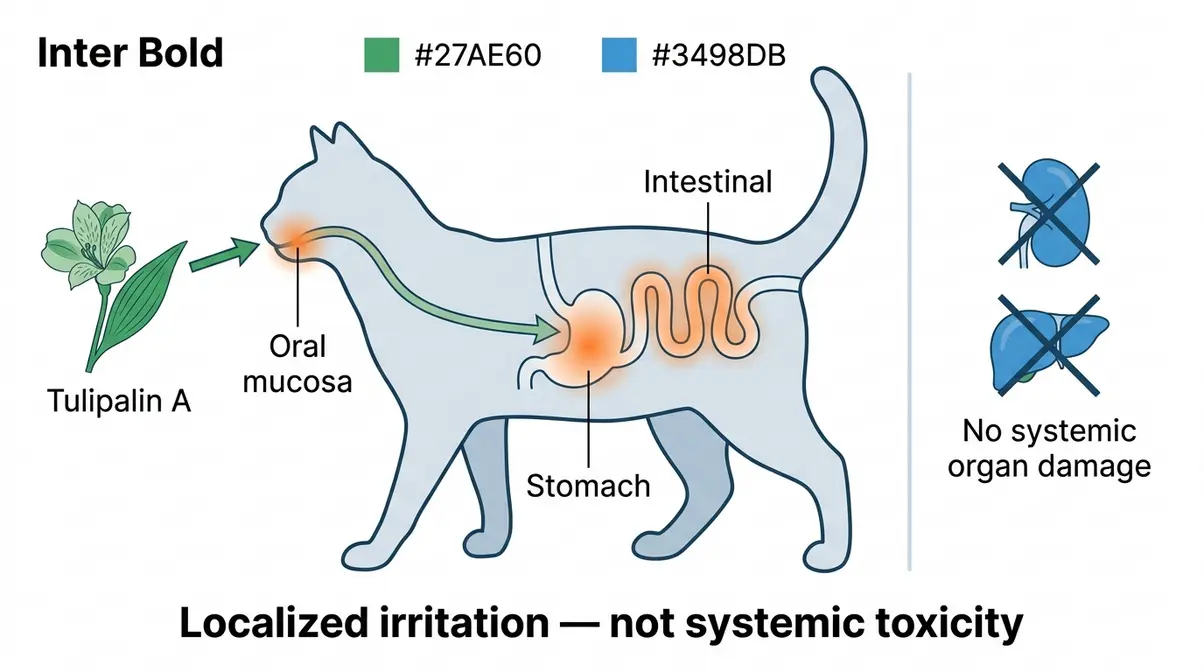
Alstroemeria contains a compound called Tulipalin A (a naturally occurring lactone found in several ornamental plants). When a cat chews alstroemeria leaves, stems, or flowers, Tulipalin A is released and can irritate the mucous membranes of the mouth, stomach, and intestines. It can also cause contact dermatitis — skin irritation — if the plant’s sap touches sensitive skin.
According to the Pet Poison Helpline’s classification of Peruvian Lily, the toxic mechanism is localized irritation rather than systemic organ damage. This means the compound does not travel through the bloodstream to attack the kidneys or liver the way true lily nephrotoxins do. The irritation stays where the plant touched — the mouth, the gut, and occasionally the skin.
Here is what that means in practical terms for your cat:
| Exposure Type | Likely Effect | Severity |
|---|---|---|
| Chewing leaves or flowers | Vomiting, drooling, mild diarrhea | Mild — typically self-limiting |
| Ingesting stems or roots | More pronounced GI upset | Mild-to-moderate |
| Skin contact with sap | Redness, itching, localized rash | Mild |
| Grooming pollen from fur | Possible mild GI irritation | Mild |
Most symptoms appear within one to three hours of ingestion and resolve on their own within 12 to 24 hours. Alstroemeria does not cause kidney failure, liver damage, or neurological effects in cats. That distinction separates it entirely from the true lilies that veterinary emergency rooms treat as life-threatening crises.
Will alstroemeria kill my cat?
Alstroemeria is very unlikely to kill a healthy adult cat. The ASPCA classifies it as mildly toxic, with effects limited to temporary gastrointestinal upset — vomiting, diarrhea, and drooling. These symptoms typically resolve within 12–24 hours without veterinary treatment. However, kittens, senior cats, or cats with underlying health conditions should always be assessed by a vet after any plant ingestion, as their tolerance may be lower.
True Lily vs. Peruvian Lily Identification
This is the most important section in the article. Before you do anything else, you need to confirm what plant your cat actually ate. The FDA guidance on lily toxicity in cats emphasizes that even a small amount of a true lily — a few petals, a leaf, or pollen licked from fur — can cause acute kidney failure in cats within 24 to 72 hours.
The Lily Misidentification Trap works both ways: it sends owners into panic over a mild plant, and it gives false reassurance about a deadly one. Use this guide to identify exactly what your cat encountered.
Identifying Alstroemeria (Mild)
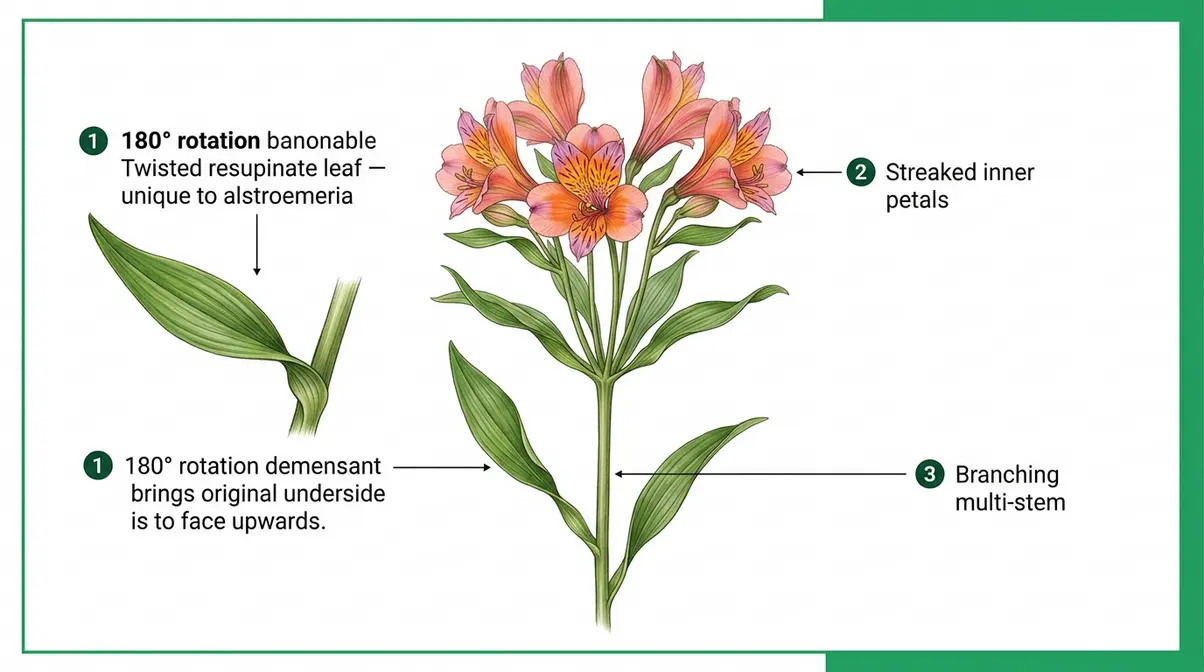
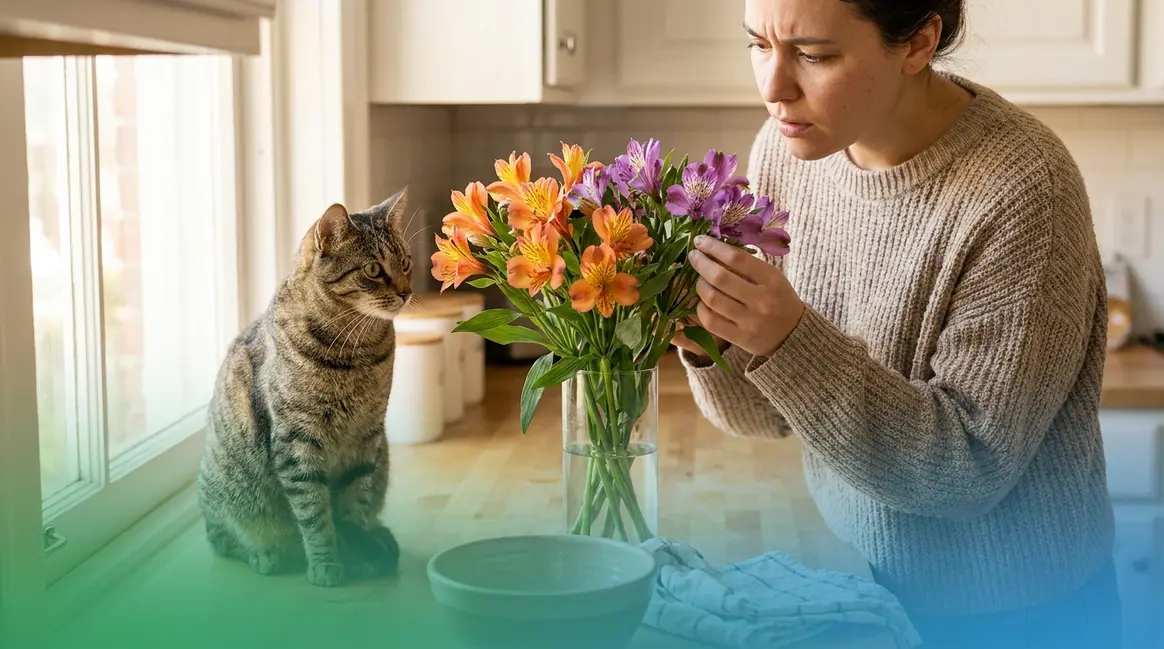
- Leaves: Twisted, or “resupinate” — the leaf base rotates 180°, so the underside faces up. This is the single most reliable identifier.
- Flowers: Small to medium-sized trumpet shape with six petals. Inner petals typically have dark streaks or spots in contrasting colors (orange, red, yellow, purple).
- Stems: Upright, branching, with multiple flower heads per stem.
- Height: Usually 18–36 inches tall in garden settings.
- Pollen: Relatively small stamens; pollen is not heavily produced.
Identifying True Lilies (Dangerous)
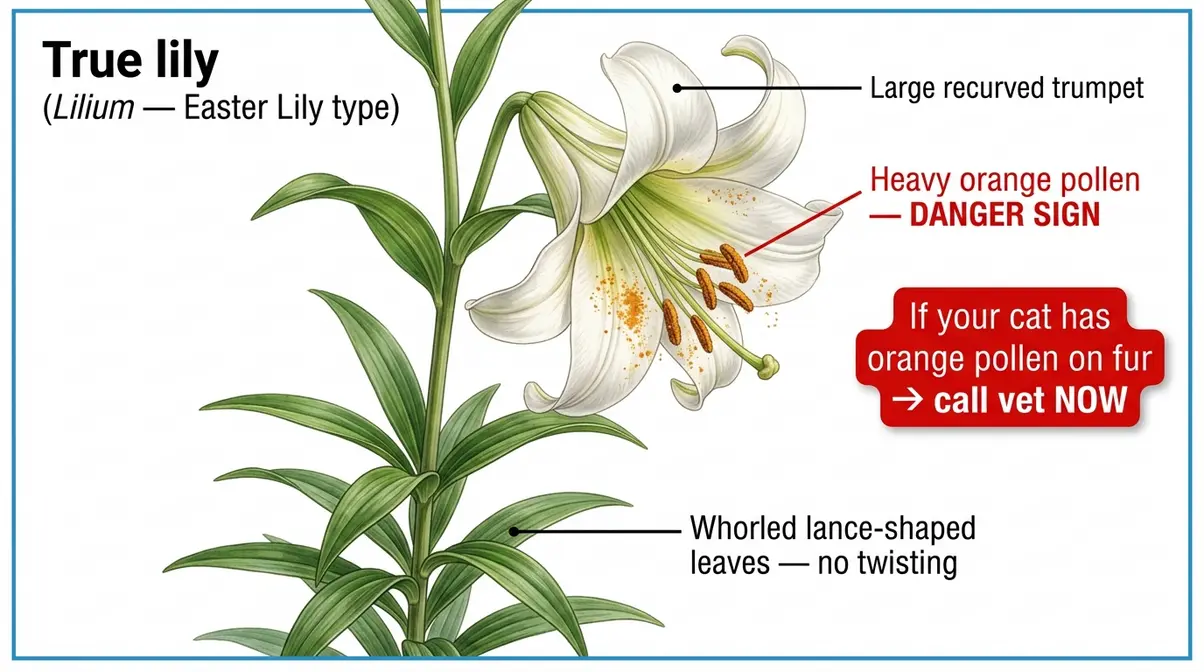
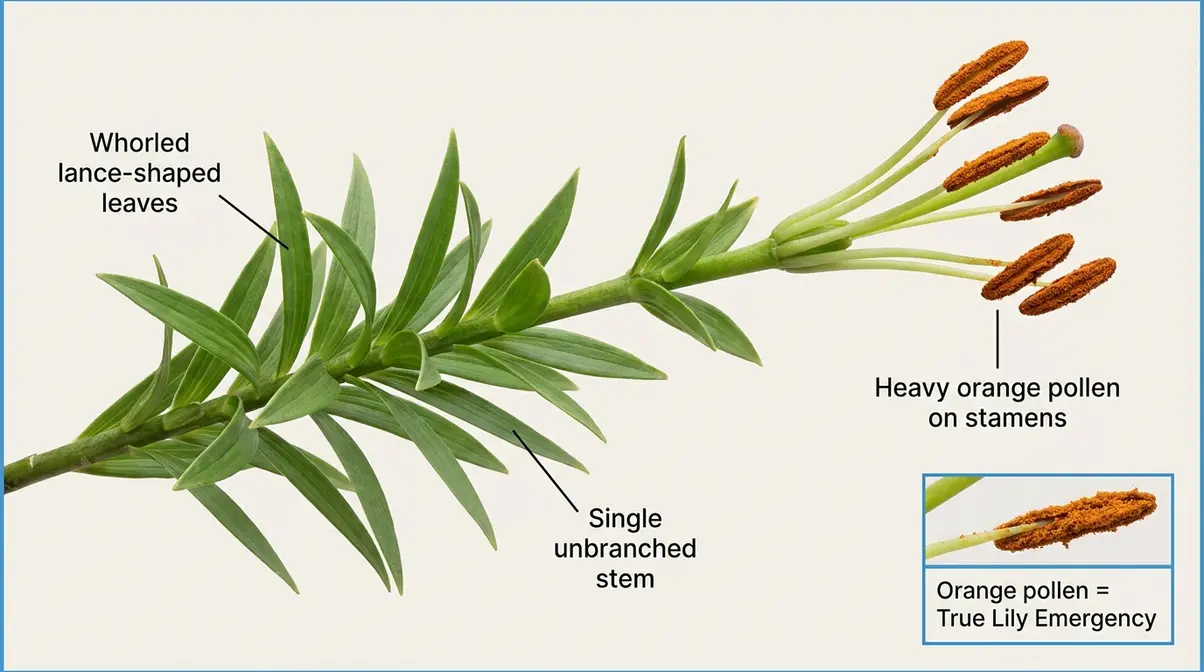
- Leaves: Lance-shaped, smooth, spirally arranged or whorled around a single central stem. They do not twist.
- Flowers: Large, showy, open trumpet shape. Six petals, often curved back (recurved). Prominent, long stamens with orange or rust-colored pollen that transfers easily to fur.
- Stems: Single, unbranched tall stem (often 2–5 feet). All flowers emerge from this one main stalk.
- Common dangerous varieties: Easter Lily, Tiger Lily, Stargazer Lily, Asiatic Lily, Oriental Lily, Rubrum Lily, Japanese Show Lily.
- Pollen: Heavy, dusty, orange pollen that visibly coats surfaces — and coats your cat’s face when they investigate.
If you see heavy orange pollen on your cat’s face, nose, or paws, treat this as a potential true lily emergency and call your vet immediately — do not wait for symptoms to appear.
- Estimated Time: 10-15 minutes
- What You Need:
- Your cat’s veterinarian phone number
- ASPCA Animal Poison Control Center number: (888) 426-4435
- A smartphone camera (to photograph the plant)
- Fresh water and a clean bowl
Step 1: Confirm What Your Cat Ate
The first step is the most important one: slow down and identify the plant before you call anyone. Identifying the exact plant is the most critical first step — it determines whether you need simple home monitoring or an emergency vet visit. Your answer determines whether this is a “monitor at home” situation or a “drive to the emergency vet” situation.
- What to do:
- Locate the plant or bouquet your cat was chewing.
- Check for a label, price tag, or florist card — many bouquets name their flowers.
- Use the identification guide above to compare leaf shape and flower structure.
- If the plant has twisted, resupinate leaves and small streaked flowers — that is alstroemeria.
- If the plant has a single tall stem, whorled lance-shaped leaves, and heavy orange pollen — treat it as a true lily emergency.
Why this step matters: Calling poison control with the correct plant name saves critical time. The ASPCA Animal Poison Control Center ((888) 426-4435) can give you a precise risk assessment in under two minutes — but only if you can tell them what plant was involved.
Photograph the plant with your phone before you do anything else. A clear photo helps your vet identify the species if you are unsure, and it documents exactly what your cat was exposed to.
How Much Alstroemeria Is Dangerous?
There is no established “safe dose” for alstroemeria in cats, because the severity of reaction varies by individual cat size, age, and health status. Even a small amount can cause vomiting in a sensitive cat. That said, the toxicity is dose-dependent — a cat who chewed one petal is far less likely to show significant symptoms than one who consumed multiple stems. The ASPCA recommends contacting Poison Control for any confirmed ingestion, even if your cat seems fine.
Step 2: Identify Your Cat’s Symptoms
Once you know what plant is involved, assess how your cat is actually feeling. Alstroemeria symptoms are mild and predictable. Knowing what to expect helps you distinguish normal post-ingestion upset from a sign that something more serious is happening.
- Typical alstroemeria symptoms (mild — usually self-resolving within 12–24 hours):
- Vomiting (one to a few episodes)
- Loose stools or mild diarrhea
- Drooling or pawing at the mouth
- Reduced appetite for several hours
- Mild lethargy
- Symptoms that require an immediate vet call:
- Vomiting that continues for more than 6–8 hours
- Complete refusal to drink water for more than 12 hours
- Bloody vomit or bloody stool
- Extreme lethargy — your cat cannot stand or respond normally
- Seizures or loss of coordination
- Labored breathing
According to the ASPCA’s Poison Control guidance, alstroemeria does not cause the severe systemic symptoms associated with true lily toxicity. If your cat is showing any of the serious symptoms listed above after eating alstroemeria, contact your vet — something else may be contributing.
Step 3: Provide Supportive Home Care
For mild alstroemeria exposure with only a few episodes of vomiting or loose stools, supportive home care is usually appropriate. In our review of veterinary toxicology protocols, we found that withholding food for a brief period is the standard first-line response for mild plant ingestion. Always confirm with your veterinarian before withholding food or water from a cat, especially kittens, elderly cats, or cats with pre-existing health conditions.
Supportive care steps for mild symptoms:
- Remove access to the plant immediately. Place it in a room your cat cannot enter, or remove it from the home entirely.
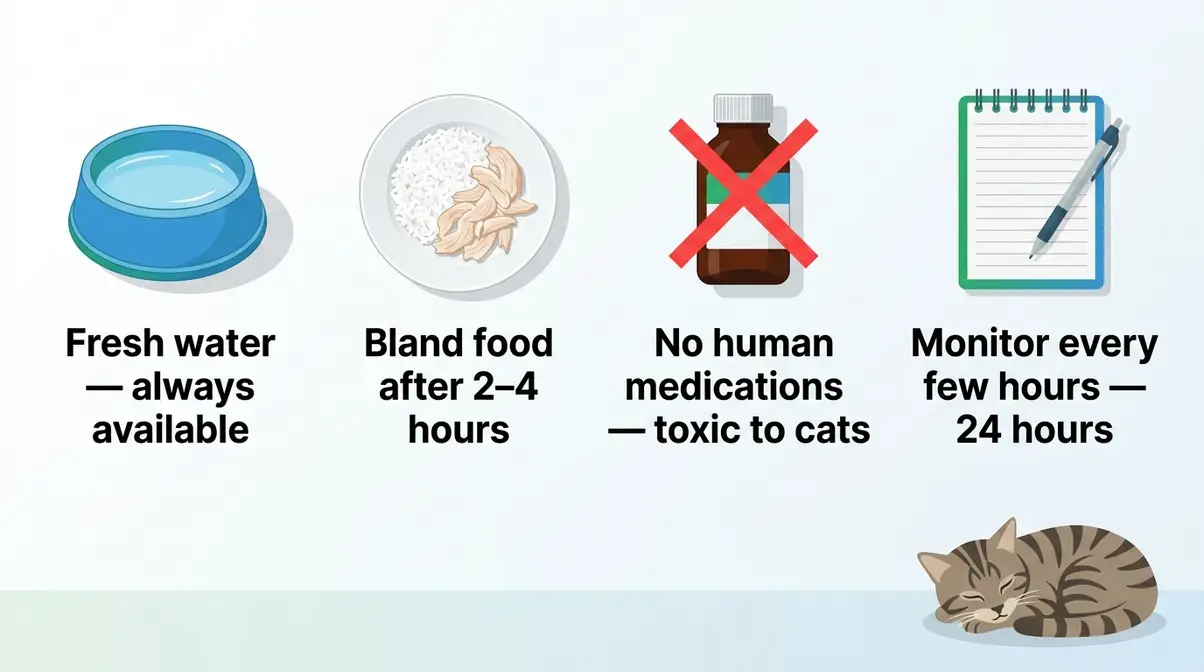
- Offer fresh water freely. Vomiting and diarrhea can cause mild dehydration. Ensure clean water is available at all times. Do not force your cat to drink.
- Withhold food for 2–4 hours after active vomiting stops, then offer a small amount of bland food (plain boiled chicken or plain white rice). This gives the stomach lining time to settle.
- Do not give human medications. Ibuprofen, acetaminophen, and most over-the-counter remedies are toxic to cats. Never administer any medication without explicit veterinary guidance.
- Monitor closely for 24 hours. Check your cat’s behavior, appetite, and litter box output every few hours. Note any changes.
Home care is supportive, not curative. If symptoms worsen or do not improve within 24 hours, contact your veterinarian. There is no home remedy that replaces professional veterinary assessment.
Step 4: Contact Emergency Vet Help
Even for a mildly toxic plant like alstroemeria, certain circumstances require professional intervention. This step defines exactly when to make that call — so you are not second-guessing yourself at 2 a.m.
- Call your vet or the ASPCA Animal Poison Control Center ((888) 426-4435) if:
- You are not 100% certain the plant was alstroemeria (not a true lily)
- Your cat is a kitten, senior, pregnant, or has a known health condition
- Vomiting persists beyond 6–8 hours or occurs more than 4–5 times
- Your cat refuses all water for more than 12 hours
- You notice any blood in vomit or stool
- Your cat seems unusually weak, disoriented, or unresponsive
- Go directly to an emergency animal hospital if:
- Your cat is having seizures
- Your cat is unconscious or cannot be roused
- You believe a true lily (Lilium or Hemerocallis species) may have been involved
A peer-reviewed study published in PMC/NIH (Lily toxicosis in cats, PMC10822363) confirms that true lily nephrotoxicity progresses rapidly — kidney damage can become irreversible within 18–24 hours of ingestion. If there is any doubt about which lily was involved, treat it as a true lily emergency. The cost of a precautionary vet visit is far lower than the cost — and heartbreak — of delayed treatment.
Step 5: Cat-Proof Your Home
The best treatment for plant toxicity is prevention. Once your cat has recovered, take these steps to eliminate the risk of a repeat exposure — or a more serious one.
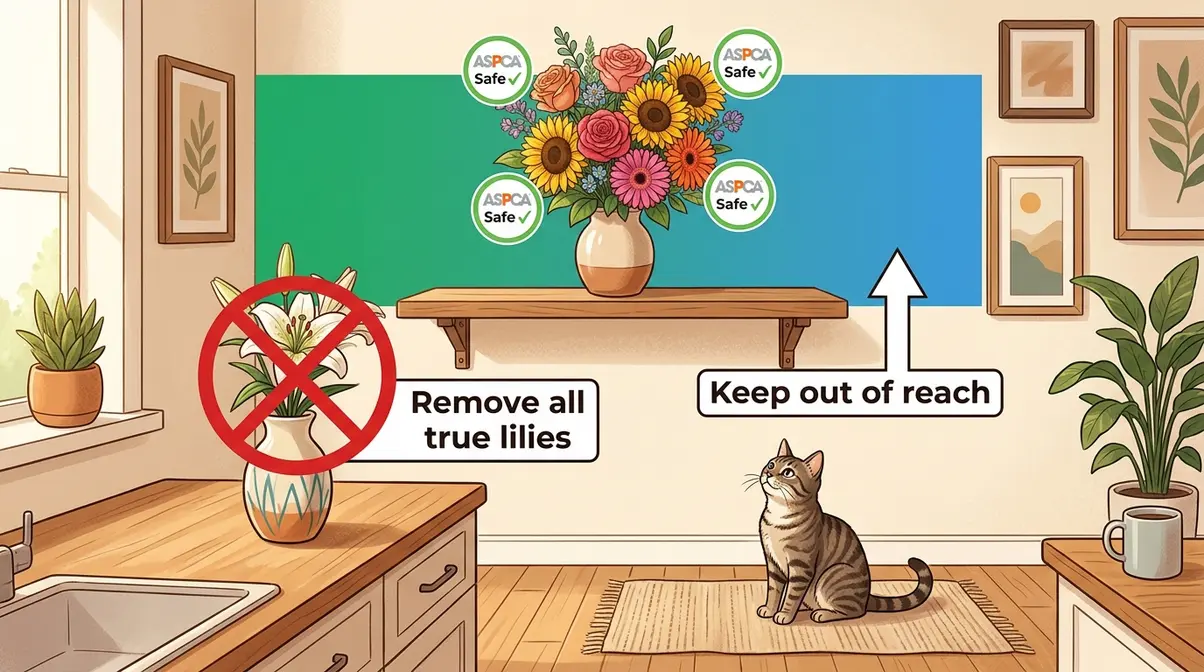
Remove All True Lilies From Your Home
If you have any bouquets or potted plants containing Lilium or Hemerocallis species, remove them from your home entirely. These plants are not safe in any room a cat can access — cats can be exposed simply by grooming pollen from their fur after brushing past a plant.
Natural Cat Deterrents for Plant Areas
If you want to keep decorative plants and flowers in your home, these evidence-based deterrents can reduce the likelihood of your cat investigating them:
- Citrus peels: Place fresh orange or lemon peels around the base of vases. Most cats dislike citrus scent and avoid it consistently.
- Aluminum foil: Line the surface around a vase with foil. Cats dislike the texture and sound underfoot.
- Plant placement: Keep vases on high shelves or in rooms you can close off. Do not assume a cat “won’t bother” a plant on a counter — cats are curious and agile.
- Bitter apple spray: Available at pet stores, this non-toxic spray can be applied to plant stems and pots as a deterrent. Reapply weekly.
Cat-Safe Flower Alternatives
The ASPCA maintains a comprehensive list of non-toxic plants for cats. The following flowers are confirmed safe and make beautiful alternatives to lilies in bouquets:
| Safe Flower | ASPCA Status | Notes |
|---|---|---|
| Roses (Rosa spp.) | Non-toxic | Thorns are a minor physical hazard |
| Sunflowers (Helianthus annuus) | Non-toxic | Bright, long-lasting cut flowers |
| Snapdragons (Antirrhinum majus) | Non-toxic | Great for arrangements |
| Orchids (Phalaenopsis spp.) | Non-toxic | Popular houseplant, safe for cats |
| Gerbera Daisies (Gerbera jamesonii) | Non-toxic | Colorful, widely available |
| Statice (Limonium spp.) | Non-toxic | Common bouquet filler, safe |
When ordering or buying flowers, tell your florist: “Please exclude all true lilies — Lilium and Hemerocallis species — as I have cats at home.” A good florist will know exactly what you mean.
Alstroemeria and Cat Safety FAQs
Alstroemeria vs. True Lily Differences
*Alstroemeria (Peruvian Lily) and true lilies (Lilium species) are completely different plants* that share only a common name. Alstroemeria causes mild GI upset via Tulipalin A. True lilies cause acute kidney failure that can be fatal within 24-72 hours. You can identify alstroemeria by its twisted, resupinate leaves and small streaked flowers on branching stems. True lilies have a single tall stem, whorled lance-shaped leaves, and heavy orange pollen on prominent stamens.
Surviving Lily Poisoning Unmedicated?
Survival without treatment depends entirely on which lily was involved. For alstroemeria, most healthy cats recover without veterinary care. For true Lilium or Hemerocallis lilies, the prognosis without treatment is poor — a peer-reviewed study (PMC10822363) found that delayed treatment significantly worsens kidney outcomes. If there is any doubt about which lily your cat ate, call your vet immediately. Do not wait for symptoms.
Cat Seems Fine After Eating: Call Vet?
If your cat ate alstroemeria and shows no symptoms after two hours, close monitoring at home is usually sufficient for healthy adult cats. However, calling the ASPCA Animal Poison Control Center ((888) 426-4435) is always a reasonable precaution — the consultation fee is modest, and they can advise you based on your cat’s specific weight and the amount ingested. Never assume “fine now” means “fine later” — some GI symptoms appear 2–4 hours after ingestion.
Are All Lilies Equally Toxic?
No — lily toxicity varies dramatically by species. True lilies (Lilium spp.) and daylilies (Hemerocallis spp.) cause acute kidney failure and are potentially fatal. Peace lilies (Spathiphyllum spp.) cause oral irritation and GI upset but not kidney damage. Alstroemeria (Peruvian Lily) causes only mild GI upset. Calla lily (Zantedeschia spp.) causes oral irritation and drooling. The word “lily” tells you almost nothing about actual danger level — which is why identifying the specific genus matters so much.
Avoiding The Lily Misidentification Trap
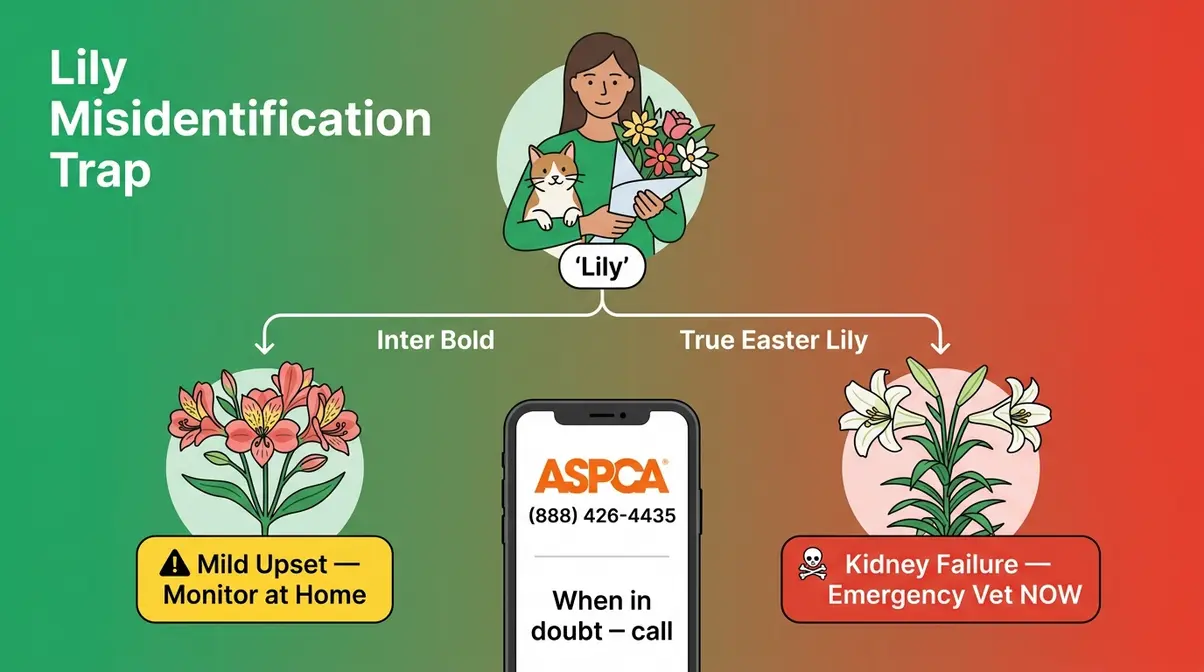
The answer to “is alstroemeria toxic to cats” is clear: yes, mildly — but not in the way that should send you to an emergency room at midnight. Alstroemeria causes temporary stomach upset through Tulipalin A, and most healthy cats recover within a day without intervention. That is the reassurance you needed.
The Lily Misidentification Trap is the real lesson here. The word “lily” covers plants that range from “minor tummy upset” to “kidney failure within 24 hours.” Knowing the difference — twisted resupinate leaves versus whorled lance-shaped leaves, small streaked petals versus heavy orange pollen — gives you the knowledge to respond correctly in any situation. A cat owner who can identify a true lily on sight is a cat owner who can act fast when it actually matters.
Your next step is practical: walk through your home today. Check every bouquet, every windowsill plant, every garden border. If you find any Lilium or Hemerocallis species, remove them. Replace them with roses, sunflowers, or gerbera daisies — all confirmed safe by the ASPCA. And save (888) 426-4435 in your phone right now. The ASPCA Animal Poison Control Center is available 24 hours a day, and having that number ready means you are never starting from zero in an emergency.

Dave King
Cat owner and writer at Mad Cat Man.