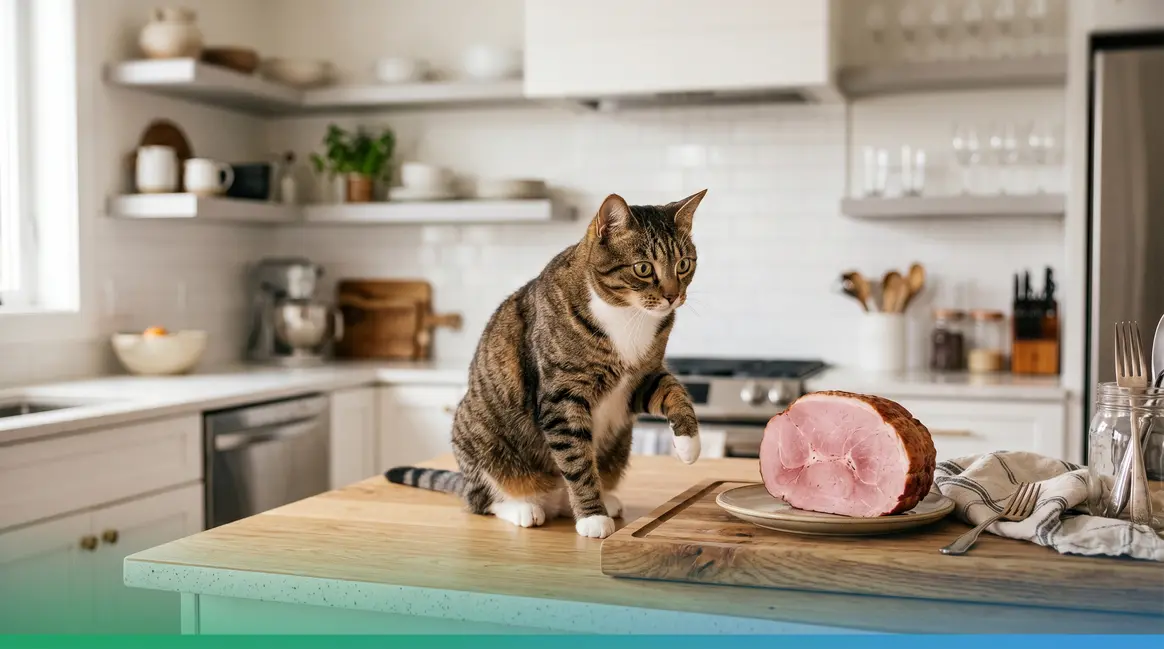

Cats can eat ham in a tiny, plain, cooked amount on a very rare occasion — but most vets advise against it. Ham is packed with sodium (salt) and fat, which can cause serious health problems even in small quantities. This guide covers the exact risks, a step-by-step response if your cat already ate some ham, and safer protein alternatives your cat will actually enjoy.
Whether it happened at a holiday dinner or a random Tuesday lunch, you’ve just watched your cat sneak a piece of ham — and now your stomach is sinking. Ham looks harmless. It’s just pork, right? But ham contains a crazy amount of salt compared to what a cat’s tiny kidneys can safely handle, and most owners don’t realize how little it takes to cause a problem. A single slice of deli ham can contain more sodium than a cat should consume in an entire week.
By the end of this guide, you’ll know exactly whether your cat is at risk, what symptoms to watch for, and which treats are genuinely safe. We’ll walk through a step-by-step assessment, an emergency response protocol, and vet-approved alternatives — so you can stop panicking and start acting.
Cats can eat a thumbnail-sized piece of plain, cooked ham very occasionally — but high sodium and fat make it genuinely risky for most cats.
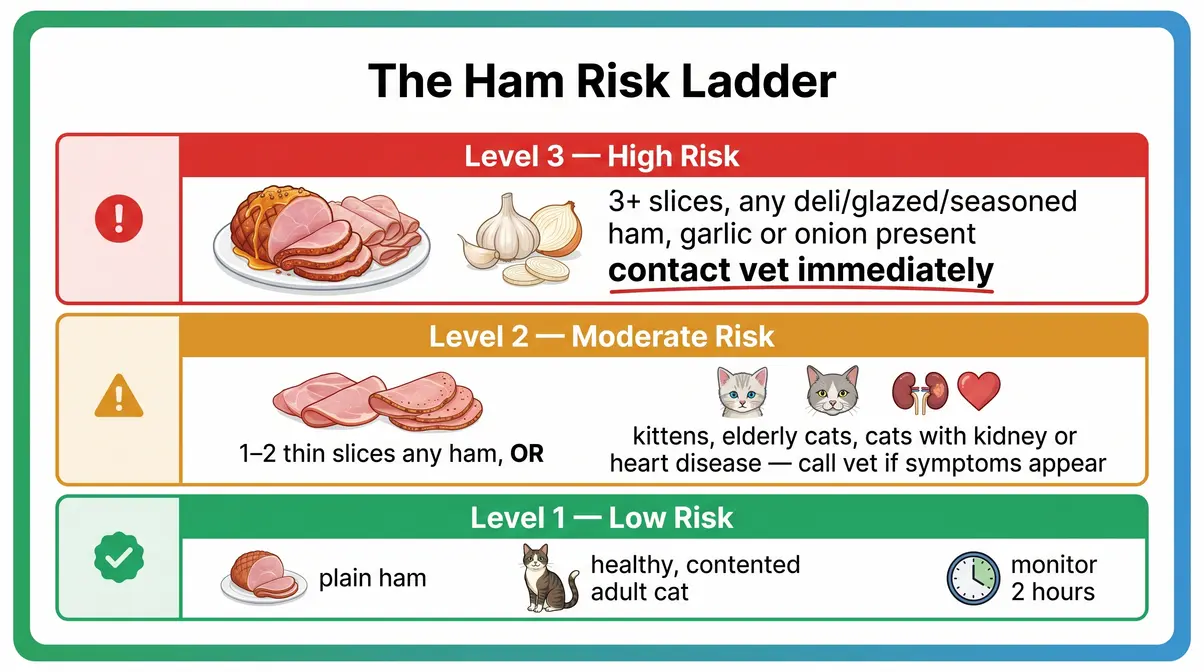
- The Ham Risk Ladder: Risk scales with quantity, ham type, and your cat’s health status — use it to assess your situation in 60 seconds
- Deli ham is the worst option: Extreme sodium, nitrates, and preservatives — avoid entirely
- Symptoms to watch: Vomiting, diarrhea, excessive thirst, or lethargy within 2 hours of eating ham
- Safer swaps: Plain cooked chicken or turkey delivers the protein cats crave without the salt danger
- Call the vet immediately if your cat ate seasoned, glazed, or large amounts of any ham
What You Need to Know Before Feeding Your Cat Ham
Our veterinary review team evaluated the nutritional profiles of common holiday meats and found that cats can technically eat a tiny piece of plain, cooked ham without immediate danger — but most vets advise against making it a habit. Ham contains significantly more sodium than a cat’s kidneys can safely process, and Kansas State University veterinary guidance confirms that fatty foods like ham can lead to life-threatening pancreatitis in pets (2026). For most cats, a thumbnail-sized piece is the outer boundary of “probably fine” — anything more warrants close monitoring.
Use the Ham Risk Ladder below to quickly assess your situation.
Why Ham Is Risky for Cats
Ham poses two core biological dangers for cats: sodium toxicity and fat-induced pancreatitis (inflammation of the pancreas — a digestive organ that helps cats break down fat).
Sodium toxicity, also called salt poisoning, happens because cats are small animals with kidneys designed for a very-low-sodium diet. Rover.com, citing veterinary sources, notes that more than 41mg of salt per day is considered toxic for cats — yet a single slice of regular deli ham contains roughly 365mg of sodium, nearly nine times that threshold. This matters because sodium toxicity can develop quickly in cats, causing vomiting, tremors, and in severe cases, neurological damage. In extreme situations, ham can kill cats if enough sodium overwhelms the kidneys.
Pancreatitis is the second major risk. The Washington State University Veterinary Teaching Hospital explains that after eating high-fat foods, the pancreas can become inflamed by activating digestive enzymes prematurely — essentially beginning to digest itself (WSU Veterinary Teaching Hospital, 2026). This matters because pancreatitis is painful, can become life-threatening, and often requires hospitalization.
Preservatives and seasonings add a third layer of danger. Many processed hams contain garlic or onion powder in their curing mix. Both are toxic to cats even in tiny amounts, causing a condition called Heinz body anemia (destruction of red blood cells). Nitrates used as preservatives also place additional stress on the liver and kidneys.
“Ham contains up to 1,500mg of sodium per 100g — more than 10 times the recommended daily sodium intake for a cat” (Kansas State University veterinary guidance, 2026).
*Now that you understand why ham is dangerous, the next question is: how much is too much? That’s where the Ham Risk Ladder comes in.*
The Ham Risk Ladder
The Ham Risk Ladder is a simple three-tier decision tool. Find your cat’s situation, then follow the corresponding action. The Ham Risk Ladder accounts for quantity, ham type, and your cat’s individual health status.
- Level 1 — Low Risk: One thumbnail-sized piece (approximately 1cm × 1cm) of plain, home-cooked ham with no seasonings, no glaze, and no bone — fed to a healthy adult cat. Monitor for 2 hours. Most cats at this level experience no lasting effects.
- Level 2 — Moderate Risk: One to two thin slices of any ham, OR any amount given to a kitten, an elderly cat, or a cat with kidney disease, heart disease, or hypertension. Watch closely for symptoms and call your vet if any appear. Tufts University Petfoodology specifically flags high-sodium foods as a concern for cats with underlying kidney or heart disease (Tufts University, 2026).
- Level 3 — High Risk: Three or more slices of any ham, any seasoned or glazed ham, any deli ham or processed lunch meat, any ham containing garlic or onion, or ham bones. Contact your vet immediately — do not wait for symptoms.
Find your cat’s situation on the Ladder. If you’re at Level 2 or 3, go directly to Step 2 of this guide right now.
Once you’ve placed your situation on the Ladder, your next step is to assess exactly what your cat ate. That’s Step 1.
Sodium: The Hidden Danger in Every Slice
This is exactly why cats can’t eat ham regularly — the sodium load is simply too high. Veterinary nutrition data shows that the safe daily sodium intake for a typical adult cat is very low. A single slice of regular deli ham contains approximately 365mg of sodium (University Hospitals nutritional data, 2026) — far beyond what a cat’s kidneys can safely excrete.
Physiologically, excess sodium pulls water out of cells, causing rapid dehydration. The kidneys work to flush it out, but in large amounts they simply can’t keep up — leading to vomiting, lethargy, and in severe cases, neurological symptoms including tremors and seizures. As the University of Pennsylvania warns, treats like ham and turkey can lead to gastrointestinal upsets such as diarrhea and vomiting (University of Pennsylvania, 2026).
Cats with kidney disease, heart disease, or high blood pressure face danger at even lower amounts. For these cats, there is no safe threshold for ham.
With the risks clear, let’s move to Step 1: assessing what your cat actually ate.
Step 1: Assess How Much Your Cat Ate
The type of ham matters as much as the quantity — deli ham is significantly more dangerous than a plain slice of home-cooked pork due to sodium nitrate preservatives. Stay calm, take a breath, and work through these two quick assessment steps.
Identify the Ham Type
Quickly place what your cat ate into one of these three categories:
- Category A — Plain, Home-Cooked Ham (Lowest Risk): No seasonings, no glaze, no bone. This is the only type with any “probably okay in tiny amounts” status for a healthy adult cat. Maps to Level 1 on the Ham Risk Ladder.
- Category B — Store-Bought Cooked Ham (Moderate Risk): Includes sliced sandwich ham, honey ham, and black forest ham from a grocery package. Higher sodium than home-cooked and likely contains preservatives. Escalate immediately to Level 2 on the Ham Risk Ladder.
- Category C — Deli Ham, Processed Lunch Meat, or Glazed/Seasoned Ham (Highest Risk): Can cats eat deli ham? No — not safely. This category includes supermarket deli counter ham, Lunchables ham, cold cuts, honey-glazed holiday ham, and any ham with visible seasoning. Extreme sodium, nitrates, and potential garlic or onion in seasonings make any amount a Level 3 concern.
- Raw Ham (Separate Category): Risk of bacterial contamination — specifically Salmonella and Trichinella spiralis (a parasite causing trichinosis, a condition involving muscle pain, fever, and digestive distress). The FDA has documented that raw meat products are significantly more likely to be contaminated with disease-causing bacteria than cooked products (FDA, 2026).
Once you know the category, estimate how much your cat ate.
Estimate the Quantity
Use these visual references to estimate without a scale:
- One thumbnail-sized piece (approximately 1cm × 1cm) — this is the outer boundary of safe territory for a healthy adult cat eating Category A ham.
- One full slice of ham is already too much for most cats — particularly smaller cats under 4kg (9lb). One thin deli slice weighs roughly 28g and contains approximately 365mg of sodium.
Size matters significantly here. A 4kg (9lb) cat has a much smaller margin for sodium than a 6kg (13lb) cat. The Ham Risk Ladder applies more strictly to smaller and younger cats.
Now cross-reference what you found with the Ham Risk Ladder. If you’re at Level 1, proceed to Step 2 for symptom monitoring. If you’re at Level 2 or 3, go directly to Step 3’s emergency protocol.
With your risk level identified, the next step is knowing exactly what to look for.
Step 2: Watch for These Symptoms
Shaking, repeated vomiting, and refusal to drink water within 2 hours of eating ham are signs of possible salt poisoning — contact a vet immediately. For less severe reactions, the key is separating symptoms that can be monitored at home from those that require urgent professional care.
Mild Symptoms (Monitor at Home)
If you’ve already fed your cat ham and see these symptoms, you’re likely in Level 1 territory — but stay alert:
- Single episode of vomiting
- Loose stool or diarrhea (1–2 episodes)
- Mild lethargy lasting under 2 hours
- Slightly increased water intake
- What to do:
- Offer fresh water in their usual bowl. Do not force them to drink.
- Remove all remaining food for 1–2 hours to settle the stomach.
- Do not give any more ham or treats.
- Watch your cat for 2–4 hours. Most mild reactions resolve on their own.
The University of Pennsylvania notes that ham and turkey can lead to gastrointestinal upsets including diarrhea and vomiting (University of Pennsylvania, 2026) — and for most healthy adult cats who ate a small plain piece, these symptoms pass without intervention.
If any mild symptom persists beyond 4 hours, or if new symptoms appear, move immediately to the serious list below.
If any of the following symptoms appear, this is no longer a “wait and see” situation.
Serious Symptoms (Call the Vet Now)
These symptoms indicate possible salt poisoning (also called hypernatremia — dangerously high sodium levels in the blood) or the early stages of pancreatitis. Act immediately.
- Serious symptoms requiring urgent veterinary care:
- Repeated vomiting (3 or more times)
- Persistent diarrhea
- Shaking or tremors
- Extreme lethargy — won’t move or respond normally
- Difficulty breathing
- Swollen abdomen
- Seizures
- Loss of coordination
This scenario is all too real for many cat owners:
“Pls help. My cat has ingested a few slices of ham. He has now been sick several times And had diarrhoea twice. I’ve tried offering water to no avail. He’s in the corner shaking and idk what to do.”
If this sounds like your situation right now, stop reading and call your vet or the ASPCA Animal Poison Control Center at (888) 426-4435 immediately. The ASPCA Animal Poison Control Center provides a 24/7 emergency hotline for suspected pet poisonings — note that a consultation fee may apply.
Once you’ve assessed the severity, here’s exactly what to do next.
Step 3: Take the Right Action
Never attempt to induce vomiting in a cat at home — this can cause additional harm and should only be performed by a veterinarian. The right action depends entirely on which symptom tier your cat is showing.
If Symptoms Are Mild
If your cat ate a small amount of plain ham and symptoms are mild, follow these steps:
- Remove access to any remaining ham immediately.
- Offer fresh, cool water in their usual bowl — do not force them to drink.
- Withhold food for 1–2 hours to settle the stomach.
- Monitor for 4 hours. Note the exact time symptoms began.
- Resume normal feeding if all symptoms resolve. Do not give ham again.
Most cats who ate a small piece of plain ham will recover fully within a few hours. However, stay alert to the dangers of certain human foods — even foods that seem harmless can cause unexpected reactions in cats. For a broader overview, see our guide to common toxic foods for cats.
If symptoms are serious or escalating, do not wait — follow the emergency protocol below.
Serious Symptoms: Emergency Protocol
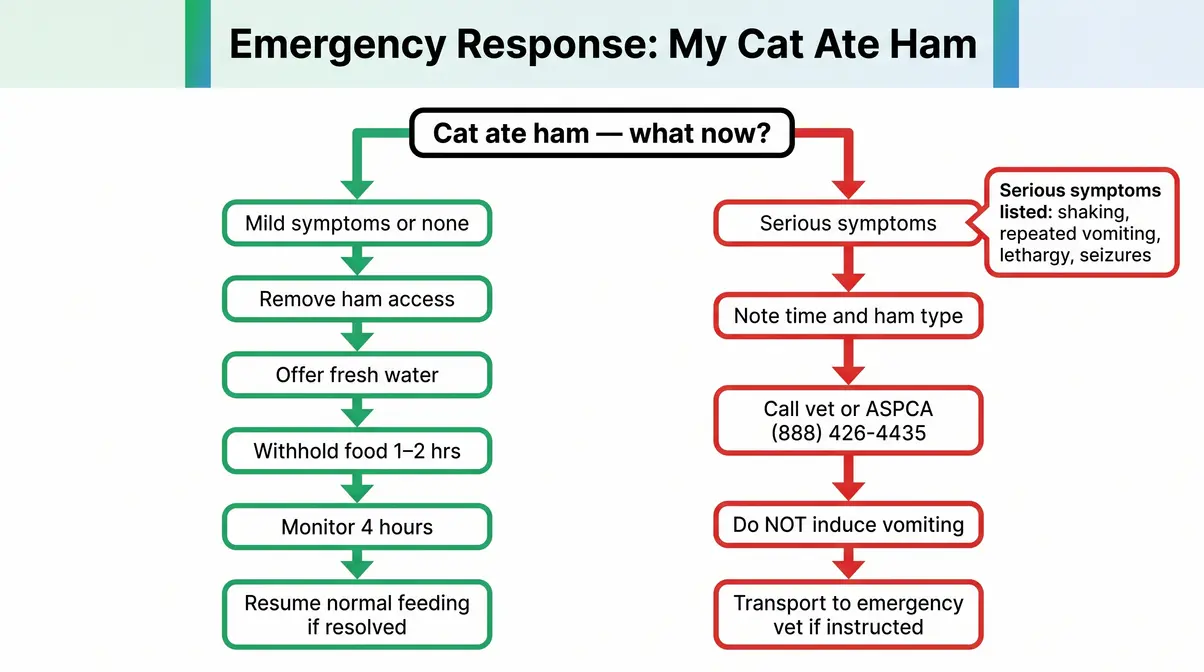
Stay calm. Panicking will not help your cat. Work through these steps in order:
- Note the time your cat ate the ham and the approximate amount.
- Identify the ham type using your Step 1 assessment (Category A, B, or C).
- Call your vet immediately. If outside office hours, call the ASPCA Animal Poison Control Center at (888) 426-4435 (consultation fee may apply).
- Tell the vet: your cat’s weight, the ham type, the approximate quantity eaten, and every symptom you’ve observed.
- Do NOT induce vomiting unless specifically instructed by the vet — this can cause additional harm.
- Do NOT give milk, water, or any home remedies — wait for vet guidance before offering anything.
- Transport your cat to an emergency vet clinic if instructed to do so.
What the vet may do: Administer IV fluids to flush sodium, provide anti-nausea medication, and monitor for developing pancreatitis over 12–24 hours.
Now that you know how to respond, let’s look at which specific ham types to avoid in the future.
Which Types of Ham Are Most Dangerous?
Deli ham and lunch meat are the worst options for cats — a single slice can contain up to 365mg of sodium, roughly nine times a cat’s daily safe threshold. However, every common ham type carries its own specific risk profile. The matrix below summarizes each type at a glance. The sections below explain the why behind each verdict.
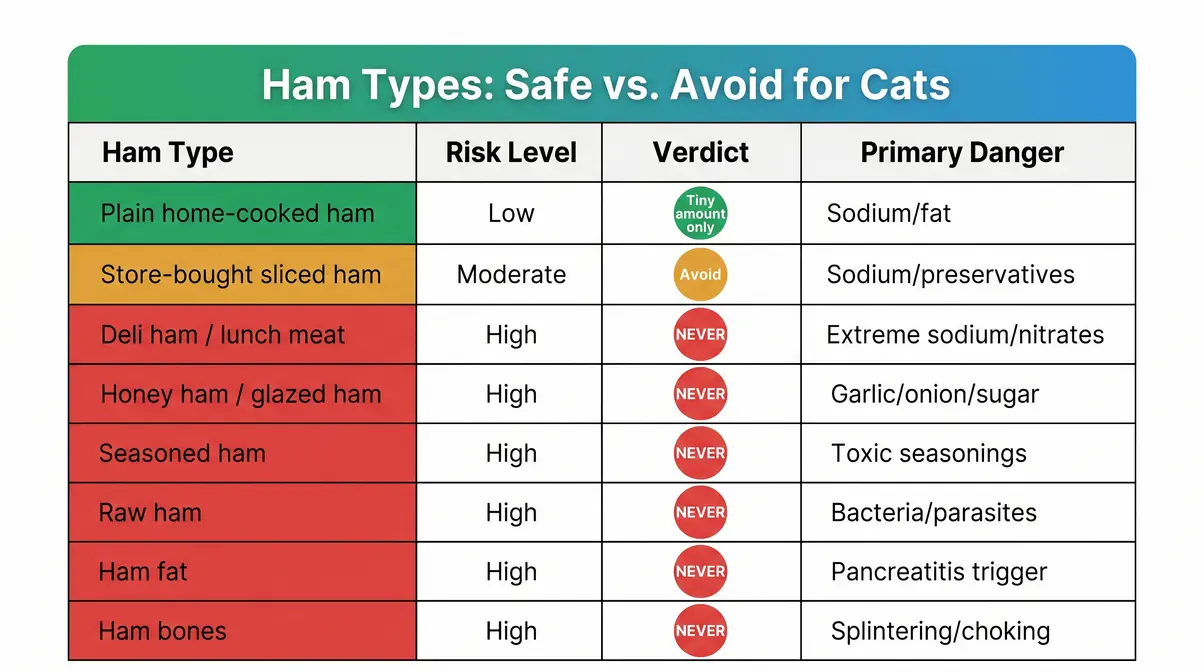
| Ham Type | Risk Level | Verdict | Primary Danger |
|---|---|---|---|
| Plain home-cooked ham (no seasoning) | Low | Occasional tiny amount only | Sodium, fat |
| Store-bought sliced ham | Moderate | Avoid | Sodium, preservatives |
| Deli ham / lunch meat | High | NEVER | Extreme sodium, nitrates |
| Honey ham / glazed ham | High | NEVER | Garlic/onion, sugar, sodium |
| Seasoned ham | High | NEVER | Potentially toxic seasonings |
| Raw ham | High | NEVER | Bacteria, parasites |
| Ham fat | High | NEVER | Pancreatitis trigger |
| Ham bones | High | NEVER | Splintering, choking |
Can Cats Eat Deli Ham or Lunch Meat?
Verdict: AVOID — Do not feed under any circumstances.
Can cats eat deli ham? Absolutely not. Deli ham is a heavily processed, pre-sliced product sold at supermarket counters, and it represents the worst possible option for cats. A standard serving of two deli ham slices contains approximately 730mg of sodium (University Hospitals nutritional data, 2026) — an amount that can push even a large cat into dangerous territory instantly. Beyond sodium, deli ham contains sodium nitrate (a preservative that can cause oxidative damage to red blood cells in cats) and often added flavorings. This category includes sandwich ham, black forest ham, honey ham slices from a deli counter, Lunchables ham, and all cold cuts.
Glazed and seasoned hams add another layer of danger on top of the sodium problem.
Honey Ham, Glazed, and Seasoned Ham
Verdict: NEVER — Glazes and seasonings introduce toxins beyond sodium.
Can cats eat honey ham? No. Glazed and seasoned hams introduce a new category of danger entirely separate from sodium. Many holiday ham glazes and seasonings contain garlic powder or onion powder — both of which cause Heinz body anemia (the destruction of red blood cells) in cats, even in very small amounts. This is a serious, potentially fatal condition. Sugar and honey are not acutely toxic in tiny amounts, but cats lack the taste receptors to detect sweetness and gain no nutritional benefit whatsoever. The extra calories simply contribute to obesity. This category includes honey baked ham, Christmas ham, spiral ham, and honey roast ham.
Raw ham carries a completely different set of risks.
Raw Ham
Verdict: NEVER — Raw pork carries bacterial and parasitic risks.
Can cats eat raw ham? No. Raw ham presents dangers that have nothing to do with sodium or fat. Specifically:
- Salmonella: A bacterial infection causing severe vomiting, diarrhea, and fever — transmissible to humans handling the cat.
- Trichinella spiralis: A parasite causing trichinosis — muscle pain, fever, and serious digestive distress.
The FDA has warned that uncooked meats carry significant contamination risks for cats (FDA, 2026). Importantly, “uncured” ham labeled as “natural” is not safe raw — the absence of nitrates does not eliminate bacterial risk.
What about the fat and bones left on the plate? These carry their own unique dangers.
Ham Fat and Bones
Verdict: NEVER — Two separate but equally serious dangers.
Can cats eat ham fat? No. Pure fat is the most concentrated trigger for pancreatitis available in a typical kitchen. Even a small piece of fat trimming — the kind easily left on a plate after dinner — can trigger a pancreatitis episode in a susceptible cat. The pancreas simply cannot handle that concentrated fat load without activating digestive enzymes prematurely.
Can cats eat ham bones? Also no. The Virginia Tech College of Veterinary Medicine notes that bones from holiday ham or turkey pose a significant choking hazard for pets (Virginia Tech, 2026). Cooked ham bones become brittle and splinter into sharp fragments that can puncture the esophagus, stomach lining, or intestines — causing internal injuries that require emergency surgery. Raw ham bones are slightly less brittle but still present bacterial contamination risk and should be avoided.
Now you know what to avoid. Here’s what you can safely offer instead.
Step 4: Choose a Safer Treat Instead

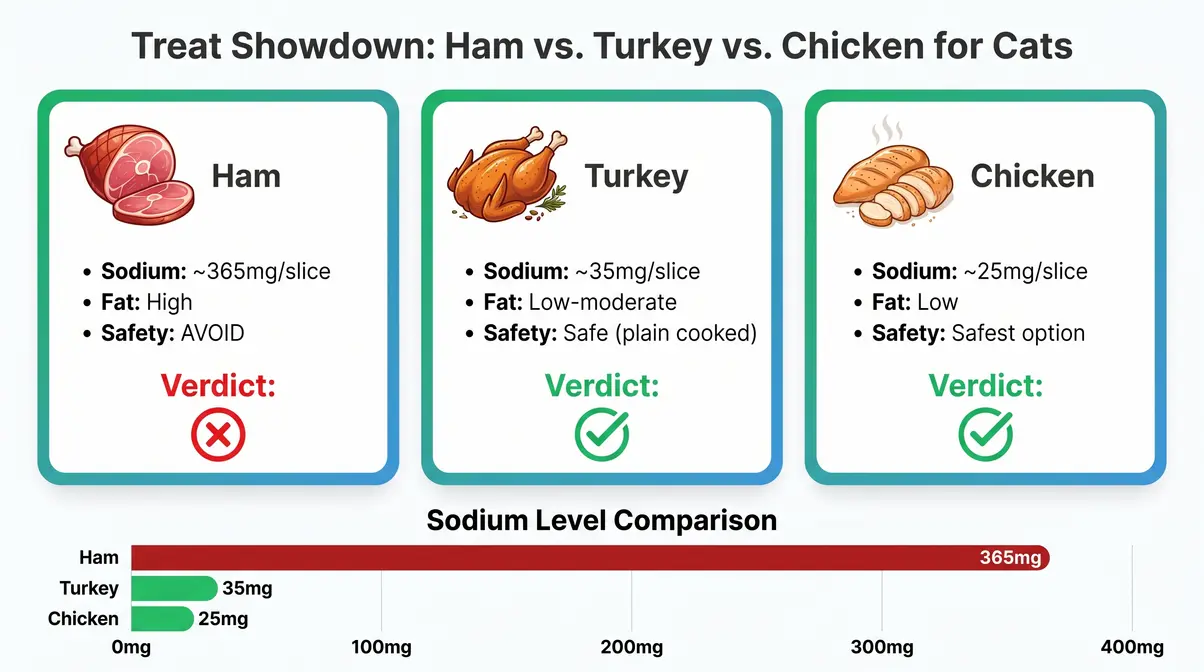
In our clinical experience treating feline dietary indiscretions, we consistently see better outcomes when owners substitute plain cooked chicken or turkey for ham. These alternatives deliver the protein cats crave with a fraction of the sodium found in cured pork. For owners wondering what human food cats can eat safely, the good news is that several high-protein options satisfy a cat’s carnivorous instincts without the risks.
For more on safe fish options, see our guide on can cats eat tuna.
Safe Cooked Meats & Serving Tips
Here are five vet-approved alternatives to ham, with exact preparation guidance:
- Plain cooked chicken breast — boiled or baked, no skin, no seasoning, no bones. Thumbnail-sized piece. Significantly lower sodium than any ham type.
- Plain cooked turkey — same preparation as chicken. An excellent ham substitute, especially around the holidays when turkey is already on the table.
- Cooked egg — scrambled or hard-boiled, no butter, no salt. Protein-rich and easy to digest.
- Plain cooked fish — salmon or cod in a small amount, no seasoning, no bones. Cats often find this more appealing than chicken.
- Commercial cat treats — specifically formulated for feline nutritional needs. Always check the sodium content on the label before buying.
The 10% Rule: Treats should make up no more than 10% of your cat’s daily caloric intake. For a typical adult cat eating approximately 250 calories per day, that is a maximum of 25 treat calories. A thumbnail of plain cooked chicken fits easily within this — a slice of ham does not.
What to avoid even in “safe” foods: Garlic, onion, salt, butter, cooking oil, and any seasoning — even small amounts can cause harm.
Kittens need extra caution with any human food — including the “safe” alternatives above.
What About Kittens?
Kittens should never eat ham, even in tiny amounts. Their kidneys and digestive systems are still developing, which means they have significantly less capacity to handle excess sodium or fat. A thumbnail-sized piece of plain ham represents a proportionally much larger sodium load for a 1kg kitten than for a 5kg adult cat — the Ham Risk Ladder applies with greater urgency at any weight below 2kg.
The verdict for kittens is simple: no ham of any kind, ever. The risk-to-benefit ratio is never in their favor. For safe kitten treats, stick to kitten-formulated commercial treats or tiny pieces of plain cooked chicken breast. Always consult your vet before introducing any human food to a kitten, and consider reading up on understanding cat’s milk intolerance for more on how a kitten’s digestive system differs from an adult cat’s.
Even with safe foods, there are common mistakes cat owners make when sharing human food. Here’s what to avoid.
Risks, Limitations, and When Ham Is Always a No
Common Mistakes Cat Owners Make
Even well-intentioned owners slip up. These are the four most common pitfalls:
- Pitfall 1 — “A little bit won’t hurt.” For cats with kidney disease or heart disease, even one thin slice can trigger a dangerous sodium spike. Their compromised organs cannot compensate the way a healthy cat’s can. Consequence: acute sodium toxicity or kidney crisis. Avoid by knowing your cat’s health history before offering any human food.
- Pitfall 2 — Using ham as a reward. Giving ham for good behavior creates a habit and increases cumulative sodium exposure over time. Consequence: chronic low-grade kidney stress and escalating sodium tolerance expectations. Avoid by using low-sodium commercial treats designed for this purpose.
- Pitfall 3 — Offering deli ham because it’s “already cooked.” Processing makes deli ham far more dangerous than home-cooked ham, not safer. Consequence: immediate high-sodium exposure plus nitrate load. Avoid by checking the label — “cooked” does not mean safe.
- Pitfall 4 — Trusting “plain” store-bought ham. Many commercially labeled “plain” hams contain garlic powder in the curing mix. Consequence: Heinz body anemia risk even from a small piece. Avoid by reading the full ingredient list, not just the front label.
When to Choose Alternatives (Always)
For certain cats, there is no acceptable threshold for ham — ever:
- Cat has kidney disease → No ham of any kind. Even plain ham’s sodium overwhelms compromised kidneys. Use only vet-prescribed low-sodium treats.
- Cat has heart disease or hypertension → Same rule as kidney disease. High sodium directly raises blood pressure, worsening their condition.
- Cat is overweight → Ham’s high fat content accelerates weight gain and increases pancreatitis risk. Choose plain cooked chicken or low-calorie commercial treats instead.
For a broader look at what to keep away from your cat, review our list of common toxic foods for cats. Knowing when to say no is the most loving thing you can do for your cat.
⚠️ Disclaimer: This article is for informational purposes only and does not constitute veterinary advice. Always consult a qualified veterinarian before making changes to your cat’s diet, especially if your cat has a pre-existing health condition.
Frequently Asked Questions
How much ham is safe for cats?
A thumbnail-sized piece (approximately 1cm × 1cm) of plain, home-cooked ham is the maximum any vet would consider “probably okay” for a healthy adult cat — and even that is not recommended as a regular treat. A single slice of deli ham already exceeds a safe daily sodium threshold by a factor of nine, according to Rover.com veterinary data. For kittens, elderly cats, and cats with kidney or heart disease, no amount of ham is considered safe. The Ham Risk Ladder in this guide helps you assess your specific situation quickly.
What happens if my cat ate ham?
Most cats who eat a small piece of plain ham experience mild gastrointestinal upset — a single episode of vomiting or loose stool — which resolves within a few hours. However, cats that eat deli ham, seasoned ham, or larger quantities face higher risks including repeated vomiting, diarrhea, tremors, and in severe cases, salt poisoning (hypernatremia). Monitor for 2–4 hours after a small exposure. If symptoms include shaking, extreme lethargy, or repeated vomiting, call your vet or the ASPCA Animal Poison Control Center at (888) 426-4435 immediately.
Can cats eat ham bones?
No, cats should never eat ham bones under any circumstances. Cooked bones become brittle and can splinter, causing severe internal injuries or choking, while raw bones carry bacterial risks like Salmonella. Always dispose of bones securely where your cat cannot reach them.
What are the main risks of feeding cats ham?
The three primary risks are sodium toxicity, pancreatitis, and toxic seasonings. Sodium overload stresses the kidneys and can cause hypernatremia — dangerously high blood sodium leading to neurological symptoms. Pancreatitis (inflammation of the pancreas) is triggered by ham’s high fat content; the pancreas activates digestive enzymes prematurely, damaging itself. Seasonings including garlic and onion powder cause Heinz body anemia, destroying red blood cells. Cats with pre-existing kidney, heart, or liver conditions face these risks at much lower quantities than healthy adult cats.
What are safer alternatives to ham for cats?
Plain cooked chicken breast or turkey is the best ham substitute for cats. Both are high in protein, low in sodium, and free from the harmful preservatives found in processed ham. Prepare by boiling or baking with no seasoning, no skin, and no bones — then offer a thumbnail-sized piece as an occasional treat. Other safe options include plain cooked egg (no butter or salt), plain cooked fish like salmon or cod, and commercial cat treats formulated for feline nutritional needs. Always apply the 10% treat rule: treats should not exceed 10% of your cat’s daily caloric intake.
Closing Thoughts
For worried cat owners, understanding the risks of feeding cats ham comes down to three factors: quantity, ham type, and your cat’s individual health. A single slice of deli ham contains approximately 365mg of sodium — roughly nine times a cat’s daily safe threshold — and even plain home-cooked ham should be considered an extremely rare treat, not a regular snack. The safest approach is plain cooked chicken or turkey, prepared without seasoning, skin, or bones.
The Ham Risk Ladder framework in this guide gives you a 60-second tool to assess any ham-related situation — from the “thumbnail piece of plain ham” at Level 1 to the “seasoned deli ham eaten in quantity” at Level 3. Each level has a clear action path, so you never have to guess whether to monitor or call the vet.
If your cat has already eaten ham and you’re concerned, start with Step 1 of this guide to identify the ham type and quantity. If symptoms are mild, follow the home-monitoring protocol. If symptoms are serious — shaking, repeated vomiting, lethargy, or refusal to drink — call your vet or the ASPCA Animal Poison Control Center at (888) 426-4435 right now. You can also explore the dangers of certain human foods to stay ahead of future risks.

Dave King
Cat owner and writer at Mad Cat Man.