
You just bought a new bag of cat food. The label says half a cup per day — and that seems impossibly small. Or maybe it says one full cup, and your cat is already looking a little round. Either way, you’re standing in your kitchen wondering how much should I feed my cat, and the answer feels maddeningly unclear.
Get it wrong and you risk real consequences: obesity, malnutrition, or a cat who cries at the bowl because they’re genuinely hungry. Before we begin: this guide is for educational purposes — always confirm feeding plans with your veterinarian, especially if your cat has health conditions. By the end of this guide, you’ll have a specific daily feeding amount for your cat, calculated using the same calorie framework veterinary organizations recommend. We’ll walk through six steps: calculating calories, choosing food types, adjusting for age, managing weight, using measurement tools, and handling special situations.
Figuring out how much should I feed my cat starts with one number: most adult cats need 20–30 calories per pound of body weight daily — a 10-pound cat needs roughly 200–260 calories, split across 2 meals.
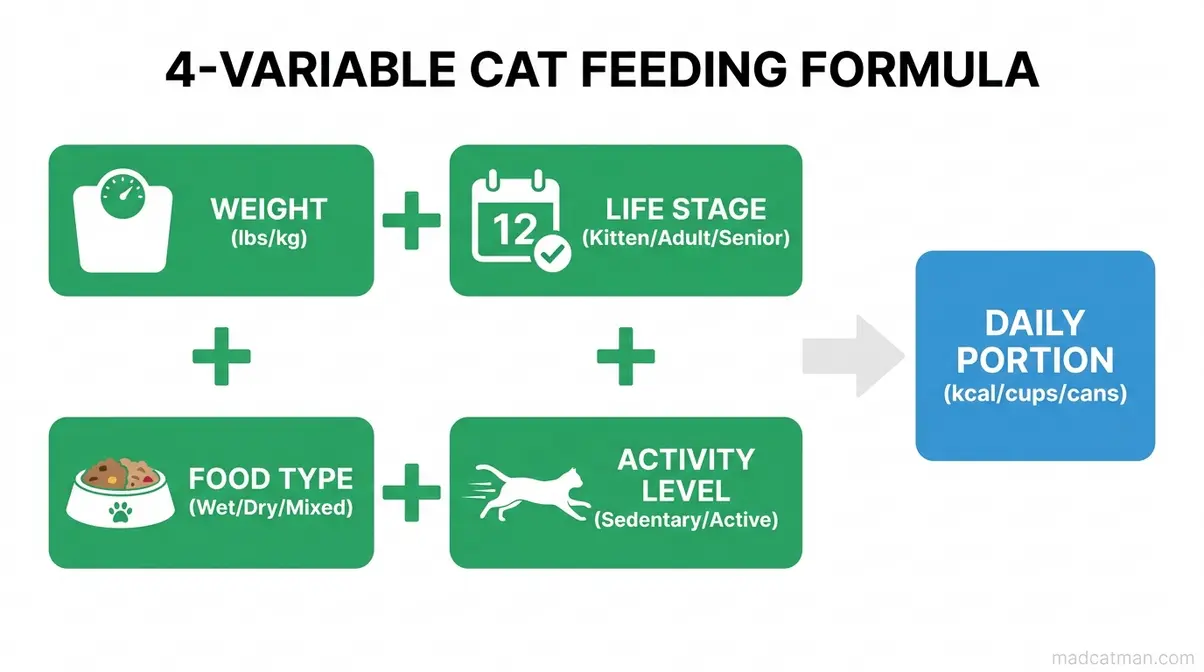
- The 4-Variable Formula: Weight + Life Stage + Food Type + Activity Level = daily portion
- Wet food: approximately 3–4 oz per meal for a 10-lb cat on an all-wet diet
- Dry food: ¼ to ½ cup per day for a 10-lb cat — not 1 full cup
- Kittens need 50–60 calories per pound — roughly 2–3× more than adult cats
- Always verify with your vet — these are starting-point estimates, not prescriptions
What You’ll Need Before You Start
Before calculating your cat’s daily portion, gather these four things:
- Your cat’s current weight (in pounds or kg) — This is the foundation of every calculation in this guide. You can weigh yourself holding your cat, then subtract your own weight.
- The food label or bag you currently use — You’ll need to check the calorie content (listed as “kcal/cup” or “kcal/can”) on the packaging.
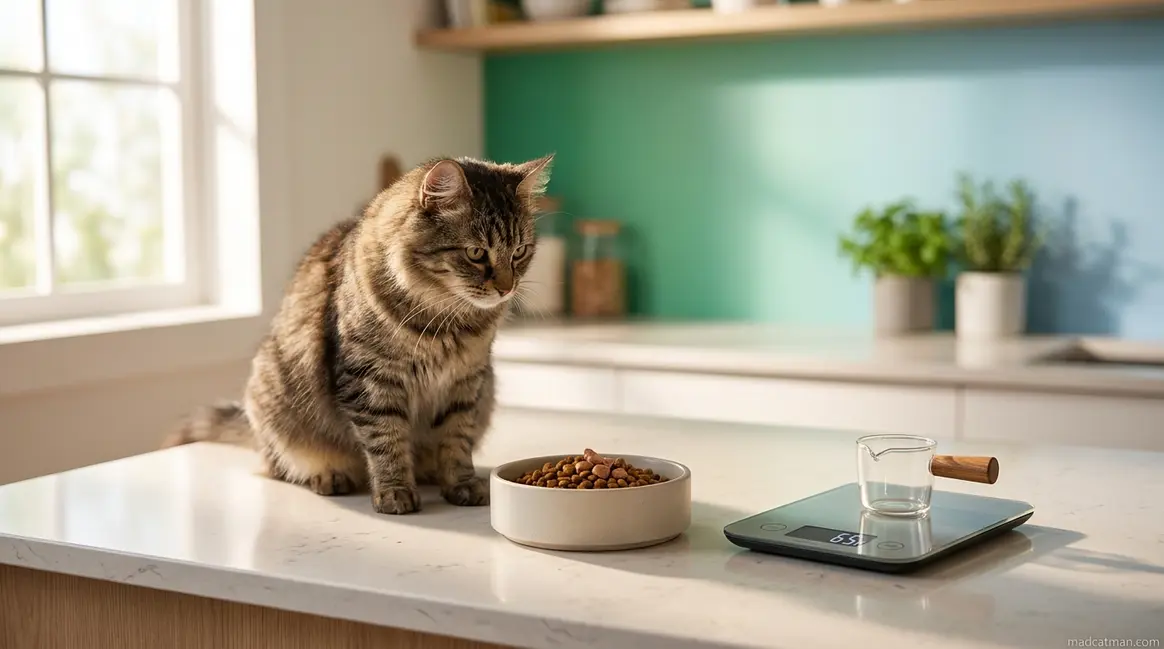
- A kitchen scale or measuring cup — Eyeballing portions leads to overfeeding in most households. A digital kitchen scale gives the most accurate results.
- About 10–15 minutes — That’s genuinely all you need to work through all six steps.
“I often find that dry food feeding instructions feel too low (the new food I bought says half a cup a day for each cat?), while the instructions for…”
You’re not alone in feeling confused. Here’s what one cat owner shared on Reddit — and it’s a feeling most of us recognize. Package labels are calculated for an “average” cat, which may be very different from yours. That’s exactly why this guide exists.
Step 1: Calculate Your Cat’s Daily Calorie Needs
An adult cat needs approximately 20–30 kcal (kilocalories) per pound of ideal body weight each day to maintain a healthy weight. For a 10-pound neutered indoor cat, that means roughly 200–260 calories per day. Everything else — food type, schedule, brand — flows from this single number. Knowing how much should I feed my cat in calories first makes every other decision straightforward.
The 4-Variable Formula Explained
The 4-Variable Formula is this article’s core framework — a simple, four-input system that eliminates guesswork from cat feeding:
Weight + Life Stage + Food Type + Activity Level = Daily Portion
Here’s what each variable means and why it matters:
- Weight — Your starting point. A heavier cat needs more calories, but not proportionally more if they’re overweight. Always calculate based on ideal body weight, not current weight.
- Life Stage — Kittens need roughly 2–3× more calories per pound than adult cats. Seniors often need fewer. This single variable changes the math dramatically.
- Food Type — Wet and dry food have very different calorie densities. A cup of dry food may contain 400+ calories; a 3 oz can of wet food may contain only 70–90 calories.
- Activity Level — An active outdoor cat may need 10–15% more calories than a sedentary indoor cat eating the same food.
Most cat feeding confusion comes from treating these four factors in isolation. The 4-Variable Formula combines them into one clear result.
Now that you understand the four inputs, let’s calculate the most important one: how many calories your specific cat actually needs each day.
Daily Calorie Needs for Your Cat
The kcal (kilocalorie — the same unit used on human food labels, sometimes just called a “calorie”) is the universal measure of food energy for cats. According to WSAVA daily calorie guidelines, an average 5 kg (11 lb) adult cat requires approximately 250–290 calories per day to maintain a healthy body weight (WSAVA, 2020). Treats should make up no more than 10% of that total.
Spayed or neutered cats need 20–30% fewer calories than intact cats of the same weight, because neutering reduces metabolic rate while increasing appetite (Purina Institute; NIH/PMC, 2024). This is one of the most overlooked reasons cats gain weight after surgery.
Use this table as your starting point:
| Cat Weight | Calories/Day (Neutered/Sedentary) | Calories/Day (Intact/Active) |
|---|---|---|
| 8 lbs | 160–200 kcal | 210–240 kcal |
| 10 lbs | 200–260 kcal | 270–305 kcal |
| 12 lbs | 240–300 kcal | 320–360 kcal |
| 15 lbs | 300–375 kcal | 390–450 kcal |
Source: Animal Medical Center of Chicago; WSAVA, 2020. Use the APOP Cat Daily Feeding Calculator for a personalized figure.
A worked example: A 10-pound, spayed adult indoor cat with moderate activity needs approximately 220–260 calories per day. The math: 10 lbs × 22–26 kcal = 220–260 kcal daily. We’ll use 240 kcal as our working number throughout this guide.
Now you know your cat’s daily calorie target. Next: how to split that across meals — because when you feed matters almost as much as how much.
Is 2 meals a day enough for a cat?
Yes — for most adult cats, 2 meals per day spaced 8–12 hours apart is sufficient and is the standard veterinary recommendation (VCA Hospitals). This schedule prevents the blood sugar fluctuations associated with free feeding and gives owners better control over daily calorie intake. Free feeding — leaving food out all day — is a leading contributor to feline obesity because cats, especially with dry food, don’t reliably self-regulate their intake.
Here’s a quick breakdown by life stage:
- Kittens (under 6 months): 3–4 meals per day
- Kittens (6–12 months): 2–3 meals per day
- Adult cats (1–7 years): 2 meals per day
- Senior cats (7+ years): 2–3 smaller meals per day
Meal-plan example #1 — 10-lb indoor adult cat: Meal 1 at 7am (120 kcal), Meal 2 at 7pm (120 kcal). Total: 240 kcal/day.
Automatic feeders and puzzle feeders are excellent tools for portion control. According to the AVMA consensus on feline feeding, mimicking natural feline hunting behaviors through frequent small meals and puzzle feeders is supported by veterinary consensus (AVMA, 2018). For a hands-free way to maintain consistent portions, see our guide to consistent feeding schedules and portion control.
You now have your cat’s daily calorie target and meal schedule. Step 2 translates those calories into actual food — whether you use wet food, dry food, or a mix of both.
Step 2: Choose Your Food Type and Measure Portions
You’re standing in your kitchen with a can of wet food and no idea how much to scoop. That’s exactly the problem this step solves. Food Type is Variable 3 in The 4-Variable Formula — and it changes the portion math entirely. When determining how much should I feed my cat, remember that wet and dry food have very different calorie densities.
Calorie density simply means how many calories are packed into each ounce or cup of food. Dry food is dense — typically 300–500 kcal per cup. Wet food is mostly water — typically 70–100 kcal per 3 oz (85g) can. Same cat, same calorie need, very different physical portions.
How Much Wet Food to Feed Your Cat
Cats fed a predominantly wet food diet naturally consume fewer total calories, which can support healthy weight management (UC Davis Center for Companion Animal Health, 2024). Wet food also provides hydration, which is especially valuable for cats prone to urinary issues. If you are exploring options, checking the best wet cat food brands in the UK can help you find high-quality choices.
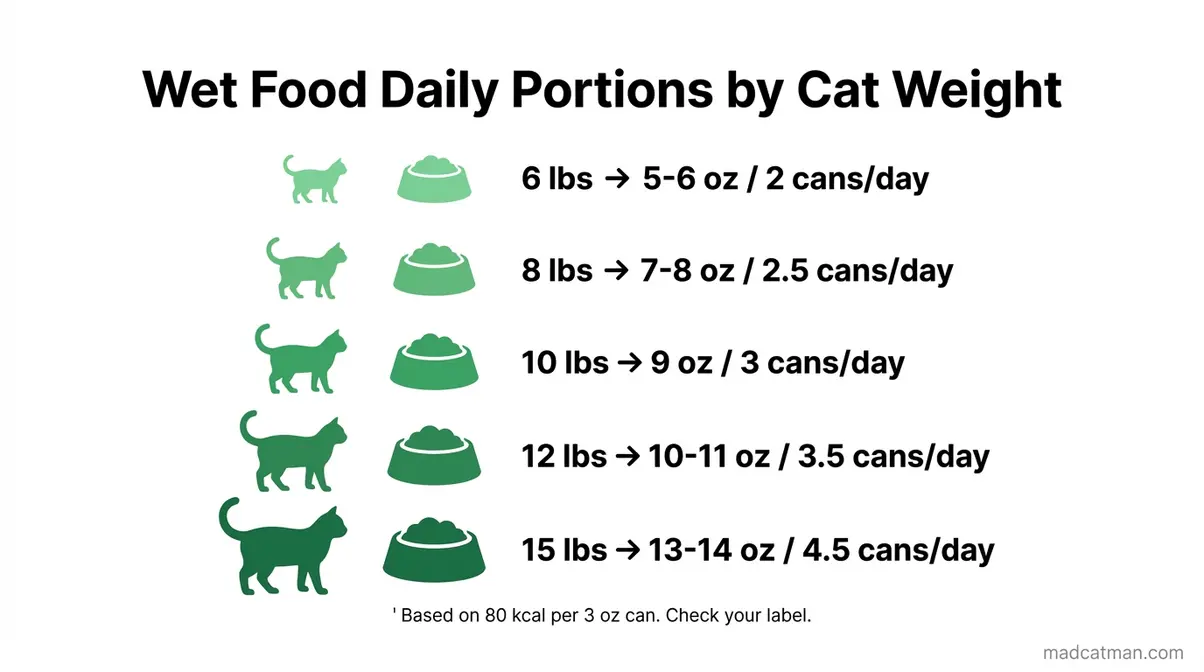
For a 10-lb adult cat needing 240 kcal/day, and using a standard 3 oz can containing approximately 80 kcal:
- Daily need: 240 ÷ 80 = 3 cans (9 oz total)
- Per meal (2 meals/day): approximately 4.5 oz per meal
Meal-plan example #2 — all-wet diet, 10-lb cat: 1.5 × 3 oz cans at 7am + 1.5 × 3 oz cans at 7pm = 9 oz total, ~240 kcal.
Always check the kcal/can figure on your specific brand’s label — it varies significantly. A 3 oz can might contain 60 kcal or 110 kcal depending on the formula.
How Much Dry Food to Feed Your Cat
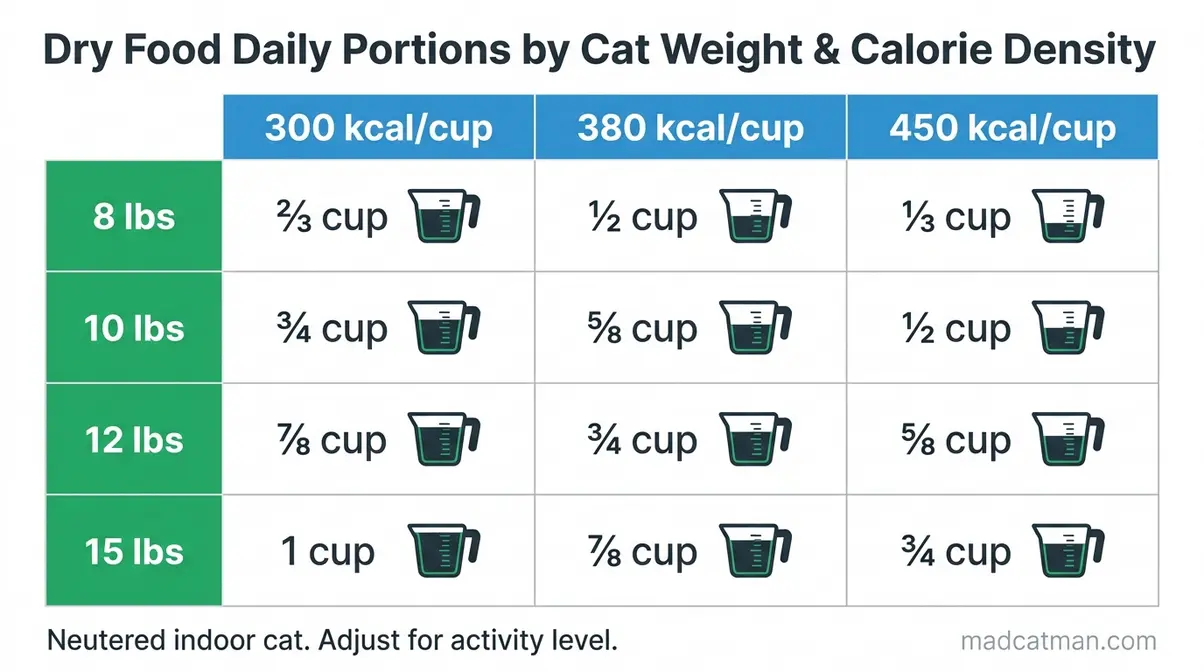
Dry food is where most owners overfeed. The package label is calibrated for an average intact adult cat — which means it’s often too high for a neutered, indoor, sedentary cat. Most adult cats of average size (8–12 lbs) need only ¼ to ½ cup of dry food per day, not a full cup (Ladynpet.com; Stella & Chewy’s feeding guidelines, 2026). When selecting kibble, understanding the truth about grain-free cat food is essential for balancing their nutritional needs.
For a 10-lb neutered indoor cat needing 240 kcal/day, and using a dry food with 380 kcal/cup:
- Daily need: 240 ÷ 380 = 0.63 cups — roughly ⅔ cup per day
- Per meal: approximately ⅓ cup per meal
Is 1 cup of cat food too much?
For most adult cats, 1 full cup of dry food per day is too much. A typical dry food contains 350–450 kcal per cup, while most neutered 8–12 lb cats only need 200–260 kcal per day. One cup would deliver 35–100% more calories than needed, leading to gradual weight gain. The correct portion for a 10-lb neutered indoor cat is typically ¼ to ½ cup per day. Always calculate based on your food’s specific kcal/cup figure, not a generic volume.
Meal-plan example #3 — all-dry diet, 10-lb cat: ⅓ cup at 7am + ⅓ cup at 7pm = ⅔ cup total, ~240 kcal.
Mixing Wet and Dry Food Ratios
Mixed feeding — combining wet and dry food — gives you the hydration benefits of wet food with the dental benefits and convenience of dry. However, you must account for calories from both sources. The simplest approach: calculate each food’s calorie contribution as a percentage of your cat’s daily target.
- Mixed feeding formula:
- Decide on the split — e.g., 50% wet, 50% dry
- Calculate calories from each: 120 kcal wet + 120 kcal dry = 240 kcal total
- Convert to portions using each food’s kcal/serving figure
- Meal-plan example #4 — mixed diet, 10-lb cat (240 kcal/day):
- 7am: 1 × 3 oz can wet food (80 kcal) + ¼ cup dry food (95 kcal) = 175 kcal
- 7pm: ½ × 3 oz can wet food (40 kcal) + ⅛ cup dry food (48 kcal) = 88 kcal (adjust to match daily total)
A cleaner practical split: ¼ cup dry + 2.5 oz wet, twice daily — a common recommendation that works well for most average-sized adult cats.
How to Read the Package Label
Package feeding guides are calculated for a “typical” intact adult cat — not your specific cat. They also assume the cat eats only that brand. For a neutered, indoor cat, the label amount is often 20–40% too high. For example, looking at detailed Farmina N&D Prime Feline Adult reviews can show you how premium brands list their calorie counts.
Here’s what to actually look for on the label:
- Find “kcal/cup” or “kcal/can” — this is the number you need, not the serving size chart
- Divide your cat’s daily calorie target by that number — the result is your daily portion in cups or cans
- Use the label’s chart only as a starting reference, then adjust based on your cat’s body condition score (covered in the Verify Results section)
Meal-plan example #5 — label-based starting point: Label says 270 kcal/cup. Your 10-lb neutered cat needs 240 kcal/day. Daily portion: 240 ÷ 270 = 0.89 cups (~⅞ cup per day), not the 1.5 cups the label suggests for a “10-lb cat.”
Where the label fails, The 4-Variable Formula succeeds — because it accounts for your cat’s specific life stage, activity level, and food type simultaneously.
Step 3: Adjust Portions for Your Cat’s Life Stage
Life Stage is Variable 2 in The 4-Variable Formula — and it’s the variable that changes most dramatically over a cat’s lifetime. A kitten’s calorie needs per pound are almost three times those of a senior cat. Getting this right matters.
Feeding Kittens (Under 12 Months)
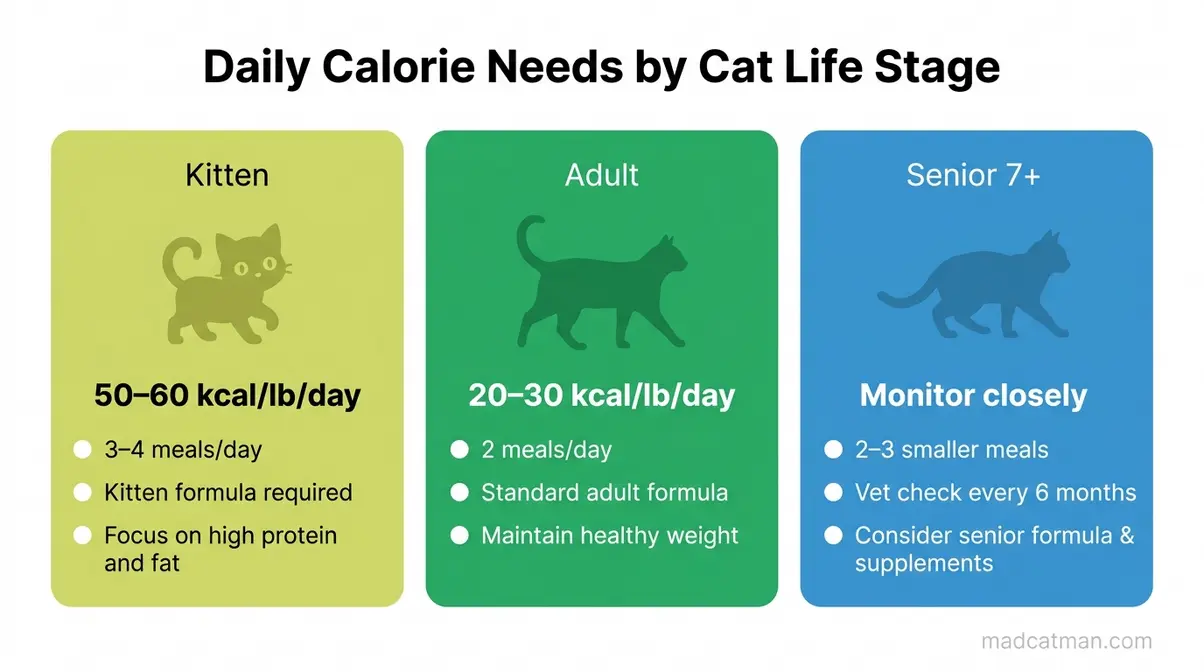
Kittens need approximately 50–60 calories per pound of body weight per day — roughly 2–3× more than adult cats (Nulo Nutrition, 2026). They’re growing rapidly, and that growth demands sustained energy. Many owners wonder if kittens can eat adult cat food, but sticking to kitten-specific recipes is crucial for proper development.
- Under 6 months: 3–4 meals per day. A 3-lb kitten needs roughly 150–180 kcal daily.
- 6–12 months: Gradually reduce to 2–3 meals per day as growth slows.
- Food type: Use kitten-specific formula (higher protein, higher fat) until 12 months.
According to the AAFP-AAHA Feline Life Stage Guidelines, kittens should be fed kitten-formulated food continuously until they reach 12 months of age, at which point transitioning to adult food is appropriate. Never put a kitten on a calorie-restricted diet without veterinary guidance — inadequate calories during development can cause permanent health damage.
Meal-plan example #6 — 3-lb kitten: 45–55 kcal × 3 lbs = 135–165 kcal/day, split across 3 meals (~50 kcal per meal).
Feeding Adult Cats (1–7 Years)
Adult cats (1–7 years) are in their metabolic sweet spot — calorie needs are stable and predictable. The 20–30 kcal per pound guideline applies most reliably here. A 10-lb neutered indoor adult cat needs approximately 200–260 kcal per day (Animal Medical Center of Chicago, 2020).
Two meals per day, 8–12 hours apart, is the standard recommendation from Cornell University’s Feline Health Center. Cornell’s veterinary team notes that scheduled meals are preferable to free feeding for weight management in adult cats.
Watch for gradual weight creep after age 3–4 — many cats slow their activity while their owners maintain the same portions. A small reduction of 10–15% in daily calories can prevent early-onset obesity.
Feeding Senior Cats (7+ Years)
Senior cats (7+ years) present a paradox: some gain weight from reduced activity, while others lose weight due to reduced appetite, dental pain, or hyperthyroidism. VCA Animal Hospitals recommends monitoring senior cats with more frequent weigh-ins — every 3–6 months — rather than assuming a fixed calorie target is correct.
- Overweight seniors: May need 20–30% calorie reduction plus a high-protein diet to preserve muscle mass
- Underweight seniors: May need 30–40 kcal per pound to maintain weight, plus more frequent smaller meals
- Dental issues: Wet food or softened kibble may be necessary if chewing is painful
Consult your veterinarian if your senior cat loses more than 10% of their body weight over 3–6 months — this is a significant clinical sign that warrants investigation.
Breed-Specific Notes
Most breed-specific feeding differences come down to size. Maine Coons, for example, are large cats (10–18 lbs is normal) and may need 300–450 kcal/day simply due to their body mass — not because they have unique nutritional requirements. Conversely, petite breeds like Singapuras may need as few as 150–180 kcal/day. The formula stays the same; the weight input changes. If your cat is a large or giant breed, always calculate based on their ideal weight for their breed standard, not their current weight.
Step 4: Modify Feeding for Weight and Health
Activity Level is Variable 4 in The 4-Variable Formula — but for cats with weight issues or health conditions, this variable overlaps with medical management. Always consult your veterinarian before making significant calorie changes for an overweight, underweight, or pregnant cat.
Feeding an Overweight Cat Safely
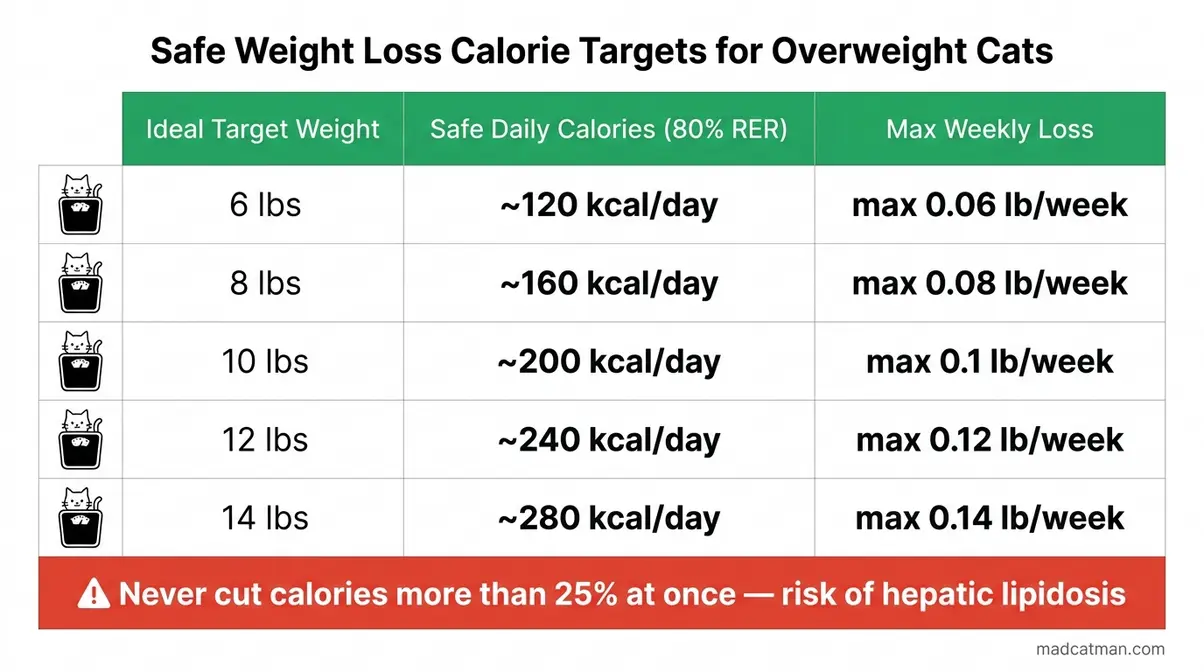
Overweight cats (those with a Body Condition Score of 6–9 out of 9) face serious health risks including diabetes, joint disease, and shortened lifespan. However, rapid weight loss is equally dangerous — cutting calories too sharply can trigger hepatic lipidosis (fatty liver disease), a potentially fatal condition in cats. Choosing the right cat weight loss food is just as important as portion control.
The safe approach, per VCA Animal Hospitals’ weight reduction guidelines:
- Target loss rate: No more than 0.5–1% of body weight per week
- Calorie reduction: Feed 80% of the RER (Resting Energy Requirement) calculated for their ideal target weight — not their current weight
- Example: A 14-lb cat with an ideal weight of 10 lbs should be fed calories calculated for a 10-lb cat (approximately 200 kcal/day), not a 14-lb cat
Research from the Cornell Feline Health Center indicates that an overweight 10-lb cat with an ideal weight of 8 lbs needs approximately 154 kcal/day for safe weight loss (Cornell Feline Health Center). Never reduce a cat’s food by more than 25% at once without veterinary supervision.
Feeding Underweight or Recovering Cats
Underweight cats (BCS 1–3 out of 9) need calorie increases, but the cause of their low weight must be identified first. Hyperthyroidism, dental pain, kidney disease, and parasites can all cause weight loss — and feeding more calories won’t fix an underlying medical problem.
Once a veterinarian has cleared the cat medically, recovery feeding typically involves:
- High-calorie, high-protein wet food (e.g., veterinary recovery formulas like Hill’s a/d)
- 3–4 small meals per day rather than 2 larger ones
- Gradual calorie increases of 10–15% per week until ideal BCS is restored
Never attempt to rapidly re-feed a severely underweight cat without veterinary guidance — refeeding syndrome is a real risk.
Feeding Pregnant and Nursing Cats
Pregnant cats need significantly more calories than their non-pregnant counterparts. Calorie needs increase progressively through pregnancy and peak during lactation:
- Pregnancy: Increase food by approximately 25–50% above normal maintenance, switching to kitten formula (higher protein and fat density)
- Lactation (nursing): Calorie needs can reach 2–6× normal maintenance depending on litter size (APOP; Purina Institute)
- Free feeding during lactation is often recommended by veterinarians — nursing mothers need continuous access to food
Veterinarians recommend switching a pregnant cat to kitten-formula food by week 6 of pregnancy and continuing through weaning. Consult your vet at the start of pregnancy to establish a specific feeding plan.
Step 5: Use Feeding Charts and Calculators
Even with The 4-Variable Formula fully understood, having the right tools makes daily feeding accurate and consistent. This step covers the two most practical resources: online calculators and unit conversion charts.
How to Use the Daily Calorie Calculator
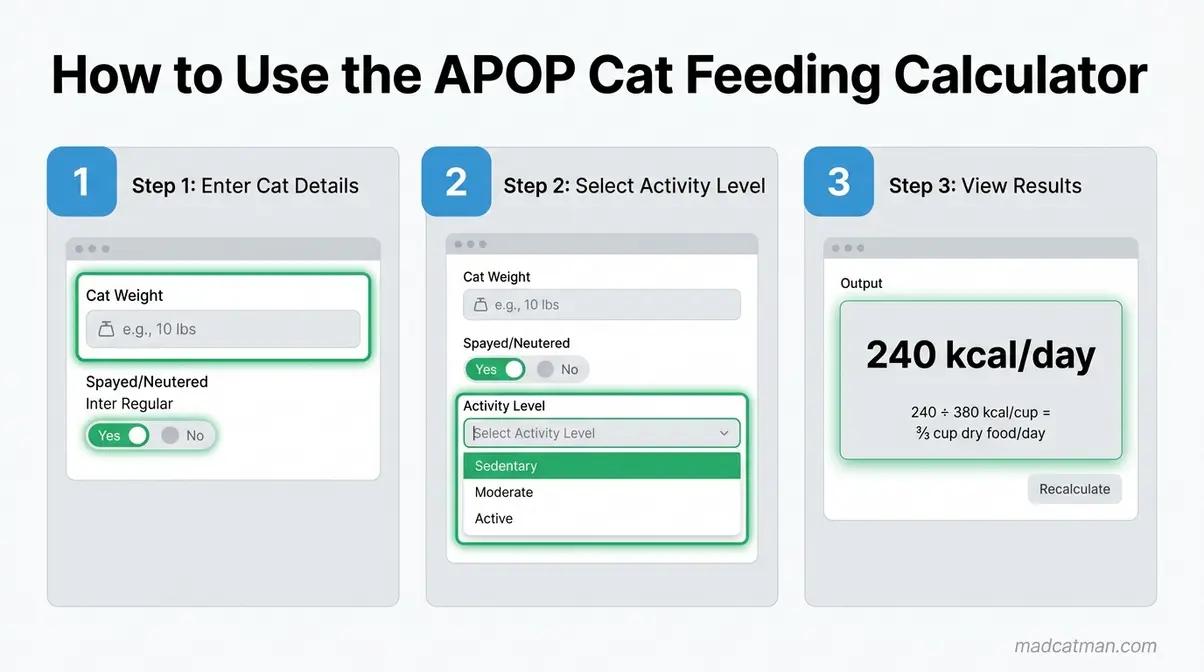
The APOP Cat Daily Feeding Calculator (Association for Pet Obesity Prevention) is the most widely recommended free tool for calculating your cat’s individual daily calorie target. It accounts for weight, spay/neuter status, and activity level.
- How to use it in 3 steps:
- Enter your cat’s current weight and whether they are spayed/neutered
- Select their activity level (sedentary, moderate, active)
- The calculator returns a daily kcal target — use this number to calculate portions using your food’s label
Once you have the kcal figure, divide it by the kcal/cup (dry) or kcal/can (wet) listed on your food’s packaging. The result is your daily portion in cups or cans.
Reading Charts: Cups vs. Grams
Feeding instructions appear in different units across brands, which creates real confusion. Here’s a quick conversion reference:
| Measurement | Equivalent | Practical Use |
|---|---|---|
| 1 cup dry food | ~100–115g | Standard measuring cup |
| 1 oz wet food | ~28g | Useful for mixed feeding |
| 3 oz can wet food | ~85g | Standard small can |
| 5.5 oz can wet food | ~156g | Standard medium can |
| 1 tablespoon dry | ~8–10g | Useful for small adjustments |
The most accurate method is always weight in grams — a digital kitchen scale removes all ambiguity between different kibble shapes and densities. A “cup” of small round kibble contains more calories than a “cup” of large irregular kibble, even from the same brand. Measuring by weight eliminates this variable.
Step 6: Handle Special Medical Feeding Situations
Some cats require feeding approaches that go beyond the standard formula. This step covers two scenarios that cat owners encounter but rarely find clear guidance on.
Assisted Feeding Basics
A cat that refuses food for more than 24–48 hours needs veterinary attention — not just a different food flavor. Prolonged anorexia in cats can trigger hepatic lipidosis within 48–72 hours, particularly in overweight cats. This is a medical emergency. This is especially critical if you are looking into how to prevent chronic kidney disease in cats, as hydration and consistent eating are vital.
If your veterinarian has assessed your cat and recommends assisted feeding:
- Syringe feeding is used for cats who need small amounts of liquid or pureed food
- Use a veterinary recovery formula (e.g., Hill’s a/d, Royal Canin Recovery) — these are calorie-dense and designed for easy syringe delivery
- Target 25–30% of normal daily calories on day one, increasing gradually over 3–5 days
- Offer food warmed to approximately body temperature (38°C/100°F) — this increases palatability for reluctant eaters
Never force-feed a cat without specific veterinary instruction — aspiration (inhaling food) is a serious risk.
Feeding a Nursing Mother Cat
A nursing mother cat’s calorie needs are among the highest in feline nutrition — potentially reaching 4–6× her normal maintenance calories during peak lactation (APOP). The simplest approach recommended by veterinarians is free feeding a high-quality kitten formula throughout the nursing period.
Key points for nursing mothers:
- Switch to kitten formula food (higher protein and fat) at least 2 weeks before the expected birth
- Provide fresh water at all times — lactation significantly increases fluid needs
- Monitor weight weekly; a nursing mother should not lose more than 10% of her pre-pregnancy weight
- Kittens should begin transitioning to solid food at 3–4 weeks, which will gradually reduce the mother’s calorie demands
Verify Results: Are You Feeding the Right Amount?
The 4-Variable Formula gives you a starting estimate. But your cat’s body is the real feedback system — and the Body Condition Score (BCS) is how you read it.
Checking Body Condition Score
The BCS (Body Condition Score) is a standardized 1–9 scale used by veterinarians to assess whether a cat is at a healthy weight based on visual and hands-on assessment (WSAVA BCS Chart, 2017; VCA Animal Hospitals). You can perform a simplified version at home.
The rib test: Run your fingers gently along your cat’s ribcage with light pressure. You should be able to feel individual ribs without pressing hard — but you should not be able to see them from across the room.
| BCS Score | What You Feel/See | What It Means |
|---|---|---|
| 1–3 (Underweight) | Ribs visible, spine prominent, no fat cover | Underfed or medical issue — see vet |
| 4–5 (Ideal) | Ribs felt easily, slight fat cover, visible waist | Feeding the right amount ✓ |
| 6–7 (Overweight) | Ribs hard to feel, waist barely visible | Reduce calories by 10–20% |
| 8–9 (Obese) | Ribs not felt, no waist, belly sags | Veterinary weight-loss plan needed |
Source: WSAVA Body Condition Scoring Chart, 2017; VCA Animal Hospitals.
How do I know if I’m feeding my cat the right amount? Your cat is at a BCS of 4–5, maintains a stable weight month to month, finishes meals without leaving food behind, and shows consistent energy levels. If your cat consistently leaves food uneaten, reduce portions by 10%. If they finish immediately and cry for more, check their BCS before adding more food — hunger cues alone are unreliable.
Recheck your cat’s BCS every 4–6 weeks, especially after any change in food brand, life stage, or activity level. This is how you close the feedback loop on The 4-Variable Formula.
Troubleshooting Common Feeding Problems
Even with a solid plan in place, real-world feeding throws curveballs. Here are the most common problems and how to handle them:
Problem: My cat eats too fast and vomits.
Slow-feeder bowls, puzzle feeders, or splitting meals into 3 smaller portions throughout the day can help. Eating too fast is common with dry food and doesn’t mean your cat is getting too much — it means the pace needs slowing.
Problem: My cat won’t eat the measured amount.
First, check the food’s palatability — a new batch of food can smell different. Warm wet food slightly (to ~38°C) to increase aroma. If your cat consistently leaves 20%+ of their meal, reduce the portion by that amount rather than assuming they’ll “catch up” later. A cat eating 80% of their calculated calories may still be at a healthy weight — check the BCS.
Problem: One cat eats the other’s food.
Use separate feeding stations in different rooms, or invest in a microchip-activated feeder that only opens for the correct cat. This is one of the most practical uses of an automatic feeder in multi-cat households.
Problem: My cat begs constantly even after eating.
Hunger-signaling behavior in cats is often habit or boredom, not genuine calorie need. Check the BCS first. If your cat is at an ideal BCS 4–5 and still begging, introduce puzzle feeders to slow eating and extend mental engagement across the day.
Problem: My cat’s weight isn’t changing despite my adjustments.
Calorie counts on labels have a margin of error of up to 10–15%. If your cat’s weight isn’t moving after 4–6 weeks of consistent measured feeding, consult your veterinarian — metabolic issues (hypothyroidism is rare in cats but exists) may be a factor.
When to Call Your Vet
Common Pitfalls to Avoid
- Pitfall 1: Feeding by the package label alone. Labels are calibrated for an average intact adult cat. A neutered, indoor, sedentary cat may need 30–40% less than the label suggests. Always cross-reference with a calorie calculation.
- Pitfall 2: Switching foods without adjusting portions. Every food has a different calorie density. When you change brands, recalculate — don’t assume the same volume equals the same calories.
- Pitfall 3: Using treats as a calorie-free reward. Treats count. Veterinary consensus indicates treats should make up no more than 10% of your cat’s daily calorie intake (WSAVA, 2020). A cat needing 240 kcal/day has a treat budget of just 24 kcal — roughly 3–5 small treats.
Alternatives to Self-Managing
Home-calculated feeding plans work well for healthy cats. However, the following situations require professional veterinary dietary guidance rather than self-management:
- Your cat has been diagnosed with kidney disease, diabetes, hyperthyroidism, or IBD — therapeutic diets prescribed by a vet differ significantly from standard commercial food
- Your cat has lost more than 10% of their body weight in under 3 months without a deliberate diet change
- A kitten is not gaining weight consistently week over week during the first 12 weeks of life
When to Seek Expert Help
Consult your veterinarian promptly if your cat refuses food for more than 24 hours, shows sudden weight loss or gain, has difficulty chewing or swallowing, or displays a dramatic change in appetite. These are clinical signs — not feeding problems — and they require diagnosis before any feeding adjustment. This guide is for educational purposes; always consult your veterinarian for personalized dietary advice for your individual cat.
Frequently Asked Questions
How much food should a cat eat a day?
Most adult cats need 20–30 calories per pound of ideal body weight per day. A 10-lb neutered indoor cat typically needs 200–260 kcal daily, split across 2 meals. According to WSAVA daily calorie guidelines, an 11-lb adult cat needs approximately 250–290 calories per day (WSAVA, 2020). The exact amount depends on your cat’s weight, life stage, food type, and activity level — which is why The 4-Variable Formula is the most reliable starting point.
Am I feeding my cat the right amount?
Check your cat’s Body Condition Score (BCS) every 4–6 weeks — an ideal BCS of 4–5 out of 9 confirms you’re feeding the right amount. At a BCS of 4–5, you can feel your cat’s ribs with gentle pressure but cannot see them. Your cat maintains a stable weight month to month, finishes meals without obsessive begging, and has consistent energy. If the BCS drops below 4, increase portions by 10%. If it rises above 5, reduce by 10% and recheck in 4 weeks.
Feeding kittens vs. adult cats
Yes — kittens have significantly different calorie needs than adult cats. Kittens need approximately 50–60 calories per pound of body weight per day, compared to 20–30 kcal/lb for adult cats (Nulo Nutrition, 2026). They also need kitten-specific formula food (higher protein and fat) and 3–4 meals per day until 6 months of age. Always feed kittens a food labeled “for growth” or “for all life stages” — adult-only formulas don’t provide adequate nutrition for a growing kitten’s needs.
Can cats live on dry food alone?
Yes, cats can survive on an exclusively dry food diet, provided it is nutritionally complete and balanced. However, because cats have a low natural thirst drive, an all-dry diet requires you to monitor their water intake closely. Incorporating a pet water fountain can encourage them to drink more and prevent urinary tract issues.
Do indoor cats need less food?
Yes, indoor cats generally require fewer calories than outdoor cats because they lead more sedentary lifestyles. An active outdoor cat might need 10 to 15 percent more calories to maintain their energy levels. Adjusting portions downward for indoor cats is a crucial step in preventing feline obesity.
Conclusion
For first-time cat owners, figuring out how much should I feed my cat daily doesn’t have to be overwhelming. Most adult cats need 20–30 calories per pound of ideal body weight each day — for a 10-lb neutered indoor cat, that’s approximately 200–260 kcal, split across 2 meals. According to WSAVA daily calorie guidelines, an 11-lb adult cat needs approximately 250–290 calories per day (WSAVA, 2020). Applying this calorie-first approach — then adjusting for food type, life stage, and activity level — is how you feed your cat with real confidence.
The 4-Variable Formula (Weight + Life Stage + Food Type + Activity Level) gives you a structured, memorable system to return to whenever your cat’s needs change — after surgery, after a birthday, after switching brands. It’s not a rigid prescription; it’s a framework that grows with your cat. Check the Body Condition Score every 4–6 weeks and let your cat’s actual body tell you whether the formula needs adjusting.
Start with the APOP calculator to get your cat’s personalized calorie target, then divide by your food’s kcal/cup or kcal/can figure to find today’s portion. Write the number down. Put it on the fridge. And remember: this guide is a starting point — always consult your veterinarian for personalized dietary advice, especially if your cat has any health conditions. A quick annual nutrition check with your vet is the single best investment you can make in your cat’s long-term health.

Dave King
Cat owner and writer at Mad Cat Man.