
Table of Contents
- What You’ll Need Before You Start
- Step 1: Understand Why Your Dog Chases Your Cat
- Step 2: Make Your Home Safe for Your Cat Right Now
- Step 3: Train Your Dog to Stop Chasing the Cat
- Step 4: Know What to Expect and When Things Go Wrong
- Limitations, Safety, and When This Guide Isn’t Enough
- Frequently Asked Questions
- Conclusion
This blog post may contain affiliate links. As an Amazon Associate I earn from qualifying purchases.
To stop a dog chasing cat indoors, you need two things working at the same time: immediate environmental changes that keep your cat safe today, and consistent daily training that rewires your dog’s response over 4 weeks. This guide walks you through 4 structured steps — from understanding why the chasing happens to managing a chase in real time. With patience and the right tools, calm coexistence is absolutely achievable.
Your cat darts under the bed the moment your dog enters the room. She barely eats, barely moves — and it breaks your heart to watch.
“Two of them hide upstairs all day until my puppy goes to bed for the night. It breaks my heart.”
— A frustrated pet owner on a dog training forum
You are not alone. Thousands of pet owners live with this exact daily stress, watching their cat hide for hours while feeling helpless to stop it. Here’s the hard truth: the dog chasing cat indoors problem will not fix itself. As the chasing continues, it becomes a self-rewarding habit — your dog learns that the chase itself feels good, which makes the behavior stronger every single day. Your cat, meanwhile, experiences chronic stress that can lead to real health problems over time.
The good news? This is a solvable problem. By the end of this guide, you’ll have a clear, step-by-step plan to stop the dog chasing cat indoors behavior — starting today. You’ll begin by understanding what’s actually driving it, then set up your home for immediate safety, and then work through The 4-Phase Peace Protocol — a proven 4-week training plan any beginner can follow.
Stopping a dog from chasing cats indoors requires two things working together: same-day environmental management to keep your cat safe, and consistent positive reinforcement training over 4 weeks. Most dogs can learn calm coexistence — but it takes patience.
- The 4-Phase Peace Protocol pairs immediate safety steps with a progressive training plan built for beginners
- Baby gates and cat shelves give your cat safe zones the dog physically cannot reach
- A house lead (indoor leash) keeps your dog manageable during training sessions
- The “Look Away” game is the single most effective technique for building impulse control around cats
- Punishment never works — it increases fear and can trigger redirected aggression toward you or your cat
What You’ll Need Before You Start
Before jumping into Step 1, gather these tools. Having everything ready will make each training session smoother and far less stressful for everyone involved.
- Tools checklist:
- A standard 4–6 ft dog leash (for indoor house lead use — you’ll clip this to your dog’s collar or harness indoors)
- High-value treats: small, soft pieces of cooked chicken, cheese, or commercial training treats your dog goes wild for
- At least one baby gate — pressure-mounted or hardware-mounted, depending on your doorway
- Cat shelves, a cat tree, or a sturdy bookcase your cat can climb (for building vertical escape routes)
- 10–15 minutes of focused training time per day — consistency matters far more than long sessions
One important mindset shift: This process takes weeks, not days. Progress is rarely a straight line — some days will feel like setbacks, and that is completely normal. Don’t let a bad day convince you it isn’t working. Finally, until training is complete, never leave your dog and cat unsupervised together in the same space. Management comes first, always.
Step 1: Understand Why Your Dog Chases Your Cat
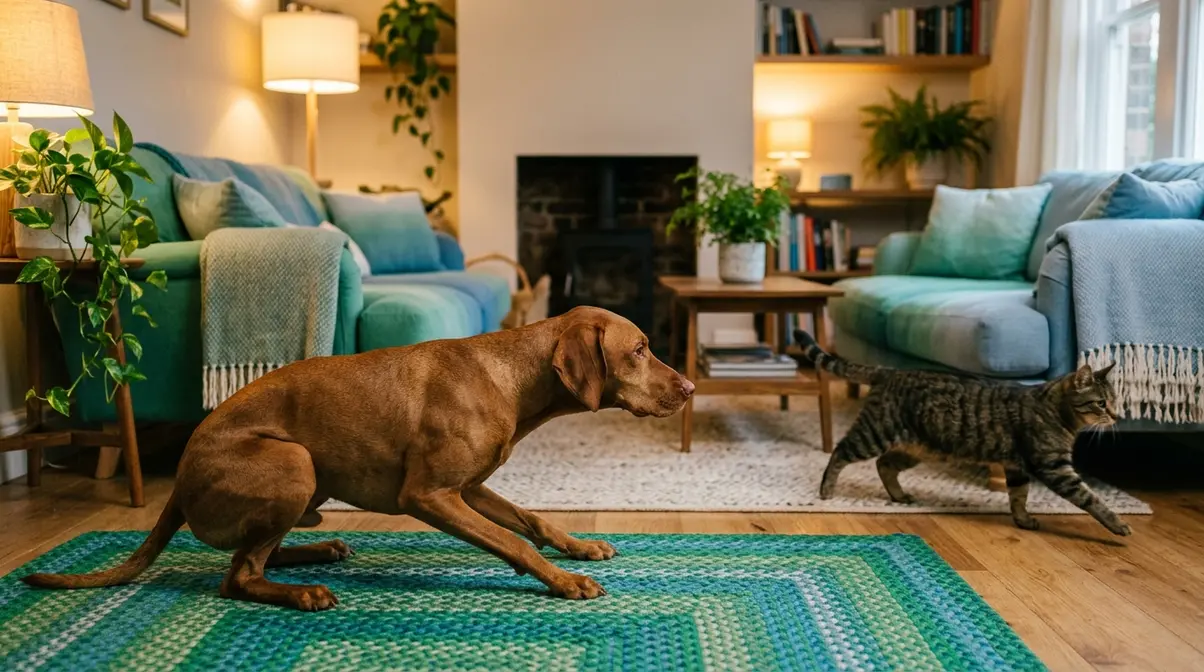
Dogs chase cats indoors because fast, unpredictable movement automatically triggers prey drive — the natural hunting instinct that all dogs are born with, regardless of breed. When your cat darts across the floor, your dog’s brain essentially flips a switch it cannot control consciously. Understanding this changes everything about how you approach training.
Dogs do not chase cats out of aggression — they chase because fast movement automatically triggers their prey drive, an instinct no amount of scolding can override.
Your dog is not being malicious. He is not dominant, spiteful, or mean. He simply cannot help himself in that moment — and that distinction matters enormously, because punishment-based responses make the problem worse, while training-based approaches actually work.
Play vs. Prey Drive: How to Tell the Difference
Not every chase is dangerous. Some dogs and cats engage in genuine play that looks alarming to worried owners. Knowing the difference tells you how urgently you need to act.
- Playful chasing looks like this:
- The dog has a loose, bouncy body — wiggly hips, relaxed face, open mouth
- The dog takes turns: he chases, then lets the cat “chase” him back
- Both animals seem relaxed afterward — the cat doesn’t hide for hours
- The dog disengages easily when you call his name
- Predatory chasing looks like this:
- The dog’s body goes rigid and low — head drops, eyes lock onto the cat with intense focus
- The dog enters a “stalk” posture before the chase even begins — slow, deliberate movement
- There is zero play-bow, no loose wiggling — the focus is laser-locked
- The dog is hard or impossible to interrupt once the chase begins
- The cat hides for hours afterward, refuses food, or stops using the litter box
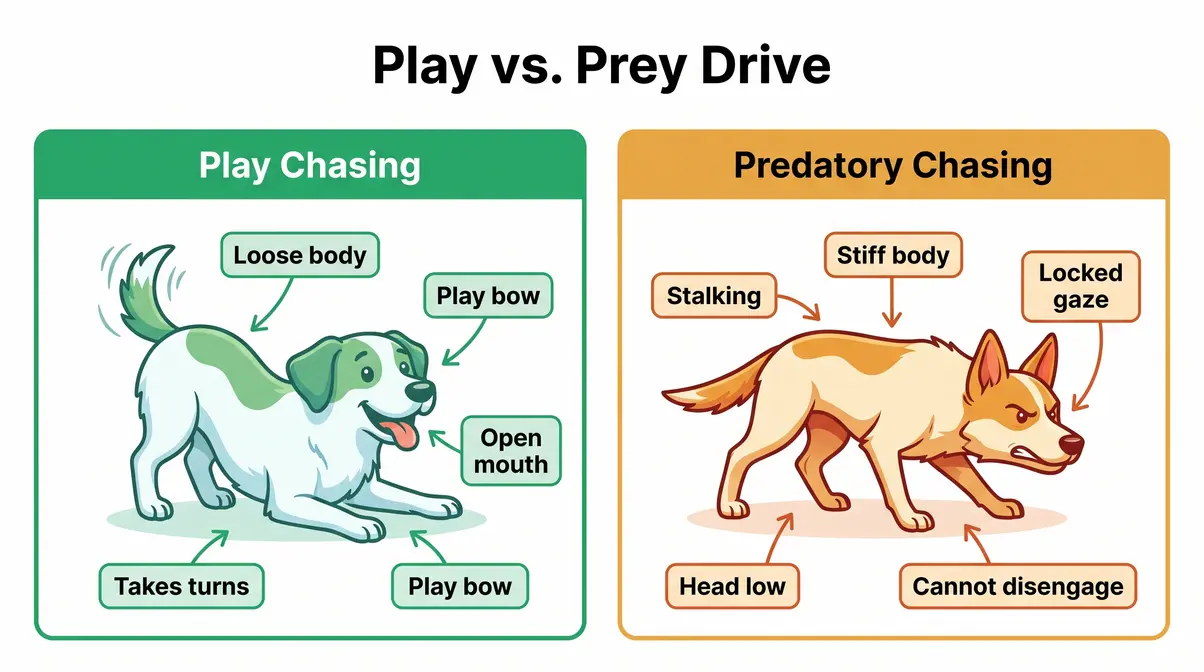
If your dog’s behavior matches the predatory column — especially the stalking posture and inability to disengage — treat this as urgent. The techniques in this guide apply to both scenarios, but predatory intensity requires more patience and, in some cases, professional support.
The Chase Sequence: What’s Happening in Your Dog’s Brain
Understanding the chase sequence helps you interrupt it earlier — before it becomes unstoppable. Veterinary behaviorists describe predatory behavior as a sequence of distinct stages: orient → stalk → chase → grab. Each stage builds on the last, and the further along the sequence your dog gets, the harder it becomes to interrupt.
Orient: Your dog spots the cat across the room. His head snaps toward it. His ears perk forward. This is the moment you have the most influence — a calm “leave it” cue can redirect him here.
Stalk: Your dog’s body drops low and slow. He begins moving toward the cat deliberately. His focus narrows completely. This is your last easy opportunity to redirect.
Chase: The cat moves — and your dog launches. At this point, his brain is flooded with excitement and the behavior is nearly impossible to stop mid-stream. This is why prevention and early interruption are so critical.
Grab: In true predatory sequences, this is the dangerous endpoint. Most pet dogs never reach this stage, but high-prey-drive breeds are at greater risk.
Imagine your dog sees the cat like a remote-controlled toy suddenly darting across the floor. The toy moves — the hand reaches out. It is that automatic, and that involuntary. This is why scolding after the fact accomplishes nothing: by the time you react, your dog has already experienced the reward of the chase itself.
This is exactly where The 4-Phase Peace Protocol comes in. The 4-Phase Peace Protocol is a structured approach that pairs same-day safety management with a 4-week progressive training plan to help your dog and cat coexist calmly indoors. Phase 1 starts with your home environment — right now, today.
✅ Checkpoint: You should now be able to identify whether your dog’s chasing looks more like play or prey drive, and you can describe the four stages of the chase sequence. Hold onto that knowledge — it will guide every training decision you make in the steps ahead.
Step 2: Make Your Home Safe for Your Cat Right Now
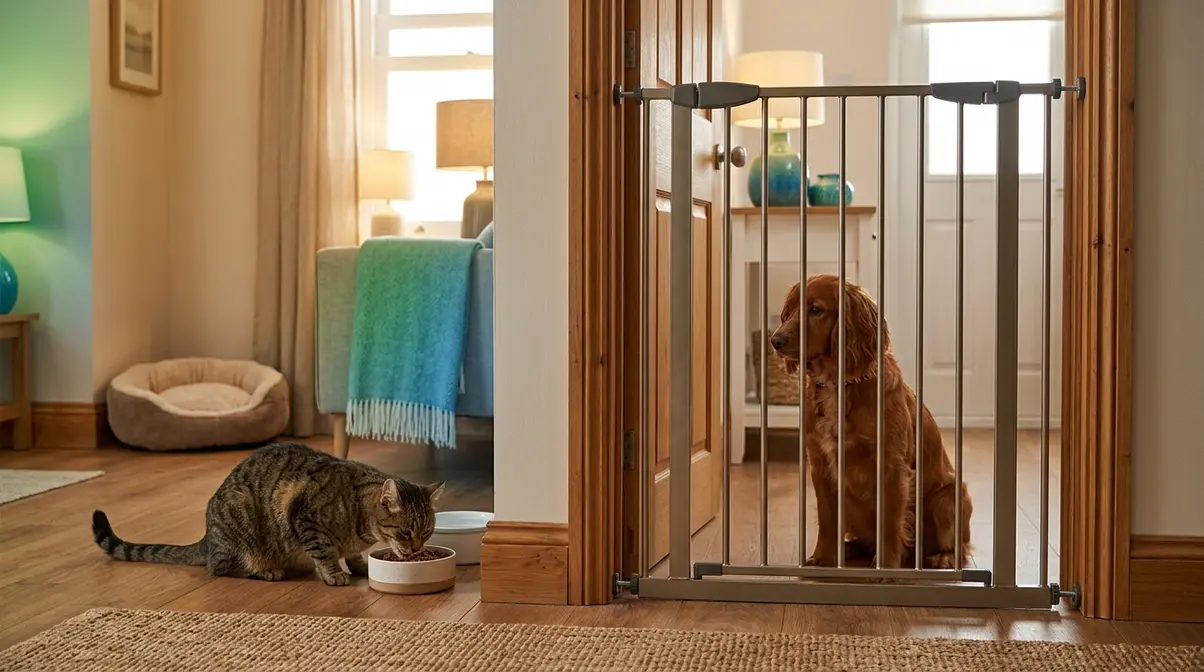
Before any training begins, your cat needs to feel physically safe. Environmental management — rearranging your home to give your cat escape routes and dog-free zones — is the single fastest thing you can do today. Across pet owner communities and veterinary guidance alike, the consistent experience is that training without environmental management first leads to slower results and more stress for both animals.
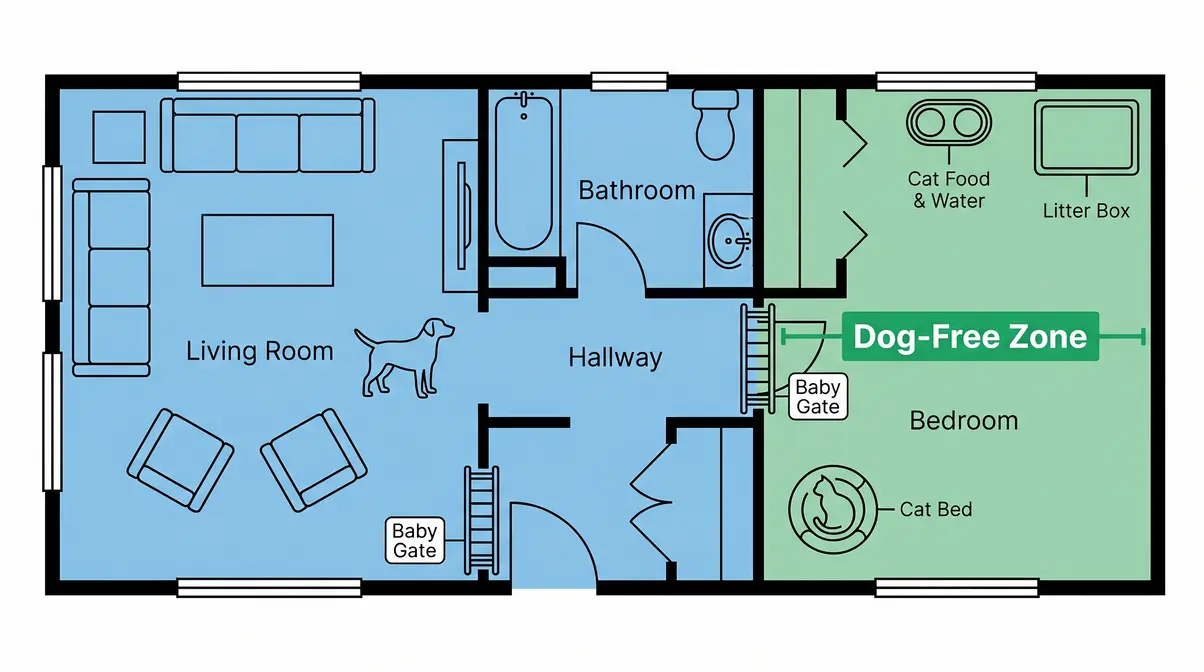
Set Up Baby Gates to Create Dog-Free Zones
A baby gate is not just a physical barrier — it is a psychological lifeline for your cat. When your cat knows there is a space the dog absolutely cannot enter, her stress levels drop noticeably. You will likely see her start using that space more, eating more regularly, and grooming herself again within a few days.
How to set up an effective dog-free zone:
- Choose a room your cat already uses frequently — a bedroom, bathroom, or spare room works well.
- Install a baby gate in the doorway. For large or athletic dogs, use a tall gate (at least 30 inches) or a gate with a small cat door built in — your cat can pass through freely while the dog cannot.
- Place your cat’s food bowl, water dish, and one litter box inside this zone. This ensures she can always access her basic needs without running a gauntlet.
- Add a comfortable bed or hiding spot inside the zone — a covered cat bed or cardboard box with a blanket gives her a place to decompress fully.
For multi-story homes: Designate one entire floor (usually upstairs) as the cat’s primary refuge. Use a gate at the top or bottom of the stairs. This immediately reduces the area your cat must navigate around your dog.
Hardware-mounted gates are more secure for strong or determined dogs. Pressure-mounted gates work well for most medium and small breeds. Check the gate daily — a dog that learns to push through a gate will do so repeatedly, and the sense of security it provided your cat disappears instantly.
Build a Cat Highway With Shelves and Cat Trees
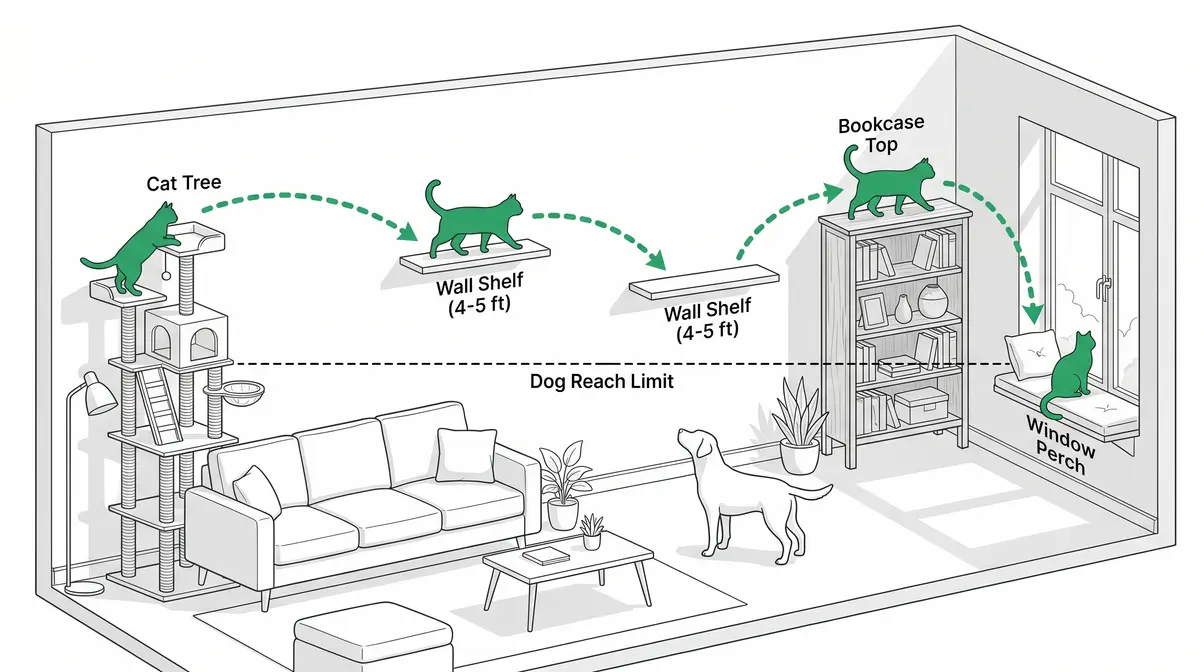
Even in shared spaces where your dog has access, your cat needs a way to move through the room without ever touching the floor. This is what animal welfare specialists call a cat highway — a connected network of elevated surfaces your cat can use to travel above dog level.
Researchers and animal welfare organizations, including guidance aligned with Texas A&M Veterinary Medicine, consistently emphasize that cats need vertical escape routes above a dog’s reach to maintain psychological wellbeing in multi-pet homes. A cat that can escape upward — rather than being cornered at floor level — is a cat that experiences dramatically less chronic stress.
- Building a basic cat highway:
- Place a cat tree near a window or sofa your cat already uses
- Add floating wall shelves at 4–5 ft height, spaced no more than 18 inches apart so your cat can jump between them comfortably
- Position shelves to connect key areas: from the cat tree to the top of a bookcase to a window ledge, for example
- Ensure every shelf has a non-slip surface — carpet tape or a small rug piece works well
The goal is that your cat can travel from one end of the room to the other without ever descending to floor level. Once she discovers this route, you will see her confidence in shared spaces grow noticeably.
Protect Your Cat’s Food, Water, and Litter Box
A stressed cat that cannot reliably access food, water, or her litter box develops serious health problems. The AVMA notes that it can take weeks to months for pets to fully adjust to a multi-species household (AVMA, 2024) — which means your management setup needs to hold up for the long haul, not just a few days.
Immediate actions to take today:
- Feed your cat in her dog-free zone, behind the baby gate. Never feed her on the floor in a shared space during the training period.
- Elevate food and water bowls to counter height if a dog-free room is not yet available — most dogs cannot comfortably eat from a surface 4+ feet off the ground.
- Place at least one litter box inside the dog-free zone. If you have multiple cats, follow the standard rule: one litter box per cat, plus one extra. A cat that cannot safely reach her litter box will find alternatives — and that stress manifests as inappropriate elimination, over-grooming, and immune suppression.
- Check food bowl access twice daily during the early weeks. A cat who is hiding and not eating for more than 24 hours needs veterinary attention — prolonged food refusal in cats can cause hepatic lipidosis (fatty liver disease), which is a serious medical emergency.
✅ Checkpoint: You should now see your cat accessing her food, water, and litter box without having to navigate the dog. She may still be skittish, but her basic needs are covered. That is a genuine win — and the foundation for everything in Step 3.
Step 3: Train Your Dog to Stop Chasing the Cat
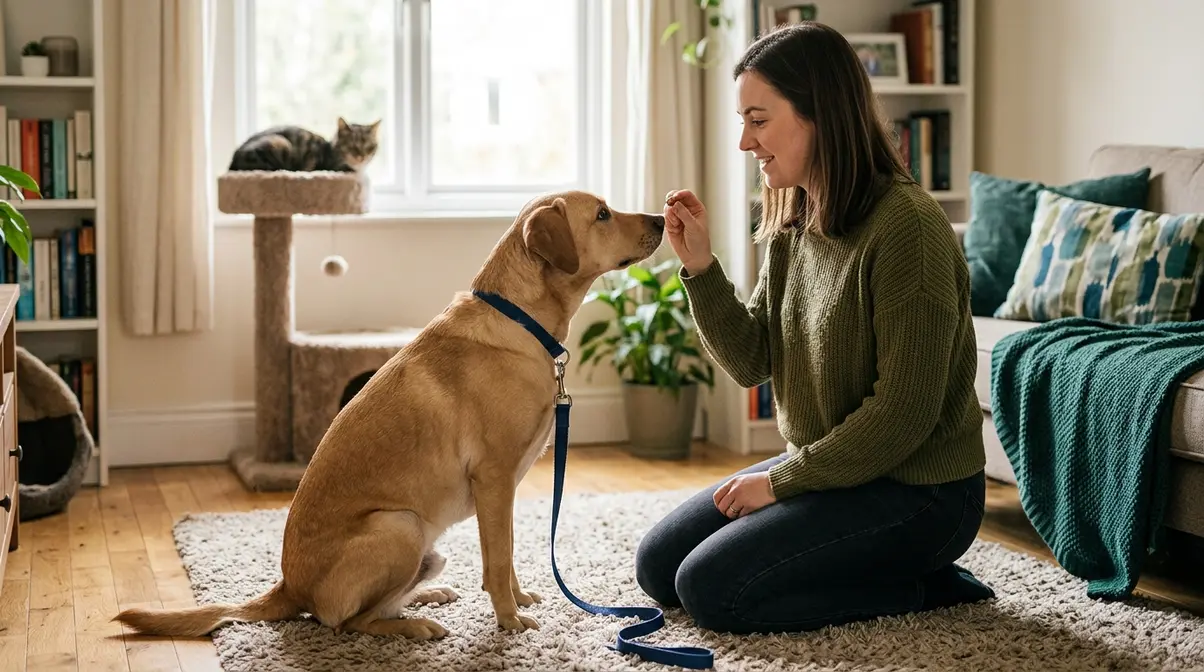
Environmental management keeps your cat safe, but training is what actually changes your dog’s behavior. This is where The 4-Phase Peace Protocol moves from passive management into active skill-building. Our team evaluated these techniques using guidance from certified veterinary behaviorists and applied animal behavior specialists — the six exercises below represent the most consistently recommended, beginner-accessible methods for reducing predatory behavior toward cats.
The core principle across all of them is positive reinforcement (rewarding the behavior you want, rather than punishing the behavior you don’t). Punishment-based approaches — yelling, leash corrections, spray bottles — do not teach your dog what to do instead. They only suppress behavior temporarily, and often increase anxiety in both animals.
Use a House Lead for Safe Indoor Management
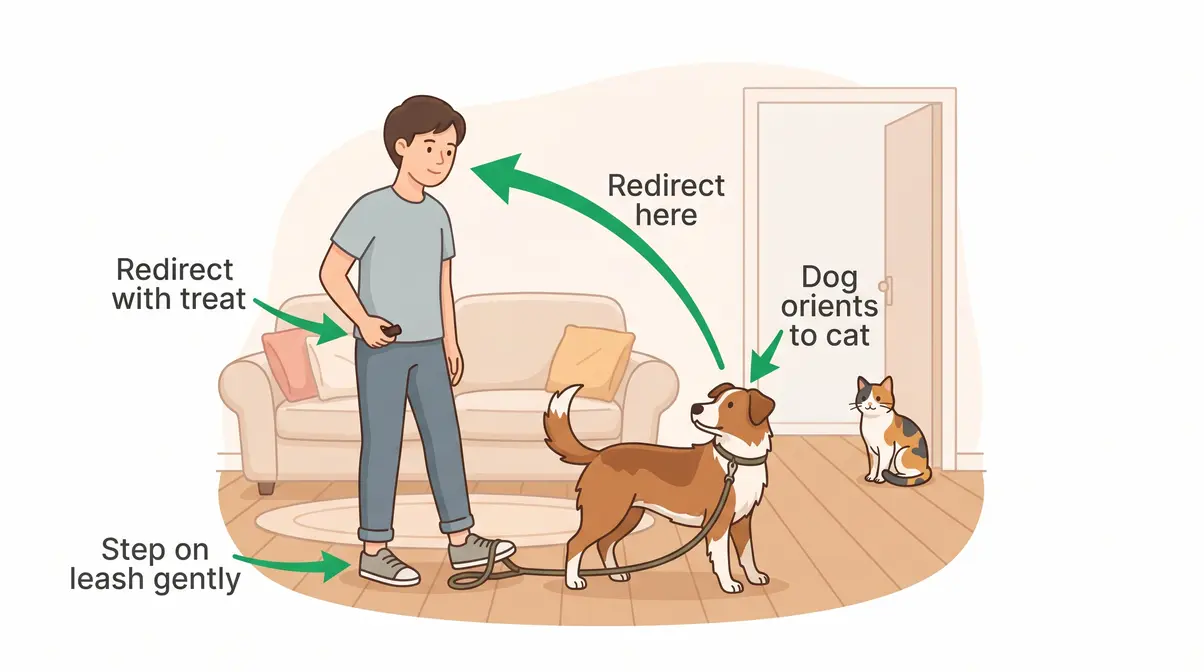
A house lead is simply a lightweight leash — 4 to 6 feet long — that you attach to your dog’s collar or harness and let drag along the floor indoors. It is not tied to anything. It just gives you a way to gently interrupt a chase or redirect your dog without grabbing his collar (which many dogs find alarming) or chasing him yourself (which accidentally turns the whole thing into a game).
Cornell University’s animal behavior guidance consistently recommends tethering and leash management as foundational tools during early pet introductions and behavior modification (Cornell University College of Veterinary Medicine, 2023).
How to use a house lead correctly:
- Clip a lightweight leash to your dog’s collar or well-fitted harness. Avoid retractable leashes — they offer no control.
- Let the leash drag freely while you are in the room and actively supervising. Never leave your dog unattended with a dragging leash — it can catch on furniture and cause injury.
- When your dog orients toward the cat (that first “head snap” from the chase sequence), calmly step on the leash or pick it up. Do not jerk it — just apply gentle, steady pressure.
- Redirect your dog’s attention toward you with a treat or his name. When he looks at you instead of the cat, reward immediately.
- Use the leash to guide your dog away from the cat if he escalates. Keep your voice calm and neutral — no scolding.
For a step-by-step look at the house lead in action, visit our guide on managing reactive dog behavior indoors for additional leash technique videos and troubleshooting tips.
Teach the “Look Away” Game (LAT)
The LAT game (Look Away, or “Look At That”) is a technique developed in applied animal behavior training and widely used by certified professional trainers to build impulse control around triggers. The goal is simple: teach your dog that noticing the cat — and then looking away from her — earns a reward. Over time, your dog learns that the cat’s presence predicts good things, not excitement and chaos.
How to play the LAT game:
- With your dog on a house lead, position yourself 10–15 feet from where your cat is resting (not moving — start easy).
- Wait for your dog to glance toward the cat.
- The instant he looks at the cat, say “yes!” (or click if you use a clicker) and immediately give him a high-value treat.
- Repeat. You are marking and rewarding the act of noticing — not the act of lunging or chasing.
- Over several sessions, your dog begins to look at the cat and then automatically look back at you, anticipating the treat. That auto-look-back is the goal.
Why this works: You are not suppressing your dog’s awareness of the cat — that is impossible. Instead, you are changing the emotional response. The cat stops being a trigger for excitement and starts being a signal for calm attention toward you. Veterinary behaviorists describe this as counter-conditioning (changing the emotional association with a stimulus from negative or exciting to neutral or positive).
Practice this for 3–5 minutes, twice daily. Keep sessions short — a mentally tired dog makes slower progress than a fresh one.
Practice ‘Leave It’ and ‘Down-Stay’ Near the Cat
“Leave it” and “Down-Stay” are two foundational obedience behaviors that give you real-time control during cat encounters. Together, they are your most powerful tools for interrupting a chase before it starts.
Tufts University’s Cummings School of Veterinary Medicine emphasizes that impulse control exercises — particularly “leave it” — are among the most effective interventions for dogs with high predatory drive toward other household animals (Tufts University Cummings School, 2023).
Teaching “Leave It” in 5 steps:
- Hold a treat in your closed fist. Let your dog sniff and paw at it.
- The moment he backs off or stops trying, say “yes!” and reward him with a different treat from your other hand (not the one in the fist — that treat is “off limits”).
- Repeat until he immediately backs away from your fist.
- Add the verbal cue: say “leave it” just before presenting the fist.
- Gradually generalize: practice “leave it” with toys on the floor, food scraps, and eventually — at distance — with the cat.
Teaching “Down-Stay” near the cat:
- Ask your dog for a “down” (lying flat) while you are 10 feet from where the cat is resting.
- Reward the down heavily — multiple treats over 5–10 seconds.
- Gradually reduce the distance to the cat over many sessions, always rewarding calm lying behavior.
- If your dog breaks the stay and orients toward the cat, calmly reset — no scolding — and increase the distance again.
A dog in a solid “down-stay” cannot simultaneously be chasing a cat. This is the physical incompatibility principle: teach a behavior that is structurally impossible to perform at the same time as the problem behavior.
Counter-Condition Both Animals for Calm Coexistence
Counter-conditioning means changing your dog’s emotional response to the cat from “exciting trigger” to “neutral or good thing.” Desensitization (gradually increasing exposure at a level below your dog’s reaction threshold) is what makes counter-conditioning possible. Used together, these techniques form the scientific backbone of The 4-Phase Peace Protocol.
The key principle: Your dog must never be close enough to the cat to react. If your dog is lunging, barking, or fixating, you are too close. Back up until he is calm, then reward that calm. Distance is your most powerful tool.
A basic counter-conditioning session:
- Place your cat on one side of a baby gate or in a carrier. Your dog is on the other side, on a house lead.
- At a distance where your dog notices the cat but remains relaxed, begin feeding treats continuously — not as a reward for any specific behavior, but simply paired with the cat’s presence.
- When the cat is visible, treats flow. When the cat moves away or is blocked from view, treats stop.
- Over many sessions — days to weeks — your dog begins to associate the cat’s presence with good things happening, rather than with the urge to chase.
This process takes time. Across pet owner communities, the consistent experience is that dogs who undergo structured counter-conditioning sessions show measurable improvement in calm behavior around cats within 3–6 weeks — though timelines vary significantly by individual dog and breed.
Increase Difficulty Gradually: A Self-Control Game Plan
Self-control games are short, structured exercises that build your dog’s general ability to manage his own impulses — and that ability transfers directly to how he behaves around the cat. Think of them as mental push-ups for your dog’s self-regulation.
Three self-control games to practice daily:
- Sit before everything: Your dog must sit calmly before receiving his food bowl, before going out the door, before getting a toy. Every repetition builds the habit of pausing before acting.
- It’s Your Choice (IYC): Place a treat on the floor. Cover it with your hand. Wait. The moment your dog stops trying to get it and backs away, uncover it and let him eat it. He learns that self-restraint earns the reward — grabbing does not.
- Boundary practice: Stand in a doorway and ask your dog to wait. Step through. Reward him for staying. Gradually extend the wait time. This builds the door impulse control that also applies to “waiting at the cat’s zone boundary.”
Increase difficulty in all training exercises slowly and systematically. The progression should look like this: more distance → less distance → cat stationary → cat moving slowly → cat moving quickly. Never skip steps. If your dog fails at a new level of difficulty, it simply means you moved too fast — drop back to the previous level and consolidate there.
✅ Checkpoint: You should now be practicing at least 2–3 of these exercises daily. Your dog should be wearing the house lead during all unsupervised shared time with the cat. You should be seeing at least some moments where your dog notices the cat and looks away on his own — even if it only lasts a second. That is real progress.
Step 4: Know What to Expect and When Things Go Wrong
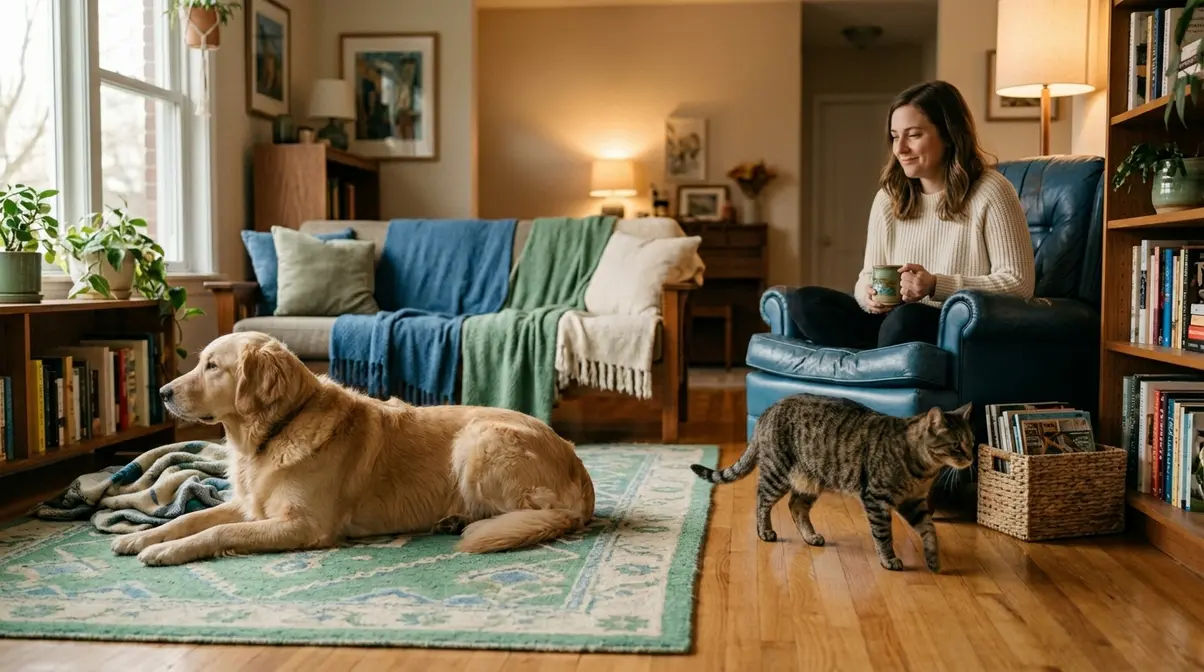
Training a dog to stop chasing a cat is not a straight line. There will be setbacks, frustrating days, and moments where it feels like nothing is working. This step gives you a realistic picture of the timeline, a plan for when chases happen anyway, and the information you need to know when to call in professional help.
How Long Will This Take? A Realistic 4-Week Timeline
The AVMA notes that it can take weeks to months for pets to adjust to living together, depending on each animal’s individual history, temperament, and the consistency of training (AVMA, 2024). Here is what a realistic first month looks like under The 4-Phase Peace Protocol:
| Week | Phase | Focus | What You Should See |
|---|---|---|---|
| Week 1 | Phase 1 — Separate & Stabilize | Environmental management only. No shared space yet. | Cat accessing food and litter box reliably. Dog wearing house lead indoors. Both animals calmer. |
| Week 2 | Phase 2 — Introduce at Distance | Controlled visual exposure through gates or carriers. LAT game begins. | Dog noticing cat without fixating. First auto-look-backs toward owner. |
| Week 3 | Phase 3 — Build Skills | Leave It, Down-Stay, counter-conditioning sessions daily. | Dog responding to “leave it” near cat. Fewer spontaneous lunges. Cat beginning to move more freely. |
| Week 4 | Phase 4 — Supervised Integration | Short, supervised shared sessions with house lead. | Dog can be in the same room as a calm cat without fixating for 5–10 minutes. |
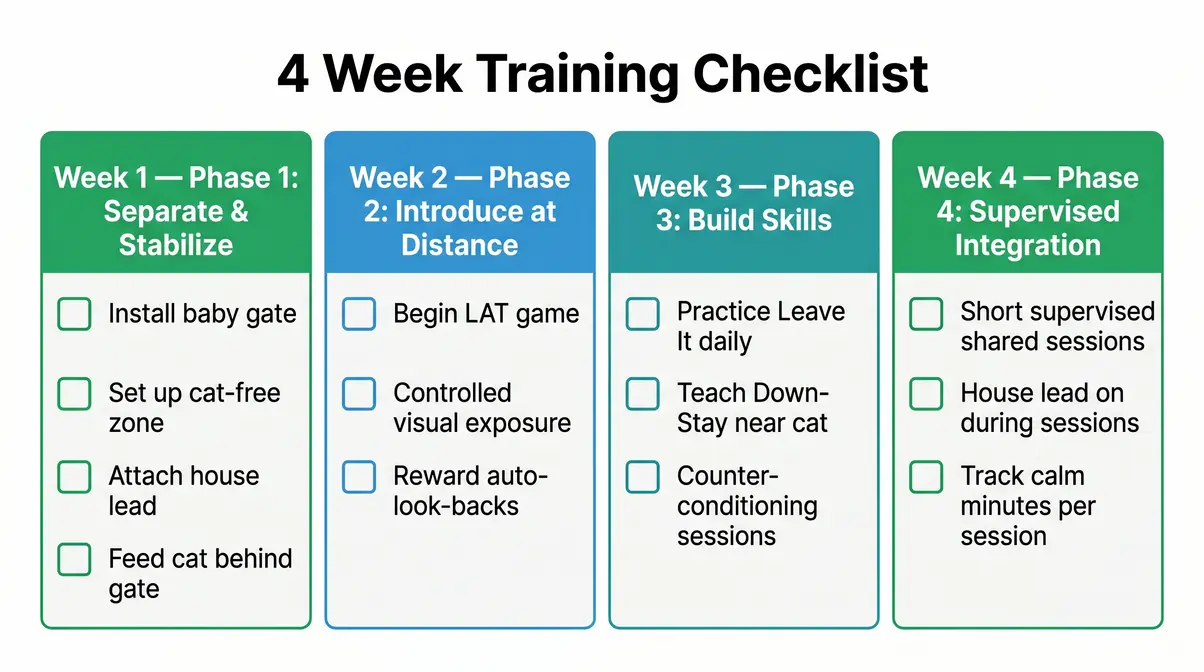
Important: These are averages, not guarantees. Some dogs make this progress in two weeks. Others take three months. High-prey-drive breeds — terriers, huskies, greyhounds, and some herding breeds — typically take longer. Progress is measured in small wins, not sudden transformations.
What to Do Immediately When a Chase Happens
Even with excellent management, a chase will probably happen at some point during training. Here is exactly what to do:
- Stay calm. Your stress escalates both animals. Take a breath.
- Interrupt, do not chase. Step on the house lead if it is within reach, or use a sharp hand clap to interrupt focus — then immediately call your dog to you.
- Separate immediately. Put your dog in another room calmly — no yelling, no drama. Give your cat time to settle (at least 30 minutes).
- Check your cat. Look for injuries — scratches, puncture wounds, limping. If your cat was grabbed or bitten, veterinary attention is needed immediately.
- Do not punish your dog after the fact. By the time the chase is over, your dog has no connection between the punishment and the behavior. You will only teach him that your presence after a chase means something scary is coming.
- Debrief: Ask yourself what triggered it. Was the cat moving fast? Was your dog overtired or overstimulated? Was the house lead off? Identify the gap in management so you can close it.
Why Punishment Makes the Problem Worse
This is the single most important thing to understand, and the reason so many owners feel stuck: punishment does not work for predatory behavior, and it actively makes things worse.
The American College of Veterinary Behaviorists (ACVB) has stated clearly that punishment-based training methods increase fear, anxiety, and aggression in dogs — and that fear-based responses to other animals frequently escalate into redirected aggression toward the owner (ACVB, 2023). When you scold, spray, or physically correct a dog mid-chase, you are not teaching him “don’t chase the cat.” You are teaching him that the cat’s presence causes bad things to happen — which increases anxiety and can actually intensify the prey response.
Additionally, a dog who is physically punished near the cat may redirect that frustration onto whoever is closest — including you or the cat. This is called redirected aggression, and it is a genuine safety risk.
The only effective path is positive reinforcement: rewarding the behavior you want (calm attention, looking away, lying down) rather than punishing the behavior you don’t. This is not “soft” training — it is simply the approach that the evidence, and the professional consensus of veterinary behaviorists, consistently supports.
When to Call a Professional Dog Trainer or Behaviorist
Some situations are beyond the scope of any self-guided training program. Seek professional help immediately if:
- Your dog has grabbed, bitten, or injured the cat — even once
- Your dog shows stalking behavior that you cannot interrupt even with treats or verbal cues
- Your dog is showing aggression toward you when you attempt to redirect him
- Your cat has been unable to eat, drink, or use the litter box for more than 24 hours despite management changes
- You have followed this protocol consistently for 6+ weeks with no measurable improvement
Look for a Certified Professional Dog Trainer (CPDT-KA) or, for severe cases, a Diplomate of the American College of Veterinary Behaviorists (DACVB) — a veterinarian with specialized board certification in animal behavior. The DACVB credential is the highest available and is appropriate for cases involving genuine predatory aggression.
✅ Checkpoint: You should now have a realistic picture of your 4-week timeline and know exactly what to do the next time a chase happens. If your situation matches any of the professional referral criteria above, make that call now — not after another incident.
Limitations, Safety, and When This Guide Isn’t Enough
This guide is designed for pet owners dealing with typical dog-chasing-cat behavior driven by prey drive and excitement. It is not appropriate as a sole resource for all situations. Honest, balanced advice means being clear about where the limits are.
Common Pitfalls to Avoid
- Moving too fast: The most common mistake is rushing the counter-conditioning process. If your dog is still fixating and lunging at the cat, you are not ready for unsupervised shared time — no matter how many days have passed.
- Inconsistent management: Leaving the house lead off “just this once” or forgetting to close the baby gate is how most setbacks happen. Management must be airtight until training is solid.
- Training when overtired or overstimulated: A dog who has just had a high-energy play session is not in the right state for calm impulse control work. Train before exercise, not after.
- Using punishment at any point in the process: Even a sharp verbal correction during a training session can poison the association you are carefully building. Keep all interactions neutral to positive.
When to Choose a Different Approach
This protocol is designed for dogs whose chasing is driven by prey drive and excitement — not by resource guarding, fear-based aggression, or territorial behavior. If your dog shows growling, snapping, or stiff-body posturing toward the cat that is not connected to movement (i.e., it happens when the cat is still), that is a different behavioral profile requiring professional assessment.
Some dogs — particularly those with extremely high prey drive or a history of predatory behavior toward small animals — may never be safely integrated with cats, regardless of training. A professional behaviorist can assess this honestly and help you make the best decision for both animals’ welfare.
When to Seek Expert Help
⚠️ Safety Disclaimer: If your dog has injured or attempted to injure your cat, or if the chasing behavior is escalating despite consistent management and training, please consult a certified professional immediately. A Certified Professional Dog Trainer (CPDT-KA) can help with most cases. For severe aggression, a veterinary behaviorist (DACVB) is the appropriate specialist. Do not attempt to manage serious predatory aggression through self-guided training alone — the safety of both animals depends on professional evaluation.
Physical punishment, aversive tools (shock collars, prong collars, spray bottles used punitively), and confrontational training methods are explicitly not recommended. These approaches are contraindicated by the American College of Veterinary Behaviorists and consistently shown to increase fear, anxiety, and aggression (ACVB, 2023).
Frequently Asked Questions
How long does it take a dog to stop chasing cats?
Most dogs show meaningful improvement within 4–6 weeks of consistent daily training and environmental management. The exact timeline depends heavily on your dog’s prey drive level, breed, age, and your consistency. The AVMA notes that multi-pet household adjustment can take weeks to months (AVMA, 2024). High-prey-drive breeds like terriers or huskies typically take longer than lower-drive breeds. Track progress in small wins — a dog who now looks away from the cat for two seconds has already changed his behavior.
Is it normal for my dog to chase my cat?
Yes — dog chasing cat behavior is extremely common in multi-pet households, especially with younger dogs and high-energy breeds. It is driven by prey drive, a natural instinct triggered by fast, unpredictable movement. It does not mean your dog is aggressive or dangerous, and it does not mean your pets cannot learn to coexist. According to Best Friends Animal Society, most dog-cat conflicts can be resolved with proper management and training (Best Friends Animal Society). The behavior becomes a concern when it escalates to grabbing or the cat shows signs of chronic stress.
Why does my dog chase my cat inside the house but not outside?
Indoors, your cat has less space to escape — which makes her movement more erratic and panic-driven, which in turn triggers your dog’s prey drive more intensely. Outside, the cat can flee quickly and put real distance between herself and the dog, which often causes the dog to disengage. Indoors, the cat gets cornered or darts in unpredictable directions, which escalates your dog’s arousal rapidly. The enclosed space also means your dog is more likely to “succeed” in the chase, making the behavior more self-rewarding over time. Environmental management (baby gates, cat highways) directly addresses this dynamic.
How do I stop my dog from chasing my cat when I’m not home?
The safest answer is: completely separate them. Until training is solid and you have seen consistent calm behavior during supervised sessions over several weeks, your dog and cat should never be left unsupervised together. Use baby gates, closed doors, or a dog crate (if your dog is crate-trained and comfortable) to ensure physical separation when you leave. Never rely on training alone to manage the situation in your absence — even well-trained dogs can revert under the excitement of unsupervised access. Physical separation is not a failure; it is responsible management.
Conclusion
Stopping the dog chasing cat indoors problem is genuinely achievable — but it requires two things working together: immediate environmental changes that protect your cat today, and consistent training that builds your dog’s impulse control over weeks. Most dogs, with daily 10–15 minute sessions and proper management, can reach a point of calm coexistence. Purina’s animal behavior guidance echoes what certified trainers consistently observe: structured, positive training paired with safe environmental design produces lasting results in the majority of multi-pet households (Purina UK).
The 4-Phase Peace Protocol gives you a clear structure for that journey: Phase 1 stabilizes your environment, Phase 2 introduces controlled exposure, Phase 3 builds the specific skills your dog needs, and Phase 4 moves toward supervised integration. Every phase builds on the last — which is why skipping ahead rarely works, and why consistency matters more than perfection.
Start today with the two things you can do in the next hour: install or reposition a baby gate to give your cat a dog-free zone, and clip a house lead to your dog’s collar. Those two steps alone will reduce the number of chases that happen today. From there, work through the protocol one phase at a time. Your cat deserves to feel safe in her own home — and with patience, your dog can learn to give her exactly that. For additional guidance on multi-pet household management, visit Blue Ridge Humane Society’s resources on dogs and cats.