
Table of Contents
- Featured Snippet Answer
- Origins & Taxonomy
- Physical Comparison: How to Tell Them Apart
- Behavior & Temperament
- Habitat, Range & Ecological Role
- Lifespan, Health & Genetic Predispositions
- Why the Myth That Maine Coons Are Descended from Bobcats?
- What to Do If You See a Bobcat Near Your Home
- Summary: Maine Coon vs Bobcat — The Bottom Line
- Frequently Asked Questions
This blog post may contain affiliate links. As an Amazon Associate I earn from qualifying purchases.
Maine Coon vs Bobcat: How They Compare — Myths, Facts & What Really Sets Them Apart
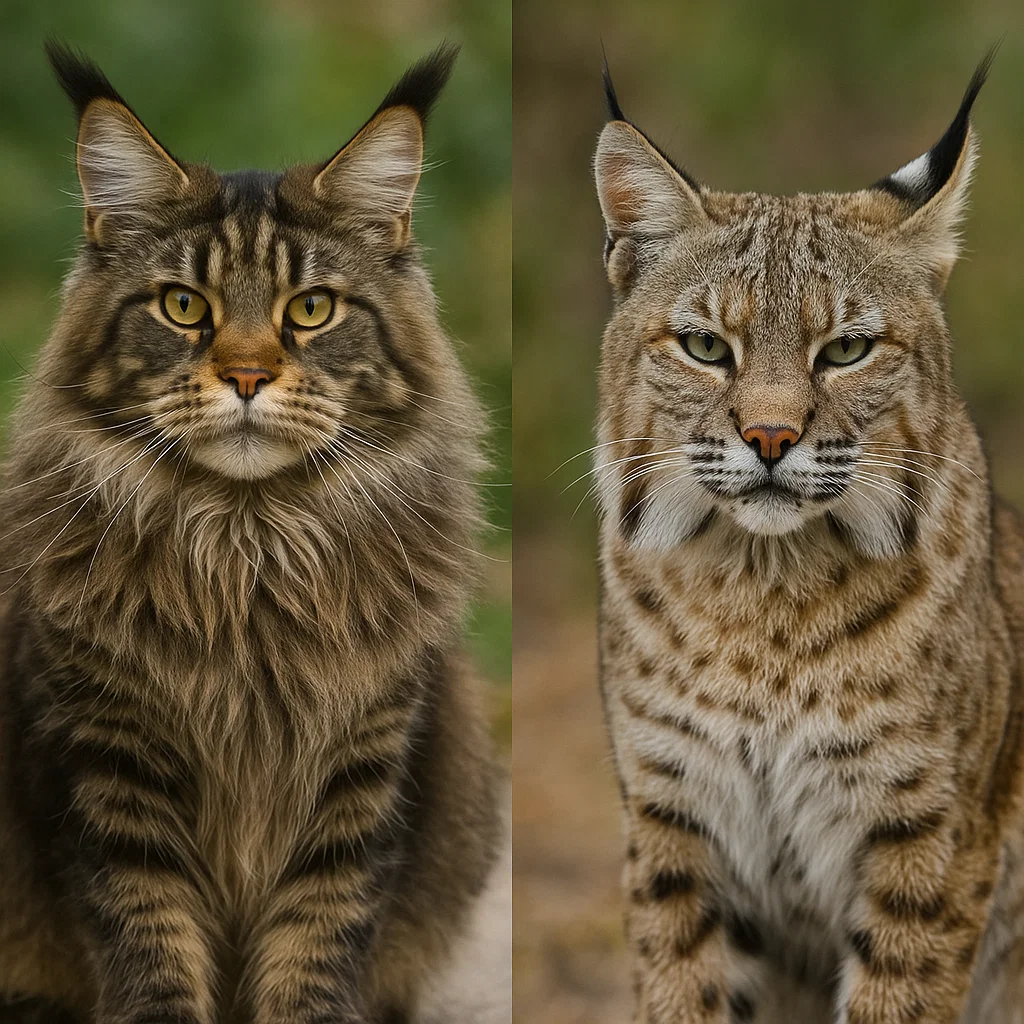
If you’ve ever glimpsed a large, tuft-eared feline and wondered whether it’s a majestic Maine Coon or a stealthy bobcat, you’re not alone. Their superficial similarities have fuelled myths, speculation, and curiosity. In reality, these two cats occupy very different worlds — one domestic and companionable, the other wild and untamed.
In this in-depth guide from Mad Cat Man, you’ll discover:
- Clear, side-by-side comparisons of appearance, behavior, and habitat
- Why the two are not closely related — despite folklore
- How their lifestyles, lifespans, and genetics differ
- What to do if you think a bobcat is in your neighborhood
- Snippet-style FAQs to answer the most common questions
Let’s unravel the differences and shine light on the truth.
Featured Snippet Answer
Maine Coon vs Bobcat: A Maine Coon is a large, gentle domestic cat breed known for its friendliness, long fur, and dog-like personality. A bobcat is a wild medium-sized North American feline with shorter fur, tufted ears, and an independent predatory nature. While they may resemble one another at first glance, their genetics, behaviors, and ecological roles differ dramatically.
Origins & Taxonomy
Maine Coon: Domestic Breed, American Roots
- The Maine Coon is one of the oldest natural cat breeds in the U.S., with roots in New England. Wikipedia+2The Spruce Pets+2
- Genetic studies place it among domestic cat lineages; it is not a hybrid of wildcats. Wikipedia
- Myths abound: that it descended from raccoons or was crossbred with wildcats. These are unfounded. Wikipedia+2MaineCoon.org+2
Bobcat: Wild North American Feline
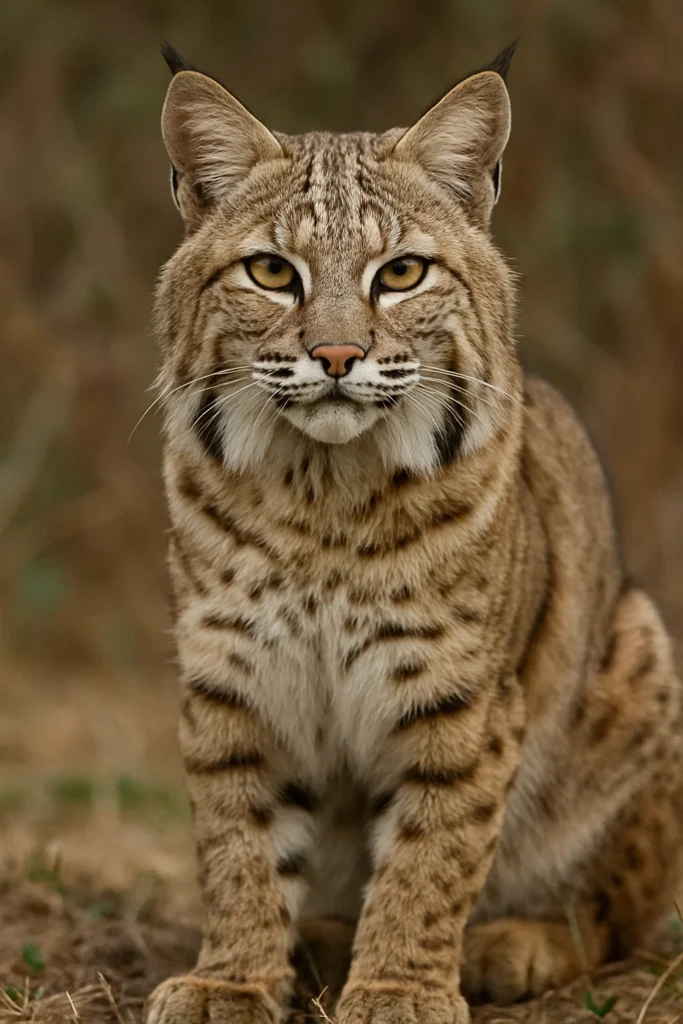
- The bobcat (Lynx rufus) is a wild species native to much of North America.
- It belongs to the genus Lynx, making it more closely related to lynxes than to domestic cats.
- It is not a domestic cat breed — interactions with humans are ecological, not domestic.
Because of their different taxonomic branches, any physical similarities result from convergent traits (ears, tufts, medium size), not shared recent ancestry.
Physical Comparison: How to Tell Them Apart
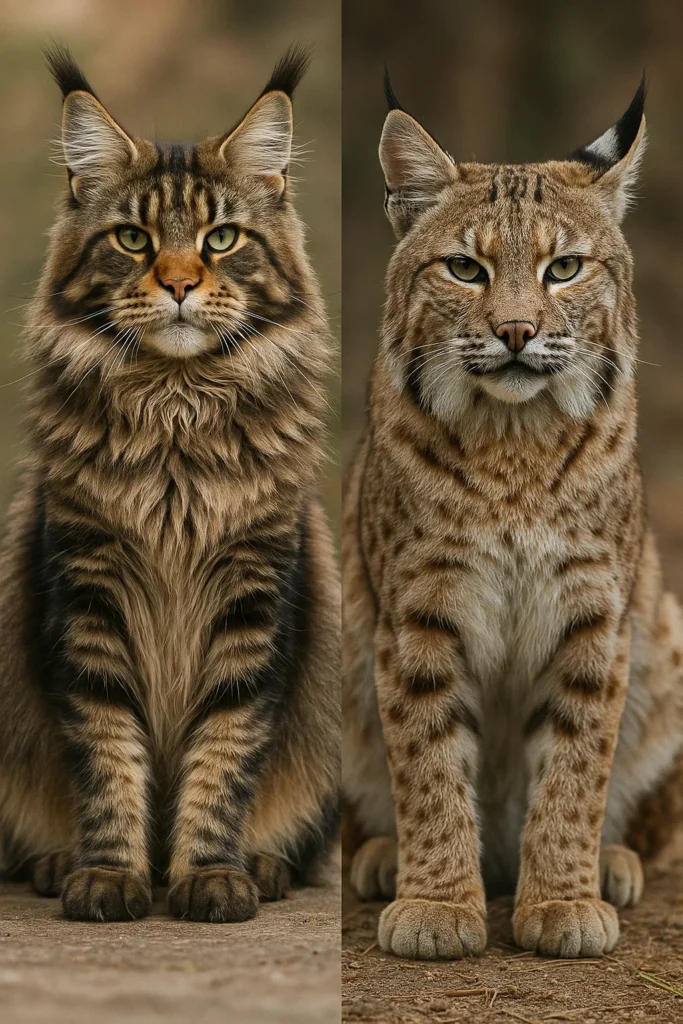
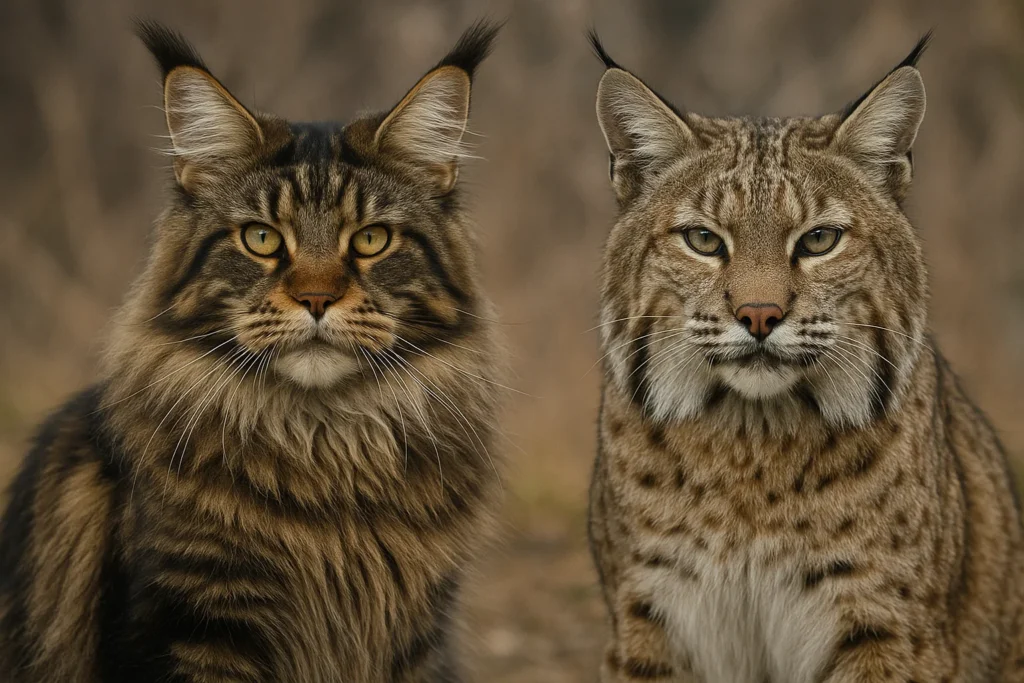
Here’s a side-by-side look at their key physical traits:
| Trait | Maine Coon | Bobcat |
|---|---|---|
| Size & Build | Large for a domestic cat: males often 13–18 lb, females 8–12 lb; bodies long and rectangular. Wikipedia+2MaineCoon.org+2 | Medium wild cat: weights average 15–30 lb, though some records exceed that. MaineCoon.org+3A-Z Animals+3Petzooie+3 |
| Height / Length | Around 10–16 in at shoulder; total length (including tail) up to ~38 in. Wikipedia+2MaineCoon.org+2 | Up to ~24 in shoulder height; total body length (excluding tail) may reach ~40–49 in in some sources. MaineCoon.org+2mainecooncentral.com+2 |
| Tail | Long, bushy, flowing — often held high or curled. | Short “bobbed” tail (hence the name “bobcat”) — generally 4–7 in. Petzooie+1 |
| Fur / Coat | Medium to long-haired, dense, often with ruff around neck, tufted ears, hair between toes; adapted for colder climates. Wikipedia+2The Spruce Pets+2 | Short to medium fur, spotted or striped pattern; fur more uniform and not as lush. |
| Ears & Facial Markings | Large ears with tufts, expressive eyes, square muzzle. | Prominent ear tufts too, but face has stronger wild cat markings, stripes, and spots. |
| Legs & Paws | Proportionate, sturdy legs; large, tufted paws (snow-shoe adaptation). | Longer legs relative to body; large paws and muscular build for hunting. |
| Color / Pattern | Many colors and patterns (tabby, solid, bicolor, smoke), excluding some disallowed ones in breed standards. Wikipedia+1 | Generally more muted wild colors: browns, grays, spotted, mottled camouflage. |
Because of these differences, a side view and tail view are often enough to distinguish one from the other in many cases.
Behavior & Temperament
Maine Coon: Domestic, Social, Trainable
- Known for friendly, social, and often dog-like behavior. They may follow owners, greet guests, and even play fetch. The Spruce Pets+2MaineCoon.org+2
- Vocal but gentle — trills, chirps, soft meows, rather than aggressive yowls.
- Happy indoors or outdoors (if safe), generally comfortable with human interaction.
- Slower to mature — some Maine Coons do not reach full size until 3–5 years old. Wikipedia
Bobcat: Wild, Independent, Elusive
- A territorial and solitary predator, not suited for domestication.
- Wild instincts: strong avoidance of humans, skilled hunting behavior, nocturnal or crepuscular activity patterns.
- Behavior driven by survival, not social bonding with humans or pets.
- No reliable trainability or socialization — they are not domesticated.
In essence: Maine Coons live in family settings; bobcats live by their wits in the wild.
Habitat, Range & Ecological Role
Maine Coon
- Lives in human homes or cat-safe outdoor enclosures.
- Adaptable to indoor environments, climate controls, and companionship.
- Does not have a wild ecological niche.
Bobcat
- Broad range across North America: forests, deserts, swamps, brushlands.
- Requires territory, prey base, cover, and minimal human disturbance.
- Plays ecological roles as predator of rodents, rabbits, small mammals; helps balance ecosystems.
If a bobcat is present near human neighborhoods, it’s a wild animal, not a domestic pet.
Lifespan, Health & Genetic Predispositions
Lifespan Comparison
- Maine Coon: Domestic cats often live 10–15 years, sometimes longer under good care. The Spruce Pets+1
- Bobcat: In the wild, lifespans are shorter — 8–12 years is common; in captivity they may live longer.
Health Issues & Genetic Risks (Maine Coon)
Because Maine Coons are a domestic breed, they have breed-associated risks:
- Hypertrophic Cardiomyopathy (HCM): A cardiac condition seen in some Maine Coons associated with the MYBPC3 gene mutation. Wikipedia
- Hip dysplasia: Larger, heavy breeds may develop hip issues over time. MaineCoon.org+1
- Spinal Muscular Atrophy (SMA): A recessive condition known in the breed.
- Other risks include obesity (if diet is unmanaged), dental disease, and joint issues.
Bobcats, being wild, typically suffer from accidents, disease, predation, or food scarcity rather than breed-specific ailments.
Why the Myth That Maine Coons Are Descended from Bobcats?
Over the years, many people have speculated that Maine Coons carry genetic lineage from bobcats — explaining their tuft ears and size. But there is no evidence to support this. Their resemblance is superficial and likely driven by convergent evolution: traits beneficial in rugged climates (ear tufts, thick fur, large feet) evolved independently in both lineages. Wikipedia+2MaineCoon.org+2
Genetic analyses place Maine Coons firmly in the domestic cat lineage, with ties to European domestic cats, not wild lynx species. Wikipedia
What to Do If You See a Bobcat Near Your Home
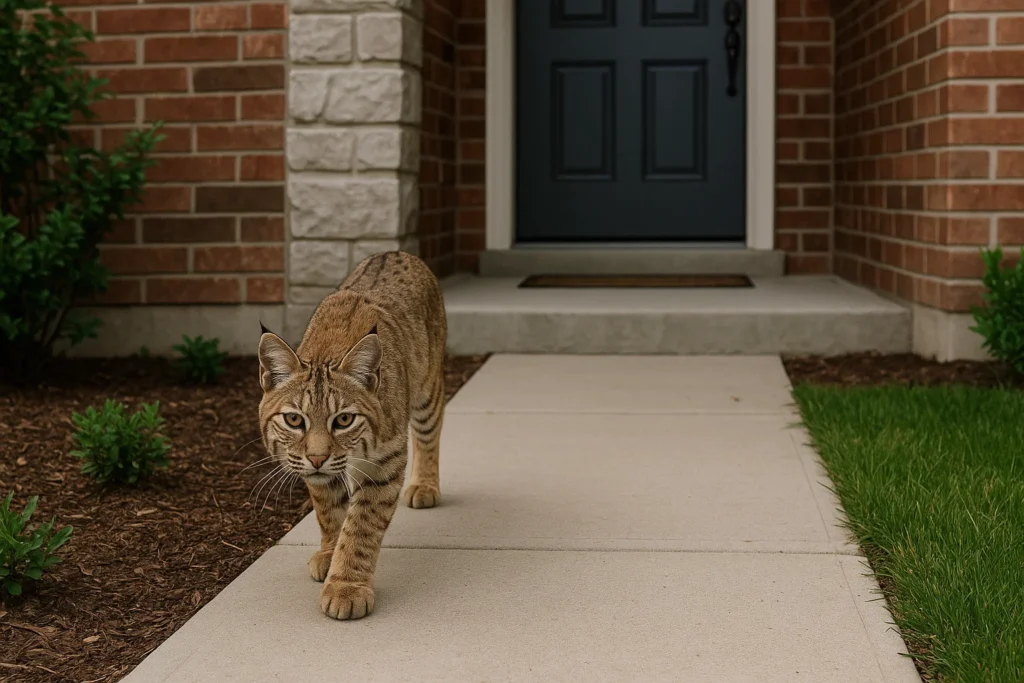
- Never approach or try to interact — it’s a wild animal.
- Keep pets indoors, especially at dusk and dawn.
- Secure trash, pet food, and bird feeders (which might attract prey).
- Contact local wildlife or animal control authorities if a bobcat is acting unusually or appears ill.
- Remember: seeing one doesn’t mean it’s safe or adoptable — it belongs in the wild.
Summary: Maine Coon vs Bobcat — The Bottom Line
- Maine Coons are big, social domestic cats bred for companionship; bobcats are wild predators with different genetics, behavior, and needs.
- While they may share tufted ears, size, or coat adaptations, these traits are superficial and not evidence of relation.
- If you’re comparing photos or trying to identify an animal, focus on tail length, behavior, and context — domestic vs wild.
Understanding both gives you clarity and dispels myths — and helps you appreciate each for what they are.
Frequently Asked Questions
Q: Can a Maine Coon interbreed with a bobcat?
A: No. They are different species with incompatible genetics. Hybridization does not occur naturally or viably.
Q: How large can a Maine Coon get vs a bobcat?
A: A large Maine Coon may weigh 13–18 lb, length ~38 in. A bobcat can be heavier, taller, and more muscular — sometimes 20–30+ lb with shorter tail and sturdier build. Petzooie+3MaineCoon.org+3A-Z Animals+3
Q: Could a bobcat be mistaken for a Maine Coon indoors?
A: Yes, from a distance or poor light. But the shorter “bobbed” tail, wild behavior, and habitat context often give it away.
Q: Are Maine Coons more prone to wildcat traits?
A: No — though they may enjoy play and hunting toys, their instincts are domestic, not wild.
Q: Do Maine Coons have any wild ancestry?
A: No genetic evidence supports that. Their lineage remains within the domestic cat evolutionary branch. Wikipedia+1
Q: Which is better as a pet — Maine Coon or bobcat?
A: Maine Coon, by far. They are bred for domestic life. Bobcats are wild and unsuitable as pets — often illegal to keep and dangerous.