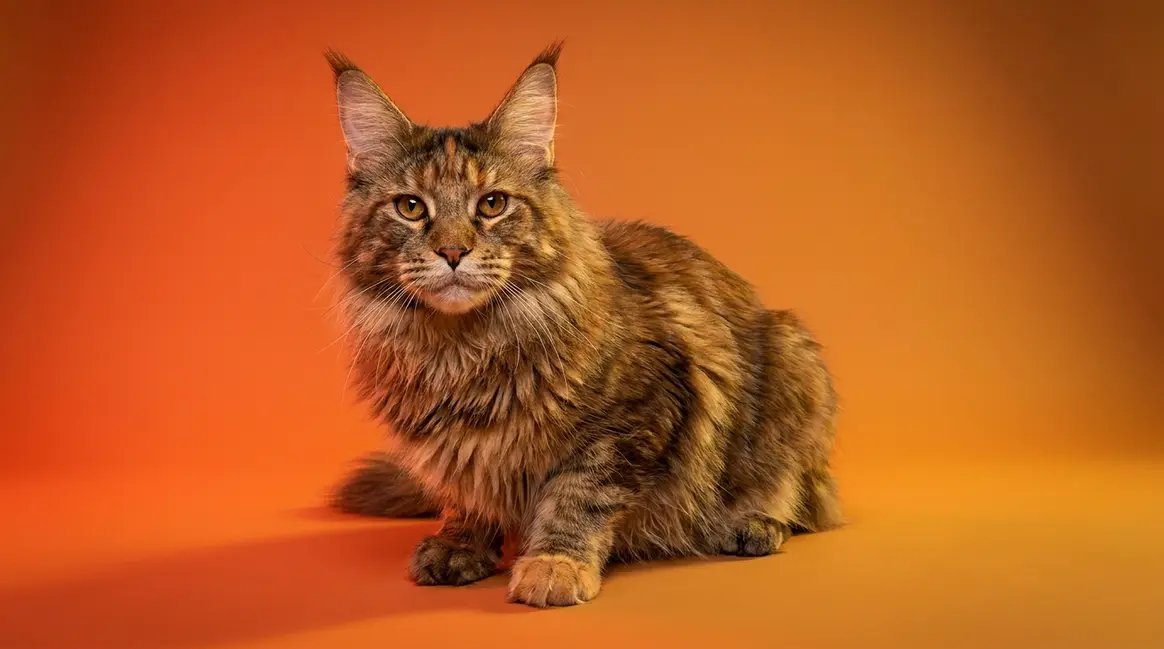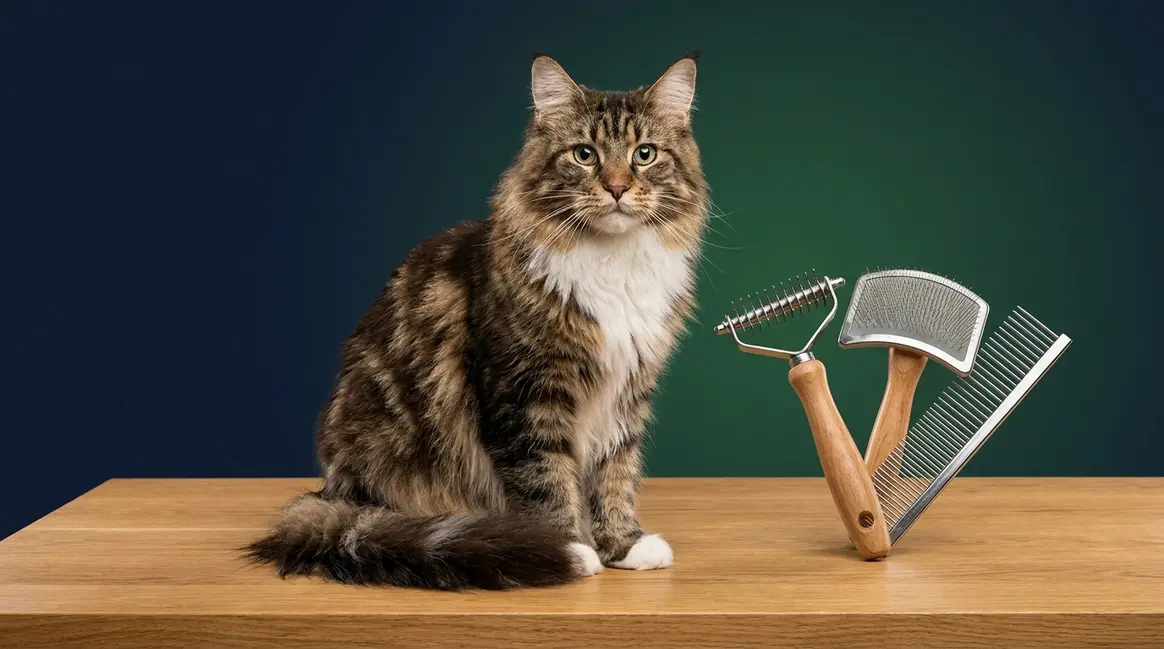

To manage Maine Coon shedding, brush your cat 2–3 times per week with an undercoat rake, support coat health through a protein-rich diet with Omega-3 supplements, and vacuum regularly. This 5-step process takes about 15–20 minutes per grooming session and can significantly reduce loose fur within 2–4 weeks.
You found fur on your sofa, your sweater, your coffee mug, and somehow — your breakfast. If you share your home with a Maine Coon, those long, silky tumbleweeds of fur rolling across your floor are a familiar sight. Maine Coon shedding is real, it’s relentless, and without a plan, it only gets worse — especially during spring and fall “blow-outs” when your cat sheds their entire undercoat (the soft, dense inner layer of fur) in a matter of weeks.
Left unmanaged, loose fur leads to mats (painful tangles close to the skin), hairballs, and the easy-to-miss early signs of a health problem hiding beneath all that floating hair. But here’s the reassuring truth: Maine Coon shedding is manageable. In this guide, you’ll learn exactly why Maine Coons shed so much, how to tell normal shedding from a health warning sign, and the 5-step routine that keeps fur under control — even during peak shedding season. The steps are: Identify → Groom → Feed → Manage → Vet Check.
Maine Coons shed moderately year-round and heavily in spring and fall — their long fur makes it far more visible than short-haired breeds. The Shedding Defense System (Groom → Feed → Manage) reduces loose fur within weeks.
- Brush 2–3 times per week with an undercoat rake to remove loose fur before it lands on your furniture
- Omega-3 supplements (fish oil) support coat health and may reduce excessive shedding — consult your vet first
- Spring and fall “blow-outs” are normal; bald patches, clumps, or skin irritation are not
- Diet matters: high-protein food supports a healthier, less brittle coat
What You’ll Need Before You Start
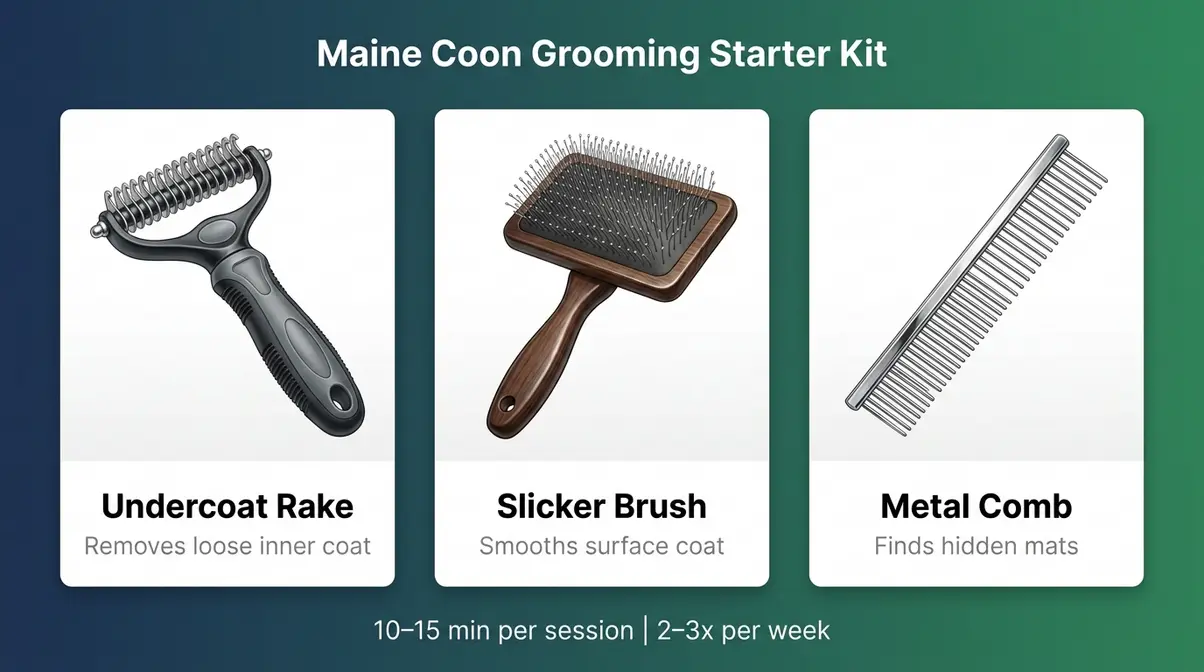
You don’t need an expensive grooming kit — just these three tools and a little time.
- A slicker brush — a flat paddle brush with fine wire bristles, used to sweep loose fur from the surface coat
- An undercoat rake — a long-toothed tool that reaches past the outer guard hairs into the dense inner layer; this is the most important tool for Maine Coon owners
- A metal comb (sometimes called a Greyhound comb) — used for finishing passes and finding hidden mats before they tighten
- 10–15 minutes per session, 2–3 times per week
- Cat-safe grooming spray (optional) — a light detangling mist that helps with stubborn knots
- Treats — the single most effective tool for making grooming a calm, positive experience your cat actually tolerates
Understanding Maine Coon Shedding
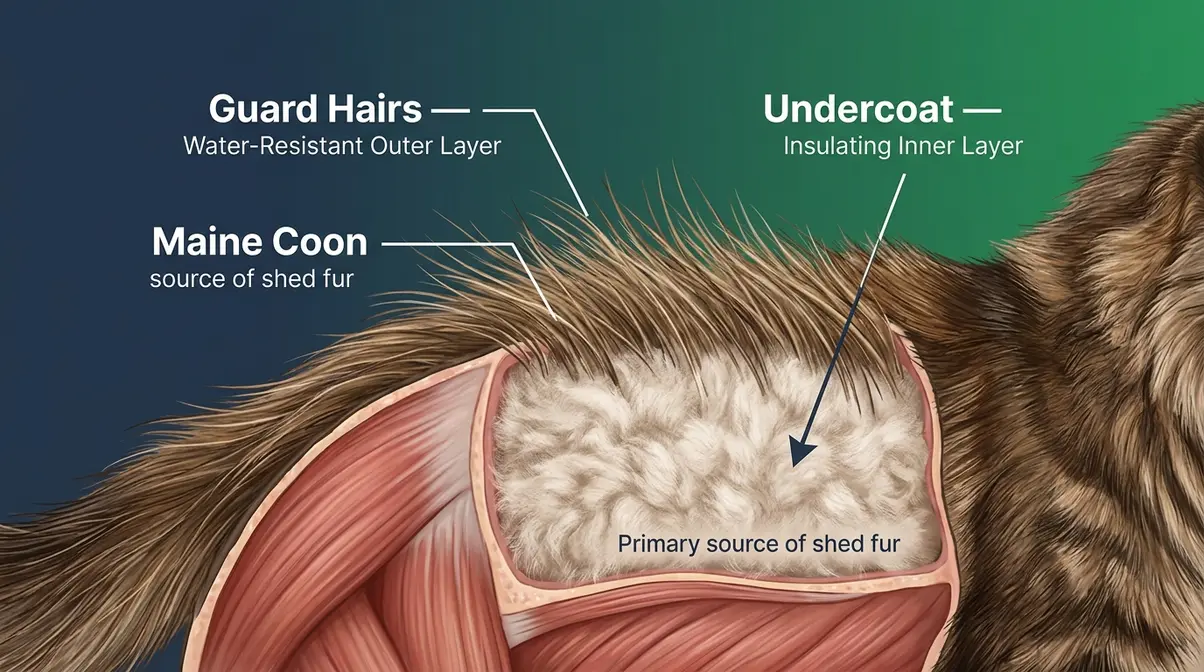
Maine Coon cats do shed — but the amount is often more moderate than new owners expect. If you want to learn about Maine Coon coat maintenance, you must first understand their unique biology. What makes it feel overwhelming is the length of each fur strand. A Maine Coon’s guard hairs (the long, water-resistant outer layer of their coat) can reach 3 inches or more, meaning every shed strand is dramatically more visible on furniture, clothing, and floors than the short fur from a typical domestic cat. Maine Coon fur isn’t necessarily shed in greater volume — it’s just impossible to ignore.
The Maine Coon’s Double Coat Explained
Maine Coons have what’s called a double coat — two distinct layers of fur that work together like a winter jacket with a removable thermal liner. The outer layer consists of guard hairs (long, slightly coarser strands that repel moisture and protect against cold). Beneath those sits the undercoat: a soft, dense, cottony inner layer whose job is insulation. Think of the undercoat as that removable fleece lining — it’s what keeps your cat warm in winter, and it’s what sheds most heavily when the seasons change.
Most of the loose fur you’re finding around your home comes from the undercoat, not the guard hairs. This is why standard brushes often feel ineffective — they skim the surface without reaching the layer that actually needs clearing. An undercoat rake is designed specifically to penetrate the guard hairs and pull out that loose inner layer before it drifts onto your sofa.
Do Maine Coon Cats Shed Badly?
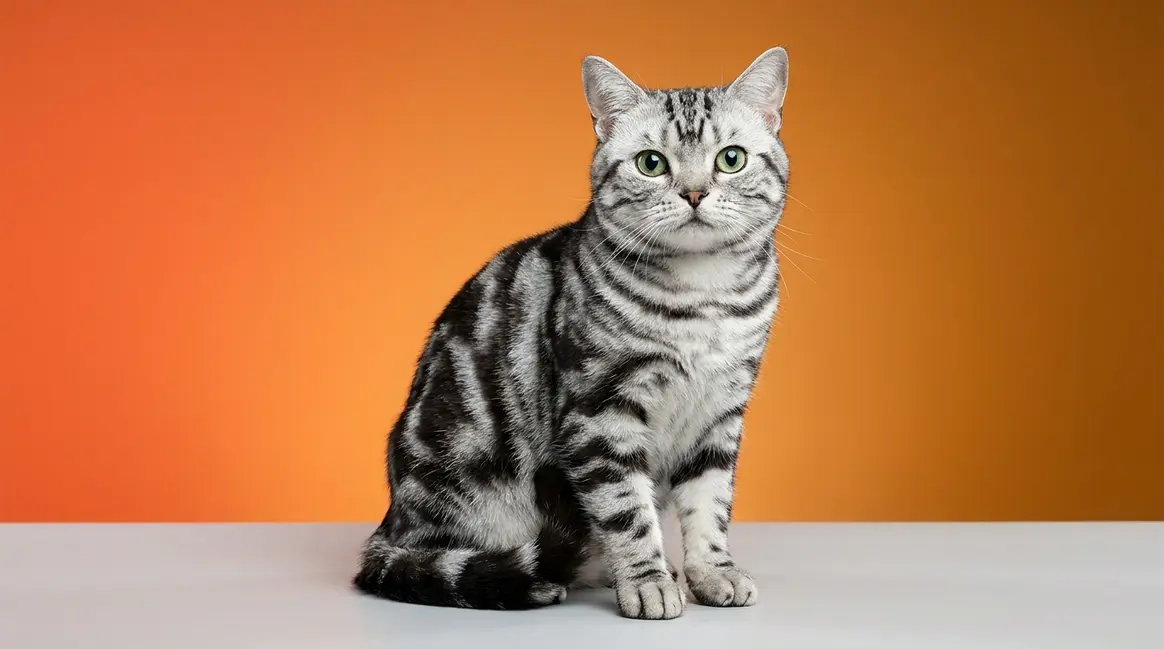
Compared to other cat breeds, Maine Coons shed at a moderate rate year-round, with two heavy seasonal periods in spring and fall (PetMD, 2026). They shed more visibly than short-haired breeds like the American Shorthair — but not necessarily more volume of fur. Compared to other long-haired breeds, they’re roughly on par with Norwegian Forest Cats and slightly heavier than Siberians, which have a reputation for lower-shedding coats.
The most honest description comes from owners themselves. Across Maine Coon communities on Reddit, a consistent theme emerges:
“The rate of shedding was about the same as my short-hair was, but since the fur strands are so long, they’re super noticeable.”
— Maine Coon owner, Reddit r/mainecoons community
That single observation reframes the whole problem. Your Maine Coon probably isn’t shedding more fur by weight — each strand is just 3–4 times longer, which means it covers more surface area and tangles into everything it touches.
When Does Maine Coon Shedding Peak?
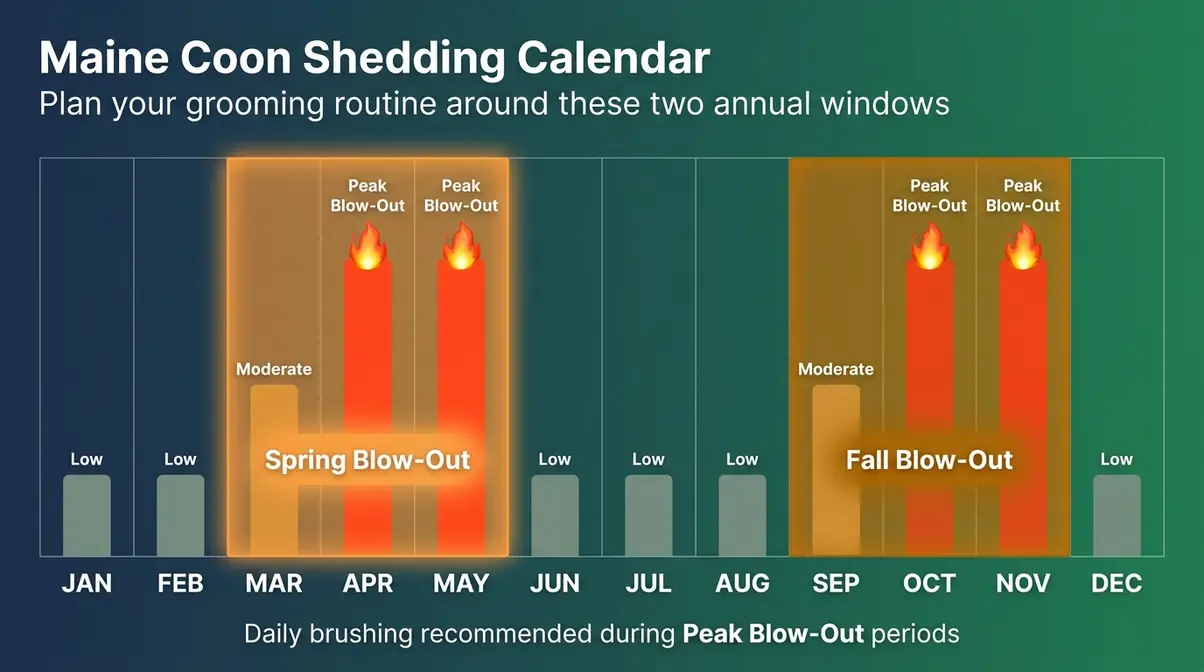
Shedding peaks twice a year: spring (March–May), when your cat sheds the heavy winter undercoat, and fall (September–November), when they shed the lighter summer coat to grow a thicker winter layer. During these periods, daily brushing is not an overreaction — it’s the most effective thing you can do. That’s exactly what the Shedding Defense System is designed to address — starting with knowing what’s normal.
Step 1: Identify Normal Shedding
The first step in the Shedding Defense System is the most important: knowing the difference between normal, healthy shedding and a warning sign that needs veterinary attention. Most of what you’re finding on your furniture is completely normal — but a small number of shedding patterns signal something worth investigating.
The Seasonal Spring and Fall Blow-Out
During the spring and fall maine coon shedding season, your cat will shed their undercoat in large, noticeable clumps. This is called a blow-out — the rapid release of the dense inner coat over 3–6 weeks. During a blow-out, you might find:
- Large tufts of soft, cottony fur on furniture and floors
- Visible thinning of the undercoat when you part the fur with your fingers
- Increased hairballs (fur swallowed during self-grooming)
- Your cat grooming themselves more frequently than usual
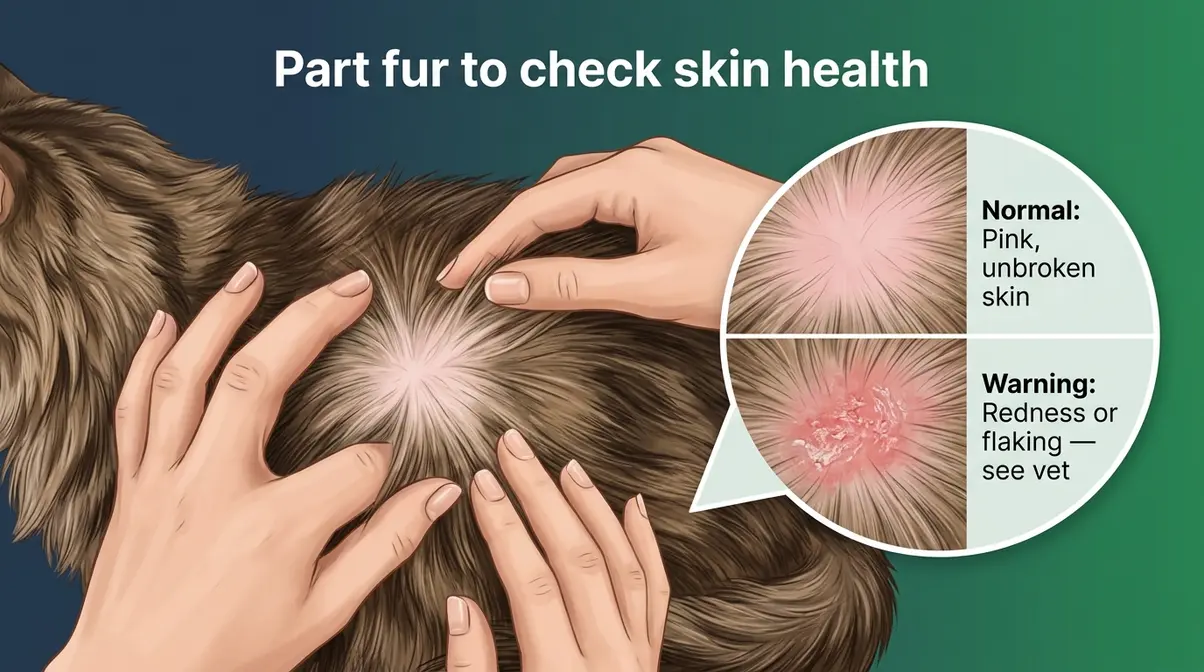
All of this is normal. The key signal that it’s just a seasonal blow-out: the skin beneath the coat looks healthy, pink, and unbroken, and new fur is visibly growing in. Brush daily during this period, and the blow-out typically resolves within 4–6 weeks (The Cattopia, 2026).
Warning Signs of Health Concerns
Heavy shedding is normal. These patterns are not:
| Warning Sign | What It May Indicate |
|---|---|
| Bald patches or thinning in one area | Ringworm, allergies, or over-grooming (psychogenic alopecia) |
| Skin redness, scabs, or flaking | Dermatitis, parasites (fleas, mites), or fungal infection |
| Clumps of fur with the root attached | Stress-related shedding or hormonal imbalance |
| Sudden dramatic increase outside of spring/fall | Thyroid disorder (hyperthyroidism), nutritional deficiency |
| Dull, brittle coat alongside shedding | Poor diet, dehydration, or underlying illness |
According to VCA Animal Hospitals, excessive or abnormal shedding in cats can be caused by stress, poor nutrition, parasites, hormonal disease, and systemic illness — all of which require veterinary diagnosis rather than grooming alone (VCA Hospitals, 2026). If you notice any of the warning signs in the table above, skip ahead to Step 5 before continuing with the grooming routine.
To ensure your cat’s shedding is normal, incorporate a two-minute skin check into your weekly grooming routine. Gently part the fur around the base of the tail, behind the ears, and along the lower back. Look for “flea dirt” (small black specks), which indicates parasites that can cause severe itching and hair loss. Check for any unusual redness, crusty patches, or areas where the fur seems brittle and breaks off easily. Environmental factors, such as sudden changes in household routine, moving to a new home, or introducing a new pet, can also trigger stress-induced shedding. If your Maine Coon experiences a sudden, heavy shed outside of the typical spring or fall windows, consider whether a recent stressful event might be the cause.
Step 2 – Master the Grooming Routine
Consistent grooming is the single highest-impact action you can take for maine coon shedding control. Maine Coon owners who brush 2–3 times per week report dramatically less fur on furniture, fewer hairballs, and a noticeably cleaner coat — compared to owners who brush once a week or less. The tools you use matter as much as the frequency.
Choosing the Right Grooming Tools
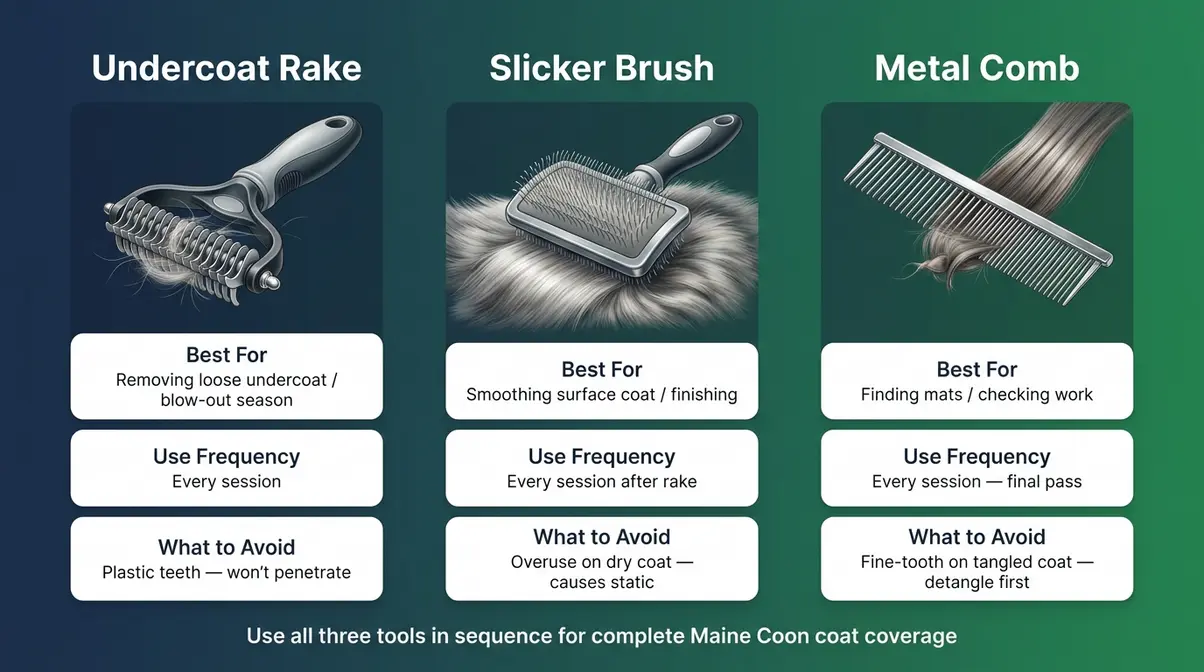
Three tools cover everything a Maine Coon coat needs:
| Tool | Best For | What to Avoid |
|---|---|---|
| Undercoat rake | Removing loose undercoat fur; the core tool for blow-out season | Rakes with plastic teeth — they don’t penetrate the dense inner coat |
| Slicker brush | Smoothing the surface coat; finishing after the rake | Over-using on a dry coat — can cause static and breakage |
| Metal (Greyhound) comb | Finding hidden mats; checking work after brushing | Fine-tooth combs on a tangled coat — always detangle first |
Furminator-style deshedding tools are popular, but use them sparingly on Maine Coons — no more than once every 1–2 weeks. Overuse can damage the guard hairs. The undercoat rake is your everyday workhorse.
The Line-Brushing Technique
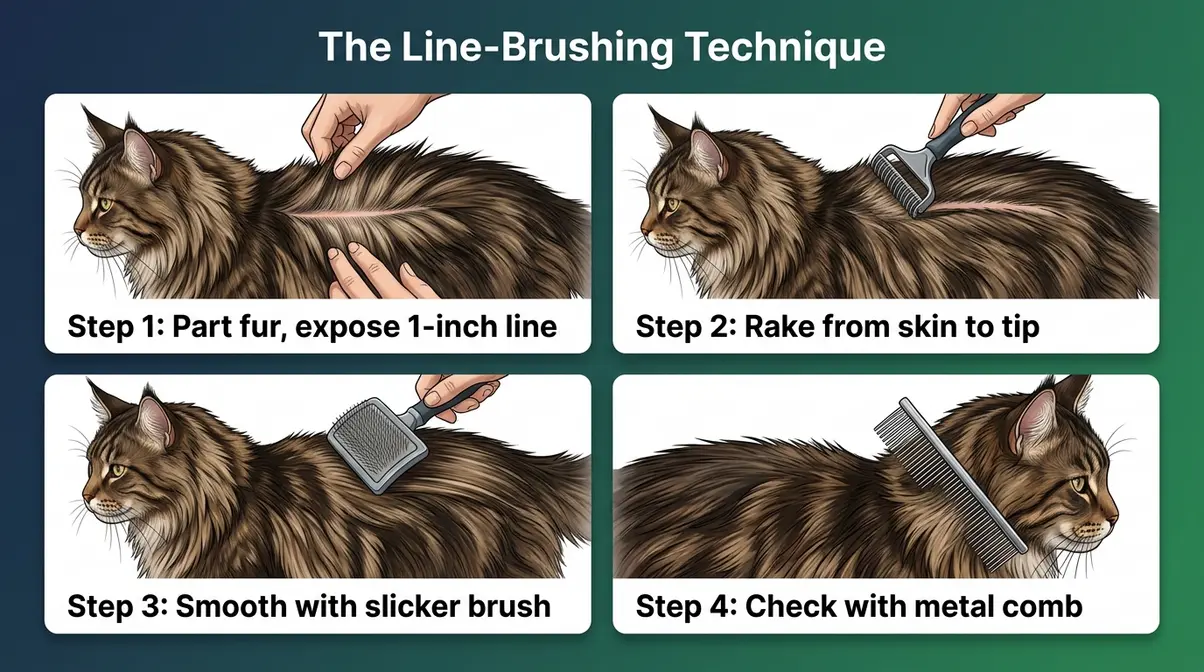
Line-brushing is the professional grooming method for long-haired cats. It works by exposing and clearing one small section of coat at a time, rather than brushing over the surface. Maine Coon owners who switch to this technique consistently report removing 2–3 times more loose fur per session than with standard brushing.
You’ll need: Undercoat rake, slicker brush, metal comb, treats. Estimated time: 15–20 minutes.
- Part 1: Preparation and Initial Brushing
- Settle your cat. Choose a calm time — after a meal works well. Place your cat on a non-slip surface (a folded towel on a table or your lap). Offer a treat to start on a positive note.
- Part the fur with your fingers. On the back or side, use your fingers to part the fur horizontally, exposing a 1-inch “line” of skin. This is the line you’ll brush.
- Brush from skin to tip along the line. Using the undercoat rake, brush gently from the exposed skin outward, following the direction of fur growth. Short, controlled strokes — not long sweeps. Remove fur from the rake after each stroke.
- Move the part upward by 1 inch. Once the line is clear, move your part up 1 inch and repeat. Work systematically from the belly upward, then from the tail toward the head.
- Part 2: Advancing and Finishing
- Switch to the slicker brush. After the rake, follow with the slicker brush across the entire coat using longer, sweeping strokes. This catches surface fur the rake left behind and smooths the coat.
- Finish with the metal comb. Run the comb slowly through the coat, especially behind the ears, under the “armpits,” and around the collar area — the spots where mats form first. The comb should glide through without catching. If it catches, you’ve found a mat (see below).
- Reward generously. End every session with treats and praise. Consistent positive association makes future sessions easier.
Preventing and Removing Mats
Mats (dense, tangled knots of fur close to the skin) are one of the most common beginner concerns — and one of the most preventable problems with regular brushing. Mats form when shed undercoat fur tangles with the outer guard hairs and compresses. Left alone, they tighten against the skin and become painful.
Prevention: Brush the mat-prone zones (behind ears, under “armpits,” collar area, base of tail) with the metal comb at every session. These spots mat first because of friction from movement.
Removal (small mat): Hold the fur firmly between the mat and the skin with your fingers — this is critical, as it prevents you from pulling the skin. Work the mat apart with the metal comb from the outside edge inward, using small, careful strokes.
Removal (large or tight mat): Do not force it. A mat cutter or mat splitter (available at pet stores) can safely split the mat into smaller sections before combing. If the mat is against the skin and won’t move, visit a professional groomer or vet — cutting mats out incorrectly causes skin injuries.
Should You Bathe a Maine Coon?
Bathing is optional for most Maine Coons and is not a substitute for regular brushing. That said, a bath every 4–6 weeks during blow-out season can loosen the undercoat and make your next brushing session significantly more productive. Maine Coons are unusually tolerant of water compared to most cat breeds — many owners find their cats curious rather than resistant at bath time.
If you do bathe: Use a cat-formulated shampoo (human shampoos disrupt the coat’s natural oils), rinse thoroughly, and dry completely with a low-heat blow dryer or absorbent towels. Never leave a Maine Coon damp — a wet undercoat can mat within hours.
Step 3: Optimize Diet for Coat Health
What your Maine Coon eats directly affects how much they shed and the condition of their coat. A dull, brittle coat that sheds excessively is often a nutritional signal — not just a grooming problem. This is the “Feed” pillar of the Shedding Defense System, and it’s the step most owners skip.
Omega-3 and Omega-6 Fatty Acids
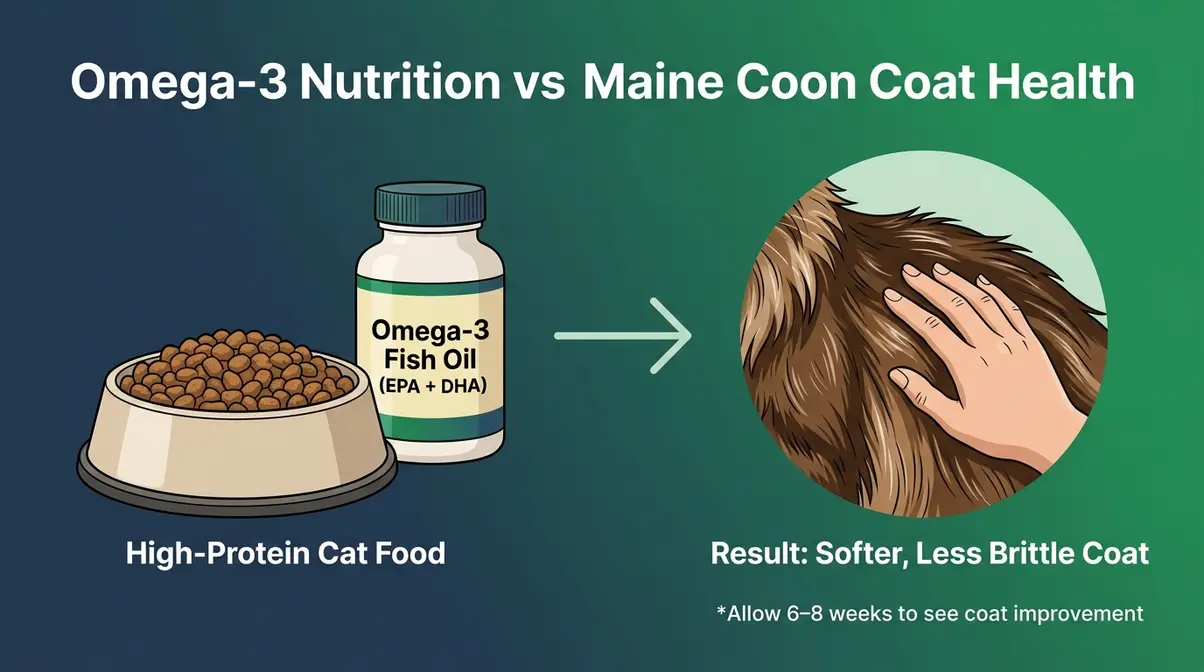
Omega-3 fatty acids (found in fish oil) and Omega-6 fatty acids (found in poultry fat and plant oils) are the two nutrients most consistently linked to coat health in cats. They support the skin’s moisture barrier, reduce inflammation, and are associated with a softer, less brittle coat that sheds less excessively.
Research from Tufts University’s Cummings School of Veterinary Medicine indicates that Omega-3 fatty acid supplementation — particularly EPA (eicosapentaenoic acid) and DHA (docosahexaenoic acid) from fish oil — can support skin and coat health in cats, though individual responses vary (Tufts University Cummings Veterinary Medical Center). The key phrase is “may help reduce” — supplements support coat health but are not a guaranteed fix for excessive shedding, which may have an underlying medical cause.
- Practical guidance:
- Look for cat-specific fish oil supplements (not human fish oil capsules, which may contain additives harmful to cats)
- A typical starting dose is 500–1,000 mg of combined EPA/DHA per day for an adult cat — but always confirm the dose with your vet before starting
- Allow 6–8 weeks of consistent supplementation before assessing results; coat changes are gradual
Always consult your veterinarian before adding any supplement to your cat’s diet. This is especially important if your cat has a health condition or takes medication.
Can Supplements Stop Shedding?
Many owners wonder: is there anything I can give my cat to stop shedding? No supplement or product stops shedding entirely — shedding is a normal, healthy biological process. However, Omega-3 fatty acid supplements (fish oil, specifically EPA and DHA) may help reduce excessive shedding by supporting skin barrier health and coat condition. Research from Tufts University’s Cummings School of Veterinary Medicine supports their use for skin and coat health in cats. Always consult your vet before starting supplementation, especially if your cat has any existing health conditions.
Best Diet for a Healthy Coat
When understanding feline nutrition, the foundation of a coat-healthy diet is high-quality animal protein. Cats are obligate carnivores — their bodies cannot manufacture essential amino acids from plant sources. Look for a food where a named meat (chicken, salmon, turkey) appears as the first ingredient, not a by-product meal or grain filler.
Key dietary markers for coat health:
- Protein: 35–45% on a dry matter basis for adult Maine Coons
- Fat: 15–20% — healthy fat supports the skin’s oil production
- Moisture: Wet food or a mixed wet/dry diet supports hydration, which directly affects coat quality; dehydration makes fur brittle and increases shedding
- Biotin and Zinc: Often included in premium cat foods; support skin cell turnover and coat strength
Avoid foods with artificial dyes, excessive carbohydrate fillers (corn, wheat as primary ingredients), or preservatives — these don’t cause shedding directly, but they displace the nutrients that support coat health.
Step 4 – Manage Shedding Around Your Home
Even with consistent grooming and an optimized diet, some fur will still land on your furniture, floors, and clothing. The “Manage” pillar of the Shedding Defense System is about reducing the impact of that fur rather than fighting a losing battle against every strand.
Vacuuming and Furniture Protection
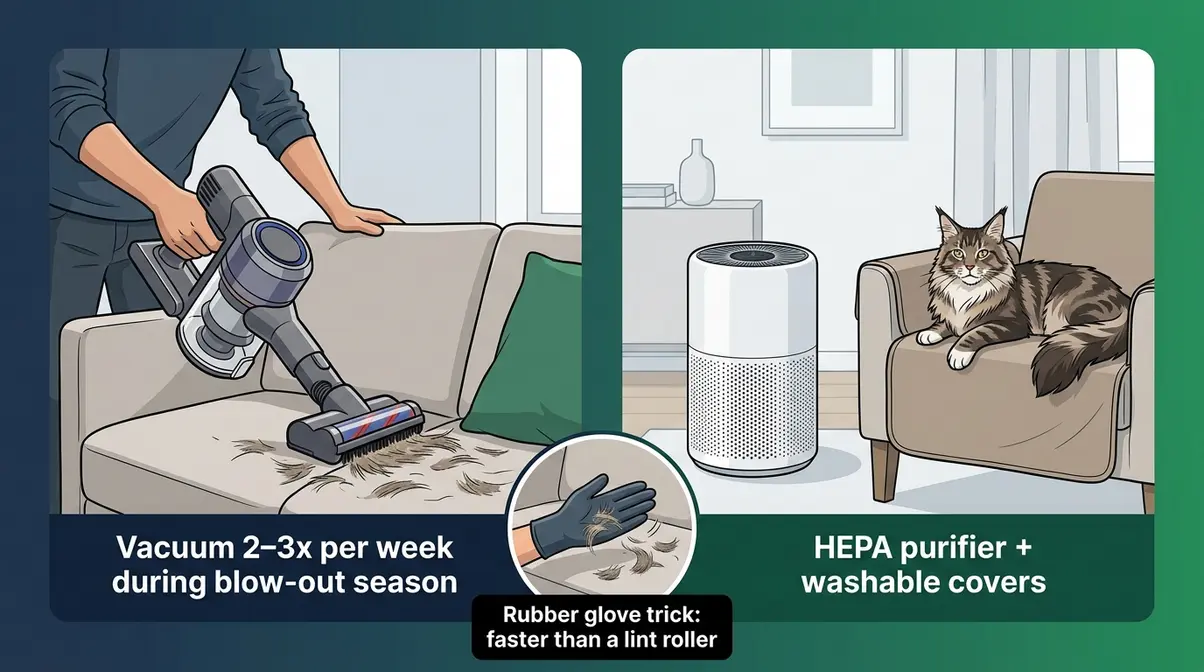
Vacuum 2–3 times per week during blow-out season, and once a week during lower-shedding months. A vacuum with a motorized brush head or pet hair attachment works significantly better than a standard floor nozzle for picking up long Maine Coon fur, which wraps around roller brushes rather than releasing cleanly.
Furniture protection strategies that Maine Coon owners consistently find effective:
- Washable furniture covers or dedicated throw blankets on your cat’s favorite spots — easier to launder than upholstery
- Microfiber fabric attracts and holds fur better than smooth cotton; choose furniture accordingly
- Rubber gloves — dampen slightly and run over upholstery; the friction pulls fur into a roll you can pick up by hand, faster than a lint roller for large areas
Air Purifiers and Lint Rollers
An air purifier with a HEPA filter (High-Efficiency Particulate Air — meaning it captures particles as small as 0.3 microns) can meaningfully reduce the amount of airborne cat fur and dander in your home. Place one in the room where your Maine Coon spends most of their time. This is particularly useful for allergy-prone household members.
Lint rollers are the fastest solution for clothing and small fabric surfaces. Keep one near the front door for a quick pass before leaving the house. For larger surfaces, a rubber pet hair removal brush (reusable, no adhesive sheets) covers more area per stroke and is more economical over time.
Step 5 – Know When to Call Your Vet
The Shedding Defense System handles normal Maine Coon shedding well. But some shedding patterns sit outside what grooming, diet, and home management can address — and recognizing those patterns is the final, most important step.
Contact your veterinarian if you notice any of the following:
- Bald patches or areas of noticeably thinned fur (not explained by seasonal blow-out)
- Skin that appears red, scaly, crusty, or broken
- Fur that comes out in clumps with the root bulb attached
- Your cat scratching, biting, or over-grooming a specific area obsessively
- A sudden, dramatic increase in shedding with no change in season or routine
- Weight loss, increased thirst, or lethargy alongside increased shedding
Several medical conditions can present as excessive shedding, including hyperthyroidism (an overactive thyroid gland — common in middle-aged to older cats), ringworm (a fungal infection, not a worm), flea allergy dermatitis, and stress-related alopecia (hair loss triggered by anxiety). According to the Merck Veterinary Manual, skin and coat changes are among the most common early indicators of systemic disease in cats — which is why a vet visit is warranted whenever the pattern doesn’t fit the seasonal norm.
Veterinary disclaimer: This guide is for informational purposes only and is not a substitute for professional veterinary advice. If you have concerns about your cat’s shedding, coat condition, or overall health, consult a licensed veterinarian.
Troubleshooting Common Shedding Problems
“I brush every day and there’s still fur everywhere.”
Daily brushing during blow-out season is correct — but technique matters more than frequency. If you’re using a slicker brush alone, you’re likely only clearing surface fur. Switch to an undercoat rake as your primary tool and use the line-brushing technique. Most owners who make this switch report a noticeable reduction in ambient fur within one week.
“My Maine Coon hates being brushed and fights me every time.”
This is almost always a conditioning problem, not a personality problem. Start with sessions of just 30–60 seconds — brush one small area, offer a treat, stop. Gradually extend the session length over 2–3 weeks. Never force a struggling cat; a short positive session is worth more than a long stressful one. Cat-safe grooming spray can also reduce the discomfort of brushing by softening tangles.
“The shedding suddenly got much worse — is something wrong?”
First, check the calendar. If it’s March–May or September–November, a blow-out is the most likely explanation. If it’s outside those windows, review recent changes: new food, new stressor (move, new pet, new person), or a medication change. If none of those apply and the shedding is accompanied by any of the warning signs from Step 1, schedule a vet visit. Sudden off-season shedding spikes with no environmental explanation warrant professional evaluation.
Limitations and Alternatives
Common Pitfalls
Relying on a single tool. The most common grooming mistake is using only a slicker brush. Slicker brushes clear surface fur but leave the undercoat largely untouched — the source of most loose fur. Always combine the undercoat rake, slicker brush, and metal comb for complete coverage.
Over-bathing. Bathing more than once a month can strip the coat’s natural oils, leading to a drier, more brittle coat that actually sheds more. Stick to the 4–6 week guideline and use a moisturizing cat shampoo.
Expecting overnight results from supplements. Omega-3 supplementation takes 6–8 weeks to show visible coat improvement. Owners who stop after 2 weeks often conclude “it didn’t work” — when the benefit simply hadn’t had time to develop.
When to Choose Alternatives
Professional grooming: If your Maine Coon has severe matting, significant anxiety around grooming, or if you’re physically unable to maintain a consistent routine, a professional cat groomer (not a dog groomer — look for one with specific long-hair cat experience) every 6–8 weeks is a practical alternative to daily home grooming. The cost typically runs $60–$120 per session.
Veterinary dermatology: If shedding persists despite consistent grooming and dietary optimization, and your primary vet hasn’t found a cause, a veterinary dermatologist can perform allergy panels, skin biopsies, and hormonal assays that general practice vets may not offer.
When to Seek Expert Help
If your cat’s coat condition is deteriorating despite your best efforts — increasing dullness, persistent matting within days of brushing, or skin lesions — this is beyond the scope of home management. A veterinarian can rule out the most common medical causes (thyroid disease, parasites, fungal infection) with a physical exam and basic bloodwork.
Frequently Asked Questions
How do I reduce Maine Coon shedding?
The most effective way to reduce Maine Coon shedding is consistent grooming with the right tools — specifically an undercoat rake used in the line-brushing technique, 2–3 times per week. Combine this with a high-protein diet and Omega-3 supplementation (fish oil, vet-approved) for coat health. Most owners see a noticeable reduction in ambient fur within 2–4 weeks of starting a consistent routine (as noted by The Cattopia).
What are the drawbacks of having a Maine Coon cat?
The primary drawbacks of Maine Coon ownership are the grooming commitment and the fur management required. Their double coat needs brushing 2–3 times per week minimum — more during blow-out season — or mats develop quickly. Their large size also means more food, larger litter boxes, and higher vet costs. That said, Maine Coons are widely regarded as one of the most affectionate and dog-like cat breeds, which most owners consider a fair trade-off.
Are Maine Coon kittens high maintenance?
Maine Coon kittens are moderately high maintenance compared to short-haired breeds, primarily because their coat needs to be introduced to grooming early. Start brushing at 8–10 weeks with very short, positive sessions — this is the most important thing you can do to make adult grooming easier. Kittens shed less than adults, but establishing the grooming habit early prevents anxiety and mat problems as the adult coat grows in, typically by 3–5 years of age (PetMD).
Why does my Maine Coon have so many hairballs?
Maine Coons are prone to hairballs because of the sheer volume and length of their double coat. When they self-groom, they swallow loose fur that can quickly accumulate in their digestive tract. You can significantly reduce hairballs by maintaining a strict brushing routine of 2-3 times per week to capture the fur before they ingest it. If the problem persists, discuss hairball-control diets or specialized digestive gels with your veterinarian.
Can I shave my Maine Coon to stop shedding?
You should never shave a Maine Coon unless it is medically necessary, such as for severe, unmanageable matting or a surgical procedure. Their double coat provides essential insulation against both cold and heat, and shaving it disrupts their ability to naturally regulate their body temperature. Furthermore, the coat may grow back unevenly or with a completely different texture, permanently altering their natural protection.
Putting It All Together
For Maine Coon owners, the fur isn’t going away — but it stops being overwhelming the moment you have a system. Maine Coon shedding is moderate, predictable, and highly manageable with the right approach. The Shedding Defense System — Groom → Feed → Manage — gives you a repeatable routine that addresses the problem at every level: removing loose fur before it spreads, supporting coat health from the inside, and reducing the impact of what does land on your furniture.
The Shedding Defense System works because it treats shedding as a three-part problem, not a single annoyance to react to. Grooming removes the fur already loose in the coat. Diet reduces the rate at which the coat becomes brittle and sheds excessively. Home management contains what escapes. Together, these three pillars turn a reactive, frustrated cleanup cycle into a calm, 15-minute routine.
Start with the undercoat rake and the line-brushing technique — that single change produces the fastest visible results. Add Omega-3 supplementation after your next vet visit, and build your vacuuming schedule around the spring and fall blow-out windows. Give it four weeks. The tumbleweeds of fur won’t disappear entirely, but they’ll shrink to something you can live with — comfortably.

Dave King
Cat owner and writer at Mad Cat Man.