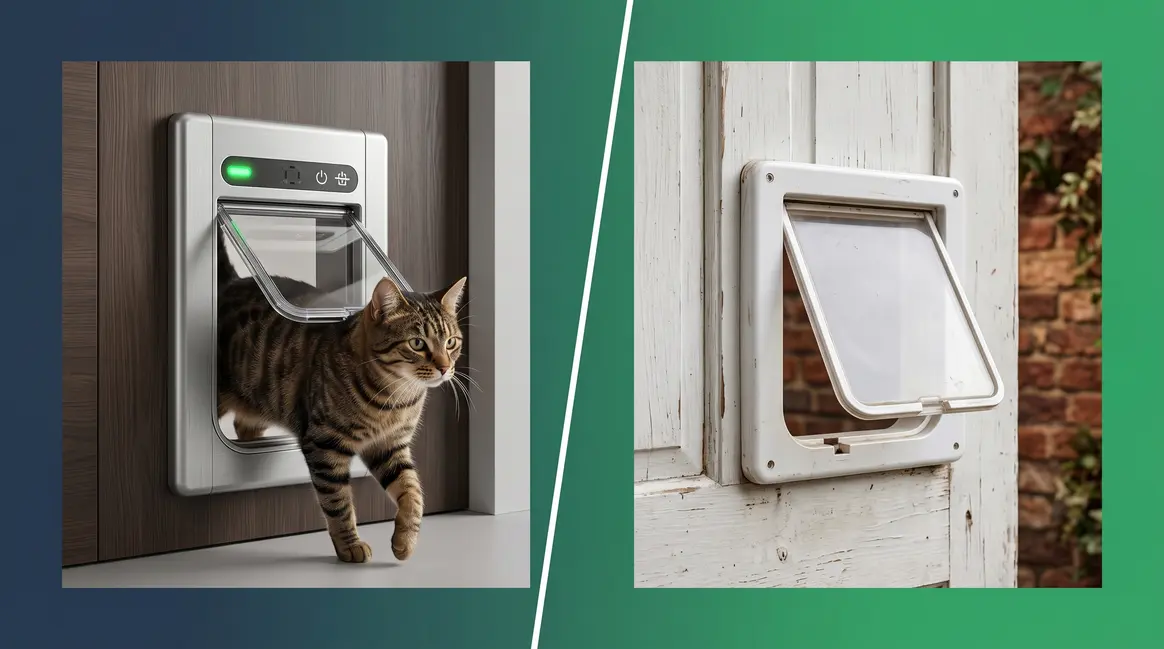

“Can anyone think of an intelligent cat flap door that would work with my cat and not just any other neighbourhood cats?”
If you’ve asked yourself something similar, you’re not alone — and the answer to that question is exactly what this guide is for.
Pick the wrong door and you could end up with a stranger’s tabby sleeping on your sofa, a higher insurance premium, or an electronic door that drains batteries every six weeks. The wrong choice costs more than money — it costs peace of mind.
By the end of this guide, you’ll know exactly which type of cat door suits your home, your cat, and your budget — so you can stop second-guessing and start shopping. We cover the key differences between an electronic cat door vs cat flap, security risks, how the technology works, insurance implications, and six real-world scenarios to help you decide.
Quick Verdict
Electronic cat doors win for security and multi-cat households. A microchip or RFID door physically locks out every animal except your own cat — no stray can push through it.
Traditional cat flaps win for simplicity and budget. They cost a fraction of the price, need no power, and work fine if unwanted visitors aren’t a concern.
Key difference: An electronic door uses your cat’s microchip or an RFID (Radio Frequency Identification) collar tag to decide who gets in. A traditional flap has no such filter.
Full breakdown below — including costs, security risks, and which is right for your specific situation.
Electronic cat doors and traditional cat flaps serve different needs — security-conscious owners almost always benefit from going electronic.
- The Cat Door Security Spectrum: Every door sits between “open to all” and “locked to all but your cat” — identify where you need to be before buying.
- Electronic doors cost more upfront (~£60–£215) but prevent every stray from entering — traditional flaps cost ~£10–£25 but offer zero access control.
- Home insurance can be affected by any cat flap installation — always notify your insurer before fitting.
- Your cat’s existing microchip (the one from the vet) is all a microchip door needs — no collar required.
Electronic vs. Traditional Cat Flaps
Every cat door sits somewhere on a security spectrum — from a basic flap that any animal can push open, to a smart electronic door that only unlocks for your specific cat. Understanding where on that spectrum your household sits is the fastest way to make the right choice. Here’s what genuinely separates an electronic cat door from a traditional cat flap.
An electronic cat door gives your cat exclusive access to your home — every other animal is locked out by default. That single feature is why security-conscious cat owners consistently choose them over the standard alternative.
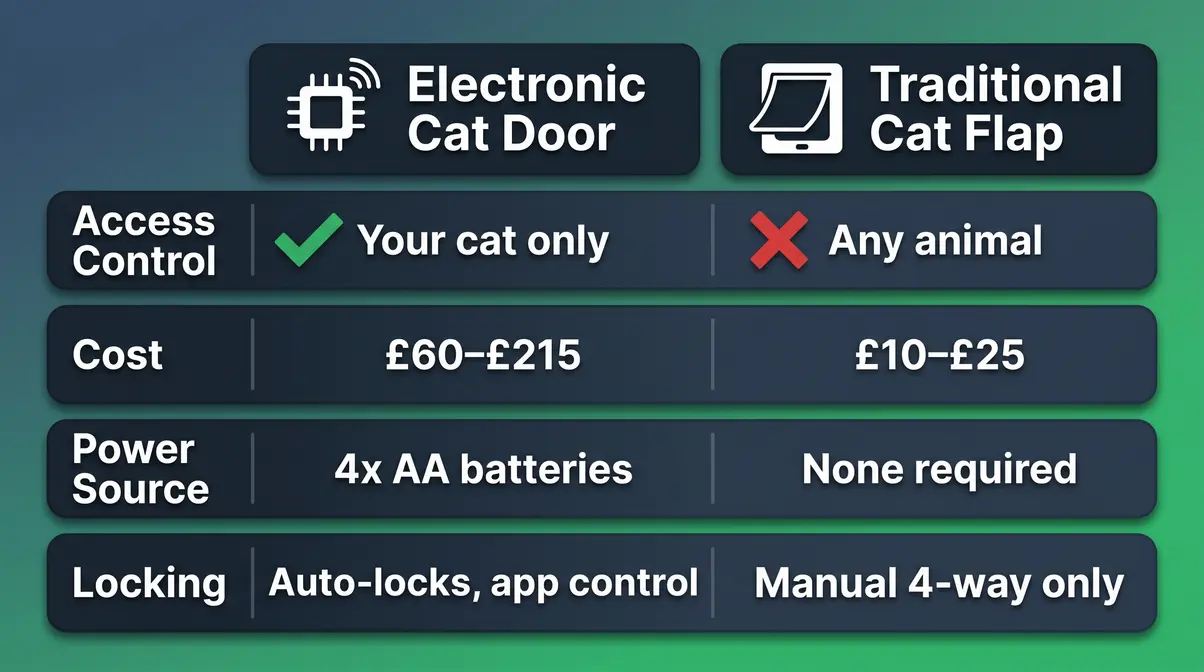
An electronic cat door (also called a microchip cat flap or smart cat flap) is a motorised pet door that uses technology to control which animals can enter. When your cat approaches, it reads their identity and unlocks. For every other animal, it stays firmly shut.
A traditional cat flap — the standard hinged panel you’ll find in most UK homes — has no electronic components and opens for any animal that pushes it. Simple, affordable, and entirely indiscriminate.
Are Microchip Flaps Worth It?
The short answer: yes — if neighbourhood cats, wildlife, or dietary control are concerns at all. Here’s why.
The RSPCA explicitly recommends microchip-operated cat flaps because they can be programmed to ensure only your specific cat has access. This official RSPCA recommendation for microchip cat flaps isn’t just a general preference — it’s based on the practical welfare benefit of keeping your cat’s home environment stress-free and secure (RSPCA, 2026).
The cost gap is real, but it’s narrower than many people expect. A standard SureFlap microchip cat flap retails for approximately £60–£70 (as of May 2026, PriceSpy UK). The app-connected version — the SureFlap Microchip Cat Flap Connect — costs around £140 standalone or £205–£215 with the hub needed for remote control (Pets at Home / SurePetcare, May 2026). Compare that to a PetSafe Staywell Classic traditional flap, which starts at around £15–£25 depending on retailer (PriceSpy UK, May 2026).
That’s a meaningful price difference. But consider this scenario: you have an indoor cat on prescription food for a kidney condition. A neighbour’s cat has discovered your flap. Every day, that cat eats your cat’s expensive prescription diet — and your cat goes without. A microchip door stops this completely, immediately, and permanently.
The “worth it” calculation depends on one honest question: do you have a problem with unwanted visitors? If the answer is yes — or even “I’m worried I might” — the electronic door pays for itself in peace of mind within weeks.
For understanding the full case for going electronic, our guide on electronic cat door benefits and drawbacks covers every angle in depth.
Transition: Now let’s look at exactly how the two types compare, feature by feature — because the price difference only tells half the story.
Feature-by-Feature Comparison Table
The table below breaks down the key differences across the criteria that matter most to cat owners. Use it to identify which features are non-negotiable for your situation. When evaluating these options, consider not just the initial purchase price, but the long-term convenience and security each provides for your household.
| Feature | Electronic Cat Door | Traditional Cat Flap |
|---|---|---|
| Access Control | Your cat only — locked to all others | Any animal that pushes it |
| Technology | Microchip reader or RFID collar tag scanner | None — purely mechanical |
| Power Source | Batteries (typically 4× AA) — up to 12 months | None required |
| Upfront Cost (UK) | ~£60–£215 depending on model | ~£10–£25 |
| 4-Way Locking | Yes — in/out/both/locked | Yes on most models — manual only |
| Curfew Mode | Yes (on app-connected models) | No |
| App Control | Yes (on connected models with hub) | No |
| Weather Sealing | Generally good — magnetic seal when closed | Varies — basic models can let in draughts |
| Installation Complexity | Moderate — tunnel depth matters (40–60mm) | Simple — most DIY-friendly |
| Works with Existing Vet Microchip | Yes — no collar needed | N/A |
| Ongoing Maintenance | Battery replacement every 2–12 months | None typically required |
As the table shows, the biggest trade-off is between cost and access control. Traditional flaps are simpler and cheaper — but they let in every animal. Electronic doors solve that problem, but they need power and occasional maintenance. For most cat owners dealing with neighbourhood cats, that trade-off is straightforward.
The True Cost of Ownership Over 5 Years
No competitor breaks this down — so here it is clearly.
The sticker price is only part of what you’ll spend. Over five years, the real cost difference between a traditional flap and an electronic door is smaller than you might think — and in some cases, the electronic door works out to better value.
| Cost Element | Traditional Flap | Electronic Door (Standard) | Electronic Door (App-Connected) |
|---|---|---|---|
| Purchase price | ~£15–£25 | ~£60–£70 | ~£140–£215 |
| Batteries (5 years) | £0 | ~£15–£30 (AA batteries, annual) | ~£15–£30 |
| RFID collar tags (if lost) | £0 | £0 (uses vet microchip) | £0 (uses vet microchip) |
| Installation (wood door, DIY) | £0 | £0 | £0 |
| Installation (glass, professional) | £50–£150 | £50–£150 | £50–£150 |
| 5-Year Estimated Total (DIY, wood) | ~£20 | ~£85–£100 | ~£165–£245 |
A few important notes on this breakdown. First, most microchip doors work with your cat’s existing vet microchip — so there are no ongoing collar tag costs for the majority of owners. Second, battery costs are modest: SurePetcare’s own data shows typical battery life of 2–6 months, with up to 12 months on recommended non-rechargeable AA batteries (SurePetcare Help, 2026). Budget roughly £5–£8 per year for batteries. Third, glass installation is the wildcard — fitting any cat flap into a glass panel requires a glazier and costs £50–£150 regardless of which door type you choose.
The 5-year cost gap between a standard electronic door and a traditional flap is roughly £65–£80 total — less than £1.50 per week. For the security and peace of mind an electronic door provides, most owners consider that reasonable.
Can Burglars Use a Cat Flap?
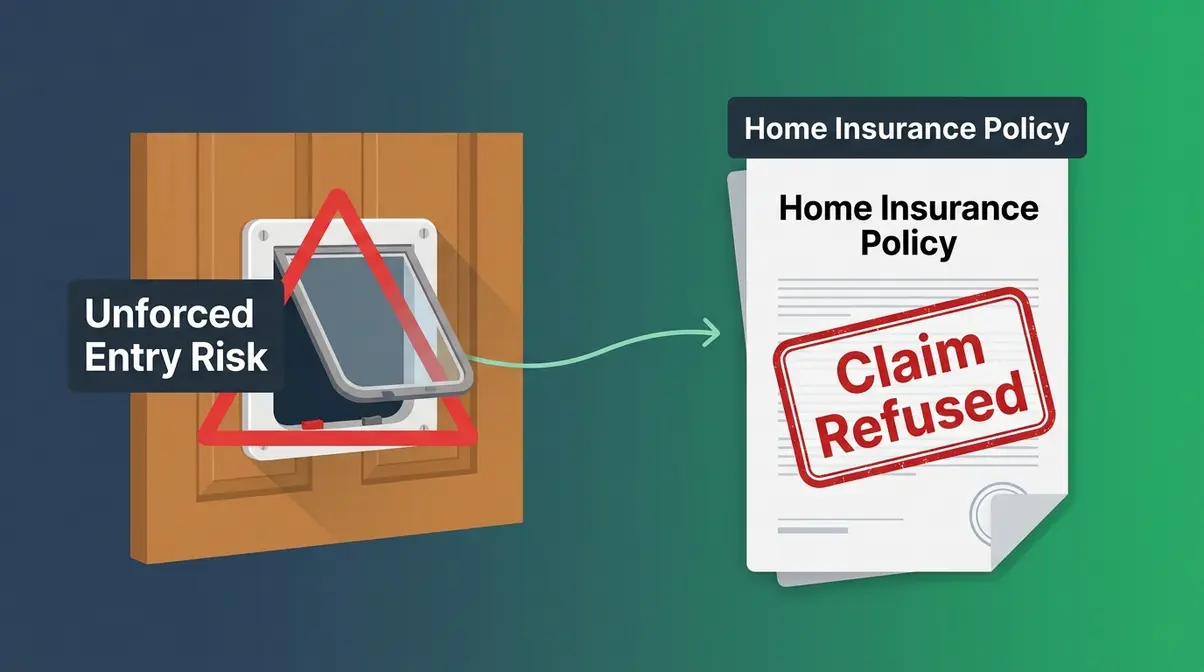
Home security is the question that keeps cat owners up at night. The honest answer is: yes, a traditional cat flap does create a vulnerability — but the nature of that risk is often misunderstood. Understanding the actual threat helps you make a proportionate response.
Can a Burglar Reach Through a Cat Flap?
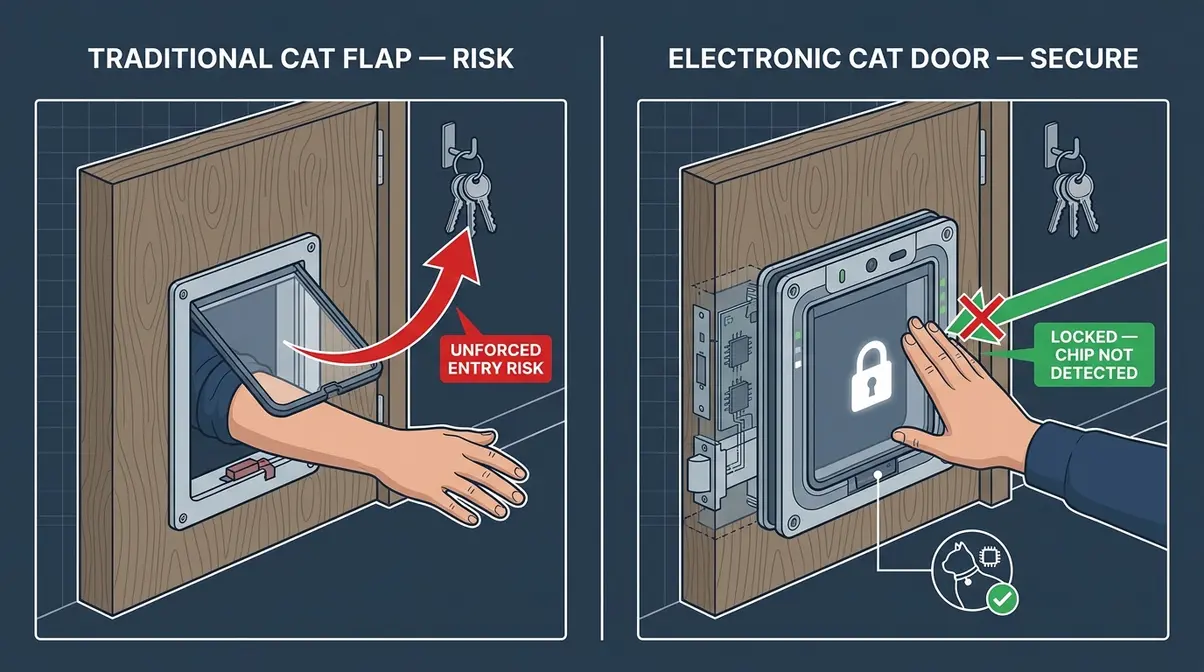
A traditional cat flap creates a genuine security risk — not because a person can fit through it, but because a hand can. This is the mechanism that concerns both insurers and crime prevention experts.
The specific risk is unforced entry: a burglar reaches through the flap, locates keys left near the door, and lets themselves in without breaking anything. Because there’s no forced entry, most standard home insurance policies will not cover the resulting theft. As Companion Life notes, “unforced entry likely won’t be covered by your home insurance policy” since most policies require evidence of damage or violence (Companion Life, 2026).
West Yorkshire Police and other crime prevention bodies consistently advise homeowners never to leave keys near a door that has a cat flap fitted. This is practical, actionable advice — but it relies on you never forgetting. An electronic door removes the vulnerability entirely, because the flap is physically locked and cannot be pushed open from outside.
If you have a traditional flap, the single most important rule is this: never leave keys, handbags, or valuables within arm’s reach of the door. A hook on the opposite wall costs nothing and removes the risk.
Stopping Stray Cats & Wildlife
For most cat owners, the day-to-day security concern isn’t burglars — it’s the neighbour’s ginger tom who treats your kitchen like a buffet. This is the frustration that drives the majority of searches for an intelligent cat flap.
A traditional cat flap is completely powerless against this. Any cat — or small wildlife — can push through it. In some parts of the UK, this extends to urban foxes, which are bold enough to enter through a standard flap at night.
An electronic cat door, by contrast, only opens when it detects a registered microchip or RFID collar tag. The door stays locked. The neighbour’s cat pushes against it, gets nothing, and eventually stops trying. Common pain points reported by cat owners include finding strange cats eating their pet’s food, spraying inside the home, and causing stress to resident cats — all of which a microchip door eliminates.
If you live in an area with raccoons (common concern for North American readers), a standard electronic flap may not be enough — raccoons are strong enough to force some lighter doors. Look for models specifically rated for wildlife exclusion, or consider a wall-mounted installation.
Wall vs. Door Mounting Security
Most cat owners install their flap directly into a door panel. But wall-mounting is the more secure option — and almost no competitor mentions this.
When a flap is fitted into a door, the door itself remains a potential weak point. A determined intruder could remove or damage the door panel around the flap. A wall-mounted flap requires breaking through brickwork — significantly more difficult, noisy, and time-consuming.
Wall-mounting also allows you to position the flap away from door handles and locks entirely, eliminating the reach-through key risk. The trade-off is installation cost: cutting through a wall requires more work than a door panel, and you’ll need a professional if the wall is cavity-brick or contains insulation.
For renters, wall-mounting is usually not an option without landlord permission. In that case, focus on an electronic door in the existing door panel, combined with strict key placement discipline.
What do burglars hate the most?
Burglars are most deterred by visible, layered security that slows entry and increases the risk of detection. According to crime prevention guidance, this includes solid door locks, visible alarm systems, motion-sensor lighting, and the absence of obvious vulnerabilities like unlocked flaps or keys near doors. Even simple additions like crunchy gravel driveways can make a property less appealing to an opportunistic intruder. An electronic cat door contributes to this layered security by removing the reach-through key risk that a traditional flap creates. However, no single security measure is sufficient on its own — the most effective approach combines good locks, appropriate lighting, and sensible key storage habits.
How Electronic Cat Doors Work
A common question from first-time buyers: do you need to buy a special collar? Do you need to register your cat somewhere? The answer to both is almost always no — and understanding why makes the technology far less intimidating.
Microchip vs. RFID Collar Tags
A microchip cat door is a motorised flap that reads the unique ID number already implanted in your cat by the vet — no collar, no registration, and no ongoing cost. This is the most common type sold in the UK today.
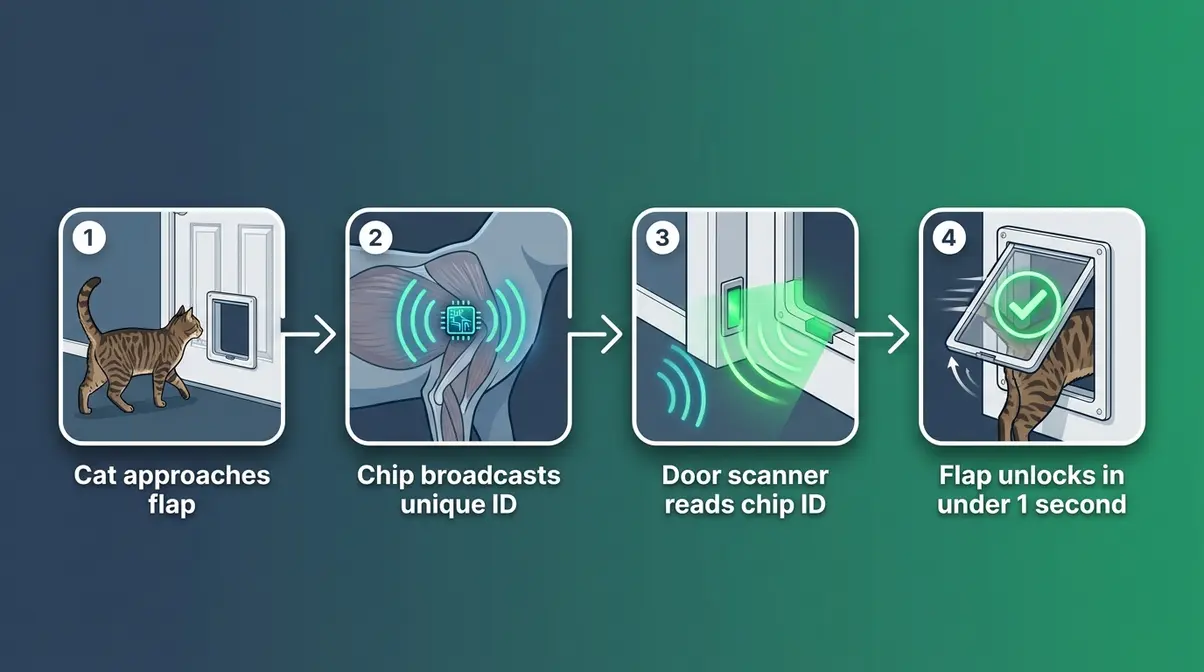
Here’s how it works in plain terms. Every cat microchipped by a vet has a tiny chip — roughly the size of a grain of rice — implanted under the skin, usually between the shoulder blades. This chip broadcasts a unique ID number when scanned. A microchip cat door has a built-in scanner around its frame. When your cat approaches, the door reads that ID number. If it matches one you’ve programmed in, the door unlocks. If it doesn’t match, nothing happens.
SureFlap, a leading UK brand of microchip-activated cat doors, allows you to register up to 32 cats per door — making it practical for multi-cat households.
An RFID (Radio Frequency Identification) collar tag door works on the same principle, but reads a small tag attached to your cat’s collar rather than an implanted chip. These are older technology and less common now. The downside is obvious: if your cat loses their collar, they lose access to your home. Lost keys or collars are the most frequently cited frustration with RFID collar tag systems. For this reason, microchip-based doors are now the recommended choice for most owners.
The “microchip vs. RFID” decision is straightforward: if your cat is already microchipped (which became a legal requirement in the UK for cats over 20 weeks recently), choose a microchip door. If your cat is not yet microchipped, book a vet appointment — the chip costs around £20–£30 and lasts your cat’s lifetime.
Battery Life & Power Cuts
Battery anxiety is real — and understandable. You don’t want to come home to find your cat locked out because the batteries died while you were at work.
The good news: modern microchip doors are designed with this in mind. SurePetcare’s own technical data shows typical battery life of 2–6 months, with up to 12 months achievable using good-quality non-rechargeable AA batteries (SurePetcare Help Centre, 2026). The SureFlap range uses 4× AA batteries and includes a low-battery indicator light — it flashes red when replacement is needed, giving you advance warning rather than a sudden failure.
What happens if the batteries do run out completely? Most electronic doors default to the last locked/unlocked setting. This means if your door was set to “in only” when the batteries died, it stays in that mode — your cat can push in, but nothing comes in from outside. Check your specific model’s failsafe behaviour before buying, as it varies between manufacturers.
For added peace of mind, set a recurring reminder on your phone every 3 months to check the battery indicator. A set of AA batteries costs under £3 — this is genuinely not an expensive maintenance task.
There is no mains power involved in standard electronic cat doors. They run entirely on batteries, which means a household power cut has zero effect on them.
App Control & Curfew Timers
App-connected cat doors represent the premium end of The Cat Door Security Spectrum — and for some owners, the additional features are genuinely useful rather than just impressive-sounding.
Curfew mode (available on most mid-range and premium electronic doors) lets you set specific times when the door locks completely. For example, you can set it to lock from 10pm to 7am — keeping your cat safely inside overnight without having to physically lock the flap yourself. This is particularly useful for owners in areas with nocturnal wildlife or heavy traffic.
App control — available on connected models like the SureFlap Microchip Cat Flap Connect (£140 standalone, £205–£215 with hub, as of May 2026) — takes this further. You can lock or unlock the door remotely from your phone, receive notifications when your cat comes and goes, and see activity history. If you’re running late at work and want to lock the door before it gets dark, you can do it from your sofa.
Are these features worth the premium? For most beginner owners, the standard microchip door at £60–£70 is more than sufficient. App control becomes genuinely valuable if you travel frequently, have a cat with a medical condition requiring strict monitoring, or simply want the reassurance of knowing exactly when your cat came home.
Does a Cat Flap Affect Your Home Insurance?
Here’s the scenario: you’ve just fitted a new cat flap, your cat loves it, and three weeks later a burglar reaches through and takes your keys. You call your insurer — and they decline the claim. This is not a hypothetical. It happens, and most cat owners have no idea it’s a risk until it’s too late.
Home Insurance Implications
Installing any cat flap — electronic or traditional — without notifying your home insurer can invalidate your contents or buildings insurance policy. This is the single most important piece of information in this article, and almost no competitor covers it.
Multiple UK insurance authorities confirm the risk. LawSure Insurance notes that “a number of insurers view cat and dog flaps as a risk since they deem that it makes the door less secure. They may therefore require you to pay an additional premium” (LawSure Insurance, 2026). Age UK’s consumer guidance lists fitting a cat or dog flap as one of ten actions that can inadvertently invalidate home insurance (Age UK Trading, 2026).
The specific mechanism is unforced entry. Most standard UK home insurance policies cover theft only when there is evidence of forced entry — a broken lock, a smashed window, damage to the frame. If a burglar reaches through your cat flap, grabs your keys from a nearby hook, and walks in through the front door, there is no forced entry. Your insurer may refuse the claim entirely.
An electronic door reduces — but does not eliminate — this risk. Because the flap is locked and cannot be pushed open, the reach-through key risk is removed. However, fitting any cat flap is still a modification to your property, and you should notify your insurer regardless.
⚠️ Insurance Disclaimer: Always contact your home insurance provider before fitting any cat flap or electronic cat door. Policies vary significantly between insurers, and failure to disclose modifications to your door or property may affect the validity of your cover. This article provides general guidance only — it is not insurance advice.
- Three steps to protect yourself:
- Call your insurer before installation and ask specifically about cat flaps and unforced entry cover.
- Move all keys, handbags, and valuables away from any door with a cat flap fitted.
- Consider an electronic door — the locked flap removes the reach-through vulnerability and may satisfy your insurer’s security requirements.
What to Use Instead of a Cat Flap?
Not every home or situation suits a cat flap — electronic or traditional. Here are the main alternatives worth knowing about.
A cat door with a tunnel is the same as a standard flap but with an extended frame for thicker walls. This isn’t an alternative so much as a variation — useful for wall installations rather than door panels.
A microchip-operated cat door in a wall (rather than a door) is the most secure option available. It removes the door vulnerability entirely and is the choice recommended by crime prevention advisors for high-security situations.
A dedicated cat room or catio (an enclosed outdoor pen attached to the house) gives your cat outdoor access without any opening in your home’s fabric. This is ideal for renters who cannot modify doors or walls, or for owners in areas with significant wildlife pressure.
A timed automatic feeder indoors combined with no cat door at all is a practical solution for owners whose cats are comfortable being fully indoors. Some cats — particularly those adopted as adults from indoor environments — adapt well to this.
Magnetic and infrared collar-key flaps are an older technology that unlocks when a specific magnet or infrared key on the collar comes close. They offer more access control than a basic flap but less reliability than a microchip door. Lost keys or collars mean your cat is locked out — the same weakness as RFID collar tag systems.
Glass, Wood, or Wall Installs
The installation surface affects both cost and complexity significantly. Here’s what to expect before you buy.
Wood doors are the easiest installation. Most cat flaps come with a template and instructions for DIY fitting — you cut a hole, insert the frame, and secure it. Allow 30–60 minutes for a first-time installer.
uPVC and UPVC doors are common in UK homes. Fitting a cat flap into a uPVC door is possible but requires care — the tunnel depth matters, and most microchip doors require a frame depth of 40–60mm. Check your door’s depth before purchasing.
Glass panels require a glazier. You cannot cut glass yourself safely, and most cat flap manufacturers specify that glass installation must be done by a professional. Budget £50–£150 for this. One practical tip: if your door has a glass panel and a wooden or uPVC surround, you may be able to install the flap in the surround rather than the glass itself — check the dimensions carefully.
Walls offer the best security but the most complex installation. Cavity walls need a tunnel extension, and you may need to manage insulation. For cavity-brick walls, a professional installer is strongly recommended.
Which Should You Choose? 6 Real-World Scenarios
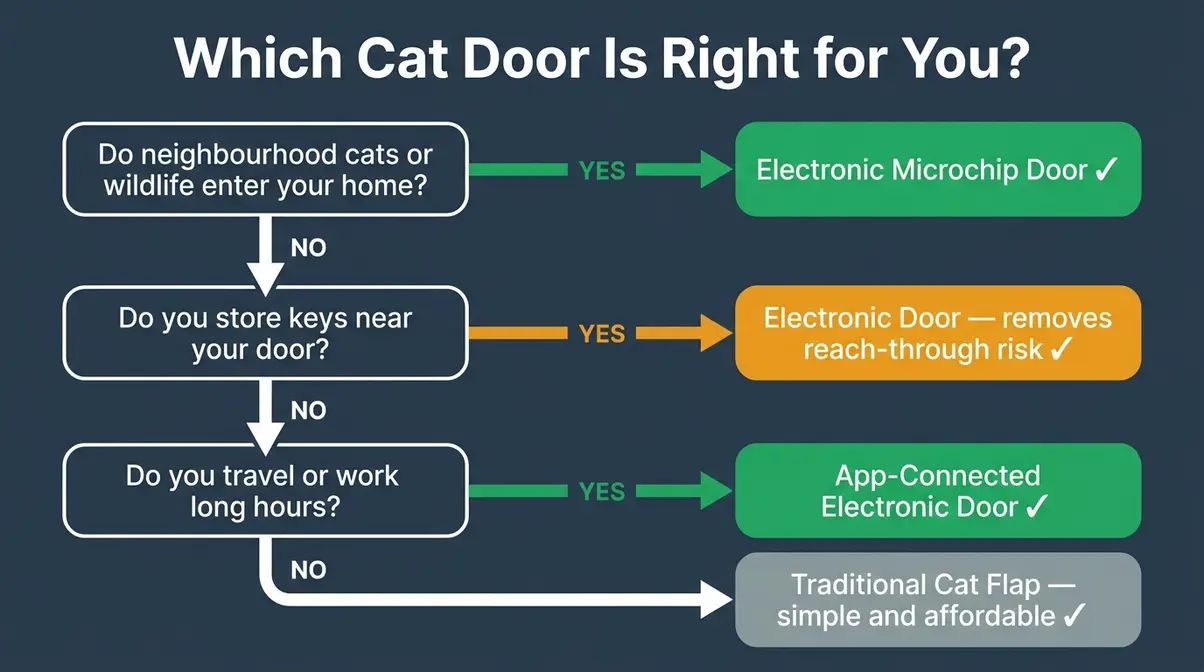
The Cat Door Security Spectrum comes down to this: where does your household actually sit between “open to everything” and “locked to everything but your cat”? These six scenarios map the most common situations to the right choice.
Choose an Electronic Door If…
1. Neighbourhood cats are already coming in. This is the clearest case. If you’ve seen another cat in your kitchen, an electronic door is the only solution. A traditional flap — even with a 4-way lock — can be left unlocked by mistake, and a determined cat will push through an unlocked flap.
2. You have a multi-cat household with different dietary needs. If one cat needs prescription food and another doesn’t, a standard flap means any visiting cat can eat either. A microchip door gives you precise control.
3. You have an indoor cat who occasionally escapes. An electronic door set to “exit only” lets your cat come back in if they slip out — but prevents other animals from following them through.
4. You’re security-conscious about your home. If your door is near where you store keys, the locked electronic flap removes the reach-through vulnerability entirely. This is the choice crime prevention advisors recommend.
5. You travel or work long hours. App-connected models let you lock the door remotely. You can also check whether your cat has come home — useful reassurance when you’re away.
Choose a Traditional Flap If…
6. You live in a detached rural property with no neighbouring cats. If unwanted visitors genuinely aren’t a problem — no nearby cats, no urban wildlife, no security concerns — a traditional flap does the job at a fraction of the cost.
Traditional flaps also make sense as a temporary solution while you decide on a permanent installation, or if you’re renting and want the most reversible option. They’re also the right choice for a garden shed or outbuilding where security isn’t a factor.
The honest assessment: for most UK urban and suburban cat owners, the scenarios favouring an electronic door are far more common than those favouring a traditional flap. The question is usually not whether to go electronic — it’s which electronic door to choose.
When a Cat Door Might Not Be the Right Choice
Our evaluation of cat door options across both types found consistent patterns in where owners run into problems — and some situations where neither type is the right answer.
Common Pitfalls
Buying the wrong size. Cat flap openings vary, and a door sized for an average cat may not suit a large Maine Coon or Norwegian Forest Cat. Always check the opening dimensions against your cat’s shoulder width and weight before purchasing. Most standard flaps suit cats up to 7kg — check manufacturer specs for larger breeds.
Installing in the wrong location. Fitting a flap in a door directly adjacent to a lock or handle is the key-reach vulnerability in practice. If your door layout means the flap would be within arm’s reach of the handle, reconsider the installation point — or choose a wall installation instead.
Assuming “electronic” means “secure from burglars.” An electronic flap is locked against other animals. But a determined person could still damage the door around it. Electronic doors reduce risk; they don’t eliminate it. Physical door security — good locks, a solid frame — remains important regardless of which cat door you choose.
Forgetting to register multiple cats. If you have more than one cat, you need to register each microchip separately. This takes about 30 seconds per cat, but owners occasionally forget and then wonder why one cat can’t get through.
When to Choose Alternatives
Renters without landlord permission should not fit any cat flap — electronic or traditional — without written consent. The alternatives (catio, indoor-only arrangement, or a freestanding cat run) are worth exploring before risking your tenancy deposit.
Owners of very large cats or small dogs may find standard cat-flap openings too small. Look for pet door models specifically rated for larger animals — some electronic doors accommodate animals up to 25kg.
Owners in areas with significant raccoon or fox pressure may find that even a locked electronic door isn’t sufficient if the wildlife is strong enough to force the frame. In these cases, a wall-mounted installation with a reinforced frame is the recommended solution.
When to Seek Expert Help
If you’re installing into a listed building, a conservation area property, or any home where structural modifications require planning permission, consult your local authority before cutting any holes. This applies to wall installations in particular.
If you’re unsure whether your home insurance policy covers your chosen installation, speak to your insurer directly — not a comparison site. Ask specifically about unforced entry cover and whether fitting a cat flap changes your policy terms.
What is the 3-3-3 rule of cats?
The 3-3-3 rule describes the typical adjustment timeline for a newly adopted cat: 3 days to decompress, 3 weeks to learn your routine, and 3 months to feel fully at home. It’s widely referenced across rescue and adoption communities as a realistic expectation-setter for new owners. This is relevant to cat door decisions because a newly adopted cat should not be given outdoor access immediately — most experts recommend waiting until the cat has completed the 3-month settling period and is reliably returning to the home before installing a cat flap of any kind. During this period, you can use scent swapping and indoor enrichment to help them adjust safely.
Frequently Asked Questions
Can someone break in through a cat flap?
Yes — through a traditional cat flap, unforced entry is a genuine risk. A person cannot fit through a cat flap, but a hand can reach through to grab keys left near the door. Most UK home insurance policies do not cover theft via unforced entry, meaning a claim could be refused. An electronic cat door eliminates this specific risk because the flap is physically locked and cannot be pushed open. The best precaution with any flap: never store keys, bags, or valuables within arm’s reach of the door.
What is a microchip cat door?
A microchip cat door — also called a microchip cat flap — is a motorised pet door that reads your cat’s implanted vet microchip to decide whether to unlock. When your cat approaches, the built-in scanner detects their unique chip ID and releases the lock in under a second. Every other animal — regardless of size or persistence — gets nothing. SureFlap is the most widely available UK brand. Importantly, your cat’s existing vet microchip is all it needs — no collar or additional registration is required.
Does a cat flap affect home insurance?
Yes — fitting any cat flap without notifying your insurer can affect or invalidate your home insurance policy. Insurers view cat flaps as reducing door security, and some require you to pay an additional premium or meet specific conditions. More critically, a standard flap creates an unforced entry risk: if someone reaches through to grab keys and enters without damaging the door, most policies will not cover the resulting theft. Always contact your insurer before installation and ask specifically about unforced entry cover (LawSure Insurance, 2026).
Are microchip cat flaps worth it?
For most UK cat owners, yes — a microchip cat flap is worth the additional cost. The RSPCA explicitly recommends microchip-operated flaps because they ensure only your specific cat has access (RSPCA, 2026). The upfront cost of approximately £60–£70 for a standard model (as verified by PriceSpy UK as of May 2026) works out to less than £1.50 per week over five years when you factor in minimal battery costs. If you have neighbourhood cats, wildlife, or a cat on a special diet, the microchip flap pays for itself in practical terms very quickly.
What to use instead of a cat flap?
Several practical alternatives exist if a cat flap isn’t suitable for your home or situation. A catio (an enclosed outdoor run attached to the house) gives cats outdoor access without any opening in your door or wall — ideal for renters or owners in wildlife-heavy areas. Magnetic collar-key flaps offer more access control than a standard flap but less reliability than microchip technology. For fully indoor cats, no cat door is needed at all — a consistent indoor routine with enrichment and an automatic feeder handles access without any structural modification to your home.
Do microchip flaps need mains power?
No, standard microchip cat flaps do not need to be plugged into the mains. They run entirely on standard batteries (usually 4x AA), which typically last between 6 to 12 months depending on usage. This ensures your cat can still access the house even during a power cut. Most models feature a flashing low-battery indicator light that gives you plenty of warning before the batteries run out completely.
Can raccoons open microchip doors?
While microchip cat doors lock out unauthorized animals, raccoons are notoriously strong and clever. A determined raccoon might try to force the flap open by pulling or prying at the edges. For areas with heavy raccoon presence, standard electronic doors may not be sufficient. Experts recommend heavy-duty, wildlife-proof electronic doors or secure wall-mounted installations to prevent larger wildlife from breaking the mechanism.
Choosing the Right Cat Door
For cat owners dealing with neighbourhood cats, dietary control concerns, or home security worries, an electronic cat door is the clear choice — and The Cat Door Security Spectrum shows why. Every door sits somewhere between “open to all” and “locked to all but your cat.” A traditional flap sits at the open end. A microchip door sits firmly at the controlled end. The question is simply where your household needs to be.
The five-year cost difference between a standard microchip door and a traditional flap is roughly £65–£80 total — less than £1.50 per week. For that, you get exclusive access control, the elimination of the reach-through key risk, and the end of finding the neighbour’s cat asleep on your sofa. The RSPCA recommends microchip doors for good reason (RSPCA, 2026), and the insurance implications of an unnotified installation make the disclosure step essential regardless of which type you choose.
Before you buy anything, take two minutes to check The Cat Door Security Spectrum against your own situation: do you have unwanted visitors? Are keys stored near your door? Do you travel frequently? The answers point clearly to the right choice.
Start with the standard SureFlap microchip cat flap if you’re a first-time buyer — it covers the core use case at a reasonable price. If app control and curfew timers matter to you, step up to the Connect model. And whichever you choose, call your home insurer before installation. That single phone call protects you from a claims refusal that could cost far more than any cat door.
⚠️ Insurance Reminder: Always notify your home insurance provider before fitting any cat flap or electronic cat door. Failure to disclose modifications may affect your policy’s validity. This article provides general guidance only and is not insurance advice.

Dave King
Cat owner and writer at Mad Cat Man.