
Table of Contents
- Why Is My Cat Meowing So Much? The Big Picture
- Cause 1: Attention, Hunger, and Learned Meowing
- Cause 2: Why Your Cat Meows at Night and in the Morning
- Cause 3: When Stress Makes Your Cat Meow More
- Cause 4: Hormonal Meowing — Heat Cycles and Intact Males
- Cause 5: Pain and Illness — When to Worry
- Cause 6: Hyperthyroidism — The Senior Cat Alarm
- Cause 7: Feline Cognitive Dysfunction — When Senior Cats Get Confused
- When to Call the Vet: Emergency vs. Wait-and-See
- Limitations and Common Mistakes
- Frequently Asked Questions
- The Bottom Line: Decode, Then Act
This blog post may contain affiliate links. As an Amazon Associate I earn from qualifying purchases.
This article is for informational purposes only and does not constitute veterinary advice. Always consult a licensed veterinarian for diagnosis and treatment of your cat’s health concerns.
📋 Medically Reviewed by a Licensed DVM | Updated: July 2026
You love your cat. But right now, you might not be feeling very loving — because they won’t. stop. meowing.
If you’re asking yourself why is my cat meowing so much, you’re not alone. Excessive meowing is one of the most common concerns cat owners bring to their vets. One frustrated owner put it perfectly:
“I’m getting overstimulated by his constant meowing and yowling.”
That feeling is real, valid, and fixable — but only once you know why it’s happening. The cause of your cat’s non-stop meowing could be as simple as a shifted feeding schedule, or as serious as a thyroid condition that needs treatment today. That’s a big range. And sorting through a generic list of “possible reasons” doesn’t help you figure out where to start.
That’s exactly why this guide introduces The Meow Decoder Framework — a simple 3-category triage system (Behavioral, Hormonal, Medical) that tells you where to look first and what to do next. You’ll also get the Nighttime Meowing Extinction Protocol, the 3-3-3 Rule for newly adopted cats, and a clear emergency checklist for when to call your vet right now.
If your cat is meowing constantly, The Meow Decoder Framework helps you triage the cause fast: Is it Behavioral (hunger, boredom, learned habit)? Hormonal (heat cycle, intact male)? Or Medical (pain, thyroid disease, cognitive decline)?
- Start here: Rule out medical causes first in senior cats (10+) — nighttime yowling in older cats is a red flag for hyperthyroidism or cognitive dysfunction.
- Behavioral fix: Stop rewarding meowing with food or attention; use the Nighttime Meowing Extinction Protocol for persistent nighttime callers.
- New cat? The 3-3-3 Rule explains why your newly adopted cat meows non-stop — and when it will stop.
- Call the vet today if meowing is sudden, high-pitched, combined with hiding, or accompanied by changes in eating, drinking, or litter box habits.
Why Is My Cat Meowing So Much? The Big Picture
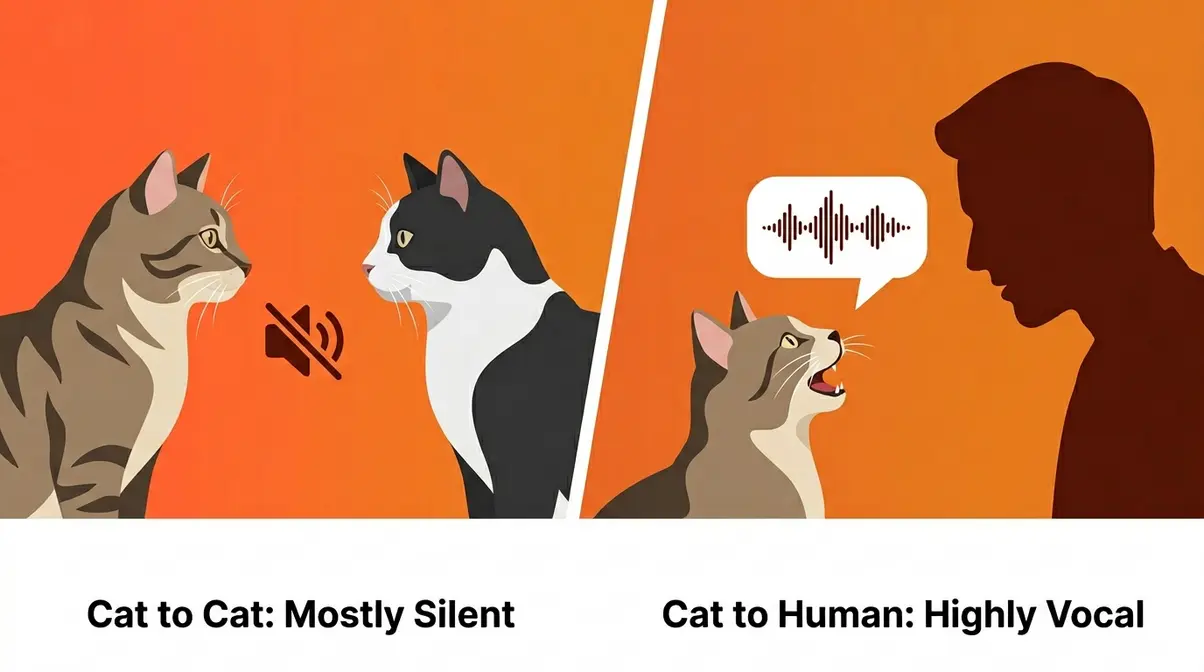
Your cat’s excessive meowing isn’t random noise — it’s a targeted communication strategy that evolved specifically for humans. Understanding this is the first step to decoding what your cat is trying to tell you.
Cats Meow to Communicate — With Humans
Here’s something most people don’t realize: adult cats almost never meow at other cats. Research from the field of animal cognition suggests that cats developed their meow vocabulary largely to communicate with people — not other felines. Kittens meow to their mothers, but as cats grow up, that behavior fades between cats. With humans, however, it continues and expands.
According to the ASPCA’s guidance on cat behavior, cats learn quickly which sounds get a response from their owners. They adapt their vocalizations over time to be more effective at getting what they want — food, attention, access to a room, or help when something is wrong.
This means your cat’s constant meowing and yowling is almost always purposeful. They’re not being dramatic (well, mostly). They’re telling you something specific. The challenge is figuring out what.
The Meow Decoder Framework
Rather than throwing a list of 20 possible causes at you, The Meow Decoder Framework organizes every reason your cat meows excessively into three categories. Start with the one that fits your situation, then follow the path to a solution.
Category 1 — Behavioral: Your cat learned that meowing works. Hunger, boredom, loneliness, and trained habits live here. This is the most common category for cats under 8 years old with no recent health changes.
Category 2 — Hormonal: Your cat is driven by reproductive instincts. Unspayed females in heat and intact males responding to females fall here. The fix is almost always spaying or neutering.
Category 3 — Medical: Something hurts, or something is wrong internally. Pain, hyperthyroidism (an overactive thyroid gland), cognitive dysfunction (feline dementia), kidney disease, and high blood pressure all cause excessive vocalization. This category requires a vet visit.
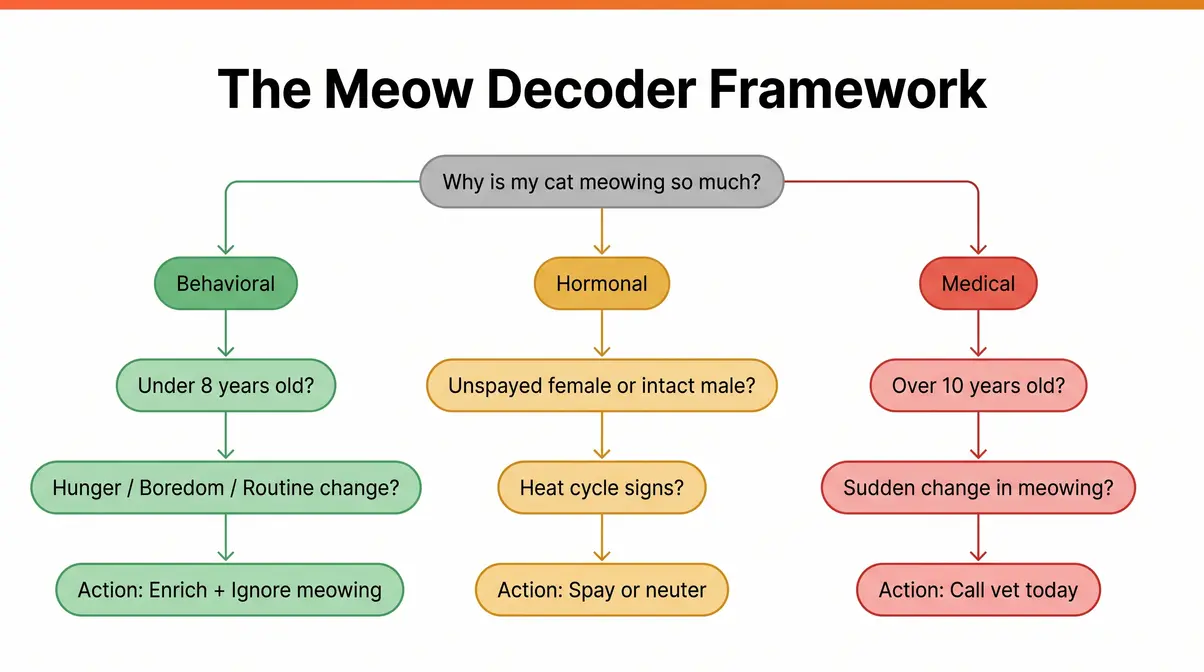
Quick Triage Rule: If your cat is under 8 years old, recently spayed/neutered, and the meowing is new but gradual — start with Behavioral. If your cat is over 10 years old and meowing has changed suddenly — go straight to Medical and call your vet.
Cause 1: Attention, Hunger, and Learned Meowing
Behavioral meowing is the most common reason cats meow non-stop — and the most fixable. But fixing it requires understanding how it started.
Hunger, Boredom, and Loneliness Meows
Cats are smart. If your cat has discovered that meowing at 6 a.m. gets you out of bed to fill the food bowl, congratulations — you’ve trained your cat to wake you up every morning. This isn’t a character flaw in your cat. It’s operant conditioning (a learning process where a behavior is strengthened because it gets a reward).
Common behavioral triggers include:
- Hunger: Meal times that are too far apart, or a cat whose caloric needs aren’t being met
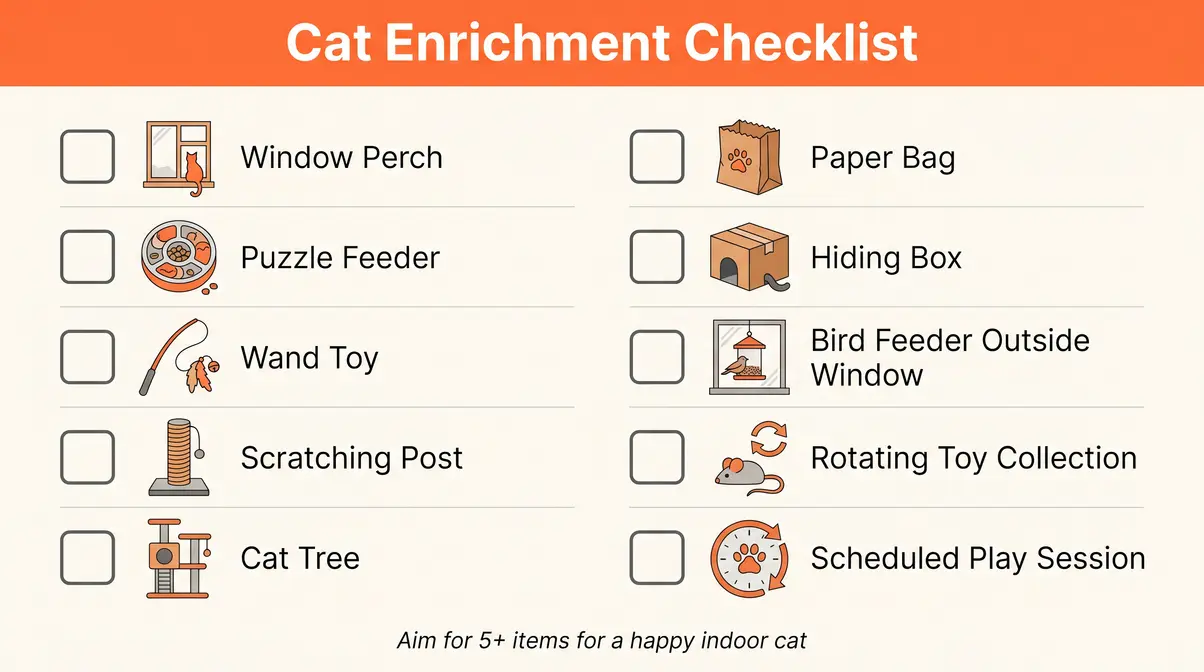
- Boredom: Indoor cats with no environmental enrichment (toys, climbing structures, window access) often meow excessively out of frustration
- Loneliness: Cats left alone for long stretches can develop attention-seeking vocalization — they’re not being needy, they’re genuinely understimulated
- Routine disruption: A change in your schedule, a new work-from-home pattern, or even rearranged furniture can trigger meowing
When Meowing Gets Rewarded
According to PetMD’s behavioral guidance, one of the most common reasons cats meow constantly is that their owners have accidentally taught them it works. Every time you respond to meowing — even to say “stop!” — you reinforce the behavior.
How to break the cycle:
- Identify the trigger. Does the meowing happen before meals? When you sit down to work? When you walk past a closed door? Pin down the pattern first.
- Stop all responses to the meowing. No eye contact, no talking, no moving toward the cat. This is the hardest step and requires consistency from everyone in the household.
- Reward silence. The moment your cat is quiet — even for 10 seconds — calmly give attention or a treat. You’re teaching them that quiet is what gets results.
- Redirect with enrichment. Before the meowing usually starts, engage your cat with a toy or puzzle feeder. Proactive enrichment prevents the behavior from starting.
Be patient. Learned behaviors that took months to develop won’t vanish in three days. Veterinary behavioral consensus suggests that consistent redirection over 2-4 weeks produces the most lasting results.
Cause 2: Why Your Cat Meows at Night and in the Morning
Nighttime and early-morning meowing is one of the most disruptive forms of excessive vocalization — and it has very specific causes and solutions.
Why Cats Go Vocal After Dark
Cats are crepuscular (most active at dawn and dusk), not nocturnal. But their activity peaks can overlap with your sleep hours — especially if they’ve been napping all day. When your home goes quiet and dark, a bored, understimulated cat sees an opportunity.
For cats under 8 years old, nighttime meowing is almost always behavioral. They want company, food, or play. For cats over 10, sudden nighttime yowling is a different story — it’s one of the most recognized signs of feline cognitive dysfunction syndrome (CDS), sometimes called cat dementia. According to the Cornell Feline Health Center, nighttime vocalization is also common in cats with hyperthyroidism or high blood pressure. If your senior cat has recently started yowling at night, this warrants a vet call — don’t wait.
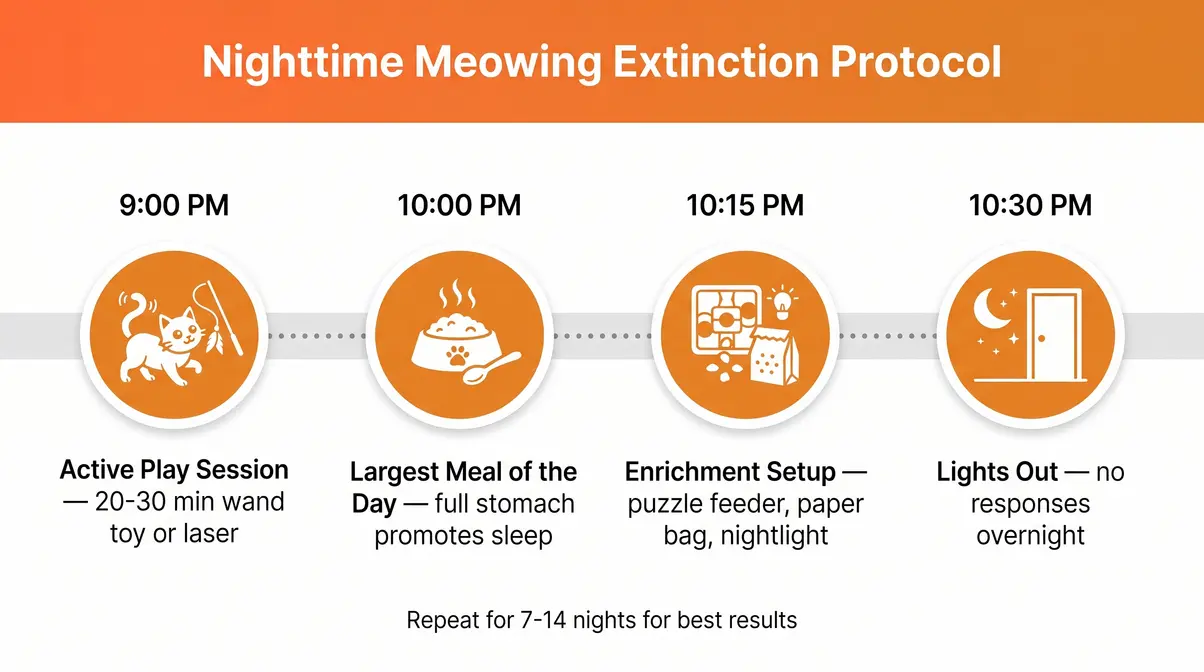
The Nighttime Meowing Extinction Protocol
For behaviorally-driven nighttime meowing in younger cats, veterinary behavioral guidance supports a structured approach. Here’s a 4-step protocol:
Step 1 — Tire them out before bed. Schedule an active play session 30-45 minutes before you sleep. Use a wand toy or laser pointer to simulate hunting. This depletes energy and triggers the natural hunt-eat-groom-sleep cycle.
Step 2 — Feed the largest meal at bedtime. A full stomach promotes sleep. According to the American Association of Feline Practitioners’ Feline Behavior Guidelines (2024), feeding the largest meal prior to bedtime is a clinically recommended strategy for cats that wake owners for food.
Step 3 — Enrich the nighttime environment. Leave a puzzle feeder, a paper bag to explore, or a window cracked (safely) so your cat has stimulation without needing you. A nightlight can also help senior cats with spatial disorientation.
Step 4 — Do not respond. Close your bedroom door if needed. Responding — even once — resets the extinction process. It takes 7-14 nights of consistency for most cats to stop the nighttime calling.
Morning Meowing: The Pre-Breakfast Show
If your cat wakes you before your alarm, you’ve trained them — unintentionally — to do exactly that. The fix is the same extinction approach above, combined with an automatic feeder set for your wake-up time. When the machine feeds them (not you), the meowing redirects away from you as the food source. Most owners see improvement within 1-2 weeks.
Cause 3: When Stress Makes Your Cat Meow More
Stress is a powerful trigger for excessive meowing. Cats are creatures of routine, and disruptions to their environment can produce significant vocal anxiety.
New Home and the 3-3-3 Rule
If you’ve just adopted a cat who won’t stop meowing, take a breath. This is almost always normal — and temporary. Animal welfare organizations including the Humane Society of the Pikes Peak Region use the 3-3-3 Rule to help new owners set realistic expectations for their cat’s adjustment period:
- 3 days: Your cat is overwhelmed and scared. They may hide, refuse food, and meow constantly out of anxiety. Give them a quiet “base camp” room with everything they need — food, water, litter box, and a hiding spot. Don’t force interaction.
- 3 weeks: Your cat starts to learn the routine. Meowing typically decreases as they feel safer. Begin gentle, short play sessions to build trust.
- 3 months: Your cat feels at home. Natural behaviors like purring, kneading, and relaxed stretching emerge. Full bonding is underway.
The 3-3-3 Rule doesn’t mean your cat will meow non-stop for three months. It means full adjustment takes that long. Most newly adopted cats significantly reduce vocalization within the first 2-3 weeks once they feel safe.
Car Trips and Other Stressful Events
Cats also meow excessively during car rides, vet visits, moves, and when new people or animals enter the home. This is anxiety vocalization — they’re telling you they feel unsafe. Strategies that help include:
- Covering the carrier with a blanket to reduce visual stimulation
- Using a pheromone spray (like Feliway) in the carrier 30 minutes before travel
- Keeping your voice calm and low — your cat reads your stress too
- Consulting your vet about short-term anti-anxiety options for cats with severe travel anxiety
Cause 4: Hormonal Meowing — Heat Cycles and Intact Males
If your cat is unspayed or unneutered, hormones may be the entire explanation for their excessive meowing.
Female Cats in Heat (Estrus)
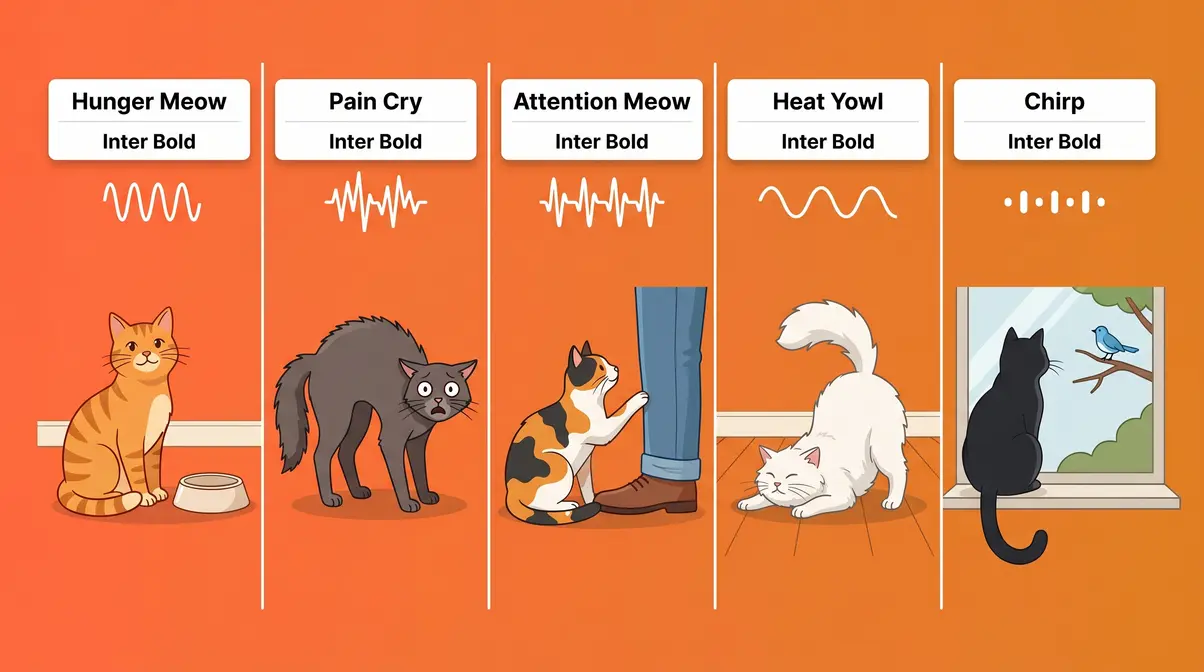
An unspayed female cat in estrus (the heat cycle, when she is reproductively receptive) can be startlingly loud. According to VCA Animal Hospitals, the most notable signs of estrus are behavioral: persistent loud calling, rolling on the floor, raised hindquarters, restlessness, and excessive affection. The vocalizations are often long, drawn-out yowls that sound completely different from a normal meow.
Female cats cycle roughly every 2-3 weeks if they don’t mate, and heat periods can last 3-14 days each. That’s a lot of yowling. The only permanent solution is spaying. Until then, keeping her indoors and away from intact males reduces the intensity of the behavior.
Intact Males
Male cats who aren’t neutered (called “toms”) also meow and yowl excessively — especially when they can smell or hear a female in heat nearby. This behavior, combined with urine spraying and roaming attempts, is a strong signal that neutering is overdue.
The solution for hormonal meowing is straightforward: Spay or neuter your cat. This eliminates the hormonal drive and typically resolves the excessive vocalization within a few weeks of recovery.
Cause 5: Pain and Illness — When to Worry
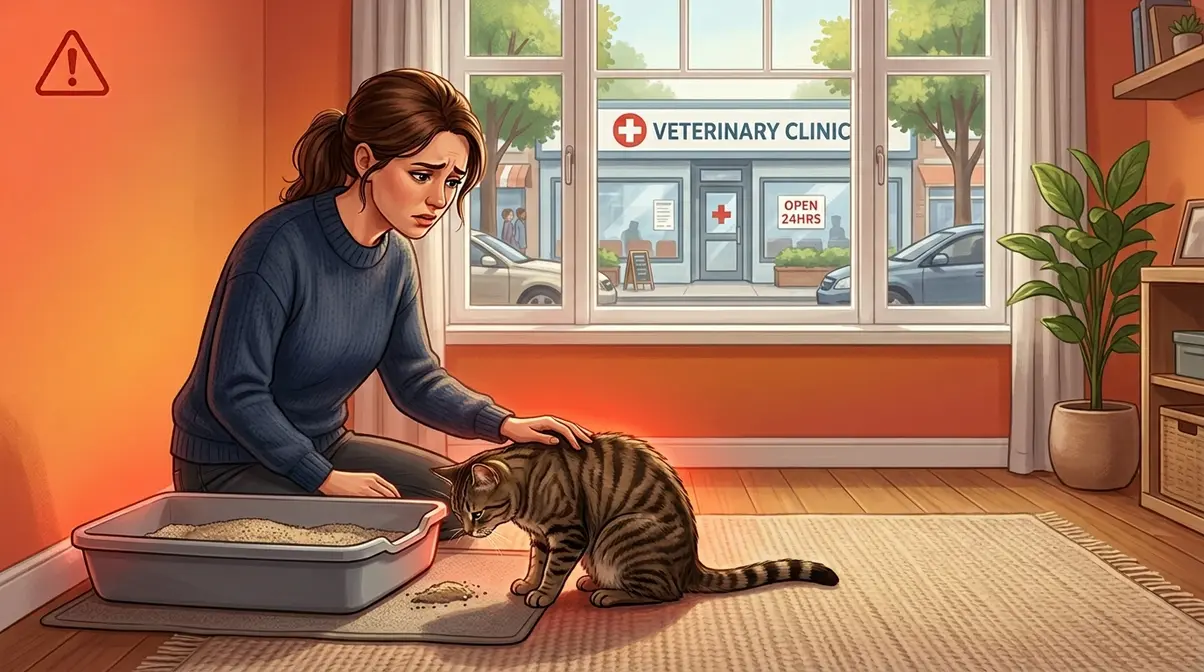
This is where The Meow Decoder Framework shifts from green to red. Medical causes of excessive meowing require veterinary attention — not home remedies.
⚠️ What to Watch For: If your cat’s meowing is sudden, high-pitched, happens near the litter box, or is accompanied by any physical symptoms listed below, treat it as urgent. Don’t wait to “see if it improves.”
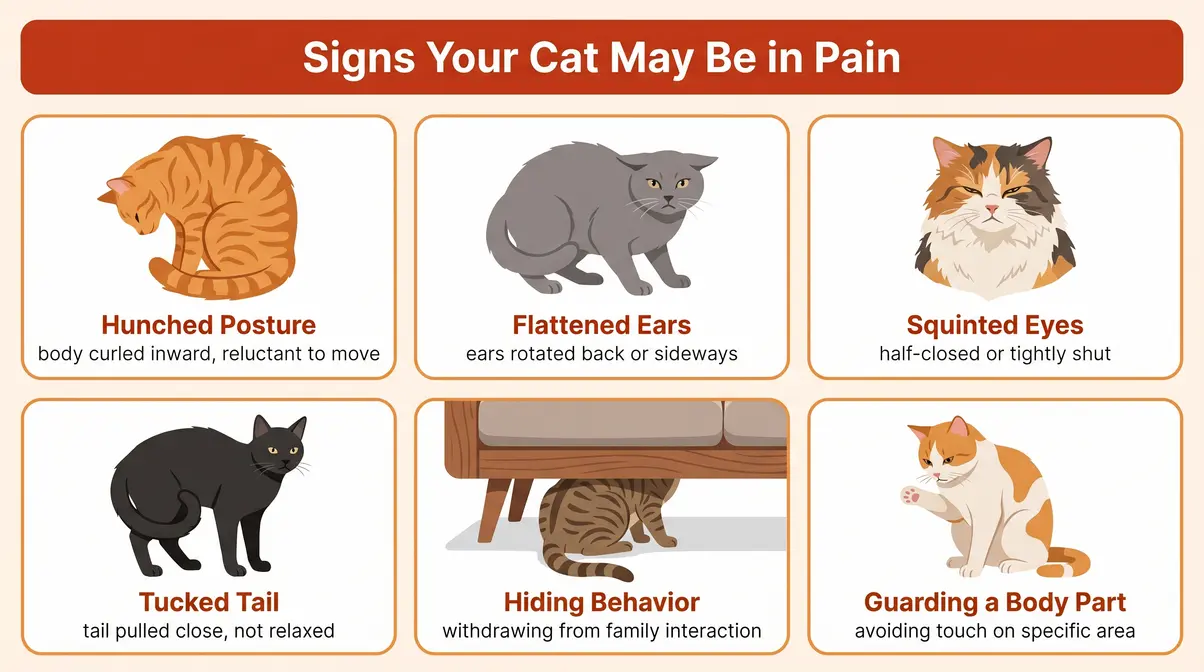
Signs the Meowing Is Pain-Related
Cats are instinctively wired to hide pain — it’s a survival behavior. When a cat meows or cries out from pain, the discomfort is often significant. Common pain-related causes of excessive vocalization include:
- Urinary blockage: A cat crying in or near the litter box and unable to urinate is a life-threatening emergency. Call your vet or an emergency animal hospital immediately.
- Dental disease: Fractured teeth, gum infections, and tooth resorption (a common feline condition) cause chronic pain that can increase vocalization, especially around eating.
- Arthritis: Older cats with joint pain may cry when jumping, being picked up, or moving around. This is often underdiagnosed because owners mistake it for “just getting old.”
- Internal pain: Gastrointestinal issues, bladder inflammation, or any internal discomfort can cause a cat to meow more than usual.
Cause 6: Hyperthyroidism — The Senior Cat Alarm
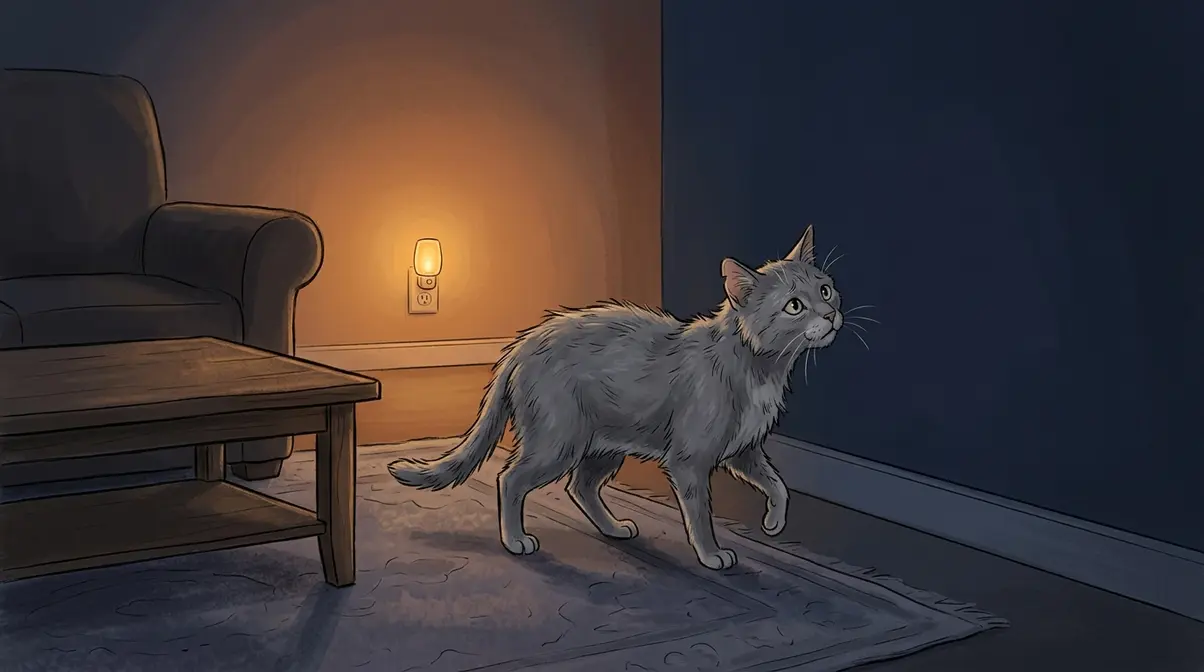
Hyperthyroidism (an overactive thyroid gland that produces too much thyroid hormone) is one of the most common medical causes of excessive meowing in cats over 10 years old. According to the Cornell Feline Health Center, it is the most common endocrine (hormonal gland) disease in senior cats — affecting approximately 10% of cats over age 10.
The thyroid hormone essentially puts the body into overdrive. A hyperthyroid cat may seem restless, hyperactive, and unable to settle — and they vocalize constantly as a result. Other signs include:
- Weight loss despite a ravenous appetite
- Increased thirst and urination
- Vomiting or diarrhea
- A rough, unkempt coat
- Racing heart rate
The good news: hyperthyroidism is very treatable. Options include daily medication, a prescription iodine-restricted diet, radioactive iodine therapy (I-131), or surgery. A simple blood test at your vet can confirm or rule it out. If your senior cat meows non-stop and has lost weight, this test should happen this week.
Veterinarians recommend: Any cat over 10 years old with a sudden increase in vocalization should have thyroid levels (Total T4) checked at their next vet visit — or sooner if other symptoms are present.
Cause 7: Feline Cognitive Dysfunction — When Senior Cats Get Confused
Feline Cognitive Dysfunction Syndrome (CDS) is the cat equivalent of Alzheimer’s disease in humans. It causes progressive changes in brain function that affect memory, awareness, and behavior. According to research published in peer-reviewed veterinary literature (PMC, 2024), CDS affects approximately 28% of cats aged 11-14, and the prevalence increases significantly with age — with some studies suggesting over 50% of cats aged 15 and older show signs.
The hallmark sign is nighttime yowling — a cat who seems lost, confused, or distressed in the dark. Other signs include:
- Staring blankly at walls or into space
- Getting “stuck” in corners or behind furniture
- Changes in sleep patterns (sleeping all day, awake and vocal all night)
- Forgetting where the litter box is
- Reduced interaction with family members
⚠️ Prerequisites/What to Watch For: CDS is a diagnosis of exclusion — meaning your vet will first rule out hyperthyroidism, high blood pressure, pain, and other medical conditions before confirming it. Don’t attempt to diagnose this at home.
According to the ASPCA’s guidance on older cat behavior problems, CDS can cause deterioration in sleep patterns, disorientation, and reduced activity — all of which contribute to nighttime vocalization. While there is no cure, management strategies include:
- Keeping the environment consistent (don’t rearrange furniture)
- Nightlights to reduce disorientation after dark
- Omega-3 fatty acid supplementation (discuss dosing with your vet)
- Prescription medications that may slow cognitive decline
- Increased gentle daytime interaction to reinforce the sleep-wake cycle
If your senior cat is meowing constantly at night and seems confused or disoriented, please consult your veterinarian. Early intervention gives your cat the best quality of life.
When to Call the Vet: Emergency vs. Wait-and-See
Knowing when to act is the most important skill in this entire guide. The Meow Decoder Framework ends here: with a clear triage decision.
Call your vet today (or go to an emergency clinic) if your cat:
- Is crying near the litter box and unable to urinate (especially male cats — this is a life-threatening emergency)
- Is meowing in a high-pitched, unusual cry that sounds like pain
- Has stopped eating or drinking for more than 24 hours
- Is hiding and unresponsive to interaction alongside increased meowing
- Is a senior cat (10+) with sudden onset nighttime yowling
- Shows any physical symptoms: vomiting, diarrhea, weight loss, labored breathing, or disorientation
Monitor for 1-2 weeks if your cat:
- Is newly adopted and meowing from anxiety (apply the 3-3-3 Rule)
- Has a known pattern of attention-seeking meowing that responds to redirection
- Meows at specific times (feeding, play) with no other symptoms
- Is an unspayed female showing heat cycle behavior
Veterinary consensus indicates: When in doubt, call. A brief phone consultation with your vet’s office can help you decide whether to come in urgently or monitor at home.
Limitations and Common Mistakes
Common Pitfalls to Avoid
Pitfall 1 — Punishing the meowing. Spraying water, making loud noises, or scolding your cat for meowing can increase anxiety and make the behavior worse. It also damages trust. Redirection and ignoring are always more effective than punishment.
Pitfall 2 — Assuming it’s behavioral when it might be medical. This is the most dangerous mistake. If your cat’s meowing is new, sudden, or has changed in character (pitch, frequency, time of day), don’t assume it’s attention-seeking. Rule out medical causes first — especially in cats over 8 years old.
Pitfall 3 — Inconsistent responses. If three people in your household respond differently to the meowing — one ignores it, one gives food, one gives pets — your cat learns that persistence pays off. Consistency across all household members is essential for behavioral modification.
Pitfall 4 — Skipping the vet because the cat “seems fine otherwise.” Cats are exceptional at masking illness. A cat with hyperthyroidism or early-stage CDS may seem energetic and normal in every other way — except for the constant meowing. The meowing is the symptom.
When to Choose a Different Approach
If you’ve tried the behavioral strategies in this guide for 4 weeks with no improvement, that’s clinically meaningful information. It suggests either an underlying medical cause you haven’t identified, or a behavioral issue complex enough to need professional support.
Consider these alternatives:
- Veterinary behaviorist: A specialist (DACVB — Diplomate of the American College of Veterinary Behaviorists) can assess and treat complex behavioral issues, including anxiety-driven vocalization
- Certified cat behavior consultant: For non-medical behavioral cases, a certified consultant can observe your cat’s specific patterns and create a custom modification plan
- Medication: For cats with anxiety-driven vocalization that doesn’t respond to environmental changes, short- or long-term anti-anxiety medication prescribed by your vet can be genuinely life-changing
When to Seek Expert Help
If your cat’s meowing is accompanied by any of the emergency signs listed above, do not wait for a regular appointment. Call your vet or an emergency animal clinic immediately. For behavioral issues that persist despite 4 weeks of consistent intervention, consult a veterinary behaviorist rather than continuing to troubleshoot alone.
Frequently Asked Questions
Why is my cat being so vocal all of a sudden?
Sudden increases in vocalization almost always signal a change — either in your cat’s environment or their health. In cats under 8, a sudden shift in routine, a new pet or person in the home, or a change in your schedule are the most common triggers. In cats over 8-10 years, sudden vocal changes are a red flag for medical causes: hyperthyroidism, high blood pressure, pain, or cognitive dysfunction. According to the Cornell Feline Health Center, nighttime vocalizing is particularly common in hyperthyroid and hypertensive senior cats. If the change is sudden and your cat is a senior, call your vet this week rather than waiting.
How do I get my cat to stop meowing so much?
The most effective approach depends entirely on the cause — which is why The Meow Decoder Framework starts with triage, not treatment. For behavioral meowing, stop rewarding it (no eye contact, no food, no attention when they meow), then consistently reward silence. For nighttime meowing, use the 4-step Nighttime Meowing Extinction Protocol: active play before bed, largest meal at bedtime, nighttime enrichment, and zero response overnight. For hormonal meowing, spay or neuter. For medical meowing — see your vet. Punishment (spraying water, scolding) makes the problem worse in nearly every case.
When should I be worried about my cat meowing?
Seek veterinary attention immediately if your cat is crying near the litter box and can’t urinate, if the meowing sounds high-pitched and painful, if it’s accompanied by hiding, vomiting, weight loss, or disorientation, or if your senior cat has suddenly started yowling at night. These are not behavioral quirks — they are symptoms. For all other cases, monitor for 1-2 weeks while applying appropriate behavioral strategies. If there’s no improvement, consult your vet regardless of whether other symptoms are present.
Why is my cat walking around meowing so much?
A cat pacing and meowing is often expressing one of three things: anxiety (a new environment, a stressor, or separation distress), a hormonal drive (heat cycle in unspayed females, or response to a female in an intact male), or a medical issue causing disorientation or discomfort. In senior cats, pacing combined with meowing is a classic sign of feline cognitive dysfunction — the cat is confused about where they are. According to the ASPCA, CDS can cause cats to wander and vocalize, particularly at night. If your cat seems lost or confused while pacing, consult your vet promptly.
What are four signs your cat is suffering?
Four key signs that your cat may be in pain or distress are: (1) Changes in vocalization — meowing more than usual, especially in a higher pitch or unusual tone; (2) Postural changes — hunching, reluctance to move, or guarding a specific body part; (3) Behavioral withdrawal — hiding, reduced interaction, or aggression when touched in a specific area; (4) Changes in basic functions — reduced appetite, altered litter box habits, or changes in grooming. Cats instinctively hide pain, so these signs often appear only when discomfort is significant. If you notice two or more of these together, contact your veterinarian.
What is the 3-3-3 rule for cats?
The 3-3-3 Rule is a guideline for newly adopted cats that breaks the adjustment period into three phases. In the first 3 days, your cat is overwhelmed — they may hide, refuse food, and meow constantly out of anxiety. Give them a quiet “base camp” room and don’t force interaction. In the first 3 weeks, they begin to learn the routine and meowing typically decreases as they feel safer. In the first 3 months, they feel fully at home — natural bonding behaviors like purring and kneading emerge. The 3-3-3 Rule is endorsed by multiple humane societies, including the Humane Society of the Pikes Peak Region, as a tool for setting realistic expectations during cat adoption.
How do I say “hi” in cat language?
The slow blink is the closest thing to a cat “hello.” When a cat makes eye contact with you and slowly closes and reopens their eyes, it’s a signal of trust and relaxed affection — often called the “cat kiss.” You can return it: look at your cat softly (not a hard stare, which reads as threatening), then slowly close your eyes and reopen them. Many cats will slow-blink back. You can also try a gentle nose-touch (extend your finger at their nose level and let them sniff and bump it) — this mimics the greeting cats use with each other. These small signals build trust and can actually reduce anxiety-driven meowing over time.
The Bottom Line: Decode, Then Act
Your cat’s constant meowing is communication — urgent, persistent, and aimed directly at you. The goal of The Meow Decoder Framework is to replace overwhelm with clarity: Is this Behavioral, Hormonal, or Medical?
Most excessive meowing in cats under 8 years old is behavioral and fully fixable with consistent redirection, enrichment, and the Nighttime Meowing Extinction Protocol. Research consistently shows that cats who receive adequate play, structured feeding schedules, and environmental enrichment vocalize significantly less — not because they’re suppressed, but because their needs are genuinely met.
For senior cats (10+), the calculus shifts. Nighttime yowling, sudden vocal changes, and meowing combined with confusion or weight loss are symptoms — not habits. Feline cognitive dysfunction affects an estimated 28% of cats aged 11-14 (PMC, 2024), and hyperthyroidism affects roughly 10% of cats over 10 (Cornell Feline Health Center). Both are diagnosable and manageable with veterinary support.
Start with triage. Apply the framework. And if you’re ever unsure whether your cat’s meowing is an emergency — call your vet. That phone call costs nothing and could make all the difference.